Lost One Earring: What to Do, Where to Look and How to Repurpose It
The Friday evening moment everyone recognises
You open your jewellery box on a Friday evening, reaching for your favourite pair. One earring is there. The other is not. You check the other compartments, pull open the bedside drawer, turn over the lid of the box. Nothing. Your mind runs backwards through the week: you definitely wore them on Wednesday. Office, coffee on the way, the Tube at rush hour, home. Somewhere along that route, one earring slipped away.
Anyone who wears earrings regularly has been here. One of the pair disappears sooner or later. Sometimes it is a department-store purchase, easily replaced. Sometimes it is the pair your grandmother passed down, or the ones you wore at your wedding. Either way, losing one feels disproportionately upsetting for something so small.
The good news is that earrings turn up more often than you would expect. This guide covers where to search first, how to search methodically, what to do with a single earring if the hunt comes to nothing, the folklore around losing an earring, and how British insurance works for jewellery that is genuinely gone for good.
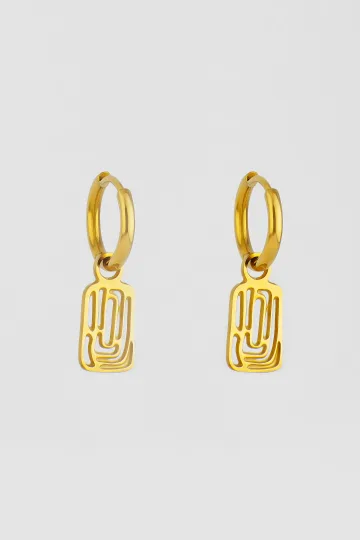
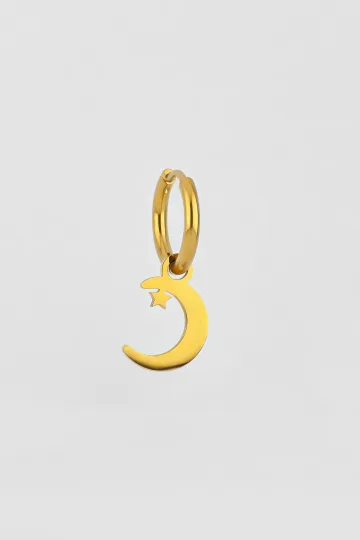
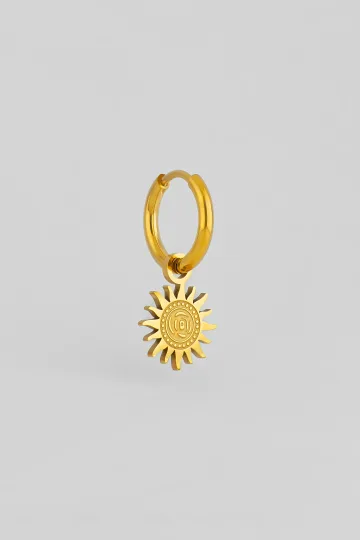
Wear the symbol, don't just read about it. These are in stock:






Why earrings go missing in the first place
Before you start searching, it helps to understand the handful of situations that account for most earring losses. This narrows the search before you begin.
Pulling clothing over the head. This is the single most common cause. A hook or butterfly back catches the fabric of a collar, turtleneck or hoodie as it passes the ear. The earring is out before you notice. The garment carries it to the floor, into a sleeve cuff, or straight into the hood. If you were removing a jumper or jacket around the time the earring went missing, start with the clothing and the floor directly beneath where you were standing.
Sleeping in earrings. Many people sleep in small studs and forget they are wearing them. Through the night a post can work free of its backing, snag on a pillowcase seam or travel into the duvet. Some sleepers find earrings days later when they change the sheets.
Water and slippery lobes. Shampoo, swimming pool water and sea water all make skin slippery. An earring that fits perfectly in dry conditions can slide free during a shower or immediately after. Beach losses are particularly hard to recover; the earring disappears into sand within seconds of impact.
The car. Putting on or removing a seatbelt, shrugging off a jacket, or adjusting a sun visor while driving creates a small amount of contact with the ear. The gap between the seat and the centre console is the great collector of small objects.
Active environments. Gyms, concerts, festivals and sports grounds all combine movement, contact with other people or equipment, and high ambient noise that masks the sound of an earring hitting the floor. Most gyms keep a lost property box at reception; it is worth checking the day after a session, not a week later.
Lost one earring? Spare me the funeral. A solo in one lobe has out-dressed the matched pair for seasons now.
What to do with the leftover earring
A single earring lands on my worktable more often than any matched pair. Someone brings in the survivor of a favourite duo and waits for a verdict. There is none. Below I answer the questions I hear most.
Can I just wear the one earring on its own? Yes, and it is the first thing I recommend. One earring in one lobe, the other ear bare, has read as expensive rather than absent-minded for years now. I suggest tucking your hair behind the ear that holds it so the piece looks like a decision. A single expressive earring works best: a stone stud, a short drop, or a mid-size hoop.
And if I want the pair back, can I wear it with a different earring? You can, and a deliberate mismatch is very much in favour right now. I suggest keeping one shared thread: the same metal, a similar size, or a common motif. Then two different earrings read as intent rather than error. A gold stud on the left and a gold drop on the right look composed even when the shapes disagree.
Is it worth turning the single earring into a pendant? Often it is the best move, and I recommend it when the earring matters as a keepsake. A stone stud or a short drop becomes a pendant easily: a jeweller removes the ear fitting and adds a small loop for a chain. I choose this route when wearing it solo holds no appeal and parting with it even less.
Or is it simpler to buy a fresh pair? If the earring is high-street with no real story behind it, I suggest not chasing a twin and taking a new pair instead. Do not bin the survivor: let it become a pendant or a charm on a bag. That way you keep the new set and the old piece still earns its place.
When should I keep hunting for the second, and when should I let go? I advise hunting when the earring is handmade, inherited, or rare: there it is worth both a jeweller for a copy and the resale listings. I recommend letting go when the piece is plain and easily replaced. Grieving over something interchangeable is wasted energy; better to replay it as a solo, a mismatch, or a pendant. Losing half a pair is not the end, it is a reason to build something new.

Turn on your camera, pick earrings, a pendant or a ring, and see the piece on yourself in real time.
Switch items in one tap.
Everything runs in your browser: no photo or video is ever uploaded.
The first hour: an order of operations
Most earrings that are never found were lost in a recoverable place and then lost again by a disorganised search. People wander, look in the same three spots four times, lift the same cushion repeatedly, and give up. What follows is the order that actually works. Do it in sequence and do not improvise.
Step one, stop moving. Freeze where you are. Every step you take from this point can push a small metal object further under furniture or embed it in a carpet pile. If you are standing on a rug or carpet, step off it carefully rather than shuffling.
Step two, check the ear and the immediate body. Touch the other lobe first to confirm which one is gone, then run a hand round your collar, inside the hood if you are wearing one, and along the shoulders. A surprising number of earrings never reach the floor at all; they sit in a hood, a cuff, a bra strap or the fold of a scarf. Shake out any garment you are still wearing before you take another step.
Step three, establish the last confirmed sighting. Not the last time you think you had it, the last time you know: a mirror, a photograph on your phone, a moment somebody commented on it. Photographs are the most reliable evidence here, and most people have taken one within the last few hours without thinking about it. Everything between that timestamp and now is your search area; everything before it is not.
Step four, list the transitions. Earrings come off during changes of state, not while sitting still. Write down, in order, every time you pulled something over your head, got in or out of a vehicle, put on or removed a coat, hugged somebody, washed your hands, or lay down. Those moments are your candidate locations, ranked by how much fabric was involved.
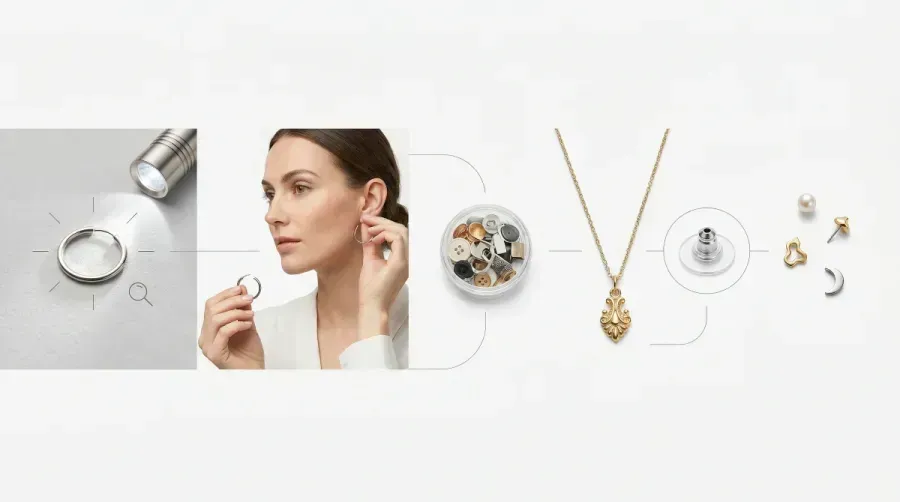
Step five, search the highest probability location first, properly. One location, completely, before moving on. Turn the main light off and use a phone torch held almost flat to the floor: a stud that is invisible under a ceiling light throws an obvious spark at a low angle. Work in overlapping strips like mowing a lawn.
Step six, secure the area against a second loss. Before anyone hoovers, tell them. Before the bed is stripped, check it. Before the dog comes back in, shut the door. More earrings are lost permanently at this stage than at the moment they fell.
Step seven, phone outward. If the loss happened away from home, start ringing places while your memory of the sequence is fresh. Cafés, taxi firms, the gym reception, the office cleaner. Ask for the manager or the person on the till rather than whoever answers, and leave a description with a number: metal, stone, size, and whether it has a distinctive back.
Step eight, set a limit. Give the active search a defined period, a day, a weekend, and then stop. Earrings that are going to turn up in the house usually turn up within a fortnight, on their own, when the bed is stripped or a coat is worn again. Continuing to search past that point costs you an evening a week and finds nothing.
Where to search first
Roughly seven in ten lost earrings are found in one of the following places. Work through them in order.
Your bag
Inside pockets. An earring removed on the go often drops straight into the open bag. Check every internal pocket, even the ones you rarely use.
The lining. If the lining has a small tear, fine objects disappear into the padding. Press the lining with your fingers all the way around. If you feel something, it may be worth carefully opening the seam.
The base of the bag. Empty everything onto a table. Tilt the bag and shine a torch into the corners.
Clothing
The collar. An earring with a hook can catch on the collar fabric and travel with the garment. Check the inside of the collar carefully, especially on roll-necks and structured shirts.
The hood. If you wore a hoodie or anorak, the earring may have dropped straight in. Turn the hood inside out.
The cuff. Buttoned or folded cuffs trap small objects reliably.
Between layers. If you wore a shirt under a jumper, check the space between them when you take them off.
Inside shoes. It sounds unlikely, but a dropped earring can land upright inside a boot or court shoe and go unnoticed for hours.
Your hair
Long hair, particularly braided or tied up, is a surprisingly common hiding place. The clasp can snag a strand as you remove the earring. Comb through with a wide-tooth comb first, then again with a fine-tooth comb.
Bedding
Many people sleep in small stud earrings. If you do, start here.
- Shake each pillow out of its case.
- Run your hand between the pillowcase and the pillow itself.
- Check the duvet cover inside, along the seams.
- Run your hands across the fitted sheet and around the headboard area.
- Check under the mattress edge.
Floor and carpet
An earring on the floor usually rolls or bounces and comes to rest under furniture. Looking at floor level with a torch angled almost parallel to the surface is far more effective than looking from standing height. Metal catches the light immediately at that angle.
Pay particular attention to:
- Under the bed
- Under the chest of drawers
- At the edge of rugs and under their fringe
- In the gap between skirting board and floor
The car
- Between the seat and the centre console
- Under the seat (use the torch)
- In the door pocket
- In the cupholder
- In the footwell mat
The bathroom
If you remove your earrings before washing your face or showering:
- The shelf or window ledge above the basin
- The floor directly below the shelf
- The pocket of your dressing gown
- The basin itself (earrings rarely go down the drain, but they settle in the curve of the plug hole)
Customer reviews
Zevira is a real jewellery shop. Genuine payments, deliveries and customer thank-yous.
🥰🥰🥰 gracias

Ok, ¡gracias! 🙂

Search techniques
These methods meaningfully increase your chances.
The low-angle torch
Turn on the torch on your phone and hold it almost parallel to the floor, pointing across the surface. Any metallic object will catch the beam and produce a bright reflection. This is how people find needles, pins and tiny stud earrings on carpet or hard floors.
The stocking trick
If you have already searched the carpet visually with no result, stretch a fine stocking or pop-sock over the nozzle of your vacuum cleaner and run it slowly over the area. Small metal objects cling to the nylon rather than disappearing into the dust bag. Check the stocking every metre or so.
Using a magnet
Silver, gold and bronze do not attract magnets. Steel, nickel and some fashion alloys do. If you have any reason to think the earring contains steel, a strong magnet on a piece of string dragged slowly across the floor can pull it out from under furniture or between floorboards where it would not catch the torch light.
Retracing your steps methodically
Sit down with a piece of paper. Write down every location you visited from the last moment you are certain the earring was in place to the moment you noticed it was gone. Then ring each place. Many cafes, taxi firms and offices in London and other cities keep a found-property box behind the counter. Transport for London runs a Lost Property Office at Baker Street where items found on the Underground, Overground, Elizabeth line, buses and river services are held for up to three months. It is worth a call or an online enquiry if you lost the earring during a commute.
Return to the scene
Go back physically to the last place you are confident both earrings were present. Stand in roughly the position you were in and look at the floor and nearby surfaces. This sounds theatrical, but the physical memory of the moment often directs your eyes to the right spot.
The thirty-minute window
If you have only just noticed the earring is missing, move quickly. The earring has not yet been hoovered up, trampled, or carried away on someone's shoe. Divide the space into zones and work through each one before moving to the next. Floor first, clothing second, bag third. Do not skip around.
How to find a lost earring at home
Start where the odds are highest rather than where you last remember it. Roughly seven in ten indoor losses turn up in four places: the bed and its linen, the floor within a couple of metres of where you undressed, the bag you carried, and the clothing you pulled over your head. Work them in that order. Kill the ceiling light and sweep a phone torch low across the floor, almost flat to the surface, so any metal throws a spark of reflection. If a rug swallowed it, stretch a nylon stocking over the vacuum nozzle and hoover slowly: the earring sticks to the mesh instead of vanishing into the bag.
How to find a lost earring outside the house
Outdoors the trick is speed and retracing, not luck. Within the first half hour, write down every place you stood since the earring was definitely on: the café table, the taxi, the office, the gym. Phone each one, because staff pocket dropped jewellery and set it aside far more often than people expect, and ask the till or manager rather than a passing waiter. On dry sand above the tide line you can sift by hand from the exact spot you sat; below the waterline the sea has usually taken it. In a car, lift the mats out and shake them, then run a hand down the seat gap where small things always slide.
How long can you leave earrings out before the hole closes
If you have lost one and the ear is now bare, the piercing rarely shuts overnight. A lobe held open for a year or more usually stays passable for days or weeks without a stud, and often longer; the older the piercing, the more forgiving it is. Cartilage and fresh piercings close much faster, sometimes within hours in the first months, so keep something in those. When you find the earring or fit a replacement, expect the first reinsertion to need a little patience and a gentle angle; if it resists, a smaller gauge or a taper helps rather than forcing it.
Upload a photo of your pet, someone you love, or an object. We'll build a 3D model and hand-cast it in pewter.




Repurposing the survivor: nine practical options
If the second earring is genuinely gone, the remaining one has more futures than most people realise. Below are the nine routes jewellers are asked for most often, with a note on what each one actually involves at the bench and what it tends to cost you in effort rather than in money.
Convert it into a pendant
The most common conversion and usually the cheapest. A jeweller removes the post or hook, files the join flush and solders on a small jump ring or a bail. For a stud with a stone this takes half an hour of bench time and the result looks purpose made. For a long drop earring it is even simpler, because the drop already hangs correctly and only the ear wire needs replacing with a bail.
Two things affect the outcome. First, the direction the piece faces: a stud designed to sit flat against a lobe may hang slightly forward on a chain, so the bail needs to be positioned to compensate. Second, weight. Anything under about five grams sits comfortably on a fine chain; heavier drops want a chain of at least one millimetre or they will kink.
Turn it into a brooch
Suited to larger, flatter earrings with a decorative front, particularly vintage clip-ons. A brooch pin and catch are soldered to the reverse, which requires the back to be flat enough to take them and the piece to be sturdy enough not to deform. The result works on a coat lapel, a scarf, or a hat, and it forgives a scale that would be overwhelming on an ear.
A caution: soldering applies heat, and heat is the enemy of set stones and of anything glued. Any stone that cannot take a torch has to be removed and reset, which changes the job from a small one into a proper commission.
Make it a charm for a bracelet
A single jump ring, and the earring joins a charm bracelet. This is the lowest intervention option of all: no soldering, no heat, and it can be reversed. It suits small studs and short drops, and it works especially well when the earring already carries a memory, since a charm bracelet is a collection of exactly those.
Hang it on a bag or a set of keys
The least reverent option and, honestly, one of the best. A sturdy earring on a lobster clasp becomes a bag charm. It is visible daily, it gets used, and it stops the piece from spending the next decade at the back of a drawer feeling like evidence of a failure. Choose this for costume pieces rather than for anything delicate, since a bag charm takes real punishment.
Set it into a hair accessory
A decorative earring front can be glued or wired onto a hair slide, a comb, or a covered band. This is one of the few conversions genuinely worth doing at home if you are practical, using a two part epoxy rather than a hot glue gun. It works best with flat, wide pieces and with clip-ons, and it gives a plain slide something worth looking at.
Keep it as a charm in the car or by a mirror
A quieter option that people rarely think of and often prefer once suggested. A single earring on a short ribbon, hung from a rear view mirror or a dressing table mirror, becomes a small daily object rather than a jewellery item. This is what people tend to do with an earring inherited from someone who has died, when wearing it feels wrong but putting it away feels worse.
Absorb it into another piece
The most creative route: the stone or the decorative element is removed and reset into something else entirely. A single stud stone becomes the centre of a ring. Two mismatched survivors from different pairs become one pendant. A drop is shortened and set into an existing bracelet. This is proper goldsmithing rather than a quick fix, and it needs a jeweller who does bespoke work rather than repairs, but it produces the only genuinely new object on this list.
Commission a duplicate with the original in hand
Worth considering when the earring is valuable, inherited, or simply irreplaceable to you. A jeweller with the surviving earring on the bench can copy it, either by hand or by scanning and casting it. Hand copying gets close but never identical; casting from the original produces a near exact twin, though the cast piece usually comes out fractionally smaller because metal shrinks as it cools, which is invisible on the ear but visible if you place them side by side.
Be realistic about when this makes sense. The work costs the same whether the original was fine jewellery or costume, so it is proportionate for a gold heirloom and disproportionate for a high street stud.
Save it as a seasonal or occasional piece
Finally, the option that requires nothing at all: keep the single earring and wear it deliberately, once in a while, on one ear. Party season, a birthday, a particular anniversary. Some pieces are better as an occasional statement than as an everyday habit, and a lone dramatic earring worn twice a year holds its impact far better than the same piece worn weekly.
Earring backs and closures: what actually holds them in
Understanding how different earring closures work explains why some earrings stay put and others do not, and it points directly to the simplest prevention measures.
Butterfly backs (push backs). The most common closure on mass-market studs. A thin post passes through the piercing and a small hinged piece clips onto the back. Over time the hinge loses tension and grips less firmly. This is the closure that accounts for the majority of stud losses. Replacement butterfly backs cost almost nothing and are sold in packs of twenty or more.
Screw backs. The post has a threaded section and the backing screws onto it. To remove the earring you have to rotate the backing deliberately several times. They do not come loose through normal movement. Most jewellers can retrofit a screw back to any earring with a standard post for roughly the price of a cinema ticket. If you own earrings you consider genuinely valuable, this is the most reliable single upgrade.
Silicone backs. Transparent discs that fit over any post. They grip with friction rather than the hinge mechanism of a butterfly. A pack costs almost nothing. The main drawback is that they are easy to lose themselves; keep a supply in a small pot in the jewellery box.
Lever backs. Found on drop and dangle earrings. A hinged lever closes over the wire to lock it in place. Considerably more secure than an open hook or French wire. If you regularly lose drop earrings with open hooks, having a jeweller replace the hooks with lever backs is a worthwhile investment.
Continuous hoops. The wire forms a complete circle through the piercing with no separate closure. They cannot fall open. The main limitation is that putting them in requires threading the wire through the piercing, which takes a moment. For occasions involving a lot of movement, hoops and ear cuffs are the practical choice.
Latch backs. A small notch on the wire slots into a catch on the backing. Common on moderately priced drop earrings. More secure than an open hook, less secure than a lever back.
Knowing your earrings' closures tells you immediately where the vulnerability is. A ten-year-old butterfly back with a loose hinge is a loss waiting to happen. A screw back on the same earring is not.







The folklore of losing an earring
Earring loss has accumulated folklore across many cultures, which is perhaps unsurprising given that earrings have been worn continuously since ancient Egypt, Mesopotamia and pre-Columbian America. The folklore falls into a few recurring patterns, and it is worth knowing them even if you regard them as nothing more than historical curiosity.
Tears and grief. In several Eastern European and Russian folk traditions, losing an earring is interpreted as a forewarning of tears or sorrow. The specifics vary by region; some traditions locate the prediction specifically in losing the left earring versus the right. These beliefs appear to have roots in the broader category of omens associated with losing jewellery generally, probably because jewellery was historically expensive enough that its loss genuinely preceded hardship.
Good luck in reversal. In some Mediterranean folk traditions, losing an earring and finding it again is considered good luck, on the principle that something feared lost returned is a symbol of recovery. The loss itself, in this reading, is not the omen; the finding is.
Gifts to the sea. Across coastal cultures in southern Europe and the Caribbean, jewellery lost in the sea was sometimes interpreted as a gift accepted by the water. In the fishing communities of the Spanish Atlantic coast, this was a benign reading: the sea had taken something and would return something else in time. Whether this applied specifically to earrings or to jewellery generally varies by community.
Broken symmetry as warning. In West African and diaspora traditions, sudden asymmetry in the body, including losing one earring, could indicate that something was out of balance in the wearer's life or relationships. The interpretation was less ominous than the European variants, more diagnostic: something requires attention.
None of these traditions, taken on their own terms, require that losing an earring actually causes anything. They are readings of an event, not explanations of a mechanism. In modern terms, an earring falls out because a butterfly back has lost its tension or a hook has caught on fabric. The coincidence between that physical event and whatever follows in life is coincidence. The folklore endures because humans find patterns in sequences of events; it does not endure because the patterns are real.
What losing an earring means in superstition
The superstition most people ask about frames a lost earring as an omen of tears or of something slipping out of your life, an old reading tied to the days when jewellery was costly enough that losing it really did signal hardship. A gentler strand treats the loss as a small release, a sign to let go of something you were gripping too tightly. Neither describes what physically happened: the earring dropped because a butterfly back lost its tension or a hook snagged on a collar. Treat the meaning as a prompt to pause and notice your week, then do the practical thing and fit a screw back so the next loss is a repair rather than a sign.
Losing your right or left earring: different meanings
Folk readings sometimes split the two sides. The right earring is often linked to work and outward affairs, the left to feelings and relationships, on the old idea that the left side of the body sits closer to the heart. Other regions reverse the pairing entirely, and that contradiction is the clearest sign you are looking at a cultural pattern rather than a law. The useful takeaway ignores fate. If you keep losing the earring from the same ear, the cause is habit: that is the ear you press a phone against, the side you pull a jumper over, or the side you sleep on. Put the sturdier closure, ideally a screw back, on the problem ear.
CAPAORA mini knife pendant
The 18th-century Spanish navaja in miniature: 40 mm of stainless steel, a real folding mechanism and a Palanquilla lock that clicks. An affordable gift to remember.
Authentic · Ships from Spain · 14-day returns
How to make a pair again
If the missing earring was from a mass-produced collection, your options are wider than you might think.
Check whether the design is still available
Search the original retailer's website. Many high-street and jewellery brand lines remain in production for several years. If the retailer no longer stocks them, look on resale platforms and second-hand sections: older collections appear regularly.
Commission a copy from a jeweller
If the earring was handmade or vintage, a skilled jeweller can often produce a matching piece from the original as a reference. This is not always straightforward for very intricate designs, but it is possible more often than people assume. Cost and turnaround vary considerably: for a simple stud, a few days; for a complex drop earring, a few weeks.
Buy a new pair and keep the survivor
Sometimes the most practical decision is to purchase a new pair and keep the remaining original as a memento or convert it into a pendant. There is no rule that says you must reconstruct the old pair.
Can you buy just one earring rather than a whole pair
Yes, and it is a more common request than the shops let on. Start with the original brand: many keep single studs and hoops as spare stock or replacement parts, even when the pair has sold through, so their customer service line is the first call. If the line is discontinued, photograph the survivor on white paper in daylight and use the image to hunt visual matches on resale platforms. For handmade or antique pieces, a jeweller can make a second from the one you hold. Keep three outcomes in mind: the original single turns up, a jeweller copies it, or you buy a fresh pair and repurpose the survivor as a pendant.
How to prevent future losses
Silicone earring backs
Transparent silicone discs that fit over the post behind the ear are available in bags of twenty or more for very little. They grip far more securely than the standard butterfly back that comes with most earrings and do not require any modification to the earring itself. Worth keeping a small supply in your jewellery box.
Replace the butterfly back with a screw back
For earrings you consider valuable, a goldsmith can replace the standard push-fit butterfly back with a threaded screw back that has to be deliberately unscrewed to remove. The conversion costs roughly the equivalent of a cinema ticket. A screw back will not come loose during the day.
Choose hoops for active occasions
Continuous-hoop earrings, where the wire forms a closed ring through the piercing, are substantially harder to lose than drop or stud earrings. For concerts, outdoor events, or any occasion that involves a lot of movement, hoops are the practical choice, as are ear cuffs that grip the cartilage without a piercing and stay put through dancing or sport.
Remove them before sleep
If you are prone to losing earrings in bed, keep a small dish or ring tray on the bedside table and make removing earrings before sleep a fixed part of your evening routine. The same spot, every night.
Remove them before washing hair
Shampoo makes the earlobe slippery. An earring that fits well in normal conditions can slide free while you wash. Making a habit of removing earrings before getting into the shower has saved many pairs.
Periodic check during the day
A light touch of the earlobe a few times during the day tells you immediately whether both earrings are still in place. If one goes missing during the morning commute, you know before the day is over, and you can retrace your steps while the route is still fresh in your mind.
Store earrings in pairs, not loose
A jewellery box with individual compartments for each pair, or a small earring stand, prevents pairs from becoming separated in storage. A single shared compartment is where pairs start to drift apart.
Check closures regularly
Closures wear out. A butterfly back that grips loosely is a loss waiting to happen. Every few months, hold each earring by the decorative part and tug the post gently. If the backing slides off with minimal resistance, replace it. Replacement backs for standard posts cost almost nothing and take ten seconds to fit.
Jewellery insurance
For earrings of significant value, it is worth understanding what your household contents policy actually covers. Many standard home insurance policies include jewellery up to a specified limit per item; for pieces above that limit, a named-item extension or a specialist jewellery policy is available. Keep a photograph and, where possible, a valuation document or purchase receipt. If an earring is lost outside the home, check whether your policy covers accidental loss away from the property, as not all do.
Leave your email, we'll send your discount code. No spam, unsubscribe anytime.
The code arrives by email, valid on your first order.
Insuring jewellery: what a policy actually covers
Insurance is the part of this subject people find out about at the worst possible moment, which is the day after. It is worth ten minutes now.
Single article limit. Almost every standard contents policy in the UK covers jewellery, but with two ceilings: an overall limit for valuables as a category, and a single article limit, typically in the low thousands, applied to each individual item. Anything worth more than the single article limit is only covered if it has been specified by name on the policy. People routinely assume their contents insurance covers an engagement ring or an inherited pair of earrings and discover at the claim stage that it did not.
Away from home cover. This is the clause that matters most for earrings, because earrings are almost always lost outside the house. Personal possessions cover, sometimes called all risks, is usually an optional add on rather than part of the standard policy, and without it a loss in a restaurant, a taxi or a park is simply not covered. Check for it specifically. Some policies also distinguish between loss within the UK and loss abroad, with a lower limit or a shorter number of days for the latter.
Loss versus theft. Read this distinction carefully. A number of policies cover theft and damage but exclude simple loss, and an earring falling out of a lobe is loss. If the wording says accidental loss, you are covered; if it says accidental damage only, you are not.
Pairs and sets clause. The clause nobody knows about until it bites. Many policies state that where an item forms part of a pair or a set, the insurer will pay only the value of the individual item lost, not the value of the pair, and will not treat the remaining half as a total loss. In practice a single lost earring may attract a settlement of considerably less than half the value of the pair, because the survivor is deemed to retain value on its own. A minority of specialist jewellery policies include a proper pairs and sets provision that pays for the full pair and takes the survivor in return. If you own earrings you would be devastated to break up, look for that wording.
Valuations and evidence. Insurers generally want a valuation for specified items, refreshed every three to five years since gold prices move. Failing that, the original receipt, a clear photograph on a plain background, and any certificate that came with a stone. Photograph earrings individually rather than as a pair, and include something for scale. Store the photographs somewhere that is not the phone you carry.
Excess and no claims. Finally, do the arithmetic before claiming. If the policy excess is substantial and the claim will push the premium up for five years, a modest earring may be cheaper to replace than to claim for. Insurance is for the pieces that would genuinely hurt, not for everything in the box.
Lost property: earrings lost in public places
If the earring went missing outside the house, there is a formal system, and it works better than most people expect. What defeats it is delay, not indifference.
Transport. Transport for London runs a central lost property office that receives items from the Underground, buses, trams and licensed taxis, and it handles hundreds of thousands of items a year, jewellery among them. Items take a few days to reach the central office from the station or garage where they were handed in, so reporting on the day and checking again after a week is the right pattern. National Rail operators each run their own lost property, station by station, and there is a charge to reclaim. If you were in a black cab, the driver is legally required to hand in property left in the vehicle; a private hire vehicle booked through an app has its own in app lost property process, usually the fastest of the lot.
Venues. Theatres, cinemas, museums, galleries, gyms and clubs almost all keep a lost property box behind the front desk. Small metal objects found by cleaning staff go into it as a matter of routine. Ring rather than email, ask for the duty manager, and describe the piece specifically. Most venues hold items for a limited period, often a month, before disposing of them or passing them to charity.
Hotels and restaurants. Hotels keep found property for a set period and log it, so a call to the housekeeping team is worth making even weeks later. In restaurants, the crucial question is when the floor was last swept and by whom, because an earring under a table goes into a dustpan rather than into a box unless somebody happened to look.
Public spaces and the law. A found item of value in England and Wales belongs to the finder against everybody except the true owner, which is why handing in matters and why the police no longer accept most found property. If you lost something in a park or a street, the realistic options are a note in the local social media group and a check with any nearby shop or café.
Describe it properly. Whatever you report to, give three things: metal and colour, the stone or shape, and one distinguishing feature such as a screw back, an engraving, or a repair. Lost property staff match on description, and "a gold earring" matches nothing.
The psychology of losing something small
Losing one earring tends to feel more upsetting than the monetary value warrants. This is not irrational.
Earrings sit close to the face. They are part of the image other people see every day. Colleagues, friends, strangers register them. They are a small but consistent element of how you present yourself. Losing one half of a pair removes something that was quietly part of your daily identity.
When the earring was a gift, the loss carries extra weight. The piece held a memory of a person, a place, an occasion. Losing it feels like a small erasure. The same applies to earrings associated with a specific moment: a first significant purchase, a trip, an anniversary. The earring was not just metal. It was a marker.
None of this requires an apology or excessive self-criticism. Earrings are small objects fastened loosely to soft tissue by a thin wire or post. They are designed to come off easily for comfort and safety, which also means they come off unintentionally. Everyone who wears earrings loses one at some point.
And occasionally, months or a year later, you find it. In the pocket of a coat you had not worn since last winter. Under the chest of drawers after moving furniture. In the lining of a handbag. That moment tends to be a genuine, small pleasure.
When a lost earring turns up months later
It happens more often than the despair of the first week suggests. Earrings surface when the sofa is moved, when the winter coat comes out in October, when a suitcase is unpacked for the next holiday, when the car is valeted, when a rug is finally taken up. Jewellers hear the same sentence constantly: it was in the lining of the bag all along.
The most common hiding places for a delayed find, in rough order: the lining of a bag reached through a hole in an inner pocket, the turn up of a coat sleeve, the seam of a duvet cover, the space between a mattress and the bed frame, under the rubber seal of a washing machine door, and inside a shoe. The washing machine is worth a particular look, since an earring in a pocket goes through the cycle, survives it, and sits in the filter trap at the bottom of the machine, which is accessible and which almost nobody checks.
There is an awkwardness to the delayed find that people are rarely prepared for. If you have already replaced the pair, or converted the survivor into a pendant, the returning earring arrives as a slight reproach. Do not undo the pendant. A returned earring can go back to being an earring, or the two can now be worn as a deliberate mismatch with the pendant on the same chain, and the fact that the pair spent a year apart becomes the interesting thing about them rather than the sad thing.
Check the returned piece before wearing it. A post that has been trodden on may be bent, and straightening it repeatedly will snap it. A stone that has spent months in a damp coat pocket may have loosened in its setting, and the tiny movement you can feel with a fingernail is the warning sign. Anything that went through a wash cycle should have its closure checked, since heat and detergent are hard on friction backs. A jeweller will check and tighten a returned earring for very little, and it is a better outcome than losing it a second time on the day you get it back.
Send a friend a discount code, they save on their first order.
Wearing a single earring on purpose
Worth stating clearly, because it changes the whole problem: one earring is a legitimate way to wear jewellery, and has been for a very long time.
Historically the single earring was a male form as often as a female one. Sailors in the age of sail wore one gold hoop, and the folklore, repeated in a dozen ports, held that the gold would pay for a burial if the body washed ashore. Renaissance courtiers wore a single pearl drop, and there are portraits of considerable men from the sixteenth century wearing exactly one. In parts of the Indian subcontinent and among various pastoral peoples of East Africa, asymmetric ear ornament carries specific meaning about age, marriage or status rather than about carelessness.
Practically, one earring works when it looks decided rather than accidental. Three things sell the decision. Scale: a single earring should be a bit larger or a bit more emphatic than the pair version would have been, because it has to carry the whole look alone. Hair: tuck the hair behind the ear that holds the earring and leave the other side down, which frames the piece and hides the bare lobe. Repetition elsewhere: pick up the same metal in a ring, a bracelet or a watch, so the eye reads a scheme rather than an omission.
It also solves a practical problem for people who cannot wear two. Anyone who sleeps on one side and finds a stud digs in, anyone with a single healed piercing after an infection in the other lobe, anyone using a hearing aid on one side, or wearing a headset for work: for all of them a single earring is the useful format rather than a compromise. Losing half a pair simply moves you into a category that already exists.
Asymmetric earrings as a style choice
For the past several years, wearing two different earrings has moved from a recognisable accident to a deliberate aesthetic. This shift has particular relevance if you are sitting with one earring and no clear plan for it.
The London and New York jewellery scenes have both contributed to this. Independent designers began releasing pairs that were intentionally mismatched: one earring long, the other short; one set with a stone, the other plain; one gold, one silver. The logic was that the visual contrast created more interest than two identical pieces. The trend has since spread well beyond independent designers.
If you have one earring left, your options include:
Pairing it with something visually contrasting. A small gold stud in one ear, a longer silver drop in the other. The contrast reads as intentional if the two pieces share at least one quality: similar metal tone, or a common design element. People with several ear piercings at different positions get the most freedom here, since each piercing can carry its own piece without the eye expecting symmetry.
Pairing it with something in the same family but not identical. Two pearl earrings where the pearls are different shapes. Two blue earrings where the shades differ. The visual connection is there; the exact match is not.
Pairing it on the same thematic ground. Both florals, but different flowers. Both geometric, but different shapes.
Wearing a single earring deliberately. One ear bare, one earring present. This is the most minimal version of the asymmetric approach. It works especially well with a statement piece that does not need a counterpart to be legible.
In a professional context, a restaurant, a meeting, an evening out, this reads clearly as a choice rather than an oversight. That was not the case five years ago.
Frequently asked questions
Is it acceptable to wear just one earring?
Yes. A single earring on one ear has a long history, and in contemporary style it is unremarkable. It reads as either a deliberate aesthetic choice or part of an asymmetric pairing, neither of which requires explanation.
What are the superstitions around losing an earring?
Various folk traditions attach meaning to losing jewellery. In Eastern European tradition, losing an earring is sometimes read as a warning of tears; in some Mediterranean traditions, finding a lost earring is considered lucky. These beliefs reflect how much earrings historically cost relative to income, not any underlying mechanism. In practical terms, earrings are lost because the backing fails, the hook catches on fabric, or a clasp wears out.
Can I buy just one earring rather than a pair?
Increasingly, yes. A number of jewellers and designers now sell single earrings explicitly, either for people with one piercing, or for customers who want to pair a new piece with an existing one. It is worth asking directly.
How do I match a new earring to the one I still have?
Bring the original with you to the shop or workshop. A good jeweller or sales assistant can suggest options by eye. If shopping online, photograph the original against a white background in natural light and use that image to search for visually compatible pieces.
What is the difference between a screw back and a butterfly back?
A butterfly back clips onto the post using a hinged mechanism that can loosen over time. A screw back has a threaded post and a backing that you rotate to tighten; it cannot come loose by itself. Screw backs are substantially more secure. A jeweller can replace butterfly backs with screw backs on most standard earrings.
Should I insure my earrings?
For everyday pieces, the cost of a specialist policy rarely makes sense. For earrings of real value, particularly heirlooms or pieces set with significant stones, a named-item addition to your home contents policy or a dedicated jewellery policy is worth the annual premium. Keep a photograph and any valuation you have.
What do I do with a single earring that belonged to a relative?
This is a different category from an everyday loss. Options worth considering: have it converted into a pendant so it becomes part of your daily wear; keep it stored carefully as a family keepsake; or, if it contains a significant stone, have a jeweller incorporate the stone into a new piece designed for wearing. There is no single correct answer.
Can I sell a single earring?
Difficult. Earrings have most of their value as pairs. The exception is a piece containing a significant stone, which can be extracted and sold or reset separately. A single earring listed as suitable for conversion to a pendant or brooch occasionally finds a buyer on resale platforms, but without any expectation of achieving pair value.
Why do earrings go missing more often than rings?
A ring grips the finger circumferentially. An earring rests in a piercing held by a thin wire or post and a small backing. The backing can loosen gradually without the wearer noticing, and because earrings sit at the side of the head rather than in the line of vision, the absence often goes undetected for hours. By the time you notice, the earring could be anywhere along the day's route.
Can I convert a stud into a pendant myself?
In principle, yes. Craft suppliers sell small jump rings and split rings. Using jewellery pliers, you can open a jump ring, thread it through the decorative part of the stud, and attach it to a chain. For earrings in precious metal or with set stones, it is better to take the piece to a jeweller to avoid accidentally stressing the setting or the metal.
If a lost earring turns up a year later, is it still wearable?
Almost certainly. Wipe the metal with a soft cloth. If it is silver and has tarnished, a paste of bicarbonate of soda and water applied with a soft toothbrush will restore the surface. If it is gold, a warm mild soap and water rinse followed by drying with a clean cloth is sufficient. Check the clasp or hook for any distortion and have a jeweller straighten it if needed.
What should I do immediately after noticing one is missing?
Stop moving and think back to the last moment you were certain both earrings were in place. Then retrace the route physically, starting with the floor and clothing, before expanding to bags and furniture. The first thirty minutes after noticing a loss give you the best chance: the earring has not yet been hoovered, walked on, or moved by someone else.
Buying it as a gift? Each one arrives ready to give.
 A branded Zevira box and a little card come with every order.














Letting go: how to close the loss
At some point the search stops being a search and becomes a habit, and it is worth recognising the moment. If a fortnight has passed, the bed has been stripped, the coat pockets emptied, the car mats lifted and the phone calls made, the earring is either somewhere it will reappear from on its own or it is gone. Continuing to hunt does not increase the odds; it just keeps the loss open.
Closing it properly helps more than people expect, and it takes about ten minutes. Photograph the surviving earring, front and back, on a plain surface. Write down where the pair came from and when, even one line, especially if it was a gift or an inheritance, because that is the information that disappears within a generation and no photograph preserves it. Then decide what the survivor is going to be: pendant, charm, single earring, or kept as it is. Making that decision is the actual end of the episode. Leaving the earring in a drawer undecided is what keeps it aching.
It is also worth being honest about what the grief is made of. Very little of it is about the money. The sharpness comes from three other things: the sense of having been careless with something entrusted to you, the fact that the pair was a complete object and is now broken, and, when the piece came from somebody, the feeling that you have mislaid a bit of that person. All three are real and none of them is proportionate to a small metal object, which is exactly why the feeling is confusing.
If the earrings belonged to someone who has died, the loss lands harder and deserves more patience. The useful reframe is that the surviving earring is now the whole of the inheritance rather than half of a broken one, and that wearing it, on one ear or on a chain, does more for the memory than keeping both in a box would have done. Objects that are used stay in the family; objects that are stored get cleared out by somebody who does not know what they were.
And a last practical note. Fix the thing that caused it. Change the backs, move the storage, take them off before the jumper, whichever applies. Turning a loss into one small change is the difference between an accident and a pattern, and it is the closest thing to consolation this subject offers.
Conclusion
Losing one earring is a small but genuine grief, particularly when the piece was meaningful. This guide will not make the loss sting less. What it can do is give you a systematic way to search before you give up, and a set of real options for what to do with the earring that remains.
Earrings break, get lost and go out of fashion. But a single surviving earring is not a dead object. It can become a pendant, a brooch, a bracelet charm, the starting point for an asymmetric pair, or a small piece of family history worn differently. That is not a consolation prize. It is just a different story for the same piece.
Silver, gold, rings, symbolic pieces and curated pairs.
About Zevira
Zevira makes jewellery in the artisan tradition of Albacete, Spain. Earring loss is something we think about in the design process: screw backs on higher-value models, secure silicone-assisted fittings for everyday pieces. We also take commissions to create a single matching earring when you have one remaining, and to convert a solitary piece into a pendant or brooch.
What you can find in the catalogue:
- Earrings with screw backs for pieces you wear regularly
- Silicone backing sets included with everyday earrings
- Single-earring commissions to match an existing piece
- Conversion of a single earring to pendant or brooch
- Asymmetric collections designed as intentional pairs
Every piece can be personalised with engraving, with the option of personal engraving. We work in sterling silver 925 and gold 14-18K.