The Shield in Jewellery: Symbol of Protection, Heraldry and History
Introduction: why this symbol never goes out of style
A friend of mine, a retired military surgeon, has worn a small silver shield pendant his entire adult life. I once asked him why. He looked at me as if the answer were obvious: "I spent my whole career covering for others. Now let something cover for me."
That sentence contains the entire symbolism of the shield. A shield is not a weapon of attack. It is a weapon of defence. It does not increase your strength; it reduces your vulnerability. And when a shield silhouette appears in a piece of jewellery, it says much the same thing across every culture: I am protected, I protect, I stand under a covering.
In a world where actual armour has long been relegated to museum display cases, the shield remains one of the most universal symbols in wearable form. Fathers wear it on their chest as a reminder of their role as protector. Families embroider it on their coats of arms. Soldiers, police officers, and firefighters tattoo it into their skin.
Wear the symbol, don't just read about it. These are in stock:




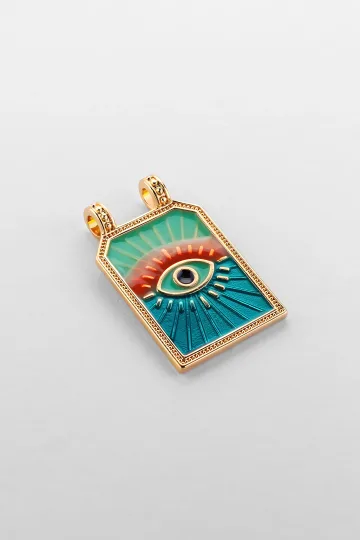
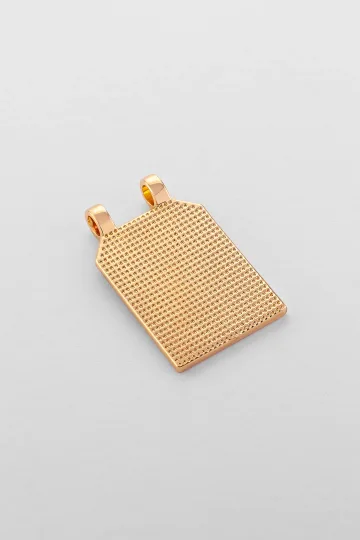
Shield jewellery: what to choose
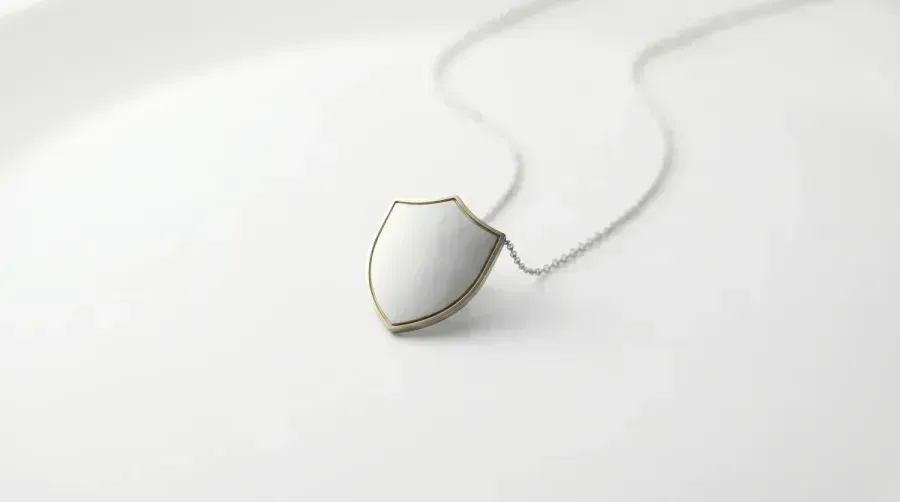
Shield pendant
The most versatile form.
- Small silver shield, 2-3 cm on a chain: for everyday wear. Budget segment.
- Medium pendant, 4-5 cm with a coat of arms or symbol: an accent with specific meaning. Mid-range segment.
- Large pendant, 6-8 cm: for Gothic or military aesthetics. Mid-to-premium segment.
- Shield pendant with enamel: heraldic colours (red cross, blue fields, green bands). Mid-to-premium segment.
- Shield pendant with a cross: the Christian defender. Universal religious choice.
Shield signet ring
The classic masculine form.
- Silver signet with a coat of arms: ideal gift for a father, grandfather, or husband. Mid-range segment.
- Gold signet with a monogram: premium, for a special occasion.
- Shield signet without a coat of arms: a universal masculine accessory.
Signets were once used to seal letters in wax, a function that persisted well into the nineteenth century.
Shield earrings
A less common form, more often seen in men's alternative fashion.
- Small shield studs: paired, minimalist.
- Drop earrings with a heraldic element: for a specific aesthetic.
Shield bracelet
- Bracelets made from shield segments: popular in Scandinavian themes. A nod to chainmail and armour.
- Single shield as a chain pendant: for daily wear.
- Multiple small shields: layered, conceptual.
Shield brooch
A vintage option. Particularly suited to blazers, military-dress uniform, and ceremonial attire. The Victorian tradition of a brooch bearing the family arms still survives in British and Irish families, worn at formal occasions as a quiet mark of lineage.
Cufflinks with a shield
A pair of small shields at the cuffs, often engraved with a coat of arms or initials. A discreet piece with a precise statement, the kind of accessory that has accompanied formal male dress since the courts of early modern Europe.
Tie pin
A narrow metal pin topped with a shield. Minimal in size, deliberate in meaning.
A family crest belongs in gold. In silver it looks like borrowed honour, sorry.
What to wear a shield with
Over years on shoots and in the fitting room the shield has passed through dozens of looks with me, from a sharp suit to a leather jacket. Here is what actually works, sorted by occasion.
What do I wear a shield with every day? For daily wear I recommend a small silver or steel shield on a thin chain over a white tee, a linen shirt or a denim jacket. A leather jacket and a shield are almost an automatic pair: rough leather and metal reinforce each other. An open top button or a shallow neckline gives the pendant room to read instead of sinking into folds.
Is a shield right for the office? Yes, as long as you keep it minimal. I suggest one solid accent: a small shield under a shirt, a signet ring with a crest on the little finger, or shield cufflinks under a suit. Navy, graphite or burgundy fabric gives a noble backdrop to silver, and even more to gold. Three pieces at once are too many here, I choose one.
How do I build an evening look? For evening I choose a gold signet or a larger pendant on a plain dark knit, a roll-neck or a silk blouse. Black, emerald or wine fabric makes the metal ring out. If you want colour, I go for an enamelled shield or one with small stones, it echoes the earrings and pulls the look together.
Shield pendant or signet ring, which to choose? I recommend a pendant for anyone who wants the symbol on show and the length adjusted to the neckline. I suggest a signet when there is a real crest or initials behind the shield: it reads quietly, lives on the hand and sits confidently in a business look. In tone a signet sounds older and weightier, a pendant looser and younger.
How do I layer a shield? Layered, a shield pairs well with a cross or a smaller medallion on chains of different lengths, and a protective set builds itself. One rule: I never mix more than two metals in a stack, and I keep at least five centimetres between lengths so the pendants do not argue. One strong shield on a clean chain always beats five symbols overlapping.

Turn on your camera, pick earrings, a pendant or a ring, and see the piece on yourself in real time.
Switch items in one tap.
Everything runs in your browser: no photo or video is ever uploaded.
Types of shield in jewellery
When a shop describes something as a "shield pendant", it may refer to quite different shapes. Knowing the distinctions is useful because each form carries its own associations.
Heater shield (heraldic)
Flat top, pointed bottom, a charge in the centre: lion, eagle, cross, star, initials. The most classic form. Associated with chivalry, family honour, and Western European tradition. Well suited to family jewellery, gifts, and tokens of belonging.
Round shield
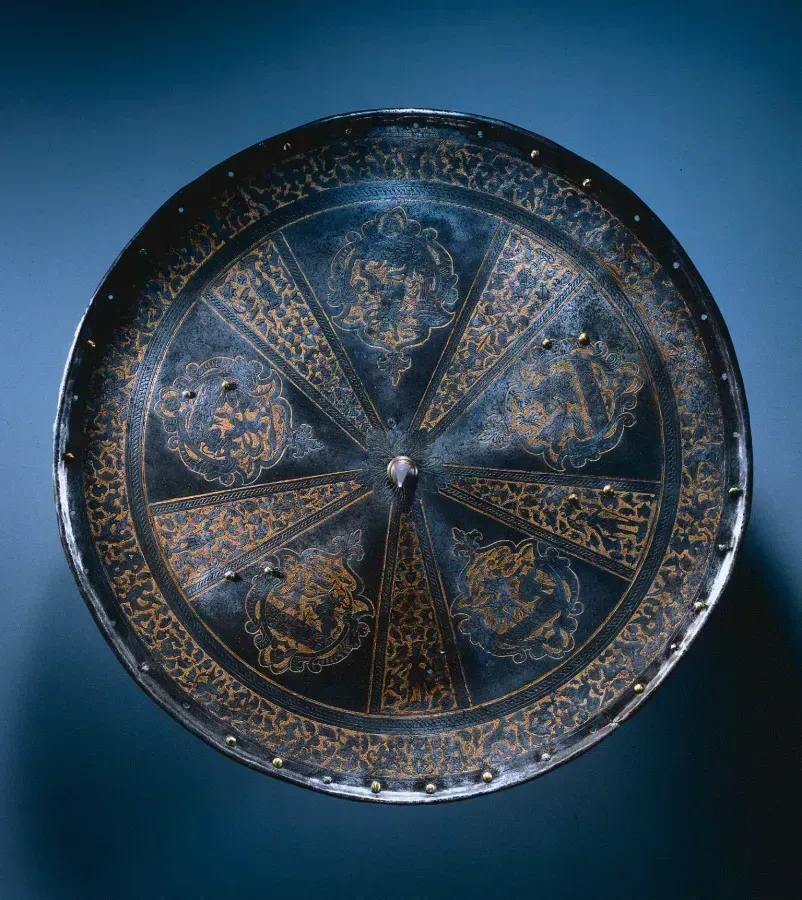
Associated with Vikings and Greek hoplites. Often decorated with runic or geometric patterns. Popular in Scandinavian, Norse, and Celtic themes.
Norman kite shield
A narrow, slightly curved form. Seen less often, but striking. Associated with the period around 1066 and the Norman conquest of England.
Almond-shaped shield
Similar to the Norman type but with a longer lower section. Appears in iconography related to the Crusades and the Iberian Reconquista.
Buckler
A small round shield used in close combat. A rare form in jewellery, but found in collections dedicated to the age of rapiers and fencing, sixteenth-century Spain in particular.
Pavise
A large rectangular shield behind which crossbowmen sheltered while reloading. Widely used in Italian city-states of the fourteenth and fifteenth centuries. Rare in jewellery, but appears in historically themed collections.
Scottish targe
A round leather shield with a spike in the centre. Popular in Scottish-themed jewellery, often combined with Celtic and Jacobite motifs.
Adarga
A Moorish leather shield used in Spain and Portugal from the thirteenth to the fifteenth century, oval or heart-shaped in outline. An element of the Reconquista that survived in Spanish military iconography and, later, in the heraldry of colonial Latin America.
Historical shields: the great prototypes
History has left a handful of shields that crossed the line from weapon to civilisational symbol.
The hoplon and aspis
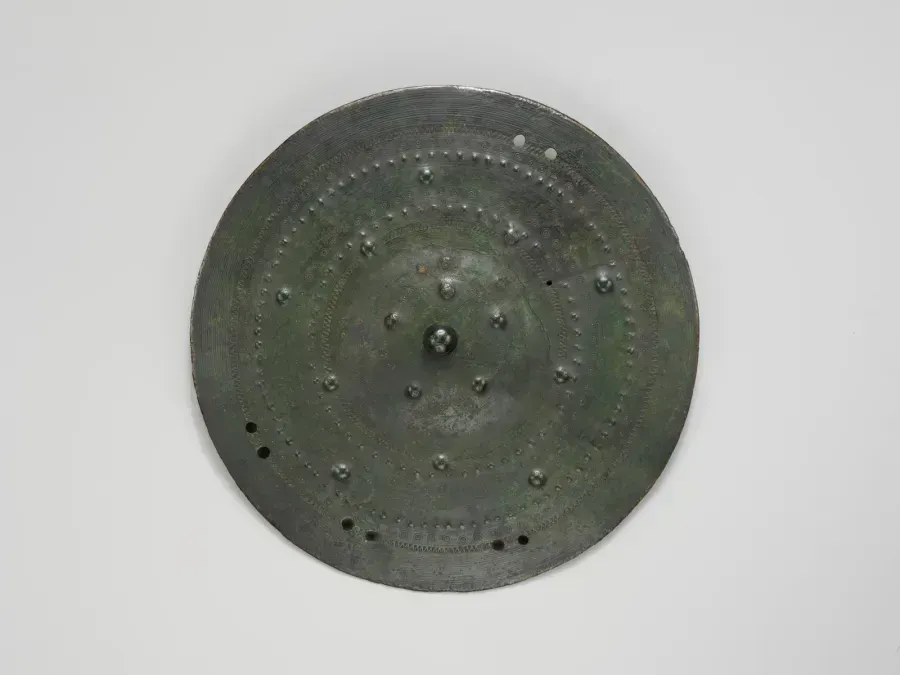
The Greek hoplon, often called the aspis, was circular, roughly ninety centimetres across, with a wooden core and a bronze facing. It was so heavy (around seven kilograms) that you did not run with it; you stood. The Spartan line at Thermopylae held precisely because each man's right side covered the neighbour to his left.
The scutum
The Roman scutum was rectangular, slightly curved, and weighed over ten kilograms. Legionaries used it not just as cover but as a wall: several rows of scuta locked together to form the testudo, impenetrable to arrows. On the scutum stood the thunderbolt of Jupiter, the legion's eagle, and the cohort number. This is the direct ancestor of the heraldic shield.
The Aegis of Athena
In Greek mythology the aegis was the hide of the goat Amalthea, which Zeus made into armour. His daughter Athena adorned it with the head of the Gorgon Medusa: anyone who saw Medusa's face turned to stone. The aegis did not deflect a blade; it protected through the gaze. The image persisted: a terrifying element on the shield's face as psychological weapon.
The Shield of Achilles
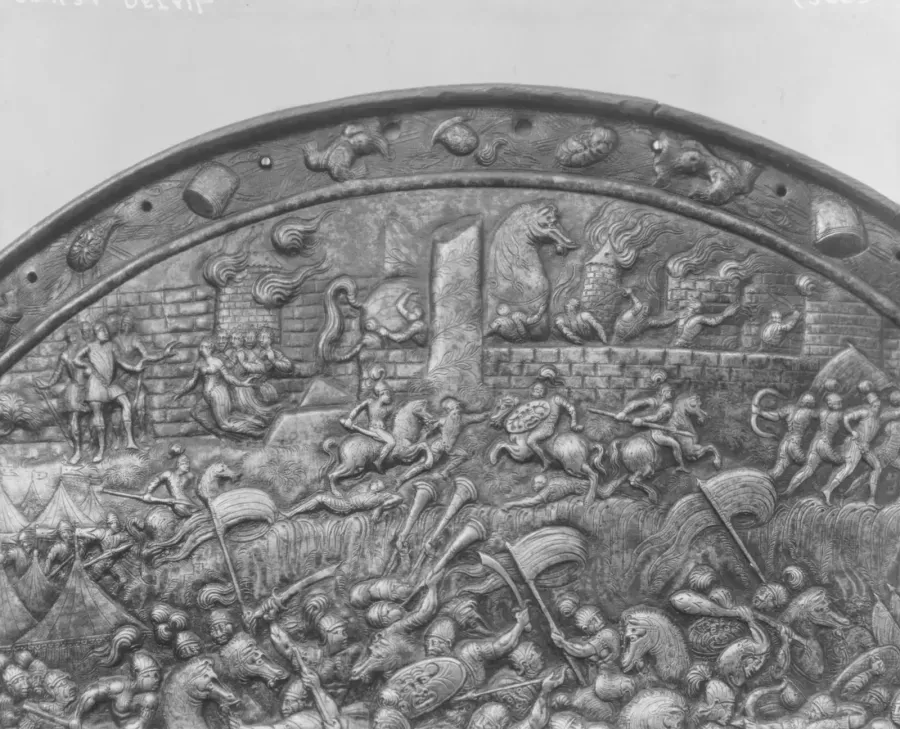
Hephaestus forged for Achilles a shield described by Homer in the eighteenth book of the Iliad, around 800 BC. On it are the heavens, two cities (one hosting a wedding and a trial, the other under siege), fields, a vineyard, cattle, and dancers. This is not a warrior's shield; it is an encyclopaedia of life. No other weapon in world literature has been described with such care and affection.
The shields of the Crusaders
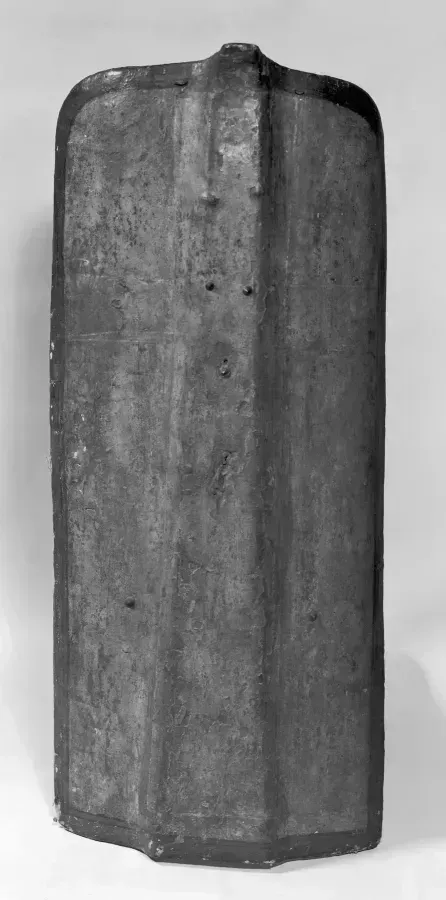
The Knights Templar carried white shields with a red cross, one of the most recognisable heraldic images in history. The Cross of Saint George, a red cross on white ground, remains the flag of England.
Heraldic charges: what to put on a shield
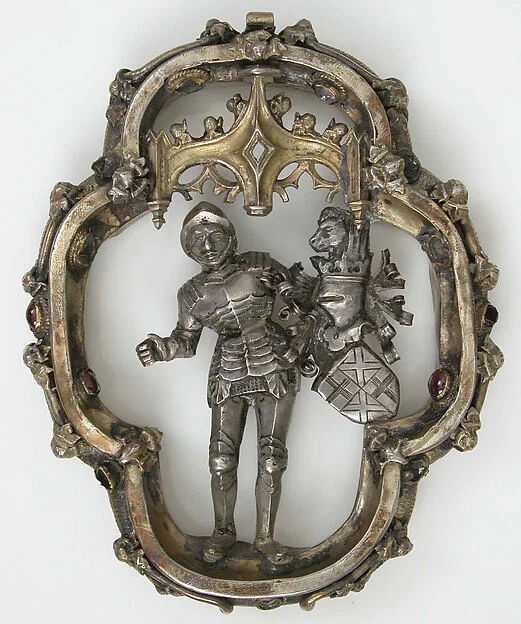
If you are considering a shield with your own symbolism, it helps to know the principal figures of heraldry.
Lion. Courage and strength. The lion appears in many poses on a shield: statant, rampant, passant. Each position carries its own meaning. It is the most common charge in European heraldry.
Eagle. Power and Roman heritage. Single-headed or double-headed: the double eagle passed from Byzantium to the Holy Roman Empire, Austria, and others.
Cross. The Christian symbol. Dozens of heraldic crosses exist: Greek, Latin, Teutonic, Maltese.
Star. Often five-pointed or six-pointed. A symbol of high ambitions, a guiding light, spirituality.
Rose. The red and white rose. York versus Lancaster, the War of the Roses.
Fleur-de-lis. The symbol of the French royal dynasty. Found throughout English heraldry as well.
Dragon. Power, protection, and Welsh heraldry: the red dragon of Wales.
Sword. Often combined with other charges on a shield.
Book. Wisdom and learning. Common on university arms and the crests of scholarly families.
Anchor. Hope. Also the heraldic symbol of seafaring families.
Hammer. Strength and craftsmanship. Craft guilds and artisan families.
Castle. Stronghold and defence. In Spanish heraldry the golden castle on red represents Castile; in German civic heraldry castles appear on dozens of city shields.
Tree. Lineage and family roots. Common in Celtic and Germanic heraldry.
Customer reviews
Zevira is a real jewellery shop. Genuine payments, deliveries and customer thank-yous.
🥰🥰🥰 gracias

Ok, ¡gracias! 🙂

Heraldry in depth: rules and traditions
Heraldry is a strict discipline with its own vocabulary and rules that have remained essentially unchanged for eight centuries.
Tinctures are the colours of heraldry. The metals are Or (gold) and Argent (silver). The colours are Gules (red), Azure (blue), Vert (green), Sable (black), and Purpure (purple). The fundamental rule: metal may not lie on metal, colour may not lie on colour. This ensures contrast and legibility at a distance.
Furs are special patterns imitating animal pelts: ermine (white with black tails) and vair (alternating blue and white shapes). Ermine was the mark of royal and aristocratic dignity.
Ordinaries are the geometric divisions of the shield field: the fess (horizontal bar), the bend (diagonal bar), the chevron, the pale (vertical bar), and the cross. They divide the field and are themselves charges.
Quartering is the division of the shield into multiple fields to represent descent from several noble families. The more quarterings, the longer the recorded lineage. The Habsburg arms of the sixteenth and seventeenth centuries carried dozens of divisions reflecting every land and dynastic alliance.
In England, the College of Arms, established in 1484, has kept continuous records of coats of arms and continues to grant new ones. In Scotland, the Court of the Lord Lyon performs the same function. Walking through the older quarters of British cities, you still find stone shields carved above doorways.
In Germany, the Siebmacher heraldic registers, published from 1605 onwards, systematically recorded the arms of the nobility and the burger class alike. German civic heraldry was distinctively broad: craft guilds, city councils, and scholarly families all maintained their own shields.
The shield knot: an older protective geometry
Before heraldic shields carried charges, another kind of shield had already been protecting for centuries. The shield knot is a knotwork design, continuous and unbroken, that appears across early medieval Celtic and Germanic metalwork, on stone crosses, and in manuscript illumination. Its four-lobed or square interlaced form has no beginning and no end, a quality that in medieval thinking made it resistant to harm.
Shield knots appear in the Book of Kells, on Viking brooches, and on Irish high crosses. They were used as amuletic devices on weapons, armour, and clothing. In contemporary jewellery, the shield knot appears engraved on shield-shaped pendants, combining the ancient protective geometry with the heraldic form.
The knot is not heraldry; it pre-dates it. But the two traditions converge in the same object: a shield meant to carry protection in its very surface.
Upload a photo of your pet, someone you love, or an object. We'll build a 3D model and hand-cast it in pewter.




Combined symbols: shield with other motifs
Shield with a cross. The Christian defender, the crusader, Saint George.
Shield with a sword. Prepared to defend and to strike. The pairing has a long literary life: see the sword as symbol of honour and justice for how the blade reads on its own.
Shield with wings. Swift protection. Used in the logos of medical services.
Shield with a crown. A knight in the service of the crown. Standard in heraldry, and richer if you know what the crown carries as a symbol in its own right.
Shield with an anchor. Maritime protection, popular among sailors and their families.
Shield with a name or monogram. Personalised protection.
How to wear a shield
Beneath clothing
A small shield pendant worn under a shirt or t-shirt. A personal protective talisman.
Visible over clothing
A medium or larger pendant worn over a shirt or jumper. Heraldic or military aesthetic.
Layered
Shield plus cross on chains of different lengths. A Christian protective combination.
With business attire
A small, minimal shield works well. A signet ring with a coat of arms is a classic masculine accessory for the office.
With everyday clothing
Any size. Particularly effective with leather jackets and vintage clothing.
Materials
The material of a shield piece changes what it says.
- Silver reads as understated and traditional. It suits everyday wear and is the most common metal for shield pendants.
- Gold, 14 or 18 carat, carries the classical knightly aesthetic. Signet rings and large pendants read best in gold.
- Oxidised silver or blackened steel creates a Gothic or military atmosphere. The darkening makes the engraved detail stand out more sharply.
- Bronze gives a historical, tactile quality: the sense of something older and heavier than the modern world.
- Steel with gold inlay reads as contemporary and industrial.
- Enamel is the heraldic choice: it allows the actual colours of a coat of arms to be reproduced faithfully, with the contrast that heraldic rules require.


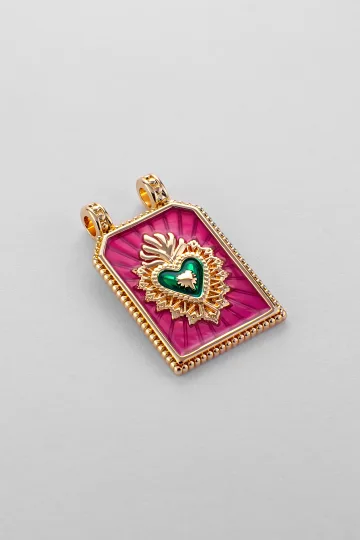



Care for shield jewellery
Engraved and embossed surface detail collects dust. A soft brush (a toothbrush with soft bristles) once a week will keep the design clear. Polish only flat surfaces; leave the engraving itself alone, because the roughness of the depth is part of its character. Ultrasonic cleaning is not advisable on engraved pieces: the vibration can damage fine lines. A silver signet that a grandfather wore for forty years and passed to his son is better precisely because of the traces it carries.
What the shield symbolises
A shield carries several meanings at once, and they rarely operate in isolation.
Protection. The most direct meaning. The shield is the first thing that stands between you and danger.
Defence and the right to refuse. The shield is not aggression; it is the right to deflect. A sword says "I can attack"; a shield says "you will have to get through me first."
Faith. In Christian tradition, the shield is one of the names for spiritual protection. "Take up the shield of faith, with which you can extinguish all the flaming arrows of the evil one" (Ephesians 6:16).
Loyalty and family. A heraldic shield is the arms of a lineage. It says: "I represent my family, I carry its name."
Honour. In medieval culture, the phrase "to stain one's shield" meant to lose one's honour. A clean shield was an untarnished reputation.
Memory of the departed. In some families, a shield jewel becomes an inherited memorial. A son wears a shield bearing his father's arms, passes it to his daughter, who passes it to her grandchild.
Silver, gold, wedding bands, symbolic pendants, paired sets.
Leave your email, we'll send your discount code. No spam, unsubscribe anytime.
The code arrives by email, valid on your first order.
Who suits a shield as jewellery or gift
For a father. A shield makes an excellent gift for a father, particularly one who has recently become a grandfather. The symbolism is direct: thank you for protecting this family. Well suited as a leather-cord pendant, a signet ring, or a shield lapel pin.
For a husband or partner. The gift that says "you are my protector" works both literally and figuratively.
For military, police, or fire service personnel. The symbolism of the shield aligns directly with the profession. Police badges worldwide take the shape of a shield: not by coincidence.
For a son, particularly one reaching adulthood. A gift that says: you are grown now, you are a protector too. The tradition of the signet ring passed from father to son traces back to medieval Europe.
For yourself in a difficult period. The shield works as a personal talisman. If you are facing a divorce, illness, legal proceedings, or a demanding project, a shield pendant becomes a tactile anchor.
For a graduate. A shield bearing the arms of a university, college, or academy.
For a wedding. Paired shields for bride and groom, sharing a common charge or joining the arms of two families.
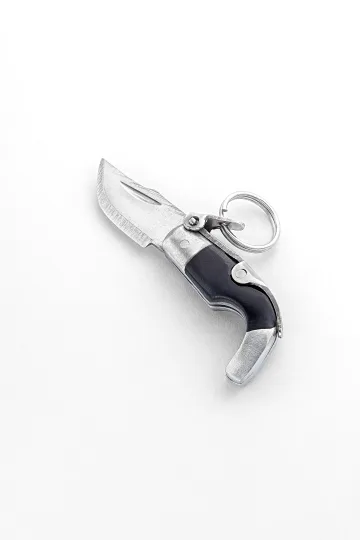
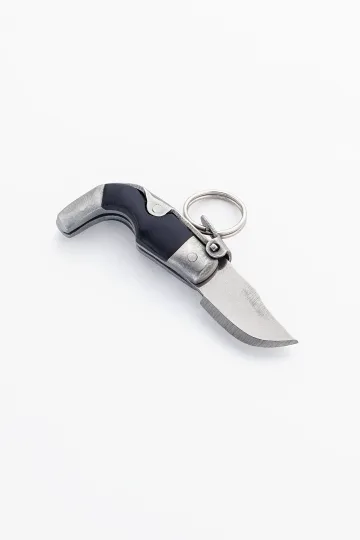
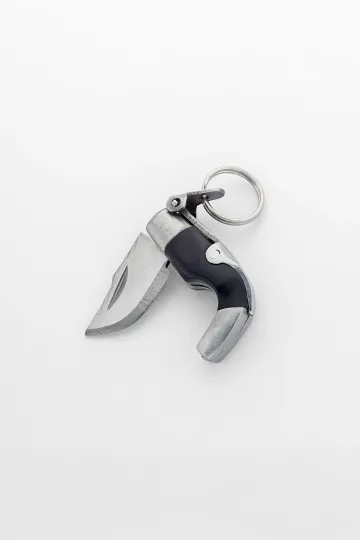
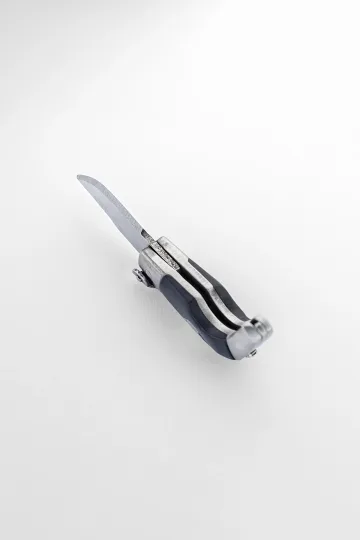
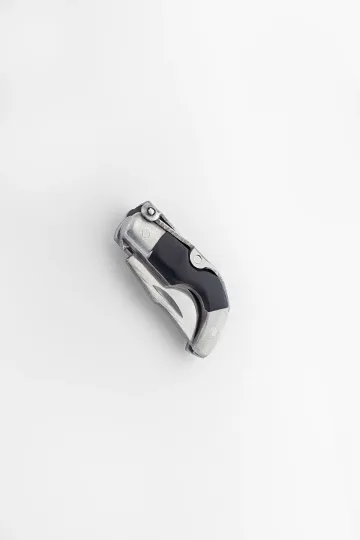
CAPAORA mini knife pendant
The 18th-century Spanish navaja in miniature: 40 mm of stainless steel, a real folding mechanism and a Palanquilla lock that clicks. An affordable gift to remember.
Authentic · Ships from Spain · 14-day returns
History of the shield: from the hoplon to the heraldic coat of arms
Ancient Greece: the hoplon and aspis
The Greek hoplon was a round shield roughly a metre across, faced with bronze. It gave its name to the hoplite, the heavy infantryman. At the Battle of Thermopylae, three hundred Spartans stood behind shields of this kind.
There is a well-known Spartan saying, attributed to Spartan mothers as they sent their sons to war: "Come back with your shield, or on it." Return with your shield meant victory; return on your shield meant you were carried home dead. Cowards threw their shields away to run faster, and that was considered the deepest disgrace.
Ancient Rome: the scutum
The Roman scutum was rectangular, slightly curved, about a metre tall. Legionaries formed it into the testudo, the tortoise formation. The scutum weighed more than ten kilograms.
Roman shields were decorated with the symbols of the legion: the thunderbolts of Jupiter, eagles, the cohort number. This is the direct ancestor of heraldry, which would formalise itself fifteen centuries later.
The Middle Ages: the birth of heraldry
In the twelfth century, European nobility encountered a practical problem. In tournaments and on the battlefield, knights were entirely enclosed in armour, and it became impossible to tell friend from foe. Shields began to be painted with identifying devices.
The heraldic shield acquired strict rules: shape, division into fields, colours (tinctures), and charges. Each family had its own unique coat of arms, inherited from generation to generation.
In England, the College of Arms, established in 1484, has kept continuous records of these devices ever since. Walking through the older quarters of British cities, you still find stone shields carved above doorways, a declaration that a family of standing once lived there.
The Vikings: the round shield
The Scandinavian round shield was made of wood with a metal boss at the centre. It was painted in bright colours, often in sectors. Found in graves from Norway to the British Isles.
The Norman kite shield
In the eleventh century, the Normans brought an elongated kite-shaped shield to England. It is the shield visible on the Bayeux Tapestry, depicting the conquest of 1066, now held in Bayeux, Normandy.
The heater shield: the classic knightly form
By the thirteenth century, the kite shield had been reduced and given a flat top. This is the shield children draw when asked to sketch a knight.
The shield in different cultures
Greece: the shield of Achilles
In Homer's Iliad, the shield of Achilles, forged by the god Hephaestus, is described in elaborate detail. On it are scenes from the full range of human life: a wedding, a harvest, a trial, war, and peace. It is not merely a weapon. It is an image of the entire world, carried into battle by the hero.
The Iliad passage is one of the most technically ambitious descriptions in ancient literature. Homer spends over a hundred lines on the shield alone. Scholars have argued for centuries whether the described scenes are meant to be read as actual metalwork or as an idealised map of the cosmos. Either way, the shield becomes a portable universe, the most extreme possible statement of what a protective object can contain.
Rome: the scutum and the legion's emblem
Every Roman shield bore the emblem of its particular unit. In modern armies, these legion symbols survive as shoulder patches and unit insignia. The transfer is direct: a Roman cohort's thunderbolt device becomes a regiment's shoulder badge, then a special-operations team's crest.
The Roman tradition also produced a famous protective shield in the religious sphere: the ancile, a small figure-of-eight shaped sacred shield said to have fallen from heaven in the reign of Numa Pompilius and kept in the temple of Mars. Eleven replica shields were made to protect the original from theft. The ancile was carried in procession by the Salii priests each March and October, marking the opening and closing of the military season.
Spain: the escudo
The Spanish coat of arms is called an escudo. The same word once named the coin, because coins bore the same device. In medieval and early modern Spain, the escudo was carved in stone above the doors of noble houses. Walking through Toledo, Salamanca, or Cuenca, you can still find them.
The Reconquista transformed the shield into a symbol of Christian identity. The Catholic Monarchs, Ferdinand and Isabella, united the castles of Castile, the lions of León, the stripes of Aragon, and the pomegranate of Granada on a quartered shield that became the template for hundreds of hidalgo families.
The Vikings: the decorated round shield
The Scandinavian shield was both weapon and declaration. The pattern painted on it could identify a clan at a distance. Viking shield rims were sometimes fitted with leather to absorb sword cuts, and shields were occasionally hung along the sides of longships both as protection and as visible statements of the crew's identity.
The Norse tradition also produced the shield-maiden, the skjaldmær, a warrior woman carrying a round shield. Whether she was historical or mythological is debated, but the figure is old enough to appear in Saxo Grammaticus and in the Hervarar saga. In contemporary jewellery, the shield-maiden motif turns the shield into a specifically female protective symbol.
Japan: tatami and yoroi
Japanese tradition did not rely on shields in the classical European sense. Samurai depended on the completeness of their armour (the yoroi) and on freedom of movement. What Japan did produce was the tate, a large standing pavise-style shield used by foot soldiers, particularly archers, as a fixed barrier rather than a personal carried piece. It never became the primary individual identity symbol the way the European shield did.
The absence of the personal carried shield in Japanese martial culture is significant: it partly explains why Japanese family heraldry, the mon, took a circular badge form rather than a shield shape.
Africa: shield and ceremony
In a number of African cultures, including the Zulu and the Maasai, the shield carried both a military and a ceremonial role, signifying rank and status within the community. Among the Zulu, shield patterns communicated a warrior's regiment; among the Maasai, shield ownership was tied to specific age-grade rites. The object never separated the practical from the symbolic.
The Zulu isihlangu, the large war shield made of ox hide, was the personal property of the warrior and was retired with him. The pattern of colour, determined by the regiment, meant that an advancing impi was a moving code that a knowledgeable observer could read. Colonial-era observers described the Zulu army's advance as carrying a living heraldry in its shields.
The shield in heraldry: family arms and ancestral honour
The heraldic shield operates under strict conventions. It is divided into fields (quarters, thirds, halves), carries charges such as lions, eagles, and crosses, and uses tinctures: six principal colours and metals (or/gold, argent/silver, gules/red, azure/blue, vert/green, sable/black). The fundamental rule is contrast: metal cannot be placed on metal, colour cannot be placed on colour.
The escutcheon is the technical name for the heraldic shield itself. An escutcheon of pretence is a small shield placed in the centre of a larger one, indicating that the bearer has a claim to a second family's arms through marriage. The terminology distinguishes the shape as a technical object from its content.
In England, the College of Arms continues to grant new coats of arms today. Many families of British descent worldwide, particularly in Australia, Canada, and the United States, apply for arms as a way of establishing a recorded lineage.
In Ireland and Scotland, clan heraldry is a living tradition. A visitor discovering their surname in the clan lists often takes home a piece of jewellery bearing that shield as a tangible connection to ancestry.
In Spain, heraldic records are extensive. The Armorial of Aragon, the Becerro de las Behetrías, and the collections of the Real Academia Matritense de Heráldica y Genealogía contain documented shields for thousands of families. Spanish surnames frequently have recorded arms.
The shield in religion: the shield of faith
The Christian tradition gave the shield an additional layer of meaning. In the Epistle to the Ephesians, the Apostle Paul describes the "whole armour of God", a list of spiritual equipment for the Christian. Among them is the shield of faith, "with which you can extinguish all the flaming arrows of the evil one."
This imagery was widely used in medieval iconography. Saint George is depicted with a shield bearing a red cross on a white ground, the very image that would eventually become associated with England.
In jewellery, a shield with a cross unites both ideas: protection and faith.
In Jewish tradition, the Shield of David (the Magen David, a six-pointed star) is one of the central symbols. The word magen means shield, making the geometry literal: this star-shaped form is understood as a protective covering.
In the Old Testament, God is repeatedly called a shield in the Psalms. "You, Lord, are a shield around me" (Psalm 3:3). The shield as divine protection runs through all three Abrahamic traditions.
Send a friend a discount code, they save on their first order.
Modern meaning: from tattoos to logos
Over the past fifty years, the shield symbol has experienced a second life in popular culture.
Tattoos. The shield is one of the most common subjects in military tattooing. Soldiers, police officers, and firefighters often have a shield bearing the insignia of their unit.
Superheroes. Captain America's star-spangled round shield, Wonder Woman's Amazonian shield: both rooted in the same ancient protective symbolism.
Police badges. Police badges worldwide take the shape of a shield. This is not an accident: the shield communicates simultaneously the protection of the citizen and the protected status of the wearer.
Brand logos. Dozens of automotive manufacturers use a shield in their logo, from Italian sports cars to Scandinavian manufacturers.
Sports clubs. The emblems of football clubs are almost always shields, from the top flights of England, Spain, Italy, and Germany down to local sides.
Military insignia. Units and corps of every country carry their own shield device.
Video games. In fantasy role-playing games, the shield is one of the central visual elements, from classic series to contemporary epics.
Personal group identity. People who are far from any aristocratic lineage wear shields bearing the symbol of a football club, a martial arts school, or a team. That is precisely what heraldry was at the start: I belong to these people, I stand with them.
Famous shields in mythology and history
The Aegis of Zeus and Athena. In Greek mythology, the aegis was the hide of the goat Amalthea. Zeus later gave it to his daughter Athena. The head of the Gorgon Medusa was placed upon it: anyone who looked on it directly was turned to stone.
The Shield of Achilles. Described in detail in the eighteenth book of the Iliad. Hephaestus forged it with scenes from the full range of life.
The Shield of Roland. The legendary paladin of Charlemagne carried a shield bearing a dragon.
The Shield of Richard I. Three lions passant on a red field, established in the twelfth century, remain part of the English royal arms to this day.
The Shield of Joan of Arc. According to legend, it was a simple white field bearing lilies and the name of Jesus.
The Shield of El Cid. Rodrigo Diaz de Vivar, the hero of the Reconquista, bore his own heraldic devices. In modern Burgos, visitors often take home a silver shield pendant as a souvenir.
The Shield of the Catholic Monarchs. The quartered shield of Ferdinand and Isabella, combining the castle of Castile, the lion of León, the stripes of Aragon, and the pomegranate of Granada, became the foundation of the modern Spanish coat of arms.
Captain America's Shield. Twentieth century, popular culture. A round shield with a star and concentric rings in patriotic colours: the most recognisable fictional shield in the world.
Personalisation: making the shield your own
A shield piece is most meaningful when it carries personal content.
Family coat of arms. In England, the College of Arms (established 1484) holds the records and grants new arms. In Scotland, the Court of the Lord Lyon. In Ireland, the Office of the Chief Herald. In Spain, the Real Academia Matritense de Heráldica y Genealogía. In Germany, the Heraldic Society and regional archives.
Personal monogram. Initials at the centre of the shield. The simplest form of personalisation, requiring no archival research.
Motto. Latin or in the family's language. Brief and pointed: "Fortiter et fideliter" (Bravely and faithfully), "In hoc signo" (In this sign), "Nunquam retrorsum" (Never backwards). A motto is often engraved on the reverse of the pendant.
A date. The year a family was founded, a year of birth, the year of a significant event.
Shield without a coat of arms. A shield form without specific heraldic content carries its meaning in the shape itself: protection, honour, belonging. Personal symbolism chosen freely is entirely legitimate as a wearable statement.
FAQ: common questions about shield jewellery
Is it a masculine or feminine piece?
Traditionally the shield was associated with men, but contemporary jewellery has broken that boundary. Large, heavy shields are more often chosen by men; small, delicate shields set with enamel or stones work well for women.
Shield with a cross versus without: what is the difference?
A shield with a cross carries Christian symbolism: the shield of faith, crusaders, Saint George. A shield without a cross is more neutral and works across traditions.
What does a blank shield mean?
A blank shield in heraldry is called an escutcheon of pretence or a plain field. It signifies either "unstained honour" or a shield ready to receive a coat of arms.
Can you wear a coat of arms that is not your own?
This is a contested point. In countries with strict heraldic traditions (England and Scotland in particular) wearing another family's arms is considered inappropriate.
How do you find your family shield?
In England, through the College of Arms. In Scotland, through the Court of the Lord Lyon. In Ireland, through the Office of the Chief Herald of Ireland. In Spain, through the Real Academia Matritense de Heráldica y Genealogía or the Archivo Histórico Nacional.
What is the difference between a shield and a coat of arms?
The shield is the shape; the coat of arms is everything placed on it and around it: the charges, the tinctures, the crest above, the motto below, and the supporters on either side. A shield pendant reproduces only the central element of a full coat of arms.
What is an escutcheon?
The escutcheon is the technical heraldic term for the shield itself, used to distinguish the physical shape from the charges placed upon it. An escutcheon of pretence is a small shield placed at the centre of a larger one, indicating that the bearer claims the arms of a second family, typically through a marriage that brought a heiress into the line. When two families formally joined their arms, the resulting quartered shield showed the escutcheons of both families side by side.
Can the shield symbol be used without any heraldic knowledge?
Yes. The shield as a shape carries its meaning independently of heraldic learning. Most people who wear a shield pendant are not pursuing genealogical research; they are drawn to the shape for what it communicates: a readiness to protect, a reference to something older and more solid than the everyday world. Personal meaning freely chosen is entirely legitimate.
How much should a shield piece cost?
From the budget end for a simple silver pendant up to the premium end for a hand-finished enamel piece with stones. The material, finish, and intricacy of the charge all affect the price.
Shield jewellery and a shield tattoo: are they compatible?
Completely. Many people tattoo a shield and wear a pendant bearing the same device. The pairing reinforces the meaning.
Can a child wear a shield?
Yes. Small silver shield medallions are popular in Spanish and Italian tradition as protective talismans for children.
Shield versus other protective symbols: which to choose?
The shield is the most universal of protective symbols. The nazar (Turkish evil eye) works specifically against the evil eye. The hamsa works against envy. The cross operates within a Christian frame. The shield encompasses the full range of protective meaning without being bound to a single tradition.
Buying it as a gift? Each one arrives ready to give.
 A branded Zevira box and a little card come with every order.








Conclusion
The shield is one of the oldest symbols to have completed the journey from a physical object to a wholly abstract idea. Nobody deflects arrows with a shield today, but the symbol has perhaps grown stronger precisely because it is no longer literal.
A shield worn in jewellery is a quiet statement: I know the world is difficult, and I am ready. I stand under a covering. Or I am the covering for someone else. Or I carry the name of a lineage that stood behind a shield for centuries.
Zevira makes jewellery in the artisan tradition of Albacete, a city with a long tradition of metalwork. Our shield pendants, rings, and signets are individual pieces, each carrying its own story. Browse the catalogue
About Zevira
Zevira makes jewellery in the artisan tradition of Albacete, Spain. The shield sits at the heart of what we do as a craft: we work with metal, engraving, and heraldry, turning an old protective symbol into a personal piece that carries a coat of arms, a monogram, or a motto.
Here is what you can find with us on the theme of the shield:
- Shield pendants in different shapes: the heraldic triangle, the round, the teardrop
- Signet rings ready for the engraving of a family crest, a monogram, or a date
- Pieces that pair the shield with a cross, a sword, a crown, or an anchor
- Heraldic enamel in the colours of a coat of arms, following the rules of the tinctures
- Cufflinks and tie pins finished with a shield crest
- Matched shields for a wedding, joining the arms of two families
Every piece can be personalised with engraving, with the option of personal engraving. Sterling silver 925 and gold 14 to 18K.