Spider Jewellery: Gothic Symbol, Arachne, and the Legacy of Louise Bourgeois
Wear the symbol, don't just read about it. These are in stock:






Introduction
Few creatures split opinion quite as cleanly as the spider. On one side sits a visceral, almost pre-rational unease, the product of millions of years of evolution that taught us to watch the small eight-legged thing moving in shadow. On the other sits genuine admiration: the geometry of a perfect orb web, the economy of movement, the capacity to draw an entire structural material out of the body itself. It is this tension, fear pressed hard against wonder, that has given the spider its symbolic weight for the past three thousand years.
In jewellery, the spider has never behaved like a heart, a flower or a bird. It has never been a neutral ornament. From the beginning it has been a statement, a sign, a question posed to whoever looks. Victorian Gothic made the web a centrepiece of mourning jewellery. The Symbolist turn of the nineteenth and twentieth centuries cast the spider as a figure of fatal attraction. The late twentieth century handed it a new role as protector and mother, and contemporary studio jewellery has returned to it with miniaturist precision and serious craft intent.
The most significant single moment in this modern renegotiation came in 1999, when Louise Bourgeois placed her nine-metre bronze sculpture Maman in the Turbine Hall of Tate Modern. Bourgeois made the spider not a monster but a memory: her own mother, a weaver and tapestry restorer, patient, protective, skilled. That shift changed everything. After Maman, wearing a spider at your lapel stopped being exclusively a gesture of Gothic subculture. It entered the language of people speaking about female strength, endurance, and the long labour of craft.
This guide covers spider jewellery in practical terms: what jewellers actually do with the motif, where the symbolic depth comes from, how different cultures read the creature, and why no single universal spider energy exists. We look at piece types, materials, techniques, the web as an independent motif, and answer the questions people actually ask, including the awkward ones.
Zevira works with this imagery in its Gothic and conceptual line. We do not romanticise fear, and we make no promises along the lines of a spider will bring you luck, because the cultural meanings are far too varied for that kind of packaging. What we do know is how expressive this image can be in the right hands, and how much a person communicates by choosing it.
Spider Jewellery: What to Choose
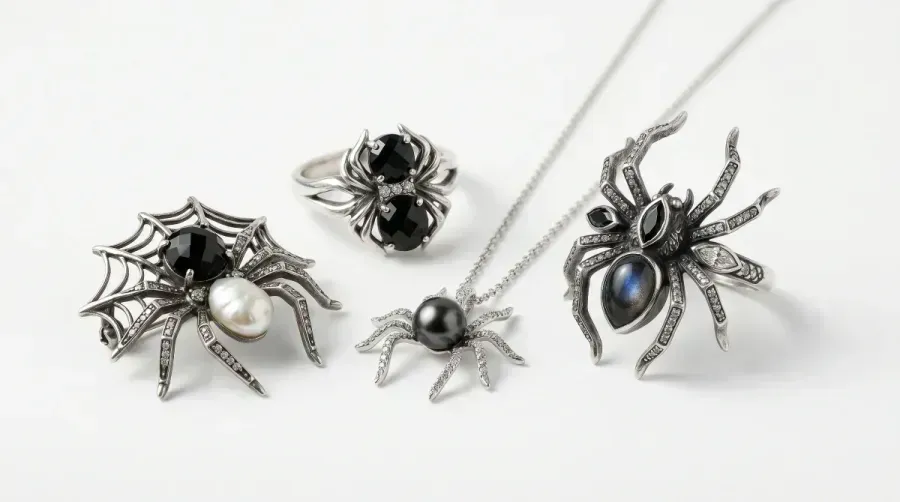
The brooch is the most natural home for a spider in jewellery, and that is not an accident. A brooch can hold complex anatomy comfortably. There is surface area for the legs, a setting for the stone in the abdomen, and the piece sits on the dense cloth of a coat, jacket or waistcoat where sculptural volume reads correctly. A Gothic spider brooch the size of a thumb nail becomes a small sculpture pinned to wool or velvet, not a flat badge. That is its chief distinction from simplified miniature versions.
A spider pendant behaves differently. On a chain the spider lives, swaying slightly with movement, and this strengthens the sense of presence. A forty-centimetre chain keeps the motif close and intimate. A seventy-centimetre chain drops the spider to chest level, where it reads as a deliberate sign. On a leather cord the piece tilts Gothic and artisanal; on a fine silver chain it reads closer to contemporary studio jewellery.
A spider ring is among the bolder choices available. An eight-legged silhouette sitting on the finger becomes part of every gesture the hand makes. We treat such rings as single statements: two spiders on one hand is already excessive, and pairing a spider ring with floral or romantic rings on adjacent fingers creates a collision of registers that neither piece wins.
Spider earrings appear less often, but the web works beautifully at ear level. A round or oval web with a stone at the centre functions as a small Gothic mandala, wearable with a black roll-neck or an evening dress with equal ease. Set a garnet, onyx or labradorite at the centre and the earring acquires depth beyond costume jewellery.
Bracelets approach the motif two ways. The first: a chain with a single small spider as the centrepiece, a quiet everyday option. The second: a web-structure bracelet in which the metal itself mimics radial lines and concentric spirals, making the motif the architecture of the piece. The second is technically harder and visually stronger.
Long sautoir pendants on cord or chain are a subcategory closer to Art Nouveau and the turn-of-the-century Symbolist tradition than to pure Gothic. There the spider tends to be stylised toward flowing lines, losing anatomical accuracy and becoming an ornamental creature. These sit well with loose-cut clothing and natural fabrics.
A spider wants oxidised silver against a dark collar, never gold on lace. One on the hand, and don't you dare add a second.
What to Wear a Spider With: Looks and Pairings
I style spiders on shoots more often than people expect, and they almost always pull the look toward themselves. Here is what holds up on real people, sorted by occasion.
How do I wear a spider every day? For daily wear I recommend a minimal silhouette or a web with a dark stone on a thin chain. I set it over a turtleneck, a chunky black knit or a plain shirt. A pale matte top is wrong, the spider looks like a sticker on it, while wool, dense cotton and jersey hold it as a graphic line. I suggest a closed or boat neckline: on bare skin the eight-legged shape reads far too literally.
Does a spider work at the office? It does, once you remove the anatomy. I choose a web without the spider, or a very small stylised sign on a short chain that sits under the top button. Charcoal, aubergine or dark green tailoring, silver hardware on belt and bag, and the pendant recedes into the working look. A large spider brooch I set aside for a strict dress code: it invites a conversation, and not everyone is ready to have one.
How do I build an evening look? The evening I give to the spider entirely. I recommend a black or wine-red dress, silk or velvet, bare shoulders, and a large brooch on the lapel or a pendant on a long chain as the focal point. Garnet or ruby in the abdomen echoes the burgundy in the fabric, onyx keeps a strict black key. For evening I take the chain shorter, into the open area, so the spider settles at the collarbone.
A spider ring, without overdoing it? One spider ring per hand, full stop. Neighbouring fingers I leave bare or give thin plain bands with no symbolism. I never mix a spider with floral or heart rings, they speak different languages and cancel each other. I set it on the index or middle finger; on the ring finger it argues with a relationship band, and that fight is pointless.
Which metals and clothing colours? I stay in the cool range: oxidised silver and white gold belong with a dark palette, warm yellow gold argues with the Gothic tone. Layers I allow only from quiet, smooth elements, a thin chain and small studs that give the spider a backdrop. One rule that never fails: one strong spider accent per outfit, a spider plus a skull or a raven is already too much.

Turn on your camera, pick earrings, a pendant or a ring, and see the piece on yourself in real time.
Switch items in one tap.
Everything runs in your browser: no photo or video is ever uploaded.
Types of Spider in Jewellery
The anatomically precise spider is the most demanding category. A real spider has eight legs arranged in pairs, two body segments (cephalothorax and abdomen) connected by a slender waist, and the small pedipalps near the head that are easily mistaken for extra legs. When a jeweller makes a realistic spider, this is the architecture being worked from, and the difference between accomplished and careless work is immediately legible in the proportions and in the clarity of the joints. This kind of spider inhabits a piece as a small sculptural creature, and that level of detail separates studio work from mass casting.
The stylised minimalist spider works differently. The jeweller abandons realistic anatomy and reduces the image to a graphic silhouette: eight fine line-legs, a plain oval body, sometimes no segmentation at all. This spider reads as a sign rather than a creature, and functions well in calm everyday settings where Gothic intensity is not required. A minimalist form holds very small scale well: it can be made tiny, the size of a grain of rice, and worn almost as a private symbol.
The geometric spider is a third branch. Here the maker consciously emphasises symmetry: legs run in strict pairs, the body may become a rhombus or hexagon, pedipalps disappear. This spider sits closer to Art Deco and to contemporary graphic design. It pairs well with structured clothing without frills or draping. Geometry removes the biological unease; the spider stops reading as a living thing and becomes an ornament.
The stone-set spider is a separate type. The concept is simple: the rounded abdomen becomes a setting, and a stone is placed within it. Garnet is most common, giving a deep wine-red; onyx for coal-black; labradorite for an interior luminescence. Less often: opal, amethyst, smoky quartz. The stone changes the character of the piece entirely. Without it the spider is austere and graphic; with it, it becomes precious, almost like the scarab in Egyptian jewellery.
The spider-in-web sets the motif out in full. The spider sits at the centre or edge of its web, the web itself worked in fine wire or filigree, and small stones may sit at intersections, reading as dewdrops or prey. This is the most demanding version technically, but it tells a complete story: author, structure, and geometry in one piece.
The web without the spider is a different matter entirely, discussed below in its own section.
Customer reviews
Zevira is a real jewellery shop. Genuine payments, deliveries and customer thank-yous.
🥰🥰🥰 gracias

Ok, ¡gracias! 🙂

The Spider as Symbol: A History
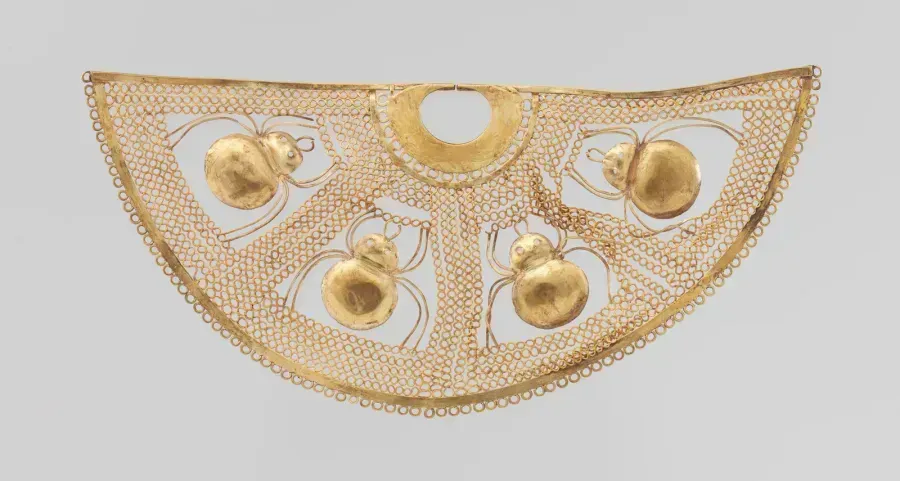
The best-known classical spider story is that of Arachne, told by Ovid in the Metamorphoses. Arachne, a Lydian girl of unsurpassed skill in weaving, challenged Athena to a contest. Athena wove the gods in their majesty; Arachne wove scenes in which those same gods behaved with cruelty and contempt toward mortals. Arachne's work was technically flawless and its content was an insult. Athena destroyed the cloth in fury and transformed Arachne into a spider, condemned to weave forever. Two things matter in this story. First, the spider here is not born a spider: it is made one as punishment. Second, the punishment is simultaneously preservation: Arachne does not vanish, she continues doing the one thing at which she was supreme. This double meaning, humiliation and continuity together, is precisely why the Arachne myth is so important to the Symbolists and Gothic writers of the nineteenth century.
Medieval Europe's relationship with the spider was grimmer and more practical. The creature was a household neighbour associated with dust, abandoned corners, sickrooms and plague. Cobweb in early literature is frequently a metaphor for desolation. In southern Italy, between the fifteenth and eighteenth centuries, a phenomenon called tarantism held that the bite of a tarantula caused a disturbed state curable only by a ritual dance, the tarantella. Medical historians now explain this largely as mass psychosomatic crisis and social ritual rather than genuine toxicology, but symbolically it matters: the spider entered the cultural memory of the South as a creature capable of triggering particular states of body and mind.
Victorian jewellery of the nineteenth century took a decisive step. In an era when mourning was tightly regulated socially and visually, a category of mourning jewellery developed: pieces in black glass, jet, oxidised silver, often carrying motifs of urns, weeping willows, webs and spiders. The web read here as a sign of time passing and memory fraying, a connection between the dead and the living; the spider as the creature tending that network. Toward the end of the century, in the Art Nouveau period, the spider shed its exclusively mourning role and entered formal jewellery, often in enamel and precious stones, as a complex Symbolist figure.
The turn toward Louise Bourgeois is the single most important modern moment. She began making spider sculptures in the early 1990s and in 1999 installed Maman in the Turbine Hall of Tate Modern. The title means simply mother, and that is the key. Bourgeois explained repeatedly that the sculpture was her own mother, who worked with textiles, restored old tapestries, and whom the artist understood as patient, protective, spinning, mending. Under Maman's body hangs a sac of marble eggs, and this makes the sculpture not a monster but a figure of maternity. Maman changed the cultural register of the spider more than any literary metaphor had done, because it is monumental, public, and multiply reproduced: casts stand in Ottawa, Bilbao, Seoul, Doha and elsewhere. After Bourgeois, a spider on a piece of jewellery can speak not only of fear but of strength, patience, and the long work of women.
In Britain, the spider also carries a specific folkloric charge through the legend of Robert the Bruce. According to tradition, Bruce, hiding in a cave after a series of defeats in his campaign for Scottish independence in the early fourteenth century, watched a spider attempt to throw its thread from one beam to another. The spider failed repeatedly but would not stop, and at last succeeded. Bruce took this as a lesson in persistence and returned to the field, eventually winning at Bannockburn in 1314. The story, whether historically exact or not, embedded the spider into British popular consciousness as a symbol of patient perseverance against difficulty, a meaning that sits very naturally alongside Gothic and craft-based readings.
Upload a photo of your pet, someone you love, or an object. We'll build a 3D model and hand-cast it in pewter.




The Spider Across Cultures
Greece: Arachne
The Greek story, already discussed above, gives the spider the role of the master craftswoman punished for pride but preserved in her craft. In this reading, the spider is a figure of creative labour that cannot be entirely extinguished, even when it is meant to be.
North America: Spider Grandmother
In the cultures of the Hopi, Navajo, Lakota and several other peoples of the south-west and plains, there exists a figure that anthropologists call Spider Grandmother or Spider Woman, the Hopi Kookyangwso'wuuti, the Navajo Na'ashjé'ii Asdzaa. She is among the central mythological figures of those traditions. She is associated with the creation of the world, with teaching humans to weave, with wisdom, and with holding the fabric of existence together through her threads. It is important to treat these as specific figures within specific living cultures, not as a generic Native American spider symbol.
West Africa: Anansi
In Akan culture in present-day Ghana and among neighbouring peoples, Anansi is a spider trickster. He is the hero of a large body of stories about wit over strength, and in the central tale he acquires all the stories in the world from the sky god and brings them to humanity. During the transatlantic slave trade, Anansi stories reached the Caribbean and the American South, where the character survived under variant names. Here the spider is not fear or motherhood: it is intelligence, voice, and the power to tell stories.
Japan: Jorgumo
Japanese tradition gives the spider an ambivalent image. Jorgumo, literally something like a binding woman, is a female yokai who takes the form of a beautiful woman, lures men, and ensnares them. In some tellings she is a pure predator; in others a guardian; in others simply a creature of old waterfalls and the boundary between worlds. Like many yokai, she is neither clean evil nor clean good.
British Isles: Robert the Bruce and Folk Tradition
Beyond the Bruce legend, British folk tradition gave the spider mixed signals: in some regions a spider found on clothing was considered lucky (money spiders), while in others web in an abandoned room signalled the uncanny. The money spider, a small pale creature said to bring wealth if it ran across you unharmed, is deeply embedded in English and Scottish popular belief. This duality, luck alongside the uncanny, makes British folk-spider symbolism unusually flexible as a motif for jewellery.
Europe: Fate and the Loom
Across European mythology, the spider rhymes directly with figures who spin the thread of life. The Greek Moirai, Clotho, Lachesis and Atropos, spin, measure and cut. The Norse Norns, Urd, Verdandi and Skuld, do the same at the roots of the world tree. The spider, with its literal capacity to draw thread from its own body, becomes a natural visual echo of these figures, a connection the Victorian Symbolist jewellery tradition used constantly.
An honest closing note: the meanings of the spider in different cultures are often directly contradictory. Creator of the world for the Hopi; cunning storyteller for the Akan; predator in certain Japanese tales; mother-protector in Bourgeois's European twentieth-century reading. No single universal spider energy exists. When you wear a spider, you are not invoking a general totem; you are choosing a specific reading that is closest to your own cultural and personal context. That is more honest, and more interesting, than pretending all traditions say the same thing.
CAPAORA mini knife pendant
The 18th-century Spanish navaja in miniature: 40 mm of stainless steel, a real folding mechanism and a Palanquilla lock that clicks. An affordable gift to remember.
Authentic · Ships from Spain · 14-day returns
What the Spider Symbolises
The first meaning that works across cultural differences is creativity and craft. A spider literally draws thread from its own body and weaves it into structure, a direct metaphor for anyone who builds something out of their own time, attention and effort. Writers, artists, craftspeople, engineers, architects, programmers: all are weavers in this sense, and a spider at the lapel or on the finger can serve as a personal sign of that work. The image fits studio jewellery particularly naturally, because the jeweller's craft is itself a slow process with many invisible hours.
The second meaning is patience. A spider does not rush its prey; it builds and waits. In a culture that values immediate results and rapid response, the spider becomes an almost countercultural image, a sign that long work and deliberate waiting have their own force. This works especially well for people engaged in projects where no result is visible in a week.
The third meaning is fate and the thread of life. Here the spider intersects with the Moirai and the Norns, and the jewellery becomes not a portrait of an animal but a sign that life is a fabric in which we are simultaneously the weavers and the thread. This is a serious Symbolist reading, more at home in the tradition of nineteenth-century European Symbolism and contemporary studio jewellery than in mass culture.
The fourth meaning Bourgeois gave us: female strength and maternity. The spider as the mother who mends, who catches harmful things, who protects her own. This is the meaning that made the spider acceptable to people entirely outside Gothic subculture. A woman wearing a spider after Maman may be thinking not of provocation but of a long line of women in her family, from a grandmother who sewed to a great-grandmother who wove.
What the spider does not symbolise is equally worth stating. It does not bring luck with money. It does not attract love. It does not guarantee legal victory or protect against the evil eye. Such claims belong to magical marketing, not to honest cultural history. In most traditions the spider is associated with work, not with fortune. Work produces results too, but through effort rather than through wearing an object.
The Web as an Independent Motif
The radial orb web is a ready-made jewellery ornament that has existed for millions of years. It has a centre, radial spokes, and a spiral wound onto those spokes. The geometry is close to perfect, which is why it translates so naturally into metal: any jeweller who works with filigree or fine wire can reproduce this structure.
Webs appear in jewellery in volume from the 1890s, first in Victorian mourning pieces in jet and oxidised silver, then in Art Nouveau with enamel and small stones. In the twentieth century the web lived in parallel in Gothic subculture and high fashion, and in the twenty-first it returned to studio jewellery as a calm minimalist motif.
A stone at the centre of the web is a particular visual move. A small diamond, zircon, rock crystal or white topaz reads as a dewdrop caught in the web at dawn, turning the piece into a miniature scene. A red garnet or ruby changes the register entirely: the drop becomes blood rather than dew, and the piece enters Gothic territory. Black onyx or smoky quartz maintains a neutral dark key, leaving the web graphic.
The web without the spider is a gentler motif than the spider itself. It provokes less instinctive recoil, reads well as ornament, and is worn by people who are drawn to the geometry and the idea of connection, but not to the image of the eight-legged creature. On a pendant medallion the web works as a ready-made graphic sign; on a ring as a complex structure circling the finger.
There is one further layer of meaning worth naming. The web is simultaneously fragile and strong. Spider silk breaks at a touch and is, weight for weight, stronger than steel: this is a fact of biomechanics. That makes the web a precise symbol for the complex ties, familial, professional, friendly, that appear delicate but have been carrying weight for years.
Leave your email, we'll send your discount code. No spam, unsubscribe anytime.
The code arrives by email, valid on your first order.
Materials and Techniques
The primary material for spider jewellery is silver with deep oxidation. Oxidised silver gives a dark, near-graphite tone against which the fine detail of a spider's anatomy reads like an engraving. Without oxidation, a silver spider looks clinical and generic; the motif loses half its expressiveness. Good oxidation does not turn the silver uniformly coal-black: it deepens the relief, leaving live highlights on raised points.
Gold is used less often for spider work but produces interesting results. Yellow gold softens the Gothic register: the spider becomes more decorative than Symbolist. Rose gold gives a warm, almost vintage tone close to Art Nouveau. White gold with small black stones can approximate oxidised silver, at a considerably higher price.
Filigree is the key technique for webs. Fine drawn wire allows a delicate network to be constructed that holds its shape through wear. In the Gothic line, Zevira makes web brooches and pendants in filigree because a cast web always looks heavier and loses the sense of actual thread. Filigree requires hand work, which is one reason pieces in this technique belong to the middle and upper price range rather than the mass market.
Casting is used for the body, legs and detail of the spider itself. Good casting reproduces the finest detail, from the texture of the abdomen to the tiny pedipalps, but demands a clean model and precise mould work. Mass-stamped casting is always identifiable: joints are blurred, legs merge into the body, pedipalps are absent. Studio casting is distinguished by depth and sharpness of detail.
The eyes of the spider are worth separate mention. A real spider has eight eyes, but in jewellery these are almost always reduced to two prominent ones set in the cephalothorax. Black onyx, red garnet or haematite are the common choices. Small stones seated in miniature collets animate the piece: the spider stops being a casting and becomes a creature with a gaze.
Oxidation helps a web read as silver thread on a dark field. When a filigree network is blackened and the uppermost layer of oxidation then gently polished away, the radial lines and spiral remain bright against a darkened ground. This creates the effect of a web seen in oblique light. It is painstaking work, and it is precisely what distinguishes accomplished Gothic jewellery from flat imitations.
Enamel appears less frequently but has its tradition in Art Nouveau. Black, deep-green or deep-purple enamel on a spider's abdomen gives a precious effect close to the Symbolist masters of the early twentieth century. Contemporary studio jewellers return to it slowly, because it demands a separate kiln and a separate body of skill.
How to Wear It
A spider brooch is an autumn and winter accent before it is anything else. A wool coat, a heavy jacket, a velvet waistcoat, a tweed blazer: these are the fabrics on which a large Gothic brooch sits properly, because they have the weight and the texture to carry it. In summer, on a light blouse, the same brooch turns the whole outfit heavy and slightly costume. The natural place for it is the lapel of a jacket or the collar of a coat, occasionally a scarf or the band of a beret. If the spider is large, one brooch is the entire statement and nothing else Gothic needs to join it.
A web pendant with a stone on a chain is a far calmer proposition. It can be worn every day and it alarms nobody, because a web reads as geometric ornament long before it reads as a reference to a living creature. That pendant works inside an office dress code, particularly through the colder months, and it works equally on a date or against a black evening dress. If you want the symbolism without the eight legs, this is the form to reach for.
A spider ring is a bolder gesture, and its rules are simple. One spider ring per hand, no more. The neighbouring fingers on that hand are better left bare or given thin plain bands with no symbolism of their own. Mixing a spider with floral, heart or romantic rings makes no sense, since they operate in different registers and blunt each other. The spider looks right on the index or middle finger; on the ring finger it competes with a relationship band, and that is a fight nobody needs.
The clothing palette that supports a spider motif runs to black, deep burgundy, dark green, aubergine, charcoal and wine red. Silver hardware on a bag and belt backs the piece up, while gold hardware works against the cool tone of oxidised silver. If the look already includes a piece from a pair of matching symbolic halves or a romantic monogram, leave the spider for another day, because mixing Gothic with romantic blurs both languages.
One rule holds for any complex symbolic jewellery: never wear two heavy motifs at once. Spider plus skull is too much. Spider plus raven is too much. Spider plus a large cross is too much. One strong symbol per outfit and it does its work. Two, and they eat each other.
Brooches and pendants with spiders, webs and a stone at the centre, web-pattern earrings.
Silver, gold, wedding rings, symbolic pieces, paired sets.
Send a friend a discount code, they save on their first order.
Who It Suits
Gothic and dark-romantic enthusiasts are the obvious audience. If Victorian mourning jewellery speaks to you, if the novels of Daphne du Maurier or Ann Radcliffe are on your shelf, if your wardrobe runs to velvet, lace and deep tones, spider jewellery belongs in your language naturally.
Creative people who think of themselves as the weavers of their own projects. Writers, artists, composers, architects, designers, programmers, engineers: anyone engaged in long, slow, attention-intensive work can wear a spider as a personal sign of that practice. This meaning pairs well with ordinary contemporary dress and asks for nothing Gothic.
People who are comfortable with provocative images. A spider will always generate a question, especially at work, and the wearer needs to be ready to answer it. For people who enjoy brief conversations about cultural history, this is a feature rather than a problem: the piece begins a dialogue rather than simply sitting as decoration.
Admirers of contemporary art and Louise Bourgeois. For this audience the spider is first and foremost Maman, and the jewellery functions as a quiet reference to an artist they love. This register is closer to museums and contemporary galleries than to subculture.
People who are drawn to the Robert the Bruce reading, persistence, endurance under adversity, and the particular quality of determination that does not depend on immediate success. This is a very wearable, everyday meaning, available even in the most conservative contexts if the piece itself is restrained.
Those for whom the spider is an image rather than a phobia. This is an important filter. If you are genuinely arachnophobic to the point of physical discomfort, do not force yourself to wear spider jewellery as a way of working through it. Jewellery is not a therapeutic tool and should not cause daily tension. There are other motifs that can carry the same symbolic weight without requiring internal struggle.
Those for whom spider jewellery is less suitable: people looking for a simple, pleasant everyday ornament will find a better fit elsewhere, because the spider always retains a Gothic overtone even in its most minimal form. Those working in very conservative corporate environments may find large spider brooches fail a dress code. In these cases a discreet initial, a geometric form or a calm natural symbol will communicate what needs to be communicated without provocation.
Frequently Asked Questions
Is spider jewellery only for Halloween?
No. Halloween is an American seasonal frame in which the spider reads as a costume accessory, and that is the narrowest possible interpretation. The real history of the spider in jewellery includes Victorian mourning fashion, Art Nouveau, Gothic subculture, and contemporary art in the line of Bourgeois. Spiders are worn on weekdays, to the office when dress codes allow, on dates, to the theatre. If you are concerned about the Halloween association, a minimalist version or a web without a spider removes the question entirely.
Can I wear a spider if I am afraid of them?
It depends on the degree of fear. If it is mild discomfort that fades when the spider is clearly silver and obviously not alive, then yes, and for many people it does help reframe the image. If it is a genuine phobia with a physical response, there is no reason to push through. Other motifs carry the same symbolic meanings without the same difficulty.
Is a spider suitable as a gift?
Only if you know the recipient well. The spider is a charged symbol, and giving it to someone whose aesthetic and relationship to the image you do not know is risky. Good situations: a gift to a writer or artist who sees themselves as a weaver of their work; to someone who admires Louise Bourgeois; to a devotee of Gothic aesthetics; to someone in a craft profession requiring slow, careful labour. Poor situations: a casual gift to a colleague, a gift to someone with a known phobia, a gift to a child.
Is the spider a masculine or feminine symbol?
Neither definitively. In classical tradition it is Arachne: female. In West African tradition it is Anansi: male. In Bourgeois it is firmly maternal. In Victorian jewellery it was worn by both men and women. Contemporary studio jewellery treats the motif as unisex, and individual wearers of any gender choose it on their own terms.
Does spider jewellery go with classic jewellery?
With care. The spider pairs poorly with romantic jewellery (hearts, flowers, roses) because they operate in opposite registers. It pairs well with geometric minimalist jewellery (fine chains, smooth bands, simple stud earrings), which gives it a background without competition. With large-scale classical jewellery such as pearls or prominent gemstones, the spider is neutral provided both pieces hold to the same price and stylistic register.
What does a web without a spider mean?
It is a gentler motif. The web alone speaks of the geometry of connection, of fragility and strength held together, without the accent on the predator. It reads as a symbol of complex ties, familial, friendly, professional, and of patient work that holds a whole together. It is worn more readily in everyday contexts than the spider itself. If what you want is the sense of the network, without the Gothic overtone, the web alone is the right choice.
About Zevira
Zevira is a Spanish jewellery brand from Albacete. The Gothic line with spider and web motifs is one category within the catalogue. Current pieces and details are in the catalogue.
Buying it as a gift? Each one arrives ready to give.
 A branded Zevira box and a little card come with every order.
















Conclusion
The history of the spider in jewellery is the history of a culture working on its own fear. A creature that has triggered instinctive unease in humans for millions of years has, through three thousand years of myth, literature, art and craft, become one of the most expressive symbols of creativity, patience and female strength available. The arc from Arachne to Maman is a movement from punishment to protection, and to wear a spider today is to place yourself somewhere along that long line.
Whether your reading is Scottish persistence, Symbolist fate, Bourgeois maternity, or simply the craft of the piece itself, the spider earns its place in jewellery through the seriousness of the image. If you choose it, choose it knowing what you are choosing. A sign this layered deserves that consideration.