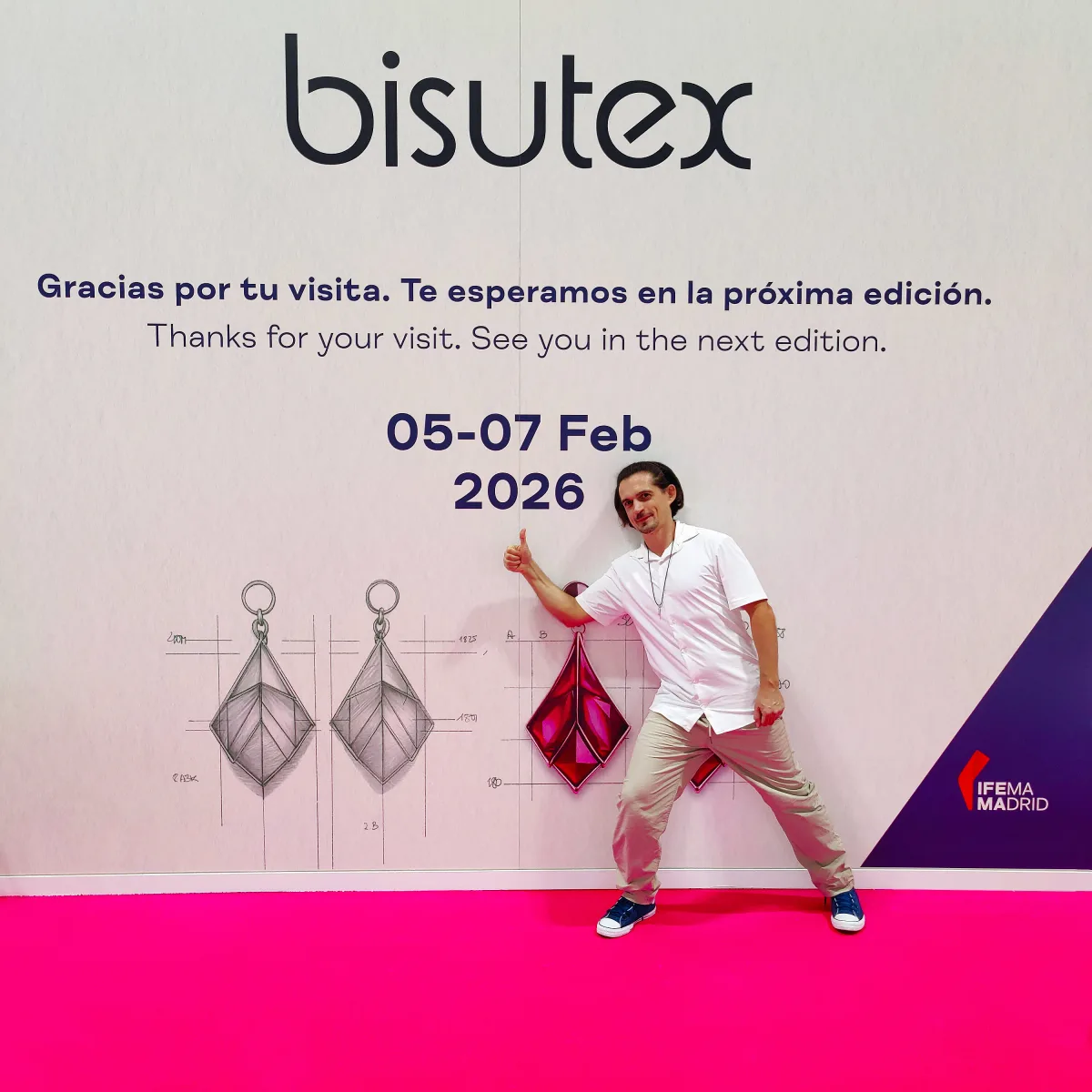
Zevira at IFEMA Madrid 2025: Report from Bisutex, Madridjoya and Intergift
From 11 to 13 September 2025 the Zevira team spent three working days at IFEMA Madrid, inside the pavilions of the September Lifestyle Week. This is our regular business trip twice a year: we study the market, look at equipment and packaging, meet suppliers, evaluate the trends of the season. In this piece we share what we saw, what we brought home, and which of it will land in the Zevira catalogue by autumn 2026.
Straight to the point: if you are curious where Zevira's assortment comes from, how we choose suppliers, which trends we factor into our collections and what we plan to add in the coming seasons, this report gives a direct answer. The technical background on the IFEMA complex itself and the history of the individual fairs is placed at the end of the article, and you can return to it whenever you like.
Our role at IFEMA
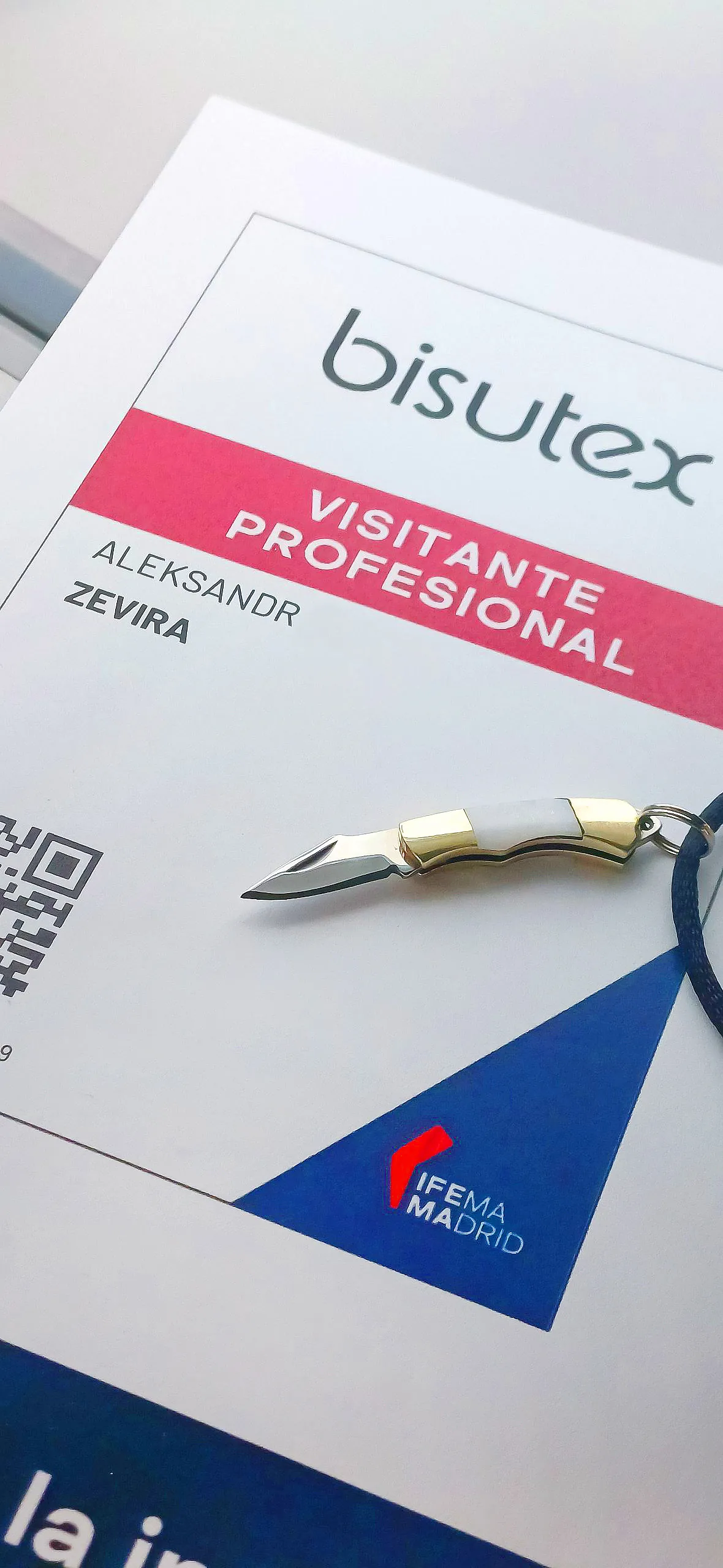
Zevira regularly attends IFEMA Lifestyle Week as an accredited professional visitor with official Visitante Profesional status. It is part of our operational cycle: the team walks the pavilions of Madridjoya, Bisutex and Intergift, studies the market, meets producers, evaluates equipment and packaging solutions, reads the trends of the season and picks directions for future collections.
The Visitante Profesional accreditation is not a formality. IFEMA issues it only to registered legal entities in the jewellery and adjacent industries, after verifying the activity of the company. These are closed B2B venues: entry is strictly by professional accreditation, every participant works inside the sector, and the conversation happens in the language of the trade.
This format gives us things that no catalogue or online sample kit can deliver.
Direct contact with the material. We feel the texture of enamel, test the weight of a piece in the hand, study how stones are set and how clasps behave, check the tone of gold across different karats. An online picture does not convey a tenth of what a piece actually feels like. At the fair you understand it in five minutes.
Direct negotiations with producers. Certain categories (basic chains, findings, clasps, components, packaging materials, equipment) make more sense to order from professional suppliers rather than trying to make everything in house. IFEMA lets us evaluate dozens of options in a single day, compare terms, and pick a partner while seeing the production in person, not through a website.
Exchange with the professional community. Large fairs host presentations, round tables, sector meetings. There people discuss what is selling well in the current season, which colour palettes the major European buyers are setting for the next one, how demand is shifting for materials and techniques. This is primary information that cannot be pulled out of a report.
What we looked at in Madridjoya
Madridjoya is the main jewellery pavilion of the complex: gold, silver, precious stones, watches and equipment. For Zevira it is the most substantial of the pavilions, because everything directly connected to our production is concentrated here.
What specifically we studied at the stands:
Precious metals. We reviewed offers for 14K and 18K gold, 925 sterling silver, and certified recycled raw materials. Separately we assessed suppliers of ready findings: clasps, jump rings, mountings, basic chain links. The task was simple: compare our current partners with alternatives and understand where it makes sense to refresh the supply chain.
Precious and semi-precious stones. Certified diamonds, sapphires of various colours, emeralds, rubies, tanzanites, aquamarines, topazes, citrines, amethysts. Separately lab-grown stones, which we actively use in our accessible segments: the price is several times lower, they are visually indistinguishable, and the ethical factor is a plus. We walked the stands offering lab-grown moissanite, and looked specifically at labradorite and moonstone to expand our coloured-stone line.
Pearls. Freshwater pearls, cultured akoya, Tahitian black, South Sea pearls, baroque irregular shapes. For us this is a direction to grow: in the current catalogue pearl is represented minimally, but after the fair it is clear how strongly the material is returning to fashion.
Watches. A short pass: watchmaking is not yet a core direction for us, but we watch the general level of the segment, because part of the jewellery houses work with watches in parallel.
After walking Madridjoya we shortlisted several potential new suppliers for stones and metals. Agreements are being finalised during October and November 2025.
The equipment that makes the jewellery
One of the most important professional discoveries at Madridjoya for a visitor from a working atelier is the equipment section. Here you see what usually does not make it into marketing materials but defines the quality of the finished piece. This is the part of the fair we arrived at with a specific list of questions for our workshop in Albacete.
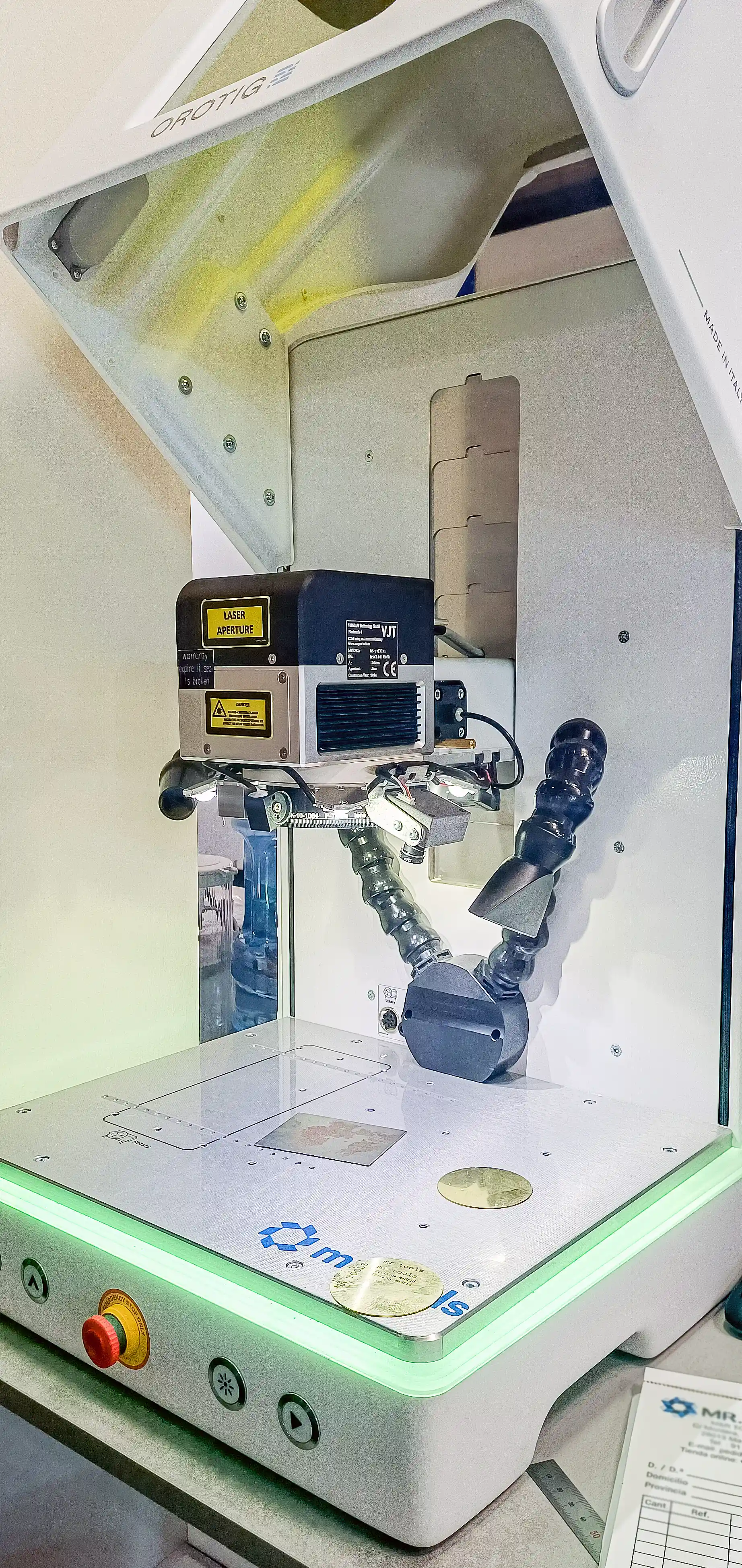
Laser welding units. Small desktop machines that spot-weld silver and gold links without heating the entire piece. For our atelier this is a key tool during repair and soldering of chains, when darkening of neighbouring sections cannot be allowed.
Ultrasonic cleaning units. From small desktop tanks to industrial chambers where dozens of pieces are cleaned at once. Parameters vary by material, by the construction of the mounting, and by the presence of stones that do not tolerate ultrasound (emerald, opal, pearl).
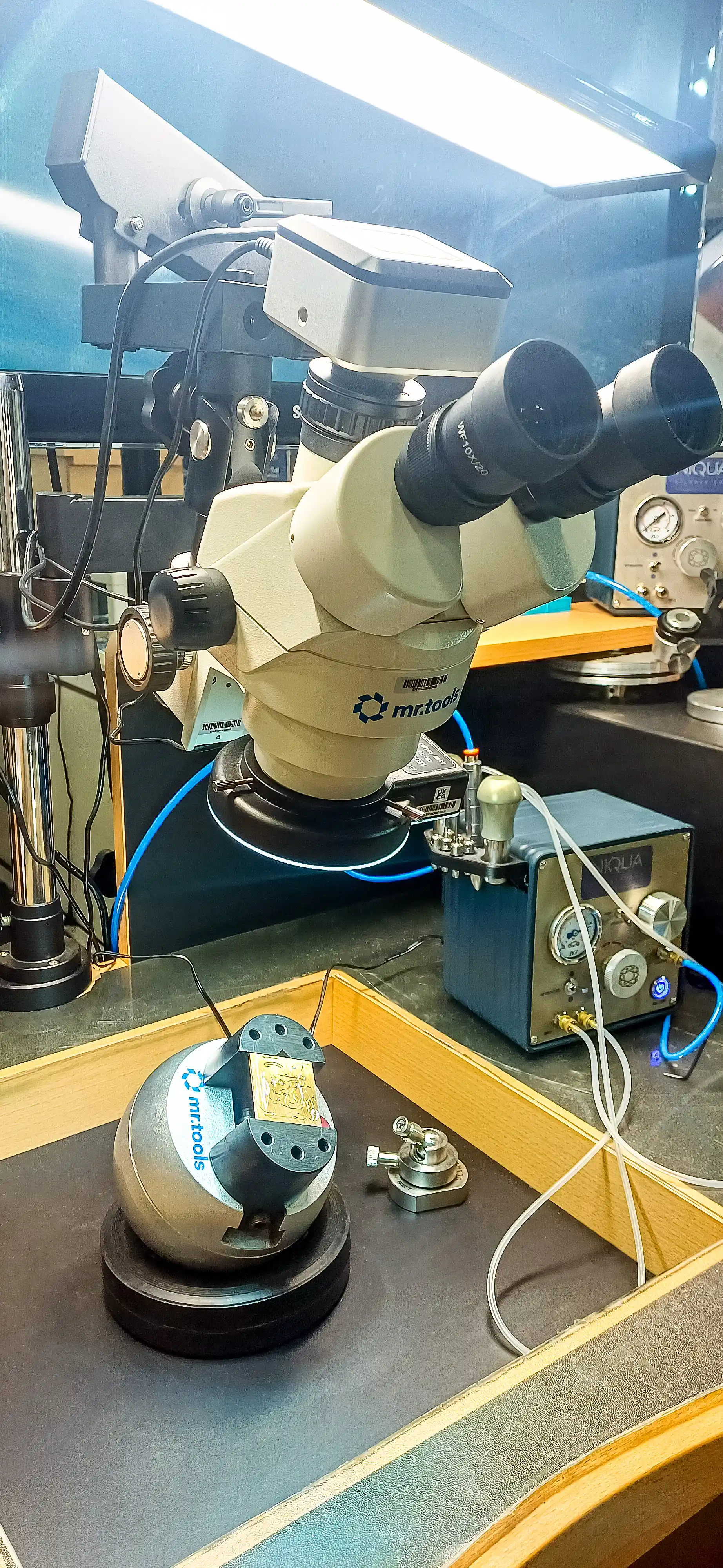
Binocular microscopes for stone setting. This is the microscope visible in the photo of our report. It is the standard jewellery instrument for working with small stones when setting into prong and bezel mountings, where tolerances run in hundredths of a millimetre.
3D printers for wax models. A client orders a custom design, the master draws it in CAD, the printer prints the wax, the wax becomes the cast piece. Ten years ago that cycle was still exotic. Today it is a standard working tool of an independent atelier.
Polishing machines, grinding units, muffle furnaces, rolling mills, drawplates for wire. Tools without which physical jewellery production does not exist. Some of the equipment in our workshop has been running a long time, and at the fair we studied offers for replacement and upgrade.
Part of what we saw in the equipment section of Madridjoya we scheduled for purchase within the next two quarters. This is a direct improvement in the quality of the pieces leaving the Albacete atelier for the Zevira catalogue.
Packaging and presentation: what we took from Intergift
Intergift, for a non-professional, is "the fair of gifts and decor". For a jewellery brand it is the pavilion of packaging, display equipment and everything tied to presenting the piece to the client. We went there with a concrete brief from our designer.
Why it matters. A jewellery piece does not exist in a vacuum. It lives inside a box, inside a pouch, inside gift wrapping. It appears in the window on a cushion, on a velvet stand, under directed light. Every one of those elements influences how the client perceives the product when opening the parcel.
What we looked at:
Shipping packaging. Cardboard boxes with magnetic closures, branded cases with foam inserts, velvet pouches, silk ribbons, paper fillers. Everything considered for international shipping: Zevira jewellery travels from Albacete to different countries, and packaging must survive postal transport, protect the piece from impact, and at the same time create an impression for the recipient.
Display equipment. Bust stands for necklaces, cushions for rings, stands for earrings, transparent boxes with built-in lighting. This is a category where we, as a brand, work above all in the photo studio and on product cards on the site: the pose of the piece, the background, the lighting directly determine how a piece looks inside a catalogue.
Gift styling. Ribbons, seals, enclosure cards. Jewellery is often bought as a gift, and a correctly styled parcel turns a box into a small celebration. At Intergift they show dozens of variants, from minimalism with a single thread on the box to layered wrapping with seasonal colour accents that rotate through the year.
From Intergift we brought something concrete: an update of the packaging line for gift orders by autumn 2026. New boxes, new ribbons, a new insert card. Following the fair these elements are already in progress with the Zevira designer.
Bisutex through Zevira's eyes
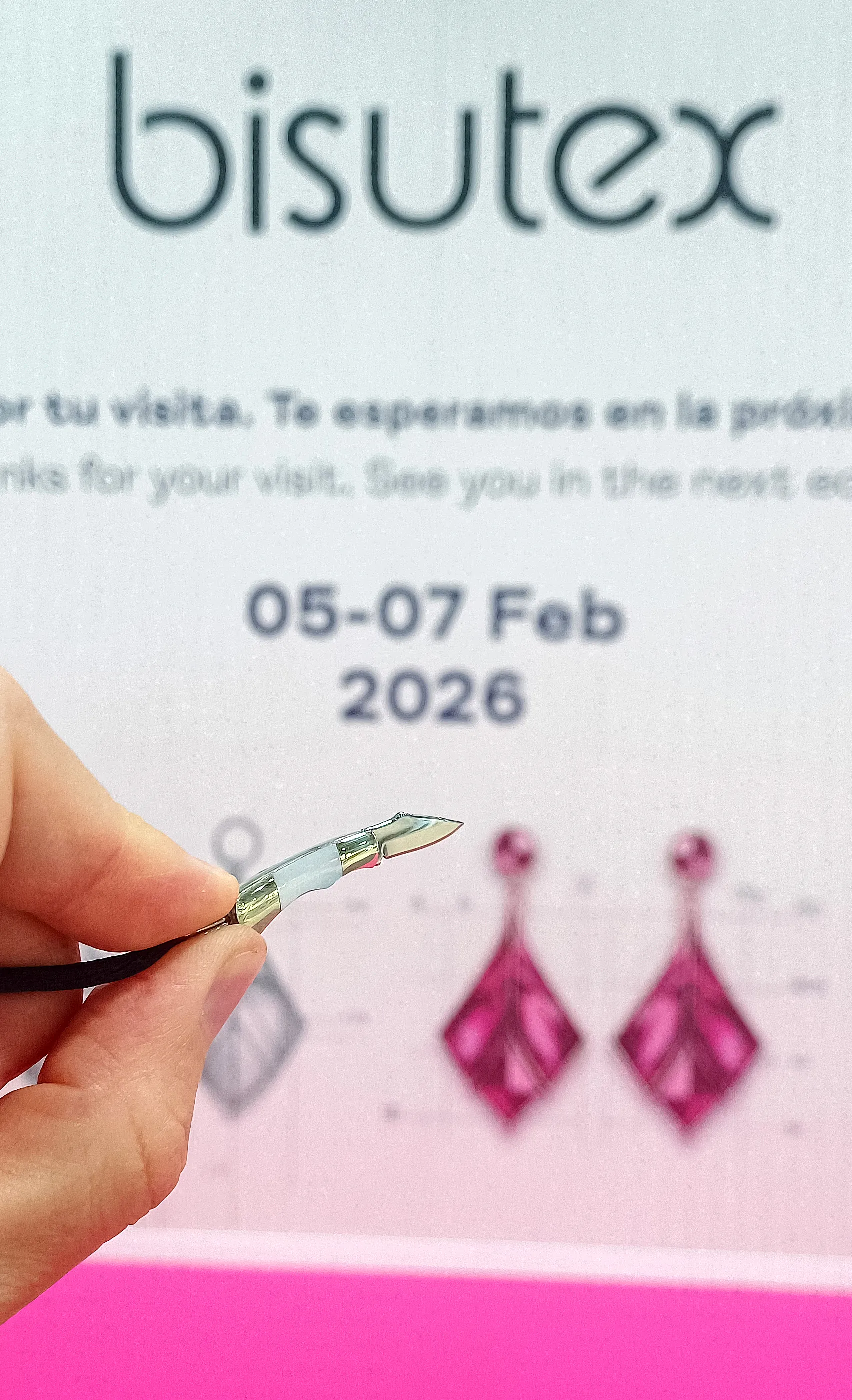
Bisutex is the pavilion of costume jewellery, accessories and mass-segment trends. Visually the brightest: colour, shape, mass production, independent design finds. For Zevira it matters for two reasons.
First, our catalogue includes categories that by formal definition belong to costume jewellery: brass pieces with PVD coating, items with resin and enamel, volume positions on a steel base. We do not hide that this is part of the assortment, and for these categories at Bisutex we look for trusted suppliers and new production partners.
Second, costume jewellery is a trend indicator. Trends move faster here than in fine jewellery, and often set a direction that the premium segment picks up a season or two later. For a brand working in six locales that wants to match live consumer queries, walking Bisutex is mandatory even for categories we do not produce in costume form ourselves.
Separately we walked the Minis zone, around 50 young companies and independent designers in compact stands. A kind of incubator of future trends. Often it is here that names appear which move into the mainstream two or three years later. After the visit we have several contacts we will be watching.
Jewellery trends for autumn-winter 2025-2026
What stood out across the general mass of stands in Madridjoya, Bisutex and Intergift. Jewellery for the autumn season of 2025-26 runs along several clear lines that read identically in the costume segment and in the fine one.
The return of scale. If the spring and summer seasons of 2023-2025 were the era of minimalism (thin chains, small pendants, discreet stud earrings), by autumn 2025 many designers are clearly pushing the assortment towards larger, more expressive pieces. Bold geometric earrings, cuff bracelets, layered necklaces are returning to collections. Good news for those who love statement pieces, and a signal that the era of absolute minimalism is gradually softening.
Pink as the dominant colour of the season. Across the stands of every pavilion the volume of pink was striking: from soft powdery tones to saturated fuchsia. Pink resins in costume pieces, rose quartz and 14K rose gold in fine jewellery, enamel in every shade of pink, pearls with a pink sheen. The scale of the presence was telling: across all segments at once.
Stones with colour, not just diamonds. On mid-segment stands there were visibly more semi-precious and synthetic coloured stones: labradorite, moonstone, amethyst, citrine, peridot. Colourless stones (cubic zirconia, zircon, moissanite) remain the main working tool, but colour is coming back as a strong accent.
Pearls everywhere. Freshwater pearl, cultured akoya, baroque forms, dark Tahitian, grey, pink, black. Pearl is returning not only in the classic "grandmother's strand" format but in unexpected hybrid solutions: pearl with metal, pearl with enamel, pearl with spikes, pearl in men's collections.
Symbols and meaning. A separate category that interests us in particular as a brand working with symbolism. In the September edition it was visible: demand for jewellery with meaning is not dropping, it is growing, and growing simultaneously in costume pieces and in silver and gold. Talismans, amulets, protection symbols, cultural motifs, astrology, zodiac signs, birthstones, tarot cards, runes, pentagrams. Symbolic jewellery is a growing niche, and many Spanish, Italian and Mexican brands are placing their bet on it.
The return of artisanal aesthetics. Hand engraving, filigree, traditional techniques. Several Spanish masters showed work in the technique of damasquinado (Toledo inlay of gold and silver on a black steel base), which we also actively use in our Forja Española line. It is good to see ancient Spanish techniques not fading into history but receiving a new reading inside contemporary collections.
Personalisation and engraving. Almost every second stand offers name engraving, birthstone selection, personal coordinates, dates. This is a stable long-term trend, and our own order book confirms it: a share of Zevira clients come specifically for a piece engraved with a meaningful date or name.
The ethical agenda. Recycled silver, certified gold, ethical supply of coloured stones. On the stands there are visibly more markings like "recycled silver", "fair-mined gold", "lab-grown" with specified countries of origin. Ethical transparency is becoming part of positioning, and that is the right direction.
What we took into work after IFEMA
We are not coming back empty-handed. After the fair our internal map of directions for autumn 2026 has several new entries.
Expansion of the coloured line. Having seen how strongly coloured stones are returning to fashion, we decided to increase the share of pieces with labradorite, moonstone, amethyst and citrine. We already use these materials, but we are moving them into more visible catalogue positions.
A pink-accent line. Today pink in the Zevira catalogue is represented mostly through 14K rose gold and rose quartz. After the September edition we are looking at expansion: enamel accents, ruby inserts in silver, pink pearl in men's series.
A series with baroque freshwater pearl. Several stands showed beautiful solutions with baroque freshwater pearl in minimal silver mountings. We are working on a similar series for release by autumn 2026. It will be an accessible segment with interesting texture.
Deepening the symbolic line. This is confirmation that we are doing the right thing. Our articles on the meaning of symbols (pentagram, ankh, all-seeing eye, ouroboros, anchor, arrow, tree of life and dozens of others) index well, and at the fair we saw that demand for amulet-jewellery is growing steadily in both segments: costume and silver. We plan to expand this category, especially in the direction of rare symbols and cultural traditions (lauburu, Sumerian motifs, Slavic symbolism).
Ethical transparency. Following the visit we are working on a more detailed page about the origin of our materials. Recycled silver, certified gold, stones from verified supplies. We will place this explicitly on product pages, not only in general statements.
Workshop equipment. A separate track: after walking the professional equipment section at Madridjoya, two positions in our workshop are scheduled for upgrade. This is a direct improvement in the quality of pieces leaving the atelier for the catalogue.
Packaging update. The new boxes, ribbons and inserts selected at Intergift are already in progress with the designer. By autumn 2026 gift orders will ship in refreshed styling.
Next visit: autumn 2026
Our next trip to IFEMA Madrid is scheduled for the autumn Lifestyle Week of 2026: September 2026, all four pavilions. Before that, part of the team will travel to the February edition of Bisutex (5 to 7 February 2026) to read the early slice of the spring-summer collections. But the main working entry is the autumn one: there all four fairs align at the same time, and within three or four days you can cover Madridjoya, Bisutex, Intergift and Momad in sequence.
For the autumn 2026 edition we will arrive with a more concrete task list. We are searching for partners in the categories we are scaling: personalised engraving, work with larger coloured stones, production of custom-designed wedding rings, expansion of the Forja Española handcraft line. A separate task is verification of the new equipment we spotted at this edition and negotiations with producers on supply terms.
For the Zevira buyer this means a simple thing: by autumn 2026 new positions will appear in the catalogue, selected not by chance but on the basis of live study of the international market. We do not just read analyst reports and scroll social feeds: we walk a real fair, we touch the materials, we talk to producers, we evaluate equipment, and we draw conclusions.
A few observations from the side
Since we sat down to write a long-form piece, here are several observations that do not fit into reports but may interest those curious about how the industry works from the inside.
At B2B fairs of this level there is an atmosphere that is hard to convey in text. It is not a shopping mall where sellers try to push something at you. It feels more like a professional conference, where everyone speaks the same language: wholesale discount percentages, MOQ (minimum order quantity), logistics, certification, delivery times, VAT, customs codes. Negotiations go calmly, without pressure. Many stands are arranged so that part of the exhibits is freely laid out for a professional to pick up, look at, study. Sellers step in only when they see real interest.
At the same time there is an awareness in the air that every contact is a potential large order, and behaviour matches. No fuss, no marketing noise. A business card, a short conversation, a photo of the stand for reference, a note in the notebook, move on to the next stand.
A separate layer is the language of communication. Most stands work in Spanish and English, but you also hear Italian, French, German and Chinese. For a brand working in six locales (Russian, Spanish, English, Italian, French, German) this is a native environment. Switching between several languages during the day is not a tourist entertainment but a working necessity.
Another observation. Despite the general trend of digitalisation and online commerce, fairs at the level of IFEMA Lifestyle Week are not losing relevance, they are gaining ground. The September 2025 edition showed growth both in the number of exhibitors and in the international geography of visitors across all four pavilions. The reason is simple: in serious B2B deals, personal contact and the ability to hold the goods in your hand remain irreplaceable. No high-resolution video replaces the feeling of the weight of a piece in the palm or the real tone of enamel under natural light.
About Zevira
Zevira is an independent jewellery brand founded in Albacete, Spain. Albacete is one of the two historical centres of Spanish artisanal production (the other being Toledo), where for centuries masters forged blades, made navajas and created jewellery in the tradition of Forja Española. We continue this tradition in a modern format: part of our pieces is produced in our own atelier with a high share of handwork, and part is sourced from trusted production partners under strict criteria for quality and materials.
We work in six locales: Spanish, Russian, English, Italian, French and German. The Zevira catalogue covers symbolic jewellery, precious and semi-precious stones, handcraft techniques (damasquinado, filigree, hand engraving), meteorite rings, personalised pieces with engraving, and the Forja Española line with navajas and Spanish blades.
Regular work at international sector events, including IFEMA Lifestyle Week in Madrid (Madridjoya, Bisutex, Intergift), is part of our production and curatorial practice. Zevira is embedded in the European professional community, and for us this is a mandatory part of the job, not a one-off appearance.
Our next visit to IFEMA Madrid is planned for the autumn Lifestyle Week of 2026. If you have wishes about which categories or techniques you would like to see in the catalogue by then, write to us. We take feedback into account when planning the trip and the task list for the fair.
Photos from IFEMA Madrid 2025
Reference: what IFEMA Lifestyle Week is
For those interested in the context of the fair itself, not only our working report, below is an extended reference on the IFEMA Madrid complex, the history of Madridjoya, Bisutex and Intergift, the numbers of the September 2025 edition, and the general logic of the sector venue. This block can be read separately from the rest of the piece.
IFEMA Madrid: the complex overall
IFEMA Madrid is the main exhibition complex of Spain: dozens of pavilions, hundreds of thousands of square metres of net exhibition space, a year-round programme of sector events. The complex sits in the north-east of Madrid, in the Campo de las Naciones district, within walking distance of Madrid-Barajas airport, which makes it convenient for international professional travel: a brand flies in in the morning, stays at one of the hotels beside the fair, works three or four days and flies back.
In February and September, IFEMA launches a cluster of four specialised fairs that together cover the whole industry of jewellery, accessories, gifts and fashion. That is what is called IFEMA Lifestyle Week: four parallel fairs inside one week, the same schedule, shared infrastructure, one professional accreditation that opens entry to every pavilion.
For a jewellery brand the format is convenient: with a single professional accreditation, within three or four days you can close the work for every category of the season. Fine jewellery in one pavilion, silver in another, watches in a third, costume jewellery and accessories in a fourth, packaging and equipment in a fifth, fashion clothing and footwear in a sixth. Everything physically within walking distance.
Together the four fairs of the September 2025 edition drew around 35,000 professional visitors. This is not a public fair with children and tourists but a closed B2B venue: entry requires registration of a legal entity, confirmation of professional activity in the sector, and official IFEMA accreditation with Visitante Profesional status on a named badge.
Madridjoya: running since 1982
Madridjoya is the international fair of fine jewellery, watches and equipment for jewellery production. It has been held by IFEMA since 1982, and across 43 years of operation it has grown into one of the key jewellery events of southern Europe alongside the Italian Vicenzaoro. The September 2025 edition gathered companies and brands from 33 countries: Spain as the home market, Portugal, Italy, France, the USA, Mexico, plus participants from Latin America, the Middle East and Asia.
The seasonal focus of the autumn edition: collections for the autumn-winter season and for Christmas sales, which in Catholic Europe make up a significant share of the annual turnover of jewellery shops. That is why the September entry is critical for those who want to make it to December with a refreshed assortment.
The specificity of Madridjoya is that the pavilion unites finished jewellery, raw material (metals, stones, pearls) and production equipment for workshops inside one space. This gives the chance in a single day to cover the whole chain: from the supplier of casting wax to the brand that sells finished wedding rings.
Bisutex: figures and format
Bisutex is pavilion 8 of IFEMA, specialised in non-precious jewellery and accessories. The name comes from the Spanish word bisutería. The fair shows costume jewellery, mid-segment watches, bags, belts, scarves, headwear, eyewear, hair accessories, leather goods.
The September 2025 edition occupied around 5,100 square metres of net exhibition space. The stands hosted around 200 exhibiting companies and about 350 separate brands from 14 countries: Spain, Italy, Germany, Belgium, Greece, Portugal, Morocco, India, the USA, Colombia, Puerto Rico and others. Professional visitors across three days numbered more than 5,500 people from 48 countries.
A separate Minis zone: around 50 young companies and independent designers in compact stands. This is an incubator of future trends, through which pass many names that move into the mid-segment mainstream two or three years later.
Intergift and Momad
Intergift is the fair of gifts, decor, packaging and retail equipment. For the jewellery sector it is primarily about packaging solutions, display equipment, gift styling and systems for presenting goods in the shop and in shipping.
Momad is the fourth fair of Lifestyle Week, dedicated to fashion in the broad sense: clothing, footwear, textile. For a jewellery brand Momad is a peripheral pavilion, but one visits it to read colour and stylistic trends of the coming season in clothing, because fashion and jewellery move in sync.
Why such fairs matter for an online brand
In the 2020s, against the general trend of online, one might expect sector fairs to be fading out. In practice the opposite is happening: IFEMA Lifestyle Week shows growth year after year. The reason is simple. In serious B2B deals in jewellery, where the subject is gold lots, certified stones, equipment contracts, personal contact and the ability to physically evaluate material remain irreplaceable. No high-resolution video transmits the sense of the weight of a piece in the hand, the real tone of enamel under natural light, the quality of polishing or the spring of a clasp.
For independent brands such as Zevira the fair format is also a way to be part of the sector, not simply a website on the internet. We physically meet producers and other brands, we are known by face, we know suppliers by face. This creates a layer of professional relationships that cannot be built through a contact form on someone else's site.
Conclusion
IFEMA Lifestyle Week 2025 confirmed what we already knew: the Spanish, and more broadly European, jewellery industry is a living and dynamic sector with a large number of strong players and clearly readable trends across every segment, from mass costume jewellery to fine pieces, from workshop equipment to packaging solutions. Regular participation at such events is not a luxury and not a PR move. It is a baseline professional task for a jewellery brand that wants to be a real participant of the sector, not just an online shop.
We returned to the workshop with a concrete list of decisions that will be rolled into the Zevira catalogue by autumn 2026, with dozens of new contacts for supply and partnership, with a refreshed understanding of where the sector is moving, and with a plan for the next visit a year from now.
Follow our journal: as the items from this list are implemented in the catalogue, we will tell the story of each new category separately.