Whale Jewellery: Symbol of the Deep, History and Meaning
Introduction
The blue whale is the largest creature that has ever lived on this planet. At up to thirty-three metres long and one hundred and eighty tonnes, it dwarfs every dinosaur that walked the Earth. When one of these animals surfaces, breathes and dives again, the tail hangs above the water for two or three seconds, two broad flukes against the sky with water streaming from the edges, before slipping below. That silhouette became one of the defining marine images of the late twentieth century, and it is now one of the most recognisable motifs in contemporary jewellery.
The cultural history of the whale is long and uneven. In the Book of Job, Leviathan appears as a sea creature so vast and so fearsome that even the author seems physically afraid. In the Book of Jonah, the prophet spends three days inside a great fish, and that episode echoes through Western art for two thousand years. Early Christian mosaics in the Roman catacombs repeat the scene as a prefiguration of the Resurrection. In antiquity a whole constellation received the name Cetus and was catalogued by Ptolemy alongside the other figures of the night sky.
Wear the symbol, don't just read about it. These are in stock:
Running alongside this mythology is a harder economic history. From the eleventh century, Basque fishermen of the Bay of Biscay were the first Europeans to hunt whales systematically from small sail boats, and the coats of arms of coastal Basque towns still carry the whale as a mark of local trade. In the seventeenth and eighteenth centuries, the Dutch and the English worked the waters off Spitsbergen. By the nineteenth century, Nantucket and New Bedford in Massachusetts had become the capitals of a global industry, and in 1851 Herman Melville published Moby-Dick and turned one chase into one of the central metaphors of American literature.
Britain's own whaling tradition ran deep and left its marks. The port of Whitby in North Yorkshire became the leading British whaling station by the late eighteenth century, sending fleets to Greenland and the Arctic. The Hull whaling industry peaked in the 1820s when the city's ships returned with thousands of tonnes of blubber each season. The bones of whales were built into garden walls and gateways across the northern coastal towns, a quiet record of how thoroughly the trade had shaped local life. It was from this same maritime culture that James Cook had sailed, trained in part by the navigational precision that whaling demanded.
In the second half of the twentieth century, the whale changed its cultural register entirely. The moratorium on commercial whaling came into force in 1986 after the International Whaling Commission adopted it in 1982. The humpback whale songs recorded by oceanographer Roger Payne in 1970, distributed on vinyl records sold by the millions, shifted mass-culture attitudes in ways that no policy document could. Greenpeace's direct actions against Soviet and Japanese whaling ships in the mid-1970s, carried out partly from British waters and with significant British public support, made the campaign one of the first globally successful conservation efforts. A creature that had been a commercial resource for centuries became within a single generation the symbol of what humanity had nearly destroyed and managed to keep.
The jewellery iconography followed the same arc, from scrimshaw carved on sperm-whale teeth and baleen by nineteenth-century sailors on long voyages, to the clean silver whale tail of today that contains no part of the animal at all.
This guide covers the whale as a jewellery motif honestly. No mysticism, no easy ecology. The meanings we read into the whale's silhouette belong to us rather than to the animal. But that is precisely what makes a piece of whale jewellery worth examining: it records a genuine cultural shift, not a fantasy.
Whale Jewellery: Choosing the Right Piece
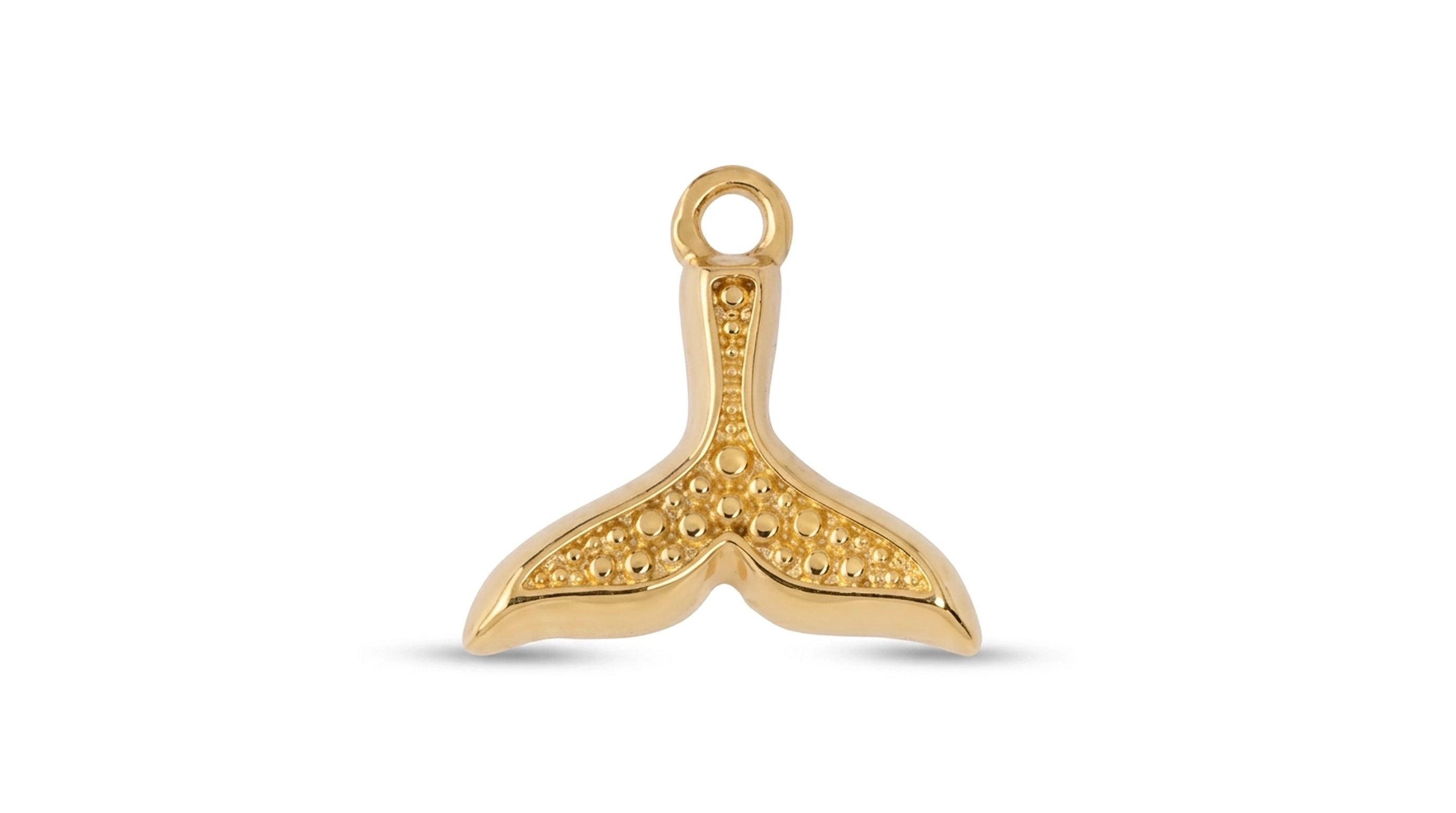
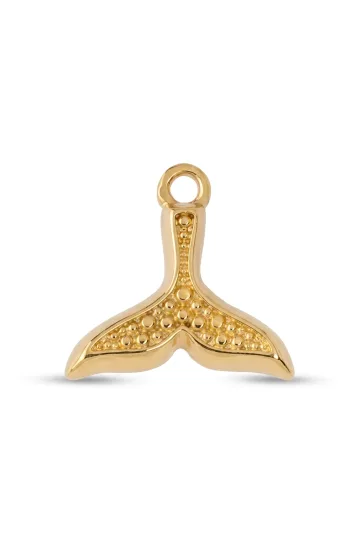
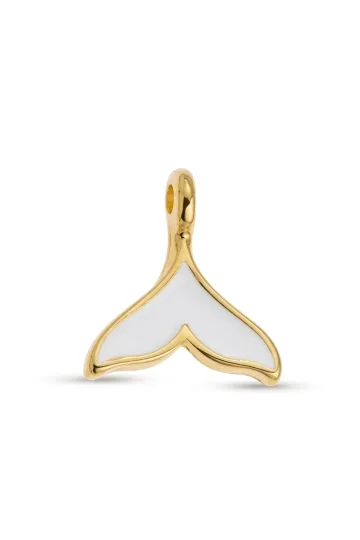
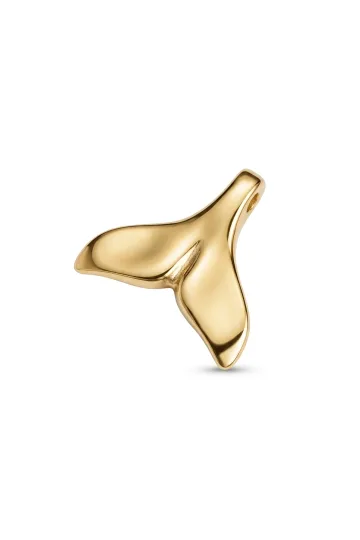
The whale tail pendant is the most widely chosen format, comfortably outpacing every other whale motif. Two symmetrical flukes with a slight curve along the trailing edge, a shallow notch at the centre, a short stalk where the tail joins the body, the width usually between one and a half and three centimetres. On a forty-five or fifty centimetre chain it sits at the collar bone and reads clearly at a glance. The graphic simplicity of the silhouette makes it genuinely versatile: equally at home with daily wear and with office clothing, suitable for any age, untroubled by a heavy collar, a scarf or a pair of glasses.
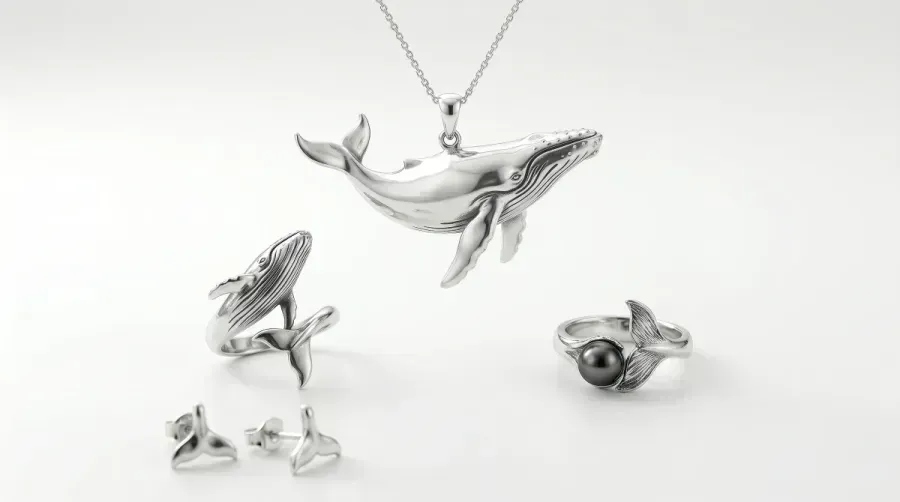
A pendant showing the whole whale mid-leap works differently. The body arched, the pectoral fins spread like wings, the tail slightly raised, often with a thin wave line beneath the figure. At less than three centimetres in width the detail tends to be lost, so most pieces run from three to four and a half centimetres. This is a statement accent, best against plain clothing when the rest of the outfit is not competing.
Stud earrings with a miniature fluke under a centimetre wide are a quiet daily motif. The shape reads as near-abstract at a distance, recognised close up rather than across a room. Drop earrings with a leaping whale two to three centimetres long bring more decorative presence, particularly when the movement is emphasised through a swinging element or a deliberate asymmetry.
Rings with a whale tail in raised relief on the shank work best when the form is kept clean: two lobes rising above the band, perhaps with a trace of oxidation in the recessed centre to separate the tail from the metal below. Wide bands with a whale wrapped round the finger exist but demand more complex anatomy and are made less frequently.
Charm bracelets benefit from a whale charm because the piece can be added to an existing collection, replaced or worn separately on a chain. Charms are usually one and a half to two and a half centimetres and tend to show the full whale silhouette, which at that scale can still hold its detail.
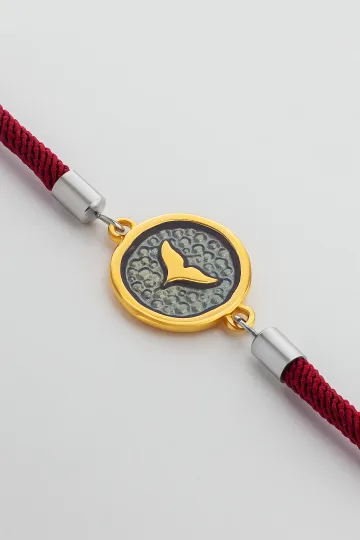
The masculine format runs larger and denser. A silver whale in full profile from three to five centimetres long, oxidised for a muted tone, on a leather or cotton cord of fifty to sixty centimetres, is a marine amulet in a register that needs no explanation. Suitable for anyone whose life is genuinely connected to the sea: divers, sailors, surfers, marine biologists.
A large brooch five to seven centimetres across works as a standalone accent on a lapel or the collar of a heavy coat. The humpback's long pectoral fins, which can reach a third of the animal's body length, give the silhouette its characteristic spread and make it readable from a distance.
Paired pendants with two flukes slightly offset, as though two whales are diving side by side, are a gift format in their own right. Whale-watching tourists returning from the Azores, the Canary Islands, Iceland or Baja California often look for exactly this as a shared record of the trip.
Children's pendants at around one and a half centimetres, on a fine chain with smooth rounded edges and no projecting fins, suit a gift for a birth or a first birthday.
A whale tail lives in silver, high at the collarbone. A gold leviathan sprawled across the chest is a gift-shop, not the ocean. End of discussion.
How to wear a whale
I have styled the ocean line across dozens of looks, and here is what actually holds up, by occasion.
How do I wear a whale every day? For everyday I recommend a silver whale tail on a fine forty-five to fifty centimetre chain: it sits at the collarbone and reads at a glance. A light top (white, sand, grey marl) lifts the metal, a dark one (charcoal, deep navy, olive) turns the fluke into the accent. It works as calmly with jeans as with a loose shirt dress.
Is it right for the office? It is, as long as you keep it quiet. I suggest a silver tail under a blazer or over a thin roll-neck, forty-five to fifty centimetres, so the pendant stays a quiet detail rather than a nautical theme on show. If you want a little more, add stud earrings with a small tail: one motif twice, no clutter.
How do I build an evening look? For evening I choose either a full leaping whale as the single accent on a plain dress in a calm tone, or the tail dropped onto a sixty centimetre chain under a deep neckline. I do not mix metals: silver for a cool palette (charcoal, blue, black), yellow gold for a warm one (burgundy, sand, dark green).
Who is the large whale on a cord for? The marine amulet on a leather or cotton cord I recommend to anyone tied to the sea by work or leisure: divers, sailors, surfers. This whale goes with a plain shirt, a coarse-knit jumper, a tee and natural fabrics, linen and cotton. Shiny synthetics I would leave off, they flatten the matte silver.
Who does it suit in general? Anyone who wants a meaningful but low-volume sign rather than a mass of shine. Two rules that never fail. First: I fit the length to the neckline, the tail should land in the open zone at the collarbone. Second: no more than two ocean motifs at once, or the look drifts into a gift-shop.

Turn on your camera, pick earrings, a pendant or a ring, and see the piece on yourself in real time.
Switch items in one tap.
Everything runs in your browser: no photo or video is ever uploaded.
Species of Whales in Jewellery
The humpback with its long pectoral fins is the most recognisable form in the leaping pose. Those fins reach a third of the body length, the longest of any whale species, and they give the figure its distinctive spread. Jewellers generally show the humpback at the moment of vertical breach, body upright and fins extended. A thin wave line below the figure completes the composition. The humpback also leads by recognition among whale-watchers because it breaches more readily than most other species.
The sperm whale with its massive rectangular head, roughly a third of its body length, is the creature Melville used for Moby-Dick. In the novel the white cachalot is named with technical precision, and its anatomy matches the real animal. The silhouette with its large flat forehead and narrow underslung jaw is immediately distinct and works well in spare, minimal executions where the profile alone carries the meaning.
The blue whale with its streamlined body, small dorsal fin and characteristic blue-grey skin carries an association of planetary scale. Its heart is roughly the size of a small car, and those figures stand behind every mention of the species. In jewellery the blue whale is often given a wash of pale blue enamel along the back.
The bowhead whale is closely associated with Inuit culture and is among the few species for which subsistence hunting remains permitted, under quota, for Arctic indigenous communities. Its silhouette is marked by an enormous head and the absence of a dorsal fin, giving it a smooth clean profile unlike the familiar triangle of most other species.
The whale tail as an isolated motif, the fluke in biological terminology, is typically a smooth two-lobed V with a shallow notch along the trailing edge. In biology the pattern of each whale's flukes is unique, like a fingerprint, and researchers catalogue individual animals precisely by fluke photographs. The North Atlantic Humpback Whale Catalogue holds more than ten thousand individually identified animals, each recognised by its tail. That biological fact gives the motif a secondary meaning beyond its graphic quality.
Orca, technically a member of the dolphin family though culturally referred to as a whale in most Western languages, offers jewellers the opportunity for high-contrast enamel work: black dorsal surface, white eye patch, white underside. The silhouette is unmistakable and draws particular resonance from the cultures of the Pacific Northwest, where Haida, Tlingit and Kwakwaka'wakw traditions have worked with the orca image for centuries.
Customer reviews
Zevira is a real jewellery shop. Genuine payments, deliveries and customer thank-yous.
🥰🥰🥰 gracias
Ok, ¡gracias! 🙂
History of the Whale as Symbol
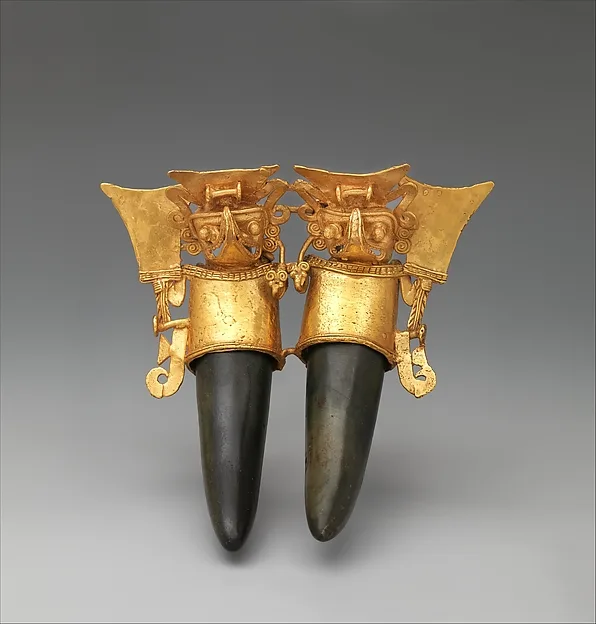
The biblical Jonah and the great fish: the Book of Jonah, one of the shortest books of the Hebrew Bible, describes how Jonah attempts to flee a divine commission, boards a ship bound for Tarshish, is caught in a storm, thrown overboard by the sailors after a lot is cast, and swallowed by a great fish. The Hebrew text says dag gadol, a great fish, not specifically a whale, but Christian tradition from early on identified the creature with a whale, and the motif settled into European visual culture as such. Three days inside the fish, then ejected onto dry land. The Gospel of Matthew cites this as the sign of Jonah, prefiguring the three days between the Crucifixion and the Resurrection, and from that moment the image became one of the most frequently reproduced in early Christian art.
Leviathan in the Book of Job appears in a long divine speech describing a creature that cannot be overcome, whose breath kindles coals and from whose mouth go burning torches. The Kabbalistic tradition reads Leviathan as the sea-chaos that must be contained at the end of time. In 1651, Thomas Hobbes took the word as the title of his major political treatise, making Leviathan synonymous with the irresistible force of the sovereign state, a usage that has run alongside the marine meaning ever since.
Cetus in Greek mythology was the sea monster sent by Poseidon to devour Andromeda and slain by Perseus. The creature gave its name to the constellation Cetus, which Ptolemy catalogued in the second century AD and which remains in the star charts today, lying south of the ecliptic near Pisces and Aquarius. It does not belong to the zodiac, though popular astrology occasionally promotes it as a thirteenth sign.
The Basque whaling tradition from the eleventh century onward made the whale a heraldic animal across the coastal towns of the Bay of Biscay. The arms of Bermeo show a harpooner attacking a whale from a boat. Ondarroa and Zarauz carry similar motifs. By the fifteenth century Basque crews were operating off Newfoundland and Labrador, and the remains of their seasonal stations at Red Bay in Labrador have been excavated to reveal three sunken Basque galleons and extensive whale-processing debris.
British whaling reached its height in the late eighteenth and early nineteenth centuries. Whitby sent its first Arctic whaling vessel in 1753. By 1790 the town had more than twenty ships working Greenland waters. Hull was the largest whaling port in Britain by the 1820s, with sixty or more ships leaving each spring. The industry provided oil for street lighting, baleen for corsets and carriage springs, and a training ground for navigators who later joined Royal Navy expeditions. The writer Elizabeth Gaskell set scenes of the trade in her novel Sylvia's Lovers (1863), and the bones of whales in the streets and gardens of Whitby and Scarborough remained visible well into the twentieth century.
Scrimshaw, the engraving of designs onto sperm-whale teeth and baleen plates, was the craft of sailors on voyages that could last three years without landfall. Hunting scenes, portraits of wives, maps of home ports, naval engagements: the best pieces are now in the marine museums of New Bedford, Mystic Seaport in Connecticut and Salem, Massachusetts. This is a historical fact worth noting because it marks the point at which the whale entered fine craft as a motif. The distinction matters: contemporary jewellery with a whale motif uses no part of the animal.
The International Whaling Commission was established in Washington in 1946. The commercial whaling moratorium was adopted in 1982 and came into force in 1986, where it remains. Exemptions exist for the subsistence hunting of indigenous Arctic communities and for a small number of countries operating under disputed scientific licences.
Greenpeace's campaigns from the mid-1970s, when inflatable boats were placed between Soviet harpoon ships and their targets, were among the first environmental actions to attract genuinely global media coverage, and the British chapter played a significant part in organising and publicising those operations. By the 1980s the humpback whale had become as recognisable a symbol of the conservation movement as the panda, and the moral force of the campaign has never entirely separated itself from the cultural image of the animal.
Upload a photo of your pet, someone you love, or an object. We'll build a 3D model and hand-cast it in pewter.


The Whale in Different Cultures
Inuit and Arctic Peoples
Among the Inuit of Alaska, Canada and Greenland, the Yupik of Alaska, and the Chukchi of eastern Russia, the bowhead whale was not merely food but the organising centre of material culture: its oil fuelled lamps and heating, its bones supported the frameworks of houses, its skin and sinew covered boats and clothed people. Nothing else in the Arctic ecosystem carried the same weight. Inuit oral tradition includes figures who transform into whales and return to the human community in animal form. The carved ivory figurines of the Dorset culture, dating from around 500 BC, and the later Thule culture objects include highly detailed whale representations that are among the earliest identifiable whale images in world art.
The subsistence quota that allows Alaskan and Greenlandic Inuit communities to continue bowhead hunting rests on a legal distinction the International Whaling Commission makes between commercial and cultural subsistence hunting. A family receiving a single whale distributes the meat and muktuk across an entire village, as generations did before them. That continuity is the basis of the exemption.
Maori and Polynesian Peoples
In Maori tradition the whale is called tohorā and belongs to the category of taonga, cultural treasures with lasting genealogical significance. The ancestor Paikea, known also as Kahutia-Te-Rangi, is said to have ridden a whale from Hawaiki to Aotearoa, becoming the founder of the Ngati Porou people. The 2002 film Whale Rider brought this narrative to international audiences. The whale tail appears as an independent motif in Maori woodcarving before European contact, and traditional objects were made from whale bone and pounamu greenstone. Contemporary jewellery in whale motifs from outside New Zealand is made from metal, not bone, specifically to avoid competing with a protected tribal tradition.
British and Northern European Tradition
Beyond Whitby and Hull, the whale entered British culture through the ports of Dundee, Peterhead and Aberdeen, which sent fleets to the Davis Strait and later the Antarctic. The Arctic explorer William Scoresby Jr, who sailed from Whitby, was one of the most productive whalers of the early nineteenth century and simultaneously a serious naturalist who published accurate descriptions and measurements of several whale species. His journals, read alongside Melville's fiction, form the two poles of nineteenth-century English-language writing about the whale: one scientific, one metaphysical.
Norse mythology dealt with the whale both as a sea creature of practical importance and as a shape that could conceal supernatural danger. The Finnish-Norse tradition of the whale island, where a sailor camps on what appears to be a small island only for it to submerge at night, recurs in Scandinavian and Irish medieval texts and was still in circulation in sixteenth-century sailor lore.
Basque Tradition
The Basque relationship with the whale lasted from at least the eleventh century to the nineteenth and reached every ocean basin. The heraldic record across the coastal towns of the Bay of Biscay, from San Sebastian and Ondarroa to Bermeo and Pasaia, shows how thoroughly the trade had shaped local identity. The archaeological site at Red Bay, Labrador, where three Basque galleons from the 1560s were excavated beginning in the 1977, is now a UNESCO World Heritage Site. It preserves the most complete physical evidence of sixteenth-century whaling in existence and links Iberian maritime history to the Atlantic whale story in a way that no other site can match.
The Jonah Mosaic Tradition in Early Christianity
The scene of Jonah inside the whale appears more often than almost any other image in the catacombs and on the sarcophagi of the first four centuries of Christianity. The catacombs of Domitilla, Callixtus and Saints Peter and Marcellinus in Rome all carry versions of the scene. The creature is usually shown with an open mouth and a fantastical body, part fish, part serpent, reflecting Greek ideas about sea monsters rather than any knowledge of actual whale anatomy. But those early Christian images established the visual grammar of the whale as something vast enough to swallow a human being whole, and that grammar fed directly into the European imagination for more than a thousand years.
Modern Environmental Symbolism
Since the 1970s the whale has carried the weight of representing what human industry nearly consumed and what international cooperation managed to rescue. The humpback songs, the Greenpeace campaigns, the collapse of commercial whaling, the gradual population recovery of several species, have made the whale an emblem of a particular kind of hope: large-scale, hard-won and still incomplete. A piece of whale jewellery worn today carries this cultural layer even when the wearer does not consciously invoke it.
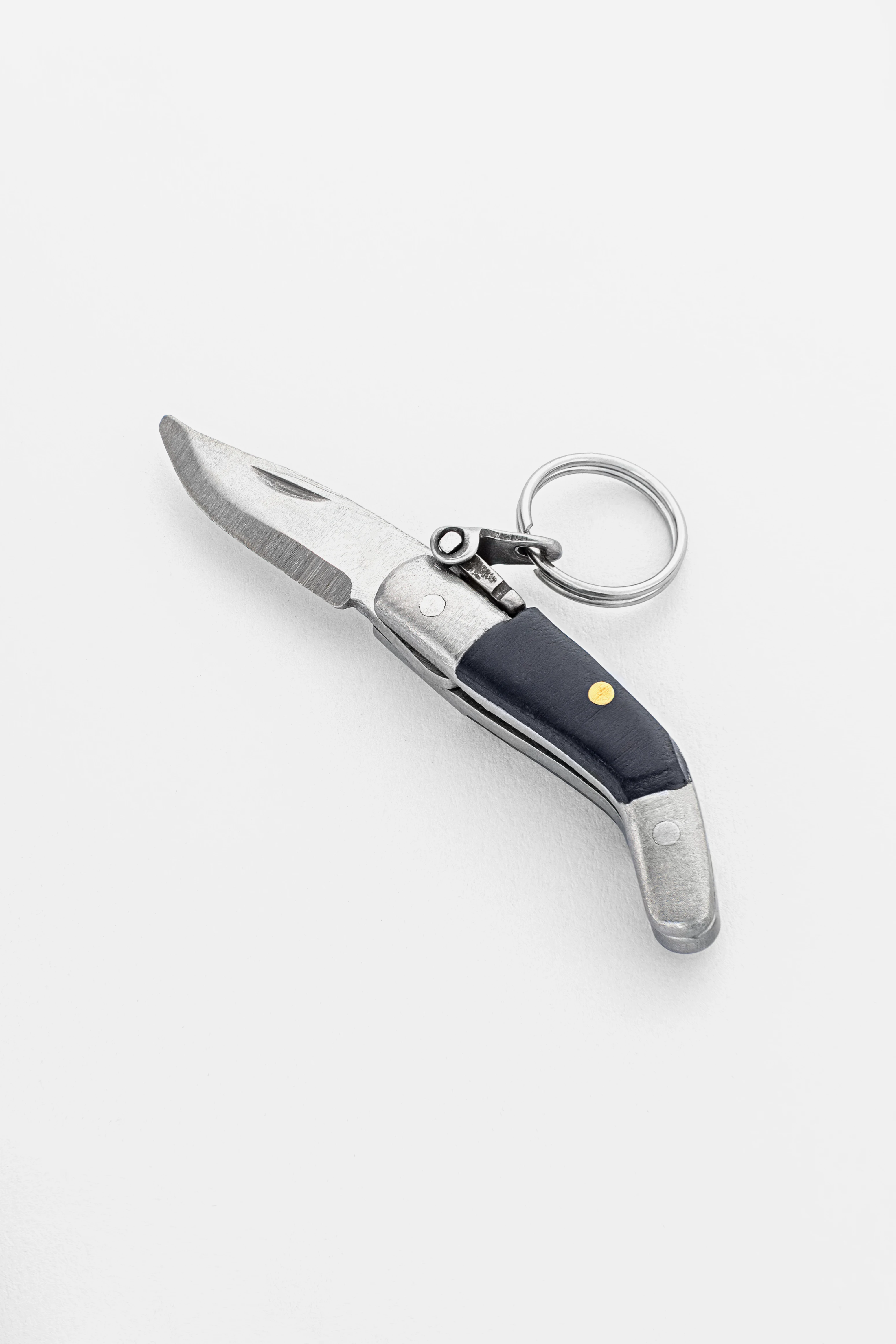
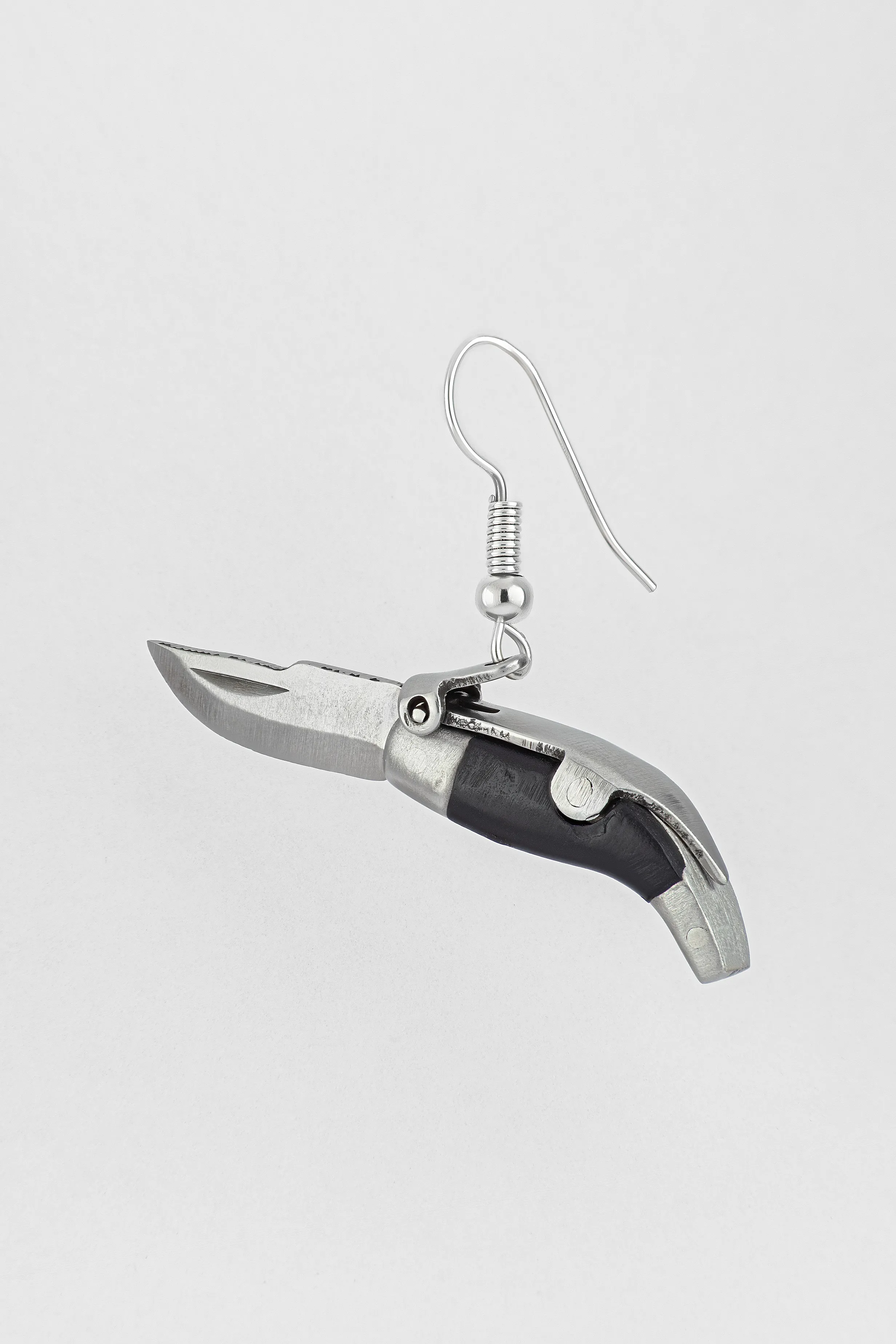
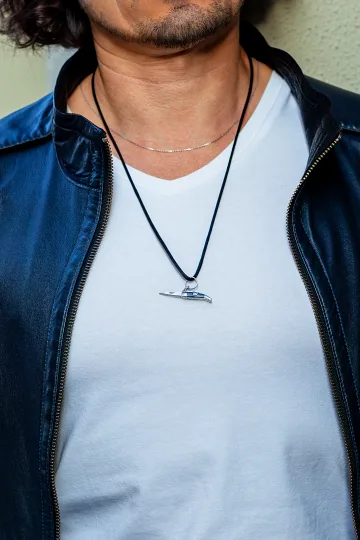
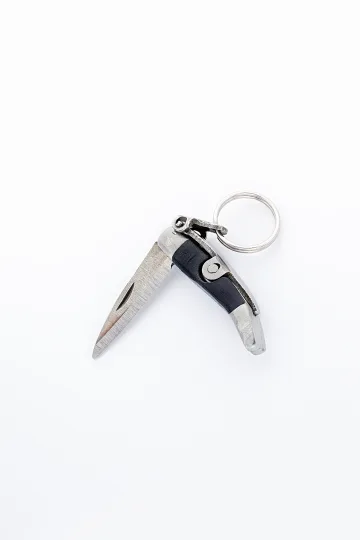
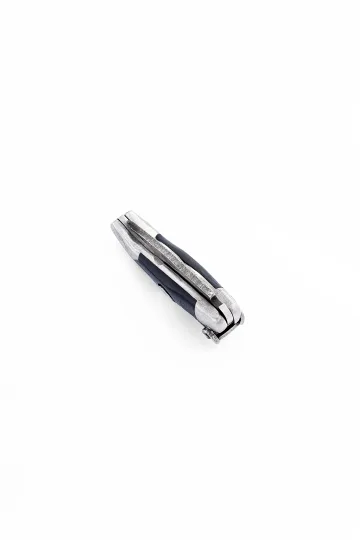
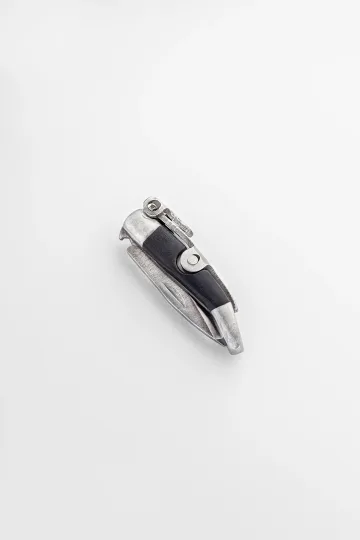
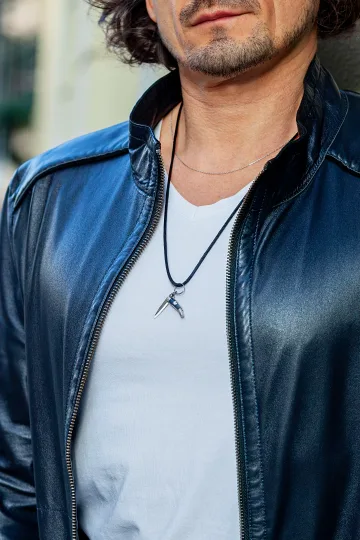
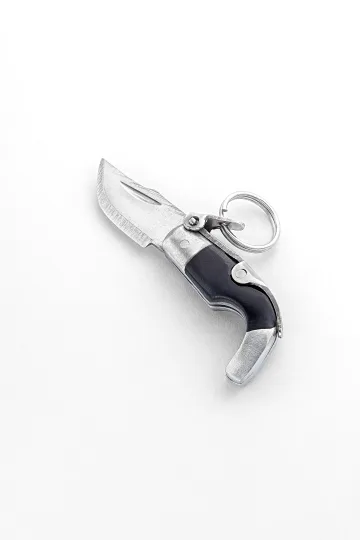
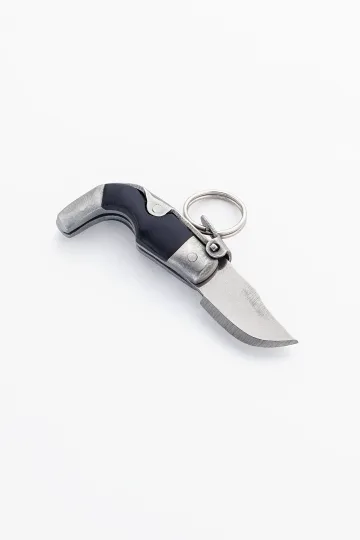
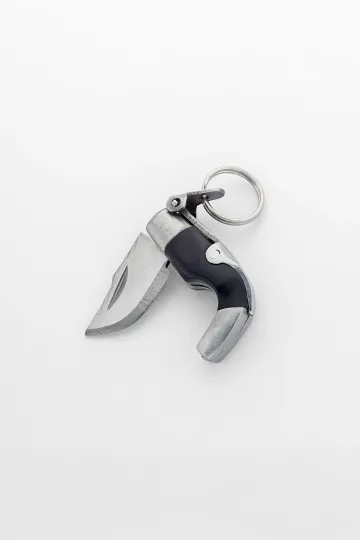
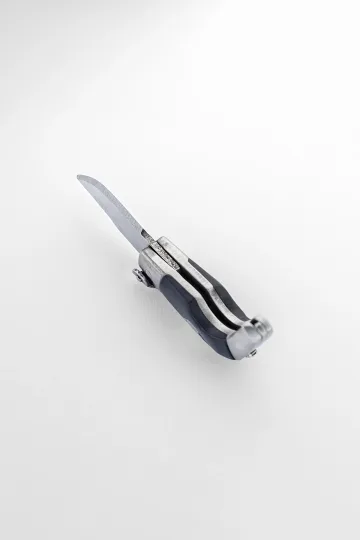
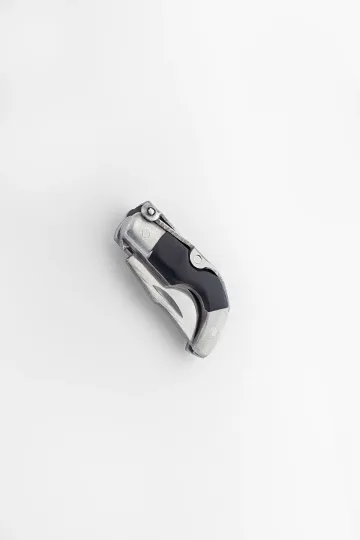
CAPAORA mini knife pendant
The 18th-century Spanish navaja in miniature: 40 mm of stainless steel, a real folding mechanism and a Palanquilla lock that clicks. An affordable gift to remember.
Authentic · Ships from Spain · 14-day returns
What the Whale Symbolises
Quiet strength is the first meaning usually associated with the whale. No large baleen whale has a documented pattern of deliberately attacking humans. Despite a size and power that exceeds anything else in the ocean, the animal moves without apparent aggression. That combination of scale and restraint is the core of the quiet strength reading.
Depth as a form of wisdom works as a metaphor rather than a claim. The sperm whale dives to two thousand metres and more, hunting in complete darkness using echolocation. That is a biological fact that easily becomes a figure of speech: the creature that goes calmly into depths others cannot reach.
Protection in the case of the humpback whale has a documented behavioural basis. Groups of humpbacks have been observed systematically intervening when orcas attack seals, sea lions and dolphins, placing their bodies between the predator and the prey and driving orcas away with their flukes and pectoral fins. Marine biologists have not reached a consensus on why this happens, but the pattern recurs across too many observations to be explained as coincidence.
Family bonds run through whale biology in ways that support the symbolism. Many whale species form stable social groups, and in orca and pilot whale populations matrilineal lines are strong enough that adult males remain with their mothers throughout their lives. Coordinated care of calves, mutual defence against predators, assistance to injured individuals: all are recorded behaviours.
Humpback whale song is among the most complex known vocal systems in the animal world. A male sings a long sequence of repeated phrases and themes for periods of up to half an hour. Over the course of a season the song gradually changes, and all males in the same population sing the same version at the same time, with the modification spreading across a population. Song travels thousands of kilometres through ocean water. For anyone working with sound and frequency, the association is precise rather than merely poetic.
One honest qualification belongs here: all of the above meanings are human projections. The whale does not transmit wisdom. Its social behaviour is the product of evolutionary pressures, not spiritual intent. What a whale motif in jewellery actually represents is a cultural position, an alignment with people who regard the ocean and its largest inhabitants as worth protecting. That is not nothing.
The Whale Tail as Motif
The tail became the dominant motif in whale jewellery for reasons worth tracing.
The visual reason: when a whale makes a deep dive, only the tail is visible above the water for a few seconds, flukes raised almost vertically. Water falls from the edges, light passes through the membrane, and the image is gone. This is the moment that whale-watching tourists photograph and carry home. It is the image that appeared on the covers of the vinyl records carrying the humpback songs in 1970.
The biological reason: each whale's fluke pattern is unique, like a fingerprint. The pattern of pigmentation, the shape of the trailing edge, the nicks and scars, together constitute the individual animal's identity. This is how the North Atlantic Humpback Whale Catalogue identifies more than ten thousand individuals. That biological particularity gives the whale tail a secondary meaning connected to uniqueness and identity.
The graphic reason: two lobes with a curved trailing edge and a shallow central notch is a clean, minimal form. It works in the contemporary aesthetic of reduced decoration without losing legibility. Unlike the full whale silhouette, which loses detail at small scale and looks empty at large scale, the tail holds its expression at any size from a four-millimetre stud to a seven-centimetre brooch.
The Whitby jet connection is worth a note here. Whitby, the town that sent fleets to the Arctic for a century and a half, is also the town most associated with British jet jewellery, the black fossilised wood carved into mourning pieces and worn extensively from the Victorian period onward. The same port produced both industries, and pieces of jet carved with whale motifs, though rare, do exist and circulate in antique markets. Contemporary jewellers making whale pendants in blackened silver sometimes consciously echo that association.
Leave your email, we'll send your discount code. No spam, unsubscribe anytime.
The code arrives by email, valid on your first order.
Materials and Craft
Sterling silver 925 is the primary metal for whale jewellery. Its cool blue-silver tone matches the skin of grey-blue cetacean species, particularly the blue whale, fin whale and minke. Silver takes fine detail well, oxidises easily to emphasise relief and accepts enamel and stone settings without complication. For wearers with a nickel sensitivity, pieces should be checked for nickel-free certification, as some silver alloys use nickel in the hardening compound.
Gold 750 in whale jewellery appears in warmer and more formal executions. Yellow gold catches the sunlit highlights on a whale's skin as it surfaces. White gold reads close to silver but with a denser feel. Rose gold is rarely used in ocean-themed pieces because the warm hue sits against the association with cold water.
Blue enamel from deep ultramarine to pale cerulean is the natural ocean background. It is applied to flat pendant surfaces, to channel inlays along the body line, or used as a gradient from dark at the base to pale near the surface, creating a sense of depth.
White enamel serves the belly and chin of the humpback, which are genuinely white, and the eye patch and underside of the orca. Orca pendants using black and white enamel in combination are among the most graphically direct pieces in ocean jewellery.
Mother-of-pearl is used as an insert for the belly and lower fins. Its iridescent surface with blue-silver overtones suggests light filtered through water and raises the tactile quality of the piece noticeably.
Small blue stones, aquamarine, blue topaz, iolite, lazulite, appear as eyes, as scattered bubble accents or as setting elements in the ocean-floor surround. Aquamarine in particular matches open-ocean water in tropical latitudes with unusual precision.
Oxidation is used selectively to darken recessed areas on the humpback's tuberculated head or the characteristic skin folds of the sperm whale, making the relief read more clearly against the polished surfaces. For the whale tail, oxidation is rarely needed: the smooth minimal form works better without it.
Engraved frequency lines on the reverse of a pendant, suggesting the graphic representation of humpback song, are a recent technique. The detail is invisible unless the wearer turns the piece over, which is precisely the point: a hidden layer of meaning for those who know it is there.
How to Wear It: Formats, Lengths and Company
Before the styling advice, the mechanics. Each whale format has a length and a context in which it simply works, and knowing them saves a good deal of trial and error at the mirror.
A whale tail pendant on a chain of forty-five to fifty centimetres is the most versatile piece in the category. The tail settles in the collarbone zone, reads clearly from the front and from the side, and does not argue with the collar of a shirt or a blouse. With a deep neckline, drop the pendant onto a sixty-centimetre chain so that it sits a little below the line of the neckline rather than competing with it. With a closed roll-neck the tail looks best worn over the fabric, where the flukes have a plain field behind them.
A pendant with a full breaching whale, three to four centimetres across, works as an expressive accent rather than a background piece. This is not a pendant to add to other necklaces; it is the main detail by itself. It goes best with plain clothing in a calm tone, so that the silhouette of the animal is not fighting a pattern in the weave for attention.
Stud earrings with a small tail are the quiet daily version of the motif. They can be worn continuously, they need no occasion, and they add nothing to the visual weight of a silhouette. They look particularly good on someone who already wears a whale pendant, because the studs then act as a background echo of the main motif rather than as a second idea.
A whale brooch on a jacket or a coat is an autumn and winter format, which suits the British calendar rather well, given how much of the year is spent in outerwear here. A jacket lapel, a coat collar, the turned-back edge of a heavy jacket, all of these give enough surface for a substantial brooch of five to seven centimetres. A brooch is most secure on a pin with a safety catch, and its position on the lapel depends on the silhouette: the denser the cloth, the higher the brooch can sit without dragging the fabric out of shape. On a fine wool coat, keep the brooch smaller and closer to the collar line, because heavy pieces on light cloth pull and leave permanent marks.
A men's look with a large whale on a leather cord goes with a plain shirt, a coarse-knit sweater or a tee. The amulet then reads as a maritime sign and works with natural fabrics, linen, cotton and wool. Synthetic shiny fabrics kill this format outright: the shine of the cloth and the shine of the silver cancel each other out and the piece stops reading as a whale at all.
What to avoid is the over-nautical costume, where one person is wearing a whale, a dolphin, a seahorse, an anchor, a fish hook, a shell and three more ocean motifs at once. That turns a piece with meaning in it into the contents of a seaside gift shop. One or at most two maritime symbols in a single look work better than the whole ocean at once. The wider question of how to combine several symbolic motifs in one outfit is covered in our guide to protective symbols in jewellery.
Colour is the easy part. Ocean shades, grey, navy, sand, olive, alongside natural fabrics, give a good result almost every time. Bright acid colours sit poorly beside a whale, because the motif needs a calm setting for its own quiet weight to register at all. This is one of the few style rules in symbolic jewellery that holds regardless of the wearer's age, gender or wardrobe.
One thing worth planning for if you buy a whale piece as a memento of a specific trip. British whale watching happens in cold, wet, salt-laden conditions, whether that is a boat out of Tobermory into the Hebridean sound, a headland watch off the Cornish coast in late summer, or the bottlenose dolphins of the Moray Firth seen from the shore at Chanonry Point. Silver worn on deck in spray needs rinsing in fresh water the same evening; salt left in the recesses of an oxidised pendant will lift the finish within a season. Leather cords should stay at home for those days altogether. A piece bought to remember the water tends to be worn straight into it, which is understandable and entirely survivable, provided the rinse happens before bed rather than three weeks later.
Silver whale tail pendants, leaping whale figures, stud earrings and leather-cord amulets.
Send a friend a discount code, they save on their first order.
Who Whale Jewellery Suits
Ocean-goers, divers and whale-watching participants. Anyone who has seen humpbacks off the Azores, the Canary Islands, Iceland, the Dominican Republic, Baja California or Hawaii often returns looking for a whale tail pendant as a personal record of the encounter. This works as a souvenir in the best sense of the word: not a tourist trinket but the mark of a specific experience.
Environmental and conservation workers. The whale is the central symbol of a successful international conservation campaign, and for people working in marine mammal protection it functions as a professional emblem rather than a general nature motif.
Readers of Melville and the broader tradition of maritime literature. Moby-Dick remains one of the major texts of world literature, translated into every principal language. A whale pendant for this reader is connected to the book, to Captain Ahab, to the philosophical layers of the white cachalot as the unknowability of nature. That is a literary association and a legitimate one.
Musicians and sound artists with an interest in the humpback song tradition. For composers, sound designers and bioacousticians the whale is a precise reference to one of the most complex vocal systems in the animal world, not a general environmental emblem.
People of quiet scale who do not need to declare their presence. The whale is enormous and does nothing to prove it. The wearer who is drawn to that logic tends to prefer a whale to more aggressive or explicit symbolic choices. A whale pendant is a statement of substance, not volume.
Whale jewellery does not suit those looking for a quick, light, cheerful motif. The cultural weight of the whale, Leviathan, Moby-Dick, the moratorium, Inuit tradition, is considerable, and the physical scale of the forms is not delicate. If the intention is a simple, joyful wearable symbol, a star, a heart or a flower will serve better. The whale asks for an engaged response from the person wearing it.
Frequently Asked Questions
Is the whale a fish? No. Whales are marine mammals of the order Cetacea. They are warm-blooded, breathe atmospheric air through a blowhole at the top of the head, give birth to live young and nurse them with milk. Whales evolved from land mammals approximately fifty million years ago and returned to the sea secondarily. Their closest living relatives are hippopotamuses, which the genetics and the anatomy confirm despite the apparent paradox.
Are whale teeth and baleen used in contemporary jewellery? No, not in any responsible modern production. Commercial whaling has been under moratorium since 1986, and the legal production of new scrimshaw or baleen objects is restricted to the subsistence quota communities of indigenous Arctic peoples and to the lawful trade in antique pieces made before the prohibitions came into force. A whale pendant bought today from any credible maker will be sterling silver, gold, enamel or stone. Nineteenth-century scrimshaw is now a museum and antique market object.
Why is the whale tail so popular compared to the full whale figure? The graphic quality of two lobes with a slight central notch works at every scale from a four-millimetre stud to a large brooch. The full whale silhouette loses legibility at small sizes and reads as a flat blob. Additionally, the biological fact that each whale's fluke is individually distinctive, the basis of scientific photo-identification catalogues, gives the tail a secondary association with individuality and identity.
Does the whale suit men? Yes. After the anchor and the fish hook, the whale is among the most direct marine motifs in menswear. Its scale, its connection to seafaring, and its association with the physical world of the ocean carry naturally in male jewellery without any styling adjustment. It sits in a different register from more decorative motifs that require reframing to read as masculine.
Is there a whale zodiac sign? The constellation Cetus, catalogued by Ptolemy in the second century AD, lies south of the ecliptic near Pisces and Aquarius and appears in all standard star atlases. It is not a zodiac sign because the sun does not pass through it during the year. Claims that it is a thirteenth zodiac sign are not grounded in any traditional astrological system.
Is Moby Dick a symbol of evil or of nature? Both readings coexist in Melville's text and are meant to. For Captain Ahab the white whale personifies an evil that must be destroyed at any cost. For Ishmael the narrator the white whale is the unknowability of nature, something older and larger than any human category, and the danger comes from trying to impose meaning on it. The deliberate ambiguity is part of the novel's architecture. A whale pendant read through Melville sits closer to Ishmael's version: not an enemy, but an immense incomprehensible presence.
Which species should I choose for a pendant? It depends on whether recognisability or personal attachment matters more to you. The humpback leads by a wide margin in how often it is chosen, because its long pectoral fins give the most expressive breaching silhouette, and it is the species most people actually see on a watching trip. The sperm whale is recognised instantly by its massive rectangular head and carries the Melville association with it. The blue whale brings the sense of planetary scale, being the largest animal that has ever lived. The orca is chosen for its graphic black and white markings, which enamel reproduces beautifully. If what you want is not a particular species but a universal sign, take the tail: it works at any size and belongs to no single animal.
Is the orca a whale or a dolphin? Technically the orca belongs to the family Delphinidae, which makes it biologically closer to a dolphin than to the great baleen whales. Culturally it has almost always been called a whale, which is where the English name killer whale comes from. In jewellery the orca exists as a motif in its own right precisely because of that black and white patterning. If biological precision matters to you, it is more accurate to call it a very large dolphin, but in everyday and jewellery contexts placing it among the whales is a settled convention rather than an error.
How do I look after a silver whale pendant? The same way as any sterling silver. Silver darkens through contact with air, perspiration, perfume and water, and that is a normal process rather than a fault. Take the piece off before a shower, a swimming pool and sleep, and store it separately in a soft pouch or a box away from damp. A soft silver cloth, or warm water with a drop of washing-up liquid and a soft brush, is enough for cleaning. One caveat specific to whale jewellery: if the piece has oxidised recesses, the skin folds of a humpback or the relief of a fluke, do not attack them with abrasives or polishing pastes, because you will remove the dark tone that creates the sense of depth in the first place, and it cannot be put back at home.
Can a whale pendant be given to a child? Yes, and there is a specific format for it: a small pendant of around a centimetre and a half on a fine chain, rounded in form, with no sharp fin tips and with smoothed edges so it does not catch on clothing or scratch the skin. These are given at a birth or a first birthday reasonably often. For very small children the chain is usually not worn at all, and the pendant is kept as a keepsake until an appropriate age. Orcas and sperm whales are rarely made in a children's format, because the softer silhouette of a tail or a breaching whale reads better at that scale and for that recipient.
About Zevira
Zevira is a Spanish jewellery label based in Albacete. The ocean range includes whale motifs among its categories. Current availability and details are in the catalogue.
Buying it as a gift? Each one arrives ready to give.
 A branded Zevira box and a little card come with every order.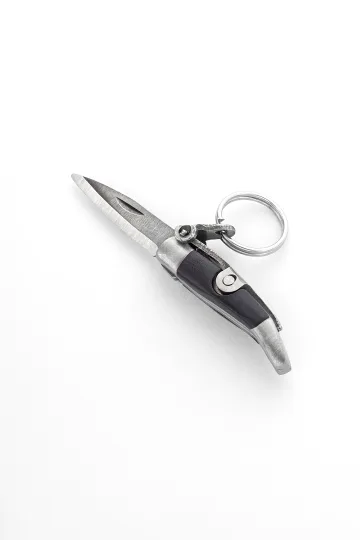




Conclusion
The whale is one of the few symbols that genuinely changes its meaning over time. For a thousand years it was the sea monster of biblical text, the quarry of Basque harpooners, the terrifying giant of Melville's fiction and the living capital of the nineteenth-century American whaling industry. In the last fifty years it became a protected wonder, an emblem of conservation, the subject of documentaries, and the destination of whale-watching voyages from a dozen coasts. That transformation is rare: the symbol did not stay fixed but moved from prey to the protected, from monster to the emblem of quiet strength.
A piece of whale jewellery worn today marks that shift. The person wearing a silver whale tail on a forty-five centimetre chain is not claiming a mystical connection to the sea and not receiving messages from the deep. They are acknowledging that something large and ancient deserves to remain, and that a well-made silver fluke above the collarbone is an honest way to mark that acknowledgement, without mysticism and without noise.