The Crown in Jewellery: Meaning, History and Symbolism
When a crown stopped belonging only to kings
Ask ten people what a crown stands for and nine will say power, king, queen. They are half right. The symbol did begin its life as an emblem of rule, but over the last three thousand years it has gathered so many layers of meaning that today it sits on the shoulders of people who will never inherit a throne.
A five-year-old wears a paper circlet at her birthday party. A bride pins a tiara to her veil. A winner of a beauty contest receives a diadem. An athlete tattoos the shape above the bicep. A rock musician wears a crown pendant over a black t-shirt. All of them are saying the same thing, even if they would not put it in words: I am claiming my place, I am worth something, I am the one in charge of my own life.
The crown left the palace a long time ago. In jewellery it has become a universal language of dignity, understood without translation from Seville to Edinburgh, from Dublin to Tokyo.
Wear the symbol, don't just read about it. These are in stock:





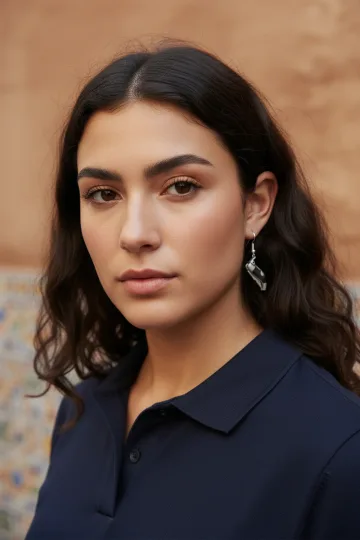
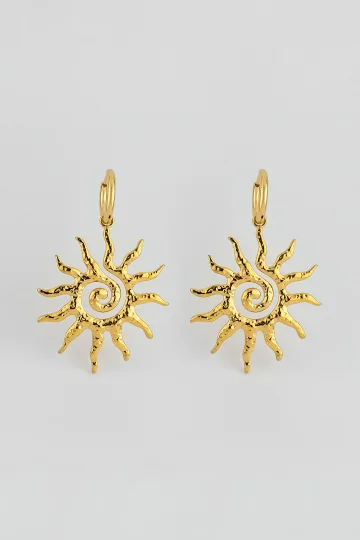
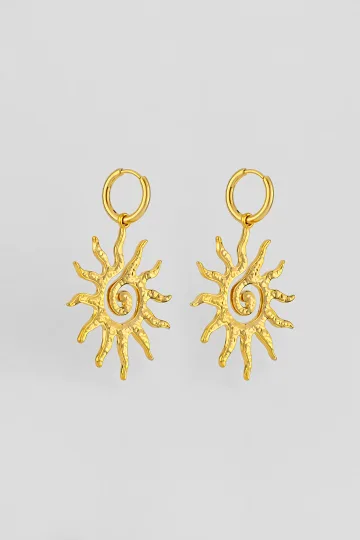

Crown jewellery: what people buy and why
Before we touch the history, let us look at what actually sits on a jeweller's bench today. Which pieces people reach for, how they differ, and how to choose one that will still feel right in five years.
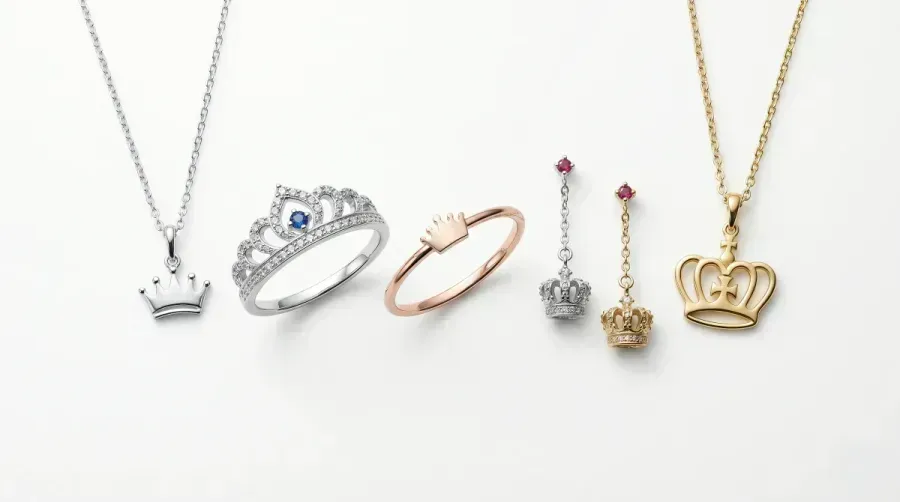
Pendants
The most popular form by a wide margin. Sizes run from the miniature (roughly the width of a fingertip) up to statement pieces the size of a pocket watch.
A small pendant on a fine chain is the everyday choice. It sits under a shirt collar, survives office life, lets you move through a day without anyone noticing. Often there is a single small stone at the centre, a ruby, a garnet, a cubic zirconia. The price sits in the budget tier when worked in silver, closer to a nice dinner for two when moved into gold.
A larger medallion pendant belongs to occasions. Worn over a jumper or a low neckline, it reads as an intentional piece, part of an outfit, something people comment on. These pieces often hang from a heavier chain. Silver keeps them in mid-range; gold lifts them into the premium tier.
A laurel wreath pendant offers the ancient alternative to the classic royal silhouette. Fine leaves curving around a medallion or hanging as an open circle. The piece suits people who want the idea of victory or achievement without the monarchical flavour.
A pendant crowned with a cross is the Christian version, familiar in Spanish and Italian traditions. The arches close with a small cross at the summit. It has a particular following in Catholic countries and among those who want the religious reading of the motif to come through.
Rings
Less common than pendants but arresting when done well.
The signet ring is the masculine classic. The symbol sits engraved into the face or rises in low relief, often paired with a family monogram. Worked in silver it sits in the middle tier; in gold it climbs to premium. A signet ring is the kind of object that gets worn for decades and passed on afterwards.
A ring with the crown as the main element has the shape rising above the band, sometimes set with stones at its centre. It is more often a women's design, sized for the middle finger as a statement piece.
King and Queen paired rings form their own small category. Two bands with matching silhouettes, engraved inside with the words or with a shared date. Some couples choose them as an alternative to traditional wedding rings, some as an addition to them.
Earrings
Small studs work for everyday use, fine on a single or double piercing, often set with stones.
Drop earrings are for occasions, with the symbol dangling from a hook or lever back.
Asymmetric studs pair a crown with a stone in the opposite ear. A contemporary take on the mismatched earring trend, which keeps the motif visible without becoming overwhelming.
Bracelets
Less common but worth mentioning. Charm bracelets carry the crown alongside other symbols, or a thin chain bracelet holds the motif as a single central detail. Leather cuffs with a metal crown plaque sit closer to the alternative and street-style end of the market.
A crown rules alone. Hang a second pendant beside it and you have demoted both to costume jewellery.
How to wear a crown
Over years on shoots and runways the crown has passed through dozens of looks with me. Here is what actually works, occasion by occasion.
How do I wear a crown every day? For an everyday look I recommend a small crown pendant on a fine chain over a plain t-shirt, a loose shirt or fine knitwear. A neutral colour (white, grey, beige, black) keeps the metal the main point. On a round or V-neck the chain sits along the collarbone, its best position. I suggest a length of 40 to 45 cm so the crown rests at the base of the neck.
Does it work at the office? It does, if you keep it restrained. I recommend a silver or gold crown without stones under a closed collar or a tailored blouse. One accent for the whole look, no stacks. A signet with a crown on the little finger or the middle finger adds character without breaking the dress code.
How do I build an evening look? For the evening I choose a larger medallion pendant on a heavier chain over a plain dress in a deep colour: wine, emerald, black. Bare shoulders or a low neckline give an expressive pendant room to breathe. Stones belong here, I recommend a ruby, a garnet or black onyx to match the outfit.
And for a wedding or a graduation? For a special day I suggest a tiara pendant and half-diadem earrings with pearls, paired with light flowing fabrics like silk or chiffon. For a bride I choose a laurel wreath pendant, which gives a soft classical note instead of heavy pomp.
How do I layer a crown? The crown likes the solo part. If you want layers, I recommend fine chains without pendants at different lengths, and I keep the symbol as the lowest and only accent. I keep metals in one family: gold with gold, silver with silver or steel. Near a crown I avoid other strong symbols, so the sword and the shield are better worn on their own terms, one hero per outfit.
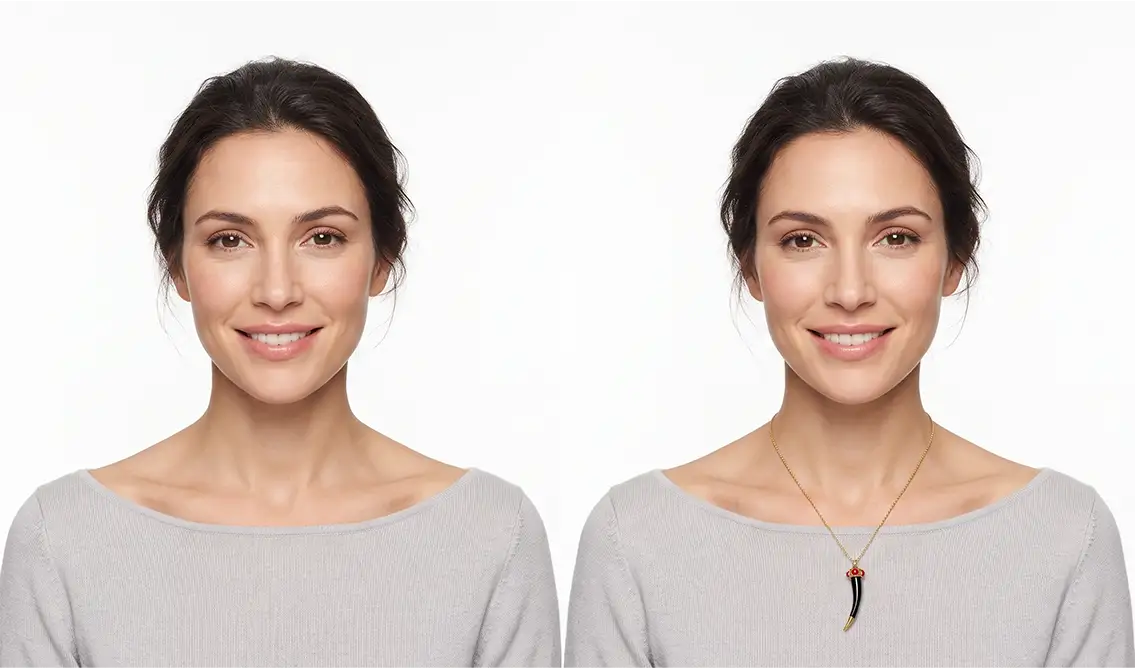
Turn on your camera, pick earrings, a pendant or a ring, and see the piece on yourself in real time.
Switch items in one tap.
Everything runs in your browser: no photo or video is ever uploaded.
Choosing your crown: four types and who they suit
Four main styles run through crown jewellery. Each carries its own reading, and each suits a different wearer.
1. The royal crown (classic)
The shape everyone draws when asked to sketch a crown: arches rising to meet at an orb or a cross at the top. Strongly associated with the British monarchy, with Spain, and with the great historical houses of Europe.
Who it suits: readers who want the classic reading, who enjoy tradition, who like the regal flavour of the symbol undisguised. It works as a gift to a mother (the queen of the family), to a partner (my queen), or to yourself after something that mattered.
Best materials: yellow gold for the classic look, silver with a soft patina for a vintage feel, enamel over silver for the Spanish flavour with coloured stones.
2. The laurel wreath
Fine leaves of olive or laurel forming a closed circle. Ancient, Greco-Roman, understated. No drama.
Who it suits: anyone who has finished a degree, defended a thesis, reached a concrete milestone. The wreath is the crown of victory without the monarchical undertone, which is why it suits academics, scholars, people who feel uneasy with pomp.
Best materials: 14K gold for the classic reading, silver with a soft green patina for the museum feel, as though the piece had come out of a dig in Thessaloniki.
3. Tiara or diadem
A half-circle or an arc, the shape worn by princesses and brides. In jewellery this often translates into a pendant shaped like half a crown, or earrings that echo the same curve.
Who it suits: women drawn to romantic, light, feminine design. A strong choice for a wedding, a graduation, a milestone birthday.
Best materials: rose gold, silver set with cubic zirconia or freshwater pearls, white gold for the wedding register.
4. The crown of thorns
A circlet of thorns. The Gothic reading. A reference to Christ, or more broadly to having come through pain.
Who it suits: those drawn to alternative or Gothic aesthetics, those who have survived something difficult. It is the mark of a survivor rather than a ruler.
Best materials: oxidised silver, blackened steel, matte finishes rather than polish.
Choosing a price tier
Before walking into a shop (or an online catalogue), it pays to know which tier you are looking at.
Budget tier sits at the level of a couple of good coffees or a relaxed lunch out. Mass-produced stainless steel with PVD coating. Reasonable for teenage jewellery or for pieces you would rather not lose track of.
Mid-range is the level of a nice dinner for two or a good pair of walking shoes. Sterling silver 925, simple handwork, sometimes well-applied gold plating. The tier for grown-up everyday jewellery and for most gifts between friends.
Premium runs closer to the cost of a short weekend away. Sterling silver set with stones, maker's work with a signed back, small 14K gold pieces. The tier for serious events: graduation, a significant anniversary, a gift to a wedding guest of honour.
Luxury sits at the price of a small piece of furniture or more. Substantial 14K to 18K gold, diamonds, bespoke commissions. The tier for weddings, the birth of a child, a major jubilee.
A practical note: for daily wear, silver 925 or PVD steel holds up well and does not ruin a weekend when it slips off a sink. For a gift to someone central or for a real milestone, move up to gold or to silver set with stones.
Who a crown pendant or ring suits
Yourself after something that mattered. Finishing a degree, a promotion, opening a business, closing a long project. A personal monument. Common among women running their own companies and among people who have come through a hard stretch.
Your mother as a gift. The phrase my queen of the family does its own work. A strong choice for Mother's Day, a big birthday, or simply because the year has been long.
Your partner. Paired King and Queen pieces, or a single pendant with an engraved name. Some couples choose this route instead of traditional wedding bands, some as a layer over them.
A daughter on her sixteenth or eighteenth birthday. A symbol of coming into her own, of owning her worth. A light silver pendant becomes a piece she will keep for decades.
A grandmother. Thanks for her role as family matriarch, stated quietly but clearly in metal.
Yourself during a rough patch. The less obvious scenario, but it works. In the months when confidence thins, a physical reminder that you are the queen of your own life no matter what else is falling apart helps keep the head upright. It sounds naive. It still works.
An athlete after a victory. A laurel wreath fits especially well here.
A friend after a divorce or a long struggle. A crown of thorns or a broken circlet, read as a symbol of having come through.
Customer reviews
Zevira is a real jewellery shop. Genuine payments, deliveries and customer thank-yous.
🥰🥰🥰 gracias
Ok, ¡gracias! 🙂
Engraving on crown jewellery
Crown pieces lend themselves to personalisation. Popular options:
- A date of a significant event (wedding, birth, graduation)
- A name of a partner, child, parent
- Initials, one letter or two
- A motto ('my queen', 'always', 'yours for good')
- The name of a reigning house for a historical reference
If a pendant has a hollow back or a signet face, the engraving goes inside. The cost of a standard engraving sits squarely in the budget tier, usually cheaper than a good lunch.
Upload a photo of your pet, someone you love, or an object. We'll build a 3D model and hand-cast it in pewter.


What the crown symbolises
The motif carries several layers at once, and they do not cancel each other out. Nobody putting on a crown pendant picks only one meaning. They are all present, only one of them speaks louder than the others on any given day.
Power and rule. The most obvious reading. The crown sits on the head of the one who rules. What matters is that ruling does not only mean ruling a country or an army. It also means ruling oneself, one's own life, whatever small territory you happen to be responsible for. In that sense every person is the potential sovereign of their own biography, and the crown is a reminder.
Dignity and self-respect. The wearer of a crown has to hold the head upright, because a tilted head sends the thing flying. Hence the metaphor: to wear the symbol is to remember that you are worth keeping your chin up.
Victory and achievement. The ancients gave laurel wreaths to the winners of athletic games. In practical terms it was the same object as a modern medal: a visible sign of recognition. Modern championships have kept the logic, and the motif in jewellery often marks a personal win, a thing endured, a finish line crossed.
Protection from above. In Christian iconography crowns sit on the heads of saints, on the Virgin, on Christ the King. The reference is not political but spiritual: the bearer is blessed, held, chosen. Worn in this key, the piece becomes a quiet reminder of connection to something larger.
Love and closeness. 'My queen', 'my king': the words are not only tender nonsense. In the Western love tradition the beloved is crowned in the eyes of the lover. Paired pieces, one for him, one for her, carry a direct inheritance from this register.
A brief history of the crown
The symbol did not arrive fully formed. It travelled a long road from a simple headband to the elaborate jewelled construction we recognise today, and every culture that handled it added something of its own.
Ancient Egypt: the double crown of the pharaoh
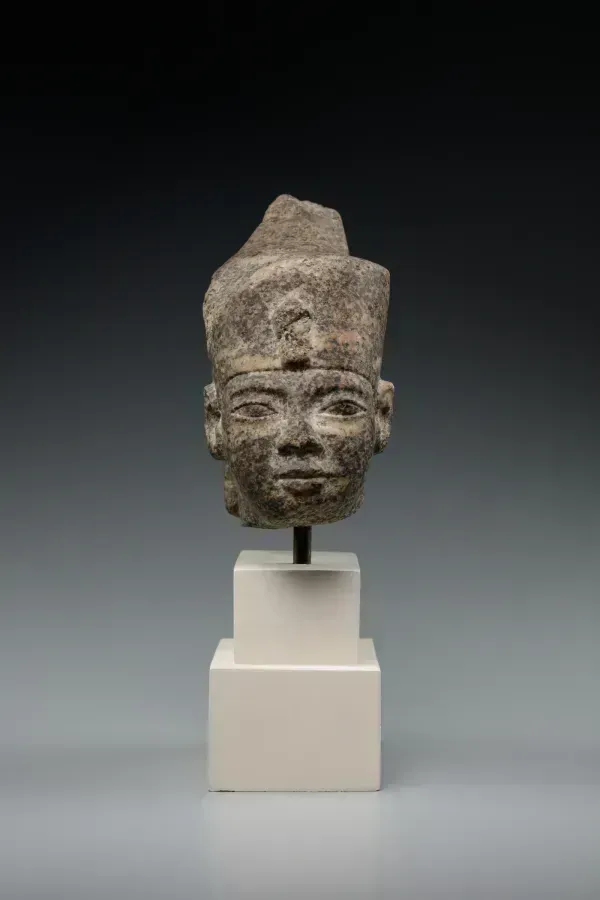
The earliest clear image of unified sovereignty comes from the Nile. Pharaohs wore the pschent, a double headdress uniting the two halves of the country. The white Hedjet stood for Upper Egypt, the red Deshret for Lower. When Menes united the two kingdoms around 3100 BCE, one slid inside the other, and the pschent was born.
Alongside the pschent, Egyptian rulers wore the nemes, the striped headcloth with the uraeus, the cobra on the brow. The cobra stood for Wadjet, the protective goddess of the pharaoh. Already in ancient Egypt, the crown was both a mark of rule and an amulet of defence. That double function never really left the object.
Mesopotamia: tiaras and horned crowns
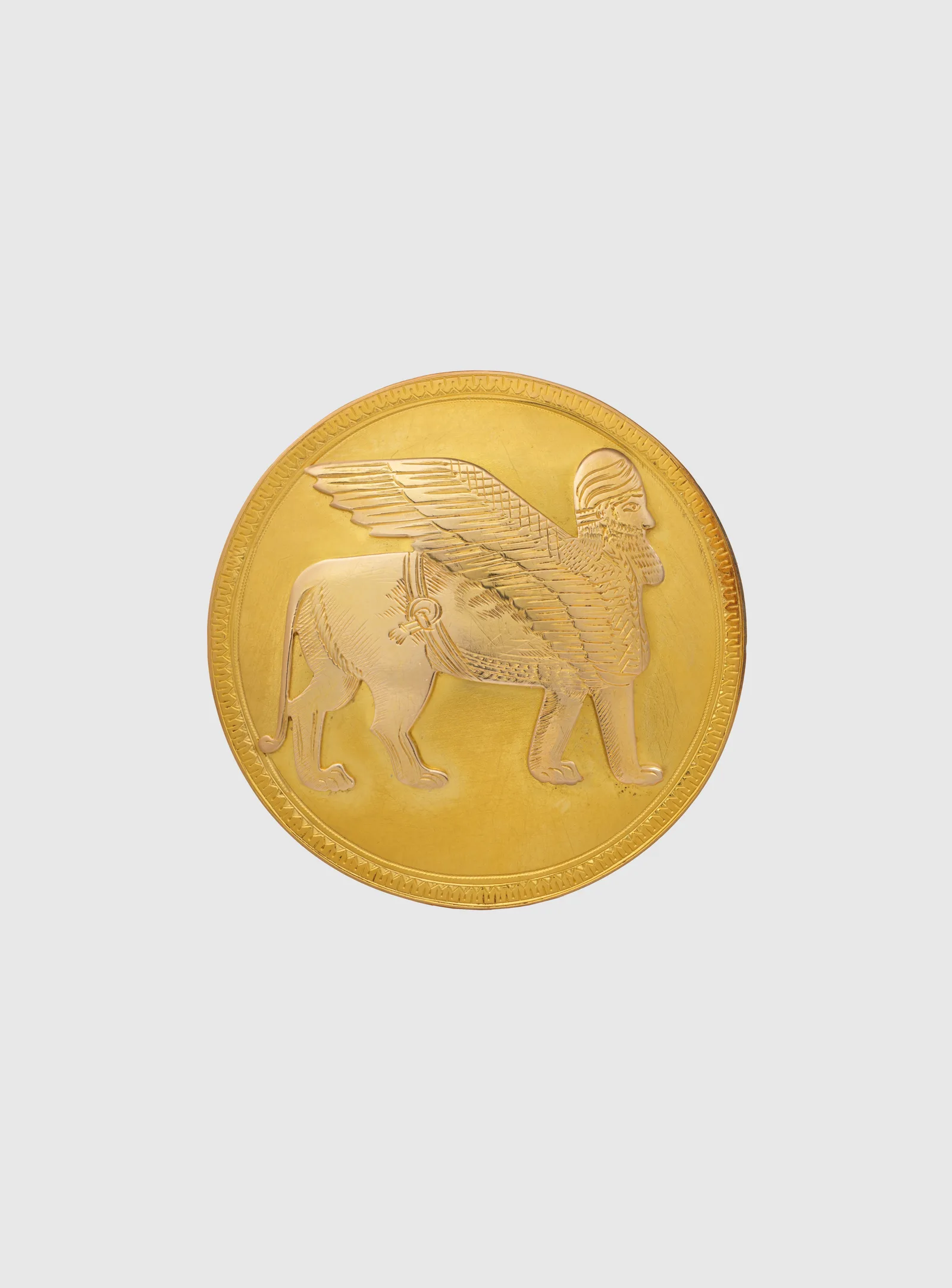
In Mesopotamia gods and kings wore horned tiaras. The number of horns indicated the degree of divinity. Assyrian kings were frequently shown in tall conical headdresses, tier upon tier of ornament. The modern word 'tiara' comes from this Mesopotamian vocabulary, though the meaning has drifted considerably.
Antiquity: the wreath as a crown
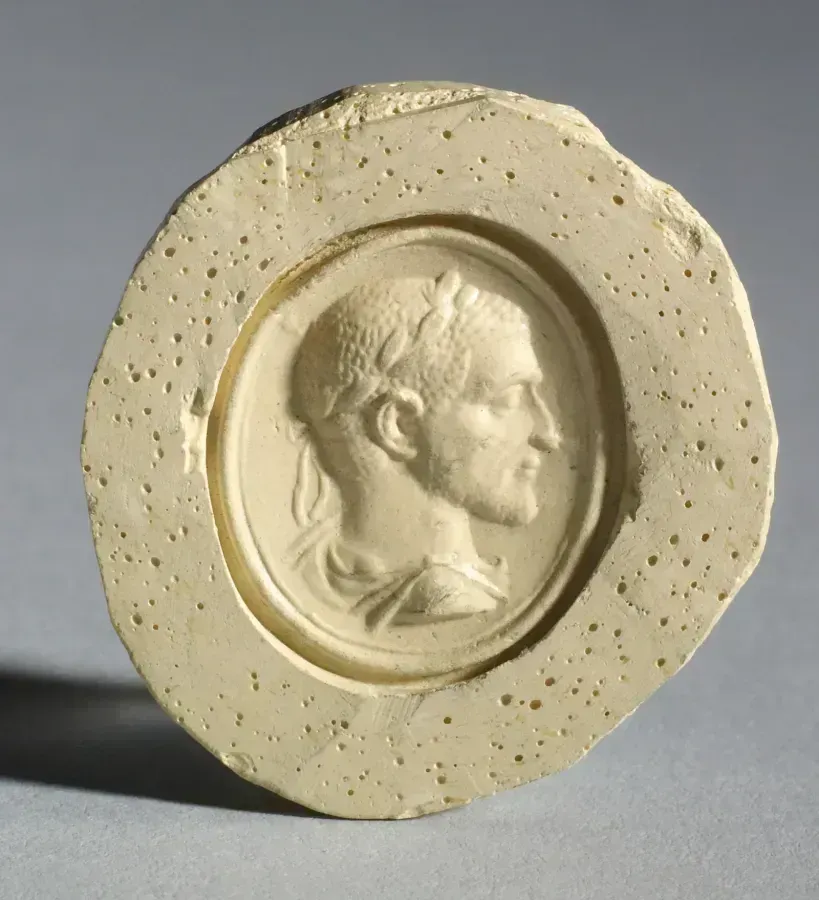
The Greeks and Romans took the word literally. A crown was a wreath. Winners of the Olympic Games received olive wreaths, poets received laurel, generals and civic heroes received different styles according to merit. The golden crown in the sense familiar today arrived later, under the Roman emperors. Julius Caesar famously refused a golden crown at the Lupercalia, because it carried the smell of kingship, which the Romans loathed. By the time of Diocletian, however, the emperors wore the diadem openly.
The classical register is still active. Someone wearing a laurel wreath pendant in 2026 is drawing a direct line back to a boy in Olympia taking his prize.
Medieval Europe: coronation as sacred rite
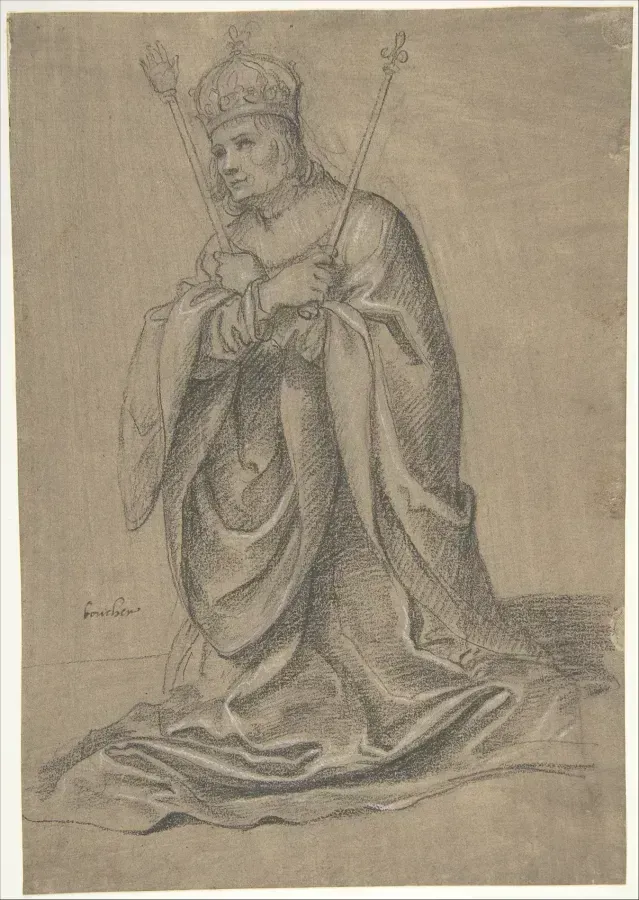
Christian Europe turned coronation from a political gesture into a sacrament. The king did not simply put the crown on his head; a bishop or the Pope placed it there, and that meant that the authority came from God. The crown of Charlemagne, preserved in Vienna, is less an ornament than a relic. It carries Old Testament scenes, and it was used by the emperors of the Holy Roman Empire for over a thousand years.
St Edward's Crown in England, the crown of the Kings of Castile in Spain, and the regalia of many other houses all passed through coronation rituals and carry the weight of those histories in their very shape.
Religious crowns
A separate chapter belongs to the crowns worn by the Virgin and the saints. In Catholic and Orthodox tradition, icons are often adorned with metal crowns, and the practice runs especially deep in Spain and Italy. The Coronation of the Virgin is a theologically anchored ritual: Mary as Queen of Heaven.
In Spanish tradition, La Macarena, Nuestra Señora del Rocío and Nuestra Señora de la Esperanza each have their own crown, often set with precious stones donated by the faithful over centuries. In jewellery this thread comes through in pendants crowned with a cross, or framed by a rose (the Marian flower), or carrying a faint echo of the processional designs.


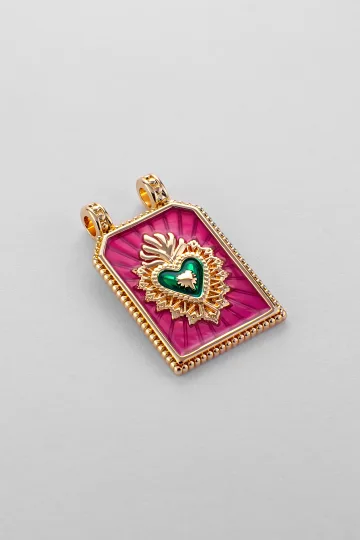

Types of crown in jewellery
When a shop tag reads 'crown pendant', that single phrase can hide very different forms. It pays to know them.
The royal crown
The classic shape with arches rising to a ball or cross. The image a child draws when asked to sketch a crown. Often associated with the British monarchy, though versions appear everywhere from Madrid to Copenhagen.
The tiara
A semicircle or arc framing the front of the head. In jewellery this becomes a half-crown pendant, often set with stones, or earrings echoing the curve. The associations are with princesses, ballrooms, bridal imagery.
The diadem
Close cousin to the tiara but often thinner and higher. In antiquity the diadem was a simple ribbon; in modern jewellery it has become a more structured piece, usually with a central stone.
The crown with a cross
Topped with a cross at the summit. A direct reference to the Christian coronation rite, popular in Catholic countries and especially in Spain.
The laurel wreath
A closed circle of leaves. Technically a crown, but with a strong classical accent. In jewellery it often appears as a ring encircled by leaves, or a pendant in the shape of a wreath. The reference is to Greco-Roman victory.
The crown of thorns
A circlet of thorns referring to the Crucifixion. Rarer in jewellery but powerfully symbolic: suffering, endurance, sacrifice. At home in Gothic and punk aesthetics.
The coronet
A reduced form indicating not a king but a duke, an earl, a viscount. A rare motif in jewellery, though it turns up in heraldic pendants.
The crown across cultures
The symbol is not universal in the sense that everyone reads it the same way. Different cultures put the accent in different places, and knowing the difference helps you choose a piece that speaks your own cultural language.
Spain: the Catholic Monarchs
For the Spanish tradition, the crown is inseparable from Ferdinand and Isabella, the Catholic Monarchs who united the country at the end of the fifteenth century. Their regalia still functions as a state symbol, appearing on the coat of arms, on coins, on facades of public buildings. When someone in Spain wears a crown pendant, more often than not the reference is to the unifying idea: one country, one tradition, one inheritance.
A chapter of its own belongs to the crowns of the Virgin in Spanish Holy Week. Every year the statues of the Virgin are carried through the streets of Seville, Malaga and other cities wearing elaborate golden crowns. Crown jewellery in Spain often carries this processional echo, even when the wearer is not thinking of it.
Britain: monarchy and popular culture
In Britain the crown is at once a state and a cultural symbol. 'The Crown' as a concept covers the monarch, the state, and a whole web of institutions. St Edward's Crown sits at the centre of the Royal Coat of Arms. The Imperial State Crown appears at every State Opening of Parliament. The coronation of Charles III in May 2023 brought the object back into the public eye for a new generation, carried on a cushion through Westminster Abbey with the same ceremony that would have been recognisable to a medieval clerk.
The Crown Jewels are kept in the Tower of London, guarded by the Yeoman Warders, visited every year by millions who queue to see them in person. The Queen Mother's Crown with the Koh-i-Noor, the Sovereign's Sceptre with Cullinan I, the orb and the spurs: these are not stored ornaments but active objects of state, brought out for coronations and funerals and state occasions.
Crown jewellery with a British accent is especially popular with travellers bringing home a souvenir with more depth than a fridge magnet, and with those whose cultural reference points are built on British film, music and drama. The silhouette of St Edward's Crown is probably the single most copied crown shape in modern jewellery worldwide.
Ireland and Scotland: Celtic threads
Celtic tradition has its own royal imagery. The O'Neill clan carried a distinctive symbol of one hand holding another, crowned above. A particular version of the Claddagh motif carries hands, a heart and a crown together, reading as love, friendship and loyalty in a single gesture.
In Scotland, crown motifs in jewellery often appear alongside the thistle (the national flower) rather than on their own. The Honours of Scotland, kept in Edinburgh Castle, are among the oldest surviving regalia in Europe, dating from around 1540. Anyone familiar with the Stone of Scone or the Ceremony of the Keys will recognise how tightly state ritual and jewelled object have remained bound together in the British Isles.
Russia: Monomakh's Cap and the Imperial Crown
Russian regalia moved through two distinct stages. Before Peter the Great, the chief object was Monomakh's Cap, a soft fur-trimmed cap with a cross at the summit, whose form carried a strong Byzantine echo. After Peter the European style came in, and by 1762 the Great Imperial Crown was made for the coronation of Catherine the Great. That object is now kept in the Diamond Fund in Moscow.
Buddhism: the crowns of Bodhisattvas
In Buddhist art, crowns are worn not by rulers but by Bodhisattvas, enlightened beings. These are layered constructions with petals, stones, and tiered ornament, symbolising the five enlightened wisdoms. Crown jewellery in this register is rarer and tends to live in Thai and Tibetan silversmith traditions.
Japan: the Shinto coronet
In Shinto tradition, a crown of sorts is worn by the miko (shrine maidens) and by bride and groom at a traditional wedding. Japanese forms are closer to hoops with hanging metal elements than to the closed European diadem. Contemporary Japanese jewellery also draws on European forms, reflecting the general globalisation of the motif.
Leave your email, we'll send your discount code. No spam, unsubscribe anytime.
The code arrives by email, valid on your first order.
The crown in love and relationships
The crown plays a particular role in the romantic vocabulary. 'My queen', 'my prince': these phrases are not sentimental filler, they have deep cultural roots.
In the medieval courtly tradition the lady was 'dame', etymologically connected to 'domina', mistress. The knight served her as a vassal. The symbolism inverts: it is not the king-man who rules over the subject-woman, but the queen-woman who accepts the service of the knight-man.
In modern relationships, paired pieces (one king, one queen) are a direct inheritance of this tradition, even if most people wearing them have never read a word of Chrétien de Troyes. The meaning reads intuitively: we are equals, and you are my chosen one.
Wedding rings with a small crown above the central stone appear in Spanish and Italian traditions. The reading: you crown my life.
The Claddagh ring, where the crown above the heart held in two hands stands for loyalty, is a whole article in itself. For now it is worth noting that the crown is not there by accident.
The crown in popular culture
The last fifty years have given the symbol a second life, driven by music, fashion and tattoo culture.
Hip-hop and R&B. Several artists across different decades played with the image of king and queen. A famous 1997 portrait of one hip-hop artist wearing a paper crown, taken three days before his death, became iconic. The wave drove a fashion for heavy gold pendants set with stones.
Rock and alternative scenes. In Gothic and punk aesthetics, the crown works differently, often with irony or with defiance. A crown of thorns, a broken diadem, a circlet of spikes: all of these refuse the conventional reading of power.
Beauty pageants. Miss World, Miss Universe, dog shows: all preserve the coronation ritual. Mass culture, certainly, but it keeps the myth alive.
Tattoos. One of the most popular motifs of the last twenty years. Usually read as 'I am the sovereign of my own life', or paired with a partner to mean 'I am his queen, he is my king'. Different numbers of points carry subtle differences: three can nod to the Trinity, five to royal status, six or more to imperial claims.
Brand logos. A crown in a logo reads 'premium'. Several Swiss watchmakers use a five-pointed silhouette as part of their identity; many beer labels, football clubs and fashion houses deploy the same shape. The reason is simple: the crown is instantly legible as status.
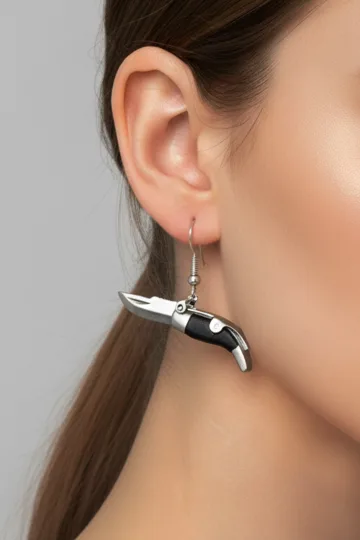
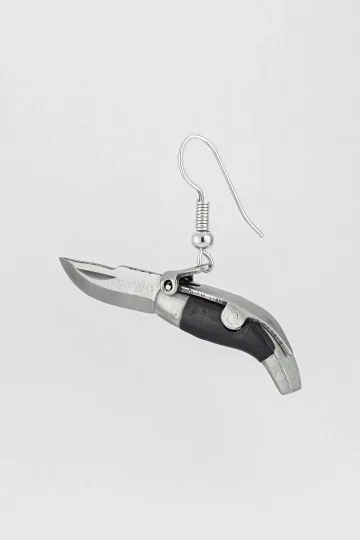
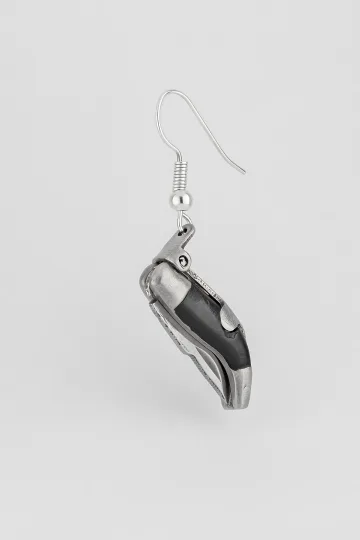
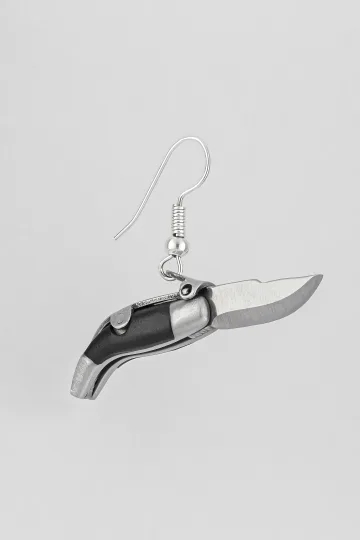
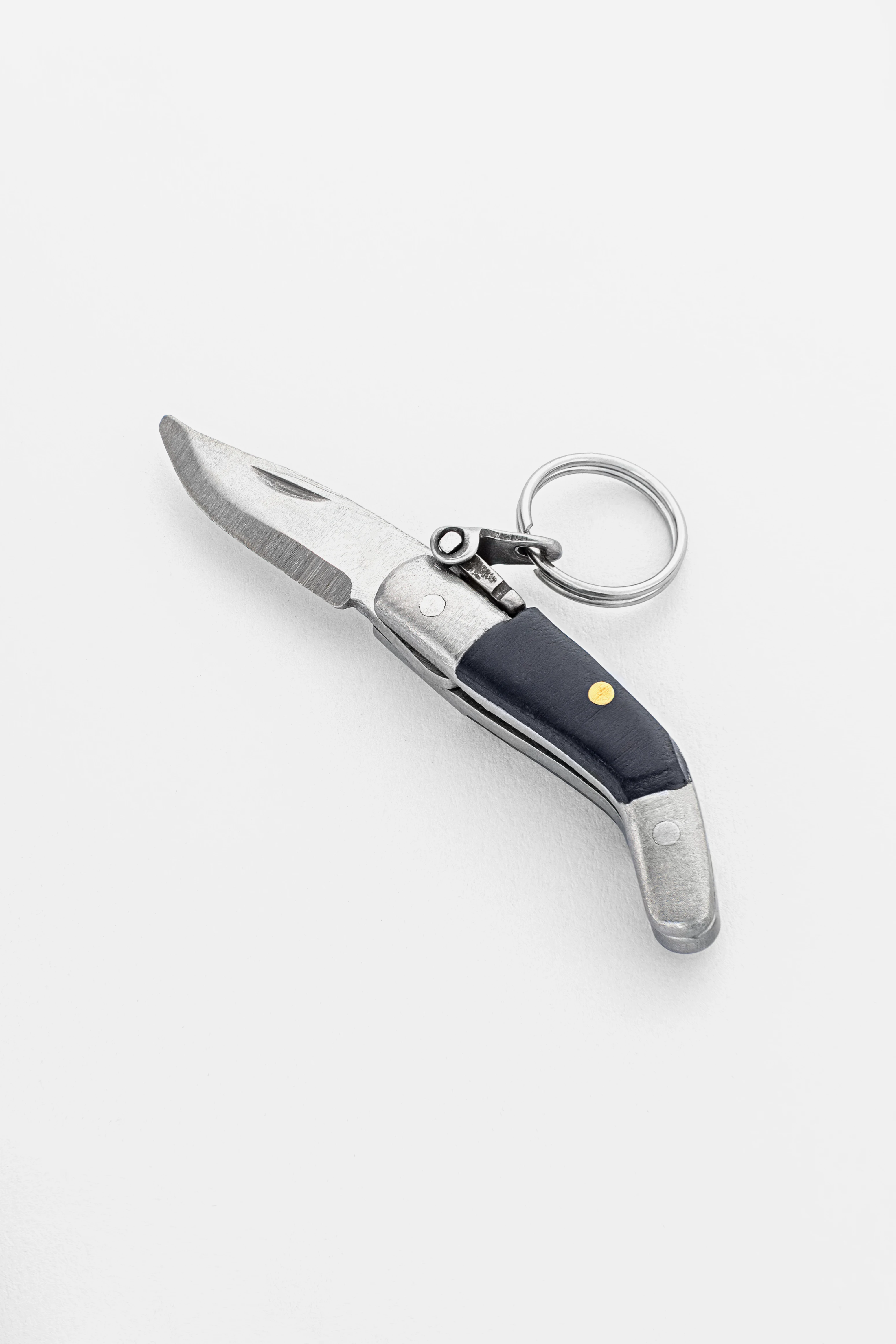
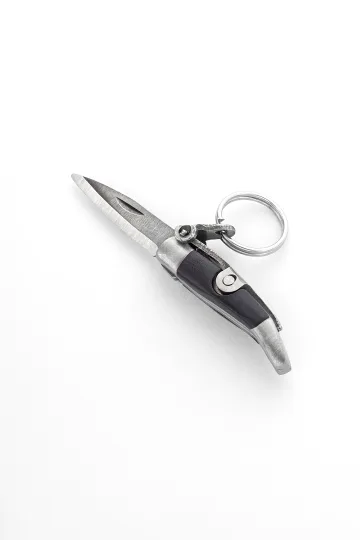
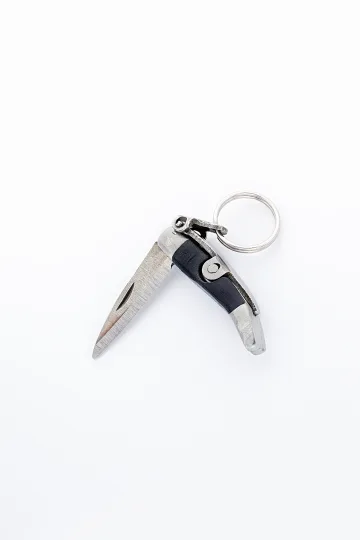
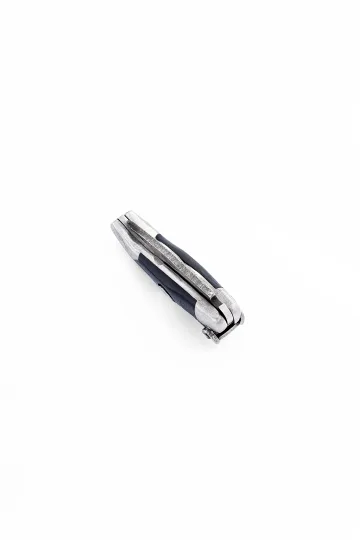
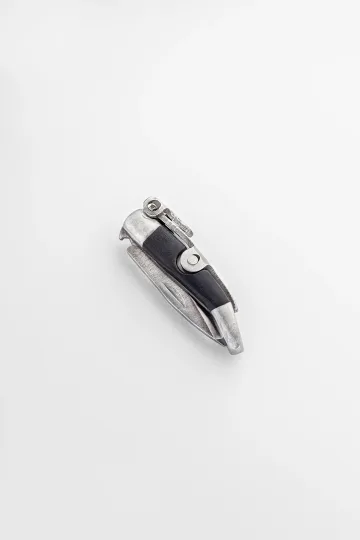
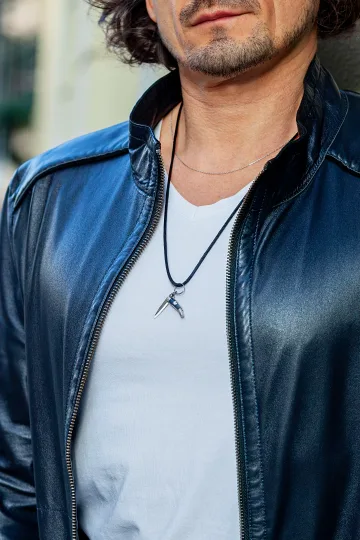
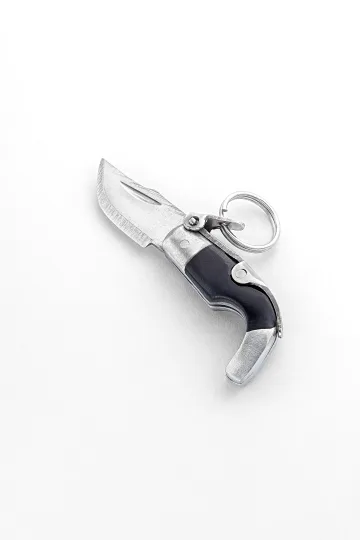
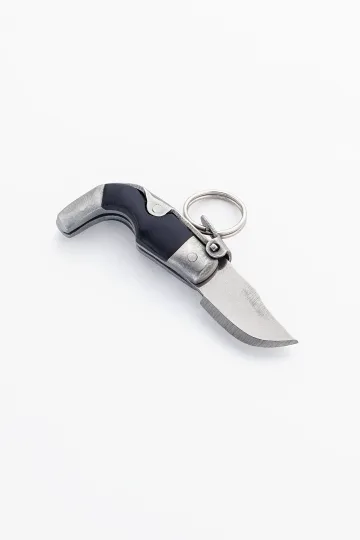
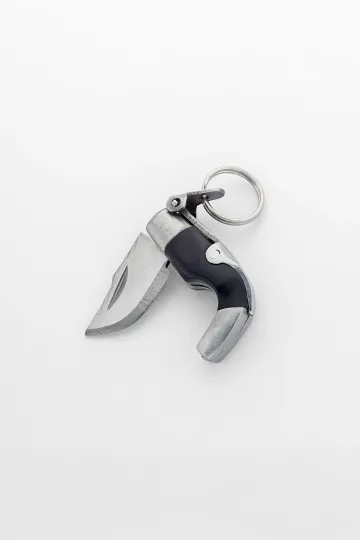
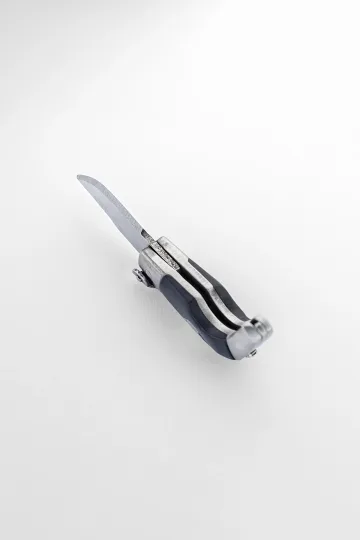
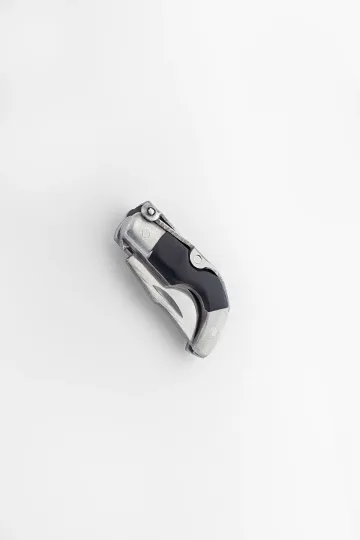
CAPAORA mini knife pendant
The 18th-century Spanish navaja in miniature: 40 mm of stainless steel, a real folding mechanism and a Palanquilla lock that clicks. An affordable gift to remember.
Authentic · Ships from Spain · 14-day returns
Crown jewellery by form: pendant, ring, earrings
Crown jewellery works in different registers. The choice of form depends on which part of the meaning you want to foreground.
Pendant
The most versatile form. A small pendant travels through the day without drawing attention. A large one becomes the centre of the outfit. The material does serious work: gold delivers the classic royal reading, silver keeps things closer to dignity without pomp, oxidised or blackened metals shift the piece into Gothic or alternative territory.
Ring
It can be a signet, with the motif worked as a crest, or a version where the crown is itself the main element rising above the band. On the middle finger it makes a clear statement. On the ring finger, particularly as a paired piece with a partner, it reads as a marker of the relationship.
Earrings
A rarer choice, but effective. Usually small studs or drops with the crown as the central element. Suits those who like legible symbols without overload.
Bracelet
Most often as a charm on a chain or a leather cord. Paired king/queen bracelets are a small but established subcategory.
Materials
Gold works with the classic reading: power, nobility, tradition. Silver shifts the piece into a more contemporary register. Rose gold often appears in paired pieces and in women's collections. Oxidised metal and blackened finishes suit Gothic, punk and alternative styles. Stones (rubies, sapphires, emeralds in classic work; black onyx in Gothic) add another layer of meaning through their own symbolism.
Frequently asked questions about crown jewellery
What does a crown tattoo mean?
Most often 'I am in charge of my own life', or 'I am crowned by my own achievements'. Paired tattoos with a partner signal belonging and equal standing. Three points can nod to the Trinity, five to royal status, six or more to imperial rank.
With a cross or without, what is the difference?
With a cross at the summit, the piece reads as Christian, referencing the coronation rite. A strong choice for believers or for those who value the connection to Christian tradition. Without a cross, the motif is more neutral and works for everyone.
Is the crown masculine or feminine?
The symbol is universal, though forms vary. Heavier pendants, signet rings and bold tattoos are more often chosen by men. Tiaras, diadems and fine pendants lean feminine. The division is not strict, and plenty of people cross it without thinking twice.
Is a crown pendant a good first serious piece of jewellery?
Yes, if the meaning resonates. It will not date, it can be worn at any age, and it translates across settings from casual to formal. A sound first investment.
What should I gift for a wedding?
Paired King and Queen pendants, rings with a crown above the heart, small earrings with crown details for the bride. Engraved silver pendants with initials also work.
What about religious use?
In Catholic tradition the crown connects to the Virgin, to Christ the King, to the saints. In Orthodox tradition to Byzantine emperors and their heirs. Wearing a crown pendant as a person of faith is entirely natural, and often reinforces the connection rather than complicating it.
How do I care for a crown piece?
Much as for any detailed jewellery. Openwork pieces collect dust in the gaps; a soft brush and mild soapy water lifts it out. Stones are polished separately, without abrasives touching their surfaces. Silver darkens over time in a way many owners prefer, but a specialist polish brings the shine back in minutes.
Can a crown pendant be worn every day?
Yes, if the piece is a comfortable size and the fittings are sound. Small pendants disappear into daily life without trouble. Larger pieces tend to be saved for specific occasions, because a heavy pendant starts to tire the neck by evening.
What does a broken crown mean?
An alternative motif, strong in Gothic and punk aesthetics. It reads as the refusal of imposed power, as inner freedom, or as a personal story of having come through. You will not find it in traditional fine jewellery, but designer and street jewellery embrace it.
Can I give a crown piece to someone I am not in a relationship with?
The paired King and Queen pieces belong to partners. A single pendant or ring is fine for friends, parents, colleagues, as long as you know the symbol means something to the recipient. The most universally safe option is the laurel wreath, which reads as 'congratulations on the win' without any romantic reading.
The crown in heraldry and modern logos
A whole field of its own is the crown in heraldry and in contemporary branding. The fact that the largest global companies still reach for it says something about its staying power.
Swiss watchmaking. In the first half of the twentieth century several major watch houses adopted the five-pointed silhouette. One reading holds that each point represents a finger of the craftsman's hand; another that they stand for five spheres of mastery. Whatever the original reasoning, the choice fused precision engineering with royal status in the public mind.
The brewing industry. Countless beer brands, especially in Latin American and European markets, place a crown on the label. The reference is not to a specific monarchy but to the secular idea of royal quality.
The word 'king' in names of colleges, regiments, bands and fast-food chains forms a whole ecosystem of commercial symbolism, where the visual crown guarantees a premium positioning.
The coat of arms of Spain. The Spanish national coat of arms carries the Royal Crown of Spain, a simplified form of the crown of Ferdinand and Isabella. It surmounts the central shield, which gathers the arms of all the united kingdoms. A Spanish person wearing a crown pendant in the national style is making a civic declaration.
The British Royal Coat of Arms. St Edward's Crown tops the British Royal Coat of Arms. The specific silhouette is recognisable at any distance and is one of the most frequently reproduced forms in crown jewellery.
The crown in Ottoman and Islamic tradition
The conversation around the crown tends to default to European and Byzantine forms. Islamic culture walked its own path. Ottoman sultans did not wear the European regalia but turbans pinned with a sorguç, a plume held in place by an elaborate jewelled brooch. By function the sorguç was the Ottoman equivalent of the European crown.
When Western films put a European crown on a Turkish sultan, the costume department has taken a liberty. Modern Turkish jewellery does draw on both traditions, since Turkey sits culturally between Europe and the Islamic world, and the motif in contemporary work often blends both registers.
Persia, by contrast, developed a European-style crown. The Pahlavi Crown, made in the twentieth century, reached back to ancient Persian imperial traditions. The Peacock Throne of Shah Jahan in Mughal India included a taj, the Persian word for crown, which gave its name to the Taj Mahal itself.
Send a friend a discount code, they save on their first order.
The crown in Gothic and alternative fashion
The crown has been rewritten in Gothic, punk, metal, emo and dark academia. Here it does not mark direct power but ironic or mournful statements.
The crown of thorns. The Christian symbol of suffering, reused in alternative fashion as a mark of refusing the easy path. A pendant or a tattoo with this motif reads: I am the sovereign of my own pain, and I do not hide it.
The broken crown. A favourite in punk jewellery. Cracked, with a missing section, with battered arches. It reads as 'I was a king, but the system broke me', or as 'I reject the crown imposed on me'.
The skull with a crown. A staple of Gothic work. Rex Mortuus, the dead king, or memento mori reminding the viewer that death levels kings and commoners alike. A heavy symbol, worn deliberately.
A crown of thorns around a heart. A Gothic variant joining thorns and heart. It reads as love that rules through suffering.
The Queen of Spades, the King of Clubs. Playing card imagery adds another, lighter register. Rings with the ace of spades or the queen of clubs appear in tattoos and designer pieces.
Further cultural layers
The crown in ancient Greece
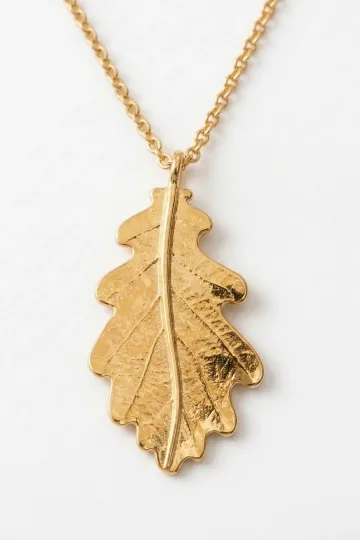
Beyond wreaths, the Greeks also worked gold headdresses. Archaeological finds in Macedonia, including the tomb of Philip II, father of Alexander, revealed a delicate gold crown of oak leaves, so finely worked that modern jewellers still study the technique. This 'golden wreath' style returns periodically to jewellery fashion, especially in Greek and Cypriot houses.
The crown in Africa
Several African kingdoms, from Ashanti in Ghana to the Zulu houses in South Africa to the Ethiopian imperial tradition, developed their own crown forms. The Ashantehene, king of Ashanti, wears a crown worked with gold elements quite different from European regalia. The regalia of Haile Selassie in Ethiopia reflected a double legitimacy: from the ancient Kingdom of Aksum and from the Old Testament lineage claimed by the dynasty.
Jewellery drawing on African crown traditions is rare in the mass market, but in diaspora communities in the UK, the US and across Europe it is gaining ground as part of wider conversations about representation.
Famous crowns in history and their influence on jewellery design
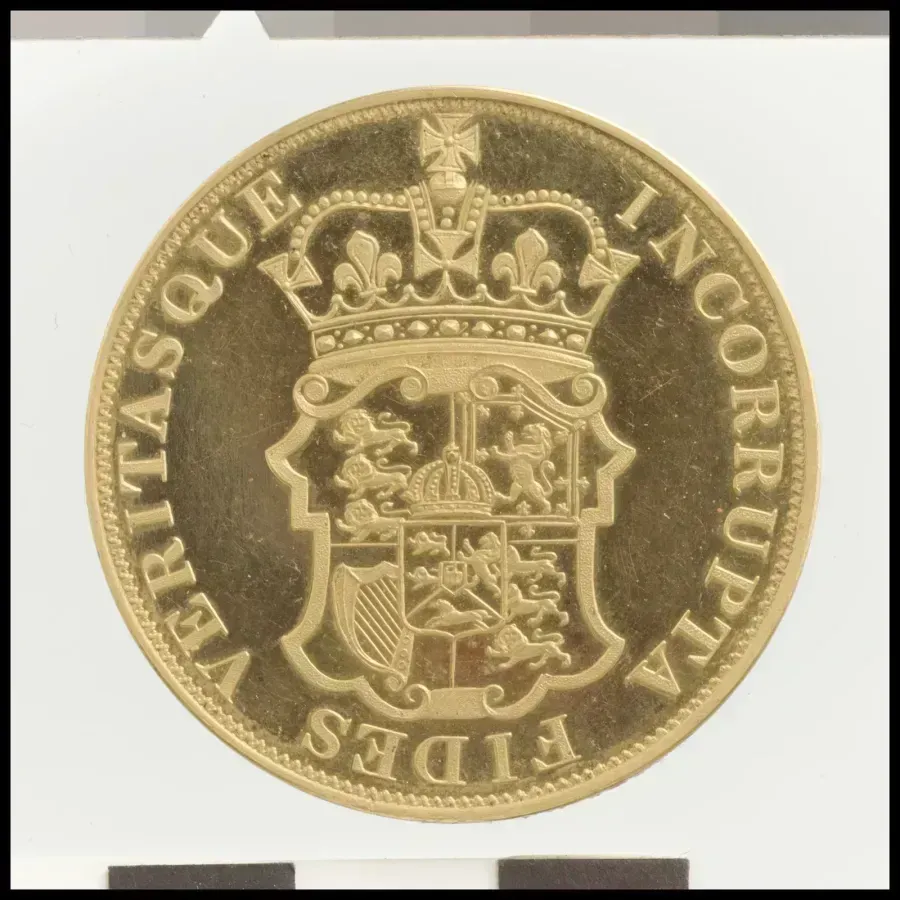
Several specific historical crowns have shaped the way the motif is drawn and worked today. Knowing them makes jewellery choices easier to read.
St Edward's Crown (England, 1661). The principal coronation crown of the British monarchs. Heavy (over two kilograms), made of solid gold, with four arches rising to an orb and a cross. Its silhouette is the single most reproduced form in crown jewellery worldwide, the shape that comes to mind when anyone thinks 'royal crown'. Set with sapphires, rubies and pearls. Kept in the Tower of London.
The Imperial State Crown (England). The crown the monarch wears after coronation for public appearances, including the State Opening of Parliament. It contains the Black Prince's Ruby, the Stuart Sapphire and the Cullinan II diamond. In jewellery it is recognisable by its high rounded shape and the density of stones.
The Crown of Charlemagne (Vienna). One of the oldest surviving crowns, dating from the tenth century. An octagonal shape, ornamented with biblical scenes and large stones. Byzantine influence is visible throughout. In modern jewellery its echoes turn up in the work of designers who draw on Romanesque and Gothic styles.
The Imperial Regalia of the Holy Roman Empire. Used for over a thousand years, kept today in the Hofburg in Vienna. Its distinctive octagonal form appears occasionally in heavy men's pendants.
The Great Imperial Crown of Russia (1762). Made by the jewellers Jérémie Pauzié and Georg Friedrich Eckart for the coronation of Catherine the Great. It carries nearly five thousand diamonds and a large red spinel. It blends Western and Eastern traditions.
The Holy Crown of St Stephen (Hungary). A unique regalia with a bent cross at the summit. Legend attributes mystical meaning to the twist; historians prefer the explanation of a fall in 1849, when the crown was hidden and damaged.
The Crown of Our Lady of Guadalupe. Kept in Mexico, one of the most venerated religious crowns of the New World. It carries the fingerprints of Spanish colonial jewellery.
The Crown of Nepal. Until 2008, when the monarchy was abolished, the Nepalese king wore a singular crown ornamented with peacock feathers and emeralds. One of the last living examples of a distinctly Eastern form still in ceremonial use.
Silver and gold jewellery, wedding bands, symbolic pendants, paired sets.
Buying it as a gift? Each one arrives ready to give.
 A branded Zevira box and a little card come with every order.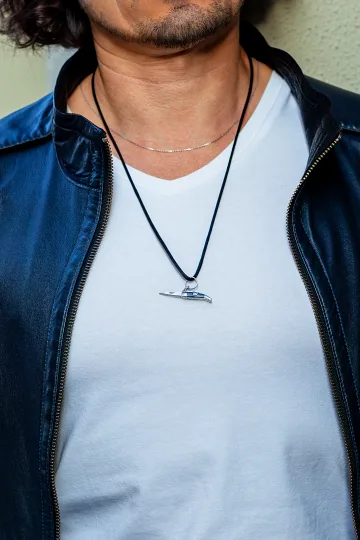




About Zevira
Zevira is an independent Spanish jewellery house based in Albacete, in the interior of Castilla-La Mancha, far from the polished showrooms of Madrid and Barcelona. Zevira works in the metalworking tradition of Albacete, a trade that has always judged a piece by the line of it held up to the light, one at a time. Our crown pendants, rings and earrings draw on the full vocabulary of the motif, from the Catholic Monarchs' regalia to the laurel wreaths of antiquity to the Gothic circlets of thorns. Each piece carries its own story, engraved or plain, in silver or gold, ready to cross the centuries with whoever chooses it. Open catalogue
In closing
The crown is one of those rare symbols that works on three layers at once. On the surface it is status and recognition. Under that, it is personal dignity and self-respect. Deeper still, it is connection to something spiritual or ancestral. In a piece of jewellery the symbol stays quiet, it does not shout, but it is visible. And the person who wears one, most of the time, wears it for themselves rather than for an audience, as a reminder: I am my own sovereign, and my life is worthy of a crown.
Three thousand years of practice is an argument of sorts. The children in paper circlets at birthday parties, the brides fastening tiaras, the athletes tattooing the shape above a bicep, the grandmothers receiving a pendant from a grandchild, they are all speaking the same old language. The crown keeps meaning what it has always meant, even when the palaces are gone.