Dog Paw Memorial Jewellery: A Guide to Keeping Your Dog Close
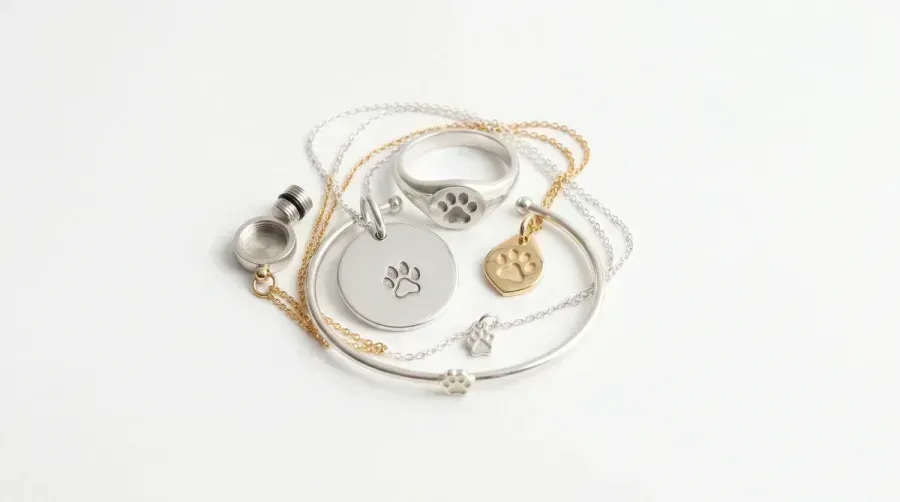
Wear the symbol, don't just read about it. These are in stock:


Introduction
There is a particular kind of quiet that settles into a house after a dog is gone. No claws on floorboards. No heavy sigh near the door. No weight at the foot of the bed. People who have never had a dog sometimes struggle to understand why this silence is so specific, so dense. People who have had a dog know immediately. There are no words needed.
It is for those people that paw jewellery exists. A pendant in sterling silver. The shape of a paw print. A space for a name, sometimes a small sealed capsule inside. A physical object to carry what cannot otherwise be held.
Grief for a dog does not always arrive in one wave. It comes in small collisions with ordinary things: the empty bowl, the lead hanging in the hall, the bag of food nobody wants to throw away. What people often need during those days is not ceremony but a small, quiet object. Something to hold. Something to wear. Paw print jewellery works that way. It does not replace the dog. It gives a shape to the fact that the dog existed, in grams of silver worn close to the skin.
Memorial jewellery for animals first appeared as a recognisable category in Victorian England, then faded to a narrow specialist trade for most of the twentieth century, and has since become entirely mainstream. Today, jewellers across Europe and the United Kingdom work specifically with this subject. Having a pendant cast from an actual paw print, or made with a small quantity of ash inside, is now as unremarkable as ordering an engraved wedding ring.
There is another version of this, worth naming early: the print taken from a living dog. While a companion is still here, a cast of the paw pads can be made. The resulting silver pendant is worn while the dog is alive. Then, after loss, it becomes memorial. The same object passes through two entirely different chapters of a family's life.
This guide is written plainly. No promises about connection, no language of magic or mysticism. Silver does not do those things. What it does: give form to something that would otherwise remain shapeless inside.
Paw jewellery: choosing the right format
The right format depends less on taste than on what the piece is meant to do.
A pendant on a chain is the most versatile choice. Worn short, at the collarbone, it is visible and part of how someone presents themselves. Worn long, below the neckline and under clothing, it becomes private: felt rather than seen. The second option is more common among people wearing a piece as memorial. The pendant can be flat with a raised paw impression, or three-dimensional, with a hollow interior for a small lock of fur.
A charm on a charm bracelet works differently. A bracelet with charms is a kind of diary: a child's initial, a travel charm, a significant year. A paw charm becomes another chapter. For people who have had several dogs over the course of a life, a bracelet allows one charm per dog. The bracelet becomes a quiet family record.
A ring with a paw print is less common but has its audience. The impression sits on the outer face of the band or as a small raised detail on a flat setting. Worn on the middle or ring finger alongside everyday rings, it enters the field of vision every time the hands are in use, and for some people that daily visibility matters more than wearing something hidden.
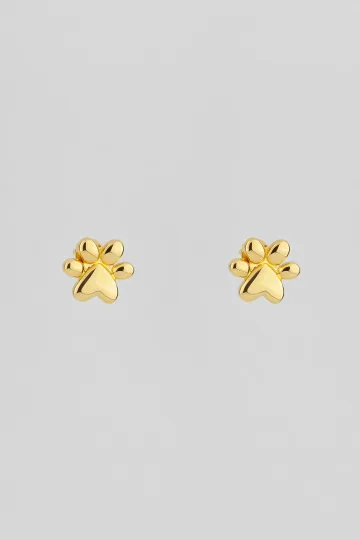
Stud earrings with a paw motif read more as an expression of love for dogs in general than as memorial. The scale is small, the motif stylised, and the association is lively rather than elegiac. They work less well for the heaviest periods of grief.
For men, the most effective formats are those that do not read as ornamental: a leather cord with a silver paw bead, a woven cord bracelet with a silver paw detail. Visually these read as functional objects, closer to a travel or work accessory. Men who never wear chains often accept these formats without discomfort.
A useful distinction to keep in mind: pieces made while the dog is still alive can carry more colour, more personality, a styled motif, the dog's name in a prominent position. Memorial pieces tend to be quieter: less surface shine, darker patina, often without visible lettering, with a date engraved privately on the reverse. The distinction is not absolute, but it helps narrow down where to begin.
One paw, in silver, close to the skin. The rhinestone charm belongs on the collar, not on you.
How to pair the paw
The paw lives on the body every day, so it is worth thinking about how it sits in real outfits, and in the odd special moment too. When I style a client, I start from one idea: the piece should live on the skin, not in a box.
What do I wear the paw with day to day? For everyday I recommend a silver paw on a fine chain inside the neckline of a tee, a roll-neck or a plain jumper. With a round or V-neck the pendant finds the collarbone on its own; under a collared shirt it tucks away and becomes a private, hidden sign. Silver gets along with any neutral palette: grey, white, beige, denim, black.
Is the paw right for the office? Yes, in a restrained version. I suggest an oxidised or matte paw with no bright enamel, on a short chain at the neckline of a blouse or under a jacket. Here it works as a quiet detail for yourself, not as a statement.
How do I build an evening look? For evening I choose gold or polished silver with a soft shine. An open neckline, a dark smooth fabric, and the paw becomes the single accent that needs no neighbours. I recommend a shorter length so the pendant rests on bare skin at the collarbone.
Can I layer the paw with other chains? You can, and it suits it. I gather it into a layer of fine chains of different lengths, each with its own meaning: a child's initial, a cross, a locket. Mix metals on purpose: silver with white gold reads evenly, silver with yellow gives a warm, deliberate contrast. On the hand a paw ring stacks neatly with plain everyday rings.
Which chain length should I pick? Two rules that never fail. For hidden, very private wear I recommend a chain from 60 cm, so the pendant slips under your clothes closer to the heart. For a visible, conversational piece I choose shorter, up to 45 cm, sitting at the collarbone. And do not overload the look: one paw is enough, there is no need to repeat the symbol.

Turn on your camera, pick earrings, a pendant or a ring, and see the piece on yourself in real time.
Switch items in one tap.
Everything runs in your browser: no photo or video is ever uploaded.
Customer reviews
Zevira is a real jewellery shop. Genuine payments, deliveries and customer thank-yous.
🥰🥰🥰 gracias

Ok, ¡gracias! 🙂

Types of paw print jewellery
Within the form itself there are several distinct approaches, and they are not interchangeable.
A realistic cast from an actual paw print is made by taking an impression of the paw pads. A soft, non-toxic impression compound is applied to the paw, pressed gently, and removed. The resulting mould is scanned into a three-dimensional digital model and used to cast a silver pendant. The result shows the individual geometry of that particular dog's pads: size, proportion, small creases, the character of each toe. For many clients, this fidelity is the whole point. The piece is not beautiful in a generic sense; it is accurate to one specific animal.
A stylised silhouette with four smaller circles above a larger central pad is a graphic simplification. It reads clearly at small scales, works well as a charm, and suits someone who loves dogs as a subject rather than memorialising a specific animal. It is also the right choice for anyone who finds a hyper-realistic cast too literal.
A geometric interpretation moves further from representation: the paw is built from clean circles, sometimes inscribed within a disc or set inside a heart. It reads as a symbol rather than a portrait. Often chosen as part of a layered piece alongside initials or other personal motifs.
A piece with name and dates assembles all identifying information into one object: a paw impression on one face, the dog's name along an arc, dates of life in two lines. The engraving can be visible on the outer surface or kept entirely on the reverse, so the exterior remains plain and the personal detail belongs only to the owner.
An ash capsule pendant is its own category. A sealed interior chamber, roughly the size of a thimble, holds a small quantity of cremation ash or a lock of fur. The mechanism is either a threaded screw cap or a permanently soldered seal. More detail on this in the section below.
A locket with photograph behind glass works like a Victorian portrait miniature. The exterior carries the paw motif; inside, behind a mineral glass window, sits a photograph of the dog. Lockets are worn closed and the photograph stays private. The format is the closest living relative of the nineteenth-century mourning locket.
Upload a photo of your pet, someone you love, or an object. We'll build a 3D model and hand-cast it in pewter.




The history of this symbol
Mourning jewellery as a recognisable category was shaped by Victorian England in the 1860s and 1870s. After the death of Prince Albert in 1861, Queen Victoria wore mourning dress for the rest of her life. Black jet, dark garnets, hair woven into flat plaques and sealed under mineral glass, gold lockets with portraits of the dead: these became the standard vocabulary of grief among the middle classes throughout Britain and the Empire. A separate trade, hair workers, earned a living producing exactly these objects for families of every income.
What is less commonly mentioned is that Victoria kept dogs, and that her feelings about them were not casual. Her King Charles spaniel, Dash, had accompanied her through her teenage years and appeared in her earliest formal portraits. When Dash died in 1840, Victoria commissioned a memorial stone at Windsor Castle bearing an inscription that attributed to Dash all the virtues that humans rarely manage together: affectionate without deceit, faithful without self-interest, brave without cruelty. The stone still stands. The inscription was not a private note; it was a public monument, and it legitimised something that had previously been considered unfit for formal expression: that a dog could be mourned as a significant loss.
Victoria also wore a medallion bearing Dash's image after his death. She was not unique in this. The Edwardian period that followed saw a modest expansion of memorial practice to include pets: small portrait miniatures of favoured dogs, sometimes set in brooches or pendants, made for clients who could afford the commission. These were never mass-market items. But they established the precedent.
The twentieth century interrupted this. Memorialising a pet became culturally awkward. Grief for an animal was considered disproportionate, something to be managed privately and not discussed at length. Those who felt it keenly learned to be quiet about it.
The shift began in the late 1990s and accelerated through the 2000s. European and British cities saw the opening of dedicated animal crematoria offering individual cremation with ash return. Pet cemeteries with proper maintenance and permanent records became available. Psychologists began writing, with evidence, that grief for a companion animal is genuine grief, following recognisable stages, with the same need for acknowledgement and ritual as grief for a person. Memorial jewellery makers began appearing: first as individual craftspeople, then as small studios, then as a recognisable sector. The Battersea Dogs Home, established in 1860, had documented the depth of human-animal bonds for over a century by then; what changed was the willingness of public culture to take those bonds seriously.
By the 2010s, paw print pendants, ash capsule necklaces, and cast impression rings were being sold not only by specialist studios but by mainstream jewellery retailers across the United Kingdom and Europe. The subject had moved from private grief to ordinary commerce, which is to say it had become normal.
Technically, the casting process evolved alongside the cultural shift. Early methods used simple clay tablets fired with the impression. Later, silicone impression compounds replaced clay: cleaner, faster, no residue on the paw pads. With the availability of affordable 3D scanning in the 2010s, impressions could be captured digitally at resolutions below a tenth of a millimetre, then used to mill or print a wax form for traditional lost-wax casting. The dog barely notices the process.
CAPAORA mini knife pendant
The 18th-century Spanish navaja in miniature: 40 mm of stainless steel, a real folding mechanism and a Palanquilla lock that clicks. An affordable gift to remember.
Authentic · Ships from Spain · 14-day returns
Memorial jewellery with cremation ash
This section is written plainly, without softening.
When a dog is cremated, the ashes are returned to the owner. In the United Kingdom and across Europe, individual cremation, where the animal is cremated alone and the complete ash returned, is the standard service offered by veterinary crematoriums. The volume of ash from a medium-sized dog is roughly half a litre, weighing around a kilogram depending on build. For jewellery purposes, a small pinch is used. The rest remains with the family.
The capsule inside a pendant is a small interior chamber: cylindrical or heart-shaped, with a volume of roughly a quarter to half a thimble. Two construction approaches exist. The first is a threaded cap with a silicone gasket, tightened by hand or with a small key. This allows the capsule to be reopened if the owner wishes to change or remove the contents. The risk is that daily wear can gradually loosen the thread; it needs occasional checking. The second approach is permanent sealing by soldering. After the capsule is filled, the cap is soldered shut and the seam polished flush. The resulting piece cannot be opened and the contents are fixed permanently. Most reputable workshops offer both, and the choice is essentially about whether the owner wants flexibility or absolute security.
A realistic cast from a paw print works as follows. An impression is taken from the paw pads using soft compound. The impression is scanned to a digital STL file at high resolution. From this file, a wax form is milled or printed, then invested in plaster and cast in molten silver by the lost-wax method. The resulting pendant preserves every detail of that specific dog's pads. Lost-wax casting itself is several thousand years old; what is new here is only the digital step between impression and wax.
Ash fused into glass or resin is a technique for those who want the ash visible. A small quantity is mixed into clear jewellery resin, or incorporated into molten glass by a lampwork specialist. A lampwork glass bead, made by working heated glass rods over a flame, can incorporate ash directly into the core of the bead as it forms. The resulting piece shows the ash suspended in transparent material. This is specialised work; relatively few studios in Britain and Europe do it well.
On the question of whether this is right: cremation ash is an inert mineral residue, chemically close to calcium carbonates and phosphates. It presents no biological risk, no infection hazard, and no radiological concern. The practice of wearing the memory of someone close in a physical object is not new: Christian reliquaries, Victorian hair lockets, Japanese pendants holding a lock of a parent's hair. Memorial jewellery for a dog sits within the same long tradition of physical memory-keeping.
What the paw symbolises
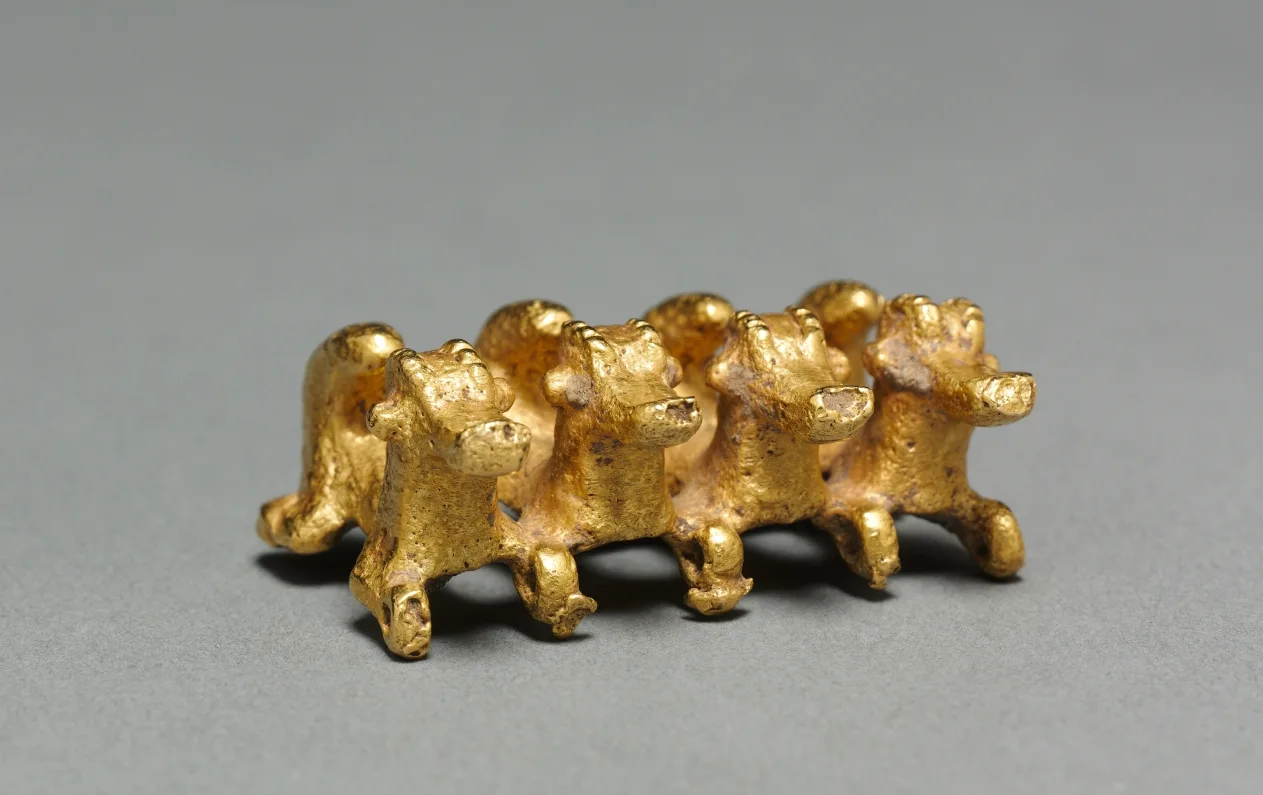
The straightforward answer: a paw print is a trace. Not a talisman, not an amulet, not a conduit between worlds. The mark left in sand, or mud, or on a wooden floor that someone keeps finding years later.
The quality most associated with dogs is loyalty that requires no conditions. A dog does not adjust its behaviour based on your mood, your income, your appearance, or your social standing. It is present, and that is enough. For many people who grew up in environments where affection came with conditions attached, this is a genuinely distinct experience. A paw print as symbol holds precisely this: unconditional presence.
Faithful attachment over time is not a poetic abstraction. Documented cases exist of dogs returning to places associated with a lost owner for years. The most cited example is Hachiko, the Akita who waited at Shibuya Station in Tokyo for nine years and nine months after his owner's death, every day, at the usual time. The paw as symbol carries this dimension: constancy of a kind that is less common among people than we might like.
The practical trace is a different layer. A dog who lives with a family for ten or twelve years changes that family's patterns: morning routines, the daily route, the particular knowledge of other dog owners in the neighbourhood, the way children understand responsibility. These traces remain after the dog is gone. The pendant registers that these traces are real.
The shift to memorial happens at the moment of loss. Before that, a paw motif is a sign of affiliation, a mark of belonging to the company of dog people. After loss, the same object carries specific, named memory. Nothing in the metal changes. What changes is the weight of meaning the owner brings to it.
Honest accounting of what a paw print cannot do: it does not bring luck, does not protect against misfortune, does not connect the wearer to a dead animal in any literal sense. A great deal of copy online promises something along these lines. A paw print pendant is a worn memory and a physical anchor for something that would otherwise remain formless. That is a true and sufficient thing to say about it. For comparison, other personal symbols such as initial and monogram pendants work through the same mechanism: they anchor meaning, not magic.
Leave your email, we'll send your discount code. No spam, unsubscribe anytime.
The code arrives by email, valid on your first order.
Materials and techniques
Sterling silver 925 is the primary metal for paw print memorial pieces. The reasons are practical. Silver is softer than gold, which means fine detail in a paw impression reproduces more faithfully. Sterling silver at 925 fineness is hypoallergenic for most wearers: the alloy component is usually copper, which rarely causes sensitivity. Silver has a visual weight that is neither austere nor showy. And silver develops a natural patina over time: recessed areas of the paw impression darken, raised areas remain bright, and the detail of the print becomes more legible with age.
Gold suits those who want something more formal or permanent. Yellow gold at 585 or 750 fineness gives the paw a warm quality. White gold reads cooler, closer to platinum in tone, and pairs well with existing white metal jewellery such as a wedding ring. Rose gold, less common in memorial contexts, suits warmer skin tones and pieces with softer associations.
Engraving of a name is done two ways. Traditional hand engraving by a skilled craftsperson produces slightly uneven lines with a living quality: each stroke fractionally different from the last. Laser engraving produces consistent, precise lines at very small scales. Both work for a dog's name and a date. Engraving on the outer face of a pendant is often curved along the lower arc; engraving on the reverse is typically straight across.
3D scanning captures a paw impression at a resolution of around 0.05 millimetres. The resulting digital file is used to mill a wax form, which is then invested and cast in silver by the lost-wax process. This is a technique unchanged in its essentials for thousands of years; only the tool that produces the wax form is new.
Enamel can be used in two ways: as a contrasting fill in the recessed areas of the impression, making the paw read sharply even at small sizes; or as a colour accent across the surface. Black enamel on silver gives a graphic result. Deep blue or dark green reads less memorial, more everyday. Enamel on silver holds for decades under normal conditions, but is affected by harsh cleaning products.
Oxidisation gives silver a deep dark tone in the recessed areas; the raised surfaces are then polished bright. On a paw print, the effect is striking: the impression appears to emerge from the metal, as if just pressed in. Oxidisation wears over time and most workshops will reapply it without charge.
Permanently sealed capsules are finished by filing and polishing the weld seam until it is invisible at normal viewing distance. Watertightness is tested under light pressure immersion before the piece leaves the workshop. After that test, the capsule is considered permanently closed.
How to wear
The plain answer is: every day. Memorial jewellery loses its meaning if it lives in a box and appears occasionally for significant occasions. The whole purpose is daily presence, the same as a wedding ring or a cross worn since childhood.
Chain length matters in two ways. A short chain, up to about 45 cm, keeps the pendant at the collarbone where it is visible to others. A longer chain, 60 cm or more, drops the pendant below the neckline. Most people wearing paw print jewellery as memorial choose the longer option: the piece stays private, felt rather than displayed. Chain weight matters too: a light pendant hangs well on a fine cable or trace chain; a heavy capsule pendant needs a more substantial chain to avoid breakage under daily movement.
Combining with other everyday jewellery is natural. A paw print pendant sits comfortably alongside a wedding ring, a birthstone pendant, a small family portrait locket, or an initial chain. These are all objects of the same kind: personal memory worn on the body. They do not compete.
On a charm bracelet, the paw sits in the sequence of family markers: a child's birth month stone, a wedding anniversary charm, a charm from a significant place. The bracelet becomes a portable record. Adding one paw charm per dog over the course of a life is a practice several clients mention as something they did not plan but arrived at naturally.
For men, the less visible formats tend to be more comfortable: a pendant under a shirt, a cord bracelet with a paw bead, a signet-style ring with a paw impression on the face. Men who never otherwise wear jewellery often find these formats acceptable precisely because they do not look like conventional jewellery.
For children, the paw motif of a living dog is simply a friendly daily symbol: a small silver pendant, worn as an expression of the bond with their own animal. The memorial dimension does not need to be introduced or explained. The same piece carries different weight in different circumstances, and a child wearing the paw of a living dog simply has a piece about their friend.
One practical dimension worth noting: wearing a paw print pendant gives a person a simple way to introduce their dog into conversation without forcing it. A colleague or passing acquaintance notices the pendant and asks. The owner can say a few words and move on. For those in early grief, this is often a relief. It provides an opening without requiring an announcement.
Silver, gold, wedding rings, symbolic pieces and paired sets.
Send a friend a discount code, they save on their first order.
Who this is for
Current dog owners, as a daily sign of the bond. People wear pendants bearing the initials of their children, charms from their wedding year. A dog sits in that same category of significant attachment. There is nothing that needs to be justified in wearing a sign of it.
People going through the loss of a dog. A worn object gives grief a physical address. Psychologists working with bereavement note that a tactile anchor helps during the first months: when something is painful internally, touching the pendant and feeling its weight provides a simple, non-analytical form of comfort. This is not mystical. It is ordinary body-level reassurance.
Families in which the dog belonged to everyone rather than to one person. In these cases, several identical pendants are sometimes cast from the same impression: one for each member of the family who wants to carry it. A quiet shared sign. Sometimes the engraving on each pendant is individual; sometimes identical.
Shelter workers and volunteers who work with many animals and do not memorialise individual dogs. For these people a paw motif means the whole population of animals they have cared for. A plain paw symbol, without name or date.
As a gift for someone who has lost a dog. This is a sensitive choice. In the immediate weeks after loss, the subject is very raw and a memorial object may arrive too soon. At two or three months, when the acute phase has passed, such a gift is more likely to be received as support rather than a reopened wound. A piece without engraving is safest: it leaves the decisions about name and date to the owner. A gift like this works best from someone close; it is too personal a gesture from an acquaintance.
Frequently asked questions
Can a pendant be made from a living dog's paw print? Yes, and this is a common starting point. The impression is taken with a soft, harmless compound; the dog does not need to be still for long and the compound leaves no residue. Many clients make the pendant while their dog is in good health, wear it as an everyday piece, and continue wearing it as memorial after loss. The same object serves both purposes.
How much ash is needed for the capsule? Very little. The interior chamber of a jewellery capsule holds roughly a quarter to half a thimble by volume, which translates to about a gram or less by weight. The main quantity of ash stays with the family; what goes into the pendant is a symbolic pinch. There is no benefit in using more.
Is it safe to wear ash? Yes. Cremation ash is an inert mineral residue, presenting no biological risk and no infection hazard. The capsule is hermetically sealed, so there is no direct contact with the contents during wear. The practice of keeping a physical trace of someone close has existed across many cultures for centuries. There are no medical objections.
Can men wear this jewellery? Yes, and many do. Memorial jewellery carries no gendered associations. For those who prefer formats that do not read as ornamental, the cord bracelet and paw bead combination, or a plain signet-style paw ring, are the most commonly chosen. Many men wear a pendant under their shirt, which keeps it personal without requiring explanation.
Is it appropriate as a gift for someone grieving? It can be, with care. Close friends who are confident the timing is right, and who choose a piece without engraving to leave decisions to the recipient, generally find the gift is well received. For acquaintances, it is worth asking directly whether such a gift would be welcome. People in grief are usually clear about this when asked.
How is the pendant cleaned, and can the chain be changed? The exterior of the pendant is cleaned with a soft polishing cloth, as with any silver piece. Brief rinsing in water is fine; prolonged soaking is not recommended. The sealed capsule interior requires no cleaning and cannot be accessed. The chain is standard and interchangeable: if it wears out or is the wrong length, any jeweller can replace it with a chain of the same clasp type.
Silver or gold for a paw piece? Silver is the usual answer, and not only for reasons of budget. The paw motif lives on contrast: the pads and the claw marks are recesses, and they read from arm's length only if those recesses sit darker than the surface around them. Oxidised silver does that on its own and keeps doing it as the piece ages. Yellow gold flattens the same relief, so a gold paw usually needs the recesses darkened deliberately or cut deeper to compensate. Against that, silver tarnishes and wants a cloth every few weeks, gold does not, and gold is the safer metal for skin that reacts. Gold plated silver sits in the middle and behaves differently by format: on a bracelet, where the piece knocks against desks and sleeves, plating wears through at the contact points within a couple of years, while a pendant hanging free keeps its finish far longer. For something meant to be worn daily for decades, solid metal outlasts any plating.
Can a piece be made if there is no ash, only fur? Yes, and fur is requested more often than people expect. A small lock goes into the same style of capsule, or is set in clear resin behind a glass front so it stays visible, or is braided and sealed inside a hollow bead. Sealed away from light and damp, fur keeps its colour indefinitely; clear resin can yellow slightly after ten to fifteen years of strong sunlight, which is worth knowing if the piece will live on an outdoors wrist rather than under a collar. Fur is also the natural option for owners who buried their dog rather than cremating, and for anyone who took a clipping years ago and put it in a drawer without knowing why. Whiskers work the same way and are often chosen for a slim tube pendant, where a single whisker fits the shape better than a pinch of anything else.
How long does the whole process take? Plan in two stages. Taking the impression is quick, minutes with a home kit, and posting the mould back adds a few days. Casting, cleaning up the surface and finishing is typically two to four weeks depending on how busy the workshop is, with engraving adding a little more and ash capsules usually assembled last so nothing is disturbed afterwards. If the piece is meant to be ready for a specific date, such as the anniversary of a death or a birthday, allow six weeks and treat anything faster as a bonus. Rush work is possible, but finishing is exactly where haste shows: soft edges on the pads, a claw that has lost its point, polish that stops short in the recesses.
Screw cap or permanently sealed capsule? A threaded cap with a rubber gasket, often with a dab of adhesive on the thread, can be opened again. That matters if the contents may later be divided between family members, or moved into a different setting, or added to. The cost is that a thread can loosen over years of daily wear and needs checking once or twice a year, the way you would check a clasp. A permanently closed capsule, soldered or set shut, removes that worry entirely and removes the option with it. The practical rule: if this is the only piece and the contents cannot be replaced, choose sealed. If you expect the piece to change hands or change form, choose the thread. And whichever you choose, fill it over a tray on a table, never over a sink or a carpeted floor.
Buying it as a gift? Each one arrives ready to give.
 A branded Zevira box and a little card come with every order.















About Zevira
Zevira is a Spanish jewellery brand based in Albacete. Paw print pieces and memorial jewellery for pet owners are among the categories in the catalogue. For current availability and details, see the catalogue directly.
The bond between a person and their dog is real. It shapes daily life in ways that are practical, not poetic: the walk schedule, the kitchen routine, the specific tiredness at the end of a day of care. When that bond ends, what is left is not metaphor. It is a gap with a specific shape, the size of one dog, in one house.
A silver paw print on a chain does not close that gap. It holds the outline of it. The object says: this was real, it mattered, and its absence is real too. For many people, that is enough reason to wear it every day.