Initials and Monograms in Jewellery: Letter Pendants, Signet Rings and Family Ciphers
The oldest personal logo in the world
There is a small ring on a particular English pinky finger. It has been there for decades, and before it arrived on that finger, it sat on another pinky, and before that, yet another. The stone is cornelian or bloodstone. The design is a family crest carved in reverse so it reads correctly when pressed into warm wax. This is a signet ring, and a version of it has been part of European dress since Roman Britain.
Meanwhile, on a different hand entirely, a fine gold chain supports a single letter. Just one initial. Maybe J, maybe S, maybe something more unusual. It sits at the collarbone and catches conversation. The chain belongs to someone who grew up in the 1990s or 2000s, who remembers a certain HBO show featuring a writer who wore her own name around her neck and made every other woman in America want the same.
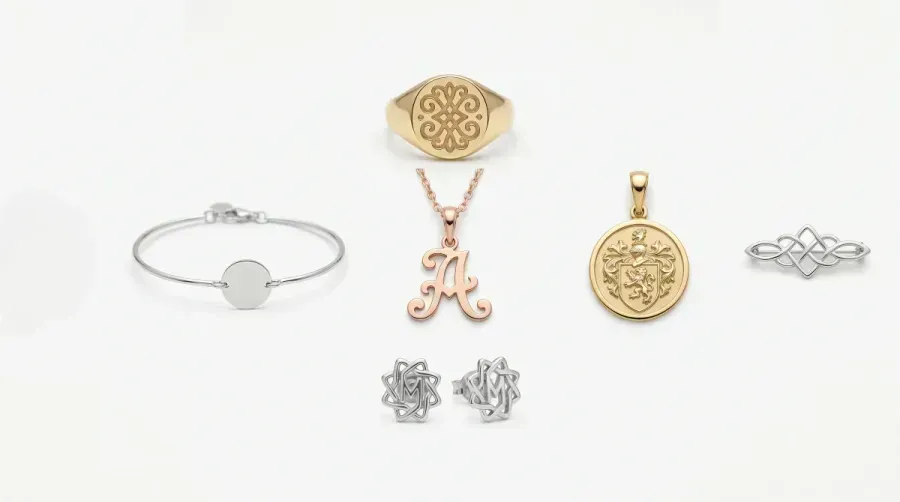
Wear the symbol, don't just read about it. These are in stock:






These two objects, the crested pinky signet and the gold letter pendant, look like they belong to completely different worlds. One is heraldic, old-money, quietly assumed. The other is pop culture, youthful, worn with confidence rather than inheritance. But they are the same impulse in two different costumes. Both say the same thing: this is me. My identity, on my body, in metal.
This is the full story of initials and monograms in jewellery. How Romans wore them, how Tudors carved them into the beams of Hampton Court, how Georgian gentlemen sealed their letters with them, how Victorian widows hid them inside lockets filled with hair, how the Art Deco generation stacked letters into geometric diamonds, and how a single scripted J on a fine chain became one of the defining pieces of modern jewellery.
The types of jewellery that carry initials
Personal letters have a way of finding every surface of the body. Some formats are centuries old. Others are younger than your smartphone. All of them still work.
The letter pendant
The simplest and the most modern. A single letter, sometimes two, hung on a fine chain and worn at the collarbone. The letter can be flat and minimal, raised and sculptural, set with stones, or left as clean polished metal. It is the most forgiving form of personalised jewellery because it carries meaning without requiring anyone else to understand it. Strangers read the letter as a style choice. Close people read it as a name.
The letter pendant also has the advantage of being entirely interchangeable. You can change chains, add more letters, wear it with a second pendant (a birthstone, a small charm, something else meaningful), or switch between a single letter for work and layered letters for weekends. It scales.
The signet ring
The original monogram format. A flat surface, usually oval or rectangular, sitting on top of a ring and carrying an engraved design. Historically the design was a family crest for use as a wax seal. Today most signets carry a single letter, a pair of initials, or a small graphic that has personal meaning.
Signet rings are traditionally worn on the left little finger, the pinky, a placement that goes back centuries. The idea was practical: the pinky is the finger least used in daily work, so a seal ring would not get in the way of writing or gesturing. The placement survived long after the practical purpose disappeared. In the United Kingdom today, a family-crest signet on the pinky still reads as a specific kind of English inheritance, usually connecting the wearer to older county families.
A signet ring does not have to carry a crest to work. A single-letter signet, clean and bold, is one of the most elegant forms of monogram jewellery that exists. It looks equally correct on a hand in a meeting room, at a bar, or holding a coffee cup at a Sunday market.
The bracelet
Engraved bracelet plates are a classic format for initials. A bar bracelet, a cuff, an ID-style plaque, or a tennis bracelet with an engraved clasp all work as carriers. The engraving can sit flat on the outer face or hide on the inner surface so the wearer is the only one who sees it.
Bracelet initials work particularly well for couples and families. A stack of three bracelets, each engraved with a different child's initial, is a modern version of a charm bracelet. A single bracelet with a partner's initial beside your own is quieter than a ring but carries similar weight.
The stud earring
Letter studs are the most discreet format. Small, symmetrical, and usually worn as a pair, either both the same letter or two different letters (your initial in one ear, a partner's or parent's in the other). Letter studs work especially well for people who already wear simple earrings every day and want to add personal meaning without changing their style.
The engineering matters here. Letter earrings are small, which means every detail of the letter shape has to be precise. A slightly off J stops looking like a J. Good craftsmanship matters more at small scales than at large ones.
Cufflinks
The classical masculine monogram format. A pair of cufflinks with interlocked initials has been standard formal dress for over a century. In the steam-liner era, every gentleman who owned a dinner jacket owned at least one pair of monogrammed cufflinks, often a wedding gift or a milestone present from a parent.
Cufflinks are now mostly worn by men who work in industries where formal dress still matters (law, banking, diplomacy) or for weddings and black-tie events. But they remain one of the most elegant carriers of a monogram. The small size demands precision. The format demands symmetry. Done well, they are as much a craft object as a piece of jewellery.
The name chain
Not strictly a single letter but deserving its own category: the full name on a chain. Flat metal letters, usually in a script font, cut into a single connected word and hung at the neck. This is the format the 1990s and 2000s made famous. Before then, name chains existed mostly in specific subcultures (hip-hop nameplate jewellery, quinceanera gifts, identification bracelets for children). After the cultural moment of that decade, they became mainstream fashion that has never really gone away.
Name chains carry a specific kind of confidence. Where a single initial is subtle, a full name is declarative. The wearer is announcing themselves. It is not accidental that name chains became popular at the same time as first-person internet culture: they are analog avatars.
An initial is a signature, not a billboard. One letter at the collarbone; save the whole name for the envelope.
How to wear your initial
Working with personalised pieces every week, I have collected the rules that never fail. An initial agrees with almost any outfit, but it speaks differently depending on what surrounds it. Here is how I recommend wearing it.
How do I wear an initial every day? For daily wear I recommend a fine letter pendant on a 40-45 cm chain over a t-shirt, a thin knit or a shirt with the top button open. The letter settles into the hollow of the collarbones and reads as a light accent. With a V-neck I suggest a slightly longer chain so the letter drops lower and reads more clearly. A plain, calm fabric (white, beige, grey, navy) gives the sign a clean background.
What if my clothes have a busy print? On a pattern a small initial gets lost. There I choose a larger version, or a signet that lives on the hand, away from the neckline, and does not compete with the fabric. A bigger letter holds attention where a fine one would dissolve.
What works at the office? Here I recommend restraint: a minimal font, a single letter, metal that matches your other pieces. A signet with an initial on the little finger or index reads as composed at a handshake and under a cuff. For a formal masculine look I choose cufflinks with a letter under the jacket, with no extra shine.
How do I dress an initial up for the evening? For evening and special occasions I recommend a larger pendant, a serif signet, or a letter with a small stone at the crossing. Under an open neckline or a thin strap I build a long chain with a visible letter; under a closed top I choose initial earrings. For a celebration a family cipher or a serif monogram fits the moment.
How do I layer an initial? An initial slips easily into a stack. I add a bare chain with no pendant, a zodiac pendant, a cross or a locket. The point is to keep the letters and pendants in scale so none overpowers the rest. I mix metals on purpose (gold with silver), but then I repeat that across the whole look, not in one spot. If in doubt about size, take a letter about one and a half centimetres on a 42-45 cm chain: a setting that works everywhere.

Turn on your camera, pick earrings, a pendant or a ring, and see the piece on yourself in real time.
Switch items in one tap.
Everything runs in your browser: no photo or video is ever uploaded.
The types of monogram: one letter, two, three, and crowned
Not all monograms are the same. There is a grammar to them, built over centuries of use by heralds, engravers, and stationery designers.
The single initial
The simplest form. One letter, standing alone, in any style from clean modern sans-serif to ornate Victorian. A single initial is the most flexible monogram because it carries no relational information. It is just you.
Single initials work across all jewellery formats and all ages. A five-year-old can wear a single-letter pendant and so can a seventy-year-old. The meaning shifts slightly (a gift for a child versus a statement of self for an adult), but the format does not change. This is why single-letter pieces remain the most commercially popular form of monogram jewellery worldwide.
The interlaced double initial
Two letters, woven together so the curves and stems interlock. The classic romantic monogram. Worn on handkerchiefs, embroidered on linen sheets, engraved on silver tea services, and carried on jewellery from the 18th century onwards. The interlaced double was the Georgian and Victorian favourite for couples: H and A, R and M, whatever the two initials were, intertwined permanently.
The engineering of an interlaced monogram is genuinely difficult. Two letters have to share space without losing legibility. The curves of one have to weave through the counters of the other. When it works, the result is a small piece of visual poetry. When it fails, it looks like a knot.
Historically, the order of letters in an interlaced monogram followed specific conventions. In British wedding monograms, the bride's initial often came first, then the surname letter in the centre (larger), then the groom's initial on the right. The centre letter was always the family name. Smaller letters flanked it.
The three-letter family cipher
The full formal monogram. Three letters, usually arranged with the surname initial in the centre and larger, the first name on the left, the middle name or partner's initial on the right. This is the format that appeared on silver, on luggage, on stationery, and on engraved jewellery for every well-off household from roughly 1750 onward.
A three-letter cipher communicates family identity rather than individual identity. It is the form that connects you to a lineage, a household, a shared name. This is why it still appears at weddings (the new shared monogram of a couple), on christening gifts (a child's initials established from birth), and on family jewellery passed down through generations.
The crowned monogram and the royal cipher
At the very top of the monogram tradition sits the royal cipher: a monarch's initials, elaborately interlaced, topped with a crown, often worked into every official surface of a reign. Tudor ciphers are the most famous. Henry VIII's initials appear carved into the beams of Hampton Court Palace, often paired with whichever wife currently held the title: H and K for Katherine of Aragon, H and A for Anne Boleyn (many of these were hastily replaced after her execution, though several survive because the craftsmen simply ran out of time). The surviving H and A at the Great Hall ceiling is one of the most quietly dramatic pieces of visual history in England.
Royal ciphers continue to this day. The cipher of the current British monarch appears on pillar boxes, on official documents, and on military insignia. Every reign generates a new cipher, carefully designed to be legible, distinctive, and reproducible at scale.
A crowned monogram in private jewellery is a deliberate borrowing of this tradition. It says: my name is worth a crown. This is vanity, of course, but honest vanity. It has been worn by people with no royal connection whatsoever for at least two centuries and remains popular in Italian, Spanish, and Latin American jewellery traditions in particular.
Customer reviews
Zevira is a real jewellery shop. Genuine payments, deliveries and customer thank-yous.
🥰🥰🥰 gracias
Ok, ¡gracias! 🙂
Fonts and styles: the shape of your letter
The same letter in two different fonts reads as two completely different objects. Font choice is the single most important aesthetic decision in monogram jewellery, more important than metal colour, size, or chain type.
Classic serif
Serifs are the small decorative strokes at the ends of letters. Serif fonts read as traditional, formal, literary. A serif letter pendant feels grown-up and established. It works particularly well for surnames and for single-initial pieces meant to be worn as professional jewellery.
Serif monograms have a long association with printed books and engraved stationery. Choosing a serif letter pendant is, consciously or not, connecting your jewellery to that typographic tradition.
Italic script
The romantic font. Flowing, slanted, connected letters that feel hand-written even when they are machine-made. Script monograms are the most popular style for feminine pieces, for gifts, and for pieces carrying names rather than just initials. The Carrie-style name chain that defined a decade was script.
Italic works beautifully on pendants and bracelet plates where there is space for the letterforms to breathe. It struggles on very small pieces, where the thin strokes and loops can become illegible.
Gothic blackletter
The heaviest, most medieval font. Thick vertical strokes, decorative terminals, an unmistakable sense of age. Gothic monograms appear in heraldic pieces, in religious jewellery, and increasingly in modern pieces that borrow from tattoo culture, where Old English script has been popular since the 1970s.
A gothic letter pendant reads as serious, sometimes austere, often masculine, though plenty of women wear them too. It is a deliberate choice. Nobody accidentally picks a blackletter font.
Art Deco geometric
The 1920s and 1930s produced some of the most sophisticated monograms ever designed. Clean geometric letters, perfectly symmetrical, often arranged in interlaced patterns within circular or octagonal frames. The Art Deco monogram appeared on cigarette cases, compact mirrors, cocktail shakers, and every kind of personal accessory an elegant person owned between the wars.
An Art Deco style monogram pendant reads as historically informed, stylish without being fussy, and genuinely timeless in the sense that the 1920s aesthetic has never actually gone out of fashion in a serious way. It also pairs well with modern wardrobes because its geometry is essentially modernist.
Modern minimalist
Thin sans-serif letters, often lowercase, sometimes very small. The minimalist monogram is the 21st-century contribution to the tradition. It reads as quiet, considered, and intentional. It appears on pieces designed for stacking and layering, where a bold ornate monogram would compete with other jewellery.
Minimalist letter pendants are particularly popular for everyday wear because they disappear visually when needed and reappear when noticed. This is a specific kind of elegance. Read more about this aesthetic in our minimalist jewellery guide.
The interlaced cipher style
Not a font exactly, but a way of combining letters. The interlaced cipher treats two or three letters as a single composed design rather than as sequential letters. The forms interpenetrate. This is the style of the Tudor ciphers, the Georgian wedding monograms, and most family crests. Done well, it is the most sophisticated form of monogram. Done poorly, it is an illegible mess.
Good interlaced ciphers require a skilled designer as well as a skilled engraver. The letters have to be drawn to fit each other. This is why bespoke cipher design remains a craft discipline worth paying for.
Upload a photo of your pet, someone you love, or an object. We'll build a 3D model and hand-cast it in pewter.


A brief history of personal letters worn on the body
Roman signet stones
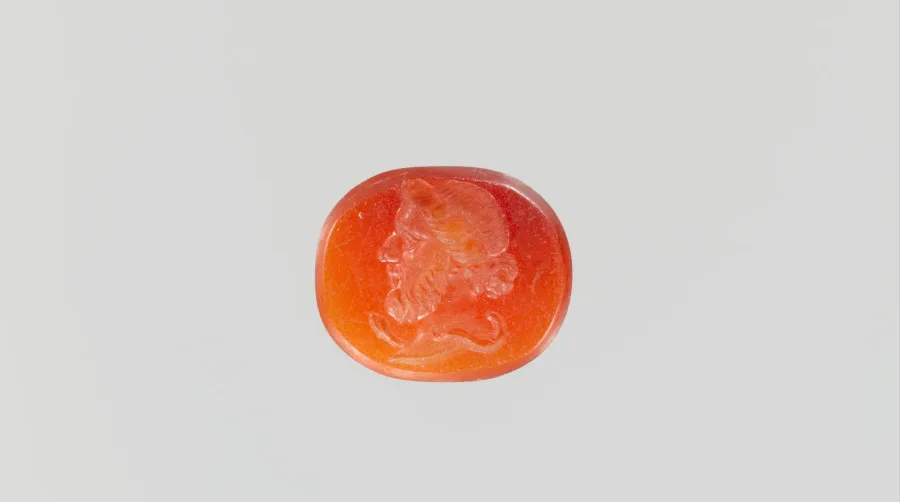
The earliest surviving monogram jewellery comes from the Roman world. Romans of every class wore signet rings with engraved gemstones: cornelian, jasper, agate, sometimes sardonyx. The gems were called gemmae and were carved in intaglio (the design cut into the stone below the surface, producing a raised impression when pressed into wax). They carried portraits, mythological scenes, personal emblems, and sometimes the owner's initials in Latin script.
A Roman signet was a functional object. It authenticated documents. It sealed letters. It closed contracts. Losing your signet ring was a serious matter because it meant anyone who found it could impersonate you legally. This is why Roman signets were worn tight on the finger, often requiring the owner's ring size to be recorded when the gem was first cut.
Roman signet traditions survived continuously in Britain through the end of the Roman occupation in the fifth century. Anglo-Saxon nobility inherited the custom. Medieval English lords continued it. When the Normans arrived in 1066, they brought their own heraldic tradition, and the two merged into the medieval English seal ring as we know it.
Medieval seal rings and feudal identity
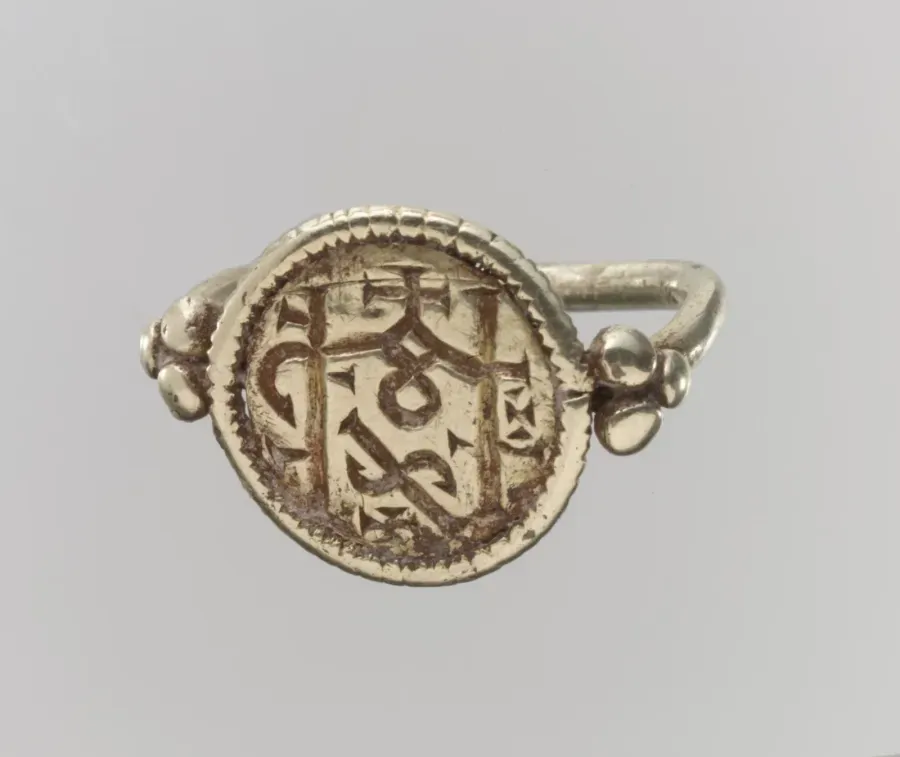
A medieval English lord's seal was his legal signature. Documents were authenticated by pressing the seal into hot wax at the fold of the parchment. The seal carried the lord's coat of arms or personal emblem. Without it, nothing could be formally sealed. With it, armies could be raised, land transferred, marriages contracted, and executions ordered.
Seal rings in this period were often large and worn on the index finger or middle finger rather than the pinky. They were tools first and jewellery second. The monogram element was usually a coat of arms rather than letters, but letter-based seals did exist, particularly for clergy and merchants.
One specific feature of medieval seals matters for modern signet jewellery: the design was always cut in reverse. A monogram carved into a signet has to read backwards so it appears correctly in the wax impression. This reversal is why some modern signet rings look slightly strange when worn (the letters are backwards to the wearer) and perfectly normal in a photograph of the wax impression. Reading more about how jewellery is crafted is worth your time in our how jewellery is made guide.
The Tudor royal ciphers
Then we arrive at Hampton Court and the Tower of London. Henry VIII, who was fond of architectural gestures, had his cipher carved into practically every royal surface during his reign. The H was enormous. The A (for Anne Boleyn), the K (for Katherine), the J (for Jane Seymour), and the successive letters for each subsequent wife were paired with it in interlaced designs.
Visitors to Hampton Court today can still see H and A entwined in the ceiling of the Great Hall, despite Anne's execution in 1536 and Henry's subsequent ordering of the removal of her initials from every royal building. The carpenters and stonemasons simply could not keep up with royal marital chaos, and several H and A ciphers survived because nobody got round to chiselling them off in time.
The Tudor royal cipher tradition established a visual grammar that influenced European monograms for three centuries. The interlocking of two letters, the crown above, the decorative flourishes around: this is the blueprint that Georgian and Victorian monogram designers worked within.
The Georgian gentleman and his seal
By the Georgian period (roughly 1714 to 1830), personal monograms had spread well beyond the nobility. A gentleman of the middle or upper-middle class carried a seal, usually hung on a watch chain at the waistcoat, and used it to close private correspondence. The seal fob, often a carved stone set into a decorative gold handle, was a piece of jewellery in its own right, worn visibly as a mark of status.
Georgian seal fobs survive in large numbers today and are collected as small works of art. The craftsmanship can be extraordinary: tiny intaglio portraits, family crests at the scale of a fingertip, mottoes carved in reverse. They represent one of the high points of personal monogram design in Western history.
This is also the period when the tradition of the pinky signet ring settled into the form we recognise today. Earlier signet rings had been worn on various fingers. By the late Georgian period, the left little finger had become the standard placement for a crest signet among English gentlemen, and it has remained there ever since.
Victorian lockets, hair, and sentimental ciphers
Victorian mourning culture transformed monogram jewellery. Lockets became central to grief: small gold or silver containers worn at the neck, carrying a lock of the loved one's hair and often an engraved monogram on the outside. The cipher inside the locket was typically a single initial (the beloved's) or an interlaced pair (yours and theirs).
The Victorians also invented or popularised the mourning ring with a hair compartment: a band that looked like ordinary jewellery from outside but contained woven hair from a deceased person under a piece of glass, with an engraved monogram identifying them. These pieces were deeply personal and often deeply strange to modern eyes. They were also, sometimes, beautiful.
Sentimental jewellery beyond mourning also thrived in the Victorian era. Lovers exchanged lockets with interlaced initials. Friends wore matching bracelets with each other's ciphers. Parents commissioned pieces for children. The Victorian middle class had enough money to afford personalised jewellery, and they bought it in enormous quantities. Most of it has been lost or melted down, but enough survives in museums and collections to show just how central the monogram was to 19th-century emotional life.
Art Deco and the monogrammed cigarette case
The 1920s and 1930s produced the most stylish monogram jewellery in history. Art Deco designers took the traditional interlaced cipher and modernised it: clean lines, geometric shapes, often inside a circular or octagonal frame, often in two-tone metal (platinum and gold, or silver and enamel).
Every fashionable person of the era owned at least one monogrammed object. The cigarette case was the most common (everyone smoked, everyone needed a case, and the flat surface was ideal for a cipher). Cigarette lighters, compact mirrors, cocktail shakers, and jewellery pieces all carried Art Deco monograms. The style crossed from jewellery into graphic design, hotel interiors, and branded luxury goods.
Art Deco monograms are still in demand today because the aesthetic survives. A cipher designed in 1928 looks contemporary in 2026. This is partly because Art Deco was the first design movement to think seriously about machine reproduction, so the forms are naturally modular and scalable. An Art Deco letter pendant produced by a modern workshop still reads as elegant because the underlying design language has not aged.
The steam liner, the luggage monogram, and the golden age of travel
Between the wars, the great ocean liners carried the wealthy across the Atlantic in style. The RMS Mauretania, the Queen Mary, the Normandie: these ships moved monogrammed luggage by the tonne. Every serious traveller's trunk carried a cipher. Every dressing case had one inside the lid. Every handkerchief was embroidered.
This is the era when monogramming as a luxury-goods category became fully commercialised. The skills of engraving, embroidery, and stamping scaled up to meet the demand of the transatlantic elite. Many of the workshops that served this market still exist (in London, Paris, Milan, New York), now serving a more varied clientele but still using techniques perfected for steamer trunks a century ago.
The specific look of the steamer-liner monogram (simple sans-serif or light serif letters, always elegantly proportioned, often in gold-leaf or deep-embossed leather) remains an aesthetic reference point today. When you see a monogrammed leather travel wallet in a shop window, you are looking at the descendant of Mauretania-era luggage markings.
The Carrie Bradshaw moment
Then, at the very end of the 1990s, something strange happened. A fictional writer in New York started wearing her own first name on a gold chain at her collarbone. The show was called Sex and the City. The pendant was a simple script-lettered nameplate, unremarkable by the standards of existing nameplate jewellery traditions, but new to the mass middle-class American audience.
Within months, every jewellery shop in North America was selling custom name necklaces. Within a few years, the format had spread globally. By the mid-2000s, the personalised letter or name pendant had become one of the defining jewellery pieces of the decade.
This mattered for reasons beyond the show itself. Before the Carrie effect, name and letter jewellery was largely associated with specific subcultures (teenage girls, quinceanera gifts, certain immigrant communities, hip-hop culture). After it, the format was mainstream. A thirty-five-year-old lawyer could wear a single gold initial to work and nobody would read it as youthful or ethnic. The letter pendant had been universalised.
The cultural moment also inadvertently reconnected the broad public to the ancient tradition of worn monograms. Most people wearing initial necklaces in 2005 had no idea they were participating in a tradition that stretched back to Roman signets. They just knew the pendant looked good. But the underlying impulse was identical: put your identity on your body, in metal, where everyone can see it.
Hip-hop nameplate: a parallel tradition
Running in parallel to the mainstream monogram tradition is the hip-hop nameplate tradition, which has its own roots and its own aesthetics. Gold nameplate pendants and bracelets became part of hip-hop style in New York in the 1970s and 1980s, drawing on Puerto Rican, Caribbean, and African-American jewellery traditions that preceded hip-hop itself.
The nameplate aesthetic is bold, often large-scale, usually in yellow gold, and often in a specific style of lettering (rounded Old English, block script, or graffiti-influenced letters). Unlike the understated mainstream initial pendant, the nameplate announces itself. The wearer's name is legible from across the room. This is not subtlety, it is self-assertion.
The nameplate tradition also developed into elaborate customisation: diamond-set letters, multi-layered designs, chain-attached pendants with personal nicknames or neighbourhood references. It has become one of the most aesthetically innovative areas of contemporary jewellery design, and several of its stylistic conventions have crossed back into mainstream jewellery.
Both traditions (the quiet initial pendant and the bold nameplate) are doing the same thing: putting a personal identifier on the body. They are just wearing different voices.



Beyond Latin script: monograms in other writing systems
A letter pendant does not have to be Roman. The monogram tradition exists in every literate culture, and for readers with multilingual heritage, there are good reasons to consider non-Latin options.
Arabic calligraphy
Arabic script is, among other things, one of the most aesthetically sophisticated writing systems in the world. Arabic calligraphy has been developed as a fine art for over twelve centuries, and modern Arabic name pendants connect to a living tradition of calligraphic beauty. A name or initial in Arabic thuluth, naskh, or diwani script is a piece of wearable calligraphy in its own right.
For people with Arab heritage, or for anyone drawn to the aesthetics of Arabic letterforms, an Arabic-script pendant is a direct line to a tradition that has been producing beautiful letters longer than Latin script has been used to write English.
Chinese characters
A Chinese character carries more meaning than a single Latin letter because it is typically a whole word or concept. A pendant with a single character might say "love," "family," "strength," or a surname. For people with Chinese heritage, or for anyone studying Chinese, a name rendered in characters (often with both the Chinese and Romanised form) is a meaningful piece of jewellery.
Calligraphic Chinese jewellery has been produced for thousands of years, with seal-script characters appearing on Zhou dynasty bronze ornaments. The tradition of carved jade pendants with inscribed characters continues today.
Cyrillic script
Russian, Ukrainian, Bulgarian, Serbian, and many other languages use Cyrillic. A Cyrillic initial pendant is a marker of heritage for speakers of any of these languages, and the Cyrillic letterforms (particularly the distinctive shapes of letters like Ж, Ш, and Я) have their own strong aesthetic identity.
Hebrew script
Hebrew initials and names on jewellery connect to an extremely long Jewish tradition of personal and religious inscription. A Hebrew name pendant is common both as a secular piece of heritage jewellery and as a religious object with specific meaning.
Devanagari, Tamil, Thai, Amharic, Georgian
And onwards. Every script has its own beauty, and every multilingual family has its own decisions to make about which script to wear. Some people wear two pendants (one in each script). Some combine multiple scripts in a single design. Some pick the script that carries the most emotional weight for them personally.
The point is: the monogram tradition is not Latin-exclusive. It is a human impulse that expresses itself in every writing system humans have invented.
Leave your email, we'll send your discount code. No spam, unsubscribe anytime.
The code arrives by email, valid on your first order.
How to combine initials: your own, your partner's, your children's
A single initial is the simplest choice. But many monogram pieces combine multiple letters, and the combinations follow their own logic.
Your own initials
The classic three-letter cipher uses the format first-surname-middle or first-middle-surname, depending on tradition. In British and American usage, the family name usually goes in the centre and is drawn larger. In some continental European traditions, the letters are equal size and run in reading order.
For a single cipher on a piece of jewellery, you can also simplify to two letters (first and surname initial), which reads as cleaner and works better at small scales.
Your partner's initial alongside yours
The most common combination in romantic jewellery. An interlaced double initial with both your letters is the modern descendant of the Tudor H and A cipher. Worn on a pendant, a bracelet, or the inside of a wedding band, it is a formalised version of "us."
There is a practical question here about what happens if the relationship ends. This is addressed in the FAQ below. But it is worth saying upfront: combined initials have been a feature of romantic jewellery for centuries, and for centuries, some of those relationships have ended. The tradition survived. So will you.
Your children's initials
A parent wearing a piece of jewellery with a child's initial is one of the oldest forms of sentimental monogram. Today the format usually appears on bracelets (often multiple bracelets for multiple children, one per child) or on a chain with several small letter pendants hanging together.
This format scales well. Second child, third child, fourth: just add another letter. It is also meaningful long after the children have grown. A mother wearing her children's initials in her seventies is wearing a history of her own parenthood.
The shared family cipher
Some couples create a shared family cipher at the time of marriage: their two initials combined with the surname in the middle, designed once and then used on everything (jewellery, stationery, home items, family gifts). This is the most traditional form of the practice, going back to the Georgian era of aristocratic household monograms.
Creating a shared family cipher is essentially designing a logo for the household. It takes a bit of work (and usually a skilled designer), but the result is a visual identity that can carry across decades.
Stacked pieces as modern alternative
Instead of combining multiple letters into a single designed cipher, many contemporary wearers simply stack individual letter pieces: one pendant per name, all on the same chain or on parallel chains. This is the modern, casual alternative to the traditional cipher.
Stacking works well because it is flexible. You can add letters as the family grows. You can remove or replace letters as circumstances change. You can swap in different fonts or metals for visual variety. It is the monogram as a living object rather than a fixed composition.
For more on combining pieces, see our jewellery layering guide.
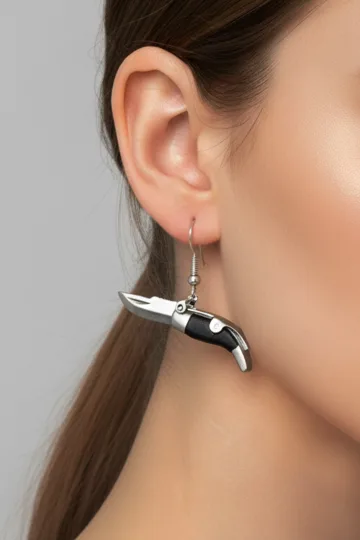
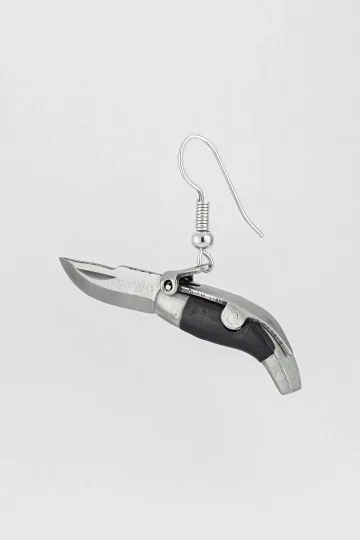
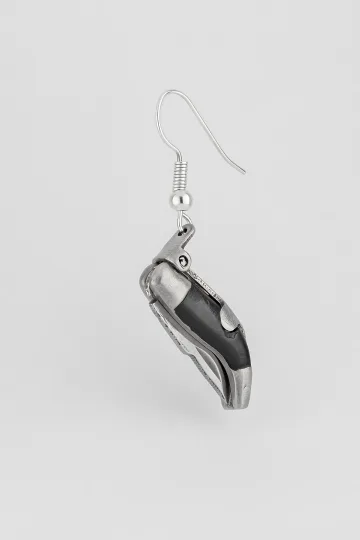
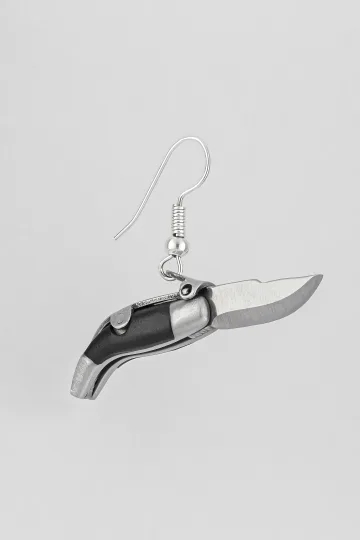
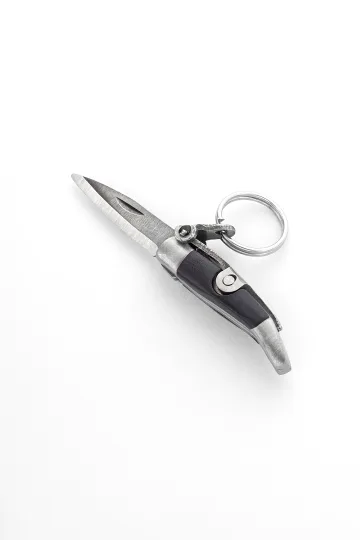
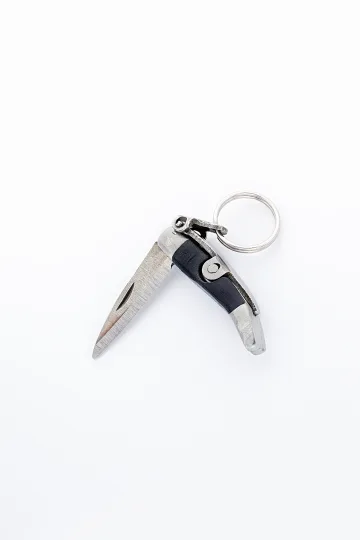
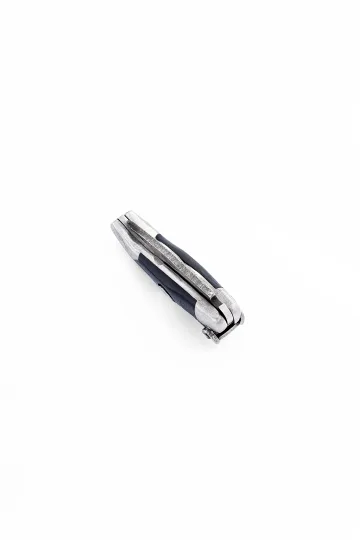
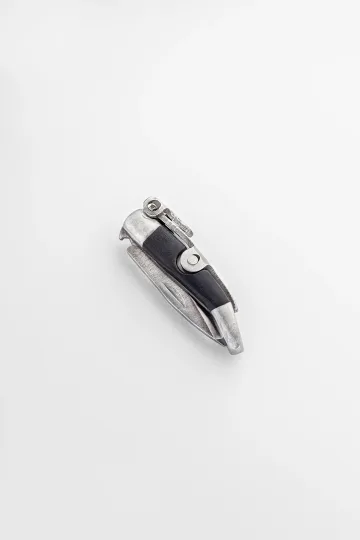
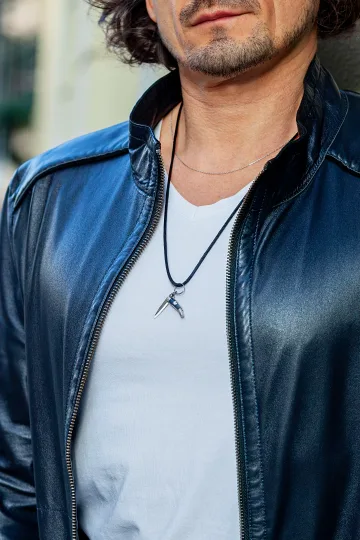
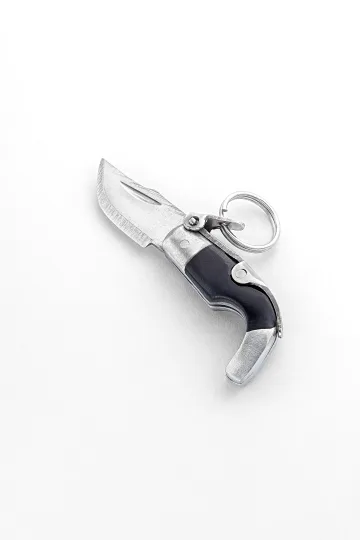
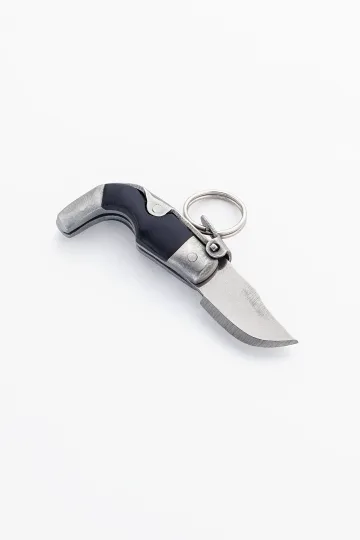
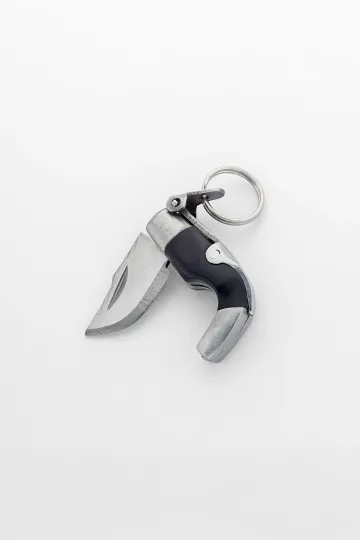
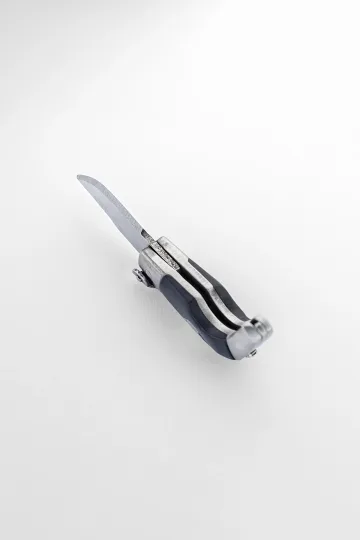
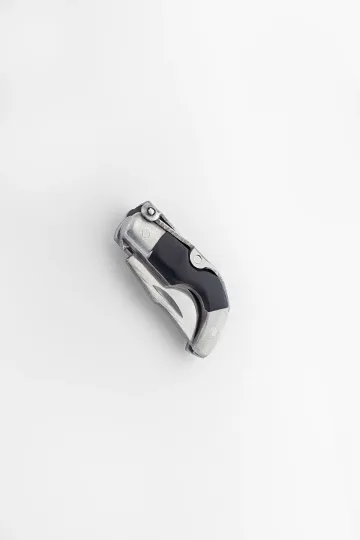
CAPAORA mini knife pendant
The 18th-century Spanish navaja in miniature: 40 mm of stainless steel, a real folding mechanism and a Palanquilla lock that clicks. An affordable gift to remember.
Authentic · Ships from Spain · 14-day returns
What monograms mean: identity, belonging, heritage, legacy
Beyond the craft and the history, there is the question of why. Why do humans persistently put their letters on their bodies?
Identity
The most basic reason. A monogram is a declaration: this is me. In a world where we are surrounded by products designed to be identical for millions of users, a personalised letter is a small claim of individuality. Not unique (plenty of other people share your initial), but specific. Yours.
Belonging
A family cipher says: I belong to this group. A couple's monogram says: I belong to this person. A shared bracelet with a friend's initial says: we are connected. Monograms mark belonging in ways that are simultaneously visible and intimate. Strangers see an M. Only the people who matter know that M is your son.
Heritage
An inherited signet ring, a grandmother's initial locket, a family cipher carried across generations: these pieces do a specific kind of emotional work. They carry the past. Wearing an ancestor's monogram is wearing a small piece of their life, and it is one of the oldest reasons to keep jewellery at all.
Personal amulet
For some people, a monogram functions as a talisman. Not magical exactly, but meaningful. The letter on the body is a reminder of who you are, particularly in moments when you forget. Graduates, new parents, people recovering from illness, people starting over: many of them wear initial jewellery as a small anchor of self.
Legacy
The mirror image of heritage. A monogram worn in life becomes an object that survives you. Your grandchildren will someday hold your signet ring, your letter pendant, your engraved bracelet, and think about who you were. Monogram jewellery is designed to outlast the body. That is part of the point.
Read more about this in our grandmother's jewellery box guide.
Letter pendants, signet rings, engraved initials inside wedding bands. Some available in catalogue, others made to order.
Who wears monogram jewellery
All ages
This is one of the rare categories that genuinely works across every age. A five-year-old with a silver letter pendant on a short chain. A teenager with a name necklace. A thirty-year-old with a stacked set of initial rings. A grandmother with her own three-letter cipher on a locket. All of them are participating in the same tradition.
Graduates
An initial piece is one of the classic graduation gifts. It marks a transition: from student to professional, from one stage of life to another. The letter is usually the graduate's first or last name, and the piece is often gold or gold-plated to signal the importance of the occasion.
Brides and grooms
Monogram jewellery appears at weddings in several forms. The bride's new surname initial on a pendant or bracelet. An interlaced couple's cipher on the inside of wedding bands. A shared family monogram commissioned for the marriage. These pieces formalise the new partnership with visual, wearable symbols.
For more, see our wedding jewellery guide.
New parents
A child's initial on a mother's bracelet is one of the most enduring forms of parenting jewellery. The pieces often start with the first child and grow over time as more children arrive. Father's versions exist too, though less commonly.
Corporate gifting
In the luxury gift world, a monogrammed piece (pen, pocket square, cufflinks, bracelet) is a standard way of saying "we value you specifically." The personalisation lifts a generic gift into something meaningful. For long-serving employees, retirement gifts, and major milestones, monogrammed jewellery remains a reliable choice.
Couples with interlocked initials
The specific romantic tradition of two intertwined letters. This has been a jewellery category for centuries and will likely continue for centuries more. Engagement, marriage, milestone anniversaries, important birthdays: all of them are occasions where a couple's cipher piece works.
For gift ideas more broadly, see our anniversary gift guide and our gift for girlfriend guide.
Myths about monogram jewellery
Myth: monogram jewellery is dated or old-fashioned. Monogram jewellery has been continuously popular for about two thousand years. It has never gone out of fashion because the underlying impulse (putting your identity on your body) is not a trend. Specific styles come and go. The category itself does not.
Myth: a signet ring on a woman is inappropriate. This is an unusually persistent bit of nonsense. Women have worn signet rings throughout history, from Roman matrons to Queen Elizabeth I (whose signet is in the British Museum) to countless modern women today. A signet on a female pinky reads as elegantly masculine-informed, not out of place.
Myth: if you divorce, the monogram becomes meaningless. Ciphers predate the relationships they symbolise. A Tudor monogram carved in 1533 is still beautiful in 2026, regardless of how the marriage turned out. A monogram is a piece of art first. Its meaning is whatever you decide, including "a piece of my own history."
Myth: initial pendants are only for young women. The Carrie moment happened twenty-five years ago. The women who wore initial pendants in the early 2000s are now in their fifties and many of them are still wearing them. Men wear them. Children wear them. The category has fully generalised.
Myth: machine engraving is always better than hand engraving. Machine engraving is more consistent, but hand engraving has depth, character, and a quality of line that machines cannot quite replicate. For fine work on expensive pieces, hand engraving is still preferred by collectors and jewellery craftspeople. Both have their place.
Myth: you cannot re-engrave a piece. You often can, depending on the metal thickness and the depth of the original engraving. A good engraver can remove an old monogram and add a new one. The piece does lose some thickness in the process, so it is not infinitely repeatable, but one or two re-engravings are usually possible.
Myth: a monogram ring has to be a signet. It does not. A monogram can appear on a plain band (engraved inside or outside), on a stone setting (engraved on the metal surround), on a carved gem (intaglio), or as an integrated part of a ring's design. The signet is just one format among many.
Send a friend a discount code, they save on their first order.
Frequently asked questions
How is engraving actually done?
Two main methods: hand engraving and machine engraving. Hand engraving uses a small chisel called a graver, held and pushed through the metal by an experienced engraver. Machine engraving uses a rotating cutting head directed by either a pantograph (for simple work) or a computer-controlled system (for complex designs). Laser engraving is a third option, using focused light to mark the metal surface rather than cut into it.
Each method has a different aesthetic. Hand engraving has slight variations in line depth and angle that read as warm and human. Machine engraving is precisely regular and reads as clean and contemporary. Laser engraving is shallow and best for surface marks rather than deep cuts. Learn more in our engraving guide.
Can I get a piece re-engraved later?
Usually yes. An old engraving can be polished out and a new one added, provided the metal is thick enough to lose some material. Signet rings with deep original engraving are sometimes too thinned to re-engrave safely. Thin pendants may have the same issue. A good jeweller will assess the piece first and tell you honestly what is possible.
How durable is engraving?
Very. A properly engraved piece will hold its engraving for generations. The letters may soften slightly over centuries of wear (particularly on a pinky signet ring that gets used), but this softening is usually considered part of the piece's character rather than damage. Victorian and Georgian engraved pieces still read clearly after nearly two centuries of handling.
What happens if I divorce and I have a joint monogram?
Options. Some people continue to wear the piece because it represents a part of their own life regardless of how it ended. Some put it away and bring it out later, after enough time has passed for the emotion to settle. Some sell it. Some re-engrave it with new initials. Some gift it to a child who carries one of the original initials. There is no right answer. The piece is yours to decide on.
What is a double-sided pendant?
A pendant engraved on both front and back, often with different designs: an initial on the front and a date, quote, or second monogram on the back. Double-sided pendants work well for carrying layered meanings (your initial on public display, a more personal inscription hidden against your skin).
What is the difference between hand and machine engraving in terms of cost?
Hand engraving is significantly more expensive because it is skilled labour paid by the hour. A hand-engraved monogram on a ring might take an hour or more of a master engraver's time. Machine engraving can produce the same design in minutes at a fraction of the cost. For high-value pieces or heirloom commissions, hand engraving is often worth the price. For casual everyday jewellery, machine engraving is usually the sensible choice.
Can I combine different scripts in one piece?
Yes, and this is increasingly common for multilingual families. A pendant with a Latin initial on one side and an Arabic, Hebrew, or Chinese initial on the other is a straightforward commission for any workshop experienced in engraving. The key is finding a jeweller who understands both scripts well enough to set them correctly.
Should my monogram match my wedding band?
It can, but does not have to. Some couples commission matching pieces (wedding bands and pendant both carrying the shared cipher). Others prefer their monogram jewellery and their wedding jewellery to be separate categories. Both approaches are correct.
What metal is best for engraved pieces?
Depth of engraving works best in softer, denser metals: gold (18k or 14k), sterling silver, platinum. Very hard steels can be engraved but require different techniques and usually look shallower. For an heirloom piece meant to last, solid gold or silver is the traditional choice. For everyday pieces at accessible price points, sterling silver or gold-plated sterling is excellent. Read more about metal choice in our metals comparison.
How long does a commissioned monogram piece take?
Depends on complexity and the workshop's schedule. A simple engraved letter on a stock pendant might take a few days. A custom-designed cipher on a bespoke ring might take several weeks or more. Engraving itself is often fast. Design, approval, and fabrication around it take most of the time.
Can I design my own cipher?
Yes. You can sketch what you want and bring it to an engraver. For a simple single letter, most engravers work from their own font library. For interlaced ciphers or complex designs, you can either commission a designer to draft it or work collaboratively with the engraver to refine an initial sketch. The bespoke cipher design process is one of the most satisfying corners of the jewellery world. You end up with a piece of graphic design that is uniquely yours.
What size should a letter pendant be?
For a single initial on a chain, anywhere from 8mm to 25mm works depending on your style. Smaller (8-12mm) reads as delicate and easy to layer. Medium (13-18mm) is the standard, readable without being aggressive. Larger (19-25mm+) reads as a statement piece and is more common in nameplate and bold script designs. For chain length guidance, see our chain length guide.
Is hand engraving still being taught?
Yes. Hand engraving is a traditional craft that is actively preserved in workshops across Europe, the UK, the US, and several Asian countries. It is not a dying art, despite what you sometimes read. There are more apprentice hand engravers today than there were thirty years ago, partly because the luxury market has created renewed demand for hand-cut work.
About Zevira
Zevira is a Spanish jewellery brand from Albacete. The initials and monograms line is one of the catalogue categories. See the catalogue for current pieces and details.
Buying it as a gift? Each one arrives ready to give.
 A branded Zevira box and a little card come with every order.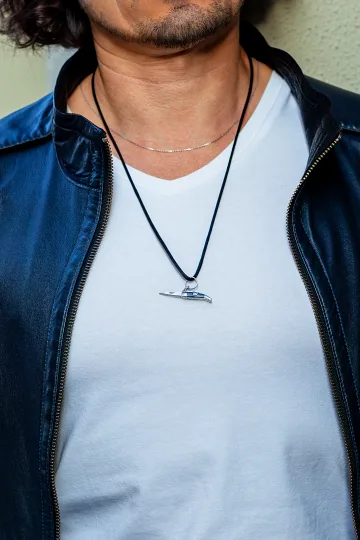




The bottom line
The letter on the chain at your collarbone, the crest on the pinky of the man sitting next to you on the train, the embroidered J on the monogrammed handkerchief in your grandmother's drawer: these are all the same object in different costumes. Each one says: this is me.
The tradition of worn monograms is older than most countries. It survived the fall of Rome, the collapse of feudal Europe, the rise and fall of empires, the industrial revolution, two world wars, and the entire transformation of modern consumer culture. It survived because the impulse behind it is fundamental to being human in a society of other humans: you want to be known, and you want the knowing to be carried on your body.
A signet ring or a letter pendant is a small answer to a big question. Who are you, walking through this noisy modern world? The letter on the chain says: this one. Me. The person standing here. And yes, I know everyone else has initials too. But these are mine.
That is the full case for monogram jewellery. It is not a trend. It is a two-thousand-year-old conversation between humans and their names, and every letter pendant in every shop today is the latest entry in that conversation. Pick your letter. Pick your font. Wear it like you mean it.
Because you do.