Dolphin Jewellery: Meaning, Mythology and the Symbol That Never Lost Its Shine
Wear the symbol, don't just read about it. These are in stock:
A symbol that stayed
There is a small silver dolphin on a shelf in my study. It came from a market stall near the harbour in Plymouth, Devon, years ago. A simple thing: a curved body, a raised tail, no more than two centimetres long on a thin chain. I bought it on impulse. I did not know then that the shape had been turning up in the same basic form since Minoan Crete in the seventeenth century BC. I did not know that it had graced the standard of the heir to the French throne for nearly five hundred years, or that it had been pressed into Roman mosaic floors from Herculaneum to York.
I know all that now, and the pendant is no less simple for it. But the knowing adds something. The dolphin on that chain is more than a souvenir of a day near the water. It is a shape that has carried almost nothing but goodwill for three and a half millennia, across every culture that has ever lived beside the sea.
That is unusual. Most powerful symbols carry a shadow. The eagle can mean imperialism. The serpent shifts between wisdom and treachery depending on the tradition. The wolf is noble in one mythology and monstrous in the next. The dolphin carries none of this ambiguity. Minoan queens, Greek philosophers, Roman aristocrats, early Christian catacombs, French dauphins, the Royal Navy, and a Florida television series all look at the same animal and say the same thing: friendly, intelligent, playful, saved by and saving in equal measure.
This guide takes that history seriously, sets it beside the biology, and ends with practical advice on what to actually buy and how to wear it. No dolphin therapy claims. No "vibrational energy of the sea." Just the real story, which turns out to be more interesting than any of that.
Dolphin jewellery: what to choose
The dolphin translates well into almost every jewellery format, but each one reads differently. The choice comes down to age, lifestyle, how often you plan to wear the piece, and how loud or quiet you want the symbol to sit.
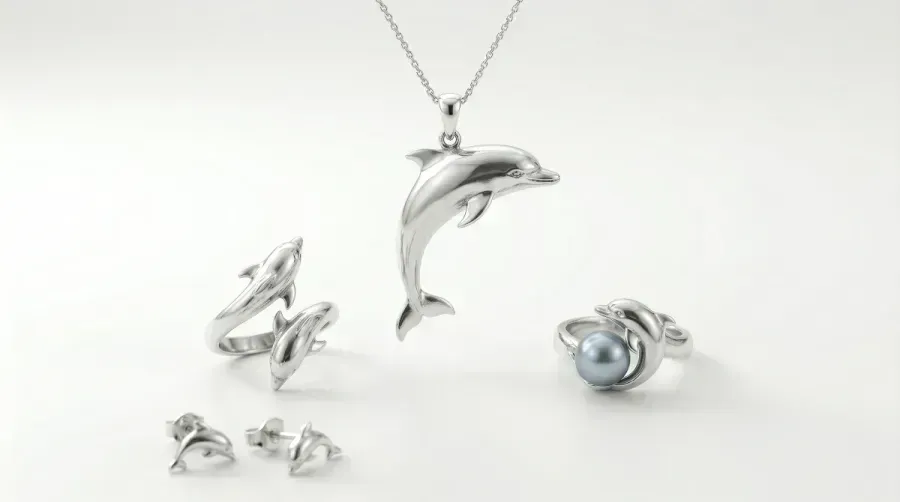
Single dolphin pendant, leaping. The most popular format by some distance. The dolphin is shown in its characteristic arc: body curved, tail raised, head angled forward and down. Typical size runs from one and a half to three centimetres. Sterling silver 925 is the standard material, sometimes with a blue enamel wave element. Worn on a chain of 45 to 50 centimetres, it sits just below the collarbone, visible over a crew neck, under an open collar, or against bare skin in summer. This format works across a wide age range.
Paired dolphin pendants, nose to nose. A format for two people: a couple, a mother and child, close friends. Two dolphins face each other symmetrically, often with a wave or small stone between them. Sets come as two matching pendants or as a composition that splits into two interlocking halves. The sentiment is warm without being sentimental.
Stud earrings, dolphin silhouette. The quietest format. A small dolphin, typically under a centimetre, in smooth silver or gold-plated silver, on a post with a butterfly back. It works with glasses, scarves, and headphones without getting in the way. Suitable for daily office wear and for children at school.
Drop earrings with dolphin. A more decorative option. The dolphin hangs on a short post or chain, with a little movement. Length is usually one to two centimetres. Turquoise drops, small pearls, or wave elements are sometimes added. Suited to warm-weather occasions and evenings.
Band ring with dolphin relief. A thin silver band with a flat or slightly raised dolphin on the outer face. The dolphin looks outward along the finger. Works well stacked with other plain bands in the current layering style.
Charm bracelet links, dolphin form. Each link of the chain is cast in the shape of a small curved dolphin. The result is a bracelet where the dolphins appear to swim around the wrist in sequence. Works in a Mediterranean summer register or year-round if the rest of the wardrobe supports it.
Children's pendants. A category that needs to be handled carefully: no sharp projections, a reliable clasp, hypoallergenic silver 925 only. The children's dolphin tends to be rounder and simpler than the adult version. Chain length runs shorter at 35 to 40 centimetres. It is one of the most natural choices for a first piece of jewellery, especially before or after a child's first trip to the sea.
Men's format. A larger silver dolphin on a leather or waxed cord. Often oxidised to bring out the line of the fins and the ridge of the back. This reads as a serious mark of connection to the sea, not a children's toy. Divers, surfers, sailors, and anyone whose life has a strong relationship with open water tend to understand it immediately.
A dolphin wants a sunlit collarbone and clean silver. One. Spare me the whole aquarium.
How to wear the dolphin
The dolphin is a light symbol, and that is exactly why it slips so easily into holiday-souvenir territory. Here is what I have learned across shoots and styling sessions, sorted by occasion.
How do I wear a dolphin every day? For town I recommend a smooth silver dolphin, no enamel, on a fine 45-centimetre chain. A quiet palette carries it best: a white or grey tee, beige knit, blue denim. Cool silver echoes blue, so a denim shirt or a Breton stripe with a small pendant works almost every time. I suggest pairing dolphin studs with a couple of slim band rings on one hand.
Does it belong in the office? It does, as long as you keep it minimal. I choose a tiny silhouette with no stones, worn under a shirt collar or above a roll-neck, with a neutral blazer and a pencil skirt. One accent, everything else smooth. Skip the layers here: at work the dolphin reads as a quiet personal mark rather than decoration.
How do I build an evening look? For evening I suggest an open dress or a silk blouse in deep blue or black, with a dolphin in blue enamel, mother-of-pearl or a drop of aquamarine. Drop earrings with a swinging dolphin bring the look alive as you move. I like silver with clear blue stones for pinned-up hair and bare shoulders.
What about a Mediterranean look? This is where the dolphin belongs. With a linen shirt, pale trousers, a woven bag and a sea-green dress I choose a silver pendant as an obvious piece of coastal style. I allow layers only if they stay in one metal: a thin dolphin chain plus a short strand of small pearls.
How do I avoid the kitsch? One rule that never fails: a single marine motif per outfit. The dolphin says enough on its own, and next to an anchor, a shell and a starfish it turns into a caricature. I give it clean surroundings and one length line, so it reads as style rather than a souvenir stall.

Turn on your camera, pick earrings, a pendant or a ring, and see the piece on yourself in real time.
Switch items in one tap.
Everything runs in your browser: no photo or video is ever uploaded.
Styles of dolphin in jewellery
Three and a half thousand years of dolphin imagery have produced several distinct stylistic lines. Each one carries different cultural weight.
Naturalistic. The dolphin rendered close to the real animal. A narrow spindle-shaped body, the characteristic dorsal fin, a horizontal fluke tail, proportions suggesting the common bottlenose. This reads clearly across all ages and backgrounds and is the format used in most modern production pieces.
Minimalist contour. The dolphin reduced to a single unbroken line. Often executed as a fine metal outline or wire silhouette. Suited to very understated daily wear and office contexts. No surface detail, just the arc and the movement.
Minoan. A reference to the fresco of the Queen's Megaron at Knossos, dating to around 1600 BC. The characteristic feature is a lateral stripe running along the body, dividing upper and lower halves. The snout is slightly elongated, the tail raised. Immediately recognisable to anyone who has encountered this image, and legible as a reference to the Bronze Age Mediterranean even to those who have not. Silver with gold plating or oxidising suits this style well.
Heraldic. The dolphin of European medieval heraldry: highly stylised, with a spiny crest, an exaggerated curve, sometimes almost dragonlike. This is the dolphin of the French Dauphins, the blazon of the province of Dauphine, the creature that gave the heir to the French throne his title for nearly five centuries. An interesting choice for collectors of historical jewellery.
Paired facing composition. Two dolphins nose to nose, often with a wave or central element between them. This composition appears on Roman coins and mosaics and has classical roots.
Dolphin with calf. An adult and small dolphin swimming together. A warm family piece, suitable as a gift to a new mother or to mark a birth. Biologically accurate: dolphin mothers and calves maintain close proximity for several years.
Dolphin in circle. A dolphin silhouette within a round frame, sometimes with text or stars added. Functions as a medallion or affiliation badge, in the tradition of city seals and guild marks.
Customer reviews
Zevira is a real jewellery shop. Genuine payments, deliveries and customer thank-yous.
🥰🥰🥰 gracias
Ok, ¡gracias! 🙂
History of the dolphin as a symbol
The history of the dolphin in art and culture does not begin with ancient Greece, though that is where most people start. It begins a thousand years earlier, on the island of Crete.
Minoan civilisation, circa 1700-1400 BC. The Minoans were the first great Mediterranean maritime culture. They traded across the Aegean in swift vessels, built multi-storey palaces, and covered their walls with vivid frescoes. The most celebrated surviving dolphin image is the fresco from the Queen's Megaron at Knossos, discovered and partially restored by the British archaeologist Arthur Evans in the early twentieth century. The painting shows large dolphins with lateral body stripes swimming among shoals of small fish. It decorated a private interior of the palace, suggesting the dolphin was a domestic as well as a ceremonial presence. For the Minoans, the dolphin was the sea made benign: not threatening, not alien, but a fellow creature navigating the same water.
Phoenician trade iconography. The Phoenicians, operating from the coasts of present-day Lebanon and Syria, inherited the maritime culture of the post-Minoan Aegean and extended it to the western Mediterranean and beyond. On Phoenician coins, amphorae, and seals, the dolphin appears as a sign of safe passage and good fortune at sea. The Phoenicians founded trading posts along the Iberian coast, including Gadir on the site of modern Cadiz, one of the oldest continuously inhabited cities in Europe.
Greek mythology. In Greece the dolphin acquires a biographical density it has retained ever since. Apollo, one of the principal Olympian gods, carried the epithet Delphinios. According to the Homeric Hymn to Apollo, the god transformed himself into a dolphin and led a Cretan ship to the foot of Mount Parnassus, where he founded the sanctuary of Delphi, the most important oracle in the Greek world. The etymology connects: delphis (dolphin) and Delphi share a root in Greek. Apollo Delphinios was revered as the patron of sailors and colonists.
The second major story involves the poet Arion of Lesbos, who flourished in the seventh century BC. Herodotus tells it: Arion had won a large purse at a poetry contest in Sicily and was sailing home to Corinth. The ship's crew resolved to kill him and take the money. Arion was granted one last wish, to sing a full song. He sang, jumped into the sea, and dolphins, drawn by the music, carried him safely to shore at Cape Taenarum. The story of Arion and the dolphin became one of antiquity's central parables about the redemptive power of music and the sea's capacity for mercy.
The third strand is Dionysus and the pirates. The Homeric Hymn to Dionysus describes how Tyrrhenian pirates kidnapped the god, mistaking him for a mortal. As the ship sailed, wine flowed across the deck, vines grew up the mast, and dolphins circled the hull. Dionysus transformed into a lion. The terrified pirates leaped overboard, and as they hit the water they were changed into dolphins. The myth explains the dolphin's benevolent disposition toward humans as a form of inherited guilt: they were once men who tried to do harm, and now they must do good instead.
Royal Navy and British heraldry. The dolphin has a particular resonance in British maritime culture. The award of "dolphins" to qualified Royal Navy submariners is one of the most recognised insignia in the service. The badge, worn on uniform, consists of two dolphins flanking a crown. To wear your dolphins means you have passed the demanding qualification process and are a fully certified submariner. The City of London's heraldic dolphins also appear in the arms of several maritime boroughs and companies. For British wearers, the dolphin in jewellery carries this naval and civic layer in addition to the classical one.
Roman mosaics and coins. Rome inherited the Greek dolphin and made it ubiquitous. Mosaic floors from Pompeii, Herculaneum, and Roman villas across Britain show dolphins swimming alongside Neptune, coiling around tridents, and playing with Cupid. The city of Tarentum (modern Taranto) in southern Italy put the image of a man riding a dolphin on its coins, referring to the local foundation legend of the hero Phalanthus, saved from drowning by a dolphin.
Medieval European heraldry and the French Dauphin. The province of Dauphine in south-eastern France had a dolphin on its coat of arms from at least the eleventh century. In 1349 King Philip VI purchased Dauphine from its last independent ruler, Humbert II, who agreed to sell on condition that the heir to the French throne take the title Dauphin de Viennois and bear the dolphin blazon. From 1350 until 1830, when the title was abolished with the fall of the Bourbon Restoration, every eldest son of the French king was known as the Dauphin. The most famous holder of the title was the future Louis XVI, who bore it until his accession in 1774. For nearly five centuries, the dolphin was the mark of the successor to one of Europe's most powerful thrones.
Renaissance and Baroque. The revival of classical antiquity from the fifteenth century onward brought the Greco-Roman dolphin back into European art in full force. Dolphins decorate fountains in Florence and Rome, appear in paintings by Raphael and Rubens, and feature in the ornamental programmes of royal palaces. Gian Lorenzo Bernini's Neptune and Triton at the Victoria and Albert Museum in London shows dolphins intertwined with the sea god's composition. This period also saw the dolphin return to jewellery as a motif of prestige, in enamel and gold, for aristocratic clients.
Nineteenth and twentieth centuries. The growth of European coastal tourism made the dolphin a commercial resort image. It appeared on postcards, souvenirs, and jewellery sold in seaside towns from Nice to Newquay. Simultaneously, the mid-twentieth century brought serious scientific study. John Lilly's research in the United States in the 1950s and 1960s, Louis Herman's language experiments in Hawaii, and long-term wild population studies in Australia and Florida built a detailed picture of dolphin cognition and social life. This scientific respect fused with the ancient cultural image and made it stronger. The modern dolphin pendant carries both the three-thousand-year tradition and the memory of that research.
Upload a photo of your pet, someone you love, or an object. We'll build a 3D model and hand-cast it in pewter.



Dolphin mythology and legend
Classical stories
The core classical dolphin narratives have been set out above: Apollo Delphinios founding Delphi, Arion carried to safety by music-loving dolphins, the Tyrrhenian pirates transformed into dolphins by Dionysus. Three brief additions.
In the myths of the Nereids, the fifty sea-nymphs who were daughters of the sea-god Nereus, dolphins serve as transport and companions. A nereid riding a dolphin is one of the most recurring images of late antique decorative art, on sarcophagi, mosaics, and lamp moulds. The image of a divine or semi-divine figure borne by a dolphin passed relatively smoothly into early Christian art, where it was reread as the soul being carried to heaven.
The Tarentum legend deserves fuller treatment. Taras, the legendary founder of Tarentum, was a son of Poseidon (Neptune) who had been thrown overboard in a shipwreck and rescued by a dolphin sent by his father. The city commemorated this founding story on its coins for centuries: the image of a naked youth riding a dolphin, often holding a trident or a Nike figure. These coins circulated across the ancient world and helped establish the dolphin-as-rescuer as a recognisable international motif.
Pliny the Elder, writing in the first century AD, devoted a substantial section of his Natural History to dolphin intelligence and its interactions with humans. He records a story from the Spanish town of Hippo Diarrhytus (near modern Bizerte in Tunisia) about a dolphin that befriended local children swimming in a harbour, allowed them to ride on its back, and became a celebrity of the Roman world. He tells similar stories from Puteoli and from the shores of Africa. Pliny did not mythologise these accounts: he treated them as natural history, as evidence of dolphin intelligence and social curiosity. His confidence in the stories says something about how seriously educated Romans took dolphin cognition.
Early Christian symbolism
The first two or three centuries of Christianity developed a rich visual vocabulary from available pagan images, and the dolphin was among the most useful. In the catacomb frescoes of Rome, on early Christian sarcophagi, and in lamp and mosaic programmes from the second to fourth centuries, the dolphin appears in several distinct roles.
Paired with the anchor, the dolphin becomes part of the most widely used early Christian emblem of hope. The anchor, already a symbol of steadfast faith borrowed from Hebrews 6:19, is given energy and direction by the dolphin wrapping around or swimming beside it. Speed united with stability: the soul moving with purpose toward its destination.
The dolphin alone functions as a symbol of the soul's safe passage after death, an adaptation of the Nereid-riding-dolphin imagery. On sarcophagi, the deceased was sometimes shown being carried across the sea of death by a dolphin, just as Greek heroes had been.
Some early interpreters also read the dolphin as a Christological symbol, drawing on the dolphin's reputation for saving the drowning, which mapped neatly onto the concept of salvation from spiritual death.
The Catacombs of Domitilla and Priscilla in Rome preserve some of the best examples of this dolphin imagery. As Christian iconography formalised during the medieval period, the dolphin gave way to the lamb and the fish (ichthys) as primary symbols, but its early importance is well documented.
British naval and modern stories
The Royal Navy dolphin tradition has already been noted. Beyond insignia, British maritime culture has accumulated its own body of dolphin encounter stories. Nelson's sailors in the Mediterranean regularly noted dolphins alongside the fleet, and the presence of dolphins was widely taken as a sign of fair weather ahead. Whether or not the sailors' weather-reading was accurate, the association was consistent enough to be recorded in logs.
In contemporary documented encounters: in 2004, surfer Todd Endris was attacked by a great white shark off Monterey Bay, California. A group of bottlenose dolphins formed a protective ring around him, repeatedly charging at the shark until he was able to reach shore. The account was corroborated by witnesses on the beach and reported in multiple publications.
In 2008, off the coast of New Zealand, a wild bottlenose dolphin named Moko guided two stranded sperm whales back to open water after human rescue workers had been unable to do so. The event was documented by conservation officials present at the scene.
Biologists interpret these events as expressions of complex social behaviour from a species with advanced empathy and the ability to recognise individuals across species lines. This is biology, not mysticism. The dolphin's nervous system, social structure, and life habits predispose it to this kind of response. That makes it more interesting, not less.
The dolphin in children's culture
There is one more layer without which the picture is incomplete: the dolphin in popular children's culture from the middle of the twentieth century onward.
The turning point came with an American television series of the mid 1960s about a tame dolphin living beside the family of a marine reserve warden in Florida. The dolphin rescued swimmers, thwarted criminals and helped children. The series sold into dozens of countries, ran in repeats for decades, spawned animated versions and a relaunch in the 1990s, and reached British children through Saturday morning television long after its first broadcast. For a generation growing up on it, the dolphin became the good friend of the sea, something close to a pet, an animal with which human friendship was simply natural.
The image reproduced itself from there into cartoons, children's books, aquarium shows, swimming club badges, pyjamas and lunchboxes. By the turn of the century the dolphin had settled among the small handful of universally likeable animal images, alongside the panda and the penguin. British seaside towns leaned on it heavily: dolphin motifs on Cornish and Devon souvenirs, on pier signage, on the mugs and keyrings that come home from half term.
That popular underlay explains something practical about the jewellery. It is why even a reserved person tends to smile at a dolphin pendant rather than analyse it, and it is also why the format you choose matters so much. The same symbol can read as a childhood keepsake or as a Bronze Age reference, and the difference is entirely in the execution.
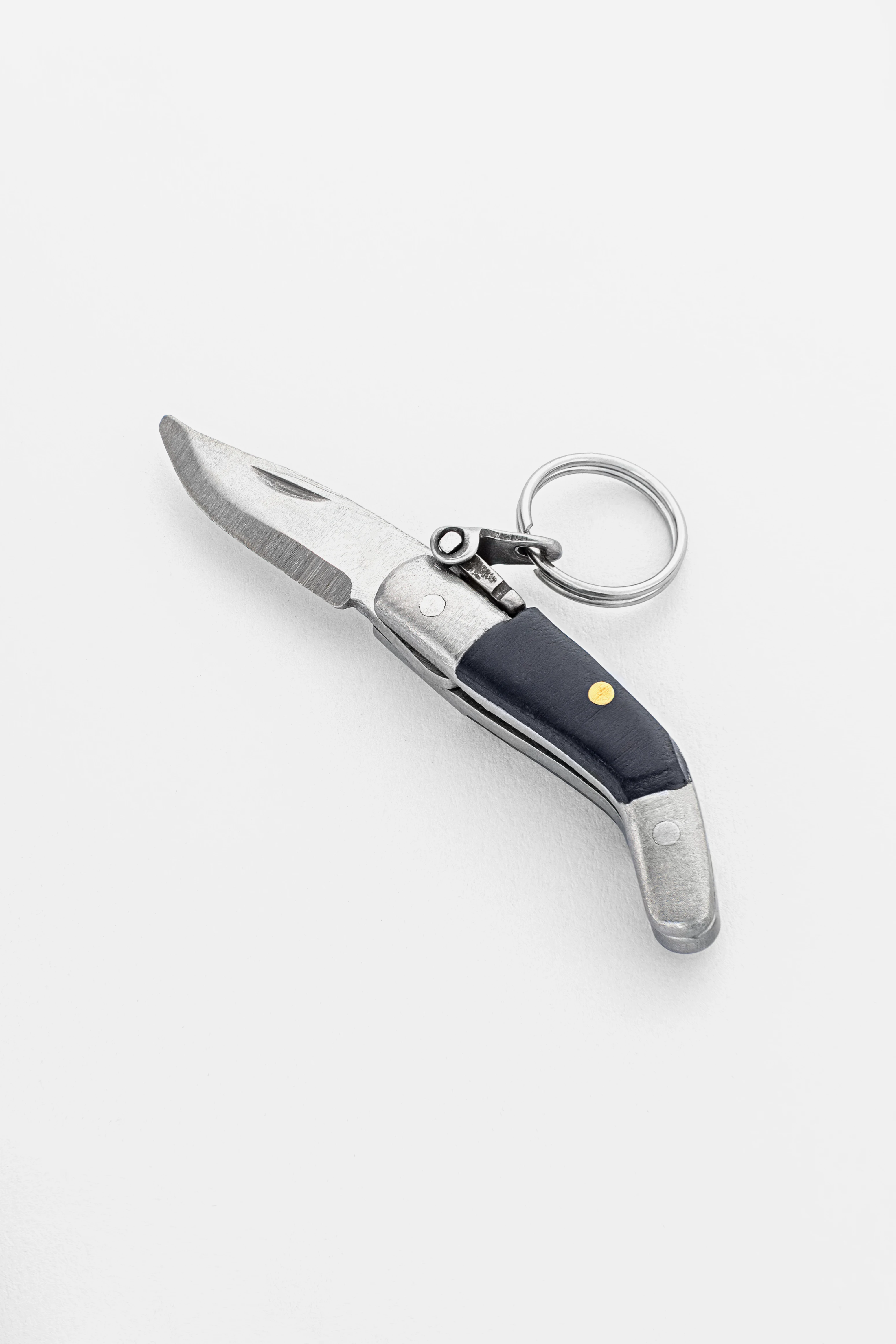
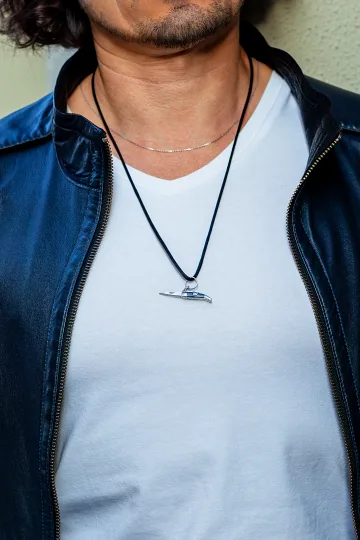
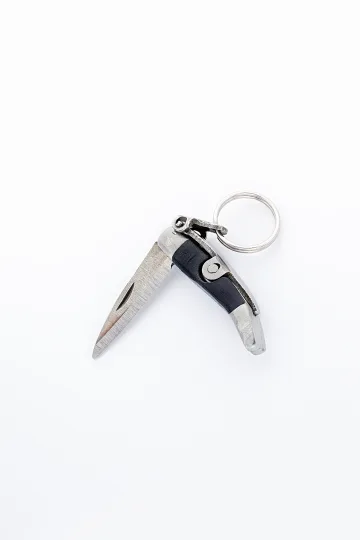
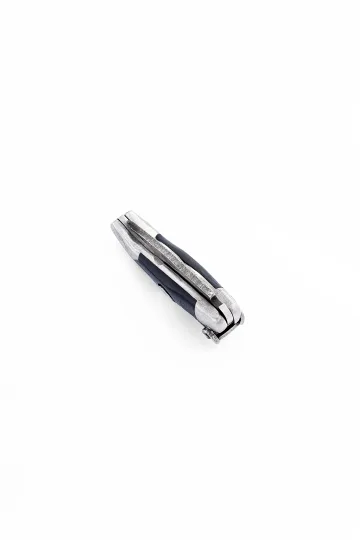
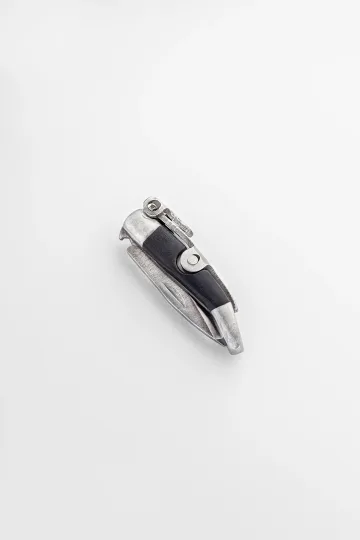
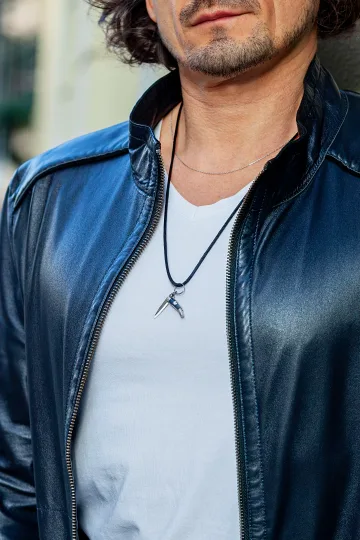
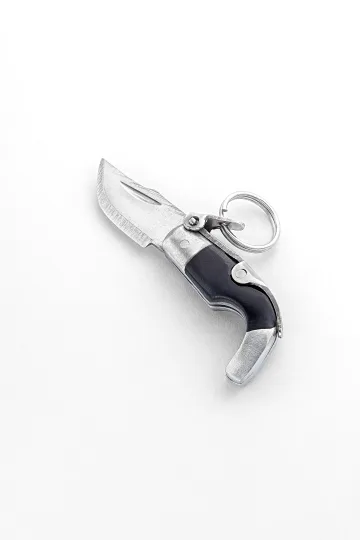
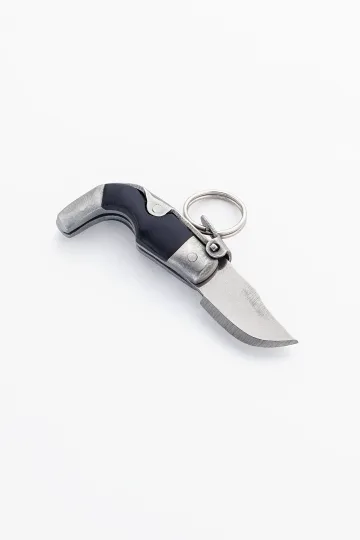
CAPAORA mini knife pendant
The 18th-century Spanish navaja in miniature: 40 mm of stainless steel, a real folding mechanism and a Palanquilla lock that clicks. An affordable gift to remember.
Authentic · Ships from Spain · 14-day returns
What the dolphin symbolises
With the history in place, the symbolism can be stated plainly.
Play as a way of living. Dolphins are among the very few animals that maintain playful behaviour into adulthood. Most mammals play as juveniles, then shift into a purely functional mode: food, territory, reproduction, protection. Dolphins play throughout their lives. They surf bow waves, pass seaweed between them, devise new hunting techniques for entertainment. This makes the dolphin a symbol of the capacity for joy that does not diminish with age, the ability to stay curious and light without becoming frivolous.
Intelligence and self-awareness. Dolphins are among a very small group of animals that pass the mirror test: when a mark is placed on their body and they are shown their reflection, they investigate the mark on themselves rather than treating the reflection as another animal. This indicates self-recognition, a marker of a form of self-awareness. The confirmed list includes great apes, elephants, magpies, and several dolphin species. This is documented science. A dolphin in jewellery, in this reading, stands for the value of a reasoning, reflective mind.
Alliance across difference. The cooperative fishing relationship between wild bottlenose dolphins and human fishermen at Laguna in southern Brazil has been documented since the mid-nineteenth century. The dolphins drive mullet schools toward the shore, then signal with a specific dive when the fishermen should throw their nets. Dolphins teach this behaviour to their offspring, maintaining the tradition across generations without any form of coercion or training. Similar interactions have been observed in Mauritania. The dolphin symbol, in this light, means partnership across different kinds of being.
The sea as home. For people who grew up near the coast, return to it regularly, or have a professional or sporting relationship with the sea, the dolphin is the most natural emblem of that connection. This layer needs no classical support; it is immediate.
Rescue and protection. The cumulative weight of three thousand years of stories about dolphins saving the drowning, from Arion to Todd Endris, has produced a stable association between the dolphin and the idea of help arriving unexpectedly from the water. This does not need to be read as supernatural. It is a symbol that says: good things can come from the direction you least expected.
A necessary qualification. Dolphin-assisted therapy, in which patients swim with dolphins in controlled conditions, has been practised since the 1970s. It has not been demonstrated to have specific clinical effects beyond those produced by any novel, physically active experience in warm water with attentive professional supervision. The World Health Organization does not classify it as evidence-based medicine. Systematic reviews, including work by Lori Marino, conclude that observed improvements are explained by general factors: novelty, physical activity, placebo effect, attention. Additionally, most therapeutic dolphins are kept in captivity, which is a serious welfare concern for an animal with a large range and complex social needs.
None of this diminishes the dolphin as a symbol. It simply keeps the conversation honest. A dolphin pendant, in Zevira's terms, means love of the sea, the value of intelligence, the pleasure of play, and a connection to classical Mediterranean culture. It is not making medical or esoteric claims.
The real animal behind the symbol
A symbol wears better when you know the creature it came from. The dolphin is one of the few motifs where the biology is more remarkable than the mythology built on top of it.
Signature whistles, or dolphins have names
Bottlenose dolphins develop an individual signature whistle within the first months of life and keep it, largely unchanged, for the rest of it. Other dolphins copy that whistle to address the individual, and a dolphin separated from its group will broadcast its own whistle to be found. Playback experiments have shown that a dolphin responds to a recording of its own signature whistle and ignores those of others.
This is about as close to a name as anything outside human language. It also means the animal on the pendant belongs to a species that recognises individuals, remembers them for decades, and calls to absent friends. Long term studies have recorded dolphins responding to the whistle of a companion they had not encountered for twenty years.
Where to see them in British waters
Britain is one of the better places in Europe to see wild dolphins, which surprises people who associate them with the tropics. The Moray Firth in north east Scotland holds a resident bottlenose population, among the largest bottlenoses in the world, grown heavy against the cold. Chanonry Point on the Black Isle is the best known viewing spot on the British mainland, watched from the shingle on a rising tide.
Cardigan Bay in west Wales holds the other major resident group, best seen from New Quay and Aberporth. Common dolphins run in large fast schools off Cornwall, the Isles of Scilly and the Hebrides, and Risso's dolphins work the deeper water around the Isle of Man and western Scotland. A dolphin pendant bought after standing on a cold Scottish shingle bank watching a pod work the tide race means considerably more than one bought from a resort stall.
Intelligence, and the ethics that follow from it
The evidence for dolphin cognition is substantial: tool use, with individuals carrying sponges on the beak to protect it while foraging, a behaviour passed from mother to daughter down generations; mirror self recognition; cooperative hunting with division of roles; and in some populations a working partnership with human fishermen going back generations.
That evidence has consequences worth naming. It is the main reason dolphin captivity has become untenable in Britain: the last dolphinarium in the United Kingdom closed in the early 1990s, and the country has kept no captive cetaceans since. It also shapes how the symbol reads now. Wearing a dolphin used to mean the holiday, the show, the animal doing tricks. It increasingly means the wild animal and the water it belongs in, which is a better meaning and, as it happens, the older one.
Leave your email, we'll send your discount code. No spam, unsubscribe anytime.
The code arrives by email, valid on your first order.
Materials and craft
Sterling silver 925. The standard material for dolphin jewellery, and the right one. The cool grey of silver suits the dolphin's natural colouring and the temperature of the sea. Sterling 925 means 92.5 per cent pure silver, with copper added for durability. It is hypoallergenic, suitable for daily wear including by children, and with proper care it lasts for decades.
Blue enamel. The most characteristic decorative element in dolphin jewellery. Enamel ranges from pale sky blue to deep ultramarine. The technique involves flooding coloured vitreous powder into recessed areas of a silver base and firing it at around 800 degrees Celsius. The result is hard, glossy, and colour-stable. Blue enamel typically represents the wave or the sea behind the dolphin, or provides a background field for the silhouette.
White mother-of-pearl. Used as an insert to represent the dolphin's paler underside, creating the contrast between dorsal and ventral colouring. Mother-of-pearl is cut from the inner layer of mollusc shells and has a characteristic iridescent sheen. It is set into a silver surround.
Small blue stones. Turquoise, aquamarine, and lapis lazuli are commonly used as accents for the dolphin's eye or as water droplets. Turquoise gives an opaque blue-green, aquamarine a translucent pale blue, lapis lazuli a deep blue with gold pyrite flecks. Stone size is typically one to three millimetres.
Oxidising. A controlled darkening of the silver in recessed areas of the relief. This brings out the outline of fins, the line of the mouth, and the texture of the body. It works especially well on larger men's pendants and on the Minoan style.
Gold plating over silver (vermeil). For pieces in the classical or Minoan register, silver is covered with a thin gold layer. A gold dolphin refers back to Hellenistic-period jewellery, when precious metal was the material of the privileged class. Vermeil is different from gold-filled or gold-plated in that it uses sterling silver as the base, which matters for durability and skin safety.
Fine engraving. Fin lines, skin folds, and the distinctive crease at the tail base are executed by hand with engraving tools. No two engraved dolphins are identical. This handwork gives the piece an individual quality that cast or stamped pieces do not have.
Lost-wax casting. Used for bracelet links and small repeated forms. A wax master model is made, a mould is cast from it, and molten silver is poured in. This process dates to antiquity and remains the standard method for high-quality serial production.
Wearing a dolphin: occasions, lengths and ages
For all its versatility, the dolphin has rules of its own, and following them is what keeps a piece from reading as a souvenir picked up on the last morning of a holiday.
Summer, by the sea. The most obvious setting, and the one it was made for. A dolphin pendant on a fine chain with a linen shirt, a pale dress, a swimsuit under a sarong. It sits comfortably in the holiday register and gives the outfit a light thematic note. One rule governs everything else: one dolphin per outfit is enough. A dolphin pendant plus dolphin earrings plus a dolphin bracelet plus a dolphin ring stops being jewellery and becomes fancy dress. One accent, everything else quiet.
In town, all year round. The dolphin works perfectly well away from the coast if the format is restrained. A small silver pendant under a jumper, fine studs, a neat band ring. In that register it becomes a quiet personal mark rather than a decorative feature. It sits best against a neutral palette: beige, grey, black, white. Under a coat through a British winter, the dolphin is a private thing you know is there, which is arguably the better way to wear a symbol anyway.
For children. One of the gentlest first pendants there is. Hypoallergenic sterling silver, a short chain of 35 to 40 centimetres, a clean outline with no sharp projections. From about six or seven it is close to ideal. If a child is going to the seaside for the first time, a dolphin pendant becomes the object that ties the trip to the memory of it. Do check the clasp: a small trigger clasp is easier for a child to manage than a spring ring, and a safety chain is worth the small extra cost.
For teenagers. The dolphin works as an end of term present, a summer holiday gift, a marker for a thirteenth birthday. At that age a piece with a meaning behind it is taken more seriously than an ordinary trinket, and a dolphin comes with a genuine three thousand year story you can actually tell. Studs or a pendant on a fine chain both work.
Chain length that suits most people. For the majority of ages and builds, 45 to 50 centimetres does the job. The pendant then sits just below the collarbone on the upper breastbone, visible under an open shirt collar or above a T shirt neckline. For children, go shorter at 35 to 40 centimetres. For a heavier men's pendant on a cord, 55 to 60 centimetres sits better.
Studs for every day. A quiet silver or gilded dolphin without enamel, without additional stones, under a centimetre across. Studs of that size do not catch on glasses, headphones or a scarf, which matters if you cycle or commute. They are nearly invisible at a glance and only resolve into a dolphin when someone looks properly, which is exactly the right amount of attention for a working day.
The Mediterranean register. A distinct aesthetic the dolphin suits perfectly. A white or linen shirt, pale linen trousers or a skirt, light shoes, a woven bag. A silver dolphin pendant reads as an obvious part of that vocabulary. It belongs to summer, but the register survives into the shoulder seasons with a wool cardigan or a shawl over the top.
For formal occasions. The dolphin can hold its own in an office or with a suit, provided the format is very restrained: a quiet silver dolphin without enamel, miniature, on a fine chain, sitting under a shirt collar. In that form it does not compete with the clothes but adds a personal note to them. The same logic governs any small piece worn against a corporate background, where the point is a single deliberate detail rather than decoration.
What to avoid. Do not combine the dolphin with other large marine motifs in one outfit. A dolphin plus a starfish plus an anchor plus a shell adds up to a caricature. One sea sign per look beats all of the sea signs at once. Avoid heavy enamel in an office setting, and avoid the very large resort format unless you are actually at the resort.
Single dolphin pendants, paired dolphins, the Minoan stylisation and small studs.
Silver and gold dolphin pendants, paired sets, Minoan style and stud earrings.
Send a friend a discount code, they save on their first order.
Who it suits
Sea lovers and swimmers. People who build holidays around water, who have a genuine relationship with the coast rather than treating it as a backdrop. For them the dolphin is a direct statement of their element.
Divers and surfers. A narrower group with a more intense relationship with open water. Many have actually encountered dolphins in the wild. For them the men's format on cord or the Minoan pendant on a longer chain is more appropriate than a small stud.
People with a light touch. The dolphin is not a heavy or dark symbol. It suits people who value playfulness, lightness, the ability to not overcomplicate. Worn daily, it is a small reminder to keep that register.
Primary school teachers and speech therapists. The dolphin's association in popular culture with children's first encounters with language and swimming gives this professional group an affinity with the symbol that is subtle but real.
Children and teenagers. The dolphin is one of the most reliably appropriate first jewellery gifts, for both boys and girls. It is neither too young nor too knowing.
Older people. For someone whose childhood summers were spent at the sea, whose earliest memories of freedom involve saltwater and distance from the shore, a dolphin pendant is not nostalgic in a sentimental sense. It is accurate.
Who it suits less. People looking for a heavy, dark, or threatening symbol. If you want the complexity of the dragon or the confrontational energy of the skull, the dolphin will feel too easy. It is not without depth, but it is never grim.
Frequently asked questions
Is the dolphin only a children's symbol?
No, though popular culture from the 1960s onward, particularly the American television series Flipper, has weighted the association in that direction. The historical record shows the opposite: the dolphin was the emblem of the heir to the French throne, the badge of the Royal Navy's qualified submariners, a motif on the dining room floors of Roman villas, and a sacred presence in the Queen's Megaron at Knossos. Format determines register. A large oxidised silver Minoan dolphin pendant on a man in his forties reads as a serious piece of historical jewellery. A small enamel dolphin on a short chain reads as a child's first gift. The symbol itself spans the full range.
Why is the heir to the French throne called the Dauphin?
The title comes from the province of Dauphine in south-eastern France, whose coat of arms carried a dolphin from at least the eleventh century. In 1349, Humbert II, the last independent Count of Dauphine, sold the province to the French crown on the condition that the king's eldest son take the title Dauphin de Viennois. The title was held by every heir to the French throne from 1350 until 1830. The most widely known Dauphin was the future Louis XVI, who held the title until his accession in 1774.
Does dolphin therapy work?
There are no confirmed specific clinical effects beyond those produced by any novel, physically active, professionally supervised experience in warm water. The World Health Organisation does not classify dolphin-assisted therapy as evidence-based medicine. Systematic reviews note that observed improvements are explained by general non-specific factors. Additionally, captive dolphin welfare is a serious concern. An honest jewellery brand does not make claims it cannot support, and we do not make them here.
Do dolphins really understand humans?
They process gestures, sounds, and context at a sophisticated level. Louis Herman's experiments in Hawaii in the 1970s and 1980s showed that dolphins could learn several dozen arbitrary signs and understand simple syntactic constructions: they distinguish "bring the ball to the hoop" from "bring the hoop to the ball." Each dolphin also has a signature whistle that functions as an individual name. But the idea that we can have a conversation with dolphins remains closer to science fiction than to the laboratory. They have their own complex communication; ours and theirs have not yet been bridged.
What do paired dolphins mean in jewellery?
Mutual support, play, partnership. Dolphins live in social groups and maintain strong pair and family bonds. The composition of two dolphins facing each other appears on Roman coins and mosaics and has clear classical roots. In modern jewellery, paired dolphin pendants are given to couples, to mothers and children, and to close friends.
Can a dolphin pendant work with formal clothes?
Yes, in the right format. A small plain silver pendant under a shirt collar, or simple silver studs, adds a private note to a formal outfit without competing with it. A university lecturer who spent their summer holiday watching wild dolphins off the Cornish coast and comes back wearing a small silver dolphin under their collar is entirely consistent. Students will notice it on closer inspection and know something useful about their teacher.
About Zevira
Zevira is a Spanish jewellery brand based in Albacete. The dolphin is one of several motifs in the catalogue. For current stock and specific pieces, see the catalogue.
Buying it as a gift? Each one arrives ready to give.
 A branded Zevira box and a little card come with every order.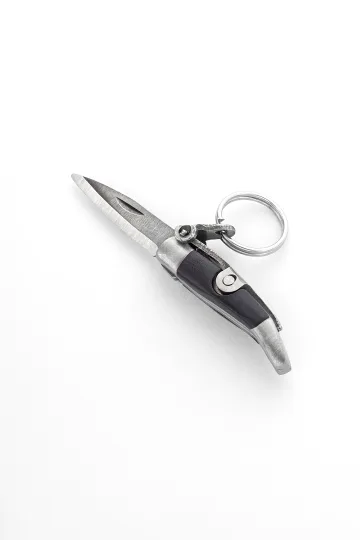





Conclusion
The dolphin occupies a rare position in three and a half thousand years of human symbolism: it has almost no negative history. From the Minoan fresco at Knossos to the Royal Navy submariner's badge, from the French dauphin's blazon to the mirror-test studies of cetacean self-awareness, every layer of the dolphin's cultural biography has added to the same account. Play, intelligence, friendship, the sea, rescue, the crossing between worlds.
Most powerful symbols have a shadow side that serious cultures have found and named. The dolphin is an exception. Whether this is because the animal's actual behaviour, over thousands of years of human observation, has consistently matched the hopeful image, or because there is something in the specific shape of the dolphin, the playful leap, the benign expression, the horizontal tail that lifts before the dive, that simply resists dark interpretation, is hard to say. Probably both.
Zevira does not claim that a silver dolphin on your neck will change anything outside your own awareness of wearing it. But we do think that a creature which has passed the mirror test, maintains playful behaviour into old age, cooperates voluntarily with human fishermen across generations, and has been carried in human art since the Bronze Age without once being cast as a villain earns its place in contemporary jewellery. The pendant is a small daily argument for that case.