Drop Earrings: The Pendant Below the Lobe That Changes Your Face
Drop earrings lengthen the face by 5-7 millimetres and remove roundness from the chin. This is the only jewellery category with a direct visual effect on face shape. A pendant length of 15-30 mm works optimally: longer becomes chandelier, shorter becomes stud.
All other ear ornaments work on the principle of accent. A stud places a point at the lobe, a hoop outlines a circle, a cuff clings to the cartilage. The drop is unique in playing with the vertical axis at the cheekbone and pulling the jawline down, adding those same millimetres that read in the mirror as "the face became narrower." This effect explains why the drop has remained in fashion for the past three and a half thousand years without serious pauses. Minoans, Romans, Renaissance, Edwardians, 1920s Art Deco, and today the same shape at the lobe, the same logic of suspension.
In this guide we dive deep into how the drop works on the face, how it differs from chandelier and stud, which materials and stones make up its canonical palette, how to choose length for face shape and occasion, which settings will handle daily wear without tearing the lobe, and most importantly: five real cases with real solutions, because jewellery selection isn't about rules but about living human results.
What is a Drop Earring and How it Differs from Chandelier and Stud
A drop earring is an ornament made of three parts. The upper attachment point at the lobe (stud, mini-ring, or hook), a connecting link (chain, hinge, rigid bend), and a pendant below the lobe. The pendant can be a stone, pearl, metal form, miniature with enamel, or a combination. The key condition: the pendant hangs freely or nearly freely below the earring base, but doesn't swing as intensely as with chandelier.
The boundaries with other categories are clear if you know the lines:
Stud (earring post). Stone or element sits at the level of the lobe, no pendant. If there's a pendant up to 5 mm long, it's still a stud with a small detail. Anything that hangs noticeably below the lobe becomes a drop.
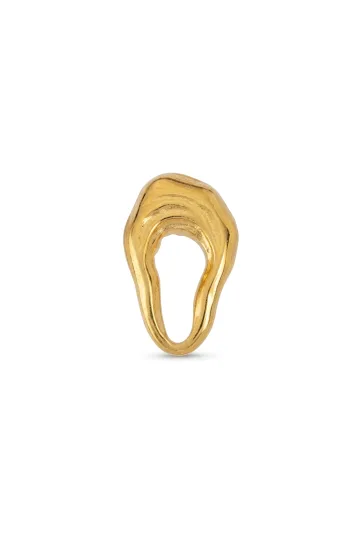
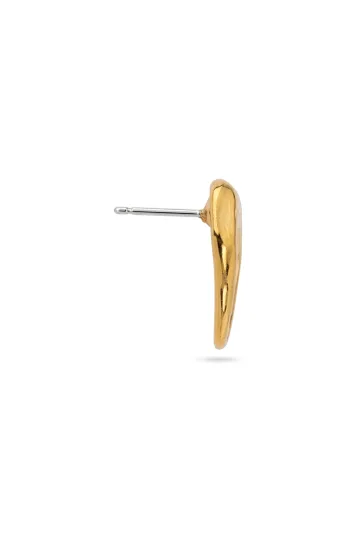
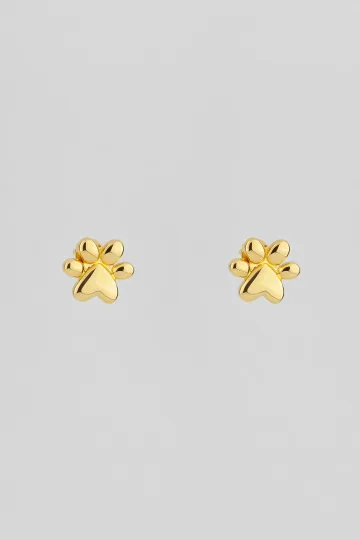
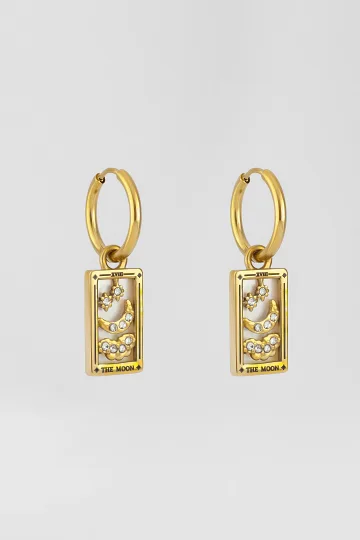
Wear the symbol, don't just read about it. These are in stock:



Drop (pendant). Pendant 10-30 mm below the lobe. One element or short sequence of elements. Minimal swinging when walking, noticeable only with energetic head movement.
Chandelier (hanging ornament). Multi-level pendant 40 mm or longer, with several horizontal bars or branches, with moving elements on multiple axes. Noticeable swing with head movement, creates constant shimmer when walking.
Dangle. Term sometimes used as synonym for drop, but more precisely describes any earring with a hanging element. A drop is a subcategory of dangle with one main pendant. A chandelier is also a subcategory of dangle. So "dangle" is the general concept, "drop" and "chandelier" are types.
These boundaries aren't numbered rules but guidelines. Edge cases occur where jewellery can belong to two categories simultaneously. A pearl on a 35 mm chain is technically on the border with chandelier by length, but without multi-level architecture remains a drop. A diamond at 18 mm with fine sparkle on top might look like a stud, but if the sparkle creates visual elongation and pendant effect, it becomes a mini-drop.
Understanding boundaries matters for selection. Drop and chandelier interact with the face differently. Drop elongates silhouette, chandelier decorates ears and draws attention through movement. Stud is static, drop is moderately dynamic, chandelier highly dynamic. For office nearly always you need a drop or stud. For ballroom a chandelier works better. For everyday city the working zone is short drop 12-18 mm or stud with pendant.
History of the Drop: From Knossos to Art Deco
The drop is older than any other earring genre. Studs appeared later, rings almost in parallel, but only the Minoans knew how to make a pendant below the lobe before the Greeks wrote the rules of geometry.
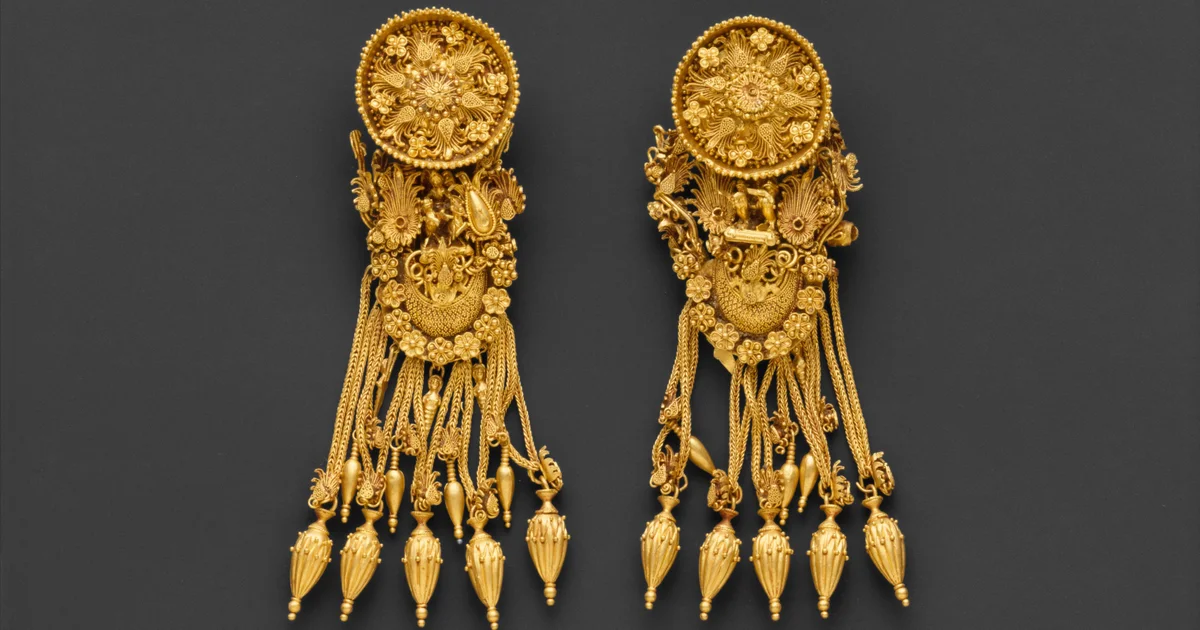
Minoan Crete, 15th Century BCE
In the treasures of Knossos and Mallia, gold drop earrings with suspended pearls and garnets were found. Construction is extremely simple: thin gold wire bent into a hook passes through the lobe, with a stone or pearl fixed at the lower end. Weight is small, about two or three grams per earring. This is everyday jewellery, not ceremonial: similar drops were worn in ordinary life, not only at religious ceremonies. The Minoans were the first to understand that a hanging stone at the cheekbone is more noticeable than a stone in a ring or necklace. This idea outlived Minoan civilisation itself and passed to the Mycenaeans, then to classical Greece.
Greek and Roman Periods
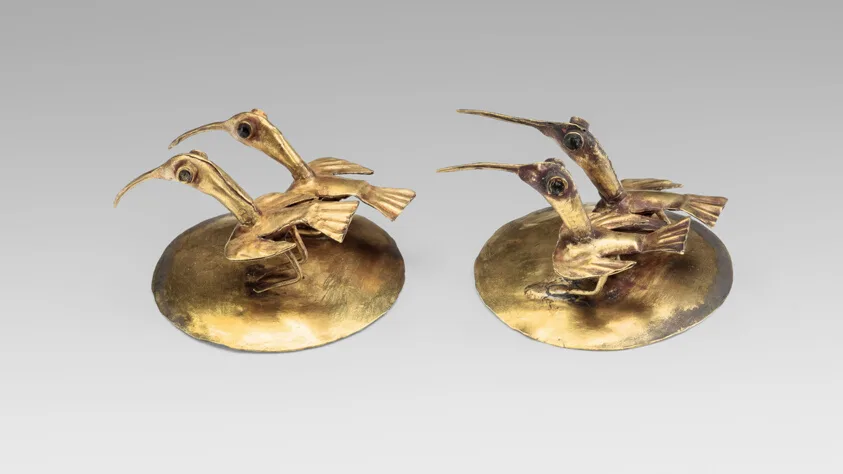
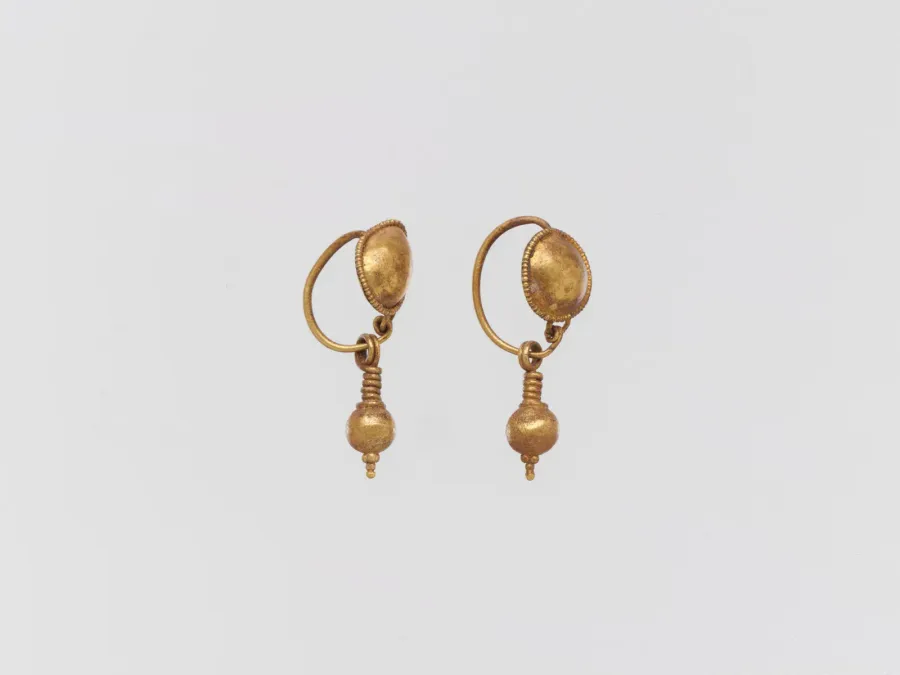
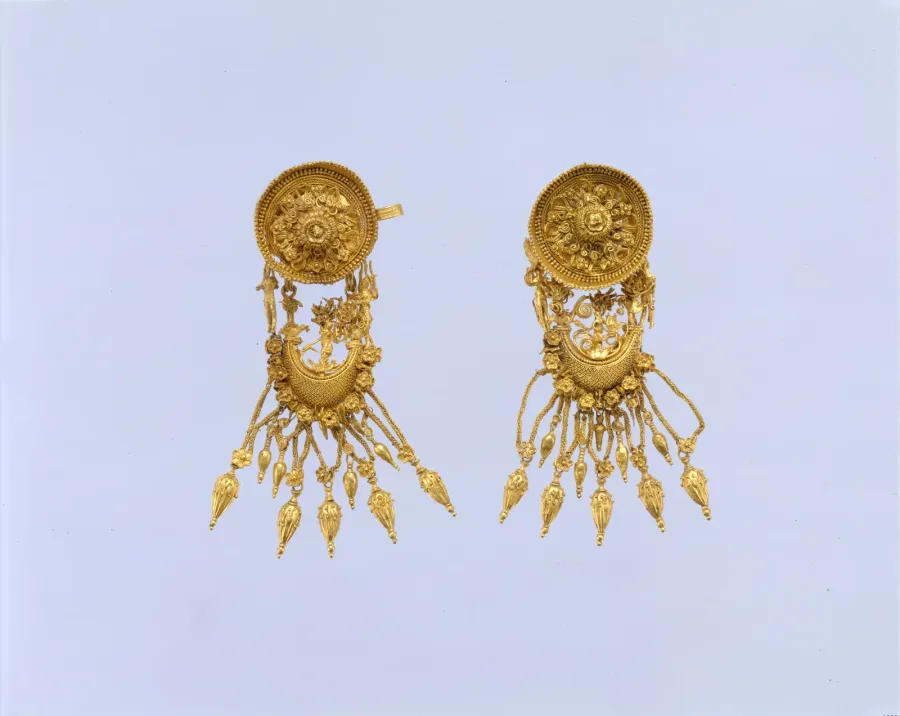
Greek jewellers of the 6th-4th centuries BCE transformed the drop into technically complex ornament. Granulation appeared (tiny gold spheres soldered to the base), filigree, coloured enamels. Drops were worn in the shape of amphorae, jugs, grape clusters, winged figures of Nike. The pendant now became a miniature sculpture rather than a plain stone.
Romans inherited the technique and added coloured stones. Garnet, amethyst, emerald from Egypt, pearls from the Red Sea and India. Roman drops became status markers: the more complex the stone and finer the work, the higher the wearer's position. Pliny the Elder in his Natural History specifically describes how wealthy Roman women demonstrated wealth through drops with two pearls of different sizes.
Byzantine and Medieval Europe
Byzantine emperors wore pendilia, long pendant ribbons at the crown with pendants hanging on the cheeks. Technically these weren't pierced earrings, but the visual effect was the same: long pendant at the face, breaking the profile and elongating it. From the Byzantine image pendilia passed into early medieval times as a symbol of royal dignity.
In Catholic Europe of the 13th-15th centuries, pierced earrings temporarily fell out of fashion among noblewomen: high collars and complex headdresses covered the ears. But Renaissance Italy brought back everything. Portraits of Isabella d'Este, Lucrezia Borgia, Raphaels' Madonnas show drops with a single pearl of classic form. This form became the standard for the next five centuries.
Moorish and Arab Tradition
Parallel to Christian Europe, the drop was preserved and developed in the Islamic world. Moorish Spain of the 10th-15th centuries left filigree drops from Alhambra and Aljafería: fine gold or silver wire twisted into ornamental patterns, with suspended pearls or coloured enamel. The East worked with similar form but added rubies, emeralds, turquoise.
The principle everywhere was one: long pendant at the cheekbone as universal way to mark a female face and make it noticeable.
Victorian Era: Mourning Drops
British Victoria era (1837-1901) added new meaning to the drop: mourning. After the death of Prince Albert in 1861, Queen Victoria wore full mourning until the end of her life, setting the tone for British fashion for forty years. A category of mourning jewellery emerged from black jet, onyx, dark glass. The drop became canonical form: jet was light and cool, could be worn as a pendant without strain on the lobe.
Victorian drops rarely had a single stone. More often a composition of several dark elements with gold connectors: main jet drop, smaller one beneath, with a small pearl at the very end. The pearl here meant tears.
Edwardian Era and Belle Époque
By the start of the 20th century the mourning period ended, diamonds returned to fashion. Edwardian era (1901-1910) gave drops with diamond sparkle on platinum: long pendant of several connected small stones ending with one large one. Platinum technology allowed an almost invisible frame, making it seem stones floated in air.
In parallel France flourished with Belle Époque in the same style. George Fouquet, René Lalique, and Parisian Art Nouveau studios worked with platinum drops with diamonds, sometimes with coloured enamel in the lower part. This era brought maximum refinement in drop form.
Art Deco: Geometry and Contrast
From the 1920s the canon changed. Art Deco abandoned soft natural forms and moved to geometry: square, triangle, diamond, rectangle. The drop of 1920-1930 often consisted of platinum geometric top with starry diamond sparkle and a large coloured stone (emerald, sapphire, ruby, onyx) or pearl suspended from it.
Material contrast worked at maximum: black onyx with white diamonds, green emerald with platinum, mother-of-pearl with rock crystal. The drop became not jewellery but an architectural form at the cheekbone.
Postwar Period and Modernity
After World War II the drop went through several waves of revival. 1950s Hollywood brought back pearl drops as image of mature elegance: Grace Kelly, Audrey Hepburn, Elizabeth Taylor constantly appeared in drops with one large pearl on long suspension.
In the 1970s bohemian revival added long drops with warm stones: tiger's eye, turquoise, coral. The 1980s brought coloured quartz and citrine to the drop. The 1990s and 2000s gave minimalism: thin chain, one stone, nothing extra. Today the drop exists in all its historical versions simultaneously, and the choice depends on which era the wearer wants to evoke.
A drop wants a bare cheekbone, not a curtain of hair. Hide it behind your locks and you might as well leave it in the box.
How to wear drop earrings
Over years on shoots and fittings the drop passes across hundreds of faces, necklines and occasions. Here is what actually works, sorted by case.
What do I wear a drop with every day? For daily wear I recommend a short drop, 15 to 22 mm, with a pearl or a single stone: it sits happily with jeans, knitwear, a simple blouse. An open collar or a shallow round neck gives the earring room by the cheekbone. Keep the clothing in a neutral colour so the drop becomes the single warm accent. Tuck the hair behind the ears or pin it up, or a short drop gets lost.
Is a drop right for the office? Yes. I recommend classic pearl, 18 to 22 mm, or a small diamond under a shirt, a jacket or a moderate turtleneck. Match the metal to the rest of the look: gold with a warm palette, white gold and platinum with a cool one. One vertical by the face and a thin chain without a pendant read composed, not loud.
How do I build an evening look? For evening I choose a length of 25 to 35 mm, an open neck and hair up or a smooth bob. A straight or horizontal neckline works on contrast: the vertical of the earring against the horizontal of the décolleté. Dense fabrics and deep colours (emerald, wine, black) carry a coloured-stone drop especially well.
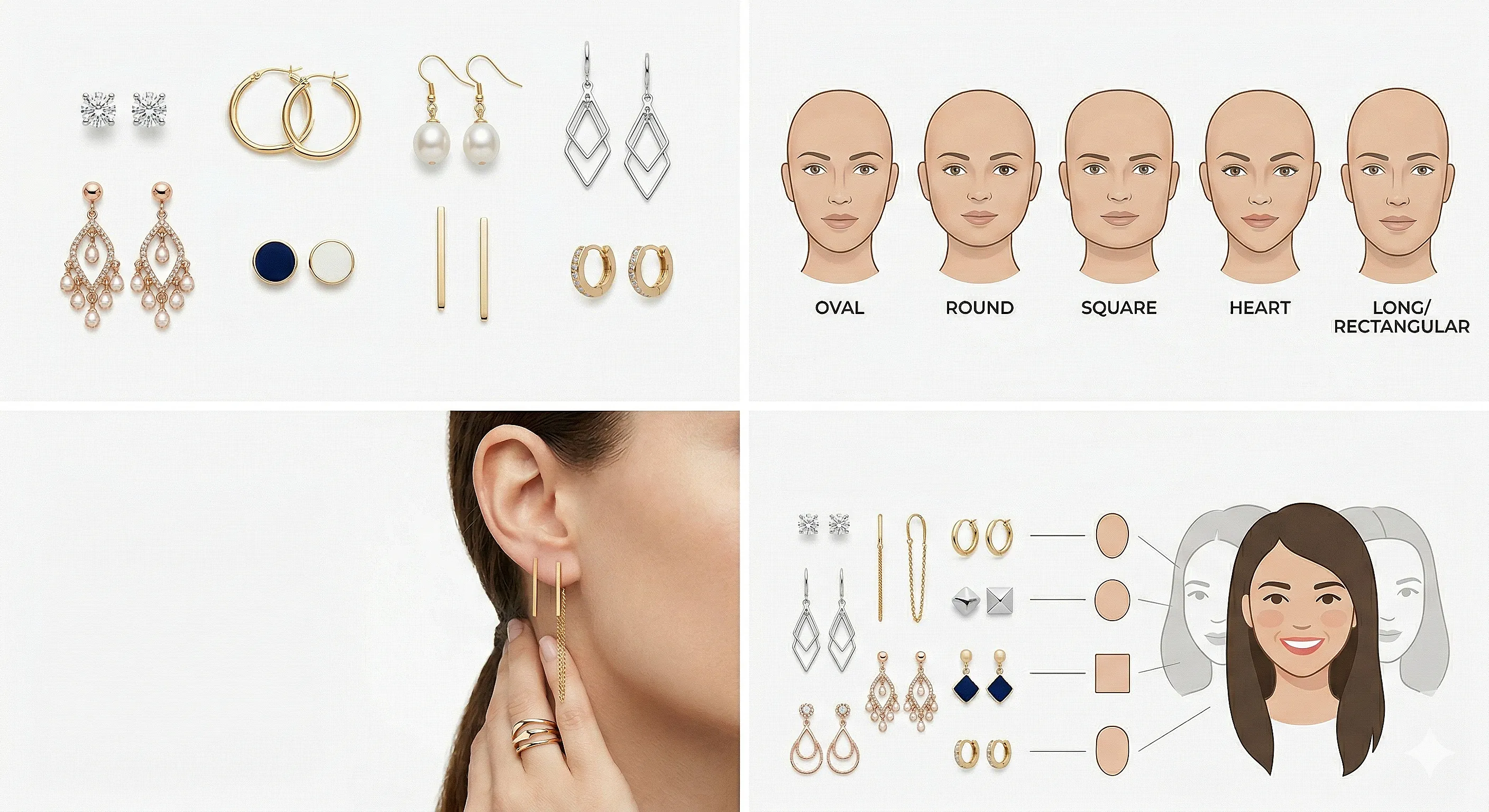
Which drop suits my face? For a round or square face I suggest an elongated or soft teardrop, it lengthens the silhouette and softens the corners. For a long face I recommend a short drop, 12 to 18 mm, with a rounded base, since a long one only adds more vertical. An oval face takes almost anything, so I choose by occasion rather than correction.
Who do drops actually suit? Anyone who wants soft movement by the cheekbone and a slightly longer line to the face. Two rules that never fail. First: match the length to the open neck and the hairstyle, not to your mood. Second: one drop in the lower piercing beats a drop in every one; keep the upper holes static, a stud or a mini hoop.

Turn on your camera, pick earrings, a pendant or a ring, and see the piece on yourself in real time.
Switch items in one tap.
Everything runs in your browser: no photo or video is ever uploaded.
Anatomy of a Drop Earring
To discuss drop selection, you need to understand its structure. A good drop consists of three working zones, and each zone determines the final effect.
Top piece: Upper Attachment Point
What sits directly on the lobe. This can be a simple stud (stone or metal element on a post), mini-ring around the lobe, flat rosette, or just a hook with no decorative top.
The size of the top piece directly influences the visual balance of the earring. A small top makes the pendant the main accent, the earring reads as "drop." A large top with its own decorative load shifts balance: the earring reads as "stud with pendant." The boundary is conditional and depends on proportions between top and pendant.
Classic ratio: the top piece comprises 20-40% of the overall earring height. If the top takes up half the height, the earring visually reads as two-component composition, not as pure drop.
Connector: Connection Link
Between the top point and pendant lies the connection link. This can be:
Chain link. Most common variant for classic drops. Length 5-25 mm, thin or medium chain from anchor, mesh, Bismarck, or Figaro weave. Chain gives pendant freedom of movement, the earring sways gently.
Hinge. Rigid metal hinge with one pivot axis. Pendant can only swing in one plane (forward-back). Used more in Art Deco and geometric drops, where the pendant itself is large and shouldn't have full freedom.
Rigid bend. Curved metal part without movement. Pendant is immovably fixed at an angle to the lobe. Earring is visually long but doesn't swing. Good for active wear.
Rod. Straight metal bar between top and pendant, sometimes decorated with fine sparkle or engraving. Creates rigid vertical line and emphasises elongating effect.
The connector type determines earring character. Chain gives softness and movement, hinge adds controlled dynamics, rigid bend fixes form, rod creates strict line.
Drop: Main Pendant
The main element of the earring. This can be a pearl, faceted stone, metal sphere, miniature figure with enamel, crystal, small stone sparkle in drop form, silk tassel, or chain ends.
Pendant size determines earring's visual weight. Small pendant (6-10 mm) makes the drop delicate, medium (10-18 mm) gives balanced accent, large (18-30 mm) becomes the main decoration of the look.
Pendant shape works with the face. Round pendant (pearl, sphere) softens the image. Faceted (diamond, citrine, amethyst) gives sparkle and geometry. Elongated drop-shaped (pear, marquise) enhances vertical effect. Geometric (square, diamond, triangle) adds Art Deco character.
Overall Earring Height
Composed of all three zones. By overall height we classify:
15-22 mm. Mini-drops and short drops. Suitable for daily wear, under closed neckline, for office. Don't get lost in hair at medium length.
22-30 mm. Classic drops. Most universal range. Work both in office and at a date and at family dinner.
30-40 mm. Elongated drops. For formal events, evening, photo shoots. Visible from any distance. Require open neck or gathered hair.
40-50 mm. Border with chandelier. Very long drop. Only formal occasions, wedding, ball gown. With active movement heavier and lobe load increases.
50+ mm. No longer a drop but chandelier or statement earring. Separate category with its own rules.
Length of 22-30 mm recommended as starting point for first drop. Further movement in either direction depends on specific occasion and face shape.
Materials and Stones: Canonical Palette
The drop historically worked with a specific set of materials. This set isn't random: each material has visual properties that emphasise the vertical axis of the jewellery.
Pearl: Thousand-Year Classic
Pearl is the main material for drops since antiquity to today. Reasons are three: soft shine without sharp glints, light weight, form naturally tending to drop (baroque pearl often has drop shape without any cutting).
Akoya 7-9 mm. Japanese saltwater pearl. Perfectly round or nearly round shape, white or slightly pinkish colour, even shine. This is the standard for classic pearl drop. Worn with any outfit, suits any face shape, survives generations.
Tahitian 8-12 mm. Pearl from French Polynesia. Dark shades: grey, peacock, eggplant, greenish. Larger than Akoya and more textured. Good for no-nonsense look, for women 40+, for rare evening outings. Dark pearl contrasts more strongly with light skin than white.
South Sea 10-15 mm. Pearl from Australia, Indonesia, Philippines. Largest category. White, golden, silvery. Evening or stage version. Usually too large for everyday.
Freshwater pearl. Mainly China. Noticeably cheaper than saltwater. Shape often uneven, baroque. Baroque drops actually valued: each pearl unique in form.
Keshi. Nuclei-free pearls forming in Tahitian oysters as byproduct. Very textured, irregular shape, intense shine. Decoratively interesting, suited to author jewellery.
Diamonds and Crystals
Drop with diamond second canonical form. Single round-cut stone 0.3-1.5 carats on thin link or platinum frame. Suits both daily wear (if stone small) and formal occasions.
Pear cut. Stone form already a drop. Elongated pear cut usually fixed on thin platinum cap with or without sparkle. Suits long neck and elongated face: stone adds vertical.
Marquise cut. Also elongated but with pointed ends. More sharp than pear. Suits square and heart-shaped face.
Briolette cut. Faceted drop without flat area. Sparkles throughout volume, no "face." Good for pendants where sparkle matters from every angle.
Round cut. Universal variant giving maximum sparkle. On drop used as lower element with transparent or platinum connector above.
Coloured Precious Stones
Sapphire, ruby, emerald. Classic trio of coloured precious stones. Suit both daily drops (small stone, 0.3-0.8 ct) and ceremonial (1-3 ct and more). Sapphire especially organic with white pearl or diamond sparkle on top. Ruby more vibrant on dark skin. Emerald requires fine frame work: soft stone easily chips.
Garnet. Historic drop material since Minoans. Warm reddish-brown colour, accessible price. Works with gold and copper.
Amethyst, citrine, topaz. Semi-precious stones available in large sizes. Work well for mid-range drops. Amethyst is cool, citrine and topaz are warm.
Semi-Precious and Ornamental Stones
Moonstone. Bluish or white stone with adularescence effect (internal play of light). Fits bohemian style and ethnics. Works well with silver.
Labradorite. Grey-green with rainbow play. Modern drop material. Fits minimalism and Scandinavian style.
Opal. Complex material: soft, requires caution in wear. But gives effect no other stone repeats. Suited for rare formal wear.
Turquoise, lapis lazuli. Warm ethno-stones. Turquoise works with silver and copper, lapis with gold.
Enamel and Miniature
Drop with enamel is separate genre, flourishing in 1900s (Belle Époque, Art Nouveau). Fine gold or platinum frame with enamel miniature inside: flower, landscape, ornament, portrait. Contemporary author jewellery returns to this technique.
Enamel comes transparent (plique-a-jour, stained glass effect), opaque (champlevé, cloisonné), painted. Each variant requires its technique and gives its visual effect.
Coral
Historic drop material in Italy and Spain. Warm red, pink, white. Today coral is rare due to environmental restrictions, but antique coral drops are highly valued. Suits warm skin and Mediterranean-aesthetic looks.
Base Metals
Yellow gold 585 and 750. Classic. Works with pearl, diamonds, coloured stones. Warm shine.
White gold and platinum. Cold shine. Suit diamonds, white pearl, sapphires. Platinum stronger than white gold and doesn't yellow over time.
Rose gold. Suits Tahitian pearl, morganite, rose quartz. Modern version of classic.
Sterling silver 925. Accessible base for drop in bohemian or minimalist style. Darkens from air, requires care.
Customer reviews
Zevira is a real jewellery shop. Genuine payments, deliveries and customer thank-yous.
🥰🥰🥰 gracias

Ok, ¡gracias! 🙂

Drop Styles: Six Main Directions
The drop as form is versatile enough to embody six completely different design philosophies, each with its history and audience.
Classic: Pearl or Single Stone
The most canonical form. Single pearl (Akoya, Tahitian, South Sea) or single stone (diamond, sapphire, emerald) hanging on thin chain or rigid bar from minimal top. Simplicity here is the hardest achievement: the entire composition rests on quality and proportion. If the stone is mediocre or the suspension point badly made, nothing can compensate.
This style emerged from 18th-century Versailles and hasn't changed fundamentally since. Audrey Hepburn, Grace Kelly, Elizabeth Taylor all wore classic drops. Today this remains the standard reference point: everything else is a variation.
Suitable for all occasions: office, date, wedding guest, formal reception. Can be everyday if material allows (non-precious drop, sturdy silver setting). Can be a lasting piece to keep for years if the material demands it (1+ carat diamond, high-quality pearl, precious metal).
Historical: Filigree and Enamel
Came from Art Nouveau (1900s) and Art Deco (1920s). Ornate top piece with filigree or enamelled pattern, connected to pendant by short rigid bar or articulated link. The decorative top is equally important as the pendant.
Filigree drops feature thin gold or silver twisted into intricate ornament, topped with enamel miniature or cabochon stone. The work is labour-intensive and expensive. Modern reproductions exist in silver at accessible prices, but the technique is the same as century-old: everything depends on master skill.
Suitable for evening, special occasions, people who want story in their jewellery. Not for office or active wear due to fragility. Precious version (gold, stone) is a piece to keep; silver version is a personal thing.
Geometric: Art Deco Descendant
Squares, diamonds, rectangles, triangles. Platinum or white gold with contrasting stone (emerald, sapphire, black onyx) or pearl on geometric frame. The frame itself is the ornament. This style epitomizes 1920s-1930s machine-age aesthetics.
Modern interpretations play with mixed metals (gold and silver combined), unusual stone combinations, sometimes adding sparkle elements. But the core remains geometric and clean.
Suitable for modern woman with minimalist aesthetic who wants subtle geometric hint. Works in office under dress code and at evening events. Sterling silver versions accessible, precious metal versions are pieces to keep for years.
Bohemian: Long and Free
Long chains (40-50 mm total length), natural stones in warm tones (tiger's eye, turquoise, amber, coral, jasper), sometimes with tassel or multiple small stones. The philosophy here is asymmetry, nature, hand-made feel.
This direction comes from 1970s bohemian revival and ethnographic collecting. Each piece is unique in stone pattern and colour variation. High wear and personal story matter more than perfection.
Suitable for bohemian style, creative person, someone wearing festival outfits or vintage clothes. Not office, not formal, not minimalist. Sterling silver or copper base. The appeal here is the look and the story, not the materials.
Minimalist: Modern Reduction
Emerged 2010s as reaction to excess. Thin post with tiny stone or geometric form, sometimes no stone at all, just a metal sphere or small geometric shape. Total length 15-20 mm. The empty space is as important as the element itself.
Philosophy: less is more, but carefully chosen. Not minimal by accident but by intention. Japanese aesthetic influence (ma, the importance of emptiness), Scandinavian purity. Everything on the earring serves a function or creates balance.
Suitable for office, minimal aesthetic, modern professional woman. Works as daily jewellery for decades. Precious metals and stones fine; the important thing is quality of design and execution.
Statement: Bold and Graphic
Large pendant (25-35 mm), sometimes with multiple elements, unusual materials (carved wood, resin, enamel with graphic pattern), sometimes asymmetric. The drop here announces itself and doesn't apologise. Colour, texture, sculptural quality matter.
This direction comes from contemporary artist jewellery and designer collections. Not meant to match with others, but to stand alone. Often commissioned or limited edition. Price varies widely depending on materials and maker.
Suitable for person with strong personal style, creative professions, anyone who uses jewellery as self-expression. Not professional offices with conservative dress codes. Wearable art rather than functional jewellery.
Upload a photo of your pet, someone you love, or an object. We'll build a 3D model and hand-cast it in pewter.




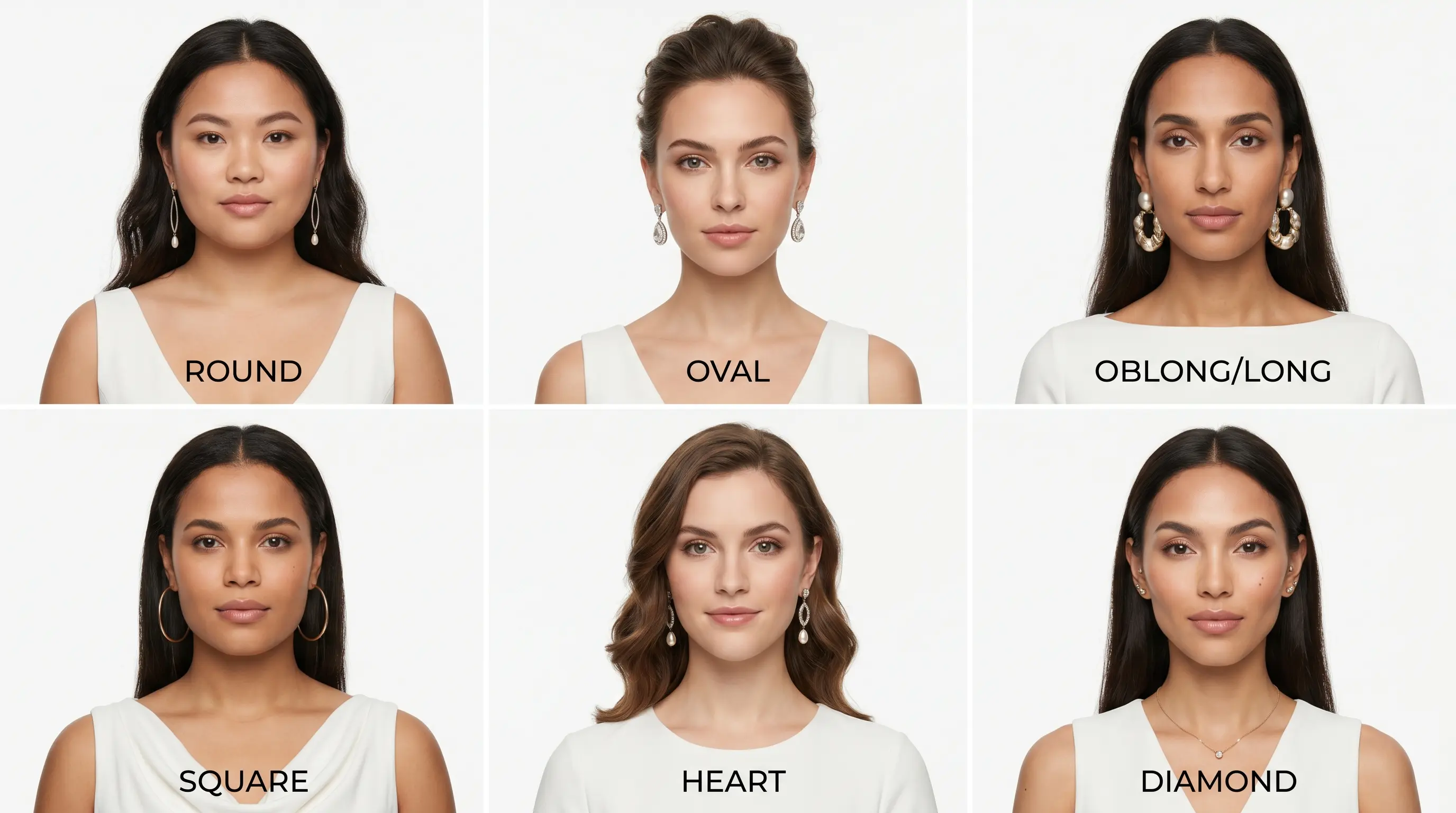
Which Drop for Which Face Shape
This is where the mathematics of jewellery meets the reality of the individual. The same length and shape work differently on different faces. The guidelines here are not rules but starting points.
Oval Face
Mathematically ideal face shape. The drop of any length works on oval without restriction. All styles suit: classic, historical, geometric, bohemian, minimalist, statement. The only recommendation: don't overscale. If face is delicate, 15-22 mm optimal. If face is large, 22-30 mm optimal. Anything longer than 30 mm starts to visually divide the face rather than harmonize.
Round Face
Goal: to elongate. Long drops (25-35 mm) work best because they pull the eye vertically and make the roundness read as less round. Avoid very short drops (under 15 mm): they emphasise roundness. Avoid chunky tops: the visual weight up by the ear makes roundness worse.
Good choices: pearl or stone on thin chain, dropping well below the ear. Even better: two-element drop where a small stone/pearl is followed by a larger one 15 mm below, creating strong vertical rhythm.
Avoid: thick studs, short drops, geometric squares that emphasise horizontal.
Oblong Face
Goal: to add visual width at cheekbones. Shorter drops (15-22 mm) work better than long ones because they place weight at cheekbone level without extending the face further. Avoid very long drops (35+ mm): they make the face look even longer.
Good choices: medium-sized stone at 20 mm that falls right at cheekbone level, creating horizontal accent. Geometric shapes work well because they interrupt the vertical line.
Avoid: very thin long chains, anything emphasising the vertical line.
Square Face
Goal: to soften angles. Round shapes (pearl drops, spheres) work better than geometric. Medium to long length (20-30 mm) works because it pulls away from jaw angle. Avoid short drops that emphasise the jaw.
Good choices: pearl drop slightly larger than average, on thin chain, drops to the middle of the ear lobe line. Soft materials (pearl, coral) better than hard (geometric diamond cuts).
Avoid: very geometric shapes, very short studs, thick gold frames that emphasise the jaw.
Heart-Shaped Face
Goal: to balance wide forehead with narrower chin. Medium-long drops (25-30 mm) work well. The weight at cheekbone/jaw level creates visual balance. Short drops emphasise the forehead.
Good choices: stone with some size (0.8-1.2 ct) on thin suspension, gives balance without heaviness. Warm-coloured stones (citrine, amethyst, rose quartz) work with the often-delicate features.
Avoid: very short drops, very long drops (50+ mm), very heavy tops.
Diamond-Shaped Face
Rare face shape. High cheekbones and prominent cheekbones are the feature. Here almost anything works as long as it doesn't overload the already-featured face. Short to medium drops (15-25 mm) optimal.
Good choices: understated pieces, minimalist aesthetic. Let the face geometry shine.
Avoid: statement drops, anything competing with existing face geometry.
Five Cases: Real Selections
Understanding anatomy and history matters, but the real test is: does it work on a real person in a real situation?
Bride on Wedding Day
The dress is white or ivory, the setting formal. The drop should complement, not compete. If veil will be worn, avoid anything that tangles (long drops, multiple elements, tassels). If no veil, longer drops (25-35 mm) work beautifully with open shoulders.
For traditional wedding: pearl drop (Akoya or South Sea, depending on veil coverage), classic chain suspension, 25-28 mm length. Metal white gold or platinum only, no yellow gold (the warmth competes with white dress). Weight slightly substantial (1-2 grams total) so earring doesn't bounce with movement.
For modern bride: options expand. Classic still works, but contemporary drops (minimalist sphere, geometric form, contemporary pearl) also suit. Key: the drop should echo something else in the outfit (metal of the ring, colour of the bouquet, the dress detail).
Duration of wear: 8-12 hours continuously at wedding, then years of occasional wear. So quality of setting and ear post is critical. Broken setting at the altar is memorable for wrong reasons.
Woman Turning 40
Milestone birthday, potential moment to own beautiful jewellery for self rather than as gift. This is a fitting moment for a drop to keep for years: 1-1.5 carat excellent diamond, or high-quality sapphire, on platinum or white gold.
Psychologically this works: the drop now isn't a gift from someone else but statement from herself. The style shift from younger years (perhaps statement drops or bohemian style) to classic refined drops marks the life transition. This is legitimate reason for jewellery.
Choose quality over size: small excellent diamond beats large mediocre one. The goal is to wear for decades daily or nearly daily, so every quality factor matters.
Duration: potentially 30-40 years of regular wear.
Mother of Two Young Children
Practical drops only. Anything that tangles in children's hands, anything with small loose parts, anything requiring delicate care: no. Go sterling silver, drop with safety post (closed back to prevent loss if somehow the post breaks), 15-20 mm length, simple stone or pearl.
This is not sentimental jewellery moment but functional. A woman caring for young children needs jewellery she can wear without worry. That actually feels good compared to fussy pieces.
Best choice: classic pearl drop on sturdy silver, 18 mm length. Can be thrown in a bag, cleaned easily, worn with any outfit. Cost accessible. Durability excellent. When children grow, the earrings remain as bridge between life phases.
Duration: 5-15 years of heavy wear, then lighter wear after children older.
Woman Ending a Relationship
Moment of redefinition. Sometimes this is moment to buy yourself what you never had permission to want before. Or to honour the time that's passing.
This is not moment for sentimental drops (gifts from ex partner). This is moment for drops that say "I choose myself." Can go statement (bohemian, colourful stone, something dramatic), or can go minimalist (clean lines, no-nonsense quality), or can go precious (a fine piece that's hers alone). The style matters less than the decision-making: she's making choice for herself.
No practical recommendation here other than: make sure the earrings make her feel the way she wants to feel when she looks in the mirror.
Duration: potentially forever, or until the next life moment. But made consciously.
Teenager Getting First Real Jewellery
This marks the transition from childhood costume jewellery to real materials. The gift or purchase should be neither babyish nor over-grown.
Good choice: small pearl (Akoya 7 mm) or small diamond (0.25-0.5 ct) on thin silver or white gold post, 15-18 mm total length. Something she can wear daily and won't outgrow. Something that still feels special and real.
Avoid: costume jewellery (defeats the purpose), something too large, something fragile.
The psychology: real jewellery for the young woman she's becoming. This earring will mark the decade. If done right, she'll have it in her jewellery box at 45 still remembering when and why she got it.
Duration: 5-10 years of near-constant wear, then forever as sentimental piece.




Earring Length and the Proportion of the Whole Look
Face shape is the first filter, and most guides stop there. It is the wrong place to stop. An earring hangs in the space bounded by the jaw, the neck, the shoulder line and the edge of the clothing, and every one of those borders changes what the same 30 mm drop looks like. A pair that reads elegant on a long neck above an open collar reads crowded on a short neck above a polo neck, and the earring has not changed at all.
The practical way to think about it: the drop is a vertical line drawn in a rectangle. Everything else in the look decides how tall that rectangle is. The taller it is, the more length the drop can take without touching an edge.
The Neck and the Drop
Measure the distance from the bottom of the earlobe to the point where the neck meets the collarbone. On most adults this is between 60 and 110 mm. The working rule is that the drop should occupy no more than roughly a third of that distance for daily wear, and no more than half of it for evening.
A short neck, meaning under about 70 mm of clear space, gets crowded quickly. A 40 mm drop on that neck ends near the collarbone, the eye reads the gap as closed, and the whole upper body looks compressed. The fix is length between 15 and 22 mm plus a narrow silhouette, so the vertical stays open.
A long neck, over about 95 mm, is the one case where a genuinely long drop earns its keep. Length between 35 and 50 mm fills the space rather than disappearing into it. Short studs on a long neck can look accidental, as though the outfit was finished in a hurry.
There is also the matter of what the neck does. If you spend the day turning your head at a screen or a counter, a drop that ends level with the jaw will tap it. Anything past the jaw and clear of it is calmer than anything that stops right at the bone.
Shoulders and the Drop
Shoulder width sets the horizontal against which the earring's vertical is read. Broad or square shoulders create a strong horizontal near the top of the body, and a short round drop next to it looks like a full stop in the middle of a long line. Length and a bit of taper restore the balance: an elongated teardrop, a graduated cascade, anything that pulls the eye down rather than sideways.
Narrow or sloping shoulders do the opposite. The upper body already reads vertical, so a long thin drop simply adds to a line that is long enough. Width helps here, meaning a drop with a rounded or slightly flared base, or a pair of stones set side by side rather than stacked.
There is a quick test that takes ten seconds in front of a mirror. Stand square on, hold the earring at the lobe, and look at the silhouette from the crown of the head to the shoulder seam. If the earring points to the shoulder, it is working with the frame. If it points across it, it is fighting the frame.
Neckline and the Drop
Clothing is the frame most people forget until the photographs come back. Each neckline sets up a shape that the earring either echoes or contradicts, and both choices are legitimate as long as they are chosen.
A V neck creates a downward point. A drop that tapers to a point repeats it, which is calm and coherent. A drop with a wide rounded base contradicts it, which is livelier and reads more deliberate. Both work. What does not work is a long drop landing exactly at the top of the V, where the two verticals collide.
A round or scoop neck creates a curve. Rounded drops, teardrops, pearls and cabochons sit comfortably inside that curve. Sharp geometry against a soft scoop can look like it belongs to a different outfit unless the rest of the look is equally graphic.
A straight or boat neckline is a pure horizontal, and it is the most generous frame for a long drop, because the contrast between the earring's vertical and the neckline's horizontal does all the work. Evening dresses are cut this way for a reason.
A polo neck or a high collar swallows length. Anything below about 25 mm ends on fabric rather than in air, loses its shadow and looks stuck to the jumper. Short drops between 12 and 20 mm keep their outline against skin.
A shirt collar, buttoned, is the trickiest of all. The collar points create two small diagonals near the jaw, and a swinging drop crosses them constantly. Something with a stiff connector that hangs on one plane behaves far better here than a loose chain.
Hairstyle and the Drop
Hair decides whether an earring exists. Loose hair below the shoulders hides anything under about 25 mm entirely, and the money spent on a delicate short drop simply disappears. If your hair is long and usually down, either buy the length that clears it or accept the earring will be a private pleasure rather than a visible one.
Hair up, whether a bun, a chignon, a high ponytail or a pinned twist, opens the whole side of the head. This is the setting a long drop was designed for. It is also the setting where the back of the earring shows, so a piece with a plain or ugly reverse becomes noticeable.
A short crop or a bob near the jaw is the sharpest frame available. The hairline gives a hard edge, and any drop that ends at exactly the same height as that edge competes with it. Go clearly shorter or clearly longer than the hair, not level with it.
Texture matters as well. Dense curls near the ear absorb small earrings and catch on open hooks. Curly hair does better with a closed clasp and a drop that hangs at least a centimetre clear of the mass, so the two are not tangled together at the end of the day.
Clasp and Wearability: Which Clasp to Choose
The visible structure of the drop, the part touching the ear, determines whether the earring stays on and whether it damages the ear over time.
Post Earring (Pierced)
Standard for ear piercings. Straight metal post goes through the piercing, holds the drop, and has a back clasp (butterfly, threaded post, screw-back) to prevent loss.
Butterfly back (push-back). Most common. Simple spring-loaded back that pushes onto the post. Pros: quick to put on, cheap. Cons: springs wear out, the back can fall off without notice.
Threaded post. The post has grooves, and the back screws onto it. Secure but slower to put on and take off. Better for valuable drops you wear constantly.
Screw-back. Medieval version of threaded, sometimes seen in vintage. Same security as threaded but less convenient.
Earring backs with safety wire. Extra safety: if the back loosens, a secondary safety mechanism keeps earring attached. Good for drops you never want to lose.
For daily-wear drops, butterfly is fine. For valuable drops (diamonds, precious pearls), upgrade to threaded or safety wire.
French Wire (Shepherd's Hook)
A thin curved wire passes through the piercing and hangs free, with nothing behind the ear to hold it. The whole earring is suspended from that curve, which is why the drop swings so freely and why the look is so light: there is no visible hardware at all from the front.
The advantages are real. Nothing presses on the back of the lobe, so the ear stays comfortable for a long evening. The wire is thin, usually 0.7 to 0.8 mm, so it suits a piercing that has narrowed. And the free swing shows off a faceted stone better than any rigid fixing, because the stone keeps catching the light as you move.
The obvious disadvantage is that a hook can slide out. On a jumper being pulled over the head, in a coat collar, on a pillow, in a scarf. Anyone who wears french wires regularly loses one eventually. Two cheap remedies help: a clear silicone stopper pushed onto the tail of the wire, or a hook with a small hammered kink that resists slipping back through the hole.
Practical verdict: excellent for an evening, a dinner, a photograph, a wedding. Poor for a commute, a nursery, a market or anywhere you take a coat on and off repeatedly. Never for sleep.
Lever-Back and Continental Fittings
The lever-back is the compromise between the hook and the post. A curved wire goes through the piercing exactly as a french wire does, then a hinged lever snaps closed behind the lobe and locks it. Nothing can slide out, and there is no small separate back to lose in a sink.
This is the fitting most European workshops default to for anything with real value hanging from it. It carries weight well because the load spreads across the curve rather than pressing on one point, which makes it kinder to a piercing than a thin post carrying the same stone. It also puts the drop slightly further forward on the lobe than a post does, which usually flatters the line of the jaw.
The costs are minor. A lever-back is bulkier from behind, so it shows when the hair is up and the head is turned. The hinge is a moving part, and after some years of daily use the spring can soften, at which point a bench jeweller can retension or replace it for very little. And it is fiddly with cold hands.
There is also the continental or omega clip, a post with a hinged arc that folds up behind the ear. It is the most secure of all and the standard for heavy stones, though it sits proud of the ear and is the least discreet.
Which Fitting for Which Life
The honest answer is that fitting should be chosen from your week rather than from the display case, and almost nobody does this.
For daily wear with anything under about 2 grams, a butterfly back on a good post is sufficient, provided you check the back with a fingertip once or twice a day out of habit. If the pair has any sentimental value at all, spend the small difference on a threaded post, because the failure mode of a butterfly is silent: it does not fall off in front of you, it falls off somewhere between the office and the bus.
For anything with a stone worth insuring, use a lever-back, a threaded post or a safety-wire back, and have the fitting checked when you have the setting checked. Fittings fail more often than settings do.
For an occasion, meaning one evening, controlled conditions, no coats being wrestled on and off, a french wire is the prettiest option available and the risk is acceptable. For a piercing that has stretched or torn and healed, avoid the post entirely and use a lever-back, so the weight spreads instead of concentrating.
And for anyone who takes their earrings out at a desk and puts them down, the fitting matters less than the small dish you put them in.
Hoop Earring (Pierced)
Less common for drops, but exists. Drop hangs from a hoop wire that curves through piercing. Useful for certain designs but less secure than post.
Clip-On (Non-Pierced)
For people without piercings. Padded clip mechanism presses onto earlobe. Pros: can be removed. Cons: can hurt after a few hours, isn't suitable for all drops (weight and balance change).
For drops, clip-ons work only for very light stones (small pearl, small semiprecious). Anything substantial will cause the clip to hurt and slip downward.
Leave your email, we'll send your discount code. No spam, unsubscribe anytime.
The code arrives by email, valid on your first order.
Antipatterns: What to Avoid in Drop Selection
Twenty years of observing drops in the world shows consistent mistakes.
Mismatch Between Top and Pendant
If the top piece is massive (like a 0.5 ct round diamond surrounded by six metal prongs) but the pendant is tiny (like a 3 mm pearl), the earring reads visually broken. Everything is top, nothing is bottom. Choose either large top and large bottom (balanced) or small top and medium bottom (classic drop). Avoid 5:1 weight ratio between top and bottom.
Pendant That's Too Heavy
Physical problem: if the pendant weighs more than 2 grams and the post isn't reinforced, the post will gradually widen the piercing hole. Over years this can lead to torn lobe.
Check weight. If the drop uses 1+ carat diamond, or large pearl on thin post, discuss with jeweller whether the post needs reinforcement.
Pendant That Swings Chaotically
If the connector (chain or hinge) allows the pendant to rotate freely on multiple axes, the earring will hit the jaw repeatedly when walking. Over time this causes irritation or bruising.
Choose drops where the pendant either hangs purely vertically (rigid bar connector) or swings gently in one plane (short stiff chain). Avoid overly long thin chains that allow multi-axis rotation.
Wrong Length for Face
Discussed earlier, but bears repeating: very short drop on round face, or very long drop on long face, compounds rather than corrects face geometry.
Before buying, look in mirror wearing a wire at the drop's intended length. Imagine the stone hanging there. Do you like how it changes your face?
Fragile Stone in Active Setting
If you're hiking, gardening, going to gym, don't wear emerald drops. Soft stones (emerald, opal, pearl with surface coating) need protection. Wear only sapphire, diamond, or hardy stones.
Matching Earrings When Asymmetry Could Be Better
Not required to wear matching earrings. Some face shapes and outfits work better with one long drop and one short drop, or one pearl and one stone. Asymmetry can be intentional and beautiful.
Too Many Drops, or a Drop Fighting a Necklace
Two versions of the same error, and both come from adding rather than choosing.
The first is the stacked ear. Multiple piercings invite multiple drops, and three swinging pendants down one lobe produce noise instead of a line. The whole point of the form is a single vertical with movement in it. Put the drop in the lowest hole, where it has air beneath it, and keep everything above it static: a flat stud, a small hugging hoop, a plain bar. The eye then reads one deliberate accent with quiet punctuation above it, which is what the ear was doing in Crete three and a half thousand years ago.
The second is the drop competing with a heavy necklace. A wide collar, a large pendant or a chunky chain occupies the same visual zone, roughly the triangle between the jaw and the collarbones, and two loud objects in that triangle cancel each other out. Neither is seen properly. If the necklace is the piece you want noticed, wear a stud. If the drops are the piece, wear a thin chain with nothing on it or no necklace at all.
The exception, and it is a real one, is a matched historic parure where the earrings and the necklace were designed as one object. Then the repetition is the point and the whole thing reads as a single composition.
Precious Stone in Flimsy Setting
1 carat diamond in thin silver post isn't functional jewellery; it's stress. Either use precious stone in precious metal, or use precious stone in quality silver with reinforced post. Don't compromise on setting quality.
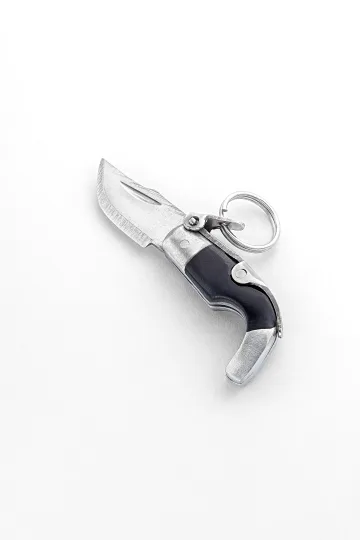
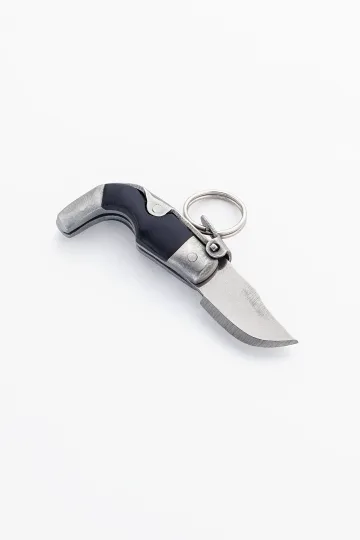
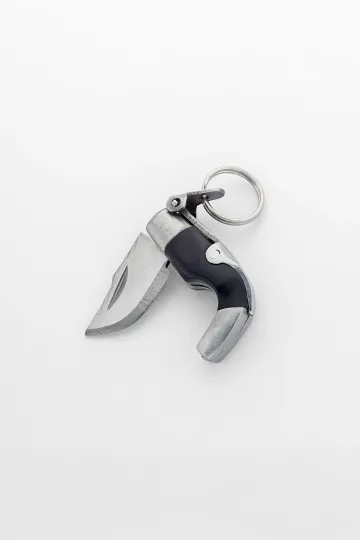
CAPAORA mini knife pendant
The 18th-century Spanish navaja in miniature: 40 mm of stainless steel, a real folding mechanism and a Palanquilla lock that clicks. An affordable gift to remember.
Authentic · Ships from Spain · 14-day returns
Care of Drops: Pearl, Metal, Enamel
Different materials need different approaches. Drops are worn near the face, so material degradation becomes noticeable.
Pearl Drops
Pearl is delicate. Protect from:
- Perfume and cosmetics (they damage the surface)
- Sudden temperature change (can cause cracking)
- Pressure (don't sleep wearing pearl drops)
Clean only with soft cloth slightly dampened with water, or with professional pearl cleaner. Store in soft pouch away from extreme conditions. Pearl that's well cared for outlives its wearer.
Diamond Drops
Actually quite durable. Diamonds don't degrade, but the setting can loosen. Every 2-3 years take to jeweller for inspection: check that the stone is secure, that the post isn't loose.
Clean with warm water and mild soap, or professional jeweller cleaner. Diamond doesn't need anything special; it stays bright without maintenance.
Coloured Stone Drops
Varies by stone:
- Sapphire/Ruby: Hardy. Same care as diamond. Regular inspection enough.
- Emerald: Fragile. Avoid water. Clean only dry with soft cloth. Don't store near heat sources.
- Amethyst/Citrine/Topaz: Moderate hardness. Protect from temperature change and pressure. Clean gently.
- Opal: Very fragile. Avoid water. Don't wear daily. Store in cool humid place (opal wants 55% humidity).
When in doubt, ask the jeweller who sold you the drop. Each stone has its specific needs.
Enamel Drops
Enamel is glass fused to metal. It's fragile. One fall and it cracks.
Protect from:
- Impact (never throw in a bag carelessly)
- Extreme heat
- Prolonged water exposure
Clean with soft dry cloth only. No soaking or harsh cleaning.
Metal: Gold, Silver, Platinum
Gold doesn't tarnish. Platinum doesn't tarnish. Sterling silver does tarnish (oxidises), especially in humid or salty environments.
For gold and platinum: occasional gentle cleaning with soft cloth. For silver: if tarnishing appears, either polish gently with silver cloth, or soak in silver cleaner following product instructions.
Never use harsh abrasives or ultrasonic cleaners unless jeweller recommends.
General Rule
If you like the drops enough to wear them, maintain them properly. It's the difference between drops lasting 5 years (with careless treatment) and lasting 50 years (with basic care). The jewellery will thank you with consistent beauty.
The Drop as a Gift: What to Weigh
Earrings are among the most given and most quietly returned pieces of jewellery in Britain. The reason is almost never taste. It is that the giver bought a shape without knowing the two facts that decide whether the shape will be worn: what the recipient's ear can carry, and what her face does with a vertical.
The good news is that a drop is more forgiving than a ring, because there is no size to get wrong, and more forgiving than a necklace, because it does not have to clear a neckline. What follows is how to narrow the choice with the information you actually have.
If You Know the Face Shape
This is the comfortable case, and the whole selection collapses into two decisions: length and the shape of the base.
For a round or square face, choose length. Somewhere between 25 and 40 mm, tapering rather than widening, so the vertical does the lengthening. A teardrop, an elongated marquise, a graduated cascade of three small stones. Avoid a wide circular pendant, which repeats the geometry you are trying to open up.
For a long or oblong face, choose width and stop short. Between 12 and 22 mm, with a rounded or slightly flared base. A single round pearl on a short link is close to perfect here and is also the safest gift in the category.
For a heart-shaped face, choose a base that is wider than the top: the drop returns weight to the jaw, which is the narrow part. For a diamond or rhomboid face, choose soft curves and a middling length, around 20 to 30 mm, so nothing repeats the point of the cheekbone.
For an oval face, relax. Almost anything works, so buy on occasion and material rather than on geometry.
If You Do Not Know the Face Shape
Most people are in this position, and there is a well-worn safe corridor.
Length between 18 and 25 mm. Long enough to be visibly a drop and to move, short enough that it will not crowd a short neck or catch on a polo neck. Base rounded rather than sharply pointed, because a curve flatters a wider range of faces than a point does.
Material: a white or cream cultured pearl, 7 to 9 mm, on a plain fitting in silver or white gold. There is a reason this pair keeps turning up as a gift across two centuries. It suits every skin tone, it reads correct at a funeral and at a wedding, it goes with a work shirt, and nobody has ever thought it vulgar.
Metal colour is the one thing worth investigating quietly beforehand, because it is easy to check and it matters more than the stone. Look at what she already wears. If everything on her hands and wrists is yellow, buy yellow. If it is all white, buy white or silver. Mixing is fashionable and entirely acceptable, but a gift is not the moment to introduce a metal she has spent a decade not choosing.
The other quiet check is the fitting. If you have never seen her wear a hook, buy a post or a lever-back.
By Age
Age is a blunt instrument, and taste cuts across it, but the practical constraints do change through a life.
For a teenager receiving her first real jewellery, small and genuine beats large and plated. A 7 mm pearl or a small stone on a short post, 15 to 18 mm overall, in silver or white gold. Buy the fitting properly: a young piercing is more sensitive, and anything that releases nickel will announce itself as itching and weeping within a day or two. Under REACH, the European nickel restriction caps release from items inserted into pierced ears at a very low level, and reputable sterling silver and gold posts sit well inside it, whereas unmarked fashion posts frequently do not.
Through the twenties and thirties, versatility earns its keep. One pair that can go from a desk to dinner is worth more than three that each do one job. This is the age at which a good 20 to 25 mm drop in silver or gold gets worn several hundred times a year.
Through the forties and fifties, quality of material starts to outrank novelty of design. This is when a fine pearl, a real sapphire or a well-cut diamond drop becomes the sensible purchase, because the piece will be worn for thirty years and then handed on.
Later, weight becomes the deciding factor. Lobes soften and lengthen with age, piercings widen, and a heavy pendant that was comfortable at thirty can drag at seventy. Light drops on a lever-back, under about 3 grams the pair, are the kind thing to give.
By Occasion
A wedding, whether she is the bride or a guest, calls for pearl or a colourless stone and a fitting that will survive a very long day. A french wire at a wedding is a lost earring waiting to happen, somewhere between the church and the third dance.
An anniversary is the moment for the upgrade: a better stone, a better metal, a piece bought to be kept rather than worn out. Ten, twenty and twenty-five years are the traditional pegs, and a drop is a sound choice for all of them because it is worn near the face and therefore seen constantly by the person who gave it.
A birthday is the freest occasion and the right one for colour: garnet, amethyst, peridot, topaz, whatever suits her rather than whatever the month dictates. Birthstone lists are a Victorian marketing convention rather than an ancient law, and there is no obligation to obey them.
A new job, a graduation or a recovery deserves something with a spine to it. Clean geometry, a single good stone, nothing fussy. The piece should feel like a full stop at the end of a difficult sentence.
Condolence is the one occasion where restraint is the whole message. Dark or colourless, small, quiet. The Victorians built an entire industry on exactly this and were not wrong about the impulse behind it.
The Drop Against the Other Earring Families
It helps to know what the drop is competing with, because half of the disappointment with a new pair comes from asking it to do a job that belongs to a different form.
Hoops and Drops
A hoop draws a closed circle beside the jaw. A drop draws an open vertical below it. The circle reads as energy and repetition, the vertical as length and pause, and the two produce opposite effects on the same face.
A hoop widens. On a long or narrow face this is a gift, and it is why a 30 mm hoop flatters a face that a 30 mm drop only makes longer. On a round face the hoop doubles the curve that is already there, which is why the same round face usually looks better in a drop.
Hoops also survive daily life better. There is no pendant to swing into a jaw, no connector to fatigue, no orientation to get wrong when the hair goes up. The trade is that a hoop is harder to make quiet: past about 25 mm it is always the loudest thing in the look, whereas a 25 mm drop can be almost invisible until she turns her head.
There is a hybrid worth knowing about: a small hoop with a pendant hanging from its base. It behaves like a drop and takes the wearability of a hoop, and it is a good answer for someone who wants movement without a post carrying all the weight.
Drops and Studs
The stud is the drop's ancestor and its rival. It sits flat on the lobe, has no movement and no length, and all of its effect is concentrated in one point of light beside the eye.
Where the stud wins is under everything: helmets, headphones, hoods, hospital scanners, sleep, scarves, small children who grab. It also wins in any setting where jewellery should be present but not discussed. Where it loses is that it does nothing for the proportion of a face. A stud cannot lengthen a jaw or soften a cheekbone, because it has no direction.
The most useful arrangement is to own both in the same metal. The stud is the default and the drop is the decision, and because they are metal-matched they can share a piercing week without ever clashing with each other.
A note on the graduation between them: the shortest drops, under about 12 mm, are effectively studs with a hinge. They give a fraction of movement and none of the length, which is exactly right for a long face that still wants some life beside the eye.
Drops and the Ear Cuff
The cuff lives on the cartilage, high on the ear, and needs no piercing at all. It is the newest of these forms in commercial terms and the oldest in archaeological ones, since bent wire wrapped around an upper ear turns up in graves long before the technology for a reliable pierced fitting existed.
The cuff and the drop occupy different heights, so they are natural companions rather than rivals. A slim plain cuff on the upper ear and a single drop in the lobe reads as one considered line running down the ear, and it gives the effect of a stacked multiple piercing without any of the piercings.
The rule is the same as everywhere else in this article: one of them moves, the other does not. A jangling cuff with charms above a swinging drop is a wind chime. Keep the cuff flat and let the drop do the moving.
Metal must match here more strictly than anywhere else, because the two pieces sit within a few centimetres of each other on the same ear and any difference in tone is obvious.
Drops and the Chandelier
The chandelier is a drop that branched. Instead of one pendant on one connector, several elements hang from a common top and spread outward as they descend, so the silhouette is triangular rather than linear.
That triangle changes everything. A drop narrows and lengthens a face. A chandelier widens the lower half, adds visual weight at the jaw and reads as ceremony rather than as daily wear. It also weighs considerably more, typically three to six times a comparable drop, which puts it firmly in the territory of lever-backs and short evenings.
Face shapes reverse accordingly. A long face, which struggles with a long drop, often looks marvellous in a chandelier, because the width is exactly what is missing. A round or heart-shaped face usually finds the chandelier adds where it is already full.
If you own one pair of each, the chandelier is for perhaps four evenings a year and the drop is for everything else. That ratio is worth remembering before buying the spectacular pair first.
Send a friend a discount code, they save on their first order.
The Life of One Drop: A Pair Through a Family
Consider a pair of pearl drops bought in Birmingham in the 1920s. They are unremarkable: two 8 mm cultured pearls, a small rose-cut stone at the top, a hinge between them, white gold, about 4 grams the pair. Inside the fitting there is a set of tiny marks, the anchor of the Birmingham Assay Office among them, which is why a century later anyone can still say exactly what the metal is and roughly when it was tested.
They were bought for a wedding, worn to it, and then worn perhaps twice a year for a decade. In the war they went into a tin at the back of a wardrobe along with a christening spoon, which is how a great many small pieces survived that decade: not treasured, just not sold. One pearl lost some of its lustre from the damp, which is the standard fate of a pearl kept in a sealed tin in an unheated house.
In the 1950s a daughter had them restrung and the hinge repaired, and wore them to her own wedding. This is the point at which most surviving drops acquire their second fitting, because the original wire has fatigued and a bench jeweller replaces it in twenty minutes. By the 1970s they were unfashionable, the pearls too small and the metal too pale for the decade, and they went back into a drawer for fifteen years.
A granddaughter found them in the late 1980s and wore them to work with a suit, at which point they became ordinary again. She had them cleaned properly, which is to say wiped rather than dipped, since a pearl that meets an ultrasonic bath or a proprietary silver dip does not survive the encounter. She lost one in a taxi in 1994 and found it three weeks later in the lining of a coat pocket, which is the single most common way an earring is both lost and recovered.
Today the pearls have lost a little nacre at the drill hole and one of the rose-cut stones sits very slightly proud in its setting. A jeweller would charge a modest amount to retip the claws and rather more to replace the pearls. The family has done neither, because at this point the wear is the record. Four women, three weddings, a war, a coat lining.
That is the honest case for buying a drop well rather than cheaply. Not investment, since jewellery of this kind rarely appreciates in any meaningful sense once you account for the decades in between. What it does instead is survive, keep its story attached to it, and stay wearable long enough for someone who was not born when it was bought to put it on and go to work.
Drops on the Road, at Work, at the Gym
Three settings where the theory meets friction, and where most damage to earrings actually happens.
Travelling
The rule that saves the most grief is to wear one modest pair and pack nothing else worth losing. Hotel rooms, hire cars, pool sides and shared bathrooms account for more lost earrings than every other environment combined, and the loss is almost always in the first hour after arrival, when everything comes off at once onto an unfamiliar surface.
Practicalities. Wear the earrings through security rather than packing them, since precious metal in these quantities does not trouble an airport arch. Choose a fitting that survives a jumper being pulled on and off in a draughty cabin, which rules out the french wire. Carry a small hard case rather than a pouch, because a pouch in a bag is a pouch under a laptop by the end of the journey.
Water is the traveller's real enemy. Chlorine attacks the alloy in sterling silver and dulls it within a single afternoon, and it is worse for anything plated. Salt water is harsher again and is very bad indeed for pearls, coral and any porous stone. Sun cream and insect repellent both leave films that dull nacre permanently. The whole problem disappears if the earrings come out before the beach rather than after it.
Hot climates make the ear swell slightly, which makes a tight butterfly back uncomfortable by the evening. Loosen it or bring a soft silicone back.
At Work
Most workplaces have no written rule about earrings and a very firm unwritten one. The unwritten rule is about noise and movement rather than size: a piece that catches the eye every time you turn your head is read as distracting, whereas the same piece that hangs still is read as smart.
For desk work, the constraints are a phone pressed to the ear, a headset, and a chin that spends the day angled down at a screen. A drop between 15 and 25 mm sits clear of a headset band and does not tap the jaw when you look down. Anything longer will end up in the palm of your hand at some point in the afternoon.
Hospitals, laboratories, kitchens and workshops usually specify studs or nothing, and the reasoning is sound: a hanging earring can be caught, contaminated or dropped into something. Keep a plain pair for those hours and the drops for the way home.
Client-facing work is the one setting where a drop actively helps. A pearl or a single stone beside the face gives something for the eye to settle on during a long conversation, and it photographs well, which matters more now that half of these conversations happen through a camera. On a video call the frame is tight, and a 20 mm drop is often the only jewellery visible at all.
Hard water deserves a mention here, since it does its work slowly and at home rather than at the office. Across the south and east of England the supply is hard enough to leave a chalky film on silver within weeks. A minute with a dry soft cloth after wearing removes it. Left in place for a year it dulls the surface and traps the sulphur compounds that cause tarnish.
At the Gym
The short version is that drops and exercise do not belong together, and almost every torn lobe seen by a jeweller has a gym, a jumper or a small child in its history.
Running and any impact work sets the pendant swinging on a repeating cycle, which is precisely the loading a thin post is least able to take. Weight training presses the ear against a bench or a bar. Yoga puts the side of the head on a mat. Swimming adds chlorine to all of it. Contact sport adds a hand.
If something must be worn, wear a flat stud in the same metal, take the drops off before you leave the house and put them in the small case rather than in a kit bag pocket. A pocket in a kit bag is where the pair becomes a single.
There is one more failure mode worth naming because it is invisible until it is serious. A post that carries a swinging weight for several hours a week gradually works the piercing channel wider and lower. The wearer notices nothing for years, then finds the hole has migrated towards the edge of the lobe and no longer holds anything neatly. It is reparable by a surgeon and entirely avoidable by not wearing heavy drops to train in.
FAQ: Drops in Detail
Q: Can you wear the same earrings if you have multiple piercings? A: Yes. You can wear drops in upper piercings, studs or hoops in lower piercings, or drops in both if balance is maintained.
Q: If my earring post bends, can I straighten it? A: Don't try yourself. Straightening bends the metal grain and weakens it. Take to jeweller; they'll often replace the post for modest fee.
Q: Is a pearl drop ruined if it gets wet? A: Not immediately. But repeated water exposure degrades pearl surface. Pearls aren't waterproof. If pearl gets wet, dry carefully with soft cloth as soon as possible.
Q: Can I take a drop into the ocean? A: Saltwater is hard on metal (accelerates tarnish) and on most stones. Don't. Leave precious drops at home when swimming.
Q: What's the difference between Akoya and Tahitian pearls? A: Akoya (from Japan) is white/cream, small (7-9 mm), perfectly round, glossy. Tahitian (from Polynesia) is dark (grey, black, green), larger (8-12 mm), sometimes irregular, more baroque. Akoya more formal and classic. Tahitian more artistic and contemporary.
Q: Do lab diamonds look the same as mined diamonds? A: Physically yes, they're identical. Visually identical. The difference is in origin story. Lab diamond costs 40-60% less. Whether that matters to you is personal choice.
Q: Should I wear my valuable drops daily or save for special occasions? A: Either way is fine. If you own a beautiful drop and wear it daily, it brings joy daily. If you save it for special occasions, it retains novelty. No right answer; depends on your relationship with jewellery. Many women do both: everyday drops in silver, occasional drops in gold or precious stones.
Q: Can you resize a drop? A: You can replace the post on a post earring (simple, common, inexpensive). You can't fundamentally change the drop form: can't make it longer/shorter without significant rework. Plan for the length you're buying.
Q: What's the most common mistake when buying drops? A: Buying length that looks good in the mirror at the store but doesn't suit daily life. Drops that are too long can be uncomfortable if you have long hair or work at desk. Drops that are too short can disappear visually if you have short hair or wide face. Choose length that works for your life, not just the photo.
Buying it as a gift? Each one arrives ready to give.
 A branded Zevira box and a little card come with every order.








Conclusion
The drop earring is a simple form that history has tested for 3,500 years. It survives because it works: physics, geometry, and psychology all align. A pendant below the cheekbone visually elongates the face and holds attention in a way no other earring achieves.
The choice of drops available now is wider than ever: materials from pearl to lab diamond, settings from minimal to ornate, styles from historical to contemporary. The framework for choosing (face shape, occasion, materials, care) is the same whether you're buying first drop or twentieth.
The secret is to choose deliberately rather than by chance. Understand what the form does, choose materials that suit your life and your ear, and care for the earring properly. A well-chosen drop is jewellery that travels with you through decades.
Silver, gold, engagement rings, symbolic jewellery, paired sets.
About Zevira
Zevira makes jewellery in the artisan tradition of Albacete, Spain. We build pieces meant to last for years and pass between generations: pearls, diamonds, and coloured precious stones in their canonical forms. Sterling silver 925 for everyday wear, gold and platinum for the occasions that call for them. Every drop is checked by hand before it ships, because a pendant that hangs at the cheekbone shows in every photo and every conversation, so the balance and the setting have to be right.
What you'll find among our drops:
- Classic pearl drops on a fixing that holds for decades
- Single-stone drops in diamond, sapphire, and emerald
- Art Deco geometric drops with clean lines and stone contrast
- Lightweight everyday pieces in silver with secure clasps