Necklace Chain Length Guide: How to Choose the Perfect Length for Any Pendant
One Pendant, Six Different Looks
Take any pendant. A nazar, a compass, a navaja, a Tarot card, a tree of life. Hang it on a 40 cm (16") chain and you get a choker tight against the throat, intimate, noticeable. On 45 cm (18"), the classic collarbone position. On 50 cm (20"), it hangs looser, swings a little. On 55 cm (22"), it hides under a shirt. On 60 cm (24"), it sits on the chest like a declaration. On 70 cm (28"), it goes over a jumper.
One pendant. Six impressions. The chain length defines character just as much as the pendant itself. Maybe more. Because you choose the pendant once, but you can change the length every day.
People spend hours picking a pendant and thirty seconds on the chain. Then they wear it and something feels off. The pendant is good, but it does not look like it did in the catalogue. Because in the catalogue it was on a model with a specific neck length, a specific neckline, and a specific chain length. You are a different person.
This guide exists so you do not get it wrong. Detailed, with examples, with specific pendants from the catalogue, with explanations for every body type and style. No guesswork.
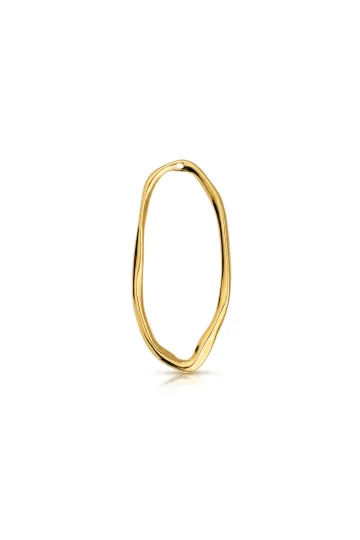
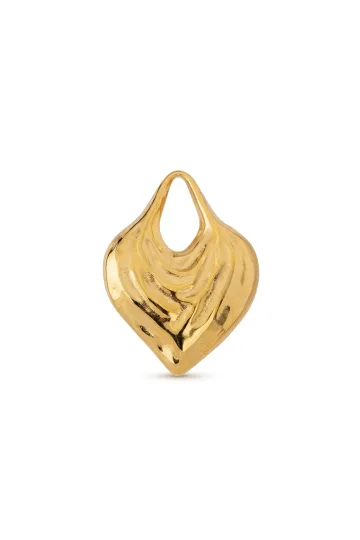
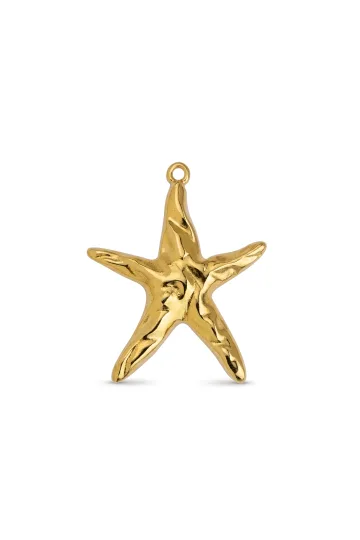
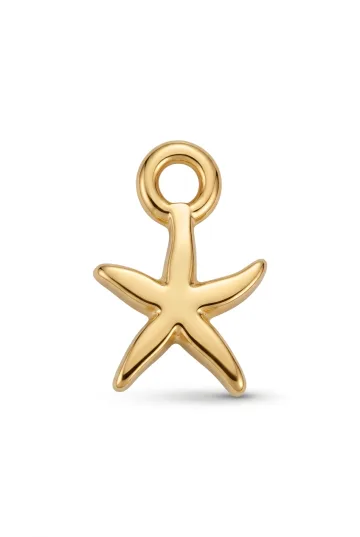
Wear the symbol, don't just read about it. These are in stock:
Standard Lengths: What the Numbers Mean
Chain length is measured end to end, including the clasp. When the chain is on your neck, half the length wraps around, and the rest hangs down the front. That hanging part determines where the pendant lands.
The formula is simple: (chain length, neck circumference) / 2 = drop depth.
Average women's neck circumference: 13-14 inches (34-36 cm). Men's: 16-17 inches (40-44 cm). Keep these numbers in mind. You will need them.
35-40 cm (14-16"): Choker
The chain wraps tightly around the neck. The pendant, if there is one, sits in the jugular notch, the hollow between the collarbones. On a women's neck (circumference 34 cm / 13.5") the drop is just 1-3 cm. On a man's neck, the chain may not even close.
How it looks. Think of a velvet ribbon with a pendant. Tight to the skin, no sag, no swinging. The pendant does not hang, it rests. That is the key difference between a choker and every other length: here the pendant is part of the neck, not a thing on the chest. For the more dramatic version of this register, the choker collar with lock carries an entirely different weight from the velvet-ribbon end of the spectrum.
Which pendants work on a choker. Only small and light ones. A nazar the size of a little fingernail: Mediterranean classic. A mini hamsa: Arab elegance. A thin cross. An initial letter. Anything under five grams.
Heavy pendants on a choker are a mistake. They pull the chain down, press on the throat, make you constantly adjust. A navaja on a choker lies horizontally instead of hanging vertically. It looks like an error, not a choice.
Necklines for chokers. Off-the-shoulder, deep V, boat neck, bandeau, spaghetti straps. Any neckline that bares the neck and upper chest. With a turtleneck, a buttoned-up shirt, a scarf, the choker hides and loses its point.
Who it suits. Women with long necks: the choker emphasises length. Women with short necks: careful, a choker visually shortens. Men: almost never (neck circumference too large, the choker digs in).
Chain type for chokers. Thin cable or snake chain. A thick chain on a choker becomes a collar. A 1-2 mm leather cord is the classic women's option. A velvet ribbon for evening.
42-45 cm (17-18"): Princess
The most universal length in jewellery. 90% of women's pendants are worn at this length. If there were a "default size" for chains, this would be it.
On a women's neck (circumference 34 cm) the pendant drops 4-5 cm below the jugular notch. That is the zone between the collarbones and the top of the chest. The pendant is visible in most necklines, does not hide, does not press, does not swing too much.
How it looks. In an unbuttoned shirt collar, the pendant peeks from behind the fabric. In a V-neck, it sits right at the centre of the V. In a crew neck, just below the edge. The distance from face to pendant is enough for the person opposite to notice the jewellery without staring at it immediately.
Here is a specific scene. You are sitting across from someone at a cafe table. You are wearing a shirt with the top button undone. A compass pendant on a 45 cm (18") chain: the person opposite sees a glint of metal, a golden disc, maybe makes out the compass rose. But the details, the arrows, the N-S-E-W letters, are only visible when you lean closer. That is the ideal distance: noticeable, but not in your face.
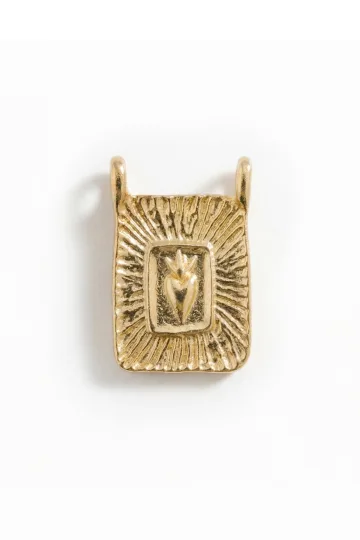
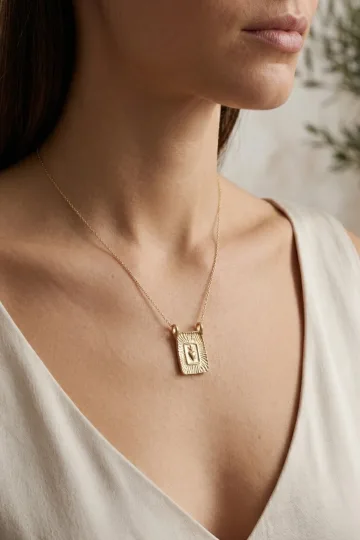
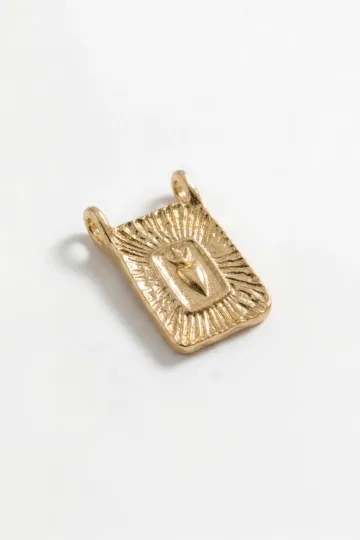
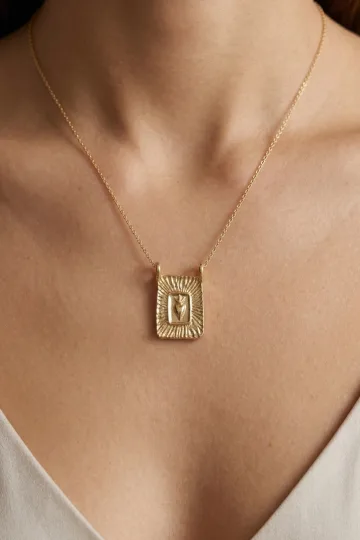
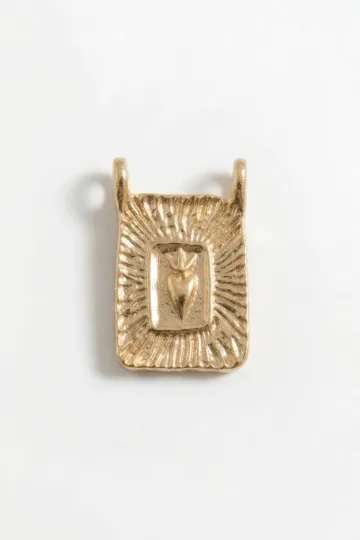
Which pendants. Practically any medium-sized one. Compass: perfect. Tree of life: classic medallion. Sacred heart: sits right between the collarbones. Bee in honeycomb: a detail that invites a closer look. Jerezana: clip point aimed downward, virolas catching light at the base.
Who. All women. Men with slim necks (circumference up to 38 cm / 15"). For men with 42+ cm circumference, this will be more of a choker.
Mistake at this length. An oversized pendant. If the pendant is bigger than 4 cm and heavy, on a 45 cm chain it rests on the collarbone instead of hanging free. Go up to 50 cm (20").
48-50 cm (19-20"): Extended Princess / Short Matinee
A transitional length. On women, a touch longer than the classic, the pendant hangs freer, there is room to swing. On men, this is the standard princess.
This is the universal men's length. If you are buying a pendant for a man and do not know the neck size, go with 50 cm (20"). It works in 80% of cases.
How it looks on a man. A punta de espada pendant on 50 cm on a male neck (circumference 42 cm): drops 4 cm below the collarbones. Under an open shirt you see the handle, the blade disappears behind the fabric. Restrained. Confident. No shouting.
A Tarot Sun and Moon ring on the ring finger + a Sun pendant on 50 cm: a set that does not clash visually. Ring below, pendant on the chest, 50 cm of distance between them.
For layering. 50 cm is the ideal second-layer length. First layer: 40-42 cm (something small near the throat), second: 50 cm (the main pendant). The 8-10 cm gap is enough to keep them from tangling.
52-55 cm (21-22"): Matinee
Pendant at the level of the upper third of the chest. Noticeably freer than princess. Swings when you walk. Catches attention in motion: a turn of the body, a lean forward, and the pendant swings out from behind the collar.
How it looks. You are walking down the street. An ouroboros pendant on 55 cm (22"): with each step it sways gently. The snake biting its own tail rotates in space. The sun catches the metal. This is no longer a quiet pendant by the collarbones. It is a moving element with a life of its own.
Which pendants. Large symbols that need space. All-seeing eye: the eye in the triangle should "look" forward, not lie flat against skin. Tarot cards: the oval shape hangs well at this length. Capaora on a thick chain or leather cord: workmanlike, rugged, no pretence.
Over clothing. 55 cm is the first length where you can wear a pendant over thin knitwear. A jumper, a long-sleeve tee, a thin turtleneck: the pendant rests on the fabric, does not hide.
Men's style. For men with a large build (neck circumference 44+ cm / 17"+) this is the normal working length. The pendant hangs freely, does not constrict, does not get in the face.
60-70 cm (24-28"): Opera
A long chain. Pendant at the level of the solar plexus or lower. This is not so much jewellery as a statement.
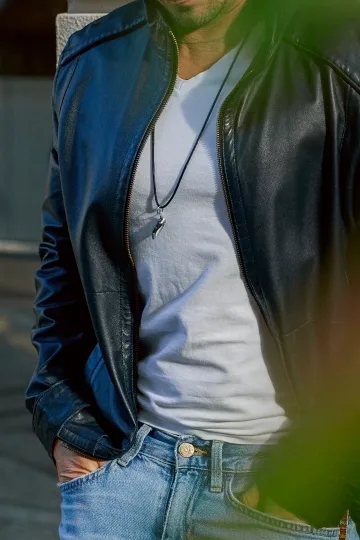
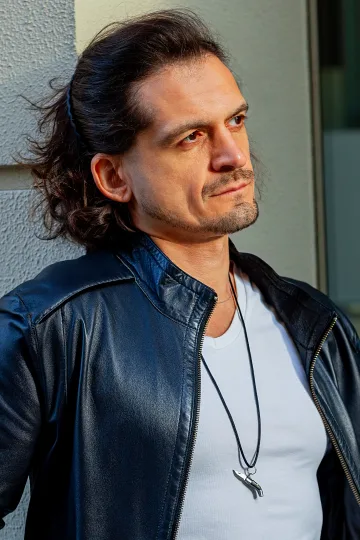
How it looks. Black T-shirt, leather jacket, and a machete on 65 cm (26"): hanging at the centre of the chest, swaying heavy and confident. That is streetwear. That is rock. That is "I do not follow rules."
Or: linen dress, a tan, and a long 70 cm (28") chain with a lotus: boho aesthetic. The pendant sits at the solar plexus, fully visible from chain at the neck to the pendant below.
Which pendants. Only large and heavy. On a long chain a small pendant gets lost like a button on a bedsheet. You need a visual anchor. A phoenix with spread wings. A skull memento mori. A dragon.
Be careful. At this length a light, flat pendant spins and flips to its back. Choose something three-dimensional, with weight, that holds its orientation.
Double wrap. A 70 cm chain can be wrapped twice: you get 35 cm, a choker. One chain, two styles. Works with thin chains without a pendant.
A pendant swinging at your navel has never flattered anyone. Match the length to the neckline, not to your mood, and don't argue.
How to Wear It: Length by Outfit
Over years on set I have hung the same pendant at a dozen lengths, and the rule is simple: you pick the length for the neckline and the occasion, not at random. Here is what actually works.
What length do you suggest under a shirt? For an open collar I recommend 45 cm for a woman's neck and 50 for a man's: the pendant peeks out of the neckline without tumbling free. If the shirt is buttoned up, I go for 50-55 cm so the piece sits under the fabric, quiet, just for you. A light shirt lifts the metal, a dark one turns the pendant into the accent.
And with an open neckline or a dress? Here I choose shorter, 40-45 cm, so the pendant works on bare skin near the collarbone. The shorter it sits, the more intimate the look reads. Under a deep V I suggest an elongated pendant right in the centre of the V: it continues the line instead of fighting it.
What about a jumper or turtleneck? Over thick knitwear I recommend 55-65 cm: the pendant should rest on the fabric, not sink beneath it. Under a turtleneck I choose a large, visible piece, since anything small gets lost in the weave. I would not suggest a thin chain here, the texture swallows it.
How do you build an evening look? For evening I choose smooth fabric in a deep colour and an open neckline, and with them a shorter chain carrying one expressive pendant. I save layering for the bold nights: three lengths with at least 5 cm between them, heavy at the bottom, light at the top.
And if it is a gift and I do not know the size? I suggest 45 cm for a woman and 50 for a man, and you will land it eight times out of ten. Safer still is a chain with an extender: 45 cm becomes a 45-50 range, and the wearer tunes the length to their own neckline.

Turn on your camera, pick earrings, a pendant or a ring, and see the piece on yourself in real time.
Switch items in one tap.
Everything runs in your browser: no photo or video is ever uploaded.
Length by Pendant Type: Specific Recommendations
Elongated Pendants (navajas, feathers, daggers, arrows)
Vertical shape. They hang "arrow-down." They need freedom for the vertical drop, otherwise they lie horizontally and lose their character.
- Women: 45 cm (18")
- Men: 50-55 cm (20-22")
A jerezana on 45 cm: clip point aimed at the heart, virolas catching light at the base. From arm's length you see the silhouette of a knife. Closer: the details, texture, the line of the blade.
A punta de espada on 50 cm: a straight silhouette like an exclamation mark on the chest. The diamond-shaped cross-section catches light on two facets.
A feather on 45 cm: light, floating with movement. On a longer chain it swings too much.
Round and Oval (compass, nazar, tree of life, medallion, coin)
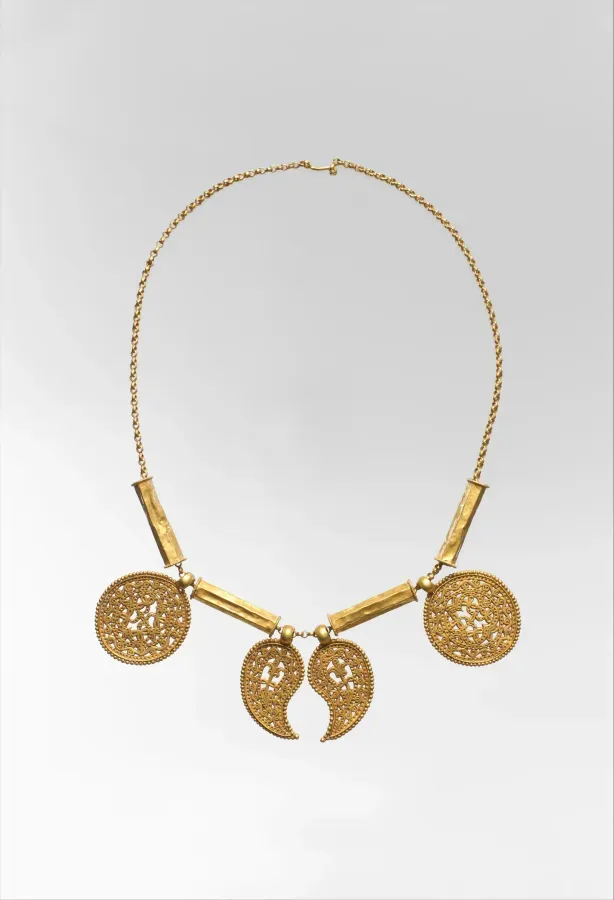
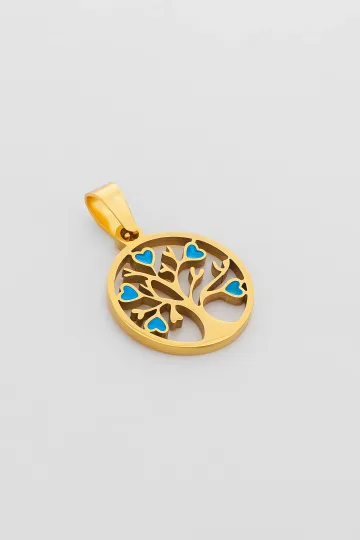
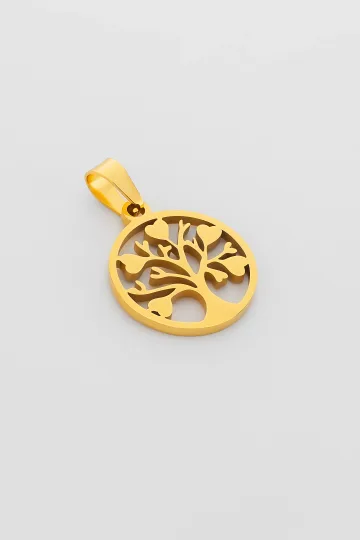
Compact, symmetrical shape. Works at any length from choker to opera. Choose by style, not by technical constraint.
A nazar on 40 cm (16"): Mediterranean choker, blue eye right at the throat. Southern European classic.
The same nazar on 50 cm (20"): more casual, free, tucked under a shirt. Different person, different look.
A compass on 45 cm (18"): the standard. On 55 cm (22"): over a thin jumper for autumn style.
Tarot Cards and Rectangular Charms
Flat shape. On long chains they spin and flip. Better at 45-50 cm (18-20"), where the pendant is pressed against the body and keeps its orientation.
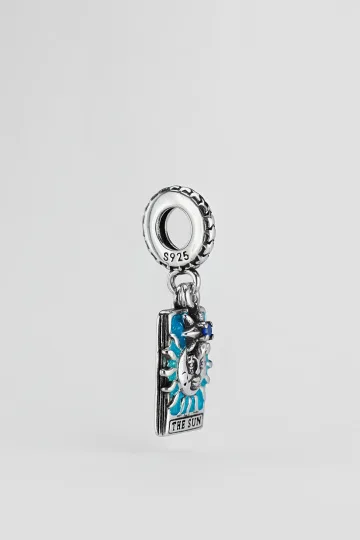
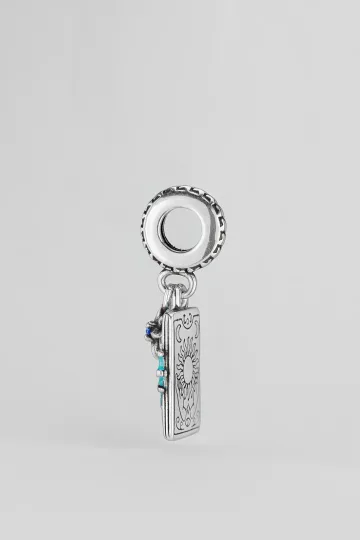
A Sun charm on 45 cm: golden tone, sun rays, lies flat.
A Lovers arcana on 48 cm: a paired pendant, shared between two, a mid-length that does not clash with clothing.
Drop Earrings + Pendant: How to Combine
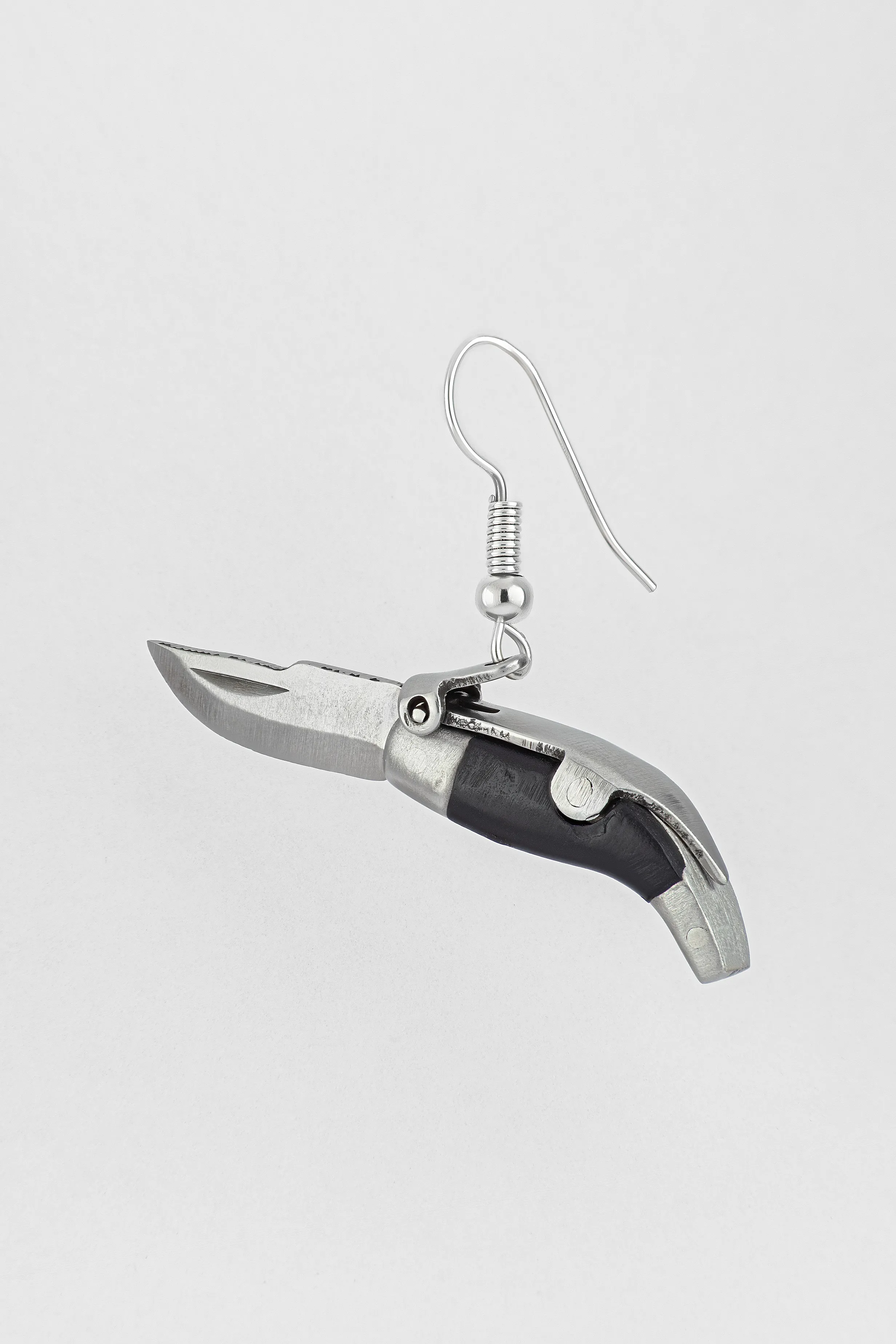
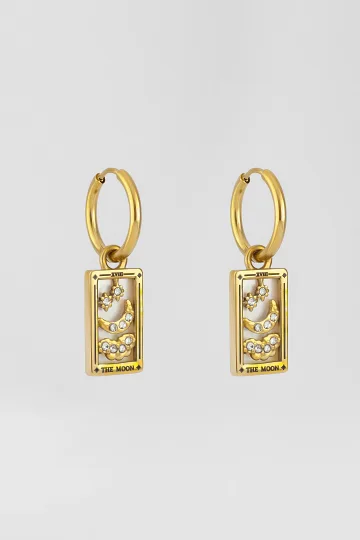
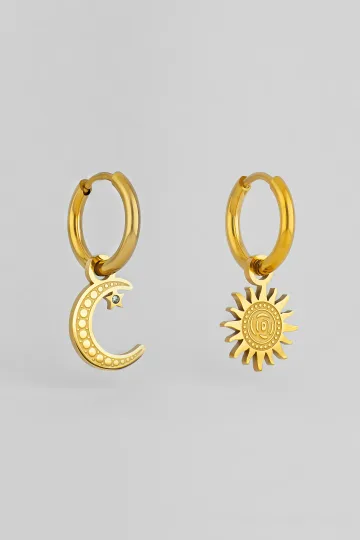
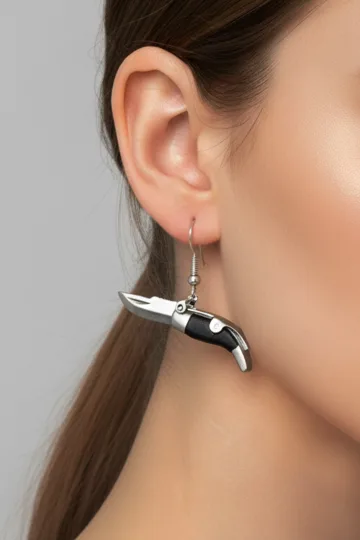
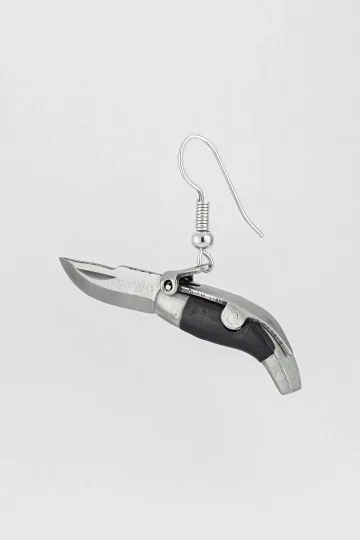
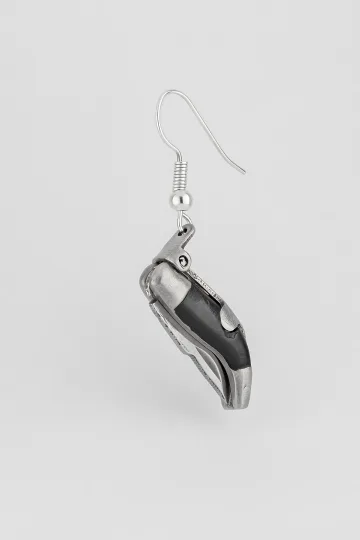
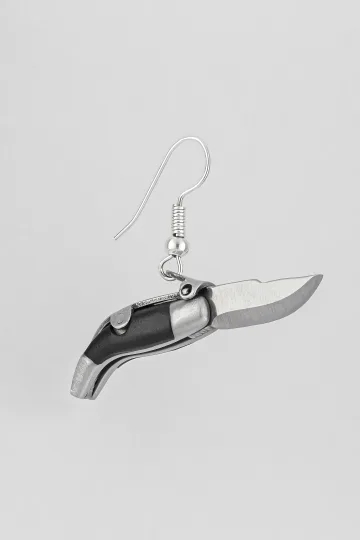
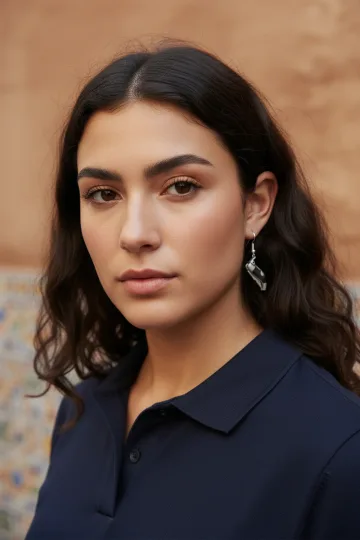
If you are wearing drop earrings (Tarot Sun and Moon earrings, a navaja earring, a labyrinth), the pendant should be at least 15 cm (6") below the earlobe. In practice that means: drop earrings = pendant on 48+ cm (19"+). Otherwise the earring and pendant merge into a visual mess at the same level.
The formula: the longer the earring, the longer the chain. Stud earring (0.5-1 cm): pendant on 42+ cm. Chandelier earring (4-5 cm): pendant on 50+ cm.
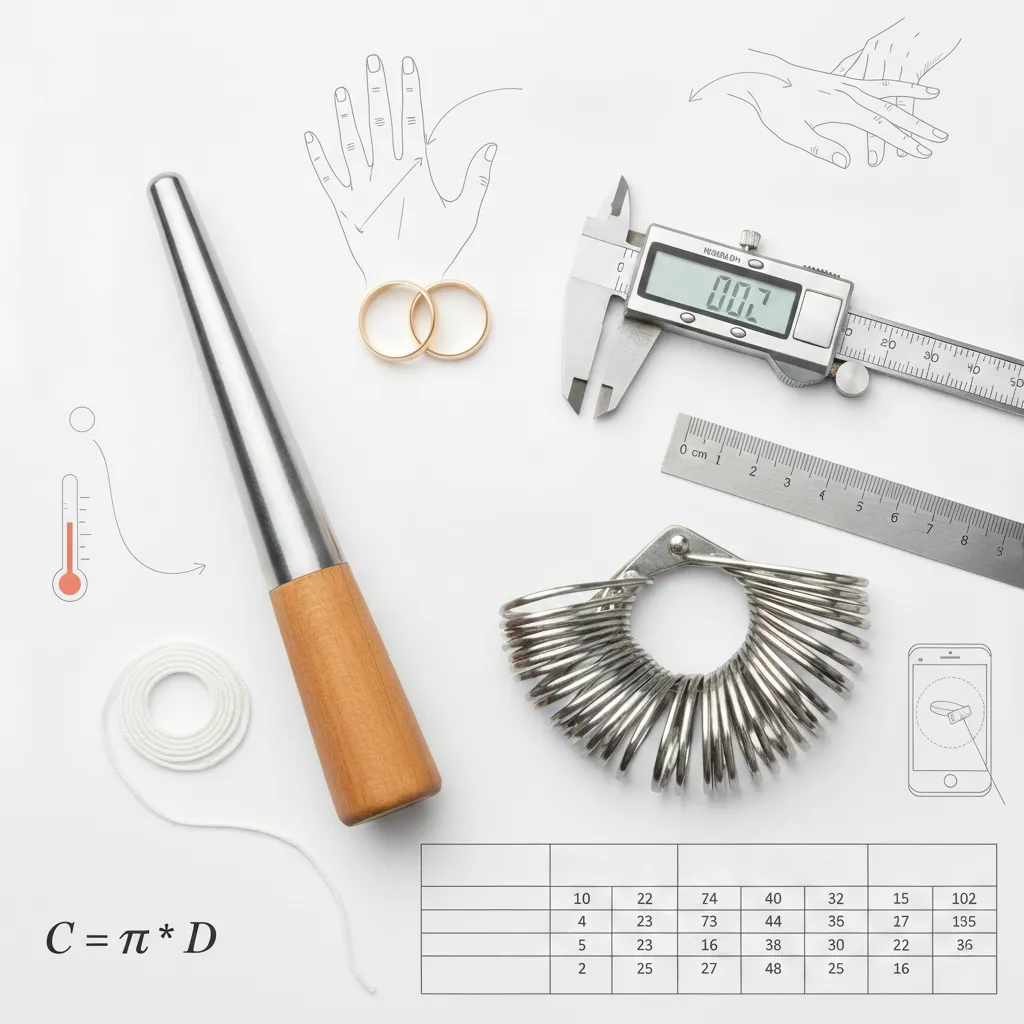
How to Measure: Four Methods
1. String
A shoelace, a ribbon, a phone charger cable, a dressing gown belt, anything flexible. Wrap it around your neck, lower the ends to the point where you want the pendant to sit. Mark it. Measure with a ruler or tape measure. Add 2 cm (3/4") for the clasp.
2. An Existing Piece of Jewellery
Got a chain whose length you like? Lay it flat on a table from clasp to clasp, without stretching. Measure it. That is your size. The most accurate method.
3. Your Hand
No tools needed. Your hand from wrist to the tip of the middle finger is roughly 7-8 inches (18-20 cm) for women, 8-9 inches (20-22 cm) for men.
- Two hand lengths: 14-16" / 36-40 cm (choker)
- Two and a half: 18-20" / 45-50 cm (princess)
- Three: 21-24" / 54-60 cm (matinee)
- Three and a half: 25-28" / 63-70 cm (opera)
A rough method, but sufficient for ordering online.
4. T-Shirt
Put on a T-shirt, stand in front of a mirror. Hold a ruler against yourself:
- Top edge of the T-shirt neckline = roughly 40 cm (16")
- 5 cm (2") below = 45 cm (18")
- 10 cm (4") below = 50 cm (20")
- Mid-chest = 55-60 cm (22-24")
Neck Circumference: Why It Matters So Much
The same chain sits differently on different people. 45 cm on a neck circumference of 32 cm drops 6.5 cm. On a circumference of 42 cm it drops 1.5 cm. The difference: a free-hanging pendant vs a choking choker.
Rule for men: add 5 cm (2") to the women's recommendation. Women's princess 45 cm = men's princess 50 cm. Women's matinee 55 = men's matinee 60.
Rule for a large build (men and women): add 3-5 cm (1-2") to the standard. A wide chest "eats" length on the sides.
Upload a photo of your pet, someone you love, or an object. We'll build a 3D model and hand-cast it in pewter.
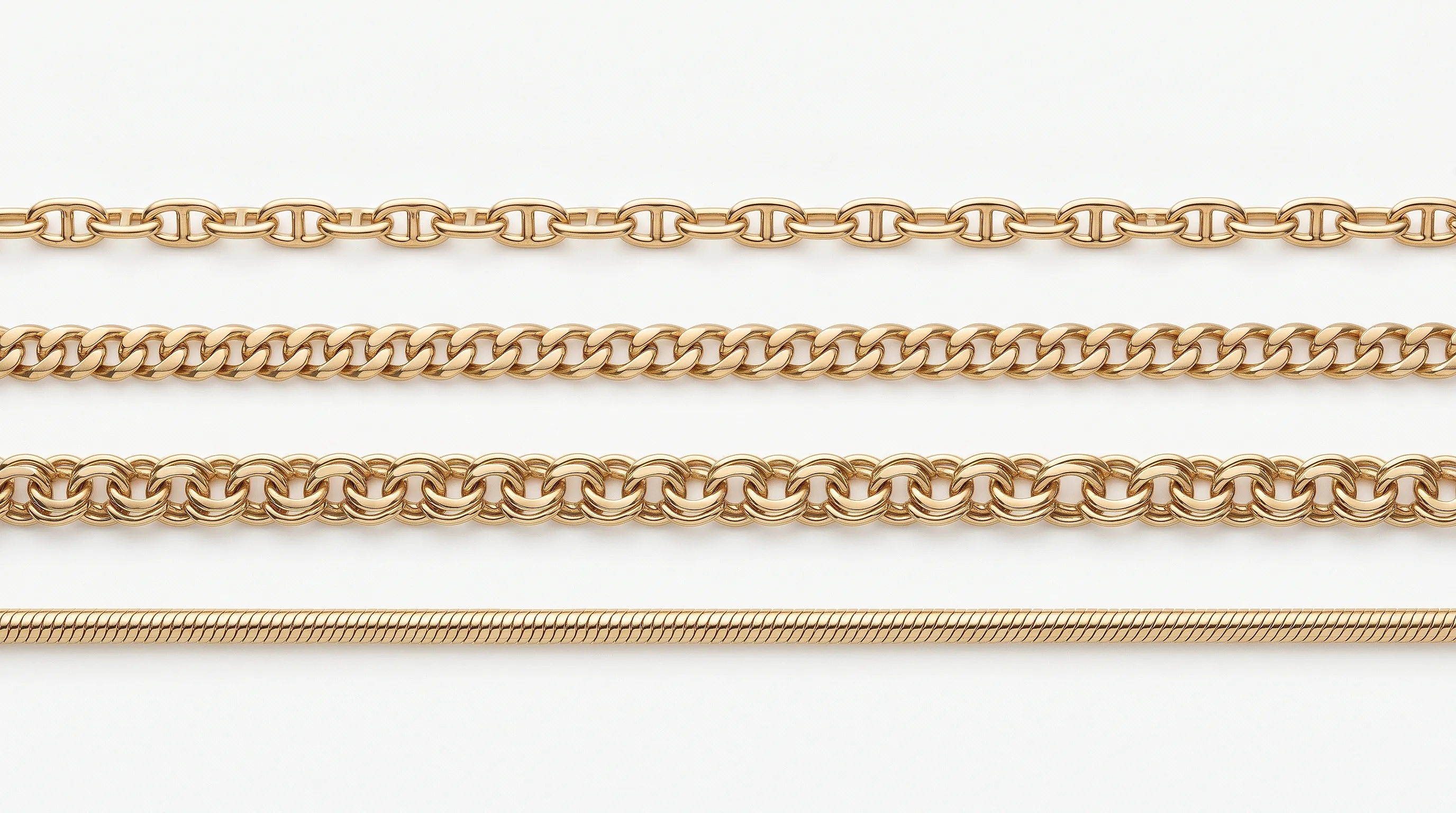
Chain Types: A Detailed Breakdown
The weave affects everything: how the chain lies, how it shines, how flexible it is, how quickly it tangles, whether it holds a heavy pendant. Choosing the weave is no less important than choosing the length.
Cable Chain (anchor)
Oval links alternating horizontal and vertical. The most common chain weave in the world. Simple, reliable, repairable: if a link breaks, a jeweller fixes it in a minute.
1-1.5 mm thickness. Delicate, feminine. For light pendants: a mini nazar, a letter, a small star. Nearly invisible on the neck: attention on the pendant, not the chain.
1.5-2.5 mm. The workhorse. For 80% of medium-sized pendants: compass, tree of life, jerezana, sacred heart. Visible but not dominant.
2.5-3.5 mm. Men's classic. For heavy pendants: navajas, all-seeing eye, Thor's hammer. The chain itself is noticeable, creating a "frame" for the pendant.
Effect on length. Cable chain is the most honest for length. 45 cm of cable = 45 cm on the neck. Does not eat length, does not stretch. What you ordered is what you get.
Curb Chain
Flat links turned into a single plane. Lies flat on skin, does not twist. Shines more than cable: more surface area for reflection.
Thin (1-2 mm). Elegant, feminine. A Curva Helada pendant on thin curb: two kinds of curves together.
Thick (3-5 mm). Hip-hop classic. Without a pendant it works as jewellery on its own. With a pendant, for large and heavy: machete, skull.
Effect on length. Curb chain hugs the neck tighter than cable. Visually sits 1-2 cm shorter at the same length. Keep in mind: curb 45 cm feels like cable 43.
Snake Chain
Smooth, round, no visible links. Looks like a solid metal tube. The pendant slides freely along its whole length.
For which pendants. Smooth shapes: lotus, moon phases, Curva Helada, medallions. The smoothness of the chain amplifies the organic feel of the pendant.
Downsides. Kinks when bent, and a kink cannot be fixed. Store it hanging on a hook, never coiled. If yanked it can snap, and links cannot be repaired; you replace the whole chain. Not ideal for an active lifestyle.
Effect on length. Snake chain is stiffer than other weaves. It does not conform to the neck but stands in an arc. A 45 cm snake sits slightly looser than 45 cm cable. Difference of 1-2 cm.
Rope / Byzantine
A complex weave of many small links braided into a thick cord. Heavy, substantial, shiny. A piece of jewellery in itself.
For which pendants. Only heavy ones: capaora, machete, large medallions. Or no pendant at all: rope chain is self-sufficient.
On whom. Men, large build. On a slim women's neck, rope chain looks like a collar. Exception: thin 2 mm rope, the women's version, elegant texture.
Effect on length. Rope is heavier than other weaves. 50 cm of rope "eats" 2-3 cm due to weight (sag). Visually sits at 52-53 cm. Get it 2 cm shorter than you think you need.
Figaro
Alternating pattern: 3 short links + 1 long. A rhythmic design. Mediterranean classic: Italians and Spaniards have worn figaro for centuries.
Character. Figaro is not a neutral chain. It has an "accent," like the Italian language. Suits pendants with a southern temperament: cornicello, nazar, hamsa, navajas, sacred heart.
With minimalist Scandinavian symbols (vegvisir, runes) figaro clashes stylistically. South and north do not go on the same chain.
Effect on length. Neutral. 45 = 45.
Singapore Chain
Flat links twisted in a spiral. Shines brighter than any other: in motion, each link catches light at a different angle. Looks more expensive than it is.
For which pendants. Dressy ones: Tarot cards, all-seeing eye, phoenix. Evening wear.
Downside. Tangles easier than others. Store separately, detangle gently: thin spiral links deform under rough handling.
Box Chain (Venetian)
Square links joined in a line. Geometric, strict, modern. Minimal shine, maximum structure.
For which pendants. Geometric and minimalist: punta de espada (straight lines + straight links), ouroboros, abstract shapes. For baroque pendants with flourishes, box chain clashes: a conflict of styles.
Effect on length. Box chain is stiffer than cable and curb. Holds its shape, does not conform. 45 cm of box chain feels like 46-47 cm of cable.
Customer reviews
Zevira is a real jewellery shop. Genuine payments, deliveries and customer thank-yous.
🥰🥰🥰 gracias
Ok, ¡gracias! 🙂
Length by Face Shape
A chain can visually correct facial proportions. Not magic, geometry. The vertical line of the chain + the horizontal accent of the pendant create a frame that changes perception.
Round Face
Elongate it. Longer chains (50-60 cm / 20-24") with elongated pendants: punta de espada, feather, vertical drops. The vertical "lengthens" visually. Avoid chokers and round medallions on short chains: they amplify roundness.
Oval Face
Lucky you. Nearly everything works. Any length, any pendant shape. Only caveat: very long chains (60+ cm / 24"+) on a petite oval face can "drag" downward. Stay in the 42-55 cm (17-22") range.
Heart-Shaped (Triangular) Face
Wide forehead, narrow chin. Chokers (35-40 cm / 14-16") visually widen the lower half and balance. Round pendants (compass, nazar, tree of life) soften the angles. Avoid long, pointed pendants: they emphasise the chin's "arrow."
Square / Rectangular Face
Strong jaw, defined angles. Round pendants on medium chains (45-50 cm / 18-20") soften the geometry. Ouroboros, Curva Helada (smooth curve), round medallions. Avoid square and strictly geometric pendants: square + square = too much.
Long Face
Shorten it visually. Chokers (35-40 cm / 14-16") and short chains with horizontal accents. Wide pendants: capaora (wide silhouette), horizontal hamsa. Avoid long chains with vertical pendants: they elongate further.
Length by Height and Build
Petite (under 5'3" / 160 cm)
Shorter is better. 40-45 cm (16-18"). Long chains on a small frame "drown" the pendant, which ends up at navel level. Small to medium pendants only. A large machete on 60 cm on a petite woman looks like body armour.
Medium Height (5'3"-5'9" / 160-175 cm)
The full range. 42-55 cm (17-22"), any pendant. The sweet spot in every sense.
Tall (5'9"+ / 175+ cm)
Longer is better. 50-65 cm (20-26"). A short choker on a long neck looks like a rope. Medium to large pendants: small ones get lost on a tall frame.
Full Build
Long chains (50-60 cm / 20-24") visually elongate the torso. The vertical line from neck to mid-chest slims. A V-neckline + 50 cm chain + vertical pendant = the classic trick. Avoid chokers: on a full neck they dig in and shorten visually.
Large Bust
Be careful with long chains: the pendant lands on the bust and "disappears" into fabric. Either go short (42-45 cm / 17-18", pendant above the bust) or very long (60+ cm / 24"+, pendant below). Medium lengths (50-55 cm / 20-22") create an awkward situation where the pendant presses against the chest.



Length by Neckline: Chart
| Neckline | Recommended Length | Why | Pendants |
|---|---|---|---|
| Deep V-neck | 45-50 cm (18-20") | Pendant at the V point, reinforces the line | Elongated: navajas, feather |
| Shallow V-neck | 42-45 cm (17-18") | Just above the neckline edge | Any medium |
| Crew neck | 48-55 cm (19-22") | Below the edge, not competing | Round: compass, nazar |
| Boat neck | 50-55 cm or 35-38 cm choker | Either below the line or above | Depends on length |
| Turtleneck | 55-65 cm (22-26"), over it | Pendant on fabric | Large, visible |
| Square neck | 45-48 cm (18-19") | Echoes the square line | Geometric |
| Strapless / bandeau | 35-42 cm (14-17") | Accent on bare skin | Delicate, small |
| Open shirt | 45-50 cm (18-20") | Pendant peeks from collar | Symbolic: navajas, Tarot |
| Buttoned-up shirt | 50-55 cm (20-22") under fabric | Personal, invisible | Anything with a story |
| Deep decolletage | 42-45 cm (17-18") | Draws the eye to the zone | Heart, lotus, star |
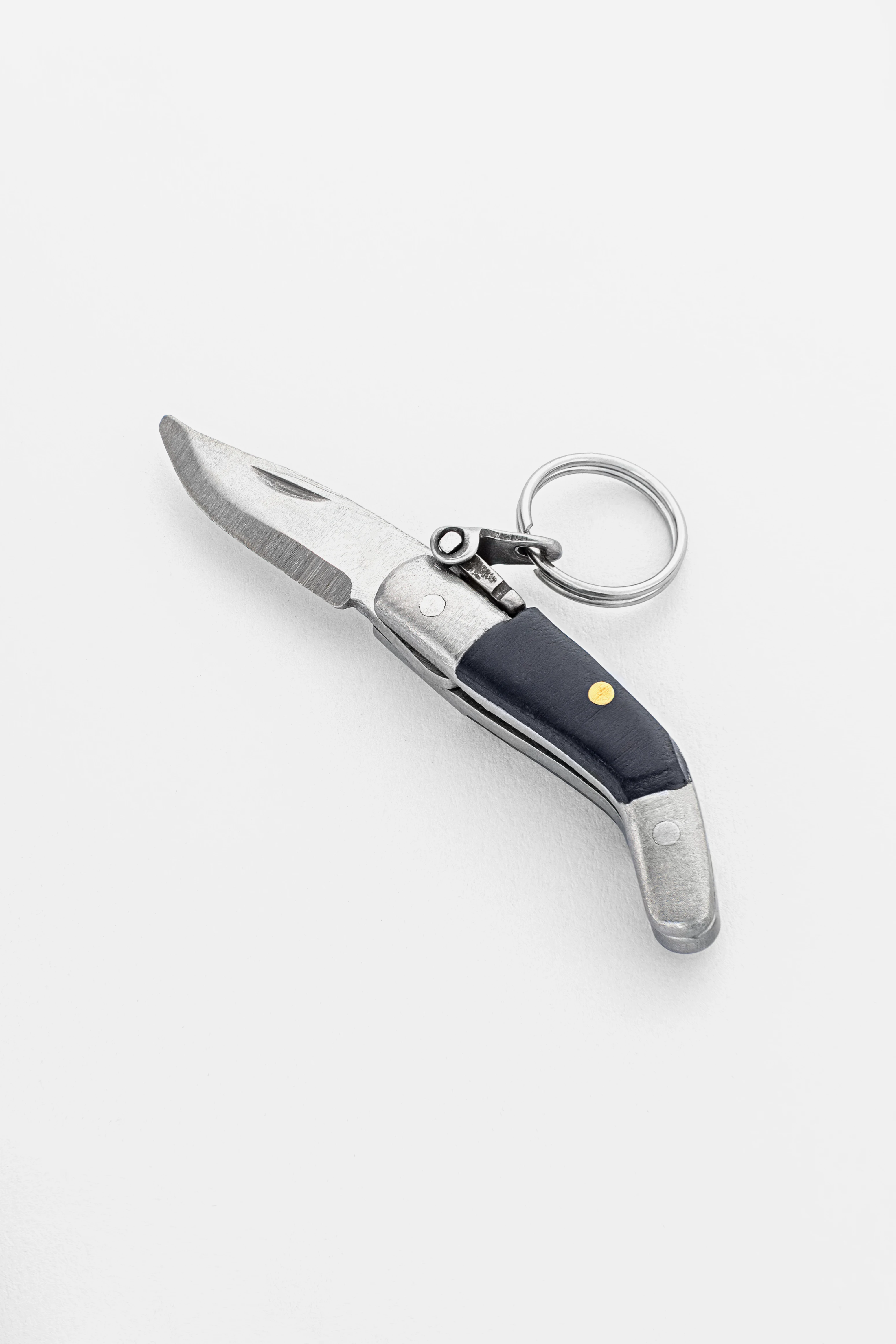
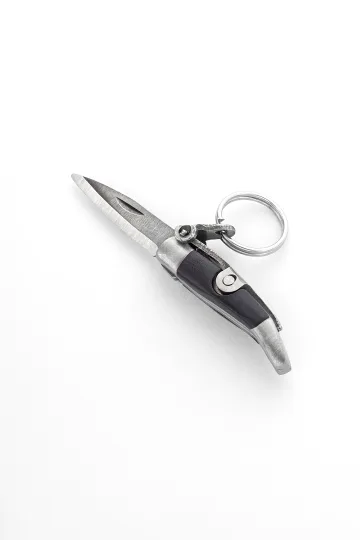
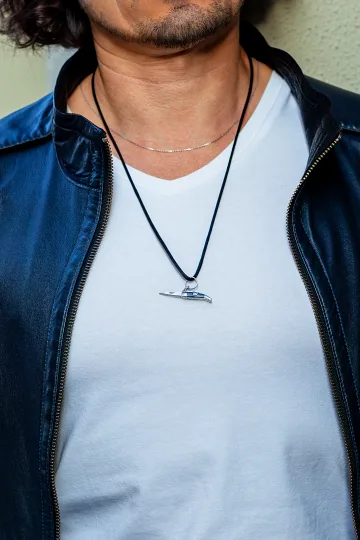
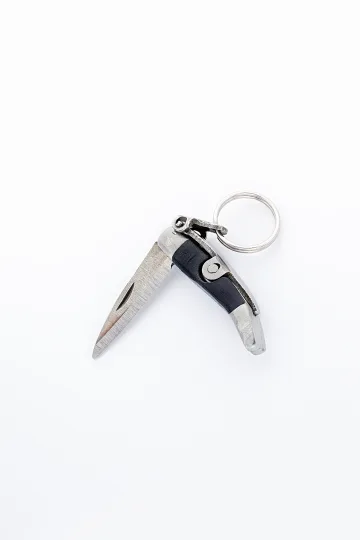
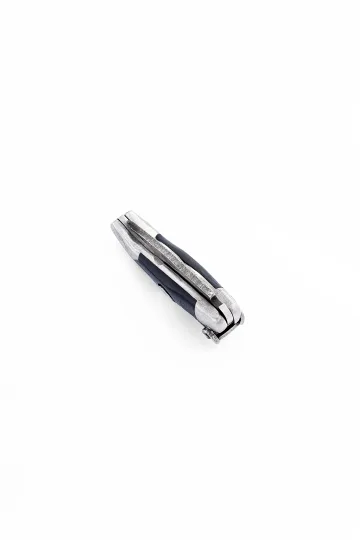
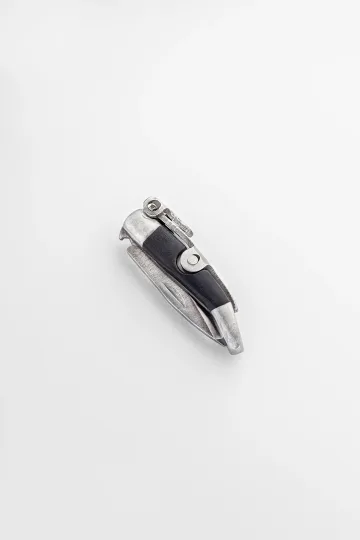
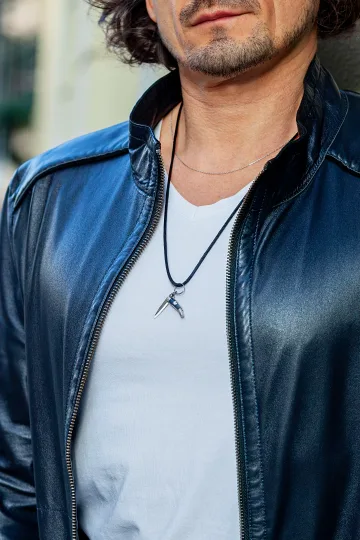
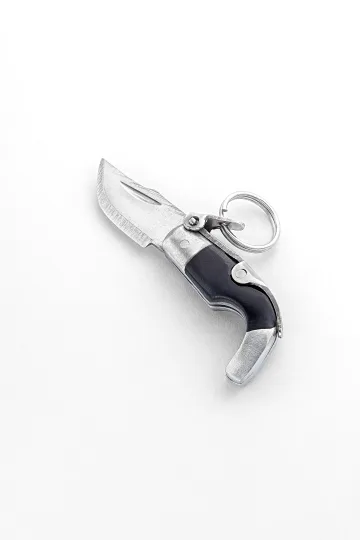
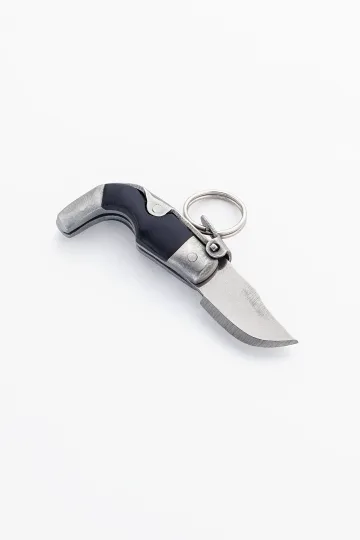
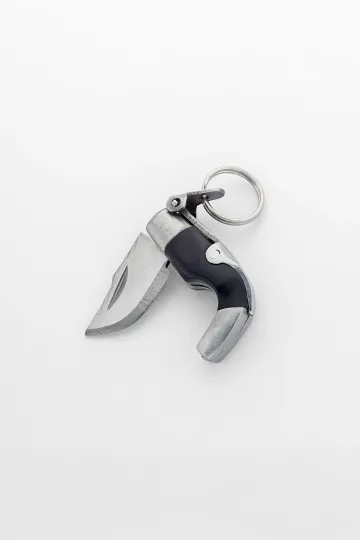
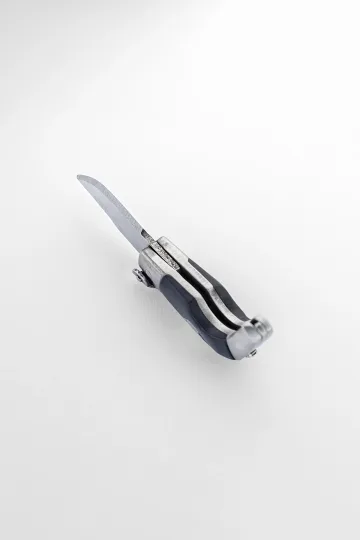
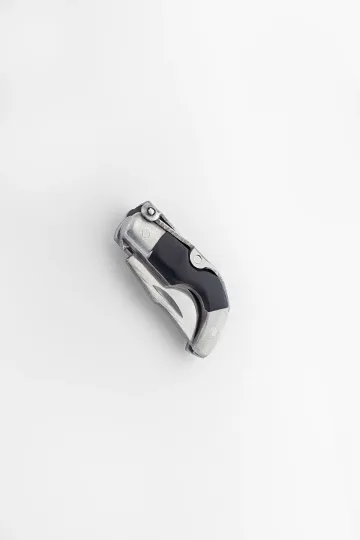
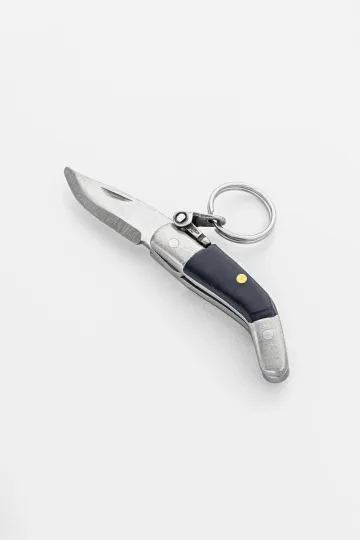
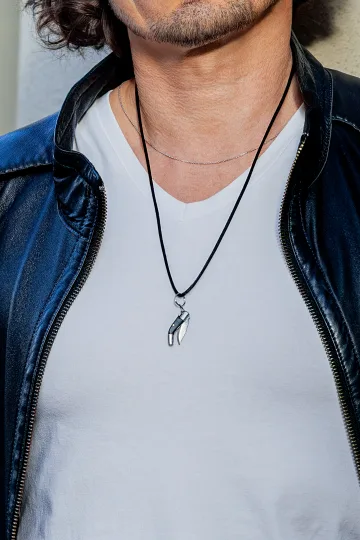
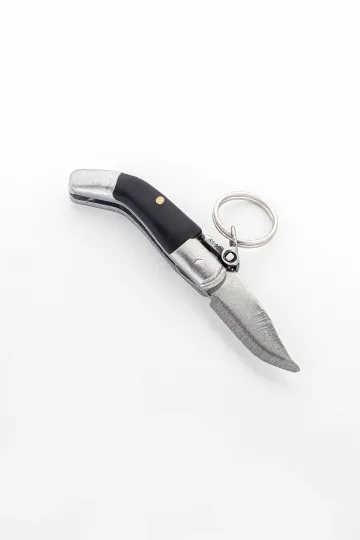
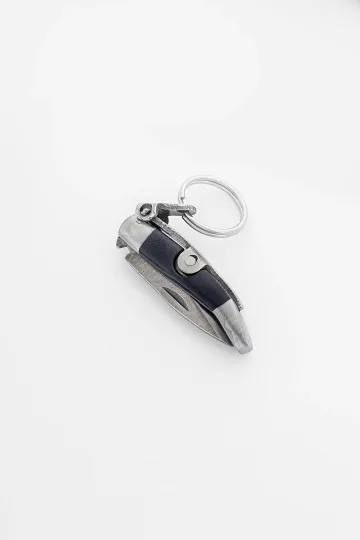
CAPAORA mini knife pendant
The 18th-century Spanish navaja in miniature: 40 mm of stainless steel, a real folding mechanism and a Palanquilla lock that clicks. An affordable gift to remember.
Authentic · Ships from Spain · 14-day returns
Pendant Weight to Chain Thickness: Specifics
Not all chains can hold all pendants. A thin chain under a heavy pendant sags, deforms, breaks. A thick chain with a light pendant: the chain dominates.
| Pendant Weight | Chain Thickness | Example Pendants |
|---|---|---|
| Under 3 g | 0.8-1.2 mm | Mini nazar, letter, mini star |
| 3-7 g | 1.2-2 mm | Compass, jerezana, bee, cross |
| 7-12 g | 2-2.5 mm | Tree of life, Tarot, navajas |
| 12-18 g | 2.5-3 mm | Capaora, machete, large medallions |
| 18+ g | 3+ mm or rope | Very large, heavy |
Easy test: hang the pendant on the chain, lift by the clasp. If the chain holds a straight line, it is fine. If it sags in an arc, it is too thin.
The Pendant Bail: A Forgotten Detail
The bail is the loop or ring on the pendant through which the chain passes. And here is what nobody mentions: if the bail is small, a thick chain simply will not fit through.
3 mm bail (small): chain max 1.5 mm. Thin cable, snake.
5 mm bail (medium): chain up to 2.5 mm. Most standard chains.
7+ mm bail (large): any chain. Rope, thick curb.
A jump ring instead of a bail is more versatile. A 5 mm ring accommodates almost any chain because the chain does not thread through; it clips on with a lobster clasp.
Before buying a chain, check: what bail does your pendant have? If it is a small closed loop, get a thin chain. If it is a ring, get whatever you want.
Chain as a Tool: Choosing by Purpose
A chain is not decoration. It is a tool that solves a specific problem. Like shoes: trainers for running, oxfords for meetings, plimsolls for the weekend. Nobody asks "which is better, trainers or oxfords?" The question is always "what for?"
You Are an Athlete, Active Lifestyle
Problem: the pendant has to survive workouts, running, the pool, sweat, showers. Must not snag, jingle, or irritate wet skin.
Solution: a 2-3 mm black rubber (silicone) cord. Silicone does not react to water, sweat, or chlorine. Does not stretch (unlike leather). Does not jingle when you move. Fully hypoallergenic: zero metal touching skin, zero nickel, zero reactions.
Length: 42-45 cm (17-18"), snug to the body. The pendant must not swing during sudden movements. A compass on rubber: traveller, runner, person in motion. A nazar on rubber: an amulet that goes with you to the gym and on the morning run.
Clasp: lobster claw in stainless steel. The only metal part, and it is small and on the back of the neck, with minimal skin contact.
Lifespan: 2-3 years, then the rubber may crack. Costs almost nothing, replacing it takes a minute.
You Are in Business, Jewellery Is Part of Your Language
Problem: the pendant as a status signal. Partners, clients, colleagues see it and read: taste, attention to detail, cultural level. The chain must not look cheap. Must not shout. Should work at the level of "noticed, appreciated, not commented on."
Solution: a thin cable or box chain in stainless steel or with a coating. 1.5-2 mm thickness. Nothing thick, nothing flashy. The chain serves the pendant, not the other way round.
Length: 48-55 cm (19-22"), under the shirt. The pendant is invisible with the collar buttoned. Visible with the top button undone: at lunch, at networking, after work. The person opposite notices a punta de espada or a compass and reads: this person makes deliberate choices.
Material: 316L stainless steel (cool tone, surgical quality) or brass with PVD coating (warm golden tone). Both resist tarnish, do not turn green, and do not pretend to be something they are not.
What NOT to do: thick rope (reads "1990s"), leather cord (reads "weekend"), flashy Singapore (reads "party").
You Are a Woman and Want to Emphasise Femininity
Problem: the jewellery draws the eye to the decolletage, underlines the neck, creates a focal point. The chain must not be rough or bulky.
Solution: snake or thin curb. Snake is smooth, no visible links, flows around the neck like water. Thin curb is flat, shines softly. Both types underline rather than dominate.
Length: 42-45 cm (17-18"). Princess. Pendant in the decolletage zone, in the neckline of a dress or blouse. Sacred heart: passion. Lotus: refinement. Curva Helada: the curve of the knife echoes the curve of the collarbone.
Date layering: 40 cm choker (thin, no pendant) + 45 cm with pendant. Two layers create depth. The eye follows from the throat to the pendant. Simple physics of attention.
Material: stainless steel snake (silver tone for an evening dress) or brass with coating (golden tone for warmth). Figaro if you want Mediterranean energy: Italian and Spanish women have worn figaro for centuries.
You Are a Self-Assured Person, Jewellery Is for Yourself
Problem: not to impress, not to attract attention, not to "show." You wear the pendant for yourself. It means something personal. The chain should be reliable, comfortable, and not get boring after a month.
Solution: medium-thickness cable chain (2-2.5 mm) in stainless steel. The most neutral option. Does not attract attention, does not irritate, does not break. Put it on and forget about it for years.
Length: 50 cm (20"). Not short, not long. Pendant under clothes most of the time. You know it is there. Others do not need to.
Pendants for this context: ouroboros (personal cycle), tree of life (family), navaja (roots), all-seeing eye (awareness). Things with depth that do not need explaining.
Material: stainless steel or rhodium-plated 925 silver. Both last decades. Stainless steel needs zero maintenance. Silver needs polishing every couple of months, but has a warmer tone.
You Are a Teenager / Young Person, First Piece of Jewellery
Problem: try it out. Do not spend much. Find your style. Do not worry about losing it.
Solution: a waxed cotton or textile cord. Costs practically nothing. You can tie it to any length without a clasp. Easy to replace. If you lose it at a party, it is not a tragedy.
Length: 45-50 cm (18-20"). Tie a knot at the height you want, cut the excess.
Pendants for a first experience: something with a story you can tell. A navaja: "It is a Spanish knife, 500 years of tradition." A nazar: "Turkish amulet against the evil eye, 5,000 years old." Your first pendant stays with you forever. Let it have a story behind it.
Later: once you know what you like, upgrade to a metal chain. The cord is the training ground.
You Are a Guitarist / Musician / Creative
Problem: jewellery as part of a stage or daily look. It needs to be visible, moving, catching stage lights.
Solution: figaro or Singapore chain, medium thickness (2-3 mm). Both types catch light in motion: figaro rhythmically (long link, short ones, long), Singapore continuously (spiral links). Under spotlights, guaranteed effect.
Length: 55-60 cm (22-24"). Pendant hangs free, swings with movement. While playing guitar it does not catch the neck (under 50 cm it catches).
A leather cord also works: rough, rock-and-roll. The look that rock musicians and stage performers have favoured for decades. Leather + metal on the neck.
Pendants: skull, navaja, raven, phoenix. Symbols with character, not cute trinkets.
You Have a Metal Allergy
Problem: wearing a pendant without itching, redness, rashes on the neck. Contact dermatitis from nickel affects 10-15% of people.
Solutions in order of priority:
Rubber cord (silicone). Zero metal on the neck. The pendant in a safe alloy (316L steel) hangs lower, skin contact is minimal. The safest option for serious allergy sufferers.
316L stainless steel. Surgical alloy. Contains no free nickel. They make implants from it that sit inside the body for years. If stainless steel triggers a reaction, you are in the 0.1% allergic to chromium, and you need titanium.
Titanium. Completely inert. Used in implants for people allergic to everything else. More expensive than stainless steel, but absolutely safe.
Rhodium-plated 925 silver. Rhodium creates a barrier between skin and the copper in the silver alloy. While the coating holds, no reaction. When the rhodium wears off (after 1-2 years of daily wear), re-plating is needed.
Waxed cotton cord. Zero metal, zero chemicals (if the cotton is natural, no synthetic coating). For light pendants only.
Avoid: uncoated brass (copper), costume jewellery alloy (nickel), cheap leather (chromium in tanning).
Test before buying. Tape a plaster to the inside of your wrist, place a chain link under the plaster, wait 48 hours. Redness = reaction. Clear = safe. Better to spend two days testing than a week treating dermatitis.
Safety: When a Shiny Chain Is a Bad Idea
There are situations where a golden chain on your neck is not a style choice but a target. Jewellery blogs do not talk about this, but it is reality, and if you travel, you should know.
Countries and Situations Where You Should Not Shine
Brazil. Rio de Janeiro, Sao Paulo, Salvador. Chain-snatching from necks ("arrastao") is a common type of street robbery. Police regularly warn tourists: do not wear visible jewellery. In favelas and even on the beaches of Copacabana and Ipanema, a golden chain attracts the kind of attention you do not want.
Colombia. Bogota, Medellin, Cali. Same situation as Brazil. "Haladores" are robbers who literally yank chains while running past. Locals know: anything shiny on the neck = an invitation.
India. Mumbai, Delhi, tourist areas. "Chain snatching" is so common it has its own category in police statistics. Gold chains are ripped off from motorcycles in motion.
South Africa. Johannesburg, Cape Town. Jewellery is one of the first things demanded during a robbery. Local residents do not wear visible gold on the street.
Naples, Italy. Yes, Europe too. Naples is known for "scippi," snatching chains from motorcycles. Less dangerous than Brazil, but enough for tourist guides to issue warnings.
Morocco, Egypt, Turkey (markets). Not so much robbery as relentless attention. Visible gold in a bazaar = traders will follow you. Not dangerous, but exhausting.
Central America (Guatemala, Honduras, El Salvador). High street crime. Visible jewellery is a risk factor.
Solution: A Cord Instead of a Chain
You are headed to Rio. Or Mumbai. Or just a neighbourhood you do not know. Grandmother's cross, the nazar you have worn since day one, the navaja from Albacete that has become part of you: you do not want to take it off.
Swap the chain for a black rubber or textile cord. Same pendant. But:
- The cord does not shine. Does not catch sunlight. Does not scream "I have metal on my neck."
- A black cord visually blends with skin and clothing. From 2 metres away the pendant is visible, the cord is not.
- If someone grabs it, the cord snaps, the pendant falls at your feet, and does not ride away on a motorcycle with your neck. A stainless steel chain will not snap on a yank; your skin will tear instead.
This is not paranoia. It is the same logic that makes you leave expensive watches at home in risky areas. The pendant stays with you. The risk disappears.
Safe Clasp
Another detail: the clasp in an unsafe area. A magnetic clasp opens on a yank, the chain comes off whole, the thief runs away with chain and pendant. A lobster clasp does not open on a yank, but a link breaks. The pendant may fall.
For travel to such places: a screw clasp on a cord. Does not open on a yank. The cord breaks before the clasp does. The pendant falls at your feet. You pick it up and keep walking.
Children and Teenagers
For children, a metal chain is a risk in any country. A child runs, climbs, plays. The chain catches on a branch, on swings, on another child. Does not break. Chokes.
A textile or cotton cord breaks at 3-5 kg of force. The child snags it, the cord snaps, the pendant falls, the child is fine. That is not penny-pinching. That is safety.
Leave your email, we'll send your discount code. No spam, unsubscribe anytime.
The code arrives by email, valid on your first order.
Comparison Chart: Chain vs Cord
| Criterion | Metal Chain | Leather Cord | Rubber | Cotton |
|---|---|---|---|---|
| Durability | Years to decades | 6-12 months | 2-3 years | 3-6 months |
| Water resistance | Yes (steel) | No | Yes | No |
| Allergenicity | Depends on alloy | Low | Zero (silicone) | Zero |
| Weight | Medium-heavy | Light | Light | Very light |
| For heavy pendants | Yes | Medium | Medium | Light only |
| Layering | Excellent | Poor | Poor | No |
| Formal style | Yes | No | No | No |
| Sport | Moderate (jingles) | No (gets wet) | Excellent | No (gets wet) |
| Price | Medium | Low | Low | Minimal |
| Replacement | Not needed | Every 6-12 mo | Every 2-3 yrs | Every 3-6 mo |
Layering: Multiple Chains at Once
The Main Rule
Minimum 5 cm (2") between layers. Without that gap, chains tangle, lie in a heap, links hook into each other. 5 cm is the distance between your index finger and pinky when spread apart.
Two Layers: Simple Combination
"Traveller" combo:
"Spanish character" combo:
- 45 cm: sacred heart (passion)
- 55 cm: jerezana (Andalusia)
"Mystical" combo:
- 42 cm (17"): all-seeing eye (awareness)
- 52 cm (20.5"): ouroboros (eternity)
"Nordic" combo:
- 45 cm: vegvisir (navigation)
- 55 cm: Thor's hammer (strength)
Three Layers: The Daily Maximum
- 40-42 cm (16-17"): small symbol near the throat (mini nazar, tiny star, dot)
- 48-50 cm (19-20"): main pendant (compass, navaja, Tarot, tree of life)
- 55-58 cm (22-23"): background chain (thin, no pendant, or with a minimal charm)
Weight rule: heavy at the bottom, light at the top. A heavy pendant on a short chain drags the rest down.
Four+ Layers
Possible but risky. More than three chains tangle, jingle, get in the way. If you want the maximum, use chains of different types (one cable, one snake, one leather). They catch on each other less.
Earrings + Pendant: The 15 cm Rule
If you are wearing drop earrings, the pendant should be at least 15 cm (6") below the earlobe. The longer the earring, the longer the chain:
- Stud earring (0.5-1 cm): pendant on 42+ cm (17"+)
- Medium earring (2-3 cm): pendant on 45+ cm (18"+)
- Chandelier earring (4-5 cm): pendant on 50+ cm (20"+)
- Navaja earring (unfolds, 3-4 cm): pendant on 48+ cm (19"+)
As a Gift: When You Do Not Know the Size
For a woman: 45 cm (18"). You will hit the mark 80% of the time.
For a man: 50 cm (20"). The universal choice.
If in doubt: 5 cm (2") longer than you think is needed. Shortening (removing a link) takes a jeweller a minute. Lengthening requires an extra piece.
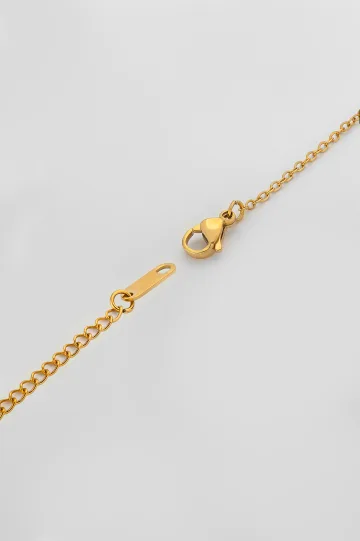
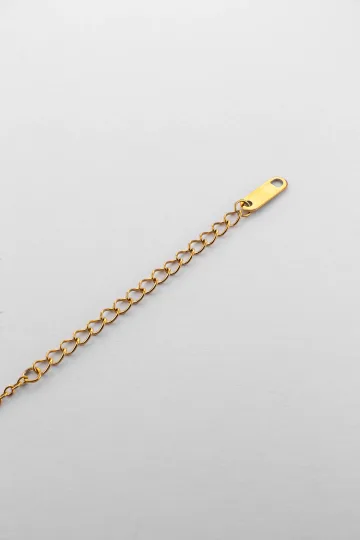
An adjustable chain solves the problem entirely. A chain with a 5 cm (2") extender lets you vary the length. A 45 cm chain becomes a 45-50 cm range. If that option exists, take it.
A chain costs less than a bouquet of flowers. The bouquet wilts in a week. The chain will define how the pendant looks for years.
Buying it as a gift? Each one arrives ready to give.
 A branded Zevira box and a little card come with every order.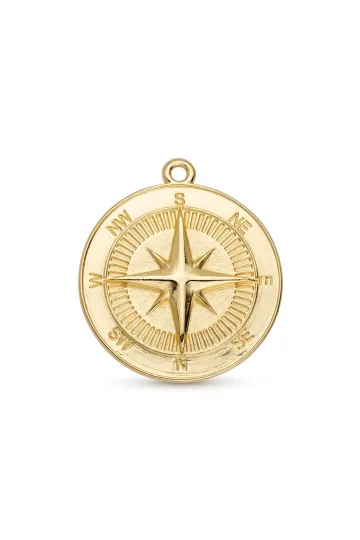



Reference Chart: Full Guide
| Length | Name | Women | Men | Necklines | Pendants |
|---|---|---|---|---|---|
| 35-40 cm (14-16") | Choker | Slim neck | No | Open | Nazar, mini hamsa, letter |
| 42-45 cm (17-18") | Princess | Universal | Slim neck | V, crew, shirt | Compass, tree, heart, jerezana |
| 48-50 cm (19-20") | Princess+ | Layering | Universal | Any | All navajas, Tarot, bee |
| 52-55 cm (21-22") | Matinee | Over jumper | Classic | Turtleneck, jumper | Eye, ouroboros, capaora, Tarot |
| 58-60 cm (23-24") | Long | Boho, statement | Streetwear | Over clothing | Machete, phoenix, large |
| 65-70 cm (26-28") | Opera | Double wrap | Rock, over jacket | Over everything | The largest |
Wear the symbol, don't just read about it. These are in stock:


Chain Length Myths
"Men cannot wear short chains." They can. Many male pop and film stars now wear short chains at 42-45 cm (17-18"). There are no gendered rules for length.
"The more expensive the pendant, the longer the chain." No connection. An expensive pendant on a choker can look better than on a long chain. Length is determined by style, not price.
"A silver chain only with a silver pendant." Mixing tones is a trend that will not leave. A gold-toned pendant on a silver chain creates contrast that draws the eye. No rules.
"Thick chain = men's, thin = women's." Outdated. A thin chain on a man with a navaja looks elegant. A thick chain on a woman with a capaora looks powerful. You determine the style, not your gender.
"One pendant per chain." Two small pendants on one chain is normal practice. A nazar + a hamsa on a single 45 cm chain: a Mediterranean duo. Just make sure the combined weight does not pull the chain.
"The chain should be invisible." The chain is part of the jewellery, not a support beam for the pendant. A beautiful figaro chain draws the eye on its own. Sometimes a chain without a pendant is the best choice.
Clasp Types: What Does Not Annoy
The clasp is the thing nobody thinks about when buying and curses every morning. A bad clasp turns putting on a chain into torture. A good one is a one-handed motion.
Lobster Claw
The most common. A spring-loaded claw that clicks onto a ring. Reliable, easy to fasten with one hand. Suits any chain. Only downside: if the lobster is too small (under 8 mm), it is hard to open with fingernails.
For Zevira pendants: a standard 10-12 mm lobster. Does not interfere, does not dominate, works.
Spring Ring
A small ring with a spring mechanism. Less reliable than a lobster, harder to fasten one-handed. Suits thin, light chains. For heavy pendants, no: the spring can bend open.
Toggle
A bar that threads through a ring. Looks beautiful, easy to fasten. But: can open on its own during movement, especially on long chains. Risky for valuable pendants.
Magnetic
Most convenient of all: just bring the ends together. But: opens from strong movement, from contact with metal surfaces, from a heavy pendant. For light chains without a pendant, excellent. For a navaja pendant, no.
Barrel Screw
Two cylinders that screw into each other. The most reliable: will not open accidentally. But: slow to fasten, needs both hands. For valuable pendants you are afraid of losing.
Send a friend a discount code, they save on their first order.
Seven Mistakes When Choosing a Chain
1. Buying the chain separately from the pendant without trying them together. Chain and pendant are a system. Thickness, colour, length: everything has to work together. A thin silver chain + a chunky gold pendant = visual conflict.
2. Forgetting about weight. A capaora pendant is heavier than a Curva Helada. On the same chain they hang differently. A heavy pendant on a weak chain sags, stretches the links, deforms the shape.
3. Choosing length "from the catalogue." The model in the catalogue is a different person. Different height, neck circumference, proportions. The catalogue's 45 cm on a model with a 30 cm neck looks different from 45 cm on you with a 38 cm neck.
4. Not accounting for clothing. A chain that sits perfectly with a V-neck may hide under a crew neck. If you wear different necklines, you need an adjustable chain or two different lengths.
5. Layering without a gap. Three chains at 45, 47, 49 cm. A 2 cm gap is not enough. They pile into one mass. Minimum 5 cm between layers: 42, 48, 55.
6. Thick chain + tiny pendant. The chain steals attention. A nazar the size of a pea on a 3 mm rope chain: no. The proportion: the pendant should be visually "heavier" than the chain.
7. Leather cord for daily wear without replacing it. Leather absorbs sweat, stretches, starts to smell after 3-4 months of constant wear. Either remove it at night and air it out, or replace the cord every six months.
Wear the symbol, don't just read about it. These are in stock:






Chain Care
Daily. Remove before showers, the pool, the gym. Chlorine, salt water, sweat are enemies of any coating.
Weekly. Wipe with a soft cloth. The microfibre cloth from your glasses is perfect. Removes sweat and skin oils that dull the metal.
Monthly. If it has dulled: warm water + a drop of mild soap + a soft toothbrush. Rinse, dry, wipe.
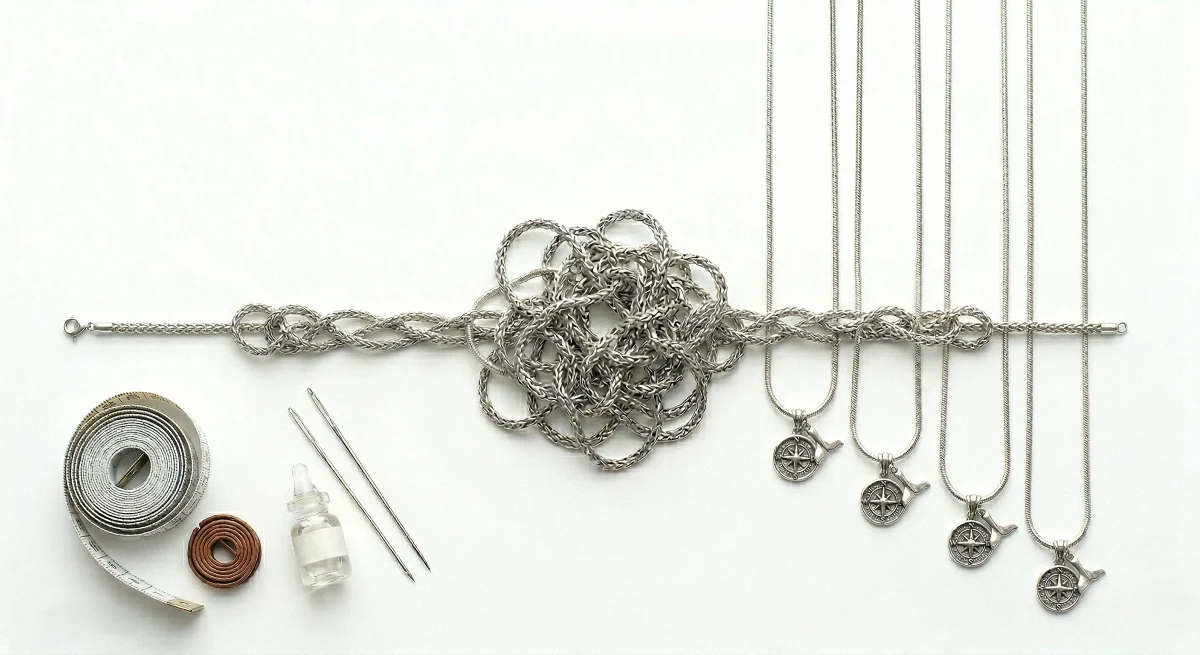
Storage. Separately from other jewellery. Chains tangle with each other worse than earbuds. Hang on a hook or store in a separate compartment. Snake chain is especially fussy: it kinks with careless storage.
Brass and patina. Brass chains darken over time. This is normal and creates a vintage effect. If you want shine, wipe with baking soda or a brass polishing cloth. If you want the patina, leave it. It is beautiful.
Stainless steel. Almost no maintenance needed. Does not tarnish, does not oxidise. Just wipe away fingerprints.
Chain by Occasion
Everyday
45-50 cm (18-20"), cable or snake, medium thickness. A pendant with personal meaning: nazar (protection), compass (direction), tree of life (family). Something you put on in the morning without thinking and only take off before bed.
Material: stainless steel or coated brass. They withstand daily contact with skin, sweat, perfume without degradation. Cheaper than silver, tougher than gold plate. What you need for something on your body 16 hours a day.
Date Night
42-45 cm (17-18"), something noticeable, something you can talk about. A Tarot card: instant conversation. An all-seeing eye: mystery. A sacred heart: passion. A pendant on a date is not decoration. It is a conversation starter. When there is a pause, the person opposite looks at the pendant and asks. Pause saved.
Work
Depends on dress code. Strict office: 50-55 cm (20-22"), under the shirt, invisible. The pendant is a personal ritual, not a public statement. Creative office: 45 cm (18"), visible, symbolic. Tech office: whatever you want, nobody cares.
Party / Concert
The bolder the better. A long 60+ cm (24"+) chain with a large pendant. Three-layer layering. Skull + ouroboros + navaja: triple impact. A party is the one place where "too much" does not exist.
Beach
Short (40-42 cm / 16-17"), so it does not flap in the water. A light pendant that will not drag you down. A rubber cord instead of a metal chain: does not rust, does not irritate wet skin. Whale tail, shell, anchor: ocean theme.
Travel
50 cm (20"), a secure clasp (lobster, not magnetic), a pendant with a connection to where you are going. Heading to Spain: navaja. Greece: all-seeing eye. Scandinavia: vegvisir. A pendant brought from a trip tells a story. A pendant put on BEFORE a trip creates one.
Gym
Take it off. Chain + barbell = damaged chain or damaged neck. If you refuse to remove it, a short 40 cm rubber cord, tight to the body, no swinging.
Wear the symbol, don't just read about it. These are in stock:




Chain as a Gift: Cheat Sheet
Do not know the neck size, do not want to ask, afraid of getting it wrong. Here is the cheat sheet:
| For Whom | Length | Chain Type | Why |
|---|---|---|---|
| Girlfriend (unknown size) | 45 cm (18") | Thin cable | Universal, 80% hit rate |
| Boyfriend (unknown size) | 50 cm (20") | Medium cable | Men's universal |
| Mum / Sister | 42-45 cm (17-18") | Snake | Elegant, feminine |
| Biker friend | 55 cm (22") | Leather cord | Rugged, honest |
| Minimalist friend | 45 cm + extender | Thin cable | Length flexibility |
| Yourself | Measure with string | Any | You know best |
If you are completely unsure: go with an extender. A 45 cm chain + 5 cm extender = a 45-50 cm range. Fits nearly everyone. Costs the same as two coffees, solves the problem completely.
Silver and gold jewellery, wedding bands, symbolic pendants, paired sets.
Wear the symbol, don't just read about it. These are in stock:



Frequently Asked Questions
What is the universal chain length? 45 cm (18") for women, 50 cm (20") for men. Works with the vast majority of pendants and necklines.
How do I know if a chain is too short? The pendant lies horizontally instead of hanging vertically. It presses on the throat. You cannot see the pendant without a mirror.
How do I know if it is too long? The pendant swings when you walk and hits the body. It spins and flips to the back. It hides behind the belt.
Can I wear a pendant on a leather cord? Yes. 2-3 mm, 48-55 cm (19-22"). For navajas, runes, skulls, Scandinavian symbols. Note: leather stretches 2-3 cm over six months.
Does the chain have to match the pendant colour? Not necessarily. A gold tone on a silver chain is a contrast that works. For a cohesive look, matching is safer. For a bold look, contrast is more interesting.
How do I choose chain thickness? Proportion: the chain serves the pendant. Light pendant (under 5 g): thin chain, 1-1.5 mm. Medium (5-10 g): 1.5-2.5 mm. Heavy (10+ g): 2.5-3 mm.
How many chains can I wear at once? Comfortable maximum is three. At least 5 cm between layers. Heavy at the bottom.
Can a chain be shortened? Yes, any jeweller removes a link in a minute. When in doubt, go longer.
Which chain for a navaja pendant? Cable, 45-50 cm (18-20"). Navajas are elongated and need space for vertical hang. On a leather cord for a workwear look.
Is an adjustable chain a good idea? An excellent one. A 5 cm extender gives flexibility: one chain, several styles. Especially useful as a gift when you do not know the exact size.
About Zevira
Zevira makes jewellery in the artisan tradition of Albacete, Spain. We know the chain length matters as much as the pendant itself, so we match the weave and the size to each piece, not the other way round.
What you will find with us for chains and pendants:
- Chains in a range of weaves: cable, curb, snake, figaro, rope, box
- Lengths from a 40 cm choker to a 70 cm opera, with adjustable options on an extender
- Pendants for every length: compact ones for a choker, elongated navajas and daggers, large symbols for long chains
- Rubber and textile cords for sport, travel, and sensitive skin
- Paired and layered sets with the pendants spaced at different heights
- A choice of clasps: lobster, screw, built for security or for speed
Every piece can be personalised with engraving by a craftsperson, with personal engraving available. 925 silver and 14-18K gold.