Nazar Meaning: The Turkish Evil Eye Amulet Explained
Nazar (Turkish nazar boncuğu, literally "gaze bead") is a blue glass eye-shaped amulet worn for over 5,000 years to deflect the evil eye. The classic version uses four concentric circles of dark blue, white, light blue, and black to "stare back" at envious or hostile glances. Also called the Turkish evil eye, mati (Greek), or simply the blue eye, it is one of the most universally recognised protective symbols on the planet.
Introduction: Why the Whole World Wears a Blue Eye
A friend of mine was sitting in a cafe when her blue glass pendant cracked. Right down the middle, no impact, no drop. She just heard a quiet snap, looked down, and there it was, split clean in two.
She wasn't upset. She was relieved. "It worked," she said, and bought a new one that same afternoon.
That's the nazar. An amulet that protects you until it breaks. And when it breaks, it means it took a hit meant for you. Odd logic? Maybe. But people have believed it for over five thousand years, and millions still do.
Wear the symbol, don't just read about it. These are in stock:

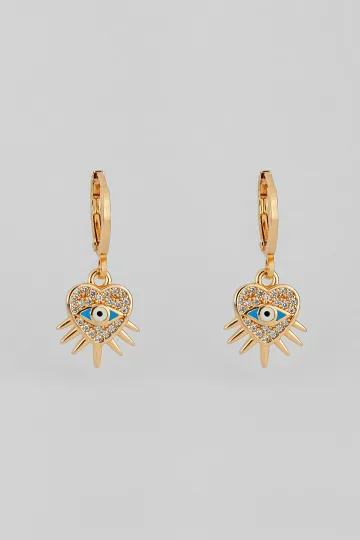
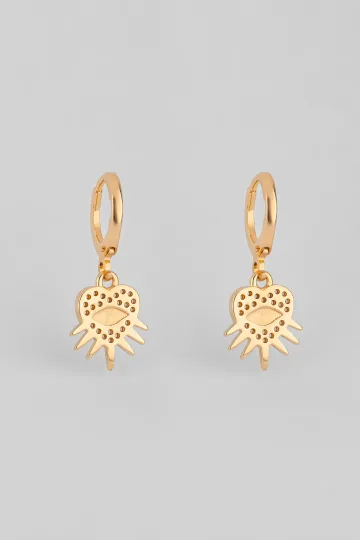
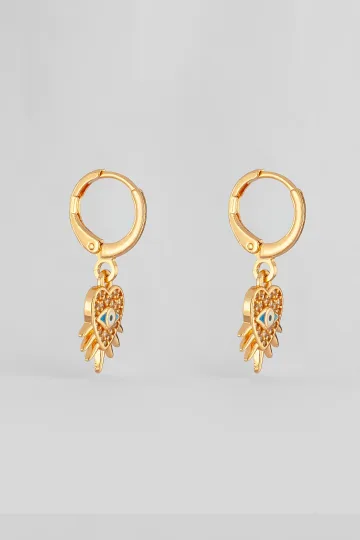

You've definitely seen this symbol. A blue eye on a friend's bracelet. Above the door of a Turkish restaurant. In a jewellery store window. On a stranger's phone case. It's so recognisable that people wear it even when they have no idea what it's called.
It shows up in Turkey, Greece, across the Middle East, throughout North Africa. And in the past decade, it's gone fully global. Designers put it in their collections, celebrities wear it on red carpets, and regular people hang it above their front doors from London to Los Angeles to Mumbai.
The Scale of the Phenomenon
To grasp how widespread this amulet really is, consider a few facts.
In Turkey, the nazar is arguably the national symbol alongside the tulip. Turkish Airlines puts it on the tails of their planes. Banks hang enormous ones in their lobby. Construction companies embed glass eyes into the foundations of new buildings: literally baking protection into the structure. Every Turkish baby receives their first nazar within days of being born, often while still in the hospital.
On social media, the hashtag #evileye has tens of millions of posts. This is not a niche symbol for the spiritually inclined. This is mainstream culture.
In the jewellery industry, the evil eye has become one of the best-selling motifs worldwide. Large jewellery labels, charm bracelet makers, and thousands of independent makers and online sellers offer evil eye collections. It's been a consistent best-seller for over a decade and shows no sign of slowing down.
Among celebrities, the blue eye has been spotted on contemporary fashion models and many others. But they didn't make it popular. They started wearing it because it already was.
In digital culture, the nazar got its own emoji (🧿) when it was added to Unicode 11.0 in 2018. That's a telling milestone. The Unicode Consortium doesn't hand out emoji slots to passing trends. The nazar emoji is now one of the most-used symbol emoji across platforms.
Why the Interest
Several reasons, all stacking on top of each other. The amulet is beautiful. It's instantly recognisable. It carries real meaning but isn't tied to any single religion. It's accessible. You can buy a glass bead for a dollar at a Turkish bazaar or a gold pendant with sapphires from a fine jeweller. And most importantly, it answers a deeply human need: the need to feel protected.
Even people who don't believe in anything mystical often say they feel "calmer" wearing one. It's not a rational decision. It's something closer to instinct. And that instinct, as we'll see, is at least five thousand years old.
What Is the Nazar
Definition and Names
Nazar (from the Arabic "نظر," meaning sight or gaze) is an eye-shaped amulet, usually made of concentric circles in dark blue, white, light blue, and black. Different cultures call it different things:
- Turkey: "nazar boncuğu," literally "gaze bead"
- Greece: "mati" (μάτι), simply "the eye"
- Arabic-speaking countries: "ayn" (عين), also "eye"
- Iran: "cheshm nazar" (چشم نظر), "eye of the gaze"
- India: "drishti" or "buri nazar," "the bad gaze"
- Latin America: "ojo turco," "the Turkish eye"
- English-speaking world: "evil eye charm" or "nazar amulet"
Here's a distinction that trips people up constantly. The "evil eye" is the curse itself, the negative energy sent through an envious or hostile look. The nazar is the protection against it. The amulet isn't evil. It guards against evil. Mixing them up is like confusing a disease with the medicine.
Anatomy of the Classic Amulet
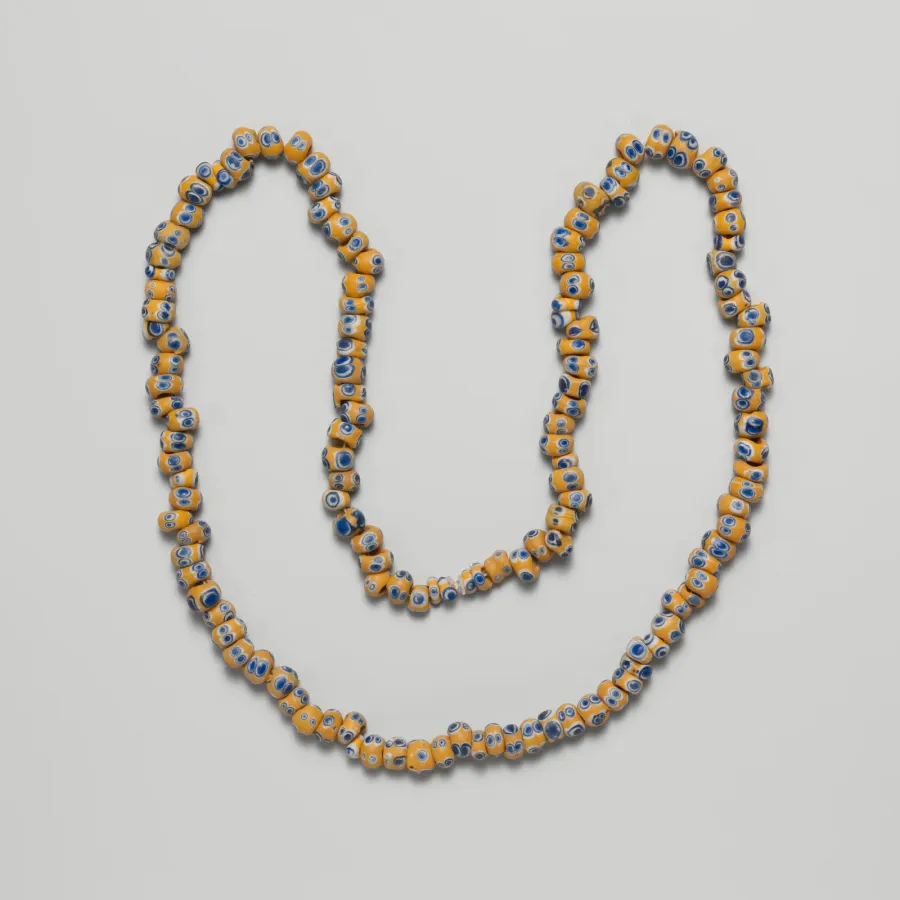
The classic Turkish nazar looks like a flat or slightly convex bead with concentric circles. Each layer is made from glass of a specific colour, and each colour carries its own meaning.
Outer ring: dark blue. The first shield. Dark blue symbolises the sky, the cosmos, infinite depth. It absorbs the initial impact of negative energy. The blue ring is the largest because it bears the primary load. The cobalt glass used for this layer has a deep colour that doesn't fade over time: a fading amulet is considered "tired" and in need of replacement.
Second ring: white. Purity and light. The white layer acts as a filter, cleansing intercepted negative energy before it can penetrate further. White also symbolises truth: the nazar "sees" through polite masks.
Third ring: light blue. The colour of water and air. This layer redirects any residual energy back to its source. It also symbolises a clear sky: calm after the storm.
Centre: black pupil. The all-seeing eye. The smallest but most important element. The black pupil "watches" the world, actively seeking threats. Black here isn't a symbol of evil but of depth and total absorption: it takes in all negative energy and releases none.
In traditional belief, the combination of all four elements is what gives the amulet its meaning. Remove one, and you just have a pretty ornament.
A nazar is blue and nothing but blue. Show up with a cloudy or green one and you are wearing a keyring charm, not protection.
How to Wear a Nazar
Over years on shoots the nazar has passed through hundreds of looks with me. Here is what actually works, sorted by occasion.
What do I wear a nazar with every day? For daily wear I recommend a small enamel eye on a thin silver chain over a white tee, a linen shirt or a basic knit. The plainer the clothing, the more the amulet reads. An open neckline brings the pendant into view, and by tradition the nazar should look out at the world. The one thing that matters: keep the blue saturated. A cloudy or faded eye works neither as protection nor as an accent.
Is it right for the office? Perfectly, as long as you keep it restrained. I suggest a matte contour eye on a short chain, sitting at the collarbone over a shirt or a thin roll-neck in a neutral colour. The amulet reads as a quiet detail, not a loud accent. One slim bracelet next to a watch works too.
How do I build a Mediterranean or boho look? Here I choose a glass bead on a leather cord or a bracelet with the eye on the wrist. Glass carries that seaside-market character, but remember it is fragile and tends to crack within a year or two of wear. For layers I stack the nazar with a thin red string or a second chain, and I keep a saturated cobalt blue as the lead colour of the look.
Glass or enamel, which lasts? For everyday wear I recommend silver with hot enamel: it holds its colour for years and shrugs off a knock. Glass is prettier and more alive, but brittle, so I suggest it to anyone who values the texture of a handmade bead. Either way I look at the blue: it should be deep and clean, not washed out.
Who does a nazar actually suit, and how do you wear it right? Almost anyone who loves pieces with meaning and does not mind a little Mediterranean nerve. I recommend wearing it openly, as an accent: an eye hidden under clothing loses both its point and its look. On a bracelet, a pendant or an ankle it sits equally well, and for children I suggest pinning a small bead to their clothes. One eye on a clean chain always beats one squeezed between five pendants.

Turn on your camera, pick earrings, a pendant or a ring, and see the piece on yourself in real time.
Switch items in one tap.
Everything runs in your browser: no photo or video is ever uploaded.
History: From Mesopotamia to Instagram
Origins (6,000+ Years Ago)
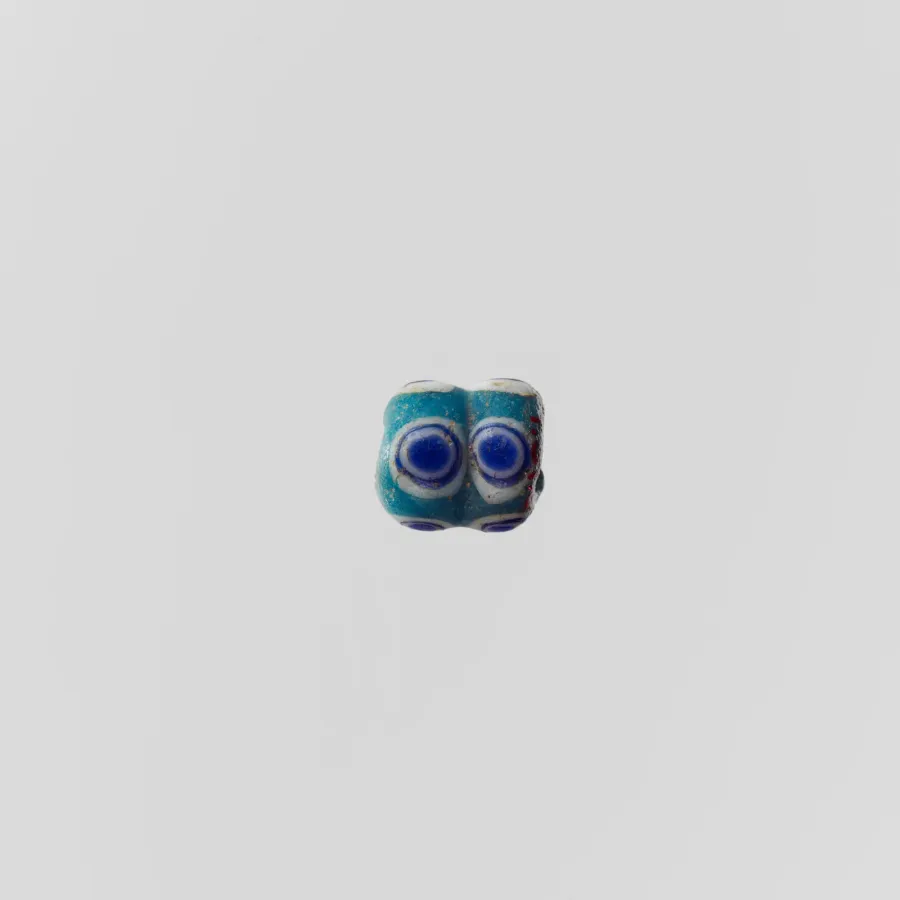
Belief in the evil eye is one of humanity's oldest and most geographically widespread superstitions. Anthropologists have found it in virtually every culture on earth, from Scandinavia to Australia.
The earliest written references appear in Sumerian cuneiform tablets over 5,000 years old. The Sumerians called it "ig-hul" (evil eye) and believed an envious glance could cause illness, crop failure, or death. But the idea is probably older still. Archaeologists have found eye-like amulets in settlements dating back 7,000 to 8,000 years. At Tell Brak in Syria, thousands of tiny stone "eye idols" were discovered, most likely connected to protection from the evil gaze.
Ancient Egypt: The Eye of Horus
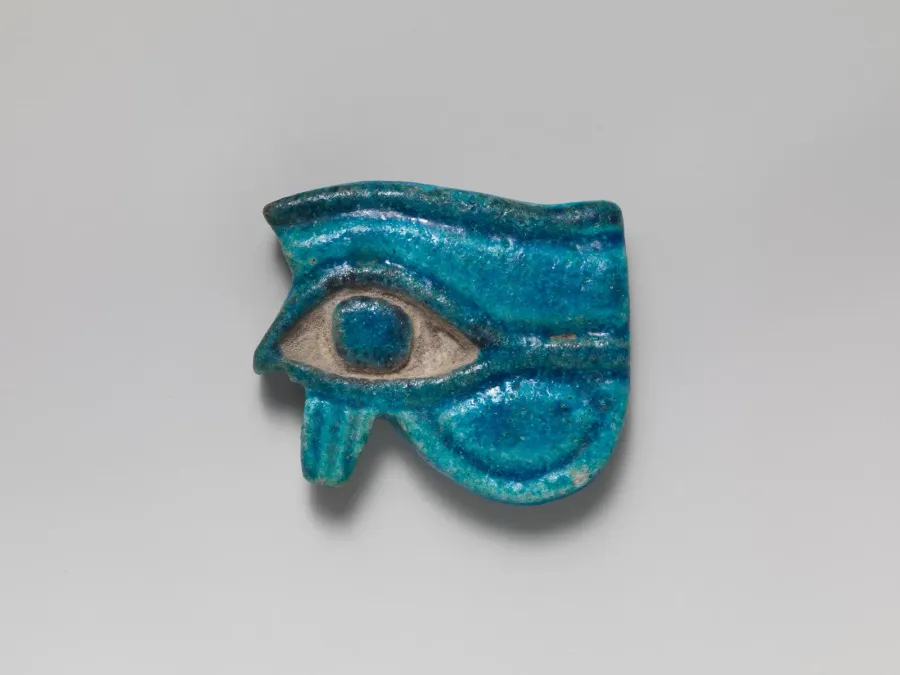
In ancient Egypt, the protective eye took one of its most famous forms: the Eye of Horus (Wadjet). Horus lost his left eye in battle with Set, and that eye became a symbol of healing, protection, and wholeness. Egyptians carved it on amulets, painted it on tomb walls, and drew it on ship bows so vessels could "see" their path. The connection to the modern nazar is direct: same idea, different visual form. Many historians consider the nazar a direct evolution of the Eye of Horus.
Ancient Greece and Rome
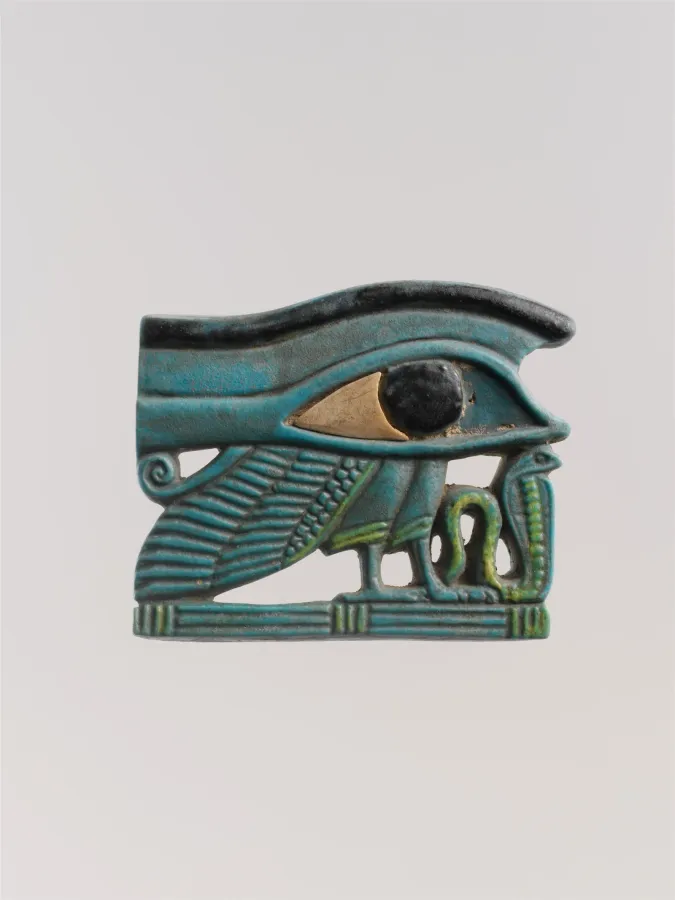
In ancient Greece and Rome, the evil eye was taken seriously enough that major thinkers addressed it. Pliny the Elder devoted an entire chapter to it in his "Natural History" (77 AD), describing people who could supposedly kill with a look. Aristotle tried to explain it through his theory of extramission, the idea that eyes emit rays, some of them "poisonous." Plutarch discussed the mechanism at length in his "Table Talk," proposing that eyes emit invisible particles carrying good or evil.
Romans wore phallic amulets called "fascinum" for protection, hung above doors, on chariots, around children's necks. Eventually, Mediterranean trade brought a more "presentable" alternative from the east: the eye-amulet, which gradually replaced the fascinum.
The Ottoman Empire: Birth of the Modern Nazar
The eye amulet in its modern form, concentric circles of coloured glass, took shape in the Ottoman Empire. Turkish glassblowers in the Cappadocia region, particularly around Goreme, gave it the form and colours that became the global standard using lampwork technique (shaping glass in a flame).
By the 18th and 19th centuries, the nazar was everywhere: on house doors, horse harnesses, newborn cradles, ship masts, fortress gates, sewn into clothing. Every Turkish bazaar offered dozens of variations.
Builders would embed nazar beads directly into the masonry of new buildings, protecting the structure for its entire lifespan. Some old buildings in Istanbul and Anatolia still contain these amulets: blue glass inclusions in the walls that are sometimes 200 to 300 years old.
The 20th Century: From Bazaar to Diaspora
In the 20th century, the nazar travelled with people. Turkish, Greek, Lebanese, and Syrian emigrants carried it to Europe, America, and Australia. In each new place, the blue eye adapted but never changed its essence.
In the United States, the nazar became especially popular in Greek and Turkish communities in New York, Chicago, and Los Angeles. Restaurants, bakeries, barber shops in ethnic neighbourhoods always had one above the door. For second- and third-generation immigrants, it became a symbol of identity: "We live here, but we remember where we come from." Greek-American and Turkish-American families passed the tradition down, and through them the amulet slowly entered mainstream American awareness.
In the UK and Australia, Mediterranean and Middle Eastern diaspora communities brought the nazar along. You'll find it in Greek restaurants in Melbourne, Turkish shops in North London, Lebanese bakeries in Sydney. Over time, it moved beyond ethnic communities and into general culture.
The Evil Eye in British Folklore
The evil eye belief isn't foreign to the English-speaking world. In British folklore, the concept of "overlooking" (casting a malevolent gaze, usually attributed to witches or people with unusual eyes) was well documented across the British Isles. In rural England, Scotland, and Ireland, various countermeasures existed: spitting, making the sign of the cross, or wearing protective objects.
The word "fascination" itself comes from the Latin "fascinare," meaning to bewitch or cast the evil eye. The idea runs deep in English-language history, even if the specific blue eye amulet arrived later through cultural exchange.
The Evil Eye in Indian Culture: Buri Nazar
India has its own massive evil eye tradition. Called "buri nazar" (bad gaze) in Hindi, "drishti" in South Indian languages, the belief cuts across every region and religion on the subcontinent. Indian protective measures take different forms: a black spot (kala teeka) on a baby's forehead, strings of lemon and green chillies outside shops, burning camphor, black thread on a child's wrist. But the classic Turkish blue eye has also become hugely popular in India, particularly in jewellery and home decor. For India's massive English-speaking population, the nazar has become the visual shorthand for a concept they've always known.
The 21st Century: From Souvenir to Global Icon
Everything changed in the 2000s. The fashion for ethnic, spiritual, and "meaningful" accessories swept the Western world, and the nazar was perfectly positioned: beautiful, recognisable, loaded with meaning, not tied to any religion, and accessible at every price point.
Social media finished the job. Influencers posed with it against the white walls of Santorini. The symbol shifted from "Turkish souvenir" to "global trend." Major jewellery labels launched dedicated lines. Charm bracelet makers added evil eye charms. Thousands of small independent makers started offering handmade versions. Online, evil eye jewellery consistently ranks among best-sellers in the charm category.
But despite all the commercialisation, the meaning hasn't been lost. Most people who wear a nazar know it's a protective charm. It sits in that interesting space between superstition and tradition, between belief and aesthetics. That's the secret of its staying power.
Nazar Meaning: How the Blue Eye Deflects Negativity
Protection from the Evil Eye: How It Works
The core idea is simple and elegant: the nazar "stares back." According to tradition, when someone throws an envious or hostile glance your way, the amulet is believed to intercept it and reflect it right back. Eye against eye. A mirror aimed at the source of the threat.
In Turkish tradition, the evil eye doesn't have to be intentional. A person can cast it without meaning to. Strong enough envy or even admiration is enough. A mother praising a neighbour's beautiful child. A colleague admiring your new car. A friend envious of your relationship. None of them want harm, but the force of their emotions can "knock" your luck off course.
This is why people wear the amulet all the time, not just when they expect trouble. The evil eye isn't a targeted attack. It's a side effect of other people's emotions. The nazar is daily insurance.
The Psychology Behind It
There's something worth noting about why this belief has survived for five millennia while others have faded. The evil eye concept maps onto something psychologically real. Envy exists. Jealousy exists. The uncomfortable feeling when someone stares at you, that exists too.
It's a common observation that people behave differently when they feel watched. The nazar doesn't need to work through supernatural channels to mean something to its wearer. For many people, wearing it brings a sense of being protected. Whether you read that as mystical or simply psychological, the feeling is real to the person wearing it.
This might explain why even thoroughgoing sceptics sometimes wear one and find themselves reluctant to take it off.
The "Masallah" Practice
This is also why, in Turkey, it's considered rude to heap praise on someone's child or possessions without adding "masallah" (God has willed it). A compliment without that word is seen as potentially dangerous, not because the speaker means harm, but because admiration without acknowledgement of a higher power might attract the evil eye.
If you've been to Turkey and praised a child while the mother smiled nervously, now you know why. She wasn't being impolite. She was worried about the evil eye. Say "masallah" and everything is fine.
Traditional Detection Rituals
In traditional Turkish and Greek families, people still practise rituals to detect the evil eye. Molten lead poured into water (kursun dokme), olive oil dripped into a cup of water (if the drop disperses, the evil eye is confirmed), or monitoring whether the person performing a protection prayer begins yawning or tearing up (a sign the evil eye was real and is now "leaving"). After confirmation, a cleansing ritual is performed and a new nazar goes on.
Why Blue
The nazar's blue colour isn't a design choice or a coincidence. It's the result of thousands of years of logic rooted in the demographics and psychology of ancient Mediterranean societies.
The "foreign gaze" theory. In Mediterranean and Middle Eastern cultures, most people had dark eyes. Light-eyed people were rare: outsiders, invaders from the north, traders. Blue or green eyes aroused suspicion. The amulet imitates that "dangerous" gaze and turns it into protection. Fighting fire with fire. This theory is supported by the fact that in Scandinavia, where light eyes dominate, dark-eyed people were considered the dangerous ones. It's always about the "other."
The "sky colour" theory. Blue is the colour of the sky and clean water: elements that in Eastern traditions symbolise divine protection and purity. A blue eye amulet is a piece of the sky you carry with you.
The Nazar Across Cultures
One of the most remarkable things about this amulet is its cross-cultural universality. No other protective charm is used by so many completely different peoples and religions. This is a global symbol adapted by dozens of cultures, far beyond any single "Turkish amulet."
- Turkey: the homeland. Part of national identity. Found in every home, shop, taxi, and office
- Greece: called "mati," worn from birth alongside the Orthodox cross
- Israel: often combined with the Hamsa. Both symbols cross religious lines, worn by Jews, Arabs, and Druze
- Iran: "cheshm nazar," paired with turquoise and Quranic calligraphy
- Egypt: connected to the Eye of Horus. Many Egyptians see them as variations of the same idea
- India: "drishti" or "buri nazar," alongside local traditions like black teeka and lemon-chilli strings
- Latin America: "ojo turco," brought by Lebanese, Syrian, and Turkish emigrants
- US and UK: arrived through diaspora communities, now mainstream through fashion and social media
Despite this cultural diversity, the visual form barely changes. The blue eye with concentric circles is recognised everywhere, from Istanbul to Mexico City, Mumbai to Athens. It may be the most universal visual symbol of protection on the planet.
Customer reviews
Zevira is a real jewellery shop. Genuine payments, deliveries and customer thank-yous.
🥰🥰🥰 gracias

Ok, ¡gracias! 🙂

Types of Nazar and What They're Made Of
Glass (Classic)
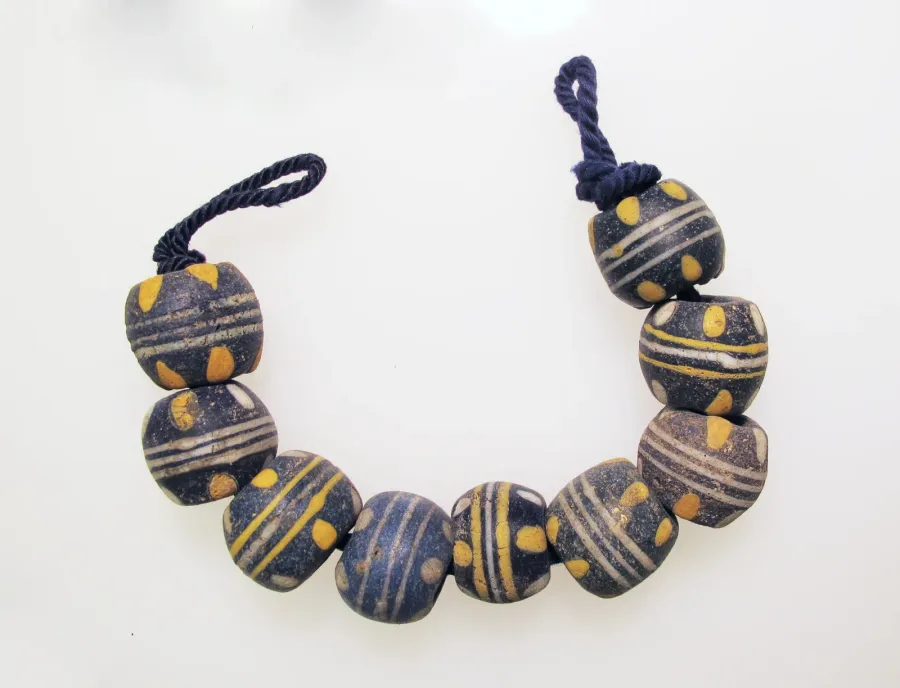
The traditional Turkish nazar made from coloured glass. Handcrafted by glassblowers using techniques barely changed in centuries: a cobalt glass rod heated in a flame, shaped into a bead, then layered with white, light blue, and black glass. Each bead is unique; slight asymmetry and micro-texture are signs of genuine handwork.
Glass nazars are fragile, and that's a feature. If the amulet cracks, it means it did its job: absorbed a blow of negative energy and protected you. Thank it, dispose of the pieces, and replace it with a new one.
Jewellery
An evil eye pendant in sterling silver is the most common format today. More durable than glass, suited for daily wear, and elegant enough to double as a real piece of jewellery rather than just an amulet.
Sterling silver evil eye pendant with enamel: the classic. A 925 sterling silver base with layers of coloured enamel reproducing the traditional blue, white and black. Hot enamel (fired at 600-800 degrees) lasts years without fading. Cold enamel is cheaper but less durable. If you want a silver necklace with evil eye pendant that holds its colour, look for hot enamel. The 925 hallmark should be stamped on the bail or the back.
With gemstones: sapphires or lapis lazuli for blue, diamonds or white topaz for white, turquoise for light blue, onyx for the pupil. The luxury option.
Minimalist: just the outline of an eye in sterling silver on a thin chain. For people who want the symbol but prefer understated jewellery. A women's evil eye necklace in sterling silver in this style works with everything from a T-shirt to a cocktail dress.
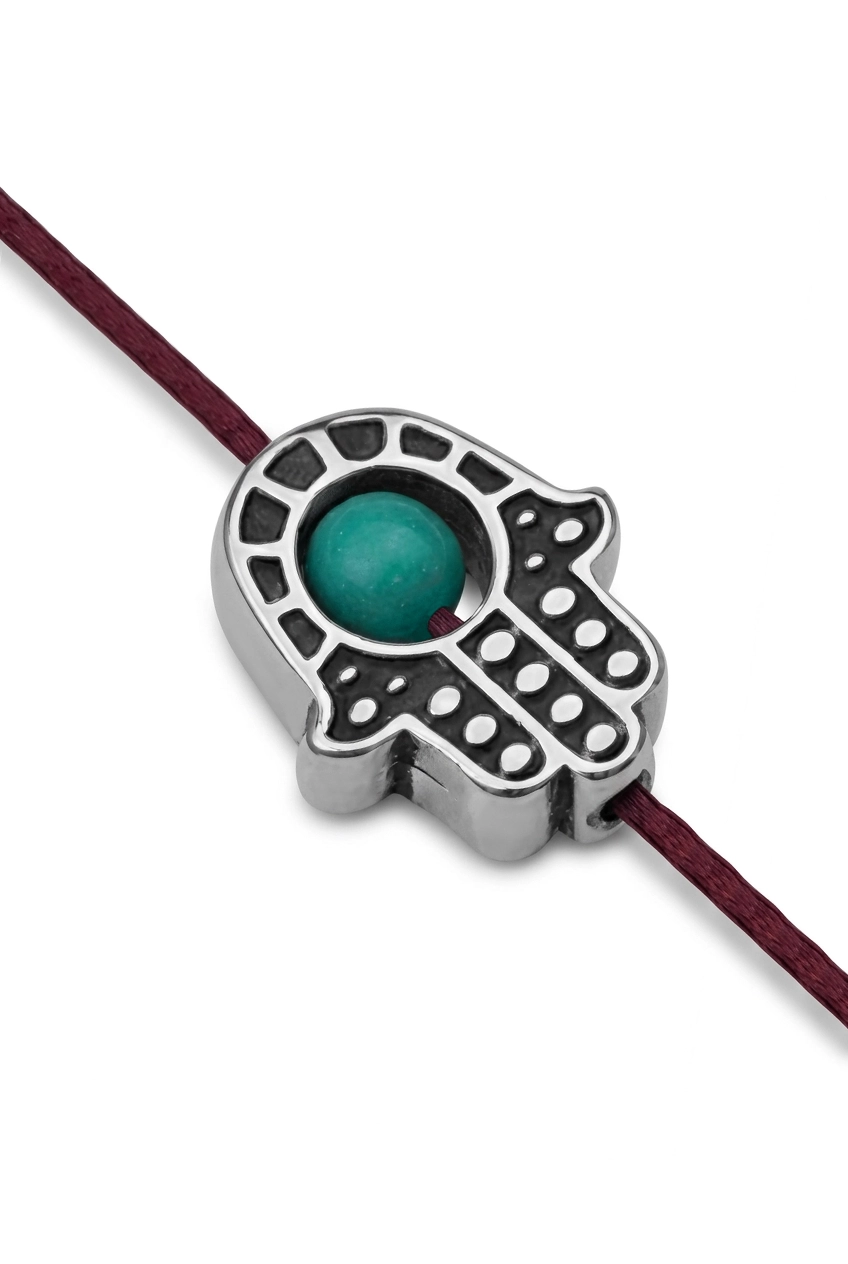
Hamsa evil eye pendant in silver: the combo piece. An evil eye set in the centre of a hamsa hand. Two symbols, two methods of protection, one pendant. Sterling silver hamsa pendants with enamel evil eye centres are among the most popular protection jewellery pieces worldwide.
Combined: nazar paired with heart (love), cornicello (European set), or horseshoe (protection plus luck).
Why 925 Silver Is the Best Metal for an Amulet
If the nazar is going to be worn daily for years rather than kept as a souvenir, sterling silver is the sensible choice, and the reasons are practical rather than symbolic.
It holds enamel properly. Hot enamel is glass fused to metal at 600 to 800 degrees, and the metal underneath has to expand and contract at a rate the glass can tolerate. Silver does this well, which is why enamel on a silver base survives decades while enamel on cheap plated alloy lifts and chips within a couple of years. The blue of a nazar is the whole object, so the substrate that keeps it attached matters more than it would on a plain pendant.
It is soft enough to work and hard enough to last. Fine silver is too soft for jewellery, which is why sterling is alloyed to 92.5 percent silver with copper making up the rest. That alloy takes fine detail, holds a setting, and stands up to daily wear on a chain, which glass conspicuously does not. A glass nazar is a beautiful thing with a limited life expectancy on a bracelet.
It is properly regulated in Britain. Anything sold here as silver above 7.78 grams must carry a UK hallmark struck by an Assay Office, showing the sponsor's mark, the fineness figure of 925 and the town mark: the leopard's head for London, the anchor for Birmingham, the rose for Sheffield, the castle for Edinburgh. That is an independent guarantee of what the metal actually is, applied by someone with no interest in the sale. Very few consumer goods carry anything comparable, and it is worth using.
It sidesteps the nickel problem. Under the European nickel restriction, carried in Annex XVII of REACH, an item in prolonged skin contact must not release more than 0.5 micrograms of nickel per square centimetre per week, and the limit for anything inserted into a piercing is stricter still. Sterling silver sits comfortably inside those limits. Unmarked plated base metal, which is what most inexpensive evil eye jewellery is made from, frequently does not, and a nazar worn every day sits against the skin for a very long time.
It ages rather than degrades. Silver tarnishes, and tarnish is reversible with a cloth. Plating wears through, and that is not reversible without re-plating. For an object meant to be kept and possibly passed on, the difference is the whole point.
The traditional argument, that silver is a lunar and protective metal in its own right across a great many cultures, is a pleasant addition. The practical case stands without it.
Ceramic
Wall-mounted amulets meant for protecting spaces rather than people. Sizes range from 10 cm to half a metre across. Hung above front doors, in living rooms, in offices. Turkish ceramic nazars from Kutahya and Iznik are often hand-painted and glazed, each one a small piece of art.
Textile and Everyday Objects
The nazar has long moved beyond jewellery and wall decor. You'll find it on cushions and blankets, towels, clothing (embroidery, patches, prints), bags, phone cases, rugs, and kitchenware. Tattoos of the blue eye have become hugely popular too, most commonly on the wrist, behind the ear, on the ankle, or between the shoulder blades.
Where a Nazar Goes: Body, Home, Workplace
The amulet is worn in three quite different registers, and the rules are not the same in each. On the body it is personal protection. In the home it is protection of a space. Alongside other jewellery it is a design element that has to get along with everything else you own.
Worn on the Body
The governing principle is visibility. The nazar works, in the logic of the tradition, by intercepting a gaze, which means it has to be where a gaze lands. An amulet buried under a jumper is decoration rather than protection, and everyone who follows the custom seriously understands this.
At the neck. The standard position and the strongest one, because the neck and the face are where people look. Chain length decides how it reads: 40 to 45 cm puts the pendant at the hollow of the throat, which is the traditional placement and the most visible; 50 to 60 cm drops it to the sternum, quieter and better under an open collar; anything longer disappears into clothing and defeats the purpose. Choose the shorter lengths if the point is protection rather than styling.
On the wrist. The second most common position and the most practical, because a bracelet stays visible even in winter clothing when a pendant does not. The traditional preference is the left wrist, understood as the receiving side, though this is a convention rather than a rule and plenty of people wear it on the right. A bracelet also takes more punishment than a pendant, so glass beads on elastic have a short life and a silver or enamel bead on a proper chain does not.
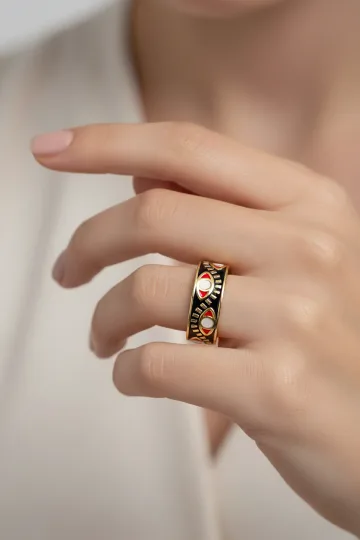
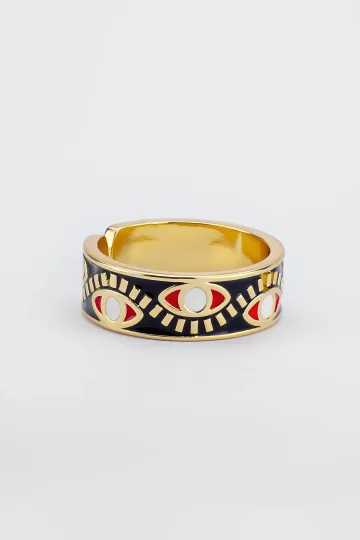
On the hand. Rings and a nazar-set ear cuff put the eye where gestures happen, which suits anyone who works with their hands or in front of people. Rings take the most wear of any position, so enamel needs to be hot-fired and settings need checking annually.
At the ear. Earrings are the discreet option, visible in profile and in conversation, hidden from a distance. A single nazar earring worn with a plain stud in the other ear is a common contemporary arrangement.
On a child. Traditionally pinned to clothing rather than worn round the neck, usually at the shoulder or on the back of a garment where the child cannot reach it. Nothing on a cord, nothing small enough to swallow, nothing glass. A fabric patch or an embroidered eye is the safe version and is entirely traditional.
The one placement to avoid is the deliberate concealment of the amulet under clothing while expecting it to work. Wear it where it shows or wear it because you like it, but be clear which you are doing.
In the Home and at Work
Protecting a space follows different logic from protecting a person: instead of intercepting a gaze aimed at you, the amulet guards a threshold.
Above the front door, on the inside, facing the entrance. This is the single most traditional placement in Turkish and Greek households, and the reasoning is straightforward: everything and everyone entering passes under it. Ceramic and large glass discs are made specifically for this, in sizes from 10 cm to half a metre.
In the main living room, positioned so it faces the room's entrance rather than a wall. The convention is that the eye should look at whoever comes in.
Over a workplace or a shop counter. Businesses across Turkey, Greece and much of the Mediterranean hang a nazar where customers can see it, and it is treated as ordinary rather than superstitious, roughly the way a horseshoe once was in Britain.
In a new home, hung before the first night, and in a new car, hung from the mirror. New things are considered exposed, and the amulet is one of the first objects installed.
Near anything that attracts admiration. The underlying idea across the whole tradition is that envy follows good fortune, so the placements are around the things people compliment: a new baby's room, a new business, a restored car, a garden.
A practical note on the object itself. A large glass nazar hung over a door is heavy and hard, so fix it properly rather than on a picture hook, and keep it away from a door that slams. Ceramic versions from the Turkish pottery towns are lighter and hand-painted, and they are usually the better choice for a wall.
What It Pairs With
The nazar is a graphic, high-contrast object: concentric circles of dark blue, light blue, white and black. That makes it easy to wear alone and slightly demanding in company.
With plain metal. The safest and best pairing. A silver nazar on a plain silver chain, alongside plain silver rings and a plain bangle, lets the eye be the only pattern in the look. This is how it is most often worn in the places it comes from.
With other protective symbols. Hamsa, cornicello, horseshoe, key. These combine happily because they belong to the same family of objects, and layering them is traditional rather than a modern invention. Keep them to two or three, on chains of different lengths so they do not tangle or clash.
With coloured stones. Turquoise, lapis and sodalite sit in the same blue register and extend it. Warm stones, carnelian, amber, garnet, work as deliberate contrast but need the rest of the look kept simple, because you now have two strong colours competing.
With other patterns. This is where it usually goes wrong. A nazar against a busy printed shirt, a patterned scarf or another strongly graphic pendant produces visual noise, and the eye stops reading as an eye. Plain fabric behind it, always.
Metal colour. Silver and white metals suit the cool blue directly. Yellow gold gives a warmer, more Mediterranean look that is entirely traditional and reads as richer. Mixing the two is fine as long as the mix is consistent across the whole look rather than accidental.
Upload a photo of your pet, someone you love, or an object. We'll build a 3D model and hand-cast it in pewter.




Who Should Wear a Nazar
No Restrictions
The nazar is not a religious symbol. It's a folk amulet that existed long before Islam, Christianity, and Judaism. It's worn by Muslims, Christians, Jews, Buddhists, Hindus, agnostics, and atheists. In Turkey, you'll find it in mosques, churches, synagogues, and entirely secular spaces.
No age restrictions: babies receive them in their first days, teenagers wear them as fashion. No gender restrictions either, though men often choose more understated versions (leather cord, ring, cufflinks) while the range for women runs from tiny studs to statement necklaces.
When It's Especially Appropriate
There are situations when the nazar is considered a particularly fitting gift or personal purchase:
Birth of a child: the first protective charm for a new life. The most traditional reason to give one. In Turkey and Greece, not giving a nazar to a newborn would be strange.
Wedding: protection for the new family from the envy of others. Weddings attract enormous amounts of attention and emotion, not all of it positive.
Starting something new: opening a business, beginning a project, starting a new job. Everything new attracts attention, and attention can carry envy.
Moving house: a new home needs protection. The nazar is the first thing to go up.
Pregnancy: the expectant mother and child are considered especially vulnerable.
Period of success: paradoxically, when things are going well, the risk of the evil eye is considered highest. A promotion, a big purchase, a successful project: all attract attention and, potentially, envy.
Travel: protection on the road. Especially popular among frequent flyers.
Celebrity and Public Life: anyone in the public eye faces an enormous number of gazes daily. It's no accident that celebrities have been photographed wearing evil eye jewellery: for those with Mediterranean or Middle Eastern heritage, it connects directly to family and cultural tradition. For others, it's both protection and style.
As a gift, the nazar is always appropriate. It's not a "superstitious" present. It's a wish for protection and good things, understood in any culture.


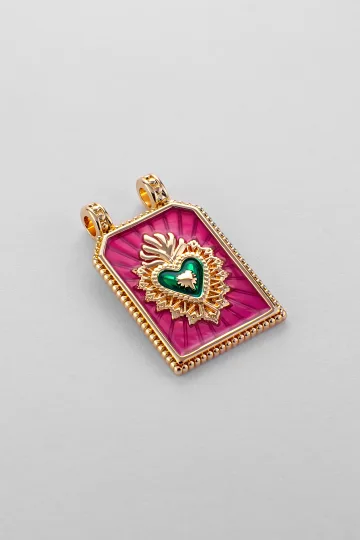



Nazar Colours and Their Meanings
The classic nazar is blue, but in recent years dozens of colour variations have appeared. Each carries its own significance:
Blue (classic): universal evil eye protection. The standard, tested over millennia. If you're unsure which colour to choose, go with blue. You can't go wrong.
Dark blue/navy: an intensified version of classic blue. Deeper protection. Considered to intercept not just surface-level envy but hidden ill will.
Red: protection in love and relationships. Guards couples from the envy of others. A popular gift for partners and newlyweds.
Green: health, growth, prosperity. Good for people starting new ventures, recovering from illness, or wanting to "grow" something new. In Islamic tradition, green is a sacred colour, which adds an extra layer of meaning.
Yellow/gold: energy, focus, financial well-being. Popular among students and entrepreneurs.
Black: strength, power, absolute protection. Considered maximally powerful because black absorbs everything.
White: purity, calm, new beginnings. Ideal for periods of change.
Pink: friendship, tenderness, harmony. Popular as a gift between friends.
Purple: intuition, spirituality, creativity. Popular among people who practise meditation.
All colour variations are considered effective. Blue remains number one, but the choice is personal.
A note on where these meanings come from, because the honest answer is more interesting than the marketing version. The blue is ancient and documented, tied to glassmaking, to copper and cobalt colourants available in the eastern Mediterranean, and to a long-standing regional association between pale eyes and the ability to cast the look. Everything beyond blue is recent. The wider palette emerged as glass workshops diversified for a tourist and export market through the twentieth century, and the meanings attached to each colour were assembled afterwards, largely from general colour symbolism rather than from any older tradition.
That does not make them worthless. A colour chosen deliberately still functions as a reminder, and a green nazar given to someone starting a business carries exactly the intention the giver put into it. It simply means that a seller claiming ancient authority for a pink evil eye is inventing.
Two practical points for anyone choosing. First, the contrast matters more than the hue. The amulet works visually because of its concentric rings of dark, light and dark, and a pale monochrome version in a single soft colour loses the graphic punch that makes it read as an eye at a distance. If you want the object to be recognisable, keep the black pupil and the white ring whatever you do with the outer colour.
Second, consider what the piece will sit against. Blue and navy are legible against almost any clothing. White and pale pink disappear against light fabric. Black reads as sophisticated and nearly invisible at a distance, which is fine if you want jewellery and beside the point if you want an amulet. Yellow and gold work best in metal rather than enamel, since a yellow enamel eye can read as sickly under indoor light.
For a gift, blue remains the correct answer unless you know something specific about the recipient. It carries the whole weight of the tradition, it suits every skin tone and every wardrobe, and nobody has ever been disappointed by one.
Nazar, Hamsa, and Cornicello: What's the Difference
Three of the most popular evil eye protection charms in the world. All three protect, but each takes a fundamentally different approach. Understanding the differences helps you choose the one that suits you, or consciously combine them.
Nazar: The Strategy of Reflection
Nazar: the mirror. Intercepts the gaze and sends it back. Works passively: you just wear it. No rituals, no special words. Must be visible to function.
The logic is worth spelling out, because it explains every design decision in the object. The harm in this tradition travels through a look, so the countermeasure is an object that looks back. The nazar is an eye facing outward, and its concentric rings are built for maximum visibility at a distance: dark against light against dark, the highest-contrast arrangement available in a small object.
That is why the material is glass and the finish is glossy. A reflective surface is not incidental decoration, it is the mechanism as the tradition understands it. It also explains the one firm rule attached to the amulet, which is that it must be seen. Hidden under a collar, it is doing nothing.
The passivity is the other distinctive feature. There is no charging, no cleansing schedule, no ritual, no phrase to be said over it. You put it on and it works, and there is nothing further required of you. Among the world's protective objects this is unusually undemanding, and it is a large part of why the nazar travelled so easily into cultures that know nothing of its origins.
The one accepted piece of maintenance is the cracking. A nazar that breaks is widely understood to have absorbed something and done its job, and the correct response is to thank it, discard it and get another. That belief is remarkably consistent across Turkey, Greece and the wider region.
Hamsa: The Strategy of Repulsion
Hamsa: the shield. The open palm pushes negativity away. More "active" than the nazar: it prevents threats rather than reacting to them. The hamsa and nazar often combine into one amulet (blue eye in the centre of the palm), creating one of the strongest protective pairings in existence.
The gesture is the point. An open palm held outward is a universally legible sign meaning stop, and the hamsa makes that gesture permanent. Where the nazar waits and reflects, the hamsa refuses in advance.
The orientation carries meaning. Fingers pointing down is generally read as inviting blessing and abundance in; fingers pointing up as warding away. Both are traditional and both are worn, and which is correct depends on which convention you are following rather than on any universal rule.
The hamsa also differs from the nazar in a way worth stating clearly: it has genuine religious associations in both Islamic and Jewish traditions, where it carries names and meanings connected to living faith. The nazar, by contrast, is folk custom without doctrinal standing anywhere. Anyone wearing a hamsa should be aware they are borrowing from a religious vocabulary in a way that wearing a nazar does not involve.
The combined form, an eye set in the centre of an open palm, joins the two mechanisms into one object and is among the most widely produced protective amulets in the world.
Cornicello: The Strategy of Attack
Cornicello: the weapon. The Italian horn doesn't reflect or push away negative energy. It destroys it. The sharp tip "pierces" the flow of negativity. If the nazar is a mirror and the hamsa a shield, the cornicello is a sword. Also carries meanings of luck, fertility, and lunar energy.
Its ancestry runs through the animal horn, and through Roman amulets of aggressive rather than defensive character. Where the eastern Mediterranean built its protection around eyes and hands, the Italian tradition built its around points, horns and gestures that are frankly rude, which tells you something about the two temperaments.
The design conventions are specific and are usually ignored by mass producers. A proper cornicello is twisted rather than smooth, is hollow rather than solid, ends in a sharp point, and is traditionally red, either coral or red-painted metal, since red carries its own protective weight throughout Mediterranean folk practice. Coral is the traditional material and remains the most prized.
There is one convention worth knowing: in Italian custom the cornicello is best received as a gift rather than bought for oneself, and buying your own is said to reduce its effect. Neither the nazar nor the hamsa carries that restriction.
Unlike the nazar it does not need to be visible, and it is frequently worn under clothing or carried in a pocket. A weapon does not have to be displayed to work.
Comparison Table
| Feature | Nazar | Hamsa | Cornicello |
|---|---|---|---|
| Origin | Turkey, Greece, Middle East | Middle East, North Africa | Italy, Ancient Rome |
| Strategy | Reflection | Repulsion | Destruction |
| Style | Passive (reacts) | Active (prevents) | Aggressive (attacks) |
| Must be visible? | Yes, essential | Preferably | Not necessarily |
| Religious ties | None | Partial (Islam, Judaism) | None |
| Additional meanings | Awareness, purity | Blessing, harmony | Luck, fertility |
| Best material | Glass, enamel | Silver, gold | Silver, gold |
| Most popular form | Pendant, bracelet | Pendant, wall-mount | Pendant |
Can You Wear Them Together?
Yes, and it's a common practice. Different amulets work through different methods and don't interfere with each other. It's like having both a lock on your door and an alarm system: different methods, same goal.
Most popular combinations:
- Nazar + Hamsa (the classic)
- Nazar + Cornicello (the European set)
- All three together (maximum protection)
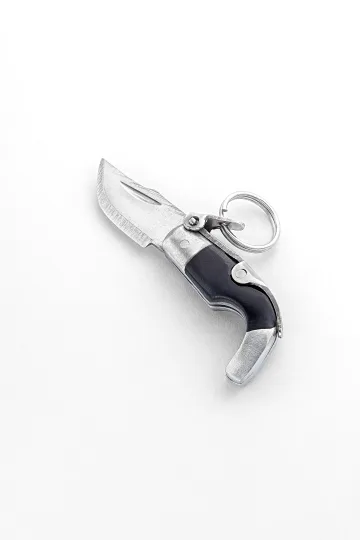
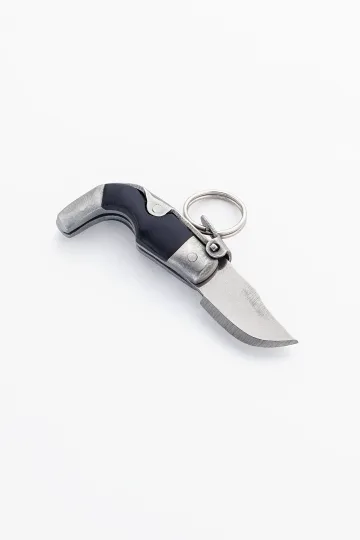
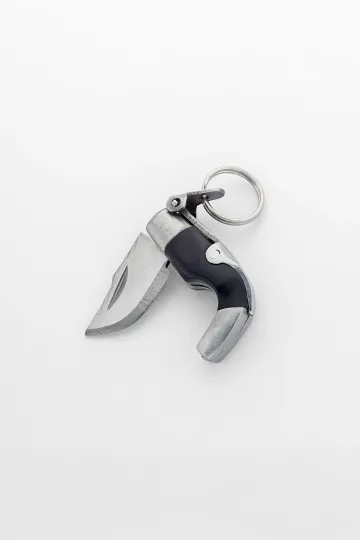
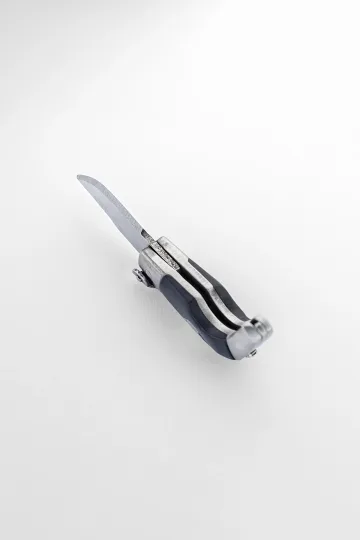
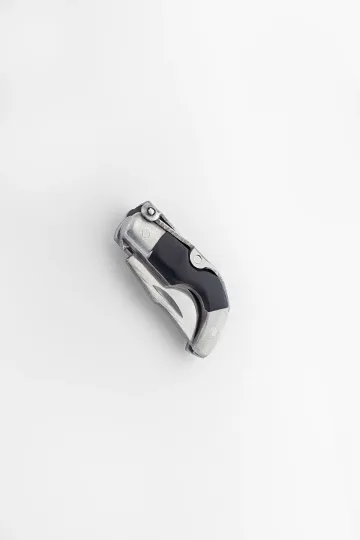
CAPAORA mini knife pendant
The 18th-century Spanish navaja in miniature: 40 mm of stainless steel, a real folding mechanism and a Palanquilla lock that clicks. An affordable gift to remember.
Authentic · Ships from Spain · 14-day returns
The Blue Eye in Detail: Pendant, Bracelet, and Countries
Eye Pendant Meaning: What Changes When You Wear It at the Neck
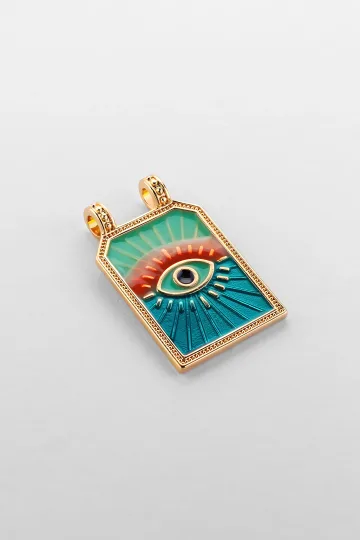
An eye worn as a pendant carries the same protective idea as the classic glass bead, but moves it into plain view on the chest. In Turkish practice the pendant sits exactly where a stranger's gaze lands first, so the painted eye catches the evil eye before it reaches the person. Giving someone an eye necklace passes on a promise of attention rather than a fashion detail. Direction matters: the eye looks outward, toward the world, never back at the wearer. Blue glass pendants read as traditional, while silver or enamel serve the same purpose in a quieter register. For daily wear a single eye on a short chain sits almost hidden under a collar and still does its job.
Amulet Against the Evil Eye: How the Nazar Is Meant to Work
The evil eye, "nazar" in Turkish, describes envy or admiration that turns to harm without anyone intending it. The amulet works on a simple logic: it draws that gaze onto itself and pulls it away from the person. If the glass cracks or the bead suddenly drops, people read it as proof that it took a hit, and they replace it without regret. You wear it where closeness happens: on the wrist during a handshake, on a pram, above the front door. Visibility is the point, since a hidden eye cannot intercept anyone's gaze. As a gift for a birth or a new home, the nazar stays a familiar gesture in many families, less superstition than a sign of care.
All-Seeing Eye in Greece: The Mati
In Greece the protective eye is called "mati", simply the word for eye. It looks almost identical to the Turkish nazar with its blue rings, yet a separate tradition sits behind it. The evil eye here is "to matiasma", and whoever catches it often complains of headache or dizziness. To lift it there is a ritual with oil, water, and a murmured prayer that older women in the family know by heart. On Crete and the islands the mati hangs on doorframes, boats, and car mirrors. Unlike in Turkey the symbol blends closely with Orthodox folk piety, so an eye and a cross often hang side by side on the same chain. The colour blue links both cultures as the shade of protection.
All-Seeing Eye in Turkey: The Nazar Boncuğu
In Turkey the classic glass bead is the "nazar boncuğu", literally the bead against the evil eye. It is still made in workshops along the Aegean, where glassblowers shape it over an open flame. "Making an eye" in Turkish means not crafting it but hanging it in a new flat, a car, or over a newborn as the first act of protection. The concentric circles of dark blue, light blue, white, and black are typical, their contrast meant to bind a hostile gaze. Unlike the Greek mati, the Turkish eye rarely carries a religious layer and counts as folk custom across faiths. In bazaars whole walls hang thick with beads, from keychains to wall pieces as tall as a person.
Blue Eye Bracelet: Meaning and How to Wear It
A bracelet with a blue eye sits at the pulse, a spot that stays in motion and in view during any conversation. That is exactly the aim: the eye needs to be seen to do its work. Tradition puts it on the left hand, the side nearer the heart, though no strict rule applies. If the cord snaps or the bead goes missing, people read it as a deflected evil eye and tie a new one. Versions with several small eyes on an elastic band are popular and stack easily with other bracelets. As a gift the bracelet suits children and travellers especially, because it sits tight and barely gets in the way on the road.
The Evil Eye in Islam: Religious Sign or Folk Custom
The blue eye is often taken for an Islamic symbol, yet the nazar predates Islam and traces back to ancient Mesopotamia. Belief in the evil eye itself appears in Islamic tradition, which is why many Muslims seek protection, though through prayer and Quranic verses rather than a glass bead. Strict readings reject the amulet as superstition, while folk custom tolerates it widely across Turkey, North Africa, and the Gulf. The eye is therefore less a religious sign than a cultural habit that works across lines of faith. Anyone who wants to respect the background wears it as a cultural symbol, not a statement of belief. The phrase "eye of Allah" is popular usage with no grounding in theology.
Frequently Asked Questions
What is a nazar? A nazar is a blue eye-shaped amulet from Turkish and Mediterranean tradition, designed to protect the wearer from the evil eye. The name comes from the Arabic word "nazar," meaning sight or gaze. The classic form is a glass bead with concentric circles of dark blue, white, light blue, and black, but the symbol now appears on pendants, bracelets, rings, ceramics, textiles, phone cases, and even emoji. Its function is purely protective: it intercepts negative or envious glances directed at the wearer.
How do you use a nazar? You wear it visibly. Unlike charms that are hidden under clothing, the nazar needs to "see" the world to do its job. Pendants are worn on the outside of the shirt, bracelets on the wrist, large versions hang above doorways or rear-view mirrors. There are no special rituals required. You do not need to charge, bless, or activate it. The symbol works through its form and presence. The only rule that traditional families follow consistently: a cracked nazar has done its job and should be replaced.
Why is the nazar always blue? Blue is the colour of the sky, of clean water, and historically of the "foreign gaze" in Mediterranean cultures where most people had dark eyes. The amulet imitates that piercing blue look and turns it into protection. The classic four-layer arrangement (dark blue outside, white, light blue, black pupil) is not arbitrary either. Each layer plays a role in the symbolic mechanism of catching, filtering, and absorbing negative energy. Other colours exist (red for love, green for health, black for absolute defence), but blue remains the default and the most powerful in traditional belief.
What should I do if my evil eye charm cracks or breaks? That's actually a good sign. According to tradition, the amulet absorbed a blow and protected you by sacrificing itself. Thank it (in your head or out loud), collect the pieces, don't keep them at home, and replace it with a new one. Some people recommend burying the pieces in the earth, symbolically returning the amulet to nature.
Can I buy a nazar for myself, or does it have to be a gift? Both work. Unlike some traditions where a charm must be given by someone else, the nazar works just fine when you buy it yourself. A gifted one is considered slightly more powerful because it carries the good intentions of the giver. But the difference isn't major.
Is the nazar a Muslim symbol? No. The nazar is thousands of years older than Islam. It was used in Mesopotamia, ancient Egypt, Greece, and Rome long before Islam existed. People of all faiths and none use it today. Yes, it's especially popular in Muslim-majority countries, but that's a cultural connection, not a religious one. Within Islam itself, attitudes toward amulets are mixed: strict scholars consider all talismans impermissible (shirk), but folk tradition proved stronger.
Why do nazars come in different colours? The classic nazar is blue, but each colour carries its own meaning (see the "Nazar Colours" section above). Blue is standard protection. Red protects love. Green is for health. Black offers maximum strength. White is for new beginnings. All variations are considered effective.
Does the size of the amulet matter? For jewellery, no. A small nazar on a thin chain protects just as well as a large medallion. For the home, somewhat: the larger the nazar above the door, the more noticeable it is to visitors. But that's more tradition and aesthetics than a hard rule.
Can the nazar cause harm? No. The nazar is purely protective. It reflects negativity but doesn't create it. It's a mirror, not a weapon. A nazar cannot cause harm to its wearer or to anyone else.
Do I need to "charge" or "activate" my nazar? In the traditional understanding, no. The nazar works through its form and colour, with no rituals required. But some people prefer to place a new nazar in sunlight, under a full moon, or rinse it in running water. These are personal practices, not requirements.
Where's the best place to buy one? The most "authentic" nazars come from Turkey: Grand Bazaar in Istanbul, Cappadocia workshops, bazaars in Antalya and Bodrum. But any amulet of the correct form and colour is considered "real," regardless of origin.
Can men wear a nazar? Yes. The blue eye carries no gender associations. In Turkish, Greek, Lebanese, Iranian, and Indian tradition, men have worn the amulet for centuries. Modern men tend to choose simpler formats: a leather cord with a single bead, a signet-style ring with the eye engraved, a small silver pendant worn under or over a shirt. Footballers wear them. Mediterranean grandfathers wear them. There is no rule that excludes anyone.
What does the nazar emoji mean? The blue eye emoji (🧿) was added to Unicode in 2018 and represents the classic nazar. People send it to friends as a symbolic gesture of protection, especially in contexts where someone might be the subject of envy: announcing a pregnancy, a promotion, a new house, a wedding. It is the digital equivalent of saying "masallah" in Turkish: an acknowledgement that good news might attract unwanted attention, and a wish that the recipient be shielded from it.
Is the nazar the same as the Eye of Horus? They are related but not identical. The Eye of Horus is an ancient Egyptian symbol from roughly 3,000 BCE, depicting the eye of the falcon god Horus, used for healing, protection, and afterlife guidance. The nazar emerged later in Mesopotamia and the Levant and travelled through Greek, Roman, and Turkish hands until it took its modern blue-bead form. Both protect through the power of the gaze, but their visual languages and cultural contexts are different. Many historians do consider the nazar a distant descendant of the Egyptian protective eye tradition.
Silver and gold jewellery, wedding bands, symbolic pendants, paired sets.
Leave your email, we'll send your discount code. No spam, unsubscribe anytime.
The code arrives by email, valid on your first order.
Nazar Symbolism in Turkish Culture: More Than an Amulet
Outside Turkey, the nazar reads as a generic protective charm. Inside Turkey, it functions as something closer to a national emblem, on par with the crescent moon and the tulip. You see it on aircraft tails, embedded in the marble of new hotels, embroidered on traditional coffeehouse cushions, painted on the prows of fishing boats along the Aegean coast. The symbol is so embedded in daily Turkish life that most Turks stop noticing it the way most New Yorkers stop noticing yellow taxis.
There is a phrase you hear constantly in Turkish households: "Nazar değmesin." It translates roughly to "may no evil eye touch you." Mothers say it to babies. Aunts say it to nieces who just got engaged. Bosses say it (sometimes unironically) to employees who have just landed a big client. The phrase is so common that it has effectively become a verbal nazar, a spoken charm that travels alongside the visual one.
The amulet also carries political and historical weight. During the late Ottoman period, when foreign powers were carving up the empire, public displays of the nazar grew more elaborate, almost defiantly so. It became a small, daily form of cultural self-assertion. After the foundation of the Turkish Republic in 1923, the new secular state did not push the symbol aside. Instead, it absorbed it: secular Turks, religious Turks, Kurds, Alevis, Greeks living in Istanbul, all kept the amulet on their walls. It became one of the rare symbols in Turkish life that crosses every ideological line.
There is also a craft dimension. Glass nazars are still produced primarily by hand, in villages near Izmir, particularly around the town of Görece. Master glassblowers, known as "boncukçu," guard their techniques and pass them through families. Visitors who tour these workshops describe the eerie experience of standing inside a furnace-hot room watching molten glass be wound onto a steel rod, layered, eyed, and broken off with a tap of a wooden paddle. The blue eye is not a factory product in any traditional sense. It is a craft that has resisted full industrialisation, partly because the hand-made versions are believed to carry more protective power.
In a sociological sense, the nazar functions as a cultural shorthand. Wearing one signals: "I take protection seriously, but lightly. I am tied to Mediterranean tradition. I am open to the idea that not everything in the world can be explained by spreadsheets." It is a small, daily expression of a worldview that resists pure materialism without leaning into any specific religion.
How a Nazar Is Made: From Molten Glass to Finished Bead
The process for making a traditional Turkish glass nazar has barely changed in three hundred years. It is one of the few crafts where the techniques used in 18th-century Anatolia are still the techniques used in 21st-century Anatolia. Here is what the workshop floor actually looks like.
It starts with a wood-fired furnace, often a brick dome heated to roughly 1,200 degrees Celsius. The fire stays lit for the entire working day. Around the furnace are workstations, each with a metal rod, a marver (a smooth flat surface for shaping), and trays of coloured glass cullet: cobalt blue, white, sky blue, black.
The master craftsman, the boncukçu, picks up a steel rod and dips it into the cobalt glass. He spins it slowly, building up a teardrop of molten glass. This becomes the outer ring, the dark blue shield. Next, he rolls the teardrop onto a tray of white glass shards. They melt and fuse on contact, creating the second layer. Then sky blue. Then a final dot of black for the pupil.
Each step has to happen fast. Glass at this temperature is viscous and unforgiving. If you wait too long, it stiffens. If you move too quickly, the layers smear and lose definition. The shape is finished by pressing it flat against the marver with a wooden paddle, then breaking it off the rod with a sharp tap. The finished bead falls into a tray of sand that slowly cools the glass overnight.
Modern workshops add a quality-check stage. Beads with bubbles, cracks, or off-centre pupils get discarded. The accepted ones get drilled with a small hole for stringing, then polished and packaged.
Industrial production exists, of course. Machine-made nazars use moulded glass and cost a fraction of the handmade versions. But they look slightly off to anyone who knows what to look for: too symmetrical, too uniform, too smooth. Traditional Turkish families and serious collectors only buy the hand-made variety, often from a specific workshop they have used for generations.
For jewellery pendants, the process is different. Silver and gold nazars are typically cast using lost-wax casting, with the blue glass or enamel applied separately. Enamelled nazars in silver settings are the most popular jewellery format worldwide: they combine the traditional colour palette with a metal that holds up to daily wear. Hot enamel, fired at high temperature, is more durable than cold enamel. If you want a nazar pendant to last, hot enamel is what you want.
The Psychology of Wearing a Nazar
Researchers have long been interested in why protective charms appear in almost every human culture. A few ideas are worth noting, and they apply directly to the nazar.
The first: wearing a protective object can ease anxiety for the person wearing it. For many people, carrying a "lucky" object during a stressful moment simply helps them feel more settled. The object itself need not have any special property. The sense that it helps can be enough. The amulet does not need to work in any mystical sense. It just needs to feel like protection.
The second: visible protective symbols can change how others treat the wearer. When people see a nazar, they often unconsciously moderate their behaviour. They are slightly less likely to make envious comments, slightly more likely to add the verbal cushion "no offence" or "I don't mean to jinx it." In other words, the amulet acts as a social signal that the wearer is paying attention to envy and ill will. This alone can reduce the actual amount of negativity directed at them.
The third: small repeated gestures can ease stress. People who own a nazar often touch it without realising. They run a thumb over the bead before a difficult meeting. They glance at the one hanging from the rear-view mirror before pulling into traffic. These micro-rituals work like a deep breath. They interrupt the spiral of anxious thoughts and return the wearer to the present moment.
Put these together and you get a charm that can mean something to its wearer regardless of whether the underlying mythology is "true." Someone who wears a nazar does not need to believe a glass bead intercepts hostile energy. The bead can simply provide a focal point for self-regulation. For many people, that alone is useful.
This is also why traditions of replacing a cracked nazar make psychological sense. A broken charm is, on the surface, a small loss. Reframing it as "the charm took the hit for me" turns the breakage into evidence that the system worked. A frustration becomes a relief. This is good psychological hygiene, regardless of one's metaphysical commitments.
The deeper point: humans have always needed external anchors for invisible feelings. Anxiety, envy, fear of bad luck. The nazar is one of humanity's most refined anchors. Five thousand years of testing have shaped it into a small, beautiful, portable object that performs an extraordinarily complex psychological function. Calling it "just a superstition" misses the point. It is more accurate to call it engineered emotional regulation, dressed up in cobalt glass.
Nazar in Turkish Cinema and TV: A Visual Language
Turkish cinema and television have used the nazar as visual shorthand for decades, and a careful viewer can read entire emotional subtexts from where and how the symbol appears.
In the films of Yılmaz Güney, the politically charged Turkish director of the 1970s and early 80s, the nazar often appears in rural homes filmed in tight close-up. Güney was not interested in folklore for its own sake. He used the amulet to mark the difference between traditional Anatolian villagers and the bureaucratic urban world that he saw as crushing them. A glass eye glinting above a peasant doorway in "Sürü" (The Herd, 1978) tells you who the camera sympathises with before a single line of dialogue.
Television soaps did the same job at scale. The phenomenon of Turkish dizi (TV series) has spread across the Balkans, the Middle East, North Africa, and Latin America over the last decade. Shows like "Magnificent Century" (Muhteşem Yüzyıl), set in the Ottoman court, embedded the nazar in palace scenes as a marker of intrigue and protection from courtly envy. Contemporary dizi like "Endless Love" (Kara Sevda) used the amulet in domestic scenes to signal old-school mothers and grandmothers, the keepers of folk wisdom.
The visual signal works because the audience knows the code. A teenage character secretly removes the nazar her mother pinned to her bag: she is rejecting tradition. A businessman places a small nazar on his desk after a hostile takeover attempt: he is reconnecting with the values he abandoned for success. The symbol does narrative work without anyone having to explain it.
Outside Turkish productions, the nazar has crept into international cinema as a marker of Mediterranean identity. Films set in Istanbul, Athens, or Tel Aviv routinely include shots of nazar beads to ground the viewer in place. Action movies partly shot in Istanbul linger briefly on market scenes where blue eyes catch the light. Greek-themed films use the amulet to signal "this is the Aegean."
The amulet has also crossed into music videos and high-fashion editorials. Evil eye imagery turns up in the visual palette of pop music videos, and oversized nazar earrings have appeared in fashion shoots. These visual references are short, almost subliminal, but they reinforce the symbol's place in global aesthetic vocabulary.
The Nazar in Public Life
The nazar shows up constantly among people who live in the public eye, and the pattern cuts across countries, industries, and backgrounds.
Singers, actors, models, photographers, and athletes have all been seen wearing evil eye jewellery, on red carpets and in everyday candid shots alike. Pop stars build stage shows around a giant blue eye projected behind them. Fashion figures with Mediterranean or Middle Eastern roots often treat the amulet as utterly unremarkable, just something their families have always done.
There is a logic to it. Anyone in the public eye faces an enormous number of gazes every day, much of it envious, and a protective charm is one way to acknowledge that reality. For those with Mediterranean or Middle Eastern heritage, the amulet connects directly to family and cultural tradition. For others, it is both protection and style.
The pattern is consistent: many of the public figures drawn to the nazar are women in highly visible roles, a good number have Mediterranean or Middle Eastern heritage, and the amulet tends to be worn as part of daily life rather than as a costume piece. It is functional, worn with the same casual seriousness that other people wear a wedding ring.
Send a friend a discount code, they save on their first order.
Nazar Tattoos: A Permanent Form of the Amulet
For people who want the protection of the nazar without ever having to put on jewellery, the tattoo is an obvious solution. And it has become enormously popular, particularly in the last decade.
The tattoo version of the nazar has its own design language. Some artists reproduce the classic concentric circles in full colour, faithful to the bead. Others abstract it: a single black eye outline, a stylised line drawing, a minimalist version that reads as nazar to those who know and as generic ornamentation to those who do not. Both approaches work.
Common placements include the inside of the wrist (where the wearer sees it daily), behind the ear (subtle, visible only when hair is up), the back of the neck, the ankle, between the shoulder blades, and the inside of the forearm. The thumb-web is becoming a popular spot because the eye can "watch" forward as the hand moves.
The cultural conversation around nazar tattoos in Turkey is mixed. Older generations sometimes see them as crossing a line: a glass bead can be replaced when it cracks, but a tattoo is permanent, which arguably defeats the symbolic logic of the protective bead "taking a hit" for the wearer. Younger Turks tend to disagree. They argue that a tattoo is the truest commitment to protection: never lost, never removed, always present.
Outside Turkey, the cultural anxiety is different. The main debate is around cultural appropriation: is it appropriate for someone without Turkish or Mediterranean heritage to permanently mark their body with the symbol? The consensus among most Turkish commentators is generous. The nazar belongs to no single people, and as long as the wearer understands what it means and treats it with respect, the tattoo is welcome. The symbol survives because it travels.
Practical considerations: the four-colour design is harder to execute than a single-colour line tattoo. The dark blue tends to fade slightly faster than black ink, and the white circle can blur over time. Touch-ups every five to ten years are common for colour nazar tattoos. Black-and-grey versions or single-line stylised eyes age better.
For people who want a tattoo plus jewellery, matching pieces are popular: a small nazar tattoo on the wrist with a matching pendant on the chest, for example. The doubling reinforces the protective intent.
Nazar in Festivals and Rituals
Several cultural moments throughout the year are tied closely to the nazar.
Turkish weddings. The nazar features in two distinct moments. Before the ceremony, female relatives of the bride sometimes pin small nazars onto her dress, hidden in the lining or along the train, to protect her on the day of maximum attention. After the ceremony, friends often gift the new couple a large ceramic or glass nazar for their home. It is one of the standard wedding gifts in Turkish tradition, on par with kitchenware in other cultures.
Greek Easter. In Orthodox Greek tradition, the Easter period is associated with renewal and protection. Many Greek families refresh their nazars during this time, replacing old or damaged ones. The Easter market in Greek towns includes stalls selling new amulets alongside red eggs and tsoureki bread.
Newborn celebrations. Across Turkey, Greece, Iran, and the Levant, the celebration of a baby's first weeks of life includes the gift of a nazar. The amulet is pinned to the cradle, the baby's hat, or the swaddling blanket. In Turkey, the "kırklama" ceremony (the fortieth day after birth) is when the nazar tradition is most strongly emphasised. The baby is considered especially vulnerable during the first forty days, and the amulet is a non-negotiable part of the protective setup.
Hıdırellez festival. This Turkish spring festival (5-6 May) celebrates the meeting of the prophets Hızır and İlyas. People write wishes on paper, place them under rose bushes, and renew their protective charms for the coming year. The nazar features prominently. New beads are bought, old ones are retired with thanks, and the entire household is symbolically refreshed.
Iranian Nowruz. The Persian new year (around 21 March) includes the "haft-sin" table with seven symbolic items beginning with the letter S. The nazar is not formally part of the seven, but it commonly appears around the table as an additional protective element for the year ahead.
Lebanese summer fairs. Throughout the summer, towns along the Lebanese coast hold open-air markets where craftspeople sell hand-made nazars alongside cedarwood, olive oil soap, and handwoven textiles. These markets function partly as cultural festivals, partly as community gatherings, and the nazar is one of the centrepieces.
House-warming rituals. Across the entire Mediterranean and Middle East, a new home is not considered "set" until a nazar is hung above the entrance. The owner often performs a small ceremony with family present: hanging the bead, saying a brief prayer or wish, and treating the moment as the actual beginning of life in the new space.
Buying it as a gift? Each one arrives ready to give.
 A branded Zevira box and a little card come with every order.










Nazar Meaning in Different Regions
The blue eye is recognisable everywhere, but its specific meaning shifts depending on the region.
Turkey. The amulet is fully integrated into daily life and carries no specific religious or political weight. It is just there, in every home, every shop, every taxi. The phrase "nazar değmesin" (may no evil eye touch you) is a daily blessing equivalent to "stay safe" in English.
Greece. Called "mati" (eye), the amulet is often paired with the Orthodox cross. Some Greek families perform a specific anti-evil-eye ritual called "xematiasma" (un-eyeing), passed down through generations and traditionally taught to children only on Good Friday. The nazar functions as the everyday version of this more formal practice.
Iran. The blue eye is called "cheshm nazar" and is often combined with turquoise, a stone with its own protective associations in Persian tradition. Iranian nazars frequently include Quranic calligraphy alongside the eye design, blending folk amulet tradition with religious text.
Israel. Both Jewish and Arab Israelis wear the amulet. In the Jewish context, it pairs naturally with the hamsa and the red string. In the Arab context, it is part of the broader Middle Eastern protective tradition. The cross-cultural use of the nazar in Israel is one of the few visible signs of shared cultural ground in a heavily divided society.
Egypt. The amulet here is often called "khurza zarqa" (blue bead) and is sometimes linked back to the Eye of Horus, blurring the line between modern folk practice and ancient pharaonic symbolism. Many Egyptian families treat the two as variants of the same underlying idea.
Lebanon and Syria. Strong tradition of hand-made glass amulets, particularly in the workshops of Hebron and the Damascene craft quarter. The Levantine versions tend to be slightly more elaborate, with gold inlay, multiple stacked eyes, or filigree settings.
India. Called "drishti" in the south and "buri nazar" in the north, the amulet has been adopted alongside (rather than replacing) older Indian protective traditions like the kala teeka (black spot) on a baby's forehead. The Turkish blue eye has become particularly popular in urban India over the last twenty years, both as jewellery and as home decor.
Latin America. Brought by Lebanese, Syrian, and Turkish immigrants in the late 19th and early 20th centuries, the amulet is now called "ojo turco" (Turkish eye) in much of the region. It is especially common in Mexico, Argentina, and Brazil, often sold in "santerías" alongside other charms and integrated with local folk-Catholic protective practices.
United Kingdom and Northern Europe. The amulet arrived through Mediterranean and Middle Eastern diaspora communities and has spread into mainstream British, German, and Scandinavian fashion over the last two decades. It functions here mainly as a stylish accessory with a sense of depth, although a growing number of wearers genuinely engage with the protective meaning.
Despite this regional variation, the visual form barely changes. The blue eye with concentric circles is recognised from Mexico City to Mumbai, Lisbon to Lahore. It may be the closest thing humanity has to a universal symbol of protection.
Wear the symbol, don't just read about it. These are in stock:


Choosing the Right Nazar: A Buyer's Guide
If you are thinking of buying a nazar, either for yourself or as a gift, there are a few things worth knowing before you spend the money.
Material first. For a wearable amulet that needs to last, sterling silver with hot enamel is the best balance of durability and tradition. Glass beads are beautiful but fragile, and they tend to crack within a year or two of daily wear (which is, depending on your perspective, either a feature or a flaw). Gold is the upgrade choice: more durable than silver, more expensive, and considered more "permanent" in protective tradition. Ceramic is for the home, not the body.
Size matters for context. For everyday jewellery, a nazar between 8 and 15 mm reads as elegant and adult. Larger (20 mm+) starts to look statement-piece. For home wall amulets, bigger is generally better, since the amulet needs to be visible to anyone entering the room. Above-door versions are often 15 to 30 cm in diameter.
Hand-made vs machine-made. Hand-made glass nazars have slight asymmetry, small bubbles, and a unique character to each bead. Machine-made versions are uniform, slightly too smooth, and feel mass-produced. Traditional Turkish families almost always buy hand-made. The price difference is modest, often less than the cost of a nice dinner out.
Where to buy. The most authentic source is Turkey itself, particularly the Grand Bazaar in Istanbul, the workshops near Izmir, and the markets of Cappadocia. Outside Turkey, look for jewellery boutiques that specialise in Mediterranean or Middle Eastern designs. Avoid generic gift shops where the provenance is unclear: the amulets there are often factory-made imports with no craft history.
Setting and chain. For pendants, a fine sterling silver chain (40 to 45 cm) is the classic length, sitting just below the collarbone. Longer chains (50 to 55 cm) work for layered looks. The bail (the loop that connects the pendant to the chain) should be sterling silver if the pendant is silver, gold if it is gold. Mixed metals look unfinished.
Quality marks. Sterling silver should have the "925" hallmark stamped on the bail or back of the pendant. Gold should be marked with karat (14k, 18k). Enamel should be specified as "hot" or "cold." If the seller cannot answer these questions, the piece is likely lower quality than advertised.
Gifting considerations. A gifted nazar is considered slightly more powerful than a bought one in traditional belief, because it carries the good intentions of the giver. If you are giving one as a gift, the appropriate occasions include births, weddings, housewarmings, the start of a new job, or simply moments when someone is going through change. The gift is always welcome and never reads as superstitious or odd.
Budget reality. A simple glass nazar bead can cost less than a coffee. A sterling silver pendant with hot enamel runs to roughly the price of a nice meal for two. A solid gold version with gemstone accents sits in the range of a proper piece of fine jewellery. Quality scales with budget, but the protective meaning does not depend on price. A handful-of-change bead from a Turkish market and a high-end gold pendant carry the same symbolic weight.
The best nazar for you is the one you will actually wear or display. A beautiful charm that lives in a drawer does no good. Pick something that fits your life, your style, and your daily routine, and the amulet will do its job.
Conclusion
The nazar has travelled from clay beads on the bazaars of Anatolia to gold pendants in European jewellery boutiques. Over five thousand years, the materials have changed, the scale has changed, the audience has changed. But the idea remains: a gaze that protects from a gaze.
It's one of the few symbols that has crossed every boundary: religious, cultural, geographic, stylistic. Worn by Muslims and Christians, Turks and Greeks, rappers and bankers, teenagers and grandmothers. Found at bazaars for pennies and in jewellery boutiques for thousands. Everywhere it means the same thing: protection.
Whether you believe in its power or simply appreciate a beautiful symbol with deep roots, the blue eye remains one of the most universal and recognisable protective charms on earth. And judging by how its popularity keeps growing, the next five thousand years should treat it just fine.
About Zevira
Zevira makes jewellery in the artisan tradition of Albacete, Spain. For us the nazar isn't a passing trend but one of the most alive protective symbols on the planet, so we treat it seriously: the classic four-layer palette, hot enamel, and silver and gold that stand up to daily wear and keep their colour deep for years.
Here's what you can find with us on the theme of evil eye charms:
- Blue eye pendants in 925 sterling silver with hot enamel that doesn't fade
- Nazar bracelets on chain and on cord, including red-string versions
- Evil eye rings and cuffs built for everyday wear
- Hamsa pendants with a blue eye set in the centre of the palm (double protection)
- Versions with natural stones: lapis lazuli, turquoise, onyx
- Paired "charm plus symbol" sets to give for a birth, a wedding, or a housewarming
Every piece is handmade by a craftsperson, with personal engraving available. 925 sterling silver and 14 to 18K gold.