Enamel Jewellery: How to Care for It So It Does Not Chip
The Most Beautiful and the Most Demanding Coating
Enamel is glass. Literally. Glass powder fused with metal at 700 to 900 degrees Celsius. The result is a bright, glossy, coloured coating that does not fade, does not oxidise and looks fresh for decades. In theory.
In practice, enamel is the most fragile element in the jewellery world. It does not bend (it cracks). It does not spring back (it chips). It does not forgive impacts (it breaks off in pieces). That is the price of beauty: what other coatings survive with a scratch, enamel survives with a crack.
But with proper handling, enamelled jewellery lives for decades. Antique enamel brooches from the 19th century still look brand new. The secret is not magic. The secret is knowing what enamel fears and not doing those things.
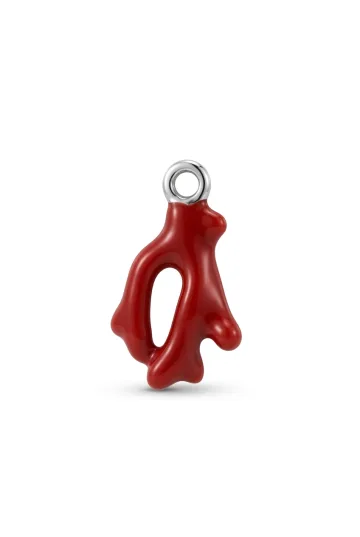
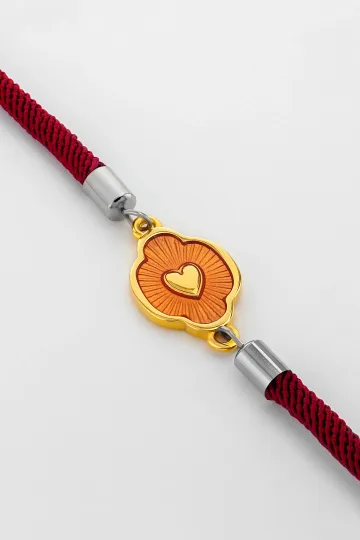
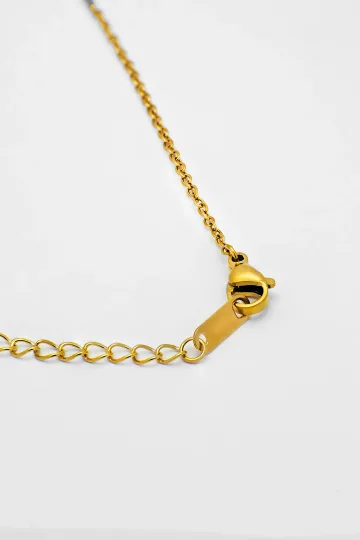
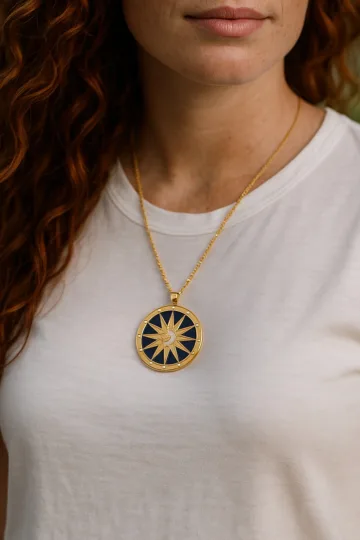
Wear the symbol, don't just read about it. These are in stock:


Types of Enamel on Jewellery
Hot Enamel (Vitreous Enamel)
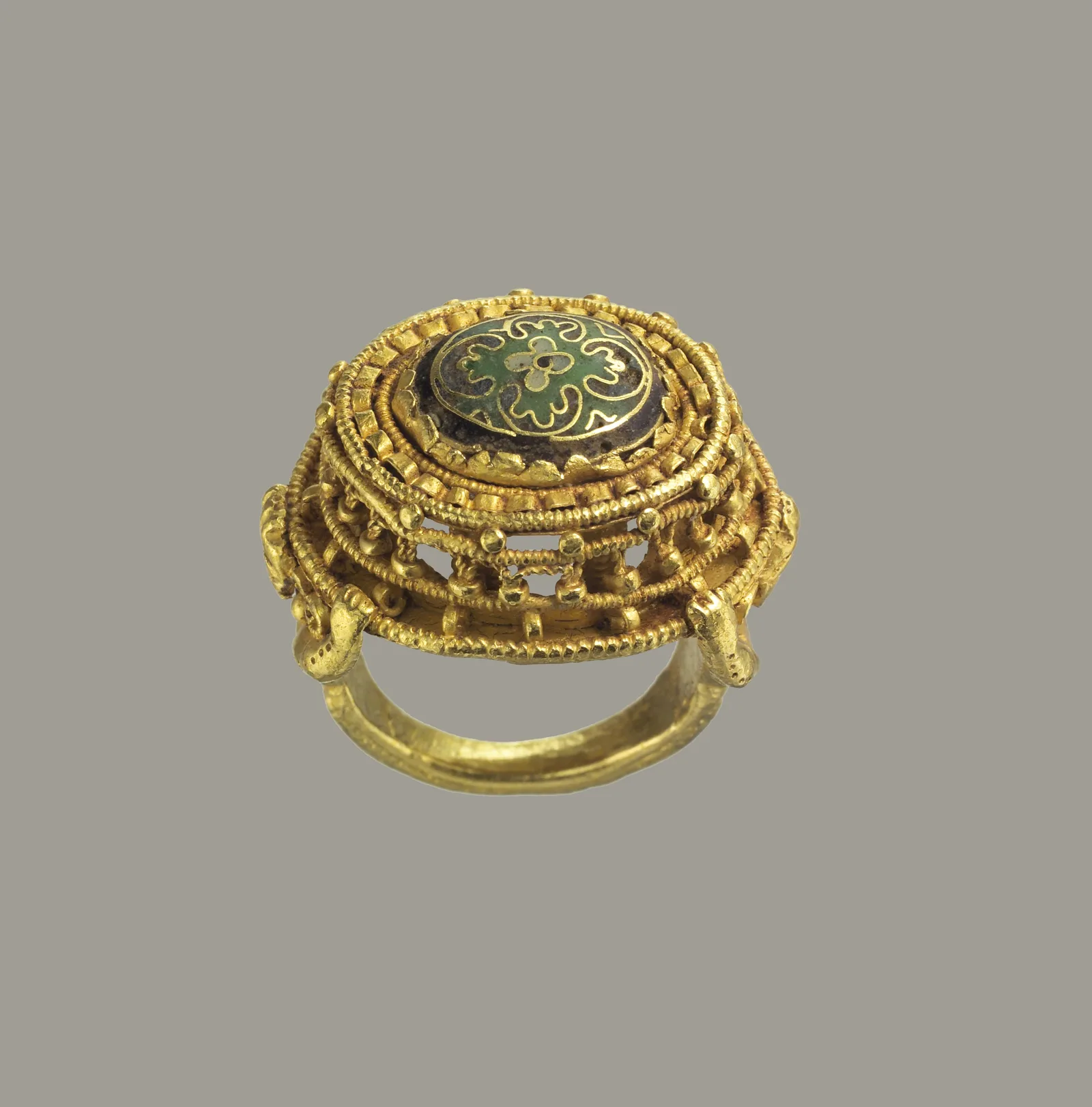
The classic. Glass powder is applied to metal and fired in a kiln at 700 to 900 degrees. The glass fuses with the surface, creating a monolithic coating. The most durable, the most long-lasting, the most expensive to produce.
Hot enamel is what you see on antique jewellery, religious icons, medals and orders. The coating does not dull, does not fade and does not peel with proper treatment. But it can still crack on impact.
What distinguishes hot enamel from everything else is the bond. The glass does not sit on the metal like paint on a wall. It fuses into it at the molecular level, which is why a hot enamel piece from the 13th century still has its colour intact. No lacquer, no polymer, no paint achieves that.
Cold Enamel (Resin Enamel)
Epoxy resin with colour pigment that cures at room temperature or with low heat (up to 150 degrees). Technically this is not enamel in the classical sense but a polymer coating. However, in commercial jewellery the term "enamel" is applied to both types.
Cold enamel is cheaper, simpler to produce and allows more vibrant, saturated colours. But it is softer than hot enamel, more prone to scratching and can yellow over time from ultraviolet light.
Most modern jewellery with coloured elements uses cold enamel. If a piece is affordable and has bright coloured details, it is almost certainly cold enamel.
The practical consequence: cold enamel needs more protection from UV and chemicals than hot enamel does. A cold enamel piece left on a sunny windowsill will show colour change within months. A hot enamel piece on the same windowsill will be unchanged in ten years.
Cloisonné (Partitioned Enamel)
A technique where thin metal strips (partitions) are created on the metal surface, and the spaces between them are filled with enamel. Each section is a different colour. The result is a mosaic effect with clear boundaries between colours.
Cloisonné is high jewellery art. Each partition is laid by hand. Firing occurs multiple times (after each layer of enamel). This is bespoke work, not mass production.
From a care perspective, cloisonné has a subtle advantage: the metal partitions protect each enamel cell from lateral impacts. A direct blow can still chip the enamel within a cell, but the risk of an impact spreading across the entire surface is lower than with a flat enamel coating.
Champlevé (Carved Enamel)
The opposite of cloisonné: not partitions on the surface, but depressions in the metal (carved, engraved or etched), which are filled with enamel. The metal surface remains higher than the enamel and serves as a "frame."
The advantage of champlevé is structural. The enamel is recessed into the metal like water in a pool. The raised metal edges act as a physical barrier against knocks. This is exactly why medieval champlevé objects from Limoges have survived centuries in good condition while other enamelled objects of the same era have not.
If you are choosing between pieces and durability is the priority, champlevé will outlast a flat-surface enamel application in the same conditions.
One loud enamel, the rest bare metal. Drape yourself in colour head to toe and you are a carnival float, not a look.
What to Wear Enamel With
Enamel hands you a colour ready to go, and that is both the fun and the catch. Here is what people actually ask me at fittings, sorted by occasion.
What do I wear enamel with every day? For everyday I recommend a single colour accent on a calm background: an enamel pendant or earrings over a white shirt, grey knit or denim. The quieter the clothing, the louder the colour reads. For an open neckline I suggest a mid-length pendant; under a high collar I choose earrings instead. Keep everything else in clean metal.
Does enamel work at the office? It does, if you keep it monochrome and dark: black, navy or burgundy in a restrained setting. A slim bracelet with an enamel inlay or quiet earrings add character without stealing the show. I suggest pairing them with dense textures: wool, gabardine, shirting cotton.
How do I build an evening look? Evening is where enamel opens up. I recommend a solid dress in a deep colour or black, and a bright enamel pendant becomes the centre of the look. For guilloché and painted enamel I choose soft lighting, since they play with shifting light. I drop any competing bright details: let there be one colour.
And for a special occasion? For a special occasion I choose cloisonné or plique-à-jour; that is a statement, not a detail. I suggest a spare outfit that does not argue with the piece. Tone on tone with the clothing it looks expensive; in contrast it catches the eye.
How do I layer enamel with other chains? When layering I place the enamel element at a middle length and frame it with plain metal chains above and below. Mixing metals is fine, but the enamel should echo at least one of them. In a stack of bracelets I keep one enamel piece and one or two thin metal ones, making sure they do not knock together.

Turn on your camera, pick earrings, a pendant or a ring, and see the piece on yourself in real time.
Switch items in one tap.
Everything runs in your browser: no photo or video is ever uploaded.
What Kills Enamel
Impacts
Enemy number one. Drop a ring on a tiled floor: chip. Bang a bracelet against a door handle: crack. Enamel is glass, and glass does not bounce.
Rings with enamel suffer the most (constant contact with surfaces). Earrings suffer the least (they hang freely, they do not strike anything). Pendants sit in between.
The physics here matter. A hairline crack on impact may be invisible at first. Over weeks of wear, as the metal flexes and temperature changes occur, that invisible crack widens. The chip you notice three months later began with a knock you have long forgotten.
Temperature Shocks
Enamel and metal expand at different rates. A sudden change (from a hot bath into the cold, from a sauna into a pool) creates stress at the boundary between enamel and metal. Microcracks are the first result. Visible cracks come next.
This does not mean you cannot go outside in winter. Everyday temperature changes are fine. Extreme ones (sauna then ice water, or a hot shower then stepping outside in sub-zero temperatures with your ring still on) are not.
The danger zone is rapid change, not temperature itself. Wearing enamel in winter is perfectly fine. Wearing it from a 90-degree sauna into a 10-degree pool is not.
Chemicals
Household chemicals, bleach, aggressive cleaning agents. All of these attack the enamel surface, especially cold enamel. Hot enamel is more resistant, but even it should not be washed in bleach.
Perfume, hairspray, sun cream: less aggressive, but with prolonged contact they can cloud the surface of cold enamel. The mechanism is solvent action on the polymer binder. Hot enamel is immune to this because glass has no polymer binder to attack.
Chlorinated pool water is a particular hazard. The chlorine attacks the adhesion layer between enamel and metal over time, which is why repeatedly swimming with enamelled jewellery accelerates delamination even without visible damage.
Abrasives
Hard brushes, polishing pastes, toothpaste (yes, people clean jewellery with toothpaste: do not do this with enamel). Any abrasive scratches enamel, and scratches on enamel are permanent. Polishing will not help: polishing a glass coating without specialist equipment is impossible.
This includes the fabric inside a jewellery drawer. If your jewellery is loose in a drawer lined with rough fabric, every time the drawer opens and closes, the fabric micro-scratches the enamel surface. Over a year of daily use, those micro-scratches accumulate into visible dullness.
Ultraviolet Light
Relevant for cold enamel. Prolonged exposure to direct sunlight can cause yellowing or clouding of the polymer coating. Hot enamel does not fear UV (glass does not fade from sunlight: cathedral windows have stood for centuries).
The practical threshold is higher than most people assume. Normal daylight through a window is fine. Direct sun for hours on end, summer after summer, will affect cold enamel. If you store jewellery on a windowsill for display, move the cold enamel pieces out of direct light.
How to Care for Enamel: The Rules
Cleaning Step by Step
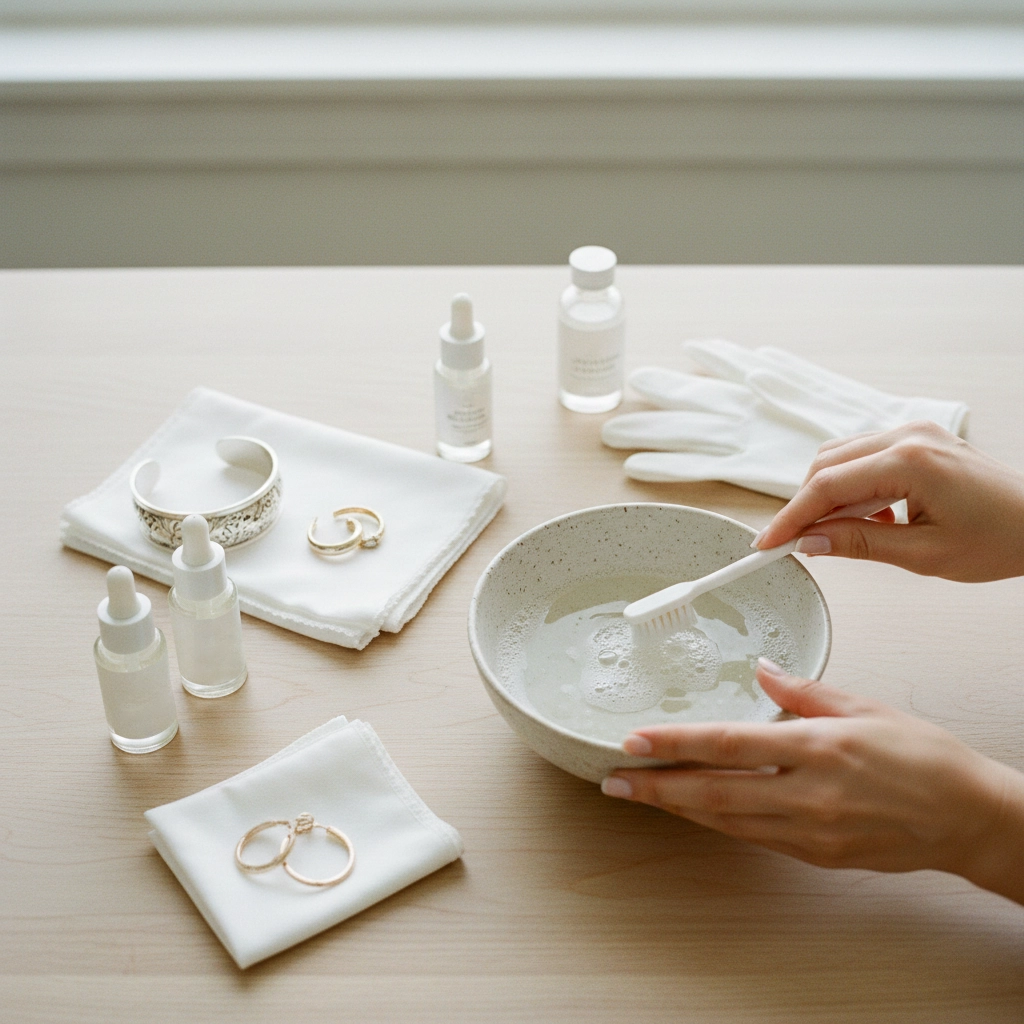
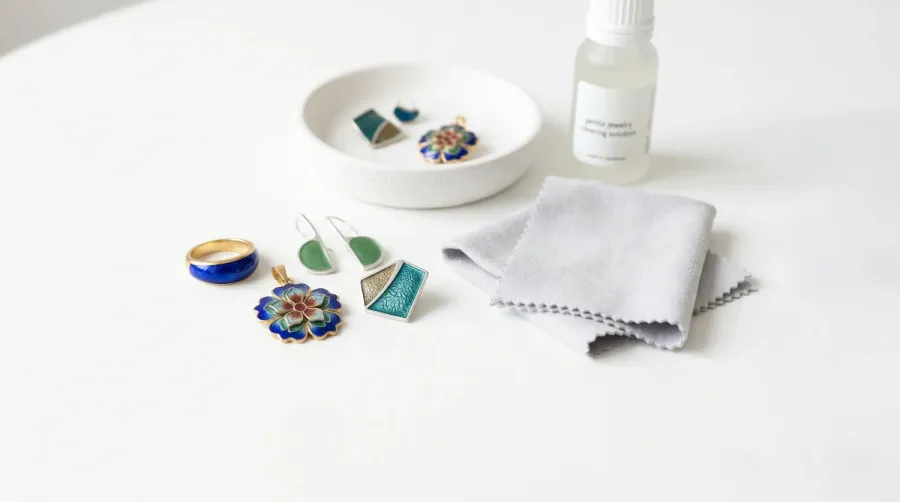
What you need. A microfibre cloth, a bowl of warm (not hot) water, and a single drop of mild soap: baby soap or an unscented dish soap. That is the entire toolkit.
Step 1. Add one drop of soap to the bowl and mix gently. The water should be warm to the touch, not hot.
Step 2. Dampen the microfibre cloth in the solution. The cloth should be moist, not dripping.
Step 3. Wipe the enamel surfaces with the damp cloth using gentle circular motions. Do not press hard. Do not scrub. The goal is to remove surface oil and dust, not to polish.
Step 4. Use a dry part of the same cloth or a second dry cloth to wipe away the soap residue. You can also briefly rinse the piece under a light stream of cool or lukewarm water. Do not soak. Rinse quickly and hold the piece so water flows off the enamel surface rather than pooling around the edges where enamel meets metal.
Step 5. Dry immediately and thoroughly with a soft dry cloth. Do not leave the piece to air-dry: water sitting in the seam between enamel and metal is exactly the scenario to avoid.
The whole process takes under two minutes. For pieces worn daily, weekly cleaning is sufficient. After contact with cosmetics or swimming (which you ideally avoid), clean immediately.
What not to do. Ultrasonic baths: the vibration creates micro-stress throughout the enamel layer and can cause cracking that is invisible at first. Steam cleaners: temperature shock. Chemical cleaning solutions for metal: they are formulated for metal, not for glass. Soaking: water penetrates through microscopic edge gaps and causes delamination over time.
Technique-Specific Cleaning Differences
Hot enamel pieces can tolerate slightly more vigorous wiping and a quicker rinse, because the glass-metal bond is stronger. Still use gentle motions: this is about tolerances, not rough treatment.
Cold enamel pieces need extra caution around the edges of the enamel zones. This is where the resin meets the metal and where delamination typically begins. Wipe these areas gently and dry them first.
Cloisonné pieces accumulate dust and oils in the seams between the metal partitions and the enamel cells. A cotton bud very lightly dampened with the soap solution can reach these seams. Do not probe deeply: you are cleaning the surface, not excavating.
Champlevé pieces are the most forgiving to clean. The recessed enamel is largely protected by the surrounding metal. Wipe the metal surfaces and the enamel with the same gentle motion.
Plique-à-jour pieces should be handled as the museum-quality objects they are. Use a dry microfibre cloth only, no water, no soap. If a plique-à-jour piece needs more than light dusting, take it to a specialist.
Storage
Separately from other jewellery. Metal scratches enamel. Enamel scratches enamel. Ideally in an individual soft fabric pouch or a compartment of a jewellery box with a soft lining.
Do not stack enamelled pieces. The weight of pieces on top presses on those beneath. One ring on another means scratches or chips.
The material of the pouch matters. Velvet is ideal: it is soft, does not shed, and provides slight cushioning. Rough cotton or synthetic fabric can still scratch over time. If your jewellery came in a branded cloth pouch, that is almost certainly the right material.
Temperature and humidity matter for storage too. A cold, damp bathroom cabinet is not ideal long-term storage for cold enamel. A dry, room-temperature drawer or jewellery box is correct.
Wearing
Put on last. After clothing, after makeup, after perfume. Contact with cosmetics equals contact with chemicals.
Remove first. Before a shower, before cleaning, before sport.
Do not wear in the kitchen. Steam, grease, washing-up liquid, impacts against crockery. The kitchen is a high-risk zone for enamelled jewellery.
Enamel rings. Remove during any manual work: washing up, cleaning, DIY, gardening. A ring receives impacts that a pendant never would.
At the gym. Remove all enamel pieces before any weight training or exercise involving equipment. The combination of sweat (mildly acidic, harmful to cold enamel over time), grip pressure on rings, and risk of dropping a weight onto a bracelet makes the gym a hostile environment for enamel.
Customer reviews
Zevira is a real jewellery shop. Genuine payments, deliveries and customer thank-yous.
🥰🥰🥰 gracias
Ok, ¡gracias! 🙂
Repairing Enamel: Possible or Not?
Small Chips
A jeweller can restore small chips in hot enamel through refiring. The colour may differ slightly from the original (each firing produces a slightly different shade), but for small defects the difference is minimal.
Cold enamel is simpler to repair: fill the chip with a fresh portion of resin in the same colour and let it cure. The result is less perfect (the boundary may be visible), but it works functionally.
The earlier you address a chip, the better the result. A small fresh chip repairs cleanly. A chip that has been worn for months develops secondary micro-damage around its edges, making the repair boundary larger and more visible.
Major Damage
If a large piece has broken off or a network of cracks has formed, it is a full rebuild. The old enamel is removed, the surface is prepared afresh, new coating is applied. It costs as much as a new piece, sometimes more. It only makes sense for items with sentimental or antique value.
DIY Repair
Not recommended. Superglue, nail varnish, hardware-shop epoxy: all of these are temporary "fixes" that look worse than the chip and complicate professional repair later.
The specific problem with superglue is that it migrates into the micro-cracks adjacent to the chip and cures there, making it impossible for a jeweller to cleanly prepare the surface for proper repair without enlarging the damage area.
When to See a Jeweller
See a jeweller if: the chip exposes bare metal (the enamel has lifted completely from the surface); if you see a crack that runs through the full depth of the enamel layer; or if the enamel is beginning to lift at an edge. These are progressive failures that will worsen with continued wear.
Advanced Enamel Techniques
Plique-à-jour
The most complex and magical technique. Enamel without a backing: transparent, like stained glass. Light passes through it completely. If regular enamel is a stained glass panel on a wall, plique-à-jour is a stained glass window.
Technically: the maker creates a framework of metal partitions, pours transparent enamel, fires it, then removes the temporary backing. What remains is a glass membrane held only by the metal framework. Each cell of enamel is unsupported from behind.
Plique-à-jour is incredibly fragile. Each glass cell is thinner than window glass. Pieces in this technique are museum-level. Wearing them daily is not recommended. If you own a pair of plique-à-jour earrings, you own something closer to wearable sculpture than jewellery in the ordinary sense.
Care for plique-à-jour is extreme: dry cloth only, no water, no chemicals, store individually in soft padding, and carry separately from other pieces in a rigid container to prevent the framework from flexing.
Basse-taille
A technique in which a relief is cut into the metal (engraving, chasing), and transparent or semi-transparent enamel is applied over the top. The relief shows through the glass layer, creating an effect of depth and shadow.
The visual result is extraordinary. The enamel itself appears to have dimension: lighter over the high points of the relief, deeper in the recesses. The piece seems to have an inner life that changes with the angle of light. Cleaning basse-taille requires extra care around the engraved areas, which can trap residue. The cotton-bud method described above is useful here.
Guilloche
A subtype of basse-taille with a mechanically applied pattern. A special lathe cuts the finest parallel lines, waves, spirals or "sunbeams" into the metal. Then transparent enamel is applied.
The pattern beneath the enamel creates iridescence: as the piece moves, the light catches different angles of the cut lines, producing a shimmer that no photograph can fully capture. This is why guilloche pieces from the early 20th century are so prized: the technique creates visual effects through pure geometry.
From a care perspective, guilloche behaves like basse-taille. The transparent enamel layer is actually thinner than in opaque enamel work, which means it is slightly more vulnerable to impact at its thinnest points.
Upload a photo of your pet, someone you love, or an object. We'll build a 3D model and hand-cast it in pewter.



The History of Enamel: From Mycenae to the Modern Day
Enamel is not a fashion-industry invention. It is one of the oldest jewellery techniques, more than three thousand years old.
The Ancient World
The earliest enamelled jewellery was found in Mycenaean tombs: 13th century BCE. Gold rings with blue and white enamel that lay in the earth for three millennia and look as though they were made last week. The best advertisement for hot enamel: thirty centuries of underground storage and the coating is intact.
The Celts brought enamel to the level of high art. Their red and blue champlevé enamel on bronze brooches and shields is a recognisable style still copied by jewellers today. The Roman historian Philostratus wrote with astonishment about these "barbarians beyond the ocean" who poured boiling colours into bronze and the colours "became as hard as stone." He was right to be astonished.
Byzantium
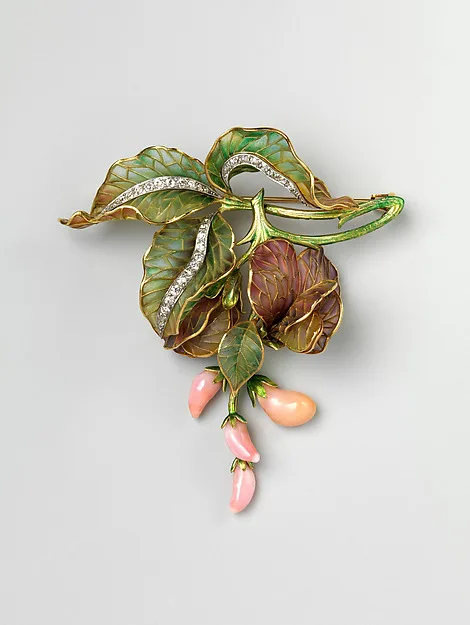
The Byzantine Empire raised enamel to the level of state art. Cloisonné became the signature technique of Constantinople. Icons, reliquaries, crowns, book covers: everything was covered in enamel with gold partitions. Byzantine enamel was valued like precious stones. Literally: in imperial inventories, enamelled icons were listed alongside rubies and sapphires.
When the crusaders sacked Constantinople in 1204, enamelled relics were carried across Europe, and European craftsmen began studying and copying the technique. The diffusion of cloisonné from Byzantium into Western Europe fundamentally shaped the history of medieval decorative art.
Limoges and Medieval Europe
The story of European enamel cannot be told without Limoges. The French city became the undisputed capital of enamel in the 12th century, and its influence reverberates to this day. Limoges craftsmen worked in champlevé enamel on copper: cheaper than gold but no less beautiful. Crucifixes, reliquaries, censers: all covered in bright blue, green and white enamel. Limoges enamel was exported across Europe and beyond.
By the 15th century, Limoges artisans had moved to painted enamel: enamel painting. This was no longer partitions or cavities but free painting with enamel colours on a metal plate. Portraits, biblical scenes, landscapes: everything that oil does on canvas, enamel did on copper. The names Leonard Limosin and Pierre Reymond stand alongside the great painters of their era in the history of French decorative art. And the result did not fade for centuries.
The Peak of Jewellery Enamel
The technique of guilloche enamel reached its peak in the workshops of master jewellers at the turn of the 20th century. First, the finest pattern was cut into the metal (engine turning), then a transparent layer of enamel was applied, through which the pattern showed. The result was depth, luminosity, iridescence that photography cannot capture.
The famous decorative eggs of this era represent the pinnacle of this technique. Up to 15 layers of enamel, each fired separately. A palette of more than 140 shades, many of which were kept secret. Some colour recipes are lost to this day.



Enamel Across Cultures
Chinese Cloisonné
Jingtailan: "blue wares of the Jingtai era." The technique came to China along the Silk Road from Byzantium in the 13th to 14th centuries and found an entirely new life. Chinese masters worked with copper (not gold, like the Byzantines), making the technique accessible for mass production. The hallmark of Chinese enamel is a riot of colour. Where Byzantine masters preferred deep blue and red, Chinese masters used dozens of shades in a single piece: turquoise, yellow, pink, green in combination.
Antique Chinese cloisonné pieces from the Qing dynasty still appear at auction and attract serious collector interest. Some are over two hundred years old, and the enamel still shines. This is a practical demonstration of what proper hot enamel with proper care achieves over time.
Japanese Enamel (Shippo)
Shippo: "seven treasures." The Japanese borrowed the technique from the Chinese but refined it to their signature minimalism. Fewer colours, more empty space, perfection in every line.
The wireless enamel technique (musen-shippo) produces colours that blend smoothly into one another without metal boundaries. The effect resembles watercolour frozen in glass. The Meiji period (late 19th century) was the golden age of Japanese enamel. The masters Namikawa Yasuyuki and Namikawa Sosuke created vases and jewellery now held in major museums worldwide.
Indian Enamel (Meenakari)
Rajasthan is India's enamel capital. Here the technique is called meenakari and is inseparable from local jewellery culture. Indian enamel is the reverse side of the jewellery: the front is inlaid with stones using the kundan technique, and the back is covered in bright enamel.
The philosophy behind this: the side that touches the skin should be beautiful for the person wearing it, not just for those looking. This says something interesting about the relationship between jewellery and its wearer: beauty as a private experience, not just a public one.
Spanish Enamel and the Albacete Tradition
Spain has its own enamel tradition, less internationally known than the French or Russian but rooted in centuries of skilled metalwork. Toledo was historically a centre of damasquinado: inlay of gold and silver into steel, sometimes combined with enamel. Toledo blades and decorative objects with enamel are collector pieces valued across Europe.
In contemporary Spanish craft, enamel has found a strong niche in artisan jewellery. The Albacete region, where Zevira is based, is historically known for fine metalwork: the city's knifemaking tradition demands the same precision that high-quality enamel application requires. The crossover between these craft disciplines is natural. The same craftsman who cuts steel cleanly applies enamel with the same exacting eye.
How to Buy Quality Enamel Pieces
Identify the Enamel Type
Ask the seller directly: hot enamel or cold? If the seller does not know, that is also information. Industrial mass-production pieces almost never use hot enamel. If the price is very low and the piece has bright even colour, it is cold enamel. If a maker tells you it is hot enamel and can describe the firing process, that is credible.
For pieces described as cloisonné or champlevé, you can usually verify the technique visually. Cloisonné will have visible metal partitions (fine raised lines separating colour zones). Champlevé will have the enamel sitting slightly below the surrounding metal surface.
Check the Application Quality
Good enamel: even surface without bubbles, without unpainted areas, without overflow beyond the design boundaries. Colour is uniform, deep, without bare patches. The boundaries between enamel and metal are sharp. In hot enamel, there is a slight depth to the colour, a glassy inner luminosity.
Poor enamel: visible air bubbles (round dots in the colour), uneven colour with thin spots, overflow onto the metal (enamel that ran over the boundaries and was not cleaned), rough surface texture. Any bubble or thin spot in new jewellery will become a chip point with wear.
Inspect the Edges
The most vulnerable point of any enamelled piece is where the enamel meets the metal at its edge. Run a clean fingertip very lightly along these edges. You should feel a smooth, even transition. If you feel a rough edge, a lifting point, or a micro-chip, the application quality is not high.
Consider the Metal Substrate
Hot enamel adheres best to copper, fine silver, and gold. On stainless steel, it is more technically demanding but achievable with proper preparation. If a piece is described as hot enamel on stainless steel, the maker has done more work than if the base is copper or silver: this is a marker of skill. Cold enamel adheres to any metal substrate provided the surface is properly prepared.
Think About How You Will Wear It
A pendant with enamel for every day: yes. A ring with enamel for every day: trickier (rings receive more impacts). Earrings with enamel: a safe option (they hang freely). A bracelet: moderate risk, depending on your lifestyle.
If you work with your hands, choose enamel on earrings or pendants. If you have a desk-based life and treat jewellery carefully, enamel rings and bracelets are manageable.
Leave your email, we'll send your discount code. No spam, unsubscribe anytime.
The code arrives by email, valid on your first order.
Enamel and the Arcana Collection
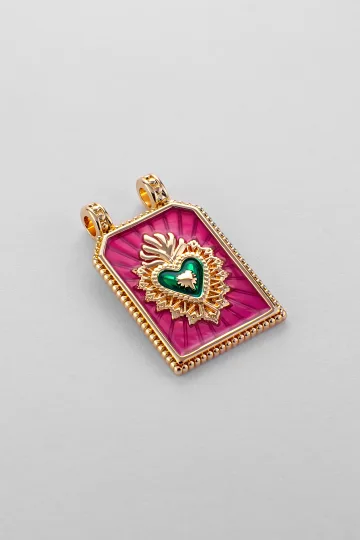
The Arcana collection by Zevira includes pieces with coloured enamel elements: tarot symbolism, mystical motifs, vivid accents on steel. The enamel here does not cover the entire piece but is used as a colour accent, filling specific design zones.
This means the majority of the piece is 316L stainless steel (maintenance-free), and the enamel elements are targeted. The practical takeaway: focus your care on protecting precisely those coloured zones, not the whole piece.
Tips for Arcana:
- Wear freely, but avoid impacts on the enamel zones
- Wipe with a soft cloth after wearing
- Store in the pouch from the package
Enamel vs Other Coloured Coatings
Enamel vs lacquer. Lacquer is the cheapest coloured coating. Applied, dried, peels within weeks. Enamel (even cold) lasts dozens of times longer. Visually, lacquer is flat; enamel has depth and volume. The glassiness is immediately visible once you know to look for it.
Enamel vs PVD. PVD gives colour through vacuum deposition. Harder than enamel, does not chip, but limited in colour range (black, gold, rose gold are the main ones). Enamel gives any colour, any shade, but is more fragile. For monochromatic pieces, PVD is often the better practical choice. For any colour other than black or metallic tones, only enamel delivers it.
Enamel vs anodising. Anodising works on titanium and aluminium. Creates colour through an oxide film rather than a coating. Tougher than enamel, but the colours are less saturated and limited to a specific range of pastels and mid-tones.
Enamel vs stone inlay. Stones give colour through individual elements. Enamel gives colour through area coverage. Stones can be replaced one by one. Enamel: only entirely. Different tools for different tasks. If the design calls for a large field of pure, saturated colour, enamel is the only serious option.
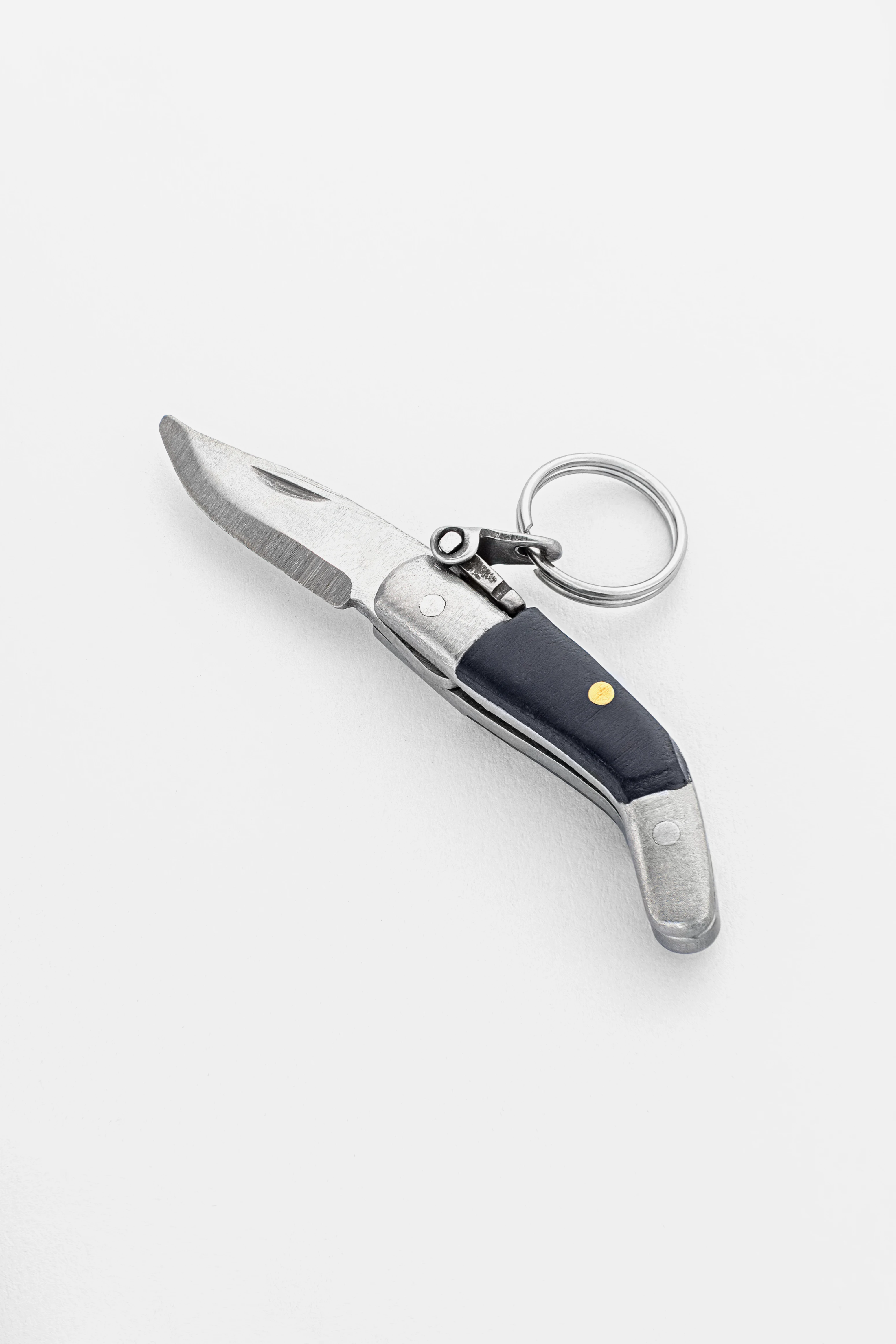
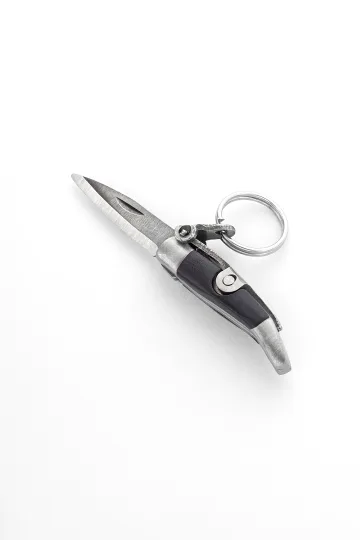
CAPAORA mini knife pendant
The 18th-century Spanish navaja in miniature: 40 mm of stainless steel, a real folding mechanism and a Palanquilla lock that clicks. An affordable gift to remember.
Authentic · Ships from Spain · 14-day returns
Travelling with Enamel Jewellery
Yes, you can travel with enamelled pieces, but with precautions. Transport them in separate pouches (not together in one heap). Do not place them in a suitcase without protection. Bear in mind the temperature changes in an aircraft hold: if your jewellery is in hand luggage, the temperature is stable.
A specific note for beach holidays: do not wear enamel jewellery at the beach. Sand is a natural abrasive, salt water is aggressive towards cold enamel, and hours of direct sun will affect colours. Leave enamel at the hotel and wear it for dinner. More in our jewellery travel tips guide.
The Environmental Angle
Hot enamel is one of the more environmentally friendly jewellery coatings. It is essentially glass: an inert, non-toxic material. Unlike some PVD processes that involve rare metals, or electroplating that uses cyanide-based solutions, enamel production uses relatively simple materials: silica, metal oxides for colour, and heat.
Cold enamel (resin-based) is less eco-friendly due to its polymer composition, but it is still far better than disposable lacquer coatings that peel and get replaced repeatedly. A single well-maintained enamel piece that lasts years generates less waste than a succession of lacquered items that need replacing every few months.
The longer any piece lasts, the smaller its per-year environmental footprint. Proper care of enamel is, among other things, an environmental act.
Enamel vs Jewellery Resin: What Is the Difference
Confusion between enamel and resin is common. Both give vivid colour. Both fill a shape. Both look similar in photographs. But the difference is fundamental.
Composition. Enamel (hot) is glass. Resin is polymer. These are different materials with different properties. Hot enamel is harder, more scratch-resistant, does not yellow. Resin is softer, more flexible, can yellow from sunlight.
Temperature. Hot enamel is created at 700 to 900 degrees. Resin cures at room temperature. The process is fundamentally different, and so is the result.
Durability. Hot enamel with proper handling will outlive its owner (and their grandchildren). Resin will not. After 5 to 10 years of active wear, resin can cloud, yellow, lose its gloss.
When resin is fine. For fashionable, seasonal pieces. For vivid accents worn for one season then changed. For costume jewellery and everyday items.
When you need enamel. For pieces you plan to wear for years. For gifts. For jewellery with sentimental value. For collectible pieces.
Cold enamel sits in between: it is an improved resin that is closer to hot enamel in durability but simpler in production.
Send a friend a discount code, they save on their first order.
Enamel in Men's Jewellery
Enamel is not exclusively women's territory. Historically, men's signet rings, cufflinks, medals and orders were covered in enamel. Modern men's bracelets and rings with enamel inserts are a continuation of this tradition.
The difference in approach: women's enamel is often multicoloured and decorative. Men's enamel tends to be monochromatic (black, dark blue, burgundy) and austere. An enamel insert on a men's ring or bracelet adds a colour accent without losing masculine character. Black enamel on a steel signet ring or dark blue on a chain bracelet: these are the details that distinguish a considered look from simply "I put on what was there."
Modern Enamel Trends
The Enamel Renaissance
Enamel is experiencing a revival. After decades when jewellery fashion focused on stones and minimalism, colour has returned. And enamel is the primary tool for colour in jewellery.
Major houses release enamel collections. Independent craftspeople create bespoke enamel pieces online. Korean and Japanese brands make extensive use of enamel in everyday jewellery. The trend has not gone away for several years, and this suggests it is here to stay.
Enamel in Everyday Jewellery
Previously, enamel was associated with something museum-like, fragile, "for going out." Today it is not. Steel bracelets with enamel inserts, pendants with coloured accents, earrings with enamel drops: this is everyday jewellery. The Arcana collection by Zevira is exactly an example of this approach: enamel not as "the whole thing" but as a vivid element within a steel construction.
This approach solves enamel's main problem: fragility. When enamel covers the entire piece, every impact is a potential chip. When enamel occupies only a protected design zone surrounded by metal, the risk decreases many times over.
Enamel and Colour Matching
Which enamel colours last best. Dark colours (black, dark blue, dark green) visually age more slowly: small defects are less noticeable. White enamel shows every scratch. Bright neon colours in cold enamel can lose saturation faster than dark ones. If durability is the priority, choose the dark palette.
Enamel as the sole accent. The golden rule: if you are wearing an enamelled piece with a vivid colour, let it be the main accent of the look. An enamel pendant with a red motif plus red earrings plus a red bracelet equals overload. An enamel pendant plus neutral earrings plus bare wrists equals style.
Layering with enamel. When layering chains, place the enamel element at the middle length: not the shortest (choker) and not the longest. It becomes the central accent, framed by simple metal chains above and below. For bracelets: an enamel bracelet plus one or two thin metal bracelets is stylish. Ensure the metal bracelets do not knock against the enamel surfaces.
FAQ
Can you get enamel jewellery wet? Brief contact with water: yes (washing hands, caught in the rain). Prolonged: no (shower, pool, sea). Water can penetrate through microcracks and cause delamination.
Does enamel fade? Hot enamel: no (glass does not fade). Cold enamel: it can yellow from UV over years. Store away from direct sunlight.
Can you wear an enamel ring every day? You can, but with care. Remove during manual work. Rings receive more impacts than any other piece of jewellery.
Why does my piece have cracks even though I did not drop it? Temperature changes. Enamel and metal expand at different rates. Microcracks can appear from everyday temperature fluctuations, but visible cracks usually come from sharp changes.
How much does enamel repair cost? A small chip costs about the same as a standard jewellery repair. A full rebuild can exceed the cost of a new piece. It depends on the enamel type, design complexity and the jeweller.
Hot or cold enamel: which is better? Hot is stronger and more durable. Cold is brighter and cheaper. For everyday jewellery, hot is preferable. For fashionable, seasonal pieces, cold is fine.
Can you polish a scratch on enamel? No, not at home. A jeweller can lightly sand the surface, but this reduces the coating thickness. Better to prevent scratches than to treat them.
How do I tell hot enamel from cold when buying? Visually it is difficult, especially from photographs. Hot enamel usually has slightly more depth and a "glassy" quality; cold enamel may be brighter and more plastic-looking. The most reliable method is to ask the seller. If the seller does not know what type of enamel they are selling, that is also information (it is most likely cold).
Which colours of enamel are the most durable? Dark colours (black, dark blue, dark green) visually age more slowly because minor defects are less visible. White enamel shows every mark. Bright neon colours in cold enamel may lose saturation faster than dark ones. If longevity is the priority, choose the dark palette.
Is enamel on stainless steel normal? Yes. 316L stainless steel is an excellent base for enamel. Steel is strong, does not rust, requires no care. An enamel element on a steel piece is the best of both worlds: the metal works without fuss, and the enamel adds colour and character. This is exactly the approach the Arcana collection uses.
Does enamel jewellery make a good gift? It is ideal. Enamel gives what a plain metal piece cannot: a specific colour. And colour is personalisation. Blue because it is her favourite colour. Green because it reminds her of the sea. Red because of passion. A metal piece says "beautiful." An enamel piece says "I chose this specifically for you." More on gifts in our gift guide.
Can I use an ultrasonic cleaner on enamel? No. Ultrasonic cleaners work by creating high-frequency vibrations in the liquid. Those vibrations are excellent for loosening debris from metal settings, but they create micro-stress throughout a glass coating and can cause cracking that is invisible initially and catastrophic over time.
What is the difference between enamel and resin jewellery? Enamel (hot) is glass fired at high temperature. Resin is polymer cured at room temperature. Hot enamel lasts indefinitely with proper care. Resin typically clouds or yellows within 5 to 10 years of regular wear.
My enamel looks dull but has no chips. What happened? Most likely: contact with chemicals (perfume, cleaning products), fine scratches from abrasive storage, or UV exposure (for cold enamel). A gentle clean with soap and water sometimes restores the gloss. If the dullness remains after cleaning, it is either surface micro-scratches (permanent, but only visible up close) or UV yellowing (also permanent).
Silver and gold jewellery, wedding bands, symbolic pendants, paired sets.
Buying it as a gift? Each one arrives ready to give.
 A branded Zevira box and a little card come with every order.


Final Thoughts
Enamel is jewellery for those ready for conscious handling. It is not "put on and forget" (stainless steel is for that). It is "put on, enjoy, carefully remove, put in the pouch."
For three thousand years, enamel has travelled from Mycenaean tombs to social media. Techniques have changed, cultures have adopted and transformed them, but the essence remains: glass fused with metal creates colour that exists nowhere else. Byzantine masters, the great jewellers of the past and modern craftspeople work with the same material, and each time the result is unique.
The care is minimal. The attention is targeted. And the reward far outweighs the small effort required.
A final thought on choosing between enamel types. If you are buying for longevity: for a piece you want to pass down, a gift with lasting meaning, or a signature piece in your collection: invest in hot enamel. The upfront cost is higher, but the decades of wear justify it many times over. If you are buying for fun, for a seasonal colour pop, for variety in your jewellery rotation: cold enamel is perfectly fine. Just know the care rules and follow them.
The reward is colour, depth and beauty that no other coating provides. Enamel is the only jewellery material that gives true, lasting, deep colour without stones. Is it worth the extra five seconds of care? People who wear enamel jewellery usually answer yes.
About Zevira
Zevira makes jewellery in the artisan tradition of Albacete, Spain. Enamel in our collections is a deliberate choice, not random decoration: small spots of colour on steel and silver, set into metal that shields the fragile glass from knocks.
What you can find with enamel at Zevira:
- The Arcana collection with tarot symbolism and mystical motifs in coloured enamel
- Pendants with enamel accents on a protected 316L steel base
- Bracelets with enamel inserts in a monochrome palette (black, navy, burgundy)
- Earrings with enamel drops: the safest way to wear a fragile coating
- Rings with spot enamel placed in protected zones of the design
- Pieces in both hot and cold enamel for different ways of wearing
Every piece can be personalised with engraving, with the option of personal engraving. Sterling 925 silver and 14 to 18K gold.