Enamel Jewelry: The Complete Guide to Styles, Care and Choosing Your Piece
Enamel jewellery is everywhere right now. Scroll through any fashion feed and you'll spot rings, pendants and earrings covered in vivid colour. It feels like a new trend. But it's not. People have been fusing glass to metal for over three thousand years.
What changed is accessibility. You no longer need to commission a master craftsman in a Parisian atelier. Today you can find beautifully made pieces at prices that make sense for everyday life. The catch? Not all enamel is created equal, and not every piece will survive daily wear.
This guide covers everything you actually need to know: what this technique is, how to tell good work from bad, how to care for your pieces, and how to wear them without looking like a Christmas tree. No sales pitch, just practical information.
What Is Enamel Jewelry
At its core, enamel is powdered glass fused onto a metal surface. That's really it. The glass powder gets heated until it melts and bonds to the metal, creating a smooth, coloured coating that can last for centuries if done properly. The technique has been around since the Bronze Age. Ancient Egyptians used it. Byzantine craftsmen perfected it. Art Nouveau designers turned the material into high art.
The reason it keeps coming back is simple: nothing else gives you that depth of colour on metal. Paint chips. Plating wears off. This coating, when properly applied, becomes part of the metal itself.
Hot enamel vs cold enamel: the real difference
This is the most important distinction, and most guides get it wrong or skip it entirely.
Hot enamel (also called vitreous enamel) is real glass powder fired at 750 to 850 degrees Celsius. At those temperatures the glass melts and fuses permanently with the metal base. The result is incredibly durable, scratch-resistant and vibrant in colour. A piece made with this technique from the 1920s can still look as vivid as the day it was made.
The downside: hot enamel is expensive to produce. It requires skilled labour, specialised kilns, and metals that can handle extreme heat (copper, gold, silver). Mass production is difficult; the full firing-and-casting cycle is described in the article on how jewellery is made.
Cold enamel is actually not the real thing at all. It's a resin-based compound that cures at room temperature or with UV light. The industry calls it enamel because it looks similar, but the chemistry is completely different. No glass, no firing, no fusion.
Cold enamel is what you'll find in most affordable jewellery, and that's not necessarily a bad thing. Modern formulations are much better than they were ten years ago. A well-made piece with this finish can look stunning and last for years with proper care. Just know what you're buying.
A brief history of enamel
The timeline is worth knowing because it puts the current trend in perspective.
Around 1500 BCE, Mycenaean craftsmen fused coloured glass onto gold. Egyptian artisans refined the technique over the next thousand years. Byzantine workshops produced some of the finest enamel work in history, pieces that survive in museums today with colours as vivid as the day they were made.
In medieval Europe, Limoges in France became the centre of champleve enamel production, supplying churches and noble houses across the continent. Some of those reliquaries and altar pieces still glow after 800 years.
The Art Nouveau period (1890-1910) brought an enamel renaissance. Artists like Rene Lalique created pieces where enamel was not just decoration but the primary material, translucent layers over carved metal, depicting dragonflies, orchids, and flowing water. These are among the most valuable jewellery pieces in the world today.
After a mid-20th-century decline, enamel came roaring back in the 2010s, driven by social media's appetite for colour and the improvement of cold enamel formulations that made the look accessible at every price point.
Why enamel became the material of the decade
Three things happened at once. First, people got tired of minimalism. After a decade of plain gold bands and tiny diamond studs, colour felt like a breath of fresh air. Second, social media rewarded bold, photogenic jewellery. A plain silver ring doesn't stop anyone's scroll. A cobalt blue ring with this decorative layer does. Third, manufacturing got better. Techniques that used to require a master artisan can now be replicated at scale without sacrificing too much quality.
There's also a cultural shift. Jewellery used to be about status. Now it's about expression. This technique lets you say something with colour and pattern that metal alone can't.




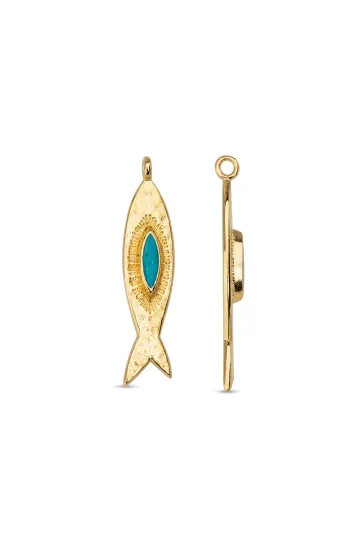
Types of Enamel Techniques
Not all enamel work looks the same, and that's because there are several distinct techniques. Knowing them helps you understand what you're looking at and what the piece is worth.
Cloisonne: the ancient art
Cloisonne is probably the oldest and most recognisable enamel technique. The name comes from the French word "cloison" meaning partition. Thin metal wires (usually gold, silver or copper) are bent into shapes and soldered onto the metal base, creating tiny cells. Each cell gets filled with coloured glass powder and fired.
The result is a mosaic-like surface where metal lines separate fields of colour. Think of stained glass windows, but on a ring.
Cloisonne requires serious skill. Every wire must be bent by hand, every cell filled precisely. That's why genuine cloisonne pieces tend to be expensive. If someone is selling "cloisonne" earrings for five euros, they're using a printed or stamped imitation.
Champleve: carved and filled
Champleve takes the opposite approach. Instead of building up walls on the surface, the craftsman carves or etches recesses directly into the metal. These cavities get filled with the material and fired.
The effect is different from cloisonne. Champleve pieces feel more substantial because the coating sits within the metal rather than on top of it. The technique works especially well for bold, graphic designs where you want large areas of colour.
Historically, champleve was huge in medieval Europe. Limoges in France became the centre of production in the 12th century, and some of those pieces survive in museums today, still bright after 800 years.
Painted enamel: miniature art on metal
This is the most painterly technique. Instead of filling cells or cavities, the artist paints directly onto the metal surface using glass-based pigments, building up layers and firing between each one.
The best painted enamel work is genuinely miniature painting. Portraits, landscapes, floral compositions. Some pieces have ten or more layers, each fired separately.
You won't find this style in everyday jewellery. It's too labour-intensive and too expensive. But knowing it exists gives you context for why enamel is considered a serious art form, not just a decorative technique.
Modern resin enamel: accessible beauty
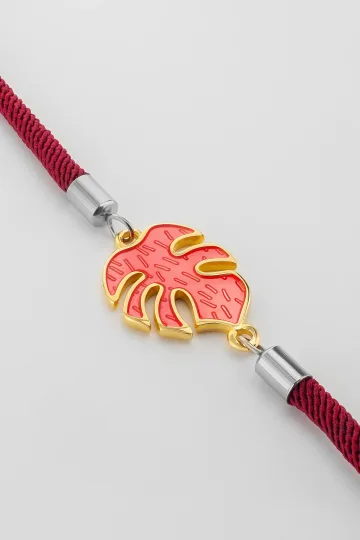
This is what most of us are actually buying and wearing. Modern resin-based coating (cold enamel) uses epoxy or UV-cured resin mixed with pigments. It's applied at room temperature, cured quickly, and can be produced at scale.
The quality range is enormous. At the bottom you get cheap pieces where the finish chips within weeks. At the top you get beautifully crafted work that's hard to distinguish from hot enamel without close inspection.
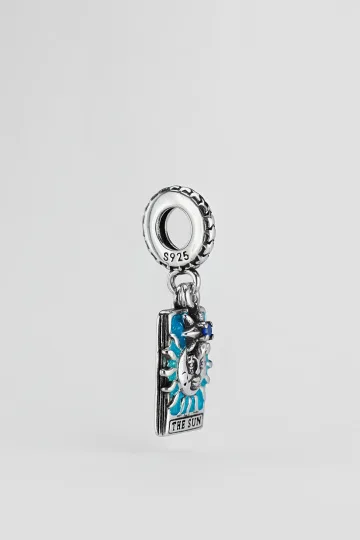
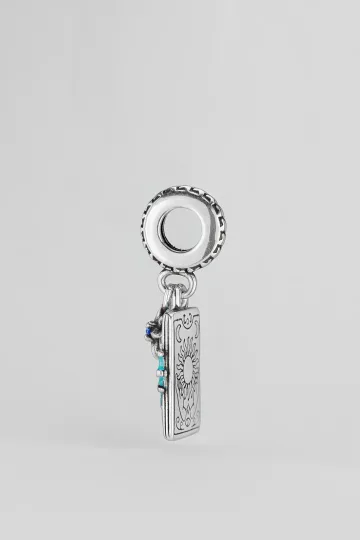
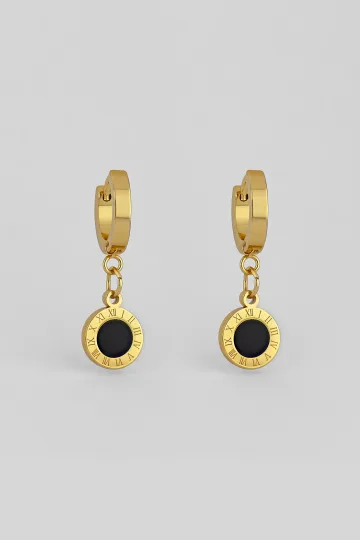
What to look for: smooth, even surface with no visible bubbles. Colours that are consistent, not patchy. Edges where the coating meets the metal should be clean and tight, not ragged.





How to Choose Enamel Jewelry That Lasts
Buying enamel jewellery is different from buying a plain gold chain. With a chain, you're mostly judging metal quality. With this technique, there's a second layer: the quality of the coating itself. Both need to be good.
Base metal matters: gold plated vs brass vs stainless steel
The metal under the decorative layer determines three things: durability, skin compatibility, and long-term appearance.
Gold plated stainless steel is probably the best option for everyday enamel jewellery. Stainless steel doesn't corrode, doesn't cause allergic reactions for most people, and provides a solid, stable base for the coating. The gold plating adds warmth and richness to the look.
Gold plated brass is common and can look excellent, but brass is softer and more prone to tarnishing over time. If the plating wears through (and it will eventually), you might see greenish discolouration. Not harmful, but not pretty.
Pure brass or copper without plating is fine for statement pieces you wear occasionally, but not ideal for everyday rings or bracelets that get constant contact with skin and water.
"Metal alloy" or "base metal" with no further specification is a yellow flag. It might be perfectly fine, or it might contain nickel (which causes reactions in about 10-15% of people). If a seller won't specify the metal, be cautious.
What to check before buying
Hold the piece (or zoom into photos if buying online) and look for:
- Surface quality: Should be smooth and even. Bumps, pits or visible bubbles mean sloppy application.
- Colour consistency: The colour should be uniform across the piece. Patches of lighter or darker colour suggest uneven application or poor pigment mixing.
- Edges: Where the coating meets metal should be a clean line. Material that overflows or leaves gaps is a sign of rush production.
- Weight: Good enamel jewellery has a satisfying weight. If it feels like plastic, the metal base is too thin.
- Closure mechanisms: Clasps, posts, and hooks should work smoothly. The best decorative work is wasted on an earring post that bends after two wears.
Red flags: when cheap means fragile
There's nothing wrong with affordable jewellery. Some of the best pieces we've seen cost under fifty euros. But there is a price floor below which quality becomes impossible.
If a fully coated ring costs three euros, something was cut. Maybe the metal is paper-thin. Maybe the finish is just paint. Maybe the plating will last a month.
Other warning signs: a surface that feels rough to the touch (should be glass-smooth), visible seams in the metal, and sellers who describe their products with every buzzword imaginable but won't answer specific questions about materials.
How to Care for Enamel Jewelry
Enamel is tougher than most people think, but it's not indestructible. A few simple habits will keep your pieces looking fresh for years; the full routine is laid out in the dedicated guide on enamel jewellery care.
Daily wear rules
The golden rule: put jewellery on last, take it off first. Apply perfume, sunscreen and hand cream before putting on your pieces. Let everything dry. These products contain chemicals that won't destroy the finish overnight but will dull it over time.
Take your rings off before washing dishes, gardening, or hitting the gym. Not because water is the enemy (it's not), but because impacts and harsh chemicals are. Banging a ring against a dumbbell is the fastest way to chip the coating.
Swimming in chlorinated pools? Take it off. Chlorine is aggressive and can damage both the decorative layer and the metal plating underneath.
Cleaning: what works, what destroys
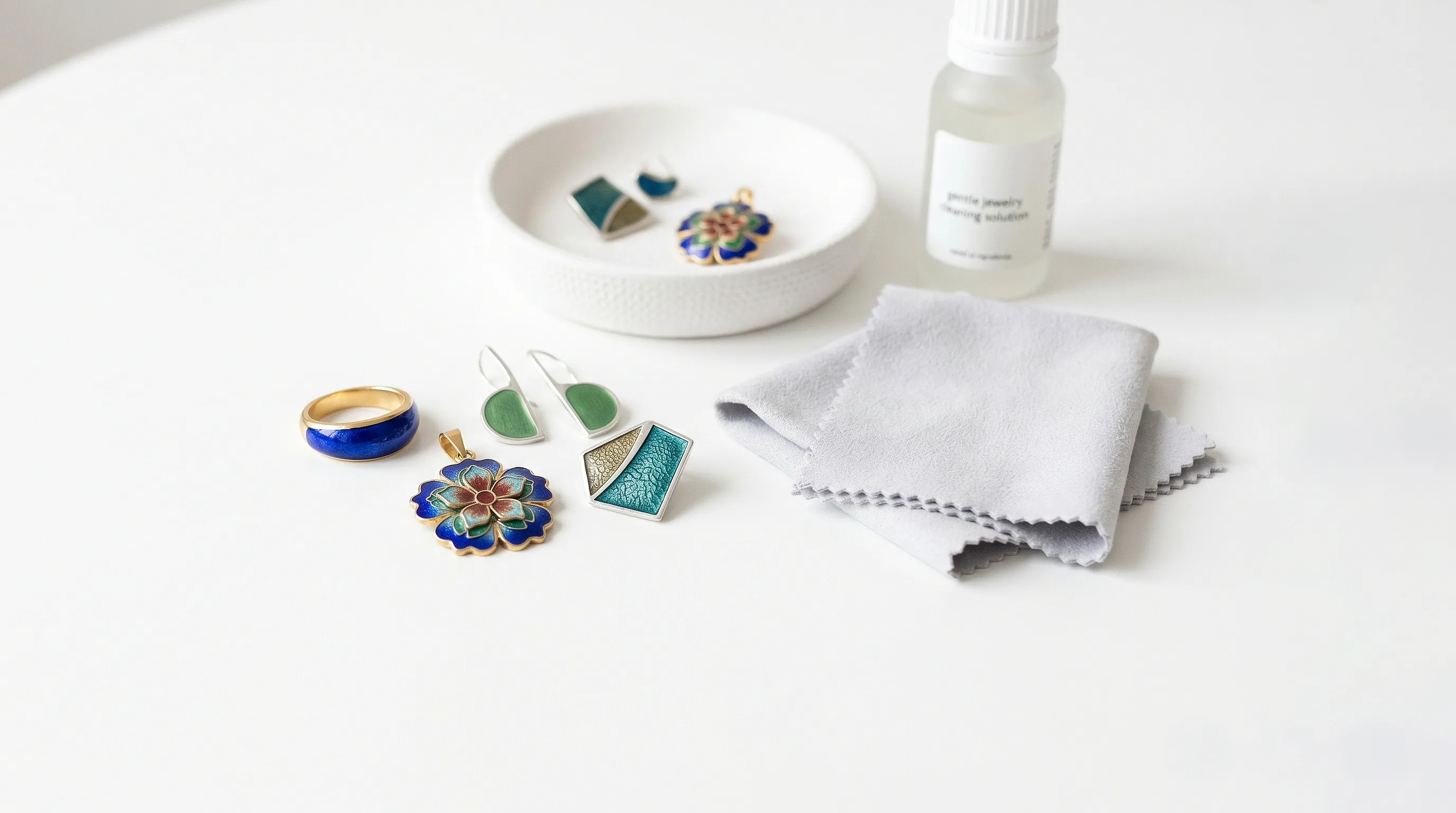
Do this: Wipe with a soft, slightly damp cloth after wearing. That's it. For most pieces, this is all the cleaning you need.
For deeper cleaning, use lukewarm water with a tiny drop of mild dish soap. Gently clean with a soft cloth (not a brush), rinse, pat dry immediately. No soaking.
Never do this:
- Ultrasonic cleaners. The vibrations can crack the coating.
- Jewellery dips or chemical cleaners. They're designed for metal, not glass-based finishes, and can strip colour or cause cloudiness.
- Toothpaste. Yes, people still recommend this. It's abrasive and will scratch the surface.
- Hot water. Thermal shock can cause micro-cracks in vitreous work.
Storage mistakes everyone makes
Tossing all your jewellery into one box is the number one killer. Coated pieces rubbing against each other (or against metal pieces) leads to scratches and chips. Always store enamel jewellery separately, ideally in individual soft pouches or compartments.
Keep them away from direct sunlight. UV exposure won't damage vitreous finishes, but it can fade cold enamel and resin over time. A drawer or a closed jewellery box is better than an open display stand by the window.
Humidity control matters too. Too dry and metal can become brittle. Too humid and you get tarnishing on the metal parts. A normal bedroom environment is usually fine.
Styling Enamel Pieces
This is where enamel really shines. Unlike plain metal jewellery that blends into your outfit, coloured pieces make a statement. The trick is making that statement intentional, not accidental.
Layering with enamel
Layering works beautifully with this style, but there's a rule: let one piece be the star. If you're wearing a bold enamel pendant, keep your earrings simple. If the earrings are the statement, tone down the necklace.
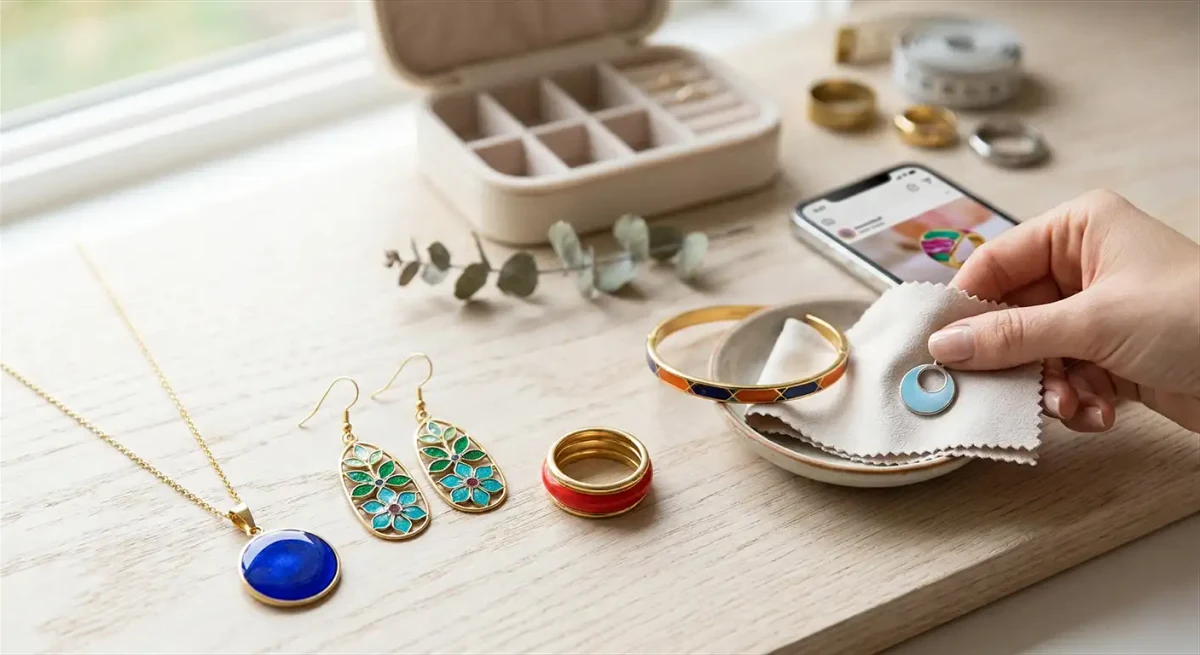
Mixing enamel with plain metal creates great contrast. A stack of thin gold bracelets with one coloured piece in the middle draws the eye without overwhelming. Two or three pieces in different colours can work together if they share a colour family (blues and greens, reds and oranges).
What doesn't work: wearing four different coloured pieces in four clashing colours with four different patterns. That's not layering. That's a craft store explosion.
Seasonal styling with enamel
Spring/Summer: Lighter enamel tones work beautifully. Turquoise, coral, soft green, and sky blue feel fresh against sun-warmed skin. These are the pieces that photograph well on a terrace or at a beach cafe. Pair with linen, cotton, and natural fabrics.
Autumn/Winter: Deep, rich tones come into their own. Burgundy, forest green, navy, and black enamel against wool sweaters and leather jackets. The colours feel warmer in low light and complement the season's palette of earth tones and darks.
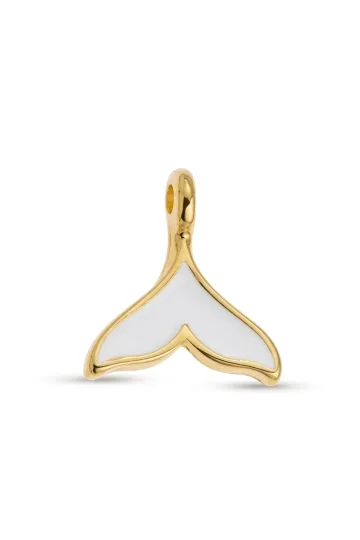
Year-round: Black, white, and metallic enamel tones are seasonless. A black enamel ring works in July and January. A white enamel pendant reads as clean and modern regardless of what is outside the window.
Matching colours without looking costume-y
The "costume jewellery" look happens when colours are too perfectly matched. If your earrings are the exact same shade of red as your dress, it can feel like a uniform. Instead, aim for colours that complement rather than match.
Wearing a navy outfit? Try pieces in deep teal or cobalt rather than navy. A black dress works with almost any colour, which is why black is the easiest base. White and cream outfits pair beautifully with soft tones: dusty blue, sage green, blush pink.
Metallic tones (pieces that combine the coating with visible gold or silver) are the most versatile. They bridge the gap between bold colour and traditional jewellery, making them safe for office wear, formal events, and everyday.


FAQ
Is enamel jewellery waterproof? The coating itself is water-resistant, not waterproof in the technical sense. Brief contact with water during handwashing is fine. The real risk comes from prolonged soaking or chlorinated water, which can damage the metal base and weaken the bond between the finish and metal over time.
How long does enamel jewellery last? Hot enamel can last for decades, even centuries if you look at museum pieces. Cold varieties (resin-based) typically last 3 to 10 years with proper care. The lifespan depends heavily on how you store the piece, how often you wear it, and whether you follow basic care rules.
Can I shower with enamel jewellery on? It is best to take it off. Occasional exposure to shower water probably will not destroy your piece, but soap, shampoo and hot steam create conditions that wear down both the glass surface and the metal plating underneath. Making it a habit shortens the life of your jewellery significantly.
What is the difference between enamel and resin jewellery? True enamel is glass powder fused to metal at high temperatures. Resin is a polymer compound that cures at room temperature. Many pieces sold as "enamel" are actually resin. Resin is lighter, less scratch-resistant and more prone to fading, but modern formulations have closed the visual gap considerably.
Does enamel chip easily? Quality enamel is surprisingly tough in normal conditions. Chipping usually happens from impacts, like dropping a ring on tiles or banging a bracelet against a hard surface. Thin layers and cheap production increase the risk. Hot enamel is more chip-resistant than cold varieties.
Can chipped enamel be repaired? Small chips in hot enamel can sometimes be repaired by a skilled jeweller who refires the piece. Cold varieties are easier to fix with colour-matched resin, though the repair may be visible up close. For deep or widespread damage, repair is often not cost-effective on affordable pieces.
Is enamel jewellery safe for sensitive skin? The coating itself is inert and rarely causes reactions. Skin sensitivity issues usually come from the metal base, not the decorative layer. If you react to nickel, choose pieces with a stainless steel base. The surface that touches your skin is essentially glass, which is hypoallergenic.
Does sunlight fade enamel colours? Hot enamel (vitreous) is extremely colour-stable and will not fade in sunlight. Cold varieties and resin-based pieces can lose vibrancy with prolonged UV exposure. If you want your colours to stay vivid, store pieces in a closed box and avoid leaving them on windowsills or in direct sun for extended periods.
Enamel as a Gift
Enamel jewellery makes an excellent gift, for one simple reason: colour is personal. Giving someone an enamel ring in their favourite colour shows you paid attention, and adding an engraving on the metal back makes the piece literally one of one. That distinguishes enamel from plain gold or silver, which fits universally but says nothing specific about the recipient.
What to consider when gifting:
Know the recipient's skin tone? Warm undertones harmonise with warm enamel colours on gold bases. Cool undertones look better with cool enamel tones on silver or steel bases. When in doubt: dark enamel colours (cobalt blue, forest green, black) work on almost every skin tone.
Know their style? Someone who wears minimalist clothing will appreciate a single enamel ring more than an opulent set. Someone who loves colour will enjoy bold earrings.
Packaging matters. Gift enamel jewellery in a soft individual pouch or a lined box. Not loose in a paper bag. The surface is scratch-sensitive, and the first impression counts.
Enamel and Metal: Which Combination for Which Purpose
The choice of base metal affects not just durability but also the aesthetic impact of the enamel.
Enamel on copper is the most classic combination for hot enamel. Copper has the right expansion coefficient: it expands under heat similarly to glass, making the bond particularly stable. That is why museum pieces from Byzantine times are still intact. Copper under transparent enamel creates a warm, luminous depth that no other metal can offer.
Enamel on gold is the premium segment. Gold does not react, does not tarnish, and gives the enamel a warm undertone. 18-karat gold and higher is used for hot enamel. The combination is stable, beautiful, and extremely durable. Also extremely expensive.
Enamel on stainless steel is the modern choice for everyday jewellery. Steel provides a solid, corrosion-resistant base. Cold enamel on stainless steel is the most common combination in affordable jewellery and works excellently when well made.
Enamel on brass is widespread and attractively priced. The challenge: if the enamel gets a scratch and water seeps in, the brass underneath can tarnish. That creates dark spots under the enamel that cannot be removed without damaging the coating. That is why edge sealing on brass enamel is particularly important.
Identifying Enamel: The Fire Test
How do you tell whether a piece is real hot enamel or resin? Without a lab it remains difficult, but there are clues.
Weight. Hot enamel is heavier. Glass is denser than resin. Two equally sized pieces, one hot enamel, one cold: the hot enamel piece feels more substantial.
Sound. Tap the surface with a fingernail. Hot enamel sounds bright and glassy, like porcelain. Cold enamel sounds duller, more plastic-like.
Temperature. Hot enamel feels cooler when you first touch it. Glass conducts heat differently than resin.
Edges. With hot enamel, the edge where enamel meets metal is often slightly rounded (ground and polished). With cold enamel, the edge can be sharp or slightly irregular.
Price. Genuine hot enamel under fifty euros is suspicious. The technique is too labour-intensive for bargain pricing.
None of these indicators is proof on its own. But together they give a good picture. And honestly: for daily life, the distinction matters less than the quality of workmanship. A well-made cold enamel piece beats a poorly made hot enamel piece any day.
Enamel and Travel: Practical Tips
Enamel jewellery on the road needs a bit more attention than plain metal pieces.
In a suitcase. Wrap each enamel ring or pendant individually in a soft cloth or small pouch. Enamel pieces knocking against each other in a jewellery bag get chips. This happens exactly once, and then you are annoyed.
At the beach. Enamel and salt water do not get along well. The salt crystals that remain on the surface after drying can dull cold enamel over time. Remove enamel jewellery before swimming. If it gets wet anyway: rinse immediately with fresh water and pat dry.
Sunscreen. One of the biggest enemies of enamel jewellery on holiday. The chemical UV filters in sunscreen can cloud cold enamel and weaken the bond between the coating and metal. Put on jewellery after sunscreen has fully absorbed.
Climate changes. Going from an air-conditioned hotel lobby to tropical heat: the temperature change can cause micro-cracks in hot enamel. With cold enamel it is less critical but also not ideal. Generally: avoid extreme temperature swings.
Repairing Enamel: What Is Possible
Small chips in hot enamel can sometimes be repaired by a skilled jeweller through refiring. This requires a specialist workshop with the right kiln and the right experience.
Cold enamel damage is easier to fix. A colour-matched resin is filled into the damaged area and cured. The repair is visible up close but barely noticeable from conversation distance. For cheap fashion jewellery, the repair is often not worth it, since the effort exceeds the price of the piece. For sentimental pieces, it is worth every minute.
A tip for the DIY-minded: nail polish in a matching colour can serve as an emergency fix for tiny chips. Not perfect, but better than a visible metal spot in the enamel surface. Clean and degrease the area before application, apply the polish thinly, and let it dry completely.
Enamel in Daily Life: Realistic Expectations
An honest word to finish. Enamel jewellery is robust but not indestructible. Realistic expectations help avoid disappointment.
Hot enamel lasts decades with normal treatment. You can wear it daily, and after ten years it looks the same as on day one. Provided you do not regularly bang the ring against hard surfaces.
Cold enamel lasts 3 to 10 years with good care. That is an honest range. At the lower end are cheap pieces regularly exposed to water, sunscreen, and friction. At the upper end are quality pieces carefully handled and properly stored.
What happens when enamel ages? With hot enamel: practically nothing, it is glass. With cold enamel: slight loss of gloss, possibly minimal colour change with prolonged UV exposure. That is not a defect, it is physics. Resin reacts to UV light, the same as any polymer.
The most important takeaway: enamel jewellery rewards care. Not excessive care. Not obsessive care. Just the basics: store individually, clean gently, keep away from chemicals. Do that and you will enjoy your pieces for years. Toss your enamel earrings into a drawer with keys and then swim in a chlorine pool, and you will be complaining in six months. Enamel is not diamond. But with a minimum of attention, it comes close.
Silver and gold jewellery, wedding bands, symbolic pendants, paired sets.
Conclusion
Enamel jewellery sits at an interesting crossroads. It's ancient but feels contemporary. It's decorative but not frivolous. The technique adds colour and personality without the commitment of a tattoo or the cost of a gemstone collection.
The key to a good experience is knowing what you're buying. Understand the difference between hot and cold varieties. Check the base metal. Store and clean your pieces properly. And when styling, remember that the colour is already doing the talking. You just need to let it.
If you've made it this far, you know more about this craft than most jewellers will ever tell you. Use that knowledge the next time you're choosing a piece, whether it's for yourself or as a gift.
Enamel is not a fashion that will disappear in two seasons. It is a material with three thousand years of history and a future that is only just beginning. The technique survived every trend because it belongs to none of them. From the Bronze Age to Byzantine workshops to Art Nouveau studios to the modern jewellery counter, enamel keeps coming back because nothing else does what it does: bringing glass-deep colour to metal, permanently, beautifully, and with a tactile quality that paint and plating cannot match.