Fish Hook Jewellery: Meaning, Maori Makau and the Sailor's Amulet
Wear the symbol, don't just read about it. These are in stock:

Introduction
A fish hook in jewellery almost never has anything to do with the hobby of angling. The curved form hanging on a leather cord or a silver chain points somewhere older and more serious: to the culture of peoples who live by the sea. For centuries, coastal communities hammered, carved and filed hooks from iron, bone, shell and shark's tooth, not only to pull fish from the water but because the hook was both the instrument that feeds a family and the object to which people tied their luck, their endurance and their hope of coming home.
Trace the coastlines of the world and map the places where a hook became a wearable symbol. The line starts in the Pacific with the Polynesian peoples, among whom a small stylised hook pendant called the hei-matau has passed from generation to generation for centuries. It runs through the archipelagos, through Maori New Zealand, through Hawaii, the Cook Islands and Tahiti. Then it turns north towards the fishing villages of Japan and circles the globe, because every maritime civilisation from Norway to Portugal, from Scotland to Sicily, carried the hook in the same double register: tool and talisman.
Contemporary jewellery draws on two distinct traditions that deserve to be distinguished from the start. The first is the Polynesian makau, most recognisably the Maori hei-matau, with its highly distinctive form and a living cultural layer behind it. The second is the European sailor's hook, less ritualised but no less old: the amulet of a fisherman or mariner on the northern and Mediterranean coasts. The two look similar on the surface but read very differently, and any honest conversation about the hook in jewellery has to account for both.
This guide deliberately avoids two extremes. One is mystification: the idea that a hook "catches luck" or "draws the energy of the sea". The amulet function of the hook is a cultural phenomenon, not a mechanical one. The other extreme is nautical kitsch, where anchors, ropes and helmsmen's wheels reduce a serious symbol to a souvenir-shop cliche. The fish hook in fine jewellery, as Zevira understands it, sits somewhere between the living cultural memory of Polynesia and a quiet respect for the fisherman's craft, without sentimentality or pretence.
One more frame. Different people wear the hook for very different reasons. A Maori person wears the hei-matau as part of their own culture. A Galician fisherman wears a small gold hook as a mark of his trade and a memory of those who did not return. Someone from London or Edinburgh who bought a silver hook at a jeweller's wears it to mark an inner connection to the sea, even if the coast is hours away. All three positions are legitimate, and the purpose of this guide is to explain how they differ.
Fish hook jewellery: what to choose
The hook sits comfortably in several jewellery formats, each with its own character. The choice depends on how visible you want the piece to be and what register it occupies in your wardrobe: everyday urban, ethnic or maritime.
Stylised hook pendant. The most common format. The shape can range from a strict fishing hook with barb and point to an elaborate spiral in the spirit of the Maori hei-matau. A pendant between one and a half and four centimetres lies quietly at the collarbone as a daily piece. A larger pendant of five to seven centimetres sits on the chest as a statement and asks for calm clothing around it so the two do not compete.
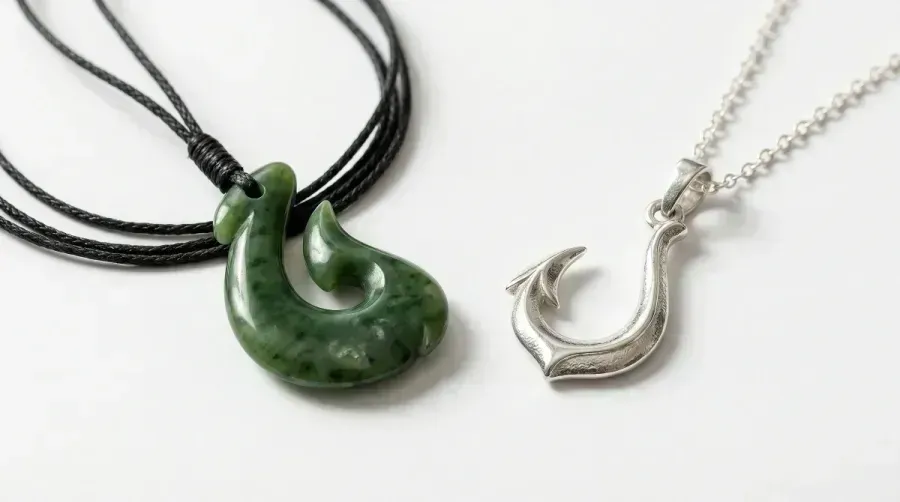
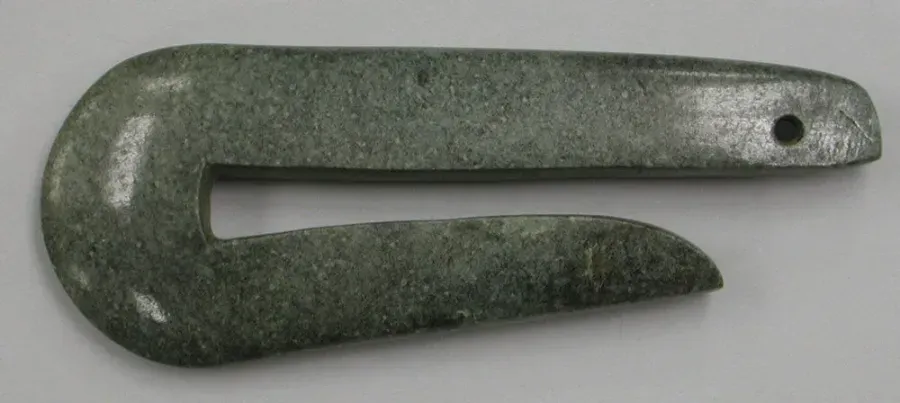
Pendant in nephrite or bone. A distinct line, more ethnographic in register. Green stone carved by hand, or cattle bone polished to the smoothness of old porcelain. These pieces are worn on a heavy leather or braided cord, often without a metal chain. They almost always carry texture: the carver leaves tool marks because a Polynesian pendant as smooth as glass would look wrong. They are heavier than silver but warm against the skin.
Sterling silver 925 pendant. A working jewellery material that allows fine detailing. A silver hook can be mirror-polished, sand-blasted to a matte finish, or oxidised to dark grey with bright ridges. Silver pairs well with a leather cord or an anchor chain and less well with a gold bracelet on the wrist next door. The classic choice for a men's pendant.
Cufflinks with a hook motif. A niche but elegant option. The small curved form in place of the standard circle or square, in silver or in silver with a green stone. Hook cufflinks work on a seafarer's shirt and equally naturally on the sleeves of the owner of an old family sailing boat on the Mediterranean. Unlike a substantial pendant, the hook here reads as a suggestion rather than a statement.
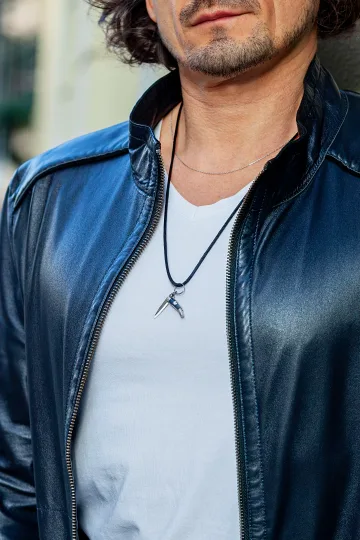
Men's heavy pendant on a leather cord. The maritime classic. A cord three to five millimetres thick, sometimes braided, sometimes flat natural leather, with a silver clasp. The hook weighs between ten and forty grams and rests heavily on the chest. It reads as ethnic menswear. It works with linen shirts, wool sweaters, dense cotton and denim jackets. It does not work with a business suit and tie.
Women's miniature on a fine chain. The opposite register. A hook just over a centimetre long, silver or with a light gilt finish, on a fine anchor or belcher chain forty to forty-five centimetres long. An everyday, understated piece without loud associations. It sits well inside a round or V-neck. It reads not as a maritime theme announced at volume but as a detail with character.
Matching maritime pairs. A separate category. Two hooks, one larger and one smaller, on two chains of different lengths, for two people connected by a shared memory of the sea: a family holiday on the coast, a sailing regatta, a childhood fishing story. Another variation on this theme is explored in the guide on paired jewellery and matching halves.
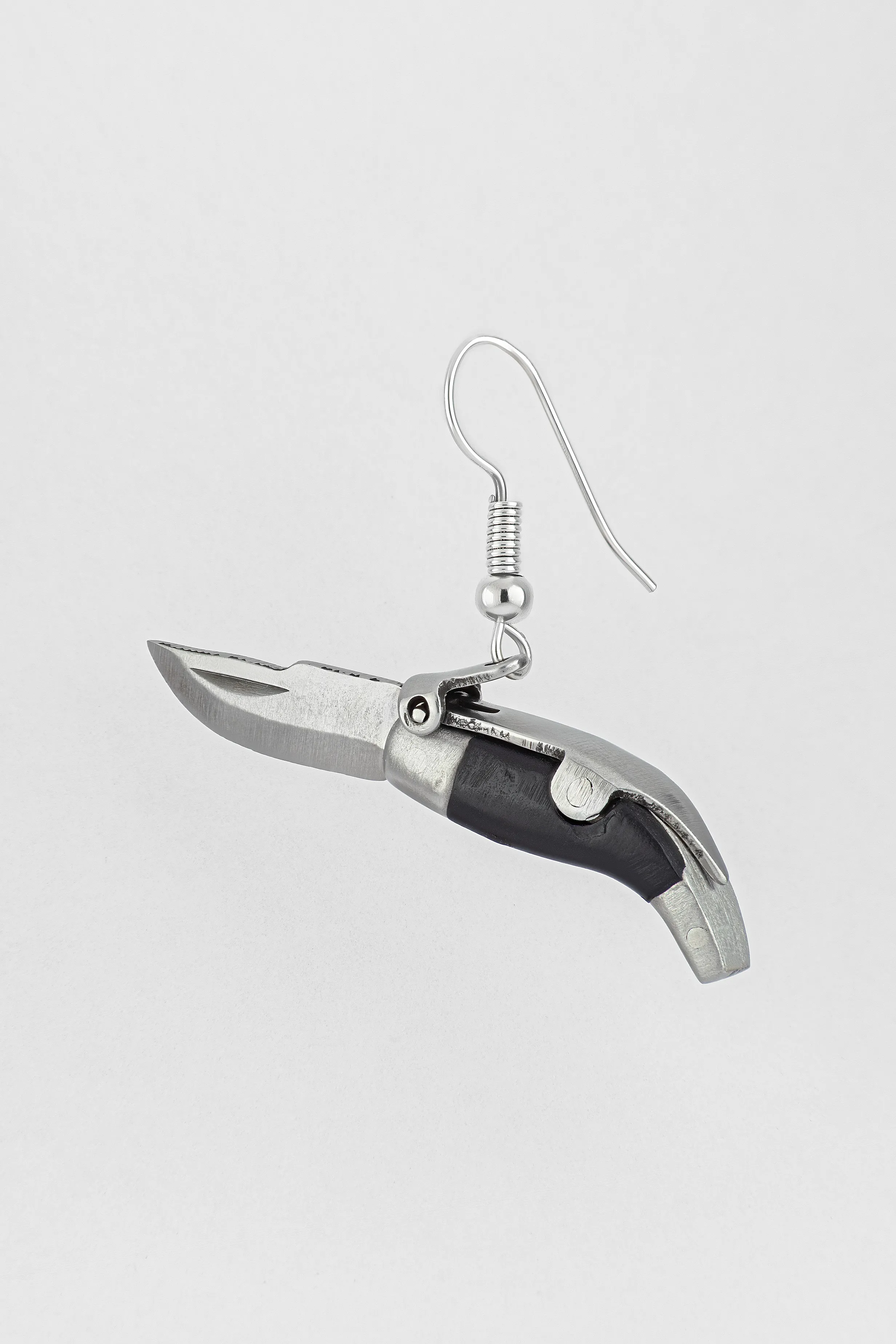
Hook earrings. Rare but interesting. Small hook drops hanging from the lobe, sometimes paired with a freshwater pearl or turquoise. They read as a restrained maritime accent and pair well with linen dresses and light sweaters.
A hook belongs on a leather cord over linen, never under a satin lapel. Salt flatters it, polish drowns it, and I won't hear otherwise.
How to wear a fish hook
I have run the hook through dozens of looks on set and through clients' own sea stories. Here is what actually holds up, sorted by occasion.
What do I wear a hook with every day? For everyday I recommend a miniature silver hook on a fine chain. It sits quietly under a round or V-neck and gets along with a white tee, a grey roll-neck, a linen shirt worn loose. A light top lifts the silver; muted tones (olive, indigo, sand) turn the hook into a quiet accent. This is a piece you can leave on for weeks.
Does it work at the office? It does, as long as you keep it restrained. I suggest a mid-size silver hook on an anchor chain, 50 to 55 cm, showing between the lapels of a blazer thrown over a fine merino sweater. When the dress code is strict, I move the theme into cufflinks with a hook motif, and it stops arguing with the tie.
How do I build an evening look? For evening I choose a contrast of textures: a large oxidised hook on a heavy leather cord over a plain dark chunky-knit sweater or a shirt open at the throat. I keep a calm frame around it: no loud prints, no second heavy pendant, no shiny satin. Silver and leather want natural company nearby, so a leather belt, suede boots and bone details suit them.
And if I want real maritime character? Then I recommend a chunky hook on a leather cord and a natural palette around it: linen, wool, heavy cotton, denim. One metal in the look, silver with silver, no gold on the next wrist. A large hook stays the soloist; a miniature one I layer with a fine wave ring and small earrings.
Who does it actually suit? Anyone who likes a calm, lived-in style with no gloss. The hook sits equally well on a man and on a woman; only the size and chain length change. Two rules that never fail me. First: match the length to the neckline, 40 to 45 cm at the collarbone, 50 to 60 under a shirt. Second: never more than one noticeable maritime piece at a time.

Turn on your camera, pick earrings, a pendant or a ring, and see the piece on yourself in real time.
Switch items in one tap.
Everything runs in your browser: no photo or video is ever uploaded.
The Maori Makau
Now the part of the subject that demands the most care, because we are not talking about a decorative motif but about a living symbol that belongs to a specific people. The hei-matau is a pendant in the form of a stylised fish hook belonging to the Maori, the indigenous people of New Zealand. The name combines two words: "hei" meaning pendant, and "matau" meaning fish hook. The shorter form "makau" appears in some Polynesian dialects. Getting the name right is already half of the respect.
The hei-matau form is highly distinctive and strongly stylised. It does not copy a functional fishing hook, though it descends from one. The central body is a smooth curve, like an inverted U or a ribbon looped back on itself. From it extends a sharpened point that curls inward in a tight spiral. At the top there is a hole for a cord or a small knob for tying. Between the lines, further spirals are often cut because Maori carving favours closed scrolls read as water, movement, continuity of life. Place a modern fishing hook beside a traditional hei-matau and the geometric relationship is visible, but the hei-matau is far richer and more complex; it is no longer a tool but the image of a tool.
The hei-matau is deeply bound to Polynesian mythology. According to Maori legend, the hero Maui, the trickster demigod of the Polynesian pantheon, drew an enormous fish from the ocean using a magic hook made from the jawbone of his grandmother Murirangawhenua, baited with his own blood. That fish became the North Island of New Zealand, still called in Maori Te Ika-a-Maui, "the Fish of Maui". In some versions of the legend the South Island is the canoe from which Maui fished. The fish hook, for Maori people, is therefore literally the instrument by which their homeland was created. Understanding that background makes it easier to treat the hei-matau with genuine seriousness.
The traditional materials of Maori carving are three. The first is iwi, bone, primarily the leg or jaw of a large animal, in the pre-colonial era sometimes whale bone. Bone is pale, warm, takes carving well, and yellows over time through contact with the skin, acquiring the patina that distinguishes an old hei-matau from a new one. The second material is pounamu, New Zealand nephrite jade, a dark green stone with a characteristic semi-translucent lustre. Pounamu is quarried in specific locations on the South Island, within the territory of Ngai Tahu, the iwi that has held the formal rights to its extraction since 1997. The third traditional material is shark teeth and bone; in modern practice, hard New Zealand timbers such as kauri and totara also appear.
Before European contact, the hei-matau was tied to the family line. It was not purchased in a shop. It was carved for a person or a family and passed from father to son, mother to daughter, grandmother to grandchild. Such a hei-matau, called taonga or "treasure", was considered the keeper of the family's mana, its spiritual authority. With European arrival in the nineteenth century, the tradition began to be diluted; hei-matau entered ethnographers' collections and caught the attention of tourists. By the twentieth century, mass production of copies began, often made outside any Maori context in China or Taiwan, from cheap stone or plastic. This is what distinguishes such objects from the work of Maori carvers today, who are organised into professional guilds and sell their work through galleries and directly from their workshops.
The question of cultural appropriation deserves an honest answer. Can a non-Maori person wear a hei-matau? There is no single blanket prohibition among Maori themselves. Most New Zealand carvers work partly for an international market and consider that spreading the symbol through jewellery supports interest in Maori culture and its survival. Two things matter significantly. The first is the level of connection between the maker and the Maori community: an object made in a Maori carver's workshop, or by a maker who works directly with an iwi, is one conversation; a souvenir from a Bali beach market is quite another. The second is the attitude of the wearer: the hei-matau is worn as a mark of respect for a culture and an ocean, not as an ironic accessory or an exotic trophy.
A silver hook from a European or South American jewellery house, inspired by the shape of the hei-matau, makes no claim to authenticity. It is a stylisation, a respectful reference to Polynesian tradition rendered in the materials and techniques of contemporary fine jewellery. We think it is important to call such things by their proper names: not "a genuine Maori amulet" or a "guardian of the spirit of the sea" in grandiose language, but a stylised hook pendant made with respect for the source of the image. The person who wants an authentic hei-matau buys from Maori craftspeople or through certified New Zealand galleries. The person who wants a beautiful maritime pendant with a cultural echo chooses between silver, nephrite and bone from any responsible jeweller.
Customer reviews
Zevira is a real jewellery shop. Genuine payments, deliveries and customer thank-yous.
🥰🥰🥰 gracias
Ok, ¡gracias! 🙂
Sailors' and Fishermen's Hooks
The second great tradition that brought the hook into contemporary jewellery is European maritime amulet culture. Here there is no single creation myth comparable to the legend of Maui, and no canonical silhouette comparable to the hei-matau. Instead there are multiple local traditions of the northern and Mediterranean coasts, all converging on one point: the hook belongs to the fisherman's trade and to the amulet of return.
On the northern coasts of Europe, in Norway, Iceland, the Faroe Islands, the north of Scotland and on the Newfoundland shore, the hook has long been a mark of belonging to the sea. Norwegian and Icelandic fishermen wore a small iron or pewter hook on a leather cord under the shirt, an amulet of safe return. A boat going into the North Sea or the North Atlantic might not come back, especially in winter, and the hook at the chest symbolised the bond between the man and his livelihood, a bond that had to hold. Sometimes the hook was paired with a small wooden or horn fish.
In Scottish fishing culture these amulets were associated with women: the wife or mother of a fisherman, sending her husband to sea, would hang a small hook around his neck, sometimes with a lock of her own hair woven into the cord.
On the Shetland and Orkney Islands, between Scotland and Norway, folklore records survive of superstitions attached to the hook. It must not be dropped on the deck. The fisherman must not step over the gear. Certain animals must not be named on board. Breaking these taboos was thought to bring poor catches. A small amulet hook worn at the neck was partly personal protection against violations that others might commit. This is not pure magic but a system of custom that maintains discipline in a dangerous profession. Other symbols work in exactly this way: the Basque lauburu carries a similar double layer of pragmatism and belief, as we describe in the article on the lauburu.
In the Mediterranean the picture is different but recognisable. Among Sicilian fishermen a small silver or copper hook on a chain was a mark of "a man of the sea". On Malta fishermen wore a hook alongside a figure of Saint Peter, patron of fishermen. Along the Iberian coast, from the Galician fishing ports in the north-west to the Andalusian ones in the south, the hook appeared as an amulet, often alongside a small image of Our Lady of the Sea (Virgen del Carmen). In July on the Galician coast, processions are still held in her honour, with icons carried out on boats into open water, and many participants wear silver hooks as part of the local tradition.
Portugal has a particularly distinct strand. Portuguese fishermen of the Atlantic coast, especially around Nazare, Peniche and Figueira da Foz, observed a tradition: after returning from a long voyage, a fisherman might give his wife or mother a small gold hook, sometimes as part of wedding gifts and sometimes as thanks for prayers offered during his absence. A gold hook worn by a woman meant "he came home". Ethnographers have recorded this tradition since the eighteenth century, and in certain fishing families it persists to this day. Contemporary Portuguese and Spanish jewellery makers working with maritime themes often draw on this tradition rather than on the Polynesian one.
Modern "maritime" jewellery collections from Spanish, Italian, Portuguese and Scandinavian makers work with this European tradition. The hook sits alongside the anchor, the helm, the rope knot and the small fish figure. Visually, these hooks differ from the hei-matau: simpler, more functional, closer to the geometry of actual fishing tackle, without spirals and ribbon loops. Neither is better; they are simply different branches of the same tree.
Upload a photo of your pet, someone you love, or an object. We'll build a 3D model and hand-cast it in pewter.



The History of the Hook as a Symbol
The history of the hook as a symbol stretches back a very long way. Here are the main points along the line.
Polynesian colonisation of the Pacific, one of the most remarkable human enterprises of antiquity, ran from the early second millennium BCE to the end of the first millennium CE. Over that span, the descendants of peoples from south-east Asia and Melanesia navigated on ocean-going canoes across a vast expanse of water, from Tonga and Samoa to Hawaii, Rapa Nui (Easter Island) and New Zealand. Fishing was the foundation of their survival at sea and on new islands. Archaeologists find Polynesian fish hooks of shell, bone and shark's tooth in the earliest settlement layers. Many of these hooks are so carefully made that they already read as objects of special status, family heirlooms, passed between generations, represented on vessels.
On the territory of New Zealand, where Maori ancestors arrived between the late thirteenth and early fourteenth centuries, objects recognisable as proto-hei-matau appear from the earliest period of Maori culture: bone pendants in the form of a stylised hook. Archaeological finds from the coasts of the North and South Islands, dated to the fourteenth through sixteenth centuries, show the gradual development of the canonical hei-matau form we recognise today. By the time of first European contact with Maori, during the Tasman voyage of 1642 and the Cook voyage of 1769, the hei-matau was already fully formed as a recognisable symbol.
In Europe, maritime amulet culture developed in parallel from entirely different roots. Between the ninth and sixteenth centuries, a Scandinavian maritime tradition took shape along the northern coasts. The Vikings, whose voyages carried them far beyond the Baltic to Iceland, Greenland and North America, had a developed culture of small amulets: Thor's hammer, sun wheels, animal figures. The fish hook appears in their material culture as a utilitarian object, and by the later medieval period, from the eleventh and twelfth centuries, records describe it as an amulet. In the fishing communities of Iceland and western Norway, by the sixteenth century a hook-amulet was already a standard attribute of the mariner.
The Mediterranean has its own chronology. Fishing here has been continuous since the Phoenicians and the Greeks. Greek and Roman finds include bronze and silver hooks that may have served as amulets. The Christian fish symbol (ichthys) from the first centuries CE also worked indirectly in favour of the hook as a symbol of "catching souls", through the association with the apostles Peter and Andrew, who were fishermen by trade. By the Renaissance period, the hook was a common motif in everyday metalwork in the coastal towns of Italy and Spain.
Early Christian symbolism gives the fish a particular resonance in European cultures. The catacomb communities of Rome, from the first and second centuries, used the fish as a covert identity marker at a time when open Christianity was dangerous. The ICHTHYS acrostic -- Iesous Christos Theou Yios Soter, "Jesus Christ, Son of God, Saviour" -- linked the fish to the deepest tenets of the faith. The apostles Peter and Andrew were called from their nets, and the evangelical image of "fishers of men" made the hook part of early Christian symbolic language. This strand of meaning runs quietly beneath the surface of European maritime jewellery, particularly in Catholic fishing communities from Brittany to Liguria.
The nineteenth century added several layers to the hook's history at once. This was the era of the whaling industry, centred on the ports of New England, especially Nantucket and New Bedford, and the Azores. Whalers on voyages lasting three to four years practised scrimshaw, carving on sperm-whale teeth and bone. These engraved objects often feature the hook, the harpoon, the anchor, the ship and the beloved woman back home. Scrimshaw is not only homesickness but a naive symbolic language that sailors used to mark their bond with their trade. When the whaling era ended in the early twentieth century, scrimshaw moved from living practice to a collector's genre, and its imagery passed into jewellery catalogues.
The twentieth century brought two important turns. The first was the revival of interest in Polynesian culture after the Second World War. The Norwegian explorer Thor Heyerdahl in 1947 crossed the Pacific on a balsa-wood raft called Kon-Tiki to test his hypothesis that Polynesia might have been settled from South America. Whatever one thinks of the hypothesis itself (most modern anthropologists hold that Polynesians came from the west, not the east), the book and the wave of publications that followed created enormous interest in Polynesian culture in the Western world. The hei-matau first began appearing in tourist shops in Auckland and Wellington in the 1950s and 1960s.
The second turn came in the 1970s with the broader revival of interest in ethnic aesthetics in European and American fashion. Polynesian, African and Native American motifs ceased to be read purely as exotica and entered ordinary urban jewellery. From that point, the hook, both Maori and European-maritime, took a settled place in the vocabulary of contemporary jewellery. Today it appears in collections from Spanish, Italian, Portuguese, Scandinavian and New Zealand makers, each tradition reading it slightly differently.
The past two decades have added an ethical dimension. At first this concerned ivory and coral; then it extended to shark bone, sperm-whale tooth and pounamu. A responsible maker of maritime jewellery today works only with materials whose provenance can be traced: silver from recycled sources or certified mines, cattle or camel bone instead of walrus bone, cultured pearl instead of harvested wild pearl, laboratory-grown stone instead of prohibited natural material. At Zevira that is the standard across all pieces with maritime themes, not only the hook.
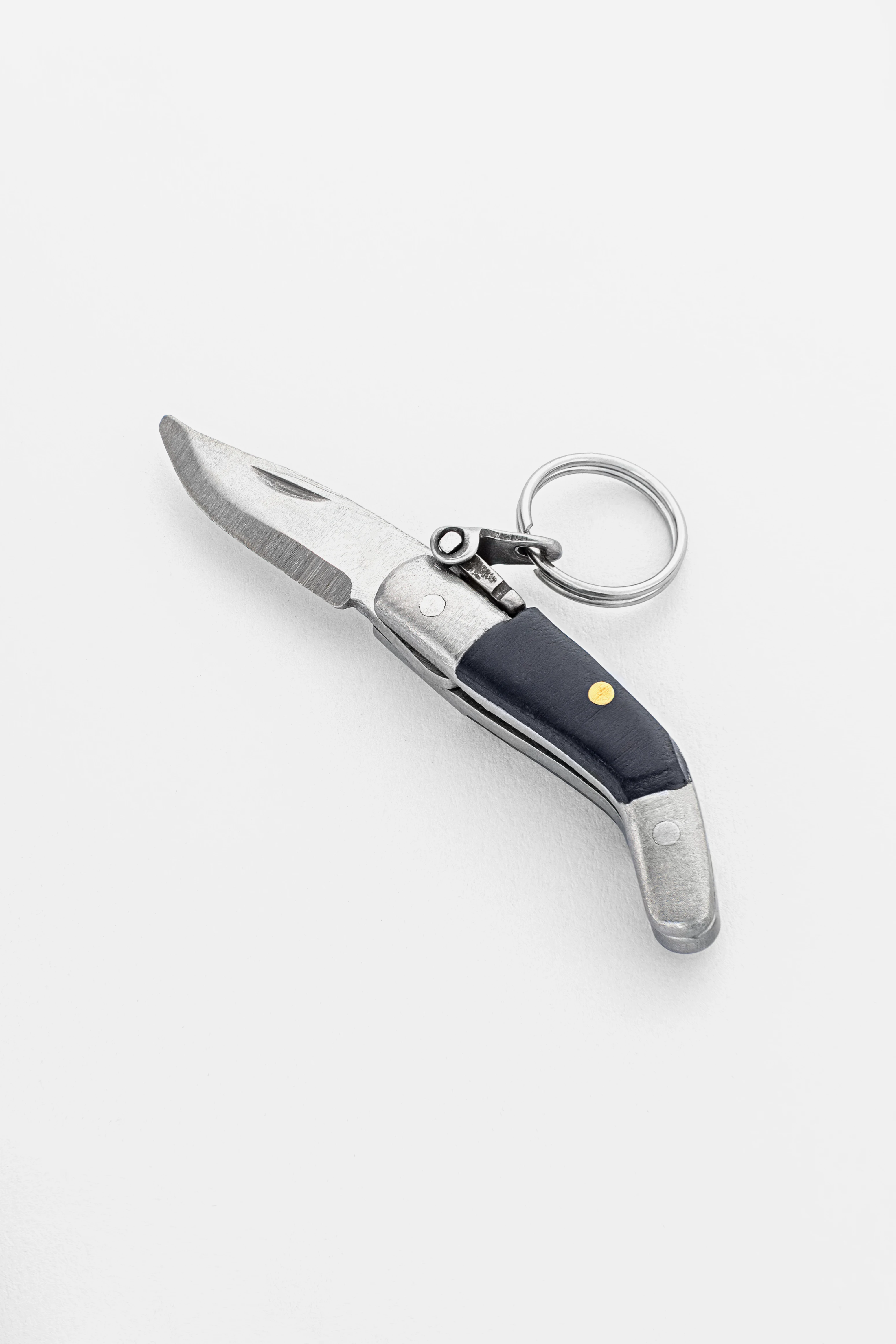
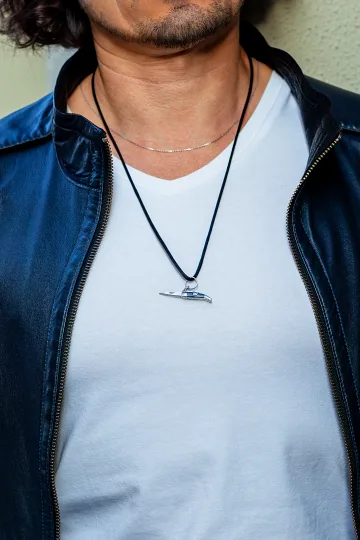
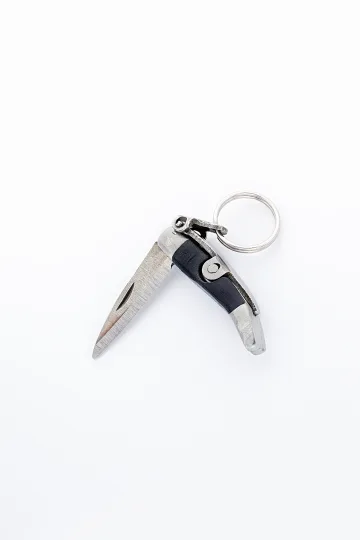
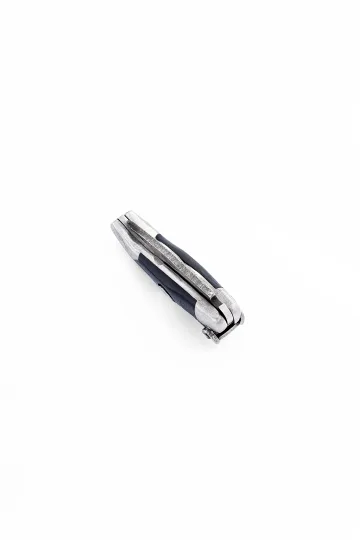
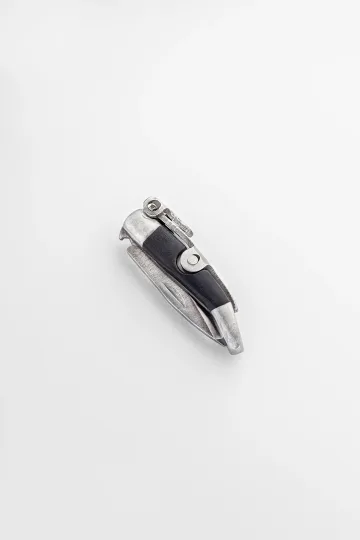
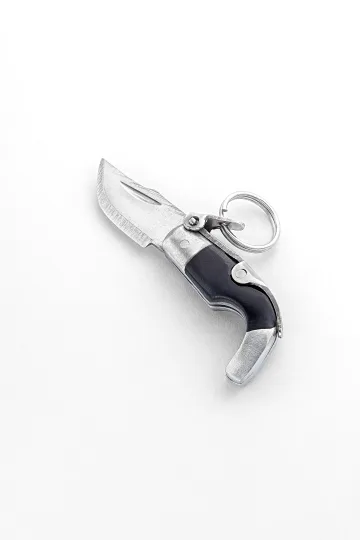
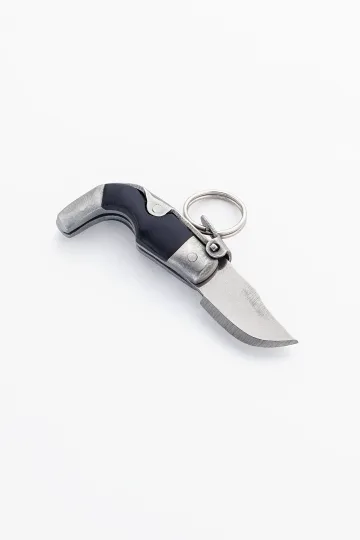
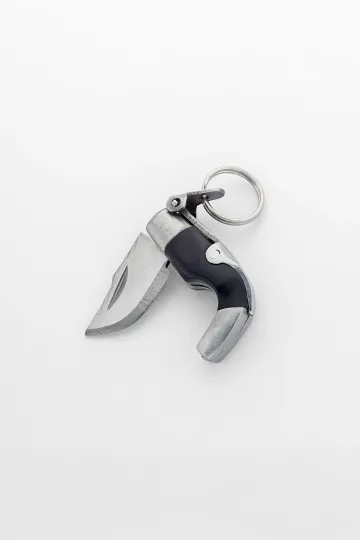
CAPAORA mini knife pendant
The 18th-century Spanish navaja in miniature: 40 mm of stainless steel, a real folding mechanism and a Palanquilla lock that clicks. An affordable gift to remember.
Authentic · Ships from Spain · 14-day returns
What the Hook Symbolises
The fish hook in jewellery carries several layers of meaning, and different wearers emphasise different ones. It is worth setting out the main ones so you can choose your own rather than inherit someone else's by default.
The first and most fundamental is the connection to the sea as an element. The hook is a human gesture towards water, an acknowledgement that the sea exists, that people depend on it, that it is stronger than any individual. This connection can be biographical (you live on the coast, you sail, you dive, you grew up on a boat with your father) or imagined (you dream of the sea, you love maritime literature, the sea is your private image of freedom and horizon). Both are complete. A piece of jewellery does not ask for a passport.
The second is luck at sea. This is the oldest amulet layer. The fisherman hung a hook around his neck when he went out because the catch determined whether his family ate and his return determined whether he lived at all. Luck here is not abstract; it is specific: let there be fish, let the boat reach the shore. For a contemporary wearer this layer works more as a metaphor: let everything I do be productive, let me reach my destination. The hook does not "protect from the sea"; it marks the wearer's respect for water and attention to their own path.
The third is provision and sustenance. The hook feeds the family. In traditional societies that was a completely literal meaning. In modern use it softens: the hook as a symbol can read as the capacity to provide for oneself and those one loves, as the readiness to work for results, as what in English might be called the quality of being a provider, without the patriarchal undertone. A man or woman wearing the hook, from this angle, is a person who sustains others not necessarily literally but in the broader sense of carrying responsibility.
The fourth is strength and endurance. Fishing is physically demanding work, and the Maori hei-matau has traditionally symbolised not only luck but strength. Pulling a large fish from the water is a matter of muscle and persistence. To wear the hook as an amulet of strength is to tell the world: I am prepared to pull. This meaning is often chosen for the hei-matau: as a gift to someone beginning a major undertaking, as an amulet after recovering from illness, as a symbol of personal resilience.
The fifth is specific to the Maori tradition: respect for Tangaroa, the Polynesian god of the sea. In Maori mythology, Tangaroa is one of the main children of Rangi (Sky) and Papa (Earth), progenitor of all sea creatures and lord of the ocean depths. The hei-matau is traditionally connected with addressing him, with asking for favour and giving thanks for a catch. For a non-Maori person wearing the hei-matau, the direct religious layer may not be personally relevant, but an understanding that the form carries this being behind it makes for a more thoughtful wearer.
A candid, sceptical note deserves its place here too. The hook is not a switch, not a magical object in any literal sense, not a source of energy, not a functional amulet in the framework of a scientific understanding of the world. The hook is a symbol, and all its power lies in how the wearer lives with it. If the wearer remembers the meaning, if they think of the sea, their work and their people when they touch the hook beneath their shirt, the symbol does its cultural work. If they do not, the hook is simply a beautiful form on a chain, and there is nothing wrong with that. At Zevira we believe the role of a jewellery maker is not to sell "power" but to make objects in which memory and attention can live.
Leave your email, we'll send your discount code. No spam, unsubscribe anytime.
The code arrives by email, valid on your first order.
Materials and Techniques
The hook can be made from a wide range of materials, each setting its own register.
Sterling silver 925. The most common material in contemporary maritime jewellery. Pure silver is too soft, so a 92.5 per cent alloy is used, typically with copper. Silver closely resembles the steel of a real fishing hook and simultaneously provides jewellery-grade quality: lustre, malleability, suitability for casting and hand finishing. A silver hook can be polished to a mirror, sandblasted to a matte finish, or oxidised, with the recesses darkened to create the effect of an antique piece. Sterling silver resists corrosion, suits daily wear and does not react with the skin of most people. It is the primary material in Zevira's maritime line.
Bronze and brass. Less common but effective in the ethnic direction. Bronze gives a warm reddish tone and patinates to brown-green, evoking old ship fittings. Brass is yellow and bright, closer in tone to gold but simpler to work. Both materials have a limitation: they can stain the skin in warm conditions, and some people with sensitive skin find daily wear uncomfortable. Bronze and brass hooks therefore usually carry a silver or nickel lining on the contact surface.
Gold, 14 and 18 carat. The premium register. A gold hook is the classic Portuguese and Mediterranean tradition discussed above. Yellow 18-carat gold (75 per cent pure metal) gives a warm, deep colour, takes engraving well and is durable. 14 carat (58.5 per cent) is harder and more resistant to wear but slightly paler. Rose gold is a rare choice for a hook but appears in women's miniature formats. White gold with rhodium plating is uncommon because silver achieves a similar visual effect at lower cost.
Pounamu (New Zealand nephrite). A cultural and natural resource protected by the Maori community of the South Island. Genuine pounamu comes in three main varieties: kawakawa (dark green, sometimes nearly black, with inclusions), inanga (pale green, like young foliage) and kahurangi (translucent green, rare and valuable). Carving pounamu is a distinct craft requiring many years of practice. A genuine pounamu piece can only be purchased from a certified workshop or gallery in New Zealand and is always more expensive than a silver hook of equivalent size. Imitation pounamu commonly found on the mass market is usually green glass, dyed soapstone or inferior nephrite from Siberia or Canada. These are not pounamu.
Bone. Traditional Polynesian material, today almost entirely replaced by ethical sources. Contemporary Maori carvers work with cattle bone (most commonly from the foot of a New Zealand beast), camel bone (imported for carving purposes) and sometimes horse bone. All these sources are ethical and require no special hunting. Bone is yellowish-white, darkens and yellows with age, acquiring a living patina. It is warm to the touch, lighter than silver and breathes against the skin. Carving bone requires specialist tools and care because the material is prone to splitting.
New Zealand timbers. Less common but present. Kauri is a soft conifer with a golden tone. Totara is harder and darker, red-brown in colour. Both are considered sacred by Maori and used in the workshops of Maori carvers. A wooden hei-matau is lighter than a silver one but requires more careful handling: prolonged wetting and hard drops should be avoided.
Combination solutions. Common in contemporary jewellery. A silver body with a green stone inset, a silver hook wrapped with leather cord, a silver central hook on a braided chain. These allow the practicality of silver to be combined with the texture of natural materials.
Key techniques worth mentioning. Lost-wax casting (a wax model placed in a mould and filled with molten silver) gives precise geometry and is used in mass and mid-range production. Hand forging (the hook shaped from a silver rod with a hammer on an anvil) gives a unique surface texture and is used in studio jewellery. Engraving allows a date, name, initials or monogram to be added to a finished hook; for more on this, see the guide on initials and monograms in jewellery. Oxidation followed by polishing of the ridges gives the classic "antique" look, popular in the maritime theme.
On price: a silver hook sits across a very wide range. A mid-sized silver pendant costs roughly what a good dinner for two would cost. A large oxidised silver hook is closer to a two-day city break. A gold pendant or a hei-matau in genuine pounamu is already at the level of a month's average income in the mid-range bracket. We deliberately avoid exact figures because they shift by region and exchange rate, but the order of magnitude is clear: the hook can be an everyday purchase or a considered one, depending on material and execution.
Wearing the Hook: Lengths, Sizes and Fabrics
The hook moves between wardrobe registers more easily than most symbolic pendants, but a few practical patterns are worth knowing before you buy. They sort into three questions: how long the cord or chain should be, how large the pendant should be, and what the clothing around it is made of.
On a leather cord, 45 to 60 centimetres. The classic men's format. The cord is dense, sometimes braided, sometimes cut flat from natural hide, and finished with a silver clasp or a simple sliding knot. The hook hangs on the chest, touching the skin under a shirt or showing at an undone top button. This format reads as maritime or as travel-worn, and it suits someone who lives near water or spends a great deal of time away from home. Leather darkens and softens with wear, so a cord bought this year looks like your own within a season and like nobody else's within five.
On a silver chain, 50 to 55 centimetres. The more jewellery-minded register. The British names for chain types are worth getting right at the counter, because they describe genuinely different things. Belcher has round or oval links and is the everyday workhorse. Curb has flattened, twisted links that lie flat against the chest. Rope is made of twisted strands and catches the light along its whole length. Figaro alternates long and short links. The marina or anchor chain carries a bar across each link, exactly like the stud in a real anchor chain, which is where the name comes from. For a hook, belcher, rope and marina work best, because they rhyme visually with the subject. This format is quieter than a leather cord and belongs in semi-formal dress, under a jacket or with a fine sweater.
On a fine chain, 40 to 45 centimetres. The more restrained option, chosen more often by women. A miniature hook of one and a half to two centimetres sits on the collarbone as an everyday piece with no announcement in it. It works under a round or V neckline, under a light blouse, under a summer dress. Combined with one or two other fine pendants on chains of different lengths, it builds the layered look that has been steady in southern European city dressing for a decade now and has settled firmly into British high-street styling as well.
Large format, four to seven centimetres. A visible pendant that needs care with its neighbours. A large hook should not be worn with heavy chains at the neck or with a loud brooch. It is the accent itself, and it wants a calm frame around it: a plain sweater, a linen shirt, a dense unprinted tee. It sits well beside a plain leather belt and wooden or bone accessories. It sits badly with bright floral prints and with metal hardware on the clothing itself, because the eye then has three or four bright points to choose between and settles on none of them.
Miniature, one and a half to two centimetres. The near-invisible daily piece. Appropriate almost everywhere except the strictest protocol contexts, a formal funeral or a diplomatic reception among them. It works in an office, in a meeting, on a long flight. It can stay on overnight without catching on bedding, which is one reason people who buy this size tend to stop taking their jewellery off at all.
Fabric matters more than most buyers expect. The hook lives best with natural fibres: linen, dense cotton, wool, cashmere, heavy denim, leather. The texture of a natural weave rhymes with the texture of hammered silver, of carved bone, of a leather cord that has been through a few winters. Synthetic glossy fabrics, satin and high-shine polyester among them, sit less comfortably with the maritime theme, because they are too smooth and too reflective, and the hook is about a rougher kind of surface altogether.
The hook does not work with a dinner jacket. In Britain the invitation usually says so plainly: black tie, or on rare occasions white tie, and both carry a settled expectation of neutral jewellery. Cufflinks, dress studs, a plain watch, at most a fine chain with a monogram pendant hidden under the shirt front. Symbolic pendants sit outside that convention, and this is a general rule for almost all ethnic and symbolic motifs rather than a rule about the hook specifically. If you genuinely want the hook at a formal event, there is a way through: silver cufflinks with a hook motif. They pass at a wedding or a reception without comment, because cufflinks are read as a personal detail rather than as a statement.
Semi-formal dress is where the hook is most at home. A jacket without a tie, chinos, a dense Oxford shirt, a merino sweater. It suits a business dinner in a coastal town, a client meeting where the dress code has been described as smart casual, a conference in the creative industries. It is particularly good in the long British between-seasons, when a jacket goes over a fine sweater and a silver hook shows in the gap for a second whenever you move.
A word on combinations. For men the hook is usually chosen as the main or the only piece. It sits comfortably with a wedding band, because the two belong to different categories and do not compete. It sits comfortably with a watch as long as both are in the same metal, silver with a steel case rather than silver next to yellow gold. A signet ring, worn in the British manner on the little finger of the left hand, is possible alongside a hook, but it needs judgement, because two substantial pieces on one person is already a full account. For women the hook works as an addition to a light base set: small stud earrings, a fine ring, perhaps a slim bracelet.
One practical note on upkeep, since it comes up more often in Britain than people expect. Across the south-east, East Anglia and much of the Midlands the water is hard, and silver worn daily picks up a dull limescale film that reads as tarnish and is not tarnish at all. Rinsing the piece in filtered or previously boiled water and drying it with a soft cloth removes it in seconds; polishing away at it with a silver cloth only wears the oxidised recesses that give the hook its depth. A leather cord asks for the opposite treatment: keep it out of the sea, out of chlorinated pools and out of the shower, because salt stiffens leather and chlorine breaks the fibres down for good.
Silver, gold, wedding rings, symbolic jewellery, paired sets.
Send a friend a discount code, they save on their first order.
Who It Suits
Identifying the natural audience for the hook is easier than for many other symbols because the meaning is specific enough: the sea, in one form or another. Here are the main groups for whom the hook in jewellery works most naturally.
First, people with a direct relationship to the sea. Sailors, recreational and professional fishermen, divers, yacht owners, sailing instructors, coastguard staff, residents of coastal towns. For these people the hook is a mark of belonging, recognised by others without explanation. A gift to such a person is almost always well received, provided the format is right: a serious mariner calls for a heavy leather cord with a substantial silver hook rather than a miniature on a fine chain.
Second, travellers. People who move frequently between continents and coastlines, who arrive regularly in port cities, who collect impressions from different oceans and seas. For a traveller, the hook is a kind of mobile anchor: an object that recalls the connection to water regardless of the city they happen to be in. It travels easily in aircraft and trains, survives the noise of airports, tolerates tropical heat and northern cold alike.
Third, people with an interest in Polynesian culture and Pacific history. Readers of ethnographic literature, admirers of Maui mythology (including the contemporary animated film), travellers to New Zealand, Hawaii, Tahiti and Fiji. For them, the hei-matau or a stylisation of it is a cultural sign rather than a casual accessory. They tend to pay more attention than most to the provenance of the piece and want to understand who made it and how.
Fourth, readers of maritime literature. Melville's Moby-Dick, Hemingway's The Old Man and the Sea, Conrad's Lord Jim and Typhoon, Stevenson's Treasure Island, Jules Verne's Twenty Thousand Leagues. If those books mean something to the person, the hook as a piece of jewellery extends the conversation. The same is true of lovers of maritime music, from old sea shanties to contemporary Scandinavian and Irish folk.
Fifth, people for whom the hook is a gift from someone close. A son giving his father who loves fishing not a new piece of tackle in the utilitarian sense but a symbol: an object the father will wear at home or on holiday. A grandchild giving a grandfather who served in the merchant navy. A wife giving her husband after a long work trip or the completion of a difficult project. In these cases the hook reads as warm attention, without any sentimentality.
Sixth, people for whom the sea is a metaphor rather than a biography. Writers, painters, designers, musicians, architects who work with the image of water. Teachers of literature. Thinkers for whom the sea represents the boundary between the human and the elemental. For such a wearer, the hook is a quiet signal, understood primarily by themselves and a few close interlocutors.
Who the hook suits less well: people for whom "maritime aesthetics" feels too masculine or too rough. This deserves clarifying: the form of the hook is actually universal; the question is size and material. A miniature silver hook on a fine chain is not rough at all. A large heavy pendant on a leather cord, yes, that reads more masculine, but even in that register a woman in the right wardrobe (a heavy sweater, wide trousers, leather boots) can wear it perfectly naturally. The gender coding of the hook is softer than it first appears.
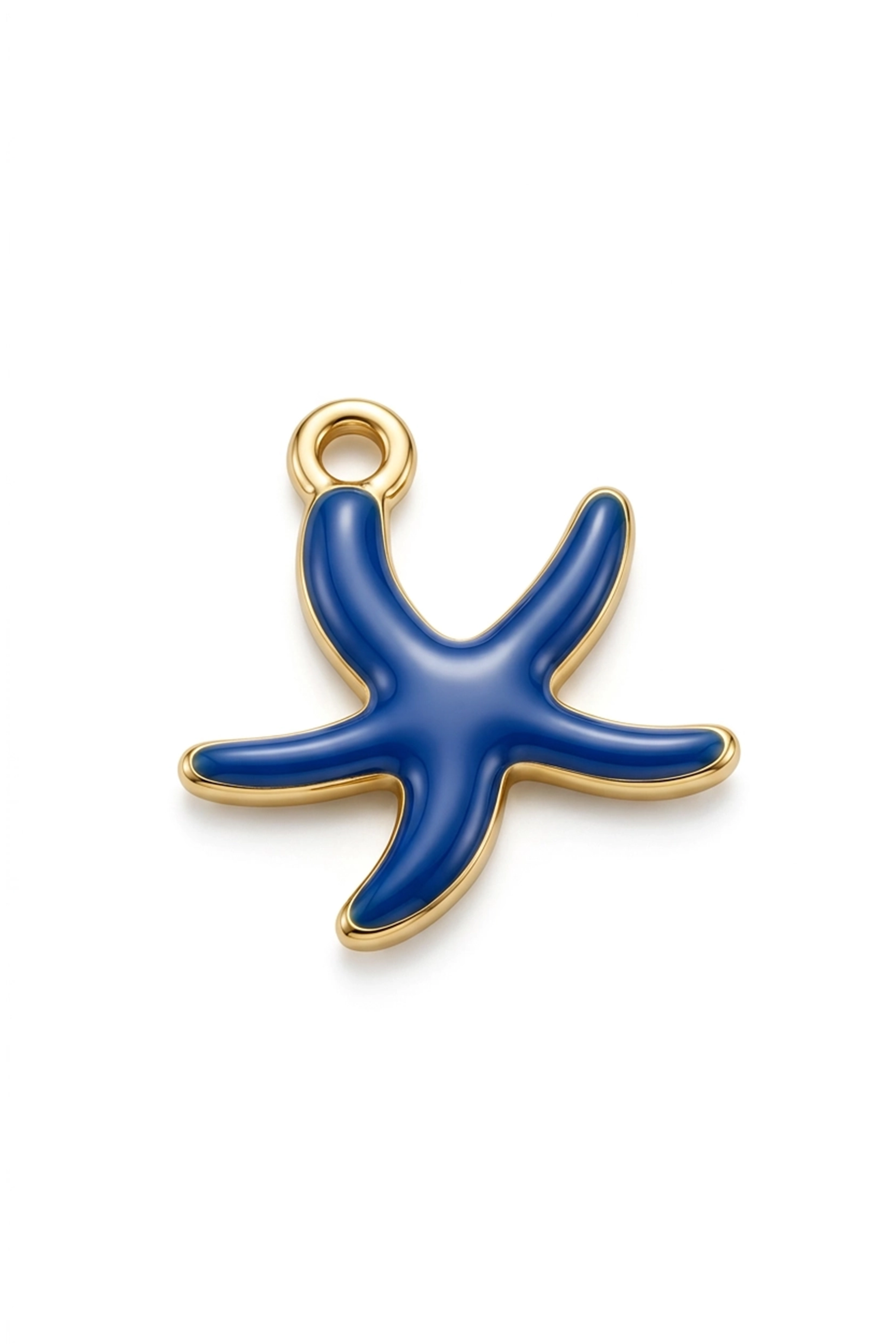
Who genuinely finds the hook difficult as a daily piece: people for whom the association with catching a live creature creates real discomfort. For vegans and vegetarians with an ethical foundation, the hook as a symbol may feel problematic because it is, after all, an instrument of capture. In such cases a different maritime motif makes more sense: a shell, a sea star, a wave, a compass. We respect that position and do not regard it as oversensitivity.
Frequently Asked Questions
Can a non-Maori person wear a hei-matau?
Yes. There is no single prohibition among Maori on non-Maori people wearing the hei-matau. Most Maori carvers work partly for an international market and consider spreading the symbol through jewellery a way of supporting interest in and survival of Maori culture. Two conditions matter. The first is the origin of the object: it is worth buying a hei-matau directly from Maori craftspeople, or from makers who work openly with Maori communities, or at minimum being clear with yourself that your silver pendant is a stylisation rather than an authentic piece. The second is the attitude of the wearer: the hei-matau is not worn as an ironic accessory, as part of a costume, or as an exotic trophy. It is worn with respect for the culture and the ocean it speaks of.
What is the difference between a hei-matau and an ordinary fish hook in jewellery?
Visually and in meaning, they are distinct, though related. The hei-matau has a very specific stylised form: a smooth outer curve, an inner point curling into a tight spiral, often with additional inner scrolls and lines. This is a recognisable canon shaped within Maori culture over centuries. An ordinary fish hook in jewellery is geometrically simpler: a stylisation of actual fishing tackle, with a sharp point, barb and sometimes a loop for the line. European maritime collections work with this more direct silhouette, without spirals. Both are legitimate but they refer to different cultural traditions and read differently.
Is it true that a tourist cannot buy genuine pounamu in New Zealand?
This is a widespread misconception. A tourist can buy genuine pounamu, provided the purchase is from a certified workshop or gallery with the appropriate licence. Since 1997 the extraction of pounamu has been regulated by Ngai Tahu, the iwi holding traditional rights to quarrying on the South Island. Ngai Tahu issues extraction licences, and legitimate carvers work either directly with the iwi or through authorised distributors. A genuine pounamu piece purchased from such a carver is usually accompanied by a certificate of provenance. Souvenir stalls at harbour fronts in Auckland or Wellington selling "pounamu" at suspiciously low prices are generally selling either ordinary nephrite (often from Canada or Siberia), dyed soapstone or green glass. This is not a fraud in the strict sense, but calling such an object genuine pounamu is inaccurate.
Why is the hei-matau form so complex?
Because it is simultaneously functional and symbolic. The functional layer: the hei-matau descends from an actual hunting hook of bone that Maori fishermen used to catch large sea fish. Such a hook needed a robust outer curve, a sharp inner point and a reliable fixing for the line. The functional form was already more complex than a simple metal hook. The symbolic layer: the spiral inside the hei-matau reads as water, wave, movement, continuity of life, infinity. Additional scrolls amplify this reading. Maori carving loves the spiral: it appears in moko tattoos, in wood carving in whare (meeting houses), in the decoration of waka (canoes). The hei-matau fuses both layers in one recognisable form.
What exactly is pounamu?
Pounamu is New Zealand nephrite, mineralogically belonging to the nephrite group (principally actinolite and tremolite varieties). Colour ranges from very pale apple-green (inanga) to deep, almost black green (kawakawa), with intermediate shades and inclusions. The rarest and most prized variety is the translucent kahurangi. Pounamu is distinguished from other world nephrites by its specific internal structure, which an experienced gemmologist identifies by fracture texture and optical characteristics. For a non-specialist, genuine pounamu is characterised by a warm, matte lustre without strong gloss, a weight noticeably greater than imitations, and a characteristically uneven, living distribution of colour.
Is the hook a masculine or feminine symbol?
In European maritime tradition the hook has historically been masculine, because fishing and sailing in the nineteenth and twentieth centuries were predominantly male trades and the amulet at the neck was an element of men's dress. In the twenty-first century this distinction has almost entirely disappeared: women wear the hook as freely as men; only scale and material shift. In Polynesian tradition the situation was different from the beginning: the hei-matau was worn by both Maori men and Maori women without significant gender coding. Today the hook is a gender-neutral symbol, and the only practical guide is size (a miniature of one and a half to two centimetres on a fine chain reads more feminine; a large piece of five to seven centimetres on a leather cord reads more masculine).
About Zevira
Zevira is a Spanish jewellery brand based in Albacete. The maritime line with fish hook and hei-matau pieces is one of the categories in the catalogue. Current stock and details are in the catalogue.
Buying it as a gift? Each one arrives ready to give.
 A branded Zevira box and a little card come with every order.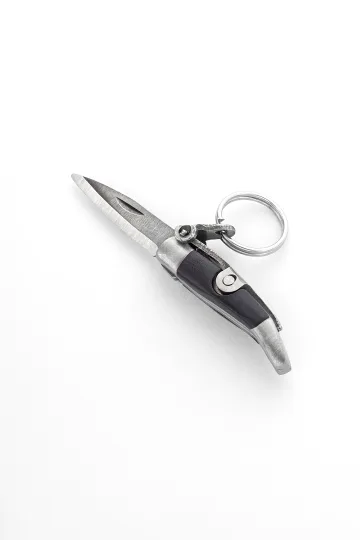




Conclusion
The fish hook in jewellery is a quiet statement. It does not proclaim status like a large diamond, nor does it announce ethnic identity at volume the way some larger symbols do. It rests on the chest beneath a shirt or at the collarbone above a sweater's neck, and it has only two interlocutors: the wearer and the occasional attentive glance. There is something fitting in that for a conversation about the sea, which also has no use for noise.
To wear the hook is to acknowledge a fact: the sea remains one of the few elements before which a person in the twenty-first century is still small. No satellite, no navigation system, no weather forecast changes that entirely. Fishermen die in the North Atlantic and the Bay of Biscay every year. The ocean is larger than us. Maui pulled an island from the water on his hook, and at that point his power, in effect, ended, because beyond that the ocean acts on its own terms. To wear the hook is not superstition in any naive sense; it is a quiet respect for water, for those who work on it, and for one's own human modesty before something greater. The jewellery makes this thought physical: the cold of silver against the skin, the weight of the pendant on a leaning movement, the smoothness of the leather cord under the fingers. All of it a small daily act of remembrance, which we are glad to help you make.