Bimetallic and Two-Tone Jewelry: A Complete Guide
Introduction: One Ring, Two Metals
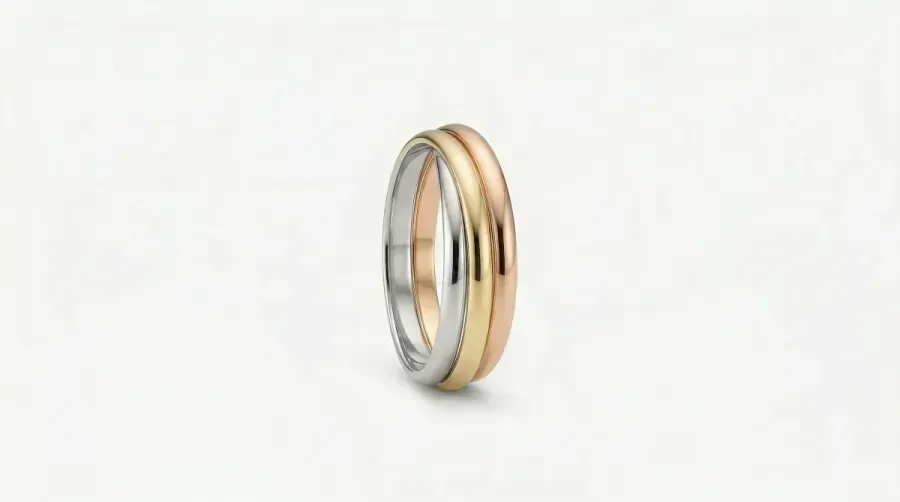
The three-colour interlocking ring is one of the most recognisable two-tone designs of the modern era. Three bands, interlocked forever: yellow gold for fidelity, rose for love, white for friendship. Each can rotate independently, yet they never come apart. Over the past century, the form became one of the most recognisable in jewellery.
That is not merely aesthetics. It is a category: bimetallic jewellery, where two or more metals are physically united into a single object. Not simply worn together -- that is metal mixing, a separate subject -- but actually joined within one piece.
American jewellery culture has always had a practical streak alongside its appetite for glamour. Two-tone pieces fit that mindset well. The two-tone wedding band became a staple of mid-century American craftsmanship: yellow gold centre, white gold shoulders, worn by couples who wanted something that looked considered without being ostentatious. That same logic applies today. A well-made two-tone ring or bracelet works across decades of changing outfits and shifting trends, which is why these pieces are often worn for years on end.
This guide covers what bimetallic jewellery actually is, how two-tone pieces are manufactured, which techniques distinguish a quality piece from a cheap imitation, and how to wear one well.
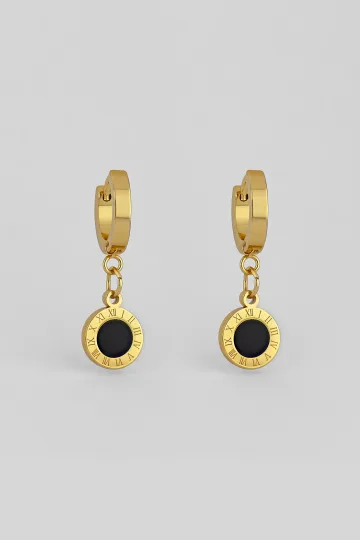
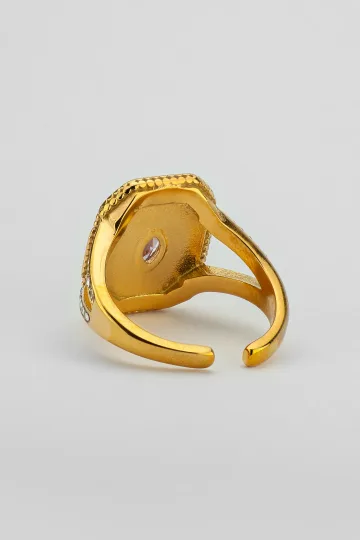
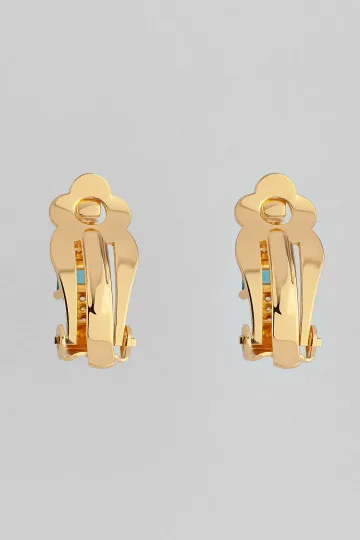
Wear the symbol, don't just read about it. These are in stock:






What Bimetallic Jewellery Is
Bimetallic jewellery means a single piece manufactured from two or more distinct metals that are physically joined together. The metals run through the object's structure, they are not layered on top of each other as a coating. This distinguishes bimetallic jewellery from plated jewellery, where a thin skin of one metal sits on a base of another.
The distinction matters in practice. A solid two-tone ring in 14k yellow and white gold will wear the same for decades. A plated ring -- yellow gold over a white base, or vice versa -- will eventually show the base metal through the top layer, usually at the edges and high-wear points. Both can look identical in a display case. Knowing how to tell them apart is the first practical skill in two-tone shopping.
The simplest test: look at the edge or inside of the shank. A solid bimetallic piece will show a clean meeting line between two distinct metal bodies. A plated piece will look uniform at the edge, with the base metal visible only when the plating wears through. A hallmark from an independent assay office, or a quality certificate from the maker, adds further confirmation.
Two-tone can mean two metals in equal proportion, or one metal dominant with the other as accent. It can mean a sharp boundary between the two metals or a gradual transition. The specific geometry -- half-and-half, striped, twisted, layered -- is what defines the visual character of a two-tone piece.
Two metals on one finger settle the tired gold-versus-silver quarrel for good. If you still pick a team, you have already lost.
How to Wear a Two-Tone Piece
After years on set I have tried two-tone pieces in every pairing imaginable, and the takeaway is simple: bimetal forgives almost everything, yet each occasion has its own logic. Here is what actually works.
How do I wear a two-tone ring every day? I recommend a slim 3-4 mm band against a neutral backdrop: white, heather grey, navy, camel. The metal then reads cleanly instead of arguing with the outfit. Under a round neck or an open collar I suggest a fine two-tone chain to match, so the hand and the neck carry the same metal.
Does bimetal work at the office? This is where it earns its keep: it looks composed and is not tied to the tone of your other accessories. I choose a two-tone ring plus a watch on a steel or two-tone bracelet, and the hand is done. Smooth fabrics, suiting wool, a muted palette, one or two pieces that echo the shared metal.
What should I wear for the evening? For evening I build the bimetal up: a three-colour ring, hoop earrings with a contrasting inner face, a two-tone bangle. Under an open neckline I recommend warm metal near the face, since yellow or rose gold wakes up the skin under artificial light. Black, burgundy, and emerald keep the metal in focus.
How do I style bimetal for a big occasion? A wedding, a jubilee, an anniversary call for signature shapes: a three-colour ring, a matching two-tone set, mokume-gane. Here I advise letting the piece be the centre of the look and sending the clothes to the background.
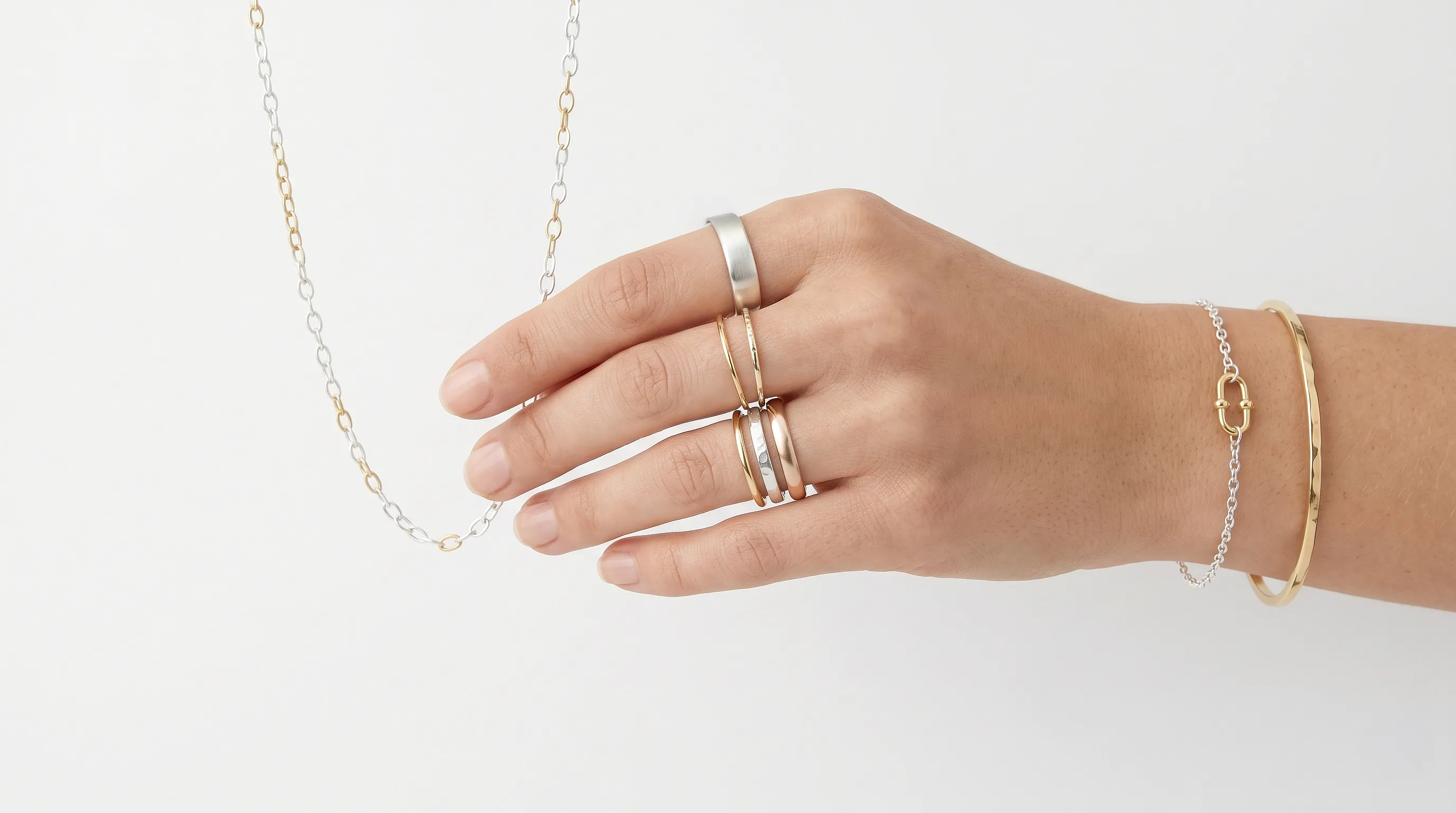
How do I get layering and stacks right? Decide which metal dominates the piece and echo it with at least one more item, so every colour appears at least twice in the look. A single yellow ring lost in all-white reads as accidental. And do not fear stacks: slim two-tone bands sit beautifully in a stack with plain rings in one of their metals.

Turn on your camera, pick earrings, a pendant or a ring, and see the piece on yourself in real time.
Switch items in one tap.
Everything runs in your browser: no photo or video is ever uploaded.
How Two-Tone Pieces Are Manufactured
Understanding how a two-tone piece is made helps you assess quality, predict durability, and avoid common mistakes when buying.
Soldering and Fusion
The foundational technique. Two separate metal components are shaped individually, then joined along a seam under high heat with a solder alloy. A well-executed solder joint is invisible to the naked eye and structurally solid. The joint line in a quality piece is clean and tight -- no gaps, no discolouration, no raised ridge. In lower-quality work, the solder line may be slightly visible, or the alloy used may discolour differently from the two parent metals over time.
Fused Stripes
Strips or billets of different metals are stacked and fused together under heat and pressure to produce a single composite bar. The jeweller then shapes rings or other forms from that bar, cutting across the layers to reveal the striped pattern. This creates a true structural bimetallic piece where both metals are integral to the cross-section. Wedding bands made this way are extremely durable because there is no seam to fail.
Twisted Wire (Filigree)
Two wires of different metals are drawn to the same gauge and then twisted together into a rope or spiral pattern. The result shows both colours winding around each other. Common in Italian-style rings and some vintage American pieces. The twist can be tight (fine spiral) or loose (open braid). This technique is all about the visual texture of alternating metals.
Inlay
One metal is set into a channel or groove cut into the surface of another. Toledo damascene -- the Spanish craft tradition from Toledo where gold wire is hammered into blackened steel -- is the oldest surviving example of this technique in Western jewellery. In contemporary pieces, inlay is used in mokume-gane rings (where the surface pattern of a laminated metal block is revealed by carving), and in some modern industrial-aesthetic rings where a coloured metal stripe runs through a steel or tungsten band.
Plating (and why it is different)
Physical vapour deposition (PVD) and electroplating deposit a thin metallic layer onto a base. The result is visually indistinguishable from a solid bimetal in a new piece, but the comparison ends there. Plating thickness in jewellery ranges from 0.5 to 3 microns for most electroplated pieces, and up to 5-10 microns for PVD coatings. Either way, the base metal eventually shows through at points of friction. Plated two-tone pieces are a legitimate product category at the entry level; the issue arises when they are sold without disclosing what they are.
Free-Moving (Modular)
The Russian wedding ring method. Three or more separate bands, each in a different metal, are interlinked so they move freely around each other but cannot be separated. This is the construction behind the classic three-colour interlocking ring. Each individual band is solid metal; the "bimetallic" effect comes from the visual combination rather than physical fusion. The engineering required to link three rings correctly -- so they rotate smoothly without catching -- is itself a marker of quality.
Mokume-gane
The Japanese lamination technique produces a composite block from 20 to 30 layers of different metals fused together. The block is then carved, drilled, or filed to reveal the internal layering as a surface pattern. The result looks like wood grain or flowing water and is unique to every piece. A full description follows in the dedicated section below.
The History of Two-Tone Design
The preference for combining two metals in a single piece is ancient. It is not a modern invention, and understanding where it comes from gives the design more weight.
Ancient Rome: Opus Interrasile (1st to 3rd century)
Roman goldsmiths worked a technique called opus interrasile: an open-work gold lattice was laid over a silver or dark metal backing. The gold was cut and pierced into lace-like patterns, so the contrasting ground showed through. Rings, diadems, and bracelets in this technique have been recovered from Pompeii and Rome. This is the earliest well-documented bimetallic contrast in European jewellery.
Byzantine Champlevé (5th to 15th century)
Byzantine metalwork combined silver ground layers with gold or enamel fills in recessed channels. Icons, reliquaries, and pectoral crosses combined gold and silver as deliberate symbolic contrast: gold for divine light, silver for purity. The Constantinople workshops created a visual vocabulary for two-metal work that spread across Europe through trade and conquest.
Medieval Reliquaries (11th to 15th century)
The most sacred Catholic objects demanded the most precious materials. Reliquaries -- containers for saints' relics -- were often made from combinations of gold and silver: gold for the front display panel, silver for the back and sides. The combination was not economy but theology: two noble metals together, hierarchy and unity in one object. The finest surviving examples are in the cathedrals of Cologne, Aachen, and Reims.
The Renaissance: Cellini and the Medici (1530s to 1560s)
Benvenuto Cellini, the Florentine goldsmith and sculptor, documented his work in two-colour metals for the Medici family. His memoirs describe using gold and silver in the same piece with the colour contrast as a deliberate artistic decision, not a technical by-product. The Florentine "contrasto" tradition -- gold pattern on silver ground, or silver ornament on gold base -- established two-tonality as a conscious creative choice in Western fine jewellery.
The Victorian Era
Two-tone gold came into fashion in England and America during the Victorian period. Frequently used as an accent technique: a centre stone in one metal colour, the surrounding mount in another. Rose gold combined with yellow gold in mourning jewellery. White and yellow gold alternated in chased ornamental bands.
Art Nouveau
René Lalique and his contemporaries mixed metals freely. Plique-à-jour enamel combined with gold and silver in a single piece. Mixed-metal work became associated with organic, nature-inspired forms that valued material contrast as part of the aesthetic.
The Three-Colour Interlocking Ring
In the early twentieth century, French ateliers popularized a three-colour interlocking ring built from three bands in yellow, white, and rose gold. The form has been produced continuously ever since and remains one of the defining bimetallic symbols of the modern era.
Swiss Two-Tone Watches (mid-century)
Mid-century Swiss watchmakers launched two-tone versions of their signature dress watches: steel cases with gold bezels and centre links. These became bestsellers across several decades and established "two-tone" as a recognisable market segment in both watches and jewellery.
The 1980s and 1990s: Peak Two-Tone
Two-tone watches and jewellery dominated the premium segment. Every significant brand offered a two-tone line. The combination of steel and yellow gold became so closely associated with a certain kind of conspicuous wealth that the 2000s turned against it.
2000 to 2015: Monochrome Reaction
A deliberate reaction against 1980s excess pushed premium jewellery toward single-metal minimalism. All-white gold, all-yellow, all-steel. Two-tone felt dated.
2020 to 2026: The Return
Quiet luxury and a renewed appetite for pieces that last brought two-tone back. The three-colour ring is fashionable again. Swiss two-tone dress watches from the first tier carry year-long waiting lists. Mokume-gane wedding bands are a growing choice for couples seeking something genuinely singular. The pendulum has swung back, and this time the preference is for pieces that look enduring rather than showy.
Why Two-Tone Pieces Are Designed That Way
The design rationale behind combining two metals in one piece is not purely visual. Several practical and symbolic reasons drive it.
Solving the Metal-Choice Problem
The classic dilemma in jewellery selection is choosing between yellow gold and white gold (or silver). Yellow is warmer, more traditional, flattering to certain skin tones. White is cooler, more modern-looking, better as a backdrop for diamonds. A two-tone piece sidesteps the choice entirely. Both metals are present, so the piece coordinates with other yellow pieces and other white pieces simultaneously.
Structural Reinforcement
Yellow gold at 18k is relatively soft. Platinum is much harder. Steel is harder still. Combining a softer decorative metal with a harder structural metal produces a piece that wears better than either component alone. The gold provides warmth and prestige; the platinum or steel provides resistance to scratching and deformation. This is one reason two-tone pieces are common in wedding bands -- a ring worn every day for decades benefits from the structural contribution of the harder metal.
Visual Dimension
A single-metal piece reads as flat in terms of colour. Two metals add visual depth and internal movement. The eye follows the line between them, reads the contrast, notices how the proportion shifts. This gives a two-tone piece more presence on the hand than a comparable single-metal piece of the same weight and size.
Symbolic Layering
The two-metal construction lends itself to meaning. Warm and cool, past and present, two people, two qualities. This is why two-tone appears so consistently in wedding jewellery: the symbolism of two things permanently joined is obvious and durable.
Bimetallic Jewellery: What to Choose
Two-Tone Ring
The most popular form.
- Two-tone band -- a simple ring, half one metal, half the other. Yellow and white gold. Mid-premium segment.
- Two-tone wedding band -- yellow gold centre with white gold edges. A classic form in American wedding jewellery. Premium segment.
- Two-tone solitaire ring -- stone in one metal setting, shank in another. Premium segment.
- Twisted ring -- two golds interlaced in a spiral. Mid-premium segment.
- Alternating-stripe ring -- minimalism with repeating metal bands. Mid segment.
Three-Colour Ring
- Three interlocked rings -- the iconic tricolor design with bands in three gold colours. Luxury (high jewellery pieces) or mid-premium (quality alternatives).
- Three-colour band -- one ring incorporating three metals in stripes. Mid-premium segment.
- Russian wedding ring -- three separate bands rotating freely around each other. A classic. Mid segment.
Two-Tone Chain
- Two-tone anchor link -- alternating links: yellow-white-yellow-white. Mid-premium segment.
- Two-tone curb chain -- heavier links, often worn by men. Premium segment.
- Layered illusion chain -- a single chain that reads as double (visually two-tone). Mid segment.
Two-Tone Earrings
- Two-tone studs -- small stone in one metal, back in another. Mid segment.
- Two-tone hoops -- yellow on the outside, white on the inside (or reversed). Premium segment.
- Gradient drop earrings -- transitioning from rose to yellow. Mid-premium segment.
Two-Tone Bracelet
- Two-tone Cuban link -- alternating links. Premium segment.
- Two-tone bangle -- halved or striped. Mid-premium segment.
- Two-tone tennis bracelet -- stones in one metal, chain in another. Luxury segment.
Watches with Bimetallic Bracelet
- Classic Swiss dress watches in steel and yellow gold -- a long-running two-tone category. Luxury segment.
- Two-tone watches with squared cases -- steel and gold. Luxury segment.
- Many mid-premium watch makers carry two-tone lines. Premium-luxury segment.
Customer reviews
Zevira is a real jewellery shop. Genuine payments, deliveries and customer thank-yous.
🥰🥰🥰 gracias

Ok, ¡gracias! 🙂

Types of Metals in Bimetallic Jewellery
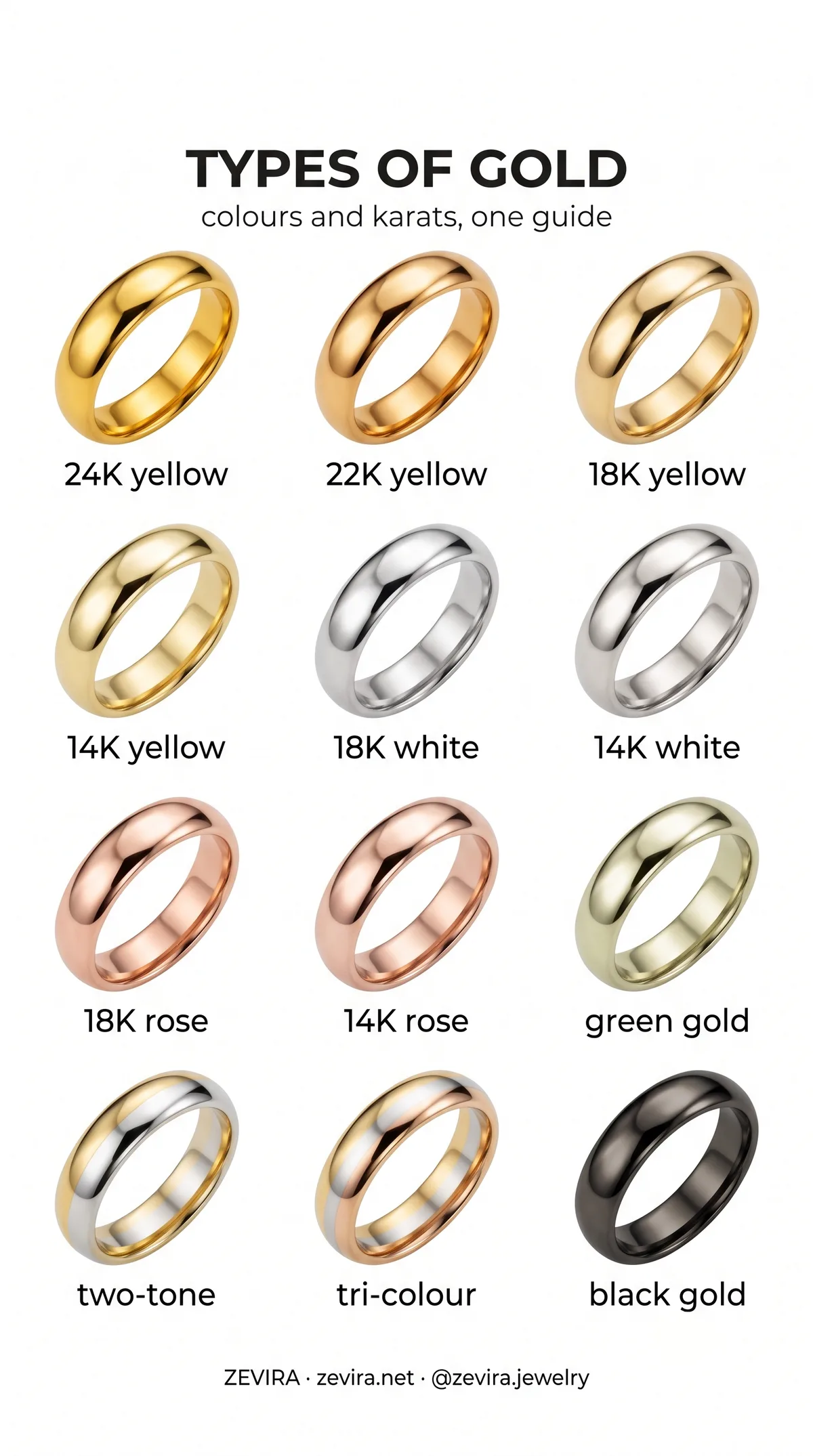
Yellow and White Gold
The most classic combination. A contrast between warm and cool tones. Universally wearable across different skin tones and outfit palettes.
Yellow and Rose Gold
All-warm tones. Less contrast, more harmony. A defining trend of the 2020s that sits well with the current preference for warmth and softness in jewellery.
White and Rose Gold
Less common. The rose tends to dominate visually. Works well for wearers who avoid yellow gold but want something softer than all-white.
All Three (Yellow, White and Rose)
The full gold palette. The most refined approach. The three-colour ring is the canonical example.
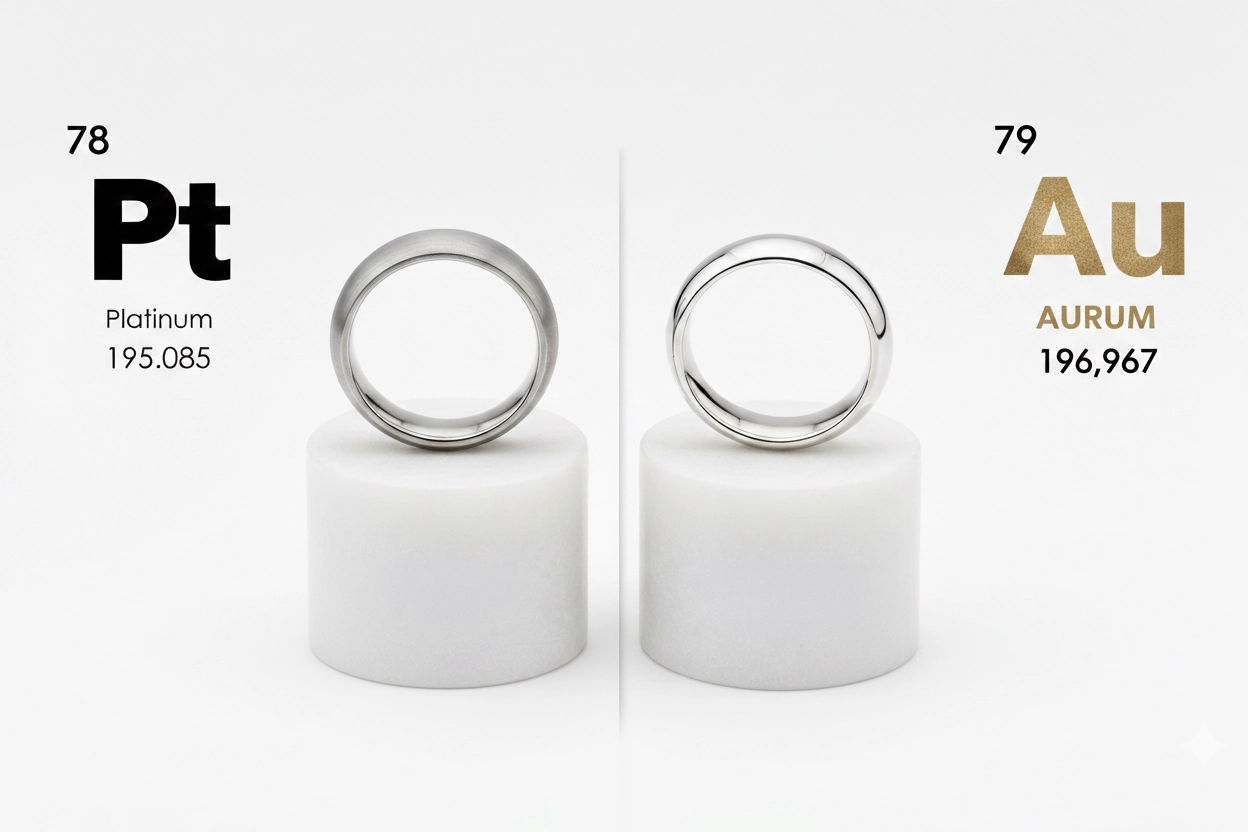
Gold and Platinum
A premium pairing. Platinum is harder than gold, and complements it visually. Frequently used in engagement and wedding rings where durability is a priority.
Gold and Silver
Less common at the premium end, more so in the mid market. Often produced as vermeil (silver partially gilded with gold). The colour contrast between warm gold and bright silver reads as higher contrast than gold-on-gold combinations.
Gold and Steel
An industrial aesthetic. Prevalent in two-tone watch models and in contemporary men's jewellery. The flatness of brushed steel against polished gold creates a strong modern contrast.
Steel and Titanium
A modern pairing. Industrial aesthetic. Tungsten combined with titanium for men's rings. These combinations tend toward the contemporary minimal end of the design spectrum.
Mokume-gane (Japanese Technique)
Layers of different metals forged together, creating a wood-grain pattern. Each piece is unique. A Japanese technique with no direct Western equivalent. Premium-luxury segment.
Damascus Steel
Forged steel with a visible pattern. Used in men's rings, bracelets and similar pieces. Premium segment.
Meteorite Inlays
Slices of iron meteorite (typically Gibeon or Muonionalusta) etched to reveal the Widmanstätten pattern, then inset alongside gold or platinum. Each piece is literally older than the planet, with a structure that cannot be reproduced by terrestrial forging. The full case for meteorite jewelry -- what these patterns are, where the metal comes from, and how to care for an iron-rich inlay -- sits naturally next to two-tone work because it is, in effect, the most extreme bimetal of all. Premium-luxury segment.
Techniques for Joining Metals
Soldering and Fusion
Two metals joined under high heat. The foundational technique.
Inlay
One metal set into a channel carved in another. The Toledan damascene tradition -- gold wire laid into black steel -- is the best-known example.
Plating
A thin layer of one metal applied over another. This is not a true bimetal in the strict sense, but produces a similar visual effect. Worth noting the distinction when purchasing.
Fused Stripes
Strips of different metals bonded into one piece, creating a striped pattern.
Mokume-gane
The Japanese technique: 25 to 30 layers of different metals are forged together and worked to reveal a wood-grain or water-flow pattern. Extremely labour-intensive.
Twisted Wire (Filigree)
Two wires of different metals twisted into a rope pattern. Common in rings and bracelets.
Free-Moving (Modular)
The Russian wedding ring method. Three or more separate bands pass through each other but are not fused.
Upload a photo of your pet, someone you love, or an object. We'll build a 3D model and hand-cast it in pewter.




What Bimetallic Jewellery Symbolizes
Versatility and Adaptability
The primary practical appeal. Works with any outfit, complements any other jewellery.
The Meaning of the Three-Colour Ring
Three interlocked bands in the classic tricolor design:
- Yellow -- fidelity
- Rose -- love
- White -- friendship
A triadic symbol of complete relationship.
Past and Future
In wedding jewellery: one metal representing inheritance and tradition, the other a new beginning.
Balance of Opposites
Cool (white) and warm (yellow) = balance. An analog of the yin-yang principle.
Complexity of Character
"I am not one single thing." Two metals speak to the complexity of the wearer.
Permanent Bond
Bimetals are joined forever. A metaphor for unbreakable connection.
The Best of Both
No need to choose. You have both.
Status and Refinement
Bimetallic jewellery is frequently associated with luxury: three-colour rings from high jewellery houses, Swiss two-tone watches. A marker of considered taste.
Choosing a Two-Tone Ring, Bracelet, or Necklace
Two-Tone Ring
The proportion of metals is the first decision. A 50/50 split gives maximum visual contrast -- both metals have equal presence. A 70/30 split lets one metal lead while the other accents. A 90/10 split creates a subtle detail effect, where the second metal appears mainly at the edges or as a thin inlaid stripe.
Width is the second variable. For everyday wear, a band of 3-4mm in a 14k two-tone gold is versatile enough to work as a single ring or in a stack. Wider bands (6-8mm) make a stronger statement and are common in men's styles.
Finish matters too. A two-tone ring where one metal is polished and the other brushed adds a textural contrast on top of the colour contrast. This technique is particularly effective in two-tone steel and gold combinations.
Two-Tone Watch-Style Bracelet
A watch-style bracelet -- meaning a link bracelet with structural links rather than a delicate chain -- follows similar proportions to watch bracelets. The most recognisable form is the alternating-link Cuban or Figaro chain, where yellow gold links alternate with white gold or steel links. These read as bold on the wrist and are generally men's or unisex sizing.
For a lighter version, a bangle with a two-tone divide (one half yellow, one half white) works well as a singular piece. The clean line between the two metals is the visual focus.
Two-Tone Necklace
A two-tone chain is typically either an alternating-link design (visible from a distance) or a twisted two-wire design (visible only on close inspection). The alternating link reads bolder; the twisted wire reads more delicate and is appropriate for fine necklace lengths.
Pendant settings can also be two-tone: a yellow gold bail and chain with a white gold setting for a stone, or vice versa. This approach lets you place the more flattering metal closest to the face (usually the warmer tone) while keeping the technically optimal metal for the stone setting.
CAPAORA mini knife pendant
The 18th-century Spanish navaja in miniature: 40 mm of stainless steel, a real folding mechanism and a Palanquilla lock that clicks. An affordable gift to remember.
Authentic · Ships from Spain · 14-day returns
Two-Tone and Skin Tone
Metal colour and skin tone interact more predictably than many people expect.
Warm and Medium Skin Tones
Yellow gold and rose gold tend to look particularly rich against olive, tan, and medium-brown skin. The warmth of the metal echoes the warmth in the skin. A two-tone piece with yellow gold as the dominant metal works well here.
Cool and Light Skin Tones
White gold and platinum tend to read more cleanly against very fair or pinkish skin. The cooler metal does not compete with the skin's undertone. However, a two-tone piece that includes yellow gold adds contrast that can be more flattering than an all-white piece.
The Practical Answer
A two-tone piece sidesteps the skin-tone question more elegantly than a single-metal piece. Because it contains both warm and cool components, it adapts to the context -- the warm metal visually recedes in one setting, the cool metal in another. This is one of the genuine practical advantages of two-tone jewellery over single-metal choices.
Two-Tone as a Safe Gift Choice
Two-tone jewellery is one of the more reliable gift categories in fine jewellery, for a simple reason: it is less likely to clash with what someone already wears.
A person who normally wears yellow gold and receives an all-white gold gift faces a choice between wearing the gift in isolation or mixing metals in a way they may not be comfortable with. A two-tone piece eliminates that friction. It contains both metals, so it coordinates with whatever the recipient already owns.
For Wedding Anniversaries
The 14th wedding anniversary is traditionally associated with two-colour gold in the modern gift list. The 25th anniversary is silver; the 50th is gold. A two-tone piece that incorporates both silver and gold tones can serve as an anniversary gift at the 25th that acknowledges both the silver milestone and anticipates the gold ahead.
For Milestone Birthdays
A two-tone piece reads as considered and enduring rather than trendy. For a significant birthday -- 30th, 40th, 50th -- it says "this is something you will wear for the next decade" more convincingly than a piece that is purely fashionable in a particular season.
For Couples
A matching set of two-tone rings in the same metal combination but different widths (wider for him, narrower for her) is a clean and readable pairing that does not require explanation. The matching metals create the connection; the different widths create the appropriate distinction.
Quality Signs in Two-Tone Pieces
Knowing what to look for separates a lasting piece from one that will disappoint in two years.
Hallmarks
In the United States, gold content must be stamped by law. A 14k stamp means the piece is 58.3% gold; an 18k stamp means 75% gold. Both metals should be stamped separately if the karat grades differ. Absence of stamps in a piece sold as gold is a red flag.
The Joint Line
In a soldered or fused two-tone piece, the joint line between metals should be clean, consistent, and free of discolouration. Hold the piece under a loupe at the seam. A good joint is invisible except as a slight colour change. A poor joint shows solder beading, irregular gaps, or a different colour than either parent metal.
Weight
Solid bimetallic pieces have a satisfying weight proportional to their size. A very light ring that claims to be solid two-tone gold is likely hollow, plated, or both. Hollow rings exist as a legitimate category (they weigh and cost less), but they should be disclosed as hollow.
Surface Consistency
At the meeting line of two metals, check that the surface is flush and smooth. Any ridge, step, or roughness at the transition suggests poor assembly.
Movement (for Modular Pieces)
In a free-rotating three-colour ring, each band should move smoothly and evenly around the others. Catching, sticking, or uneven tension is a manufacturing defect. The links in a two-tone chain should also move freely without any binding.
Six fast checks, no tools. Leave your email, we'll send the PDF and a discount code.
No spam, unsubscribe anytime.
Care of Two-Tone Finishes
Cleaning
Solid gold bimetal (yellow and white, yellow and rose): warm water with a small amount of mild dish soap, soft toothbrush. Rinse thoroughly. Dry with a lint-free cloth. Both gold colours respond the same way to this treatment.
Gold and platinum bimetal: identical care. Platinum is inert and requires no special handling beyond avoiding abrasives.
Gold and steel (watches and bracelets): mild soap and water. Avoid prolonged water exposure for the steel components, as even stainless steel can spot if left wet. Dry thoroughly after cleaning.
Plated two-tone: no ultrasonic cleaning, no abrasive polishes, no harsh chemicals. The plating layer is thin enough that even mild abrasion can accelerate wear. Clean only with a damp soft cloth.
Mokume-gane: dry cloth only. The surface pattern can be damaged by ultrasonic cleaning and chemical cleaners that attack one metal layer faster than another. Consult the maker for any specific care instructions.
Storage
Store two-tone pieces separately from other jewellery to prevent scratching. Different metals have different hardnesses, and a platinum or steel piece stored loose with soft gold will scratch it. Individual soft pouches or compartmented jewellery boxes are the right solution. Keep two-tone pieces with silver components away from rubber, which accelerates tarnishing.
Resizing and Repair
Resizing a two-tone ring requires a jeweller with specific experience in bimetallic work. The challenge is that the solder or fusion joint must be reopened and reconstructed in the correct proportion. An inexperienced jeweller may use a solder that discolours one of the metals, or may fail to maintain the proportion of the two metals across the resized area. Ask explicitly whether the jeweller has resized bimetallic rings before commissioning any work.
The Three-Colour Ring: A Closer Look
The most celebrated bimetallic symbol merits its own section.
Design
Three bands, each in its own metal:
- Yellow gold 18ct
- White gold 18ct
- Rose gold 18ct
The bands are interlocked so that each passes through the next, but they never separate. Each can be rotated around the finger independently, yet they move as one.
Widths
Standard widths:
- Classic -- the traditional width
- Small -- more delicate
- Large -- more pronounced
- Rose-dominant -- a retro variant
Symbolism (the classic tricolor version)
- Yellow -- fidelity
- Rose -- love
- White -- friendship
Many couples wear it as an alternative to a solitaire engagement ring.
Cultural Legacy
The three-colour interlocking ring is sometimes worn on the little finger, a styling choice associated with the design since the early twentieth century. It is worn widely regardless of gender and appears regularly at significant events.
How to Style It
- A single three-colour ring on one finger, without other rings
- In a stack with plain bands in one of the three metals
- Alongside a two-tone bracelet or necklace for a cohesive set
Swiss Two-Tone Watches: A Closer Look
The combination of steel and gold in one case and bracelet is a long-established two-tone format in watchmaking.
The Technology
Bezel and centre links in gold (yellow or rose); case and outer links in stainless steel (often the house's own grade). This is not plating: the gold and steel components are separate, individually machined parts assembled together.
Models
- Classic two-tone dress watch -- the foundational two-tone format
- Two-tone sports watch -- for active wear
- Two-tone travel watch -- for those who cross time zones
- Two-tone chronograph -- sporting aesthetic
- Platinum and steel -- for the top segment
Collectibility
Two-tone watches have a long following among collectors, and vintage examples remain popular on the secondhand market. How any individual piece fares over time depends on the wider market and is never guaranteed.
Mokume-gane: The Japanese Technique
A unique technique without a direct Western equivalent.
What Mokume-gane Is
"Mokume-gane" translates literally as "wood-grain metal." Layers of different metals -- typically 25 to 30 -- are forged together, selectively oxidised, and worked to reveal a visible pattern. The pattern resembles tree rings or flowing water. Every piece is unique, like a fingerprint.
Metals Used
- Sterling silver (925)
- Yellow, white and rose gold
- Platinum
- Palladium
- Occasionally copper, bronze or brass for colour variation
The Process
- Metal sheets are stacked
- Heated in a furnace
- Forged and fused
- Cooled
- Cut or carved into shape
- Acid-etched to reveal the pattern
- Polished
Each piece takes days to weeks of work.
In Jewellery
- Mokume-gane rings -- wedding bands, expressive bands. Premium segment.
- Mokume-gane pendants -- flat sections with visible patterns.
- Mokume-gane cufflinks -- for men.
- Mokume-gane bangles -- rare and valuable.
Notable Makers
- Hiroko Sato Pijanowski (Japan/USA) -- revived the technique in the twentieth century
- George Sawyer (USA) -- one of the leading contemporary practitioners
Send a friend a discount code, they save on their first order.
Advantages and Disadvantages
Works with Any Wardrobe
Suited to both cool (dark, navy, grey) and warm (cream, tan, burgundy) palettes.
Pairs with Any Other Jewellery
Can be worn alongside anything -- gold or silver -- without strict matching.
No Need to Choose a "Type"
In conservative dress codes, the expectation is that a person is either a gold or a silver person. Bimetallic jewellery sidesteps that convention entirely.
Durability
If one of the metals is softer (gold, for instance), the other (platinum, steel) compensates in hardness.
Visual Interest
A more engaging look than monochrome, without being conspicuous.
Lasting Appeal
Luxury bimetallic pieces -- three-colour rings, Swiss two-tone watches -- are made to be worn for years and stay relevant through changing trends.
Resizing Is More Complex
Adjusting the size of a two-tone ring requires a jeweller with specific experience. Not every workshop can do this well.
Counterfeits
Two-tone jewellery can be harder to verify. Plating can mimic a solid two-tone metal. A certificate of authenticity matters.
Risk of Separation
In lower-quality pieces using electrolytic bonding, the metals can part. In well-made pieces -- fused, soldered or mokume-gane -- this does not happen.
Two-tone rings, wedding bands, chains combining gold and silver.
Who Bimetallic Jewellery Suits
Those who want versatility. No need to choose.
Couples and the engaged. Three-colour rings, two-tone wedding bands.
Watch enthusiasts who treat timepieces as jewellery. A Swiss two-tone dress watch functions as both accessory and jewellery.
Admirers of quiet luxury. Refined without ostentation.
Those drawn to Japanese craft traditions. Mokume-gane as a singular choice.
Those with an interest in Spanish cultural heritage. The Toledo damascene tradition.
People who work in creative fields. Visual interest without excess conservatism.
A meaningful personal gift. A considered, lasting piece.
For wedding anniversaries. The 14th anniversary is traditionally associated with two-colour gold in the modern gift list.
How to Style Bimetallic Jewellery
With Any Wardrobe
Every colour works. No rigid matching required.
With Single-Metal Jewellery
The bimetallic piece acts as an anchor. Other jewellery can be in one of its metals.
With Other Bimetallic Pieces
Multiple two-tone pieces work together. A three-colour ring, a two-tone bracelet and two-tone watch form a cohesive set.
With Stones
Bimetal frequently serves as the setting for a single stone. The stone can sit in one of the metals as an accent.
Across Ages
Bimetallic jewellery suits any age. For younger wearers, it reads as refined without being stiff. For older wearers, it is adaptable without appearing conservative.
Care for Bimetallic Jewellery
Cleaning
Solid gold and silver bimetal: mild soap and a soft brush. Take care with silver, which tarnishes faster.
Solid gold and platinum: the same care routine applies. Warm water and soap.
Plated bimetal: avoid ultrasonic cleaners and harsh chemicals.
Mokume-gane: dry cloth only. The patterned surface can be damaged by ultrasonic cleaning.
Storage
In a separate soft cloth pouch or compartment in a jewellery box, so the metals are not scratched by other pieces.
Repair
Only with a jeweller experienced in bimetallic work. Ask about their experience before commissioning any alteration.
FAQ
What is a bimetallic piece of jewellery?
A piece made from two or more metals physically united into one object -- fused, soldered or layered. Not to be confused with metal mixing, which means wearing different pieces together.
What is the difference between bimetallic and plated jewellery?
Bimetallic is solid throughout: both metals run through the full thickness of the piece. Plated means a thin layer of one metal applied over a base of another.
Is the three-colour ring a true bimetal?
Yes -- it is a classic example of a tri-metal piece. Each of the three interlocked bands is solid 18ct gold in its own colour.
Can you buy bimetallic jewellery in the mid-market?
Plated two-tone pieces, yes. Solid two-tone in genuine metals starts at mid-premium.
Which bimetallic combination is the most durable?
Gold and platinum, or steel and gold. Both are harder-wearing than plain gold, particularly 18ct, which is relatively soft.
How do you choose the proportions?
It depends on the look you want:
- 50/50 -- maximum contrast
- 70/30 -- one metal dominates, the other reads as an accent
- 90/10 -- the second metal as a subtle detail
Is "bimetallic" a brand-specific term?
No. It is a technology, not a trademark. The three-colour ring, the Swiss two-tone watch, mokume-gane from any maker -- all are bimetallic.
Is bimetallic jewellery suitable for everyday wear?
Yes. Most bimetallic pieces are made for daily use. They are frequently more durable than plain soft gold.
Is the Russian wedding ring a bimetal?
Yes. Three bands in different metals, moving freely. It is often described as the Russian form of the three-colour ring.
What should bimetallic jewellery cost?
A simple two-tone silver ring sits in the mid segment. A two-tone ring in 14ct gold is premium. Solid 18ct three-colour is luxury. Handmade mokume-gane is premium-luxury.
How do you tell a quality two-tone piece from a cheap one at a glance?
Check the joint line between metals under magnification. In a quality piece it is clean and sharp. Check for hallmarks. Weigh the piece in your hand -- solid bimetallic has satisfying density. Ask whether the piece is solid throughout or plated.
Does two-tone jewellery ever look dated?
Styles cycle, but the fundamental design logic of two-tone -- structural combination of warm and cool metals -- is sound enough to survive fashion cycles. The pieces that dated were the ones made to look flashy rather than considered. A clean, well-proportioned two-tone band or chain reads as enduring rather than trendy.
Buying it as a gift? Each one arrives ready to give.
 A branded Zevira box and a little card come with every order.















Conclusion
Bimetallic jewellery is not a limitation, it is an expansion. You do not choose between yellow and white -- you have both. You do not restrict yourself to gold-palette outfits -- every colour works. You do not worry whether a piece will clash with your other jewellery -- it will not.
The history of two-tone design runs more than two thousand years: from Roman opus interrasile in the first century, through Byzantine champlevé, through Florentine Renaissance contrasto, through Art Deco platinum-and-gold, through the mid-century American two-tone wedding band, to the current revival of quiet luxury. The design logic behind combining two metals in one object has never stopped making sense.
In 2026, bimetallic jewellery is enjoying a revival alongside the quiet luxury aesthetic. Three-colour rings are fashionable again. Swiss two-tone dress watches from the first tier carry year-long waiting lists. Mokume-gane wedding bands are a growing choice for couples seeking something genuinely singular.
If you are looking for a piece that will work across ten or more years of different wardrobes and shifting trends, bimetallic is a strong choice.
About Zevira
Zevira is a Spanish jewellery brand based in Albacete. Two-tone jewellery is one of the categories within our catalogue. Current availability and details are in the catalogue.