The Key in Jewellery: Meaning of a Symbol of Secrets, Access and Memory
Introduction: a small object with a long history
There are few things that are simultaneously practical and symbolic by their very nature. The key exists for one simple purpose: to open what is locked. And that function is so fundamental that almost every culture has built its own mythology around it.
With a key you open your home. You enter a church. You unlock a treasure chest. You start a car. Finding the way to someone's heart stopped being a metaphor centuries ago. It became a cliché a thousand years old.
In jewellery this motif has lived for a long time. Victorian ladies wore small key figures in lockets. Contemporary designers produce oversized pendants shaped like enormous antique specimens. Lock-and-key paired pendants have become a classic of wedding gifts and anniversary tokens.
This guide explores how the key symbol works in jewellery today, what it means across cultures and how to choose the right one. It travels through myth, faith, mourning and romance, then lands on the practical questions of size, metal and styling that decide which key actually suits you.
Wear the symbol, don't just read about it. These are in stock:


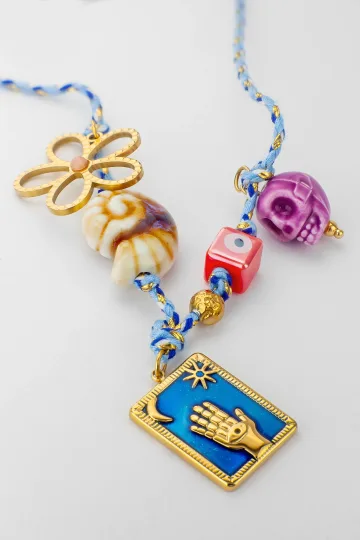
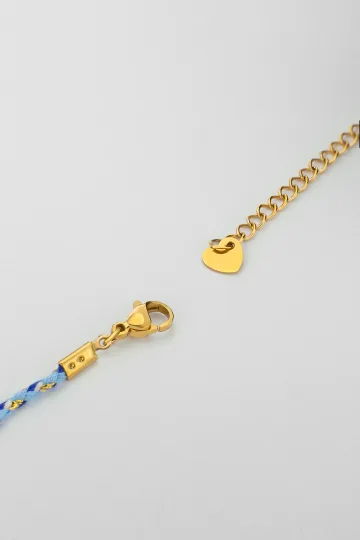
Key jewellery: what to choose
Key pendant
The most common form. Shapes and sizes vary considerably, and the meaning shifts with them.
- Small minimalist 2-3 cm on a fine chain. An everyday piece, a personal symbol. Suitable for the office or daily wear. Entry-level segment.
- Medium vintage 4-5 cm with ornamental bow and bit. Dark academia, Victorian aesthetic. Mid-range segment.
- Large 6-8 cm substantial and detailed. Gothic or steampunk aesthetic. Mid-to-premium segment.
- Genuine antique set in a mount: a real nineteenth-century key set in a silver bezel. A unique object. Premium segment.
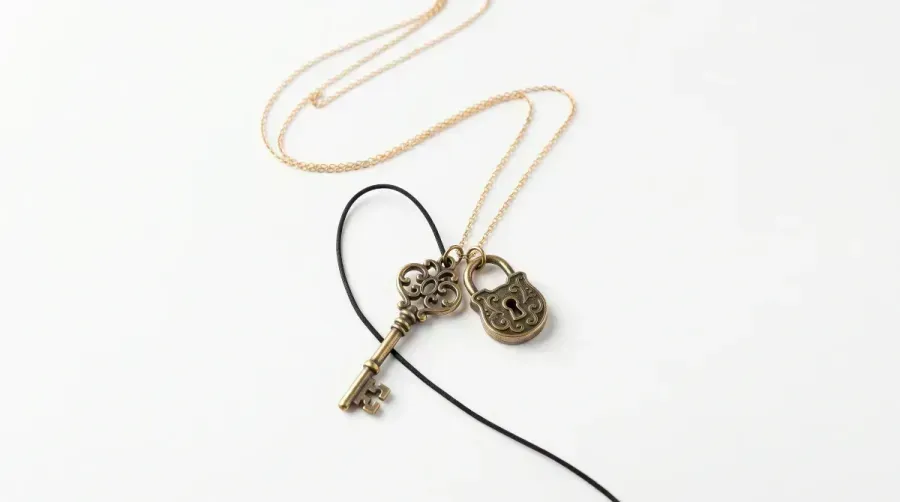
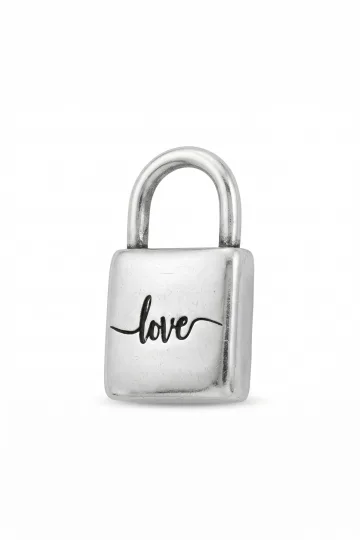
- Lock-and-key pair: two pendants, one bears the key, the other a lock or miniature casket. Mid-range segment.
Ring
Less common than pendants but a popular format.
- Thin shank with a small key motif as an accent on the band. Minimalist touch.
- Signet with engraving: the masculine version, a considered look. Mid-range segment.
- Sculptural with a substantial key: large, for dark academia or gothic styles. Mid-to-premium segment.
Formats beyond the pendant
The key travels well past the neck. As earrings it can be a pair of small symmetrical studs for every day, an asymmetric duo with a lock on one lobe and a key on the other in the current mismatched trend, or long drops on fine chains for a gothic or bohemian mood. As a bracelet charm it works either as a single key on a chain for daily wear or as a cluster of small skeleton keys, each carrying its own private meaning, and on a plain leather cord it turns unisex and relaxed. The brooch is the most period of all: a large ornamental key pinned to a tweed jacket or a heavy coat lapel reads instantly as dark academia or Victorian revival, and it stays one of the few ways to wear the motif large without a chain at all.
A key belongs on a bare collarbone, not smothered under a turtleneck. Tuck it away and you might as well have left it at home.
What to wear a key with
Over years on shoots a key pendant has passed through dozens of looks in my hands. Here is what actually works, by occasion.
What do you wear a key with every day? For daily wear I recommend a small smooth silhouette up to three centimetres in silver on a fine chain. A light top (white, sand, grey) lifts the metal, a dark one turns the key into a quiet accent. Under a shirt or thin knit it stays almost hidden and works as a private sign only you know about.
Does it work at the office? It does, if you keep it restrained. I suggest a clean key without a heavy bit, silver or yellow gold, 45 to 50 cm so the pendant slips under the top button. Under a jacket it reads as a detail, not a loud accent. A strict dress code is no verdict: the key lives happily under the collar.
How do I build an evening look? For evening I choose a large Victorian specimen over a plain dress in a deep colour: black, wine, emerald. Dense dark fabric, velvet or heavy knit, shows oxidised silver at its best. Over an open neckline the pendant settles in the centre, its strongest position.
How do I layer a key? I recommend two or three chains of different lengths: one with the key, another with a slim medallion or a small lock. Keep to one metal so the look does not splinter. With jeans and a leather jacket a key on a leather cord works, with none of the dressed-up shine.
How do I pick the length and not lose the pendant? I match the length to the neckline: short for a closed collar, long for an open one. A large key wants a denser chain, a thin cord wears through fast under that weight. And never mix more than two metals in one look, or the key gets lost in the glitter.

Turn on your camera, pick earrings, a pendant or a ring, and see the piece on yourself in real time.
Switch items in one tap.
Everything runs in your browser: no photo or video is ever uploaded.
Types of keys in jewellery
Antique Victorian key
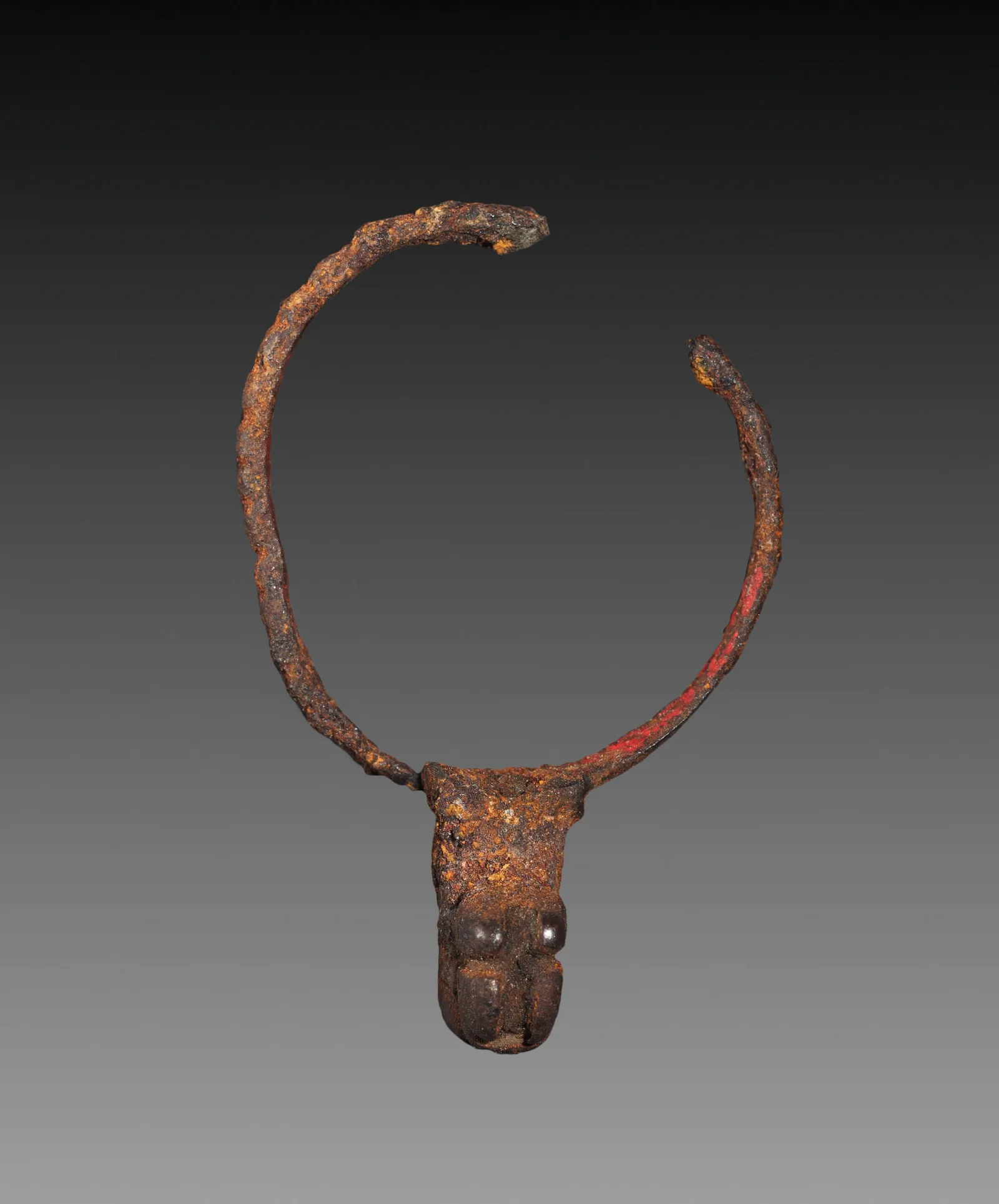
Ornate bit, carved bow, often with surface ornament. The silhouette of "grandmother's old chest key". The most popular form in jewellery. Often modelled on real eighteenth- or nineteenth-century specimens.
Heart key
A stylised shape in which the bow is formed as a heart. A romantic symbol, popular in paired pendants. Also a common Christmas or Valentine's gift.
Skeleton key
A simple form with an oval bow and a flat bit pierced with cut-out holes. In Britain and America these were once master keys that opened many locks in a single building. The name has nothing to do with bones: the working part was filed down to its bare skeleton so it could clear the wards of different locks. In jewellery this is the classic minimalist variant, and its clean outline is the shape that first comes to mind when someone hears the word key.
Ornamental key
Detailed, with patterns worked across the bit and openwork tracery in the bow, sometimes set with small stones such as sapphire, amethyst or garnet in the handle. These are the pieces that lean hardest into the dark academia and Victorian revival aesthetic. The extra ornament reads as heirloom rather than hardware, which is why an ornamental key suits anyone who wants the symbol to look inherited rather than bought last week.
Church key / "St Peter's key"
Triple bit, often with a cross at the top. Two crossed keys are the canonical attribute of Saint Peter, a central Christian motif. Popular across Catholic and Anglican traditions.
Initial key
Personalised, with the bow shaped into a single letter. It is one of the easiest keys to give with intent: the initial of a partner, a child or the wearer's own name turns a generic symbol into something addressed to one person. Because the letter carries the whole meaning, these keys stay deliberately plain everywhere else, a clean bit and a slim shank, so the initial is what the eye lands on first.
Watch key
An antique winding key for a mechanical pocket watch, small, with a neatly turned bow that hides its purpose. This entire category disappeared from daily life the moment crown winding arrived and pocket watches no longer needed a separate tool, which is exactly what makes surviving examples collectable. Set on a chain, a genuine watch key carries a quiet mechanical history that a purely decorative key can only imitate.
Lock and key on a single pendant
Both on the same chain. Symbol of "a couple that has already found each other". Romantic register, sitting comfortably alongside the Claddagh ring with its heart, crown and clasping hands.
Contemporary interpretations
Two modern readings pull the key in opposite directions. The steampunk version loads the silhouette with cogs, rivets and decorative industrial elements, aimed squarely at a Victorian-industrial subculture that likes its jewellery to look engineered. The minimalist version strips everything away: a clean outline with no ornament, no patina and no historical reference, built for daily wear and for people who want the shape without the storytelling. It is the same object, read either as a salvaged machine part or as a plain geometric sign, and the choice says a good deal about the wearer.
How to wear key jewellery
Worn against the skin
A small key pendant beneath a shirt or blouse. A personal symbol that nobody sees. The classic Victorian tradition: the sign of a secret kept close to the chest.
Worn over clothing and layered
On the outside the key changes register completely. A medium or large pendant shown over a jumper or a coat becomes a deliberate dark academia or gothic statement rather than a secret. Layering multiplies it: key plus lock on chains of different lengths, or key plus heart, or a cluster of three to five motifs that reads as a small curated collection. Even a strict dress code leaves room for the symbol if you keep it small and clean, which is why a minimalist key slips under a work collar while a large Victorian specimen belongs to more creative rooms, in publishing, the arts or media. With casual clothes the size stops mattering: the key is at its best against tweed jackets, vintage dresses and worn leather coats.
Materials and finishes
- Sterling silver: universal, suits all styles
- Oxidised silver: Victorian aesthetic and dark academia
- Yellow gold: classic, romantic
- Rose gold: contemporary, softer register
- Bronze or copper with patina: antique appearance
- Blackened steel: gothic or steampunk
How a key hangs on a chain, and why that matters
A key is rarely flat. A key pendant usually has bulk to it: the working part with the cuts at the bottom, called the bit or the ward, a suspension loop at the top, the bow or a fitted ring, and a shank between them. Because of that a key behaves differently on the chest from a flat medallion.
The main problem nobody warns you about is the twist. If the loop was soldered in the plane of the key, the pendant lies flat and reads like a picture. If the loop was set at a right angle to that plane, which is common on cast antique-style reproductions, the key keeps turning edge-on and effectively disappears against the light. Before buying, look at a side-on photograph or ask how the loop is oriented relative to the face of the key.
A bit at the bottom makes the pendant heavy at the feet. The centre of gravity sits low and forward, so a large key pulls on the chain and tumbles slightly as you move. For a figure longer than five centimetres choose a chain with denser links: a fine 1 mm cable or a braided cord wears through quickly where it passes through the loop under that weight. For a key worn every day, a curb or belcher chain from 1.5 mm up is the safer choice.
A pierced bit with fine teeth is the most vulnerable part of the whole piece. The teeth catch on knitwear, on hair and on the edge of a bag, and they bend. Sterling silver is softer than gold and it shows on thin elements: one bad snag can be straightened by hand, but repeated bending fatigues the metal until it snaps. If you wear a key daily and actively, choose a silhouette with a solid bit rather than an openwork one.
Customer reviews
Zevira is a real jewellery shop. Genuine payments, deliveries and customer thank-yous.
🥰🥰🥰 gracias

Ok, ¡gracias! 🙂

Caring for key jewellery
A key pendant collects dirt differently from a smooth piece. The pattern on the bow and the cuts in the bit are traps for skin oils, hand cream and textile dust. Every couple of weeks work over the relief with a dry soft toothbrush; for heavier build-up add warm water with a drop of non-abrasive soap, then dry thoroughly.
Patina and oxidised finishes carry a caveat that ruins a lot of pieces. The dark film in the recesses is not dirt but a deliberate accent that creates the Victorian antiqued look. Polishing pastes and impregnated silver cloths lift that darkening from the raised areas and leave it in the hollows, which is exactly right, but rub too enthusiastically and the blackening goes altogether, leaving the relief flat and lifeless. An oxidised key should be cleaned only on the raised parts, and gently.
Bronze and copper with a patina darken over time from water and perspiration and can leave a greenish mark on the skin. That is copper oxidising, harmless but visible. Take a piece like that off before the shower, the pool and the gym, and wipe it after contact with sweat. Silver and gold do not have that fault, though silver still blackens faster than usual around chlorine and hydrogen sulphide, so a swimming pool and a spa both count.
British tap water is worth a thought here. Across much of the south and east of England the water is hard, and it leaves a chalky film in the cuts of a bit that dulls the whole pendant within weeks. In the softer-water regions of Scotland, Wales and the north-west that is less of an issue. Where the water is hard, rinse with cooled boiled or filtered water and dry with a soft cloth rather than letting the piece air-dry.
An antique key in a mount needs twice the care. Old iron rusts, and a drop of water trapped between the key and its silver cap sets corrosion going from the inside. Such pieces are never washed under a tap: dry cleaning only, stored separately in a soft pouch, out of contact with other jewellery that would scratch the soft metal.
A genuine antique key or a modern reproduction
Anyone buying antique keys in a mount benefits from being able to tell a real old object from a fresh cast copy in the antique manner. The difference in price and in meaning is large: one is a unique object with a history, the other a decorative pastiche.
Forged and turned keys of the eighteenth and nineteenth centuries carry the marks of hand work. The bit was filed, and uneven file strokes run across it in different directions; the cuts are not perfectly symmetrical. A cast reproduction is the opposite, smooth and symmetrical, sometimes with a seam along the outline where the mould halves met and with small round pits on the surface from air bubbles in the metal. The sharp internal corners of the cuts are crisp on a genuine key and rounded off on a casting.
The material talks too. Old keys are more often wrought iron or steel, less often brass, and they answer to a magnet, which separates iron from a brass reproduction in a second. Iron usually carries pitting corrosion and a dense dark scale that cannot be convincingly faked with fresh patination: an artificial patina lies in an even film, while real rust is patchy and bitten in. Wear is uneven as well: on a genuine key the bow, the part a hand gripped, is rubbed and handled, while the bit is often better preserved.
Two British specifics are worth adding. Silver mounts and caps made in the United Kingdom after 1900 normally carry a hallmark struck by an Assay Office, and the town mark tells you where: a leopard's head for London, an anchor for Birmingham, a rose for Sheffield, a castle for Edinburgh. The date letter narrows the year. If a seller dates a silver-mounted key to the Victorian period and there is no hallmark anywhere on the mount, ask why. And a piece described as antique in the trade sense normally means a hundred years old or more; anything younger is properly called vintage, and the distinction is one an honest dealer will make without prompting.
None of this is formal authentication, only a quick check before you buy. If the seller calls a key antique, ask about its provenance and request close-up photographs of the bit and of a magnet test. An honest dealer takes that in their stride.
Upload a photo of your pet, someone you love, or an object. We'll build a 3D model and hand-cast it in pewter.




What the key symbolises
There are several layers of meaning that often operate simultaneously.
Access. The most direct meaning. The key opens. Metaphorically it represents the possibility of entering somewhere: a relationship, a profession, a body of knowledge, another person's inner world.
Secrecy and mystery. It guards what is locked. The Victorian tradition of wearing a key at the neck spoke of a personal secret, a diary, letters. The contemporary reading is access to the self, to the unconscious, to the mystery of identity.
Knowledge. The key to understanding, to the answer. Educational symbolism. School and university emblems frequently include a key as a reference to the knowledge that opens the way.
Love and marriage. "The key to my heart." Paired jewellery, "she holds the key to me": a romantic metaphor that in European culture goes back at least five hundred years. Victorian mourning brooches often incorporated a key motif alongside braided hair, signifying that the deceased still held the key to the wearer's heart.
Power and responsibility. The keys of a castle, of a monastic treasury, of a guild strongroom. Whoever holds them bears responsibility. A symbol of office and authority.
Memory. The key to a house that no longer exists. To the room of a loved one who has died. A symbol of connection with the past, with what has gone.
Spiritual access. The keys of Saint Peter to the gates of heaven. In occult traditions: access to hidden knowledge. In Kabbalah, Hermeticism and Freemasonry: a foundational symbol of initiation.
Solution. "The key to solving a problem." The metaphor of finding a way out.
In ancient Greek mythology the goddess Hekate was often depicted bearing keys. She was the goddess of crossroads, boundaries and the threshold between worlds. Her keys opened the passage between the living and the dead, giving the key its oldest symbolic layer in Western tradition.
The history of the key as a symbol
Antiquity: Hekate and Janus
In ancient Greece, Hekate was the goddess of crossroads, liminality and the passage between worlds. Her keys, sometimes described as golden, opened the boundaries between the living and the dead. She is among the earliest divine figures associated with the key as a symbol of power over thresholds.
The Roman god Janus, patron of doorways and transitions, was also linked to this symbolism. Two-faced, he looked simultaneously into past and future, and the key in his hand was a sign of control over temporal transitions.
In ancient Rome the household keys were kept by the pater familias (the head of the family). This was the sign of his authority. When he died, they passed to his heir together with his duties.
Christianity: the keys of Saint Peter
One of the chief Christian symbols. In the Gospel of Matthew, Christ says to Peter: "I will give you the keys of the Kingdom of Heaven." This is the literal foundation of papal authority (the Pope as successor of Peter).
In Catholic iconography Saint Peter is always depicted with two keys, usually one gold and one silver (one to open, one to lock). Two crossed keys are the arms of the Vatican, set beneath the papal crown.
Within the Anglican tradition the keys of Saint Peter carry a slightly different emphasis. They are less specifically tied to papal succession and more broadly read as symbols of priestly stewardship and the authority to bind and loose. Both traditions, however, regard the key as among the holiest of symbols.
In jewellery this motif is popular across Catholic and Anglican communities. A pendant with two crossed keys reads immediately as a religious medallion.
The Middle Ages: the lady of the house
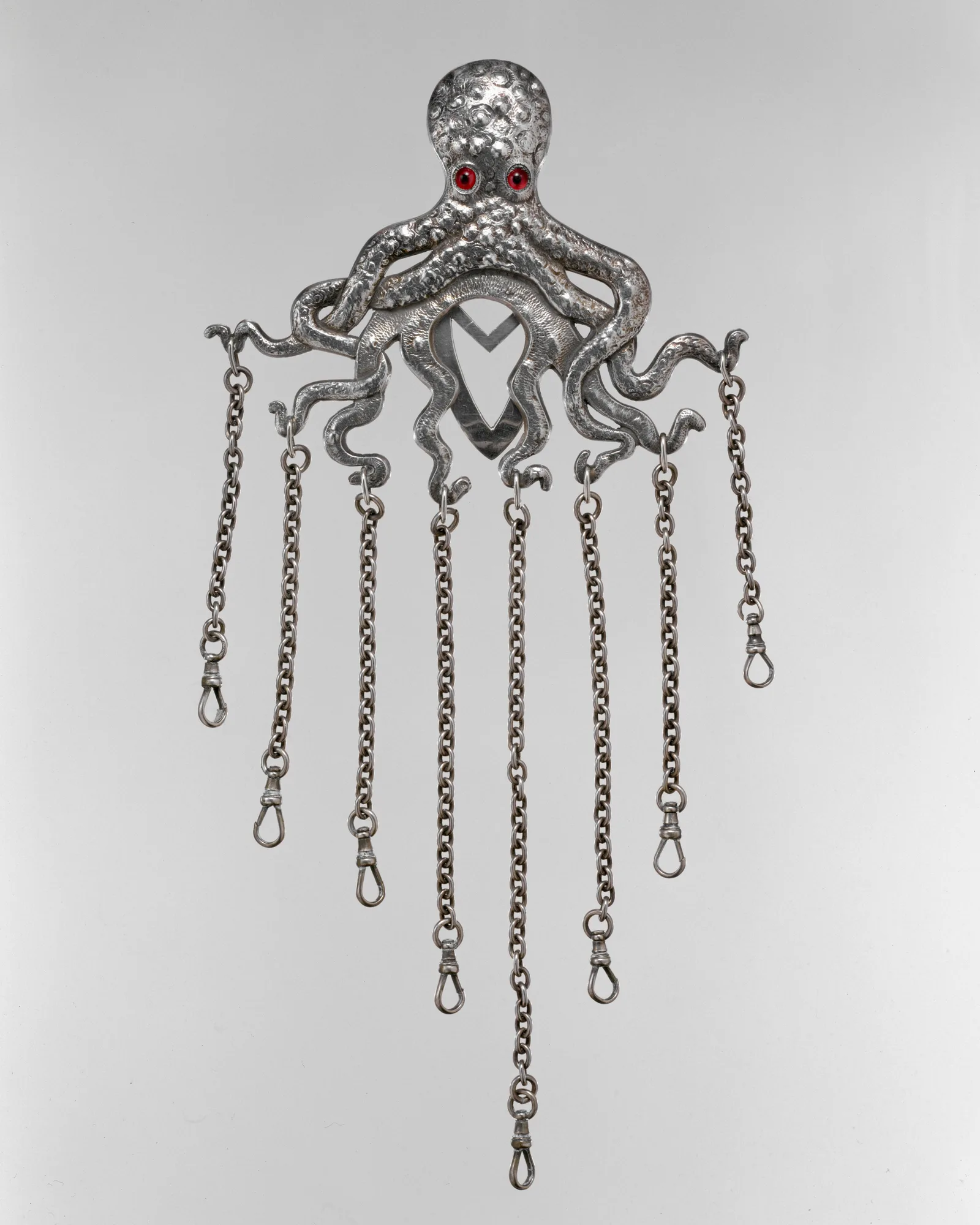
In medieval Europe a chatelaine's bunch of keys worn at the belt was a sign of status. She was the mistress of the house, with access to the larder, the cellar, the linen chests. The chatelaine (from Old French) was a decorative clasp with chains for suspending keys and small utensils.
This tradition survived into the nineteenth century. Victorian ladies wore chatelaines hung with miniatures, watches, scissors and thimbles. It was simultaneously an ornament and a practical accessory.
The Middle Ages: the gates of a city
When a city was conquered, the defeated would ceremonially present the conqueror with the keys to the main gates. This was a ritual capitulation. The ceremony of "the keys to the city" survives to this day as a formal gesture: the city presents symbolic keys to an honoured guest.
In heraldry the key is a frequent charge. Scottish, German and French coats of arms include it as a reference to an office of custodian or porter, often paired with a shield and weapons.
The Renaissance: alchemy and the occult
In alchemical and occult tradition the key is the symbol of secret knowledge. Rosicrucians, alchemists and Gnostics used it as a central element of their iconography. The Clavicula Salomonis ("Key of Solomon"), a famous occult treatise of the seventeenth century, took its very name from the symbol. The logic was simple and seductive: if hidden truth is a locked door, then whoever holds the key holds power over it. The treatise circulated in dozens of hand-copied manuscripts, each promising that its diagrams and seals were the key to commanding unseen forces, and the image of the key as gatekeeper to forbidden knowledge outlived every copy.
This symbolism passed into Freemasonry, which uses the key motif in rituals and lodge decoration, often combined with the compass and square.
The Victorian era: mourning jewellery and secrecy
In the nineteenth century the key motif entered fashion as one of the dominant themes in jewellery.
Several reasons combined:
- The fashion for diaries and correspondence (notes kept under lock)
- Mourning jewellery (in memory of the departed) often incorporated miniature keys for caskets holding a lock of the deceased's hair
- Gothic novels and sensation literature (Edgar Allan Poe, the Brontë sisters) aestheticised the motif of "access to the locked room"
- The chatelaine as a middle-class accessory
Victorian key pendants were often made to imitate patina, with ornament in the "antique" style. That aesthetic still works today.
The twentieth century: flat key, key to the heart
In the twentieth century the key lost some of its magical aura. It became an ordinary object; everyone has a key to their flat. But the romantic symbolism of "the key to my heart" survived in popular culture: in films, in songs, in novels.
In the 2000s key pendants in the premium segment experienced a fresh wave of popularity. A simple silhouette in various interpretations in silver and gold proved universally desirable.
The present: dark academia and steampunk
In the 2020s the motif returns through two subcultures: dark academia (university aesthetics, old libraries, secret societies) and steampunk (Victorian-industrial).
Social media positioned it as the symbol of dark academia: students photographing themselves with a key pendant in a library became a visual cliché. This influenced independent craftspeople and the mass market alike. The appeal is easy to trace. A key photographs well, it hints at a story without telling it, and it reads as bookish rather than flashy, which is exactly the mood the aesthetic sells. What began as a niche look on a handful of feeds now moves through student wardrobes and high-street counters in equal measure.
CAPAORA mini knife pendant
The 18th-century Spanish navaja in miniature: 40 mm of stainless steel, a real folding mechanism and a Palanquilla lock that clicks. An affordable gift to remember.
Authentic · Ships from Spain · 14-day returns
Keys in different cultures
Spain and Latin America
In the Catholic tradition of Spain, the keys of Saint Peter are among the foremost symbols. Murcia, Toledo, Santiago de Compostela all have churches displaying this image.
In Spanish popular tradition there is also the belief that a key placed under the pillow protects against nightmares. A domestic amulet, not jewellery as such, but in jewellery a small pendant sometimes carries the same protective meaning.
In Mexico, milagros (small metal votive charms) include the key as a symbol of opening the way, solving a problem, liberation.
Italy and the Vatican
Two crossed keys are the arms of the Vatican. In Italy the key is one of the most widespread motifs in religious jewellery. In Rome pilgrims to the tomb of Saint Peter have long carried home small tokens of his crossed keys, and that pilgrim souvenir is one of the oldest ways the motif entered everyday devotional jewellery.
Germany and Scandinavia
In German heraldry the key is a civic emblem before it is a personal one: the coat of arms of Bremen carries the silver key of Saint Peter, the city's patron, and locals still call the sign simply der Schlüssel, the key. In German jewellery the motif is often combined with runic or Christian symbols.
England: the Victorian tradition
The defining culture of this aesthetic. London jewellers of the nineteenth century made the key one of their leading motifs. In London today you can still find shops specialising in antique specimens and key jewellery.
France: the key to the heart
In France the key is above all a love token. "Clé de mon cœur", key of my heart, is used as an endearment, and the older idea of giving a sweetheart a small key still colours how the jewellery reads there. Key pieces stay a steady favourite, and French jewellers return to the motif season after season.
Japan
Three keys tied together are sometimes worn as a good-luck charm standing for love, health and prosperity, the three wishes granted only when the keys are kept as a set. The motif has its roots in classical antiquity rather than in Japan, and although it circulates as a Japanese charm it is not a documented native tradition. Read simply as a compact, optimistic emblem, the trio works well in contemporary jewellery, often as three tiny keys fanned out from a single ring.
Eastern Europe
In Russian, Polish and Balkan tradition the key is a symbol of the home and hearth. A pendant engraved with a house name or children's birth dates is a family heirloom.
The key in popular culture
Alice in Wonderland
The small golden key that opens the door to the garden is one of the central images in Lewis Carroll's novel. "Alice-style" pendants (miniature, often with enamel) form their own sub-genre.
Modern fantasy
Contemporary fantasy fiction keeps the old image alive: enchanted or flying keys that guard a hidden passage, a locked chamber that hides the heart of the plot. The key is rarely the headline of these stories, yet it turns up again and again in the jewellery their readers wear, prized because it hints at a secret door without naming it.
Games, screens and the dark academia shelf
Beyond the classics the key keeps surfacing. A hugely popular video game hands its hero an oversized key-blade and has spawned a whole strand of youth jewellery built around it. In portal fantasy the key is often invisible but always implied: a wardrobe opens onto a snowbound world with no lock in sight, yet the whole story turns on the idea of a passage to somewhere else. And the dark academia shelf, those campus novels of secret societies, private libraries and keys to professors' offices, handed the aesthetic its defining props long before social media borrowed them for a photo backdrop.
Leave your email, we'll send your discount code. No spam, unsubscribe anytime.
The code arrives by email, valid on your first order.
The key in art and painting
The Saint Peter of the old masters
The image of the apostle with two keys runs through the whole of European painting. Renaissance and Baroque artists painted Peter with a heavy bunch, and the way the keys lie in his hand told the viewer what the scene meant. The gold key is turned upwards, towards heaven, the silver one points down, towards earth: one unlocks the gate, the other locks it behind whoever has entered. The detail repeats across dozens of altarpieces, and it was from painting that the motif passed into devotional medals and from there into mass-produced religious jewellery. The National Gallery in London has several such panels, and once you have noticed the pair of keys you will find them everywhere.
The still life and the theme of transience
In seventeenth-century Dutch still life a key often lies among the objects that recall the fragility of life: a guttering candle, a wilted flower, an hourglass. A locked casket beside a key laid down was read as a hint that locks and treasures cannot be held for ever. That melancholy note echoed later in Victorian mourning jewellery, where the key became a sign of what is locked away for good.
Allegory and emblem books
The Baroque age produced whole books of emblems in which every object carried an encoded meaning. There the key stood for prudence, caution, the ability to keep another person's secret. A silent figure who could be trusted with a confidence was drawn with a small key at the lips. That layer of meaning is subtler than plain access, and it still works: a key at the throat hints that the wearer has an inner life closed to outsiders.
The psychology of the key: why people choose it
A sense of control
A key is a small object that grants power over a space. Psychologically people reach for the symbol at moments when they want the feeling of running their own life back. A key pendant works as a quiet reminder: I have access, I decide what to open and what to leave locked.
A boundary and personal space
A locked door is a boundary, and a key is the right to draw it. People who value privacy choose the motif almost without thinking. It says to everyone else without a word: the entrance is not for all, there is an area you come into by invitation. That is why the key settled so comfortably into the aesthetic of introverts and of anyone fond of a quiet, study-bound way of life.
Transition and threshold
A key opens a door, and a door is always a passage from one state to another. At a break in life, moving house, changing jobs, graduating, parting, a person wants an anchoring object that marks the line. A key does that job more precisely than most symbols, because its whole function is to start something new.
A keeper of memory
A separate reason for choosing one is a link to a particular person or place. Psychologists call such things transitional objects: the object takes on the role of an anchor holding a connection with someone or something no longer there. A key suits that role better than most, because it already stands for entry to a place now closed. Set into a loop, it stops being a useless piece of metal and turns into a carrier of memory you can keep about you every day, without explaining to anyone what it once unlocked.
The key as a charm and in folk belief
In folk tradition the key was credited with protective power, and a level head helps here. Metal and shape guard nothing by themselves; this is a cultural metaphor, not a property of the object. But as folklore the beliefs are interesting, and they explain why the motif has proved so durable.
The key at the cradle
In several European traditions an iron key was laid in a cradle or under an infant's pillow, in the belief that the metal and the image of a locked door would keep harm away. Essentially it is a version of the wider belief in the protective power of iron, to which the key simply added the idea of a closed entrance.
The house key and the threshold
The key to the family home was held to be the guardian of the hearth. It was not handed to strangers and not thrown away even when broken. In Balkan and Slavic tradition the old house key passed down with the house itself and became a family relic holding the memory of the line. Britain has its own version of the sentiment in the twenty-first birthday key, once given as a token that the young adult now had the run of the house, and still cast in silver as a keepsake.
Three keys for luck
The motif of three keys on one ring appears across several cultures with much the same meaning: three doors worth opening in a life, usually love, health and prosperity. The roots of the talisman go back to antiquity and to the idea of the key as a mark of access to good things; it is also known as a lucky charm in Japan, though it cannot fairly be called a documented Japanese tradition. In jewellery three keys on a single pendant read exactly that way, as a wish for a full life.
What to give on different occasions
Occasions for gifting a key
A key suits the moments that turn on a threshold. For a housewarming, engrave the date of the move or the new address and let "new home, new access" do the talking. For a graduation, pair it with initials or the line "knowledge opens doors", marking the step into adult life when one's own choices start opening the paths. For a couple, a lock pendant and a matching key pendant remain a classic of romantic gifting, at home at an anniversary, on Valentine's Day or as a proposal. For a reader or a writer, choose an ornamented key in the dark academia register, made for people who love old books and university corridors. For a collector, little beats a genuine antique key set in a jewellery mount, a single object that already carries its own history. As a gift to yourself after a hard ending or a finished project it says, quietly and without display, that a new chapter has opened. And in Catholic and Anglican families a small silver key stands in for the keys of the Kingdom of Heaven, which makes it a fitting First Communion or Confirmation present.
Silver, gold, wedding rings, symbolic pieces and paired sets.
Send a friend a discount code, they save on their first order.
Who it suits
Students and academics. As a symbol of knowledge, of access to learning.
Writers, scholars and researchers. Dark academia and its references.
Lovers of history and antiques. Vintage specimens carry historical depth.
Couples. Paired lock-and-key jewellery.
People in transition. Moving house, a new job, a new chapter of life.
In memory of those gone. The key to a house that no longer exists as a symbol of remembrance.
The faithful (particularly Catholics and Anglicans). The keys of Saint Peter.
Gothic and dark academia enthusiasts. A central symbol of both aesthetics.
Literary fans (Alice, modern fantasy, dark academia). References to favourite books.
Frequently asked questions
Is this a Christian symbol?
It can be. Two crossed keys are the sign of Saint Peter and of papal authority. But the motif is far older than Christianity. It appears in Greek, Roman, Egyptian and Asian traditions. Contemporary wearing is not necessarily religious.
What does a lock-and-key paired pendant mean?
Classic romantic symbolism. "You have access to me." Suitable for a couple, an engagement, an anniversary gift. In some traditions both partners wear both pieces; in the French tradition one person wears the key, the other the lock.
Can men wear key jewellery?
Yes, absolutely. Substantial steampunk or gothic forms are often worn by men. Dark academia is gender-neutral. Victorian style is worn by everyone, with no gendered expectation.
Does the key have a protective function?
In some traditions, yes. Spanish folk tradition places a key under the pillow against nightmares. The Mexican milagros tradition uses it as a sign of liberation from a problem. It is not, however, a universal protective symbol.
Does size matter?
Yes. A small key (2-3 cm) is a personal, intimate symbol. A large key (6 cm and above) is a statement, a visible accent. A medium key (4-5 cm) is the versatile option.
Which material is best?
It depends on the aesthetic. Silver or oxidised silver for dark academia. Yellow gold for classic romance. Copper or bronze with patina for steampunk. Blackened steel for gothic.
Is it compatible with a cross?
Yes. Crossed keys already approach the form of a cross. A pendant with a cross-shaped bow is a classic Christian symbol.
How to explain it if someone asks?
Short answers work better than long ones. "I like the aesthetic", "It's dark academia", "It was my grandmother's", "Just a beautiful piece", "It marks my move." Most people do not press beyond the first question.
Where to find a genuine antique key?
European flea markets (Portobello in London, Saint-Ouen in Paris, Porta Portese in Rome), specialist antique shops, vintage online marketplaces. In Britain, markets in Bath, Edinburgh and the London Lanes also carry antique key specimens regularly.
How much should this cost?
From the entry-level segment for a simple silver pendant to premium for a handcrafted piece with a genuine antique in a jewellery mount. A quality vintage-style piece sits in the mid-range.
Notable keys in literature and history
The keys of Saint Peter
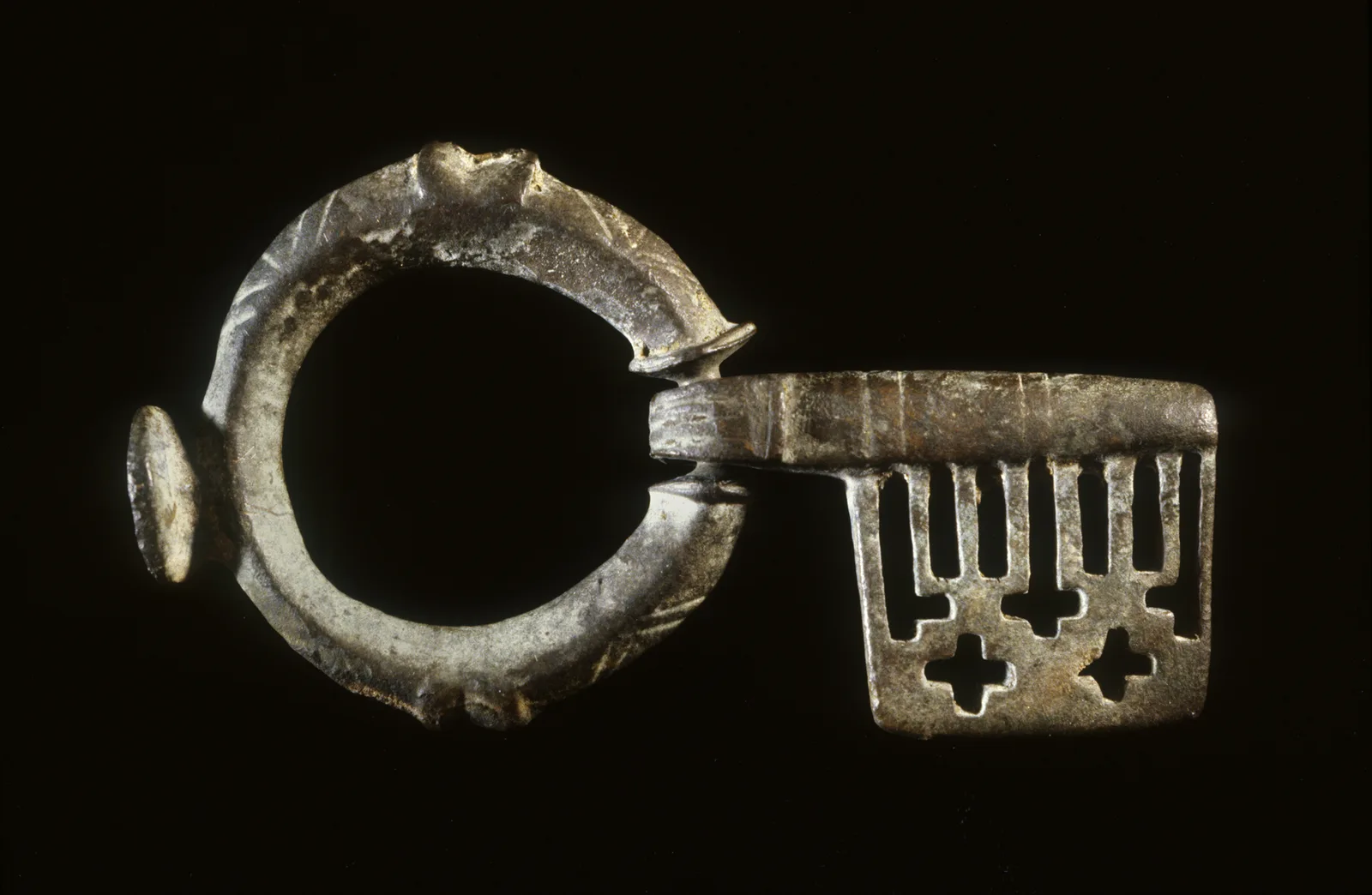
Two keys of Saint Peter are among the oldest Christian symbols. They appear in art from the fourth century. A foundational element of Vatican heraldry.
The Clavicula Salomonis
A celebrated occult text of the seventeenth century, attributed to King Solomon. Contained rituals, incantations and seals. The title is metaphorical: the key to secret knowledge.
The chamberlain's key at court
For several centuries the European courts had an office whose badge was a key worn openly on the person. A chamberlain carried a gilded key, at first a working one that genuinely opened the private apartments, later purely ceremonial, fixed to a ribbon or a bow at the back of the coat. The point was visible: this man has access where others do not. The tradition ran through the Habsburg, Prussian and Russian courts, and in Britain the office of Lord Chamberlain still carries a key as part of its regalia at coronations and state occasions. The gold key of the ceremonial officer and the small key pendant on a chain are the same idea at different scales, one publicly granted, the other privately chosen.
The Bastille key
In 1790 the Marquis de Lafayette sent the actual iron key of the Bastille across the Atlantic to George Washington, entrusting it to Thomas Paine to carry. It was meant as a token of a revolution that had crossed from one republic to another, a physical piece of a fallen prison passed between two founders. That very key still hangs at Mount Vernon today, which makes it perhaps the most famous single key in the world and a reminder that a key can be a political gift as readily as a romantic one.
Alice and the golden key
Lewis Carroll's Alice's Adventures in Wonderland (1865) made the small golden key one of the most recognised literary images in the English language. The key to the magical door.
Surprising facts
- A court key you could never lose. A royal chamberlain wore a gilded key at the back of his belt, turned outward so everyone at court could read it. It unlocked nothing important on its own; it was a badge announcing that its owner had access to the ruler's private rooms.
- Your collarbone is named after a key. The word clavicle comes from the Latin clavis, meaning key. Anatomists gave the bone that name because it rotates on its axis the way a key turns in a lock.
- Handing back the keys was itself a divorce. In Roman law a husband who took the household keys from his wife performed an act the sources call claves ademit. The gesture did not accompany the divorce; it was the divorce, spelled out in the one object that stood for running the house.
- The lock came before the metal key. A pin-tumbler mechanism in wood was already working in the ancient Near East some four thousand years ago, long before anyone forged a key in iron. The principle inside a modern deadbolt is that old.
- The cuts on a key are a code, not decoration. Every notch filed into a bit is matched to the wards inside one particular lock. What looks like ornament is a functional cipher, which is why an unfamiliar key will not turn even when it slides in cleanly.
- A lock and its key once served as a betrothal gift. Lovers exchanged a small casket that locked, with the key given separately, so that handing over the key completed the pledge. The mechanics of the object carried the promise as plainly as any ring.
- The papal keys are always tied with a red cord. On the Vatican arms the two crossed keys are never drawn loose. Heraldic rule binds their bows together with a red cord, a fixed detail that appears in every correct rendering of the emblem.
Buying it as a gift? Each one arrives ready to give.
 A branded Zevira box and a little card come with every order.















Conclusion
This is one of those symbols that works without explanation. Everyone understands intuitively: it opens, it grants access. And that basic clarity allows it to carry the most varied meanings: from a romantic metaphor to a gothic symbol, from dark academia to the Christian tradition.
A key pendant can mean any or all of these things, and the wearer decides what it means to them. A small pendant worn inside a blouse is a personal sign of secrecy. A large piece in a Victorian mount is a statement of style. A paired lock with its key at a partner's neck is a promise.
About Zevira
Zevira makes jewellery in the artisan tradition of Albacete, Spain. The key is part of our gothic and winter collections, as well as a dedicated theme in our paired "lock and key" pieces for two.
What you can find at Zevira with a key:
- Antique Victorian keys as pendants
- Small minimalist keys on fine chains
- Paired "lock and key" sets for partners
- Heart keys in the romantic tradition
- Keys with gothic motifs (skulls, crosses)
- Key charms for charm bracelets
- Personal engraving on the key shaft
Each piece is made by hand, with the option of personal engraving. We work with sterling silver 925 and 14-18 carat gold.