The Lighthouse in Jewellery: Meaning of the Symbol of Light and Direction
Introduction: a tower standing alone in the storm
A lighthouse is a paradox. It stands alone. On a rock, on a headland, on a remote islet. Often there is no one nearby, only wind and waves. And yet a lighthouse does not exist for itself. Every night it shines for others. For sailors it cannot see. For ships that may pass without a word.
The lighthouse is a symbol for those who guide others without receiving anything in return. For parents, teachers, therapists, doctors, and those in rescue services. For everyone whose role is to be a point of light so that others can find their way.
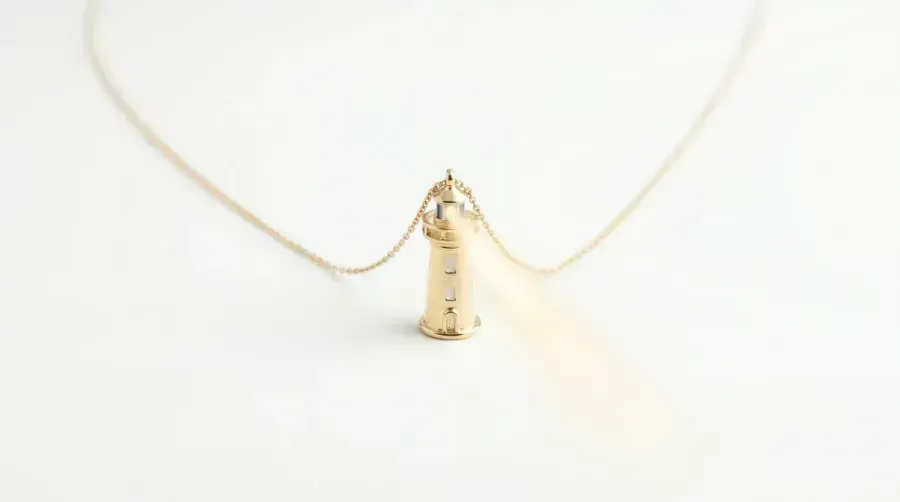
In jewellery, the lighthouse is a deep and rare symbol. Not as ubiquitous as an anchor or a whale, but for those who feel its meaning, it is very personal.
This symbol has existed for thousands of years. Ancient Greeks built fire towers along their coasts long before the common era. The Romans placed stone beacons all around the Mediterranean and Atlantic shorelines. Medieval monks maintained fires on clifftops as part of their calling. Lighthouse keepers in the nineteenth century changed the oil in their Fresnel lenses every night, alone against the sea. All of them shared one purpose: to shine for those they could not see, so that those people might find their way home. That is what makes the lighthouse so personal as a symbol in jewellery.
Wear the symbol, don't just read about it. These are in stock:

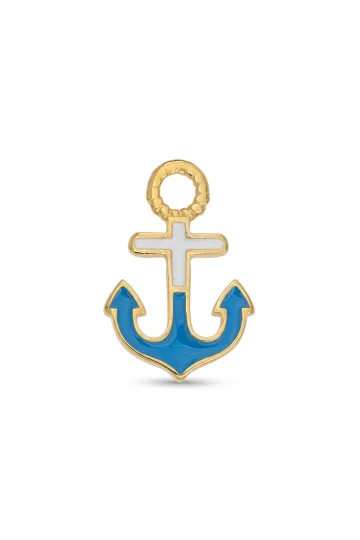








A history of lighthouses: from the Pharos to the present day
The Lighthouse of Alexandria, third century BC
The Lighthouse of Alexandria, built around 280 BC on the island of Pharos off the Egyptian coast under Ptolemy II Philadelphus, was one of the Seven Wonders of the Ancient World. Estimates of its height range from 100 to 140 metres. A fire burned at its summit, visible at sea for some fifty kilometres, reflected and amplified by a polished bronze mirror.
The lighthouse stood for approximately 1,500 years before a series of earthquakes brought it down in the fourteenth century. From its name, Pharos, come the words "phare" in French, "faro" in Spanish and Italian, and all derived terms for lighthouse in the Romance languages. The Pharos literally gave the lighthouse its name.
The Tower of Hercules, second century AD
The Tower of Hercules in La Coruna, Galicia, is the oldest working lighthouse in the world. Built by the Romans in the second century AD and reconstructed in 1791, it remains in operation today, standing 55 metres tall. It was inscribed on the UNESCO World Heritage List in 2009.
According to legend, Hercules built the tower on this spot after his victory over the giant Geryon. La Coruna is the only city in the world whose coat of arms features an active lighthouse. For Galicians, this is not simply a navigation marker; it is living history spanning two millennia.
Trinity House, established 1514
Trinity House, the lighthouse authority for England, Wales, the Channel Islands, and Gibraltar, was granted its first royal charter by Henry VIII in 1514. For more than five centuries it has been responsible for maintaining lighthouses and other aids to navigation around the English and Welsh coasts. The corporation remains the lighthouse authority to this day, one of the oldest in the world.
Trinity House employed some of the most accomplished engineers and mariners in British history. The quality of their work set a standard that shaped lighthouse construction globally. Their archives preserve centuries of log entries, oil consumption records, and correspondence that read as a history of the sea itself.
The Eddystone Lighthouse, Plymouth Sound, 1696
The Eddystone reef off Plymouth is among the most dangerous stretches of the English coast. The first lighthouse here was built in 1696, but being of timber it was destroyed by the great storm of 1703. A second burned down in 1755. The third, designed by John Smeaton and completed in 1759, was a breakthrough in engineering: the first lighthouse to use interlocking granite blocks in a tapered cylindrical form that gave each block the strength of the whole. The present structure, completed in 1882, stands to this day.
Smeaton's design was revolutionary not only in engineering but in thinking. He modelled the shape of the tower on the trunk of an oak tree, widest at the base and tapering upward, so that the sea's force would be directed past the structure rather than against it. The principle influenced every major offshore lighthouse built in the following century.
The Bell Rock Lighthouse, Angus, Scotland, 1811
Bell Rock stands in the North Sea off the Angus coast on a reef that disappears beneath the tide at high water, eighteen miles from shore. Built by Robert Stevenson and completed in 1811, it is one of the oldest offshore lighthouses still in operation anywhere in the world. Robert Stevenson was the grandfather of the novelist Robert Louis Stevenson, author of Treasure Island. The Stevenson family built the great majority of Scottish lighthouses across three generations, one of the most remarkable engineering dynasties in British history.
The construction of Bell Rock was one of the most demanding engineering projects of its age. Workers could only reach the reef for a few hours at each low tide, laying stone by stone in conditions that had already claimed hundreds of ships. The lighthouse has stood without interruption since its completion more than two centuries ago.
The Stevenson dynasty, 1786 to 1938
No family shaped the map of the British coast more than the Stevensons. Over roughly a century and a half, four generations of them designed and built the great majority of Scottish lighthouses, close to a hundred towers in all, many of them on rocks that engineers of other nations declared unbuildable.
Robert Stevenson, who built Bell Rock, set the pattern: he worked out how to land men and stone on a reef that was dry for only two or three hours a day, and he invented the balance crane to lift the blocks into place. His sons Alan, David and Thomas carried the work outward into the Hebrides and the Northern Isles. Alan Stevenson built Skerryvore off Tiree in 1844, a tower often described as the most graceful masonry lighthouse ever raised, on a reef eleven miles out in the open Atlantic. Thomas Stevenson developed the holophotal system, an arrangement of lenses and mirrors that captured almost the whole output of the lamp and threw it seaward.
Thomas's son declined the family trade and went off to write novels; the sea stayed in his work all the same, and Treasure Island and Kidnapped are full of coasts his relatives had lit. The Stevensons themselves never patented their most important optical work. Thomas held that a device which saved lives at sea belonged to everybody, and gave the designs away to lighthouse authorities in other countries.
For a piece of jewellery, this is the part of the history worth carrying: the lighthouse was not built by a state or a committee but by particular people, working in freezing water, for the benefit of strangers they would never meet.
The Lizard Point Lighthouse, Cornwall
The lighthouse at Lizard Point marks the southernmost tip of mainland Britain and one of the most important headlands on the English Channel route. Vessels rounding Cornwall from the Atlantic have used this light for generations. The headland is notorious for its hazards in poor visibility, and the lighthouse has guided countless ships safely past the rocks.
For those who grew up on the Lizard peninsula, or whose families have fished from Cadgwith and Coverack, the beam from Lizard Point is not a tourist landmark. It is the light that has always been there, part of the air and the dark, the same as it was for their grandparents' grandparents.
The Fresnel Lens, 1822
In 1822 the French physicist Augustin-Jean Fresnel invented a new type of compound lens for lighthouse use. The Fresnel lens concentrates light into a powerful horizontal beam visible at sea for dozens of kilometres, while using a fraction of the fuel required by earlier systems. It was a revolution in navigation: lighthouses became visible at twice the range, and fuel consumption fell sharply. Fresnel lenses are still in use in lighthouses around the world today.
Cape Hatteras, North Carolina
Cape Hatteras Lighthouse in North Carolina is the tallest brick lighthouse in the United States, rising to 59 metres with its distinctive black-and-white spiral pattern. It marks the Diamond Shoals, one of the most dangerous stretches of the American eastern seaboard, where the warm Gulf Stream meets the cold Labrador Current to create volatile seas. Hatteras has been a watchword for maritime peril since the earliest European settlement of the Carolina coast.
In 1999 the entire structure was moved nearly 900 metres inland to protect it from coastal erosion. The move was one of the most ambitious preservation projects in American lighthouse history, and the lighthouse remains active in its new position.
Automation and the last keepers, 1998
The final chapter of the story is the quietest one, and it happened within living memory. Through the 1980s and 1990s, Trinity House and the Northern Lighthouse Board converted station after station to automatic operation. Sensors replaced the eye at the window. Electric lamps on automatic changers replaced the paraffin vapour burners that had to be pumped and trimmed by hand. Radio links to a central control room replaced the keeper's log.
The last manned lighthouse in England, North Foreland in Kent, was automated in November 1998. Fair Isle South in Shetland, the last in Scotland, had been automated earlier the same year. On the day the keepers left North Foreland the light did not go out, and no ship at sea noticed anything at all. That is precisely why the moment mattered so little to navigation and so much to everybody else.
What ended was a way of life: three men to a rock station, a month on and a month off, relief by boat or, later, by helicopter, weather permitting. What did not end was the light. Every one of those towers still burns, and the coast is arguably better lit now than it was when people lived in them.
This is worth holding onto when you wear the symbol. Automation is often read as loss, and there is real loss in it. But the meaning of the lighthouse was never the keeper's loneliness. It was the promise that the light would be there. The promise was kept, and it outlived the people who made it.
A lighthouse belongs high on a bare chain, catching the light. Smother it under three other charms and it goes dark, which rather defeats the object.
What to wear a lighthouse with
Over years on set I have styled the lighthouse into dozens of looks, from a plain roll-neck to dark silk for the evening. Here is what actually works, sorted by occasion.
What do you wear a lighthouse with day to day? For everyday I recommend a small pendant of 2-3 cm on a fine chain. It settles into the neckline of a tee, a roll-neck, or a simple blouse and reads as a personal detail rather than a loud accent. The lighthouse looks best on plain clothes in a calm palette: white, grey, faded navy, sand. A Breton stripe or a linen shirt adds a coastal mood without tipping into costume.
Does a lighthouse work at the office? It does, as long as you keep it restrained. I suggest a minimalist silver or gold silhouette under a shirt or jacket, around 45-50 cm. It stays quiet and keeps its meaning to itself. A large, detailed lighthouse I would not choose for workwear: it pulls focus and argues with a sharp cut. Save the detailed versions for your own days.
How do you build an evening look? For the evening I choose a pendant with a stone at the top: moonstone, opal, or labradorite catch artificial light and glow against dark fabric. An open neckline, silk, or rich velvet lets the lighthouse lantern do its full work. For a real occasion I recommend gold or blackened silver: the contrast of polished and darkened surfaces reads as more serious.
How do you layer a lighthouse? The lighthouse layers well if you keep a rhythm. I recommend pairing it with another maritime pendant at different lengths: the lighthouse higher, an anchor or a shell lower. Keep metals in one family, or mix warm and cool on purpose, but no more than two tones at once. A stack of three chains at different lengths balances the tall vertical shape of the lighthouse.
Who does the lighthouse suit best? Those who love pieces with meaning, a calm restrained aesthetic, and a coastal palette. The result is warm and composed rather than showy. My main note on length: a chain of 45-50 cm brings the pendant to the centre of the chest, where the silhouette of the tower reads best.

Turn on your camera, pick earrings, a pendant or a ring, and see the piece on yourself in real time.
Switch items in one tap.
Everything runs in your browser: no photo or video is ever uploaded.
The symbolism of the lighthouse
The lighthouse is not a simple symbol. It is not merely a maritime motif. It carries several layers of meaning that operate simultaneously.
Light in the darkness. The most direct meaning. A lighthouse shines when all around is dark. The metaphor: being a ray of hope for others, illuminating a path not for yourself but for those sailing nearby.
Direction. A lighthouse keeps you on course and away from the rocks. The symbol of "find your way, I will show you." Not one who leads by the hand, but one who shines from a distance, allowing the other to move under their own power.
Steadfastness. A lighthouse stands for centuries in one place. Storm, rain, waves, it does not move. A symbol of strength and constancy. Not a hero, but a foundation.
Coming home. For a sailor, a lighthouse means "I have made it back, I am close to home." The lighthouse appears throughout sea shanties and folk songs of homecoming. Warmth, recognition, the end of the journey.
Salvation. Without a lighthouse, a ship may founder on the rocks. The lighthouse as literal lifesaver.
Solitude with purpose. The lighthouse keeper was one of the most solitary of professions. Keepers would live alone or with family on a remote station for decades. The aesthetic of "a lone servant of light" is deeply romantic. It speaks of those whose work matters but goes unseen.
Femininity and motherhood. Many cultures connect the image of the lighthouse with the mother: standing still, always present, guiding without leaving. "Mother as lighthouse" is a recurring poetic metaphor.
Faith. In the Christian tradition the lighthouse serves as a metaphor for Christ, "the light of the world," and for the church as a guide for the soul. Medieval monks maintained beacon fires as a religious duty.
The survivor. One who has lived through a storm and continues to shine often identifies with the lighthouse. Not broken, but tempered.
Memory of the departed. In some traditions the lighthouse is associated with guiding a soul on its way. "May there be light on your path."
The gift of reliable presence. There is a quality in the lighthouse that has nothing to do with drama. It does not perform. It does not announce. It simply shows up, every night, without asking whether anyone is watching. That constancy, the reliability of someone who will be there regardless, is its own kind of love. It is the quality of the parent who is always awake when you need them, the friend who answers the call at three in the morning.
Silver, gold, commitment rings, symbolic jewellery, and paired sets.
Lighthouse jewellery: what to look for
Lighthouse pendant
The most popular form.
- Minimalist pendant 2-3 cm a clean, instantly recognisable silhouette. An everyday piece. Budget segment.
- Realistic pendant 4-5 cm with detail (gallery, windows, a beam of light). Sometimes a specific famous lighthouse. Mid-range segment.
- Statement pendant 6-7 cm a bold accent, part of a coastal collection. Mid-to-premium segment.
- Pendant with a stone for light a small moonstone, opal, or citrine set at the top of the tower to imitate the light. Particularly beautiful. Mid-range segment.
- Coordinate pendant not a lighthouse image but an engraving of the coordinates of a beloved lighthouse. For those who want a connection to a specific place.
Lighthouse earrings
Less common, but striking.
- Stud earrings as small lighthouses paired, everyday.
- Drop earrings lighthouse and wave a maritime composition, ideal for summer.
- Asymmetric earrings a lighthouse on one, an anchor or shell on the other.
Lighthouse ring
A rare option. Usually part of a collection of maritime symbols, or a signet ring with an engraved silhouette. The lighthouse on a ring is always stylised rather than realistic: otherwise the form is lost.
Bracelet with a lighthouse charm
- On a leather cord coastal bohemian style, often unisex.
- On a steel chain with maritime charms lighthouse, anchor, and helm together for a layered nautical look.
- Charm bracelet the lighthouse as one charm within a personal collection of symbols.
Lighthouse brooch
A vintage option, for a jacket or coat. Especially good on wool coats and tweed blazers.
Lighthouse styles in jewellery
Minimalist silhouette
A simple recognisable profile: a tall tower, a dome on top, a beam. Well suited to everyday pieces. The form needs no great size to be recognised.
Realistic
Detailed, with specific proportions. Often a named lighthouse such as the Eddystone, Bell Rock, or Lizard Point. For those who have a connection to a particular place.
With a beam
A lighthouse with radiating rays of light. Stylised. Emphasises the function rather than the architecture. Works especially well on brooches and medium-sized pendants.
On a rock
A lighthouse standing on a cliff or headland. Three-dimensional, more complex. For those who want a lighthouse within a landscape.
With a maritime element
Lighthouse and wave, lighthouse and anchor, lighthouse and boat. Part of a broader maritime composition.
With a stone
A lighthouse with a small stone at the top to imitate light. Most beautiful with moonstone, opal, or citrine. The stone literally glows in the right light.
Materials and finishing: what to consider
Sterling silver 925
The most popular metal for lighthouse pieces. Silver holds fine detail well, which matters with a form that relies on architectural elements: windows, the gallery, the lantern room. Oxidised detailing, where black is worked into the recesses, makes each element read more clearly, like a pencil drawing given depth. The contrast between polished surfaces and darkened crevices is particularly effective on a lighthouse.
Gold 14 or 18 carat
Gold adds warmth and dresses up. A lighthouse pendant in 14-carat gold carries a different mood from the same piece in silver: quieter, more deliberate. The weight of gold also changes how the piece sits against the skin. Well suited to those who prefer their jewellery to feel personal rather than statement.
Gemstone accents
A small stone at the top of the tower is the most expressive use of gemstone in lighthouse jewellery. The stone stands in for the light, which is the point of the whole symbol.
- Moonstone adularescence gives it an inner glow that moves as the piece moves, very convincing as a light source.
- Opal reflects the full spectrum; fire opal in particular has an actual warmth to it.
- Citrine warm amber to deep honey yellow; the colour of a kerosene flame.
- Labradorite the spectral flash of labradorite against a silver tower is dramatic in evening light.
A lighthouse piece with a stone at the top is the choice for those who want the symbol to be unmistakably clear: this is not just architectural detail, this is specifically the light.
Enamel
Enamel allows colour in a way that metal alone cannot provide. A lighthouse with a red lantern room in enamel, or a white tower with a black stripe, references specific real lighthouses. Enamel is more fragile than stone but more vivid.
Customer reviews
Zevira is a real jewellery shop. Genuine payments, deliveries and customer thank-yous.
🥰🥰🥰 gracias

Ok, ¡gracias! 🙂

Pairings: what to wear with a lighthouse
The lighthouse works beautifully alongside other maritime symbols.
Lighthouse and anchor. The classic pairing. The anchor is stability, the lighthouse is direction. One says "I hold," the other says "I guide." Together they speak a maritime language in jewellery, and the anchor's own two-thousand-year layered history gives the pairing its full weight.
Lighthouse and compass. The traveller's theme. Both are about orientation in space, but differently: the compass is within you, the lighthouse is external, a landmark in the world.
Lighthouse and shell. A softer maritime theme. Nature and coastal civilisation together. Well suited to those who want maritime aesthetics without the more overtly nautical symbolism of the anchor.
Lighthouse and infinity. Enduring love as a constant light. A good pairing for a gift to someone who has always been a lighthouse in your life.
Lighthouse and wave. Movement and permanence. The wave moves; the lighthouse stands. A philosophically resonant pairing.
Lighthouse in a coastal collection. Worn alongside other ocean-themed pieces, the lighthouse fits within a broader ocean jewellery collection that can include shells, sea glass, nautical stars, and dolphins. The lighthouse anchors the collection with its vertical emphasis and human significance.
Engraving a lighthouse piece
Engraving turns a piece of jewellery into something personal. For the lighthouse there are several particularly good options.
Coordinates of a beloved lighthouse. Latitude and longitude in degrees: a specific place that matters. A lighthouse near where you grew up. One you sailed past. One from a holiday that stayed with you.
A date. The date of something important. A departure. The end of a difficult period. The start of something new.
A short phrase on the reverse. "Guide me home." "Always your light." "Hold the light." "Still burning." "You found me."
A name or initials. A gift from someone who was a lighthouse in your life: a teacher, a parent, a mentor. Their initials on the inside.
A place name. Bell Rock. Hatteras. Lizard. A single word that means a great deal to the person wearing it, invisible to anyone else.
Upload a photo of your pet, someone you love, or an object. We'll build a 3D model and hand-cast it in pewter.




How to care for a lighthouse piece
A lighthouse is a piece with fine detail. Tower windows, a gallery, a dome, sometimes a beam of light. These details collect dirt faster than a plain piece.
Clean with a soft brush. An old toothbrush or a specialist jewellery brush with warm water and a little soap works well on detailed pieces. It is important to work into all the recesses.
After the sea. Salt settles in fine details and accelerates the oxidation of silver. After a swim in the sea, rinse with fresh water and dry thoroughly.
Storage. In a separate compartment or soft pouch. Chains from other pieces can catch on the projecting details of a lighthouse.
Silver with oxidised detail. If the lighthouse has blackening in its details, a popular option that emphasises the architecture, clean with particular care: aggressive products will strip the oxidation. Soft brush and water only.
Gold and plated pieces. Gold pieces are less sensitive to salt but still benefit from rinsing after swimming. Plated pieces require particular care: the plating layer is thin, and abrasive contact will wear it away faster at the raised details.
Hard water. Much of England sits on chalk and limestone, and in the south east and the Midlands the tap water is hard enough to leave a dull film on silver after repeated rinsing. If you live anywhere from Kent to Cambridgeshire, finish the rinse with a jug of filtered or distilled water and dry with a lint free cloth. In the soft water regions of Scotland, Wales and Cornwall this is not an issue.
How to wear a lighthouse
There is no single correct way to wear this symbol, but there are five patterns that come up again and again, and each one says something slightly different.
Under your clothes
A small lighthouse pendant worn beneath a tee or a blouse. Nobody sees it; you feel it when you move. This is the choice of people for whom the meaning matters and the display does not. It is also, quietly, the most common way the symbol is actually worn. A piece bought for oneself at a turning point tends to live under the collar rather than on top of it.
Practical note: choose a smooth silhouette without sharp projecting details if it will sit against skin all day, and keep the chain fine so it does not print through thin fabric.
On top
A medium or large pendant worn over a jumper or a shirt. This is the coastal register: relaxed, visible, daytime. It works especially well against knitwear, where a detailed tower has something to sit against, and against linen, where the texture of the cloth and the texture of oxidised silver agree with each other.
Size matters more here than anywhere else. On top of a heavy jumper a 2 cm pendant vanishes; 3 to 4 cm holds its own.
Layered
The lighthouse plus one or two other maritime pieces on chains of different lengths: an anchor, a compass, a shell, a small ship's wheel. Worn together they read as a collection rather than a single statement, which suits people who have gathered pieces over years rather than buying a set.
Keep the lighthouse highest. It is a vertical shape and it needs clear space above and below to be recognisable; put it under a wider pendant and it turns into an unidentified silver shape.
With workwear
A small minimalist lighthouse works with a suit, a blazer, or a sharp shirt. Under a collar, on a 45 to 50 cm chain, it is a private detail rather than an accessory. A large detailed tower does not work here: it competes with the tailoring and, in a client facing role, invites questions you may not want to answer between meetings.
For those in professions where the symbol reads as a statement about the work itself, teaching, nursing, the lifeboat service, this is often the version they choose. Visible to those who know, invisible to the rest.
With casual clothes
Any size, and the widest latitude. The lighthouse belongs to a palette of navy, white, sand and grey, and it looks at home with a Breton stripe, a fisherman's jumper, a denim shirt, a waxed jacket. Add a stone lantern if you want a little warmth against a plain outfit.
This is also the safest register for men who are wearing a symbolic pendant for the first time. Against a plain shirt on a leather cord or a heavy chain, the lighthouse reads as maritime hardware rather than as decoration.
The lighthouse keeper: a lost profession
Before automation arrived in the twentieth century, every lighthouse had a keeper. In the United States the Lighthouse Service employed some 6,000 keepers by the early 1900s. In Britain, Trinity House managed hundreds of posts from the Scilly Isles to the Farne Islands. These men and women lived on station, often for years at a stretch, in accommodation built into or beside the tower.
The keeper's day had a fixed rhythm. Clean the lens. Polish the brass. Trim the wick. Record the weather. Log the ships. Wind the clockwork mechanism that rotated the beam. At sunset, light the lamp. At dawn, extinguish it. This routine, repeated without variation through gales and fogs and storms, was the foundation on which safe passage depended.
Many keepers served for decades at the same light. Some married and raised children on their stations. Others lived alone, visited by supply tender every few months. The isolation was real: before radio, a keeper cut off by storm might go weeks without news of the world.
The psychological dimension of the keeper's life has been written about extensively. The journals and log books that survive in lighthouse authority archives record not only weather data but the interior life of people choosing or compelled into radical solitude. Some accounts are matter-of-fact. Others reveal a rich inner world built from observation of sea and sky. A few record breakdowns. Many record something rarer: a deep contentment in a life organised around purpose rather than society.
The last lighthouse in the United States to be automated was Boston Light in 1998, though it retains a ceremonial keeper to this day. In Britain, the North Foreland Lighthouse in Kent was the last to lose its keeper, also in 1998. The era of the kept light is over. What remains is the light itself, the keeper's purpose without the keeper, and the symbol that carries all of that forward.
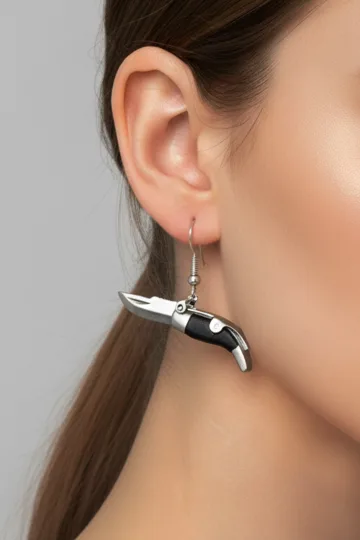
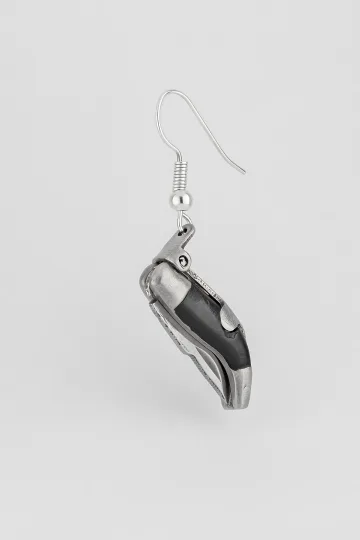
CAPAORA mini knife pendant
The 18th-century Spanish navaja in miniature: 40 mm of stainless steel, a real folding mechanism and a Palanquilla lock that clicks. An affordable gift to remember.
Authentic · Ships from Spain · 14-day returns
The lighthouse across maritime cultures
The lighthouse symbol belongs to every seafaring nation, and each has adapted it within its own relationship to the sea.
The British Isles. The coast of Britain and Ireland is one of the most historically lighthouse-dense in the world, the consequence of centuries of the world's most extensive maritime trade passing through waters studded with rock and subject to some of the most extreme weather conditions in the North Atlantic. The lighthouse is woven into the culture here as it is nowhere else: from the Stevensons of Scotland who built dozens of lights to the Trinity House authorities who maintained them, the lighthouse has been an institution. It appears on pub signs, in poetry, on commemorative ware, on the covers of novels.
The Mediterranean. In the ancient world, the lighthouse at Alexandria was the defining symbol of human mastery over the sea. The Phoenicians and Greeks before them used fire towers across the Mediterranean. The Romans systematised this with stone beacons from the Pillars of Hercules to the Black Sea. In Italian, Spanish, French, and all the Romance languages, the word for lighthouse descends from the name Pharos. This linguistic legacy means that every time a speaker of a Romance language says the word for lighthouse, they are echoing a building that stood for fifteen centuries.
The Atlantic seaboard of Western Europe. Brittany, Galicia, the coast of Portugal: these are shores where the sea has always been both livelihood and threat. The fishing cultures here have their own lighthouse traditions, including the custom of gifts and talismans bearing the lighthouse image before a voyage. The lighthouse here is not abstract symbol but practical expectation.
North America. The American lighthouse is inseparable from the story of European settlement of the coasts. Lighthouses were among the earliest public buildings constructed by the new nation: Boston Light was commissioned in 1716, before independence. George Washington personally ordered the construction of Portland Head Light. The lighthouse appears on state seals, municipal emblems, and coastal tourism branding across the eastern seaboard and the Great Lakes.
East Asia. In Japan, the lighthouse arrived with Western maritime contact in the Meiji era but quickly took on local meaning. The image of solitary purpose, of useful service in isolation, fit naturally into a culture that had its own traditions of the dedicated solitary figure. Japanese lighthouse imagery often adds seasonal elements: cherry blossoms, winter snow, autumn colours against the tower.
The lighthouse as a gift
Few symbols work as well across as many different relationships as the lighthouse. It carries warmth without sentimentality, and significance without requiring explanation.
For a teacher or professor. "Thank you for being a light." It is one of the finest things you can say to someone who has guided you, and the lighthouse says it without words. Engrave their initials and the year. A piece in sterling silver with oxidised detail reads as considered and serious.
For a parent. Particularly a mother at a milestone: retirement, a significant birthday, a child leaving home. The lighthouse as steady presence, as the one who was always there. Not a generic gift, but a specific acknowledgment of what they have been.
For someone in a difficult time. A friend going through illness, loss, or a hard transition. The lighthouse says "you will find your way." It is encouragement without platitude, hope without pressure.
For a sailor or someone in the maritime professions. A direct connection. Coastguard, lifeboat crew, fisherman, naval officer. For them the lighthouse is not metaphor but instrument, and wearing it as jewellery is a way of carrying that identity.
For someone who guides. A therapist, a mentor, a chaplain, a social worker. People whose work is to help others find their way, often without recognition. The lighthouse acknowledges what they do.
For yourself. In the middle of a transition. At the beginning of something difficult. After a period of darkness. "I am a light. I hold. I do not shift."
Leave your email, we'll send your discount code. No spam, unsubscribe anytime.
The code arrives by email, valid on your first order.
Choosing between a realistic and a stylised lighthouse piece
This is one of the questions that comes up most often with lighthouse jewellery, and the answer depends on what the piece is for.
A realistic piece, meaning one based on a specific lighthouse or featuring identifiable architectural detail, is for someone with a direct connection. If you grew up in sight of Portland Head Light, or your father served at Bell Rock, or you sail past the Lizard twice a year, then a realistic piece carries that specific weight. The architectural accuracy is the point. It is recognition, not decoration.
A stylised or silhouette piece is for the symbol. The pure form of the lighthouse, tower and dome and beam, stripped of a particular place, carries all the meaning with none of the location. This is the choice when you want to say "I am a lighthouse" or "you are a lighthouse in my life," without that statement being about somewhere specific.
Most lighthouse jewellery sits between these extremes: recognisably a lighthouse, with some architectural detail, but not closely modelled on any particular structure. This gives you the symbol's emotional register with enough visual complexity to hold interest.
The question of scale is separate. A small minimalist lighthouse, 2-3 cm, is an everyday piece you can wear without it reading as a statement. A larger realistic piece, 4-5 cm, is for when the piece is the point, when you want someone to notice and ask. The largest pieces, 6 cm and above, are for deliberate impact: the statement jewellery of a coastal collection.
What makes the lighthouse such a strong symbol for a gift
Giving a symbolic piece is harder than it looks. The symbol has to say the thing you mean without being obvious about it, and it has to be legible without a paragraph of explanation attached. Most motifs fail one test or the other. The lighthouse passes both, and the reason is that it carries four separate readings that work independently.
At the surface it is simply maritime. A handsome, recognisable object with a long history behind it. That alone is enough for someone who sails, swims, walks the coast path, or grew up within sight of the water. No further meaning needs to be intended, and the gift lands.
One layer down it is a symbol of orientation. The person you give it to has been a fixed point for you, or is a fixed point for somebody else. That reading arrives without being spelled out. Teachers, parents, mentors, nurses, therapists, lifeboat crew: each of them can wear the same piece and find their own version of the meaning in it.
Deeper still it is a symbol of staying put. The lighthouse does not move. In a period when everything else is moving, that is a specific and rather serious statement. As a gift at a parting, a bereavement, or a move to another country, it says something true without saying anything sentimental.
The fourth layer is the most personal: the coordinates of one particular light, the name of one particular headland, the date of one particular day, engraved on the back. At that point the piece stops being a symbol in general and becomes the record of a specific history that only two people can read.
Because all four layers are available at once, the lighthouse is unusually safe to give. You do not have to explain which one you meant. The person receiving it will find their own, and it will be the right one.
Metals and stones in lighthouse jewellery: a closer look
The choice of metal, and the presence or absence of a stone, changes the character of a lighthouse piece more than the design does. It is worth understanding the differences before choosing.
Oxidised sterling silver
The most popular option, and deservedly so. Blackening settles into the recesses and makes the architecture of the tower legible: window openings, the gallery rail, the lantern room, all picked out in dark lines like an engraving. The piece looks detailed and serious rather than pretty. A good choice as a gift for an adult who cares about substance over shine.
Practical note: oxidation is a surface treatment, not a permanent property of the metal. It wears at the high points over years of handling, which most people find improves the piece.
Polished sterling silver
Smooth silver without blackening gives a softer result. The details are less sharply defined and the overall impression is lighter and calmer. For minimalist forms this works very well: a clean silhouette of a tower with no competing texture. A sound choice for anyone who wears silver but prefers a restrained aesthetic.
Under British hallmarking rules any silver piece above 7.78 g must carry a mark from an Assay Office, London, Birmingham, Sheffield or Edinburgh, and a small lighthouse pendant usually falls under that weight. The absence of a hallmark on a light piece is normal and says nothing about the metal.
Yellow gold, 14 or 18 carat
Warm and understated. Yellow gold gives the lighthouse a faintly nostalgic character, something like an old photograph or a warm memory. It suits a piece meant to be worn close to the skin as a private, almost intimate object. It costs more than silver, and it wears differently: gold does not tarnish, so the piece looks the same in ten years as it does on the first day.
White and rose gold
White gold reads as stricter and more contemporary, closer to the register of technical jewellery, and it flatters a sharply cut modern tower. Rose gold adds warmth without turning yellow, and softens a realistic design that might otherwise look severe. Both make sense for a piece intended to be worn daily rather than kept for occasions.
A stone at the lantern
Almost any lighthouse improves with a small stone standing in for the light. It is the most direct possible statement of the symbol: tower and flame, in the same object. The stones that work best:
- Moonstone. A moving internal glow that shifts as the piece moves. It imitates a live flame more convincingly than anything else at this size.
- Opal. Rainbow play across the surface; fire opal brings real warmth into a cool silver setting.
- Citrine. Anything from amber to honey yellow, the colour of an old paraffin lantern seen through glass.
- Blue topaz. Cleaner and colder, closer to a modern LED light. The right choice if the tower itself is a spare, geometric design.
- Labradorite. The dark option: grey stone that flashes blue only at certain angles, exactly the way a beam catches you and then passes.
A stone set piece needs slightly more care, since stones are vulnerable to knocks and moonstone in particular is soft, but the visual payoff is large.
Who it suits
Those who work at sea. Sailors, fishermen, coastguard. A direct professional connection. The lighthouse is no abstraction but a working reference point.
People from coastal communities with a lighthouse nearby. Local identity runs deep: for a Cornishwoman, the Lizard light is not a decorative image but part of the landscape she grew up in. For someone from Whitby or Oban the same is true, and a lighthouse pendant often sits within a wider ocean-themed collection of pieces carrying the same coastal vocabulary.
Teachers, mentors, therapists. "I am a light for others." One of the finest possible themes for a gift to an educator.
Parents, particularly mothers. "I guide my children through life." The lighthouse as a symbol of the parental role: to stand still, to shine, not to leave.
People in rescue and emergency services. Paramedics, firefighters, lifeboat crews.
Those who feel alone but purposeful. Artists, researchers, activists. Those whose work matters but is not applauded.
Lovers of solitude and the natural world. The aesthetic of "one with nature."
Those in the middle of a transition. Finishing a degree, moving city, changing profession, a divorce, a bereavement. The lighthouse as "I will find the way." A good gift to oneself or to a friend in a difficult moment.
In memory of someone who guided you. The lighthouse as a metaphor for someone no longer here who continues to shape who you are.
Why the lighthouse keeps recurring in art
The lighthouse does not appear in books and paintings at random moments. It turns up at hinges: the last night of a voyage, the year a family falls apart, the point at which a character decides whether to go on. That is not a coincidence. The hinge is exactly what the symbol is about. It is dark, the shore is close, and everything depends on seeing one fixed point.
British marine painting made the visual grammar that everyone else inherited. Turner, the greatest painter of the sea this country produced, put small hard lights against enormous weather again and again, and the composition he arrived at, a tiny stubborn flame set against a roaring infinity, became the standard way of picturing a lighthouse for the next two centuries. Almost every lighthouse image you have ever seen, on a book cover, a tea towel, a tattoo, descends from that arrangement.
The American painters worked in a different key. Their lighthouses stand on windless afternoons, against bleached sky and dry yellow grass, and the emptiness around them speaks about isolation as a condition rather than a danger. That is why the motif became load bearing for an entire aesthetic of American solitude, and why it still reads as melancholy rather than heroic to a lot of viewers.
Literature added the third element: unreachability. In the great modernist treatment of the subject the family plan a trip to the lighthouse and then simply do not go, for years, through war and death and the passing of time, and the crossing finally happens when the person who wanted it most is no longer there to make it. That book fixed the lighthouse as the image of the thing you keep meaning to reach.
Folk song, meanwhile, kept the plain version alive. In traditional maritime music the light appears at one point only: the end of the passage. Saw the light, so I knew I was home. Dozens of variants say the same thing in different words, and that simple phrase holds the emotional centre of the whole symbol. The lighthouse is not the beginning of the journey. It is the part where you get back.
A recent black and white feature about two keepers on a remote rock, shot in a nearly square frame, found a fourth register again: the tower as a pressure vessel that strips people down to what they actually are. That it became a cult film says the image has lost none of its force.
Send a friend a discount code, they save on their first order.
The lighthouse in literature and art
Virginia Woolf, "To the Lighthouse" (1927). One of the central texts of literary modernism. The lighthouse as a metaphor for an unreachable goal, for desire, for the passage of time. Still on every serious reading list.
Jules Verne, "The Lighthouse at the End of the World" (1905). An adventure set on a remote lighthouse off the Patagonian coast. One of Verne's final novels, published after his death.
Henry Wadsworth Longfellow, "The Lighthouse" (1849). Longfellow's poem opens with the lighthouse as a symbol of unflinching duty: "Steadfast, serene, immovable, the same year after year." The lines are engraved on lighthouse monuments across the United States. Longfellow, who lived in Cambridge, Massachusetts, within sight of the sea, returned to maritime imagery throughout his career.
J.M.W. Turner and Edward Hopper. The lighthouse as a solitary light in the natural world. Hopper in particular captures a quality of isolation and quiet that matches the symbol perfectly. His paintings "The Long Leg" and various other coastal works show the lighthouse as presence and architecture simultaneously.
Robert Eggers, "The Lighthouse" (2019). A contemporary noir about two lighthouse keepers on a remote island, shot in black-and-white in a near-square format. The film has acquired cult status.
Sea shanties and folk music. The lighthouse is a recurring image in maritime song: "I saw the lighthouse beam, and I knew I had made it."
Romantic poetry of the nineteenth century. Longfellow, Tennyson, and others used the lighthouse repeatedly as an image of hope, direction, and solitude.
Winslow Homer. The American painter Homer, who spent decades painting the Maine coast, returned to lighthouses and maritime subjects throughout his career. His work captures the coexistence of danger and beauty that the coastline represents.
Famous lighthouses
Eddystone Lighthouse, Plymouth Sound, England. Rebuilt multiple times; its history is one of engineering determination against the sea. The current tower has stood since 1882.
Bell Rock Lighthouse, Angus, Scotland. Built by Robert Stevenson and completed in 1811. One of the oldest still-operational offshore lighthouses in the world, standing on a rock submerged at high tide eighteen miles out to sea.
Lizard Point Lighthouse, Cornwall. The southernmost lighthouse on mainland Britain, marking one of the most important headlands on the English Channel route.
Tower of Hercules, La Coruna, Galicia. Built by the Romans in the second century AD and still operating today. The oldest active lighthouse in the world and a UNESCO World Heritage Site.
Cape Hatteras Lighthouse, North Carolina. The tallest brick lighthouse in the United States. Its black-and-white spiral pattern is instantly recognisable. It marks the Diamond Shoals, long known as the "Graveyard of the Atlantic."
Portland Head Light, Maine. Commissioned by George Washington in 1790 and one of the most painted lighthouses in the world. It stands at the entrance to Portland Harbor and its image appears on countless items of American coastal art and craft.
Cordouan Lighthouse, Gironde, France. The oldest active offshore lighthouse in the world, completed in 1611. Known as the "Versailles of lighthouses." Inscribed on the UNESCO World Heritage List in 2021.
Boston Light, Boston Harbor. The oldest lighthouse site in the United States, first lit in 1716. Boston Light has been continuously staffed longer than any other lighthouse in America and remains the last staffed lighthouse in the United States Coast Guard system.
Frequently asked questions
Is the lighthouse only a maritime symbol?
Originally yes, but the modern reading is broader. It can be worn as a metaphor for leadership, direction, or inner light. Many teachers and therapists wear a lighthouse precisely in this sense, without any maritime connection.
Does it suit a teenager?
Yes, particularly with the emphasis on "find your own way." A fine gift at the start of university life, on leaving school, or at the beginning of independence.
I already wear an anchor. Is a lighthouse too much?
Not at all. That is a maritime collection. The anchor represents stability; the lighthouse represents direction. They say different things and complement each other well.
How do I choose the right lighthouse for my piece?
If there is a specific lighthouse connected to a place or memory, that is the best choice. If not, follow the style: a minimalist form for everyday wear, a realistic one when a particular meaning matters.
What does a darkened lighthouse mean?
Not a traditional symbol. Sometimes it suggests the end of a chapter, a vocation, or an era. But that is deeply personal symbolism, not a universal reading.
Is it a good gift for a teacher?
Yes, very much so. "Thank you for being a light." One of the most meaningful gifts a teacher can receive. An engraving with their initials or the date makes it more personal still.
Does it suit men?
Yes. Particularly larger stylised pendants, leather-cord bracelets, or signet rings.
Which metal works best for a lighthouse?
Sterling silver 925 holds detail well and sits in an accessible price range. Gold 14ct adds warmth. With oxidised detailing, the architecture of the lighthouse becomes sharper. The choice depends on the look you want.
Is the lighthouse a Christian symbol?
Not strictly. But in the Christian tradition it has long served as a metaphor: "the light of the world." Appropriate in a Christian context, but not exclusive to it.
Can I engrave coordinates on a lighthouse piece?
Yes, and it is one of the best engraving options. The coordinates of a lighthouse you love: latitude and longitude. A precise and personal connection to a place.
Were lighthouses historically given as gifts to sailors?
Yes. In Britain and France there was a tradition of gifting lighthouse pieces to sailors before a long voyage: "the lighthouse will always bring you home." Wives would embroider small lighthouse images and tuck them into a husband's kit. This was not abstract romance but specific, earnest hope.
How is a lighthouse different from a candle as a symbol?
A candle is intimate and finite, its light small, its burn limited. A lighthouse is public, engineered, built to last. A candle is a personal act of warmth; a lighthouse is a permanent commitment to those you cannot even see. They are both about light, but the lighthouse is about scale and duration.
Why is the lighthouse so often associated with mothers?
Because the two ideas overlap almost exactly. The lighthouse does not travel with you, it does not steer for you, and it cannot stop you making a bad decision. What it does is stay in one place and keep burning so that you can find your way back. That is a very precise description of what a good parent does once a child is grown, and it is why lighthouse pendants are among the most common Mother's Day pieces with any real meaning behind them.
Does a lighthouse work as a piece for a couple?
It works, but it is worth being clear about which reading you are choosing. Two matching lighthouses say: we are each other's fixed point. A lighthouse for one person and a ship or a compass for the other says something different and, for a lot of couples, more honest: one stays, one travels, and the light is what brings them back together. Both versions are commonly made. The second tends to age better.
Can I wear a lighthouse if I have never lived by the sea?
Yes, and a great many people do. The maritime layer is the surface of the symbol, not the whole of it. The meanings underneath, orientation, endurance, being a fixed point for somebody else, have nothing to do with salt water and apply as well in a city as on a headland. If it bothers you, choose a spare geometric design rather than a detailed nautical one; it reads as a tower of light rather than as coastal decoration.
How is a lighthouse different from a star as a symbol?
A star is out of reach and impersonal. It gives direction, but it belongs to nobody and it owes you nothing. A lighthouse is built, maintained and paid for by people, it stands on ground you can walk to, and it exists specifically so that you in particular do not drown. The star is fate; the lighthouse is care. That difference is the whole reason people choose one over the other.
What is the significance of the lighthouse beam rotating?
The rotation means the light is never fixed on one point. It sweeps, reaches every direction, covers the full horizon. As a symbol this reads as a kind of equality: the lighthouse does not choose who it guides. It offers its light to everyone who is out there.
The lighthouse in jewellery as an act of self definition
There is a category of jewellery that is worn for oneself rather than for anybody else, and the lighthouse holds an honourable place in it. It is very often worn under clothing, out of sight. It is very often given at moments that matter but do not call for an announcement: the start of a hard stretch, the end of a long illness, the anniversary of something private.
As a statement about yourself, the lighthouse says: I know what my role is. That is not boastful, because the lighthouse's role is not a loud one. The tower stands off to one side. It is not on the main stage. It does its work without applause and without an audience, and the ships that pass safely never stop to say thank you. Which is precisely why wearing one for yourself often matters more than wearing it for other people.
The moments when this piece appears are recognisable. Someone reassessing a life, changing careers in their forties, coming out of a long relationship or going into a new one, finishing a course of treatment, taking on the care of a parent. It is not a claim that everything is fine. It is a claim that the light is still on.
There is a version of this that belongs to particular work. Lifeboat crew, coastguard volunteers, night shift nurses, teachers in difficult schools: people whose job is to be reliable when conditions are bad. For them the symbol is close to literal, and it is usually worn without comment, on a plain chain, under a uniform.
A lighthouse bought for oneself says something specific: I choose to be both the marker and the traveller. That is an adult decision, and a good piece of jewellery holds it in place.
Conclusion
The lighthouse is a symbol for those whose role is to be a light for others. A quiet role, not a loud one. Without a lighthouse, ships might not founder, but only if they never set out. Without a teacher, a student may still learn, only more slowly, and in greater darkness.
A lighthouse in jewellery is a quiet reminder of one's own purpose. Not for others to see. For yourself. "I am a light. I hold. I do not shift."
Buying it as a gift? Each one arrives ready to give.
 A branded Zevira box and a little card come with every order.
















The lighthouse and the British coast: a particular relationship
For anyone who grew up on these islands, the lighthouse is not an abstraction borrowed from somewhere else. It is a specific building on a specific headland, usually one you can name. Britain has around eleven thousand miles of coastline and some of the most treacherous tidal water in Europe, and the network of lights built to cope with it is one of the country's great unremarked pieces of infrastructure.
The geography made the engineering. The Atlantic swell coming into the western approaches, the fog banks that sit over the Channel for days, the tide race off Portland Bill, the shifting sandbanks of the Thames Estuary: each demanded a different answer. Rock stations, built on reefs that vanish at high water, are the extreme case, and Britain and Ireland have most of the world's famous examples. Eddystone off Plymouth. Bell Rock in the North Sea. Skerryvore and Dubh Artach in the Hebrides. Wolf Rock off Land's End, built from more than three thousand dovetailed granite blocks. Fastnet off the Cork coast, the last thing emigrant ships saw of Europe, which is why it was known as the teardrop of Ireland.
The administration is unusual too, and older than most nations. Trinity House looks after England, Wales, the Channel Islands and Gibraltar. The Northern Lighthouse Board, founded in 1786, covers Scotland and the Isle of Man. The Commissioners of Irish Lights cover the whole island of Ireland. All three are funded not by taxation but by light dues, a charge levied on commercial shipping calling at ports, so the ships that benefit pay for the lights directly, an arrangement that has survived largely intact for centuries.
What that produced is a coastline where the light is part of ordinary life rather than a monument. People in Whitby, Flamborough, Souter, Portland, St Ives, Oban, Portpatrick grew up with a beam crossing the bedroom ceiling at a fixed interval, and each light has its own character, a rhythm of flashes that identifies it to a navigator and, to the people who live near it, sounds like home. Now that the towers are automated, many of the old keepers' cottages are let to holidaymakers, and a night in one is the closest most people will come to the life the symbol commemorates.
This is worth saying plainly because it changes what the jewellery means here. In a landlocked country the lighthouse is a metaphor. On this coast it is a memory: a particular light, a particular stretch of water, a particular person who took you to see it.
About Zevira
Zevira makes jewellery in the artisan tradition of Albacete, Spain. The lighthouse is part of our maritime collection, and in coastal Britain it is far from an abstract symbol. From the Lizard to Bell Rock, from Whitby to Flamborough Head, the lighthouse belongs to the landscape and the life beside the sea.
What you can find at Zevira with a lighthouse:
- Lighthouse pendants in a classic silhouette
- Lighthouse combined with anchor and compass for a maritime look
- Minimalist silver lighthouses for daily wear
- Lighthouse with an enamel or stone lantern that glows
- Signet rings with an engraved lighthouse
- A gift for someone who has been a lighthouse in your life: a teacher, a mentor, a parent
Every piece can be personalised with engraving, with the option of a personal engraving. We work in sterling silver 925 and 14-18 carat gold.