Octopus Jewellery: Symbol of Intelligence and Transformation
Octopus motifs have appeared with growing frequency in jewellery showcases over the past two decades. The octopus was never part of the classical European repertoire alongside roses, doves, and horseshoes, yet in the space of a generation it has embedded itself in the language of jewellery firmly enough to raise no eyebrows at all. The reasons sit simultaneously in fashion, art, and science.
Formally, the octopus as a jewellery motif predates any modern collection by a considerable distance. Minoan pottery from Crete, dating to the eighteenth through fifteenth centuries BCE, is covered in images of octopuses with curling tentacles, and the famous octopus flask from Gournia is among the earliest masterpieces of Mediterranean ceramic art. Hokusai included an octopus in one of his most discussed prints in 1814. Victorian-era design made it into a mechanical wonder. But the genuine return of the motif to jewellery happened alongside the scientific surge of interest in cephalopod intelligence: Sy Montgomery published "The Soul of an Octopus" in 2015, "My Octopus Teacher" won an Academy Award in 2020, and suddenly the eight-armed creature with three hearts and two-thirds of its neurons located in its limbs had established itself at the intersection of biology, philosophy, and aesthetics.
This article examines the octopus as a jewellery symbol honestly and without mysticism. There will be no "octopus energy," no "spirit of the deep," no shamanism. Instead: a genuinely astonishing living creature whose behaviour is documented by biologists, whose iconography spans three and a half thousand years, and whose presence in a piece of jewellery says something about the wearer's taste that no generic pendant can.
An octopus in jewellery is a statement. Nobody wears it as filler. If a ring with tentacles wrapping the finger or a pendant with an octopus spread around a gemstone appears in your jewellery box, it is always a deliberate choice. That is exactly what makes it worth understanding.
Wear the symbol, don't just read about it. These are in stock:



Octopus jewellery: what to choose
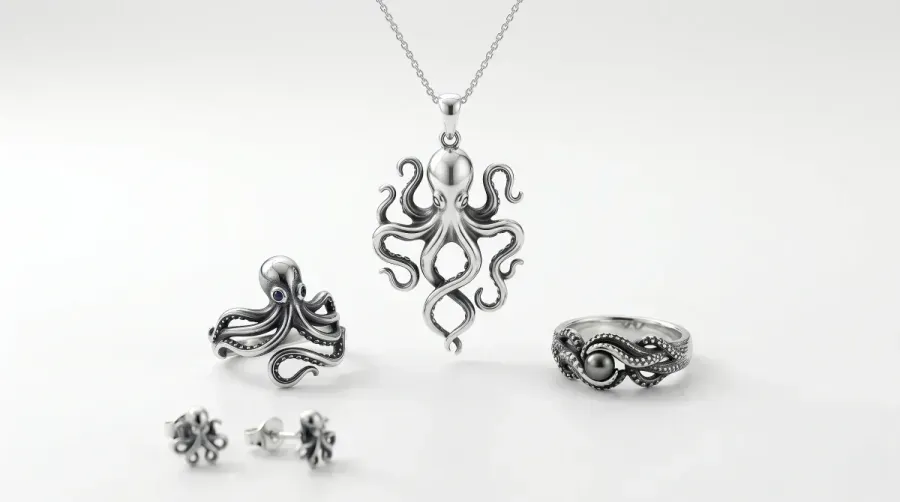
The range of octopus jewellery at Zevira has expanded considerably over recent seasons, and the diversity of forms reflects the diversity of the animal itself. The main formats are made in sterling silver with oxidisation, sometimes with pearls or coloured enamel.
Pendants with the octopus head and spreading tentacles around a stone work as the central element of a necklace. The head sits at the top, tentacles radiate outward and cradle the stone from below, creating the impression that the octopus has caught its prey. The stone is often labradorite, opal, pearl, or garnet. Chain length is typically around forty-five centimetres, so the pendant rests just below the collarbone.
Wrap rings with tentacles coiling around the finger are a genre of their own. The octopus here is not a flat relief but a three-dimensional body encircling the finger from all sides. The head sits on top, several tentacles extend toward neighbouring phalanges, and some curl back on themselves. Such a ring immediately becomes the focal point of the hand, and wearing it alongside competing jewellery on the same hand rarely works.
A single tentacle as a standalone motif operates more quietly and suits more restrained styling. The tentacle curves in an S-shape, a spiral, or a wave, and can wrap the finger as a slim ring, descend along the neck as a pendant, or coil around the wrist as a bracelet. This is the octopus as a hint, recognisable but understated.
Octopus earrings come in two formats: small flat-silhouette studs at the earlobe, and long drop earrings where the octopus swings on a chain and moves with the wearer. Drop earrings are often worn symmetrically, though an asymmetric pairing also appears: one ear with the octopus, the other with a small pearl or a single tentacle.
Substantial brooches for lapels or coats suit wearers who want a statement accessory without drawing attention to the neck or hands. An octopus brooch is typically three-dimensional with detailed suction cups, and reads well against dense dark fabric.
Bracelets with stylised tentacle links exist in two versions: a chain of identical tentacle elements and a single octopus on a cord bracelet that wraps the wrist. The first is closer to a classic bracelet, the second to a wearable art object.
Medallion pendants with an engraved octopus reproduce Minoan aesthetics: a round disc with an octopus cut into the surface, its tentacles curling in a rosette arrangement. This is a deliberately archaeological device, and it sits well with linen and wool garments.
Men's format on a leather cord features a substantial octopus pendant on a leather strap rather than a chain. This is maritime aesthetics related to fishing imagery, and it pairs comfortably with other ocean motifs from the catalogue.
Paired octopus pieces are made to order. The idea: one piece carries the head, the other the tentacles of the same animal, and they visually complete each other when the two wearers are together. This is a rare and affecting format, logic-wise akin to paired jewellery with matching halves, but working on a biological rather than a mechanically symbolic narrative.
Octopus types in jewellery
The iconography of the octopus is richer than it first appears. Over three and a half millennia the motif passed through a dozen cultures and artistic schools, and several distinct visual traditions coexist in contemporary jewellery.
The realistic biological silhouette with spread tentacles stays closest to an actual octopus's anatomy. The mantle is sack-like, the eyes are large, the tentacles vary in length, and the suction cups are detailed with engraving. This is the "documentary" octopus, chosen by wearers for whom biological accuracy matters.
The stylised Minoan octopus with tentacles curling into a rosette comes straight from Cretan pottery. The tentacles scroll into spirals, forming a symmetrical rosette composition. This is a decorative device in which biology yields to geometry. Such pendants work particularly well in the circular medallion format.
The wrap-ring octopus is a separate format in which the animal's head and mantle form the upper part of the ring while the tentacles encircle the finger. Different makers approach this differently: some press the tentacles close to the finger, others extend them outward for an openwork silhouette.
A single tentacle in an S-curve or spiral is the minimalist option. Sometimes the tentacle holds a pearl in one of its suckers; sometimes it simply curls into a graceful flourish. This is the octopus reduced to a fragment, operating on the same principles as architectural detail in classical sculpture.
The octopus in jet propulsion is a rare but expressive motif. Here the tentacles stream backward, as the animal moves by jetting water. The result is dynamism that the seated octopus does not possess.
The stone-in-the-mantle format resembles a crown: the octopus holds a stone, which becomes the main focal point. A large pearl is sometimes used in place of a gemstone.
The close-up head is an unusual but striking device: tentacles are barely visible while the face with enormous eyes dominates. This is closer to a sculptural portrait than a decorative motif.
Art Nouveau style with organic lines places the octopus in its own aesthetic territory. Tentacles blend with plant scrollwork, and the piece uses filigree, enamel, and mother-of-pearl. Art Nouveau prized the octopus for its natural fluidity, and figures like Lalique and Galle explored sea-creature motifs extensively before 1914.
The steampunk octopus with mechanical elements merges the organic and the industrial. Some tentacles become cogs, screws, and pipes; the eyes become clock faces. This continues the Victorian tradition of the mechanical creature.
One octopus, and that is plenty. Hang a seahorse and an anchor beside it and you are not wearing a look, you are running a fishmonger's window.
How to wear it
I have styled the octopus in every form: wrap rings, pendants, drop earrings. Here is what actually works, occasion by occasion, not what sounds pretty.
What do I wear an octopus with day to day? I recommend a calm, unpatterned ground: jersey, a linen shirt, dense cotton. Deep neutral tones, charcoal, graphite, navy, wine, bring out oxidised silver best. Choose an open or rounded neckline so the tentacled silhouette reads in full instead of drowning in the fabric.
Does it belong at the office? It does, as long as you keep it a hint. I choose the smallest silhouette: a stud, a fine ring with a single tentacle, a small brooch on the lapel. A straight-cut jacket, a clean neckline, one quiet nod to the motif, and the look stays restrained.
How do I build an evening look? For the evening I suggest a smooth fabric in a saturated colour, wine, emerald, black, and silk, velvet or satin against it. A large wrap ring or a pendant with tentacles curling around a stone belongs here. Let one declared piece lead and keep the rest of the jewellery to a minimum.
How do I mix metals and layers? Keep one metal per set: a silver octopus goes with fine silver chains, a gold one with warm links. A stack of thin rings on the other hand is fine, but no second figurative motif. An anchor, a seahorse and a shell alongside it stop being a look and become a sailor costume.
Who does the octopus suit? Those who want jewellery with a story, not a quiet background. The expressive, the faintly ironic, the ones unafraid of attention. I suggest the steampunk version for anyone who wears a waistcoat and a watch on a chain. A medium chain, around forty-five centimetres, sits below the collarbones and leaves room for the look.

Turn on your camera, pick earrings, a pendant or a ring, and see the piece on yourself in real time.
Switch items in one tap.
Everything runs in your browser: no photo or video is ever uploaded.
Customer reviews
Zevira is a real jewellery shop. Genuine payments, deliveries and customer thank-yous.
🥰🥰🥰 gracias

Ok, ¡gracias! 🙂

History of the octopus as a symbol
Minoan Crete in the eighteenth through fifteenth centuries BCE made the octopus one of the primary motifs in its decorative arts. Pottery, pithoi, seals, and frescoes are covered in marine imagery, and the octopus appears among the most frequent. The octopus flask from Gournia belongs to the "Marine Style" of Minoan pottery and is counted among the early masterpieces of Mediterranean ceramic art. The octopus is shown with widely spread, undulating tentacles filling the entire vessel surface. Archaeologists have also uncovered a range of seals bearing octopus imagery, and one hypothesis connects them with a maritime trading guild, the octopus functioning as something like a corporate emblem for merchants operating across the Aegean.
The British Museum holds a number of Minoan and Mycenaean objects with octopus decoration, including pottery vessels that demonstrate how widely the Marine Style was distributed across the eastern Mediterranean. Visitors to the museum's Greece and Rome collections encounter the octopus as a recurrent motif across centuries.
Classical antiquity continued the motif in Roman floor mosaics in coastal houses. The octopus there is usually part of a marine scene with fish, dolphins, squid, and crab. It is less a symbol than an accurate depiction of observed fauna, but the regularity with which it appears in domestic decoration shows that the classical world felt a sustained interest in it.
Medieval bestiaries treated the octopus harshly. Europe lost direct acquaintance with most cephalopods, and their place was taken by monstrous hyperbole. The kraken, the legendary sea creature of northern legend, is partly descended from the octopus: tentacles capable of dragging a ship to the bottom, supernatural size. The kraken was not a true octopus, but its iconography borrowed heavily from one.
Nineteenth-century Japanese woodblock prints returned a human dimension to the octopus. Hokusai included octopuses in several works. The most discussed, a print of 1814 in the shunga genre, became the subject of extended art-historical debate and is widely acknowledged as a work that influenced both subsequent Japanese and European artists. Contemporary jewellery rarely reproduces it directly, but it is regularly cited as a significant cultural reference.
Victorian England enjoyed revived classical marine motifs. The octopus appears on shell cameos, engraved rings, and decorative silver. This was the reassertion of Greco-Roman aesthetics through the lens of an industrial century, and it prepared the ground for what followed.
Steampunk and mechanical octopuses appeared in Victorian scientific fiction. Jules Verne described a giant squid attacking the Nautilus in "Twenty Thousand Leagues Under the Sea" in 1870, and visual tradition quickly conflated squid and octopus into a single image of sea monster. When steampunk crystallised as an aesthetic in the late twentieth century, the mechanical octopus became one of its primary symbols: a living creature rebuilt from clockwork, as an industrial hyperbole of nature.
The twentieth century added further layers. H.P. Lovecraft published "The Call of Cthulhu" in 1928, and although Cthulhu is not an octopus, its tentacled head strongly influenced subsequent iconography. In 1969, the Beatles released "Octopus's Garden" on "Abbey Road," and the octopus entered pop culture as the comfortable inhabitant of an underwater garden.
The 2000s through 2020s brought a scientific renaissance. Research demonstrated that octopuses use tools, solve puzzles, recognise individual people, and display behaviour previously considered exclusive to vertebrates. Books, documentaries, and popular science articles elevated the octopus to the status of an "intelligent animal" comparable to primates and corvids. For jewellery, this provided a powerful impulse: a symbol of intelligence grounded in real biology acquired a new reading.
Upload a photo of your pet, someone you love, or an object. We'll build a 3D model and hand-cast it in pewter.




The octopus in culture and art
Minoan Crete
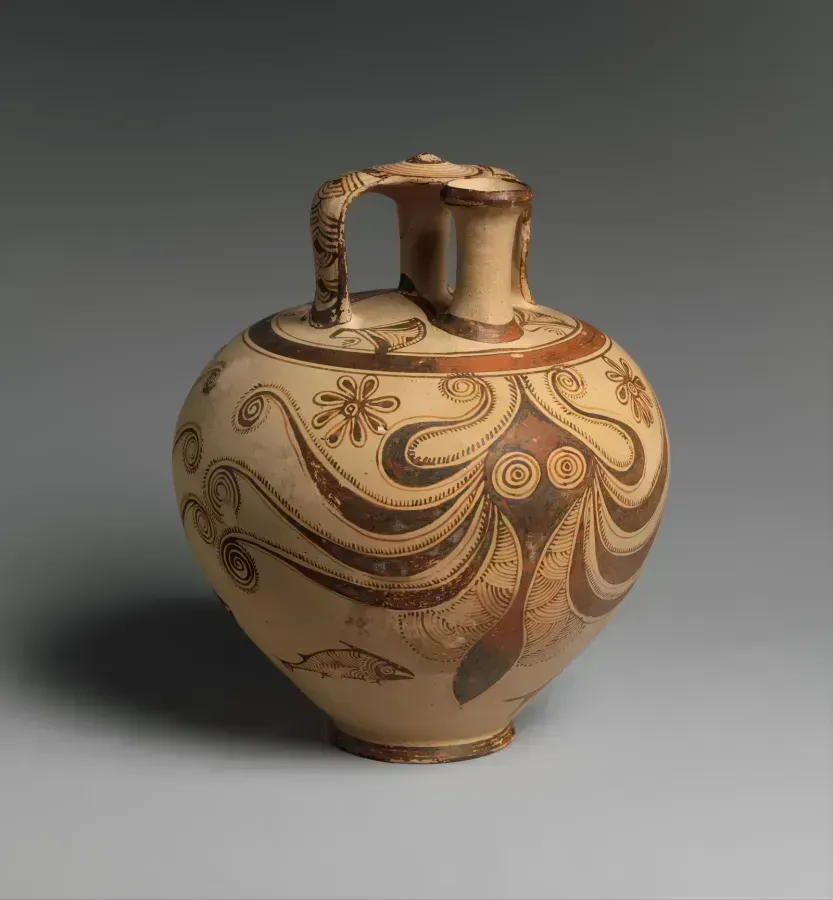
The Marine Style of Minoan pottery is a self-contained episode in the history of decorative arts. On the cusp of the sixteenth and fifteenth centuries BCE, a series of vessels appeared on Crete covered entirely in sea imagery: octopuses, dolphins, nautiluses, seaweed, coral. The octopus is among the central figures, its body and tentacles filling the curved surface of a jug or pithos and creating the sensation that the vessel is held by a living creature. This was not coincidence: Minoan civilisation was built on maritime trade, and the sea was its economic and cultural foundation. The octopus as a symbol of the sea was simultaneously a symbol of life itself.
Japan
Ukiyo-e, "pictures of the floating world," flourished in the Edo period from the seventeenth through the nineteenth century. The octopus entered this repertoire through fishing scenes and through more exotic compositions, the most discussed of which belongs to Hokusai. The 1814 print shows an encounter between an ama diver and an octopus, and its composition became part of the history of erotic art in Japan. From an art-historical standpoint it is a bold work that influenced subsequent Japanese and European artists. Contemporary jewellery does not reproduce it directly, but it is cited as an important cultural reference point.
Polynesia
Kanaloa in Hawaiian mythology is one of the four principal gods, associated with the ocean, the underworld, and wisdom. In some Hawaiian traditions Kanaloa takes the form of an octopus, giving the mollusc the status of a sacred animal. Similar motifs appear in Maori and Tahitian traditions: the octopus as a creature connected with the world beyond the visible, with the depths of the sea, and with wisdom. Unlike the medieval European kraken, the Polynesian octopus is not a monster but a bearer of knowledge.
European medieval bestiaries
European tradition regarded the octopus with suspicion. Medieval bestiaries described it as a sea monster with tentacles capable of overturning a boat. Combined with northern legends of the kraken, this produced the image of the sailor's enemy. Only during the Renaissance, with the return of interest in classical natural philosophy, did the octopus begin to be perceived again as an animal rather than a terror.
Steampunk and the Victorian revival
The second half of the nineteenth century produced a particular aesthetic in which mechanics and organics were fused. The mechanical octopus became one of its key images: a living creature in the form of a machine, a symbol of industrial hyperbole. Victorian jewellers used octopus imagery in brooches and clasps, and the steampunk culture of the late twentieth and early twenty-first centuries continued the tradition in a more conceptual register.
Contemporary art and literature
Sy Montgomery published "The Soul of an Octopus" in 2015, and this book was one of the catalysts for mass popular interest in cephalopod intelligence. Montgomery, a science journalist, describes her observations of octopuses at the New England Aquarium and talks with biologists about what "mind" means in a creature whose nervous system is organised quite differently from any vertebrate. In 2020, "My Octopus Teacher" won the Academy Award for documentary feature and cemented the octopus in mass culture as a protagonist, not a monster. Several other popular science books on cephalopod consciousness have appeared in the past decade, including Peter Godfrey-Smith's "Other Minds," and each one deepened popular fascination with this animal.
CAPAORA mini knife pendant
The 18th-century Spanish navaja in miniature: 40 mm of stainless steel, a real folding mechanism and a Palanquilla lock that clicks. An affordable gift to remember.
Authentic · Ships from Spain · 14-day returns
What the octopus symbolises
Intelligence is the octopus's central meaning in contemporary jewellery iconography, and it is grounded in documented fact. Amphioctopus marginatus, known as the coconut octopus, carries coconut shells and uses them as portable shelters: this is documented tool use, something that was not previously ascribed to any invertebrate. Octopuses solve puzzles, open jars from the inside, recognise individual humans, and respond differently to familiar and unfamiliar faces. Their nervous systems contain roughly 500 million neurons (for comparison, a domestic cat has around 700 million), with two-thirds of those neurons located in the tentacles. This means the tentacles operate as semi-independent "mini-brains" capable of local decision-making. Such an architecture of intelligence is radically different from our own, and this is precisely what makes the octopus philosophically interesting.
Adaptability is another documented property. The octopus changes colour, texture, and shape in fractions of a second through specialised chromatophore cells and papillae in its skin. It can imitate rock, seaweed, a coral-dwelling octopus, a flatfish, a banded sea snake. In symbolic reading, this translates into the idea of flexibility, of the capacity to reshape oneself without losing one's essential nature.
Transformation as a metaphor follows from the same capacity. The octopus is not fixed in one form; it continuously remakes itself. For a person moving through significant life changes, this resonance is real: a piece of octopus jewellery becomes a personal reminder of plasticity.
The ability to pass through any gap no larger than its beak is one of the most celebrated features of the species. The octopus has no skeleton; the beak is its sole rigid organ, meaning it can pass through any opening slightly wider than the beak. This reads as a symbol of the idea that obstacles in the general sense do not exist, only the capacity to find a way through.
Regeneration is another trait with symbolic reach. The octopus regrows lost tentacles. This is not full-body regeneration, but for an invertebrate it is a significant capacity.
The contrast between complexity and brevity adds a melancholy note to the octopus's symbolic register. Most species live for one to two years. Females stop feeding after laying eggs and die before their young hatch. A creature with such a sophisticated nervous system lives so briefly. This invites reflection on the nature of intelligence and its relationship with time.
The number eight adds a separate layer of meaning. In various cultures the eight is associated with completeness, the cycle, and infinity (an eight rotated on its side becomes the infinity sign). Eight directions of light in Buddhist cosmology, eight-pointed stars in Mediterranean ornamentation, the eight-pointed cross in Christian symbolism: the number appears everywhere and is rarely accidental. The octopus, having eight arms, finds itself in this large family of "octuple" symbols.
One caveat that deserves saying: all of these meanings are human interpretations of real biological behaviour. The octopus has no idea it is a "symbol of intelligence." It simply lives its life, hunts, hides, regrows what is lost, and dies. The symbolism is what we overlay. But it is not baseless: unlike many animal symbols, the octopus actually possesses what we attribute to it.
Leave your email, we'll send your discount code. No spam, unsubscribe anytime.
The code arrives by email, valid on your first order.
Materials and techniques
Sterling silver with oxidisation is the basis for most of our octopus pieces. Oxidisation creates dark shadows between the tentacles, emphasising volume and making the suction cups readable. Without oxidisation the relief is lost: polished bright silver reads as too decorative for a creature whose nature is bound up with shadow and crevice.
Engraving the suction cups on the tentacles is the key technical point. Each tentacle must be covered in small circular indentations, and the care taken over them is what distinguishes a quality octopus from a decorative blank. Where the suction cups are engraved rather than left as a flat cast surface, each piece comes out slightly individual.
Enamel in blue, red, or violet is used for "colour" octopus pieces and refers to the chromatophores of the living animal. The enamel surface imitates skin that shifts in hue. Pieces of this kind are most often executed in an Art Nouveau idiom or as individual art objects where colour is part of the concept.
Pearl as the eye or within the tentacles is a classical device. A round pearl at the eye position brings the octopus to life. A pearl held in a tentacle returns the narrative of the hunt: the octopus has caught its prey.
A large gemstone at the centre of the mantle is a format in which the octopus becomes the setting. Labradorite, opal, amethyst, and moonstone are the best fits because their colour associates with the sea. The stone becomes an equal protagonist in the piece.
Filigree in an Art Nouveau manner is applied to the tentacles when their fluidity is to be emphasised. Fine silver or gold wire creates an openwork contour, and the octopus reads less as an animal than as a pattern with an implied animal.
Oxidised silver for depth between tentacles is an extension of the same theme. Dark shadows between tentacles read as "shadow in a sea cave" and give the piece visual depth.
Gilding for mixed techniques is used when the head and tentacles need to be differentiated by colour, or when individual suction cups are to be highlighted with gold accents. This is a decorative device that reads well on large rings and brooches.
Complex casting for three-dimensional wrap rings is a production challenge of its own. A ring in which tentacles coil in three dimensions cannot be stamped: it is cast in a split mould or in several parts and assembled. We use lost-wax casting, which preserves the detail.
Care for octopus jewellery has its specific considerations. Oxidised silver gradually lightens with wear, particularly where the piece contacts skin and clothing. For octopus jewellery this is actually an advantage: the brightening tentacle ridges and darkening hollows between them deepen the relief; the piece "settles in" to its wearer. Ultrasonic cleaning is not recommended because the oxidisation may lift unevenly. A soft cloth, and if needed a mild soapy rinse, is sufficient. Pieces with enamel require additional care: impacts on the enamel surface leave chips, and high temperatures can cause micro-cracking.
Practical rules for wearing an octopus piece
The advice above sets the register. What follows is the set of concrete rules that decide whether a piece looks considered or looks like a novelty, worked out piece by piece rather than in the abstract.
A large octopus ring on one hand carries the whole look. The rule is simple: only one. A second ring on the same hand will compete with the octopus for attention and lose, and the eye will end up reading neither. On the other hand something minimal is fine, a plain band or a single stone, but never a second animal or figurative motif.
A pendant on a medium chain wants plain clothing in black, white or navy, and it works every time. The octopus is a saturated symbol on its own and needs a quiet ground beneath it. Dense unpatterned fabric, a simple neckline, one chain. Adding a second pendant or a shorter necklace above it blurs the focus and the tentacles stop reading as a shape.
Drop earrings need hair off the face. A symmetrical pair reads properly only when the animal's silhouette is visible, which means hair up or tucked back. With loose hair the effect is lost entirely, and a small stud with a miniature octopus is the better choice for that day.
A large coat brooch belongs on the left lapel, high, closer to the shoulder than the chest. The one thing to avoid is doubling animal motifs on the same garment. If your scarf already carries some sort of fauna, the octopus brooch stays at home.
The steampunk octopus wants a vintage wardrobe around it: a jacket, a waistcoat, a watch on a chain, a high-collared shirt. In that setting the mechanical octopus stops looking exotic and becomes part of a coherent whole, which is the point of the aesthetic in the first place.
In a business wardrobe the octopus survives as an almost invisible detail. A stud with a tiny silhouette, a small brooch on the lapel of a plain jacket, a fine ring with a single tentacle. The trick is not to overplay it: office dressing runs on restraint, and the octopus works there as a hint that only people looking closely will catch. That is usually the effect you want anyway.
Avoid the sailor costume. One octopus is enough. An octopus pendant worn with seahorse earrings and an anchor bracelet turns an outfit into a themed party. Jewellery speaks more quietly, and is heard better, when there is only one of it.
Consider water and salt before the beach. Oxidised silver in seawater loses its darkened recesses faster than most people expect, and a wrap ring with fine tentacles has a great many recesses. British hard water in the Midlands and the south east does the same job more slowly at the bathroom sink. Take the piece off before swimming and before washing up, and the contrast that makes the design legible stays where it should be.
Wrap rings, pendants with Minoan styling, earrings and drop pendants with tentacles.
Send a friend a discount code, they save on their first order.
Who it is for
People in the sciences find the octopus particularly fitting. Biologists, neuroscientists, psychologists, ethologists: it is close to them as a subject of study and as a phenomenon of non-standard nervous architecture. For a researcher working with cognitive processes, an octopus piece communicates professional affiliation more quietly than any other jewellery.
Those who appreciate non-linear thinking are equally well served. Programmers, philosophers, editors, writers, people whose work involves pattern recognition and solving problems that do not have obvious answers. This is the emblem of an intelligence that is not straightforward.
Lovers of the sea need no explanation. Divers, sailors, travellers who spend significant time by the water. The maritime theme is organic here.
Fans of Art Nouveau, steampunk, and jewellery with character find in the octopus one of the few motifs that works fully in both aesthetics. Its organic lines fit Art Nouveau perfectly, and its connection to Victorian industrial fiction makes it at home in steampunk.
Those moving through a period of personal transformation may find the octopus a fitting personal marker. A career change, a move, leaving a relationship, returning to study: moments when a person is remaking themselves. The symbolism of adaptability sounds apt here.
Admirers of Hokusai and Japanese graphic art find the octopus speaking a particular language. It is a reference not only to the famous 1814 print but to the entire ukiyo-e tradition, to fishing scenes, to the Japanese relationship with the ocean world.
As a gift for an unconventional person who can be surprised the octopus works as a mark of attention. It implies that the recipient is capable of appreciating an unusual choice, and the gift makes an impression of its own.
It will not suit someone who wants light decoration. The octopus announces itself. For someone who wears jewellery as background, not wishing to be expressive, a large octopus is too loud. For that purpose there are other, quieter motifs available.
Frequently asked questions
Does an octopus have eight "legs" or "tentacles"?
Biologists prefer the term "arms," since these are manipulatory organs rather than locomotory ones: the octopus moves primarily by jetting water and walks along the sea floor on the tips of its arms. Formally these are eight arms, while "tentacles" are the longer, retractable feeding appendages found in squid and cuttlefish, which octopuses do not have. In everyday speech and in jewellery the word "tentacles" has stuck, and we use it with awareness of its inaccuracy.
Do octopuses really have three hearts?
Yes. Two gill hearts pump blood through the gills for oxygenation; the systemic heart distributes blood around the body. When the octopus swims, the systemic heart stops, and the animal tires quickly: one reason it prefers to walk or hide.
Why is the octopus associated with mysticism and "the deep"?
Several reasons. Unusual appearance, eight arms, a sack-like body, and the ability to change form set it outside the familiar zoological repertoire. Medieval legends of the kraken accumulated a deep sediment of fear. In 1928 Lovecraft wrote "The Call of Cthulhu," and although Cthulhu is not an octopus, the tentacled head became an icon of cosmic horror, and the association settled in mass culture. Contemporary science gradually dismantles the mysticism, but the cultural residue remains.
Is the octopus suitable as a gift?
Yes, if the recipient appreciates unconventional motifs. This is not a universally safe gift: it is a choice that presupposes knowledge of the recipient's taste. One small note: some people experience trypophobia, a discomfort with clustered holes such as suction cups. Before a large gift it is worth confirming that the recipient is comfortable with octopus imagery.
Does the octopus work with a formal look?
Depends on scale. A small octopus on a stud earring, a fine ring with a single tentacle, a small brooch on a lapel all work in professional dress. A large wrap ring or a substantial pendant with spread tentacles is a distinct stated look and will not integrate into strict formal wear. Into relaxed smart-casual, with a chunky knit and a wool skirt, it works.
Is the story of Paul the Octopus predicting football results true?
The story dates from the 2010 FIFA World Cup. Paul, an octopus living in an aquarium in Oberhausen, Germany, "predicted" the results of several matches involving the German national team by choosing a mussel from one of two containers marked with the competing teams' flags. From a scientific standpoint this was statistical coincidence; octopuses have no predictive ability. But the story lodged in popular memory and continues to function as a cultural anecdote sustaining the octopus's reputation as an "intelligent" animal.
Buying it as a gift? Each one arrives ready to give.
 A branded Zevira box and a little card come with every order.















About Zevira
Zevira is a Spanish jewellery brand from Albacete. The octopus line is one of the catalogue categories. See the catalogue for current pieces and details.