Pendant Keeps Flipping Over: Why It Happens and How to Fix It
Introduction: a familiar frustration
You put on your favourite pendant in the morning. It sits beautifully on your chest, face outward. An hour later you catch your reflection and it has flipped over, design pressed against your skin. You turn it back. Ten minutes later, same story.
If this happens to you regularly, you are in good company. It is one of the most common complaints about necklaces. And it is not a defect, it is physics. But there are reliable ways to fix it.
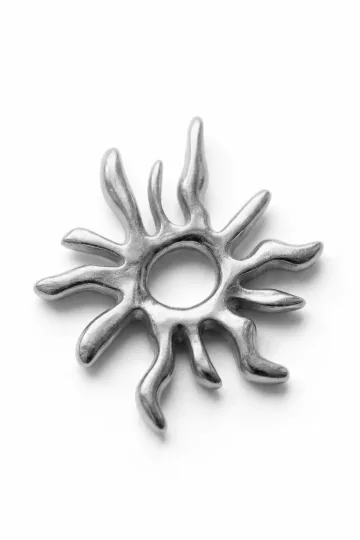
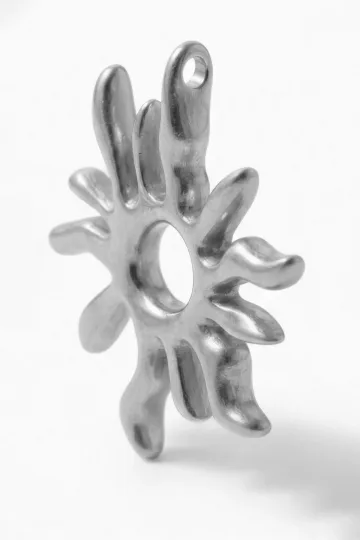
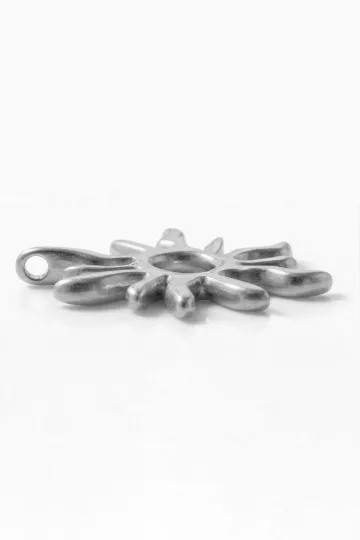
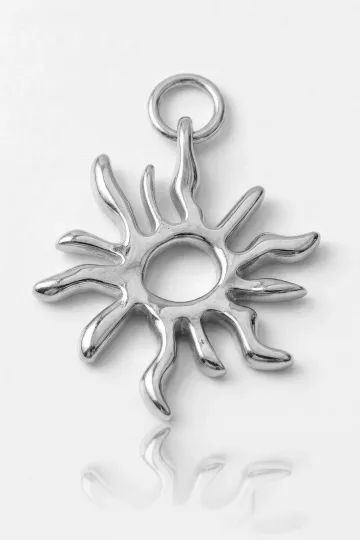
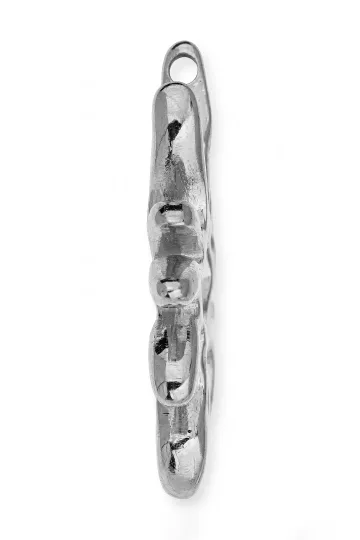
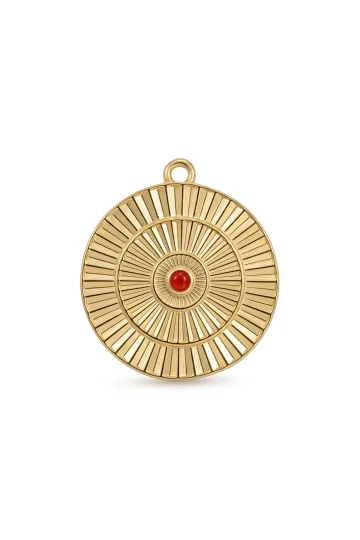
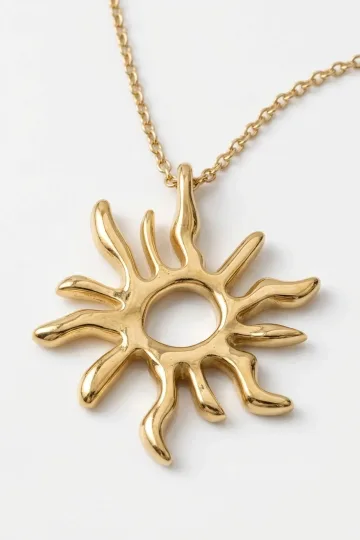
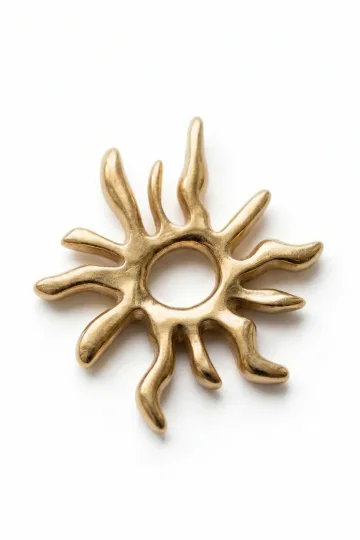
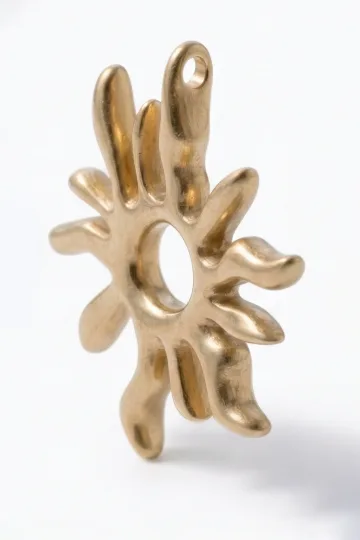
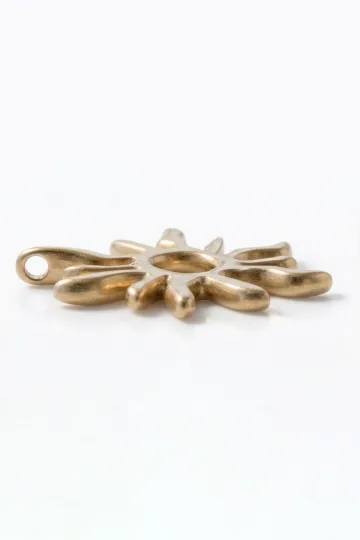
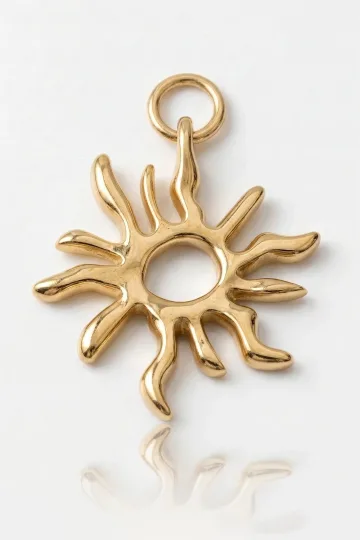
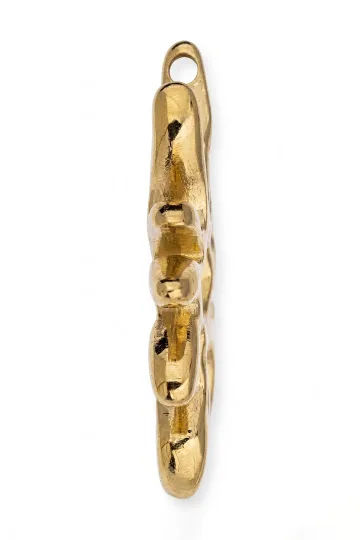
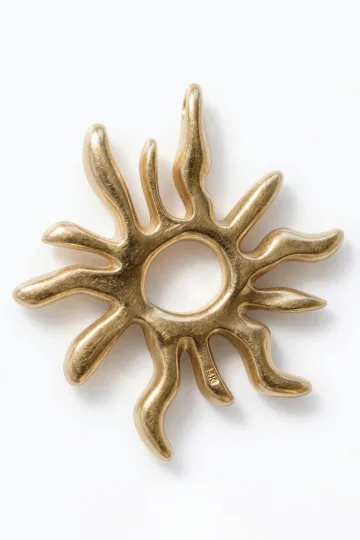
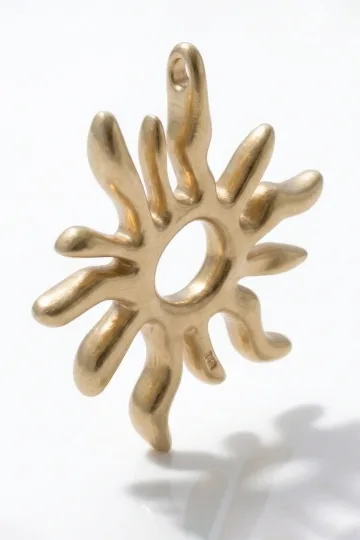
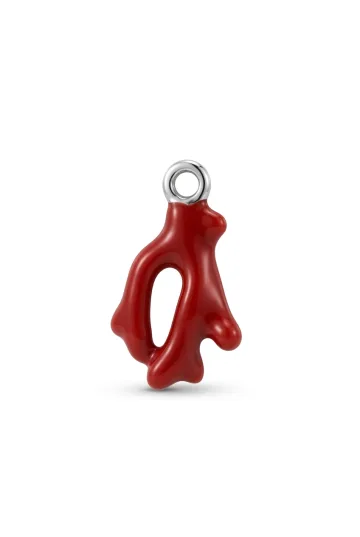
Wear the symbol, don't just read about it. These are in stock:
Why a pendant flips over
There are three main reasons, and they usually act together.
The centre of gravity does not sit under the bail
This is the root cause. A pendant has a bail (the small loop at the top) through which the chain passes. If the bail sits directly above the centre of gravity, the pendant hangs level. If the bail is off-centre, the pendant tilts.
Most jewellers account for this, but not always. It is especially common with asymmetric pendants, complex shapes, or when the bail has been soldered by eye rather than by measurement.
One side is heavier than the other
Many pendants have a front and a back. The front typically carries the design, stones, or enamel, making it heavier. The back is flat and lighter. Physics always favours the heavier side. When you move, the pendant rotates until the heavier part sits lowest, which means face-down.
The chain slides across the skin
When a chain rests on bare skin it shifts with every movement. Each small shift rotates the pendant a little further. Over the course of a day, the pendant ends up facing any direction at all.
A pendant flips out of physics, not spite. Heavy at the bottom, bail dead centre, and the drama is over.
How to choose a pendant that won't spin
Hundreds of pendants have passed through my hands, and a good half of clients arrive with the same complaint: a favourite piece stubbornly turns its back to the room. Here is what I check first when I pick a pendant that faces people, not skin.
Which pendant shape do you recommend so it won't spin? I recommend shapes with a heavy bottom and gathered weight: a teardrop pointing down, a tall vertical, a compact symmetrical medallion. A wide flat leaf or a thin disc I suggest avoiding, that shape works like a sail and catches every movement. When the lower part sits a touch heavier than the top, the centre of gravity keeps the piece facing outward on its own.
Where should you look on the bail? The bail is the first thing I check. I suggest choosing a pendant where the loop sits squarely at the top centre and stays in the same plane as the front. A flat or oval bail holds the pendant more honestly than a round jump ring it swings around freely. If the bail is off by even a couple of millimetres, the pendant will tilt no matter how many chains you try.
What weight should you choose? I choose a pendant whose mass is gathered low and central, not spread across a wide front plate. A compact dense piece hangs calmer than a large thin one. For a heavy pendant with a stone on the front, I recommend planning a counterweight or a second contact with the chain from the start, otherwise the front outweighs everything and turns away.
What length and chain type do you suggest? I suggest a length clear of the 50 to 55 cm zone, that is exactly where pendants spin most. A little shorter towards the collarbones, or noticeably longer, and the hang settles. I choose the chain for the job: a flat snake or omega barely twists and holds the pendant straighter than a round weave, while for a large piece I recommend a heavier chain so it does not slide across the skin on its own.
Symbol or comfort, which matters more? I suggest not choosing between them. A double-sided design or an engraving on the back settles the question entirely: that pendant has no losing side, and however it turns it still reads with intent. When I build a look where the pendant should show all day, I choose symmetry and keep the chain fix as insurance.

Turn on your camera, pick earrings, a pendant or a ring, and see the piece on yourself in real time.
Switch items in one tap.
Everything runs in your browser: no photo or video is ever uploaded.
The physics of flipping: what is actually happening
Understanding the mechanics helps you choose the right fix rather than guessing.
Weight distribution and the pendulum effect
A pendant on a chain behaves like a pendulum. A pendulum always seeks the position where its centre of gravity sits as low as possible. If the pendant's centre of gravity does not sit directly below the bail, the pendant will continuously try to rotate into the position where its heavy side is lowest, which is face-down.
A simple test: hold the chain between two fingers right at the bail. If the pendant immediately tilts forward or backward, the bail is not above the centre of gravity. If it hangs straight, the geometry is sound.
Why a fine chain cannot hold the pendant steady
A fine chain (0.7-1.0 mm) weighs very little and creates minimal friction against the skin. With every body movement it slides freely. When the chain slides, the pendant rotates with it.
A heavier chain weighs more and exerts more contact pressure against the skin. That friction keeps the chain and pendant in position. This is why heavier curb or bismarck chains cause fewer flipping problems than delicate cable chains.
Link size mismatch and bail type
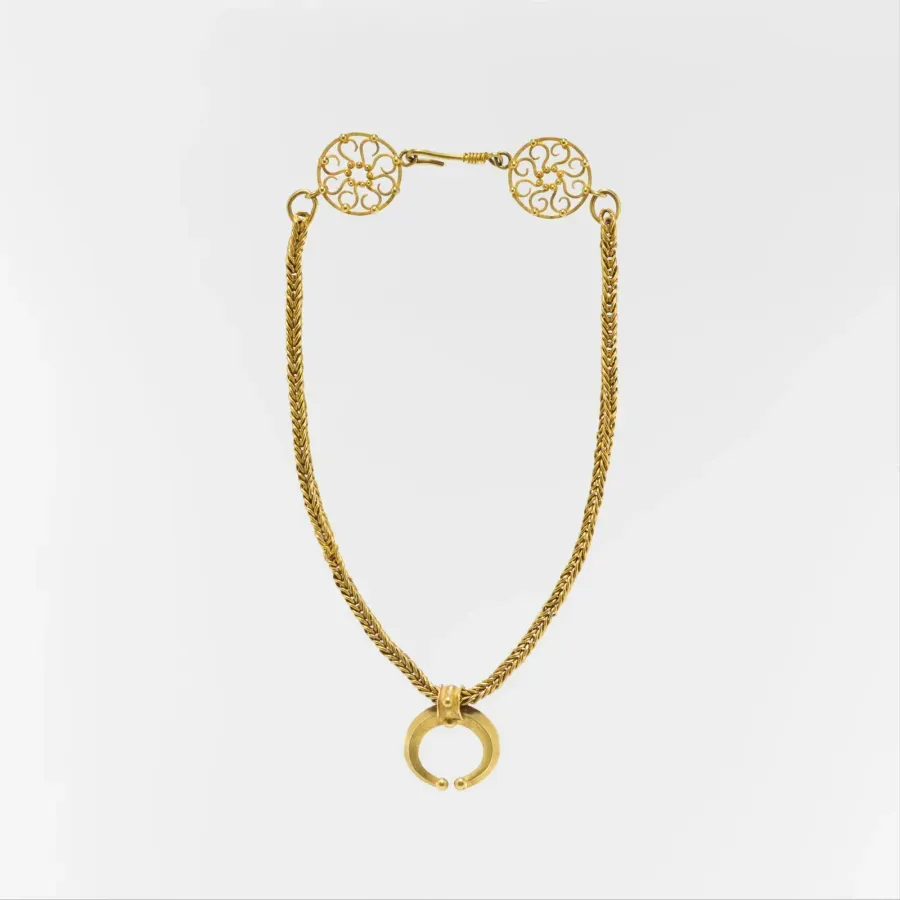
The type of bail matters considerably. A standard round open jump ring gives the pendant complete freedom to rotate in any direction. If the ring's diameter is larger than the chain width, the pendant hangs loosely and flips easily.
A flat or oval bail limits the angle of free rotation. A closed soldered ring is more secure than an open one. When choosing a pendant, it is worth looking at the bail type, not just the design.
Bail types: what they are and how they differ
The bail is a small detail that determines how your pendant behaves on the chain. These are the main types:
Open jump ring
The most common type. A simple metal ring that is not soldered closed. Inexpensive to produce but gives the pendant maximum rotational freedom. The most prone to flipping.
What it looks like: a small round or oval metal ring with a visible gap.
Closed soldered ring
The same ring, but soldered shut. Stronger, more secure, and the pendant sits more steadily. Functionally similar to the open ring in that the pendant can still rotate, but the ring itself will not open accidentally.
Better suited to heavier pendants. Essential for antique pieces.
Bail enhancer (double bail)
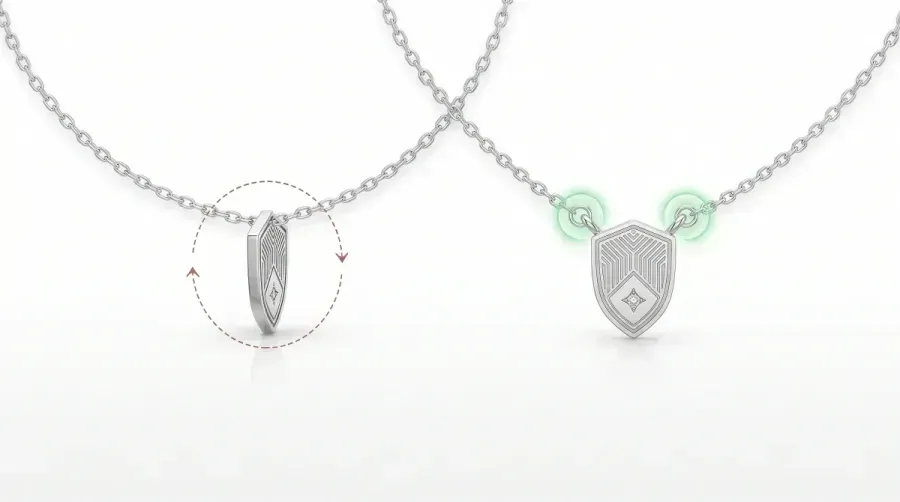
A decorative connector piece that fits over the existing bail. It creates two contact points with the chain rather than one, which prevents rotation entirely.
Visually it adds a small decorative element. A good solution when you want to fix the problem without altering the pendant itself.
V-bail
A bail shaped like the letter V, with two attachment points to the pendant body. The chain passes through the upper point of the V. More stable than a single ring because it has a wider base.
Commonly used on coins and flat medallions.
Hinged bail
A bail with a movable hinge. The pendant can swing forward and back but cannot rotate around its axis. Well suited to heavier pieces or pendants worn during more active days.
Threaded bail
A bail that passes through the pendant body itself. Two points of contact with the body give maximum stability. Requires a hole through the pendant.
Used on coins, jade pendants, and stone pieces.
Finding where to add weight yourself
Before soldering anything or buying a fix, it pays to know exactly where the pendant's centre of gravity sits and how far it has drifted from the bail. Without that, a counterweight goes on by guesswork and the pendant simply starts tipping the other way.
Lay the pendant flat on a straight table edge with half of it overhanging. Slide it outward until it begins to tip. The point at which it balances on the edge is the vertical line of its centre of gravity. Note how many millimetres that line sits below the bail: the greater the distance, the harder the piece will pull face-down.
The second measurement is for depth. Stand the pendant on its edge and rock it gently. The side it falls towards is the heavier one. If the front outweighs the back by more than a couple of millimetres of offset, a counterweight on the bail will not save it and you need a second point of contact with the chain, which means a double bail or a V-bail.
A simple rule for the mass of a counterweight: the bead should weigh roughly as much as the excess on the heavy side. By eye that is about a quarter of the weight of the decorative element itself. A 4 mm pearl adds around 0.1 g, a 6 mm silver bead around 0.5 g. So for a large stone one small bead is usually not enough, and moving the bail is the simpler answer.
Do this on a soft cloth rather than a bare table, and do it away from the edge of a sink. A pendant that tips off a hard surface chips exactly where you least want it to, and enamel and soft stones such as opal or turquoise take damage from a fall of a few centimetres.
Customer reviews
Zevira is a real jewellery shop. Genuine payments, deliveries and customer thank-yous.
🥰🥰🥰 gracias

Ok, ¡gracias! 🙂

Quick fixes, no jeweller required
The simplest ways to stop the flipping without touching the pendant itself.
Shorten the chain
A shorter chain leaves the pendant less freedom to swing and rotate. If the chain hangs loosely from the collarbone down to the chest, the pendant swings freely and flips easily. A shorter chain presses the pendant into a more stable position.
How to shorten: buy a shorter chain separately, or ask a jeweller to shorten the existing one (a very affordable job). Typical lengths:
- 40 cm, sitting at the base of the neck
- 45 cm, the classic length, just above the collarbone
- 50-55 cm, below the collarbone, on the upper chest (the most common problem zone)
- 60 cm or more, lower on the chest (also tends to flip)
Very short and very long chains flip less than mid-length ones.
Switch to a heavier chain
A fine chain does not hold the pendant in position because it has almost no weight of its own. A thicker, heavier chain creates more friction against the skin and stays put.
Try swapping a 1 mm box or cable chain for a curb or bismarck in 2-3 mm. It changes the visual style somewhat, but the pendant sits far more steadily.
Wear it over clothing
A pendant on fabric flips far less often than one on bare skin. The textile creates friction that anchors the pendant. If flipping is a persistent problem, wearing the necklace over a blouse, jumper, or top can be enough on its own.
Add a small counterweight
This is a classic jeweller's trick. A small extra loop, ring, or bead is attached to the bail. It shifts the centre of gravity and levels the pendant out.
Common choices:
- A small pearl or round bead
- A cubic zirconia
- A small cross-shaped loop
- An extra chain link
A jeweller can do this for the price of a coffee.
Solutions by pendant type
Round medallions
Medallions flip often because of their simple geometry. The bail is rarely positioned exactly above the centre of gravity.
Fix: have a jeweller solder a second bail on the side opposite the heavier edge. Or use a double-loop bail (two attachment points instead of one, see below).
Asymmetric pendants
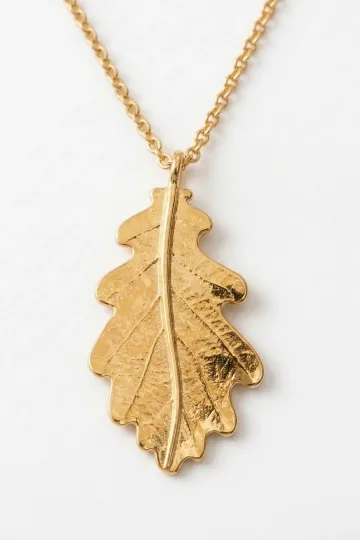
Leaf, feather, drop shapes. The front face is heavier, and the pendant rotates constantly.
Fix: a double-loop bail. The chain passes through two bails instead of one, which prevents all rotation. A jeweller can solder the second bail for a modest fee.
Pendant with a stone on the front
The stone makes the front significantly heavier than the back. The pendant flips face-down.
Fix:
- Add a counterweight to the bail at the top
- Relocate the bail to the side of the pendant so the stone hangs below the attachment point
- Wear it on a finer chain and limit vigorous movement
Small stud-style pendants
Very small, light pendants (5-10 mm) flip because the chain itself keeps twisting.
Fix: use a heavier chain, or a flat chain style such as a snake or herringbone chain, which does not twist.
Cross pendants
Crosses are particularly prone to flipping during active movement. The equal arms of the horizontal bar create a tendency for the pendant to seek a horizontal resting position when the body tilts. Some crosses are heavier at the back due to thicker metal casting.
Fix: check bail placement carefully. The ideal bail position on a cross is exactly at the midpoint of the horizontal bar. A slightly off-centre bail is correctable by re-soldering. A shorter chain (40-42 cm) also helps considerably.
Upload a photo of your pet, someone you love, or an object. We'll build a 3D model and hand-cast it in pewter.




Workshop solutions
If the quick fixes do not help, a jeweller is the right next step. Re-soldering a bail follows the same logic as any other old jewellery restoration job, only on a brand-new piece.
Double-loop bail
The most effective permanent solution. Instead of one bail, the pendant is threaded through two. The chain passes through both, and the pendant physically cannot rotate.
Cost: in the affordable range, roughly the price of a casual lunch, depending on the complexity. The visual change is minimal, but the problem disappears completely.
One trade-off: the pendant becomes fixed in a single plane. If you like the pendant moving freely, this may not suit you.
Re-soldering the bail
The jeweller removes the bail and re-solders it precisely above the centre of gravity. It requires careful measurement and takes a little longer.
Cost: comfortably in the budget range.
Adding internal weight
If the pendant is hollow, a small steel or lead pellet can be placed inside to shift the centre of gravity. It is an uncommon technique, but it works.
Replacing the pendant
Sometimes the honest answer is that the design is poorly balanced from the start. In that case, replacing it with a similar piece from a better-balanced range makes more sense. If you bought it recently from the original maker, it is always worth explaining the problem and asking for a correction or exchange.
Choosing the right chain for your pendant
Matching the chain weight to the pendant weight solves half the problem at the point of purchase.
Light pendants (under 3 grams)
A chain diameter of 0.7-1.0 mm suits small, fine pendants. A thicker chain would visually overwhelm a small pendant and look disproportionate.
That said, a fine chain with a light pendant is the combination most prone to flipping. A flat chain style, snake or omega, helps considerably here.
Mid-weight pendants (3-8 grams)
An optimal chain diameter is 1.2-1.5 mm. This weight creates enough friction to hold the pendant without dominating the visual balance of the piece.
Good options: curb chain, figaro, anchor.
Heavy and statement pendants (8 grams and above)
A chain of 1.8 mm or thicker is needed here. Bismarck, Cuban curb, and heavy anchor chains all provide the necessary mass and friction.
For very heavy pendants (15 grams and above), a double bail in addition to a correctly weighted chain is worth considering.





Prevention: how to avoid the problem at the point of purchase
Check the balance before you buy
When choosing a pendant, hold the chain with two fingers and observe how it hangs. If it tilts to one side or immediately starts to rotate, it will do the same thing every day you wear it.
Good jewellers check the balance themselves before selling. If the seller seems puzzled by your test, that says something about their quality control.
A useful question to ask the seller: what type of bail does this pendant have? If it is an open jump ring, ask whether it can be replaced with a soldered ring or a V-bail. On more expensive pieces this is worth doing at the time of purchase.
Mind the chain length
Avoid the problem zone of 50-55 cm. This is the most common length sold, and the one at which pendants flip most frequently. Go a bit shorter or noticeably longer.
Chain type matters
Flat chains (snake, omega, herringbone, box) resist twisting far better than round-link chains (curb, bismarck, rolo). If flipping is an issue, a flat chain is worth trying first.
Pendant weight
Very light pendants (under 2 grams) tend to float and rotate. Very heavy ones (over 20 grams) may hang steadily but tire the neck. The sweet spot is roughly 5-15 grams.
Remove it for sport and exercise
Active movement, bending, and jumping all accelerate flipping. Pendants with open bail rings on fine chains are best removed during exercise. Repeated repositioning also stresses the bail over time and can worsen the problem.
When to go to a jeweller rather than fixing it yourself
Some situations call for a professional, not a DIY attempt.
Go to a jeweller when:
- The piece is gold (14ct, 18ct). Soldering at home requires proper equipment and is easily done badly
- The piece is antique, so amateur attempts can irreversibly damage patina or historical integrity
- The pendant has genuine stones, because heat from a blow torch can crack many natural stones
- You need to relocate the bail rather than simply add a second one
You can handle at home:
- Changing the chain
- Adding a bail enhancer (no soldering, simply clips over the existing bail)
- Adding a counterweight bead through an open ring
- Shortening the chain with jeweller's chain-nose pliers
Hatton Garden in London and the Birmingham Jewellery Quarter both have independent jewellers who handle bail repairs and re-soldering at very reasonable rates. Many offer same-day service for straightforward jobs. John Lewis also offers a jewellery care and repair referral service if your piece was purchased from a major retailer and you want a trusted referral.
Leave your email, we'll send your discount code. No spam, unsubscribe anytime.
The code arrives by email, valid on your first order.
Body, posture and clothing: what is overrated and what is underrated
The same pendant behaves differently on different people, and the piece is only part of the reason.
Chest and the tilt of the torso. If the chain rests on the chest, the pendant hangs not vertically but on a sloping surface. Any forward lean, at a desk, behind a wheel, with a phone in your hands, increases that angle, and the pendant slides into a face-to-body position. On a flatter chest the pendant hangs almost plumb and flips noticeably less. This is why the same piece sits perfectly on a friend and spins on you.
Synthetics and static. Polyester, fleece and acrylic build up charge through friction. Charged fabric literally attracts a light pendant and turns it towards the body. Cotton, silk and wool barely do this at all. A British winter of fleece layers and dry heated offices is close to the worst case for it. If your pendant reliably sticks its back to a jumper, the problem lies in the fabric rather than in the bail.
Sweat and summer. Damp skin is slippery, the chain travels across it more freely, and the friction that normally holds the pendant in place disappears. Flipping increases in hot weather and at the gym for that reason rather than because of movement as such. A flat chain, a snake or an omega, holds better on damp skin than a round one.
Hair length. Loose hair catches the chain constantly and twists it a little with every turn of the head. If the pendant only spins when your hair is down, try wearing the chain over a collar or tying your hair back before you blame the piece.
CAPAORA mini knife pendant
The 18th-century Spanish navaja in miniature: 40 mm of stainless steel, a real folding mechanism and a Palanquilla lock that clicks. An affordable gift to remember.
Authentic · Ships from Spain · 14-day returns
How a worn bail makes the problem worse
Flipping intensifies over time on its own, and that is mechanics rather than imagination.
An open jump ring in a soft metal, 925 silver or 14 carat gold, gradually wears through at the point where a chain link rubs against it. The gap opens out, the ring goes from round to teardrop, and the pendant gains still more freedom to rotate. This is why an old pendant that used to hang correctly starts spinning more often with the years.
The sign of wear: run a fingernail along the inside of the bail at the point of contact with the chain. If you feel a worn groove, or if the ring is visibly thinner on one side when held to the light, it needs replacing rather than compensating for with a different chain. A worn open ring carries a second danger too: it springs open and the pendant is lost.
Different metals wear each other at different rates. A steel or gold-plated chain grinds through a soft silver bail considerably faster than silver runs against silver. If the chain is harder than the bail, it is the bail that suffers. That is one more argument for a soldered closed ring, which has no gap to open out in the first place.
Clasps and findings: how they affect flipping
The clasp and the connecting rings look like details, and they frequently decide whether a pendant stays face-out or not. Every gram of metal in those parts shifts the balance of the whole assembly.
Spring ring
The classic round clasp with a spring inside. Light and inexpensive, though on a fine chain its mass still counts against the total weight. If the clasp creeps forward and ends up near the pendant, two heavy elements start competing for the lowest point and the chain twists faster. The habit of checking where the clasp is saves a great deal of irritation: it should live at the nape, not slide down towards the collarbones.
Lobster clasp
A sprung claw-shaped clasp. More secure than a spring ring and better at holding, but it too concentrates weight at one point of the chain. On a light pendant a bulky lobster clasp can outweigh the piece and turn the chain by itself, especially if the chain is fine. For small pendants it makes sense to ask for a smaller clasp.
Toggle clasp
A ring with a bar that passes through it. Decorative, and often worn at the front as part of the design. Because of the weight of the bar, a toggle affects the balance of the chain considerably. If you wear it at the front, allow for the fact that it pulls the chain down on its own and can compete with the pendant for the lowest position.
Magnetic clasp
Convenient for anyone who struggles with small findings, and increasingly common for that reason. The drawback for our problem is that a magnetic clasp rotates easily about its own axis and drags the chain round with it. On a problem pendant it is better set aside in favour of a lobster.
Box clasp
A flat clasp in which a tongue snaps into a box-shaped body. On the heavy side, but the flat form sits stably against the neck and barely rotates. A good choice for flat chains such as a snake, with which it forms one smooth continuous line.
The simple rule for findings
The lighter and more compact the clasp relative to the pendant, the less it interferes with the balance. If the pendant is already heavy and inclined to flip, a heavy decorative clasp only compounds the problem. In an argument between a handsome clasp and a pendant that hangs quietly, quiet usually deserves to win.
Metal, thickness and stiffness: what affects stability
How a pendant behaves depends on its shape and equally on what the pendant and the chain are made of. Some metals slide, others grip; some bend, others hold their form.
925 silver against gold
Silver is softer than gold and wears more at the point where the bail meets the chain. On the other hand it is denser than many alloys at the same volume, so a silver pendant often sits more stably than a light plated equivalent. Fourteen carat gold is harder and wears more slowly, its bail keeps its original shape for longer, and a bail that keeps its shape keeps the pendant straight.
Steel and titanium chains
Steel is stiff and hardly wears at all, but a hard link grinds through a soft silver or gold bail. If you are pairing a steel chain with a silver pendant, use a soldered closed ring or the bail will be the first thing to go. Titanium is light, which cuts both ways: the chain pulls down less, and it also generates less friction against the skin, so a pendant on it turns more readily.
Chain flexibility
A stiff chain that resists bending, a thick snake or an omega, lies against the body almost like a collar and holds the pendant in one plane. A very soft fluid chain follows every movement of the body and passes it straight to the pendant. For a problem pendant, moderate stiffness works better than a soft draping chain.
Plating and slip
Rhodium plating, gold plating and high polish all make the surface of a chain smooth, and a smooth chain travels more freely across smooth skin. A matt or lightly textured finish gives slightly more friction. The difference is small, though in borderline cases it can tip the balance the right way.
Care: so the pendant does not start flipping over time
A pendant that hung straight for a year sometimes starts turning, and the cause is usually accumulated wear and dirt rather than the design. A few habits keep the balance alive.
Watch the bail and the rings
Every couple of months, inspect the place where the chain rubs the bail. If a groove has worn in, or the gap in an open ring has widened noticeably, it is time to see a jeweller before the pendant is lost. Replacing a worn ring is cheaper and far calmer than searching a pavement for a fallen pendant.
Clean the chain, not only the pendant
Skin oil and dust pack in between the links and change how the chain slides and lies. A dirty chain behaves unpredictably: it sticks in one moment and slips in the next. Gentle cleaning in warm water with a drop of soap restores the mobility of the links. On tarnishing and home cleaning there is a detailed guide on why jewellery darkens and how to clean it.
Take it off at night and for sport
Sleep, showers and training give a pendant the best chances to twist the chain and work the bail loose. The habit of removing the piece overnight and during exercise protects the findings and the balance together. Store the pendant unclasped and laid out straight so the chain does not set into kinks.
Straighten out kinks
A kink or a twist in a chain creates a permanent point around which the pendant will rotate. Straighten the chain carefully before putting it on. A knot in the chain is often the hidden reason a pendant has suddenly started to turn, and half an hour with a needle and a drop of oil undoes most of them.
Send a friend a discount code, they save on their first order.
Facts that surprise
A flipping pendant looks like a domestic annoyance, and behind it sits plain physics and an unexpected history. A few facts that change how the problem reads.
The same law that keeps a tightrope walker up
A pendant seeks the lowest position for its centre of gravity by the same principle that holds a tightrope walker on the wire. A long balancing pole drops the combined centre of gravity below the rope and makes the person stable. The pendant does the reverse to you: its centre of gravity wants to sit under the point of suspension, and if the bail is in the wrong place, the piece stubbornly hunts for its stable position face-down.
Old pendants often did not flip
Ancient and medieval amulets were frequently made symmetrical or double-sided, because they were credited with protective power and both faces carried an image or an inscription. Which way round it hung did not matter: the charm worked in any position. Modern flat pendants with an empty back flip precisely because they acquired a definite front.
Lockets were designed to be turned
Old lockets with a portrait inside were often worn closed and privately, against the body. What we treat as a fault was their intended use: the face of someone dear was kept near the heart rather than on display. The symmetrical oval of a locket still balances better than most figurative pendants, which is why inherited Victorian lockets tend to behave impeccably while a modern cut-out shape does not.
Area matters more than weight
A thin light leaf spins more than a heavy compact sphere, and the reason is area rather than mass. A flat wide form works like a sail and catches every current of air and every movement. That is why a large flat pendant can be more temperamental than a small dense one, and why the fix for a leaf is rarely a heavier chain.
Chain length creates a zone of bad luck
Pendants on chains of around 50 to 55 centimetres flip more than any others. At that length the piece lies on the upper curve of the chest at an angle while keeping the freedom to swing. Shorter or longer and the pendant is either held flat against the body or hangs plumb, and both extremes are calmer than the middle.
Sweat genuinely changes the physics
Summer flipping happens not because people move more but because damp skin is slippery. A thin film of sweat removes exactly the friction that was holding the chain in place. In a dry winter the same pendant on the same chain can behave noticeably better, which is why the problem seems to come and go with no explanation.
Symmetry costs more to make
A double-sided pendant, the kind that cannot flip in any meaningful sense, requires both faces to be finished, which is twice the work. Mass production therefore economises on the back and leaves it flat. A well-behaved pendant is partly a luxury for exactly that reason: symmetry is more expensive than a single good face.
Targeted answers to the most searched questions
How to stop a pendant from flipping over
The reliable fixes, from quickest to most permanent. Slide a small clear silicone stopper or a weighted bead right up against the bail so the pendant cannot drift along the chain. Match the bail ring to the chain: an open ring wider than the link lets the pendant spin, so close it or swap it for an oval or a V-bail. Move the length off the 50 to 55 cm zone, either up to the collarbone or well below it. Put a light pendant on a heavier or flatter chain so friction holds it. For a front-heavy piece, add a counterweight at the top or have a second bail soldered on. Work through them in that order and most pendants settle after the first two.
Does a pendant flip during daily wear?
Yes, and daily movement is usually the trigger rather than the pendant itself. Every step, every lean over a desk or a phone nudges the chain, and a thin cable chain slides on the skin with each nudge, carrying the pendant round with it. A bulky or front-heavy design speeds this up because its centre of gravity keeps hunting for the lowest point. To calm it during a normal day: wear it over a top rather than on bare skin, choose a flat snake or omega chain that resists sliding, keep the length out of the mid-chest zone, and take it off for anything active. None of this needs a jeweller.
Necklace chain keeps twisting: how to untangle and stop it
A twisting chain is a chain fault, not a pendant fault, so treat it separately. To untangle: unclasp it, hold one end and let the chain hang free so gravity spins out the kinks, then lay it flat and ease any remaining knot open with two pins. To stop it coming back, switch to a flat style, snake, omega or herringbone, which cannot corkscrew the way round cable and box chains do. Store it hung up or laid straight rather than dropped in a dish, do not pull it over your head while clasped, and smooth out any kink before you put it on. A single set kink becomes the pivot the whole chain twists around.
Why does my necklace keep turning around the same way?
Direction is the clue. A pendant that always shows its back on the same side has an off-centre bail or a heavier front face, so the heavy part stubbornly falls to the bottom. Random turning in both directions instead points at a sliding chain. For the consistent one-way turn, changing the chain will not help: add a counterweight at the top of the bail, or have the bail re-soldered directly above the centre of gravity, or move to a double-loop bail so the piece cannot rotate at all. Check the front for a stone that tips the balance, since a single set stone is often the whole cause.
My diamond pendant keeps turning sideways on the chain
A stone-set or solitaire pendant turns sideways because the setting and the stone carry most of the weight to one edge, while a fine chain gives it nothing to hold against. Four fixes, easiest first. Add a small clear stopper bead on each side of the bail so the pendant cannot slide or spin. Move to a slightly heavier or flatter chain for more friction. Fit a V-bail or a bail enhancer to create two contact points instead of one. If it still leans, a jeweller can re-seat the bail above the true centre of gravity, which is the permanent answer for a valuable stone piece you do not want to swap.
Frequently asked questions
The pendant only flips when I move
This means it is balanced when still, but the chain rotates with movement. Fix: a heavier or denser chain, or switching to a shorter length so the pendant presses closer to the neck.
The pendant flips the moment I put it on
A clear sign of a bail that is off-centre. Quick options: double-loop bail or re-soldering.
The chain itself keeps twisting
That is a chain problem, not a pendant problem. Flat chain styles (snake, omega) do not twist. Round fine chains (especially thin Venetian styles) twist easily.
Can I fix this at home?
For some things, yes:
- Move to a shorter chain (chain-nose pliers, not scissors)
- Switch to a heavier chain
- Add a small bead as a counterweight (available from craft supply shops)
For soldering or re-positioning the bail, a jeweller is the right person.
How much does it cost to fix a flipping pendant?
It depends on the work needed. Adding a counterweight ring or moving to a different chain is minimal cost, roughly the price of a coffee. Re-soldering the bail or fitting a double loop costs a little more, in the range of a casual lunch. On gold or antique pieces the price is higher because of material value and the care required.
Can I change the chain without changing the bail?
Yes, in many cases. If the pendant flips mainly because the chain is too light or too thin, switching to a heavier or flatter chain may fix everything. If the cause is an off-centre bail, changing the chain alone will not be enough.
Is it a manufacturing defect? Can I return it?
Legally it is not always classified as a defect, since the piece looks exactly as advertised. But if you bought it recently (within 30 days in the UK under the Consumer Rights Act, or 14 days across much of the EU), most retailers will accept a return without difficulty.
After that window, grounds for return become narrower. It is worth contacting the seller with photos or a short video and requesting a free repair. Good jewellers usually prefer to resolve it rather than lose the customer.
Why do expensive pendants sometimes flip just as badly?
Price does not guarantee considered geometry. High-volume jewellery operations produce thousands of pieces a week and rarely test each one for balance. Independent jewellers who make smaller runs often balance their work more carefully, because they can.
Are there pendants that simply never flip?
Yes: symmetric round medallions with the bail placed precisely at the top centre. Coins with symmetric designs. Truly flat pendants with no distinct front or back (reversible designs).
Does the clasp affect flipping?
Sometimes. A heavy spring-ring clasp shifts the weight distribution of the chain. If the pendant always rotates in the same direction and the clasp migrates to the front, that can be the cause. A lighter bolt-ring or lobster clasp often helps.
Reversible pendants as a solution
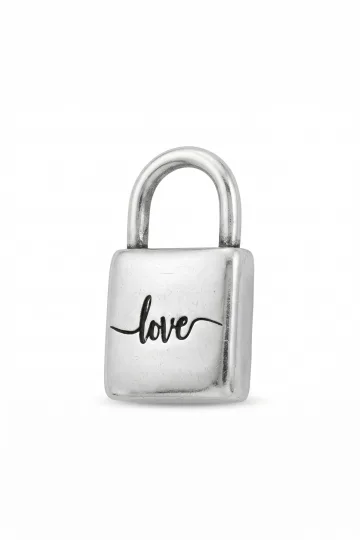
Reversible pendants, with the same design or complementary designs on both sides, have no definitive front, so it does not matter which way they face. Several contemporary designers have adopted this approach precisely to eliminate the problem. Adding a back-side engraving achieves a similar result: the reverse stops being the "wrong" side.
How do I attach a bail enhancer to a bracelet?
A bail enhancer, the double bail adapter, is usually sold as a separate part. On a bracelet it attaches either through the clasp or through a link of the bracelet itself. What matters is that the diameter of the enhancer's opening matches the thickness of the link. If the link is wider, the pendant will rattle about and you gain nothing.
Does a silicone stopper bead help?
Yes, and it is one of the cheapest fixes available. A small clear silicone stopper bead slides onto the chain hard against the bail, on one side or on both. It pins the pendant at the right point and stops it travelling along the chain and winding up. The solution is invisible, goes on without tools and comes off just as easily. The one drawback: under a very heavy pendant the silicone compresses over time and stops gripping, and there a second point of contact with the chain is the better answer.
Why does my pendant always flip the same way?
If the pendant reliably shows its back on one particular side, the cause is almost certainly a displaced centre of gravity or a heavier front face. Random flipping in both directions points to a chain that slides; a strictly repeating flip in one direction points to the construction, because the heavy part goes downward every time. That is cured with a counterweight or by moving the bail, not by changing the chain.
Can I twist the chain so the pendant stays put?
Temporarily yes, and it is not a solution. A light twist in the chain will sometimes hold a pendant in place for a couple of hours, but constant twisting kinks the links and wears out both the chain and the bail faster. Better to spend one effort on the right bail, a silicone stopper or a suitable chain than to fight kinks every morning.
Real scenarios with practical answers
Scenario 1: a coin pendant on a 50 cm chain
One of the most classic cases. The coin turns face-down within minutes of being put on.
Steps:
- Check whether the bail is positioned centrally on the coin. Very likely it is not.
- Ask a jeweller to solder a second bail on the opposite side. With the chain running through both, the coin cannot rotate.
- Alternative: switch to a 40-42 cm chain so the coin sits higher, pressed against the collarbone, with less room to swing.
Scenario 2: a heart pendant that always shows its back
Hearts flip particularly often. The reason is the asymmetric shape: the upper portion is wide and substantial, the lower portion tapers to a point. The centre of gravity sits slightly back if one side carries a decorative surface.
Steps:
- If the heart is flat on both sides, add a small bead to the bottom point. This lowers the centre of gravity and stabilises the hang.
- If one face is clearly the front, consider re-soldering the bail slightly toward the front face, or replacing it with a reversible heart design. The hidden back will keep darkening anyway, so it is worth knowing why silver tarnishes and how to clean it.
- Check whether a stone on the front is significantly increasing its weight. If so, a counterweight at the bail may be all that is needed.
Scenario 3: a photo locket
Lockets are a common gift, and they often flip over, pressing the photograph against the skin.
Steps:
- Lockets are usually heavy enough to hold position. If they flip, the bail placement is the problem.
- Check whether the bail sits exactly at the centre of the top edge. If it is off to one side, that is the fault.
- Ask a jeweller to remove the existing bail and re-solder a centred one.
Scenario 4: a thin leaf pendant
A flat leaf shape on a fine chain is essentially a sail. It catches every air current and movement.
Steps:
- Add a small counterweight bead between the bail and the clasp on the chain.
- Switch to a flat snake or herringbone chain, which does not twist.
- A double-loop bail through two points on the leaf is the most reliable solution.
Scenario 5: a small stud-style heart pendant
Hearts flip often because the shape is asymmetric: broad at the top, pointed at the bottom. All of the mass sits in the upper lobes while the bail is fixed in the notch between them, which puts the centre of gravity well behind the point of suspension. On a small heart the whole piece weighs so little that the chain wins every argument.
Steps:
- If the heart is flat and finished on both faces, add a small drop-shaped bead at the lower point. That moves the centre of gravity down below the bail and the heart hangs stably.
- If only one face is finished, replacing it with a double-sided heart solves the problem permanently and costs less than the workshop time to correct the original.
- Some jewellers make hearts with a curve through the body, a shape that resists flipping by construction rather than by counterweight. It is worth asking for that design specifically when you buy.
- On a very small heart, a silicone stopper each side of the bail does most of the work on its own, because there is not enough mass in the piece to compress the silicone.
Buying it as a gift? Each one arrives ready to give.
 A branded Zevira box and a little card come with every order.













When to return the piece to the seller
If the problem is severe and none of the fixes work, returning the piece is a legitimate option.
In the UK: 30 days under the Consumer Rights Act for a full refund. After 30 days, the retailer can choose to repair or replace.
In the EU: 14-30 days depending on the country and retailer policy.
What to write: "The pendant has a structural issue: it rotates face-down due to an off-centre bail, which prevents it from functioning as a decorative piece."
What helps your case:
- A short video showing the pendant turning by itself
- A photograph clearly showing the bail offset from the centre
- A comparison with another piece from the same range that hangs correctly
Good jewellery retailers generally prefer to repair or replace rather than deal with a dispute.
Conclusion
A flipping pendant is not a catastrophe. It is a geometry problem, and geometry has solutions. In most cases, one of three things fixes it: a shorter chain, a heavier chain, or a double-loop bail. If the issue is serious and persistent, a jeweller can sort it permanently for a small fee.
The main thing: do not discard a pendant just because it flips. It can almost always be corrected.
Silver, gold, wedding rings, symbolic pieces, matching sets.
About Zevira
Zevira makes jewellery in the artisan tradition of Albacete, Spain. Every pendant is checked for balance before it leaves the workshop. If a piece flips after purchase, we correct it at no charge.
What you can find with us:
- Pendants with flat or oval bails designed to resist rotation
- Pendant and chain sets matched for weight compatibility
- A pendant correction service for flipping pieces
- Double-loop bail mounting for heavier pendants
- Counterweights for problematic designs
Every piece can be personalised with engraving, with the option of personal engraving. We work in sterling silver 925 and gold 14-18 ct.