Seahorse Jewellery: Meaning, Symbol and History
Wear the symbol, don't just read about it. These are in stock:
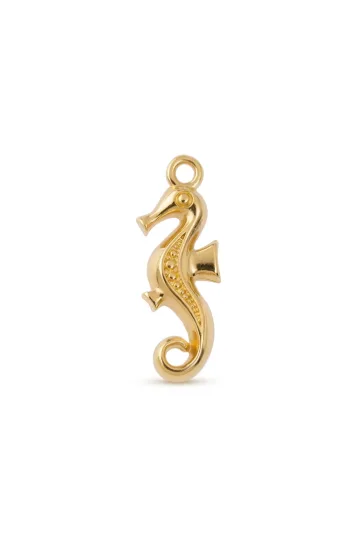
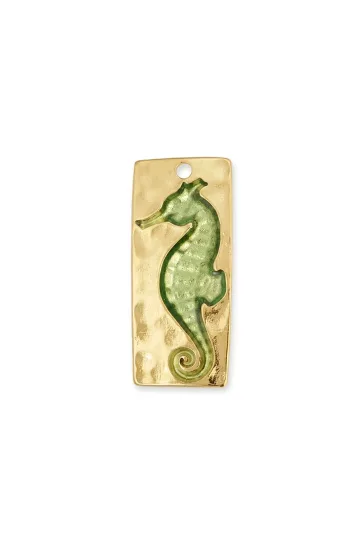
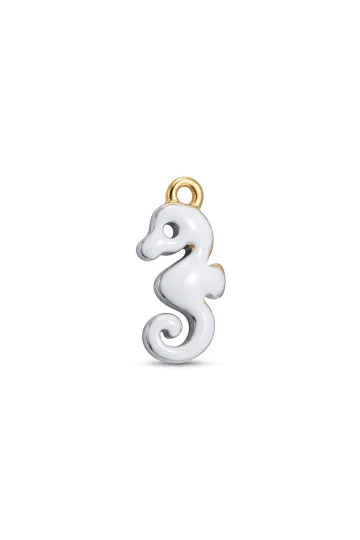
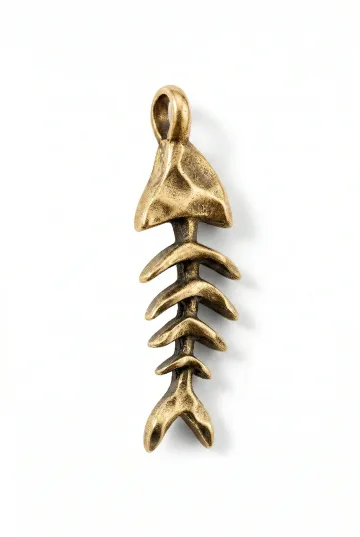
A creature that plays by its own rules
The seahorse does not look like a fish. It swims upright, steers with a dorsal fin that beats up to fifty times per second, grips seagrass stems with a prehensile tail, and has no stomach whatsoever, which means it must eat almost continuously to survive. Its bony armour of fused rings replaces the scales found on ordinary fish. The head, with its long tubular snout and bony crown called a coronet, looks nothing like anything else in the ocean. It belongs to the order Syngnathiformes, related to pipefish and sea dragons, and even within that odd company it stands apart.
The most remarkable thing about it, though, is not its form but its reproductive biology. In seahorses, the male carries the young. The female deposits eggs into a specialised brood pouch on the male's abdomen, where they are fertilised, nourished through the pouch wall and supplied with oxygen until they are ready to be born. The male then undergoes muscular contractions to release the juveniles -- sometimes as many as two thousand in a single birth. No other vertebrate on earth does this. It is the only genuinely male pregnancy known in the animal kingdom.
This biology has made the seahorse a symbol almost without trying. Ancient sailors along the Cornish coast and in the harbours of the Mediterranean encountered the creature and folded it into their mythologies. The British Museum holds Roman-period mosaics depicting hippocampi -- the mythological half-horse, half-fish being -- pulling the chariot of Neptune across the deep. The real seahorse and its mythological cousin became intertwined for centuries. Medieval bestiaries, produced in monastic scriptoria across England and France, described the "equus marinus" as a creature of the deep that grazed on underwater meadows and moved with uncanny slowness.
Today the seahorse occupies a particular place in jewellery. It is not a mass motif like the butterfly or the heart. People who choose it have usually chosen it deliberately, for a reason that matters to them: a new father, a diver who encountered one at thirty feet down, a marine biologist, someone who simply feels they have always moved to a different rhythm than those around them. A seahorse pendant almost always has a story behind it. That story is usually worth hearing.
Seahorse jewellery: what to choose
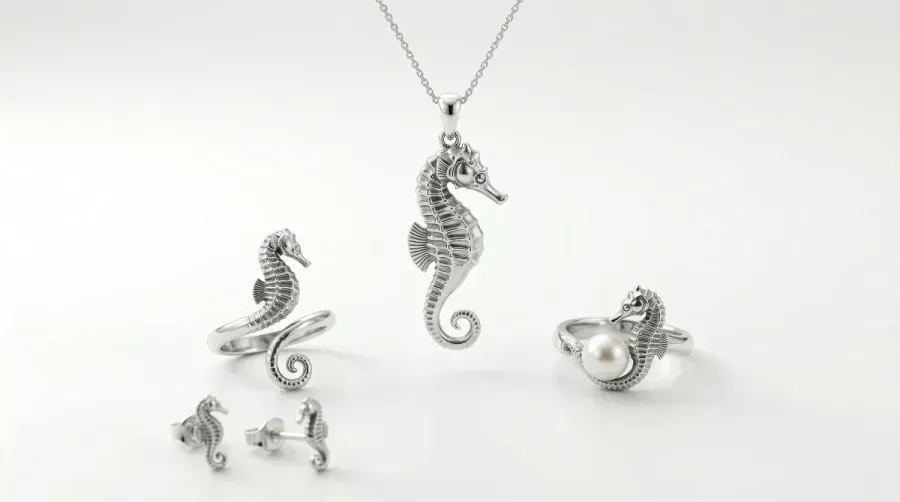
The pendant is the most established format. A figure between two and three and a half centimetres, with a well-defined coronet, tubular snout and coiled tail, worn on a chain that sits at the collarbone. At this length the detail is visible, the silhouette is immediately legible, and the piece works for office, daily and evening contexts without adjustment. Both men and women wear this format easily.
Paired pendants -- two seahorses coiled tail to tail -- draw on the actual biology of seahorse courtship. During their morning greeting rituals, bonded pairs interlock tails. The two-piece format works well as a gift to a couple, or as a matched set for partners expecting a child. The logic overlaps with paired jewellery traditions discussed in other symbolism contexts, but with a biological grounding that gives it uncommon weight.
Stud earrings with a miniature seahorse of around one centimetre are a solid everyday choice. The silhouette reads clearly even at small size. Drop earrings with a larger figure, from two to three centimetres, enter more decorative territory and suit an Art Nouveau treatment, where the tail becomes a flowing curve and the fins dissolve into plant forms.
Brooches at four to six centimetres are a format that suits the seahorse particularly well. The figure can accommodate full detailing -- every body ring, both fins, the coronet -- and holds its own on a lapel, on a heavy-knit jumper, or on a wool coat. In British tailoring tradition, the brooch lapel is an established site for personal symbolism, and the seahorse in this format makes a quiet but readable statement.
Rings with a seahorse in relief on the shank are less common and for good reason: the complex silhouette does not always survive the mechanical demands of daily hand wear. They exist, and when well executed they are striking, but they require care. A charm for a bracelet resolves the problem neatly: the seahorse becomes interchangeable with other maritime charms and can be worn or removed at will.
Men's formats on a leather or waxed cord -- a heavier oxidised silver seahorse, sometimes in a more graphic silhouette -- read as a maritime amulet without feminine associations. This format has a long history in British coastal communities, where sea-related imagery on a cord or chain was a common form of personal talisman among fishermen and sailors.
A seahorse wants oxidised silver and a bare collarbone. Gilded and glittered, it is a fridge magnet. Take it off.
How to wear a seahorse
Over years on shoots and behind the display case the seahorse has passed through dozens of looks with me. Here is what actually works, sorted by occasion.
What do I wear the seahorse with every day? For daily wear I recommend a small seahorse: a contour pendant on a thin chain or one-centimetre studs. A linen shirt, a white tee, a straight cotton dress. A light top lifts the silver, a dark one turns the figure into the accent. Here the seahorse works as a quiet detail noticed only up close.
Is it right for the office? Yes, as long as you keep it restrained. I suggest smooth silver without coloured enamel, a medium pendant under a closed neckline or a shirt with a fine jumper. Heavy detailing and bright enamel look like too much in a work frame. An oxidised contour reads as a calm detail, not jewellery on show.
How do I build an evening look? For evening I choose the decorative format: an Art Nouveau pendant with enamel, drop earrings from two centimetres, or a rhodium brooch with selective gilding. An open or V-neck calls for a medium pendant at the collarbone. Hair worn up leaves the figure room to read as the accent.
And as a gift for an occasion? For a birth, an anniversary or a first birthday I suggest the paired format: two seahorses linked by their tails, or a heart formed from the pair. The back of a pendant takes an engraved date well. A gift like this to a new father stays a rare piece of men's jewellery with a direct personal meaning.
Who does it actually suit? Anyone who values a quiet personal token and likes the marine theme and flowing lines rather than a shiny pile. Two rules that never fail. First: one marine motif per look, a seahorse at the neck means plain earrings, otherwise you get an aquarium. Second: keep the metal in one tone, silver with silver, gilding with warm stones.

Turn on your camera, pick earrings, a pendant or a ring, and see the piece on yourself in real time.
Switch items in one tap.
Everything runs in your browser: no photo or video is ever uploaded.
Types of seahorse jewellery
Realistic silhouette. The most demanding in craft terms and the most unmistakable in result. Every diagnostic feature must be present: coronet, tubular snout, dorsal fin, segmented body rings, coiled tail. Oxidising the recessed areas and leaving the raised surfaces bright is standard practice. It creates depth and makes the figure readable at arm's length. Without this treatment, a realistic seahorse in plain polished silver can look flat.
Minimal contour. The opposite approach. The profile of the creature is simplified to a clean line, sometimes cut from flat silver sheet with the interior left open. This format works well in everyday jewellery and in professional contexts where heavy ornament would be out of place. It is recognisable even to people who do not know the mythology.
Art Nouveau treatment. The seahorse was one of the preferred motifs of the 1890s to 1910s. Under Lalique and his contemporaries, the fins became waterweeds, the tail merged with a breaking wave, the body surface was worked in plique-a-jour enamel that glows like a fragment of the sea. This vocabulary returns in jewellery every generation and continues to find an audience among those who value the tradition of organic ornament.
Heraldic hippocampus. The mythological being with a horse's forequarters and a fish's hindquarters is a distinct subject from the biological seahorse. It appears in classical relief sculpture in the British Museum, on the arms of Ipswich, Belfast and Newcastle-upon-Tyne, and in a range of maritime civic heraldry. In jewellery it reads as a symbol of maritime authority and historical connection to the sea rather than as personal symbolism around fatherhood or patience.
Miniature, one to two centimetres. The everyday scale. Stud earrings, small pendants, charms for slim chain bracelets. At this size the seahorse enters the wardrobe without announcement and becomes part of the regular rotation.
Pair forming a heart. Two seahorses arranged so their S-curves meet to form a heart shape. Popularised in Scandinavian jewellery in the 1970s, widely adopted since. The biological reference to courtship and pair bonding gives it a foundation that the heart alone does not have.
Customer reviews
Zevira is a real jewellery shop. Genuine payments, deliveries and customer thank-yous.
🥰🥰🥰 gracias

Ok, ¡gracias! 🙂

History of the symbol
The association of the seahorse with maritime myth in Britain runs through the entire tradition of coastal culture. The Royal Navy's heraldic heritage includes the seahorse on multiple crests and badges; the city of Belfast placed it on its civic arms in 1890. Newcastle-upon-Tyne, Ipswich, and a number of other port cities in England and Scotland carry the hippocampus in their armorial bearings as a direct reference to maritime trade and naval identity.
The natural history tradition is inseparable from this. The first public aquarium in the world opened at London Zoo in 1853, and the seahorse was among its most popular exhibits from the outset. Its immobility, its strange form and its apparent patience made it a favourite subject for Victorian illustrators and natural historians. Philip Henry Gosse, the Victorian marine biologist whose work brought the rock pool and the tidal zone into popular British consciousness, wrote about the seahorse with visible admiration in his 1855 "A History of the British Sea-Anemones and Corals."
Cornwall and Devon have their own folk associations with the creature. Sea horses in local tradition were considered protectors of fishermen, and small carved wooden or bone figures of seahorses were kept as household charms in fishing villages from Newlyn to Brixham. These material objects belong to the same impulse that, in more formal guise, put the hippocampus on civic arms and naval badges.
Charles Darwin, in his "Voyage of the Beagle" (1839), noted the seahorse's grip on seagrass with interest and commented on its apparent stillness in the water. The scientific description of male pregnancy was known earlier -- it was documented by naturalists in the seventeenth century -- but the Victorian period made it a subject of popular fascination.
Rene Lalique, working in Paris in the 1890s and 1900s, produced jewellery in which marine motifs including the seahorse were treated with an originality that has not been surpassed. His approach -- organic, asymmetric, using translucent enamel and pearl -- established the visual language for seahorse jewellery that persists in fine work today. The Art Nouveau movement in Britain, through makers such as Jessie M. King and the Birmingham School of Arts and Crafts, engaged with the same maritime vocabulary.
In the twentieth century the motif entered the commercial mainstream. It became standard in any maritime collection and appeared on the civic imagery of Floridian resort towns after the seahorse was designated Florida's official saltwater fish in 1961. From the 1990s it acquired a conservation dimension: seahorses are listed on Appendix II of CITES, their habitats are diminishing, and their presence in ecological imagery reflects genuine concern for their survival.
Upload a photo of your pet, someone you love, or an object. We'll build a 3D model and hand-cast it in pewter.




The seahorse in mythology
Greece and Rome
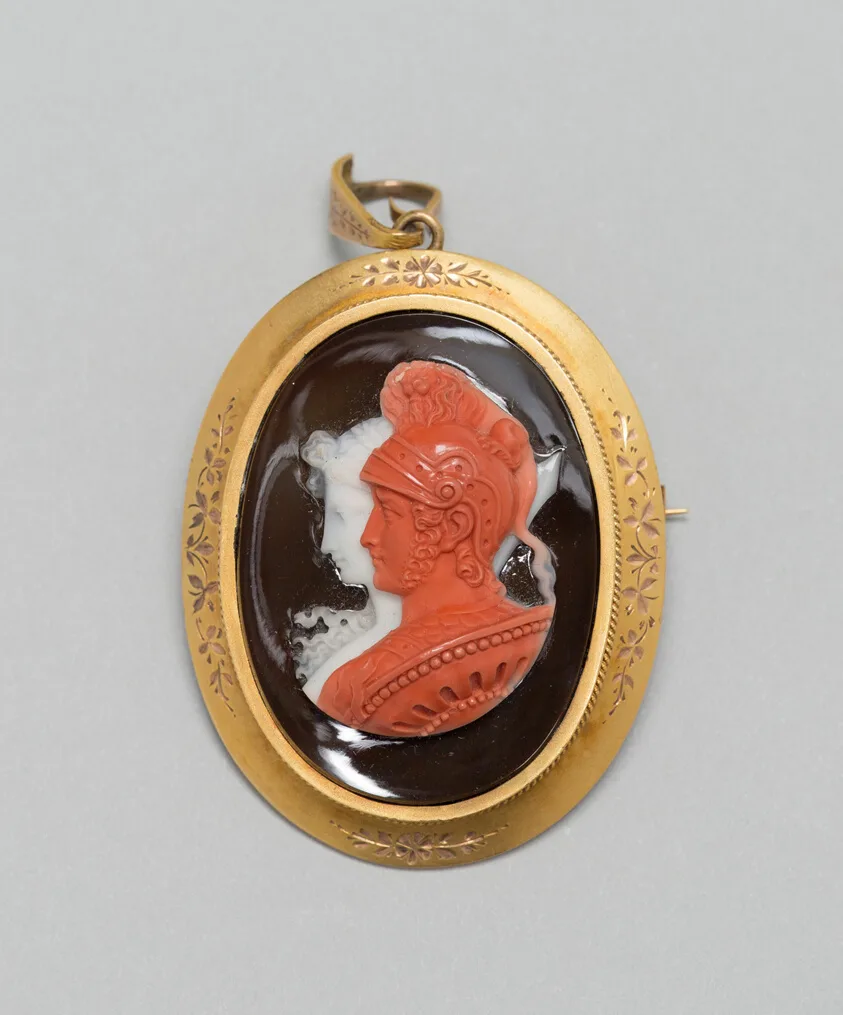
The hippocampus -- "hippo" (horse) and "kampos" (sea monster) -- appears in Greek mythology as a creature of Poseidon's retinue. It drew the sea god's chariot, it served as a mount for Nereids and Tritons, and its image was widely used in the decoration of bathhouses, coastal villas and triumphal monuments. The Baths of the Seven Sages at Ostia Antica, outside Rome, and the marine mosaics of Pompeii both feature hippocampi in their decorative programmes. The creature carried the same symbolic weight as the horse on land: power, speed, divine authority -- but transposed to the domain of water.
The British Museum holds examples of this tradition in its Roman and Greek collections: bronze figurines, gems, and mosaic fragments in which the hippocampus is rendered with the same confidence and assurance that the artists brought to terrestrial horses.
Cornwall and the Atlantic coast
British coastal communities from Cornwall northward maintained their own oral traditions about seahorses separate from classical learning. The creatures were associated with good fishing, with protection from drowning and with the benevolence of the sea. Their physical resemblance to a horse -- the neck, the coronet, the upright carriage -- made them natural candidates for the role of "sea horse" in a maritime world where horses were the primary animals of land transport. A carved seahorse on a boat's bow post or a small figure kept at home occupied a similar talismanic function to the horseshoe in agrarian culture.
China and the Far East
In Chinese, the seahorse is "haima" (sea horse). Classical Chinese natural philosophy related it to the dragon family: the elongated snout, the body crest, the spiral tail and the segmented bony surface all suggested kinship with the long dragon. This placed the seahorse in an exalted category -- minor sea dragon, creature of transition between elements. In folk medicine it was attributed with properties related to childbirth and the protection of young children, which adds another layer to the fatherhood symbolism.
European civic heraldry
The hippocampus and seahorse appear on the arms of numerous British and Irish port cities and maritime trading companies from the fourteenth century onward. The heraldic figure typically has the forequarters of a horse and a fish's or seahorse's tail, and is shown rampant or naiant. The specific cities of Belfast, Newcastle-upon-Tyne and Ipswich carry versions of this charge. In the maritime counties of England the symbol was a straightforward declaration of the city's identity as a port and its dependence on sea trade.
Modern culture
From the 1960s onward the seahorse settled into a new role as an emblem of marine conservation. Ocean and coral reef charities adopted it for their logos, coastal tourist boards put it on signage, and it became the informal badge of several warm-water regions on both sides of the Atlantic.
The choice was not arbitrary. The seahorse reads instantly as a symbol of a vulnerable sea because it genuinely is vulnerable: it swims badly, it depends entirely on seagrass and reef structure for anchorage and camouflage, and it is sensitive to pollution and to changes in water temperature. An animal that cannot outrun a problem makes an honest mascot for habitats that cannot either.
In Britain the same logic put the seahorse at the centre of seagrass restoration campaigns. Seagrass meadows are among the most efficient carbon stores in the coastal environment and among the most damaged, and the seahorse became the recognisable face of a habitat that is otherwise hard to make people care about. Recent survivalist and marine documentaries have leaned on the same image, and a good deal of contemporary illustration and print design uses the silhouette for exactly this association.
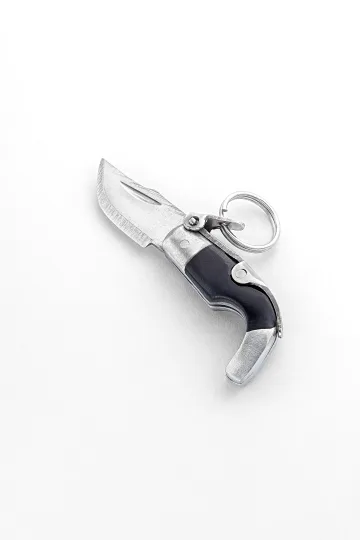
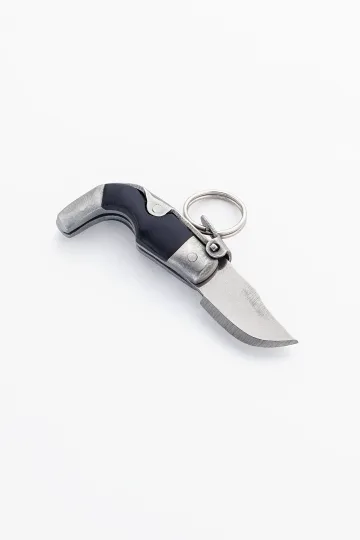
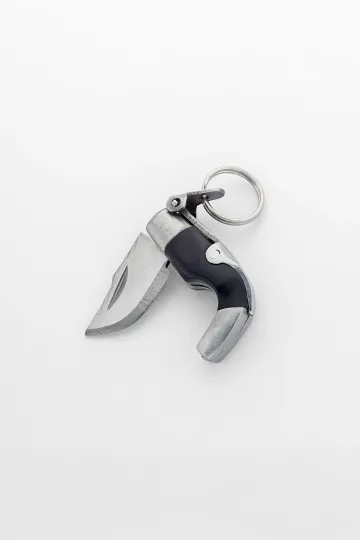
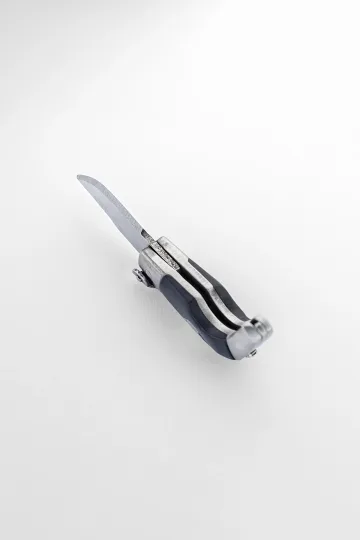
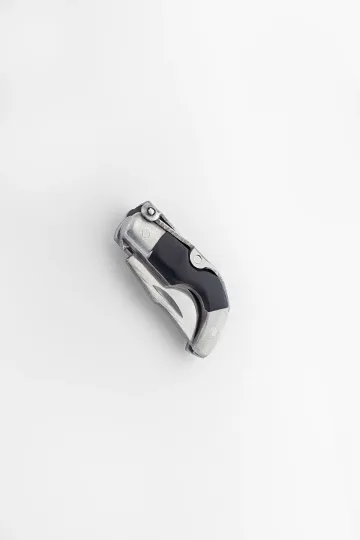
CAPAORA mini knife pendant
The 18th-century Spanish navaja in miniature: 40 mm of stainless steel, a real folding mechanism and a Palanquilla lock that clicks. An affordable gift to remember.
Authentic · Ships from Spain · 14-day returns
The seahorse and conservation: why nobody should buy a dried one
This section is not decoration on the end of a jewellery article. If you are drawn to the seahorse as a symbol, the fate of the actual animal is part of what you are buying into, and it is worth knowing before you shop.
The scale of the trade. Tens of millions of dried seahorses leave the sea every year. The great majority go into traditional medicine markets, and a substantial remainder are sold as curios: varnished on keyrings, sealed inside resin pendants, mounted in shadow boxes, glued to shells in seaside gift shops. Each one was a live animal taken from a wild population, since seahorses are extremely difficult and expensive to breed at commercial scale and almost nothing on the curio market comes from captive stock.
The legal position. Every species in the genus Hippocampus was listed on Appendix II of CITES, the convention governing international trade in endangered species, with the listing taking effect in 2004. That was the first time an entire genus of marine fish had been listed. Appendix II does not ban trade outright, it requires that exports be licensed and demonstrably sustainable, and in practice a great many exporting countries have been unable to demonstrate that. Several have suspended exports altogether.
In British waters. Two species live around these coasts: the short-snouted seahorse and the long-snouted or spiny seahorse, both found along the south and west of England and Wales and into Ireland. Both have been protected under the Wildlife and Countryside Act since 2008, which makes it an offence to kill, injure, disturb or take them, and to damage their habitat. The seagrass beds where they live, Studland Bay in Dorset being the best-documented example, have been the subject of long arguments about anchoring and mooring, because a boat anchor dragged through seagrass removes the only structure a seahorse has to hold on to.
Why the pressure is so hard to relieve. Directed fishing is only part of it. Bycatch from bottom trawling accounts for an enormous share of the total, since seahorses live exactly where trawls are dragged and they cannot escape a net. Add habitat loss, coastal development and pollution, and the population declines continue even where the targeted trade has been curbed. Most species are classed by the IUCN as vulnerable or as data deficient, which in practice means nobody has counted them properly.
What this means at the shop counter. A dried seahorse in resin is not a piece of jewellery, it is a small taxidermy object, and it will not last. Dried specimens fade, go brittle and crumble, and the resin yellows. It cost an animal its life, its provenance is almost never verifiable, and depending on where you bought it and where you carry it, it may be illegal to bring home. Customs officers at British airports seize marine curios regularly, and travellers are genuinely surprised.
A seahorse in silver has the opposite properties. It lasts generations, it takes engraving, it can be repaired, and the only thing it costs is metal that can be recycled indefinitely. The symbolism survives the translation perfectly well: the fatherhood, the patience, the grip on the seagrass all read from a cast figure exactly as they read from the animal. If anything they read better, because nobody has to look at the piece and wonder what happened to the creature.
The practical rule is simple. Buy the seahorse as an image, never as a body. And if you want to do more than avoid harm, the seagrass restoration projects around the British coast take small donations and put them directly into replanting the habitat the animal depends on.
Leave your email, we'll send your discount code. No spam, unsubscribe anytime.
The code arrives by email, valid on your first order.
What the seahorse means
Fatherhood. The central and most scientifically grounded meaning. The male seahorse undergoes a genuine pregnancy -- the eggs are deposited into his brood pouch, nourished through the pouch wall and carried to term before being released as live juveniles. This is unique among vertebrates. It is not a case of the male guarding eggs, which occurs in many fish. It is internal gestation in the strict physiological sense. The symbol of the seahorse as a father's emblem has a factual basis that distinguishes it from most symbolic associations in the jewellery tradition.
Monogamy. Many seahorse species form season-long or lifetime pair bonds. Partners meet each morning and perform a brief greeting display, entwining tails and moving through the water in synchrony. Biologists have documented pairs that maintained contact for multiple seasons. The image of two animals returning to the same meeting point each morning carries obvious resonance for the representation of committed partnership in jewellery.
Patience. The seahorse is one of the slowest fish in the sea. The dwarf seahorse, the slowest of all, covers perhaps a metre and a half per hour under its own power. It hunts not by pursuit but by waiting: hovering motionless in seagrass until prey drifts into range of its vacuum-tube mouth. The symbolic reading -- achievement through stillness, the long game rather than the sprint -- is direct and earns its place.
Distinctiveness. No other fish swims upright. No other fish has a prehensile tail and no caudal fin. No other fish wears a bony coronet. In a collection of marine imagery, the seahorse cannot be confused with anything else. In jewellery, this translates without difficulty: the person who chooses a seahorse chooses to be recognised as different from the general run.
Resilience through apparent fragility. The seahorse is a poor swimmer and an easy target in open water. But its tail can withstand sustained tension: it anchors to seagrass in currents strong enough to snap a human's grip. This is the biology of quiet endurance -- not spectacular strength, but the kind that does not let go.
These meanings are human projections onto biological behaviour. The seahorse is not aware of being patient or monogamous in any reflective sense. What distinguishes this symbolism from most luck charms and generic talismans is that the projection is grounded in documented fact. The male pregnancy is real. The morning greeting display is real. The anchoring grip is real. This gives the symbol an unusual integrity for those who care about such things.
Materials and techniques
Sterling silver (925) is the natural material for maritime motifs. The cool grey tone of silver reads as wet metal, salt spray and sea light. Oxidised silver, where the recessed areas are darkened chemically and the raised areas remain bright, allows the bony ring structure of the seahorse body to be fully legible. Without oxidising treatment, the intricate surface of a realistic seahorse figure can collapse into an undifferentiated shine.
Enamel in teal, turquoise and marine blue introduces colour and turns the piece into a decorative object rather than a pure silver exercise. Hot enamel fired in a kiln gives saturated depth that cold enamel cannot replicate. In Art Nouveau work, plique-a-jour enamel -- translucent, without a metal backing, like a miniature stained glass window -- is the prestige technique for seahorse and marine imagery generally.
Pearl as an eye detail is a classic solution. A freshwater pearl of one and a half to two millimetres set as the eye gives the figure a gaze and turns a silhouette into a creature. White river pearl on plain silver; black Tahitian pearl on oxidised silver or on gold. The presence or absence of this single detail makes a significant difference to the reading of the piece.
Small stones -- aquamarine, chrysolite or citrine -- placed at the brood pouch or coronet position add symbolic precision. Aquamarine reinforces the maritime reading; citrine warms the palette; chrysolite pairs with green enamel. Stone sizes of one and a half to three millimetres are correct for the seahorse proportions. Larger stones unbalance the figure.
Gold and silver combined. A selective gilding of the body on a silver background gives a formal quality suited to brooches and gift pieces. Full gold seahorses -- 14ct or 18ct -- are special commission items. The historical tradition runs to silver, and the material feels right for a creature of cool coastal water.
Oxidising for definition. The segmented body of the seahorse, with its twelve to fifteen distinct body rings plus the tail rings, loses all its character without dark contrast in the recesses. Oxidising is not a cosmetic choice here but a functional one: it makes the anatomy readable. A quality piece will have clearly differentiated rings; a mass-produced one will often flatten these into a vague texture.
Hand engraving of fins and tail rings is what separates commissioned work from press-stamped pieces. An experienced eye can tell immediately: the number of rings, their distinctness, the coherence of the fin rays. This is where the maker's hand leaves its trace.
Send a friend a discount code, they save on their first order.
Who it suits
New and expectant fathers. The biological case for this gift is clear and requires no embellishment. A silver seahorse pendant given at the birth of a child, with the birth date or the child's initials engraved on the reverse, is a piece that stays in use for decades and carries a meaning that does not thin with repetition.
Divers and marine professionals. For anyone who has encountered a seahorse in the water -- which tends to be a memorable experience, given how still and strange they are -- a seahorse in jewellery is a direct reference to a specific place, dive site or research project. Marine biologists and ocean conservationists wear them for the same reason.
Patient people in slow professions. Medicine, archival research, restoration, rehabilitation, social work, hospice care, long-cycle science. Professions where results accumulate over months or years rather than days. The seahorse as a personal emblem of the long game sits quietly in professional environments and is recognised without explanation by others in the same field.
People who function differently. The seahorse does not try to be an ordinary fish. Its survival strategy is built entirely around its non-standard biology. For people who feel this resonance personally -- who have built their lives around a different tempo, a different role, a different kind of strength -- the motif carries an obvious personal truth.
Art Nouveau enthusiasts. The seahorse is one of the signal motifs of the 1890-1910 period. Anyone building a coherent wardrobe in that aesthetic knows this and chooses accordingly. The British Arts and Crafts jewellery tradition, the Glasgow Style, the Birmingham enamel tradition -- all engaged with marine imagery in this period, and the seahorse was central to that engagement.
Those who value specificity. The seahorse is not a mass symbol. It does not say what the heart says, or what the anchor says. It says something specific, and the person who wears it has usually decided what that specific thing is. This is a different kind of jewellery choice from the decorative, and it suits a different kind of wearer.
It does not suit those seeking an immediately legible status piece. The seahorse is a quiet symbol. Its weight is personal rather than social. If the goal is immediate declaration of wealth or position, a different motif will achieve that goal more efficiently.
Frequently asked questions
Does the male seahorse really become pregnant? Yes, in the strict biological sense. The female deposits eggs into a pouch on the male's abdomen. Within the pouch the eggs attach to the lining tissue, receive oxygen and nutrients through the pouch wall, and develop for two to four weeks before the male releases the juveniles through muscular contractions. A large male of one of the bigger species may release up to two thousand juveniles in a single birth. This is the only known example of male pregnancy in the vertebrate animal kingdom.
Is a seahorse actually a fish? Yes. It belongs to the order Syngnathiformes, family Syngnathidae, genus Hippocampus. Its closest relatives are pipefish and the leafy sea dragon. It has gills, fins and the bony structure characteristic of fish. The upright posture and prehensile tail are specialisations for life in seagrass beds, where remaining motionless and gripping vegetation is more useful than speed.
Is it an appropriate gift for a father? Among the most considered you could make. The biological argument for the seahorse as a father's emblem is factual rather than sentimental. A pendant with the birth date or initials engraved on the reverse turns a piece of jewellery into a durable family object. The gift works at birth, at the first birthday, at any anniversary of fatherhood.
Are seahorses endangered? All seahorse species are listed on Appendix II of the Convention on International Trade in Endangered Species (CITES), meaning their international trade is monitored and regulated. The main pressures are habitat loss (seagrass beds and coral reefs), bycatch in bottom trawl fisheries, and harvest for use in traditional Chinese medicine. A silver or gold seahorse in jewellery has no connection to any of this: it is a metal and enamel object. A dried seahorse on a souvenir key ring is a different matter.
What is the difference between a hippocampus and a seahorse? The hippocampus is a mythological creature with a horse's forequarters -- head, mane, forelegs -- and a fish's or seahorse's hindquarters: a spiral tail and fins. It appears in Greco-Roman sculpture, on mosaic floors, in civic heraldry. The seahorse is a living animal. In jewellery, the realistic seahorse is used for personal symbolism (fatherhood, patience, patience, partnership); the heraldic hippocampus is used for maritime mythology and civic reference.
Does a seahorse pendant work for women even though the symbolism is about fatherhood? Easily. The fatherhood dimension is one layer among several: the morning greeting ritual, patience, distinctiveness, the Art Nouveau aesthetic, marine life more generally. Women wear seahorse jewellery for all of these reasons. A shared family symbol -- the mother wearing one, the father wearing one -- is a coherent and honest use of the motif.
How do I look after a detailed seahorse pendant? The body rings and fin rays are exactly the places where polish, soap and body oils collect, and once the recesses fill in, the anatomy that makes the piece worth wearing disappears. Warm water, a drop of washing-up liquid and a soft toothbrush, worked gently along the rings rather than across them, clears it. Dry it thoroughly afterwards, since water trapped in the recesses is what starts tarnish. And keep polishing cloths for the raised surfaces only: rubbing an oxidised piece all over will lift the dark contrast out of the grooves and flatten the whole design.
Is silver or gold the better choice for this motif? Silver suits it better for a straightforward reason: the seahorse depends on contrast to be legible, and oxidised silver gives the darkest, cleanest recesses of any common jewellery metal. Gold reads warmer and softer, which flatters the flowing Art Nouveau interpretations but does less for a naturalistic figure with fifteen distinct body rings. If you want gold and detail together, look for pieces with selective gilding, where the raised surfaces are gilded and the recesses left dark.
What size should a seahorse pendant be? Two to three centimetres is the range where the detail is readable at conversational distance without the piece dominating. Below about a centimetre and a half the rings and fin rays merge into a vague outline whatever the maker intended, which is why very small seahorses are usually rendered as a simple contour instead. Above four centimetres you are into statement territory, which works for an evening piece but sits awkwardly under a shirt collar.
Which chain suits it best? A fine cable or box chain, and no thicker than the pendant's own metal. The seahorse is a vertical figure with a curled tail, and it needs to hang freely and turn slightly to be seen properly, so anything stiff or heavily textured fights it. Length of 45 to 50 centimetres places the figure at the collarbone, which is where it reads best against most necklines.
Can a seahorse piece be engraved? The reverse of a cast pendant usually offers a flat area large enough for a date, a set of initials or a short line. This is what turns the piece into a family object rather than an ornament, and it is the single most common request for a birth gift. Ask before buying whether the back is flat enough, since some pieces are cast hollow or fully modelled on both sides and cannot take an engraving.
About Zevira
Zevira is a Spanish jewellery brand based in Albacete. The seahorse is part of the marine collection. Current pieces and availability are in the catalogue.
Buying it as a gift? Each one arrives ready to give.
 A branded Zevira box and a little card come with every order.










Conclusion
The seahorse is a quiet symbol, and that is precisely its character. It does not compete with larger and louder motifs. It carries the weight of genuine biological fact -- male pregnancy, morning greeting rituals, the anchoring grip of the tail -- and translates that biology into a symbol that bears examination. Most lucky charms do not survive close attention. The seahorse does.
It suits people who have thought about what they want their jewellery to say, and who have a specific answer. A new father. A diver who still thinks about the one they saw at thirty feet. A scientist who is in it for the long run. Someone who has always moved at a different pace and is no longer troubled by it. For any of these people, a seahorse in silver or gold is a piece that will still be making sense in twenty years, worn in the same way, carrying the same weight, without requiring justification or explanation. That is not a common thing to be able to say about a piece of jewellery.