Sumerian Jewellery: A Guide to the Ornaments of the World's First Civilisation
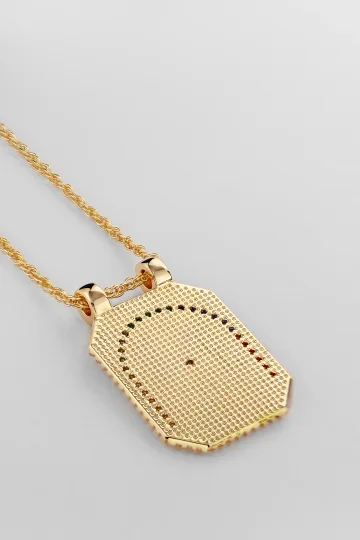
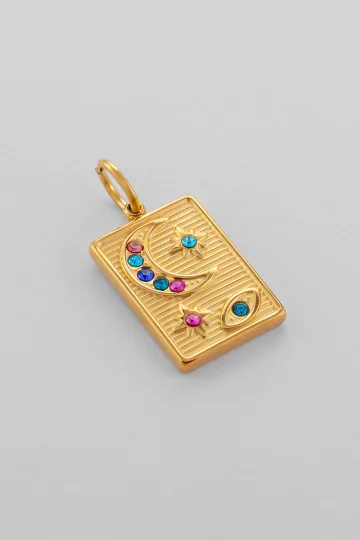
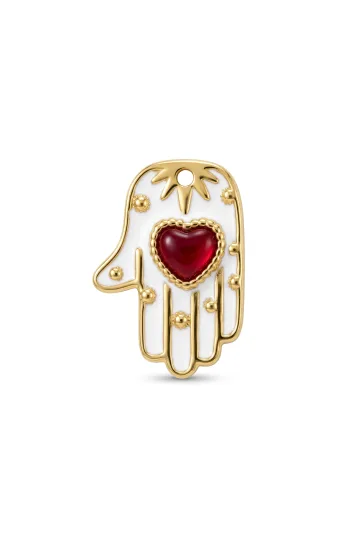
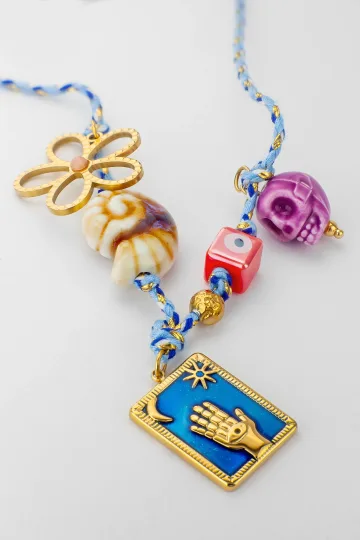
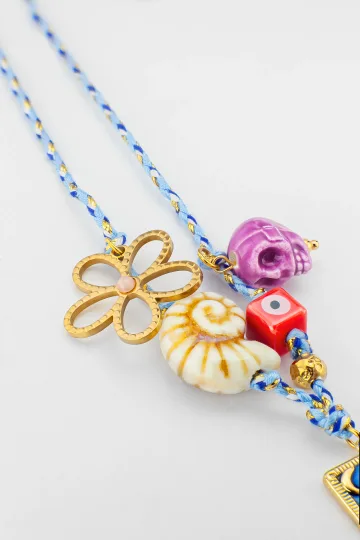
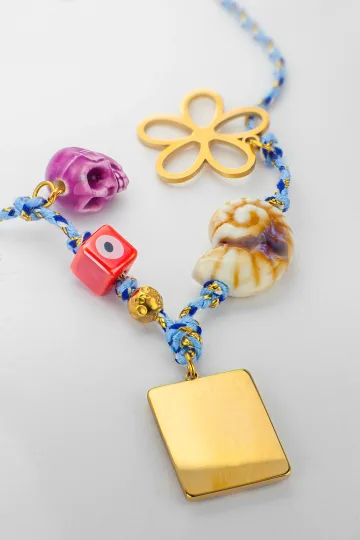
Wear the symbol, don't just read about it. These are in stock:

Introduction
The Sumerians lived in the southern reaches of Mesopotamia, between the Tigris and Euphrates, from the middle of the fourth millennium BC until the early second. This was the first urban civilisation known to scholarship: Ur, Uruk, Lagash, Nippur, Eridu grew into genuine cities long before the first Egyptian nomes rose along the Nile. The Sumerians invented cuneiform writing, the wheel, irrigation systems, and the sexagesimal number system that still gives us the hour and the degree. They also created the first jewellery tradition in history, one whose technical sophistication continues to astonish researchers today.
In 1922 the British archaeologist Leonard Woolley began excavating the mound of Tell el-Muqayyar, beneath which lay ancient Ur. By 1934, when the work concluded, the world had gained one of the most significant archaeological discoveries of the twentieth century: the Royal Tombs of Ur, dated to roughly 2600-2500 BC. Sixteen exceptionally rich burials yielded gold helmets, diadems wreathed in beech leaves, necklaces of lapis lazuli and carnelian, crescent-shaped earrings, cylinder seals, and dozens of other objects of a quality Europe would not match for another thousand years.
What is most remarkable is not the age but the maturity of the Sumerian jewellery tradition. By the time of the royal burials at Ur, Sumerian craftsmen had already mastered granulation, filigree, inlay, the drawing of gold wire, and the stamping of gold sheet on relief matrices. They assembled complex multi-layered ornaments from dozens of components, imported lapis lazuli from Afghanistan some two and a half thousand kilometres away, and traded carnelian with the Indus Valley. This was not a naive early form but a fully developed, established school.
The aim of this article is to show not merely a catalogue of museum artefacts but the living connection between Sumerian jewellery and what we wear today. The rosette of Inanna, the eight-pointed star of Ishtar, the crescent of the moon god Sin, the solar disc of Shamash, granulated gold beads, filigree chains: all of these continue to function as a visual language five thousand years on. Sumerian aesthetics live in Art Deco, in ethnic silver jewellery, in modern reconstructions, and in individual motifs of minimalist pieces, not as quotation but as a deep cultural layer. To place this story in its wider arc, running from these Royal Tombs through Egypt, Etruria, Byzantium and on to today, see the broader survey of 5,000 years of jewellery history.
At Zevira we approach this subject with academic attention. The Royal Tombs of Ur excavations, the British Museum's Mesopotamian collections, the work of Woolley himself, Samuel Noah Kramer, and Thorkild Jacobsen all form the foundation on which our historical-archaeological line rests. We make jewellery that respects the source and lives in contemporary wear.
Principal Sumerian Ornaments
The Sumerian jewellery wardrobe was considerably richer than many imagine. These were not isolated amulets on a cord but complete ensembles worn simultaneously by elite women and men alike. The burial of Queen Puabi gives a sense of the scale: several kilograms of gold, silver, lapis lazuli, and carnelian lay on and around her skeleton.
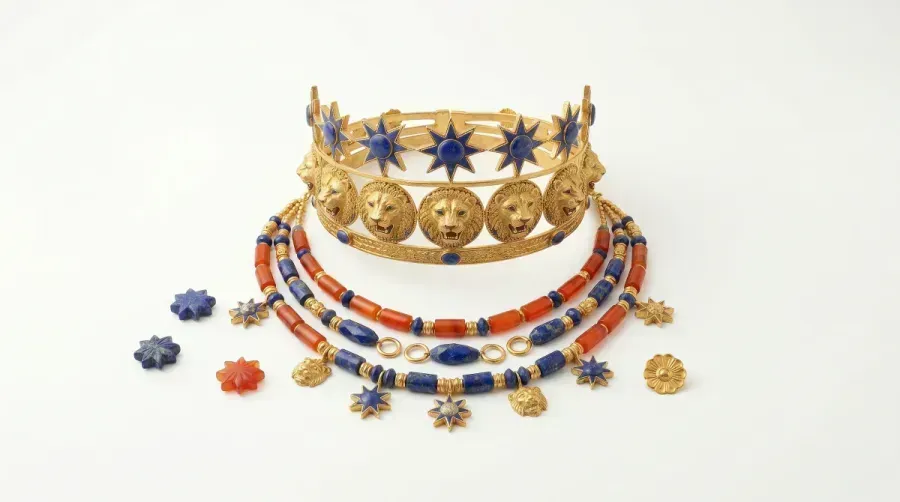
Diadems and headdresses occupied a central place. The most celebrated is the headdress of Queen Puabi, which consists of several layers: a lower row of gold ribbons with lapis and carnelian pendants, over which sits a wreath of gold beech leaves set with stones, then a comb of gold flower-rosettes on tall stalks. The entire construction was mounted on a wig of black wool that fitted close to the head and served as the foundation. Similar, if less elaborate, headdresses were worn by priestesses and noblewomen.
Necklaces were multi-stranded. It was not unusual for a burial to contain five, seven, or ten strings of beads at once. The beads were strung in a fixed order: long carnelian drop pendants, round lapis lazuli spheres, gold bicone elements, sometimes small gold animal figures. The combination of red carnelian, blue lapis, and yellow gold produced the famous three-colour Sumerian chord that became the visual signature of Mesopotamia for millennia.
Earrings were large. The most common form was a crescent of gold foil on a frame, sometimes with granulation along the edge and sometimes with pendants. Dozens of pairs of such earrings have been found in the tombs of Ur. Some examples reach five or six centimetres in diameter. From the position of the bodies in the burials, they were worn in pierced lobes, as today.
Rings served a dual purpose. On one hand there were simple gold bands, sometimes with granulation and filigree. On the other, rings bearing cylinder seals: a small carved cylindrical element of stone attached to a gold pin or suspended from a chain. Such an object functioned simultaneously as ornament, amulet, and personal signature. An impression of the seal in clay was legally binding, so its owner literally wore it on their person.
Cuff bracelets were made from gold foil stretched over wooden or bitumen cores, light but visually massive, creating the effect of broad metal bands. Another type consisted of gold and lapis beads on several strands gathered into a wide ribbon. Waist ornaments, wide belts of the same multi-stranded beads, crossed the torso and emphasised the silhouette.
A separate category comprised amulet pendants depicting deities: a tiny gold bull symbolising Enlil, the gold fish of Enki, the stylised eight-petalled rosette of Inanna. These were worn either as the centrepiece of a necklace or alone on a plain cord.
Lapis wants gold, never silver. In a cold metal the blue stone just sulks.
How to wear Sumerian jewellery
After years with the historical line I have built dozens of looks around Sumerian motifs. Here is what genuinely works, sorted by occasion.
What do I wear a Sumerian motif with every day? For daily wear I recommend a single accent: a pendant with the eight-pointed star or plain crescent earrings over a solid-colour top. I suggest a dark base, black, wine, deep green or sand, where the triad of gold, blue lapis and red carnelian reads like a finished picture. For fabric I choose the earthy kind, linen, dense cotton, wool, suede, which echo the craft nature of ancient jewellery far better than gloss.
Is it right for the office? Yes, as long as you keep it restrained. I recommend a cylinder seal on a cord or a ring with the rosette of Inanna: the sign is read by those who know, and it does not argue with a business code. I suggest one metal, no mixing, and a medium length so the pendant sits just under the top shirt button.
How do I build an evening look? For evening I choose an open neckline, a V or a boat cut, which frees the throat and chest for a multi-tier necklace or large crescent earrings. I suggest a smooth fabric in a deep colour, wine, emerald, black, so all the attention goes to the stone rather than the pattern of the clothes.
Can I mix gold and silver in one look? Carefully. The ancient palette is built on a warm tone, and a cold metal next to it dims the whole thing. I recommend staying with one metal: a stack of bracelets in yellow gold, earrings and one pendant from the same range, and the look holds together. Patinated silver I style on its own, with warm dark clothing, for an antique, slightly severe character.
Who does this aesthetic actually suit? Anyone unafraid of presence who loves a piece with meaning, the archetype of a queen or a priestess, a quiet strength without fuss. Two rules that never fail. First: one strong element per look, Sumer is weighty and does not forgive overload. Second: I keep the pendant at a medium length so the sign lands at the base of the throat instead of getting lost in the neckline.

Turn on your camera, pick earrings, a pendant or a ring, and see the piece on yourself in real time.
Switch items in one tap.
Everything runs in your browser: no photo or video is ever uploaded.
The Tomb of Queen Puabi
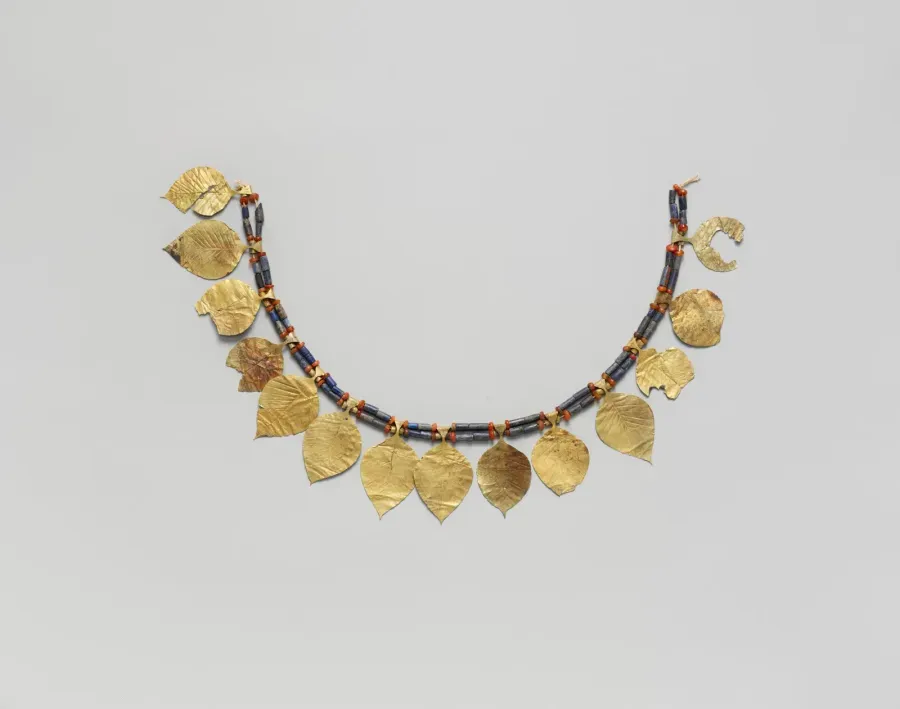
Queen Puabi deserves separate treatment. This is one of the most celebrated archaeological discoveries of the twentieth century, and her name means to jewellery history what Tutankhamun's means to Egyptology.
In 1927, during the fifth season of Woolley's work at Ur, the team found tomb PG 800. The burial chamber belonged to a woman of roughly forty years of age, laid on wooden biers in a stone chamber. In a separate death pit beside her lay the bodies of twenty-five attendants: men with spears and helmets, women in ornaments, grooms with oxen and carts. These were companions sacrificed at the burial of their mistress. Woolley described the arrangement of the bodies as suggesting a peaceful departure: the people appear to have taken some preparation and died without resistance. Twenty-first-century CT scanning of the skulls revealed evidence of blows to the temple with a blunt object, making the picture considerably grimmer.
The identity of the woman was established from a cylinder seal found on her body. The inscription in Sumerian cuneiform read: Puabi, nin, meaning lady or queen. Whether she was a queen in the political sense or a high priestess remains debated among scholars. Her status, in any event, was of the highest order.
On her skeleton lay approximately three kilograms of jewellery. The key elements were: a massive gold headdress in three tiers (ribbons, beech leaves, floral combs), crescent earrings, three necklaces of gold, lapis, and carnelian beads, a wide belt of the same materials on multiple strands, ten gold rings on her fingers, a cylinder seal, a fish-shaped amulet, and a scatter of individual beads around her body. A gold cup stood over the body; beside it, a gold drinking straw for beer, a commonplace Sumerian banqueting implement.
After excavation, the finds were divided among three institutions under the division-of-finds agreement of the time. Part went to the British Museum in London, part to the Penn Museum (University of Pennsylvania Museum of Archaeology and Anthropology) in Philadelphia, and part remained in the Iraq Museum in Baghdad. The famous gold headdress of beech leaves was among the pieces held in Baghdad.
In April 2003, during the invasion of Iraq, the Iraq Museum was looted. Thousands of artefacts vanished from the storerooms, including part of the Ur tomb inventory. Much was subsequently recovered through Interpol investigations and painstaking restoration work, but a portion of the objects is considered permanently lost. The head reconstruction of Puabi assembled by Woolley's team survived.
For those of us working with Sumerian aesthetics today, Puabi is the primary reference. Her headdress has been replicated by dozens of jewellery laboratories, from university workshops to major museums. An accurate replica, assembled from the same materials and proportions, is considered among the most technically demanding tasks in historical jewellery reconstruction.
Customer reviews
Zevira is a real jewellery shop. Genuine payments, deliveries and customer thank-yous.
🥰🥰🥰 gracias

Ok, ¡gracias! 🙂

Lapis Lazuli and Carnelian
Without these two stones, any discussion of Sumerian jewellery is incomplete. They define its visual identity as surely as turquoise defines Egyptian.
Lapis lazuli had only one significant source in the ancient world: Sar-i-Sang, a deposit in the Badakhshan province of northeastern Afghanistan, in the foothills of the Hindu Kush. The same region still yields the finest lapis in the world today: dense blue stone with gold-flecked pyrite inclusions and without the large white calcite patches that diminish its quality. The distance from Sar-i-Sang to Ur in a straight line is roughly two and a half thousand kilometres; along caravan routes through Iran, closer to three and a half. This means that three thousand years before the common era, in an epoch when the wheel had barely appeared, a long-distance trading network was already operating to supply the blue stone to Sumerian cities.
For the Sumerians this colour was sacred. The blue of lapis was the sky where the gods dwelt. According to myth, it was the hair of the goddess Inanna, the Ishtar of the later Akkadian tradition. When Inanna descends into the underworld in the famous poetic text, she wears seven attributes, one of which is a necklace of lapis lazuli. The stone carried the highest ritual significance.
It was used in the form of beads of various shapes: spherical, bicone, drop, cylindrical. Gems were carved with images of deities. Inlaid into gold cloisons, lapis created the blue-and-gold contrast that still looks strikingly contemporary. Large compositional panels were also cut in lapis, notably the famous Standard of Ur, where inlaid lapis panels carry scenes of war and peace.
Carnelian, the red-orange variety of chalcedony, arrived from the opposite direction, the southeast. The principal source was Gujarat in western India and the Indus Valley, home of the Harappan civilisation, Sumer's contemporary. By way of the Persian Gulf, sea routes, and the overland paths of Iran, carnelian beads arrived by the thousand at Ur and its neighbour cities.
Particularly notable are the so-called etched carnelian beads. This was a distinctively Harappan technique: an alkali paste was applied to a polished bead and heated, bleaching the surface and creating a white pattern on the red-orange ground. Beads bearing such patterns have been found in both Indus Valley cities and the Royal Tombs of Ur. This is among the most compelling archaeological evidence for direct trade between the two civilisations.
Beyond lapis and carnelian, the Sumerians used agate, chalcedony, pyrite, quartz, rock crystal, mother-of-pearl, cowrie shells, and ivory. But the triad of gold plus lapis plus carnelian became their signature combination. Red, blue, and yellow: three pure colours forming a visual chord that is instantly recognisable and still works today.
Upload a photo of your pet, someone you love, or an object. We'll build a 3D model and hand-cast it in pewter.



Gold, Silver, and Electrum
Gold was the principal precious metal of the Sumerians. It was sourced from several regions: Anatolia (modern Turkey), the deserts of the Arabian Peninsula, and possibly the Armenian Highlands. Gold dust and nuggets were brought into the river cities of Sumer, melted into ingots, and worked directly.
In purity, Sumerian gold was typically higher than later Classical gold, often around twenty-two carats, sometimes close to pure. This reflects primitive refining methods: gold and silver were separated by roasting with salt and lead, and the earliest refinings produced high-purity metal. Lower-grade alloys came later, when hardness and wear resistance became priorities.
Silver was known and used by the Sumerians, though its prestige shifted over time. In the early period it was roughly equivalent to gold in status; later it receded. The main sources were the Taurus Mountains in Anatolia. Silver went into larger objects: vessels, ceremonial weapons, some jewellery. Part of Puabi's headdress was assembled on a silver foundation.
Electrum, the natural alloy of gold and silver in a ratio of roughly three to one or four to one, was valued in its own right. Its warm, slightly greenish or whitish-gold tone differed from both pure gold and pure silver, creating a third tone. Some headdress ornaments and cups were made specifically from electrum.
The technical standard of metalworking is extraordinary. Sumerian craftsmen could draw wire to a hair-thin section through stone drawplates with diminishing holes, stamp gold sheet of sub-millimetre thickness on relief stone matrices, and solder components using a copper-gold eutectic. Some of their methods were lost and only rediscovered in the twentieth century. The canonical example is granulation. The German goldsmith Wilhelm Elbert, working in Pforzheim during the 1930s to 1950s, spent years studying Sumerian and Etruscan pieces under a microscope and reproducing the original process. Today's granulation technique rests on his reconstruction.
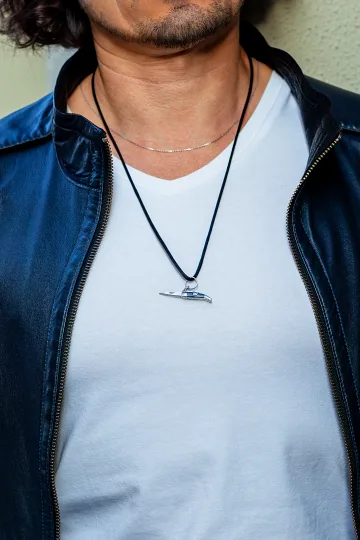
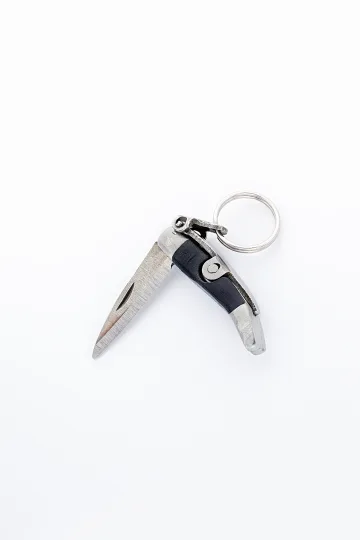
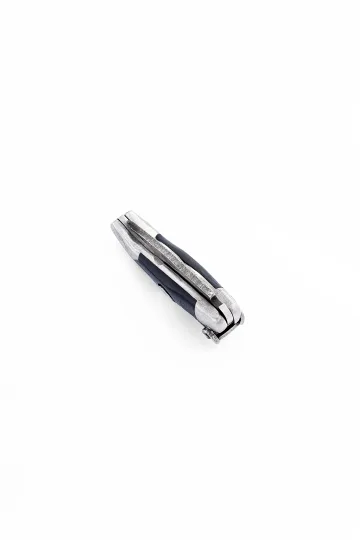
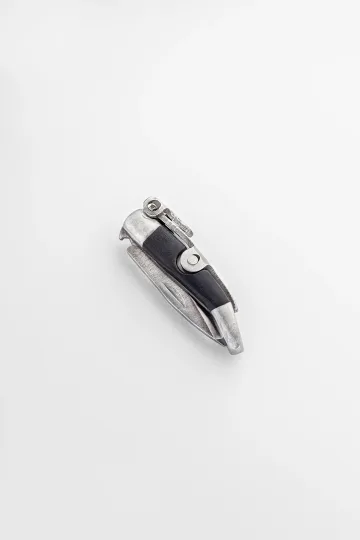
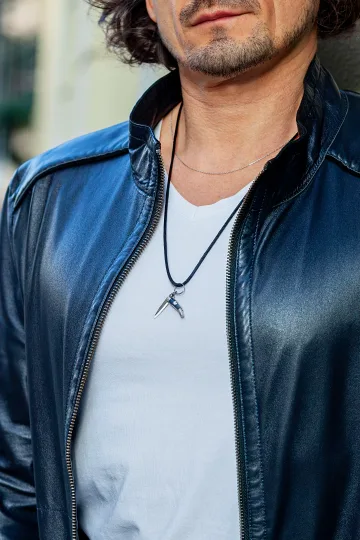
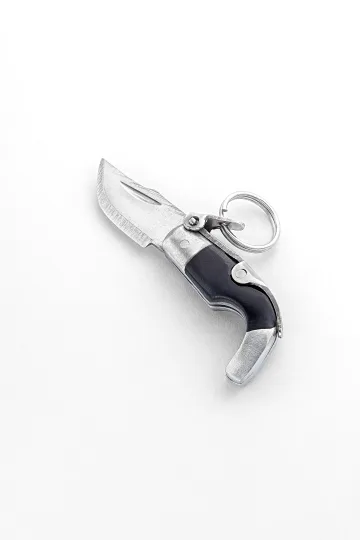
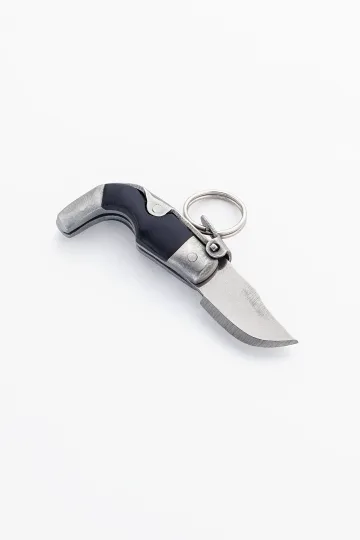
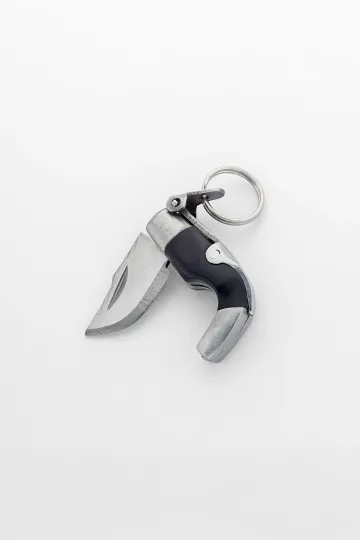
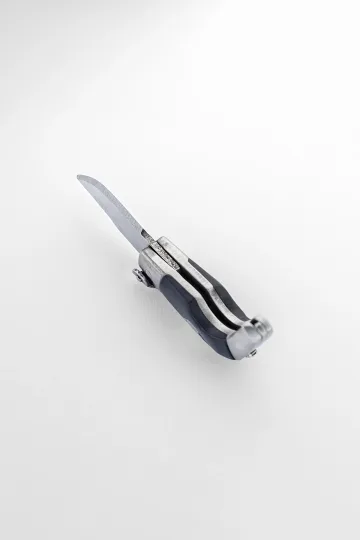
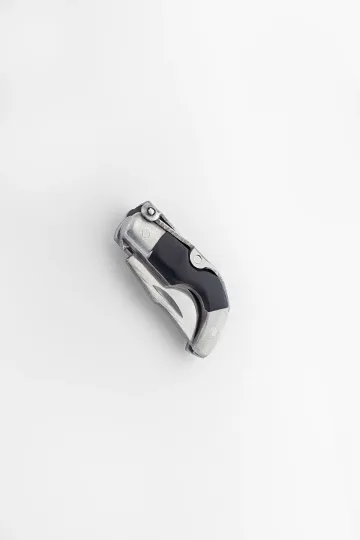
CAPAORA mini knife pendant
The 18th-century Spanish navaja in miniature: 40 mm of stainless steel, a real folding mechanism and a Palanquilla lock that clicks. An affordable gift to remember.
Authentic · Ships from Spain · 14-day returns
Symbolism of Sumerian Jewellery
Sumerian images were always legible. This was not abstract decoration but a precise language of signs, each connected to a specific deity, myth, or social function. For an educated resident of Ur, a piece of jewellery was an unfolded text.
The Rosette and the Eight-Petalled Flower
The principal symbol of Inanna, goddess of love, fertility, war, and the planet Venus, later Ishtar in the Akkadian tradition. The eight-petalled rosette appears everywhere: on diadems, pendants, inlays, cylinder seals, and temple walls. Eight petals correspond to the eight-pointed star, another sign of Inanna. This geometry functions simultaneously as a flower and a stellar body.
The Eight-Pointed Star
Often found alongside or overlaid on the rosette. This is the direct image of the planet Venus, which the Sumerians called Dilbat. The morning and evening star was linked to the duality of Inanna, warrior and beloved. The eight-pointed star became one of the longest-lived symbols of Mesopotamian culture, surviving the Sumerians and Babylonians and continuing through Assyrian seals into contemporary jewellery.
The Crescent
Symbol of Sin (also called Nanna), the moon god and patron deity of Ur. The crescent appears on Ur jewellery nearly as frequently as the rosette. Crescent earrings, pendants, and sceptre finials are all connected to the lunar cult. Sin was understood as a wise elder who counted out time and governed the night sky. To the inhabitants of Ur, he was their own chief god.
The Solar Disc
The sign of Utu (Shamash), the sun god and deity of justice. Often depicted as a disc with rays, or a disc within a winged rosette. Important as a symbol of law: in Sumerian tradition the sun sees and records all things, so the divine seal of a judge was precisely the solar disc.
The Bull
A motif of power. Associated with Enlil, the supreme god of wind and authority, but more broadly with all things pertaining to strength and fertility. Gold bull-heads adorned musical instruments (notably the famous lyre from the Royal Tombs), pendants, and mace finials. A bull with a lapis lazuli beard is among the most recognisable Sumerian images.
The Vine Cluster and Beech Leaves
Fertility and royal dignity. The beech wreath in Puabi's headdress symbolically unites the royal person with the plant world and the cycle of renewal. The vine did not grow on an industrial scale in Sumer, but as a symbol of fruitfulness and divine wine it was important.
Cylinder Seals
A universe unto themselves. A small carved cylinder of semi-precious stone (lapis, carnelian, chalcedony, agate) could be hung on a cord around the neck or mounted on a pin at a ring. Rolled across wet clay, it produced a continuous frieze impression. The compositions on seals are an encyclopaedia of Sumerian mythology: the hero-lion-fighter Gilgamesh, the god Enki with two streams of water flowing from his shoulders, scenes of feasting, battle, sacrifice, and mythological journeys.
Funerary Function
A significant portion of Sumerian jewellery was intended to accompany its owner into the afterlife. This links the Mesopotamian tradition to the Egyptian. In both cases an ornament did not only adorn the living but accompanied them after death. The parallel is worth bearing in mind when standing before either collection in a museum.
Leave your email, we'll send your discount code. No spam, unsubscribe anytime.
The code arrives by email, valid on your first order.
Techniques of the Sumerian Craftsmen
The technical repertoire of the Sumerian jeweller deserves close examination. Almost everything they could do by 2500 BC continues to be practised today, sometimes with minimal modification.
Granulation
The application of minute gold spheres, ranging from a fraction of a millimetre to two or three millimetres in diameter, to the surface of an object. The spheres are made by dripping molten gold onto charcoal or into water, then sorted by size. They are attached to the ground without solder by a process known as diffusion bonding: heated together with an organic binder, the gold particles and the ground surface fuse at their point of contact, leaving a clean join with no trace of solder.
Sumerian craftsmen had mastered granulation by around 2500 BC. Over the following millennia the technique spread to Egypt, Minoan Crete, and Etruria. By the end of Antiquity it had gradually been lost, and European goldsmiths into the twentieth century could not fully reproduce it. The revival is attributed to Wilhelm Elbert, the German craftsman who from the 1930s systematically studied Sumerian and Etruscan pieces under a microscope and reconstructed the original process. Contemporary granulation is built on his findings.
Filigree
The weaving of thin gold or silver wire into an open lattice ornament. Wire is drawn through a drawplate with a series of decreasing holes, then twisted, flattened, bent into scrolls, and soldered either to a base or assembled as a free-standing openwork structure. Sumerian pieces often combine filigree and granulation, with the spaces between the wire scrolls filled with small spheres.
Inlay
Stones and coloured materials are set into gold cloisons, cells bent from strip and soldered to a base. This is the direct ancestor of mediaeval cloisonne, which in Byzantium and among the Celts would acquire its name and status as an independent school, but was invented in Mesopotamia. The Sumerians inlaid lapis, carnelian, mother-of-pearl, red limestone, and bitumen to create polychrome compositions.
Stamping
A sheet of gold or electrum of sub-millimetre thickness was laid on a stone matrix with carved relief and pressed with a tool that transferred the pattern to the metal. This produced gold appliques for wooden vessels, overlays for diadems, and thin leaves for wreaths. Matrices of hard stone, sometimes bronze, allowed the same motif to be repeated in series.
Wire Chains
Sumerian chains are remarkable: craftsmen could braid gold wire into complex woven cords in which each link passes through several neighbours, creating a dense, flexible construction. Some types of such weave returned to jewellery practice only in the modern period.
Cylinder Seal Carving as a Separate Technique
Engraving on soft stone (serpentine, steatite) and later on hard stone (chalcedony, haematite, lapis) using copper and bronze gravers and abrasive powders. A craftsman would work on a cylinder roughly two centimetres in diameter and up to five centimetres tall, carving a miniature composition in intaglio. The quality of the impression depended directly on the carver's skill. The finest seals are works of miniature sculpture comparable to a Renaissance medal.
Assembly of Multi-Part Objects
Puabi's headdress is not one object but a construction of several dozen individual components: ribbons, leaves, floral rosettes, pendants. All of this was assembled on a foundation of wig or fabric. This modular logic makes Sumerian jewellery surprisingly versatile: an ornament could be assembled and disassembled, varied according to occasion.
Modern Jewellery in the Sumerian Manner
Interest in the Sumerian heritage in jewellery began with Woolley's publications in the 1930s and the first exhibitions of the Ur finds at the British Museum and in Philadelphia. The press at the time wrote about Queen Puabi and her headdress in roughly the same way it would write about Tutankhamun a decade later. The public discovered that a civilisation existed whose jewellery was no less impressive than Egypt's, and far less well known.
Art Deco took up the wave quickly. The geometry of the rosette, the eight-pointed star, and the solar disc sat naturally within the stylistic language of the 1920s and 1930s. Jewellery in the lapis-carnelian-gold palette with clear geometric motifs appeared from Parisian and New York houses. Direct Sumerian replicas were rare, but the visual vocabulary of Ur entered the general arsenal of the era.
A second wave came in the 1960s and 1970s with the vogue for ethnic, archaeological, and museum-inspired jewellery. Silver replicas of Sumerian necklaces became a visible part of the craft market in Europe and North America. They were often made not by jewellers in the narrow sense but by artist-ethnographers working with texture and form without strict academic fidelity.
Contemporary Sumerian-influenced jewellery divides into three directions.
Precise museum replicas: expensive one-off pieces reproducing originals with high fidelity. Such objects are commissioned by university museums, cultural foundations, and private collectors. A replica of Puabi's diadem assembled by hand with genuine granulation, lapis lazuli from Afghan Sar-i-Sang, and carnelian may occupy a workshop for several months.
Free interpretations using Sumerian techniques and motifs in a contemporary form. This is no longer a replica but an original work: the jeweller takes granulation, filigree, or inlay and uses them to make something new, recognisably Sumerian in spirit but contemporary in proportion and function. Such pieces live in everyday wear without demanding a formal occasion.
Individual Sumerian motifs in minimalist jewellery. The eight-pointed star as the sole element of a pendant. The rosette of Inanna on a ring. The crescent of Sin in simply shaped earrings. This approach makes Sumerian aesthetics accessible without overloading an outfit.
A growing fourth direction is the laser engraving of Sumerian cuneiform on polished surfaces: a short quotation from the Gilgamesh epic, a name in Sumerian transliteration, a dedication in cuneiform. This functions as a deep and unusual accent.
Send a friend a discount code, they save on their first order.
Materials and Techniques Today
Contemporary Sumerian jewellery almost never uses pure high-carat gold as its primary material. Originals were made in twenty-two carats and above, but today this belongs to rare bespoke commissions. The principal material of replicas and interpretations is sterling silver. In many cases it is gold-plated silver: vermeil, with a layer of gold several microns thick, giving a warm golden tone to the surface at a more accessible price point.
For the sensation of a genuinely warm yellow tone, craftsmen sometimes use copper-gold alloys. Some makers work in plain silver without gilding, allowing it to patinate deliberately: Sumerian aesthetics in silver acquire a noble antique character that has its own appeal.
Lapis lazuli is still mined in Afghanistan, at the same Sar-i-Sang. The stone reaches jewellers through intermediaries in Peshawar or directly from Kabul. High-quality Afghan lapis with its dense blue tone and gold-flecked pyrite inclusions is the foundation of any serious contemporary Sumerian piece. Alternatives (Chilean lapis, Siberian lapis) are used less and yield lower colour intensity.
Carnelian today is available from several sources: India (including the historically Harappan Gujarat region), Brazil, and Madagascar. Quality Indian carnelian in density and colour is close to the ancient material, making replicas visually accurate.
Granulation and filigree are executed by hand following traditional methods. The craftsman prepares gold or silver spheres, sorts them by size, places them on the surface of the base, and bonds them through heat. This is slow work; each centimetre of finished granulated surface requires hours. This is why pieces with genuine granulation cost substantially more than stamped imitations.
Inlay is done by hand: a cell of the required shape is bent from strip, soldered to the base, the stone is placed inside, and the edge is carefully burnished over it. Precise inlay is among the most technically demanding operations in hand jewellery work.
Laser engraving of cuneiform is a relatively recent option. It does not replace traditional techniques but allows a subtle textual accent to be added: a name, a short quotation, an ideographic sign. At Zevira we use engraving sparingly, only where it does not compete with the decorative geometry of the primary motif.
Silver, gold, symbolic motifs, paired sets. Inanna rosettes, crescent pendants, Mesopotamian-inspired pieces.
Who Is This For
Sumerian aesthetics speaks to a particular kind of person. It is not a universal jewellery language, and that is its strength.
Enthusiasts of ancient civilisations. Those who have read Samuel Noah Kramer, Thorkild Jacobsen, or translations of the Gilgamesh epic, who have visited the British Museum and stood for a long time before the Standard of Ur. Such a piece is a personal emblem of belonging to a certain circle of readers and interests.
Archaeologists, Assyriologists, students of ancient history. A professional gift for a colleague, a supervisor, or a graduate of an ancient history department: a reliable choice.
Collectors of ethnic and museum jewellery. Those who already have Tuareg silver, South Indian garnets, or Turkish filigree in their collections, the Sumerian layer fits naturally.
Museum visitors and travellers. Ur is in Iraq today, and direct access is limited for understandable reasons, but Sumerian collections exist at the British Museum in London, the Louvre in Paris, the Penn Museum in Philadelphia, the Pergamon Museum in Berlin, and the Iraq Museum in Baghdad. A piece with a Sumerian motif after visiting one of these collections is a living memory of the encounter with an artefact.
Readers of mythological and epic literature. The Gilgamesh epic, the Enuma Elish, the myth of Inanna's descent: all of these live in contemporary culture as a constant background. A pendant with the rosette of Inanna or the eight-pointed star of Ishtar becomes a material continuation of what has been read.
Women for whom the archetype of the queen or the priestess matters. The image of Puabi, the image of Inanna-Ishtar in her power and complexity, is not merely history. It is a working psychological model of feminine strength, dignity, sensuality, and authority simultaneously. To wear jewellery in the Sumerian aesthetic is to invoke that archetype.
A gift for a historian, archaeologist, art historian, teacher of ancient history, or specialist in Near Eastern studies. A meaningful, considered, and well-aimed choice.
Sumerian aesthetics will not suit those looking for light everyday decoration without historical weight. Sumer is always substantial: even in minimalist interpretations it carries five thousand years of cultural gravity. For a strictly contemporary office environment or pure minimalism without historical reference, it may read as too dense a language. In that case it makes sense to limit oneself to a single accent element (a pendant with the eight-pointed star, a ring with a rosette, crescent earrings) while keeping the rest of the look neutral.
Frequently Asked Questions
Is it true that servants were buried alive with Queen Puabi?
Yes, this is confirmed by the scientific evidence. In tomb PG 800 and adjacent royal burials at Ur, Woolley found the bodies of dozens of attendants: guards, court women, grooms. Twenty-first-century CT scanning of the skulls revealed evidence of blows to the temple with a blunt implement. The attendants appear to have been sedated with a preparation and then killed before being arranged in burial positions. By today's standards this is barbarism, but in the context of the Early Bronze Age it was part of royal ritual and is attested in other cultures of the period from China to North Africa.
Can one buy a genuine Sumerian artefact?
Practically not. Authentic pieces from the Royal Tombs of Ur are museum property with catalogue numbers at the British Museum, the Penn Museum, and the Iraq Museum. Any piece offered on the private market as an original Sumerian artefact is almost certainly either a quality replica or an illegally removed object, often connected to the looting of the Iraq Museum in April 2003. Such purchases are best avoided on ethical grounds: the market for illicit artefacts fuels the looting of archaeological sites across the Middle East.
Why was lapis lazuli so important to the Sumerians?
Three reasons. First, colour: in Sumerian mythology the blue of lapis was the sky where the gods lived, and the hair of the goddess Inanna. Second, status: the stone was mined only in Afghan Badakhshan, two and a half thousand kilometres from Ur, and its supply required a complex trading network, making it simultaneously rare and costly. Third, material quality: lapis is dense, heavy, and satisfying to handle, with characteristic gold-flecked pyrite inclusions, and the Sumerians valued this physical weight.
How does one distinguish genuine granulation from a stamped imitation?
Genuine granulation consists of individual spherical beads bonded one by one to the surface. Under magnification, each bead is a perfect sphere with its own shadow and a point of contact with the ground. A stamped imitation produces a flat relief with pseudo-spheres that are part of the metal sheet itself, without true three-dimensional form. To the touch, genuine granulation is textured and raised; a stamp is smooth with gentle undulations.
What are the main Sumerian motifs used in jewellery today?
The eight-pointed star of Ishtar (Inanna), the eight-petalled rosette, the crescent of the moon god Sin, the solar disc of Shamash, and the bull's head associated with Enlil and divine power. Cylinder seal compositions, particularly the lion-fighting Gilgamesh, also appear as engravings on modern pieces. The gold-lapis-carnelian colour triad translates into contemporary work through the choice of stones.
Do Sumerian motifs work for men?
Yes, and arguably better than many other historical jewellery traditions. Sumer was a culture with gender-equal attitudes towards ornament: the kings of Ur wore as much gold as the queens. For a masculine wardrobe, cylinder seals on a cord, signet rings with carved motifs, pendants depicting Gilgamesh wrestling a lion (one of the most emphatically masculine images in world iconography), wide granulated cuffs, and bull-head pendants all work well. Sumerian men's jewellery reads naturally with a shirt, a jacket, or a plain sweater.
What does the eight-pointed star mean on Sumerian jewellery?
The eight-pointed star is the emblem of Inanna, known to the Akkadians as Ishtar, goddess of love, fertility, and war, and it is one of the oldest divine signs we can read with confidence. The star stands for the planet Venus, which Inanna embodied, and which appears in the sky as both the morning and the evening star. That double appearance is why the goddess herself carries a double nature, tender and violent by turns. On cylinder seals the star marks her presence in a scene; on jewellery it functioned as a sign of protection and of the wearer's alignment with her.
Do not confuse it with the eight-petalled rosette, which sits alongside it in the same iconography and is often mistaken for the same symbol. The rosette is a flower form, rounded petals radiating from a centre, associated with fertility and with the divine in a general sense. The star is angular, made of points rather than petals, and belongs specifically to Inanna. Both appear on the ornaments from the Royal Cemetery at Ur, sometimes on the same object, and the visual difference is easy to see once you know to look for it.
How do you care for jewellery with lapis lazuli and carnelian?
Both stones are more fragile than they look, and both dislike the things people habitually clean jewellery with. Lapis is a rock rather than a single mineral, relatively soft at around 5 to 6 on the Mohs scale, and porous. Ultrasonic cleaners can shake it loose from a setting, steam cleaners can damage it outright, and household detergents, perfume, hairspray and chlorinated water will dull the surface over time. Many lapis pieces are also wax or resin treated to deepen the colour, and solvents strip that treatment.
The routine that works is dull and effective: a soft cloth, lukewarm water, a drop of plain soap if genuinely needed, and immediate drying. Carnelian is harder, around 7, and tolerates handling better, but it fades under prolonged strong sunlight, so a windowsill is a poor place to leave a piece. Store both away from harder stones that will scratch them, ideally in a soft pouch rather than loose in a box. In hard water areas, and much of southern and eastern Britain qualifies, rinse in cooled boiled or filtered water rather than straight from the tap, since limescale leaves a film in the pores of lapis that is tedious to remove.
How does Sumerian jewellery differ from Egyptian?
The two traditions overlap in time and share a taste for gold, but they read very differently. Sumerian work is built on volume and mass: heavy gold leaves, thick strung ropes of beads, granulation in dense fields, headdresses that pile ornament on ornament. The colour scheme is a tight triad of gold, deep blue lapis, and orange-red carnelian, and it repeats with remarkable consistency across the Ur finds. Symbolism is astral and divine, centred on stars, crescents, discs and bulls.
Egyptian work is flatter, more graphic, and more strictly composed. Cloisonné inlay dominates, with cells of gold filled by turquoise, faience and carnelian to produce clean fields of colour. The palette is broader and brighter, with turquoise and green playing a large part that lapis alone plays in Sumer. Egyptian symbolism leans towards the afterlife and protection: the scarab, the ankh, the eye of Horus, the winged sun. In practical terms, if a piece looks like a mosaic laid flat, it is drawing on Egypt; if it looks like a mass of gold and beads with texture you want to run a thumb over, it is drawing on Ur. Both collections can be compared in a single afternoon in the galleries of the British Museum, which is the fastest way to see the difference for yourself.
Can you wear Sumerian jewellery every day?
Yes, provided the format is chosen for the life you actually lead. The reconstructions of Puabi's full headdress are exhibition pieces and behave like exhibition pieces: heavy, fragile at the joints, and demanding of the person wearing them. What works daily is the smaller vocabulary drawn from the same source. A single rosette pendant on a fine chain, a pair of gold leaf earrings, a slim granulated band, a cylinder seal worn as a pendant on a cord, a carnelian and lapis bead strand at wrist length.
The practical constraints are the stones rather than the metal. Lapis chips against desks, door frames, and car keys, so a ring set with it is a poor everyday choice while a pendant is a good one. Strung bead pieces need restringing every few years, sooner if worn constantly, and a broken string in a supermarket is an unhappy experience. Granulated surfaces trap skin oils and hand cream and need an occasional soft brush. None of this is onerous, and it is very much less trouble than the original wearers went to.
Which cuneiform inscription should you choose for an engraving?
Start by deciding whether you want Sumerian or Akkadian, because they are different languages written in the same script, and a text that reads correctly in one is nonsense in the other. Sumerian is the older and the language of the city states; Akkadian is Semitic and later. Most short engravings offered commercially are actually Akkadian, and a seller who cannot tell you which is being used is a seller to avoid.
The safest choices are the ones that existed as real formulae. Personal names written in the standard way, short dedications of the votive type ("for the life of", followed by a name), or a single well attested sign such as the star of Inanna. What does not work is transliterating a modern English sentence sign by sign, which produces something that looks like cuneiform and means nothing, in the same way that spelling an English word with Greek letters is not Greek. If the inscription matters to you, ask for the transliteration and the translation in writing, and if possible have it checked by someone who reads the script; British universities with Assyriology departments are frequently willing to answer a short query of this kind.
Buying it as a gift? Each one arrives ready to give.
 A branded Zevira box and a little card come with every order.





About Zevira
Zevira is a Spanish jewellery brand from Albacete. The historical-archaeological line with Sumerian motifs is one category within the catalogue. Current availability and full details are in the catalogue.