Sun and Moon Jewellery: The Meaning of a Dual Symbol
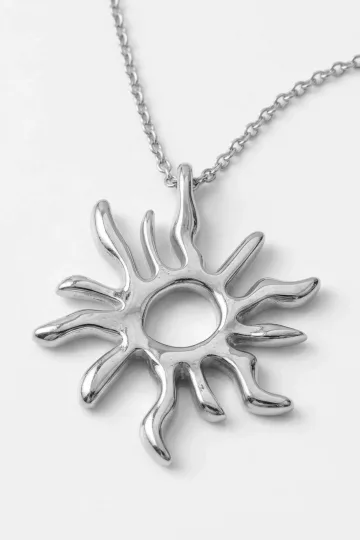
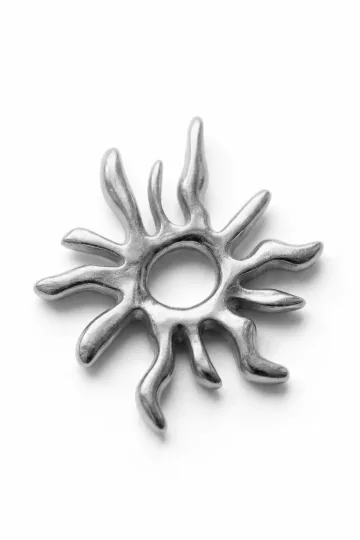
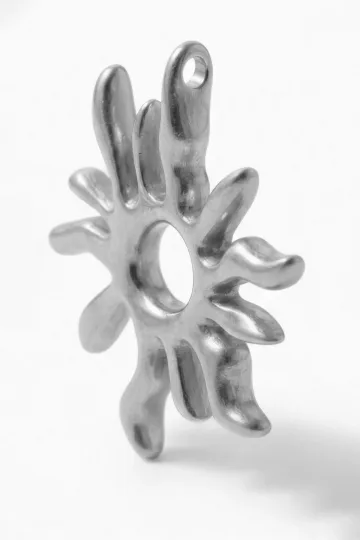
Wear the symbol, don't just read about it. These are in stock:
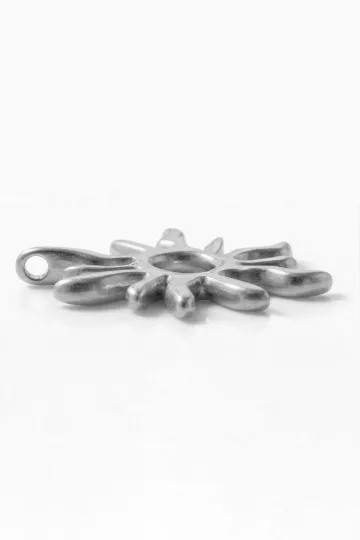
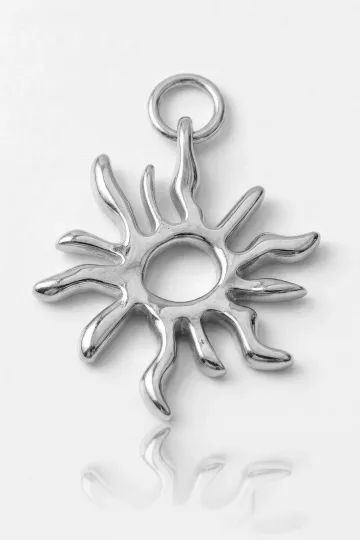
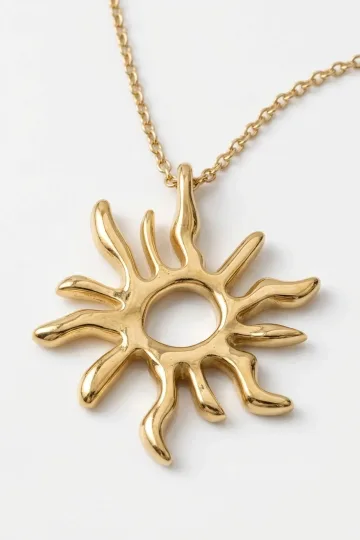
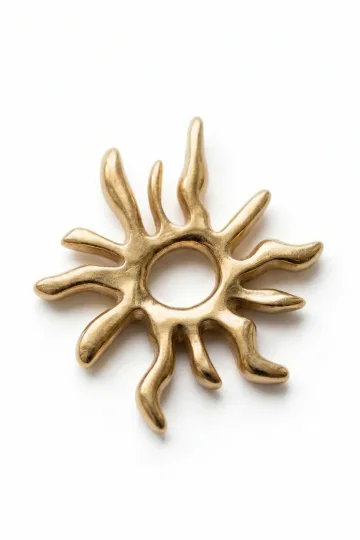
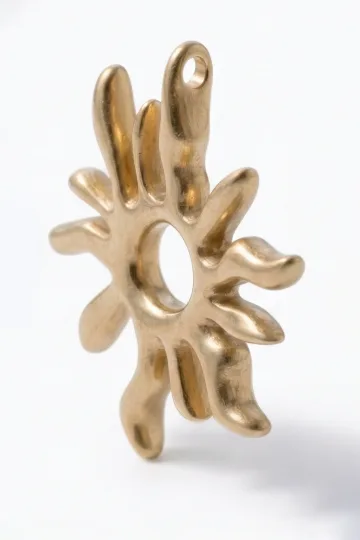
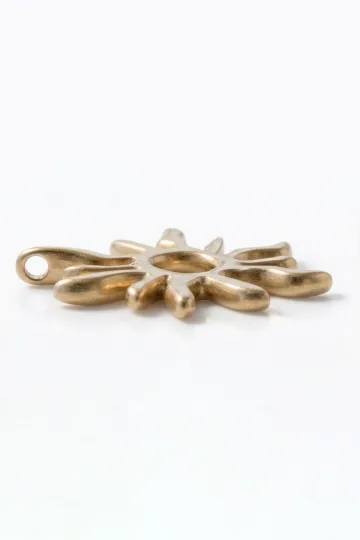
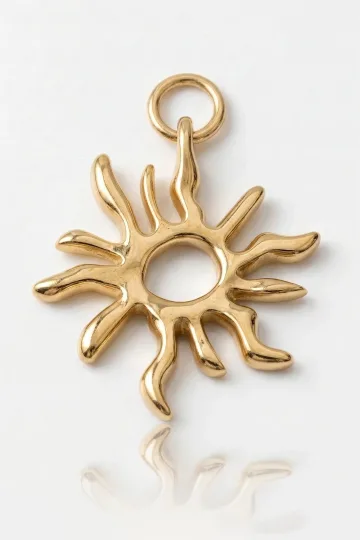
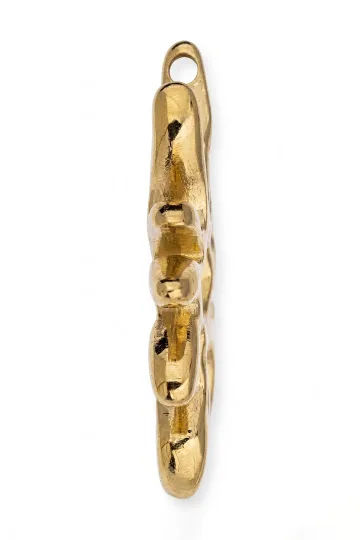
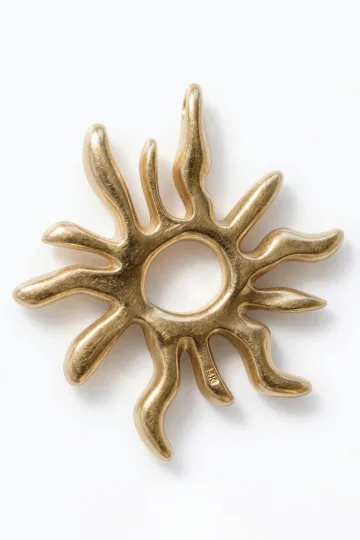
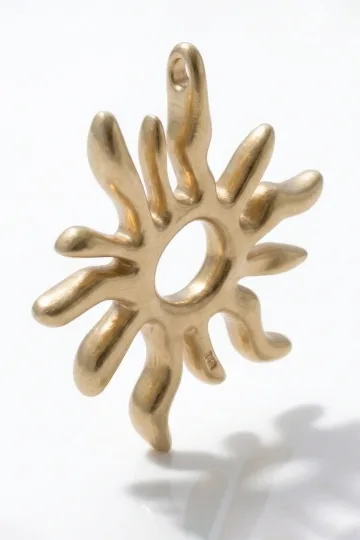

Gold and Silver in One Set
In medieval alchemy, every metal was assigned to a celestial body. The sun, marked ☉, corresponded to gold. The moon, marked ☽, corresponded to silver. When a goldsmith crafted a sun pendant in gold and a moon pendant in silver, this was not mere aesthetics: it was an alchemical code inscribed in metal.
Few people know that connection today, yet jewellery pairing sun and moon in two metals still looks exactly right. Because it is exactly right. The eye recognises the truth of the pairing even when the mind does not know its history.
The sun-and-moon pair works in jewellery precisely because it rests on several foundations at once: alchemy, mythology, astrology, folklore, visual harmony, and astronomy. This is not simply a pretty design. It is an archetypal pairing woven into human consciousness over millennia. No other symbolic duo carries such depth across so many traditions simultaneously.
This article examines the pairing in full: from Sumerian tablets to contemporary eclipse pendants, from the astrological birth chart to the practical question of who this gift suits best.
Sun and Moon Jewellery: What to Choose
The format of the piece determines how the symbol reads. The same sun-and-moon pairing looks entirely different depending on where and how the motif is placed.
Pendant with Both Symbols on One Piece
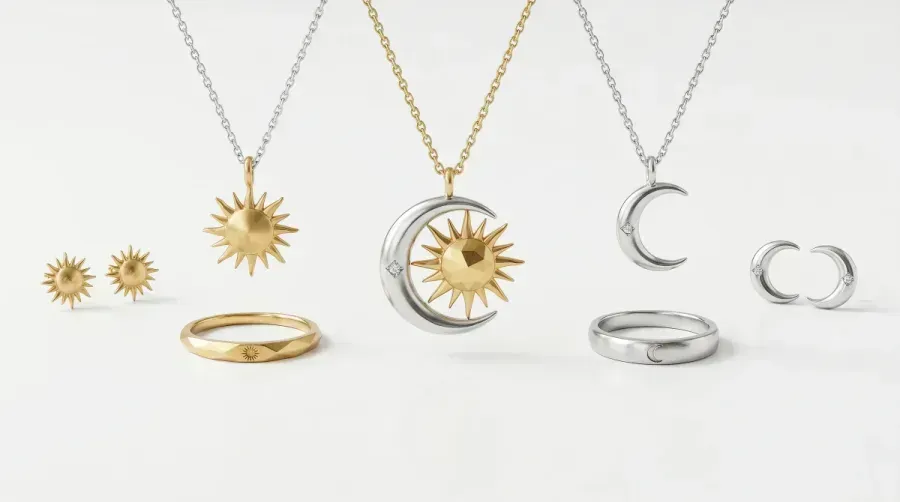
The most popular format. Sun and moon share a single pendant: typically the solar disc to the right or above, the crescent to the left or below, sometimes embracing each other. Worn on one chain. This is a single symbol of the unity of opposites, speaking of wholeness rather than of two people.
It suits those who wear jewellery for themselves, as a reminder of balance. It also works as a gift to one person carrying the message: "there is both light and stillness in you."
Paired Pendants: Sun for One, Moon for the Other
The classic format for two people. One person wears the sun, the other the moon. Each pendant is complete on its own, yet together they form a whole image. In this format the jewellery says: we complete each other.
The metal reinforces the idea: the solar pendant naturally works in gold or gold-plated silver, the lunar pendant in sterling silver 925. The pair then carries the alchemical code described above, even if those who wear it are unaware of its history.
More on the format of split-half pendants, their history and logic: paired split jewellery.
Asymmetric Earrings
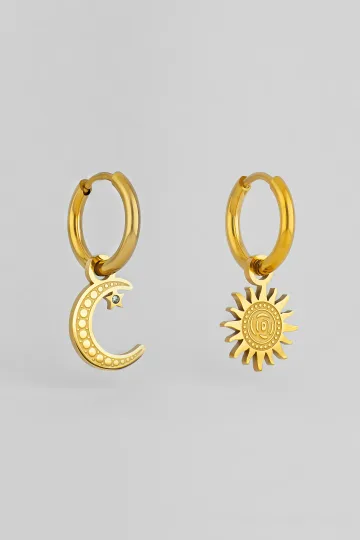
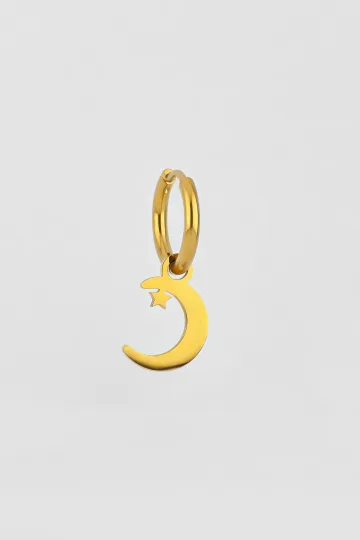
One earring carries the sun, the other the moon. The format is growing in popularity precisely because asymmetry has moved from mistake to deliberate choice. The pair works as a single statement while each ear carries its own symbol. On wearing asymmetric earrings and how to style them: asymmetric earrings.
Ring with Two Motifs
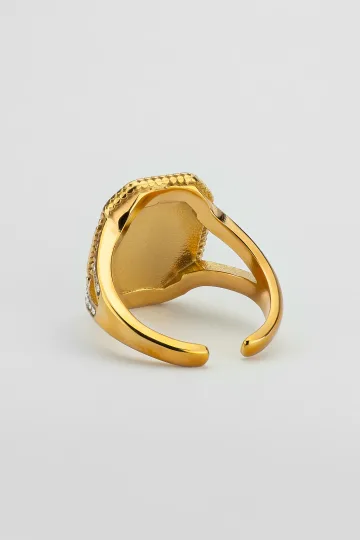
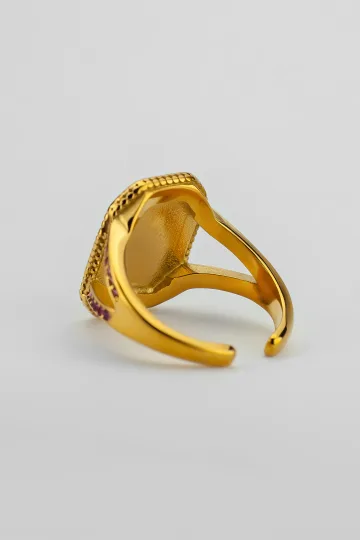
Sun and moon on one ring: usually as relief work on the band or two motifs flanking a central stone. A compact option for those who prefer jewellery on the hand rather than the neck.
Variation: paired rings, one carrying the sun, one the moon. Worn on the same hand or on both.
Eclipse Pendant
One of the strongest visual motifs in contemporary jewellery design. The solar disc and the lunar disc overlap, as they do during a total eclipse. Sometimes a corona extends beyond the edge of the dark disc; sometimes a thin crescent remains visible. A rare and memorable image.
With stones: moonstone inside the lunar disc, citrine or yellow sapphire inside the solar disc. This is both visually precise and symbolically consistent.
Charm Bracelet
A chain bracelet with two charms: sun and moon. A lighter, more playful format than a pendant, less monumental. Works well in layered combinations with other bracelets.
The moon wears silver, the sun wears gold, and never the other way round. A gold-plated crescent at a black-tie dinner I will spot before you sit down.
What to Wear Sun and Moon With
Over years of styling shoots I have put the sun-and-moon pair through dozens of looks and occasions. Here is what actually works, sorted by the moment.
What do I wear sun and moon with every day? For daytime I recommend a minimalist outline: a fine crescent or a small solar circle on a 40-45 cm chain. It sits at the collarbone and lives happily with knitwear, a shirt, or a rollneck. A light top lifts silver; warm cream and ochre agree with gold. I suggest keeping a single pendant that holds both symbols as the only accent, and the look assembles itself.
Does the symbol belong at the office? It does, if you keep it restrained. I choose silver or matte gold plating and a 45-50 cm length so the pendant slips under the top button. Under a jacket the sun and moon read as a quiet detail rather than a loud gesture. A strict dress code is no verdict: the symbol is there, the noise is not.
How do I build an evening look? For evening I suggest an open neckline and a longer chain, 50-55 cm, so the pendant falls deeper and reads from across the room. Stones come alive here: moonstone with its cool glow and citrine with its warm yellow catch the light. For a special occasion I choose an eclipse pendant or a paired set in two metals.
How do two people wear the pair? For two I recommend splitting the metals: a gold sun for one, a silver moon for the other. Keep the chains the same length, and the two pieces read as one even when the wearers simply stand side by side. This works not only for couples but for sisters, friends, a mother and daughter.
Who does this pair suit? Those who like meaning in a piece rather than shine alone. Two rules that never fail. First, do not run two strong sun-and-moon accents at once, they argue; keep the second symbol neutral. Second, if you are unsure where to start, take silver and a single outline symbol, you can always add a layer later.

Turn on your camera, pick earrings, a pendant or a ring, and see the piece on yourself in real time.
Switch items in one tap.
Everything runs in your browser: no photo or video is ever uploaded.
Types of Sun and Moon in Jewellery
The sun and moon as symbols have many visual versions, and the choice of form changes the character of the piece.
Minimalist Outline
A fine line forming a solar circle or lunar crescent. No detail. The symbol works through purity of form. Suitable for everyday wear, pairs with any wardrobe. In this version the piece speaks without raising its voice.
Sun with Needle Rays
A disc with thin straight rays radiating outward. Recalls the Japanese flag or Aztec coinage. A decisive, slightly ceremonial option. Depending on the length and number of rays, it can read as a mandala or as a compass rose.
Anthropomorphic Sun: The Face
A solar disc with eyes, nose, and mouth. One of the oldest iconographic types: the sun face appears in pre-Columbian American art, the Renaissance, the Baroque, and folk craft the world over. In jewellery it adds warmth and personality. The sun with a face smiles.
Crescent with a Face
A crescent moon in profile with fine facial features. Another ancient type. Worn as a standalone symbol or paired with the solar face. Together they create the sense of characters rather than pure geometry.
Sun and Moon with Stones
The most natural combination: moonstone in the lunar symbol, a yellow stone (citrine, yellow topaz, sapphire, amber) in the solar symbol. This is not mere decoration; it is mineralogical logic. The moonstone is named after the moon for its blue-white glow. Citrine and amber carry the colour of sunlight.
A diamond in a solar symbol signals a special occasion: a wedding ring with a sun halo, or an anniversary gift.
Customer reviews
Zevira is a real jewellery shop. Genuine payments, deliveries and customer thank-yous.
🥰🥰🥰 gracias

Ok, ¡gracias! 🙂

History of the Symbol
The Earliest Images: Petroglyphs and Tablets
Solar and lunar discs appear in rock art long before any written tradition. People drew a circle with rays and a crescent virtually everywhere they left marks on stone. Both symbols are intuitively clear: one shines by day, the other by night, and both govern time.
In Sumerian cuneiform, the god Utu (Sun) and the god Nanna (Moon) are among the first recorded deities. Sumerian cylinder seals dated to the third millennium BC depict the solar disc and crescent as celestial emblems. These are among the oldest known examples of symbols in a decorative-applied context.
Egypt: Ra and Thoth
In the Egyptian system, Ra, the solar deity, holds the central position in the pantheon. His barque crosses the sky by day and the underworld by night, and this cycle is reproduced in countless jewels of the pharaonic era: the solar disc with uraeus, the scarab rolling the sun disc.
The moon in Egyptian tradition is associated with Thoth, god of wisdom, writing, and reckoning, and with Khonsu, the lunar deity. An interesting detail: the moon in Egypt was often masculine rather than feminine. This breaks the modern assumption that the moon is always female.
The pairing of solar disc and lunar crescent appears on Egyptian amulets and necklaces, worn as a symbol of complete celestial protection: day and night, both luminaries on the side of the wearer.
Greece: Helios and Selene, then Apollo and Artemis
The Greek pantheon gave this pairing a particular beauty: it became a sibling pair. The first version, Helios (Sun) and Selene (Moon), a brother and sister who relieve each other daily on the celestial stage. The second, later version: Apollo and Artemis, twins. Apollo becomes the deity of sunlight; Artemis the mistress of the moon and of the hunt.
The twin pairing is especially important for jewellery symbolism: it transforms a set of two pieces into something beyond a mere duo. It is a single origin that has taken two paths. Those who wear paired sun-and-moon pendants unknowingly reproduce one of the oldest images in Greek mythology.
Related material on the astrological aspect of the subject: lunar phases in jewellery.
Medieval Alchemy: A Pivotal Moment for Jewellery
It was alchemy that created the direct connection between symbol and material that makes sun-and-moon jewellery such a legible idea.
In the alchemical tradition, which reached its height between the twelfth and sixteenth centuries, each metal corresponded to a celestial body. Gold was the metal of the Sun: the same colour, the same association with life and warmth, the same supreme value. Silver was the metal of the Moon: the same cool lustre, the same mutability, the same reflective quality.
Alchemists denoted gold with the sign of the Sun (☉) and silver with the sign of the Moon (☽) in their treatises. When a jeweller today makes a paired set with a gold sun and a silver moon, the alchemical code being reproduced is seven or eight centuries old.
Isaac Newton, who died in 1727, left behind thousands of pages of alchemical notes in which the solar-lunar metal pairing features repeatedly. His hermeticism reminds us that this tradition was not fringe thinking but occupied the finest minds of its age.
This is not esotericism. It is the history of materials science and symbolism. And it is beautiful in practical terms: the nature of the metals themselves suggests what to do. Gold for the sun. Silver for the moon. A simple and convincing rule.
More on bimetallic jewellery and mixing two metals: two-metal jewellery guide.
The Renaissance and Astronomical Jewellery
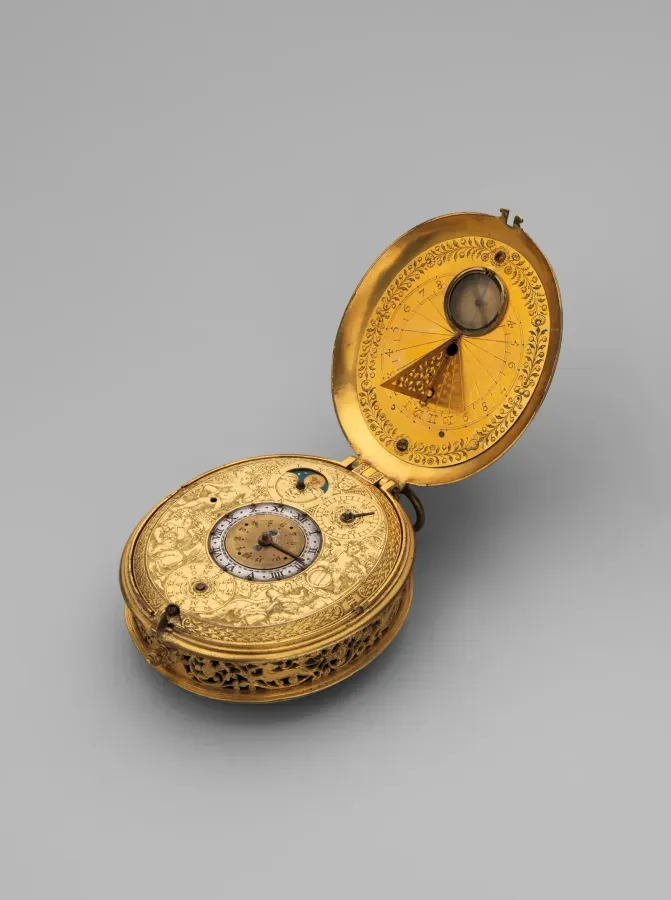
In the sixteenth and seventeenth centuries, against the backdrop of the scientific revolution, celestial symbols gained a new dimension. Jewellery began depicting armillary spheres, astrolabes, and solar systems. Sun and moon ceased to be mythology alone and became astronomy as well.
At the same time astrology flourished, and jewellery with planetary symbols became personalised objects: the wearer wanted to carry the symbol of their ruling luminary.
British Folklore and Seasonal Festivals
In British folk tradition the solar and lunar cycle is marked by the great seasonal gatherings. Lughnasadh in August and Mabon at the autumn equinox are points where the waning of the sun and the growing prominence of the moon are observed together. Folk craft produced rings, brooches, and pendants in which the solar wheel and the lunar crescent appear side by side, a pairing reflecting the turning year rather than any single moment within it.
The Twentieth Century and Today
In the 1970s, alongside renewed interest in astrology and what became known as the New Age, solar and lunar symbolism returned to mainstream jewellery. In 2017, following the total solar eclipse that crossed North America, eclipse motifs in jewellery received a fresh impulse. The visual image of two overlapping discs became a direction in its own right.
Today the sun-and-moon pairing holds a stable place in jewellery collections, connecting astrological, mythological, and aesthetic audiences through a single symbol.
Upload a photo of your pet, someone you love, or an object. We'll build a 3D model and hand-cast it in pewter.




Sun and Moon Across Cultures
Ancient Near East: Utu and Nanna
The earliest recorded names for solar and lunar deities come from Sumer. On cylinder seals and votive plaques from the third millennium BC, the solar disc and crescent stand together as markers of divine authority. The pairing was not decorative invention but cosmological fact: two celestial powers, one for day and one for night, whose joint presence meant complete protection.
Egypt: Full Celestial Patronage
The Egyptians sought the favour of all celestial forces, so combining solar and lunar symbols on one amulet was close to the norm. Amulets bearing the Eye of Ra (solar symbol) together with the lunar crescent of Thoth were worn for protection in daylight as well as after dark.
An important detail for jewellery: Egyptian craftsmen combined gold (the metal of the sun) and electrum, a natural alloy of gold and silver, in single pieces. This alchemical pairing was being hammered in Memphis workshops millennia before alchemists wrote the rule down.
Greece and Rome: From Myth to Astrology
Through the Graeco-Roman tradition, sun and moon acquired archetypally stable characteristics: Apollo-Sun carries light, order, foresight, and the arts. Artemis-Diana-Moon carries independence, the hunt, the night, and changeability.
These attributes passed into astrology, where the Sun represents personality, the self, and vital force, while the Moon represents emotion, the unconscious, and cyclical rhythm. A piece of jewellery carrying both luminaries becomes a symbol of a complete person: rational and intuitive together.
The Maya and Aztecs: Central Forces of the Calendar
In pre-Columbian Mesoamerica the sun held the central position in cosmology. The Aztec Sun Stone (commonly called the Aztec Calendar) is not merely a beautiful artefact: it is a sophisticated time-reckoning system with the face of the solar deity Tonatiuh at its centre.
The Maya had a moon goddess, Ix Chel, patroness of weaving, medicine, and fertility. In Maya tradition, sun and moon were connected as brother and sister, or as husband and wife, depending on the mythological version.
In contemporary jewellery collections, Mesoamerican iconography of the solar face with its features and flame-rays has become one of the most recognisable types of sun jewellery.
The Celts: Wheel and Crescent
Celtic tradition knew the solar wheel with spokes as its primary solar symbol. The lunar crescent appears on Celtic coins and metalwork. A characteristic of Celtic iconography: both symbols often interweave with endless knotwork patterns. Related symbolic territory: the infinity symbol in jewellery.
British and Northern European Folk Tradition
In British Isles folk craft, the solar wheel and the lunar crescent appear together on embroidered pieces, carved furniture, and in the designs of vernacular brooches. The wheel cross, known across northern Europe, carried the same solar association. The pairing of wheel and crescent in folk metalwork was practical magic: both emblems together meant protection through every hour of day and night.
China and Yin-Yang: A Conceptual Parallel
The yin-yang symbol is not a literal depiction of sun and moon, but it carries the same philosophical idea: two principles, light and dark, mutually conditioning and flowing into each other, forming a single whole. More on the symbol: yin-yang in jewellery.
The difference in emphasis: yin-yang is about equilibrium and interpenetration. Sun-and-moon is about cycle and return. One speaks of balance at every moment; the other of movement and coming back.
CAPAORA mini knife pendant
The 18th-century Spanish navaja in miniature: 40 mm of stainless steel, a real folding mechanism and a Palanquilla lock that clicks. An affordable gift to remember.
Authentic · Ships from Spain · 14-day returns
The Symbolism of the Pair
Day and Night: Fundamental Polarity
The sun shines by day. The moon illuminates the night. Together the pair covers all time. In this most basic reading, jewellery carrying both luminaries says: I am with you always, in the bright day and in the dark night.
Union of Opposites
The sun-and-moon pairing carries an idea that can be described differently depending on the tradition. Alchemists called the joining of sun and moon the "conjunctio," the supreme goal of the work: gold and silver fused into one. The analytical psychologist Carl Jung used the image of the solar-lunar conjunction as a symbol of the reconciliation of the conscious and the unconscious in a person, not because Jung invented the image, but because he described what had long been present in culture.
As a cultural frame this is useful: the wearer of a piece carrying both luminaries can understand it as a reminder that there is both a daylight side and a night side in a person, and that both matter.
Masculine and Feminine
In most traditions (Greek, Romance, Germanic, Indic) the sun has masculine grammatical gender or is associated with a male deity, while the moon is feminine or associated with a goddess. This is why paired sun-and-moon jewellery is often distributed so that the sun is worn by the man and the moon by the woman.
But this is only one tradition, not a rule. In Egyptian, Semitic, and some Polynesian traditions the moon is masculine. In Japanese mythology the sun goddess Amaterasu is feminine. A sun jewel is beautiful on a woman; a moon jewel is beautiful on a man.
Cycle and Return
The sun rises and sets every day. The moon completes its full cycle each month. Both symbols carry the idea not of ending but of cyclical return: the day's end does not mean the sun disappears; it means the sun is travelling and will return. This makes the pair particularly suited to anniversaries and celebrations: we have completed a full cycle and come back.
Balance as a Principle of Living
The pair works as a jewellery reminder. In intensive periods when life is all action and output (solar mode), or conversely all retreat and inward turning (lunar mode), the symbol of two luminaries says: find both.
The Eclipse as a Special Meeting
The eclipse in jewellery symbolism deserves separate attention. When the moon covers the sun or when the earth casts its shadow on the moon, two luminaries arrive at a rare and precise alignment. In traditional cultures eclipses were events of particular significance: seen as either a warning, a sign of transition, or the moment when two forces meet face to face.
The eclipse motif entered mainstream jewellery after 2017, when the total solar eclipse over North America attracted unprecedented attention. The visual image of two overlapping discs proved so powerful that it spread from scientific illustration into jewellery design.
An eclipse pendant, in which the lunar disc partially covers the solar disc, carries the idea of a meeting rather than a confrontation. This is the moment when different principles do not merely coexist but literally overlap. As a gift between two people it says: there is a point of complete alignment between us, rare and precise, like an astronomical syzygy.
Paired Jewellery for Two
The sun-and-moon pairing for two people works on several levels, and not only for romantic couples.
Romantic Couples
The classic version: one person wears the solar pendant in gold or gold-plated silver, the other the lunar pendant in sterling silver 925. The metals differ, but both pieces come from the same collection: one design, one quality, one story.
There is no rigid rule about who wears what. Tradition associates the sun with the man and the moon with the woman. But many couples choose the reverse, or let astrology decide (whoever has a stronger Sun sign wears the solar pendant; whoever has a stronger Moon sign wears the lunar).
Friends or Sisters
A sun-and-moon set works beyond romantic relationships. Friends who have been through dark and light periods together, sisters with different temperaments, mother and daughter where one is as practical as the sun and the other as intuitive as the moon. These are among the most personal and precise gifts because the pairing speaks about specific people.
The Metals and the Alchemical Code
If you are choosing a paired set and want it to carry maximum meaning: gold for the sun, silver for the moon. This is alchemically correct. It is visually distinct. It is practical: different metals give different colour, and two people wear clearly different pieces rather than matching ones.
Zevira uses sterling silver 925 as its primary metal. For the solar pendant in the paired line, 18K gold plating is applied. For the lunar pendant, plain silver. The pair is assembled exactly this way.
More on the meaning and practice of paired jewellery: paired jewellery guide.
Engraving
Inside the solar pendant you can engrave a name or a date. Inside the lunar pendant, the same, but something different. Together they form a record of two people and a moment between them. This makes the piece not only symbolic but biographical. On engraving initials and monograms: personalised jewellery and monograms.
Leave your email, we'll send your discount code. No spam, unsubscribe anytime.
The code arrives by email, valid on your first order.
Astrology and the Birth Chart
The Sun in the Birth Chart
In the astrological tradition, the Sun in the birth chart indicates the essence of personality: who you are in your depths, your life's purpose, how you wish to express yourself in the world. The Sun sign is what most people know as their zodiac sign: if you were born with the Sun in Leo, your sign is Leo.
Leo is considered the classic solar sign: bright, warm, generous, inclined towards self-expression. Wearing a sun jewel as a Leo literally means carrying the symbol of your ruling luminary.
The Moon in the Birth Chart
The Moon in the birth chart indicates the emotional world: how you respond, what you need for inner comfort, what patterns are inherited from early life. The sign in which the Moon stands is often more important than the Sun sign for understanding how a person feels from within.
Cancer is considered the classic lunar sign: sensitive, intuitive, deeply connected to home, family, and memory. For Cancer, a moon jewel is the symbol of its ruling luminary.
The Metal of the Luminary
Many astrologers traditionally recommend wearing jewellery in the metal of one's ruling luminary: gold for those whose Sun is strong (Leo, those with the Sun in exaltation or in the first house), silver for those whose Moon is prominent (Cancer, Pisces, a pronounced Moon placement). This practical recommendation has its roots in the same alchemical system.
For those with both luminaries strong, a paired set in two metals becomes a literal symbol of their birth chart. A gold sun around the neck and a silver moon: both luminaries present.
The Astrological Gift
Knowing the recipient's birth chart (this requires date, time, and place of birth) makes it possible to choose a piece precisely. If someone has the Sun in Leo, give a solar pendant in gold. If the Moon is in Cancer, a lunar crescent in silver. If both luminaries are in key signs, the paired set.
This turns the gift into something personal at a level that a standard shop purchase cannot offer. On celestial symbolism in jewellery more broadly: celestial jewellery.
How to Wear and Style Sun and Moon Jewellery
One Symbol or a Pair
If you are wearing jewellery for yourself rather than as part of a duo with someone else, you can choose either a single pendant combining both symbols or separate pieces that you combine on yourself: a moon pendant with sun earrings, or a sun ring with a lunar crescent bracelet.
One rule: do not overload the theme. If a pendant with both luminaries is around the neck, the earrings can be neutral or support the celestial theme lightly (small stars, a fine crescent). Two active sun-and-moon accents at the same time compete rather than reinforce.
Metal and Wardrobe
A gold sun pairs well with warm clothing tones: ochre, terracotta, khaki, cream. A silver moon works more precisely with cool tones: blue, grey, white, violet. A double set in two metals is convenient because you simply choose the appropriate pendant for a given outfit, or wear both at once, in which case any wardrobe colour works.
Chain Length
A sun-and-moon pendant is most often worn on a 40-45 cm chain (sitting at the collarbone and just below). With a deeper neckline, 50-55 cm works, so the pendant falls into the decollete. For a paired set it is convenient when both chains are the same length: visually they read as a pair even when the two people stand side by side.
Care
Sterling silver 925 tarnishes over time through contact with air and sulphates. A lunar silver pendant can be refreshed with a soft cloth and silver polishing compound. 14K and 18K gold is considerably more resistant: a wipe with warm water, neutral soap, and a soft brush is usually sufficient.
Pieces with stones (moonstone, citrine) require careful handling: ultrasonic cleaning is unsuitable for most semi-precious stones. A soft damp cloth and care are the approach. More on care: jewellery cleaning at home.
Pendants, rings, earrings, and paired sets with solar and lunar motifs in silver and gold plating.
Send a friend a discount code, they save on their first order.
Who It Suits
Romantic couples. The sun-and-moon paired format is one of the most articulate jewellery languages for two people. It needs no explanation, carries many layers of meaning, and looks beautiful.
Friends and sisters. A friendship that has known both dark and light periods, different characters, a shared history: the sun-and-moon pair describes this more precisely than a heart.
Mothers and daughters. A classic transmission of a symbol across a generation: the daughter wears the moon (intuition, emotion, the night sky of youth), the mother wears the sun (light, warmth, life force). Or the reverse. Both work.
Astrology enthusiasts. The piece becomes a wearable reminder of the ruling luminaries in the birth chart.
Mythology lovers. The sun-and-moon pair is Apollo and Artemis, Ra and Thoth, Helios and Selene. Anyone historically curious will find their own point of entry.
Minimalists. A contour crescent or a sun circle in plain metal: the fewest possible lines, the greatest depth of meaning. The symbol works in its simplest form.
Those who wear jewellery for themselves. A reminder of balance between action and rest, between bright and dark periods of life. The pairing does not require being addressed to another person.
As a gift for a special occasion. A silver wedding anniversary (25 years) and a golden anniversary (50 years): silver for the moon, gold for the sun, the alchemical code aligning with the symbolism of the jubilee. A more considered choice than a standard gift.
Frequently Asked Questions
Can a woman wear the sun and a man the moon?
Yes. The convention of "sun for the man, moon for the woman" came from Graeco-Roman mythology and European grammatical gender (in several languages "sun" is masculine and "moon" feminine). In Egyptian, Japanese, and several other traditions it is the reverse. The jewellery carries no gender certificate. Wear what resonates, or distribute according to temperament, zodiac sign, or personal preference.
Is it right to mix gold and silver in one ensemble?
Not only right, but alchemically appropriate for this specific pairing. A gold sun and a silver moon is a logical pair in any symbolic system. Mixing metals in one ensemble is normal now and reads as contemporary. More on the practice: two-metal jewellery guide.
What does an eclipse pendant mean?
The eclipse, the visual moment of the solar and lunar discs overlapping, reads in jewellery as the fusion of opposites, the moment when two different principles become one whole. In astrology, eclipses are regarded as points of change, turning, the end of one thing and the beginning of another. This is not a dark omen: it is a rare and powerful moment. An eclipse pendant says roughly what an ouroboros pendant says: a cycle has completed and the next begins.
Does the sun-and-moon pair work as an anniversary gift?
Perfectly. For a silver anniversary (25 years): a silver moon. For a golden anniversary (50 years): a gold sun. For earlier anniversaries: the paired set in two metals, because you have two luminaries and two people in this story. For a first anniversary it works as well: 365 days is twelve lunar cycles, and the theme speaks for itself.
Double pendants on one chain: how does that work?
Two versions exist. First: a single pendant with both symbols, sun and moon already joined on the metal, worn on one chain by one person. Second: two separate charm pendants on the same chain, worn together. The second version allows the charms to be worn separately (one person takes the moon, the other the sun), and when they meet, both are strung on the shared chain. Both formats exist; the choice belongs to the wearers.
Which stone suits a solar piece and which a lunar piece?
For the moon: moonstone (adularia) is the first and obvious choice, its blue-white glow precisely reproducing moonlight. White topaz, pearl, and opal also work. For the sun: citrine (yellow quartz), yellow sapphire, amber, golden topaz. A diamond in a solar piece for formal occasions: it literally carries sunlight, scattering it in all directions.
How do you combine sun and moon jewellery with other pieces?
The celestial theme pairs well with other celestial symbolism: stars, comets, spirals. From the catalogue you can build a layered look with a sun pendant, moon earrings, and a bracelet with a star motif. The single language of "sky" works without conflict. On general principles of combining: layered jewellery guide.
For whom is sun-and-moon the best gift?
For someone whose story you want to mark. This is not a generic celebratory gift for any occasion; it is a gift for someone you know well enough to say: "there is both day and night in you, and I am with you in both." Or: "we are a pair, as the sun and the moon." That is what makes the piece precise rather than simply beautiful. Further ideas: jewellery gift guide.
About Zevira
Zevira is a Spanish jewellery brand based in Albacete. The sun-and-moon line is one category in the catalogue. Current stock and details are in the catalogue.
Buying it as a gift? Each one arrives ready to give.
 A branded Zevira box and a little card come with every order.















Conclusion
Sun and moon work as a symbol because they are real. Not invented by a brand, not devised by a designer. Two celestial bodies that people observed every day and every night throughout human history naturally became symbols of two principles present in every life.
Alchemists wrote this in gold and silver. The Greeks told it as the myth of twins. British folk craft preserved it in wheel-and-crescent metalwork. Astrologers encoded it in the birth chart. All of them were speaking of the same thing.
A piece of jewellery carrying the sun and moon needs no explanation precisely because the explanation is already built into us. You see the pairing: sun and moon. And you understand: day and night, light and stillness, you and I, I am whole.
That is a rare quality in a symbol: to speak to everyone, in every language, without a dictionary.