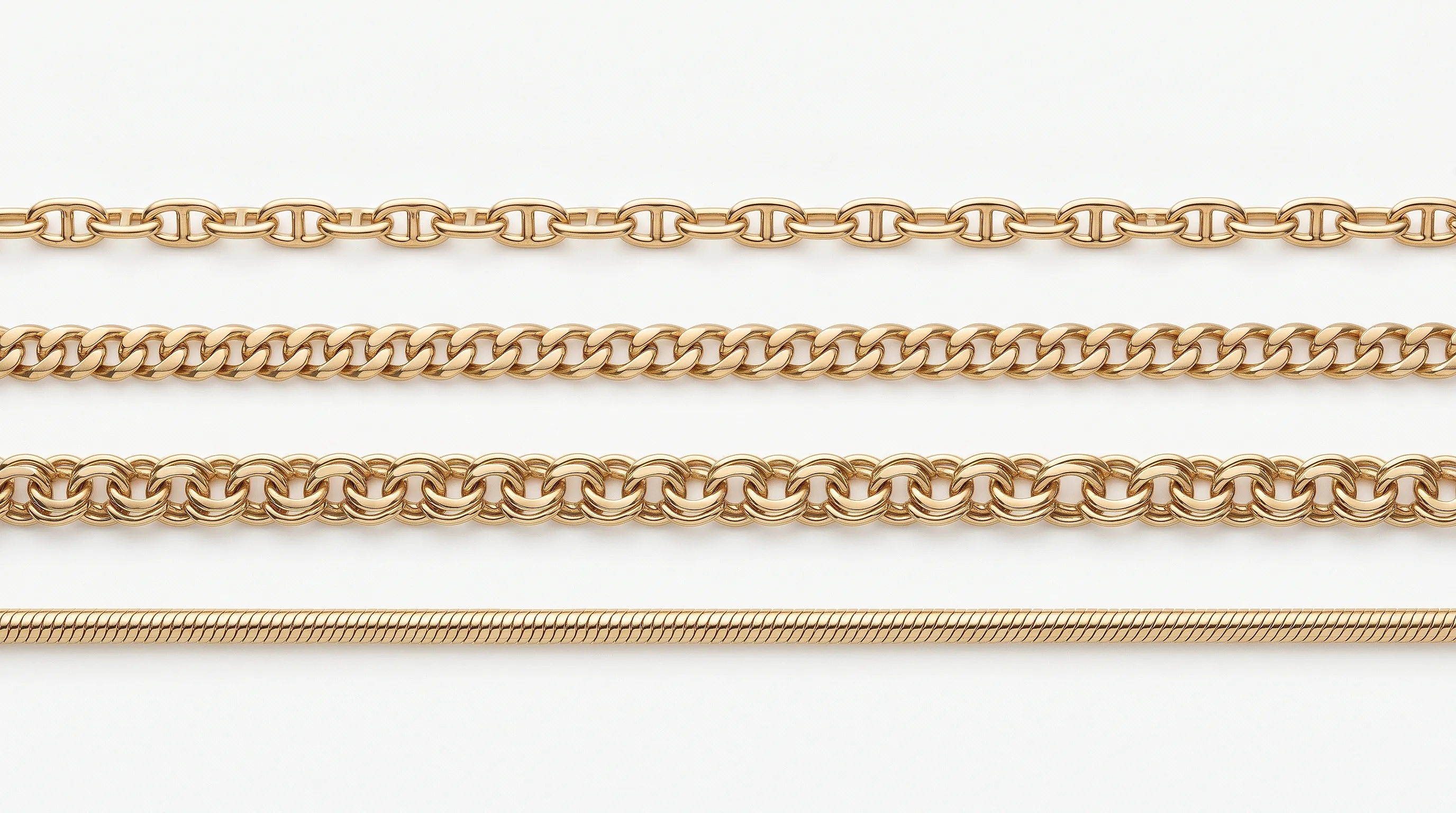
Anchor Chain: Maritime Weave That Became Classic Menswear
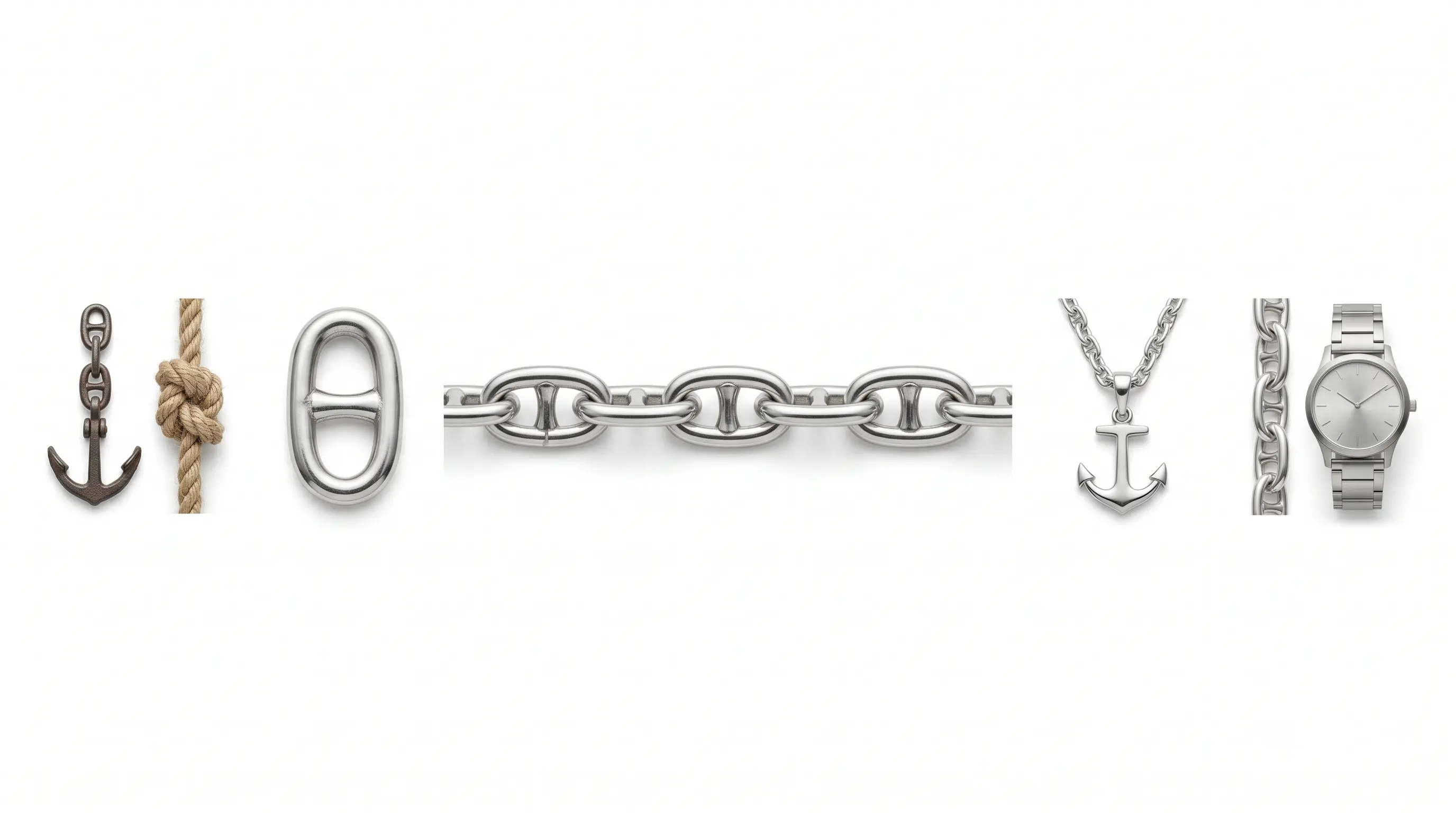
An 19th-century ship's anchor chain was engineered to hold loads around fifty tons. An anchor chain necklace inherits this engineering in miniature. The perpendicular crossbar in each link isn't decorative, it prevents the oval from flattening under tension. This is the strongest of all jewellery weaves, and that's why it remained the universal masculine classic more than 150 years after its birth.
In this guide, we'll explore where anchor weaving came from, how it differs from similar chains with round and flat links, how to read its variations (anchor, mariner, flat anchor, diamond cut), which lengths and thicknesses work for different purposes, which gifts it suits best, and where it's better not to wear it at all. This is a long text, but an anchor chain is the kind of piece you buy once in a lifetime and wear for decades. It makes sense to choose consciously.
Origin of the Anchor Chain
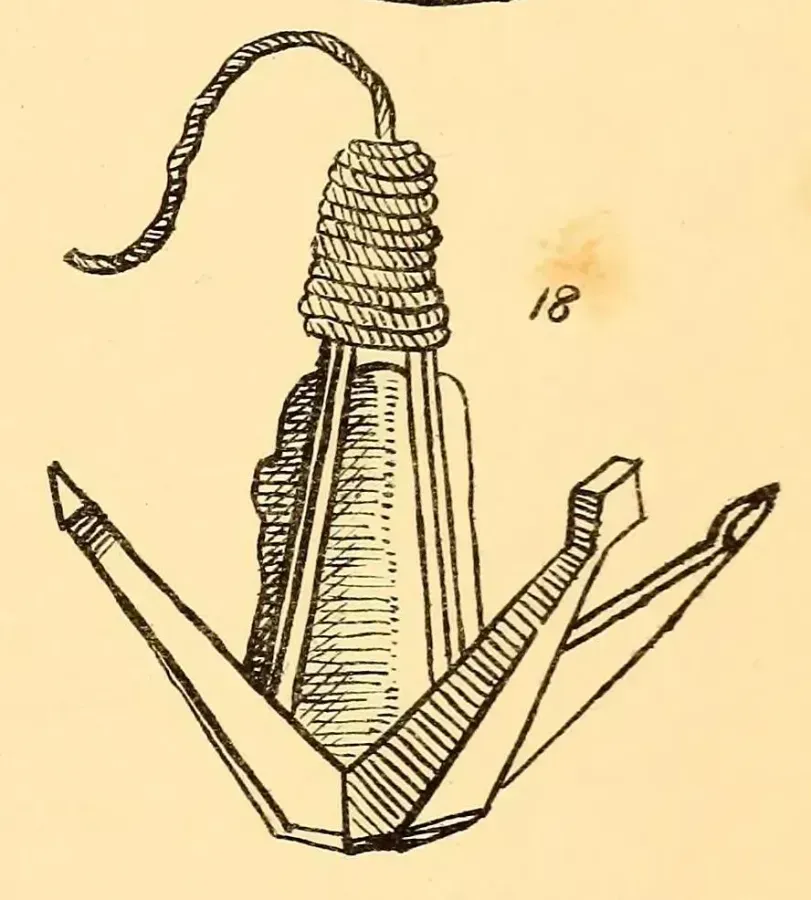
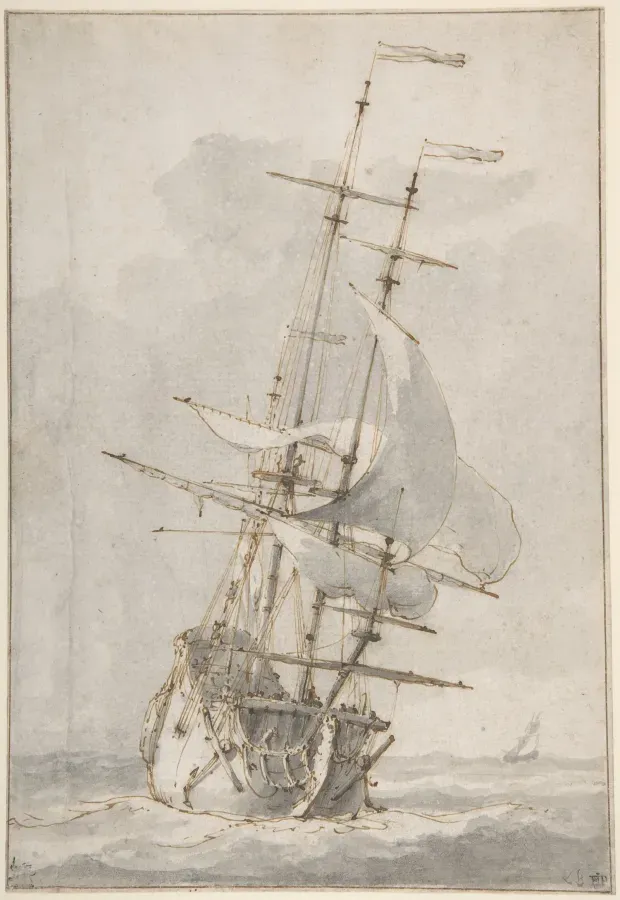
The history of the anchor chain begins not with jewellers, but with engineers. Until the late 18th century, ships anchored using hemp rope. Rope thick as a human thigh held ships weighing hundreds of tons, and was itself a consumable: it rotted, broke, required replacement every few years. The captain of a large vessel knew that in a storm, his rope could snap beneath the keel, sending the ship onto the rocks.
The Invention of the Chain Anchor System
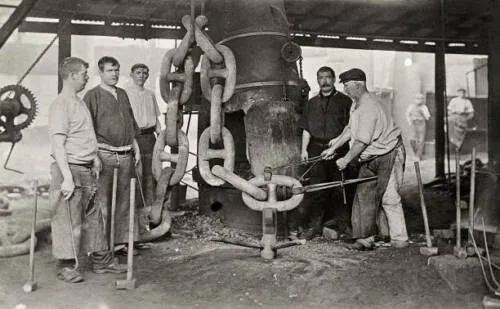
In 1808, British engineer and fleet captain Samuel Brown patented the chain anchor system. The idea wasn't entirely new, chains had been used for anchors before, occasionally, but nobody made them standard because of two problems. A chain without reinforcement inside each link stretched easily under load and broke at its weakest point. A chain without a crossbar tangled when hoisting and jammed the windlass.
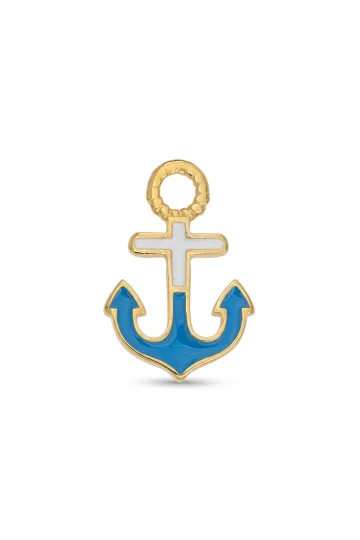
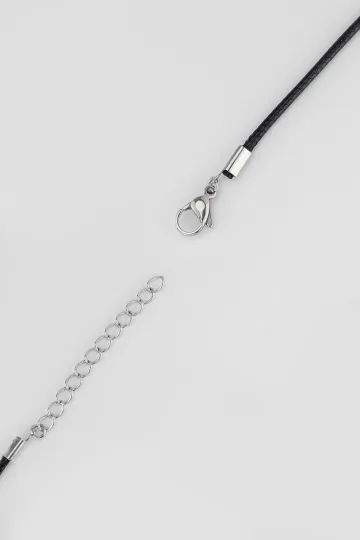
Wear the symbol, don't just read about it. These are in stock:



Brown solved both problems with one device. He added a perpendicular crossbar to each oval link, which he called a stud. The crossbar acted like a bridge support: it prevented the oval from flattening under tension and preserved the link's geometry under any load. This increased the breaking strength three to four times compared to unstudded chain. Brown's chain allowed anchors to hold ships weighing 1500-2000 tons on rope. The black links with crossbars became the calling card of the British fleet and quickly spread along trade routes.
By the 1830s, the chain anchor system was standard in most naval fleets worldwide. Rope was completely phased out from the regular equipment of military and large commercial vessels by the 1850s. In this same period, port masters and blacksmiths serving the shipyards began making miniature copies of anchor chain as amulets for sailors and dock workers. These were the first anchor chains in the jewellery sense.
Symbolism and the Transition to Jewellery
A mid-19th century merchant sailor was an unprivileged working class, but possessed a distinct culture. Having traded home for a ship's deck, a person dressed and carried items that held protective meaning. Tattoos with anchors, rings with maritime symbols, a small copy of anchor chain around the neck: this wasn't fashion, but an attempt to stitch the ship into daily life.
The anchor chain fit this logic perfectly: it copied the very chain that held the ship at anchor. Wearing a miniature anchor chain around the neck meant carrying a piece of engineering that saved the ship every day. By the end of the 19th century, such a chain was a mandatory attribute of the non-commissioned officer class in merchant fleets across Britain, Germany, the Netherlands, Sweden, and Norway. A sailor typically had one chain for his entire career, passed down to sons and grandsons, and often several generations of one family wore the same piece.
The 20th Century and Transition to Mass Code
By the early 20th century, anchor weaving had spread beyond maritime circles. In the English and American middle class, pocket watches on chains became fashionable, and anchor weave with its sturdy geometry became the standard for such chains: it held the watch's weight, didn't stretch, didn't catch on waistcoat linings. The same craftsmen who made anchor watch chains for businessmen and engineers made neck chains of the same geometry for ladies and gentlemen.
In the 1950s-1960s, the anchor chain underwent an Italian fashion phase. After the war, a group of workshops in Italy made a narrow, long anchor with tightly compressed double links the signature of Mediterranean menswear style. This variation was called "mariner," and it was based on the same anchor weave, only the links were stretched more than usual and went in double rows, increasing metal density without increasing weight. Mariner chains of the 1960s were worn by fishermen, dock workers, merchant sailors, and gradually, the middle class. Without reference to specific workshops: in Italy, it was a regional style that belonged to no one house.
The Hip-Hop Wave of the 1980s and Return to Classics
By the 1980s, the anchor chain came to the US as part of a new cultural code. African-American musicians of New York and Los Angeles in those years were building a visual language in which heavy metal around the neck worked as a symbol of escaping poverty. Heavy anchor and panzer chains (50-150 grams) became mandatory attributes of this aesthetic. By the 1990s, gold anchors 8-12mm thick were a mass icon of the genre, and through videos and magazines, this aesthetic spread worldwide.
During this same period, the anchor chain's reputation in more conservative circles suffered: the heavy chain became associated with a specific subculture, and part of the classical audience rejected the weave for a decade. The return began in the mid-2010s, when a new generation of men aged 30-45 rediscovered the anchor in its classical version (3-5mm, silver or white gold) as a universal men's chain without genre associations.
Today, the anchor chain exists in two parallel worlds. On one hand, it's a calm classic for business, sports, and informal wardrobes, that same "one chain for everything." On the other hand, it's a recognisable heavy thing for those building a more expressive visual image. Both readings work, and the choice depends on what function you want from the metal around your neck.
Anchor Chain in Women's Wardrobes: A Separate Story
Parallel to the men's canon, anchor chains developed in women's jewellery, but took their own path. The first thin anchors for women appeared in England in the 1880s as part of Victorian fashion for "maritime" accessories. In seaside resorts in Brighton and Eastbourne, resort workshops opened that made jewellery for vacationing ladies with maritime motifs. A thin anchor chain 40-45cm long with a small anchor, shell, or maritime knot pendant was a popular souvenir and remained a regional seaside style for a long time.
During the interwar period (1920s-1930s), thin anchor chains became part of Art Deco aesthetics. Geometrically clean weaving with crossbars fit perfectly into the era's love of graphics and lines. During this period, anchors also appeared in short and long "soutoir" variations: two wraps of thin anchor with a large artistic pendant at the end.
After World War II, women's anchor chains faded into the background: more "delicate" snakes, rolos, and thin panzer chains dominated. The return came in the 2010s, when minimalism and the trend toward "masculine" items in women's wardrobes brought anchor weave back as one of the key choices of the modern woman.
Anatomy of Anchor Weave
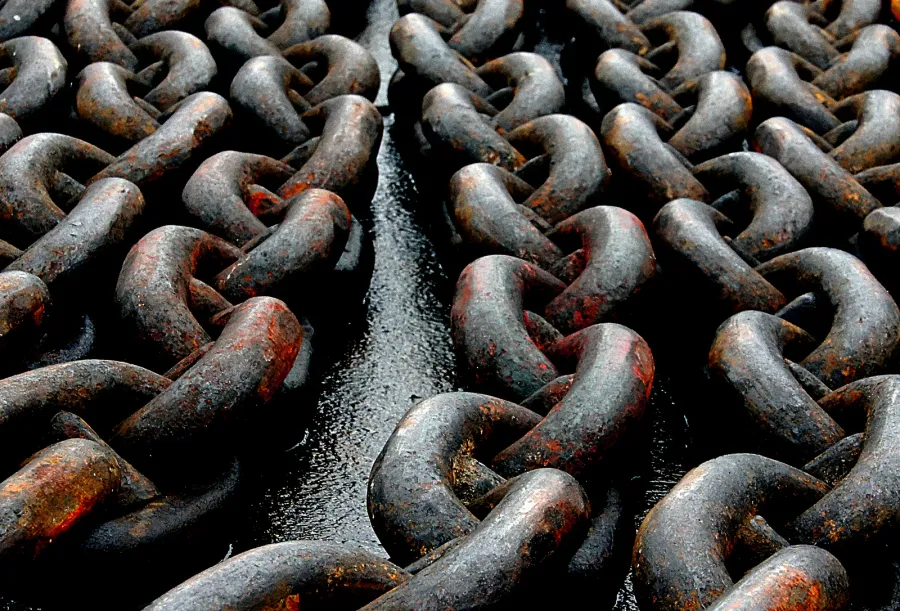
To understand how anchor chains differ from similar weaves and why they're stronger than their nearest relatives, we need to look at a single link. All the mechanics of the weave sit in its geometry.
The Link as an Engineering Unit
A basic anchor link is an oval with a perpendicular crossbar in the middle. The oval isn't regular, it's elongated: length is usually 1.5-2.5 times the width. This proportion matters because it determines how links connect to each other and how the chain behaves in motion.
The crossbar runs exactly through the geometric centre of the oval. Its thickness usually equals the thickness of the link walls or slightly less. It's made from the same metal as the oval itself and soldered to the walls on both sides. If the crossbar is soldered well, the link withstands breaking load three to four times greater than the same oval without a crossbar.
This strength isn't theoretical. A 3mm silver 925 anchor chain withstands about 25-30 kilograms of breaking load before the link begins to deform. The same thickness panzer or rollo chain withstands 8-12 kilograms. For everyday wear, the difference isn't critical: no chain should experience such loads. But in scenarios where a chain accidentally snags (clothing, door handle, backpack strap), the anchor survives the jerk where other weaves would already be broken.
Angle of Link Connection
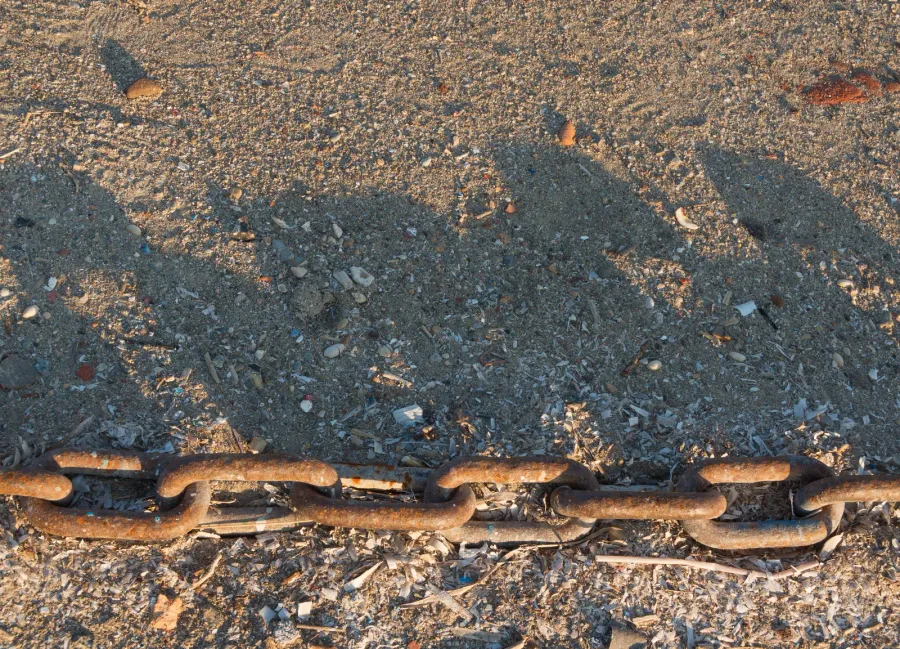
Anchor links connect to each other at 90-degree angles. Each following link lies perpendicular to the previous one, giving the chain a characteristic visual rhythm: a row of ovals that alternate between "in plane" and "on edge." This rhythm differs from panzer chains (where links twist to lie in one plane after polishing) and rollo chains (where links are round and the connection has no expressed axis).
Perpendicular connection gives the chain two important characteristics. First: it doesn't twist on the neck because neighbouring links work as stabilizers for each other. Second: as the chain moves, links rotate around contact points without friction against neighbours, which slows wear at connection points. Modern anchor chains of the massive class under daily wear last 30-40 years without visible signs of wear in the connections.
Proportions and Proportional Families
Link proportion is the key parameter that divides anchor weave into subfamilies. Roughly, there are three.
Short links (1.2:1 to 1.5:1 proportion) look almost round. A chain with such links is dense, heavy, reads as "heavy work." This is typical English maritime style.
Medium links (1.5:1 to 2:1 proportion) are most common. A chain with such links is universal, lays flat, looks good with medium-sized pendants. This is the basic anchor.
Long links (2:1 to 3:1 proportion) look visually elongated, and a chain with such links seems more elegant at the same width. This is the "mariner" variation. It looks good on a narrow neck and in thin execution (1.5-2.5mm) is often sold as a women's or unisex version.
Wire Thickness and Cross-Section
By anchor chain thickness, we usually mean its width (the short side of the link). Inside this width hides the wire thickness that forms the link. The ratio between them is also a parameter.
Solid links (proportional fill) use wire with thickness of 25-35% of the link width. That is, in a chain 5mm wide, the wire is 1.3-1.8mm. Such a link looks visually dense, heavy, expensive (lots of metal), and at equal width looks "real." This is the premium segment.
Lightweight links (light fill) use wire 15-22% of the width. A chain the same width weighs 30-40% less but looks similar. This is the basic and mid-range segment.
Hollow links (hollow link) use thin wire bent into an oval shape, or stamped links from sheet metal. Such a chain is light (often 3-5 times lighter than solid at the same width) but loses significantly in strength and is more prone to deformation.
In gifts for serious occasions, solid chains are chosen because they last for generations. In everyday personal purchases, lightweight chains are often taken: cheaper, lighter, and with careful wear also last a long time.
Link Cross-Section: Round, Oval, Flat
The third parameter is the shape of the link's cross-section itself.
Round cross-section is classical and historical. The link is made from round-section wire. Such a chain has a "three-dimensional" appearance: looking from above or the side, you see volume. It looks heavier visually, denser in perception.
Flat cross-section (flat anchor) uses flat-section wire, usually rectangular or elongated oval. The link has flat top and bottom. Such a chain lies on skin with one side and doesn't "somersault." This matters in two cases: when you want the chain to lay flat (say, on a wedding photo shoot) and when the chain has a flat pendant (medal, engraved plate) that needs to be stabilised.
Faceted cross-section (diamond cut) is any variant where the link surface is worked with a cutting tool or special grinding disk so flat facets appear that catch light. A chain with diamond cut sparkles much more and looks brighter visually than a polished smooth chain of equal mass. The minus: facets show dust and scuffs less obviously, but with heavy wear the facet edges become slightly blurred.
Clasp and Finish
In an anchor chain, the clasp is chosen based on thickness and mass. For thin anchors (up to 2mm), a standard medium-sized carabiner works. For medium (3-5mm), often an enlarged carabiner or box clasp ("box clasp") with a spring tongue is used. For massive (6+ mm) use a high-strength carabiner or a special screw clasp.
Anchor chain finish comes in four types. Polished (mirror shine). Satin (matte, brush-worked). Diamond cut (faceted). Oxidised (darkened hollows with bright facets, "old silver" effect). For a gift to an adult man, polished or diamond cut is often chosen. For women's or unisex variants, satin or polished is more common.
Customer reviews
Zevira is a real jewellery shop. Genuine payments, deliveries and customer thank-yous.
🥰🥰🥰 gracias

Ok, ¡gracias! 🙂

Variations of Anchor Weave
Within the anchor weave family lives a whole range of recognisable variations. They differ in link geometry, connection method, and surface treatment. Knowledge of these variations is important for two reasons: to not buy the wrong thing and to see all its engineering features in the finished piece.
Basic Anchor
This is the same classical anchor chain with medium-proportion oval links, perpendicular connection, and polished surface. If a catalogue says simply "anchor" without specifications, it means this one. Basic anchor works as a universal choice: suits any pendant, any occasion, any age.
Basic anchor links usually have 1.5-2:1 proportion. Width depends on purpose: 1-2mm for women's and unisex niches, 3-5mm for men's everyday, 6-12mm for massive dress.
Mariner with Elongated Link
Mariner is anchor with accentuated long links (2:1 proportion and higher). Visually, the chain seems more "light" and narrow at the same width as basic anchor. The elongated link reads as a modern interpretation of classics.
Mariner is often made flat (mariner flat), and then the chain lays on skin like a ribbon. This is a very characteristic summer and beach style: the chain doesn't press, doesn't "build" the image, but is visible and recognisable. Mariner flat 3-4mm is the most common choice for women and for men who don't want massiveness but want character.
Within Mariner there's a subspecies with double links. The link is made not by one oval, but by two connected in one plane parallel ovals, which gives width while preserving length. This variation is especially associated with Southern European style of the 1960s (without reference to specific workshops). It's worn today as "Italian mariner" or "double mariner."
Flat Anchor
Flat anchor differs from volumetric anchor only in wire cross-section: it's rectangular or flatly oval instead of round. This shift gives the chain different behaviour on skin. Flat anchor lays with its wide side to the body, doesn't rotate, doesn't "escape" aside, and when you move your head, it stays in the right orientation.
Plus of flat anchor: it reads as more modern than volumetric. On bare neck or over a t-shirt, it works as a graphic line, not a volumetric object. This is often the choice of younger audiences and people who value minimalism.
Minus of flat anchor: at width over 5-6mm it becomes visually too dense and loses elegance. That is, massive flat anchor is a rare choice; it usually stays in the 2-5mm range.
Diamond Cut Anchor
Faceted anchor is anchor where the link surface is worked with a cutting tool or grinding disk so flat facets appear that catch light. On polished surface, reflection goes evenly, and the chain sparkles like a mirror. On faceted surface, reflection breaks into many small sources, and the chain sparkles like it's covered in sparks.
Diamond cut processing exists in two types. One-directional: facets go in one direction along the chain, and the sparkle reads as a "spark stripe." Multi-directional (multi-cut): facets go in different directions, and the sparkle reads as a "spark cloud." Multi-directional processing is more expensive and complex, characteristic of the premium segment.
Application of Diamond Cut. Faceted anchor draws light more strongly on dark clothing, so it works well on black shirts, dark sweaters, suits. On light clothing, the difference between faceted and polished isn't so noticeable. Faceted anchor also subjectively ages better: scratches and scuffs get lost in the general facet pattern, while on polished surface they stand out.
Curb Anchor (Twisted Anchor)
This is a hybrid between anchor and panzer weave. Links are anchors (with crossbar) but the connection isn't classical perpendicular, but twisted, like panzer. After twisting and polishing, you get a chain where links lay in one plane, like panzer, but on close inspection the crossbar is visible.
Curb anchor combines anchor's strength with panzer's laying. It's a dense, non-twisting, flat-topped chain with extra strength. Used in massive men's models where strength and neatness are equally important.
Decorative Anchor (Ornamental Anchor)
This is a collective name for anchor weaves where the standard link is replaced with a stylised one. For example, the link can be in the shape of a heart, letter, maritime knot, miniature anchor. The crossbar is preserved as a functional element (it carries the load), but the outer contour of the link changes to ornamental.
Decorative anchor is used in women's and teen niches where "cute" geometry is important. The strength of such chains is usually lower than standard anchor of the same width (because non-standard link shape resists stretching less effectively), and you shouldn't wear them with heavy pendants.
Antique Anchor (Old-Style Anchor)
This is anchor with clear signs of handcrafted execution: rough link edges, visible solder marks, unpolished surface, oxidation. The aesthetic references the 19th-century ship anchor chain but in jewellery scale. The chain looks like a piece of real ship rigging, only smaller.
Antique anchor is popular with men aged 35-50 who appreciate handcrafted aesthetics and don't want smooth "store-bought" shine. Often such chains are hand-made, and each link has slight differences from others. This gives the chain individuality but reduces its versatility: it works in casual and handcrafted style but looks poor with a suit and formal clothing.
Upload a photo of your pet, someone you love, or an object. We'll build a 3D model and hand-cast it in pewter.




Lengths and Proportions of Anchor Chains
Chain length on the neck determines where it sits and what effect it creates. For anchor weave this is especially important because the weight and geometry of the link change how it sits: a heavy anchor will sit lower than the same length thin anchor.
Standard Lengths and Their Uses
40-42cm is a choker. Anchor chain of this length hugs the neck and reads as a decorative element, almost like a collar. A choker of anchor weave is a specific choice, rather rare. Suits younger women, not suitable for pendants.
45cm is neck length without pendant. The chain lays right on the collarbone or slightly below. An anchor of this length works well solo, as an independent piece, or with a very small pendant (up to 15mm). Thin anchor (1-2mm) at 45cm is a typical women's everyday variant.
50cm is standard universal length. The chain descends to mid-chest (sternum), which is good for a medium pendant (25-50mm). If you're buying anchor "in general" for everyday wear, 50cm is the right choice for most men and women of average height.
55cm is men's everyday length. The chain lays mid-chest, on a man with a shirt it shows in the upper collar opening. This is the length that works well over a t-shirt and under a shirt simultaneously. Most massive men's anchors are made exactly 55cm.
60cm is long men's or medium women's. The chain descends below mid-chest, closer to the solar plexus. Works well with a massive pendant (50-80mm) or a massive chain solo.
65-70cm is a long chain with pendant worn over clothing. Often worn over t-shirts, sweaters, at wedding photo shoots as a "dress" chain with a large pendant. Anchor of this length is usually massive (4mm and thicker) because thin at this length would be flimsy.
75+ cm are very long chains, sometimes called "sautoir" or "sutouar" in old French usage. They descend below the sternum, usually worn as a double wrap around the neck or as one very long piece over a dress. Anchor of this length is rare; usually made as Mariner with a long elegant link.
Anchor Bracelet
An anchor bracelet is a short chain 18-22cm long that lays on the wrist. The logic is the same as the neck variant, just in miniature.
18cm suits a thin women's wrist. 19-20cm is medium universal size. 21-22cm is a men's bracelet that when clasped lays freely, doesn't press, and leaves room for movement. If the bracelet is too tight, it chafes the wrist bone and comes off after an hour of wear.
An anchor bracelet works well paired with an anchor neck chain but isn't necessary. Often men wear an anchor bracelet and a panzer or other weave around the neck. The main thing is that the metal matches in colour and treatment.
How Length Affects Body Perception
A long chain visually lengthens the torso. This is used on people with short necks or bulky bodies: a 60-65cm anchor on a large man makes the silhouette more vertical.
A short chain visually widens the shoulders. A 40cm choker on narrow shoulders creates an impression of wider ones. This is sometimes used in specific situations but is rare in everyday wear.
The ideal length for most people is 50-55cm. It doesn't work toward lengthening or widening and leaves the chain neutral in its effect on proportions.




Five Cases: How to Choose an Anchor Chain
To understand how anchor works in real tasks, let's look at five typical scenarios. Each requires its own thickness, length, and metal.
Case One: A Man 40+ for Retirement or Milestone
Context. A man aged 40-55, often a manual or engineering worker, retiring or marking an important personal milestone. Until now, he wore minimal jewellery (watch, wedding ring). The gift should be weighty, serious, recognisable.
Choice. Massive anchor 6-8mm, 925 silver, 55-60cm length, polished or diamond cut finish. Chain weight 50-80 grams. Better silver than gold: silver is less "flashy," and a person unused to jewellery wears it more willingly than gold.
Why it Works. A massive anchor is a symbolic gift: "You now have something heavy, strong, and noticeable." The crossbar in each link works as a small metaphor of reliability, and many recipients notice this themselves. Such a chain often becomes the only serious piece around the neck for the next ten or twenty years.
Alternative. If the recipient doesn't like large sizes, the same anchor only thinner: 4-5mm, 55cm, silver. Less effect, but the chain fits into any situation.
Case Two: Wife or Partner as Alternative to Classic Chain
Context. A woman aged 30-45 who already has a thin snake or panzer. You want to give something new but don't want to change the style completely. A thin anchor gives that characteristic touch without stepping outside the women's visual code.
Choice. Thin anchor 1.5-2mm, silver or 585 gold, 45cm length, polished finish. Weight 5-10 grams. Works best paired with a small pendant 15-20mm: a shell, monogram, symbolic sign (for example, a scallop shell that references the maritime theme without declaring it directly).
Why it Works. A thin anchor reads as "modern classic." The geometry with the crossbar is recognisable but not aggressive. Against a background of standard snake or panzer, such a chain stands out as a detail without stepping out of style. And unlike snake, it doesn't fear a bend from accidental impact.
Alternative. If you want an even lighter aesthetic, mariner flat 2-3mm. The chain lays wide-side, doesn't rotate, adds graphic quality.
Case Three: Son for 18th Birthday
Context. A young man aged 18-22, the beginning of adult life. The gift should be both dress and wearable every day, so the recipient doesn't put it away in a box.
Choice. Medium anchor 3mm, 585 gold (or silver for budget) 50cm length, polished or diamond cut. Weight 12-25 grams depending on metal. Carabiner or box clasp.
Why it Works. A young man at this age doesn't wear heavy metal (unless part of a specific subculture), and massive anchor 6+ mm would be inappropriate. At the same time, thin 1-2mm will read as "childish" or "feminine." Medium 3mm gold hits the right corridor: weighty enough to feel "serious," understated enough to wear to work and university.
Alternative. If the recipient does sports or active pursuits, better take steel anchor 3mm. Steel doesn't scratch, doesn't react to sweat, survives any hits. Price is lower, but with proper treatment steel looks like silver.
Case Four: Navy Veteran on Anniversary
Context. A man aged 60-80 who served in the navy or merchant marine. An anniversary, usually a significant one. The gift should have meaning tied to his biography, not be "generic."
Choice. Massive anchor 5-6mm, silver or steel, 55cm length, polished finish, with engraving on a small anchor-pendant. The engraving can be short: coordinates of where he served, service start date, ship name. Each such chain needs its own story.
Why it Works. For a navy veteran, an anchor chain isn't a "gift," it's a return of an item he knows from his youth. Many sailors wore anchor chains during service, and decades later they became a recognisable symbol. A new anchor with engraving works like a medal: an item that, along with its standard form, carries personal history.
Alternative. If the veteran never wore jewellery, an anchor bracelet instead of a chain. A bracelet on the wrist is more everyday and easier to accept.
Case Five: Over a White Shirt in Casual Business
Context. A man aged 30-45, works in a hybrid office (not strict dress code but not free style either). Wears shirts, sometimes without a tie. Wants to add "character" to the image without stepping outside business code.
Choice. Thin or medium anchor 2.5-3mm, 585 gold (or silver for cooler look), 50-55cm length, polished or satin finish. Worn under the shirt, sometimes visible in an unbuttoned collar.
Why it Works. A chain in this range doesn't violate business code; it's almost invisible under a buttoned shirt. Yet in an unbuttoned collar or at a tie-less meeting, it appears as a personal touch, not assertive but recognisable. Anchor weave here is preferable to snake or rollo: it gives minimal texture that reads "masculine" but not aggressively.
Alternative. Same range but in platinum or white gold. A silvery cold metal works better with white shirts, doesn't contrast, doesn't "jump out."
Additional Scenarios: Daughter, Nephew, Anniversary
Daughter at 16. Thin anchor 1.5mm in 585 gold 42-45cm long. Age demands delicacy: the chain should be "her own," not repeat mother's or grandmother's. Anchor weave in this size reads neither as masculine nor "childish," and pairs well with a small pendant: monogram, symbol, thin cross.
Nephew at christening. Silver anchor 1-1.5mm at 35-40cm with a small cross pendant. The chain grows with the child: in a year or two it can be lengthened by adding more links of the same weave. Silver is preferable to gold: the child might lose it, and the financial loss will be less.
Brother at 30. Medium anchor 3-4mm in silver or steel, 50-55cm, polished finish. A threshold age: no longer young, not yet mature. Medium anchor hits the right corridor of weight and character. If the brother does sports, steel is better.
Husband on wedding anniversary. The logic is individual and depends on years lived. For a fifth anniversary, medium anchor 3mm in gold with the date engraved on the clasp. For a tenth, a more massive 4-5mm with an engraved pendant. For a twentieth, a massive dress 5-6mm, silver or platinum, with a symbolic pendant.
Grandfather at 80. A complex scenario because at this age people rarely start wearing new jewellery. An anchor suits only if grandfather already wears a chain and there's reason to think he'll accept a replacement. In this case, take thin (2-3mm) silver or steel, light, without massiveness. Meanwhile, check that his current chain doesn't chafe his skin: with age, skin becomes thinner and more sensitive.

Turn on your camera, pick earrings, a pendant or a ring, and see the piece on yourself in real time.
Switch items in one tap.
Everything runs in your browser: no photo or video is ever uploaded.
Anchor vs. Other Weaves
To make your choice conscious, let's see how anchor differs from its nearest neighbours in the jewellery weave family. Each weave has its strengths and weaknesses, and in some scenarios anchor isn't the best choice.
Anchor vs. Panzer (Curb)
Panzer chain uses oval links without a crossbar, twisted so they lay in one plane after polishing. This is probably the most classical and universal weave in jewellery.
Anchor is stronger. The crossbar in each link gives a 2-3x advantage in breaking load at equal width. This matters for heavy pendants and for people wearing chains round-the-clock (training, sleep, manual work).
Panzer is more versatile. It has no association with maritime theme and reads as neutral classic choice. Anchor still carries a maritime flavor, which not everyone likes.
Anchor is more characteristic. The crossbar creates a recognisable geometry: looking at the chain, a person recognises it from afar. Panzer requires closer examination.
Choice. For maximum neutrality and universal style, choose panzer. For maximum strength and characteristic geometry, choose anchor.
Anchor vs. Bismarck
Bismarck uses double or triple interlacing of oval links. Each "link" of Bismarck consists of two or three parallel ovals interlaced so the chain comes out dense and wide.
Anchor is stronger per individual link. The crossbar makes each separate link stronger. Bismarck is stronger in mass: through its multi-layered nature, it distributes the load across several parallel links and, if one layer is damaged, continues holding.
Bismarck is visually denser. At the same width, a Bismarck chain looks more "solid" and weighty. An anchor at the same width is lighter and airier.
Anchor is recognisable. The crossbar geometry is read immediately. Bismarck requires knowledge to recognise, and in public perception it often gets confused with other complex weaves.
Choice. Bismarck is for those who want a "maximally masculine" massive chain and aren't afraid of complex weave. Anchor is for those who value geometric recognizability and engineering cleanliness.
Anchor vs. Snake
Snake uses links that aren't visible as individual elements: the chain looks like a smooth round tube, without texture. This is achieved through very fine links closely fitted to each other.
Snake is smooth and quiet. It doesn't snag on clothing, doesn't jingle as it moves, has no visible texture. This is the typical choice for fine minimalism and for people who want the chain to not "work" as jewellery.
Anchor is characteristic and visible. It has a pattern that reads. This is for people who want the chain to be noticeable as an object, not dissolve into the background.
Snake is fragile on bending. One strong bend (e.g., accidentally sat on the chain or snagged with your sleeve) can damage the weave structure, and it can't be restored. Anchor survives any mechanical impacts.
Choice. If minimalism and smoothness matter, snake. If durability and recognizability matter, anchor.
Anchor vs. Figaro
Figaro uses rhythmic alternation of links of different lengths: three short, one long, repeats. This gives the chain noticeable rhythm and is associated with Southern European style (especially Italian).
Figaro is more rhythmic. The interplay of link lengths creates visual movement. Anchor is more static; its rhythm is uniform.
Anchor is stronger. Long Figaro links stretch before short ones, and under stress the chain deforms unevenly. Anchor holds load with all links equally.
Figaro is more characteristic by style. It's a "Mediterranean" choice, recognisable regional code. Anchor is more universal: it works in any style without regional ties.
Choice. Figaro for those who want rhythmic variety and Southern European flavor. Anchor for those who want engineering strength and neutrality.
Anchor vs. Rollo
Rollo (or belcher) uses round-in-plane links without a crossbar. A very simple weave, known since antiquity.
Rollo is more versatile for pendants. Round links dictate nothing by form, and any pendant lays on rollo naturally. Anchor with its elongated links works less naturally with round pendants.
Anchor is stronger. The crossbar again gives a 2-3x advantage in breaking load.
Rollo is softer in perception. Round links read as "delicate," especially in women's and children's niches. Anchor reads as "engineering," even in thin execution.
Choice. For a woman as a base for a large complex pendant, rollo. For strength and characteristic geometry, anchor.
Leave your email, we'll send your discount code. No spam, unsubscribe anytime.
The code arrives by email, valid on your first order.
Thickness and Weight: Guide for Choosing
Anchor chain thickness and its weight are nonlinearly connected: mass grows faster than width because it increases in both volume and wire thickness. This section gives practical guidelines so you know what mass you're working with.
Thin Anchor: 1-3mm
A 45-50cm chain of this thickness weighs 5-15 grams in silver, 8-22 grams in 585 gold. This is a light everyday range.
Who it Suits. Women of any age as an independent piece or with a small pendant. Men who don't like feeling metal on the neck (some can't tolerate even medium mass due to sensitivity). Teens and young people up to 25.
What Pendants. Up to 5 grams. That is, pendant size up to 25mm in silver, up to 20mm in gold. A heavy pendant can technically sit on a thin anchor but will risk clasp failure or link stretching near the pendant.
Finishes. Any. Polished for classics, satin for matte aesthetic, diamond cut for sparkle.
Medium Anchor: 3-5mm
Weight 15-50 grams in silver, 25-80 grams in 585 gold on 50-55cm. This is the basic universal range.
Who it Suits. Men for everyday wear. Women who value characteristic jewellery. Gifts for serious occasions (milestone, graduation, wedding anniversary).
What Pendants. Up to 20 grams. Pendants up to 50mm. A chain this wide handles practically any reasonable pendant without risk.
Finishes. Polished (universal), diamond cut (for sparkle), satin (for matte), oxidised (for "aged" look).
Massive Anchor: 5-8mm
Weight 50-150 grams in silver, 80-250 grams in 585 gold on 55-60cm. This is a noticeable dress chain.
Who it Suits. Men who want to "wear metal." Gifts for milestone, retirement, personal threshold. People whose chain is part of an expressed personal style.
What Pendants. Up to 50 grams. Pendants of any reasonable size, including large medallions and crosses.
Finishes. Polished, diamond cut, oxidised. Satin is possible but looks less effective on a massive chain.
Super-Massive Anchor: 8-12mm
Weight 150-300 grams in silver, 250-500 grams in 585 gold on 55-60cm. This is now a collector's or status piece.
Who it Suits. Very narrow niche: collectors, artists, representatives of specific cultural codes (hip-hop music, boxing, certain skilled professions). Not suitable for business, corporate, classical style.
What Pendants. Up to 100 grams or without a pendant (the chain itself as jewellery).
Finishes. Usually polished or diamond cut. Matte texture on such mass loses meaning.
Collector's Anchor: 12+mm
Weight 300+grams. A rare choice, usually custom. A chain of this format is already a workshop piece, not a catalogue item. Worn exclusively in specific contexts.
CAPAORA mini knife pendant
The 18th-century Spanish navaja in miniature: 40 mm of stainless steel, a real folding mechanism and a Palanquilla lock that clicks. An affordable gift to remember.
Authentic · Ships from Spain · 14-day returns
Antipatterns: What Kills Anchor Chains
Not every combination of anchor weave with other wardrobe elements works. There are classic mistakes that turn a good gift into something unwearable.
Thin Anchor with Heavy Pendant
This is the most frequent buyer mistake. The logic "it's strong weave, it doesn't matter" doesn't account for physics. The crossbar strengthens the link but doesn't cancel its material limit.
A 1mm chain has a link diameter of about 2mm. The crossbar is about 0.3-0.4mm. This size handles the chain's weight and pendants up to 3-5 grams well. A pendant of 10-15 grams creates constant stretch on the nearest link, and over several months this link stretches, the crossbar can crack from metal fatigue, and the chain either breaks or starts "living" with bent geometry.
Solution. For a pendant of 5-10 grams, use width of at least 2mm. For 10-20 grams, at least 3mm. For 20-50 grams, at least 4-5mm. Better to overestimate thickness than underestimate.
Massive Chain with Suit and Tie
Width 5+mm under a shirt with a tie creates visual conflict. The chain isn't visible, but its relief shows through thin shirt fabric and reads as a "strange bump" on the chest. If the shirt is dark, the effect is amplified through the silhouette.
Plus, massive weave under a shirt chafes the skin: thick links press on the sternum with movement, and after several hours of wear, characteristic irritation appears.
Solution. Under a shirt with a tie, wear thin (up to 3mm) or medium (3-4mm) chain. Massive 5+ mm only in open shirt without tie, over a t-shirt, or over a sweater.
Chain Over Winter Wool Sweater
Coarse wool has nap that snags on the corners and angles of links. Weave with perpendicular geometry and a crossbar has many "snag points" that nap catches especially eagerly. After an hour of wear, the chain pulls out from under the sweater wrapped in wool, and each link is covered with a layer of fibres.
Besides the unkempt look, this wrapping harms the metal. The nap, as it moves, polishes the link surface in undesirable places, creating small irregularities and matte spots.
Solution. In winter, wear the chain either over your sweater (then nap doesn't contact metal) or under a shirt without a sweater. If it must go under a sweater, choose sweaters with smooth yarn (merino extrafine, thin cashmere weave) without expressed nap.
Diamond Cut on Sensitive Skin
Faceted processing makes the link surface slightly rough to the touch. For most people this is unnoticeable, but for people with sensitive skin or with psoriasis, eczema, allergic dermatitis, the chain facets can irritate the skin.
Solution. On sensitive skin, choose polished or satin finish. Save diamond cut for dress occasions when the chain contacts skin briefly.
Three Weaves at Once
A crossbar chain pairs well with one or two other different-type chains. For example, thin anchor plus snake, or medium plus panzer. But once a third weave appears in the set, the image becomes visually overloaded.
Solution. On the neck, maximum two different chains. If you want three, space them by context: one for everyday, one for going out, a third in a collection.
Engraving Across the Full Length
Some craftsmen offer engraving with a phrase across the full chain (each link gets a letter). This is a bad idea for two reasons.
First. Engraving each link weakens the metal where the cutting tool goes. Under tension, such links behave unpredictably.
Second. A phrase on a chain becomes "noisy" from movement: as the links change position, letters end up in the wrong order. Reading the engraving is difficult.
Solution. Do engraving on a separate pendant that hangs on the chain. On the pendant, you can place a long text, coordinates, date, symbol. On the chain itself, engraving is limited to the clasp (a short inscription of 5-10 characters).
Mixed Metal Colours Without Logic
A yellow gold chain with a silver pendant, or white gold with a rose gold pendant, often looks unmatchable. Chain and pendant should be from one colour family or deliberately contrast (e.g., silver with a black stone).
Solution. When buying chain and pendant separately, immediately check them together, not from catalogues. Metal colours in reality differ from catalogue renders.
Care for Anchor Chains
Anchor weave is one of the most patient among jewellery in terms of care. The crossbar protects the link from deformation under accidental stress, and the flat geometry simplifies cleaning. A few simple rules will extend the chain's life for decades.
Daily Care
Remove the chain before sleep (optional). The weave isn't damaged by sleeping in it, but with prolonged wear without breaks, skin oils and sweat accumulate in link corners. It's enough to remove it every 2-3 days and wipe with a soft cloth.
Remove before sports and sauna. Sweat contains salts that, in contact with silver, speed up darkening. In a sauna, high temperature speeds up oxidation. Better to have a sports chain in steel if you want to wear jewellery round-the-clock.
Remove when working with chemistry. Cleaning products, nail polish, hair dye, perfumes, these are typical enemies of jewellery. Silver and gold alloys are no exception. Especially aggressive are chlorine-containing products (swimming pool): they leave black spots on silver, microscopic damage on gold.
Regular Cleaning
Once a month, rinse the chain in warm water with soft soap. Use an old soft toothbrush to work through link corners and crossbars. Rinse with clean water, wipe dry with a soft cloth.
Every six months, take the chain to a jeweller for professional cleaning. Good workshops do this free or for a token fee. Professional ultrasonic cleaning restores the chain to "out of the box" appearance.
For heavy silver darkening, use special silver products (sold in jewellery shops). Don't use toothpaste, baking soda, or ammonia: these folk methods can damage coating or oxidation. For 585 gold, warm water with soap is enough.
Storage
Store your chain in a separate pouch or box. A link with a protruding crossbar can snag more delicate jewellery (especially snake) and damage it during shared storage.
The ideal environment for silver storage is dry and dark. Humidity speeds up darkening. If the house is humid, put a silica gel packet in the jewellery box (the kind that comes in shoe boxes).
Gold doesn't need special storage conditions; it doesn't darken in air. But physical contact with other jewellery will still damage the surface.
Repair and Length Adjustment
If the chain becomes long or short, it can be shortened or lengthened by any jeweller. This is a standard service. When shortening, the jeweller removes several links and re-solders the clasp to the new position. After the work, the chain is visually indistinguishable from factory-made.
The cost of shortening depends on region and workshop but is usually modest. Links removed during shortening normally stay with the owner. This saves on future lengthening if needed. These removed links can also be used as spare parts for repairs.
If a link is severely damaged (crack in the crossbar, bent oval), soldering is possible but the link is weaker afterward. Replacing the damaged link with a new one from the same metal is the ideal option.
Send a friend a discount code, they save on their first order.
Frequently Asked Questions
Anchor or Panzer: What to Gift a Man
If the recipient regularly wears jewellery and already has a style sense, and you want to gift something characteristic, get anchor. The crossbar makes the chain recognisable, and the fact "I have an anchor" works as a small style identification.
If the recipient doesn't wear jewellery, and this gift will be his first neck chain, panzer is better. It's more neutral, doesn't carry maritime associations, is more easily accepted by people unused to jewellery.
Can You Gift an Anchor Chain to a Woman
Yes, in thin (1-2mm) or medium (2-3mm) execution. Weave of this width has long stepped beyond men's code and works as "modern classics" on a woman's neck. Mariner flat 2-3mm especially works as a women's unisex choice.
Massive versions (5+mm) on a woman read as "masculine chain on a woman," which can be a conscious stylistic decision (gender-fluid aesthetic, rock style, craft wardrobe) but won't suit a classical women's image.
How Much Does a Men's Anchor Chain Weigh
Depends on width and length. Base guidelines in silver for 55cm length:
- 3mm: about 18-25 grams
- 4mm: about 30-40 grams
- 5mm: about 45-60 grams
- 6mm: about 65-85 grams
- 8mm: about 110-140 grams
- 10mm: about 170-210 grams
In 585 gold, weight is roughly 1.8x greater at the same geometry because gold is denser than silver. So 5mm in 585 gold at 55cm weighs about 80-110 grams.
Gold or Silver for Anchor Chain
585 gold is more expensive, more durable against scratches, doesn't darken, handles daily wear better without maintenance. Minus: weight is greater; the chain subjectively feels "heavier" on the skin. In everyday wear (especially sports), gold heats in the sun and can be uncomfortable.
Silver 925 is cheaper, lighter, softer. Darkens with sweat and air contact, needs regular cleaning. Many love this darkening as "character"; others see it as a minus.
For gifts to veterans, fathers, people 50+ years old, silver is often chosen. For gifts to young people or for personal everyday use, 585 gold.
Platinum and white gold are neutral options that work in a cold colour. Platinum is more expensive than 585 gold and is rare in massive chains.
Surgical stainless steel (316L) is a cheap, hypoallergenic, non-scratching option. Especially good for sports and active pursuits. Price is lower, but with quality polishing, steel looks like silver.
Can You Shorten an Anchor Chain
Yes, and it's a standard service at any jeweller. When shortening, the jeweller removes several links and re-solders the clasp to the new position. After the work, the chain is visually indistinguishable from factory-made.
The cost of shortening depends on region and workshop but is usually modest. Removed links normally go back to the owner: they can come in handy for future lengthening or repair.
Anchor Chain Darkens, Is This Normal
Silver always darkens. This is a chemical reaction of the metal with sulphur compounds in the air and skin. Darkening starts after several weeks of regular wear and becomes noticeable over time.
This isn't a defect; it's a metal property. Many love this darkening and deliberately leave chains "with history" without cleaning. Others prefer polished silver and clean regularly. Both approaches are normal.
585 gold doesn't darken but can become dull over time from microscopic scratches on the surface. Polishing restores the shine.
Steel doesn't darken at all. This is its advantage for those who don't want to maintain jewellery.
What if Anchor Chain Gets Twisted
Twisting is common in volumetric weave (round cross-section), especially in long chains. Links rotate in different planes, and the chain lays in a "wave."
To straighten, remove the chain, hold it by the clasp, and let it hang freely. Its own weight will straighten it. If twisting is heavy, twist the chain several times in the direction opposite the twist.
To prevent twisting in the future, choose flat variation (flat anchor). Flat link cross-section doesn't let the chain rotate.
Can You Wear Anchor in the Shower
You can, if it's quality silver or gold. Water itself doesn't harm metal. But hot water combined with soap, shampoo, and conditioner speeds up silver oxidation. Chlorinated water (pool, some tap water in regions) damages the surface.
Better to remove the chain before showering. In a sauna, definitely remove it (high temperature is dangerous for both metal and the clasp).
How to Tell Real Anchor from Fake
Real anchor has clear crossbar geometry in each link. The crossbar is soldered from both sides, without gaps.
A cheap fake often imitates a crossbar through stamping: the link has a relief that looks like a crossbar, but this is just a pressed pattern without a real cross-bar. In backlighting, such a fake is immediately visible: you should see a gap inside the link on both sides of the crossbar.
Also check the metal hallmark. Silver 925 should have a 925 or Ag925 stamp. 585 gold should have a 585 or 14K stamp. Steel chains usually have no hallmark, but quality 316L steel has a marking near the clasp.
Chain Chafes Neck, Is This Normal
No, this signals the chain isn't right for you. Possible reasons:
- Too short (presses on the cervical vertebra): needs lengthening.
- Too heavy for your constitution: get thinner.
- Poor-quality clasp (scratches): replace the clasp.
- Rough link edges (poor processing): take to a workshop for finishing.
A good anchor chain should be forgotten a minute after putting it on. If you constantly feel it, it's time to consider a replacement.
Can You Wash While Wearing Anchor
You can, if the fabric is soft and without expressed nap. Hard material (coarse wool, heavy denim) rubs the chain with movement and slowly polishes the link surface in undesirable places.
Under cotton, silk, thin wool shirts, anchor is worn without problems for years.
What Clasp is Most Reliable for Anchor
For thin (up to 2mm) anchor, a standard carabiner is enough. For medium (3-5mm), a reinforced carabiner or box clasp with spring tongue is better. For massive (6+ mm), a high-strength carabiner or a screw clasp.
A screw clasp is most reliable but less convenient: it's hard to open. This is a compromise between safety and ease.
Does Anchor Chain Symbolize Something
Anchor chain has a general maritime connotation (references the ship's anchor chains) but carries no direct symbolism in most modern wearers. It's simply a strong, recognisable weave.
If you want to strengthen maritime symbolism, add an anchor pendant. More detail about anchor meaning as a symbol in jewellery and maritime symbols generally is written in separate guides.
Can You Gift Anchor to Father
Yes, it's one of the most common scenarios. An anchor 4-5mm in silver 55cm long is a classic gift to a father at 50, 60, or 70. Silver is better than gold for people unused to jewellery: it's more restrained, less "flashy."
If the father wears a pocket watch on a chain, add an anchor bracelet of the same weave 19-21cm on the wrist. This creates an ensemble.
What If Anchor Chain Breaks
Don't panic. An anchor chain is repaired in almost any case.
If the break is in the middle of the chain, a jeweller will solder the links together. The seam after good soldering is invisible.
If the clasp breaks, the jeweller will replace it. If the old clasp is intact, save it: it can be used on another chain.
If a link is deformed (oval stretched, crossbar cracked), the link will be replaced. If it's one link, the repair cost is modest. If several links are damaged, it might be easier to buy a new chain than to repair.
All these operations take one or two days in a normal jewellery workshop.
How to Read Width in Catalogue Notations
In catalogues, anchor width is usually indicated as one number in millimetres: "3mm," "5mm," "8mm." This is the short side of the link (the oval width at its narrow part). The long side of the link is usually 1.5-2x greater than the listed width.
If the catalogue lists two numbers ("4×8mm" or "5×10mm"), the first is link width, the second is length. This gives a more precise idea of geometry: "3×4.5mm" is a short nearly-round link, "3×7mm" is an elongated mariner-style link.
Additional notations in catalogues:
- Hollow or H: hollow link (lighter but less durable)
- Solid or S: solid link (heavier, durable, expensive)
- DC or Diamond Cut: faceted processing
- Polished: polished surface
- Matte or Satin: matte or satin surface
When buying, check that all these parameters are stated. If the catalogue gives only width without specifying link type, it's often a sign of a hollow chain (the seller hides info because solid is always stated explicitly).
Anchor in a Collection of Several Chains
If you already have several different chains, anchor fits into the ensemble by several rules.
With Panzer. You can wear together, different lengths: panzer 50cm plus thin anchor 45cm. A 5-10cm length difference gives a tiered effect. Thicknesses should differ: anchor thinner than panzer or vice versa, but not the same.
With Snake. Anchor and snake contrast well by texture: anchor's characteristic geometry plus snake's smooth tube. Different lengths: one shorter by 7-10cm.
With Rollo. A softer contrast because both chains have visible links. Can wear together, but the effect is weaker than with snake or panzer.
With Figaro. Complex pairing: both anchor and Figaro have expressed link geometry. A tiered stack of two "textured" chains looks overloaded. If you want both, wear them alternately, not together.
With Bismarck. Impossible pairing: both chains are massive and characteristic. Each is an independent image on its own. Together, they compete.
Anchor as Part of Men's Jewellery Ensemble
If a man wears multiple pieces, anchor can be the central element. The logic follows.
Anchor chain plus anchor bracelet: a canonical ensemble, especially for men 40+. Chain 4-5mm on neck, bracelet same 4-5mm on wrist. Same metal. This is a "set" that reads as a conscious style choice.
Anchor chain plus a signet ring: a classical pairing for a mature men's image. Ring on pinky or ring finger, chain under shirt or visible. Metals must match.
Anchor chain plus a watch with metal band. Metal matching is required. If the watch is silvery (steel, white gold, platinum), the chain is also cold-coloured. If the watch is gold, the chain is gold.
Anchor chain plus a tattoo. The chain goes along a neutral zone (sternum, collarbone), not crossing tattoos. If there's a chest tattoo, the chain is either short (to the collarbone) or long (below the chest), not intersecting the image.
How Long Does an Anchor Chain Last
With normal wear and regular care, a 3mm silver anchor lasts 30-50 years without serious wear. A 585 gold one lasts 50+ years. Steel lasts indefinitely.
Anchor chains often pass from generation to generation. In sailors' families, chains 100+ years old are found, initially purchased in the early 20th century and passed from father to son.
This is one of the main arguments for anchor weave: you're buying not a fashionable accessory but equipment that will pass to your children and grandchildren.
Conclusion
An anchor chain isn't a fashion choice. It's an engineering classic, one and a half centuries old, that has proven its universality across all social layers: from 19th-century merchant sailors to young 2020s office men. It has basic logic worth understanding before purchase: an oval link with a crossbar, perpendicular connection, breaking strength 2-3x higher than neighbouring weaves at the same width.
The choice of a specific anchor depends on the task. Massive 6-8mm for those who want to "wear metal" and who suit an expressed masculine code. Medium 3-5mm for most people and most cases, that very "one chain for everything." Thin 1-2mm for women, unisex aesthetic, and people who value minimalism with character.
Don't buy an anchor "in general": think about thickness, length, metal, finish. Each of these parameters changes the result. A well-chosen anchor chain serves decades and often becomes a family piece passed on. This is rare in modern wardrobes where most things are designed for one or two seasons. Anchor chain works in reverse: the longer you wear it, the more right it becomes.
If you're choosing a chain for the first time and aren't sure what suits you, start with a medium anchor 3mm in silver, 50cm long. This is a basic universal option that will suit almost anyone, and from it you can then figure out what you want to add or change. Anchor weave forgives selection mistakes better than most others because its strength and universality give you a safety margin on wearability.
Silver, gold, engagement rings, symbolic jewellery, paired sets.
Buying it as a gift? Each one arrives ready to give.
 A branded Zevira box and a little card come with every order.













About Zevira
Zevira makes jewellery in the artisan tradition of Albacete, Spain. The anchor weave is a catalogue staple for us: it's exactly the kind of piece you buy once in a lifetime and wear for decades, so we work every link and every crossbar to make sure the chain outlasts generations.
What you can find with us on the anchor theme:
- Anchor chains from thin 1.5-2mm to massive 6-8mm, in 925 silver and 14-18K gold
- Anchor bracelets 18-22cm for men's and women's wrists, paired with a chain or worn solo
- Polished, satin, and diamond-cut finishes for different wardrobes
- Engravable pendant plates for personal text: a date, coordinates, a monogram
- Maritime pendants (anchor, scallop shell, knot) to pair with a thin anchor
- Length and thickness matched to a specific pendant, so the link nearest the pendant won't stretch
Every piece can be personalised with engraving, with the option of personal engraving. 925 silver and 14-18K gold.