Ancient Coins in Jewellery: Meaning, History and How to Wear Them
Introduction: thirty seconds of history around your neck
In the British Museum's Room 49, behind a glass case, sits a gold aureus of Hadrian minted around 120 AD. It was found in the Thames, passed through the hands of a Roman merchant, possibly a soldier, and ended up in the river's mud for eighteen centuries before a mudlark pulled it out of the bank near Southwark Bridge.
That coin never became a pendant. But thousands just like it did. Today, across Britain, people wear Roman coins set in silver bezels, Anglo-Saxon sceattas threaded on fine chains, and Victorian gold sovereigns mounted as brooches exactly as their great-grandmothers wore them. The tradition of wearing a coin as jewellery is not a modern affectation. It is older than England itself.
An ancient coin pendant is thirty seconds of history you carry on your person. In a culture that replaces everything on an eighteen-month cycle, that is a quietly radical act.
Wear the symbol, don't just read about it. These are in stock:



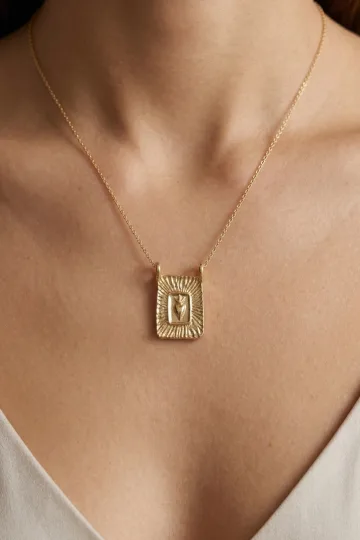
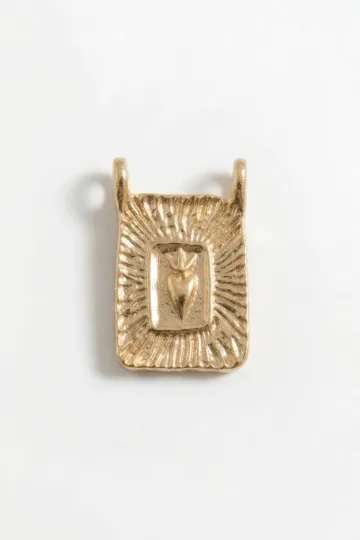
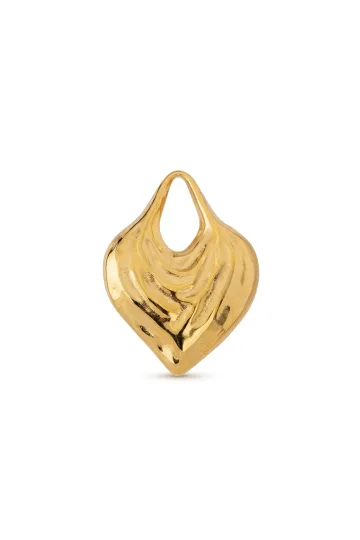
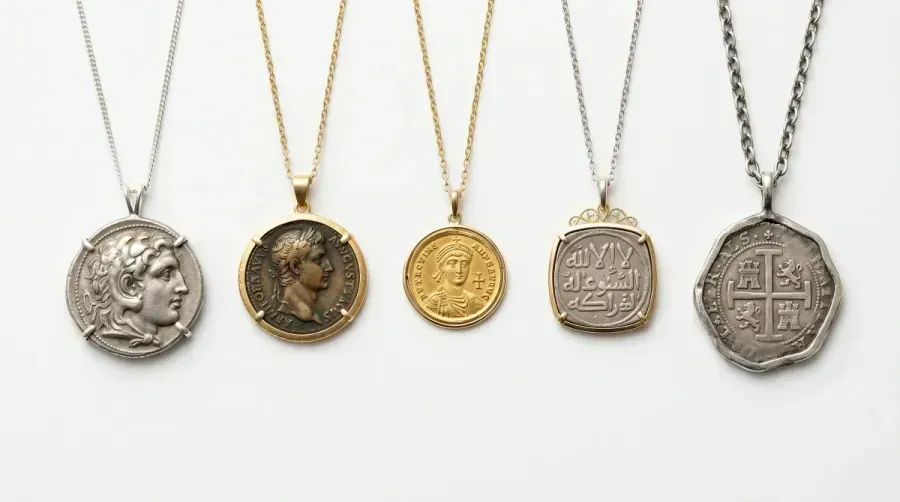
Ancient coin jewellery: what to choose
Pendant
The most natural form.
- Small pendant with an authentic bronze Roman coin, around 2 cm accessible genuine history. Budget to mid range.
- Medium silver disc in a bezel setting, around 3 cm more presence, works as a statement piece. Mid range.
- Large medallion, 4-5 cm a true focal point. Mid to premium range.
- With a gold coin or gold-plated disc premium, particularly prized. Luxury range.
Earrings
- Small coin studs paired. Excellent alongside a matching pendant.
- Drop earrings more assertive, suited to evening wear.
Ring
- Signet ring with an antique disc the masculine classic, a serious piece. Mid to premium range.
- Ring with a small coin set like a stone the feminine version, refined and wearable.
Bracelet
- Single coin charm on a chain minimalist.
- Several coins strung together layered, Mediterranean in character.
- On a leather cord for a more rugged, worn-in aesthetic.
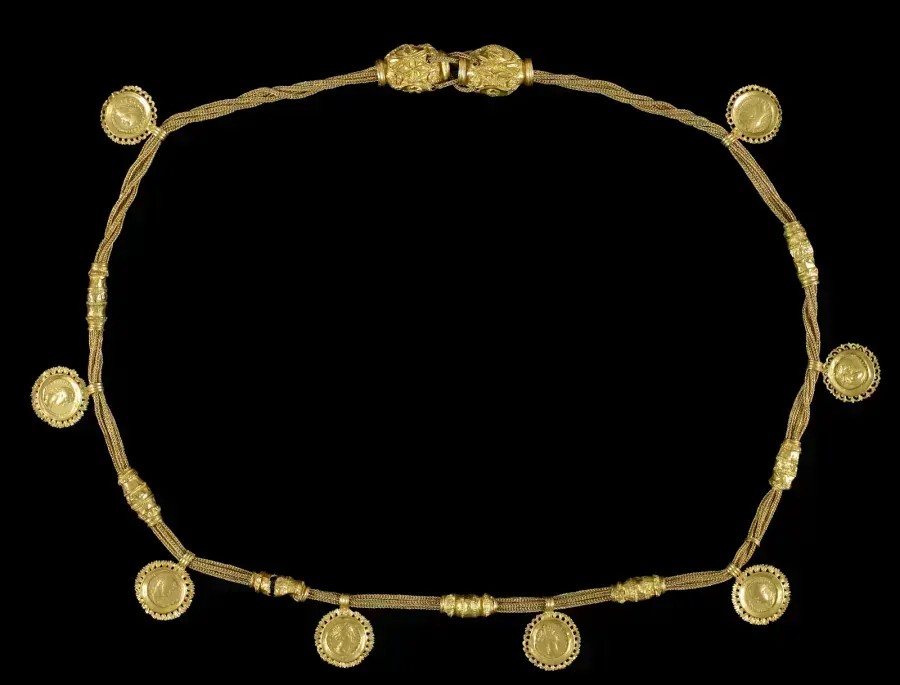
Multi-strand necklace
A multi-strand piece with several discs. A Mediterranean and Near Eastern tradition, often part of bridal ceremony in Greece, Cyprus, Lebanon and among diaspora communities in Britain. Premium range.
A coin wants a bare collarbone, not the stuffiness under a buttoned collar. And don't you dare polish the patina off: that is its passport, not dirt.
How to wear coin jewellery
Over years on shoots and private fittings the coin disc has passed through dozens of looks with me. Here is what actually works, sorted by occasion.
What do I wear a coin with every day? For daily wear I recommend a small or medium disc on a fine chain over a plain tee, a linen shirt or knitwear. The quieter the background (white, sand, graphite, khaki), the louder the metal speaks. A busy print swallows the disc, so I suggest keeping the fabric matte: linen, dense cotton, fine wool, suede. Under a V-neck the coin lands right in the centre, its strongest position.
Is it right for the office? Yes, as long as you keep it restrained. I recommend one neat disc in a smooth setting at mid length, with a shirt or a jacket, nothing piled on. Stud earrings from the same series pull the look together. A large multi-strand necklace I suggest leaving at home on a work day, while a small disc under the top button reads as a quiet detail.
How do I build an evening look? For evening I choose a large medallion or drop earrings. A dark dress with bare shoulders, smooth hair, and let the coin be the only accent. For a special, Mediterranean-minded occasion I suggest layering several discs on chains of different lengths over a summer dress.
How do I wear a coin in layers? A coin loves layers, but by one rule. I recommend adding one or two chains of different lengths, thin and without pendants, so the eye slides down while the disc stays the lead. Keep metals in one family: a gold coin wants a gold chain and warm stones, silver and bronze go with cool silver.
Who does a coin pendant actually suit? Anyone who likes pieces with a story and a quiet, understated force rather than a shiny pile. It sits equally well on a minimal look and in a bohemian one. Two rules that never fail. First: the more open the neckline, the longer the chain, so the disc lands on skin rather than fabric. Second: one disc on a clean chain always beats one squeezed between five pendants.

Turn on your camera, pick earrings, a pendant or a ring, and see the piece on yourself in real time.
Switch items in one tap.
Everything runs in your browser: no photo or video is ever uploaded.
Famous ancient coins worn as jewellery
Greek
Athenian tetradrachm (5th century BC). Athenian silver coinage. The owl of Athena on the reverse, her helmeted head on the obverse. One of the most recognised ancient coins in the world, found across the British Museum's collection.
Corinthian stater with Pegasus (6th-5th century BC). Silver coinage from Corinth, bearing the winged horse. Popular in collections with a mythological theme.
Syracuse decadrachm (5th century BC). One of the finest die-cut works of ancient numismatics, with the nymph Arethusa and a four-horse chariot. Originals appear at specialist auction. Replicas feature in premium jewellery.
Roman
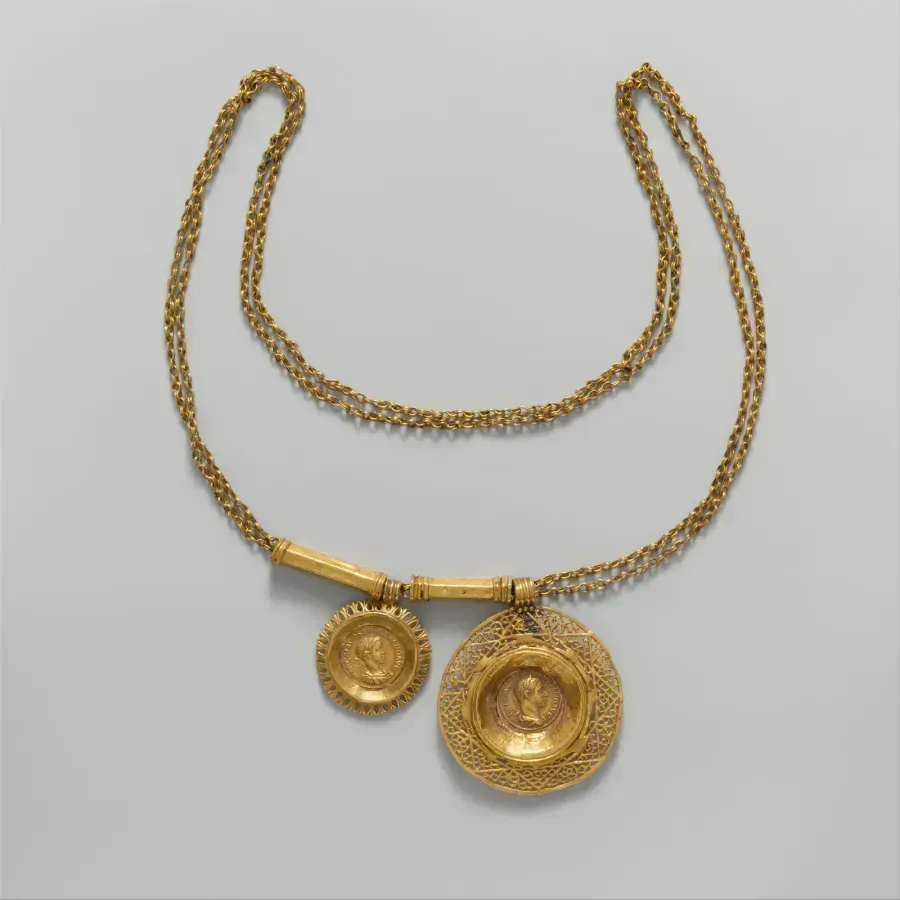
Denarius of Augustus. Silver coinage bearing the portrait of Rome's first emperor. A favourite for Roman-themed pieces and deeply connected to Britain's own history: millions of denarii circulated in Britannia during the occupation.
Aureus of Hadrian. The emperor who built the wall that still crosses northern England. Gold aurei of Hadrian carry particular resonance in Britain. A serious collector's piece.
Antoninianus. Bronze coinage of the 3rd century AD. Widely found across former Roman Britain, frequently offered at accessible prices. An excellent starting point for anyone wanting a genuine historical piece for everyday wear.
Sestertius. A large bronze disc. Detailed imperial portraits and reverse scenes make these visually striking as pendants.
Anglo-Saxon
Sceatta. Small silver penny of the 7th and 8th centuries, circulating across England and the North Sea trading network. Sceattas appear in considerable numbers in Britain's museum collections. Their small size makes them ideal as delicate pendants.
Gold mancus. Rare Anglo-Saxon gold coinage of the 9th century. More commonly encountered as a replica in premium jewellery.
Byzantine
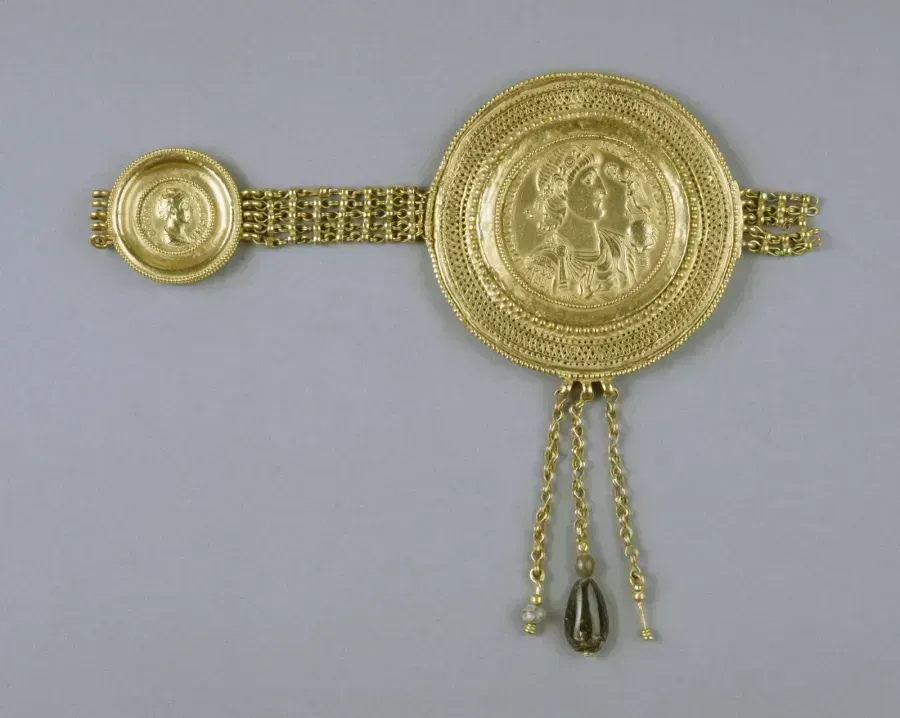
Solidus (nomisma). The gold standard of the medieval world, stable for over seven centuries. Christ on one face, the emperor on the other. Found in hoards across Britain, evidence of long-distance trade.
Miliaresion. Silver Byzantine coinage, often with a cross. Sought after in the Christian jewellery tradition.
Authentic coin vs replica
Choosing between a genuine historical coin and a modern replica is one of the first decisions any buyer faces.
An authentic coin. It has made its own journey through time, carrying the marks of that passage. Every specimen is unique. Prices vary considerably: a worn bronze antoninianus sits in the accessible range, a rare gold aureus in the luxury bracket. For daily wear, authentic coins require care: no rubbing, no chemical cleaning, no impact. But you are wearing a real historical object.
A quality replica. Many ancient coin types are reproduced by specialist workshops to a high degree of accuracy. A replica struck in sterling silver or gold from a cast of the original is indistinguishable to non-specialists and far more practical for everyday use. Price is typically in the mid range, roughly comparable to a good restaurant dinner, which is considerably more accessible than a genuine piece.
An interpreted design. A jeweller may create a piece in the antique spirit without reproducing a specific historical coin. These are original works. They are often among the most beautiful pieces available, though they carry no historical claim.
The ethical question. Buying authentic ancient coins raises legitimate concerns: provenance, export laws, the archaeology of the context that was destroyed when the object was removed from the ground. Countries including Italy, Greece, Egypt and Turkey maintain strict controls on the export of antiquities. The UK Treasure Act 1996 requires reporting of finds over 300 years old. Buy from reputable dealers with documented provenance.
Customer reviews
Zevira is a real jewellery shop. Genuine payments, deliveries and customer thank-yous.
🥰🥰🥰 gracias

Ok, ¡gracias! 🙂

What an ancient coin symbolises in jewellery
A coin pendant carries several layers of meaning at once.
Wealth and fortune. The obvious reading. A coin is money. As a piece of jewellery it becomes wealth made permanent, carried always. Across many cultures, from Chinese to Mediterranean to Latin American, coin jewellery is explicitly understood as a luck charm.
Contact with history. A genuine ancient coin carries literal information about a vanished world: a portrait, a Latin inscription, the image of a god. It is physical contact with a past that would otherwise be entirely abstract.
Eternity. It survived a thousand years before it reached you and will probably outlast you by several more centuries. That is a quietly sobering reminder of where any individual life sits within historical time.
Travel. Coins have always moved. A Roman denarius might have passed through Britannia, Egypt and Asia Minor within a single human lifetime. A coin pendant carries the suggestion of movement and of a world wider than one's own immediate circumstances.
Cultural belonging. A Greek tetradrachm speaks of Athens. A denarius speaks of Rome. A Byzantine solidus speaks of Constantinople. A choice of coin is also a choice of cultural affiliation. For people of Greek, Italian, Turkish or Levantine heritage living in Britain, this has particular meaning.
Memory of the dead. In some families, old coins are the closest thing to relics from grandparents and great-grandparents. An inherited coin set as a pendant is among the most personal gifts one generation can pass to the next.
Adventure. Spanish doubloons, pieces of eight, Caribbean hoards. A whole tradition of romantic association with seafaring, exploration and the kind of life lived at the edge of the known world. Many people are drawn to coin jewellery precisely because of that particular mythology.
Silver and gold jewellery, wedding rings, symbolic pieces and paired sets.
Who suits coin jewellery
History enthusiasts. Anyone who studied ancient history, classics or archaeology, or simply reads about it.
Travellers. Particularly those with a lasting attachment to Greece, Italy, Turkey, the eastern Mediterranean, or the landscapes of Roman Britain.
Numismatists. Coin collectors for whom a pendant is a natural extension of the hobby.
Academics and teachers. Historians, classicists, archaeologists and those who work with the ancient world professionally find coin jewellery a quiet form of professional identity.
People who value things built to last. The opposite of fast fashion in every sense. A coin that has survived eighteen centuries will survive being worn daily.
Those with classical-world heritage. Greek, Italian, Lebanese, Syrian or Turkish roots in Britain give coin jewellery a more personal dimension.
As a gift for a significant occasion. A graduation gift for someone reading history or classics. A wedding anniversary piece. An eighteenth birthday present for someone beginning to form their own sense of who they are.
Upload a photo of your pet, someone you love, or an object. We'll build a 3D model and hand-cast it in pewter.




A history of coins in jewellery
Coins have been worn as ornaments almost as long as they have existed as currency. The practice began in the Greek world during the 7th and 6th centuries BC and has never entirely stopped. On the wider timeline of 5,000 years of jewellery making, this is a relatively late chapter: by the time the first coins were struck, people had already been wearing pendants and seals for thirty centuries.
What made coins different from beads or carved seals was the combination of standardised size, intrinsic metal value, and legible imagery. A coin carried a face on it, usually a ruler or a god. Wearing that face communicated something specific: allegiance, devotion, status, captured luck. That double function, object of exchange and object of meaning, is why coins made the transition to jewellery so naturally and why the tradition has persisted across cultures that had nothing else in common.
Antiquity
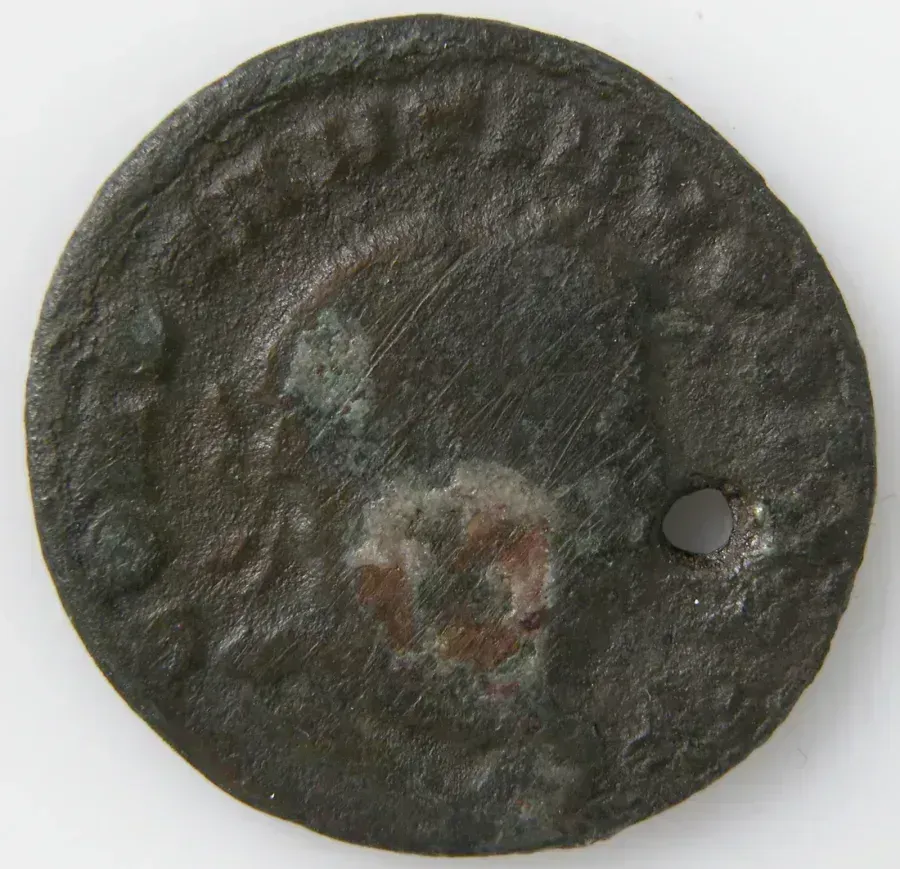
Greeks, Romans and Etruscans drilled holes in metal discs and suspended them on cords. It was not a mass practice, partly because coins were needed as money, but examples survive in museum collections worldwide, including the British Museum. Earlier still, in the Sumerian jewellery of the third millennium BC, the same role of "a marker of identity worn around the neck" was played by carved cylinder seals and lapis beads; by the time coins existed the idea of carrying authority on a cord was already old.
From the 1st century BC onwards, coin-shaped objects intended specifically as ornaments rather than currency began to appear. The distinction between coin and jewel became deliberately blurred.
The Roman tradition: aurei in bracelets, solidus pendants
Roman goldsmiths did not stop at drilling a hole. By the 1st century AD, gold aurei were being set in bracelets using a metal collar around the coin's edge, the type of mount now called a bezel setting. Sets of coin necklaces with soldered suspension loops survive from the 1st to 3rd centuries AD, and examples sit today in the British Museum's Roman collections. These were expensive objects: an aureus was worth twenty-five silver denarii, and wearing one as jewellery was a statement as much as a sentiment.
Soldiers wore trophy coins on their belts or as neck pieces. A foreign coin taken in battle was understood as a powerful charm: it carried the luck of a defeated enemy.
The Byzantine world
Byzantine craftsmen loved large gold jewellery, and coin discs were frequently incorporated as centrepieces. A solidus bearing Christ or the emperor was a common feature of Byzantine necklaces. This tradition moved westward through the Balkans and northward through trade.
Coin reliquaries represent a separate stream of this tradition. In monasteries across the Balkans and Asia Minor, ancient coins were incorporated into icon frames and reliquary caskets. A coin from a distant past carried the weight of continuous time and unbroken faith.
The stabilising power of the solidus across seven centuries was itself significant. From the 4th century reign of Constantine I until the 11th century debasement under Michael IV, the gold content of the nomisma remained essentially constant. That monetary reliability made it a symbol of permanence in a world prone to upheaval. When Byzantine jewellers set a solidus into a necklace, they were not just using a convenient disc of gold: they were invoking continuity itself as a quality. The same logic applies today when people choose genuine antique coins over replicas for significant occasions.
Medieval Britain and Europe
In medieval Britain, wearing coin jewellery was the preserve of the wealthy: the coins themselves were valuable. Royal and noble households wore pendants set with gold florins, ecus and bezants. The Cheapside Hoard (London, early 17th century), now in the Museum of London, contains jewellery set with coins from across the known world, evidence of a city at the centre of global trade.
The Mildenhall Treasure (Suffolk, found 1942), a collection of late Roman silver now held at the British Museum, demonstrates how deeply Roman precious metalwork penetrated the landscape of Britain long before the Norman Conquest.
The Grand Tour and Victorian passion for antiquity
The 18th and 19th centuries produced Britain's most sustained love affair with ancient coin jewellery. Wealthy men and women returning from the Grand Tour brought Greek, Roman and Byzantine coins back from Naples, Athens and Constantinople and had them set by London goldsmiths. The Hoxne Hoard (Suffolk, 1992), the largest Roman treasure ever found in Britain at the time of its discovery, reminded the modern public just how deeply Roman coins were embedded in the landscape of Britain. Victorian jewellers routinely set gold sovereigns as brooches and pendants. That practice survives today.
The archaeological jewellery movement of the mid-19th century formalised what had been an informal practice. Italian goldsmith Fortunato Pio Castellani, working in Rome from the 1830s, pioneered the systematic revival of ancient jewellery techniques alongside genuine antique coin settings. His work influenced jewellers across Britain and France. By the 1870s, archaeological jewellery, pieces that either used genuine ancient coins or evoked them closely, had become a recognisable strand of upper-middle-class taste in Britain, associated with classical education, serious travel, and a deliberate rejection of purely decorative ornament.
The Sutton Hoo tradition
The Sutton Hoo ship burial (Suffolk, 7th century AD) contained no coin jewellery in the strict sense, but it demonstrated the enormous status that came from controlling and displaying precious metal objects. Anglo-Saxon sceattas, the small silver pennies of the 7th and 8th centuries, circulated across the North Sea trading network and appear in considerable numbers in British museum collections. Anglo-Saxon aristocrats wore coin-like gold foils as pendants. The tradition of the wearable precious disc runs continuously through British history.
The 20th and 21st centuries
Interest in ancient and vintage jewellery rises and falls in cycles. The 1960s and 1970s saw a significant wave of ethnic and archaeological-inspired pieces. Since the early 2010s, appetite for things with genuine history behind them has grown steadily. The antique coin pendant is one of the forms that has benefited most from this shift.
The coin motif in jewellery today
Contemporary jewellers approach the coin motif from several distinct angles. Some source authenticated ancient coins and set them in hand-fabricated mounts, treating the coin as the centrepiece of a bespoke piece. Others commission casts from museum originals and strike replicas in precious metal, which allows exact fidelity to a historical type without the fragility or legal complications of an original.
A third approach, increasingly common among studio jewellers, takes the coin as aesthetic inspiration rather than direct reproduction. These pieces share the proportions and weight of a struck disc but carry original imagery: a portrait drawn from life, an animal motif rooted in local natural history, an abstracted design derived from the geometric patterns found on particular coinage traditions. The result is neither historical document nor novelty item but something in between, a contemporary object with deep formal roots.
The appeal crosses demographics in ways that many other jewellery motifs do not. Coin jewellery is worn by people who collect ancient history as a serious pursuit and by people who simply like the weight and solidity of a round metal disc. That breadth of audience is one reason why the motif persists across fashion cycles where more obviously trend-driven forms do not.





Coin jewellery across different materials and forms
Beyond the pendant, the coin disc appears across a wide range of jewellery forms, each with its own logic and heritage.
The signet ring. A coin set flat into a bezel ring creates one of the most ancient forms of personal jewellery. Roman citizens used signet rings to seal documents; a coin in place of an intaglio simply replaces one flat disc with another. For men in particular, a signet ring set with a sestertius or antoninianus is one of the few pieces of male jewellery that carries no ambiguity about its seriousness.
Stacked bracelets. Several coin charms on a single chain bracelet, or a charm added to an existing chain, builds a layered effect that reads as collected over time rather than bought complete. This is the aesthetic of the souvenir, the memorial, the accumulated life.
The torque or collar. In some high-end interpretations, coin discs are set along the length of a rigid collar or torque, referencing Iron Age and Celtic metalwork traditions directly. These are substantial pieces, worn in place of a necklace rather than with one.
The hairpin or comb. Less common but historically attested: coin discs fixed to hairpins or combs. Roman women wore these, and the form appears in Byzantine and Ottoman metalwork. Contemporary versions exist, particularly in markets with strong Mediterranean heritage communities.
Mounting techniques
How a coin is set determines both its preservation and how the piece looks when worn. There are five main approaches.
Bezel setting. A metal collar runs around the coin's full circumference, holding it securely. The most protective option for genuine antique coins. The downside: the bezel covers part of the design around the edge.
Claw setting. Several small metal prongs hold the coin at its edges, leaving both faces fully visible including the reverse. Less protective than a bezel, better suited to replicas or coins that will be worn occasionally.
Pendant bail. A loop is soldered to the coin's edge, or threaded through an existing hole, allowing the coin to hang freely. The most historically authentic approach: Romans used exactly this method. Works well for coins with a natural hole or thickened rim.
Frame with safety catch. The coin sits inside a hinged frame that closes with a clasp, like a locket. The coin can be removed if needed. A sensible choice for inherited pieces or coins of sentimental value.
Swivel mount. The coin is set on a pivot so it can rotate to show both faces. Popular in numismatic jewellery where the reverse carries as much interest as the obverse.
Leave your email, we'll send your discount code. No spam, unsubscribe anytime.
The code arrives by email, valid on your first order.
Significant hoards and British finds
Most coins on the open antique market descend from documented hoards. Several of the most important are closely connected to Britain.
Hoxne Hoard (Suffolk, 1992). Found with a metal detector. Over 14,000 late Roman coins from the 4th and 5th centuries AD, gold jewellery and silver tableware. Held at the British Museum. The largest Roman gold and silver treasure ever found in Britain and one of the great late-Roman finds anywhere in Europe.
Mildenhall Treasure (Suffolk, found 1942). Late Roman silver of extraordinary quality, now at the British Museum. While primarily tableware rather than coins, it illustrates the depth of Roman material culture in the British landscape.
Sutton Hoo (Suffolk, 7th century AD). The ship burial contained Frankish gold coins and coin-like gold foils, demonstrating Anglo-Saxon engagement with Continental monetary culture.
Trierer Goldmuenzenfund (Trier, Germany, 1993). Around 2,600 late Roman gold coins of the 3rd and 4th centuries. The largest known hoard of late Roman gold. Held at the Rheinisches Landesmuseum Trier.
Manching Celtic Hoard (Bavaria, found 1999). Over 400 Celtic gold coins from the 2nd century BC, found at the site of the Celtic oppidum at Manching. Stolen from Manching Museum in 2022, the case highlighted the vulnerability of numismatic collections.
CAPAORA mini knife pendant
The 18th-century Spanish navaja in miniature: 40 mm of stainless steel, a real folding mechanism and a Palanquilla lock that clicks. An affordable gift to remember.
Authentic · Ships from Spain · 14-day returns
Authenticating coins: what to look for
The antique coin market contains a significant number of forgeries. A few practical reference points.
Patina. On genuine coins, patina accumulates unevenly: heavier in the recesses of the design, thinner on raised surfaces. Chemically induced or artificially applied patina tends to be uniform. A sharp boundary between apparently aged and apparently clean areas is a warning sign.
Weight. Many replicas use less metal than originals and are therefore lighter. A genuine Roman denarius weighs between 3.1 and 3.9 grams depending on the period of issue. Significant deviation from known standards warrants scrutiny.
Edge. Ancient coins were struck by hand and typically have slightly irregular edges. A coin presented as antique with a perfectly machined rim is inconsistent.
Provenance documentation. A reputable dealer will provide documentation: the collection or hoard the coin came from, when it was recorded, which auction houses it has passed through. Major auction houses including Bonhams, Spink and Sotheby's publish provenance in their catalogues. Absence of documentation does not prove forgery, but it reduces confidence considerably.
Professional assessment. When in doubt, consult a professional numismatist or approach a recognised numismatic society before purchasing.
The ethics of buying antique coins
The international market in ancient coins is regulated by convention and national law. Several things are worth understanding before a purchase.
Greece, Italy, Turkey and Egypt have some of the strictest cultural property laws in the world. Exporting coins without proper documentation is treated as trafficking in cultural property. A coin purchased from an unreliable source may not simply lack paperwork; it may be legally compromised.
The UK Treasure Act 1996 requires that finds of coins more than 300 years old be reported to the local coroner within 14 days. The Crown assesses declared treasure; finders may receive a reward. Independent excavation and sale of finds is a criminal offence.
Reputable dealers supply full provenance. Check it. Museum-quality replicas in bronze or silver, produced from casts of originals, offer the same visual result without legal risk, and many major museums sell high-quality reproductions in their shops.
Coins across cultures
Britain and Rome
Britain was part of the Roman Empire for nearly four centuries, from AD 43 to around 410. Millions of Roman coins circulated across Britannia. Finds from the Thames foreshore, ploughed fields and recorded hoards are a constant reminder that this landscape was once Roman. Wearing Roman coin jewellery here carries a locational meaning that it does not carry anywhere else.
Greece
The Athenian tetradrachm, with its owl, is a national symbol. The coins of Magna Graecia (the Greek cities of southern Italy and Sicily) are among the finest artistic achievements of the ancient world, and frequently appear in British museum collections alongside pieces from the mainland.
Italy
Italy inherited and preserved the ancient Roman coin tradition. In contemporary Italian goldsmithing, coin pendants are a classic form. The ducato veneziano and the fiorino fiorentino both had enormous influence on European monetary culture.
The Eastern Mediterranean
Greek communities, particularly in Cyprus and among diaspora populations in London, retain the tradition of gold disc necklaces as bridal gifts. Similar traditions exist in Lebanese, Syrian and Armenian communities.
The Ottoman world
Ottoman altins and akce appear in jewellery made for multicultural European markets. In Britain, with significant Turkish-Cypriot and Turkish communities, Ottoman coin jewellery has its own resonance.
China
The Chinese cash coin, a round disc with a square central hole, represents the harmony of heaven (the circle) and earth (the square). It is threaded on red cord and worn as a prosperity charm. Widely available in Britain and among British Chinese communities.
Luck coins and lucky charms
Not all coin jewellery derives from historical currency. Alongside genuine antique pieces, there is a strong tradition of purpose-made luck tokens.
Chinese cash coin. Round with a square hole. A symbol of cosmic harmony and prosperity, frequently incorporated into pendants and bracelets.
St Christopher medal. Strictly not a coin but a medal, round in form, bearing the patron of travellers. Widely worn in Britain, particularly among Catholics and those with Mediterranean heritage.
Miraculous Medal. The medal of Our Lady of Grace, originating in 19th-century France but widely worn in Britain's Catholic communities. Round, coin-like in form.
Coronation coins. Special commemorative strikes issued at coronations have been kept and worn as family heirlooms for generations. Edward VII, George V, Elizabeth II, Charles III: each coronation produced pieces that entered jewellery cabinets rather than coin collections.
Sovereigns. The gold sovereign, minted continuously from 1489 with various interruptions to the present day, has been the English coin most consistently worn as jewellery. Victorian and Edwardian sovereign brooches and pendants are still found in antique shops and inherited through families.
Send a friend a discount code, they save on their first order.
Mount materials
The material of the setting affects longevity, price and the overall character of the piece.
Solid gold (14-18 carat). The appropriate choice for a genuine antique coin. It does not tarnish, does not corrode, and is hypoallergenic. A solid gold mount will last as many centuries as the coin already has.
Sterling silver (925). The standard for the mid-market. Silver tarnishes slowly and benefits from occasional polishing, though only the mount, never the coin itself. Well suited to bronze and silver ancient coins.
Gold-filled silver. A practical compromise. Looks like gold, costs considerably less. The gold layer can thin at points of friction over time. Suitable for replica coins worn regularly.
Bronze. Rarely used for coin settings, occasionally for historical reconstructions. Darkens and develops its own patina over time.
Caring for coin jewellery
The fundamental rule: do not polish the coin. Patina is not dirt. It is the natural protective layer that has formed over centuries, and it is part of the coin's identity, authenticity and value. A freshly polished ancient coin loses both its collector value and much of its character.
What is acceptable: wipe with a soft dry microfibre cloth. Avoid unnecessary exposure to water. Remove before swimming (gold settings are not harmed by water, but chlorine or salt water is unwelcome). Store in a soft pouch or case, separate from other pieces.
For genuine antique coins, the setting itself may need attention over the years: a bezel can loosen, a bail can wear thin at the solder point. Take the piece to a jeweller who works with antique materials before any problem develops rather than after.
If you wear coin jewellery daily alongside other pieces, the greatest risk is contact abrasion: a harder piece of jewellery scratching the surface of the coin or abrading its patina. Store and wear coin pieces separately from harder stones and metals where possible.
Frequently asked questions
Will a genuine coin survive daily wear?
It depends on the specimen and the setting. Silver coins, particularly Roman denarii, are more durable than gold ones. In a closed bezel setting, the coin is well protected. On an open mount or cord, edges can wear, especially against clothing. For daily wear, a replica is the more practical choice if the coin is precious.
How do I clean an ancient coin in a pendant?
Do not clean it yourself. The patina and surface deposits are part of the coin's identity and often of its value. If cleaning is genuinely needed, consult a numismatist or a specialist in old jewellery restoration.
What is the difference between an original and a replica?
An original is datable, provenance-traceable and has survived from its period of issue. A replica is a modern reproduction. To the non-specialist eye they can look identical. The price difference is typically considerable.
My setting has broken. What should I do?
Take it to a jeweller. Do not attempt to repair it yourself, especially if the coin inside is an original.
Can I wear it as a luck charm?
Yes. That is one of the oldest functions of coin jewellery and requires no further justification.
Which coin should I choose first?
For a first piece, a Roman bronze antoninianus or follis of the 3rd or 4th century AD is a sensible starting point. Widely found across former Roman Britain, available at accessible prices, visually legible and requiring no special maintenance. If you feel drawn to a particular period or culture, start there.
Is it suitable as a wedding gift?
In Greek, Italian, Turkish and Levantine tradition, yes: gold disc necklaces have long been bridal gifts. In mainstream British tradition it is less common but entirely meaningful, particularly for couples with a shared interest in history or travel.
What makes some coins more sought after than others for jewellery?
Visual legibility matters more than rarity for wearable pieces. A coin with a clear portrait, a recognisable deity or a well-preserved design reads well when worn; a worn, blurry coin does not. Among Greek coins, the owl tetradrachm of Athens and the nymph Arethusa of Syracuse are repeatedly chosen because their designs are sharp and instantly readable at arm's length. Among Roman coins, coins of Augustus, Hadrian and Marcus Aurelius are frequently chosen because the portraits are among the best-preserved and most artistically accomplished in the series. The sestertius is popular as a pendant specifically because it is large: the portrait fills the disc in a way that smaller denominations cannot.
Can the same coin appear in multiple pieces?
Genuine ancient coins exist in unique specimens; you cannot have the same original twice. Replica workshops, however, produce the same type in multiple strikes. If you are buying a replica and want to know whether you are the only owner of that exact type, the answer is no: replicas are produced in editions. If uniqueness matters to you, an authentic specimen is the only option, accepting all the care that entails.
What does the portrait on a coin actually show?
On most Greek coins it shows a deity associated with the issuing city: Athena on Athenian coins, Apollo on Delphi, the nymph Arethusa on Syracuse. Roman coins from the 1st century BC onward show the reigning ruler or members of the imperial family. The portrait became increasingly realistic under the Empire; coins of the 1st and 2nd centuries AD include some of the most accomplished portrait sculpture of the Roman world, the face of an emperor rendered in a few millimetres of metal with extraordinary precision. Byzantine coins show Christ from the 10th century onward, and the emperor on the reverse. Medieval European coins show royal profiles in a more stylised register.
What if I find a coin myself?
Under the UK Treasure Act 1996, finds of coins more than 300 years old must be reported to the local coroner within 14 days. Failure to report is a criminal offence. Coins declared as treasure are assessed by the Crown; finders may receive a reward. Do not attempt to excavate or sell finds independently.
Is coin jewellery only for women?
No, and historically it was not. Roman soldiers wore coin pendants. Medieval knights wore coin-set brooches. The signet ring with an antique disc is a long-established piece of male jewellery. Coin jewellery sits outside the gendered categories of most contemporary jewellery, which is part of its appeal to people who find those categories restrictive.
How do I know if a dealer is reputable?
Look for membership of a recognised numismatic body such as the British Numismatic Trade Association (BNTA) or the International Association of Professional Numismatists (IAPN). Reputable dealers list provenance in writing, accept returns if a coin proves to be misrepresented, and can provide references. Be cautious about online sellers who describe coins as "uncleaned" or "just excavated" without supporting documentation.
Buying it as a gift? Each one arrives ready to give.
 A branded Zevira box and a little card come with every order.













Conclusion
An ancient coin set in silver or gold is one of the few pieces of jewellery that contains a genuine and direct connection to a world that no longer exists. Not a reference to it, not a stylistic echo, but a physical object that was made, handled and used by people who lived in a different civilisation.
That paradox, wearing something two thousand years old as casually as a watch or a pair of earrings, gives coin jewellery a particular quality. It is simultaneously ordinary (it is just a piece of metal with a picture on it) and extraordinary (it has survived longer than most things built to survive). It reminds you, without making a fuss about it, that you occupy a very small part of a very long story.
Zevira makes jewellery in the artisan tradition of Albacete, Spain, in a tradition that sits at the intersection of Roman, Moorish and Atlantic European craft. Open the catalogue
About Zevira
Zevira makes jewellery in the artisan tradition of Albacete, Spain. The coin motif feels native to us: the Iberian Peninsula lived through Iberian, Roman, Visigothic, Moorish and Atlantic coinage, and that layered numismatic history sits at the foundation of how we work.
What you will find in our coin range:
- Pendants holding a coin disc in a bezel setting, for genuine strikes and replicas alike
- Signet rings set with an antique disc in place of an intaglio
- Pieces on chain and leather cord in the Mediterranean spirit
- Minimalist discs on a fine chain for everyday wear
- Paired sets of pendant and matching coin studs
- Mounts built for gold and bronze coins, with the patina properly protected
Every piece can be personalised with engraving, with the option of personal engraving. Sterling silver 925 and 14-18K gold.