Azabache: Spanish Jet in Jewellery, Meaning and Protection
Introduction: The Stone That Is Not a Stone
You walk into a jeweller's shop in Santiago de Compostela. On the counter sits a small black fist, thumb pressed between index and middle finger, gleaming like resin in the sunlight. The shopkeeper looks up and says: "That's a higa made of azabache. It's for a child. Against the evil eye."
This is how azabache has worked in Spain for two thousand years. Not quite jewellery in the conventional sense, but a talisman. A grandmother, a godmother, an aunt buys the piece and gives it to the newborn. A cord on the wrist, a small pendant on the pram, a little bracelet on the ankle. Often the first object a child receives after baptism.
And yet azabache is not, strictly speaking, a stone. It is coal. Very old, very dense, very black coal that polishes to a mirror shine. An organic material formed from trees that fell into prehistoric swamps 180 million years ago.
For British readers, the parallel is Whitby jet from Yorkshire, the defining material of Victorian mourning jewellery after Prince Albert's death in 1861. Spanish azabache and English jet share the same geological origin; they differ in geography, cultural narrative, and the traditions they carry.
This guide covers what azabache is, where it comes from, why people wear it, and how to choose a piece.
Geology: What Azabache Actually Is
Azabache is routinely called a stone, which is not quite accurate. It is better described as fossilised lignite: a dense organic carbon formed from the wood of Mesozoic conifers, principally from the genus Araucaria.
The process worked as follows. Trees growing 180 million years ago in the warm swamp forests of the Jurassic period fell into water and were buried under sedimentary rock without oxygen. Instead of rotting, the wood compressed over millions of years into a dense organic carbon mass. That process took tens of millions of years. The result is a material with properties that set it clearly apart from ordinary gemstones.
- Mohs hardness: 2.5 to 4. This is exceptionally soft. A human fingernail can scratch azabache with moderate pressure. Common obsidian is roughly twice as hard.
- Density: 1.3 to 1.4 g/cm3. Azabache is remarkably light. Glass is about twice as heavy; most minerals are heavier still.
- Colour: a deep, matte-resinous black that, after polishing, develops a characteristic mirror gloss with an inner sense of depth that no glass or plastic imitation fully replicates.
- Composition: organic carbon with small amounts of sulphur and resins. This is why azabache smells of coal and sulphur when burned, and why scratching it leaves a brownish streak rather than a black one.
These physical properties matter for more than academic reasons. They directly determine how azabache jewellery should be worn, stored, and cleaned.
Spanish Deposits
The most important active deposit lies in the El Bierzo area of Asturias. This is the primary source of raw material for Santiago's workshops today. Secondary deposits exist in Galicia, particularly around Compostela itself.
Two historically significant but largely exhausted sources are Antequera in Málaga and Utrillas in Teruel. The latter is mentioned in medieval chronicles as a supply point for Galician craftsmen.
Spanish azabache is distinguished by its compactness and depth of colour. Its composition is comparable to British Whitby jet from Yorkshire: both formed from Jurassic conifers, both show a layered structure when fractured. Whitby jet is slightly softer and carries a warmer colour tone; Asturian azabache delivers a denser, more saturated black.
Azabache, Cannel Coal, and Lignite
In the nineteenth century, British experts debated which materials qualified as genuine jet. The conclusion: true jet, whether Spanish azabache or Whitby jet, is distinguished from cannel coal by more uniform texture and stronger polish, and from common lignite by its significantly higher density. Both Spanish and British varieties are still considered the world's finest grades.
Is Azabache a Stone or a Mineral?
The question comes up constantly in shops, and the honest answer is neither. Azabache has no crystal lattice, so it fails the basic definition of a mineral, and it is not rock either. It is fossilised wood: lignite from Jurassic conifers, squeezed for roughly 180 million years until it turned into a dense, polishable carbon. Gemmologists file it with the organic gems, alongside amber, coral, pearl and tortoiseshell, because it began as living matter rather than as geology. That classification explains every one of its oddities at once. It is soft where a mineral would be hard, light where a mineral would be dense, warm to the skin where a mineral would be cold, and vulnerable to heat where a mineral would shrug it off. When a jeweller calls it a black stone, that is a convenient shorthand rather than a technical claim. Strictly speaking, azabache belongs to the fossilised plant kingdom, which is also why every care instruction in this guide reads more like the advice you would give for amber than for onyx.
Azabache in English: Why It Is Called Jet
Anyone searching azabache in English quickly hits a translation gap. The English word is simply jet, the same material Victorian Britain mined at Whitby, and there is no separate English term for the Spanish variety. So azabache in English is jet, and more precisely Spanish jet or Asturian jet when the origin matters. This is more than a dictionary note. Because English-speaking shoppers know the word jet mainly from antique mourning jewellery, they often miss that the Spanish tradition is alive and centred on infant protection rather than on grief. When a listing says azabache, read jet; when it says jet, remember that the Galician amulet and the Whitby brooch are the same black fossil wood put to very different cultural uses.
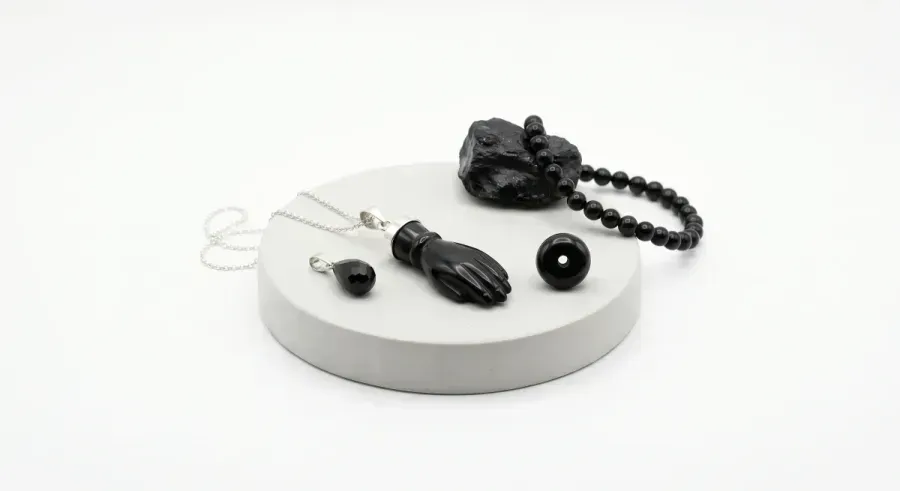
Azabache on white linen and silver. Black on black buries the stone, give jet some light.
How to wear azabache
Over years on set I have styled azabache in dozens of looks, from a baby's higa to a heavy gothic medallion. Black jet is trickier than it looks, so here is what actually works, occasion by occasion.
What goes with azabache day to day? For everyday I recommend white linen or pale cotton and a small bead pendant on a thin chain. Azabache is warm, matte and light, so against a pale background it reads as a deep black mark, not a dark void. Silver beside it lifts the contrast better than gold, so I choose a silver setting or chain. One rule I keep firm: black on black buries the stone, so I never pick a dark top under azabache.
Does it belong at the office? It does, as long as you keep it minimal. I suggest a round bead pendant of one to two centimetres on a short chain, under a closed or business neckline. Azabache has no glassy glare; it reads as a calm dark stone and never fights with a shirt or blouse. Under a jacket it stays a quiet detail rather than the focus, so a strict dress code is no obstacle.
How do you build an evening or gothic look? For evening or gothic I choose a large medallion or drop earrings and give them a light frame. Silver filigree or a white pearl nearby draws the resinous depth out of the jet, which is the whole reason to wear it. I recommend an open neckline and one strong accent, not a cluster of pendants. Azabache is matte and sombre, more honest than cold glossy onyx, and against bare skin at the collarbones it looks composed rather than heavy.
What about the Camino or a token of mourning? For the Camino de Santiago I keep it classic: azabache with a concha shell on a cord, bought at the start of the road. It is an old traveller's amulet, and I recommend wearing it openly. For a mourning look I suggest a calm dark pendant with no sparkle, muted silver and a simple shape. The tone stays restrained, and I add nothing decorative.
Who does it actually suit? Anyone who loves quiet pieces with history and depth rather than bright glitter. Azabache sits well on minimalism, on layers and on gothic alike. Two rules never fail me. First, give the jet light: pale clothing and silver beside it, not black on black. Second, azabache is soft and light, so protect it from harder stones in a stack and let it carry a look as a single accent.

Turn on your camera, pick earrings, a pendant or a ring, and see the piece on yourself in real time.
Switch items in one tap.
Everything runs in your browser: no photo or video is ever uploaded.
Wear the symbol, don't just read about it. These are in stock:








Azabache Jewellery: What to Choose
The Child's Higa (higa de azabache)
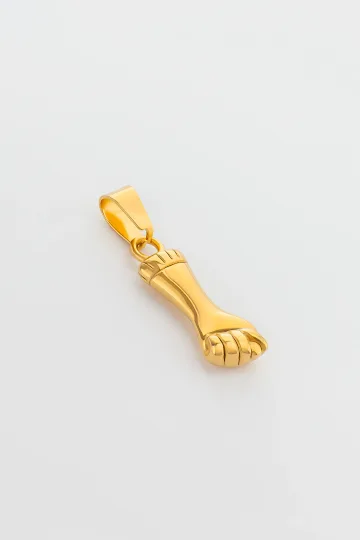
The classic protective amulet for newborns. A small fist 2-3 cm in length, thumb wedged between index and middle fingers (the higa gesture, a Mediterranean ward against the evil eye).
- On a cord or chain for a newborn, fastened to the pram or clothing. Budget to mid-range.
- Mini bracelet with higa for a toddler. Budget to mid-range.
- Higa pendant in a silver setting more durable, for longer wear. Mid-range.
The Concha (Pilgrim's Shell)
The scallop shell, "concha de vieira" in Spanish, is the official emblem of the pilgrimage to Santiago de Compostela. Carved from azabache, it carries two layers of meaning at once: the pilgrimage route and the apotropaic protection against harm on the road. Medieval pilgrims purchased these carvings on arriving in Compostela; finds from pilgrim graves across Europe confirm the practice.
The Cross (Cruz de Caravaca and Cruz de Lázaro)
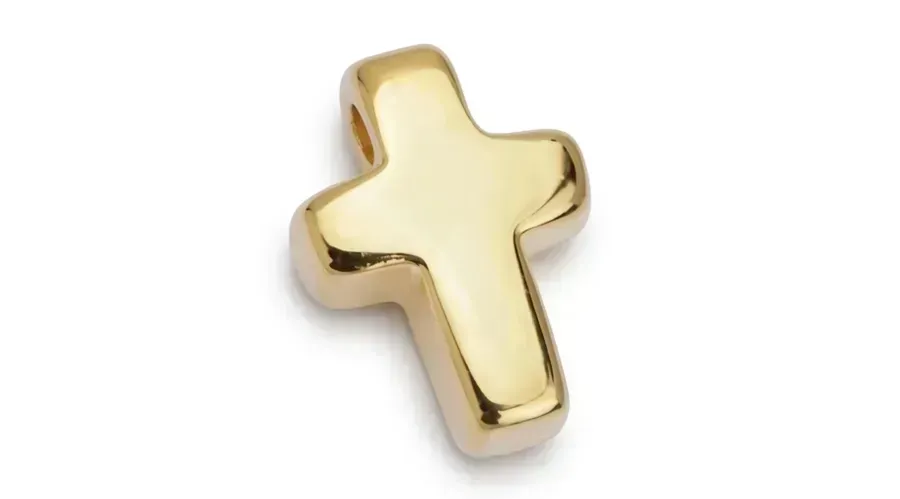
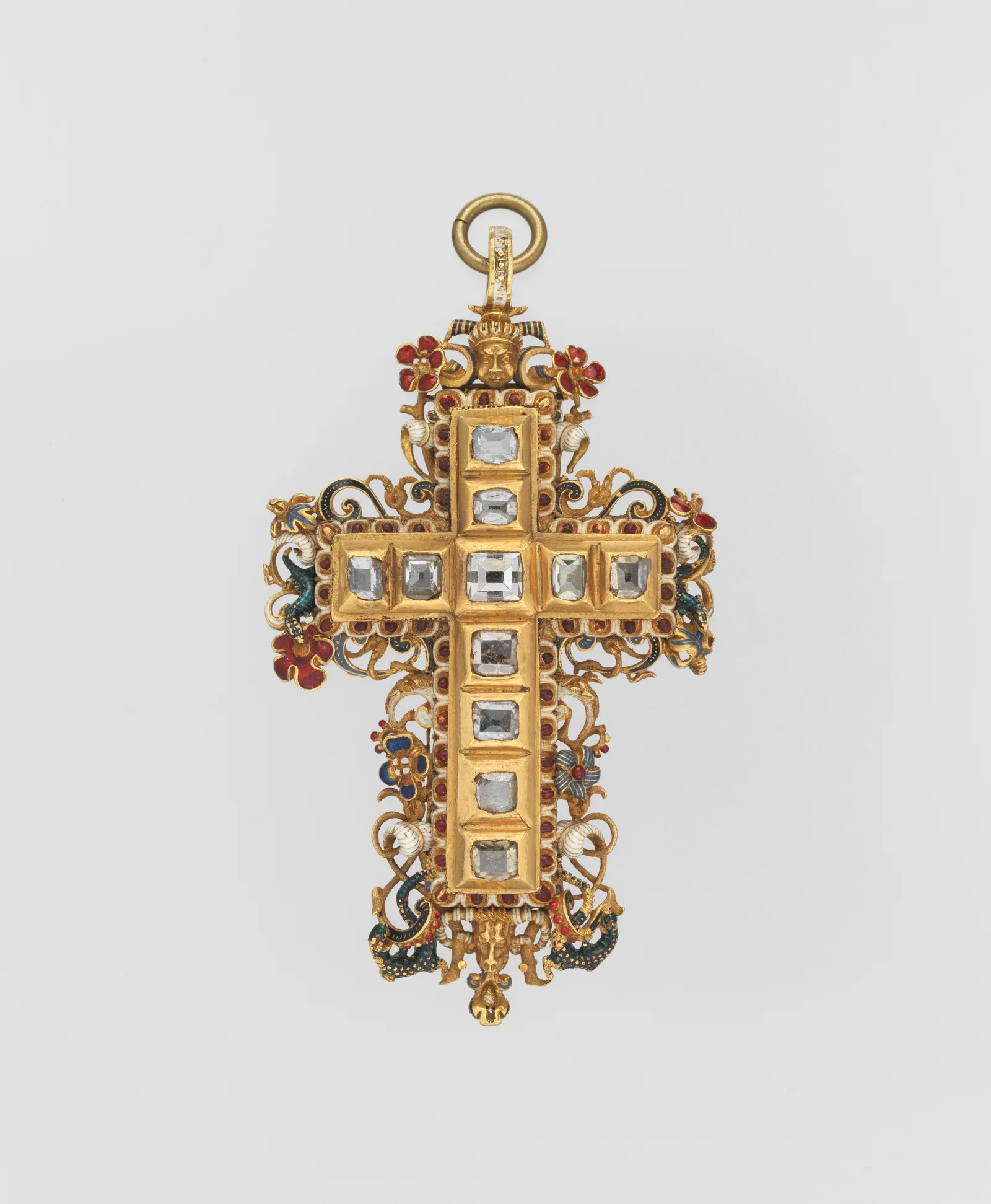
Two crosses recur in azabache and neither is an ordinary crucifix. The Caravaca cross carries a distinctive double crossbar and comes from the town of Caravaca de la Cruz in Murcia, a pilgrimage site in its own right; in Spanish folk practice it was hung over doorways and cradles as much as worn, and in jet it became a standard medallion format. The cross of Saint Lazarus, plain and single-barred, was historically worn against sickness and plague, Lazarus being the patron invoked against leprosy and contagion. Both forms sit oddly close to the higa in intent, which is precisely the point: a Galician workshop would carve a protective fist and a protective cross from the same blank on the same afternoon, and a customer often bought one of each. For British buyers the Caravaca form is the more recognisable of the two, since its silhouette turns up in Spanish antique jewellery that reached English collections through the nineteenth-century trade.
Classic Pendant
For adults at any age.
- Round bead pendant 1-2 cm minimalist, everyday. Budget range.
- Engraved pendant with motif Santiago shell, cross, higa, Celtic knot. Mid-range.
- Large medallion pendant 3-5 cm for a statement piece or gothic aesthetic. Mid to premium range.
Earrings
- Small azabache studs paired, black, versatile. Budget to mid-range.
- Drop earrings with azabache and silver the contrast of black and white metal. Mid-range.
- Large drop earrings gothic aesthetic. Mid-range.
Bracelet
- Simple cord with a single azabache bead the traditional format, adult-friendly.
- Bracelet of several beads mala style, for meditation or protection.
- Silver bracelet with azabache insert a more formal option.
Ring
- Flat-top ring with azabache insert minimalist, masculine.
- Ring with a black cabochon universally wearable.
- Signet ring with engraved azabache centre premium format with motif or monogram.
Rosary (rosario) of Azabache
Traditional Catholic prayer beads made of azabache. Popular in Galicia and Asturias, and carried home by Camino pilgrims.
Combinations with Other Materials
Azabache pairs well with several traditional materials that amplify its cultural resonance.
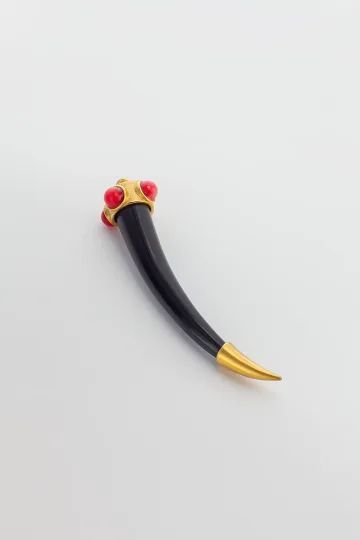
With coral. The combination of azabache and coral is one of the oldest in Spanish protective tradition. Coral was associated with the sea; azabache with the earth. Together they were considered protection across both elements. Galician fishermen wore such pairings at sea, and the combination remains part of Asturian folk jewellery to this day.
With silver filigree. Galician jewellery craft is renowned for its delicate silver lacework, known locally as "encaje de piedra." Azabache set into Galician silver filigree is the classic form of regional craftsmanship. The openwork silver setting frames and deepens the black, creating an effect that polished cabochon alone does not achieve.
With pearls. A Mediterranean luxury combination. The contrast of white and black, sea-born pearl and earth-formed coal, appears in historical Portuguese and Spanish jewellery from the sixteenth and seventeenth centuries.
With religious medals. In Spanish folk Catholic tradition, azabache was sometimes worn alongside a saint's medallion or a double scapular. The combination was organic: an apotropaic amulet and a church symbol worn together, each reinforcing the protective intent.
Types of Azabache in Jewellery
Engraved
With Moorish, Celtic or Christian motifs on the surface. Galician craftsmen have specialised in this technique for centuries.
Polished Cabochons
Smooth, mirror-polished. A deep, reflective black field. Used in minimalist and gothic jewellery.
Combined with Silver
Azabache inserts in a silver setting. The most common form. The contrast of warm silver and deep black works visually.
With Gold
A more premium option. Black and yellow contrast for romantic or high gothic pieces.
Natural (Unworked)
Pieces of azabache in their raw form, unpolished. A rare aesthetic suited to bohemian jewellery.
Combined with Cord
Azabache beads on leather or silk cord. The simplest but most expressive form.
What Azabache Symbolises
Protection from the Evil Eye (mal de ojo)
The oldest and most central meaning. Spanish and especially Galician tradition holds that azabache's black colour absorbs negative energy. The amulet works on two levels:
- Symbolic (the child is protected by a visible sign, understood by everyone who sees it)
- Cultural (for those who believe, azabache actively deflects harm)
Mourning and Memory
In Victorian Britain, jet from Whitby became the defining material for mourning jewellery after Prince Albert's death in 1861. Queen Victoria wore black for forty years, shaping European fashion. Spanish azabache carried a parallel mourning role in Catholic tradition, worn by widows in black as an alternative to coloured jewellery.
Organic Origin and the Earth
Azabache is not a mineral stone but fossilised wood. For many wearers, this means a connection to the plant world and to deep geological time: 180 million years compressed into something that fits on a cord.
Pilgrimage and Santiago
In Galician tradition, azabache is the symbol of the Camino de Santiago. Pilgrims buy azabache figures in Santiago de Compostela as a permanent record of the journey. For British pilgrims especially, carrying a Santiago shell alongside a piece of azabache has become part of the Camino identity.
Widowhood and Mourning
In Spanish Catholic tradition, azabache was worn by widows as a sign of mourning. This practice has nearly disappeared, but it remains present in cultural memory.
Men's Protection
Although azabache is most often associated with women and children, a male tradition exists. Sailors, fishermen, and men in dangerous occupations wore azabache to guard against harm at sea and in the natural world.
Azabache Meaning: The Short Answer
People search for azabache meaning expecting a single line, so here it is. Azabache is Spanish jet, a black fossilised wood worn for one core purpose: protection against the evil eye. In Galician, Asturian and wider Iberian tradition the black material is believed to absorb envious or harmful attention before it reaches the wearer, which is why the classic gift is a fist-shaped charm tied to a newborn. Everything else layered onto azabache over the centuries, mourning, pilgrimage, status, grows out of that founding idea. When a Spanish grandmother hands over a piece, the message is compact and old: may nothing harmful settle on you.
Azabache Spiritual Meaning
The azabache spiritual meaning sits a step beyond simple superstition. Because the material is fossil wood, roughly 180 million years of compressed plant matter, many wearers read it as a grounding object that ties them to deep time and the earth rather than to a mineral kingdom. In folk belief the black surface is thought to draw off heavy or intrusive energy, acting like a small emotional shield rather than a lucky charm that attracts good fortune. That distinction matters: azabache is defensive, not acquisitive. It is asked to keep something away, not to bring something in, which is why it has always belonged to the vocabulary of protection and mourning rather than of wealth or romance.
The History of Azabache in Spain
Prehistoric Period
The earliest azabache ornaments were found in caves in Asturias, dating to around 12,000 BCE. These are among the oldest personal ornaments found in Europe: round pieces of azabache with a hole bored for a cord. The material's black colour and unusual warmth to the touch apparently distinguished it from ordinary stones from the very beginning.
The Roman Period
The Romans prized azabache as a magical material. Pliny the Elder in his Natural History (first century CE) describes "gagatis lapis" (the stone from Gagai) and its properties in detail. Roman soldiers carried azabache amulets on campaign; excavations of Roman military sites have found azabache in soldiers' graves. Pliny attributed to it the power to repel serpents, ease toothache, and detect epilepsy, writing that when burned in a room it expelled evil. These claims were repeated by later medieval encyclopedists, ensuring azabache's reputation survived the end of the Roman world.
Early Christian and Medieval Spain: The Camino Transforms Everything
From the fourth and fifth centuries, azabache became the principal material of Galician jewellery. This coincides with the emergence of the cult of Saint James (Santiago) and the first pilgrimages to Compostela.
The decisive transformation came in the ninth and tenth centuries, when the pilgrimage to Santiago de Compostela became one of the great routes of medieval Christendom. Craftsmen in the city, known as azabacheros, carved higas, shells, crosses, and apostle figures from Asturian and Galician raw material. Pilgrims who arrived after weeks on the road from Germany, France, England, or Portugal bought these carvings and carried them home.
Azabache served as an apotropaic object on the journey itself: tradition held that it protected the traveller against the evil eye, disease, and what was then called "bad air," meaning what we would now recognise as infection. The pilgrimage rosary in azabache was among the earliest standardised souvenir objects. A pilgrim arriving in Santiago invariably bought a set of azabache prayer beads.
The scallop shell carved from azabache became the portable proof of a completed journey. Archaeological finds in pilgrim graves across northern Europe confirm that these carvings were taken home and buried with their owners as objects of genuine personal significance.
The Church, the Inquisition, and the Normalisation of Azabache
The Catholic Church initially regarded azabache amulets with suspicion, since they too closely resembled pre-Christian protective objects. During the period of the Spanish Inquisition in the fifteenth to seventeenth centuries, some azabacheros faced investigation as vendors of superstitious goods. A portion of craftsmen relocated to Portugal and Italy.
Over time the Church accommodated azabache within Catholic practice. The image of the Apostle Santiago, the scallop shell, the Caravaca cross, and other Christian symbols carved from azabache received official acceptance. By the seventeenth century, the azabache amulet had shifted in cultural standing from a folk protective charm to something close to a religious medal.
The Sixteenth to Eighteenth Centuries: The Golden Age
The guild of azabache craftsmen in Santiago de Compostela was formally established in 1443 and has functioned, with interruptions, ever since. It regulated quality, pricing, and apprenticeship. The guild's statutes specified minimum thicknesses for carved pieces, prohibited the sale of coal dust pressings as genuine azabache, and required masters to sign their work. In the sixteenth to eighteenth centuries, azabache was one of the principal souvenirs of Santiago: small higas, large figures of Saint James, rosaries, crosses, the Cruz de Santiago, medallions, and triskeles.
The output was considerable. Santiago in the pilgrimage season was ringed with stalls selling azabache carvings; contemporary accounts describe pilgrims buying three or four pieces each to take home as gifts. The craft was not incidental to the city's economy but central to it.
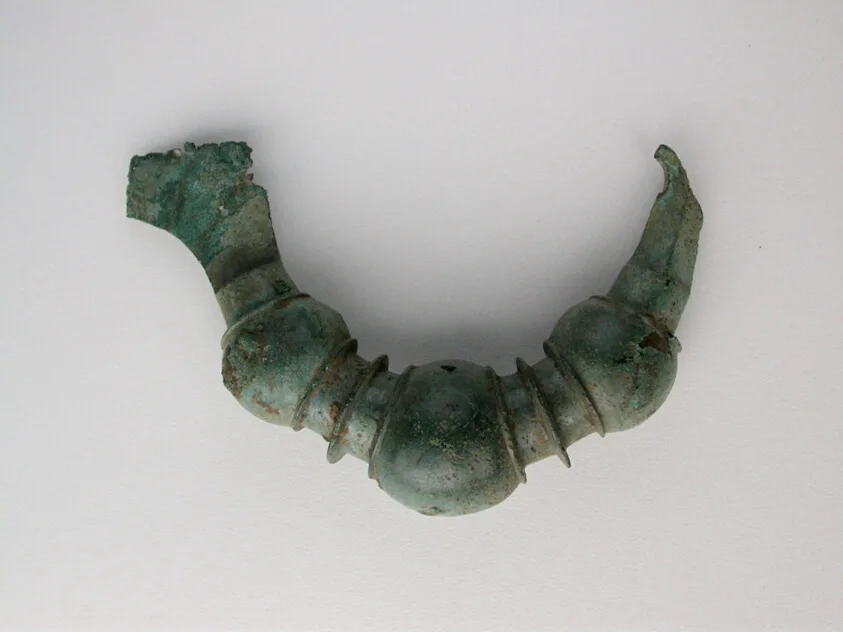
The azabacheros did not work in isolation. They sat within a wider European tradition of small dark ornaments worn as fasteners, badges, and amulets, the same instinct that produced the dark bow brooches of late antiquity. A pilgrim arriving in Compostela already understood, on sight, what a small black carved object was for.
The Nineteenth Century: The Victorian Moment
England discovered azabache on its own terms. Whitby, a coastal town in Yorkshire, had supplied jet for centuries, but the death of Prince Albert in 1861 transformed demand. Queen Victoria wore black for forty years, and women across Britain and Europe followed: aristocracy, middle class, servants alike. Whitby jet became the defining material of Victorian mourning jewellery.
The classic forms: large engraved brooches, heavy bead necklaces, drop earrings, lockets containing a lock of the deceased's hair.
After Victoria's death in 1901 the fashion ended, but antique Whitby jet is now collected as a significant category of Victorian material culture.
The Twentieth Century: Decline and Survival
The early twentieth century was difficult. The Spanish Civil War, the Second World War, and the Franco regime disrupted traditional craft production. Cheaper mass-produced black jewellery undercut Galician workshops. The population of practising azabacheros in Santiago fell sharply through the mid-twentieth century.
The workshops survived, though barely. The economic recovery of the 1960s and the renewal of pilgrimage tourism in the 1970s and 1980s brought a first revival. After 1975 and the democratic transition, azabache began to be promoted as part of Galicia's cultural heritage.
The Twenty-First Century: Revival
Modern Galicia actively positions azabache as part of its regional identity. Santiago de Compostela has an official certification, "Azabache de Galicia," for authenticated pieces. The Azabache Museum in Santiago documents the material's history. The Asturian regional government is pursuing "Indicación Geográfica Protegida" status for azabache from El Bierzo. The Santiago craft tradition has been formally recognised as intangible cultural heritage.
In parallel, gothic aesthetics, particularly in the early 2000s and again in the 2020s, returned azabache to international fashion.
Azabache from Santiago de Compostela
Santiago is where the whole tradition concentrates, and the geography is small enough to walk in ten minutes. The Praza das Praterías and the Rúa Azabachería, the street that takes its name from the trade, have held jet workshops since the Middle Ages, arranged around the cathedral's north portal where pilgrims arrived. Buying a higa, a shell or a cross there is still the most genuine souvenir the Camino offers, because the object, the place and the craft have not been separated in eight centuries. A medieval pilgrim went home with a carved jet scallop in their satchel; a walker finishing the Francés today buys much the same thing from a workshop a few doors from where it was always sold.
The catch is that Santiago is also a tourist city, and the streets around the cathedral carry a great deal of moulded black plastic sold to people in a hurry. The three quick checks are the ones that never fail: the weight should surprise you by being almost nothing, the surface should warm against your palm within seconds, and the seller should be able to say where the raw material came from, which for an honest workshop means Asturias. Workshops that cut and polish on the premises will usually show you the bench. Santiago did more than lend its name to the pilgrimage route; it made azabache the material signature of the road.
The Craft: How Azabache Is Made
Working azabache is by its nature handwork. A raw piece from Asturias or Galicia is first rough-cut with a hand saw, then refined with files and chisels. Each higa, each shell, each cross is an individual piece. No two are identical.
Polishing is done on leather wheels with progressively finer abrasive grades. The final polishing stage produces the characteristic mirror gloss with inner depth that no imitation material fully reproduces. Pressed coal dust can be polished to shine, but it lacks the layered internal structure that makes genuine azabache's gloss distinctive under close inspection.
If a silver or gold setting is involved, it is made separately and fitted by hand to the individual azabache piece. This is why two pieces from the same craftsman's workshop look similar but are never identical.
The Azabachería: Workshops and Guild Regulation
The word "azabachería" refers both to the individual workshop and to the craftsman's trade district around the north portal of Santiago Cathedral. By the fifteenth century this district had become a regulated commercial zone: stalls and workshops side by side, each licensed by the guild, each subject to inspection. The guild statutes, first codified in 1443, ran to considerable detail. They specified the minimum thickness of carved pieces so that buyers received something durable rather than a thin shell liable to crack on the journey home. They prohibited mixing genuine azabache with pressed coal dust, and they required each master to mark his work. These provisions addressed real problems: demand during pilgrimage seasons was so high that fraud was chronic.
The carving of the scallop shell (concha de vieira) required particular skill. The natural shell has irregular curves and an uneven surface: reproducing this in stone meant the carver could not rely on mechanical shortcuts. An experienced azabachero carved roughly six to eight shells a day; a higa, being a more compact three-dimensional form, took longer per piece. Masters typically specialised: some in flat medallion work with fine engraved motifs, others in fully three-dimensional apostle figures.
The tools have changed little in six centuries: straight and curved chisels, needle files, a small bow saw for initial shaping. Power tools exist in some workshops today but are generally avoided for final detail work, since the softness of azabache means that a drill or rotary tool removes material faster than intended. Hand control produces cleaner edges.
How Colour Varies Within a Single Piece
Raw azabache from El Bierzo is not uniformly black throughout. There are internal variations in colour density: some areas polish to an almost purple-black depth, others to a warmer brownish-black. A skilled carver orients each piece before cutting to place the densest colour zone at the most visible surface. This internal variation is part of what makes two nominally identical pieces from the same workshop subtly different in appearance. It is also one of the practical tests for genuineness: a perfectly uniform colour throughout, with no variation at the edges or in areas removed by cutting, suggests a compressed or manufactured product.
Customer reviews
Zevira is a real jewellery shop. Genuine payments, deliveries and customer thank-yous.
🥰🥰🥰 gracias

Ok, ¡gracias! 🙂

The Psychology of Protection
Why does a black object on a cord reassure people? The answer has little to do with whether the evil eye is real and everything to do with how protection is experienced. Azabache works on three layers, each addressing a different anxiety.
The Mother's Level
For the person who buys the higa, the amulet is a way to discharge worry into an action. A new parent cannot control infection, accidents, or the sheer fragility of an infant, and the helplessness of that is hard to carry. Fastening a small black fist to the pram converts an open, formless fear into a finished gesture. The psychological literature on ritual describes exactly this effect: a defined action performed at a moment of uncertainty lowers anxiety, regardless of the belief content behind it. The grandmother who presses a higa into a daughter's hand is doing something measurable for her own peace of mind.
The Child's Level
For the child, the amulet is one of the first objects that is unmistakably theirs. It is warm to the touch, smooth, dark, and unlike anything else in the cot. Long before the child can understand the word protection, the higa functions as a constant, familiar presence. Children raised with azabache often keep the worn first piece into adulthood, not from belief but from attachment, the same way people keep a first blanket.
The Community's Level
The third layer is social, and it is the one most people miss. A visible amulet on a newborn is a public statement: this family asks for the community's goodwill and disclaims any wish to provoke envy. In small Galician and Asturian villages, where envy was understood as a genuine social danger, the higa was a polite signal that defused tension. It said, in effect, do not begrudge us this child. The protection it offered was as much about managing the human community as deflecting any supernatural force.
Protective Folklore: What People Believed Azabache Could Do
The protective role of azabache in Spanish folk tradition was more specific than a general association with good luck. Distinct beliefs governed when it was worn, how it worked, and what happened when it stopped working.
The most widely held belief was that a piece of azabache that broke or cracked had absorbed a harmful force directed at its wearer, particularly at a child. A crack in a child's higa was read as proof that the amulet had fulfilled its purpose, not as bad luck. The broken piece was typically buried or thrown into running water rather than simply discarded, because the absorbed harm was considered real and dangerous. A new higa was obtained promptly.
In Galicia, a related belief held that genuine azabache changed colour slightly when exposed to strong negative energy: it was said to lose its depth of shine and take on a milky or dull surface. This matches the physical reality that the surface gloss of azabache is damaged by cosmetics, salt, and acids, meaning that a piece worn against skin did sometimes lose its mirror finish over time. The folk interpretation of this change was protective rather than alarming.
Azabache was also used in the specific remedy for mal de ojo once it had taken effect. Traditional Galician healers (curanderos) used azabache alongside prayers and ritual gestures to diagnose and treat what they understood as the evil eye in infants. The diagnosis involved passing the piece over the child; if the azabache warmed or the child calmed, the cause was confirmed. These practices were documented by Spanish ethnographers from the nineteenth century onward and were still observed in rural Galicia into the mid-twentieth century.
A male protective use: fishermen in the Rías Baixas area of Galicia wore azabache beads on cords at the wrist or ankle, believing the material protected against accidents at sea and specifically against drowning in water touched by strong currents. This was a practical belief in a region where fishing mortality was high, and the tradition overlapped with the azabache-and-coral combination mentioned elsewhere.
Azabache and Mourning Jewellery: The Victorian Story
After Prince Albert's death in December 1861, Queen Victoria entered a period of mourning that lasted until her own death in 1901. Forty years in black.
This shaped the whole of British and European fashion. The typical forms of Victorian mourning jewellery:
- Large brooches engraved with motifs (weeping willows, anchors, clasped hands)
- Heavy bead necklaces
- Drop earrings
- Lockets containing hair
After 1901 the fashion ended, but antique Whitby jet has since become a significant collecting category. It now occupies the luxury segment at auction. The Victoria and Albert Museum in London holds a substantial collection.
Upload a photo of your pet, someone you love, or an object. We'll build a 3D model and hand-cast it in pewter.




Whitby and the Yorkshire Jet Trade
If azabache is the Spanish half of this story, Whitby is the English half, and the two halves rarely get told together. Anyone who has grown up in Britain has probably handled jet without knowing it: a great-aunt's mourning brooch, a bead necklace at the back of a drawer, a black cross in a box of family oddments. All of it comes from a strip of Yorkshire coastline barely fifteen miles long, and all of it began in the same Jurassic swamp forests that produced the material sold today outside Santiago Cathedral.
The Cliffs and the Workings
Whitby jet occurs in the Upper Lias shales of the North Yorkshire coast, a dark band exposed in the cliffs between Whitby, Sandsend, Kettleness, Runswick Bay and Robin Hood's Bay. The seam is thin, irregular, and never generous. Jet does not lie in workable beds like coal; it occurs as flattened lenses and logs, the crushed remains of individual drifted trees, scattered through the shale with no pattern a miner can rely on.
For centuries the material was simply gathered. Storms tore lumps out of the cliffs and threw them onto the beach, and locals walked the tideline after rough weather looking for the black pieces the sea had done the work of extracting. That collected material still has a name in the trade, and pieces recovered from the foreshore are prized for having already survived a good deal of punishment. When demand outran what the beaches offered, jet men drove narrow adits horizontally into the cliff faces and followed the seam by candlelight, working in tunnels too low to stand in. It was dangerous, poorly paid, and entirely seasonal in the way coastal work tends to be.
The Whitby Workshops and the Jet Boom
The manufacturing side grew from almost nothing. A local turner is credited with working jet on a lathe in the early nineteenth century, and by the 1850s the town had a recognisable industry. The Great Exhibition of 1851 put Whitby jet in front of a national audience, and Prince Albert's death ten years later turned a fashion into an obligation. Court mourning rules issued through the Lord Chamberlain's office specified jet as the only jewellery permitted during the deepest stage of mourning, which meant that every household with any pretension to observing the etiquette needed some.
The result was a boom of a size the town had never seen. At its height in the 1870s Whitby held roughly two hundred workshops and employed something in the region of fifteen hundred men and boys, in a town whose entire population was under fifteen thousand. Whole streets turned into workshops. Boys were apprenticed at twelve to grind and polish. The work divided into specialisms in the same way it had in Compostela four centuries earlier: some men carved, some cut beads, some did nothing but polish on rouge-charged wheels.
The collapse was almost as quick. By the mid-1880s the trade was in serious trouble, undercut by cheaper substitutes, hurt by a general slump, and finally abandoned by fashion as Victorian mourning etiquette loosened. Many workshops closed within a decade. A handful of families kept the craft alive through the twentieth century, and it survives today at a small scale, supplied largely by beach-collected and stockpiled material rather than by new mining.
Whitby Jet Against Asturian Azabache
Geologically the two are siblings, both fossilised conifer wood of Jurassic age, both formed by the same burial and compression. The differences that matter are practical and cultural rather than chemical.
In the hand, Asturian material tends to be denser and to take a colder, more saturated black, while the Yorkshire material often carries a warmer, faintly brownish tone under strong light. Neither is better; they are different blacks, and a collector who handles both learns to tell them apart the way one learns to tell two grades of oak. The Whitby trade itself distinguished what it called hard jet, from the marine shales, which polished superbly and stayed stable, from softer grades out of freshwater deposits and from imported lots of variable quality, which were cheaper and far more likely to craze into a network of fine surface cracks over a few decades. A great deal of the badly crazed Victorian jewellery that turns up in British house clearances is soft-grade material rather than a failure of jet as such.
Culturally the two traditions barely touch. Spanish jet is about protecting the living, above all infants, and it is bound to a pilgrimage. English jet is about commemorating the dead, and it is bound to a court and a period. One material, two completely different jobs.
French Jet, Vulcanite and the Other Victorian Substitutes
The Whitby boom created demand that Whitby could not meet, and the gap filled with imitations. Four are worth knowing, because all four still circulate in British antique shops and online listings.
French jet is not jet at all. It is black glass, usually moulded and often backed with foil or set in stamped metal, made in quantity in France and Bohemia. It is the most common thing sold as jet today. Glass gives it away instantly: it is cold to the lips, heavy for its size, and where it chips the break is conchoidal and glassy rather than woody. It also tends to have a hard, glittering surface with no depth behind it.
Vulcanite, also sold as ebonite, is hardened rubber, patented in the 1840s and used heavily for mourning jewellery from the 1860s. It moulds beautifully, which is why vulcanite pieces often have crisper repeated detail than any carver could produce. It ages badly: exposure to light turns it a dull khaki brown, and a suspiciously brownish black brooch is very often vulcanite. Rubbed hard, it gives off a faint smell of sulphur, though it is worth being gentle about that test.
Bog oak, mostly Irish, is genuinely wood, blackened by centuries in peat. It is light like jet but has visible grain, and it never takes the same mirror polish.
Pressed jet dust was made from the workshop waste of Whitby itself, bound and moulded. Under a loupe it looks granular and uniform, with none of the layered internal structure of a solid piece.
Together these substitutes did to Victorian Britain exactly what plastic does to Santiago today, which is a reminder that the authenticity tests in this guide are answering an old problem rather than a modern one.
Buying Victorian Whitby Jet Today
Antique jet is widely available in Britain and reasonably priced compared with other Victorian jewellery, which makes it an easy entry point for collectors. A few things separate a good buy from a disappointment.
Look first for crazing. Fine surface cracks in a spider-web pattern are the commonest fault, they are effectively irreparable, and they usually indicate a soft grade of material. Check the reverse of brooches for the original pin fitting; replaced fittings are common and reduce value. Carved work is worth more than plain beads, and named or attributable workshop pieces more again. Beware of restrung necklaces where beads from several sources have been mixed, which is easy to spot because the blacks will not quite match along the strand.
Above all, apply the same tests you would use in Galicia. Warmth against the wrist, near-weightlessness, a brownish streak on an unglazed tile, a matte-resinous depth rather than a glassy glare. The material is the same on both coasts, and so are the fakes.
The Higa and the Figa: Gesture, Amulet, and Deep History
The higa (in some Spanish and Portuguese texts "figa") is a gesture with roots that predate Spanish culture itself. A closed fist with the thumb pressed between the index and middle fingers is attested as an apotropaic sign in Roman antiquity, in North African traditions, and across the Mediterranean world.
In Spanish folk tradition, the gesture carries two simultaneous meanings. As a sign directed at a person, it can be a crude insult. As an amulet worn on the body, it is protective: a ward against the envious glance, the deliberate hex, or the inadvertent harm caused by excessive admiration. The latter is what the traditional belief in the evil eye describes: harm caused not by ill will but by concentrated, admiring attention from someone with strong energy. An infant is particularly vulnerable to this, which is why the higa is primarily a child's amulet.
The tradition of giving a higa to a newborn is not merely symbolic. In Galician and Asturian communities well into the twentieth century, the gift of an azabache higa at birth or baptism was a practical social act: it announced the child's need for collective protection and acknowledged the community's responsibility to wish the family well rather than envy them.
Azabache Baby Bracelet: What It Means and Why It Is Red
The azabache baby bracelet is the single most searched form of the amulet, and its meaning is precise. A small polished bead or a tiny fist charm of jet is strung on a red or coral cord and tied to a newborn's wrist, usually at birth or baptism. The black element does the protecting; the red thread amplifies it, since red is the traditional colour against envy across Mediterranean and Latin American cultures. Parents in Puerto Rico, the Dominican Republic, Mexico and Spain still put one on within days of birth. If a stranger admires the baby a little too intensely, the bracelet is there to catch that attention. The bracelet is meant to be worn, not displayed, and is often kept afterwards as a keepsake.
Mano de Azabache: The Hand Amulet and Its Origin
The mano de azabache, literally the azabache hand, is the higa carved into a small clenched fist. Its origin runs back through Roman antiquity, where the same gesture, thumb tucked between the first two fingers, was already a recognised sign against harm. Spain inherited it and paired it with jet, so the amulet carries a double charge: the protective form of the fist and the protective substance of the black stone. Worn point-down on a bracelet or pendant, the azabache hand is understood to deflect the evil eye rather than to bring luck. It travelled with Spanish settlement into the Caribbean and Latin America, where the mano de azabache remains a standard newborn gift today.
How to Distinguish Genuine Azabache from Imitations
The industry of azabache imitation is ancient: the Romans were already counterfeiting it. The main types of imitation:
Plastic Imitations
The most common and least expensive. Shiny, light, without the characteristic warmth of organic material.
Black Glass
The imitation used in the nineteenth and twentieth centuries, particularly the "French jet" (black glass mimicking Whitby jet).
Pressed Coal Dust
Externally similar but homogeneous in structure, without the natural internal layering of genuine azabache. Visible under a loupe.
Black Onyx or Obsidian
Mineral imitations. Also black, but colder to the touch and heavier.
Jet of Different Origin
Azabache from other locations (the Americas, Turkey) differs in quality from Galician jet.
Tests
Warmth test. Genuine azabache is warm to the touch, as an organic material. Glass feels cold. Minerals are intermediate.
Weight test. Azabache is very light. Glass is heavier. Plastic is lighter still.
Scratch streak test. Genuine azabache leaves a brownish streak when scratched. A black streak indicates mineral or glass.
Magnet test. Azabache is not magnetic (rules out painted steel).
Sound test. Strike two pieces of azabache together: a soft, deep sound. Glass rings. Plastic sounds hollow.
Warmth and smell test. Gently warming azabache (body warmth is enough) produces a faint sulphurous coal smell. Plastic smells chemical; glass is odourless.
Fire test (professionals only). Azabache burns and smells of coal. Glass does not burn.
Certificate. Genuine "Azabache de Galicia" carries an official certificate from the Consejo Regulador.
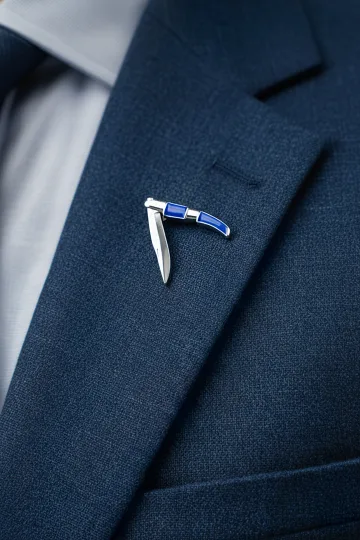
CAPAORA mini knife pendant
The 18th-century Spanish navaja in miniature: 40 mm of stainless steel, a real folding mechanism and a Palanquilla lock that clicks. An affordable gift to remember.
Authentic · Ships from Spain · 14-day returns
The Geography of Genuine Azabache: Where It Is Mined and Where It Is Worked
One reason azabache resists mass production is simply that there is not very much of it, and it comes out of the ground in very few places. Understanding that map is the single most useful thing a buyer can carry into a shop, because almost every fake is exposed by a seller who cannot answer a straight question about origin.
Extraction: The Few Deposits That Matter
El Bierzo and the Asturian seams. The principal working source sits in the north-west of Spain, in the belt running through Asturias and the neighbouring Bierzo district of León. Jet has been dug here since before Roman administration reached the region, and the material is regarded as the best in the world for density and depth of colour: a black that closes over on itself when polished rather than throwing light back flatly. Practically all of Santiago's workshops buy Asturian raw material.
Galicia. Secondary deposits exist in Galicia itself, including around Compostela. Volumes are small, but the quality is good, and historically the Galician craftsmen were working partly on stone from their own doorstep before Asturian supply became dominant.
Historic and now exhausted. Antequera in Málaga and Utrillas in Teruel both appear in medieval and early modern records as supply points, and both are effectively worked out. Parts of northern Portugal produced jet as well, on the same geological trend. Beyond Iberia the only other deposits of real jewellery significance are the Yorkshire seams described above and scattered minor occurrences in France, Turkey, the Caucasus and North America.
The honest summary is that the world's supply of good jet is finite and modest. Current estimates suggest El Bierzo holds enough at present extraction rates to keep the workshops going for several generations, which is comfortable but not infinite. This is a material with a hard ceiling, and that is part of why nobody has ever managed to industrialise it.
Working: Effectively Two Regions
Jet is cut and polished where it is found, and the reasons are entirely practical. The raw material is brittle and travels badly, so every extra journey costs breakages. The skill is local and transmitted by apprenticeship rather than by manual, so there is no pool of trained carvers anywhere else. And the guild and certification structures that police quality only operate in the historic workshops.
- Santiago de Compostela. The overwhelming majority of working azabacheros, concentrated in the old town around the cathedral's north portal, on and around the street that still carries the trade's name.
- Villaviciosa and Gijón in Asturias. A smaller group, working closer to the seams themselves.
Outside those two clusters, a piece described as azabache was almost certainly finished somewhere with no tradition behind it, which usually means machine work on imported or substitute material.
How to Verify Origin
The certificate. The "Azabache de Galicia" mark, issued by the Consejo Regulador de Artesanía de Galicia, is the strongest documentary proof available. It attests that the raw material is of Asturian or Galician origin and traceable, that the piece was worked by hand rather than machined, that the maker is a registered member of the craft register, and that the work meets the scheme's quality standards. It is not a decorative sticker; it is the difference between a claim and a checkable fact.
Failing that, three softer signals. Ask for the maker's name and look it up in the published craft register. Keep any workshop receipt, which functions as informal provenance and matters a great deal if the piece is ever passed on. And look, under a loupe, for the small asymmetries of hand work: a relief that is a fraction deeper on one side, tool marks inside a carved recess, a drilled hole that is not machine-perfect. Uniformity is the tell of a mould, not a mark of quality.
For buyers in Britain there is one further practical route. Where a piece is mounted in silver and sold in the UK, the mount itself will normally carry a British hallmark from an Assay Office such as London, Birmingham, Sheffield or Edinburgh. The hallmark says nothing about the jet, but it does tell you the seller is operating inside a regulated system and takes documentation seriously, which is a reasonable proxy for the care they have taken over the stone.
Caring for Azabache
Cleaning
Soft dry cloth only, ideally lambswool or chamois. No abrasives of any kind. Azabache is a soft material (Mohs 2.5-4) and scratches easily. Even casual contact with a ring set with a harder stone can leave a mark.
Storage
Separately from other jewellery, to avoid contact with harder stones. A soft pouch or a separate compartment in a jewellery box works well.
Avoid Water and Chemicals
Azabache does not tolerate:
- Perfume and cosmetics (oils dull the surface)
- Salt water (attacks the organic structure)
- Pool chlorine
- Perspiration during intense exercise
- Prolonged rain
Water in small amounts does not destroy azabache immediately, but regular contact gradually creates micropores in the internal structure and permanently diminishes the surface gloss.
Temperature Changes
Azabache can crack under sudden temperature changes. Do not leave it in direct sunlight for extended periods or expose it to rapid heating and cooling.
Repair
Cracks in azabache are difficult to repair. Best left to a specialist in Santiago de Compostela or Asturias.
A Seasonal Calendar for Wearing Azabache
Collectors who have owned jet for decades tend to wear it differently through the year, and once you know why, the logic is obvious. Azabache reacts to three things: sudden temperature change, prolonged damp, and anything greasy or salty on the skin. British weather and British heating deliver all three, just not at the same time.
Spring (March to May)
A good season, and arguably the easiest. Temperatures are moderate, humidity is climbing but nowhere near its peak, and there is no strong sun to worry about. Jet can be your main piece without much thought. The one thing to watch is the first proper spring downpour: a soaking is not fatal, but repeated wettings dull the surface over time, and a piece worn under a coat collar is a piece that stays dry.
Summer (June to August)
The awkward season. Sun, sea, sun cream, perspiration and air conditioning all work against the material at once. Sun cream is the worst offender by a wide margin, since the oils in it sink into the polish and leave a permanent haze. Keep jet indoors or in shade, and leave it at home for the beach entirely; salt water attacks the organic structure directly, and a swim in the sea is genuinely damaging rather than merely inadvisable. For office wear a small pendant under a shirt is perfectly fine. Anyone training or playing sport should take it off.
Autumn (September to November)
The ideal season, and the one experienced wearers save their best pieces for. Temperatures are kind, humidity is falling, the sun has lost its force, and there is no central heating running yet to dry the air out. If you have a large carved medallion that spends most of the year in its pouch, this is when to wear it.
Winter (December to February)
A good season with one specific hazard, which in Britain is a serious one: the gap between a heated interior and a cold street. Radiators and dry indoor air followed by a step outside into near-freezing damp is exactly the thermal cycling that opens hairline cracks in a soft organic material. The practical answer is to wear jet indoors and under clothing rather than exposed, and to give a piece a few minutes to come to room temperature before handling it if it has been in a cold room. Never put jet on a radiator or a hot windowsill to dry it.
One year-round note for readers in hard-water areas, which is most of southern and eastern England: the mineral film left by hard water dries onto polished jet as a faint grey bloom. Do not scrub it. Buff it gently with a dry chamois or lambswool cloth, and keep the piece away from taps in the first place.
Azabache at Different Stages of Life
In Galician and Asturian tradition, wearing jet was tied to particular moments in a life rather than being an open choice of ornament. The pattern is worth setting out, because it explains why the same material can read as a baby gift, a sailor's charm and a widow's jewellery without any contradiction.
The newborn. The first amulet arrived immediately after birth or at baptism, given by a godmother, a grandmother or a close relative. A small higa was tied to the swaddling, the pram or the clothing. The reasoning was double. An infant attracts the most concentrated attention of anyone in the household, and in traditional belief that attention itself was the danger, so the child was at maximum exposure. At the same time the amulet lowered the mother's anxiety and signalled to everyone around that this family took the child's welfare seriously.
From toddler to school age. The higa stayed relevant and simply migrated: off the swaddling, onto a bracelet or a short chain. The belief was that as long as a child was small enough to be over-admired, the jet should be visible rather than tucked away. Some mothers deliberately passed a dulled, evidently well-used piece to a younger sibling, having had it re-polished by a workshop first, and read the restored shine as protection renewed.
Adults. The amulet meaning weakened without disappearing. Adults, men included, put jet back on during illness, before a dangerous journey, or through a stretch of sustained bad luck. Fishermen and sailors wore it continuously, which in coastal Galicia was less superstition than occupational habit in a trade with a high mortality rate. Pregnant women commonly returned to wearing jet, since pregnancy, like infancy, was understood as a period of heightened vulnerability.
The elderly and the seriously ill. In late Catholic folk practice in Galicia, a jet rosary was the traditional object at a dying person's bedside. That single object did two jobs at once, apotropaic and devotional, which is a fair summary of how Spanish folk religion has generally worked.
Widowhood. A widow put on jet as the visible marker of a changed social position: she was in mourning, and yet she was still wearing jewellery, which mattered in communities where appearing entirely unadorned carried its own message. The custom has largely gone, but nineteenth-century ethnographic accounts record it as ordinary practice across rural Galicia and Asturias, and it runs closely parallel to what was happening in Yorkshire at exactly the same time.
Leave your email, we'll send your discount code. No spam, unsubscribe anytime.
The code arrives by email, valid on your first order.
The Four Roads to Santiago and Azabache's Spread
The pilgrimage to Santiago de Compostela was not served by a single route. Medieval pilgrims travelled along four main roads that converged in Spain: the Via Turonensis from Tours, the Via Lemovicensis from Vézelay, the Via Podensis from Le Puy-en-Velay, and the Via Tolosana from Arles. Each brought pilgrims from a different part of Europe into northern Spain, and all four converged at Puente la Reina in Navarre before continuing west to Santiago.
This geography mattered for azabache. Pilgrims who completed the journey bought carved pieces in Santiago and then carried them back along these same routes. By the twelfth century, the four roads functioned as distribution channels. A pilgrim from Cologne who had walked the full way to Compostela returned home with a scallop shell or a higa of azabache. His neighbours saw it. The objects became known and recognised far beyond Galicia.
French pilgrimage records from the twelfth century onward mention the "pierres noires de Saint-Jacques" purchased in Compostela. German accounts from the same period list "schwarze Steine vom Jakobsweg" among the items brought back. English pilgrims from the post-medieval period were so associated with azabache carvings that the term "pilgrim badge" in British archaeology often refers specifically to Santiago azabache pieces found in English graves and river deposits.
The fourteenth-century poet John Lydgate described returning pilgrims wearing black stones from Santiago. Excavations along the Thames in London have produced azabache higa carvings alongside Santiago scallop shells, both identified as pilgrim souvenirs lost or deposited in the river over four centuries of English pilgrimage to Compostela. This material evidence makes azabache one of the most geographically travelled objects of medieval material culture.
Azabache in Other Cultures
England (Whitby Jet)
Whitby jet has been worked since the Iron Age; prehistoric grave finds confirm this. The nineteenth-century peak was the defining cultural moment. Antique Whitby pieces are collected as a distinct category of Victorian craftsmanship.
Italy (giaietto)
An Italian tradition, particularly in Sicily and Liguria. Amulets against the evil eye, often in the form of hands (mano cornuta). Italian pilgrims walking the Camino historically brought Galician azabache home to Italy; this cross-cultural exchange is documented in Italian pilgrimage accounts.
Turkey and the Middle East
Jet (called "siyah kehribar" in Turkish) appears in Islamic jewellery and prayer beads (tesbih).
Latin America
Spanish colonists brought the tradition to Mexico, Peru, and Colombia. Azabache amulets are part of local folk protection traditions in these countries.
Azabache in Cuba and the Caribbean
Azabache in Cuba is not a curiosity but a living custom. Spanish settlement carried the newborn amulet across the Atlantic, and in Cuba the black jet bead merged with the wider Afro-Caribbean vocabulary of protection, where it often sits beside coral, amber and a single ojo turco bead on the same infant bracelet. The Cuban azabache is usually a small round or fist-shaped piece on a gold or red cord, given at birth and expected to be worn until the child is a toddler. The same pattern holds through Puerto Rico, the Dominican Republic and the Cuban diaspora in Florida, where jewellers still sell azabache baby bracelets as a first gift. The meaning has not drifted: it guards the child against the strong admiring gaze of strangers.
France
Breton jet appears in jewellery from Brittany, where the Celtic heritage parallels that of Galicia. Auvergne jet, quarried around Saint-Flour and Aurillac, has its own local craft tradition. French pilgrims walking to Santiago from Le Puy-en-Velay, Vézelay, Tours, or Arles encountered Galician azabache at the journey's end and brought it home; this is documented in French pilgrimage accounts from the twelfth century onward.
Silver, gold, wedding rings, symbolic pieces, paired sets.
Who Azabache Is For
Lovers of Galicia and Spanish culture. The defining local material.
Camino de Santiago pilgrims. The traditional pilgrim souvenir, carried home since the Middle Ages.
Parents of newborns. The classic protective amulet for a child.
Gothic aesthetic enthusiasts. A central gothic material.
Antique collectors. Victorian Whitby jet as a significant collecting category.
Those who value protective symbolism. Against the evil eye and negative energy.
Lovers of natural materials. Organic, geological, irreplaceable.
Those in mourning. Following a tradition that spans centuries.
Black and silver aesthetic wearers. Azabache with silver is a classic pairing.
Styling: Azabache Across Different Aesthetics
Black is the most cooperative colour in a jewellery box, so the question is rarely whether jet will work with a wardrobe. It is which form and which setting suit the aesthetic you actually dress in. Eight familiar looks, and what azabache does inside each of them.
Minimalist
Jet is close to ideal here. A plain black pendant on a fine silver chain gives you maximum restraint with full visual legibility, which is the exact combination minimal dressing is usually chasing. Someone in a black shirt and grey trousers can wear a single jet piece as their only jewellery without disturbing the line at all. Keep the form geometric, keep the setting invisible, and let the material's depth do the work. One caution repeated from earlier: black on black flattens the stone, so pale or mid-grey layers give it far more presence than an all-black outfit does.
Boho
Jet on a leather thong or a plain silk cord is a classic bohemian object, and it predates the aesthetic by several centuries. Jet beads strung with other natural materials, wood, coral, horn, glass, produce a genuinely ethnographic look rather than a costume version of one. A bracelet like that with a plain dress in natural fibre is about as complete as boho styling gets. The pieces to seek out are the unpolished or lightly polished ones, where the material reads as found rather than finished.
Business and Tailoring
A small jet pendant disappears easily under a shirt; small jet studs sit slightly more visibly and read, in a professional setting, as a conservative choice with a European pedigree behind it. That is the whole message jet sends in a boardroom: I value tradition, I am not trying to be noticed. Pair it with grey, navy, camel and substantial cloth, wool and gabardine rather than anything shiny. Keep your metals consistent, since jet in a silver mount asks for silver elsewhere and a gold mount pulls gold along with it.
Gothic
This is where jet is central rather than optional. A large pendant of three to five centimetres, black drop earrings, a bracelet of jet beads: that is a complete gothic set, and it is an authentic one rather than a borrowed look. Jet reads here as an aesthetic statement about night, mortality and the Victorian imagination rather than as protection, and gothic dressing found in it a nearly perfect material. It is black, it carries a documented history of mourning, it is organic and natural, and it is sombre without being cold. The distinction worth understanding is that jet is matte and resinous where black glass and onyx are glassy and hard, which is exactly why it looks like depth rather than like plastic under low light.
Biker and Heavy Leather
A jet bracelet or a substantial jet pendant sits naturally against leather. The material has enough visual weight and enough evident handwork to hold its own at the scale this look operates on, where thin delicate pieces vanish. Jet set into a wide leather cuff is a particularly good hybrid, since the leather takes the knocks and the stone stays protected. The practical warning applies more here than anywhere: keep jet away from studs, chains and heavy hardware that will scratch it.
Sport and Active Wear
Frankly, jet is the wrong material for daily athletic wear. It is soft, it is brittle, and it does not tolerate sustained perspiration. What does work is a small pendant on a fine chain worn under a training top as a private amulet, put on before something that matters and taken off afterwards. That is closer to how sailors and fishermen used it than to how it is usually sold, and it is a legitimate use as long as you accept that the piece is being worn for a moment rather than for a season.
Romantic and Feminine
Jet in silver filigree, or jet set alongside pearl or white coral, produces the most interesting contradiction in the whole material. The stone is sombre; the setting is delicate. Galician filigree in particular frames black in a way that makes it look softer without making it look sweet, since the openwork lets light through around the stone. The result suits anyone who wants their jewellery to read as strong and gentle at the same time, which is a combination most black stones simply cannot manage.
Cultural Identity
For some wearers the aesthetic question is beside the point. A Camino pilgrim wears jet as identification: a jet scallop shell is legible to anyone who knows the route as the mark of a completed pilgrimage, and it stays legible for decades afterwards. Someone Spanish, or of Spanish descent living abroad, may wear jet as a cultural anchor, an assertion of where they are from that needs no explaining to those who recognise it and asks nothing of those who do not. Worn this way, the piece is closer to a badge than to an ornament, and the styling advice reduces to one line: wear it openly and wear it alone.
Facts That Surprise
A material this old accumulates oddities. A handful that tend to catch people off guard:
It floats closer to wood than to stone
Azabache is so light (density around 1.3) that it behaves more like the timber it once was than like the gemstones it sits beside in a shop window. Hold a polished bead and a glass imitation of the same size, eyes closed, and the real one is the one that feels almost weightless.
A cracked amulet was good news
In the folk reading, a higa that split had taken a blow meant for the child. The crack was proof of success, not failure. Families buried or drowned the broken piece and bought a fresh one, untroubled.
The Romans were already faking it
Counterfeit azabache is not a modern scam. Roman workshops produced imitations in cheaper black materials to meet demand for the amulets Pliny had made famous, which means the authenticity tests in this guide answer a problem two thousand years old.
It can warn you of a thunderstorm, sort of
Because azabache holds an electrostatic charge when rubbed (the Greek word for the related substance gave us the word electron), antiquarians noticed that a polished piece attracts dust and hair in dry, charged air. Old accounts dressed this up as the stone sensing danger.
London's river is full of it
Centuries of English pilgrims walking to Compostela came home with azabache, and a good deal of it ended up in the Thames. Mudlarkers and archaeologists still pull Santiago shells and higa carvings from the foreshore, lost or discarded over four hundred years.
Queen Victoria made Yorkshire rich
The mourning fashion that followed Prince Albert's death in 1861 turned Whitby, a small fishing port, into the centre of a jet industry employing thousands. When the fashion faded after 1901, the town's economy collapsed almost as fast as it had risen.
No two pieces are the same colour all the way through
Raw azabache shades from a near-purple black to a warmer brown-black within a single lump. Carvers orient each blank to put the densest colour on the show face, which is part of why genuine pieces never look mechanically uniform.
Real Stories: Azabache and the People Who Carry It
The walker from Yorkshire
Margaret, a retired teacher from near Whitby, walked the Camino Francés in her sixties having grown up surrounded by Victorian jet she had never thought twice about. In Santiago she bought a small azabache scallop from a workshop by the cathedral. She told the maker she already knew the material; he pointed out that her Whitby jet and his azabache were the same Jurassic forest, eight hundred miles apart. She wears the shell on the same chain as a piece of her grandmother's mourning jewellery, the two ends of one story finally touching.
The sceptic who kept the stone
Tom, an engineer from Bristol, walked the route as a personal challenge with no religious feeling whatsoever. He bought a plain azabache bead at the end mostly as a souvenir. Years later he still carries it in a coat pocket. He does not believe it does anything. He also has never quite been willing to leave it at home, which is, in the end, how most amulets actually work.
The grandmother's gift, exported
A British family with Galician roots kept the custom of the higa across three generations in England. When the youngest grandchild was born in Manchester, the great-grandmother sent a tiny azabache fist from A Coruña with instructions to fasten it to the pram. None of the younger family members claim to believe in mal de ojo. The higa went on the pram anyway, because refusing it felt like refusing the great-grandmother, and that mattered more than the question of belief.
The gothic collector
Sophie, who plays in a dark wave band in London, found azabache through the aesthetic rather than the folklore. She wanted black jewellery with weight of history rather than the cold shine of glass. A large polished azabache pendant became her stage piece. The crowd sees gothic glamour; she knows it is fossilised Jurassic wood carved by a Galician hand, which she likes considerably more.
The Anthropology of a Black Stone
Azabache sits at a junction of two belief systems that, in Spain, never fully separated. The evil eye, the apotropaic gesture of the higa, the idea that a black object absorbs harm: all of this is older than Christianity and belongs to a Mediterranean folk logic the Church spent centuries trying to absorb rather than abolish. The result is a syncretism worn around the neck: a higa, a pagan ward, carved next to a Caravaca cross on the same cord, neither cancelling the other.
Part of azabache's hold on people comes from its texture and warmth. Most amulets are made of cold, hard materials. Azabache is the opposite: it warms quickly against skin, it is soft enough to feel almost alive, and it carries a faint organic smell when warmed. People describe it as comforting in a way that glass and mineral stones are not, and that physical quality does real work in why the tradition endured.
Its fragility carries meaning too. A stone that can crack is a stone that can take a blow on your behalf. The very softness that makes azabache awkward to wear, the property a jeweller might call a flaw, is precisely what made the folk belief coherent: only something that can be damaged can be understood as a shield. The amulet's vulnerability is the proof of its service.
Catholicism and Folk Belief in a Single Object
Spanish Catholicism has always been syncretic in practice, whatever the official position. After the late fifteenth century the Peninsula was formally under a strict orthodoxy, but in villages far from any diocesan authority the older layer survived intact: belief in protective amulets, in the harmful glance, in the ordinary magic of earth and material. Azabache turned out to be the perfect medium for holding both layers at once. It was demonstrably ancient and pre-Christian, worn by pagan Romans, and yet it could be Christianised simply by carving a cross or an apostle's figure onto it. An amulet against envy became a devotional medal without changing hands.
That ambiguity was socially useful. A mother could fasten a higa to her child and describe it to a curious neighbour as the protection of the Apostle, and everyone in the village understood both readings simultaneously and saw no conflict. A symbol able to be pagan and Christian at once, superstition and faith at once, is a symbol very difficult to kill, and that durability is a large part of why azabache is still being carved in Compostela.
A Local Material as Inherited Identity
Azabache holds because it is local rather than imported. A Galician mother did not wear it because it was fashionable, though during the Victorian decades it certainly was. She wore it because it came out of the ground in her region and was cut by a craftsman a few streets away. That separates it from almost every other protective amulet in circulation, most of which travel as ideas rather than as substances.
When a Spanish family gives a child a piece of jet, something is being transferred beyond the object. The message is roughly this: you belong here, you are the inheritor of a practice older than the Church in this country, one that saw Romans and pilgrims come through, and it stands between you and harm. That is a considerable amount of freight for a two-centimetre carving, and it is carried without anyone having to say a word of it out loud.
Warmth and Texture: What the Body Registers
Jet was never popular purely as a symbol. It was popular as a substance you could feel, and the sensory difference is genuinely unusual. Its warmth against skin is unlike the cold of stone or glass, its surface is smooth without being slick, and warmed in the hand it gives off a faint organic trace that no mineral does.
This matters more than it sounds. A child sees the higa and also feels it, and the nervous system registers it as categorically different from every other object in the cot. Long before any of the meaning is available, the amulet is already established as familiar and as reliably present. The material works on the symbolic register and the sensory one at the same time, and the sensory one arrives first. That is why people who dismiss the belief entirely still keep the object.
Why the Reassurance Arrives Immediately
Tradition holds that jet acts quickly, and by the standards of amulets it does. A mother buys the piece, fastens it on the child and reports feeling better almost at once, which is not the case with more abstract or more distant forms of protection. The mechanism is unmysterious: the physical act of choosing, buying and fastening converts an unbounded worry into a completed task, and a completed task is what anxiety responds to.
This is also why azabache never depended on anyone believing in the evil eye as such. The relief is produced by the doing, and the doing is available to a sceptic exactly as it is to a believer. The number of people who describe themselves as entirely rational and nonetheless put the higa on the pram is, in Galicia and elsewhere, very large.
What Happens When a Tradition Emigrates
The custom travels, and it changes shape as it goes. Spanish settlement carried the newborn amulet across the Atlantic, where it merged with other protective vocabularies and became, in the Caribbean and much of Latin America, a standard birth gift with a red cord attached. Spanish and Latin American families in Britain have carried it a second time, and the pattern is consistent: the belief content erodes across a generation or two while the practice survives almost unchanged.
The reason is that the object stops being primarily about the evil eye and becomes about the person who sent it. A grandmother in A Coruña posts a small black fist to a grandchild born in Manchester, and the younger generation, who would not claim to believe in mal de ojo under any circumstances, fasten it to the pram anyway. Refusing the amulet would mean refusing the grandmother, and that calculation is not close. Traditions in diaspora tend to survive as kinship rather than as belief, and azabache is a clean example of it.
Ethics and Sustainability
Azabache has an unusual environmental profile for a material in the jewellery trade. It is not mined at scale, it is not synthesised, and it does not depend on the chemically intensive processing that shadows many fashionable stones and metals.
The raw material already lies in the ground as a fossil deposit, extracted in modest quantities from El Bierzo and worked by hand close to where it is found. There is no synthetic substitute pretending to be the genuine article in the certified trade: the imitations are simply other materials sold honestly as glass or plastic by reputable sellers and dishonestly by everyone else.
The craft argument carries its own ethical weight. A certified piece supports a registered Galician craftsperson working in a tradition that nearly died in the twentieth century. Buying authenticated azabache rather than a mass-produced black bead keeps a six-hundred-year-old skill economically alive. Longevity is the quiet sustainability case: a well-kept piece lasts generations, which is the opposite of disposable jewellery, and museum pieces from the sixteenth century survive in fine condition to prove it.
How to Assess Quality When Buying
Beyond distinguishing real azabache from fakes, there is the separate question of judging quality among genuine pieces. A few things to check in the hand before buying.
Depth of the polish
Hold the piece to the light and tilt it. Good azabache shows a gloss with visible depth, almost wet looking, not a flat surface shine. A shallow, plasticky reflection suggests either a poor polish or a poor blank.
Weight in the hand
It should feel surprisingly light for its size. A piece that feels dense or heavy is a warning sign that it is glass, onyx, or a pressed material rather than true azabache.
Edges and relief
On carved pieces, look at the crispness of the edges and the inside of any deep relief. Hand carving leaves clean, confident lines; sloppy or rounded detail points to rushed or mechanical work.
Temperature against the skin
Rest it against the inside of your wrist. Genuine azabache warms quickly and feels neutral to warm. A persistent coldness points to a mineral or glass imitation.
The back of the piece
Turn it over. A quality maker finishes the reverse, even though it will not be seen. A rough, unpolished back on an otherwise glossy piece often means corners were cut.
Colour at any cut edge
Look at any cut or drilled edge for the natural variation in the black, from near-purple to brown-black. Perfectly uniform colour throughout can indicate a pressed or manufactured product rather than natural azabache.
Documentation
For anything in the mid range or above, ask for provenance, and ideally the "Azabache de Galicia" certificate. A seller who cannot say where the material came from is a seller to be cautious with.
Send a friend a discount code, they save on their first order.
Antique Azabache and Buying for the Long Term
Nobody sensible buys jet as an investment. People buy it as an object meant to last a lifetime and then be handed on, which is a different proposition and a more honest one. That said, Victorian jet has been a recognised collecting field for decades, and knowing how that market reads a piece will make you better at choosing a new one.
Victorian Jet Among Collectors
At auction and in the antique trade, Victorian jet and Spanish azabache both appear as collectable material: plain nineteenth-century bracelets, brooches with detailed carving, parures of matching pieces, and occasional attributable workshop work. The interest rests on three things. The supply is capped, because the material comes from a handful of places and no more is being made. The period carries historical weight, since mourning jewellery is a direct window into Victorian social ritual. And the carving on the better pieces is genuinely fine work of a kind nobody is producing at that scale any more. Collectors reward authenticity and documented provenance above almost everything else, which is exactly the same hierarchy that governs new pieces.
Choosing a Modern Piece Meant to Last
If you are picking contemporary azabache with the long term in mind, a few characteristics separate a piece that will still be worth having in fifty years from one that will simply be old.
- Certified work from a registered azabachero, with documentation and a traceable origin for the raw material
- Larger pieces, medallions in the three to five centimetre range, because the size of usable raw blanks is limited and the carving hours are real
- Engraved and carved work over plain beads, since the artistry is the part that cannot be reproduced
- Matched sets made in a single workshop, which are far harder to assemble after the fact than people expect
Practical Advice for an Heirloom Purchase
If the intention is explicitly to pass the piece on, weight your decision towards the following.
- Provenance. The "Azabache de Galicia" certificate, or at minimum a workshop receipt naming the maker. Keep it with the piece rather than in a drawer somewhere else.
- The maker's name. Work by established azabacheros with a long record carries both quality and traceability.
- Size and complexity. A substantial carved piece with engraved detail holds interest across generations in a way a plain bead does not.
- The mount. A properly hallmarked silver setting protects the jet physically and dates the piece independently. In Britain, an Assay Office mark on the mount gives an heir a fixed point of reference.
- Condition discipline. Store it properly from day one. Scratches, crazing and dulling are what actually destroy long-term value, and all three are preventable.
When Azabache Is Simply Jewellery
There is nothing wrong with the other kind of purchase. Inexpensive jet bought without certification from a market stall, with no documentation and no maker's name, is a piece of jewellery with sentimental value, and that is a complete and legitimate reason to own it. Many people buy azabache for the symbolism, for the memory of a journey, or because they liked it in the window. Just be clear with yourself which purchase you are making, because the two have entirely different criteria and it is disappointing to discover afterwards that you assumed the wrong one.
Restoration and Conservation: Keeping a Family Piece
Inherited jet is common in Britain, far more common than most people realise, and it usually arrives in poor condition after decades in a drawer. Some of that damage is reversible and some is not, so it is worth knowing which is which before anyone starts rubbing at it with a cloth.
When to Call a Specialist
Go to a professional if the piece has cracked, if it has dulled structurally rather than superficially, or if you have inherited Victorian jet that needs cleaning and re-polishing. The best restorers are in Galicia and Asturias, and a small number of specialists in and around Whitby work on English jet to the same standard.
What a competent restorer can do:
- Re-polish the surface and bring back the depth of gloss on a piece that has gone matte
- Repair cracks, though this is difficult work, since the adhesive has to be compatible with an organic material and remain invisible on a mirror-black surface
- Remake or repair a worn or loose mount, which is often the actual problem rather than the stone
- Add engraving, if you want to personalise an inherited piece for the next holder
Cost tracks the work involved, from modest for a straightforward re-polish to considerably more for the repair of a cracked medallion. Ask for the estimate before committing, and ask specifically whether the restorer has worked on jet as opposed to hardstone, because the techniques are not transferable.
Conservation in Storage
If you have a family piece you intend to preserve rather than wear:
- Keep it dry. Damp is the slow enemy, and an unheated loft or a cellar is the worst place in the house.
- Store it separately from other jewellery so nothing harder can touch it.
- Use a soft pouch of chamois or cotton, never a sealed plastic bag, which traps moisture against the surface.
- Keep it out of direct sunlight, which over years can lift a brownish cast in the black.
- Use no chemical polish of any kind. A dry, soft cloth is the entire permitted toolkit.
- Write down what you know: maker, place, date, who wore it. Provenance is the part that evaporates fastest between generations, and it is the part that matters most later.
Signs a Piece Needs Attention
- The surface has lost its gloss and gone flat or matte, which is usually re-polishable
- Visible cracks, which need a specialist's opinion before anything else happens
- A loose or distorted mount, where the metalwork rather than the stone is failing
- An overall brownish cast where the piece was once true black, often recoverable
- Patches and blooms, frequently from cosmetics or skin oils, and sometimes liftable
Fine crazing across the whole surface, the spider-web pattern common on soft-grade Victorian material, is the one fault that is effectively permanent. It can be improved slightly and never removed.
When Restoration Is Not Worth It
If the piece is relatively recent, inexpensive, without historical interest and without personal attachment, restoration will often cost more than replacement. That is a straightforward comparison and there is no sentiment required in making it. Sentiment, of course, changes the answer completely, and it usually should: people restore a grandmother's brooch for reasons that have nothing to do with arithmetic, and the arithmetic is not the point.
FAQ
What is azabache in English?
Azabache is the Spanish word for jet, a black gemstone material that is really a very old, dense form of coal. In English shops and museums you will see it labelled jet, or Spanish jet to separate it from the English Whitby variety. So if you are looking for the English name, azabache and jet are the same material. The Spanish word stays in use because it is tied so closely to Galician craft and the Camino de Santiago.
What does azabache mean?
The word azabache simply names the material itself: a deep black, mirror-polished jet formed from fossilised conifer wood. In everyday Spanish it also describes the colour, a rich glossy black, so a person can have "ojos de azabache" meaning jet-black eyes. As an object, azabache almost always refers to the carved amulets, beads, and pendants made in Galicia and Asturias. The most familiar form is the higa, the small protective fist given to newborns.
What is the spiritual meaning of azabache?
In Spanish and especially Galician folk tradition, azabache is a protective material worn against the evil eye, known as mal de ojo. The black colour is believed to absorb harmful or envious energy directed at the wearer, which is why it is given to vulnerable infants. A cracked piece was read as proof that the amulet had taken a blow meant for its owner. Its meaning blends much older Mediterranean protection beliefs with later Catholic use, so the same piece can carry both an apotropaic charm and a Christian symbol.
What does the azabache hand mean?
The hand is the higa (also written figa), a closed fist with the thumb pushed between the index and middle fingers. Worn as an amulet, it is a ward against the evil eye and against harm caused by envious or overly admiring attention, which tradition held was especially dangerous to babies. That is why the azabache higa is above all a child's amulet, fastened to a pram or clothing at birth or baptism. The same gesture aimed at a person, rather than worn, can read as a crude insult, so its meaning depends entirely on how it is used.
Where does azabache come from? (origin)
Azabache is fossilised wood: it formed from the trunks of Jurassic conifers that fell into swamps around 180 million years ago and were compressed, without oxygen, into a dense black carbon. The main Spanish source is the El Bierzo area, with historic deposits in Asturias, Galicia, and around Compostela itself. English jet comes from the same kind of Jurassic forest but is quarried at Whitby in Yorkshire, eight hundred miles north. The Galician material is carved by hand in workshops around Santiago Cathedral, a craft running back at least six centuries.
Is azabache actually coal?
Yes, technically. It is a specific grade of coal formed from conifer trees 180 million years ago. Organic in origin, compressed over geological time into a dense carbon mass.
Can you wear azabache every day?
Yes, but with care. Keep it away from salt water, showers, chemicals, and prolonged sweat. Remove before sleeping to avoid scratching against bedding.
Is azabache safe for children?
Yes. It is a natural material with no toxins. Watch the size: a small higa can be a choking hazard for infants. Fasten it to the pram or clothing rather than placing it in the child's hands.
What is the difference between azabache and obsidian?
Obsidian is volcanic glass (a mineral). Azabache is fossilised coal (organic). Both are black, but obsidian is harder and heavier. Both carry protective symbolism, but in Spanish tradition the specific material is azabache.
What is the difference between azabache and black onyx?
Black onyx is a banded chalcedony, a mineral of the quartz family. It is significantly harder (Mohs 6.5-7) and heavier than azabache. Onyx is cool to the touch; azabache is warm. In Spanish folk tradition, they are not interchangeable: the azabache higa is culturally specific.
Can you give azabache to a non-Christian?
Yes. Azabache predates Christianity: Roman amulets exist from the first century CE. Its protective symbolism is not strictly religious. People of many backgrounds and beliefs wear azabache.
What is the higa?
The higa is a gesture: a fist with the thumb pressed between index and middle fingers. In Mediterranean tradition, it is a ward against the evil eye. In azabache jewellery, the higa is the most popular form. It appears across the Mediterranean world from antiquity, but in Spain it is specifically associated with azabache and with the protection of children.
Can you wear azabache with metal jewellery?
Yes. It pairs well with silver (the classic combination), gold (premium), and steel elements (gothic). Store separately from other jewellery to prevent harder metals from scratching the soft surface.
Does azabache need to be recharged or cleansed?
Within the folk tradition, a piece of azabache that had cracked or visibly lost its gloss was understood to have done its work and was retired. A new piece was obtained. Outside the folk belief context, azabache does not require any ritual treatment. Surface dullness caused by cosmetics or skin oils can be partially restored by gentle polishing with a soft cloth. A seriously dull piece can be lightly re-polished by a specialist.
Can azabache be engraved after purchase?
Yes, with appropriate tools. Fine steel engraving burins work on azabache. However, the softness of the material makes this a task for a specialist rather than an improvisation: too much pressure cracks the stone. Most Santiago workshops offer engraving as a service at the time of purchase.
How long does a well-maintained piece of azabache last?
Azabache pieces from the sixteenth and seventeenth centuries exist in museum collections in near-perfect condition. The material is stable if kept dry, away from abrasives, and out of strong sunlight. A piece worn with care and stored properly can last for generations.
How much does genuine azabache cost?
A small pendant or higa: budget range. A mid-sized detailed piece: mid-range. A large, hand-carved piece: premium. Antique Victorian Whitby jet: luxury at auction.
Where to buy genuine azabache?
In Galicia, particularly in Santiago de Compostela (workshops near the cathedral). Look for the "Azabache de Galicia" certificate. Also in Asturias. Outside Spain, through independent craftspeople based in Galicia and verified online workshops.
Why does genuine azabache cost more than plastic?
Natural material, extracted in limited quantities, worked entirely by hand. Each piece is unique. The raw material itself is finite: the main deposits in Asturias are substantial but not inexhaustible. Antique pieces also carry historical value.
What does the "Azabache de Galicia" certificate guarantee?
The certification issued by the Consejo Regulador de Artesanía de Galicia guarantees that the piece is made from genuine natural azabache of Galician or Asturian origin, worked by hand by a registered craftsman. It is the clearest available proof of authenticity when buying outside Santiago itself.
What is the difference between azabache and Whitby jet?
Both are organic, both formed from Jurassic conifers around 180 million years ago, and both come out of the ground in strictly limited quantities. Spanish azabache tends to be denser and to give a colder, more saturated black; Whitby jet often runs slightly softer with a warmer brownish-black undertone. The larger difference is cultural. The Spanish material belongs to pilgrimage and to the protection of children; the English material belongs to Victorian mourning and to a specific forty-year fashion. Both are valued at broadly similar levels today, and a good piece of either is better than a mediocre piece of the other.
Is it true that azabache cracks because it took a blow?
In folk tradition, yes, and the crack was read as proof that the amulet had done its job rather than as a defect. Physically, jet cracks because it is soft, organic and intolerant of impact and thermal shock, so cold water on a warm piece or a knock against a hard surface will do it. What is interesting is how well the two explanations fit together. A material chosen to be breakable makes a psychologically convincing shield, because only something capable of being damaged can plausibly have absorbed something on your behalf. That is one of the quiet mechanisms behind the whole tradition.
Does azabache absorb negative energy?
In folk belief, yes. Physically, no: it is fossilised carbon and it does nothing of the kind. What it does do, reliably, is act as a physical anchor for an intention. People who put on jet with the thought that it protects them frequently report feeling steadier in difficult situations, and that effect is real even though the mechanism is entirely in the wearer. This is a question about perception rather than about the material, and the honest answer does not require pretending otherwise.
How can you spot fake azabache in an online shop?
Ask the seller three questions: where the raw material comes from, whether there is certification, and who made the piece. A credible answer names Asturias or Galicia, offers the "Azabache de Galicia" mark, and gives a maker's name you can check against the published craft register. A listing that says azabache and cannot say more is a red flag on its own. Beyond that, ask for photographs from several angles, including the reverse and any drilled or cut edge where the natural colour variation should be visible. Read the reviews. Serious workshops usually show the bench and the process rather than only the finished object, and sellers of moulded plastic never do.
Who does azabache not suit?
Anyone who genuinely dislikes black or finds it too sombre, though the small minimalist pendants are neutral enough to sidestep that. Practically, it is a poor choice for people who are constantly in water, whether pools or the sea, for anyone who trains hard and perspires heavily while wearing jewellery, for those working daily with chemicals or cosmetics, and for the habitual pocket-carrier who keeps things loose alongside keys. None of that rules the material out; it simply means it wants a little thought. For anyone reasonably careful, jet suits almost everybody who values history and craft in what they wear.
Azabache as a Philosophical Object
Strip away the folklore and the commerce and jet remains an unusually articulate object. It says several things about time, place, work and safety that most jewellery cannot.
On the Connection to the Past
Putting on azabache means wearing a material older than every piece of art humanity has ever made, by an almost absurd margin. These were trees growing in the Jurassic, in a world where dinosaurs were the ordinary large animals. That fact does something specific to a person's sense of scale: it locates a human life as a very small mark on a very long line, and it does so through an object small enough to hold. Few materials deliver that as directly, and the ones that do, amber above all, are jet's close relatives.
On the Connection to Place
Jet is one of the very few pieces of jewellery that is genuinely impossible to make anywhere else. The material comes from two or three specific places on the planet and is worked in two or three specific towns. That anchors the object to geography in a way that gold, which is anonymous by nature, never can be. Wearing Galician azabache means carrying a particular corner of north-west Spain around with you, and wearing Whitby jet means carrying fifteen miles of Yorkshire coast. Objects with a fixed address are rare and getting rarer.
On the Connection to Hands and Work
Every piece of jet is cut by a person. In an era when most jewellery is cast from a master model or printed and then finished, that is no longer normal, and the evidence is visible in the object: the slight asymmetries, the tool marks in the deep relief, the way no two pieces from one workshop are identical. Jet keeps insisting that a piece of jewellery can be the outcome of a human skill rather than of a production run, and it insists on it simply by refusing to be machined well.
On the Connection to Protection
Whatever your beliefs, jet is a physical way of expressing a wish for someone's safety, which is one of the harder wishes to express in words. For a child it stands for a parent's care. For a traveller it stands for the road. For someone grieving it stands for a memory being kept. For a believer it stands against harm directly. Those are four different meanings and the object carries all of them without strain, which is a fair definition of a universal language: many cultures saying the same thing in different words, through the same small black shape.
Comparison Table: Azabache and Other Black Materials
Black jewellery materials look interchangeable in a photograph and behave nothing alike in the hand. The differences that matter to a wearer are hardness, weight, thermal feel and origin.
| Material | Hardness (Mohs) | Weight | Feel against skin | Organic | Age | Symbolism | Segment |
|---|---|---|---|---|---|---|---|
| Azabache (Spanish jet) | 2.5 to 4, soft | Very light | Warms fast | Yes, fossilised wood | 180 million years | Protection, pilgrimage, mourning | Mid to premium |
| Whitby jet | 2.5 to 4, soft | Very light | Warm | Yes, fossilised wood | 180 million years | Mourning, Victoriana | Mid to premium |
| Black onyx | 6.5 to 7, hard | Heavy | Stays cool | No, mineral | Geological | Protection, focus | Budget to mid |
| Obsidian | 5 to 6, hard | Very heavy | Cold | No, volcanic glass | Geologically young | Protection, transformation | Budget to mid |
| Black glass (French jet) | 5 to 5.5, hard | Heavy | Cold | No | Nineteenth century onward | Imitation, period costume | Budget |
| Vulcanite | 2 to 3, soft | Light | Warm | No, hardened rubber | Nineteenth century onward | Mourning substitute | Budget |
| Black pearl | 2.5 to 3, soft | Light | Slightly warm | Yes | Recent | Rarity, refinement | Luxury |
Read the table alongside your own habits rather than in the abstract. If you want black jewellery you can wear swimming and forget about, onyx is the sensible answer. If you want black jewellery with eight hundred years of continuous craft behind it and are prepared to take it off before a shower, there is only one candidate.
Conclusion
Azabache is one of those materials that carries a whole region's history within it. Twelve thousand years ago, someone in an Asturian cave threaded a black piece on a cord and wore it around their neck. The tradition has not broken since. Roman soldiers carried azabache on campaign. Medieval pilgrims took it home from Santiago. Victorian widows wore it for decades. Galician grandmothers still give a newborn grandchild a higa as a first amulet.
A piece of azabache is not simply a black pendant. It is a connection to that unbroken thread, a path worn smooth over thousands of years. Whether you wear it as protection, as a Santiago souvenir, as a gothic statement, or as a family piece, azabache operates on all those levels at once.
In a market where most jewellery is synthetic, most traditions have been forgotten, and most materials are cheap to the point of meaninglessness, jet remains a rare example of a genuine thing with a genuine history. It cannot be faked convincingly for long, because people notice. It cannot be mass-produced, because hand skill does not scale. And it cannot really be devalued, since 180 million years is a very stable position from which to negotiate.
Buying it as a gift? Each one arrives ready to give.
 A branded Zevira box and a little card come with every order.















A Last Question: Why Azabache and Not Something Else
If you have read this far you already know the answer, but it is worth stating plainly.
Azabache is neither an exotic curiosity nor a passing trend. It is one of the oldest continuously used materials in European culture, and it has outlasted the Romans, the Vikings, the crusades, the Inquisition, the industrial revolution, two world wars and the arrival of the digital age. It has outlasted them because it works, on three levels at once: psychologically, culturally and physically.
When a Spanish mother fastens a jet fist to her newborn, she is not performing an exotic ritual. She is connecting her child to a chain of practice running back roughly twelve thousand years to a cave in Asturias where somebody drilled a hole in a black pebble and hung it round their neck. That is a simple act, and it is a powerful one, and it is entirely authentic in a way that very little else on the jewellery counter can claim.
Jet survives because nothing replaces it cleanly. You cannot print it. You cannot synthesise it. You cannot make it quickly or cheaply. You cannot scale its production without losing the thing that made it worth having. Every one of those limitations is a reason it is valued, and every one of them is why people who care about authenticity, history and the plain beauty of a black object that warms against the skin will go on wearing it.
About Zevira
Zevira works from Albacete, in the Manchegan jewellery tradition. Azabache is Galician craft, and we respect it as part of Spain's wider heritage. We offer jewellery incorporating this material.
What you can find with azabache at Zevira:
- Higa de azabache: the classic Spanish evil eye amulet
- Santiago cross in azabache: the Galician pilgrim symbol
- Minimalist azabache pendants on silver chains
- Black azabache beads for bracelets
- Natural Galician azabache: ask any seller for provenance documentation
Every piece can be personalised with engraving, with the option of personal engraving. We work in 925 silver and 14-18K gold.
Historical Note: 180 Million Years in One Piece of Jewellery
Every time you put on azabache, you are wearing the Jurassic. The Araucaria trees it formed from were growing when dinosaurs were the ordinary large fauna of the planet. When those trees fell into a swamp 180 million years ago, nothing about the event suggested that their remains would end up in museum cases, on carvers' benches, and around the necks of queens and of mothers protecting their children.
That is a depth of history well past anything human memory can hold. Jet is a way of touching it physically, which is a strange thing for a small black ornament to be able to offer, and it is the reason the material keeps its hold on people who arrived for entirely different reasons.
If you have reached the end of this guide, you understand by now that azabache is a way of tying yourself to history, to geography, to craft and to the idea of protection. Genuine jet will always be scarce, will always ask for a little care, and will always repay the attention, because it is real. Every hour spent polishing it, every century it lay in the ground, every generation that passed it on, all of it is present in a single piece. It has the weight of history behind it, and that weight is felt on the skin.