Diamond Engagement Rings: The Complete Guide to Choosing Your Ring
Why the Ring Matters More Than You Think
People love to say "it's just a ring." They are wrong. Not because the diamond holds mystical power, but because the ring becomes part of the story you tell for the rest of your life. Your children will ask about it. Your partner will glance at it during hard conversations and remember why you are together.
The engagement ring sits at the intersection of emotion and permanence. Unlike flowers that wilt or holidays that fade, this object stays. It accumulates scratches from real life, catches the light during ordinary moments that somehow become extraordinary. The ring is not the relationship, but it becomes a physical anchor for it.
That is why the choice deserves real thought. Not months of anxiety, but genuine consideration of what will make your partner's eyes light up. The wrong ring is not a disaster. But the right one becomes irreplaceable.
This guide covers diamond engagement rings specifically - settings, styles, and practical decisions. For broader buying advice, see our how to choose an engagement ring guide; for the matching wedding ring, see the dedicated diamond wedding bands guide. The diamond ring itself: how it is built, what makes different styles work, and how to navigate the real choices ahead.
Ring Settings Explained
The setting is the architecture of the ring. It determines how the diamond is held, how much light reaches it, and how the piece feels when worn. Two identical diamonds in different settings will look like completely different rings.
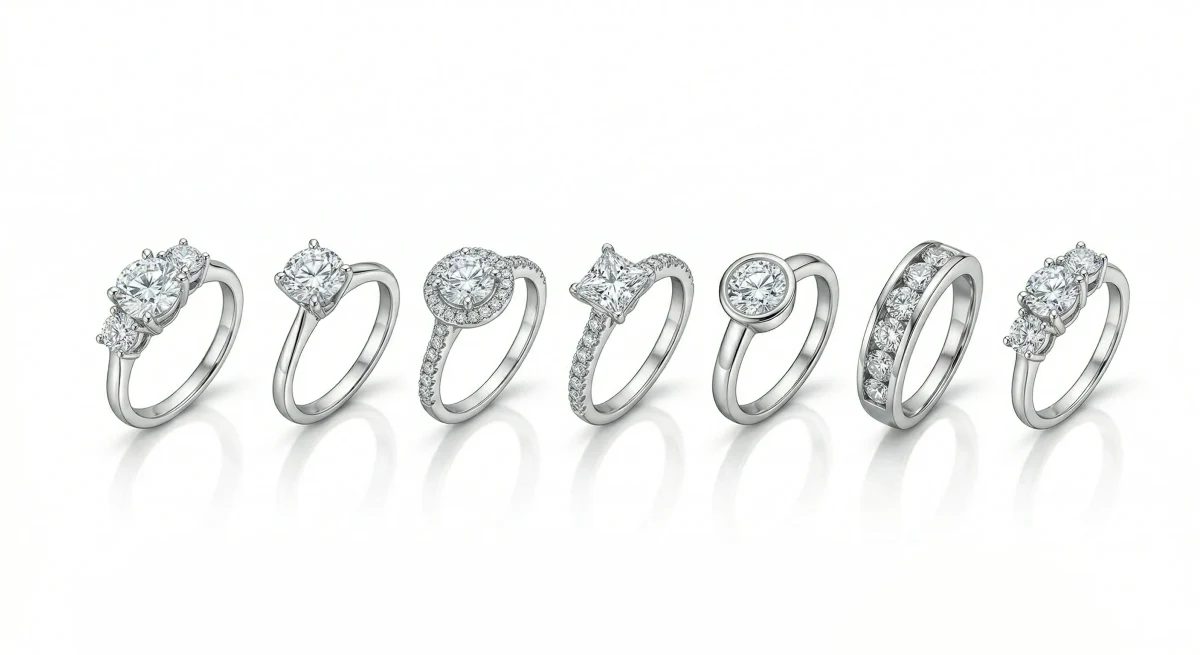
Solitaire
One diamond, held by prongs on a simple band. Nothing competes for attention.
Advantages: Timeless. Works with any diamond shape. Easy to pair with wedding bands. Simple maintenance.
Disadvantages: The diamond has nowhere to hide - every flaw, colour tint, and inclusion is on full display. You need a better quality stone to pull off a solitaire. A smaller diamond can look lonely without accent stones.
Best for: Classic elegance. People who want the diamond to speak for itself.
Halo
A circle of smaller stones surrounds the centre diamond, creating the impression of a larger stone and adding significant sparkle. Double halos add a second ring for even more drama.
Advantages: Makes the centre diamond appear 0.25 to 0.5 carats larger. Allows a smaller, less expensive centre stone while achieving visual impact. Excellent value proposition.
Disadvantages: Can look busy on very small fingers. Tiny halo stones loosen over time. Cleaning requires more attention due to all the small settings.
Best for: Maximum visual impact on a moderate budget.
Pave
Pave (pronounced "pah-vay") features small diamonds set closely along the band, creating a surface paved with light. Minimal metal between stones means the band itself sparkles.
Advantages: Serious sparkle without the cost of larger accent stones. Makes the entire ring feel more luxurious. Complements nearly any centre stone shape.
Disadvantages: Tiny stones can come loose, especially on the underside where daily wear creates friction. Resizing is difficult because stones run along the band.
Best for: All-over sparkle lovers who do not mind occasional professional maintenance.
Bezel
Metal wraps completely around the diamond's perimeter, holding it flush with the rim. Sleek, modern, protective.
Advantages: Most secure setting type. Diamond protected from knocks. Low profile means fewer snags. Excellent for active lifestyles. Hides edge imperfections.
Disadvantages: Less light enters from the sides, reducing brilliance compared to prong settings. Metal rim makes the diamond appear slightly smaller. Less traditional.
Best for: Active people, medical professionals, anyone who works with their hands.
Tension
The diamond is held between two ends of the band by metal pressure alone, appearing to float with no visible support. Dramatic and architectural.
Advantages: Maximum light exposure. Truly unique appearance. Modern and distinctive.
Disadvantages: Resizing extremely difficult or impossible. Not every jeweller can work with these. Diamond must be precisely calibrated to the band. Limited shape options.
Best for: People who want something truly unusual and understand the maintenance implications.
Three-Stone
Three stones together, traditionally representing past, present, and future. The centre stone is larger, flanked by two smaller stones that can match or contrast in shape.
Advantages: Rich symbolism. Visually substantial. Side stones add width and presence. Design flexibility through mixing shapes.
Disadvantages: More expensive due to additional stones. Requires careful proportioning. Can feel bulky on smaller fingers.
Best for: Those who value symbolism and want a ring with visual weight.
Cathedral
Arched metalwork rises from the band to support the centre stone, resembling cathedral arches. The stone sits elevated, giving the ring a sense of grandeur.
Advantages: Structural support for the centre stone. Distinctive side profile. Makes the diamond appear taller and more prominent. Works with both solitaire and accented designs.
Disadvantages: Higher profile increases catching on things. Arches can make it harder to find a flush-fitting wedding band.
Best for: People who appreciate architectural detail and want visual depth from every angle.
Diamond Shapes for Engagement Rings
The shape of the diamond is the most visible decision you will make. It determines the ring's personality and how it looks on your partner's hand.
Round Brilliant
The most popular shape, roughly 60% of all engagement ring diamonds. 57 or 58 facets engineered to maximise light return.
On the finger: Universally flattering. Proportional on any hand size.
Personality: Classic, maximally brilliant. If your partner has no strong preference for unusual shapes, round brilliant is the reliable choice. Retains resale value better than any other shape.
Princess
Square shape with pointed corners and brilliant-style faceting. Developed in the 1960s, hugely popular since the 1990s.
On the finger: Modern and geometric. Works well on longer fingers. Can appear to shorten shorter fingers slightly.
Personality: Contemporary but established. Sharp corners require protective prong settings to prevent chipping.
Oval
Elongated round shape that has surged in popularity recently. Same facet pattern as round brilliants.
On the finger: Slimming, lengthening effect. Makes fingers appear longer. Extremely flattering on wider hands.
Personality: Elegant and current without being trendy. Faces up larger than rounds of the same carat weight because the elongated shape covers more surface area.
Cushion
Square or rectangular with rounded corners, sometimes called a "pillow cut." Larger facets produce broad flashes of light rather than fine scintillation.
On the finger: Soft and romantic. Rounded corners give a vintage feel. Works beautifully in halo settings.
Personality: Romantic, vintage-inspired. Shows colour more than rounds, so lower colour grades will be more apparent.
Emerald
Rectangular with step-cut facets creating a "hall of mirrors" effect. About clarity and transparency rather than fiery brilliance.
On the finger: Elongating, sophisticated, dramatic. Long lines draw the eye along the finger.
Personality: Understated glamour, clean lines, quiet confidence. Open facets reveal everything, so you need higher clarity - inclusions are very visible.
Pear
Teardrop shape combining round brilliant at one end with a point at the other.
On the finger: Worn point-up, it elongates the finger dramatically. The asymmetric shape is distinctive.
Personality: Unique, romantic, slightly unconventional. Works beautifully as both centre and side stones. The point requires a protective prong.
Marquise
Elongated shape with pointed ends, like a narrow eye. Allegedly designed to resemble the lips of the Marquise de Pompadour.
On the finger: Maximum finger-lengthening effect of any shape. Creates the illusion of significantly more slender fingers.
Personality: Bold, dramatic, vintage. Less popular recently, making it a statement of individuality. Watch for the "bow-tie effect" - a dark shadow across the centre of poorly cut marquise diamonds.
Metal Choices
The metal affects the diamond's apparent colour, the ring's durability, maintenance needs, and how it ages over time.
Platinum
The densest and most durable precious metal in jewellery. Naturally white, never needs plating.
With diamonds: Cool white tone makes diamonds appear whiter and brighter. Ideal for diamonds graded D-G where you want no warmth reflected into the stone.
Practical considerations: Heavier than gold. Does not wear away but displaces - scratches push metal aside rather than removing it. Develops a satiny patina. Hypoallergenic. Most expensive option by a significant margin.
White Gold
Gold alloyed with white metals (palladium, nickel, or zinc), plated with rhodium for a bright white finish.
With diamonds: Visually similar to platinum when freshly plated. Works with all colour grades. Rhodium wears off over time, revealing a yellowish undertone - replating needed every 12-24 months.
Practical considerations: More affordable than platinum. Lighter. Some alloys contain nickel (allergy risk). The most popular metal for engagement rings globally.
Yellow Gold
Available in 14K (58.3% gold) and 18K (75% gold). 24K is too soft for daily wear.
With diamonds: Adds warmth to the diamond. Flattering for diamonds with slight colour (H-K), as gold's warmth makes the natural tint less noticeable. For colourless diamonds (D-F), it can add unwanted warmth, though some prefer the softer vintage look.
Practical considerations: No plating required. Easy to maintain. 14K is harder than 18K. Warm tone suits olive and darker skin tones particularly well. Strong comeback after years of white metal dominance.
Rose Gold
Gold alloyed with copper, creating the distinctive pink hue. More copper means deeper rose colour.
With diamonds: Adds a warm, romantic quality. Complements all colour grades, though adds slight warmth. Particularly striking with cushion and oval cuts.
Practical considerations: Copper makes it harder and more durable than yellow gold. No plating required. Colour deepens slightly with age. Not hypoallergenic. The most fashion-forward metal choice currently.



Lab Diamonds vs Natural for Engagement
A personal decision with no objectively correct answer. Here are the practical differences.
What they are: Lab-grown diamonds are chemically, physically, and optically identical to natural diamonds. Real diamonds. The difference is origin: one formed underground over billions of years, the other was created in a laboratory over weeks.
Price: Lab diamonds cost approximately 60-80% less than natural diamonds of equivalent quality. A lab diamond and its natural equivalent of the same size and grade can differ in price by a factor of four to six.
Resale value: Natural diamonds retain some resale value (typically 30-50% of retail). Lab diamonds currently have very limited resale value, and prices have been declining as production scales up.
The emotional question: Some feel the diamond's ancient origin is part of its meaning. Others feel lab diamonds' ethical advantages align better with their values. Neither position is wrong.
Practical recommendation: Discuss openly with your partner if possible. If budget is the primary concern, lab diamonds deliver significantly more visual impact for the same money.
Budget Reality Check
Marketing has distorted expectations around engagement ring costs. Here is a realistic picture.
What to Expect at Each Tier
Natural round brilliant diamonds sit on a broad spectrum. A half-carat falls in the entry-level to mid-range tier: accessible enough that most couples can reach it without major financial strain, similar in outlay to a good used car. Moving up to three-quarters of a carat pushes into solid mid-range territory, roughly the cost of an economy holiday for two to a long-haul destination. A one-carat natural stone reaches the premium tier: meaningful money, comparable to several months of rent in many UK cities. At one-and-a-half carats, you are in luxury territory, an amount that represents a substantial portion of an annual salary for most households. Two carats and above is ultra-luxury, at which point the stone itself could fund a significant home renovation.
Lab-grown diamonds compress this dramatically. A one-carat lab stone sits comfortably in the entry-level to mid-range bracket. A one-and-a-half-carat lab diamond typically costs what a natural half-carat would. The visual result, however, is identical.
Settings without a centre stone range from entry-level (a simple solitaire) through mid-range (halo, pave) to premium (elaborate three-stone designs). The setting alone is rarely the dominant cost, but cutting corners here risks losing the diamond entirely.
Where to Save
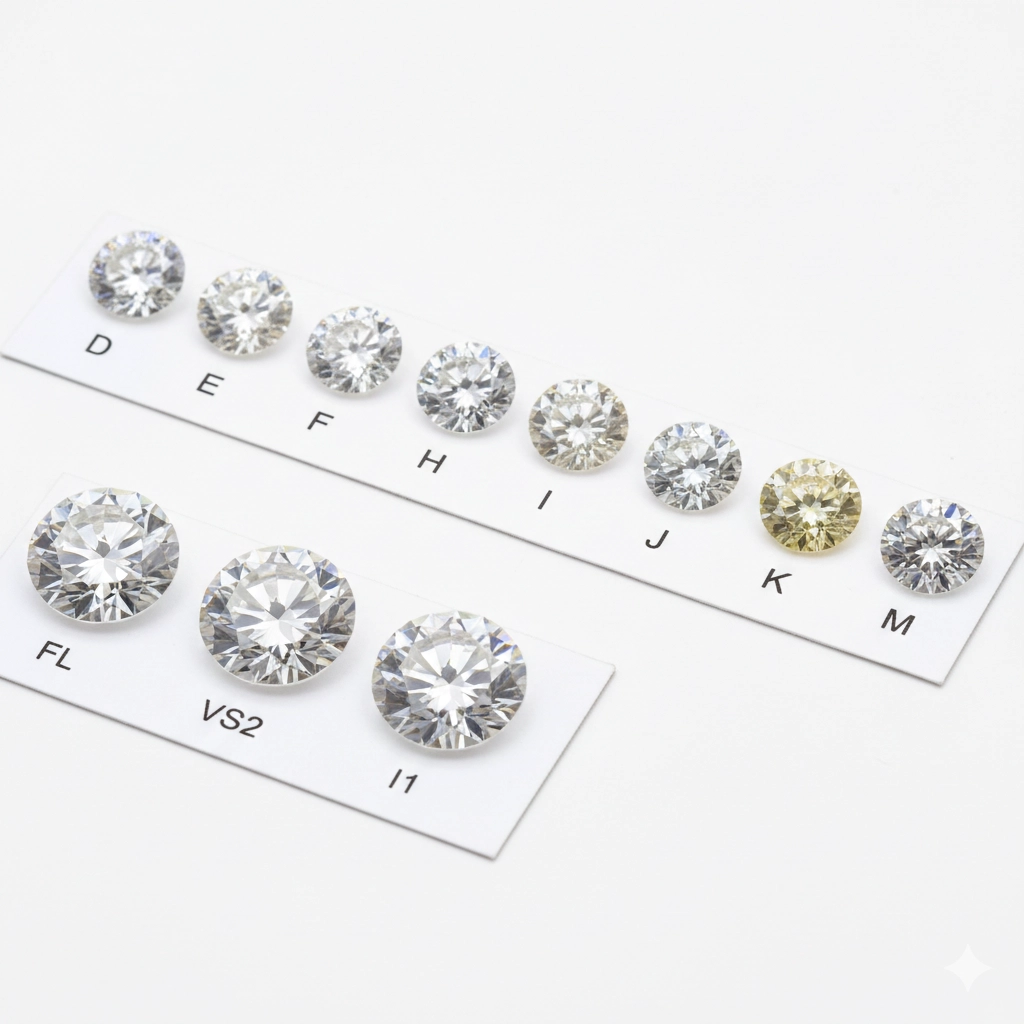
Colour: Going from D to G colour saves significant money with virtually no visible difference in a white metal setting. In yellow or rose gold, you can comfortably go to H or I.
Carat weight: A 0.90 carat diamond is visually indistinguishable from a 1.0 carat diamond on the finger, but costs 15-25% less because of the psychological pricing premium at whole carat marks.
Clarity: VS2 and SI1 diamonds are "eye-clean" (no visible inclusions to the naked eye). Paying for VVS or IF clarity is paying for something only visible under 10x magnification.
Where Not to Save
Cut quality. This is the single biggest factor affecting how brilliant and beautiful a diamond appears. A perfectly cut 0.8 carat diamond will outshine a poorly cut 1.2 carat diamond every time. Never compromise on cut.
The setting's structural integrity. A cheap setting with thin prongs will lose your diamond. The metalwork needs to be solid enough to last decades of daily wear.
Ring size accuracy. Getting the size wrong means resizing, which can weaken certain settings (especially pave and eternity-style bands). Take the time to get it right.
The Proposal Ring vs The Forever Ring
Not every engagement ring needs to be the forever ring from day one. Modern couples increasingly separate the proposal moment from the final ring selection.
The Placeholder Approach
Buy an affordable ring for the proposal - a simple silver band with a cubic zirconia, or a modest gold ring. Use it for the moment. Then go ring shopping together afterwards, with the engagement already happily settled. This removes the pressure of guessing perfectly and makes ring shopping a shared experience.
Choosing Together Beforehand
Some couples shop for the ring together before the proposal. The "when" and "how" remains a surprise, but the ring is a mutual decision. Both people feel invested, and practical concerns are addressed together.
The Upgrade Path
Start with what you can afford now, with the understanding that the ring may be upgraded later. Many couples upgrade at a significant anniversary. No financial strain at the start of a life together, and the original ring retains sentimental value.
What to Avoid
Do not go into serious debt for a ring. Your partner wants to marry you, not a monthly payment plan.
Common Mistakes When Buying a Diamond Engagement Ring
1. Prioritising Carat Weight Over Cut Quality
The most common mistake. People fixate on carats because it is easy to compare. But a beautifully cut smaller diamond will always look better than a poorly cut larger one. Cut determines brilliance, fire, and sparkle. Everything else is secondary. If you want to understand the grading system itself, see our explainer on what a diamond carat actually is, alongside gold purity.
2. Ignoring Your Partner's Actual Style
You love a classic solitaire. Your partner wears chunky vintage jewellery and has never worn anything minimalist. The ring should reflect their style, not yours. Pay attention to what they actually wear.
3. Shopping Without Knowing Their Ring Size
Guessing leads to resizing, which costs money, time, and can compromise certain settings. Borrow a ring from the correct finger, ask a close friend, or use discreet methods.
4. Buying Online Without Seeing the Diamond
Certificates describe measurable qualities but cannot convey how the stone actually looks. Two diamonds with identical specs can look noticeably different in person. If buying online, choose a retailer with a strong return policy and ideally video of the actual stone.
5. Getting Distracted by Fluorescence Fears
Many buyers avoid fluorescence because they have read it is "bad." Faint to medium fluorescence rarely affects appearance and can actually make lower-colour diamonds appear whiter. Strong fluorescence occasionally causes milkiness, but not automatically. Judge each stone on its actual appearance.
6. Choosing a Setting That Does Not Suit Their Lifestyle
A tall cathedral setting on someone who does heavy manual work. A delicate pave band on a rock climber. The setting must work with how your partner actually lives, not just how it looks in the shop.
7. Buying the First Ring You See
Your perspective changes dramatically after seeing twenty rings versus two. Even if you choose the first one, the comparison gives you confidence in the decision.
8. Neglecting the Profile View
Everyone focuses on the top-down view because that is how rings photograph. But the wearer sees the profile constantly. Make sure it looks good from the side too.
9. Forgetting About the Wedding Band Pairing
The engagement ring will eventually sit next to a wedding band. Some settings (wide halos, unusual shapes) make it very difficult to find a flush-fitting band. Think about this during selection, not after.
10. Relying Entirely on the Two-Months-Salary Rule
This marketing invention has no basis in financial reality. Spend what makes sense for your situation. The value is in the commitment, not the price tag.
The History of the Diamond Engagement Ring
The diamond engagement ring tradition is younger than most people believe. And its origin is less romantic than the advertising suggests.
The first documented diamond ring
In 1477, Archduke Maximilian of Austria gave his bride-to-be, Mary of Burgundy, a ring set with a diamond in the shape of an M. This was the first documented diamond engagement ring in history. It was a political statement, not a romantic one. The engagement united two powerful royal houses.
For the next four hundred years, diamond engagement rings remained a privilege of the highest aristocracy. Regular people got engaged with simple gold bands, silver rings, or no rings at all.
The 1947 diamond marketing revolution
In 1938, the diamond syndicate, the South African diamond company, launched one of the most successful advertising campaigns in history. The agency N.W. Ayer developed the slogan "A Diamond Is Forever." The goal: to establish diamonds as an essential part of every engagement.
It worked. In 1939, fewer than 10% of American brides received diamond rings. By 1990, it was over 80%. The diamond engagement ring was not created by tradition. It was created by marketing.
The "two months' salary rule" is also an invention of the 1947 diamond marketing campaign. In the 1980s, a campaign ran with the line "Isn't two months' salary a small price to pay for something that lasts forever?" It was never a social norm. It was advertising copy.
This does not mean a diamond engagement ring is a bad choice. It means you are free to make your own decision without feeling pressured by a marketing tradition. If a diamond is what makes your partner happy, wonderful. If a sapphire, moissanite, or a plain gold band fits better, equally wonderful. The meaning is in the commitment, not the stone.
Diamond alternatives worth knowing
If a diamond is not the right fit for you or your partner, there are excellent alternatives.
Moissanite. Optically almost identical to diamond, actually even more brilliant. Originally discovered in a meteorite in 1893 by Henri Moissan. Now produced synthetically. Mohs hardness 9.25 (diamond is 10). Costs about 10-15% of a comparable diamond. Indistinguishable from diamond to the naked eye.
Sapphire. Mohs hardness 9. Durable enough for daily wear over decades. Queen Elizabeth II's engagement ring contained sapphires. The famous late-1980s British royal sapphire engagement ring, now worn by the next generation, is a blue sapphire. Sapphires come in many colours, not just blue: pink, yellow, green, orange (padparadscha).
Ruby. Technically a red sapphire. Same hardness, same durability. Rubies were more valuable than diamonds for centuries. A ruby engagement ring is historically the more traditional choice.
Emerald. Beautiful, but Mohs hardness only 7.5-8 and often included. Requires more care than diamond or sapphire. An emerald engagement ring is a choice for people who appreciate its character and are willing to maintain it.
The engagement ring tradition varies by country
In many European countries, the engagement ring tradition differs from the American model. In parts of Germany and Scandinavia, couples traditionally wear a plain gold band on the left hand during the engagement, then move it to the right hand at the wedding. In other regions, the engagement ring becomes the wedding ring. No separate purchase required.
This matters for international couples and for anyone who shops with an open mind. The diamond engagement ring is a strong choice, but it is not the only valid tradition. Some couples prefer matching bands without stones. Some choose coloured gemstones with personal significance. Some skip the ring entirely and get matching tattoos, or a piece of art, or nothing at all.
The point is that the tradition should serve the couple, not the other way around. If a diamond is what resonates, buy a diamond. If it is not, do not let a marketing campaign from 1938 make you feel guilty about choosing something else.
Getting the ring size right
Getting the size wrong is the most common preventable mistake in engagement ring buying. Three discreet methods.
Borrow a ring. If your partner wears a ring, borrow it for a day. Take it to a jeweller who measures the size. Or place it on paper, trace the inside, and measure the diameter.
Ask a close friend. Your partner's best friend probably knows. They may even know the exact preference in style, shape, and metal. Involve them early. They are your intelligence network.
Measure during sleep. Wrap a thin strip of paper around your partner's ring finger while they sleep. Mark where it overlaps. Measure the length in millimetres. Not the most romantic method, but surprisingly accurate. Use a ring size chart to convert the measurement.
Frequently Asked Questions
What is the most popular diamond shape for engagement rings?
Round brilliant, by a significant margin, roughly 60% of sales. Oval has grown rapidly and sits in second place in many markets. Cushion and princess follow. That said, "popular" does not mean "best for you." Choose the shape your partner is drawn to.
How many carats should a diamond engagement ring be?
There is no "should." The average in the UK is 0.5-1.0 carats, in the US slightly higher at 1.0-1.5 carats. What matters far more is cut quality, setting choice, and whether it suits your partner's hand and style.
Can you tell the difference between a lab diamond and a natural diamond by looking at it?
No. They are optically identical. A trained gemologist using specialised equipment can detect the difference, but the naked eye cannot. Both will sparkle identically on your partner's finger.
Is platinum worth the extra cost over white gold?
Depends on priorities. Platinum is more durable, needs no replating, and is hypoallergenic. White gold is lighter, more affordable, and looks virtually identical when freshly plated. If your partner has metal sensitivities or wants zero maintenance, platinum justifies the premium. Otherwise, white gold is excellent.
Should I buy the engagement ring and wedding band as a set?
Not necessarily, but worth considering. A set ensures the rings fit together and share design language. Many prefer choosing the wedding band closer to the wedding. Solitaires pair easily with bands later. More complex settings (halos, unusual shapes) benefit from advance planning.
What engagement ring setting is most durable?
Bezel offers the most protection, followed by channel settings. Prongs are perfectly durable for normal wear but need inspection every 12 months to ensure they have not loosened. Tension settings are secure but require specialist maintenance.
How far in advance should I buy the engagement ring?
Allow at least six to eight weeks. Stock rings can be ready in days, but custom orders and bespoke designs take longer. If you want a specific diamond sourced to your specs, add two to three weeks. Always build in a buffer.
Is it bad luck to go ring shopping together?
No. A modern invention with no historical basis. In many cultures, couples have always chosen rings together. The proposal can still be a surprise even if the ring is not.
Do I need a diamond engagement ring, or can I choose another stone?
You can choose whatever stone you both love. Sapphires, rubies, emeralds, and moissanite are popular alternatives. The diamond engagement ring is a tradition, not a requirement. However, diamonds are the hardest natural material (10 on the Mohs scale), making them the most practical choice for daily wear over decades. Softer stones require more care.
What is the best way to insure an engagement ring?
Most home insurance policies cover jewellery but with low limits. Specialist jewellery insurance is recommended for any ring in the mid-range tier or above. Get an independent appraisal, keep certificates and receipts, photograph from multiple angles. Ensure coverage includes theft, loss, damage, and mysterious disappearance.
Silver and gold jewellery, wedding bands, symbolic pendants, paired sets.
Caring for Your Diamond Engagement Ring
A diamond is the hardest natural material on Earth, but "hardest" does not mean indestructible. Here is what daily life actually does to a diamond ring and how to keep it looking its best.
Daily wear reality
Diamonds resist scratching from nearly everything, but the setting does not. Gold prongs bend. Platinum displaces. White gold rhodium plating wears off. The diamond will outlast every other component of the ring. Your maintenance effort should focus on the setting, not the stone.
Lotions, soaps, and oils build up behind the diamond over time, creating a film that blocks light. A diamond that looked brilliant when purchased and now seems "dull" probably just needs cleaning, not replacing. Soak in warm water with a drop of dish soap for 20 minutes. Brush gently with a soft toothbrush behind the stone. Rinse and dry. The brilliance returns.
Annual check-up
Once a year, take the ring to a jeweller for a prong check. They will inspect each prong under magnification and tighten or rebuild any that have worn thin. This five-minute appointment prevents the catastrophe of a lost diamond. Most jewellers offer this service free or for a nominal charge.
When to take it off
Remove the ring before heavy lifting, gardening, climbing, or any activity where impact could bend a prong. Remove it before applying hand cream, sunscreen, or cleaning products. Remove it before swimming in chlorinated pools (chlorine can weaken certain gold alloys over time). The diamond does not care. The setting does.
The "forever" perspective
A well-maintained diamond ring genuinely lasts forever. The diamond itself is billions of years old. The metal can be reworked, prongs replaced, bands resized. Twenty years from now, a jeweller can restore the setting to near-original condition. The stone will still be the stone. That is the real meaning behind "a diamond is forever." Not the marketing slogan. The physical fact.