Diamond Color and Clarity Scale: Complete Guide to Evaluating Stone Quality
When Science Meets Beauty
You're standing in front of a jewellery display. Two diamonds look absolutely identical, but one costs three times more than the other. What's the difference? Why is one stone significantly more expensive when they appear indistinguishable to the naked eye?
The answer lies in the diamond grading system: colour and clarity scales. These aren't just letters and numbers on a certificate. They're the language spoken by all jewellers worldwide, a coordinate system that determines a stone's true value.
If you've been searching for "diamond colour scale," "diamond clarity chart," "how to evaluate diamond quality," or "what do letters D, E, F mean," you're in the right place. This guide will help you read certificates like a professional and avoid overpaying for characteristics invisible to the naked eye.
Wear the symbol, don't just read about it. These are in stock:



The 4C System: Universal Grading Standard
History of Creation
Before the 1940s, there was no unified standard for evaluating diamonds. Every jeweller used their own terms: "first water," "first grade," letters A-B-C, Roman numerals. This created chaos. The same stone received different grades in different countries.
Everything changed when the international 4C system was developed:
- Cut: quality of stone processing
- Colour: degree of colorlessness
- Clarity: presence of inclusions
- Carat: weight in carats
Today, the 4C system is the global standard. A certificate from New York reads the same as in London, Dubai, or Hong Kong.
Why Colour and Clarity Matter So Much
Of all the 4C characteristics, colour and clarity determine a stone's visual beauty and price the most.
Cut: undoubtedly important, but its quality is easily assessed visually by the stone's brilliance.
Carat weight: obvious. Bigger stone = higher price (all else equal).
But colour and clarity are characteristics requiring special knowledge. The difference between D and H colour stones may be invisible to buyers, but the price difference is enormous.
A diamond earns its keep at breakfast, not locked in a vault waiting for some anniversary. Hoarding sparkle in velvet is a crime. Don't argue.
How to Wear a Diamond
Years of styling shoots and shop windows taught me one thing: a diamond sounds different depending on what sits next to it. Here is what actually works, occasion by occasion.
What do you wear a diamond with every day? For everyday I recommend a small stone on a pendant or modest studs over knitwear, jeans and a cotton shirt. A dark solid top (graphite, navy, black) lifts the sparkle, a light one (white, beige) softens it, and for daytime that is fine. Here the stone works as a point of light near the face, not as a statement.
Does it belong at the office? It does, if you keep it restrained. I suggest a fine chain with a single stone or studs up to five or seven millimetres: that reads as polish, not luxury. A closed neckline, a turtleneck or a buttoned shirt balances the shine. I keep the one point of light rule: earrings or a pendant, never a pile of both.
How do you build an evening look? For the evening I choose an open neckline, smooth fabric in a deep colour and a pendant on a short or medium chain, so the stone settles in the hollow of the collarbones. Hair up frees the neck and the earrings. On dark silk or crepe a diamond catches the light best.
Which setting metal should match your skin? For cool colouring (fair skin, ashy tones) I recommend white gold and platinum, for warm colouring (golden skin, chestnut hair) I suggest yellow or rose gold. Warm metal also hides a faint tint in the stone, so with yellow gold you can safely drop the colour grade by one step. The setting changes, the stone itself does not.
Who suits a larger stone, and how? A larger stone suits anyone who loves eye-catching looks and special dates. I recommend a halo or wide prongs: they add presence. Two rules that never fail. First, match the chain length to the neckline: 40 to 45 cm for an open neck, 50 and longer under a closed top. Second, one point of light always beats five at once, so do not pile everything on.

Turn on your camera, pick earrings, a pendant or a ring, and see the piece on yourself in real time.
Switch items in one tap.
Everything runs in your browser: no photo or video is ever uploaded.
Before the 4Cs: The Old British Grading Words
Anyone who inherits jewellery in Britain sooner or later meets a valuation typed on onion-skin paper, and none of the words on it look like GIA letters. This vocabulary was the trade language of Hatton Garden and Antwerp for the better part of a century, and it has not entirely died out. Understanding it is the difference between reading a grandmother's insurance schedule correctly and guessing.
"Of the First Water" and What It Actually Meant
The phrase came into English from the pearl and gem trade of the Indian Ocean, where "water" described a stone's transparency and lustre. A diamond of the first water was flawless and colourless. Second water meant a slight tint or a visible feather. Third water meant obvious problems. By the eighteenth century the phrase had escaped the jeweller's bench and entered ordinary English as a compliment, which is why Victorian novels describe a scoundrel as "a rogue of the first water."
The problem with the term was that it had no reference standard. One dealer's first water was another's second. Two shops on the same London street could disagree completely and neither was lying. That failure is exactly what the 4C system was built to fix.
River, Wesselton, Crystal and Cape: The Mine Names
The second old system named colour grades after the places the stones came from, which worked as long as everyone in the trade knew what a given mine produced.
River. The whitest grade, named for the alluvial deposits worked along South African and Brazilian rivers. Roughly equivalent to D and E on the modern scale.
Jager. A bluish-white grade named after the Jagersfontein mine, sometimes ranked above River. In practice the "blue white" it described was often fluorescence rather than body colour, and the term was eventually discouraged because sellers abused it.
Top Wesselton and Wesselton. Named for the Wesselton mine near Kimberley. Top Wesselton corresponds roughly to F and G, Wesselton to H.
Top Crystal and Crystal. Roughly I and J. A faint but real warmth.
Top Cape, Cape and Light Brown. The Cape series stones carry the visible yellow that nitrogen produces, corresponding to K and downward. "Cape yellow" is still used by antique dealers as shorthand for a warm old stone.
These names survive in the Scandinavian nomenclature (often written Scan D.N.) and in the CIBJO terminology recognised across continental Europe, so a modern Belgian or German report may still print them beside the letter grade.
Old Clarity Words: Loupe Clean and Piqué
The European clarity vocabulary ran in parallel. Loupe clean (lupenrein in German) meant nothing visible at ten times magnification, covering what GIA now splits into FL, IF and the VVS grades. Below that came VS and SI, which survived into the modern system unchanged. At the bottom sat piqué, from the French for pricked or spotted: Piqué I, II and III correspond to I1, I2 and I3, and "pikey" stones is still heard in British workshops as trade slang for heavily included goods.
You will also meet spotted, feathered and carbon spots on older British paperwork. Carbon spot is a misnomer that refuses to die: most black inclusions are graphite or chromite crystals, not loose carbon.
How the Old Terms Map Onto D-Z Today
| Old British and European term | Modern colour grade |
|---|---|
| Jager, River | D, E |
| Top Wesselton | F, G |
| Wesselton | H |
| Top Crystal | I |
| Crystal | J |
| Top Cape | K, L |
| Cape | M, N |
| Light Brown, Brown | below N |
| Old clarity term | Modern clarity grade |
|---|---|
| Loupe clean | FL, IF, VVS1, VVS2 |
| VS (très petites inclusions) | VS1, VS2 |
| SI (petites inclusions) | SI1, SI2 |
| Piqué I, II, III | I1, I2, I3 |
Treat any conversion as approximate. Old grading was done by eye against whatever the dealer had to hand, and the tolerances were wide. If you are insuring an inherited piece, the sensible move is a fresh valuation against modern standards rather than trusting a term coined before the Second World War.
Why a Diamond Is Transparent: The Physics
Colour in a diamond is not paint or dye. It is an accident of atomic structure, and understanding the mechanism makes the whole D-Z scale suddenly obvious rather than arbitrary.
Carbon, Pressure and a Perfect Lattice
A diamond is carbon and nothing else, arranged in a cubic lattice where every atom bonds to four neighbours at equal angles. Those bonds are extremely strong and extremely tight, which is what makes the material the hardest naturally occurring substance known. It also means there are no loose electrons available to absorb visible light. Light in the visible range passes straight through, bending sharply because the refractive index is high, splitting into a spectrum because the dispersion is high, but never being swallowed.
That is why a perfect diamond is perfectly colourless. Not white, not clear like glass, but genuinely without a hue of its own. Everything you see in a well cut stone is light borrowed from the room and handed back to you rearranged.
Nitrogen: The Atom That Makes Yellow
Nitrogen sits next to carbon on the periodic table and is close enough in size to slip into the lattice in carbon's place. Around 98% of natural diamonds contain some nitrogen. A nitrogen atom brings one more electron than the carbon it replaced, and that spare electron does absorb light, specifically at the blue and violet end of the spectrum. Remove blue from white light and what reaches your eye is faintly yellow.
The more nitrogen, and the more it clusters into groups, the stronger the yellow. That single fact is the whole D-Z scale. D means almost no nitrogen. K means enough for anyone to see. Cape yellows have a great deal of it.
Brown, by contrast, usually comes from plastic deformation: the crystal was squeezed and sheared deep in the earth, its lattice planes slipped, and the resulting defects absorb light broadly across the spectrum. This is why brown tints often look "muddy" rather than warm.
Boron, Hydrogen and the Rarer Colours
Boron has one electron fewer than carbon rather than one more, and it absorbs at the red end. Remove red and you get blue. Boron-bearing diamonds are vanishingly rare because boron is a crustal element and diamonds form in the mantle, which is why blue stones command what they do. Boron also makes the diamond a semiconductor, which is one of the tests laboratories use.
Hydrogen produces greys, violets and occasional greens. Natural irradiation from surrounding rock creates green surface staining. A very particular lattice defect involving nitrogen and a vacancy produces pink and red, and geologists still argue about the exact mechanism.
The practical takeaway: nitrogen is common, so faint yellow is common and therefore cheap to avoid only up to a point. Boron is rare, so blue is rare and priced accordingly. Nothing about the D-Z scale is a matter of taste. It is a rarity ladder built on trace chemistry.
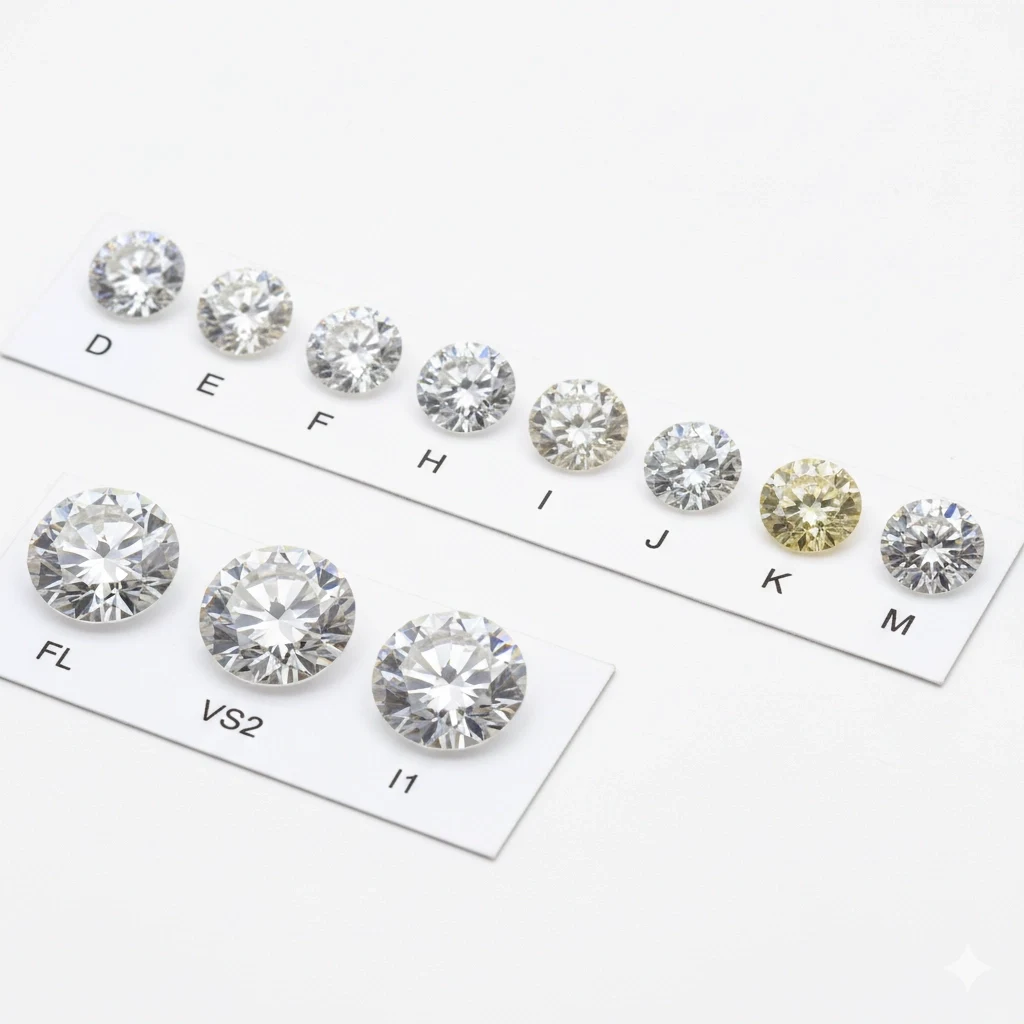
Diamond Colour Scale: From D to Z
What Is Diamond "Colour"?
Paradox: when discussing diamond "colour," we mean the degree of its colorlessness. The ideal diamond is absolutely transparent, without any tints. It's like a drop of purest water or crystal-clear glass.
Most mined diamonds have a barely noticeable yellow or brown tint caused by nitrogen impurities in the crystal lattice. Less nitrogen = whiter and more expensive stone.
Color is just one letter on a certificate, and it interacts with the other three Cs in ways that shape both appearance and price. To see how weight specifically fits into the picture, the dedicated guide to diamond carat weight walks through the relationship between size, mass, and value in detail.
Why Does the Scale Start with Letter D?
The international scale intentionally starts with letter D, not A. The reason is simple. Before the 4C system was created, many used letters A, B, C to denote quality. The developers wanted to create an entirely new standard, unconnected to old systems.
D marks the beginning of a new era in diamond evaluation.
Colour Classification: Detailed Breakdown
D-E-F: Colourless
D, Absolutely Colourless
- Highest grade on the scale
- Absolutely transparent stone without the slightest hint of tint
- Extremely rare (less than 1% of mined diamonds)
- Price: Premium, 40-50% more expensive than G grade stone
E, Essentially Colourless
- Only a gemologist can see the difference from D when comparing with reference
- Indistinguishable from D to average buyer
- Price: 30-40% more expensive than G stone
F, Exceptionally White
- Barely noticeable tint can only be detected by experienced specialist
- Looks absolutely white in setting
- Price: 20-30% more expensive than G stone
For whom: Perfectionists, collectors, investment purchases. For engagement rings in platinum or white gold with large stones (2+ carats).
Metals: Platinum, white gold, silver.
G-H: Nearly Colourless, The Sweet Spot
G, Excellent White
- Tint barely distinguishable when compared to D reference
- Looks perfectly white in setting
- Best price-to-quality ratio
- Difference from F visible only in direct comparison
- Price: Baseline for "premium" category
H, Good White
- Very slight warm tint present
- Looks white in white gold or platinum setting
- Indistinguishable from G to naked eye
- Price: 10-15% lower than G
For whom: 80% of engagement ring buyers. Smart choice when you don't want to overpay for D-E-F but want a perfectly white stone.
Metals: White gold, platinum, rose gold (contrast).
Expert tip: If budget is limited, better to get H stone with VS1 clarity than D stone with SI2 clarity. Colour difference won't be noticeable in setting, while SI2 inclusions may be visible.
I-J: Nearly Colourless, Economy
I, Hint of Warmth
- Warm tint becomes noticeable when compared to whiter stones
- Looks great in yellow or rose gold setting
- For stones up to 1 carat, difference from H is minimal
- Price: 15-20% lower than H
J, Noticeably Warm
- Tint visible upon close examination
- Contrast noticeable in white metal setting
- Looks harmonious in yellow gold
- Price: 20-25% lower than H
For whom: Budget-conscious buyers. Those choosing yellow or rose gold. For smaller stones (under 0.7 carat) where tint is less noticeable.
Metals: Yellow gold (stone's tint blends with metal), rose gold.
Important: For stones over 1 carat in white metal setting, I-J grade may look yellowish. Be careful.
K-L-M: Noticeable Tint
K-L-M
- Yellow or brown tint visible to naked eye
- Often called "warm" diamonds
- Look frankly yellow in white metal
- May look interesting in vintage-style yellow gold
- Price: 40-60% lower than G
For whom: Budget purchases, vintage settings, small side stones in composite rings.
Not recommended: For main stone in white metal engagement ring.
N-Z: Light Yellow and Brownish
N-Z
- Distinct yellow or brown colour
- Not yet "fancy" stones, but no longer white diamonds
- Rarely used, mainly in budget jewellery
- Price: 60-80% lower than G
Important: Don't confuse with fancy yellow diamonds (Fancy Yellow), which have bright saturated colour and cost MORE than white diamonds.
Fancy Colours: Separate Category
Fancy coloured diamonds are stones with bright, saturated colour:
- Pink
- Blue
- Yellow
- Green
- Red (rarest)
They're evaluated by different system, where colour intensity matters:
- Faint
- Very Light
- Light
- Fancy Light
- Fancy
- Fancy Intense
- Fancy Vivid
- Fancy Deep
Paradox: Yellow stone in Z category is cheap, while bright yellow fancy stone can cost many times more than colourless D stone!
Coloured stones beyond diamond follow their own grading vocabulary entirely. The sapphire colours guide covers how the same mineral, corundum, takes on blue, peach, lavender, teal, and the legendary padparadscha, and why colour saturation drives sapphire price the way the D-Z scale drives diamond.
How Colour Is Actually Graded
Most buyers picture a gemologist holding a stone up to the light and pronouncing a letter. The real procedure is almost the opposite, and knowing it explains why the differences you are paying for are so hard to see on the finger.
Master Stones and the Comparison Method
Colour is never graded in the absolute. Every laboratory keeps a set of master stones, a graduated row of diamonds whose colour has been fixed by repeated cross-checking against other masters. The stone being graded is laid in the row and moved along until it sits between two masters. The lower of the two gives it its grade.
This matters because it means a grade is a bracket, not a point. A stone graded G might sit right against the F master or right against the H master. Two G stones from the same laboratory can be visibly different when placed side by side, which is one of several reasons that two lots with identical paperwork can look unlike each other in a display case.
Master sets are expensive and are recalibrated regularly, because a master stone that develops a surface film or gets confused with a neighbour poisons every grade made against it.
Face-Down, Not Face-Up
Grading is done with the stone table down, resting on its crown in a white folded trough, viewed through the pavilion. The reason is that a cut diamond's brilliance actively hides its body colour: all that returned light overwhelms the faint tint. Turn it over and the sparkle is switched off, leaving the body colour visible against a neutral background.
The consequence is worth repeating, because it is the single most useful thing in this article. You are being sold a grade assigned under conditions engineered to make colour as visible as possible, then you wear the stone under conditions engineered to make colour as invisible as possible. That is the gap that the sensible buyer exploits.
Standardised Light and Neutral Surroundings
Laboratory grading uses a controlled daylight-equivalent lamp at a specified colour temperature, a white non-fluorescing tray, and a bench with no coloured surfaces nearby. Graders wear neutral clothing. Even a red jumper reflected off the trough is enough to shift a call by a grade.
Shops rarely replicate any of this. A jeweller's display uses warm halogen or bright white LED, mirrored trays, and often a black velvet pad that increases apparent contrast. None of that is dishonest, but none of it is neutral either. When you compare stones in a shop, ask for a plain white surface and, if there is a window, walk to it.
Why Two Laboratories Can Disagree by a Grade
Grading is human judgement applied against physical references, so it varies. Most major laboratories grade colour by consensus, with two or more graders working independently and a supervisor resolving disagreements. Even so, a stone sent twice to the same laboratory can come back one grade apart, and stones sent to different laboratories quite routinely do.
The reputational differences between laboratories are real and consistent enough that the trade prices them in. The strictest laboratories are treated as the benchmark; more lenient ones tend to run one to two grades softer on colour and clarity alike. This is not fraud, it is calibration drift, but it means a "G/VS1" from a soft laboratory can be a stone that a strict one would call I/VS2, and the price you pay should reflect whichever is true. Compare like with like, or the whole exercise is meaningless.
Lighting Changes Everything
The same diamond is a different object in six different rooms. Nobody warns buyers about this, and it produces more post-purchase anxiety than any other single factor.
Direct Sunlight
The best light a diamond will ever see. Sunlight contains the full spectrum plus an ultraviolet component, so dispersion is maximal and you get the rainbow flashes that make diamonds famous. It also activates fluorescence, which in a blue-fluorescing stone shifts the apparent colour a touch whiter.
The catch: direct sun flatters everything. A mediocre cut looks good in it. Never make a final decision in bright sunlight alone.
Overcast Daylight
North-facing window light on a grey British afternoon is the most honest light there is, and it is what gemologists approximate with their grading lamps. Diffuse, neutral, no strong directional glare. Colour shows truthfully, inclusions show truthfully, and a poorly cut stone reveals its dead zones immediately.
If you take only one piece of viewing advice from this guide: look at the stone by a window on a cloudy day before you commit.
Incandescent and Halogen Bulbs
Old-style filament bulbs and halogen spots run at a warm colour temperature, heavy in yellow and red. This has two effects. It makes any diamond throw more orange and red fire, which looks lovely. It also makes a warm-coloured stone look warmer, so an I or J that read as acceptably white by day can look distinctly buttery under a table lamp.
Jewellers' cases have used warm halogen for decades because it maximises fire. That is showmanship rather than deception, but be aware of it.
LED Lighting at Home
Most British homes have now switched to LED, which changes the picture. Cool white LED at high colour temperature is heavy in blue, which actively helps a warm stone look whiter. It also produces very hard, small point sources, which creates sharp, spiky scintillation.
The downside is that many cheap LEDs have poor colour rendering and spiky spectra, which can make a diamond look slightly harsh or metallic. If your kitchen light makes your ring look wrong, replace the bulb before you blame the stone.
Candlelight and Firelight
Extremely warm and extremely low. Almost no white brilliance, very few flashes, but what you do get is broad, slow, orange fire as the flame moves. Old cut diamonds, with their large facets and high crowns, were designed for exactly this light, which is why a Georgian rose cut can look lifeless in a shop and magical over dinner.
Body colour is essentially invisible by candlelight. Even a K stone reads as warm-toned rather than yellow.
Ultraviolet and Club Lighting
Under blacklight the ordinary rules stop applying. Around a third of natural diamonds fluoresce, usually blue, and a strongly fluorescent stone will glow visibly. This is harmless and often rather beautiful, and it is one of the few settings where fluorescence is immediately apparent to the naked eye.
It is also a rough authenticity clue: many simulants fluoresce differently or not at all. It is not a test, but if you own two stones you believe to be identical and only one glows, that is worth investigating.
The Practical Conclusion
Judge colour by overcast daylight, judge cut by daylight and by a single point source, and judge overall appeal in the light you actually live in. If you spend your evenings under warm bulbs and your ring is white gold, a whiter colour grade earns its keep. If you are outdoors constantly, cut matters far more than the letter.
Stone Size and the Colour Threshold
Colour visibility scales with the volume of diamond the light has to travel through. A tint that is undetectable in a small stone becomes obvious in a large one, because there is simply more material absorbing blue light on the way through. This gives some practical thresholds.
Under Half a Carat
Below roughly 0.50 carat, body colour is very hard to see even in a white metal setting. Stones down at 0.20 or 0.30 carat, the sort used for accent work and small studs, can go to J or K without anyone noticing in wear.
For side stones, halo stones and pavé, buying a high colour grade is close to wasted money. Match the side stones to the centre so that nothing looks obviously mismatched, and stop there.
Half a Carat to One
This is the range where the colour threshold begins to bite. In platinum or white gold, H is the safe floor and G is comfortable. In yellow gold you can drop to I or J and the metal will absorb the difference entirely.
At around 0.70 to 0.90 carat, most people cannot pick a G from an H without a reference stone in hand. That is where the value sits.
Above One Carat
From one carat upward, each colour grade becomes progressively more visible. At two carats and beyond, the difference between H and J is apparent to an untrained eye in a white setting, and a K stone reads as plainly yellow.
The rule of thumb the trade uses: for every doubling of weight, tighten your colour floor by roughly one grade. H at one carat, G at two, F at four. Whether you follow it depends on the metal, the shape, and how much you care about a tint that most observers will never remark on.
Diamond Clarity Scale: From FL to I3
What Is Diamond "Clarity"?
Clarity determines the presence of internal features (inclusions) and external flaws (blemishes).
Inclusions are nature's "fingerprints":
- Other minerals trapped in diamond
- Small cracks
- Clouds of microscopic points
- Voids
Important to understand: Inclusions aren't defects. They're natural results of stone formation under pressure over billions of years. Most inclusions are impossible to see without loupe or microscope.
How Is Clarity Evaluated?
Gemologist examines stone under 10x magnification (standard jeweller's loupe). Clarity grade considers:
- Number of inclusions
- Size of inclusions
- Location (centre of stone or edges)
- Type (cracks more dangerous than crystals)
- Colour (black more noticeable than white)
Clarity Classification: Detailed Breakdown
FL: Flawless
Characteristics:
- No inclusions or blemishes at 10x magnification
- Absolute perfection
- Less than 1% of stones reach this level
Price: Premium, collectible
For whom: Investors, collectors, very wealthy buyers
Practicality: Excessive for engagement ring. Overpaying for characteristic impossible to appreciate without loupe.
IF: Internally Flawless
Characteristics:
- No internal inclusions
- Only tiniest surface traces of polishing
- Extremely rare
Price: Very high
For whom: Same categories as FL
Difference from FL: Minimal, visible only to gemologist. In practice, IF looks same as FL.
VVS1-VVS2: Very Very Slightly Included
VVS1:
- Minute inclusions extremely difficult to detect even by experienced gemologist
- Usually located at stone's edges
- Price: Very high
VVS2:
- Inclusions slightly more visible than VVS1, but still microscopic
- May be closer to centre
- Price: High
For whom: Premium segment buyers wanting exceptional quality
Practicality: Good choice if budget allows. But difference from VS is invisible to naked eye.
VS1-VS2: Very Slightly Included
VS1:
- Inclusions very small
- Not visible to naked eye (eye-clean)
- Gemologist detects them quickly
- Price: Medium-high
VS2:
- Inclusions small, but slightly larger than VS1
- Not visible to eye (with rare exceptions in large stones)
- Price: Medium
For whom: 80% of engagement ring buyers. This is the gold standard.
Why this is optimal:
- Stone looks absolutely clean
- Price 30-50% lower than VVS
- Difference from VVS not visible without loupe
Expert tip: If choosing between E colour with VS2 clarity and G colour with VVS1 clarity at same price: take E/VS2. Colour matters more than clarity for visual impression.
SI1-SI2: Slightly Included
SI1:
- Inclusions immediately noticeable to gemologist
- Usually not visible to naked eye
- Important: Depends on inclusion location
- Price: Affordable
SI2:
- Inclusions may be visible to eye if located in stone's centre
- Requires careful inspection before purchase
- Price: Low
For whom:
- SI1: good budget choice for stones up to 1 carat
- SI2: only if inclusions at edges or for small stones
SI2 Risks:
- Inclusions may be visible
- If inclusions are cracks, risk of chips
Tip: Always demand to see SI1-SI2 stone in person before buying. Ask to show inclusions under loupe. If they're at edges: excellent. If in centre, look for another stone.
I1-I2-I3: Included
I1:
- Inclusions visible to naked eye
- May affect stone's brilliance
- Price: Very low
I2-I3:
- Numerous inclusions
- Noticeably affect transparency and brilliance
- Risk of chips and cracks
- Price: Minimal
For whom: Not recommended for engagement rings
Where used: Inexpensive costume jewellery, small accent stones
The Geology of Inclusions: What Is Actually in There
A clarity grade tells you how much is inside a stone. It says nothing about what the contents are, and that is the more interesting question.
The Most Common Residents
Olivine, also called peridot. A greenish mineral abundant in the earth's mantle, where diamonds form. Under a loupe it appears as a pale green crystal or a green-tinged point. One of the commonest mineral inclusions, and one of the least visually damaging because green against colourless reads as soft rather than stark.
Garnet, usually pyrope. Reddish to dark. Visible as a red or near-black point depending on size and lighting. More noticeable than olivine, particularly if it sits under the table where every facet reflects it repeatedly.
Chromite. Black and opaque. The most conspicuous inclusion type there is, because black against a transparent colourless background has nowhere to hide. A single chromite crystal of any size under the table will drop a clarity grade on its own.
Graphite. The same element as the diamond around it, arranged in sheets rather than a lattice. Appears as black flakes or smoky clouds. A large graphite inclusion makes a stone look dirty rather than merely included, which is why graded stones with graphite tend to sell at a discount even within their grade.
Diamond in diamond. Rare and genuinely lovely: a small diamond crystal captured inside a larger one, with its own crystallographic orientation. Geologists prize these. Graders treat them as inclusions like any other, which is one of the small absurdities of the system.
How Old Are Inclusions
Older than the diamond containing them, which is a strange thing to say about anything. A garnet crystal trapped inside a diamond formed first, floating in mantle material, and the diamond grew around it afterwards. The gap can be tens or hundreds of millions of years.
Diamonds themselves are typically between one and three and a half billion years old. They form at depths of roughly 150 to 200 kilometres and reach the surface only when a rare, violent kind of volcanic eruption carries them up fast enough that they do not convert to graphite on the way.
What Inclusions Tell Geologists
Nobody can drill to the mantle. Diamonds are the only samples of it that arrive intact and chemically sealed, because the diamond cage is so rigid and inert that whatever it trapped is preserved exactly as it was. Isotope work on diamond inclusions has established when plate tectonics began, how much water is stored deep in the earth, and where the carbon in diamonds originally came from. Some of it appears to be recycled organic carbon from the surface, dragged down by subduction and returned as gemstones.
A stone with a visible inclusion is carrying a sealed sample of a place no instrument has ever reached. That is a genuinely good answer to give anyone who calls it a flaw.
Why a Flaw Is Also a Fingerprint
Every inclusion pattern is unique. No two natural diamonds have the same internal map, which is why the plot on a laboratory report functions as an identity document. If you leave a ring for resizing or resetting, the plot is your proof that the stone that comes back is the stone that went in. Photograph the plot and, if the stone is large enough to matter, ask the jeweller to note the laser inscription number on the job ticket.
Perfectly clean stones lose this. An IF diamond has no plot worth speaking of, and identifying it depends entirely on the girdle inscription and the measurements. It is a small argument in favour of a stone with character.
Summary Table: Colour and Clarity Relationship
| Category | Colour | Clarity | Appearance | Price (1ct) | For Whom |
|---|---|---|---|---|---|
| Collector | D-E-F | FL, IF, VVS1 | Absolute perfection | Very Premium | Collectors, perfectionists |
| Premium | G-H | VVS2, VS1 | Perfect whiteness, clarity | High Premium | Affluent buyers |
| Optimal | G-H | VS2, SI1 | White, eye-clean | Moderate Premium | 80% of buyers |
| Economy | I-J | SI1, SI2 | Warm tint, acceptable clarity | Mid-range | Budget purchases |
| Budget | K-M | SI2, I1 | Noticeable tint, possible inclusions | Low | Minimum budget |
Cut: Why It Outranks Colour and Clarity
This is a guide to colour and clarity, and it still devotes a full section to cut, because cut governs what you actually see more than the other two combined. A buyer who understands this will get a better-looking stone for less money than one who does not, every single time.
What the Cut Actually Does
Rough diamond looks like a lump of dull grey glass. Unimpressive is putting it kindly. Cutting turns it into a precise optical instrument whose job is to take light in through the crown, bounce it off the pavilion facets, and send it back out through the table towards the viewer.
Three separate effects come out of this. Brilliance is white light returned. Fire, or dispersion, is white light split into spectral colours by refraction, the rainbow flashes. Scintillation is the pattern of light and dark that flickers as the stone or the viewer moves.
Cut quality determines what percentage of entering light comes back through the table rather than leaking out of the bottom or sides. An excellently cut round returns the great majority of it. A poorly proportioned one, cut deep to preserve weight from the rough, lets light escape through the pavilion and shows a dead grey circle in the centre called a nailhead. Cut too shallow and you get a fisheye, a pale ring reflected around the table.
Cut vs Colour vs Clarity
A G/VS2 with an excellent cut outshines a D/VVS1 with a fair cut. That is not a rhetorical flourish, it is a statement any gemologist will confirm, and you can demonstrate it in thirty seconds with two stones and a window.
Two mechanisms explain it.
Brilliance masks tint. A stone throwing back a flood of white light drowns out a faint yellow body colour. A dull stone transmits light through its bulk instead of reflecting it, and transmitted light picks up every trace of nitrogen absorption on the way. The dull stone shows its colour; the bright one hides it.
Scintillation masks inclusions. Flashes of light firing on and off across the surface give the eye nowhere to settle. Small points and feathers vanish in the visual noise. In a lifeless stone, the eye has nothing to look at except the interior, and it finds every inclusion there is.
The Cut Grades and What They Mean
The major laboratories grade round brilliants on a five-step scale. Excellent or Ideal means proportions, symmetry and polish all fall within the optimal ranges. Very Good means a slight compromise somewhere, usually invisible without instruments. Good means noticeably less light return, which most people can see when comparing. Fair and Poor mean the stone was cut to save weight rather than to perform, and it shows.
Within Excellent there is still a spread, because the grade covers a range of proportions. If you want to go deeper, ask for the depth, table, crown angle and pavilion angle figures and check them against the ideal ranges given elsewhere in this guide. A stone at 61% depth with a 56% table, a 34.5-degree crown angle and a 40.8-degree pavilion angle is about as good as round brilliants get.
Where Never to Economise
If the budget will not stretch, cut colour first, then clarity, then weight. Never cut the cut.
The order matters because the first three are matters of rarity and the fourth is a matter of performance. You can drop from F to H and lose almost nothing visually. You can drop from VVS1 to VS2 and lose nothing at all. You can drop from 1.00 to 0.92 carat and no observer will ever notice. Drop from Excellent to Good and everyone notices, including people who could not tell you why.
The Main Diamond Shapes
Shape is a separate matter from cut quality: it describes the outline, not the workmanship. Each shape has its own relationship with colour and clarity, which is why this section belongs in a guide about those two things. A fuller treatment of every outline lives in the guide to diamond shapes.
Round Brilliant
Fifty-seven or fifty-eight facets, the most researched and most standardised geometry in gemstone cutting. Maximum brilliance, maximum fire, the only shape with a laboratory cut grade. It also wastes the most rough, which is part of why it carries a premium per carat.
For colour and clarity purposes, the round is the forgiving shape. Its facet pattern breaks up body colour and buries inclusions better than anything else. If you are unsure what to buy, buy a round.
Princess and Radiant
The princess is a square outline with brilliant-style faceting, the second most popular shape for engagement rings and a considerably better use of the rough, which is why it costs less per carat. Sharp corners are its vulnerability: they need protective prongs or a bezel.
The radiant is a rectangle or square with cropped corners and brilliant faceting, effectively a compromise between the emerald outline and the round's sparkle. Both shapes hide inclusions reasonably well and both show slightly more body colour than a round.
Oval, Marquise and Pear
The elongated brilliants. All three buy visual size: an oval faces up roughly 10 to 15% larger than a round of the same weight, and a marquise more still. They also flatter the hand by lengthening the finger.
Their shared weakness is the bow-tie, a dark band across the waist caused by the wearer's own head blocking light from reaching the shallow centre. A faint bow-tie is normal and adds contrast. A heavy one is a defect and no certificate will warn you about it, because fancy shapes are not cut-graded. Look at the stone, or at a decent video of it, before buying.
Colour concentrates at the points of pears and marquises, so a J-colour marquise can look warm at the tips while the body reads white.
Emerald and Asscher
The step cuts. Long parallel facets rather than triangular ones, producing broad flashes like light off a hall of mirrors instead of the round's glitter. Restrained, architectural, and having a long moment in British jewellery.
They are also the least forgiving shapes in existence for both colour and clarity. The wide open table works as a window straight into the stone. Buy at least VS2 and preferably VS1, and at least G colour. An SI1 emerald cut is a gamble; an SI1 round is usually a bargain.
Cushion, Heart and the Rest
The cushion is a squared outline with rounded corners, descended directly from the old mine cuts of the eighteenth and nineteenth centuries. Softer, warmer scintillation, sometimes described as crushed ice. It hides inclusions well and tolerates a slightly lower colour grade because the fire is generous.
The heart is difficult to cut convincingly and needs enough size to read as a heart at arm's length. Below about 0.70 carat it tends to look like a lopsided pear.
Old cuts proper, meaning rose cuts, old mine cuts and old European cuts, turn up constantly in British antique jewellery. They were cut by candlelight for candlelight and they follow none of the modern proportion rules. Grading them against a modern scale is close to meaningless, and buying one is a matter of falling for a particular stone rather than reading a report.
Shape and Inclusion Visibility
Not every outline conceals its contents equally, and that changes the clarity grade you should be shopping for.
Shapes That Hide Inclusions Well
Round brilliant, princess, radiant and cushion. Dozens of small facets throw light in every direction and create optical noise that the eye reads as sparkle. Small inclusions disappear into it. For these shapes, SI1 is frequently eye-clean and represents the best value on the entire clarity scale.
Cushions with a crushed-ice faceting pattern are the champions here, hiding inclusions that a round would show.
Shapes That Hide Nothing
Emerald and Asscher. The step facets are flat, wide and transparent, working as panes of glass rather than as mirrors. There is no visual noise to hide behind. The minimum sensible clarity for these shapes is VS2, and VS1 is more comfortable.
Baguettes, used as side stones, share the problem but are usually too small for it to matter.
Shapes That Mask Body Colour
The round brilliant again, by a wide margin. Its dispersion is high enough that spectral flashes overwhelm a faint yellow tint. A G round looks whiter than a G emerald cut placed next to it.
Cushions and old cuts also mask colour well because their fire is generous. Emeralds and Asschers mask nothing, which is why a G floor is sensible for them and H is the absolute limit. Ovals and pears sit in between, with the caveat about colour concentrating at the points.
Customer reviews
Zevira is a real jewellery shop. Genuine payments, deliveries and customer thank-yous.
🥰🥰🥰 gracias

Ok, ¡gracias! 🙂

Fluorescence in Depth
Fluorescence deserves its own section because it is the single most underrated variable in diamond buying, and the only one where market prejudice consistently works in a knowledgeable buyer's favour.
What Fluorescence Is
Roughly a third of natural diamonds glow under ultraviolet light. The glow is usually blue, occasionally yellow, green or white. The cause is defects in the crystal lattice, most often involving nitrogen, that absorb ultraviolet energy and re-emit it as visible light.
Laboratories grade the intensity on a five-step scale: None, Faint, Medium, Strong, Very Strong. The grade describes strength only, and says nothing about whether the effect is desirable.
Why It Matters for Colour
Blue is the complementary colour to yellow. Overlay a faint blue glow on a faint yellow body colour and the two partially cancel, leaving something closer to neutral.
Daylight contains an ultraviolet component, so this is not a laboratory curiosity. An I-colour stone with medium blue fluorescence can look like an H, sometimes a G, in ordinary daylight. It is graded and priced as an I, because grading is done under controlled conditions where the effect is measured separately.
When Fluorescence Helps
For stones in the G to J range, medium blue fluorescence is a straightforward advantage. The stone looks whiter in daylight and costs less than an equivalent non-fluorescent stone, because the market has spent decades treating fluorescence as a defect.
That prejudice originated with a genuine problem in a small number of very strongly fluorescent stones, and it then spread indiscriminately across the whole category. The discount is real and the drawback, in this colour range, usually is not.
When Fluorescence Hurts
For D to F stones, strong or very strong fluorescence can be a problem. Occasionally it produces a hazy, oily or milky look in daylight, described in the trade as overblue. It does not happen in every such stone, and studies suggest the proportion affected is small, but the risk is concentrated in exactly the price bracket where you can least afford a surprise.
There is also a resale consideration. Whatever the optics say, the market discounts strongly fluorescent stones, and that discount follows the stone when you come to sell.
The Practical Rule
If your budget is tight and you are shopping in the I to J range, actively hunt for medium blue fluorescence. You get a visually whiter stone for less money, which is close to a free lunch and is one of the things experienced buyers quietly do.
If you are buying D to F, avoid Strong and Very Strong. Faint and Medium are almost always harmless at that colour level, but view the stone in daylight regardless. In every case, the test is your own eyes by a window, not the word on the report.
Carat Weight and the Magic of Round Numbers
Why 0.99 Costs Less Than 1.00
Diamond prices do not rise smoothly with weight. They step, and the steps sit at psychologically round figures: 0.30, 0.50, 0.70, 0.90, 1.00, 1.50, 2.00, 3.00. Crossing one of those thresholds produces a jump of 10 to 20% for a stone that is a fraction of a millimetre wider.
The cause is pure human preference. People want a one carat diamond. Not 0.97, not 0.99, one. Demand piles up at the round numbers, supply is deliberately cut to hit them wherever the rough allows, and price follows.
The exploit is obvious. A 0.92 to 0.97 carat stone is visually indistinguishable from a full carat, because the diameter difference is around a tenth of a millimetre, and it can cost meaningfully less. If the figure printed on the report is not important to you, buying just below a threshold is one of the easiest savings available.
Weight Is Not Size
Carat measures mass, not dimensions, and the relationship between them is not linear. A two carat round is twice the weight of a one carat round but only about 26% wider: roughly 8.2 mm across against 6.5 mm. Yet it costs in the region of four times as much, because large rough is disproportionately rare.
Consequently, if what you want is visible size on the hand, weight is an inefficient way to buy it. Shape is far more efficient. A 0.70 carat oval faces up close to a 1.00 carat round. So does a well-cut marquise at even less weight.
Spread, Depth and the Stone That Wears Big
Two stones of identical weight can face up noticeably differently, and the culprit is depth. A stone cut deep, with a high depth percentage, carries weight down in the pavilion where nobody sees it. A stone cut to ideal proportions puts as much of its mass as possible into diameter.
The trade calls the visible diameter for a given weight spread. Ask for the millimetre measurements alongside the carat weight and compare them against the expected figures: a well-cut one carat round measures about 6.4 to 6.5 mm. Anything under 6.3 mm at that weight is hiding mass, and you are paying for diamond you cannot see. The detailed guide to carat weight works through the arithmetic.
Treated Stones: What Enhancement Means
Treatment covers any process applied after cutting to improve a stone's apparent colour or clarity. Treated stones are real diamonds, not simulants, but they occupy a different market and must be disclosed.
Laser Drilling
A laser burns a microscopic channel from the surface to a dark inclusion, then acid is introduced to dissolve or bleach it. The black spot becomes white or vanishes, and the clarity grade improves.
The channel remains, visible under a loupe as a fine white line running in from the girdle or crown. Laboratories always disclose it. The treatment is stable and permanent, so it presents no durability problem, but the stone should be priced as what it is.
A newer variant uses a pulsed laser to reach the inclusion through existing fractures, leaving a less obvious wormlike trace. It is harder to spot and equally disclosable.
Fracture Filling
A glass-like substance with a refractive index close to diamond's is forced into surface-reaching feathers under heat and pressure. The fracture stops reflecting light and becomes nearly invisible.
This one is unstable. The filler can be damaged by the heat of a jeweller's torch during a resizing or a re-tipping, by ultrasonic cleaning, and sometimes by strong acids used in dip cleaners. When it goes, the fracture reappears and the stone looks worse than before treatment.
Filled stones show a distinctive flash effect under a loupe, a flicker of orange or blue along the filled plane as the stone is tilted. Strict laboratories decline to grade them at all. Always tell any jeweller working on your ring if a stone is filled, or you will get it back changed.
HPHT Colour Treatment
High pressure, high temperature processing repairs the lattice deformation responsible for brown colour, converting brownish stones into colourless ones or into vivid fancy colours. It is essentially a controlled repeat of the conditions the stone experienced in the mantle.
The treatment is permanent and stable, and the resulting stone is a genuine diamond with genuinely improved colour. It sells at a substantial discount to an untreated stone of the same appearance. Laboratories detect it by spectroscopy and disclose it, and HPHT stones from reputable sources are usually laser-inscribed to that effect.
Irradiation and How to Think About Treated Stones
Exposure to an electron or neutron beam, usually followed by controlled annealing, produces greens, blues, yellows and browns. Almost all inexpensive coloured diamonds on the market are irradiated. Modern treatment is done at licensed facilities and the stones carry no residual radioactivity worth worrying about.
The honest position on all of this: treated stones are not fakes and are not shameful. They are natural diamonds that have been improved, and they should be sold at prices reflecting that. What matters is disclosure. If a report notes a treatment and a seller tells you the stone is untreated, walk away, because the problem is no longer the stone.
For engagement rings, a treated stone is perfectly acceptable if you know what you have and paid accordingly, with the exception of fracture-filled stones, which create ongoing repair complications you may not want to inherit.
How to Read Certificate and Clarity Diagram
Diamond Certificate Structure
International certificate contains:
- Certificate number (unique stone ID)
- Issue date
- Shape and cut (Round, Princess, etc.)
- Dimensions in millimetres
- Carat weight
- Cut proportions
- Grades for cut, colour, clarity
- Fluorescence
- Clarity diagram (inclusion map)
How to Read Clarity Diagram
The stone diagram shows types and locations of inclusions:
Inclusion types:
Crystal:
- Crystal of another mineral inside diamond
- If white or transparent, less noticeable
- If black, very noticeable, avoid under table
Cloud:
- Cluster of microscopic points
- Creates hazy effect
- If cloud is large and centred, stone may look cloudy
Feather:
- Small crack
- Resembles little feather
- If it reaches the surface, chip risk
Needle:
- Thin long inclusion
- Usually barely noticeable
Pinpoint:
- Tiny dot
- Practically invisible
Cavity:
- Void on surface
- Noticeable, avoid
Diagram reading tips:
✅ Good: Inclusions at edges, small pinpoints, needles ✅ Acceptable: Small clouds, not centred ❌ Bad: Black crystals under table, large centred clouds, surface feathers
Practical Advice: How to Choose a Stone
Rule 1: Metal Determines Minimum Colour
Platinum or White Gold:
- Minimum: H
- Optimal: G
- Premium: F and higher
Yellow Gold:
- Minimum: J
- Optimal: I
- Acceptable: K-L (tint blends with metal)
Rose Gold:
- Minimum: I
- Optimal: H
- Premium: G
Why: White metal works as mirror and emphasises any stone tint. Yellow metal masks stone's warmth.
Rule 2: Stone Size Determines Priority
Stones under 0.5 carat:
- Priority: Colour > Clarity
- Why: Inclusions in small stone not visible even at SI1
- Recommendation: G/SI1 better than I/VS2
Stones 0.5-1.0 carat:
- Priority: Colour = Clarity
- Recommendation: H/VS2: sweet spot
Stones 1.0-2.0 carat:
- Priority: Clarity ≥ Colour
- Why: Stone's "window" larger, inclusions more noticeable
- Recommendation: G/VS1 or H/VS2
Stones 2.0+ carat:
- Priority: Clarity > Colour
- Recommendation: Minimum VS1, preferably VVS2
Rule 3: "Eye-Clean" Is Your Best Friend
Eye-clean means inclusions not visible to naked eye.
Don't overpay:
- VS2 eye-clean = VVS1 visually
- Price difference: 20-30%
- This money better invested in larger weight or better colour
How to check:
- Look at stone in bright light
- From distance of 8-12 inches
- Can you see any dots, lines, clouds?
- If no, the stone is eye-clean
Rule 4: Fluorescence Can Help (or Harm)
Fluorescence: stone's glow in ultraviolet light.
Positive effect:
- I colour stone with medium blue fluorescence can look like H
- 15-20% savings
Negative effect:
- D stone with very strong fluorescence may look hazy
Recommendation:
- For D-F stones: avoid strong/very strong fluorescence
- For G-J stones: medium blue fluorescence is an excellent option
- Always view stone in natural light
Rule 5: Cut Matters Most
Truth: G/VS2 diamond with "excellent" cut will look better than D/VVS1 with "fair" cut.
Why: Cut determines brilliance. Poor cut kills all brilliance, even in perfect stone.
Beyond the general "excellent vs fair" verdict, the choice of shape changes everything about how light, color, and inclusions read on the finger. For a side-by-side breakdown of two very different geometric approaches, see the comparison of princess and emerald cuts.
Priority:
- Cut: Minimum very good, optimal excellent
- Colour: G-H
- Clarity: VS2-SI1
- Carat: What budget allows
Upload a photo of your pet, someone you love, or an object. We'll build a 3D model and hand-cast it in pewter.




The Setting: How Metal Changes What You See
The stone is half the equation. The metal around it is the other half, and it can move the apparent colour grade by a full step in either direction. A comparison of the two most common white metals is set out in the platinum against white gold guide.
White Gold and Platinum
Bright white metal is a mirror sitting directly against the stone, and mirrors are unforgiving. Any warmth in the diamond is reflected back into it and amplified. This is why the colour floor is highest for white settings.
Platinum is naturally white and stays white. White gold is a yellow gold alloy that has been bleached with palladium or nickel and then rhodium plated; when the rhodium wears through, usually after a couple of years of daily wear, a warm undertone comes through the setting and the stone starts looking warmer with it. Replating restores both. Nickel-containing white gold is regulated in Britain and across Europe under the nickel restriction in REACH, so reputable modern pieces release very little, but anyone with a known nickel sensitivity should ask what the alloy is.
Practical floor: H, with G comfortable and F onward being genuine luxury rather than necessity.
Yellow Gold
Yellow gold is the great forgiver. Warm metal surrounds the stone with warm reflections, and against that background a faint yellow body colour simply stops registering as a fault. It reads as continuity.
You can drop confidently to I or J in yellow gold and still have a stone that looks white by contrast with its own setting. K and L are viable for a deliberately vintage look, particularly in an old cut. This is the single largest saving available anywhere in diamond buying, and it costs nothing but a change of preference about metal colour.
One caveat: a bezel or a rub-over setting puts metal in direct contact with the girdle all the way round, which transmits the most colour. Claw settings hold the stone away from the metal and transmit the least.
Rose Gold
Copper-rich alloys give rose gold its colour, and the effect on a diamond sits between white and yellow. Warm enough to soften a tint, but the pink cast can occasionally make a stone look faintly peachy rather than warm.
Floor: I, with H comfortable. Rose gold has become a popular choice in Britain over the last decade, and it pairs particularly well with cushions and old cuts, where the warmth of the metal and the warmth of the fire agree with each other.
Two-Tone Settings
A white metal head on a yellow or rose shank is a long-standing trick and a genuinely clever one. The stone sits in white claws, so it faces up as white as it would in an all-platinum ring, while the band delivers the warmth and the lower cost.
It also allows a piece to work with a wearer's existing jewellery regardless of which metal that is, which matters more than people expect. If you already wear yellow gold everywhere and are being pushed towards platinum for the sake of the stone, two-tone is the answer.
Silver
Sterling silver is the whitest of the common metals, whiter even than rhodium-plated gold, which means it shows body colour more clearly than anything else. It is also softer, so claws need attention over the years, and it tarnishes and needs cleaning.
None of that rules it out. Diamonds were set in silver for most of the eighteenth and nineteenth centuries, precisely because silver was the whitest metal available, and antique pieces are typically silver-topped gold: silver against the stone for whiteness, gold beneath for strength and to stop the silver marking the skin. If you are buying silver, aim for G or better and expect to look after the setting. What sterling silver means and how to verify it is covered in the 925 silver guide.
The Psychology of Buying: Traps Everyone Falls Into
Most bad diamond purchases are not caused by dishonest sellers. They are caused by predictable errors of reasoning that buyers make on their own, usually under time pressure and often with an audience.
The "Only the Best Will Do" Trap
The instinct is understandable. This is a significant purchase with emotional weight attached, and settling feels wrong.
But "the best" in diamond terms means D/FL, and a D/FL sits in a display case looking exactly like a G/VS2 to everyone who will ever see it on your hand. You are paying a very large premium for a rarity that expresses itself only under laboratory conditions. That is a legitimate thing to want, but be honest that you are buying rarity rather than beauty, because they are separate products.
The Certificate-Thinking Trap
Buyers learn the 4Cs, and then start shopping for grades instead of shopping for stones. They compare reports on a screen, filter by parameters, and select the best combination of letters available at their budget.
The report does not describe how a stone looks. It describes measurable properties, of which the only one that reliably predicts beauty is the cut grade, and even that has a spread inside it. Two G/VS2 rounds with Excellent cuts from the same laboratory can look meaningfully different. Look at stones. Use the report to narrow the shortlist, then use your eyes to choose.
The Magic Carat Trap
Insisting on a round number costs 10 to 20% for a difference in diameter that nobody can perceive. Everyone knows this and a large proportion of buyers do it anyway, because a report reading 1.00 has a psychological weight that 0.94 does not.
If the number genuinely matters to you, buy it and enjoy it. If it does not, and you are only reaching for it because it feels like the proper thing to do, that is the easiest money you will ever save.
The "Everything Must Be Perfect" Trap
This is the trap of trying to maximise all four Cs simultaneously with a fixed budget. The result is always a stone that is small, because weight is the variable that gets sacrificed when every other grade is pushed upward.
Diamond buying is an exercise in allocation. Decide which two attributes matter for your particular piece and let the other two find their level. For a white gold solitaire, that usually means cut and colour, with clarity and weight adjusting. For a yellow gold vintage-style ring, it means cut and weight, with colour and clarity adjusting.
The "Dearer Means Better" Trap
Price in the diamond market tracks rarity, market prejudice and retail structure, not beauty. A strongly fluorescent G costs less than a non-fluorescent G and may look better in daylight. A shallow-cut 1.05 carat costs more than a well-cut 0.95 and looks worse. An emerald cut costs less per carat than a round because it wastes less rough, and it is not the inferior stone.
Anyone who lets the price tag do their looking for them will systematically overpay. Learn the mechanism behind each price step in this article, and you can decide which steps are worth taking.
How to Compare Stones: A Step-by-Step Method
Theory is only useful if it converts into a sequence of decisions. Here is that sequence, in the order that produces the fewest regrets.
Step 1: Set the Budget First
Decide the figure before you look at a single stone, and decide it away from any shop. Every subsequent decision is a trade-off, and trade-offs are impossible without a fixed constraint.
Write the number down. The reason for writing it down is that the diamond trade is structured around gentle upward pressure, in which each individual step costs only a little more than the last, and by the fifth step you are somewhere you never intended to be.
Step 2: Fix the Shape
Choose the outline before anything else, because everything else depends on it. Shape determines the minimum sensible colour, the minimum sensible clarity, the price per carat and the way the stone will look on a hand.
Ask the wearer if it is a surprise-free purchase. If it is a surprise, look at what they already own: people are remarkably consistent about outline preference, and a wardrobe full of rounded shapes is not a coincidence.
Step 3: Choose the Minimum Colour
Take your metal and your shape and read the floor off the tables in this guide. White metal and a round: H. White metal and an emerald cut: G. Yellow gold and a round: J. Rose gold and a cushion: I.
That floor is a floor, not a target. Anything above it is discretionary spending, and knowing that turns colour from an anxiety into a lever.
Step 4: Choose the Minimum Clarity
Same procedure. Round, princess, cushion or radiant: SI1, verified eye-clean. Oval, pear or marquise: SI1 to VS2 depending on size. Emerald or Asscher: VS2 at the softest.
Add one grade for stones above 1.50 carat, because the larger the table, the more there is to see through. Anything above your floor is again discretionary.
Step 5: Decide the Weight
Whatever the budget has left after cut, shape, colour and clarity have been settled goes into weight. This is the correct order, because weight is the only one of the five that can absorb an arbitrary amount of money without changing the character of the stone.
Check the millimetre measurements, not only the carat figure, and consider sitting just below a magic threshold.
Step 6: See the Stone in Person
Or, at minimum, see a proper 360-degree video at high magnification. Hold it at normal viewing distance, around 25 to 30 centimetres, in overcast daylight. Look straight down through the table. Then tilt it. Then look at it on a hand rather than on a tray.
Ask yourself two questions. Can I see any inclusion without being told where to look? Does it go dark anywhere as I tilt it? If both answers are no, the stone has passed the only test that matters.
Step 7: Read the Certificate Line by Line
Last, not first. Check that the report number matches the laser inscription on the girdle, that the measurements match what you were told, that the plot matches the inclusions you found or failed to find, and that the comments section is clear of treatment disclosures you were not expecting.
Check the date, too. A report more than a few years old is still valid for a stone that has not been damaged, but stones do get chipped and re-polished, and an old report may describe a stone that no longer exists in that form.
Characteristic Impact on Price
Price Jumps by Colour
Transition between adjacent colour categories:
- From G to F: +10-15%
- From F to E: +10-15%
- From E to D: +15-20%
- From H to G: +10-12%
- From I to H: +10-15%
- From J to I: +15-20%
Example (1 carat stone, VS2, excellent cut):
- Colour J: Baseline
- Colour I: +15%
- Colour H: +13% more
- Colour G: +12% more
- Colour F: +10% more
- Colour E: +10% more
- Colour D: +20% more
Conclusion: Each step toward alphabet's beginning = substantial markup.
Price Jumps by Clarity
- From VS2 to VS1: +5-10%
- From VS1 to VVS2: +15-20%
- From VVS2 to VVS1: +10-15%
- From VVS1 to IF: +20-30%
- From IF to FL: +30-50%
Example (1 carat stone, G colour, excellent cut):
- SI1: Baseline
- VS2: +20%
- VS1: +10% more
- VVS2: +20% more
- VVS1: +10% more
- IF: +30% more
- FL: +50% more
Optimal Purchase Zone
Best price-to-quality ratio:
- Colour: G-H
- Clarity: VS1-VS2
- Savings: 40-60% compared to D/IF
- Appearance: Indistinguishable from premium categories
Lab-Grown Diamonds: Same Scales
Lab-grown (cultured) diamonds are evaluated by same 4C system.
Important: These are real diamonds, chemically identical to natural.
Price: 40-70% lower than natural with same characteristics.
Example:
- Natural G/VS2 1ct: Premium price
- Lab-grown G/VS2 1ct: 40-70% less
Certification: Certificates issued with "Laboratory-Grown" notation.
Where to buy:
- Major jewellery chains
- Specialized online stores
- Direct from manufacturers
For whom: Those wanting maximum size for budget. Ethical buyers. Forward-thinking couples.




Natural and Lab-Grown Side by Side
The lab-grown question now comes up in almost every diamond conversation in Britain, and it is worth answering properly rather than in a paragraph.
What a Lab-Grown Diamond Is
A diamond grown in a machine rather than in the mantle. Two processes dominate.
HPHT reproduces the natural conditions directly: a carbon source, a metal catalyst, pressures around 5 to 6 gigapascals and temperatures around 1,400 degrees Celsius, applied to a small diamond seed. Growth takes days to weeks. HPHT stones often carry faint metallic flux inclusions from the catalyst.
CVD, chemical vapour deposition, works at low pressure instead. A hydrocarbon gas is broken down in a plasma and carbon atoms settle layer by layer onto a seed plate. CVD stones grow flatter and are frequently HPHT-treated afterwards to improve colour. Most lab-grown material sold now is CVD.
The output of either process is carbon in a diamond lattice. Same hardness, same refractive index, same dispersion, same thermal conductivity. It is a diamond by every definition that matters chemically and optically, and it is graded on exactly the same D-Z and FL-I3 scales.
Can Anyone Tell the Difference
Not by eye, not with a loupe, and not with the thermal probes that jewellers have used for decades to separate diamond from simulants, because a lab-grown diamond conducts heat exactly like a mined one.
Laboratories separate them reliably using spectroscopy and fluorescence imaging, which reveal the growth structure. Mined diamonds grew slowly in eight directions from a central point; grown diamonds show layered or cross-shaped growth patterns instead. Most lab-grown stones are also laser-inscribed on the girdle with the word "laboratory-grown" and a report number.
So the honest answer is that no person will ever know unless you tell them or they send it to a laboratory. Whether that matters is a question about what you want from the object, not a question about the object.
The Ethical Question
The usual framing pits an ethical laboratory against an unethical mine. Reality is more tangled.
Modern mining in Botswana, Namibia and Canada is heavily regulated and, in the Botswanan case, funds a substantial share of a national budget that pays for schools and hospitals. Millions of people work in the diamond pipeline, mostly in cutting and polishing centres in India. Removing demand does not automatically improve their situation.
Growing takes no land and displaces no communities, but it is energy-intensive, and how clean it is depends entirely on the grid it runs on. A CVD reactor on renewable power is a genuinely low-impact product; the same reactor on coal is not. Claims of carbon neutrality in this sector should be read with the same scepticism as anywhere else.
The defensible conclusion is that both choices can be made responsibly and both can be made irresponsibly, and that the deciding factor is the specific supplier rather than the category.
The Resale Question
Lab-grown prices have fallen steeply and continuously as production capacity has grown, and there is no physical scarcity to arrest the decline. A lab-grown diamond should be assumed to have very little resale value.
Mined diamonds are not an investment either, and anyone who tells you otherwise is selling something. Retail carries a large margin, that margin is not recoverable, and second-hand sale is a trade transaction at trade prices. Prices for stones, metals and finished jewellery rise and fall, and there is no guarantee of resale value on anything.
The difference is one of degree rather than kind: a mined stone with a strict laboratory report retains some liquidity, and a grown stone retains almost none. If resale matters to you, buy mined. If it does not, this consideration is irrelevant and should be dropped from the decision entirely.
Practical Advice on Choosing Between Them
Buy lab-grown if what you want is the largest, whitest, cleanest stone your budget can produce, and if the idea of an object made in a factory does not trouble you. The maths is decisive: the same money buys a dramatically larger stone.
Buy mined if the geological story is part of the appeal, if you want the stone to have been somewhere before it reached you, or if you want whatever residual liquidity exists. Both are diamonds. Neither choice needs defending.
Insist on a report either way, and insist that the grown stone is inscribed. The one genuinely bad outcome in this market is buying grown material at mined prices, and that only happens when nobody looked at the paperwork. A direct comparison against the leading simulant is set out in the moissanite and lab diamond guide.
Alternatives to Diamond
Diamond is not obligatory, and several alternatives are better suited to particular jobs. Here is an honest account of each.
Moissanite
Silicon carbide, first identified in a meteorite crater and now grown commercially. Hardness 9.25 on the Mohs scale, second only to diamond among common gem materials, so it stands up to daily wear indefinitely.
Its dispersion is more than double diamond's, which produces a very obvious rainbow effect that people either love or immediately identify as not-diamond. In small sizes it passes casually; above about a carat the fire gives it away to anyone who has looked at diamonds. It also has a faint greenish or greyish cast under some lighting.
Cost is a small fraction of diamond, mined or grown. For anyone who wants a large white stone and does not care about the material, it is the most sensible choice on this list.
Cubic Zirconia
Zirconium dioxide, hardness around 8.5, and the cheapest convincing white stone there is. Brand new, a well-cut cubic zirconia is genuinely bright and can fool a casual glance.
The problem is durability. It is not hard enough to resist the accumulated micro-scratching of daily wear, and the facet edges abrade. After a year or two of constant use it goes cloudy and dull, and there is no reviving it. Perfect for occasional pieces, travel copies of valuable rings and costume work. A poor choice for something worn every day for decades.
White Sapphire
Colourless corundum, hardness 9, extremely tough and completely natural. It has an entirely different look: low dispersion means no rainbow fire, and the effect is a soft, glassy, watery brightness rather than a sparkle.
Some people prefer that restraint, and it suits antique-style settings very well. Others find it flat after diamond. It also tends to look slightly milky as it picks up surface grease, more so than diamond, so it needs cleaning more often. The wider corundum family and how colour is judged in it is covered in the sapphire chemistry and history guide.
Morganite and Coloured Options
Morganite is pink beryl, the same mineral family as emerald and aquamarine, and it has been the standout alternative stone of the last decade, particularly set in rose gold. Hardness around 7.5 to 8, acceptable for a ring worn with some care, and the peachy pink is genuinely flattering against most skin tones.
Other options worth considering: aquamarine for a cool, clean look, spinel for a hard and underrated stone in reds and greys, and garnet in the more unusual colours. Coloured stones sidestep the entire colour and clarity conversation and replace it with a different one, in which saturation and tone matter and small inclusions are frequently expected rather than penalised.
Lab-Grown Diamond Revisited
Worth restating in this list because it is the alternative most likely to satisfy someone who genuinely wants a diamond and genuinely cannot justify the mined price. It is not a substitute material with a compromise attached. It is the same material.
If the objection to alternatives is that they are not diamond, this one answers it completely. If the objection is that they are not rare, it does not answer it at all. Knowing which objection you actually hold makes the choice straightforward.
Diamond Certification
International Certification Labs
Recognized worldwide:
GIA (Gemological Institute of America):
- Most strict grading criteria
- Gold standard in industry
- Certificates accepted everywhere
- Cost: Moderate to high (depends on size)
- Time: 2-4 weeks
AGS (American Gem Society):
- Very strict standards, especially for cut
- Highly respected
- Numerical scale (0-10)
- Cost: Similar to GIA
IGI (International Gemological Institute):
- Popular for lab-grown diamonds
- Slightly more lenient than GIA
- More affordable
- Widely accepted
HRD (Hoge Raad voor Diamant):
- European standard
- Strong reputation
- Popular in Europe and Asia
Recommendation: For stones over certain value, get GIA or AGS certificate. For lab-grown, IGI is acceptable.
What Certification Checks
Regardless of lab, they check:
- Authenticity (natural or synthetic)
- Treatments (enhancements to improve characteristics)
- Weight (exact carat weight)
- Colour on the D-Z scale
- Clarity on the FL-I3 scale
- Cut quality and proportions
- Fluorescence, the glow in ultraviolet
Buying Diamond: What to Require
Essential documents:
- Quality certificate from GIA, AGS, IGI, or another reputable lab
- Invoice or bill of sale
- Appraisal (for insurance)
- Return policy documentation
What to check:
- Certificate number matches stone (laser inscription on girdle)
- Lab seal and gemologist signature on certificate
- Clear photos/diagrams
- Full disclosure of treatments
Red flags:
- No certificate at all
- "Certificate in process"
- Characteristics only from seller's words
- Price significantly below market
Where to Buy Certified Diamonds
Physical stores:
- Major chains with good reputation
- Independent jewellers with certifications
- Advantage: See stone in person
Online retailers:
- Prices 20-40% lower (no showroom costs)
- Larger selection
- Detailed information
- Return policies
- Delivery worldwide
What online seller should provide:
- Full certificate with all characteristics
- Multiple photos/videos
- Return guarantee (14-30 days)
- Consultation before purchase
- Transparent pricing
Recommendation: Buy from specialists in diamonds who provide complete information about each stone. Avoid sellers who can't show certificate or say "certificate in process."
Where to Get a Stone Checked in Britain
The international laboratories described above are the ones whose reports accompany new stones. A British buyer with an inherited piece, an uncertified stone or an insurance requirement needs a slightly different set of options.
The International Laboratories Seen in Britain
GIA operates laboratories in several countries and takes submissions through trade intermediaries in London's Hatton Garden. Its reports are the benchmark against which everything else is measured, and a GIA report on a significant stone is worth the wait.
HRD Antwerp and IGI Antwerp are both readily accessible from Britain and both are well established, HRD historically the stricter of the two. IGI has become the dominant name for lab-grown stones. AGS, long respected for its cut science, has now been absorbed into GIA's operations, so its older reports remain valid while new submissions go through GIA.
Beware of reports from small laboratories with impressive-sounding acronyms and no track record. If you have never heard of the issuer and neither has your jeweller, treat the grades as the seller's opinion rather than as an independent finding.
British and Regional Options
AnchorCert Gem Laboratory, part of the Assay Office Birmingham, sits in the Jewellery Quarter and offers gemstone identification, diamond grading and independent valuation. It is the most convenient serious laboratory in Britain for anyone who does not want to send a stone abroad, and it also handles the detection of lab-grown material in mixed parcels.
Gem-A, the Gemmological Association of Great Britain, founded in 1908 and based in London, is primarily a teaching body: its FGA and DGA diplomas are the qualifications you should look for after a gemologist's name. It also runs a laboratory service.
The Institute of Registered Valuers, part of the National Association of Jewellers, maintains the register of qualified jewellery valuers in Britain. For insurance purposes, this is the credential that matters.
Independent high-street jewellers with an FGA-qualified member of staff can usually give you a reliable informal opinion on a stone for very little, and will tell you honestly whether it justifies a laboratory submission. That conversation is worth having before you spend anything.
What a Valuation Is and Is Not
A valuation is not a grading report and the two are constantly confused. A grading report describes a stone's physical characteristics under laboratory conditions. A valuation puts a figure on a finished piece of jewellery for a specific purpose, usually insurance replacement.
Insurance replacement valuations are deliberately generous, because they are meant to cover the cost of commissioning an equivalent piece at retail. That figure is not what the piece would fetch if you sold it, which will be very substantially lower. Nobody is deceiving anybody; the two numbers answer different questions. Confusion between them causes a great deal of disappointment at the point of sale.
Valuations should be refreshed every three to five years, because metal prices, stone prices and labour costs all move. An out-of-date valuation risks leaving you underinsured.
Hallmarking Is Not Grading
British hallmarking is one of the oldest consumer protection systems anywhere, running since the fourteenth century, and it is compulsory for precious metal items above the weight thresholds. Four Assay Offices operate: London, Birmingham, Sheffield and Edinburgh, each with its own town mark, a leopard's head, an anchor, a rose and a castle respectively.
What a hallmark guarantees is metal fineness and nothing else. It says the shank is 750 parts per thousand gold or 950 parts platinum. It makes no statement whatever about the stone, its grade, its origin or whether it is a diamond at all.
This is worth being clear about, because people occasionally treat a hallmarked ring as a certified ring. Metal and stone are documented by entirely separate systems, and you need both.
What the Certificate Does Not Tell You
A laboratory report is a document of great precision about a narrow set of questions. The gaps in it are as important as the contents.
Beauty Is Not a Graded Property
There is no line on any report for how good a stone looks. The nearest thing is the cut grade, which exists only for round brilliants and covers a range wide enough to include stones that clearly outperform each other.
Two stones with identical reports can differ in contrast pattern, in the size and distribution of their flashes, and in how they behave as they move. None of this is captured. Only your eyes capture it.
The Plot Is Simplified
The clarity plot marks the inclusions that determined the grade. It does not mark every inclusion in the stone, and it does not represent them to scale. Symbol size is standardised for legibility, so a plot with three symbols may describe a stone that is visually cleaner than one with two.
The comments section beneath the plot frequently carries the important information: "clouds are not shown", "additional pinpoints are not shown", "internal graining is not shown". A stone graded VS2 whose grade rests on a cloud too diffuse to plot can look hazy in a way that nothing on the diagram predicts.
Origin Is Usually Absent
Standard reports say nothing about which mine or which country a stone came from. Origin determination for diamonds is far less developed than it is for coloured stones, and where it is offered it is a separate premium service requiring the rough to have been tracked from the outset.
If provenance matters to you, it has to be documented through the supply chain rather than deduced from the stone afterwards. Ask the seller directly and expect either a clear answer with paperwork or an honest admission that the information does not exist.
Buying Online: What to Watch
Most diamonds in Britain are now shortlisted online even when the final purchase happens in person. The medium has real advantages and one structural weakness, which is that you are choosing an optical object from a photograph.
What the Seller Must Provide
A full report from a recognised laboratory, viewable in its entirety before purchase and verifiable on the issuing laboratory's own website by report number. A seller who shows you a summary of the grades but not the document itself is showing you a marketing claim.
High-magnification video of the specific stone, not a stock image of a representative stone. The distinction matters enormously and is easy to check: ask whether the video shows the exact stone you would receive.
A clear returns policy. Under British consumer law, distance sales carry a statutory cancellation right, but the practical terms vary and bespoke or personalised items are treated differently. Read what you are agreeing to before you order a ring made to your specification.
What to Read in the Listing
Measurements in millimetres alongside the carat weight, so you can check spread. Depth and table percentages. Crown and pavilion angles if given. Polish and symmetry grades separately from the overall cut grade. Fluorescence intensity and colour.
The comments field from the report, reproduced in full. This is where treatments, unplotted clouds and internal graining are disclosed, and it is the field most often quietly omitted from listings.
Warning Signs
Grades quoted without an issuing laboratory named. "Certificate available on request" or "certificate in process". Reports from laboratories nobody can identify. Prices dramatically below comparable stones with the same specification, which almost always indicates a soft grading laboratory rather than a bargain.
Stock photography instead of the actual stone. No returns period, or a returns period shorter than a fortnight. Pressure to decide today because the stone is about to be sold to somebody else. Refusal to answer a direct question about whether a stone is mined or grown.
None of these individually proves bad faith. Any two of them together is enough reason to shop elsewhere, because there is no shortage of sellers who will answer everything.
Leave your email, we'll send your discount code. No spam, unsubscribe anytime.
The code arrives by email, valid on your first order.
The History of Diamond Grading
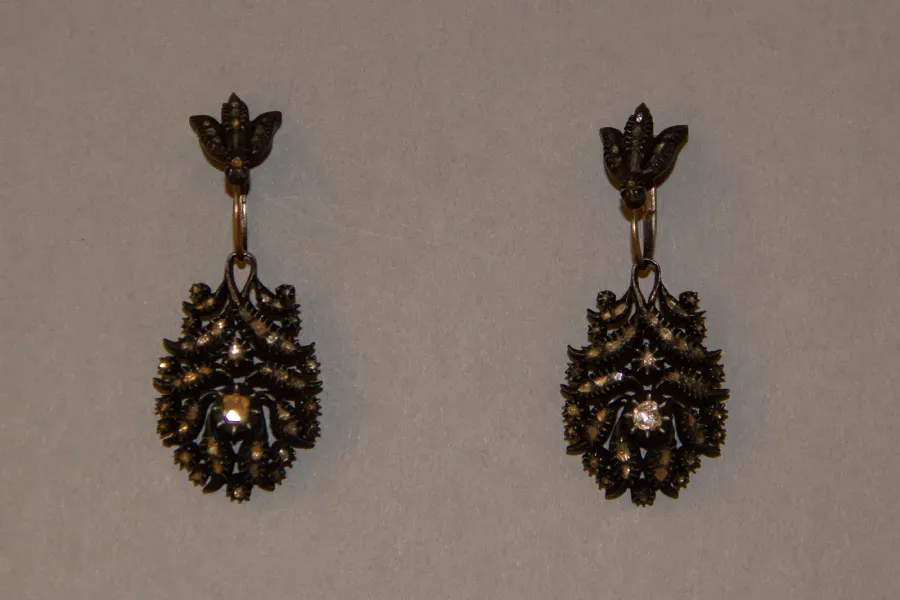
Before the 4C system, buying a diamond was an exercise in trust. There was no common language. What one jeweller called "first water" (a term borrowed from pearl grading, meaning the finest quality), another might call "Grade A" or "river" or simply "fine." The same stone could receive different evaluations in different shops on the same street.
The chaos was particularly acute in the international trade. A dealer in Amsterdam using one terminology tried to communicate with a dealer in Mumbai using another, through a dealer in New York using a third. Paperwork was unreliable. Disputes were common. The only thing everyone agreed on was that the system was broken.
The German-speaking world contributed important groundwork to the eventual solution. Friedrich Mohs, a Viennese mineralogist, developed his hardness scale in 1812, ranking minerals from 1 (talc) to 10 (diamond). While not directly related to the 4C system, Mohs established a crucial principle: minerals should be described by measurable, objective properties rather than subjective impressions. That principle became the philosophical foundation of modern gemology.
The 4C system itself was developed by the Gemological Institute of America (GIA) in the 1940s and 50s. Robert Shipley, GIA's founder, saw that the diamond trade needed a universal vocabulary, and he set out to create one. The colour scale (D to Z) was deliberately designed to start at D rather than A, specifically to break from every previous system. If people saw "A" or "B," they would assume it was the same old system in new packaging. Starting at D made it clear: this is something new.
The clarity scale (FL to I3) was developed through painstaking examination of thousands of stones under standardised conditions. The ten-power magnification standard (10x loupe) was chosen because it provided enough detail to distinguish meaningful differences without revealing inclusions so microscopic that they had no impact on beauty or durability.
By the 1970s, the 4C system was accepted worldwide. Today, it is the undisputed standard. A diamond graded G/VS2 in New York means exactly the same thing in Tokyo, Dubai, and Munich.
Beyond the 4Cs: Additional Factors That Affect Value
The 4C system is the starting point, not the whole story. Several additional factors influence a diamond's value and beauty, and experienced buyers learn to evaluate them.
Fluorescence. A notable share of diamonds exhibit fluorescence, a visible glow (usually blue) when exposed to ultraviolet light. For diamonds in the D-F colour range, strong blue fluorescence can in some cases cause a hazy or milky appearance in certain lighting conditions, which may make the stone less desirable and affect its price. But for diamonds in the I-K range, medium blue fluorescence can actually make the stone appear whiter, improving its visual performance and offering a price advantage. The key is to see the stone in person. Fluorescence is not inherently good or bad. Its effect depends on the specific stone and the viewing conditions.
Symmetry and polish. These are sub-categories of the cut grade. Symmetry describes how precisely the facets align. Polish describes the smoothness of each facet's surface. Both are graded from Excellent to Poor. For the best light performance, aim for Excellent in both. Very Good is acceptable. Below that, the stone may show visible imperfections when examined closely.
Girdle thickness. The girdle is the thin edge where the crown (top) meets the pavilion (bottom). A girdle that is too thin risks chipping. A girdle that is too thick hides carat weight in a place where it contributes nothing to the stone's appearance. Medium to slightly thick is ideal.
Culet. The culet is the tiny facet at the very bottom point of the pavilion. In modern diamonds, the culet should be None (pointed) or Very Small. A large culet appears as a visible dark spot when you look through the stone from above, like a hole in the centre of the diamond.
Depth and table percentages. For a round brilliant, ideal depth is 59-62.3% of the diameter, and ideal table is 54-57%. Stones outside these ranges may face up larger or smaller than expected for their weight. A stone with a very deep pavilion (high depth percentage) hides weight below the surface. A stone with a very large table (high table percentage) may lack fire because the crown is too shallow to create colour dispersion.
These factors are listed on most major lab certificates. Learning to read them gives you an edge over buyers who focus only on the 4C summary grades.
Shape-Specific Grading Considerations
The 4C system was originally designed around the round brilliant cut, and it works best for that shape. Fancy shapes (oval, pear, marquise, emerald, cushion, etc.) present some unique challenges.
Colour visibility varies by shape. Round brilliants are the best at masking body colour because their complex faceting breaks up the colour perception. A G-colour round looks whiter than a G-colour emerald cut. The large, open facets of emerald and Asscher cuts act like windows that show body colour more readily. For these shapes, consider going one colour grade higher than you would for a round.
Clarity visibility also varies. Round brilliants hide inclusions well behind their complex facet pattern. Step-cut shapes (emerald, Asscher) show inclusions much more clearly because their facets are flat and transparent rather than reflective. An SI1 round might be completely eye-clean, while an SI1 emerald cut might show visible inclusions. For step cuts, consider going one clarity grade higher.
Cut grading for fancy shapes is less standardised. GIA provides cut grades only for round brilliants. For all other shapes, the cut quality is left to the buyer and seller to evaluate. This means you need to assess proportions yourself or rely on a knowledgeable jeweller. Key things to watch for: a well-proportioned bow-tie pattern in ovals and pears (a small dark zone across the centre is normal, a large dark zone means poor proportions), even brilliance across the stone, and pleasing overall outline (not too narrow, not too stubby).
Common Buying Scenarios
Real life is more useful than abstract theory. Here are specific scenarios that cover the situations most buyers actually face.
Scenario 1: Engagement ring on a moderate budget. You want a ring that looks beautiful on the hand without spending beyond your means. The formula: G colour, VS2 clarity, Excellent cut, round brilliant. In the 0.70-0.90 carat range. Set in 14K white gold with a simple solitaire or slim halo. This combination delivers a stone that looks white, clean, and brilliant to every observer, at a price point that does not require a loan.
Scenario 2: Maximum visual impact for the budget. You want the biggest possible look. The formula: I or J colour, SI1 clarity (eye-clean), Very Good or Excellent cut, oval or marquise shape. Set in 14K yellow gold (the warm metal masks the stone's body colour). An I-colour oval in yellow gold can look stunning, and the elongated shape adds visual presence. You get a stone that looks 30-50% larger than a round of the same weight.
Scenario 3: Top-grade stone for a collection. You want the rarest combination of grades, chosen for the pleasure of owning something exceptional rather than for any financial return. The formula: D-F colour, IF-VVS1 clarity, Excellent cut, round brilliant. Over 1.00 carat, ideally over 2.00. GIA certificate mandatory. No fluorescence above Faint. The entry price is steep, and jewellery should never be treated as a financial instrument: prices for stones, metals, and finished pieces can rise or fall, and there is no guarantee of resale value. Buy a piece like this because you love it.
Scenario 4: Lab-grown for maximum size. You are not concerned about resale and want the most impressive stone possible. The formula: F-G colour, VS1-VS2 clarity, Excellent cut, oval or cushion shape. 1.50-2.00 carat range, lab-grown. IGI certificate. Set in 14K or 18K gold. This combination delivers a large, visually stunning stone at a fraction of the mined equivalent price. The stone is chemically identical to mined. Nobody can tell the difference without laboratory equipment.
Common Situations and What They Mean
These are the five things people say after buying, in roughly the order of how often they say them.
"The Stone Looks Cloudy"
Three possible causes, in order of likelihood. First, it is dirty: skin oil, hand cream and soap film build a greasy layer on the pavilion within days and cut light return dramatically. Clean it and look again before doing anything else.
Second, unplotted clouds. A stone graded on the basis of diffuse cloud inclusions can look milky even at VS grades, and the report's comments field is where this hides. Check for a note about clouds not being shown.
Third, strong fluorescence in a high-colour stone producing the overblue effect. Take the ring outdoors on a bright day and then into a windowless room. If the haze appears outside and vanishes inside, that is fluorescence.
"It Looks Yellow Under My Kitchen Light"
Almost always a lighting problem rather than a stone problem. Warm filament and halogen bulbs push everything towards yellow, and a warm-graded stone under a warm bulb looks warmer still.
Compare it by a window on an overcast day. If it reads white there, the stone is what you bought and the bulb is the variable. Switching kitchen and bathroom bulbs to a cooler colour temperature genuinely changes how a ring looks day to day, and costs almost nothing.
"It Sparkled in the Shop, Not at Home"
Jewellery displays are engineered lighting environments: multiple bright point sources at close range, mirrored surfaces, dark backgrounds for contrast. Almost anything sparkles in one.
Domestic lighting is diffuse and dim by comparison, and diffuse light produces far fewer flashes because there are fewer distinct sources to reflect. This is normal and affects every diamond ever sold. It is also the reason to insist on seeing a stone by a window before buying, so that the comparison happens before the money changes hands rather than after.
"I Can See an Inclusion. Is That Normal for VS2?"
Not normal, but not impossible either. VS2 should be eye-clean at normal viewing distance in ordinary light for the overwhelming majority of stones. Exceptions arise in step cuts, in stones above two carats, and where a single inclusion sits directly under the table.
Test it properly: 25 to 30 centimetres, overcast daylight, without knowing where the inclusion is. Having someone else hand you the ring helps, because once you know where to look you will always find it. If it is genuinely visible under those conditions, and you are within a returns period, use it.
"Someone Said My Stone Is Small"
Somebody will always say this, and it says considerably more about them than about the ring.
The practical answer, if it bothers you, is that visual size is a matter of face-up diameter and setting design rather than carat weight. A halo adds apparent size. An elongated shape adds apparent size. A slim band makes the stone look larger by contrast. A stone reset from a heavy Victorian mount into a fine modern one can appear to grow by half a carat without a single change to the stone.
CAPAORA mini knife pendant
The 18th-century Spanish navaja in miniature: 40 mm of stainless steel, a real folding mechanism and a Palanquilla lock that clicks. An affordable gift to remember.
Authentic · Ships from Spain · 14-day returns
A Diamond Over Decades
The Stone Does Not Age
Diamond is chemically inert at everyday temperatures and harder than anything it will encounter in normal life. It does not oxidise, does not fade, does not yellow with age and does not wear measurably. A stone bought today will be optically identical in a hundred years.
The one real vulnerability is cleavage. Diamond is hard but not tough: it has directions of weakness along which a sharp blow can split it. Knocking a ring hard against a door frame at the wrong angle can chip a girdle or take a corner off a princess cut. Hardness resists scratching; toughness resists breaking, and diamond is only exceptional at the first.
The Setting Ages
Everything around the stone wears. Claws thin, particularly the ones on the side that meets a desk edge or a steering wheel. Rhodium plating on white gold wears through in one to three years of daily wear. Shanks thin from the bottom where they rub against a neighbouring ring.
A claw check every couple of years is the single most valuable maintenance habit, and most jewellers do it while you wait for nothing. Lost stones are almost always the result of a worn claw that had been visibly worn for a year.
The Real Enemy Is Grease
The reason people think their diamond has dulled is almost always a film of oil on the pavilion. Diamond is lipophilic: it actively attracts grease, which is the working principle behind grease tables in diamond recovery plants.
A film only microns thick disrupts the total internal reflection that produces brilliance. Light that should bounce back to the viewer leaks out instead. Five minutes with washing-up liquid and a soft brush restores a stone completely, and doing it fortnightly keeps a ring looking like the day it was bought.
Caring for a Diamond
Cleaning at Home
Warm water, a drop of ordinary washing-up liquid, ten minutes of soaking, then a soft toothbrush worked over the back of the stone where the film accumulates. Rinse thoroughly, dry with a lint-free cloth. That is the entire procedure and it works better than anything sold in a bottle.
Do it over a bowl rather than an open sink, because rings do go down plugholes. The full method for gold and silver pieces is in the home cleaning guide.
Hard Water in Britain
Much of England sits on chalk and limestone, so water in London, the South East, East Anglia and the Midlands is hard, while Scotland, Wales, Cornwall and the North West are largely soft. In hard water areas, limescale deposits on the pavilion and behind the claws in the same way it does in a kettle, and it is more stubborn than grease.
The fix is a final rinse in cooled boiled water or distilled water, or a short soak in a weak solution of white vinegar followed by a thorough rinse. Do not use vinegar on a piece containing pearls, opals or emeralds, and do not use it on fracture-filled stones.
What to Avoid
Chlorine, which attacks the alloys in gold settings and can pit a shank over repeated exposure. Take rings off before swimming pools and hot tubs. Bleach and drain cleaners, for the same reason.
Ultrasonic cleaners on any stone that is fracture-filled, heavily included, or set alongside softer stones. Ultrasonics work by cavitation, and a stone with a feather reaching the surface can be split by them. If you do not know the clarity grade, do not put it in an ultrasonic.
Steam cleaners on treated stones. Hand cream and hairspray applied while wearing the ring, which is how the film builds in the first place. Storage that lets the diamond touch other jewellery, because it will scratch everything it meets, including other diamonds.
Professional Cleaning
Worth doing annually. A jeweller will clean ultrasonically where appropriate, steam the piece, check and re-tip claws, and re-plate rhodium on white gold. The claw check is the part that actually matters; the shine is a bonus.
Antique and inherited pieces should be cleaned professionally rather than at home the first time, because closed-back Georgian and Victorian settings often contain foil backing behind the stone that water will destroy permanently. If a setting is closed at the back, ask before you soak it.
Insuring a Diamond in Britain
What Cover Includes
Standard home contents insurance covers jewellery inside the home up to a limit, usually with a single-item cap that is lower than most people assume. Anything worth more than that cap has to be specified individually on the policy, by description and value.
Cover for items taken out of the house requires a personal possessions extension, which may be limited to Britain or extended worldwide. An engagement ring worn daily is out of the house constantly, so a policy covering only contents at the address is close to useless for it.
Accidental loss, meaning the stone falls out or the ring goes missing rather than being stolen, is a separate consideration and is not always included. It is also the way jewellery is most often actually lost.
Home Contents Against Specialist Policies
Adding a ring to a contents policy is cheaper and simpler. It is also subject to the policy's general excess and, in the event of a claim, may affect the premium on everything else you own.
Standalone jewellery policies from specialist insurers usually cost more but tend to offer worldwide cover, accidental loss as standard, agreed-value settlement rather than replacement at the insurer's discretion, and no impact on the household policy. For a single significant piece, they are often the better structure. The comparison is worked through in the jewellery insurance guide.
Valuations and Revaluation
Insurers want a valuation from a qualified valuer, ideally one on the Institute of Registered Valuers register, describing the piece in enough detail that a replacement could be commissioned from the description alone. That means the stone's grades, the measurements, the metal, the setting style and photographs.
Refresh it every three to five years. Metal prices in particular move enough over that period to leave a piece significantly underinsured, and insurers will apply average if the sum insured is well below the true replacement cost.
Practical Advice on Cover
Photograph the piece from several angles the week you get it, photograph the report and the receipt, and store all of it somewhere that is not the same building as the jewellery. Note the girdle inscription number separately.
Tell the insurer honestly how the piece is worn. A ring worn daily including for gardening and sport is a different risk from one kept in a safe, and a claim declined for misdescription is worse than a slightly higher premium.
Travelling With a Diamond
Customs and Declarations
Personal jewellery worn or carried for personal use travels freely within most jurisdictions and does not require declaration in ordinary circumstances. The complication arises when a customs officer cannot tell whether an item is personal property or goods being imported.
Since Britain left the European Union, carrying valuable jewellery to and from the continent sits in the same category as carrying it anywhere else, and the practical protection is documentation. Carry a copy of the receipt or valuation showing the piece was bought before the trip. For genuinely valuable items travelling repeatedly, ask a customs broker about the documents available for temporary export; the paperwork is tedious once and useful thereafter.
Value thresholds for declaring goods differ by country and change. Check the current rules for your destination rather than trusting a figure someone quoted years ago.
Security on the Road
The dull advice is the correct advice. Wear valuable pieces rather than packing them, because worn items are covered under personal possessions extensions and checked luggage frequently is not. Never put jewellery in hold baggage under any circumstances.
Hotel safes are a deterrent against opportunists and nothing more; they are not secure against anyone with intent and access. If you would be devastated by the loss, the item should not be on the trip.
A common and sensible practice is a travel copy: a well-made cubic zirconia or moissanite version of a daily ring, worn abroad while the real one stays at home. Nobody can tell across a dinner table, and the anxiety disappears.
Climate and Everyday Risk
Diamond itself is indifferent to heat, cold and humidity. Settings are not. Extreme cold makes fingers shrink, which is how rings are lost in ski resorts and cold sea water. Heat and humidity make fingers swell, which is how rings get cut off in hospital.
Salt water accelerates tarnish on silver and is corrosive to some alloys. Sunscreen, insect repellent containing DEET and chlorinated pool water all attack settings and build film on stones. Take rings off for swimming and reapply nothing while wearing them.
Buying a Diamond as a Gift
Choosing for Someone Else
Look at what they already wear, which is a more reliable guide than anything they will say if asked directly. Note the metal colour first, because that is the strongest and most consistent preference people hold, and it dictates the colour grade you should be shopping for. Note whether their existing pieces are rounded or angular. Note the scale they are comfortable with.
Ring size is the recurring trap. Borrowing a ring they already wear and having it measured is the only reliable method, and it must come from the correct finger, since sizes differ by a full size or more between hands. The ring size guide covers the conversions. When in doubt, size slightly large: enlarging a ring is harder than reducing one.
If it is an engagement ring and you have any uncertainty at all about the design, a well-chosen loose stone presented with the intention of choosing a setting together is a legitimate and increasingly common approach. The engagement ring guide covers the decision in full.
When the Budget Is Tight
Prioritise cut absolutely, then buy a smaller stone in a setting that flatters it. A well-cut 0.30 carat in a delicate, well-proportioned ring looks considerably better than a poorly cut 0.70 in a heavy mount, and it looks like a deliberate choice rather than a compromise.
Consider a cluster or a halo, which build visual size from small stones at a far lower cost per apparent millimetre. Consider yellow gold, which lets you drop two colour grades for free. Consider a lab-grown stone. Consider a shape other than round, since round carries the largest premium.
What not to do: buy a large stone with visible inclusions and a lifeless cut because the specification sounds impressive. Everyone can see a dull stone. Almost nobody can read a carat weight.
When the Budget Is Not the Issue
Buy the cut first, still. Then decide whether you are buying beauty or rarity, because above a certain level they diverge and the money goes to different places.
If it is beauty, the answer is an exceptionally cut stone in the G to H and VS range, at the largest size that suits the hand, in a setting made properly. If it is rarity, the answer is D to F, IF to VVS, over a carat, with a strict laboratory report and no fluorescence above Faint.
And in either case, jewellery should never be bought as a financial instrument. Prices for stones, metals and finished pieces rise and fall, and there is no guarantee of resale value. Buy it because you want the object to exist.
Selling a Diamond: The Second-Hand Market
Why Resale Disappoints
The gap between what a diamond costs at retail and what it fetches second-hand is large, and almost everyone who discovers it discovers it at a bad moment.
The reasons are structural. Retail price includes the shop, the staff, the marketing, the stock financing and the margin, none of which are recoverable. A trade buyer must be able to resell at a profit, so they buy at well below trade wholesale. And there is no shortage of second-hand diamonds, so nothing about the transaction favours the seller.
Expect a fraction of the original purchase price, and expect the offer to be lower for lab-grown stones, for stones without a recognised laboratory report, and for stones in dated settings where the metal is worth more than the design.
The Exceptions
Certain things do hold value better. Large stones, meaning above two or three carats, with strict laboratory reports and top grades, are genuinely liquid because the market for them is international. Fancy coloured diamonds in strong saturations, particularly pinks and blues, are scarce enough to be sought after. Signed antique pieces of documented origin trade on their design and craftsmanship as much as their stones.
For everything else, the honest planning assumption is that a diamond is a purchase and not a store of value.
Practical Advice on Selling
Get more than one offer, and get them from different kinds of buyer: a trade dealer, an auction house specialist and a consignment jeweller price the same item quite differently. Auction works best for large or unusual pieces and badly for ordinary ones, because the fees consume the proceeds.
Have the stone graded if it is not already, since an ungraded stone is bought at the buyer's most pessimistic assumption. Clean the piece. Bring the original documents. And decide your floor before you walk in, because the negotiating dynamic in that room is not in your favour.
Photographing a Diamond
How to Shoot It
Diffuse daylight near a window, not direct sun and not flash. Flash flattens a diamond completely, replacing all the internal light play with a single hard highlight.
Get close but keep the phone steady, tap to focus on the stone rather than the hand, and reduce exposure slightly, because phone cameras consistently overexpose a bright stone into a white blob. A dark, plain background makes the stone read; a busy one destroys it.
For sparkle specifically, you need a small hard light source somewhere in the room in addition to the ambient light, and movement. A single lamp plus a slow rotation of the hand produces the flashes that pure window light will not.
What to Avoid When Photographing
Direct flash, always. Heavy filters and saturation adjustments, which turn white metal blue and make the whole image obviously manipulated. Extreme macro, which shows the stone at a magnification no human eye ever experiences and makes normal surface dust look like damage.
Also avoid photographing straight after applying hand cream, which is the single most common reason a ring photographs badly.
Video Beats Stills
A diamond is a moving object. Its entire appeal is the way light behaves as the angle changes, and a still frame captures none of it. Any seller who supplies only stills is showing you the least informative view available.
For your own records, a ten-second video rotating the stone under a single light source is more useful for identification and insurance than any number of photographs, because it shows the inclusion pattern in motion.
Myths and Misconceptions
Myth 1: "FL stones are most beautiful"
Truth: Beauty is determined by cut and brilliance, not clarity. VS2 can look as beautiful as FL.
Myth 2: "Only D-E-F stones are white"
Truth: G-H-I look absolutely white in settings. Difference from D-E-F visible only in direct comparison outside setting.
Myth 3: "Clarity more important than colour"
Truth: Depends on stone size. For small (under 0.5ct) colour more important. For large (1ct+): clarity.
Myth 4: "Inclusions are defects"
Truth: Inclusions are nature's fingerprints. If not visible to eye, it's not defect but normal quality.
Myth 5: "Certificate = Quality guarantee"
Truth: Certificate describes characteristics but doesn't guarantee stone is beautiful. Two G/VS2 stones can look different due to cut.
Myth 6: "Lab-grown diamonds are fake"
Truth: They are carbon in a diamond lattice, with the same hardness, refractive index and dispersion as mined stones. No jeweller can identify one by eye or by loupe, and the standard thermal probe reads them as diamond because they are diamond. What separates them is origin and scarcity, which affect price and resale but not the material. Calling them fake is simply inaccurate.
Myth 7: "A diamond is an investment"
Truth: Retail carries a margin that is not recoverable, resale happens at trade prices, and there is no guarantee of value in either direction. Prices for stones, metals and finished jewellery rise and fall. A handful of exceptional stones behave like collectibles; an ordinary certified diamond does not. Buy it as a purchase you want to make, not as a financial position.
Myth 8: "The round brilliant is always the best cut"
Truth: It returns the most light and is the most standardised, which is why it is the safe default. That does not make it the right shape for every wearer. An emerald cut on a long hand, a cushion in an antique-style mount or an oval on a small finger can all look better than a round would, and all of them cost less per carat.
Myth 9: "Only buy from a big high-street name"
Truth: A recognised laboratory report, a clear returns policy and a seller who answers direct questions are what protect you. Size of shopfront is not a proxy for any of the three. Some of the best diamond buying in Britain happens through small independent jewellers and through the trade in Hatton Garden and Birmingham's Jewellery Quarter, where overheads are lower and expertise is concentrated.
Myth 10: "A small stone is something to apologise for"
Truth: Scale is a matter of proportion, not size. A well-cut small stone in a setting designed around it looks intentional and elegant; a large dull one in a heavy mount looks like a compromise made badly. Nobody who looks at a hand is estimating carat weight, and the people who comment are the people whose opinion should carry the least weight.
Myth 11: "Two stones with the same grades look the same"
Truth: The grades are brackets, not points. Two G/VS2 rounds with Excellent cuts can differ in where they sit within each bracket, in contrast pattern, in the size and rhythm of their flashes, in fluorescence and in whether the inclusions are pinpoints or a cloud. Reports narrow a shortlist. They do not choose a stone.
Myth 12: "You can test a diamond by scratching glass"
Truth: Anything harder than about 5.5 on the Mohs scale scratches glass, which includes quartz, cubic zirconia, moissanite, sapphire and topaz. The test proves nothing and risks damaging the mount. The scratch test in the other direction is worse: rubbing a suspected stone against something hard can chip a genuine diamond along a cleavage plane. Use a laboratory, or a jeweller with a thermal and electrical conductivity tester.
Diamonds in Silver: An Honest Combination
Why Silver and Diamond Work
There is a lingering idea that diamonds belong only in gold and platinum, and it is a modern one. For most of the eighteenth and nineteenth centuries diamonds were set in silver, because silver was the whitest metal available and goldsmiths wanted nothing warm behind a stone that was meant to read as pure light. Georgian and early Victorian pieces are typically silver-topped gold: a silver setting against the stone, a gold shank and back for strength and to keep the silver off the skin.
The combination is honest in a way that matters. Silver costs a fraction of platinum, which means the money in a piece goes into the stone and the workmanship rather than into the metal. For a pendant or a pair of studs, where a setting takes far less punishment than a ring does, it is a genuinely sensible allocation.
What to Watch For
Silver's whiteness cuts both ways: it is the least forgiving background for body colour. Aim for G or better if the stone is the focus, and be aware that anything below H will read warm against sterling.
Sterling is soft, so claws need checking more often than in white gold and considerably more often than in platinum. Rub-over and bezel settings suit silver better than fine claws do, because a continuous rim of metal is far stronger than four thin ones.
Silver tarnishes. Regular wear keeps it bright, storage in an airtight bag with an anti-tarnish strip keeps a piece that is worn rarely, and a soft cloth deals with the rest. Modern tarnish-resistant sterling alloys have largely solved the problem for anyone who finds it tiresome.
Diamond Traditions Around the World
The diamond engagement ring feels ancient and is not. Its dominance dates to a mid-twentieth-century advertising campaign, and outside a handful of countries it remains one custom among several.
Britain and Ireland
The engagement ring here is overwhelmingly a single diamond, and the trilogy and halo designs have held their popularity for decades. Britain has its own distinct wrinkle in that antique and inherited rings carry real social weight: a Victorian cluster or an Art Deco piece is read as evidence of continuity rather than as a budget decision, which is not the case everywhere.
Wedding bands are traditionally plain, and the eternity ring given on a significant anniversary or the birth of a first child is a specifically British and Irish habit. Hallmarking, being compulsory here, means most British pieces carry a datable set of marks, and being able to read them is a small pleasure. Band traditions are covered in the diamond wedding bands guide.
Continental Europe
Scandinavian and German-speaking countries commonly use plain bands for both engagement and marriage, worn on the left hand while engaged and moved to the right at the wedding, or the reverse depending on the country. Diamonds appear, but a diamond solitaire is a choice rather than an expectation.
France has a strong tradition of coloured stones in engagement rings, and southern Europe leans towards yellow gold in a way that Britain largely abandoned in the 1990s and is only now returning to. Across the continent the old CIBJO grading vocabulary of River and Wesselton still surfaces on older paperwork.
India
The largest diamond cutting and polishing industry in the world, and a culture in which gold has historically carried far more significance than diamonds. Jewellery in Indian wedding traditions is given in quantity, is often the bride's own property in a legally meaningful sense, and is heavily gold.
Diamonds have grown steadily in urban wedding jewellery, usually as accents in elaborate gold pieces rather than as a solitary stone. The polki tradition, which uses uncut or minimally cut natural diamonds set in gold foil, values a completely different aesthetic from the brilliant-cut ideal: soft, glowing, irregular, and graded by no scale in this article.
Japan
The diamond engagement ring arrived in Japan in the second half of the twentieth century and was adopted rapidly and thoroughly. Japanese buyers are, as a market, unusually attentive to cut quality, and the hearts and arrows optical patterning that indicates exceptional symmetry is taken more seriously there than almost anywhere else.
Platinum is strongly preferred over gold, which is the reverse of most of Asia.
China
Diamonds were historically absent from Chinese jewellery traditions, where jade holds the position that diamond holds in the West: the material with cultural depth, moral association and family significance. Gold has long been the metal of celebration and of wedding gifts.
Diamond engagement rings have become common in urban China within a single generation, which makes it one of the fastest cultural adoptions of a jewellery custom on record. Red, gold and jade still carry the ceremonial weight, and a diamond ring frequently sits alongside them rather than replacing anything.
Send a friend a discount code, they save on their first order.
Famous Diamonds and What They Teach
The Koh-i-Noor
One of the oldest documented diamonds in the world, with a traceable history running back at least to the fourteenth century and a legendary one running further. It passed through Indian and Persian rulers, Afghan shahs and the Sikh Empire before reaching the British Crown in the middle of the nineteenth century. It sits today among the Crown Jewels in the Tower of London, and its ownership remains actively contested.
It weighs 105.6 carats in its current form. The original was roughly 186 carats, and it was recut in the 1850s because its Mughal-style cutting looked dull to Victorian eyes accustomed to brilliance. Nearly half the weight was sacrificed for light performance, which is the most emphatic possible demonstration that cut outranks carat.
Cullinan and Its Nine
The largest gem-quality rough diamond ever found: 3,106 carats, discovered in South Africa in 1905 and named after the mine's chairman. It was cleaved and cut into nine major stones and just under a hundred smaller ones.
Cullinan I, the Great Star of Africa at 530 carats, is set in the Sovereign's Sceptre. Cullinan II, at 317 carats, sits in the Imperial State Crown. Both are on public display in the Tower of London, which makes them the most accessible truly great diamonds anywhere: a British buyer can go and look at the benchmark for what colourless means.
The lesson is that division is sometimes multiplication. Nine great stones proved more useful than one impossible one.
The Hope Diamond
A deep blue stone of 45.52 carats, its colour caused by boron, graded today as Fancy Deep Greyish Blue with VS1 clarity. It is also a semiconductor, and it phosphoresces red for several seconds after ultraviolet exposure, which is genuinely eerie to see.
Its reputation as a cursed stone was largely manufactured by newspapers and dealers in the early twentieth century, and it worked spectacularly well as marketing. The diamond now sits in a museum collection in Washington and is among the most visited objects in the world.
Old Cuts in British Jewellery Boxes
The famous stones are in museums. The interesting ones are in bedside drawers all over Britain, and there are a great many of them, because the country accumulated jewellery for two centuries and never really disposed of it.
Rose cuts, old mine cuts and old European cuts turn up constantly in inherited pieces. They face up smaller for their weight than modern stones, they often grade in the K to M range, and by modern proportions they are all wrong. They are also, in the light they were cut for, quietly beautiful in a way that no modern stone reproduces. Do not have one recut. The weight loss is irreversible and the character goes with it.
What These Stories Tell Us
That a diamond stops being a stone remarkably quickly. Every great diamond is chiefly a story, and the physical object is the thing the story is attached to.
Yours will do the same on a smaller scale. In sixty years it will be the ring from that particular day, worn by a particular person, and the letter on the report will be an administrative detail that nobody in the family remembers. That is not an argument for buying badly. It is an argument for buying something you actually like the look of, since that is the part that lasts.
Why Sparkle Moves Us
The Water Theory
There is a well-argued hypothesis in evolutionary psychology that the human attraction to glossy, glittering surfaces is a residue of the need to find water. Experiments have found that preference for glossy images correlates with thirst, that children show the preference before any cultural exposure to jewellery, and that the visual signature people respond to is specifically the moving highlight of a liquid surface.
Whether or not that is the full explanation, it fits what a diamond actually does. Scintillation, the flicker as the stone moves, is precisely the visual pattern of light on disturbed water. The stone is not doing anything a puddle does not do. It is doing it far more intensely and it does not evaporate.
Why Some Stones Move Us and Others Do Not
Because the eye responds to contrast and rhythm rather than to quantity of light. A stone that returns light evenly across its whole face looks bright and dull at the same time. A stone with a strong pattern of dark and bright zones, shifting as it moves, reads as alive.
That contrast pattern is a product of proportions, and it is the reason two stones with identical reports can feel completely different in the hand. It is also why nobody should buy a diamond from a specification alone. The property that makes a stone worth owning is not on the document. How similar effects work in other materials is covered in the guide to optical effects in gemstones.
The Future of Grading
Machine Grading and Consistency
Colour and clarity grading remains a human judgement, and human judgement varies. Automated systems using calibrated imaging and machine learning already handle a growing share of routine grading, and they are better than people at one specific thing: giving the same answer twice.
The likely outcome is not the disappearance of gemologists but a division of labour, with machines producing the reproducible measurements and people handling the borderline calls and the detection work that matters most. Buyers should benefit, because grade inflation and drift between laboratories are precisely the problems that consistent measurement solves.
Three-Dimensional Inclusion Mapping
The flat clarity plot is a compromise dating from an era of hand-drawn diagrams. Modern scanning can produce a full three-dimensional map of every inclusion in a stone, at true scale and in true position.
That changes several things at once. Identification becomes unambiguous, since a three-dimensional inclusion map is effectively a fingerprint. Buyers can see exactly where an inclusion sits rather than guessing from a symbol. And cutters can plan recuts and repairs with far more information than they have now.
Traceability and Provenance
Tracking a stone from rough to retail has become technically feasible, combining physical inscription with a tamper-resistant digital record at each stage. Several such schemes now operate at scale.
The honest caveat is that any such record is only as reliable as the physical link between the stone and the entry, and that link is made by people. What the technology genuinely fixes is the paperwork problem: a report that can be verified instantly against the issuing laboratory, and a chain of custody that does not depend on a folder in a filing cabinet. Provenance claims that cannot be checked this way should still be treated as claims.
Colour Scale: Summary Table
Everything about colour on one page, with the practical decisions attached rather than left implied.
| Grade | Category | Visible tint | Best metal | Sensible use |
|---|---|---|---|---|
| D | Colourless | None, even face-down against a master | Platinum, silver | Collection pieces, rarity buying |
| E | Colourless | Detectable only by a grader with references | Platinum, white gold | Large stones where every grade shows |
| F | Colourless | Traceable by a specialist, invisible in a setting | Platinum, white gold | Step cuts above two carats |
| G | Near colourless | Only against a D master | White gold, platinum, rose gold | The value peak for white metal |
| H | Near colourless | Very slight warmth, invisible set in white | White gold, platinum, rose gold | The sensible floor for white metal |
| I | Near colourless | Warmth appears next to whiter stones | Yellow gold, rose gold | Best value with a warm metal or with blue fluorescence |
| J | Near colourless | Warmth visible on close inspection | Yellow gold | Small and medium stones, warm settings |
| K, L, M | Faint | Yellow readable at arm's length | Yellow gold | Vintage looks, old cuts, accent work |
| N to Z | Very light to light | Plainly yellow or brownish | Yellow gold | Rarely used in fine jewellery |
Two rules that sit underneath the whole table. Warm metal buys you two grades for nothing. Round brilliants hide roughly one grade more than step cuts do.
Clarity Scale: Summary Table
| Grade | Meaning at 10x | Eye-clean? | Sensible use |
|---|---|---|---|
| FL | Nothing internal or external | Always | Rarity buying only |
| IF | Nothing internal, trace surface marks | Always | Rarity buying only |
| VVS1 | Extremely difficult to find, usually at the edge | Always | Premium buying, step cuts above three carats |
| VVS2 | Difficult to find, may sit nearer the centre | Always | Premium buying |
| VS1 | Small, found readily by a grader | Always | Emerald and Asscher cuts, large stones |
| VS2 | Small, slightly larger than VS1 | Nearly always | The default sensible choice for most buyers |
| SI1 | Noticeable at once under a loupe | Usually, in brilliant shapes | The value peak in rounds, princesses and cushions |
| SI2 | May be visible unaided if centrally placed | Sometimes | Only after inspecting the specific stone |
| I1 | Visible unaided, may dull the stone | No | Accent work, budget pieces |
| I2, I3 | Numerous, affects transparency and durability | No | Not recommended for rings worn daily |
The rule underneath this table: the grade tells you how much is in the stone, and the plot tells you where. Where matters more. An SI2 with a feather at the girdle beats a VS2 with a cloud under the table every time.
Twenty Facts About Diamond Colour and Clarity
The colour scale begins at D specifically so that nobody would confuse it with the older A, B, C systems it replaced.
The difference between a D and a G is invisible to an unaided eye once the stone is set.
Roughly four buyers in five choose stones in the G to H and VS1 to VS2 range for engagement rings, and they are choosing correctly.
Fewer than one diamond in a hundred reaches Flawless.
Inclusions inside a diamond are frequently older than the diamond around them, sometimes by hundreds of millions of years.
The yellow tint on the D-Z scale is caused by nitrogen atoms substituting for carbon in the crystal lattice.
Blue diamonds are caused by boron, which is a crustal element rather than a mantle one, which is why they are so rare.
An SI1 in a round brilliant is very often eye-clean and visually indistinguishable from a VVS.
A rub-over setting transmits more of a stone's body colour than fine claws do, because metal touches the girdle all the way round.
Emerald and Asscher cuts reveal inclusions more readily than any other shape, and need at least VS2.
Medium blue fluorescence makes I and J stones look whiter in daylight, and they cost less because the market distrusts fluorescence.
A 0.95 carat stone is a tenth of a millimetre narrower than a full carat and can cost noticeably less.
Filament and halogen bulbs make any stone look warmer; cool white LED makes any stone look whiter.
Lab-grown and mined diamonds cannot be told apart by eye, by loupe, or by a jeweller's thermal probe.
Two stones both graded G/VS2 can look meaningfully different, because grades are brackets rather than points.
A D/FL with a mediocre cut looks worse than a G/VS2 cut excellently, and the gap is obvious to anyone.
Older British and European paperwork uses mine names for colour: River, Wesselton, Crystal, Cape, running from whitest to most yellow.
An oval faces up roughly 10 to 15% larger than a round of the same weight, and a marquise more again.
Diamond attracts grease actively, which is why a ring dulls within days and why five minutes with washing-up liquid restores it completely.
A diamond does not age. In a century it will look exactly as it does now, though the setting around it will not.
Glossary of Terms
For anyone who wants to hold a conversation with a jeweller on equal terms.
Carat (ct) is a unit of mass for gemstones, equal to 0.2 grams. Not to be confused with the carat used for gold purity, which describes fineness and is spelled karat in some markets.
Table is the large flat facet on the top of the stone. Most light enters and leaves through it.
Crown is the upper portion of the stone, above the girdle, comprising the table and the angled facets around it.
Girdle is the narrow band around the widest point, where crown meets pavilion. Laser inscriptions are placed here.
Pavilion is the lower cone below the girdle, which reflects light back up through the table.
Culet is the point or tiny facet at the very bottom of the pavilion.
Claws, called prongs in some markets, are the metal fingers holding the stone. Usually four or six.
Bezel or rub-over is a continuous rim of metal enclosing the girdle. Stronger than claws and more protective, but transmits more body colour.
Halo is a ring of small stones encircling a centre stone, used to increase apparent size.
Brilliance is white light returned to the viewer from the stone's internal facets.
Dispersion, called fire in the trade, is the splitting of white light into spectral colours as it passes through the stone.
Scintillation is the pattern of flashes as the stone, the light or the viewer moves.
Spread is the face-up diameter for a given weight. A well-cut stone has good spread; a deep one hides mass below the surface.
Inclusion is any internal feature: a crystal, a feather, a cloud, a pinpoint, a needle.
Blemish is any external feature: a scratch, a nick, a polish line, a natural left from the original rough surface.
Eye-clean means no inclusion is visible to an unaided eye at normal viewing distance in ordinary light.
Fluorescence is visible glow under ultraviolet light, graded from None to Very Strong.
Treatment or enhancement is any process applied after cutting to improve apparent colour or clarity, such as laser drilling, fracture filling or HPHT processing.
Master stones are the graduated reference diamonds against which colour is graded by comparison.
Loupe clean is the older European clarity term covering everything from Flawless through VVS2.
Piqué is the older European term for the included grades, Piqué I to III corresponding to I1 to I3.
Hallmark is the compulsory British mark guaranteeing metal fineness, applied by an Assay Office. It says nothing about the stone.
Frequently Asked Questions
Q: What's more important, colour or clarity? A: Depends on size. Under 0.5ct, colour. Over 1ct, clarity. For 0.5-1ct, roughly equal.
Q: Can I see difference between D and G? A: Only in direct comparison outside the setting. In a ring, no.
Q: What does "eye-clean" mean? A: Inclusions not visible to naked eye. VS2 and SI1 often eye-clean.
Q: Is SI1 stone bad? A: No, if eye-clean. For stones up to 1 carat, SI1 is excellent choice for price.
Q: What's better: G/VS2 or F/SI1? A: G/VS2. Clarity matters more in most cases (if SI1 isn't eye-clean).
Q: Is stone with fluorescence bad? A: No. Medium Blue for G-J stones is even good, since it makes them appear whiter. Avoid Strong/Very Strong for D-F.
Q: Are lab-grown diamonds worse than natural? A: No, they're chemically identical. Difference only in origin.
Q: Can I distinguish G from H? A: Unlikely. Even gemologists distinguish them only when comparing to reference.
Q: Worth paying for VVS? A: Only if budget allows and you want investment quality. Visually VS looks the same.
Q: What's minimum colour for white gold? A: H. Lower will show yellowness.
More Questions Buyers Actually Ask
Q: My grandmother's ring is described as "first water". What does that mean in modern terms? A: It was the old British trade phrase for the finest quality, meaning colourless and free of visible flaws. It had no fixed reference standard, so it does not translate to a specific letter grade. Expect the stone to be good rather than exceptional by modern measurement, and have it graded properly if you are insuring it.
Q: The valuation says "Wesselton VS". Is that a good stone? A: Wesselton corresponds roughly to H on the D-Z scale, so yes, it is a solidly white stone with small inclusions that will not be visible. That is a perfectly desirable specification and would be a sensible thing to buy new today.
Q: Should I get an inherited diamond recut? A: Almost never. Recutting an old European or old mine cut to modern proportions costs 20 to 30% of its weight, destroys the character that makes old cuts attractive, and cannot be undone. The exception is genuine damage, such as a chipped girdle, where a light repolish may be the only way to make a stone wearable again.
Q: Does a hallmark tell me anything about the diamond? A: No. British hallmarking certifies precious metal fineness only, applied by the Assay Offices in London, Birmingham, Sheffield or Edinburgh. Stone quality is documented by a separate laboratory report, and a hallmarked ring can contain any stone at all.
Q: How do I check that a report is genuine? A: Every major laboratory maintains a free online report lookup. Enter the number from the document and compare every field with the paper you are holding. Then check that the number is laser-inscribed on the stone's girdle, which a jeweller can show you under magnification in a few seconds.
Q: Is it safe to buy a diamond that has been laser drilled? A: Yes, in the sense that the treatment is permanent and creates no ongoing problem. It must be disclosed on the report, and the stone should be priced below an untreated equivalent. Fracture-filled stones are the ones to be careful with, because heat during future repairs can undo the filling.
Q: What colour grade should I buy for an emerald cut? A: One grade higher than you would for a round, so G rather than H in white metal. Step cuts have large open facets with little dispersion to disguise a tint, and the difference is genuinely visible.
Q: My stone looks different from the video the seller showed. Is that normal? A: Some difference is normal, because video is shot under strong controlled lighting. A stone that looks markedly duller in ordinary daylight than in the video is a different matter. Compare it by a window against the video within your returns period and act quickly if you are unhappy.
Q: How often should a ring be checked? A: Claws every twelve to eighteen months for a ring worn daily, and immediately if the stone rattles or catches on fabric. Most jewellers check them at no charge, and it is the maintenance that prevents the one loss that cannot be reversed.
Q: Can hard water damage my diamond? A: Not the diamond, but limescale builds behind the setting in hard water areas across much of southern and eastern England, and it dulls a stone as effectively as grease. A final rinse in cooled boiled water after cleaning solves it.
Q: Are old British grading terms still used anywhere? A: The mine-name colour terms survive in the Scandinavian nomenclature and in CIBJO terminology used across parts of continental Europe, and they appear constantly on older British valuations. Loupe clean and piqué are still heard in workshops. New reports use the GIA letters.
Q: What is the one thing I should not compromise on? A: Cut. Everything else is a matter of rarity that mostly hides itself once the stone is set. Cut is the only grade on the report that reliably predicts whether the stone will look alive on a hand.
Ten Rules of a Smart Buyer
Fix the budget before looking at a single stone, and write it down.
Buy the cut first. Cut, then colour, then clarity, then weight, in that order of priority and never any other.
Let the metal set your colour floor. H for white, I or J for yellow, G for step cuts.
Let the shape set your clarity floor. SI1 for rounds and cushions, VS2 for emeralds and Asschers.
Verify eye-clean with your own eyes at 25 to 30 centimetres, by a window, on an overcast day.
Read the comments field on the report, not only the grades. Treatments and unplotted clouds live there.
Hunt for medium blue fluorescence if you are buying in the I to J range, and avoid Strong above F.
Check the millimetre measurements alongside the carat weight, and consider sitting just below a magic threshold.
Compare grades only between reports from laboratories of comparable strictness, or the comparison means nothing.
Never treat jewellery as a financial instrument. Buy the piece because you want it to exist.
Buying it as a gift? Each one arrives ready to give.
 A branded Zevira box and a little card come with every order.













The Short Formula
For anyone who has scrolled to the end, which is a perfectly reasonable thing to do.
White gold or platinum solitaire: colour G or H, clarity VS2 or a verified eye-clean SI1, cut Excellent, weight whatever the budget allows after that.
Yellow gold: colour I or J, clarity VS2 to SI1, cut Excellent, and enjoy the saving the metal just handed you.
Emerald or Asscher cut: colour G, clarity VS1 or VS2, cut given as proportions rather than a grade, so check depth and table yourself.
Maximum size on a limited budget: lab-grown, colour G, clarity VS2, cut Excellent, oval or cushion shape, yellow gold.
Rarity buying: colour D to F, clarity IF to VVS1, cut Excellent, over one carat, strict laboratory report, fluorescence no higher than Faint.
Accent and side stones: match them to the centre stone so nothing looks mismatched, then stop thinking about it. Nobody grades pavé.
The Final Checklist
Print this, or keep it open on a phone in the shop.
Before you go: budget written down, metal decided, shape decided, colour floor and clarity floor read off the tables above.
In front of the stone: is the report from a laboratory you recognise, and does the number verify online? Does the girdle inscription match? Do the millimetre measurements match the weight, or is the stone hiding mass in its depth?
Looking at it: at arm's length, in daylight, can you see an inclusion without being told where it is? Tilt it slowly. Does any area go dark and stay dark? Does it still look right on a hand rather than on a tray?
Reading the paperwork: what does the comments field say? Any treatment disclosed? Any note that clouds or graining are not shown? Fluorescence, and is it the right kind for this colour grade?
Before paying: what is the returns period, and what voids it? Is there a valuation for insurance, and is it recent? Have you photographed the report and the stone?
If every one of those has a clean answer, you have done more due diligence than the overwhelming majority of diamond buyers ever do, and you can stop worrying and enjoy the thing.
A Last Word
Everything in this guide is a tool for one purpose: making sure the money goes into the part of the stone you can actually see.
The letters exist because a chaotic trade needed a shared language, and they did their job. But they were designed to describe rarity, and rarity and beauty stop tracking each other some way up the scale. Past a certain point you are buying the certificate rather than the stone, and the certificate is not the thing that gets worn.
The best diamond for you is the one that looks alive in your kitchen on a grey Tuesday, sits comfortably within what you meant to spend, and belongs to somebody who never once thinks about the letter on the report. That stone exists at G/VS2. It has existed at G/VS2 the whole time.
Conclusion: How to Make the Right Choice
Choosing diamond by colour and clarity scales isn't chasing the first letter of alphabet. It's finding balance where stone shines on hand, not just in certificate.
Remember the essentials:
- Setting masks colour: G-H in white gold look like D-F
- Eye-clean is enough: VS2 looks like VVS to naked eye
- Cut matters most: Excellent Cut more important than D colour
- Size determines priorities: Small means colour, large means clarity
- Fluorescence is your friend: Medium Blue for G-I saves money
Formula for perfect stone for 80% of buyers:
- Colour: G or H
- Clarity: VS2 or SI1 (eye-clean)
- Cut: Excellent
- Metal: White gold or platinum
Remember: No table replaces live viewing of stone. Always see diamond in person before purchase, in natural light, and trust your eyes.
Silver and gold jewellery, wedding bands, symbolic pendants, paired sets.
How Zevira Helps Choose the Perfect Diamond
We understand choosing a diamond is a serious decision and a meaningful purchase. That's why at Zevira we created a system that simplifies this process:
Complete Transparency:
- Ask for a GIA or IGI quality certificate when purchasing any diamond
- Detailed photos and videos of each stone
- Precise description of all characteristics (colour, clarity, cut, carat)
- No hidden flaws; we show the stone as it is
"Eye-Clean" Principle:
- We select only VS2-SI1 stones that look flawless without loupe
- You don't overpay for VVS that's impossible to see
- 20-40% savings with same visual effect
Optimal Price-to-Quality Ratio:
- Focus on G-H colour stones (perfectly white in settings)
- VS2-SI1 clarity (eye-clean)
- Only excellent and very good cuts (maximum brilliance)
Personal Consultation:
- Our specialists help choose stone for your budget
- Explain all characteristics in simple language
- Show difference between stones with real examples
- Help find balance between size, quality, and price
Guarantees and Security:
- 14-day return without explanation
- Warranty on all items
- Independent appraisal option
- Worldwide insured delivery
Lab-Grown Diamonds:
- We have grown diamonds at 50-70% discount from natural
- Same characteristics, same certificates
- Perfect option for larger size at same budget
Why Buy From Us:
- Lower overheads than traditional showrooms (no shop-floor rent)
- Work directly with cutters
- Every stone checked by our gemologists
- Honest consultations; we don't push expensive stones, we help find your perfect option
Zevira: We work only with certified diamonds. Our specialists help you find perfect balance between colour, clarity, and budget. Every stone we hand-select by "eye-clean" criteria, so you pay only for what you see.
#DiamondColorScale #DiamondClarityScale #DiamondGrading #4CSystem #DiamondChart #HowToChooseDiamond #DiamondClarity #DiamondColor #CertifiedDiamonds #EngagementRingDiamond