Princess Cut vs Emerald Cut: The Definitive Guide to Choosing Your Diamond Ring
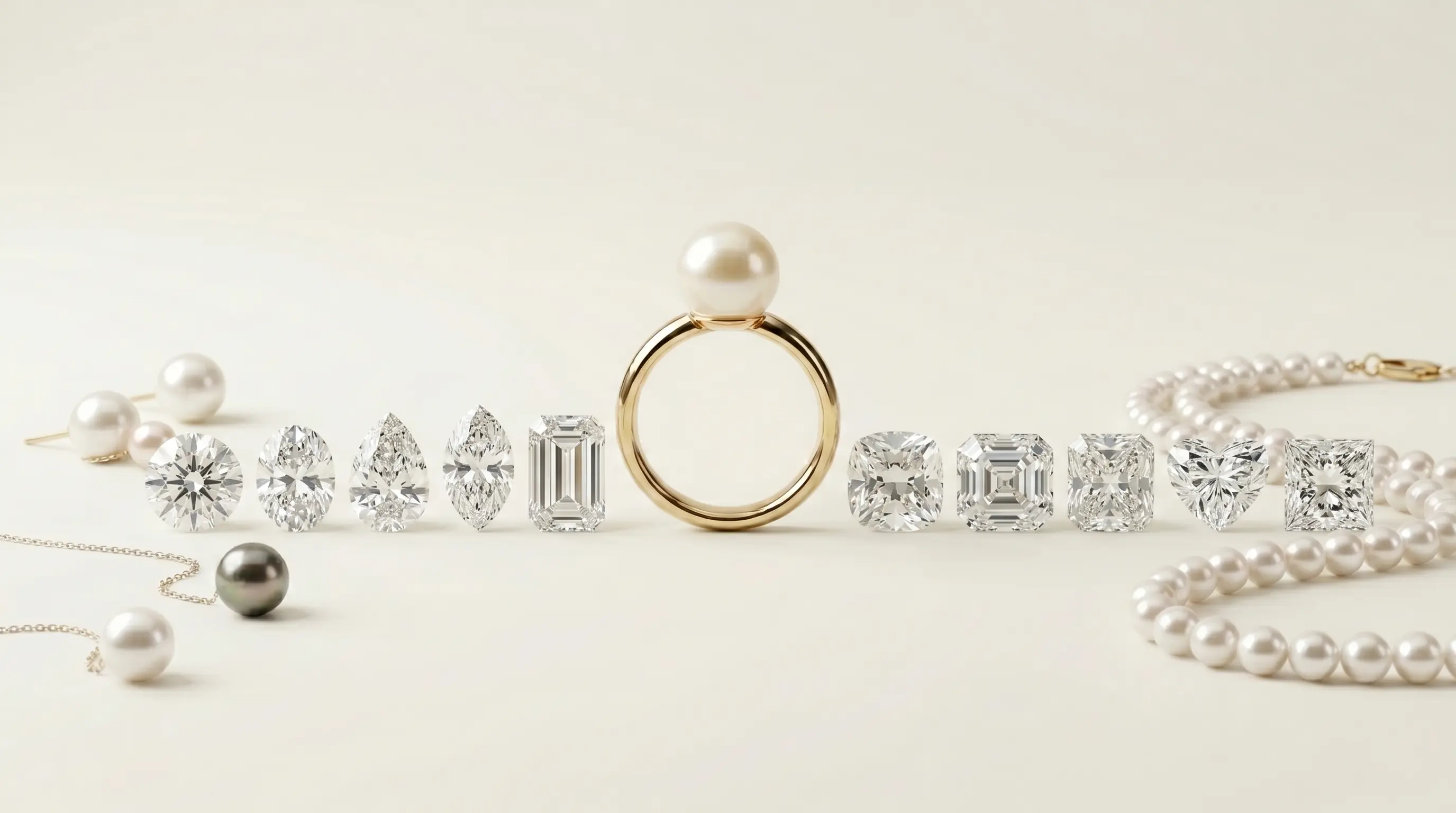
Choosing a diamond shape is one of those rare decisions where centuries of craftsmanship collide with deeply personal taste. In the world of fine jewellery, two geometric cuts have been locked in an elegant rivalry for decades: the fiery Princess and the aristocratic Emerald. Each transforms a diamond ring into a statement of character, turning raw carbon into something that speaks volumes about its wearer.
Modern luxury is no longer just about carat weight. It is about intention. Understanding the difference between a princess cut and an emerald cut diamond will help you invest in a symbol that remains relevant across decades, not just seasons. This guide unpacks the aesthetic and technical secrets behind both shapes so your diamond ring becomes a true reflection of your story.
What Are Princess Cut and Emerald Cut Diamonds?
Before choosing sides, it helps to understand what each shape actually is from a geometric, optical, and craftsmanship perspective.
Princess Cut: The Square Inferno
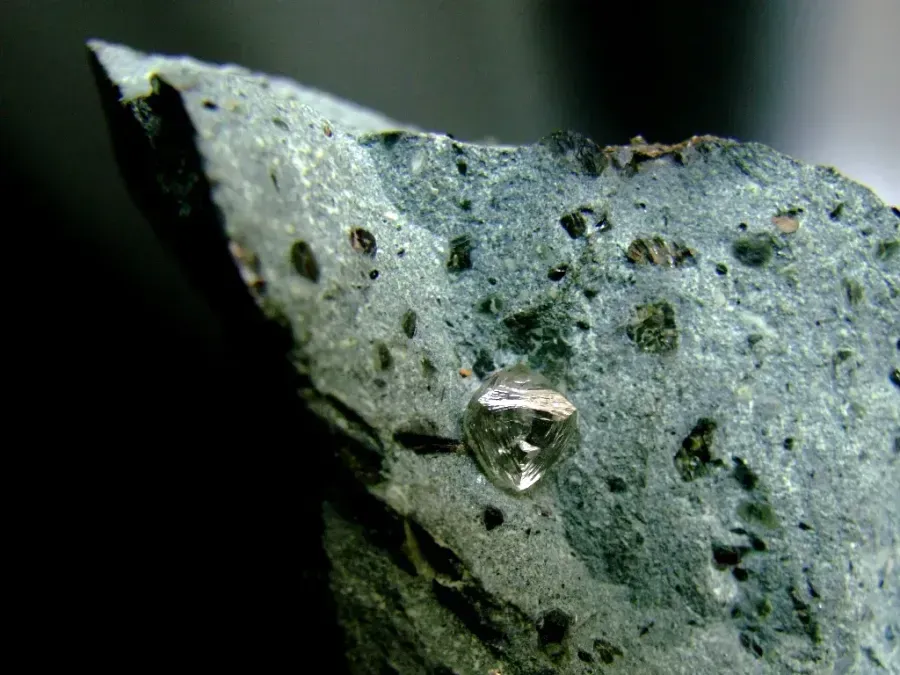
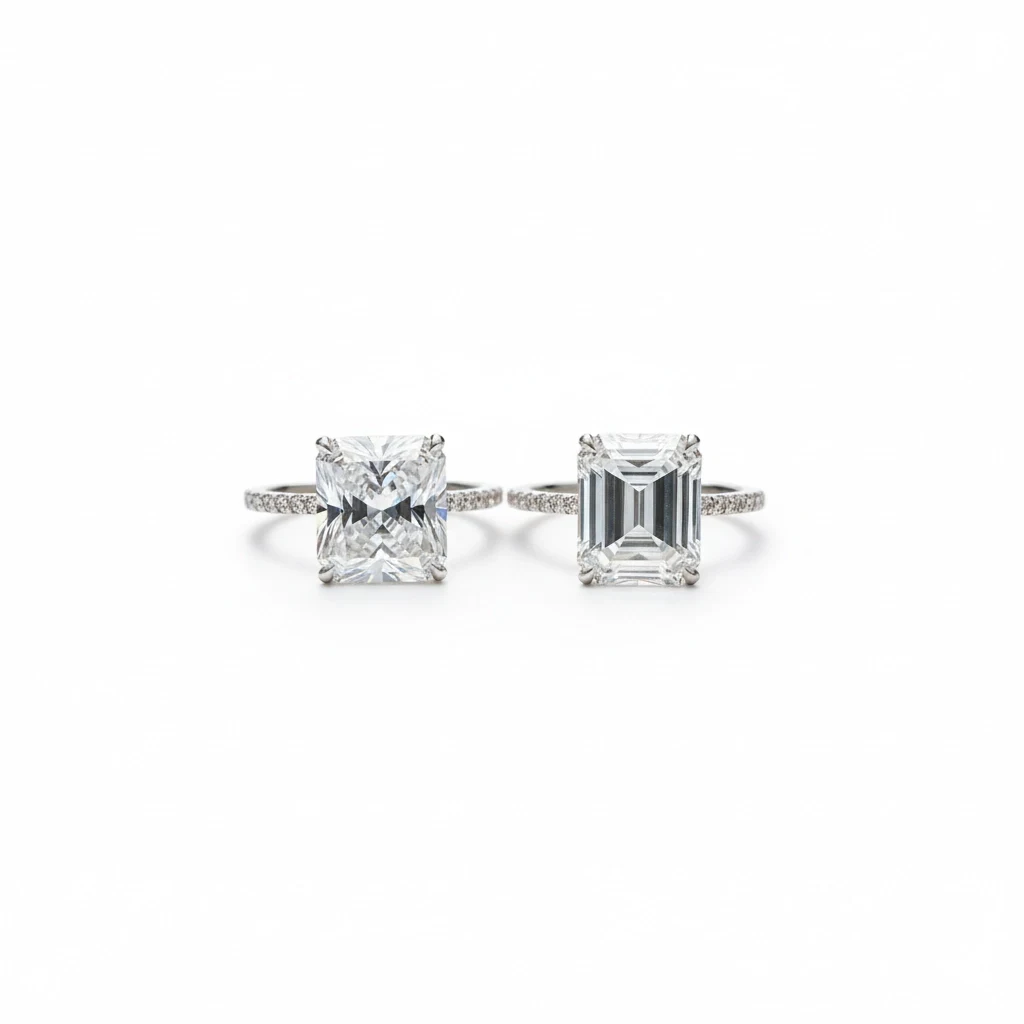
The princess cut is a square (occasionally slightly rectangular) diamond shape with sharp corners and a complex facet arrangement. Its technical name is "square modified brilliant cut." The stone contains 57 to 76 facets arranged in chevron patterns across the pavilion (bottom half), creating an intense light performance that rivals the classic round brilliant.
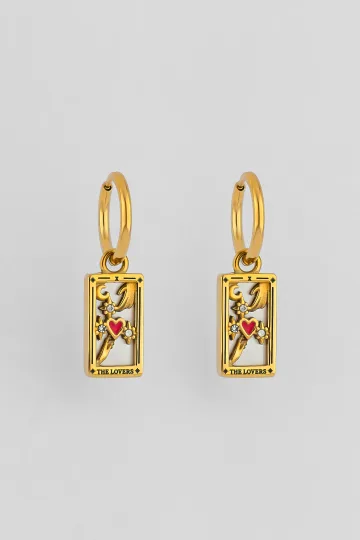
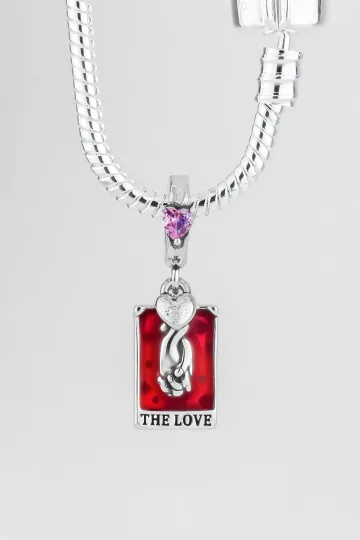
Wear the symbol, don't just read about it. These are in stock:





The key characteristic of a princess cut diamond is its brilliant-type faceting. Facets are arranged as triangles and kite shapes, similar to a round brilliant. Light entering the stone bounces multiple times and disperses into spectral flashes. The result: a bright, almost aggressive sparkle that is visible from across the room.
The ideal length-to-width ratio for a princess cut sits between 1.00 and 1.05, making it a near-perfect square. Stones between 1.05 and 1.10 still appear square to the naked eye, but anything above 1.10 starts looking noticeably rectangular.
Emerald Cut: The Hall of Mirrors
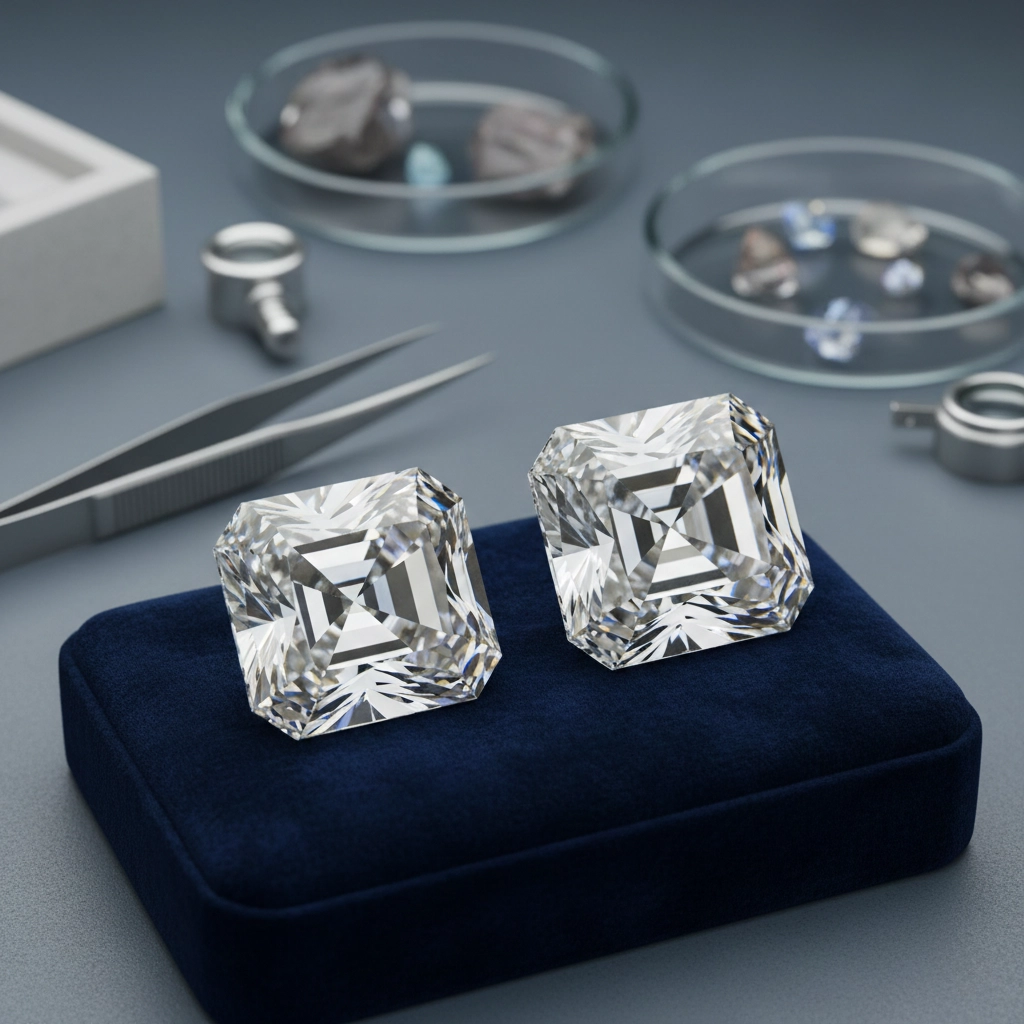
The emerald cut is a rectangular step-cut shape with cropped corners. It gets its name from the gemstone it was originally designed for: the long, parallel facets minimised pressure on fragile emeralds during cutting, reducing the risk of fracture.
Unlike the princess cut, the emerald cut uses step-type faceting. Facets run parallel to each other like staircase treads, producing not a shower of sparkles but broad, slow flashes of light. Jewellers call this the "hall of mirrors" effect. You are essentially looking into a corridor of reflections that recedes into the depth of the stone.
The standard facet count is 57. The optimal length-to-width ratio falls between 1.30 and 1.50. Stones in this range look classically elegant. Ratios below 1.30 push the shape toward a square (at which point it becomes an Asscher cut), while ratios above 1.50 create a deliberately elongated silhouette.
How Light Behaves: Two Different Shows
To truly understand the difference, picture two bodies of water.
Princess cut is a mountain stream in direct sunlight. Dozens of small waves break the beam into hundreds of tiny rainbow flickers. The light dances, shifts, changes with every micro-movement of your hand. Gemologists call this "scintillation." Combined with "fire" (the dispersion of white light into spectral colours), the princess cut delivers what can only be described as a diamond fireworks display.
Emerald cut is a mountain lake at sunset. The surface is calm. Reflections are broad, slow, deep. Instead of a scatter of sparks, you see entire bands of light rolling from one edge of the stone to the other. This is "brilliance" in its purest form: the brightness of white reflection rather than coloured dispersion. The effect is contemplative, almost hypnotic.
Neither type of light performance is objectively better. They appeal to different parts of your aesthetic sensibility: princess cut speaks to a hunger for energy, emerald cut to a need for stillness.
Optical Properties Compared
| Optical Parameter | Princess Cut | Emerald Cut |
|---|---|---|
| Brilliance (white light return) | High | Very High |
| Fire (spectral dispersion) | Very High | Moderate |
| Scintillation (sparkle) | Very High | Low |
| Pattern contrast | Medium | High |
| "Window" effect | Minimal | Noticeable |
| Sensitivity to lighting | Moderate | High |
Emerald cut is "sensitive to lighting," meaning it loses more visual impact under dim artificial light than princess cut. But under diffused daylight, it unleashes its full magic, transforming into that mesmerizing corridor of reflections.
Quick Reference: Core Specifications
| Parameter | Princess Cut | Emerald Cut |
|---|---|---|
| Silhouette | Square | Rectangle |
| Faceting type | Brilliant | Step |
| Facet count | 57 to 76 | 57 |
| Light character | Intense sparkle (fire) | Broad flashes (hall of mirrors) |
| Ideal length-to-width ratio | 1.00 to 1.05 | 1.30 to 1.50 |
| Corners | Sharp | Cropped |
| Depth (% of width) | 64 to 75% | 61 to 67% |
| Origin of the shape | Israel, 1979 | Europe, 16th century |
| Closest relative | Radiant Cut | Asscher Cut |
| Visual metaphor | Mountain stream in sun | Mountain lake at sunset |
History: From Royal Courts to Silicon Valley Minimalism
Emerald Cut: Five Centuries of Pedigree
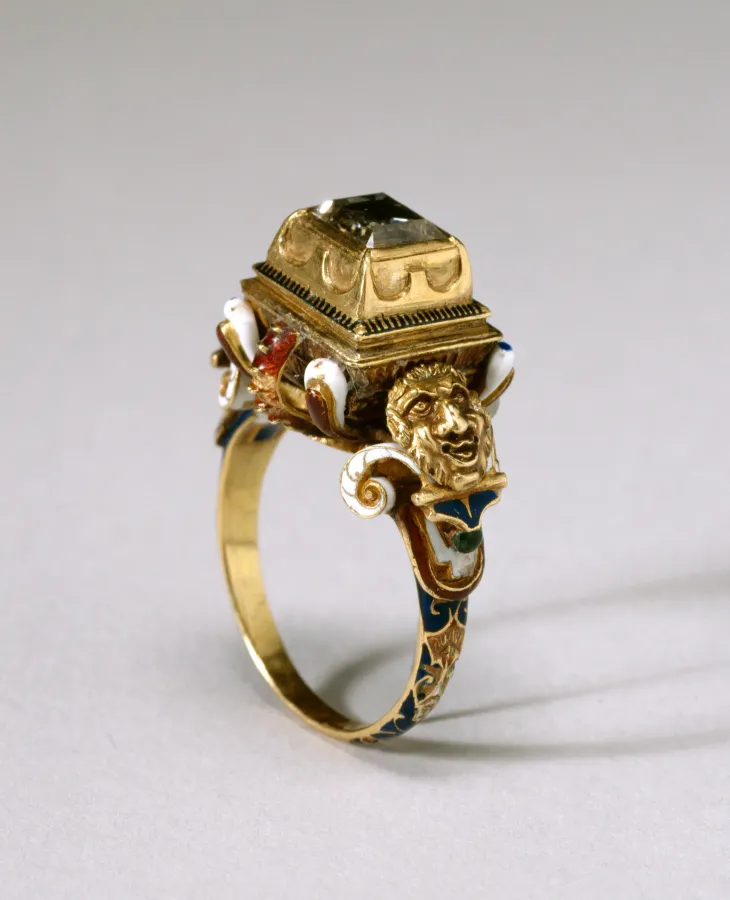
Step-cut diamonds have existed since the Renaissance. As early as the 16th century, cutters in Antwerp and Amsterdam were using rectangular shapes with parallel facets to process fragile stones. But the cut received its official "Emerald Cut" designation and canonical proportions in the 1920s.
The Art Deco era essentially created this shape's identity. The geometric aesthetic of 1920s and 1930s architecture, fashion, and decorative arts resonated perfectly with the clean lines of step-cut faceting. The Chrysler Building, Empire State Building, Erte's graphic art, Coco Chanel's costume design: all existed in the same visual universe as the emerald cut diamond.
In postwar decades, the cut became synonymous with Hollywood royalty. When cameras captured close-ups of movie stars' hands, it was the step-cut diamond that delivered that signature "slow, confident glow" that read beautifully on screen. Grace Kelly's engagement ring, though actually a different cut, helped cement the association between rectangular diamonds and timeless glamour.
Princess Cut: The Young Challenger
The princess cut is a relatively young shape. Its creation is attributed to several cutters, but the key contribution came from Israeli diamond cutter Israel Itzkowitz, who in 1979 patented a shape called the "Quadrillion." Around the same time, South African cutter Basil Watermeyer developed a similar shape called the "Barion."
By the mid-1980s, the "Princess Cut" brand had firmly established itself in the industry, becoming the second most popular diamond shape after the round brilliant. It was the jewellery industry's answer to a new generation's demand: something bold, geometric, yet no less dazzling than the traditional round.
The princess cut fit perfectly into the minimalist aesthetics of the 1990s and 2000s. A clean square in a sleek setting was the jewellery equivalent of Jonathan Ive's Apple designs or Tadao Ando's concrete architecture.
Timeline Comparison
| Period | Emerald Cut | Princess Cut |
|---|---|---|
| 16th to 18th century | Proto-step-cuts in Antwerp workshops | Does not exist |
| 1920s | Formalized during the Art Deco era | Does not exist |
| 1940s to 1960s | Peak popularity among Hollywood stars | Does not exist |
| 1979 | Steady demand | "Quadrillion" patent filed |
| 1980s to 1990s | Perceived as established classic | Explosive growth in popularity |
| 2000s to 2010s | Renaissance via vintage trend | Stable #2 after round |
| 2020s | New wave: quiet luxury | Geometric minimalism |
Cultural Geography: What Different Markets Prefer
Diamond shape preferences vary meaningfully by region, reflecting deeper cultural attitudes toward beauty and status.
In the United States, princess cut held the #2 spot for years. The American market values "bang for the buck," which is maximum visual impact per dollar. But emerald cut has been surging in recent years, particularly among millennials and Gen Z buyers seeking individuality and a connection to vintage aesthetics.
In Britain and Continental Europe, step cuts have always commanded more respect than in America. European taste leans historically toward restrained elegance. The emerald cut is a "very European" stone: understated, storied, requiring a connoisseur's eye to fully appreciate. Hatton Garden jewellers report steadily growing demand.
In Japan, the precision and symmetry of the princess cut resonates with a cultural reverence for perfection of form. The square in Japanese aesthetics represents order, harmony, and completion.
In the Middle East and India, large stones with maximum sparkle are favoured, making princess cut a popular choice. But a growing segment of "conscious luxury" buyers is opening the door for emerald cut.
In Australia and New Zealand, both cuts compete closely. The relaxed outdoor lifestyle favours the "easy brilliance" of emerald cut for everyday wear, while princess cut dominates the engagement ring market.
An emerald cut is a window creature, a princess owns the evening. Wear them backwards and the stone dies, and don't you dare blame the cutter.
How to wear a princess or emerald cut ring
In years of shoots and fittings hundreds of rings have passed through my hands, and the geometry of a stone decides a look harder than people expect. Here is what actually works, sorted by occasion.
What do I pair the ring with every day? For daily wear I recommend a compact princess under a carat on a slim band: its sparks read even under office light and sit happily with jeans, a white shirt and knitwear. I suggest keeping the hand clean, one bright ring plus a plain wedding band, not five competing accents. An emerald cut I save for anyone who spends the day near a window, since diffused daylight opens its hall of mirrors fully.
Is it right for the office? For a business code I choose the restraint of an emerald cut, its calm glow reads as confidence rather than display. I recommend cool metals, platinum or white gold, they reinforce that tone and never argue with a sharp suit. If you want warmth, I suggest yellow gold against beige, cream and deep green fabrics.
How do I build an evening look? For evening I choose the princess, its rainbow flashes come alive under the spot lighting of a restaurant or a stage, especially against silk, satin and bare shoulders. Here I allow layers: an engagement ring plus an eternity band and matching stud earrings. For an anniversary or a ceremony I build the opposite, one large stone and the bare minimum around it so the eye stays on it.
How many metals and rings on one hand? I do not recommend more than two metals on a hand, white gold with platinum reads clean, an added rose already makes noise. I suggest setting a single rhythm of sparkle: a square princess I pair with plain neighbours, while a step cut emerald contrasts beautifully with a band of round stones. A stack of thin rings I leave for the next finger so the main stone holds its own line.
Which shape suits my hand and my mood? An elongated emerald I recommend for a broad palm and short fingers, it visually lengthens the hand. A compact princess I choose for long slim fingers, where it sits in balance. And I keep the mood in mind: the square is about energy and presence, the rectangle about depth and quiet restraint. I suggest choosing the shape for the look you feel easy in, on weekdays and on the big dates alike.

Turn on your camera, pick earrings, a pendant or a ring, and see the piece on yourself in real time.
Switch items in one tap.
Everything runs in your browser: no photo or video is ever uploaded.
Women's Princess Cut Rings: Modern Brilliance
Why People Choose Princess Cut Diamonds
There are several objective reasons the square cut remains a perennial favourite.
First, maximum light return. Among all fancy shapes (meaning everything except round), the princess cut delivers the highest fire and scintillation. If you want a ring that burns on the hand, scattering rainbow flashes with every gesture, this is the shape that delivers.
Second, raw material efficiency. When cutting a rough diamond into princess shape, up to 80% of the original crystal weight is preserved (compared to just 40 to 50% for a round brilliant). Less waste means lower cost per carat. All else being equal, a princess cut diamond will be significantly less expensive than a round stone of the same weight.
Third, visual size advantage. The square shape with sharp corners creates the illusion of a larger stone. The surface area of the table (top facet) fills more visual space than a round brilliant of the same carat weight.
Fourth, versatility. Princess cut works equally well in a solitaire setting, surrounded by a diamond halo, in vintage pave, or in an ultra-modern bezel. The square is geometric neutrality: it adapts to any design context.
Carat Recommendations for the Square Shape
Size perception depends heavily on shape. Square diamonds can appear slightly smaller than elongated shapes of the same carat weight because the mass distributes evenly rather than stretching along the finger.
Here are approximate face-up dimensions for princess cut diamonds at various carat weights:
| Carats | Face-up Size (mm) | Visual Impression |
|---|---|---|
| 0.50 | 4.2 x 4.2 | Delicate accent |
| 0.75 | 4.8 x 4.8 | Noticeable but refined |
| 1.00 | 5.5 x 5.5 | Classic engagement size |
| 1.50 | 6.2 x 6.2 | Expressive, eye-catching |
| 2.00 | 6.9 x 6.9 | Statement piece |
| 3.00 | 7.8 x 7.8 | Exceptional, collector level |
The sweet spot for engagement rings is 0.80 to 1.50 carats. Stones in this range deliver good visual presence without overwhelming the finger, while allowing you to prioritise high clarity and colour grades within a reasonable budget.
Metal Choice for Princess Cut
The metal of the setting acts as a colour filter for your diamond.
White gold and platinum. Cool-toned metals emphasise the diamond's colorlessness. If your stone grades D through F on the colour scale, white metal lets it reach its full potential. Platinum is denser and heavier, giving a satisfying sense of substance on the finger. White gold is lighter and more affordable but requires periodic rhodium plating to maintain its brightness.
Yellow gold. The warm tone of gold masks the slight yellowish tint in stones graded G through J, allowing you to choose a more affordable diamond without visible compromise. Yellow gold paired with a square cut creates a "sunbeam in a frame" effect: warm, joyful, with a touch of retro sophistication.
Rose gold. The romantic hue of rose gold adds warmth and softness to the geometric severity of the princess cut. This is a contrast between rigid form and gentle colour, creating interesting visual tension. Especially appealing for those who want a square diamond but not a "cold" or "severe" look.
| Metal | Best Diamond Colour | Character | Maintenance |
|---|---|---|---|
| Platinum | D to F | Icy elegance | No plating needed |
| 18K White Gold | D to G | Clean minimalism | Rhodium every 1 to 2 years |
| 18K Yellow Gold | G to J | Warm sophistication | No coating needed |
| 18K Rose Gold | F to H | Romance + geometry | Darkens slightly over time |
Shape and Hand Type: Finding the Right Match
Finger shape and hand proportions affect how any ring looks when worn.
| Hand Type | Princess Cut Recommendation | Why |
|---|---|---|
| Long, slender fingers | Any carat size, wider bands work well | Square balances length |
| Short fingers | 0.75 to 1.25 ct, thin band | Avoids visual overload |
| Wide fingers | 1.00 ct and up, medium band | Square looks proportional |
| Petite hands | Up to 1.00 ct with halo | Halo adds size without bulk |
For emerald cut, the logic shifts. The elongated shape visually lengthens the finger, making it especially flattering for shorter fingers. On very long fingers, a vertically oriented emerald cut may over-emphasise length. In that case, consider a horizontal "east-west" setting or squarish proportions (ratio closer to 1.20).
Men's Rings: Bold Geometry and the Emerald Cut Diamond
Masculine Style and Step-Cut Diamonds
The emerald cut diamond speaks quietly but carries weight. That is precisely why it has become a favourite in men's fine jewellery. Where princess cut announces itself with a shower of sparks, emerald cut demonstrates depth and structure. Think of the difference between fireworks and a sunset: both are beautiful, but they create entirely different impressions.
In men's rings, step-cut diamonds solve several problems at once. The rectangular shape visually lengthens the finger and harmonizes with larger hands. The broad step facets do not look "excessively sparkly" in the context of a masculine wardrobe. They produce a calm, dignified radiance that reads as confidence rather than ostentation.
Cropped corners offer another practical advantage. In a men's ring that sees heavier daily wear, the absence of sharp corners reduces the risk of chipping from accidental impacts.
Band Width for Rectangular Stones
The band (shank) must be proportional to the stone. For men's rings with emerald cut, a good rule is: band width equals 40 to 60% of the stone's width.
| Stone Width (mm) | Recommended Band Width (mm) | Style |
|---|---|---|
| 5 to 6 | 3 to 4 | Understated, everyday |
| 6 to 7 | 4 to 5 | Balanced, versatile |
| 7 to 8 | 5 to 6 | Bold, declarative |
| 8+ | 6 to 8 | Artisan, collector |
A band that is too narrow makes the stone appear to "float" and increases the risk of shank deformation under stress. Too wide, and it visually consumes the stone, removing the breathing room a diamond needs.
Matte Metals Paired with Emerald Cut
One of the most striking combinations in men's jewellery design is a matte (satin-finished) metal paired with an emerald cut diamond. The contrast between the subdued, velvety metal surface and the clean mirror facets of the stone creates a dramatic visual effect.
Satin Finish. Fine parallel lines create a silk-like texture. Pairs beautifully with the parallel steps of an emerald cut, as if the metal's lines are an extension of the stone's geometry.
Sandblast. Uniform grainy texture. Creates a rougher, industrial contrast against the smoothness of the cut.
Brushed. Directional strokes, similar to brushed steel. A modern, technical look that works particularly well with platinum and titanium.
Hammered. A "forged" surface texture. An organic, artisanal quality that creates an interesting tension with the mathematical precision of step faceting.
Secure Settings for Large Stones
A large emerald cut diamond in a men's ring requires a setting that can withstand an active lifestyle.
Bezel. The stone is surrounded by a continuous strip of metal along its entire perimeter. Maximum protection, minimal profile. This setting virtually eliminates snags and stone damage. Visually, the bezel emphasises the rectangular shape, creating a clean "frame."
Half-Bezel. Metal wraps the stone along its two long sides, leaving the short sides open. A compromise between protection and visual lightness.
Channel. The stone sits in a channel between two metal walls. Excellent for composite designs where the emerald cut is flanked by side stones.
Flush (Gypsy) Setting. The stone is set completely into the metal, with its table facet flush with the ring's surface. The most practical option: nothing protrudes, nothing snags, nothing scratches. Ideal for men who work with their hands.
The 4Cs: How Quality Standards Differ for Each Shape
The 4C grading system (Carat, Colour, Clarity, Cut) works differently for each shape. Understanding these nuances lets you prioritise wisely and avoid overpaying for characteristics that do not affect the visual result.
Carat is the first parameter on every certificate, and how that weight translates into face-up size is something the dedicated carat guide explains in detail. The colour and clarity letters that follow are best understood through the full D-to-Z and FL-to-I3 scales guide, which is the reference behind the recommendations below.
Colour: Who Hides It, Who Reveals It
Princess cut, thanks to its intense light play, does an excellent job masking slight body colour. The constant sparkle and fire "distract" the eye from tonal warmth in the stone. For a princess cut in white metal, a comfortable minimum is G to H. In yellow gold, you can confidently go down to I or J without visible compromise.
Emerald cut is a different story entirely. The large, open facets act as windows: you look straight into the stone and see its real colour. Step faceting does not create the kaleidoscopic effect that camouflages tint. For an emerald cut in white metal, aim for F to G minimum. In yellow gold, H to I is acceptable.
Clarity: Transparency Under the Microscope
Here the difference between cuts becomes even more dramatic.
Princess cut conceals inclusions superbly. The complex facet pattern breaks light into many small reflections, behind which most inclusions simply vanish. For princess cut, SI1 to SI2 clarity is generally sufficient, provided the inclusion is not sitting dead centre on the table.
Emerald cut is the most "honest" shape in existence. Step facets create wide, unobstructed viewing zones through which any inclusion is visible with cinematic clarity. For emerald cut, VS2 and above is recommended. SI1 stones are possible but require careful inspection: the inclusion must not be in the central table area, or it will be eye-visible.
Cut Quality: No Compromises
For both shapes, cut quality is the single most important factor in the stone's beauty. A poorly cut diamond with high colour and clarity will look worse than a superbly cut stone with more modest specs.
Important note: unlike round brilliants, GIA does not assign an official cut grade for princess cut or emerald cut diamonds. Instead, look at the symmetry and polish grades (Excellent or Very Good) and at the stone's specific proportions.
4C Priority Matrix
| Parameter | Princess Cut Priority | Emerald Cut Priority |
|---|---|---|
| Carat | Medium | Medium |
| Colour | Can economize (G to H) | Important (D to G) |
| Clarity | Can economize (SI1 to SI2) | Critical (VS2 and up) |
| Cut | Critical | Critical |
Detailed Clarity Guide
| Clarity Grade | Meaning | Princess Cut | Emerald Cut |
|---|---|---|---|
| FL / IF | Flawless / Internally Flawless | Overkill, you are overpaying | Ideal if budget allows |
| VVS1 / VVS2 | Very Very Slightly Included | Excellent choice | Excellent choice |
| VS1 / VS2 | Very Slightly Included | Optimal for most buyers | Recommended minimum |
| SI1 | Slightly Included | Good choice with inspection | Risky, needs visual check |
| SI2 | Slightly Included (more visible) | Acceptable in larger stones | Not recommended |
| I1 and below | Inclusions visible to eye | Not recommended | Absolutely not |
Detailed Colour Guide
| Colour Grade | Description | Princess in White Metal | Princess in Yellow Gold | Emerald in White Metal | Emerald in Yellow Gold |
|---|---|---|---|---|---|
| D to E | Absolutely colourless | Luxury | Overpaying | Ideal | Good |
| F to G | Near colourless | Recommended | Good | Recommended | Recommended |
| H | Faint warmth | Good | Recommended | Acceptable | Good |
| I to J | Light warm tone | Acceptable | Excellent | Not recommended | Acceptable |
| K and below | Noticeable tint | Only for "warm" designs | Possible | Not recommended | Not recommended |
Ideal Proportions: What to Look for on the Certificate
Since GIA does not assign cut grades for fancy shapes, you will need to evaluate proportions yourself.
Princess Cut: Ideal Proportions
| Parameter | Excellent | Good | Acceptable |
|---|---|---|---|
| Depth % | 65 to 75 | 64 to 76 | 62 to 78 |
| Table % | 67 to 72 | 64 to 75 | 60 to 78 |
| Length-to-width | 1.00 to 1.03 | 1.00 to 1.05 | 1.00 to 1.10 |
| Polish | Excellent | Very Good | Good |
| Symmetry | Excellent | Very Good | Good |
Emerald Cut: Ideal Proportions
| Parameter | Excellent | Good | Acceptable |
|---|---|---|---|
| Depth % | 61 to 67 | 59 to 69 | 57 to 72 |
| Table % | 61 to 69 | 58 to 72 | 55 to 75 |
| Length-to-width | 1.30 to 1.50 | 1.20 to 1.60 | 1.15 to 1.70 |
| Polish | Excellent | Very Good | Good |
| Symmetry | Excellent | Very Good | Good |
Quick Quiz: What Is Your 4C Strategy?
Answer three questions to discover your approach.
1. What attracts you most in a diamond?
- (A) Bright flashes and rainbow fire
- (B) Depth, transparency, and internal purity
2. On a limited budget, would you prefer...
- (A) A larger stone with minor inclusions
- (B) A smaller stone that is completely eye-clean
3. How would you describe your style?
- (A) Bold, modern, attention-grabbing
- (B) Restrained, elegant, detail-oriented
Result: Mostly (A) answers point you toward princess cut. Mostly (B) answers suggest you should seriously consider emerald cut.
Setting Styles: Protecting Corners and Enhancing Form
A setting does more than hold a stone in a ring. It is an engineering solution that affects security, appearance, and even the optical performance of the diamond.
Settings for Princess Cut
Sharp corners are the Achilles' heel of the princess cut. The corners are thinner than the main body of the stone and vulnerable to chipping on impact. The right setting protects these weak points.
Four-Prong. The classic choice. Each prong covers one corner, providing basic protection. Pro: maximum stone visibility, excellent light entry. Con: prongs can catch on fabric.
V-Prong. A specialised solution for square cuts. Metal cradles each corner in a V-shaped pocket, offering better protection than a standard prong. This is the gold standard for princess cut.
Partial Bezel. Metal frames the corners and part of the sides but leaves the central facet areas open. High protection with preserved light play.
Halo Setting. A ring of small diamonds surrounds the centre stone. The halo visually enlarges the centre stone and creates a metal "buffer" around its corners. Dual function: aesthetics plus protection.
Settings for Emerald Cut
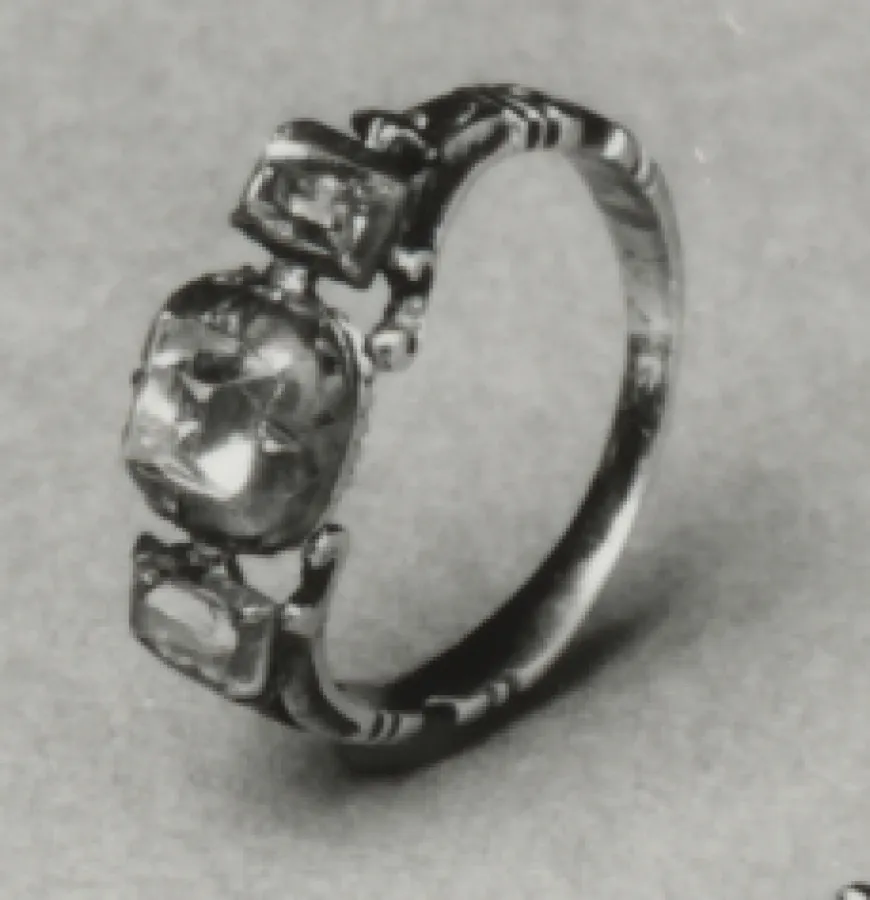
Cropped corners make the emerald cut less vulnerable than the princess, but the shape has its own setting requirements.
Four-Prong. Works well, sitting on the cropped corners. Provides maximum visibility of the stone and its step facets.
Double Prong. Two prongs at each corner. Creates a decorative accent and holds the stone more securely at higher carat weights.
Bezel. A continuous metal frame. Especially effective for emerald cut: the metal "frame" emphasises the rectangular geometry, creating that "window into a stone" effect.
Three-Stone. A centre emerald cut flanked by two side stones (typically trapezoid or baguette shaped). A classic composition that visually elongates the finger and adds architectural complexity.
Setting Comparison by Key Criteria
| Setting Type | Corner Protection (Princess) | Corner Protection (Emerald) | Stone Visibility | Practicality |
|---|---|---|---|---|
| 4-Prong | 3/5 | 4/5 | 5/5 | 3/5 |
| V-Prong | 5/5 | N/A | 4/5 | 4/5 |
| Bezel | 5/5 | 5/5 | 3/5 | 5/5 |
| Halo | 4/5 | 4/5 | 4/5 | 3/5 |
| Three-Stone | 4/5 | 4/5 | 4/5 | 4/5 |
Eternity Rings with Princess and Emerald Cut Diamonds
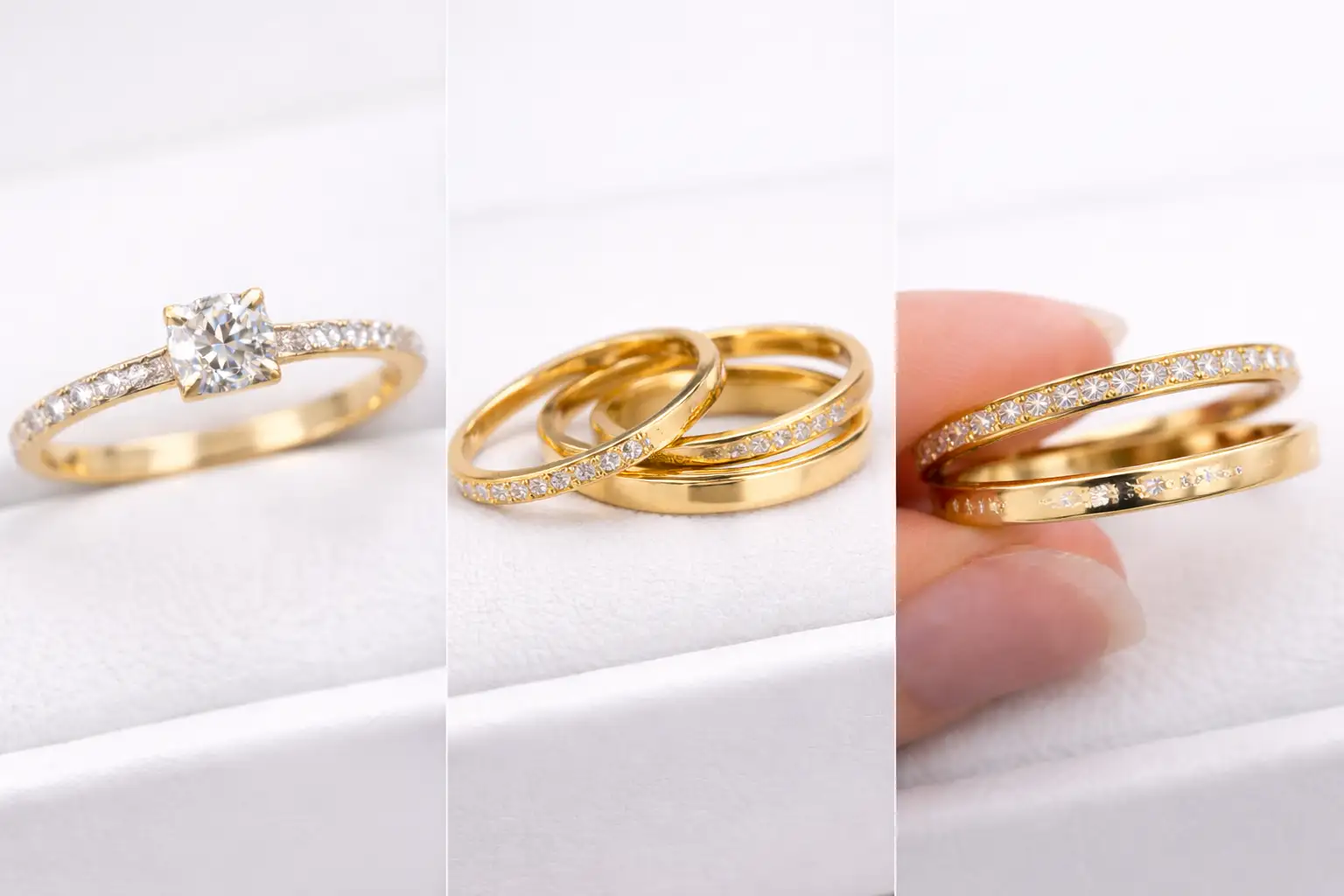
Eternity bands are wedding or anniversary rings where diamonds encircle the shank completely (full eternity) or halfway (half eternity). Geometric cuts create distinctive effects in these designs.
Princess Cut Eternity
Square stones in a channel or shared-prong setting sit tightly against each other, creating a seamless "mosaic" of diamonds. There are virtually no gaps between stones, giving the impression of a continuous sparkling surface. This is one of the most brilliant types of eternity rings.
Technical challenge: the stones must be perfectly calibrated in size. Even a fraction of a millimetre difference between adjacent stones breaks the visual continuity.
Critical note: a princess cut full eternity ring cannot be resized. Stones run the full circumference, and changing the ring's diameter requires adding or removing stones, which destroys the design. Know your exact finger size before committing.
Emerald Cut Eternity
Rectangular step-cut stones in an eternity band create a "railroad track" effect. The parallel facets of each stone visually merge with those of its neighbour, forming long corridors of light. The effect is calmer but no less refined.
Emerald cut eternity rings typically contain fewer stones (due to each stone's larger footprint), but each stone "reads" individually. The result is a rhythmic, architectural pattern.
Full vs Half Eternity
| Criterion | Full Eternity | Half Eternity |
|---|---|---|
| Visual effect | Maximum sparkle from every angle | Sparkle only on visible portion |
| Comfort | Stones may be felt on the palm side | Smooth interior |
| Resizing | Not possible | Possible (within 1 to 2 sizes) |
| Cost | Higher (more stones) | Lower (fewer stones) |
| Best for | Perfectionists | Pragmatists |
Carat Count by Ring Size
| Ring Size (US) | Princess Cut Stones (2.5mm) | Emerald Cut Stones (4x3mm) | Approximate Total Carats |
|---|---|---|---|
| 5 | 18 to 20 | 12 to 14 | 1.50 to 2.00 ct |
| 6 | 20 to 22 | 14 to 15 | 1.80 to 2.20 ct |
| 7 | 22 to 24 | 15 to 17 | 2.00 to 2.50 ct |
| 8 | 24 to 26 | 17 to 18 | 2.20 to 2.80 ct |
| 9 | 26 to 28 | 18 to 20 | 2.50 to 3.00 ct |
Note: figures are for full eternity. For half eternity, divide stone counts roughly in half.
Stacking Rules
Eternity rings rarely exist in isolation. They stack with other rings to create a layered composition.
Classic stack: engagement + wedding band + eternity. Three rings on one finger. Order matters: wedding band closest to the palm (symbolically closest to the heart), then engagement ring, then eternity ring on top.
Princess cut stacking tip: square stones create a continuous line of sparkle, so a princess cut eternity pairs best with smooth or minimally adorned neighbouring rings. Two pave-heavy bands next to each other compete for attention.
Emerald cut stacking tip: step-cut stones produce a rhythmic, architectural pattern. An emerald cut eternity contrasts beautifully with a round-diamond band, as the different sparkle rhythms complement each other.
Upload a photo of your pet, someone you love, or an object. We'll build a 3D model and hand-cast it in pewter.




How Band Width Affects the Perception of Your Diamond
Band width is one of the most underrated parameters in ring design. It fundamentally changes how the stone is perceived and how the overall proportions read.
Narrow Band (1.5 to 2.5 mm)
A thin band creates the "floating stone" effect. The diamond appears larger because the metal does not compete for visual attention. For emerald cut, a narrow band emphasises the stone's horizontal span, amplifying the finger-lengthening effect.
Downside: thin bands are more prone to deformation, especially in softer metals like yellow gold. For daily wear, a minimum of 2 mm with a reinforced profile is recommended.
Medium Band (2.5 to 4 mm)
The sweet spot. Adequate strength, good proportion with most carat weights, versatile style. For princess cut, a medium band creates a balanced "frame" without competing with the stone.
Wide Band (4 to 8 mm)
Wide bands make a statement on their own. The stone becomes an integrated part of the design rather than the sole protagonist. For men's emerald cut rings, a wide band is the norm, especially with matte or textured finishes.
Proportion Formula
| Carat Weight | Ideal Women's Band Width | Ideal Men's Band Width |
|---|---|---|
| 0.50 to 0.75 | 1.5 to 2.0 mm | N/A |
| 0.75 to 1.00 | 2.0 to 2.5 mm | N/A |
| 1.00 to 1.50 | 2.0 to 3.0 mm | 4.0 to 5.0 mm |
| 1.50 to 2.00 | 2.5 to 3.5 mm | 5.0 to 6.0 mm |
| 2.00+ | 3.0 to 4.0 mm | 5.0 to 8.0 mm |
Matching Sets in Geometric Style
Geometric cuts open unique possibilities for matching ring sets: rings that are visually linked by a shared design language but adapted for different hands.
The "One Language, Two Accents" Concept
The idea behind a matching set is not to make two identical rings. It is to make two rings that speak the same visual language (the geometry of clean form) but with different inflections.
Option 1: Princess + Princess. Both rings feature princess cut diamonds, but hers is in a delicate halo with pave and his is a solitaire in a wide bezel. Shared element: the square. Difference: scale and texture.
Option 2: Emerald + Emerald. Hers is an elegant step-cut on a thin band with side baguettes. His is an emerald cut flush-set in a wide satin band. Shared element: the rectangle. Difference: openness vs. minimalism.
Option 3: Princess + Emerald (cross-format). For couples who want connection, not repetition. Hers is princess cut, his is emerald cut. The unifying element: both shapes belong to the world of straight lines and clean angles. The difference: square vs. rectangle, sparkle vs. depth.
Customer reviews
Zevira is a real jewellery shop. Genuine payments, deliveries and customer thank-yous.
🥰🥰🥰 gracias

Ok, ¡gracias! 🙂

Pairing a Princess Cut Ring with a Wedding Band
One of the most common challenges after the proposal: finding a wedding band that sits perfectly alongside the engagement ring. For a princess cut diamond, this requires some planning.
The Sharp Corner Problem
A princess cut diamond has sharp corners that often extend beyond the engagement ring's shank. A straight wedding band cannot sit flush against such a ring: a gap forms. This is not a defect; it is geometric reality.
Solution 1: Contoured Band
The wedding band is shaped with a V-cut or U-cut notch that follows the engagement ring's silhouette exactly. The band "hugs" the stone, eliminating the gap. This requires custom fabrication or selection from specialised collections.
Solution 2: Embrace the Gap
Accept the gap and use it as a design element. A small space between rings lets each piece "breathe" and prevents metal-on-metal friction. Some designers intentionally create ring sets with a deliberate interval.
Solution 3: Ring Enhancer
A wedding band that wraps around the engagement ring from both sides, creating a single unified piece. Three rings appear as one complex jewel. Especially striking with princess cut: the square stone sits at the centre of a symmetrical diamond composition.
Solution 4: Separate-Hand Wearing
Wear the engagement and wedding rings on different hands. In many European traditions, this is standard practice. It eliminates the shape compatibility question entirely.
Which Wedding Band Style for Which Lifestyle
Beyond shape compatibility, your lifestyle should influence which wedding band you pair with your princess cut engagement ring.
Active lifestyle (gym, hiking, manual work). Choose a flat, low-profile band in platinum or 14K gold. Avoid bands with pave-set stones on top, as they catch on equipment and gloves. A plain or brushed-finish band in the same metal as the engagement ring creates a clean, practical stack.
Office and social lifestyle. A pave or channel-set band adds sparkle without the worry of heavy impacts. V-contoured bands work beautifully here since they stay protected in day-to-day office environments.
Creative and artistic lifestyle. Consider a textured or hand-forged band. Hammered finishes, bark textures, or mixed-metal designs add individuality. The contrast between an organic band and a geometric princess cut stone can be visually compelling.
Travel-heavy lifestyle. A low-profile enhancer ring that wraps the engagement ring securely reduces the risk of the centre stone catching on luggage, seatbelts, or clothing. Some frequent travellers opt to leave their engagement ring at home and wear only the wedding band while abroad.
Band Compatibility Matrix
| Band Type | Compatibility | Visual Effect | Selection Difficulty |
|---|---|---|---|
| Straight smooth | Gap inevitable | Minimalist | Low |
| Straight with pave | Gap inevitable | Sparkling contrast | Low |
| V-contoured | Flush fit | Unified composition | Medium |
| Enhancer (jacket) | Perfect integration | Luxurious, dimensional | High |
| Twisted | Partial fit | Organic, relaxed | Medium |
Custom Design: Creating Something Uniquely Yours
Ready-made rings from catalogues cover most needs, but sometimes you want something that exists in only one copy. Custom design is the process of creating a ring from scratch to your exact specifications.
What Can Be Customized
Stone proportions. Choose a specific length-to-width ratio: a perfect 1.00 square for princess cut or an elongated 1.50 rectangle for emerald cut. Every diamond is individual, and you can select the exact stone whose proportions appeal to you.
Band profile. Flat, comfort fit, D-shaped, knife edge: each profile gives a different sensation on the finger and a different visual effect. This is the part of the ring you feel all day, every day, so it deserves attention.
Hidden halo. Micro-diamonds placed not around the centre stone but beneath it, on the setting's "basket." From above: a clean solitaire. From the side: an unexpected scatter of tiny stones. A surprise visible only to those who look closely.
Colour accents. Sapphires, rubies, emeralds, or coloured diamonds as side stones or on the inner surface of the band. A coloured stone can carry symbolic meaning: a birthstone, a favourite colour, a national emblem, or simply a flash of personality.
Engraving. Interior engraving transforms a ring into a secret message. Dates, coordinates of where you met, a meaningful phrase, a fingerprint, a sound wave of the word "yes": possibilities are limited only by imagination and the physical surface area of the ring's interior.
The Custom Process: Step by Step
| Stage | What Happens | Duration |
|---|---|---|
| 1. Consultation | Discussion of concept, style, budget | 1 to 2 meetings |
| 2. Stone sourcing | Selection by certificate and visual inspection | 1 to 4 weeks |
| 3. 3D modelling | Creation of a digital ring model | 1 to 2 weeks |
| 4. Approval | Review of renders and/or wax model | 1 week |
| 5. Production | Casting, stone setting, polishing | 2 to 4 weeks |
| 6. Quality control | Inspection and final fitting | 2 to 3 days |
Total timeline: 6 to 12 weeks. Plan accordingly, especially if the ring is for a specific date.
Custom Design Cost Factors
Many people assume custom is dramatically more expensive than off-the-shelf. In reality, the design and fabrication premium is typically 15 to 30% above the cost of materials (stone plus metal). What often makes custom rings "expensive" is that buyers tend to specify higher-quality materials than they would accept in a mass-produced piece, simply because they are paying attention to every detail.
For a fair comparison: take the specs of the custom ring you want (carat weight, colour, clarity, metal type) and price a comparable stock ring from a reputable retailer. The difference is the true "custom premium," and it is usually smaller than expected.
Personalisation Ideas for Both Cuts
Beyond full custom, there are many ways to personalise a standard ring design.
Engraving Ideas
| Type | Example | Character |
|---|---|---|
| Date | 06.15.2026 | Classic |
| Coordinates | 40.7128 N, 74.0060 W | Modern |
| Initials | A + M | Minimalist |
| Paired phrase | "Always" / "And forever" | Romantic |
| Symbol | Infinity sign | Universal |
| Sound wave | Graphic of "I do" | Unique |
| Fingerprint | Laser-etched pattern | Deeply personal |
Birthstone Accents
Adding a birthstone to the interior or side of the ring is a popular personalisation. The stone is invisible during normal wear but reveals itself when the ring is removed.
| Month | Stone | Colour | Pairing with Princess | Pairing with Emerald |
|---|---|---|---|---|
| January | Garnet | Deep red | Warm contrast | Dramatic depth |
| February | Amethyst | Purple | Regal accent | Elegant echo |
| March | Aquamarine | Light blue | Cool harmony | Natural family |
| April | Diamond | White | Classic doubling | Extra sparkle |
| May | Emerald | Green | Vivid contrast | Perfect match |
| June | Alexandrite | Colour-change | Conversation piece | Intriguing |
| July | Ruby | Red | Bold energy | Striking contrast |
| August | Peridot | Yellow-green | Sunny warmth | Fresh accent |
| September | Sapphire | Blue | Timeless | Aristocratic |
| October | Opal | Multi | Playful fire | Subtle depth |
| November | Citrine | Golden | Warm complement | Vintage feel |
| December | Tanzanite | Violet-blue | Modern luxury | Cool elegance |




Fluorescence: The Often-Overlooked Factor
About 25 to 35% of natural diamonds exhibit fluorescence: the tendency to glow under ultraviolet light. This property is frequently misunderstood and deserves its own discussion.
What Fluorescence Actually Is
When a diamond with fluorescence is exposed to UV light (including the UV component in sunlight), it emits visible light, most commonly blue. The GIA grades fluorescence on a five-point scale: None, Faint, Medium, Strong, Very Strong.
How Fluorescence Interacts with Each Cut
Princess cut. The intense scintillation and fire of brilliant-type faceting mask the visual effects of fluorescence during normal wear. In most cases, even Strong Blue fluorescence has no negative impact on appearance. This means fluorescent princess cut diamonds represent a genuine savings opportunity: you can buy a stone at a 5 to 15% discount with no visible downside.
Emerald cut. The large, open step facets leave nowhere for fluorescence effects to hide. In a stone with Strong fluorescence, the "oily" or "milky" appearance (which occurs in a minority of fluorescent stones, not all) is more readily visible. For emerald cut, stick with None or Faint unless you can visually confirm that a specific fluorescent stone looks clean.
Fluorescence Strategy by Colour Grade
| Diamond Colour | Recommended Fluorescence | Why |
|---|---|---|
| D to F | None to Faint | Strong fluorescence may create oily appearance |
| G to H | None to Medium | Safe zone for most stones |
| I to J | Medium to Strong Blue | Blue fluorescence can visually "whiten" the stone |
| K and below | Strong Blue is a plus | Counteracts yellow tint |
For I to J colour diamonds, Medium or Strong Blue fluorescence can actually improve appearance by counteracting the warm body colour with cool blue emission. This is one of the savviest budget moves in diamond buying: a J-colour stone with Strong Blue fluorescence can face up as white as a G or H at a fraction of the cost.
The Resale Question
People rarely buy engagement rings as investments, but the resale question comes up often enough to address directly.
Reality Check: Diamonds Are Not Stocks
No diamond (with rare collector exceptions) appreciates in value after purchase in the way that stocks, real estate, or certain watches can. The retail markup means you will not recoup the full purchase price on resale. This is true for both princess cut and emerald cut, for natural and lab-grown stones alike.
Relative Liquidity by Shape
Round brilliant diamonds are the most liquid on the secondary market because they have the broadest demand. Among fancy shapes, princess cut and emerald cut both have decent liquidity, though neither matches round.
Emerald cut tends to hold value slightly better in the resale market because of its association with "timeless classic" status. Princess cut is marginally more trend-sensitive, meaning its resale value can fluctuate with fashion cycles.
Lab-Grown Resale
Lab-grown diamonds currently lose value much faster than natural stones on the resale market. If long-term value retention matters to you, natural is the safer choice. If the ring is purely a symbol and never intended for resale, lab-grown offers dramatically more stone for your budget.
The Practical Takeaway
Buy the ring as a symbol, not as a financial instrument. Choose based on beauty, meaning, and personal connection. If you happen to resell decades from now, a well-chosen, well-documented natural diamond will retain more value, but the primary "return" on a diamond ring is the joy it brings, not the price it fetches on a resale platform.
CAPAORA mini knife pendant
The 18th-century Spanish navaja in miniature: 40 mm of stainless steel, a real folding mechanism and a Palanquilla lock that clicks. An affordable gift to remember.
Authentic · Ships from Spain · 14-day returns
Metal Choice: Platinum vs Gold for Both Cuts
The metal of the setting is not merely an aesthetic decision. It affects longevity, comfort, maintenance, and how your diamond will look in ten, twenty, or thirty years.
Platinum: The Enduring Standard
Platinum's density is 21.45 g/cm3, making it noticeably heavier than gold alloys. That is a difference you feel on the finger. A platinum ring feels substantial, "real."
Platinum is hypoallergenic. Jewellery-grade platinum is 950 purity (95% pure), virtually eliminating allergic reactions.
The key property of platinum is that it does not lose metal when it wears. It displaces it. A scratch on platinum is not a loss of material but a shift: metal moves aside, forming a patina. Over time, a platinum ring develops a characteristic soft, velvety sheen that jewellers call "patina." Many connoisseurs consider this patina more beautiful than a polished surface.
Gold: Warm Classic
Gold in jewellery is used as an alloy. Pure gold (24K) is too soft for rings.
| Karat | Gold Content | Characteristics |
|---|---|---|
| 18K (750) | 75% | Optimal balance of durability and colour |
| 14K (585) | 58.5% | Harder than 18K, more accessible |
| 10K (417) | 41.7% | Maximum hardness, paler tone |
| 9K (375) | 37.5% | Popular in the UK and Australia |
For diamond rings, 18K is recommended: sufficient hardness, rich colour, good value retention.
How Metal Affects the Perception of Each Cut
| Combination | Effect | Recommendation |
|---|---|---|
| Princess + Platinum | Cold, clean, modern brilliance | For colourless stones D to F |
| Princess + Yellow Gold | Warm tones enrich the stone's fire | For stones G to J |
| Princess + Rose Gold | Romantic contrast of form and colour | For stones F to I |
| Emerald + Platinum | Icy aristocratic bearing | For stones D to F, high clarity |
| Emerald + Yellow Gold | Vintage chic, Art Deco callback | For stones G to I |
| Emerald + Rose Gold | Soft elegance with depth | For stones F to H |
Cost Analysis: Which Cut Gives You More for Your Money?
Price is one of the most practical questions and also one of the most nuanced. A diamond's price depends on dozens of factors, but shape is one of the most significant.
Why Princess Cut Is Less Expensive
When cutting a rough diamond into princess shape, material loss is minimal: up to 80% of the original crystal weight is preserved. Less waste translates directly to lower cost per carat.
Additionally, the cubic crystal structure of diamond is naturally suited to a square shape. The cutter does not need to "fight" the material, simplifying and reducing the cost of the process.
Approximate Cost Comparison Per Carat
Taking a 1.00 ct round brilliant, colour G, clarity VS2, Excellent cut as the 100% baseline:
| Parameter | Round Brilliant | Princess Cut | Emerald Cut |
|---|---|---|---|
| Relative cost | 100% | 60 to 75% | 55 to 70% |
| Face-up size at 1 ct | 6.5 mm (diameter) | 5.5 mm (side) | 7.0 x 5.0 mm |
| Rough retention | 40 to 50% | Up to 80% | 60 to 70% |
| Recommended clarity | VS2 to SI1 | SI1 to SI2 | VS2 and up |
Hidden Cost Factors Most People Miss
Fluorescence. Stones with Strong Blue fluorescence trade at a 5 to 15% discount versus non-fluorescent stones. For princess cut, this is often pure savings since fluorescence rarely affects appearance in brilliant-type faceting. For emerald cut, visual verification is needed.
"Magic" carat weights. A 0.99 ct diamond costs noticeably less than a 1.00 ct stone, despite being visually identical. This psychological threshold applies at every major mark: 0.50, 1.00, 1.50, 2.00 carats. Buying just below the round number can save 10 to 20% with zero visual compromise.
Origin. Stones from certain origins (South African, Botswanan) sometimes trade at a premium. If geographic provenance is not emotionally important to you, it is a factor you can safely ignore.
Budget-to-Result Matrix
| Budget Level | Princess Cut: What You Get | Emerald Cut: What You Get |
|---|---|---|
| Modest | 0.50 to 0.70 ct, SI1, H to I | 0.50 to 0.70 ct, VS2, G to H |
| Moderate | 0.80 to 1.20 ct, SI1, G to H | 0.70 to 1.00 ct, VS1, F to G |
| Comfortable | 1.20 to 1.80 ct, VS2, F to G | 1.00 to 1.50 ct, VVS2, E to F |
| High | 2.00+ ct, VS1, E to F | 1.50 to 2.00 ct, VVS1, D to E |
| Exceptional | 3.00+ ct, VVS, D to E | 2.50+ ct, IF to VVS, D to E |
Lab-Grown Diamonds in Geometric Cuts
The lab-grown diamond (LGD) market is expanding rapidly and reshaping the industry. For buyers of princess cut and emerald cut rings, it opens significant new possibilities.
What Is a Lab-Grown Diamond
A lab-grown diamond is a real diamond. Same chemical formula (pure carbon), same crystal structure, same physical and optical properties. The difference is origin: instead of forming over millions of years under the earth's crust, the stone is grown over several weeks in a controlled environment.
Two main production methods exist: HPHT (high pressure, high temperature) and CVD (chemical vapour deposition). Both produce gem-quality stones that are indistinguishable from natural diamonds without specialised equipment.
Lab-Grown vs Natural: Side by Side
| Parameter | Natural | Lab-Grown |
|---|---|---|
| Chemical composition | Pure carbon (C) | Pure carbon (C) |
| Crystal structure | Cubic | Cubic |
| Hardness (Mohs) | 10 | 10 |
| Optical properties | Identical | Identical |
| Origin | Earth's mantle, millions of years | Laboratory, several weeks |
| Certification | GIA, AGS, HRD | IGI, GIA (marked Lab-Grown) |
| Resale value | Retains partial value | Depreciates rapidly |
| Emotional value | "Nature's miracle" | "Conscious choice" |
The CVD Nuance for Emerald Cut
One underreported aspect: CVD-grown diamonds sometimes exhibit a characteristic "brownish haze," a subtle undertone that may not register on the colour grade but can be visible to the eye. In princess cut, this haze is virtually invisible thanks to intense light play. In emerald cut, it can show. When selecting a lab-grown emerald cut, request video under multiple lighting conditions and check for a "post-growth treatment" note on the certificate.
Caring for Your Diamond Ring
A diamond is the hardest natural material (10 on the Mohs scale), but that does not make it invulnerable. Proper care ensures both appearance and structural integrity for decades.
Home Cleaning: The Basic Method
The safest and most effective home cleaning method for both cuts:
- Prepare a solution: warm (not hot) water plus a few drops of mild dish soap
- Soak the ring for 20 to 30 minutes
- Gently brush with a soft toothbrush, paying attention to the underside of the stone (pavilion) and the setting junctions
- Rinse under clean warm water (close the drain first)
- Pat dry with a soft, lint-free cloth
Care Differences by Cut
Princess Cut. Pay special attention to the corners. Oils and grime accumulate in sharp corners faster than on flat surfaces. Also check prongs regularly: sharp corners place extra stress on the setting, and loose prongs are a more common issue for princess cut than other shapes.
Emerald Cut. Step facets are like open windows: any contamination shows clearly. This means emerald cut requires more frequent cleaning to maintain its ideal appearance. On the positive side, flat facets are easier to clean since there are no hidden crevices where dirt can hide.
What Never to Do
| Action | Why It Is Dangerous |
|---|---|
| Home ultrasonic cleaning | Vibrations can loosen settings, especially princess cut prongs |
| Chlorine-based cleaners | Corrode jewellery alloys, especially gold |
| Contact with abrasives | Scratches the metal setting |
| Cooking or washing dishes while wearing the ring | Oils, acids, micro-impacts |
| Exercising in the ring | Band deformation, stone impacts |
| Applying lotion or perfume on the ring hand | Oil film reduces diamond brilliance |
Professional Maintenance Schedule
| Frequency | Procedure |
|---|---|
| Every 1 to 2 weeks | Home cleaning (see above) |
| Every 6 months | Professional inspection plus ultrasonic clean at jeweller |
| Every 1 to 2 years | Prong check and tightening |
| Every 2 to 3 years | Rhodium plating (white gold only) |
| As needed | Metal scratch polishing |
Storage Rules That Save Stones
| Rule | Why | How |
|---|---|---|
| Store separately | Stones can scratch each other | Individual slots in a jewellery box |
| Soft lining | Prevents micro-impacts | Velvet, suede, or microfiber |
| Away from chemicals | Protects metal from corrosion | Separate from perfumes and cleaners |
| Closed storage | Blocks dust and humidity | Box with a lid |
| Travel case | Security on the road | Hard-shell mini case |
Seasonal Considerations
Certain seasons and situations demand extra attention to your ring.
Winter. Cold temperatures shrink fingers. A ring that fits perfectly in summer may feel loose in January. If you live in a cold climate and notice your ring sliding, have a jeweller add sizing beads (small metal bumps inside the band) for a snugger fit during cold months.
Summer. Heat and humidity cause fingers to swell. Your ring may feel tight on hot days. Sunscreen, insect repellent, and chlorinated pool water are all enemies of diamond brilliance. Remove your ring before applying sunscreen and before swimming.
Holiday travel. Never pack jewellery in checked luggage. Keep it in your carry-on in a hard case. Consider travel insurance for high-value pieces if your regular policy does not cover loss or theft abroad.
Pregnancy. Fingers often swell during pregnancy, sometimes by a full size or more. Rather than resizing (which may need to be reversed later), switch to wearing the ring on a chain around the neck, or have a temporary silicone "keeper" band made.
Insurance: A Complete Walkthrough
Insuring a diamond ring may feel like an afterthought, but it is one of the most practical decisions you can make.
Types of Jewellery Insurance
Homeowner's or renter's insurance rider. The simplest option: add a "scheduled personal property" rider to your existing home insurance policy. This covers theft, loss, and sometimes damage. Limits vary; check whether the policy covers "mysterious disappearance" (losing the ring without knowing how).
Standalone jewellery insurance. Companies like Jewellers Mutual, BriteCo, and Lavalier specialise in jewellery coverage. Benefits include: no deductible (or very low), coverage worldwide, replacement at current market value, and claims that do not affect your homeowner's premium.
What You Need to Insure
| Document | Purpose | How to Obtain |
|---|---|---|
| Gemological certificate (GIA, AGS) | Proves stone characteristics | Comes with the diamond |
| Appraisal | States replacement value in dollars | Commissioned from a certified gemologist |
| Purchase receipt | Proves ownership and price paid | From the retailer |
| Photographs | Visual identification | Take at home in good light |
| Girdle inscription number | Links physical stone to certificate | Visible under 10x loupe |
Appraisal vs Certificate: Understanding the Difference
A certificate (GIA, AGS, IGI) describes the stone: its weight, colour, clarity, dimensions, and any notable features. It does not state a dollar value.
An appraisal is a separate document prepared by a certified gemologist (ideally someone other than the seller) that estimates the ring's replacement value at current retail prices. This is the figure your insurance company uses to set coverage.
Important: replacement value on an appraisal is typically 10 to 20% higher than what you paid, because it represents the cost to replace the exact ring at current retail pricing, not the price you negotiated. Appraisals should be updated every 2 to 3 years, as diamond prices and metal costs fluctuate.
Insurance Cost Estimates
Specialized jewellery insurance typically costs 1 to 2% of the appraised value per year, and that ratio holds consistent across every price tier. An entry-level diamond ring sits at the lower end of annual premiums, which works out to roughly the cost of a streaming subscription each month. A mid-range ring doubles that, landing around the price of a dinner out per month. A premium ring brings the monthly figure to something closer to a short weekend trip per year spread across twelve payments. At the luxury tier the annual premium is still modest relative to the asset being protected, and at the ultra-luxury tier it remains well under 2% annually.
The key takeaway is proportionality: the certification fee, the appraisal fee, and the insurance premium all scale with the stone's value rather than adding a fixed burden. Buying up in quality does not disproportionately increase the cost of protection.
For the peace of mind it provides, jewellery insurance is one of the best-value forms of asset protection available.
Leave your email, we'll send your discount code. No spam, unsubscribe anytime.
The code arrives by email, valid on your first order.
Diamond Shape and Lifestyle Compatibility
Not every diamond shape suits every lifestyle equally well. Here is a practical matrix to help you think about how your daily activities interact with your ring.
Lifestyle Compatibility Chart
| Activity | Princess Cut Risk Level | Emerald Cut Risk Level | Recommendation |
|---|---|---|---|
| Office/desk work | Low | Low | Both fine; remove for heavy typing if band is wide |
| Gym/weight training | Medium (corner chips) | Low (no sharp corners) | Remove for both, but emerald is safer if you forget |
| Cooking | Medium | Medium | Remove before handling raw meat or dough |
| Gardening | High | Medium | Always remove |
| Childcare (infant) | Medium (prongs snag) | Low (bezel safe) | Choose bezel or flush setting for either cut |
| Medical/lab work | Low (with gloves) | Low (with gloves) | Remove before gloving if possible |
| Swimming (pool) | Low | Low | Remove: chlorine damages metal |
| Swimming (ocean) | High (loss risk) | High (loss risk) | Never wear; cold water shrinks fingers |
| Winter sports | Low | Low | Gloves protect; cold shrinks fingers |
The "Forget to Remove" Factor
Life is busy, and nobody remembers to take off their ring every single time. If you know you are the type to forget, factor this into your choice.
Princess cut in a V-prong or bezel setting is reasonably durable for occasional oversights. Emerald cut in a bezel or flush setting is even more forgiving, thanks to cropped corners and a lower profile.
The riskiest combination is a princess cut in standard four-prong setting worn during high-impact activities. The sharp corners are exposed, the prongs can catch and bend, and a single unlucky impact can chip a corner.
If your lifestyle involves frequent hand use (rock climbing, mechanical work, musical instruments), seriously consider: (a) emerald cut over princess cut for corner safety, and (b) a bezel or flush setting for maximum protection.
Protecting Your Investment
A diamond ring is both an emotional and a financial asset. Protecting that value requires specific steps.
Certification
Buy diamonds only with a certificate from a reputable gemological laboratory.
GIA (Gemological Institute of America). The gold standard. Strictest and most conservative grading. A GIA certificate is the best guarantee that a stone's characteristics match what is claimed.
AGS (American Gem Society). Particularly strong in cut quality assessment. Uses a 0-to-10 numerical scale (0 = ideal).
IGI (International Gemological Institute). Most common for lab-grown diamonds. Good reputation, though grading may be slightly more lenient than GIA.
Insurance
Specialized jewellery insurance covers risks that standard homeowner's policies may exclude: stone loss from the setting, accidental damage, theft outside the home. Update your appraisal every 2 to 3 years to keep coverage aligned with current replacement cost.
How to Read a GIA Certificate
A GIA report is a two-page document containing everything about your stone. Key fields to examine:
Report Number. A unique identifier verifiable on GIA's website. This number is typically also laser-inscribed on the diamond's girdle.
Shape and Cutting Style. For our purposes, look for "Square Modified Brilliant" (princess cut) or "Emerald Cut."
Measurements. Length x width x depth in millimetres. For princess cut, both sides should be close in value (difference no more than 0.3 mm for a visual square).
Clarity Plot. A schematic map of inclusions. Red symbols indicate internal inclusions; green marks external blemishes. Pay attention to location: centre-table inclusions are more visible than edge inclusions.
Comments. May contain important notes such as "Additional clouds not shown," which is a red flag for emerald cut where such inclusions may be visible.
Trends in Geometric Diamond Rings (2024 to 2026)
Jewellery fashion is cyclical, but several recent developments look less like passing trends and more like structural shifts in buyer preference.
Trend 1: Quiet Luxury
The "quiet luxury" aesthetic aligns perfectly with emerald cut. This movement rejects "loud" wealth in favour of restrained elegance recognisable only to those in the know. Emerald cut, with its slow, deep glow and aristocratic silhouette, has become the visual emblem of this approach.
Princess cut found its niche here too: a clean solitaire in a thin setting with no halo, no side pave, no embellishment. Pure form, pure brilliance, nothing superfluous.
Trend 2: East-West Setting
One of the most interesting developments: a rectangular stone is set horizontally (across the finger) rather than vertically (along it). This radically changes the ring's silhouette.
An emerald cut in the east-west position visually widens the finger and creates an architectural, almost sculptural effect. A princess cut in this orientation reads as a rotated diamond shape: playful geometry.
Trend 3: Mixed Cuts
A centre stone of one cut type surrounded by side stones of another. For example: an emerald cut centre with two triangular trillion-cut sides. Or a princess cut framed by step-cut baguettes. The contrast between faceting types (brilliant plus step) creates visual dynamism: different "rhythms" of light in one ring.
Trend 4: Toi et Moi (Two-Stone Rings)
The "you and me" format: a ring with two stones set side by side. Two princess cuts of different carat weights, princess plus emerald, two emerald cuts. The format carries romantic symbolism (two people, two stones) and simultaneously delivers maximum visual interest.
Trend 5: Asymmetry and Deconstruction
A stone offset from the centre of the band. A band that splits into two branches. A setting that reveals the stone from an unexpected angle. These experimental approaches most often involve geometric cuts, where the stone's clean lines create contrast with the "disrupted" geometry of the setting.
Trend Staying Power
| Trend | Durability | Forecast 2026+ |
|---|---|---|
| Quiet Luxury | 5/5 | Fundamental shift, here to stay |
| East-West | 3/5 | Niche but stable |
| Mixed Cuts | 4/5 | Growing, will go mainstream |
| Toi et Moi | 4/5 | Peak passed but format established |
| Asymmetry | 2/5 | Artisan segment, not mass-market |
The Big Quiz: Which Cut Is Right for You?
Take this expanded 10-question test. Each answer earns points. At the end, you get your "diamond profile."
1. When you walk into a room, you want...
- (A) Everyone to turn and notice: 2 points
- (B) Only the right people to notice: 0 points
- (C) Depends on my mood: 1 point
2. Your ideal restaurant...
- (A) A buzzy spot with an open kitchen and dramatic plating: 2 points
- (B) A quiet room with impeccable service and white tablecloths: 0 points
- (C) A cozy place with character and great food: 1 point
3. Your relationship with fashion...
- (A) I follow trends and enjoy being ahead of the curve: 2 points
- (B) I have a timeless wardrobe that does not depend on the season: 0 points
- (C) A mix of classics and contemporary accents: 1 point
4. Which architecture inspires you?
- (A) Zaha Hadid, Frank Gehry: bold forms and energy: 2 points
- (B) Mies van der Rohe, Tadao Ando: clean lines and stillness: 0 points
- (C) Antonio Gaudi: organic fantasy: 1 point
5. If you were a music genre...
- (A) Electronic: rhythm, energy, effects: 2 points
- (B) Jazz: depth, structure, improvisation: 0 points
- (C) Indie: individuality and mood: 1 point
6. Artwork for your wall?
- (A) Vibrant abstract expressionism: 2 points
- (B) A black-and-white minimalist portrait: 0 points
- (C) A moody landscape: 1 point
7. Your approach to giving gifts...
- (A) Big reveal, surprise, wow factor: 2 points
- (B) A perfectly chosen item that says "I know you": 0 points
- (C) Something personal, handmade, or found with intention: 1 point
8. Carat weight or clarity, if you had to choose?
- (A) More carats, even with minor inclusions: 2 points
- (B) Fewer carats, but eye-clean perfection: 0 points
- (C) Depends on the stone: 1 point
9. Your favourite lighting...
- (A) Bright sun, shop windows, spotlights: 2 points
- (B) Soft diffused light, candles, fireplace: 0 points
- (C) Golden hour: warm evening glow: 1 point
10. When choosing between two things, what wins?
- (A) Energy and first impression: 2 points
- (B) Depth and long-term value: 0 points
- (C) Instinct and feeling: 1 point
Results
15 to 20 points: You are Princess Cut. You value brightness, energy, and modern style. Your diamond should sparkle as boldly as you do. A princess cut diamond with its fiery flashes is your stone. Try: a solitaire on a thin white band or a dynamic halo design.
8 to 14 points: You are a Micro Mix. You blend different facets of your personality with ease. Either cut could work for you, depending on the specific ring and the moment in your life. Try: see both options in person and trust whichever stone speaks to you more strongly.
0 to 7 points: You are Emerald Cut. You value depth, refinement, and quiet confidence. You do not need to announce your taste; it speaks for itself. An emerald cut diamond with its mirror-like clarity and aristocratic glow was made for you. Try: a clean solitaire in platinum or a vintage three-stone design.
Top 10 Mistakes When Choosing Princess Cut or Emerald Cut
Years of observing buyer decisions reveal recurring mistakes worth knowing about in advance.
Mistake 1: Chasing carats over cut quality
A large stone with poor proportions looks worse than one that is 20 to 30% smaller but perfectly cut. A princess cut that is too deep (over 78%) hides carat weight at the bottom where nobody sees it, so you pay for millimetres that never reach the eye.
The trap is that carat weight is the one figure a buyer can quote confidently, so it becomes the number the decision hangs on. Face-up diameter is the figure that actually determines how the ring reads on a hand, and two stones of identical weight can differ by more than half a millimetre across the table. Ask for the measurements in millimetres, not only the carat figure, and compare those.
Mistake 2: Choosing emerald cut without a visual clarity check
The certificate plots inclusions on a map but does not convey real-world visibility. An SI1 on paper can be completely invisible (a white feather at the edge) or glaringly obvious (a dark crystal at the centre of the table).
Step cuts are unforgiving here in a way brilliant cuts are not. The wide open facets of an emerald cut behave like sheets of glass, and anything sitting under the table gets presented rather than hidden. Always look at the actual stone, or at minimum a high-resolution video with the stone rotating, before committing to any clarity grade below VS2 in a step cut.
Mistake 3: Setting a princess cut without corner protection
Open prongs placed mid-side leave the sharp corners exposed. One bad knock and a corner chips. Always choose a setting where every princess cut corner is shielded by metal.
This is the single most common cause of damage to princess cut stones, and it is entirely preventable at the design stage. V-prongs, corner-covering claws or a full bezel all solve it. A four-prong setting that grips the flat sides rather than the points looks tidy in a showcase and leaves the most fragile part of the stone completely unprotected.
Mistake 4: The wrong length-to-width ratio for an emerald cut
Buying an emerald cut at a 1.10 to 1.20 ratio lands you in no-man's-land: the stone looks neither square (Asscher) nor elegantly rectangular (classic emerald). Stick to 1.30 to 1.50, or consciously choose 1.00 to 1.05, which is an Asscher cut.
Ratio is where a step cut succeeds or fails visually, and it is not recorded as a grade anywhere on the report. You have to calculate it yourself from the millimetre measurements. Do that before you look at price, because a stone at an awkward ratio is often the one being discounted.
Mistake 5: Mismatching metal and diamond colour
A J-colour diamond in platinum will look yellowish because the cool metal emphasises the stone's warmth. The same stone in yellow gold will appear colourless. Simple rule: warm stones in warm metal, cool stones in cool metal.
The saving here is real. Choosing a warmer colour grade deliberately and setting it in yellow or rose gold buys you two or three grades of budget that go into cut quality instead. The mistake is paying for a D colour and then surrounding it with yellow metal, which throws away the thing you paid for.
Mistake 6: Buying without a certificate
Without an independent lab report, objective evaluation is impossible. This applies to both natural and lab-grown diamonds.
Be specific about which laboratory. GIA and IGI reports are the ones British and European jewellers treat as reliable; in-house "certificates" issued by the seller are marketing documents, not grading reports. Check that the report number is laser-inscribed on the girdle, and check that the stone in front of you matches the measurements on the paper.
Mistake 7: Ignoring fluorescence
Strong blue fluorescence combined with high colour grades (D to F) can sometimes give the stone an "oily" or hazy appearance in daylight. For an emerald cut this is especially visible across the large open facets.
The reverse is also worth knowing: in warmer colour grades, faint to medium fluorescence can improve face-up appearance and comes at a discount. Fluorescence is not a defect, it is a variable, and the mistake is treating it as either automatically bad or automatically irrelevant.
Mistake 8: Comparing stones by photo instead of video
Studio photos are shot in perfect lighting with macro lenses. They do not show how the stone looks on a real hand in real lighting. Video is better than photo. In person is better than video.
If you are buying online, insist on 360-degree video under diffuse lighting, not spotlit. Spot lighting makes every diamond perform. Overcast daylight through a window is the honest test, and it is the light most British buyers will actually see the ring in for most of the year.
Mistake 9: Underestimating finger size changes
Finger size fluctuates with temperature, time of day, physical activity, and age. Measure at different times and under average conditions.
The seasonal swing in a cool, damp climate is larger than most people expect: the same finger can differ by close to a full size between a January morning and a warm afternoon. Measure at the end of the day, at room temperature, at least three times on separate days, and take the middle figure rather than the smallest.
Mistake 10: Rushing
A diamond ring is a lifetime purchase. Give yourself time. Look at dozens of stones. Compare. Come back the next day. First impressions matter, but they need to survive a second and third visit.
Sellers know that urgency closes sales, so time-limited framing appears constantly. Nothing in this category is genuinely scarce. If a stone is right, it will still be right a week later, and if it is not, a week is what reveals that.
Expert FAQ: Emerald vs Princess
The most commonly asked questions, answered directly.
Which cut looks larger at the same carat weight?
Emerald cut. The elongated shape distributes mass along its length, creating a larger coverage area on the finger. A 1.00 ct emerald cut measures approximately 7.0 x 5.0 mm, while a 1.00 ct princess cut measures 5.5 x 5.5 mm. The rectangle "reads" as a bigger stone.
Which cut sparkles more?
Princess cut, hands down. The brilliant-type faceting produces maximum dispersion and scintillation. If sparkle means rainbow flashes and fire with every hand movement, princess cut will significantly outperform.
But if by "glow" you mean luminosity, depth, and broad flashes of light, then emerald cut offers its own captivating kind of beauty.
Which cut hides inclusions better?
Princess cut, by a wide margin. The many small facets "break up" inclusions, making them nearly invisible. Emerald cut is the opposite: the most transparent shape, through which you can see virtually everything.
Which cut is more durable?
Emerald cut. Cropped corners make the stone less vulnerable to chipping. The sharp corners of princess cut are a high-risk zone, particularly in open-prong settings.
Which cut is more timeless?
Emerald cut has over 500 years of history in various forms and associations with multiple eras of jewellery design. Princess cut is younger (under 50 years) but has already established itself as a modern classic.
Both shapes are geometric, though, and geometry in jewellery design is timeless by definition.
Does shape affect how often you need to clean the ring?
Yes. Emerald cut loses visible brilliance faster because the wide facets "show" contamination more clearly. Princess cut maintains the appearance of sparkle longer even with light soiling, as the many facets compensate for haze on individual surfaces. Both need regular cleaning, but emerald cut is more honest about its current state.
Should I buy a diamond online?
For princess cut, online purchasing is relatively safe: the intense light play masks nuances that are hard to capture on screen. For emerald cut, extra caution is needed: the "transparency" of step faceting makes visual inspection (at minimum via video) critically important.
Minimum requirements for a safe online purchase: a GIA or AGS certificate, video under multiple lighting conditions, a return policy of at least 30 days, and photos with a scale reference.
How does hand size affect carat choice?
| Ring Size (US) | Minimum for Visible Impact | "Sweet Spot" Carats | "Wow Factor" Carats |
|---|---|---|---|
| 4 to 5 | 0.50 ct | 0.75 to 1.00 ct | 1.25+ ct |
| 5.5 to 6.5 | 0.60 ct | 0.80 to 1.20 ct | 1.50+ ct |
| 7 to 7.5 | 0.70 ct | 1.00 to 1.50 ct | 1.75+ ct |
| 8 to 8.5 | 0.80 ct | 1.00 to 1.50 ct | 2.00+ ct |
| 9+ | 1.00 ct | 1.50 to 2.00 ct | 2.50+ ct |
These figures are approximate and shape-dependent. Remember that emerald cut visually "reads" larger at the same carat weight.
Final Comparison Table: Princess Cut vs Emerald Cut
| Criterion | Princess Cut | Emerald Cut | Note |
|---|---|---|---|
| Sparkle | 5/5 | 3/5 | Princess = fire, Emerald = broad flashes |
| Transparency | 3/5 | 5/5 | Emerald shows the stone's "soul" |
| Inclusion masking | 5/5 | 2/5 | Princess hides, Emerald reveals |
| Colour masking | 4/5 | 2/5 | Same principle |
| Visual size per carat | 4/5 | 5/5 | Emerald appears larger |
| Corner durability | 2/5 | 5/5 | Cropped corners = safety |
| Cost per carat | 4/5 | 4/5 | Both less expensive than round |
| Setting versatility | 5/5 | 4/5 | Princess adapts to any style |
| Timelessness | 4/5 | 5/5 | Emerald = five centuries of history |
| "Quiet luxury" | 3/5 | 5/5 | Emerald = the quiet aristocrat |
| "Bold statement" | 5/5 | 3/5 | Princess = energy and fire |
| Suitability for men's rings | 3/5 | 5/5 | Emerald = the masculine classic |
| Suitability for eternity bands | 5/5 | 4/5 | Princess = seamless mosaic |
Glossary of Key Terms
| Term | Definition |
|---|---|
| Brilliant cut | Faceting with triangular and kite-shaped facets, maximising light dispersion |
| Step cut | Faceting with parallel rectangular facets, creating a "mirror" effect |
| Table | The large top facet of a diamond |
| Pavilion | The lower portion of a diamond, from girdle to culet |
| Girdle | The narrow band around the diamond's perimeter, separating crown and pavilion |
| Chevron | V-shaped facets on the pavilion of a princess cut |
| Crown | The upper portion of a diamond, from girdle to table |
| Shank (band) | The ring's hoop that encircles the finger |
| Prong | A metal "claw" holding the stone in its setting |
| Bezel | A continuous metal rim surrounding the stone |
| Halo | A ring of small diamonds around the centre stone |
| Pave | A technique where the metal surface is "paved" with tiny stones |
| Solitaire | A ring featuring a single centre stone |
| Three-Stone | A ring with three stones |
| Eternity | A ring with stones set around the full circumference |
| Comfort Fit | A band profile with a rounded interior surface |
| 4Cs | The diamond grading system: Carat, Colour, Clarity, Cut |
| Fluorescence | A diamond's glow under ultraviolet light |
| Appraisal | A professional valuation of the piece |
| Lab-Grown Diamond | A diamond produced in laboratory conditions |
| Scintillation | The pattern of light and dark areas when a diamond moves |
| Fire | The dispersion of white light into spectral colours |
| Brilliance | The total amount of white light returned to the eye |
Buying it as a gift? Each one arrives ready to give.
 A branded Zevira box and a little card come with every order.








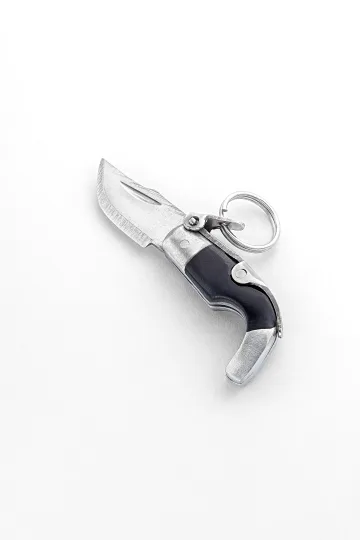
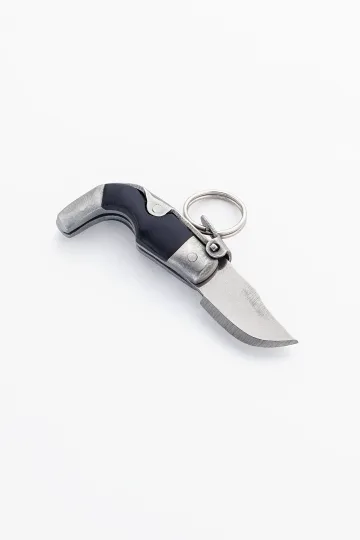
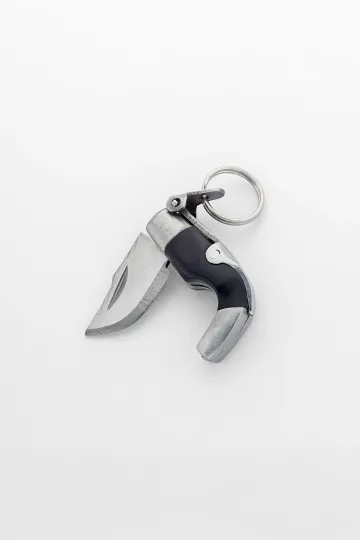
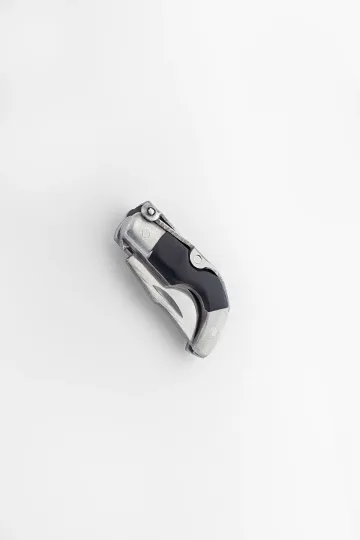
FAQ
Which cut looks larger at the same carat weight? The emerald cut. Its elongated shape distributes mass across a wider area on the finger, creating the impression of a bigger stone. A 1.00 ct emerald cut measures roughly 7.0 x 5.0 mm, while a 1.00 ct princess cut sits at about 5.5 x 5.5 mm.
Which cut sparkles more? The princess cut wins this one decisively. Its brilliant-style faceting produces maximum dispersion and scintillation. Where the emerald cut offers broad, slow flashes of light, the princess cut delivers a constant shower of rainbow reflections with every movement of the hand.
Which cut hides inclusions better? The princess cut, by a wide margin. The complex facet pattern breaks light into so many tiny reflections that most inclusions simply disappear. The emerald cut's large, open facets act like windows, making even minor inclusions visible to the naked eye.
Which cut is more resistant to damage? The emerald cut. Its cropped corners make it far less vulnerable to chipping than the sharp points of the princess cut. If you lead an active lifestyle, the emerald cut is the safer choice. Princess cut rings benefit from protective settings like V-prongs or bezels at the corners.
Is the princess cut a timeless shape or a passing trend? The emerald cut has over 500 years of history behind it. The princess cut is younger (under 50 years old) but has already established itself as a modern classic. Both shapes are geometric, and geometry in jewellery is timeless by definition.
Can you combine princess cut and emerald cut in a single ring? Absolutely. It is actually a current trend in bespoke jewellery. A central emerald cut flanked by two princess cut side stones (or the reverse) creates a striking contrast between two different light rhythms. The key rule is that the side stones must match the centre stone in colour and clarity grades.
How does hand size affect carat choice? For petite hands with ring sizes around 48 to 50 mm, stones of 0.75 to 1.00 ct already make a strong impression. Larger hands (ring size 57 mm and above) generally need at least 1.00 ct for visible impact. Shape matters too: the elongated emerald cut looks particularly elegant on slender fingers.
How often should you clean a princess cut or emerald cut ring? The emerald cut loses its visual sparkle faster because its broad facets show dirt and oils more readily. The princess cut maintains the impression of brilliance a bit longer, even with light soiling. Both benefit from a gentle clean every two to three weeks using warm water and mild soap.
Conclusion
In the end, choosing between the fiery energy of a princess cut and the mirror-like depth of an emerald cut diamond is a decision of the heart. Both shapes represent the pinnacle of the cutter's art, capable of transforming a piece of carbon into a permanent heirloom. Your ring will not simply be a piece of jewellery. It will be a precious witness to the moment that defined your story, carrying its magic and its light into future generations.
There is no "right" cut. There is only the cut that is right for you. Take the knowledge from this guide, try both options in person, and let the stone choose you.
Five Rules Worth Remembering
If you take only five things from this entire guide, let them be these:
Rule 1: Cut quality matters most. The quality of the cut determines a diamond's beauty more than carat weight, colour, and clarity combined. Never compromise on cut.
Rule 2: Princess cut forgives. This shape masks inclusions and body colour. Use this to optimize your budget.
Rule 3: Emerald cut reveals. This shape shows everything. Invest in clarity and colour, even if it means stepping down in carat weight.
Rule 4: Try them in person. No photo, no video can replicate the real experience of a stone on your hand in your lighting.
Rule 5: Trust yourself. Technical specs, trends, and expert advice are tools, not verdicts. The ring that makes your heart beat faster is the right ring. Full stop.
Your perfect diamond is already out there. All you have to do is find it.
Send a friend a discount code, they save on their first order.
Three Real-World Scenarios
To make abstract recommendations tangible, here are three concrete buying scenarios.
Scenario 1: The First Engagement Ring
Situation: A young couple, moderate budget, style leans modern and urban.
Princess Cut Path: A stone of 1.00 to 1.20 ct, colour H, clarity SI1, set with V-prongs on an 18K white gold band, comfort fit profile, 2.0 mm width. Bright, modern, noticeable. The budget allows a respectable size, and princess cut hides SI1 inclusions beautifully.
Emerald Cut Path: A stone of 0.90 to 1.10 ct, colour F, clarity VS2, four prongs on a 950 platinum band, comfort fit profile, 2.0 mm width. Sophisticated, understated. The stone is slightly smaller, but the clarity and colour are excellent, which is essential for emerald cut.
Key Difference: The princess cut buyer maximizes visual impact. The emerald cut buyer maximizes visual purity. Both achieve something memorable within the same budget.
Scenario 2: The Anniversary Upgrade
Situation: A couple celebrating their 10th anniversary. The modest first ring has served well, but now they want something significant.
Princess Cut Path: A stone of 1.80 to 2.20 ct, colour G, clarity VS2, set in a halo with micropave on an 18K rose gold band. The kind of ring that speaks for itself.
Emerald Cut Path: A stone of 2.00 to 2.50 ct, colour E, clarity VVS2, three-stone design with trapezoid side stones in platinum. Hollywood classicism meets timeless elegance.
Key Difference: The princess cut upgrade goes for maximum drama. The emerald cut upgrade goes for quiet authority. Both are unmistakable statements of commitment renewed.
Scenario 3: The Connoisseur's Men's Ring
Situation: A man in his 40s, refined taste, active lifestyle, works with his hands.
Best Path: An emerald cut 1.50 ct, colour G, clarity VS1, flush-set into a wide (6 mm) platinum band with satin finish. The stone sits level with the surface: nothing protrudes, nothing snags, nothing scratches. Interior engraved with coordinates. The kind of restrained beauty that only connoisseurs notice and appreciate.
Geometric Cuts in Cultural Context
Choosing a diamond shape does not happen in a vacuum. It connects to broader cultural currents that shape how we perceive beauty, status, and personal expression.
Art Deco and the Return of Geometry
The 1920s gave the jewellery world an arsenal of geometric forms. The influence of Cubism, Constructivism, Egyptian and Aztec motifs created an aesthetic where straight lines and clean angles became synonymous with elegance. Emerald cut became the definitive stone of this era: its step facets echoed the stepped facades of Art Deco architecture.
Today's revival of this aesthetic is not mere nostalgia. It is a reaction to a decade of boho excess and maximalist decoration. Buyers in the 2020s are returning to structure and order, to the idea that beauty lies in proportion rather than embellishment.
Minimalism and the New Functionalism
Running parallel to the Art Deco renaissance is a jewellery minimalism inspired by Scandinavian design, Japanese "wabi-sabi" aesthetics, and the "less is more" philosophy. A princess cut in a clean solitaire setting (a pure square on a thin metal hoop) has become the icon of this approach.
Minimalism in jewellery design is not "simplicity from scarcity." It is a deliberate rejection of the superfluous, designed to let the stone speak for itself. And in that context, cut quality becomes absolutely critical: with no halo, no pave, and no side stones, the centre diamond must be impeccable.
The Psychology of Squares and Rectangles
Shapes carry unconscious associations. Shape psychology is a real discipline, and its findings apply directly to jewellery design.
Square (princess cut): stability, reliability, equality of sides, balance, order, confidence. The square is a "grounded" figure; it stands firmly on its base. Psychologically, it associates with pragmatism and decisiveness.
Rectangle (emerald cut): elegance, movement, direction, perspective, depth. The rectangle has an axis; it "leads" the eye. Psychologically, it associates with sophistication and aspiration.
This is not mysticism. These are basic principles of visual perception. Awareness of these associations helps explain why one stone "feels right" while another does not.
Cuts and Architectural Parallels
| Architectural Style | Related Cut | Visual Connection |
|---|---|---|
| Art Deco (Chrysler Building) | Emerald Cut | Step facets echo stepped facades |
| Bauhaus (Mies van der Rohe) | Princess Cut | Pure square, "less is more" |
| Deconstructivism (Zaha Hadid) | Princess in asymmetric setting | Disrupted expectations of form |
| Japanese Minimalism (Tadao Ando) | Emerald Cut in bezel | Clean lines, light, concrete |
| Scandinavian Modern | Princess Cut solitaire | Functional simplicity |
| Gothic (Notre-Dame) | Emerald Cut three-stone | Verticality, depth, stained glass |
Alternative Gemstones in Princess and Emerald Shapes
Princess and emerald are not cuts exclusive to diamonds. Other gemstones in these shapes can be compelling alternatives or complements.
Moissanite. A lab-created stone with a refractive index even higher than diamond. In princess cut, moissanite literally blazes: rainbow flashes are visible from a metre away. In emerald cut, it displays beautiful broad flashes, though an experienced eye can distinguish it from diamond by its characteristic double refraction.
Sapphire. White sapphire in princess cut is a budget alternative to diamond, though sparkle is significantly weaker. Coloured sapphires (blue, pink, yellow) in emerald cut are absolutely stunning: the step facets reveal colour saturation, creating a "stained glass" effect.
Emerald (the gemstone). The irony: the emerald cut was designed specifically for natural emeralds. If you are drawn to this shape, consider a ring with an actual emerald for historical authenticity.
Aquamarine. Blue beryl (emerald's cousin) is magnificent in emerald cut: clear, transparent blue framed by step facets. A more accessible alternative for those who value form and colour.
| Stone | In Princess Cut | In Emerald Cut | Price Range (vs Diamond) |
|---|---|---|---|
| Diamond | Maximum brilliance | Mirror depth | 100% |
| Moissanite | Fiery (brighter than diamond) | Beautiful but "different" | 5 to 10% |
| White Sapphire | Modest sparkle | Underwhelming | 1 to 3% |
| Coloured Sapphire | Vivid colour plus sparkle | Deep colour plus elegance | 10 to 50% |
| Emerald (stone) | Unusual but possible | The original pairing | 20 to 80% |
| Aquamarine | Delicate, light | Crystal clarity | 3 to 10% |
Wear the symbol, don't just read about it. These are in stock:
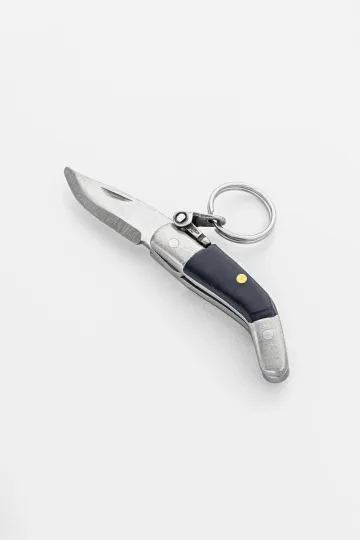
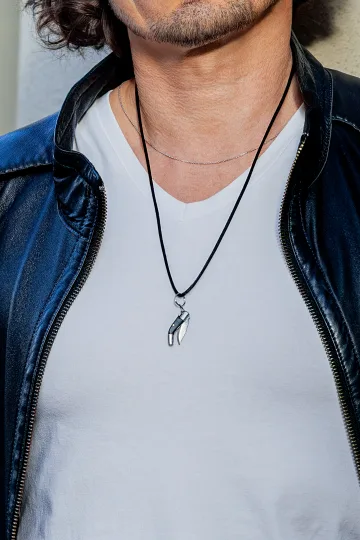
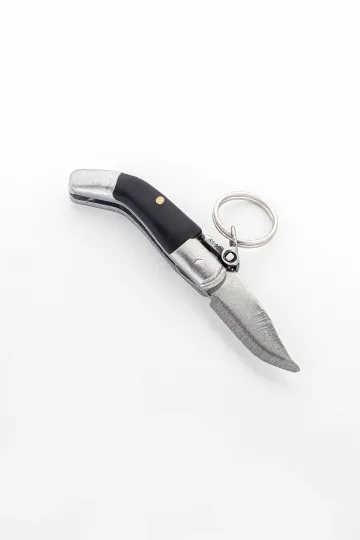
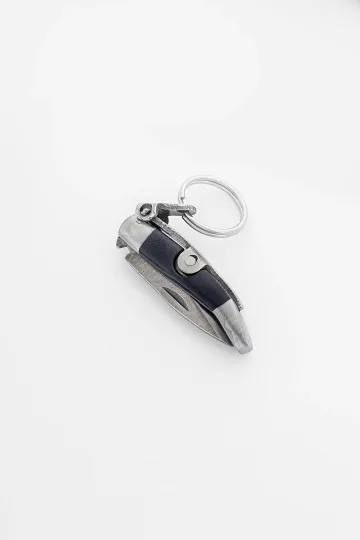
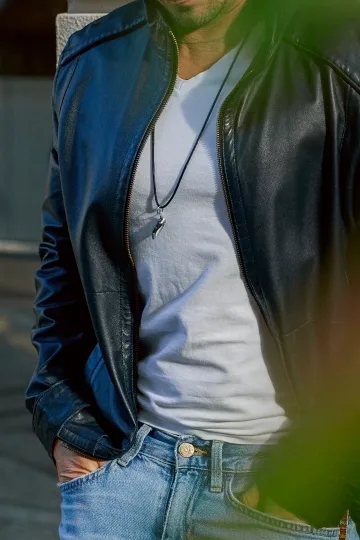

How to Photograph Your Diamond Ring
In the age of social media, photographing the ring is almost as important as choosing it. Here are professional tips for both cuts.
General Principles
Diamonds photograph best in diffused daylight. Direct sun creates harsh flares, and artificial light (especially LED) can introduce unwanted colour casts.
Ideal conditions: overcast day, window light, a white or light grey surface for bounce.
Photographing Princess Cut
Princess cut is inherently photogenic. The many small facets create a scatter of reflections that reads well even on a smartphone screen. For maximum effect, rotate the ring slightly during shooting: each new angle produces a new flash pattern. Video conveys the beauty of princess cut better than any single photo can.
Best angles: top-down (shows the square table), 45 degrees (shows fire and depth), and side profile (reveals hidden halo if present).
Photographing Emerald Cut
Emerald cut is more challenging to photograph. The broad facets create large reflections that can overwhelm the camera sensor. Instead of a scatter of small sparkles, you get one or two bright bands and darker zones. This is normal: that is how step faceting works.
The secret to great emerald cut photos: soft, diffused light from multiple directions. Avoid point sources. Use a white sheet of paper as a reflector below the ring to illuminate the "hall of mirrors" from underneath.
Best angles: top-down (shows the corridor of reflections), 30 degrees (reveals the depth of the steps), and on-hand with a natural gesture (shows scale).
Photography Quick Reference
| Parameter | Princess Cut | Emerald Cut |
|---|---|---|
| Lighting | Bright diffused | Soft diffused |
| Background | Any (stone "punches through") | Neutral (white, grey) |
| Format | Video beats photo | Photo can beat video |
| Angle | 45 degrees for max fire | Top-down for max depth |
| Focus | Auto works well | Manual (on the table facet) |
| Post-processing | Minimal | Boost contrast and sharpness |
Care Myths Debunked
Several persistent misconceptions about diamond care deserve correction.
Myth: "A diamond is forever, so it needs no maintenance." Reality: Diamond is virtually scratch-proof (10 on Mohs scale), but it can fracture along certain cleavage planes under a hard blow. More importantly, oils, lotions, dust, and household chemicals build up a film on the surface that can reduce brilliance by 30 to 40%. An uncleaned diamond after a year looks like a stone worth half its actual value.
Myth: "Toothpaste is great for cleaning diamonds." Reality: Toothpaste contains abrasives safe for tooth enamel but capable of scratching metal settings (especially gold). For the diamond itself, it is harmless but no more effective than soapy water. Keep it simple.
Myth: "Boiling removes all contamination." Reality: Sudden temperature changes can cause thermal shock and damage a stone with internal stresses or large inclusions. Especially risky for fracture-filled diamonds.
Myth: "Emerald cut gets dirty faster than princess cut." Reality: Both stones accumulate grime at the same rate. The difference is that emerald cut shows dirt more obviously because of its large open facets. Princess cut masks contamination with its intense scintillation, creating an illusion of cleanliness. That does not mean princess cut needs less cleaning; it means emerald cut is more honest about showing its current condition.
Wear the symbol, don't just read about it. These are in stock:
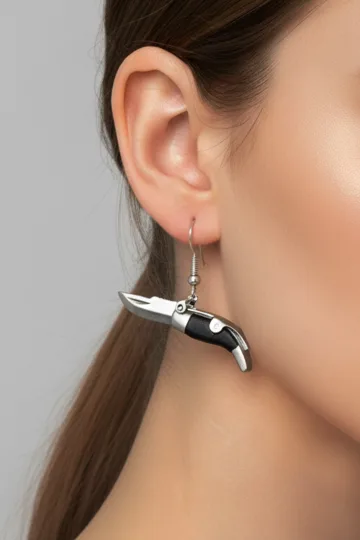
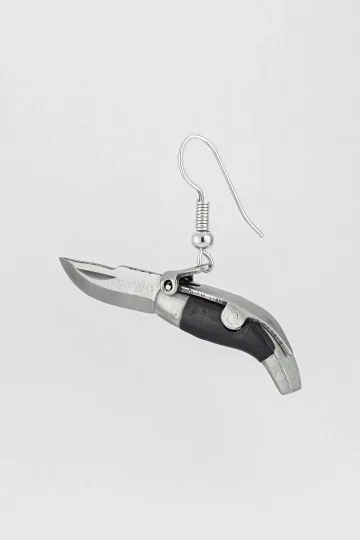


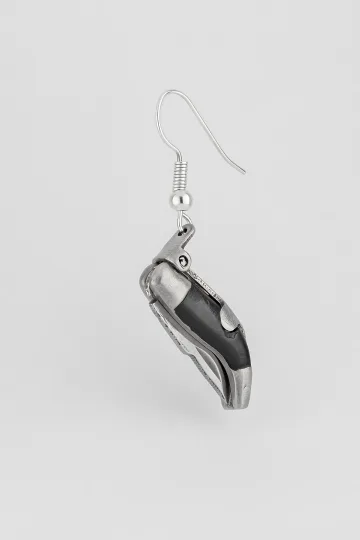

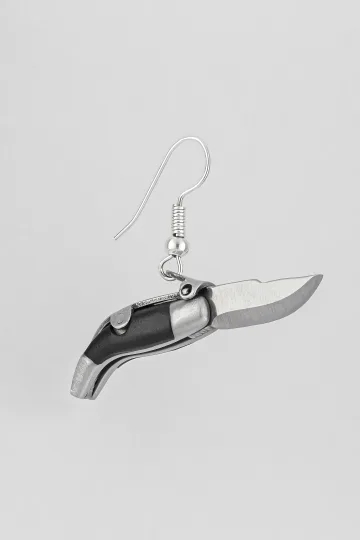


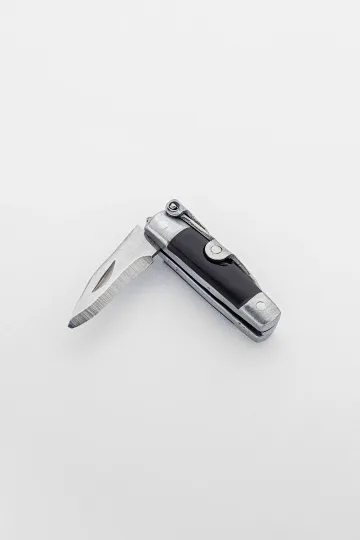
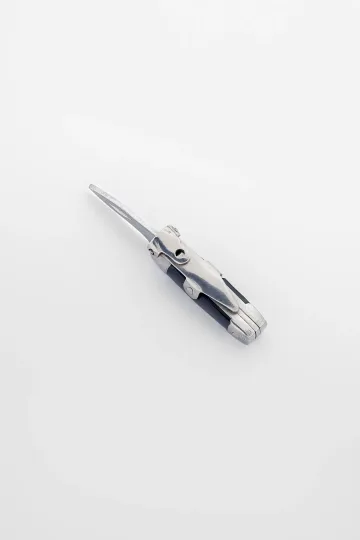
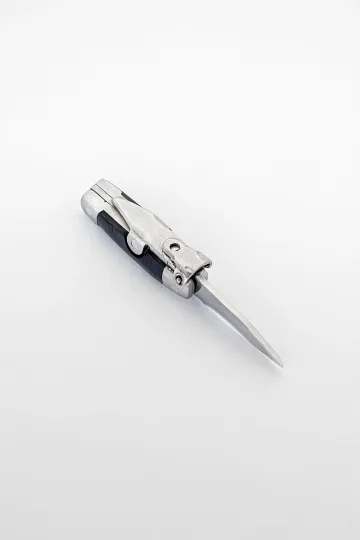
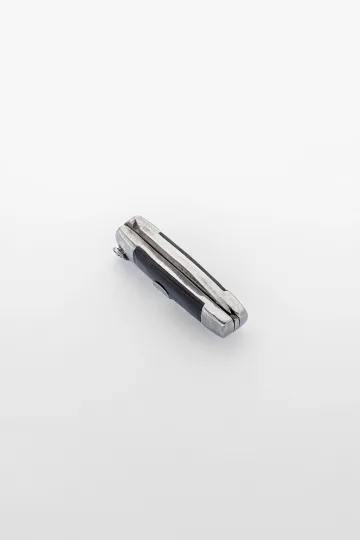
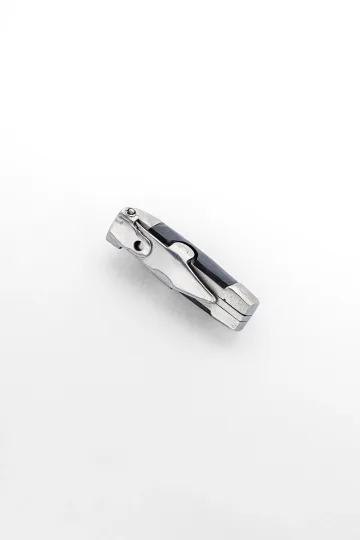
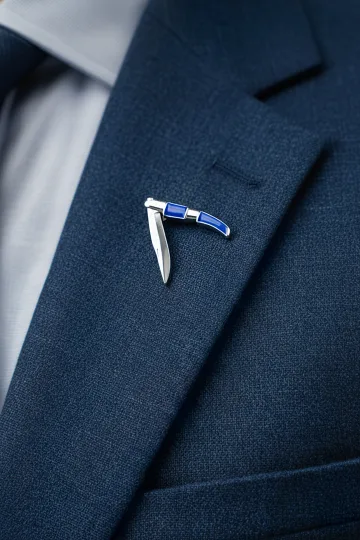



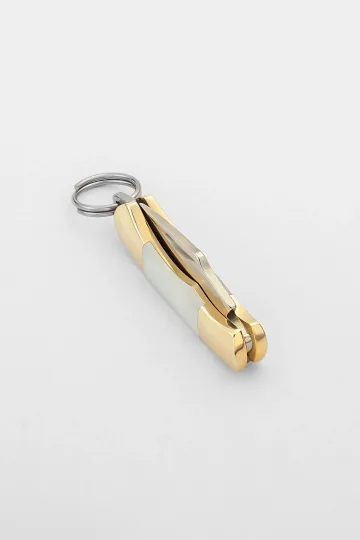
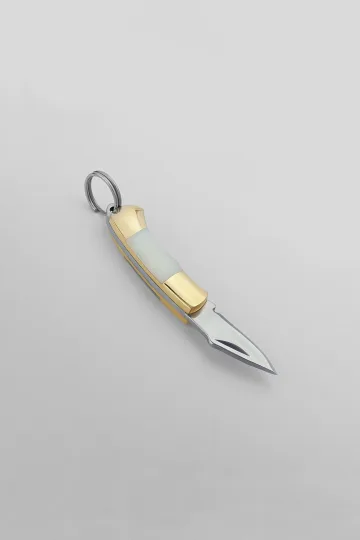
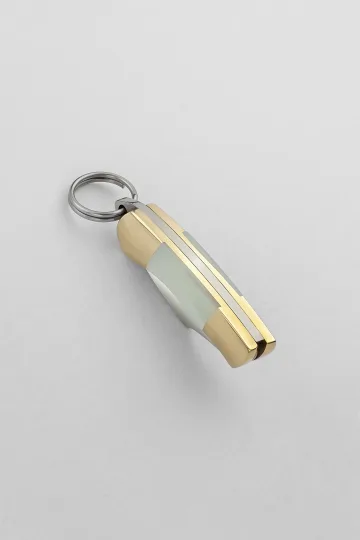

Ring Sizing Guide
Before investing in a diamond ring, make sure you know the exact finger size. This is especially critical for eternity rings, which cannot be resized.
Measurement Methods
Method 1: Ring sizer (most accurate). A set of plastic or metal sample rings that slide onto the finger. Available at any jeweller, often free of charge.
Method 2: String or paper strip. Wrap around the finger at the base, mark where it meets, and measure the circumference with a ruler. Cross-reference with the table below. Less accurate than a ring sizer.
Method 3: Measure an existing ring. If you (or the recipient) have a well-fitting ring for the correct finger, measure its internal diameter with calipers.
Size Conversion Table
| US Size | Internal Diameter (mm) | Circumference (mm) | UK Size | EU Size |
|---|---|---|---|---|
| 4 | 14.9 | 46.8 | H | 46 |
| 5 | 15.7 | 49.3 | J 1/2 | 49 |
| 5.5 | 16.1 | 50.6 | K 1/2 | 50.5 |
| 6 | 16.5 | 51.8 | L 1/2 | 52 |
| 7 | 17.3 | 54.4 | N 1/2 | 54 |
| 7.5 | 17.7 | 55.7 | O 1/2 | 55.5 |
| 8 | 18.1 | 57.0 | P 1/2 | 57 |
| 8.5 | 18.5 | 58.3 | Q 1/2 | 58 |
| 9 | 18.9 | 59.5 | R 1/2 | 59.5 |
| 9.5 | 19.4 | 60.8 | S 1/2 | 61 |
| 10 | 19.8 | 62.1 | T 1/2 | 62 |
| 10.5 | 20.2 | 63.4 | U 1/2 | 63 |
| 11 | 20.6 | 64.6 | V 1/2 | 64.5 |
Tips for Accurate Measurement
Measure in the evening: fingers swell slightly by end of day. Avoid measuring right after exercise, a shower, or in cold weather. Right and left hands may differ in size: measure the specific hand. When in doubt between two sizes, choose the larger. For wide bands (4+ mm), go up half a size from your usual.
Secret Sizing for a Surprise Proposal
If you are planning a surprise, covertly determining your partner's ring size is an art in itself.
The Sleeping Ring Method. If your partner wears a ring on the target finger (or a neighbouring one), "borrow" it for an hour and take it to a jeweller for measurement. Or trace the inner edge on paper. Or press it into a bar of soap.
The Accomplice Method. Recruit a close friend or family member. They can find a plausible excuse (trying on costume jewellery, shopping together) to determine the size.
The Statistical Method. If all else fails, the most common women's ring size in the US is 6 to 6.5; in the UK, L to M. The most common men's size in the US is 9 to 10. This is a gamble, but most rings (except full eternity) can be resized within 1 to 2 sizes after the proposal.
Buyer's Checklist: Everything in One Place
Before making the final purchase, run through this checklist. Each item is a question that should have a clear answer.
Stone Selection
| Item | Your Answer | Done |
|---|---|---|
| Shape: Princess or Emerald? | __________ | [ ] |
| Target carat weight | __________ ct | [ ] |
| Minimum colour grade | __________ | [ ] |
| Minimum clarity grade | __________ | [ ] |
| Natural or lab-grown? | __________ | [ ] |
| Fluorescence preference | __________ | [ ] |
| Certificate (GIA/AGS/IGI) | __________ | [ ] |
| Visual inspection completed? | __________ | [ ] |
Setting Selection
| Item | Your Answer | Done |
|---|---|---|
| Metal (platinum/gold/karat) | __________ | [ ] |
| Setting type | __________ | [ ] |
| Band width | __________ mm | [ ] |
| Band profile | __________ | [ ] |
| Side stones (yes/no/which) | __________ | [ ] |
| Engraving text | __________ | [ ] |
Practical Details
| Item | Your Answer | Done |
|---|---|---|
| Exact finger size | __________ | [ ] |
| Total budget | __________ | [ ] |
| Insurance arranged? | __________ | [ ] |
| Appraisal obtained? | __________ | [ ] |
| Deadline for the ring | __________ | [ ] |
| Maintenance plan (jeweller) | __________ | [ ] |
Print this checklist and fill it in as you make decisions. It will help structure the process and catch important details before they become expensive oversights.
Band Profile Guide
The cross-section shape of your band is a detail many people overlook, but it is critical for all-day comfort.
| Profile | Description | Comfort | Visual Effect | Best For |
|---|---|---|---|---|
| Flat | Flat exterior and interior | 3/5 | Modern, minimalist | Fans of clean geometry |
| Comfort Fit | Flat outside, rounded inside | 5/5 | Classic | Everyone, especially first-time wearers |
| D-shaped | Slightly domed outside, flat inside | 4/5 | Traditional | Classic taste |
| Knife Edge | Pointed ridge along centre | 3/5 | Elegant, slimming | Women's solitaire rings |
| Euro Shank | Square cross-section, prevents rotation | 4/5 | Geometric | Rings with large top-heavy stones |
| Half-Round | Semicircular inside and out | 4/5 | Soft, streamlined | Everyday wear |
For both princess cut and emerald cut, comfort fit is the most versatile choice: easy on and off, no irritation even during extended wear.
Silver and gold jewellery, wedding bands, symbolic pendants, paired sets.
Wear the symbol, don't just read about it. These are in stock:
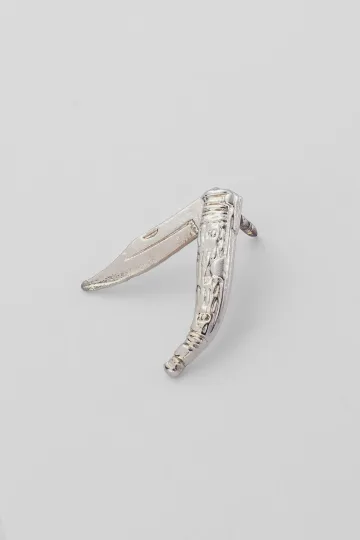


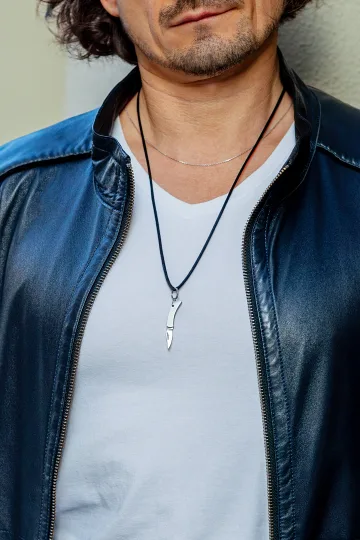
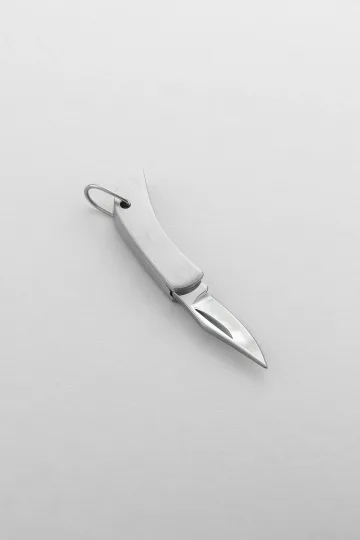
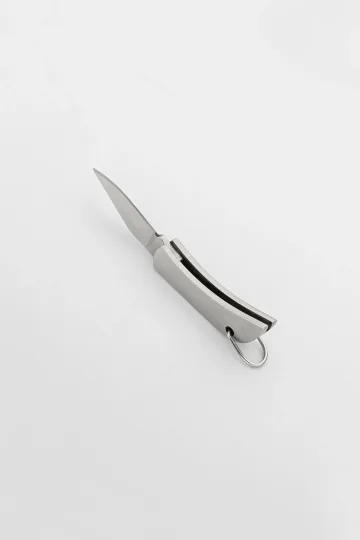

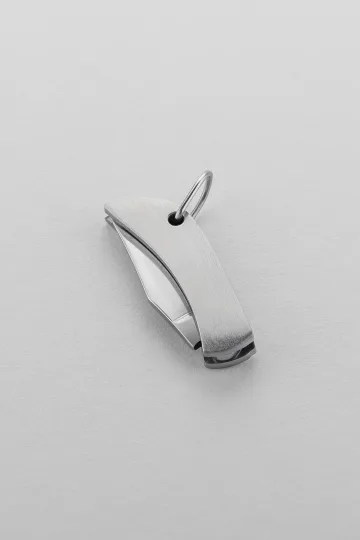


Units of Measurement in the Jewellery World
The jewellery industry uses its own measurement system, which can be confusing. Here is a quick reference.
| Unit | What It Measures | Equivalent | Where You See It |
|---|---|---|---|
| Carat (ct) | Stone weight | 1 ct = 200 mg = 0.2 g | Certificate, stone description |
| Point (pt) | Weight of small stones | 100 pt = 1 ct | Side stones, pave |
| Karat (K) | Gold purity | 24K = 100%, 18K = 75% | Hallmark on ring |
| Pennyweight (DWT) | Metal weight | 1 DWT = 1.555 g | Appraisals |
| Millimeter (mm) | Stone/ring dimensions | Standard metric | Certificate, sizing |
| Grain | Pearl weight | 4 grains = 1 ct | Pearl jewellery |
Important: do not confuse "carat" (stone weight, abbreviated ct) with "karat" (gold purity, abbreviated K). They are two entirely different concepts that share a similar name. In professional contexts, weight uses "ct" and gold purity uses "K" or "Kt."
The Mohs Hardness Scale: Where Your Stone Sits
| Hardness | Reference Mineral | Jewellery Stones at This Level | Scratch Resistance |
|---|---|---|---|
| 10 | Diamond | Diamond | Absolute |
| 9 | Corundum | Sapphire, Ruby | Very High |
| 8 | Topaz | Topaz, Spinel | High |
| 7.5 | (none) | Aquamarine, Emerald | Good |
| 7 | Quartz | Amethyst, Citrine | Moderate |
Diamond (10) scratches everything but cannot be scratched by anything. This is exactly why diamond rings must be stored separately from other jewellery: your diamond will scratch sapphires, gold, and everything else in the box.
Shape Terminology Quick Reference
Confused by shape names that sound similar? Here is a disambiguation guide.
| Name | What It Actually Is | Key Feature | Relation to Princess/Emerald |
|---|---|---|---|
| Princess Cut | Square brilliant cut | Sharp corners, 57 to 76 facets | This article's protagonist |
| Emerald Cut | Rectangular step cut | Cropped corners, parallel facets | This article's protagonist |
| Asscher Cut | Square step cut | Like emerald cut but square (ratio 1.00 to 1.05) | Emerald cut's square sibling |
| Radiant Cut | Rectangular brilliant cut | Like princess but rectangular, cropped corners | Princess cut's rectangular cousin |
| Cushion Cut | Square/rectangular modified brilliant | Rounded corners, "pillow" shape | Softer alternative to princess |
| Baguette | Small rectangular step cut | Used as side stones | Miniature emerald cut |
| Trapezoid | Tapered rectangular step cut | Used as side stones | Emerald cut's sidekick |
Acronyms You Will Encounter
| Acronym | Stands For | Context |
|---|---|---|
| GIA | Gemological Institute of America | Diamond certification |
| AGS | American Gem Society | Diamond certification |
| IGI | International Gemological Institute | Lab-grown certification |
| HRD | Hoge Raad voor Diamant | European certification |
| 4Cs | Carat, Colour, Clarity, Cut | Grading framework |
| LGD | Lab-Grown Diamond | Diamond origin |
| HPHT | High Pressure, High Temperature | Lab diamond production method |
| CVD | Chemical Vapor Deposition | Lab diamond production method |
| EGL | European Gemological Laboratory | Certification (less strict) |
| RBC | Round Brilliant Cut | Shape reference |
About Zevira
Zevira makes jewellery in the artisan tradition of Albacete, Spain. The geometric cuts this guide covers are not abstract theory to us. We build rings around square and rectangular stones, choose the setting to match the shape and the metal to flatter the stone's colour, so the line of the hand and the character of the wearer come through at a glance.
What you will find with us on the subject of cuts:
- Solitaire rings with a square-geometry stone in a protective setting built around the corners.
- Rings with a rectangular step cut in a bezel that brings out the hall-of-mirrors effect.
- Wedding bands and eternity rings with calibrated stones for a seamless line of sparkle.
- Matching "one language, two accents" sets for his and her hands, sharing the same metal and finish.
- Side stones and three-stone compositions with trapezoid and baguette accents.
- Inside-band engraving: a date, coordinates, initials, or a symbol.
Every piece can be personalised with engraving, with the option of personal engraving. Sterling silver 925 and 14 to 18K gold.