Bangle Bracelet: Closed Bangle That Slides Over the Hand
Bangle and cuff are two different philosophies. A bangle is always closed, slides over the hand, and is worn stacked 5-15 pieces. A cuff is open, compresses on the wrist, and is worn alone. An Indian bride wears 21 bangles. A European lady wears one. Let's break down how the same form, viewed from a thousand-year perspective, transformed into jewellery for weddings, heirlooms, status, rebellion, routine, and again weddings.
A bangle is not the simple object it appears to be on a store shelf. At the level of form, it's a closed circle of metal, glass, or stone. At the level of culture, it's a knot where Indian wedding numerology, the Chinese inheritance system through female lines, African tribal hierarchy, and European Art Deco of the 1920s converge. Each tradition left its own vocabulary: choodi, kangan, jade-bangle, dabazh, riviera. And each solves the wrist problem in its own way.
This guide covers the full mechanics of the bangle: how it fundamentally differs from a cuff and from an ordinary clasp bracelet, how it evolved in India, China, Africa, and Europe, how to select diameter and thickness, which materials are traditional and why, how to assemble a stack following the odd-number rule, what never to do, how to care for it, and why a closed hoop can't be resized even if a jeweller promises to try.
What is a Bangle and How It Differs from Cuff and Regular Bracelet
First, about the precise name. In English, bangle. In French and Italian, bracelet rigide. In German, Reif. In jewellery terminology dictionaries, the bangle is singled out as a separate category, and this category is organised differently from all other bracelets.
It's a completely closed rigid hoop made of metal, stone, or other hard material. It has no clasp, no links, no hinge, no adjustment. It either slides over the hand or it doesn't, there's no middle ground. The inner diameter is fixed once and for all.
This gives three critical properties. First: size is critical at the point of purchase. Miscalculate by 3 millimetres too small, and the hoop simply won't pass over the knuckle of your thumb. Second: the bracelet won't sit snug against your wrist like a watch. It's always slightly wider than your wrist circumference because it needs to pass through your hand, which is wider than your wrist. Third: a rigid hoop moves freely on the hand, slides along the forearm with movement, rolls toward the hand when the arm is down, and moves up toward the elbow when the arm is raised.
Wear the symbol, don't just read about it. These are in stock:




Bangle and Cuff: The Same Thing or Different Objects
A cuff is an open hoop with a gap. The opening is usually on the inside of the wrist where it's less visible. A cuff is compressed by hand onto your wrist circumference and is held tight by the springiness of the metal.
Visually, both look similar: a circle, metal, no links. The difference comes down to three things.
The first difference is fit. A rigid hoop is always slightly loose, moves around. A cuff sits tight, like a watch without a band. If a cuff rotates on your hand, you gently bend it with two hands until it sits right. A closed hoop can't be bent, it can only be put on.
The second difference is sizing. A bangle is selected by hand diameter. A cuff is selected by wrist circumference. These are different measurements, and one doesn't convert to the other.
The third difference is how it's worn. Rigid hoops are stacked because a single thin bracelet of this type looks unfinished on the hand. A stack of 5-15 pieces is the norm for Indian choodi and modern boho. A cuff alone on the hand is an independent piece, like a watch or a wide ring. Stacking cuffs is theoretically possible but impractical: each is compressed to the wrist, they don't fit tightly, they slide around, and they creak against each other. The idea of a cuff is solitude; the idea of a closed hoop is multitude.
Read more about cuff principles in the dedicated guide on types of bracelets.
Bangle and Clasp Bracelet: Difference in the Logic of Jewellery
Chain bracelets, charm bracelets, tennis bracelets, leather, woven, these are all constructions with a clasp on the wrist. They share one thing: you put them on and take them off by undoing the clasp; nothing needs to be pushed through the hand.
This creates completely opposite logic. A clasp bracelet sits snugly on your wrist circumference and shouldn't slip below the bone. Adjusting the length with links or rings allows you to fit it precisely. Modern fashion demands that a chain bracelet lies on the wrist like a watch, it doesn't fall onto the palm and doesn't slide toward the elbow.
A closed hoop operates on the opposite principle. It should move. Free movement along the forearm is not a bug, it's a feature. When you write at a desk with your hand, the hoop rolls toward your hand and lands on the table with a soft tap. When you raise your hand to fix your hair, it slides toward the elbow and clinks against its neighbours in the stack. This is part of the jewellery.
So it's wrong to expect from this form the same service as from a clasp bracelet. A rigid hoop doesn't know how to stay in one place. If you want a bracelet that doesn't move, you need to look toward a cuff or a chain.
Brief Definition for Catalogue
Summary: a closed rigid hoop without a clasp, worn by sliding over the hand, usually stacked or as an independent heirloom from dense material like jade. The main ancestors in tradition are Indian choodi and Chinese jade-bangle. The main European heirs are Victorian engraved bangle, Edwardian stack, and Art Deco with enamel.
History: From Indian Choodi to European 20th Century
The history of this form naturally divides into five chapters: the Indian choodi tradition, the Chinese jade hoop tradition, African tribal forms, 19th-century Europe, Art Deco, and the modern era of the 20th-21st centuries. In each chapter, the closed circle solves its own task.
Indian Choodi: The Married Woman's Adornment
The Indian tradition of stacked bangles is the deepest and most living preserved practice. The word choodi (sometimes churi) means precisely the rigid wrist hoop, usually made of glass or metal. In Sanskrit, there are separate words for gold hoops (kangan), silver (kada), glass (chudi), and each carries its ritual weight.
The most famous rule of Indian wedding ritual: the bride wears 21 bangles on each hand made of gold, glass, and red lacquer. The number 21 relates to Hindu numerology: it's a symbol of cycle completion, three times seven. In Punjab and Rajasthan, 21 is the standard. In Bengal, seven is enough. In southern states, often just two white shell bangles, symbolising the purity of seawater.
The bride wears the full stack for the first 40 days of marriage without removing it. This is a visible sign of her new married status to everyone she meets. After 40 days, some bangles are removed, leaving an everyday set of 7-9 pieces worn constantly into old age. If a woman becomes widowed, strict tradition dictates she breaks all her bangles and wears them no more. In modern India, this strict custom is observed less often, but it still lives in rural regions.
The choodi stack is no random collection. Colours have meaning. Red is love and fertility, green is prosperity and luck, gold is wealth, white is purity, black is protection from the evil eye. At an Indian wedding, the colour choice is discussed with the bride's mother and aunts, and the combination is read by guests.
Technically, an Indian wedding bangle is 22-karat gold. The high karat gives a characteristic red-golden tone valued in South Asia more than European 18-karat gold with its cool yellowish tint. Additionally, bangles are made from copper (kada), worn by men and women as part of Ayurvedic tradition.
Pakistani Kangan: A Shared Root System
The Pakistani kangan tradition overlaps almost completely with the Indian choodi. The same word, kangan, in Hindi and in Urdu alike, means the bride's wedding bangle. The same counts of seven, eleven, or twenty-one hoops in a stack. The same high gold standard, because in both cultures the metal is savings as much as ornament. The differences sit in the ornament: the Pakistani school leans towards vegetal motifs and calligraphic bands, while the Indian workshops favour geometric repeats and granulation.
In both traditions a bangle is not an individual purchase but part of a family system. At a wedding, some of the hoops come from the bride's family and some from the groom's. They are mixed on the same wrist, and the mixture is the point: two lineages joined in one stack. Afterwards, a bangle engraved with a name or a date is kept as a relic and handed down. British families with roots in Punjab, Sindh, and Gujarat keep exactly this practice going in Southall, Leicester, and Bradford, and the jewellers on those high streets stock 22-carat hoops precisely because the demand never went away.
Thai and South-East Asian Traditions
In Thailand, Cambodia, Laos, and Myanmar the bangle is just as deeply rooted, but it plays a different part. Here it is everyday jewellery rather than wedding jewellery. A Thai woman may wear a pair of thin silver hoops from childhood as a protective amulet against spirits, and nobody reads them as a marital sign. Buddhist monasteries occasionally bless a bangle, and a blessed hoop becomes a talisman kept for life.
Thai silver bangles often carry elephants, lotus flowers, or interlocking spiral ornament. The Burmese tradition prefers wider, flatter hoops in chased silver, sometimes with a repoussé band running the full circumference. Cambodian work is known for gold hoops in filigree, where the openwork does the decorating and the metal stays light. For a British buyer this matters practically: South-East Asian silver is usually a higher fineness than sterling, which makes it softer, warmer in colour, and easier to dent, so a hoop bought on holiday wants gentler handling than a Birmingham-assayed sterling one.
Chinese Jade Bangle: Heirloom Jewellery
The Chinese jade bangle tradition differs fundamentally from the Indian one. Here it's not a stack but a single piece. One dense hoop of green jadeite or jade on one hand, usually the left. This is heirloom jewellery, not wedding jewellery.
Jade is the stone of perfection for Chinese people. Green symbolises life, health, immortality. In Chinese philosophy, there are five virtues of jade: compassion, righteousness, wisdom, courage, purity. Wearing jade means wearing these qualities.
A jade bangle is made from a solid piece of stone. The inner circumference is machined over many hours. If there's a crack or flaw in the material, the stone shatters during processing and the work is lost. This explains why a pure, solid jade bangle is expensive: both the material and the quantity of rejected blanks.
The most important part of Chinese tradition is the transmission. A bangle passes from mother to daughter at certain life stages, most often at marriage or the birth of a first child. After passing through generations, such a bangle is literally woven into the family. It gets a name; it's recognised on the granddaughter's hand by those who remember it on the grandmother's. It's jewellery, it's a family icon.
Chinese jade bangles are worn with care. It's easy to crack if struck on a hard surface. In Chinese beliefs, a cracked bangle is a sign: the stone accepted the blow that would otherwise have hit the wrist or the owner's life. A cracked bangle isn't discarded, it's wrapped in red silk and kept.
African Tribal Tradition: Bronze, Copper, Ivory
In Africa, the bangle is part of many tribal traditions, and each uses its own materials. West African peoples (Fula, Hausa, Dagara) make bangles from bronze and brass. East Africa (Maasai, Samburu) uses copper and brass hoops with coloured beads. Ethiopian tradition includes silver bangles with Christian crosses.
Among several peoples, ivory and horn were used for wide bangles until restrictions on ivory trade at the end of the 20th century. Today, old African bone bangles are found only in museums and private collections.
The bangle in African tradition often carries status. Among the Maasai, the number of copper bangles on a woman's hand reflects her age group and social rank. Among the Fula, the thickness of a brass bangle speaks to family prosperity. This layer of meaning has no European equivalent.
European 19th Century: The Return of the Bangle
In Europe, the bangle existed as a form even in antiquity: Roman gold armillae were worn on the forearm, Celtic torcs were originally neck pieces but smaller versions became bracelets. However, between the fall of Rome and the Enlightenment, the bangle virtually disappeared from use, yielding to brooches, rings, and thin chains.
The return came in the first half of the 19th century with fascination with the East. Indian officers of the British army sent gifts to their wives from the colonies, and in the high houses of London and Paris, the first gold bangles with Eastern engraving appeared. Then fashion took hold: the Victorian lady of Albert's era began wearing a pair of gold bangles with miniature enamel or an engraved date.
The Victorian bangle is 18-karat gold with engraving around the entire circumference. Often, cameos were added, tiny enamel miniatures, medallions with the hair of a deceased relative (there was a separate fashion for mourning jewellery). Engravings carried initials, Latin or French mottos, engagement dates.
The Edwardian era of the late 19th and early 20th century raised the bangle to the status of a required accessory. They wore stacks of 3-5 pieces on one hand, usually with long gloves. Metal colours were mixed: yellow gold, rose gold, white gold with platinum. Here, the European habit of mixing metals in one stack was born.
Art Deco 1920s: Bakelite and Geometry
The twenties transformed the bangle. A new material appeared, bakelite, the first synthetic plastic, invented in 1907. From bakelite, bangles were stamped in saturated colours: black, bright red, ocher, emerald green. They were worn stacked 10-15 pieces on one hand.
Art Deco brought geometry: black enamel on white gold, repeating diamonds and triangles, inlay with onyx, coral, and mother-of-pearl. This was the fashion of 1925 Paris and 1920s New York. The bangle became a statement of modernity: nothing Eastern, nothing Victorian, pure geometry of the machine age.
Brass and chrome also entered the Art Deco era as materials. A brass bangle with black and white enamel was the mass ornament of a Parisian factory worker and New York typist. Bakelite bangles were sold in department stores cheaply and worn in bunches.
1950s: Return to Elegance
After the war, fashion swung back to classic. The bangle became thinner, quieter, more often made of one metal without decoration. The 1950s Paris and Milan style offered a minimalist gold bangle 4-6 mm wide, worn singly or as a pair. This was the jewellery of famous businesswomen of the postwar era: journalists, actresses, diplomats.
In Italy, at this time, the toi et moi tradition arose: a paired bangle given to a couple. One for him, one for her. Often with an engraved date.
Modern Bangle 20th and 21st Centuries
The modern Italian bangle of the mid-20th century from the old Milanese jewellery school is a wide rigid hoop of yellow gold with a textured surface imitating weaving. It became a classic and is still worn. We intentionally don't name designer and brand names because this article is about form, not brands.
The modern bangle lives in several formats simultaneously. The minimal-bangle is a thin smooth hoop of yellow, white, or rose gold 1.5-3 mm wide. Worn singly or stacked 2-3 pieces in mixed metals. This is the most common form for the office and everyday wear.
Stack-bangle in Indian style returns to fashion on a wave of interest in ethnicity. Girls and women outside Indian culture assemble stacks of 5-7 coloured glass or enamel bangles and wear them on weekends or in creative settings. The ethical question of cultural appropriation is debated, but the overall fashion vector permits it: respectful citation without religious context is acceptable.
The riviera-bangle with diamonds (a row of stones around the entire hoop) is a premium category of the last 30 years. It differs from the Victorian tradition by the absence of a central accent: stones run evenly around the hoop, creating a continuous line of light.
Technologically, another format emerged: magnetic bangle from medical steel for those who believe in magnetotherapy. There's no scientific evidence of the effect, but the market steadily exists.
Customer reviews
Zevira is a real jewellery shop. Genuine payments, deliveries and customer thank-yous.
🥰🥰🥰 gracias

Ok, ¡gracias! 🙂

Bangles chime on a bare wrist with the sleeve pushed up. Do not you dare bury them under a shirt cuff, they are not a watch.
How to Wear a Bangle
I have built stacks on dozens of wrists over the years on set. Here is what actually works on the wrist, sorted by occasion.
How many hoops should you wear at once? A single thin hoop on a bare wrist looks orphaned, so I recommend either building a stack of five to seven or taking one dense hoop that holds the arm on its own. An odd number in a stack reads as a finished composition, an even one as an unfinished split. Three, five, seven.
What do you wear it with every day? For everyday I suggest one flat hoop 2 to 4 mm in yellow or white gold. I push the sleeve up or go short-sleeved so the metal shows rather than creasing the fabric. A light top lifts the gold, a dark one turns the hoop into an accent. I send the watch to the other arm so they do not fight for the spot.
Is it right for the office? It is, if you keep it restrained. I recommend one minimal hoop with no jingle, up to four millimetres wide, on the arm with a watch on the opposite wrist. A stack under a strict dress code distracts with movement and sound, so I save it for creative settings and weekends.
How do you build an evening look? For the evening I choose either a riviera with its row of stones for a bare shoulder or a boat neckline, or a heavy cast hoop in yellow gold with a smooth dress in a deep colour: wine, emerald, black. The quieter the fabric, the louder the metal works.
How do you mix metals without overdoing it? I mix on purpose: yellow gold with white, gold with silver is already the norm, but one colour leads and the other supports. In a stack the main metal holds the numbers, the second adds an accent in a five to two ratio. And one rule that never fails: a large hoop on one arm frees the other of a bracelet, let that one carry the watch or stay bare.

Turn on your camera, pick earrings, a pendant or a ring, and see the piece on yourself in real time.
Switch items in one tap.
Everything runs in your browser: no photo or video is ever uploaded.
Anatomy of Bangle: Diameter, Thickness, Weight
A rigid hoop looks simple but is measured by three independent parameters, all important.
Inner Diameter
This is the main measurement. Inner diameter determines whether the bracelet will pass through the hand. Standard sizes in international classification:
- S: inner diameter 58-62 mm. Fits tiny hands, usually European clothing sizes XS-S.
- M: 63-67 mm. The most common size.
- L: 68-72 mm. Large hands, clothing size L and up.
- XL: 73 mm and larger. More common in men's bangles.
In the Indian tradition, the measurement system is different: size is expressed in inches in 1/16-inch increments, from 2-4 (2 and 4/16 inches, about 56 mm) to 2-12 (about 70 mm). Indian brides often know their size from adolescence.
How to measure yourself at home. Make a fist with your thumb pressed to your pinky as if trying to put on a tight glove. With a soft tape, measure the widest part of your hand around the thumb knuckle. Divide the circumference by 3.14 to get the diameter. Add 3-5 mm clearance so the hoop doesn't go on forcefully. This is your inner diameter.
If hand circumference when clenched is 195 mm, the diameter comes out to 62 mm. Add 4 mm clearance and you get 66 mm. This is size M-plus. In a shop, look for a model with inner diameter 66-68 mm.
Common mistake: measuring wrist circumference. The wrist is narrower than the hand, and a bangle sized for the wrist won't pass through the hand.
Thickness and Profile Width
Thickness is the size of the metal cross-section. Thin profile 1-2 mm. Medium 3-5 mm. Thick 6-10 mm. A very wide hoop (15-25 mm wide) is no longer stacked because it takes too much space on the hand.
Width and thickness affect weight. A thin gold bangle, 65 mm diameter with 1.5 mm profile, weighs about 5-7 grams. The same diameter with 5 mm profile weighs 20-25 grams. A wide cast gold hoop can weigh 40-60 grams.
Thin profile suits stacking and everyday wear. A thick hoop is independent jewellery, worn singly. Intermediate thickness of 3-4 mm is versatile: works both in a stack and as a standalone piece.
Cross-Section Shape
This isn't thickness in millimetres but the shape of the profile itself. There are five main types:
- Round. Standard wire cross-section, like a thin gold bangle. Rolls easily, lies tight on skin along one line.
- Half-round. Flat inside, curved outside. More comfortable to wear because the flat part presses to skin and doesn't roll. The most common profile for Indian bangles.
- Rectangular. Flat ribbon profile, like a thin strap. Often found in modern minimal bangles.
- Tubular. Hollow inside, lighter by weight. Thin metal wall, empty inside.
- Twisted. Spiral-twisted profile imitating rope. Decorative, especially in a stack.
The choice of profile affects style. Round and half-round are traditional Indian and Asian school. Flat rectangular are European minimal and Italian modern. Twisted reads as ethnic, boho.
Weight and Wrist Load
The weight of a hoop directly affects comfort. One light bracelet weighing 5-10 grams isn't felt on the hand at all, can be worn all day. One heavy one weighing 30 grams feels like a watch, normal for constant wear. A stack of 7-10 thin hoops totaling 50-80 grams is also comfortable because the weight is distributed.
Problems begin with heavy jewellery in large quantities. A stack of 5-7 thick hoops totaling over 100 grams noticeably loads the hand. By day's end, slight swelling appears, and in rare cases, tingling in the fingers. If work involves long sitting at a computer, such a stack is uncomfortable.
The solution is distribution between hands. Indian tradition is always symmetrical: the same stack on both hands. Modern fashion is more often asymmetrical: a heavy stack on one hand, a watch or single thin bangle on the other. Choose based on the load on the hand you use more.
Materials: 22-Karat Gold, Silver, Copper, Jade, Glass, Bakelite
The material of a closed hoop determines its region of origin, price, durability, and behaviour on skin. Let's review nine main types.
22-Karat Gold
The Asian standard. 22 karats equals 916 fineness, 91.6% pure gold and 8.4% alloy (usually copper and silver). Very high karat gives a characteristic saturated red-golden tone. In India, Pakistan, UAE, Saudi Arabia, Thailand, this is the standard fineness for wedding jewellery.
Pros. Colour is saturated, warm, recognisable. Almost completely hypoallergenic due to low alloy content. Doesn't darken, doesn't patina, stays gold for life. In India, high-karat gold jewellery is traditionally part of the dowry and carries cultural significance within the family.
Cons. Very soft metal. A thin 22-karat gold bangle deforms from an accidental impact. Engraving reads for a long time, but edges can wear. Not suitable for active sports.
18-Karat Gold
European standard. 750 fineness, 75% pure gold. Colour is less saturated than 22-karat, more pallid. The alloy is significantly harder due to higher percentage of ligature.
Pros. Noticeably stronger than 22-karat. Suitable for thin profile without risk of quick deformation. Supports engraving, enamel, stone inlay. Standard material for Victorian, Edwardian, Art Deco, and modern European bangles.
Cons. Price is lower than 22-karat proportionally to gold content. Colour is less vivid: in India, it's considered insufficiently red; in Europe, it's considered ideal.
14-Karat Gold
585 fineness, 58.5% pure gold. American and Northern European standard for everyday jewellery. Colour is even paler than 18-karat, closer to lemon yellow.
Pros. High durability. Affordable price. Wear is barely visible. Good for an everyday bangle worn constantly.
Cons. In some people, it causes allergic reaction due to high ligature content (often nickel in cheap alloys). Modern makers often use nickel-free ligatures.
925 Silver
Standard jewelry silver 92.5%, the rest usually copper. Common material for everyday bangles in Europe, Latin America, and CIS countries.
Pros. Cool white shine. Hypoallergenic for most. Price an order of magnitude below gold analogs. Supports engraving, chasing, enamel, bluing. Universally stylistic: suits both minimal looks and ethnicity.
Cons. Darkens from contact with skin and air. A silver bangle needs polishing every six months to a year. Softer than gold, bends under pressure.
Copper
Folk and Ayurvedic material. Pure copper has a red-pink tone that darkens over time to brown with green patina. In Indian and Thai tradition, a copper bangle is worn as everyday, separate from wedding gold.
Pros. Very affordable. Unique colour that darkens and patinas individually on each hand. In Indian Ayurveda, considered beneficial for joints and circulation (though there's no clinical evidence). Light.
Cons. Stains skin green (normal, washes off). Darkens quickly. Not suitable if you perspire a lot because it patinas unevenly and leaves marks on clothes.
Jade and Jadeite
Stone material of Chinese tradition. Jadeite is more valuable than jade, has more transparent structure and brighter green colour. A bangle is carved from a solid stone piece with no bonding.
Pros. Stone density gives a sense of weight and seriousness. Colour is deep, plays in light. Worn for life, passed down as an heirloom. Doesn't darken, doesn't patina.
Cons. Very fragile to impacts. Hitting a hard surface can cause a crack. Expensive material. Difficult to resize (effectively can't). Doesn't like sharp temperature changes: don't take it out of cold water and put it on a warm heater.
Glass (churi)
Indian tradition. Thin glass hoops in saturated colours: red, green, gold, blue. Made by hand in glass-blowing workshops, especially in Firozabad in Northern India.
Pros. Very bright colours, unattainable in metal. Light. Low price per piece, so people buy a whole set at once. Authentic Indian wedding material.
Cons. Fragile. Hits hard surfaces and shatters. A full stack lasts a season, then some pieces need replacing.
Bakelite
Vintage Art Deco material. The first synthetic plastic, invented in 1907. Mass-produced in 1920-50s, then replaced by cheaper plastics. Today, a bakelite bangle is a collectible item.
Pros. Unique palette of bright saturated colours: black, bright red, ocher, emerald. Warm to touch, unlike metal. Light. Has collector value.
Cons. Not made today, can only find vintage. Fragile; drops cause cracks. Dislikes alcohol and acetone.
Plastic and Resin (Modern Boho)
Modern bangles from acrylic, epoxy resin, recycled plastic. Often with colour flecks, gold dust, metal inserts. Favourite material of boho and festival style.
Pros. Light. Very affordable. Wide palette of colours and textures. Doesn't cause allergies (rare exceptions). Suits summer, beach, ethnic looks.
Cons. No collector value. Deforms from high temperature (can melt in a hot car in summer). Surface scratches easily.
Surgical Steel
Modern hypoallergenic material for those who react to any alloy. Cold silvery-grey colour, doesn't darken.
Pros. Completely hypoallergenic. Doesn't darken, doesn't patina. Very durable, doesn't deform. Suits sports, swimming, showers.
Cons. Heavy compared to gold and silver. Can't be resized due to durability. Colour less warm than precious metals.
Upload a photo of your pet, someone you love, or an object. We'll build a 3D model and hand-cast it in pewter.



Styles: Choodi, Jade, Art Deco, Minimal, Riviera
After material comes style. The same material can work in different styles, and vice versa: one style can be assembled from different materials. Let's review seven main directions.
Indian Choodi (Stack)
The standard-example. A stack of 7-21 thin hoops on one hand. Materials mixed: 22-karat gold, glass, enamel, lacquer. Colours saturated: red, gold, green.
Stack logic. One colour dominates (e.g., red as a symbol of love), others complement. Thickness varies: 5-7 thinner bangles combine with one or two thicker accent pieces. Sound is considered part of the jewellery, not a nuisance.
Suits. Those who love presence on the hand. Works well with ethnic wardrobe, linen dresses, layered looks. Not very compatible with strict office.
Chinese Jade (Single)
One dense hoop of green jade or jadeite, worn constantly, usually on the left hand. No second piece on that hand: the stone is the central element.
Style logic. Pure form, no decoration, no inserts. Stone colour speaks for itself. Often such a hoop is inherited and has a personal history.
Suits. Lovers of quiet luxury, people with respect for family tradition. Works well with minimalist wardrobe of dark and muted colours.
Afro-Tribal (Copper, Brass)
Copper or brass hoops with obvious ethnic aesthetics. Often several of different thickness, with geometric pattern engraving or coloured bead inlay.
Style logic. Stack or 2-3 wide massive hoops. Metal colour is warm, patinated. Often combined with beads and cords in one piece.
Suits. Ethnic aesthetics lovers, those drawn to African jewellery plasticity. Works with linen wardrobe, floor-length skirts, earthy tones.
Victorian (Engraving, Miniature, Enamel)
Gold 19th-century bangle with engraving around the entire circumference. Often with enamel miniature, medallion, initials, or date. Sometimes with small diamonds as an accent.
Style logic. One or a pair. Metal colour is classic yellow. Engraving plays in light. Often a family piece, passed down several generations.
Suits. Vintage aesthetics lovers, those interested in family history. Works well with classic wardrobe: tweed jacket, wool dresses, silk blouses.
Art Deco (Geometry, Black Enamel)
Rigid hoop from 1920-30s in geometric style. Black enamel on white gold or platinum, repeating diamonds and triangles, onyx, coral, or mother-of-pearl inlay. Sometimes bright bakelite as independent jewellery.
Style logic. One accent wide hoop (4-8 cm width) or a pair. Metal colour is white or black with coloured accent. Decoration is geometric, no plant motifs.
Suits. 1920s aesthetics lovers, those drawn to graphic silhouettes. Works with straight dress silhouettes, Gatsby suits, monochrome looks.
Minimalist Modern (Thin Flat)
One or two flat hoops 2-4 mm wide in yellow, white, or rose gold. No decoration, no stones, no engraving. Pure form only.
Style logic. Silence and invisibility. Jewellery shouldn't grab attention from face or wardrobe. Often combines different gold colours on one hand: yellow + white, rose + yellow.
Suits. Business style, minimal aesthetics, those who wear jewellery as a background. Universal by age and occasion.
With Diamonds (Riviera-Bangle)
A row of stones around the entire hoop. Diamonds or moissanites in round cut, 2-3 mm each, total 1-3 carats per piece. Setting usually pavé or channel.
Style logic. One accent hoop dominates. Worn with minimal looks in the evening or for a business dinner. Works as a subtle and restrained status signal.
Suits. Quiet luxury lovers. Suitable for age and social categories where open diamond display reads as appropriate: management positions, anniversaries, celebrations.




Five Cases: Bride, Heirloom, Promotion, Anniversary, Teenager
Theory and style are abstract. Let's move to concrete cases. Five real scenarios of how jewellery is chosen for a person and an event.
Case 1. Indian Bride for a Wedding
Deha, 26 years old, is marrying her fiancé Arjun in a traditional Punjabi wedding in Delhi. The wedding is four days long with haldi, mehndi, and pheras rituals. Deha's family prepares a wedding stack of 21 bangles on each hand.
Stack composition. Ten gold hoops from 22-karat gold with plant ornament engraving. Five red glass bangles as a symbol of love and fertility. Four green glass bangles as a symbol of prosperity. Two pure white lacquered bangles as a symbol of the bride's pure thoughts.
Size. Deha measured her hand a month before the wedding and left some clearance because hands swell from stress before weddings, and too-tight hoops will pull.
After the wedding. Deha wears the full stack for 40 days without removing it, not even at night. Then gradually removes: first the glass elements (after two months), then part of the gold. An everyday set of 7 gold and one green glass piece remains as a wedding reminder.
Cost. The stack was ordered jointly by both families. It's part of the dowry and, in Indian tradition, carries deep cultural and family meaning passed between generations.
Case 2. A Bride and Her Grandmother's Bangle
Anna, 32 years old, is getting married. The wedding is European, without Indian rituals. Anna inherited a gold Victorian hoop from her great-grandmother, brought into the family over a century ago and passed down through three generations.
Description. 18-karat gold, 5 mm wide, 65 mm diameter. Around the entire circumference, engraving with great-grandmother's initials and her own wedding date, 1898. On the inside, a tiny scratch from a fall in the 1970s, which grandmother loved to show saying "this is the mark."
Decision. Anna decided not to change, resize, or add to it. The hoop fit by size almost exactly (her inner diameter measured 64 mm), passes with slight pressure and doesn't slip. It sits tighter than normal because Anna wants it to stay on all day.
Wears. Was the only hand jewellery at the wedding. Now wears daily for four years. Engraving reads clearly, the scratch hasn't grown. Plans to pass it to her daughter someday, who is two now.
Parallel meaning. Anna doesn't consider herself religious or superstitious, but the fact of connection through four generations is more important to her than any brand or new piece.
Case 3. Promotion Gift to Herself
Maria, 41, received promotion to director of sales in an international company. Wants to mark the event with a gift to herself. Budget is not critical, but Maria principally doesn't wear branded luxury; everyone at work knows she doesn't.
Choice. Minimalist gold hoop, 18-karat, flat profile 4 mm wide, 67 mm diameter. No stones, no engraving. Orders from an independent jeweller, chooses the form after three trials of prototypes in brass.
Choice logic. Maria wears a watch on her left hand (old family piece from grandfather). Her right hand needs one accent that doesn't compete with the watch visually. A thin minimal hoop is the right scale: it's clear jewellery is there, but it doesn't shout.
After a year. Maria got so used to this piece she doesn't remove it in the shower or at the pool. 18-karat gold holds water and chlorine. The bracelet is slightly scratched on the outer surface, but that's normal for daily wear and considered part of the piece's character.
Case 4. Daughter's Gift to Mother on 70th Birthday
Elena, 45, is choosing a gift for mom's 70th birthday. Mom has had everything standard for a long time. Elena looks for something personal, not catalogue.
Solution. Grandmother's hoop from the 1950s in 14-karat yellow gold, which lay in mom's jewellery box for 40 years because it was too small (mom's hands are bigger than grandmother's). Elena takes the jewellery to a jeweller, recast to a larger diameter while preserving the engraving.
Process. The jeweller cuts the old piece, adds a fragment of gold from another old family thing (mom's early marriage ring, also lying unused), recasts everything into a new hoop 70 mm diameter. The engraving is restored by the jeweller with exact repetition of the old pattern.
Giving. Elena gives mom not "new jewellery" but her returned piece and mom's own ring in a new form. The gift has no financial equivalent: no shop sells this.
Mom is 70, she cries at the moment of receiving. This is the rare kind of emotion from jewellery that even a huge budget in a standard boutique can't buy.
Case 5. Stack of Coloured Glass for Teenage Daughter
Katya, 14 years old, loves ethnic aesthetics and Indian series. Mom Lida wants to give her a rigid bracelet without going overboard with adult luxury.
Choice. A stack of 7 glass hoops of different colours: two red, two green, one gold-metallized, one blue, one clear with gold glitter. All 60 mm diameter, thin 2 mm profile. Bought at an Indian shop for a moderate price; total cost for the whole stack is less than one movie.
Logic. Katya isn't used to jewellery, she needs a light entry into wearing. Glass hoops are a safe experiment: cheap, bright, not scary if lost or broken.
After six months. Katya wears the stack on weekends and school events when she can deviate from uniform. She's already broken two of the seven pieces and replaced them. Her favourite red one she wears constantly. For her birthday, Lida will give her a 925 silver hoop with engraving to gradually introduce Katya to durable jewellery.
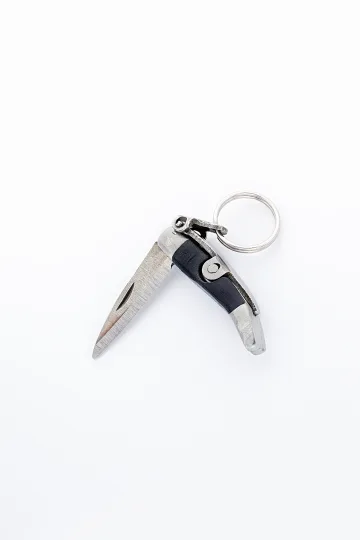
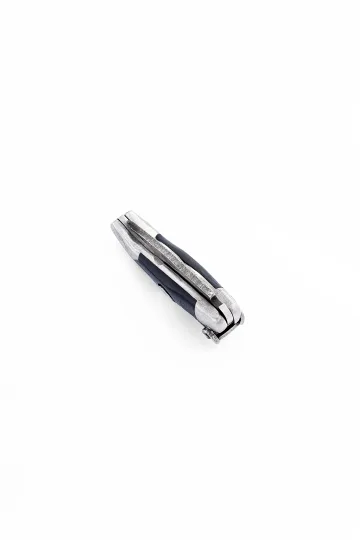
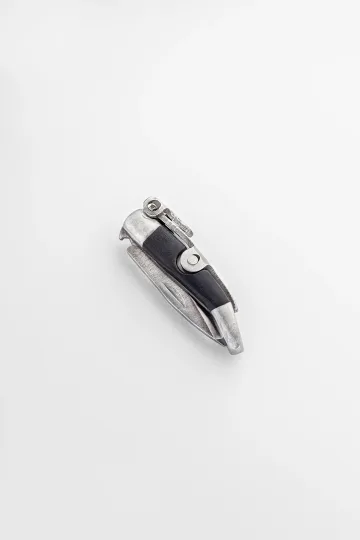
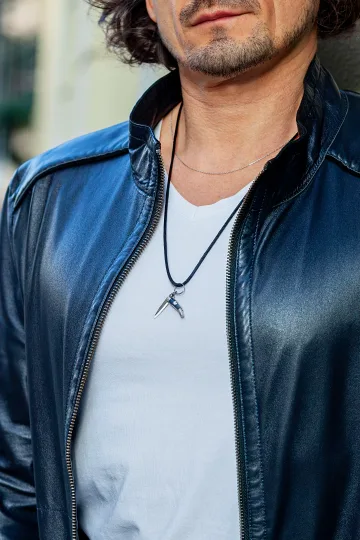
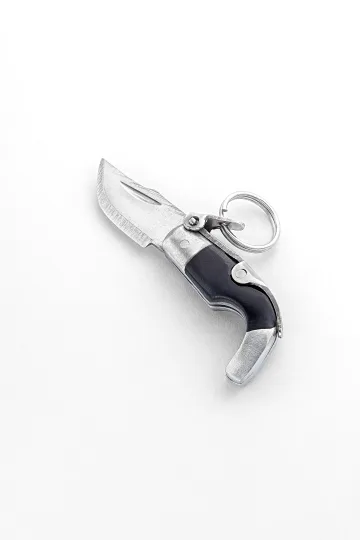
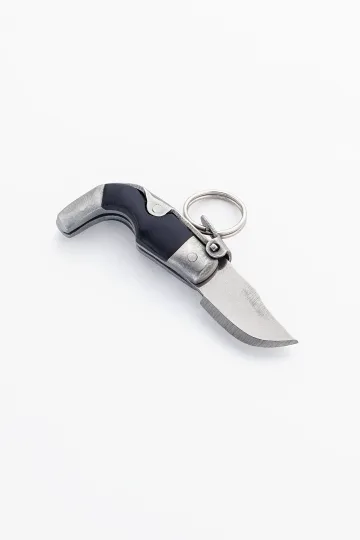
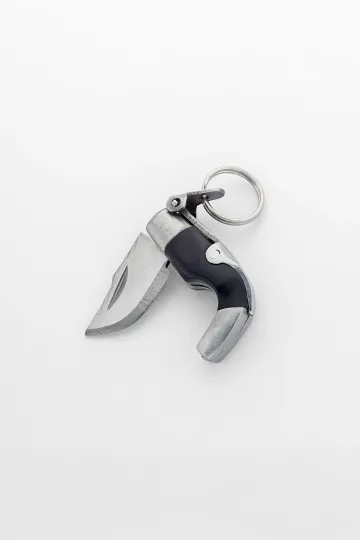
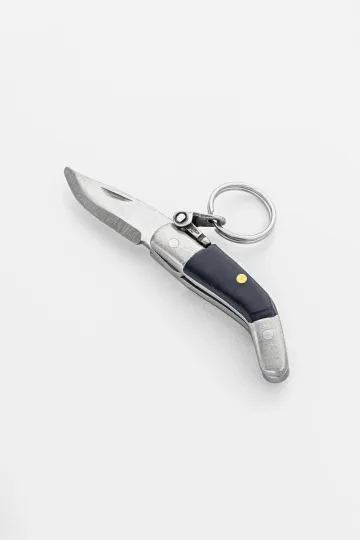
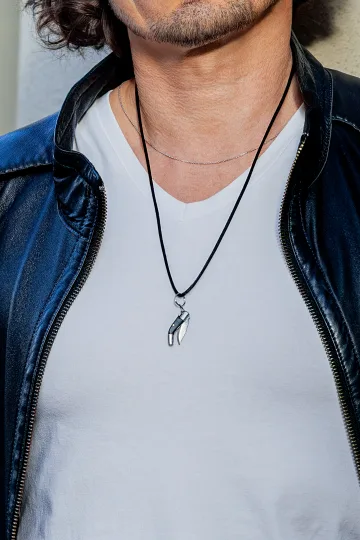
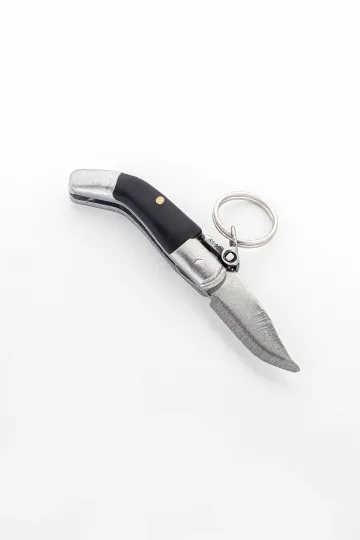
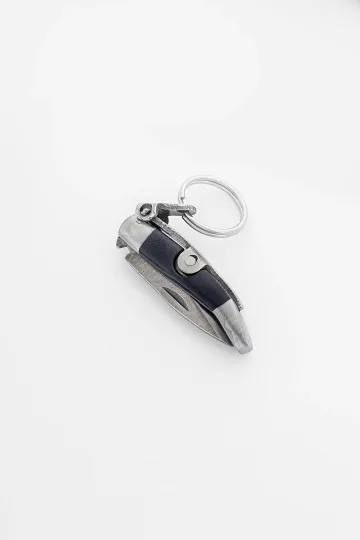
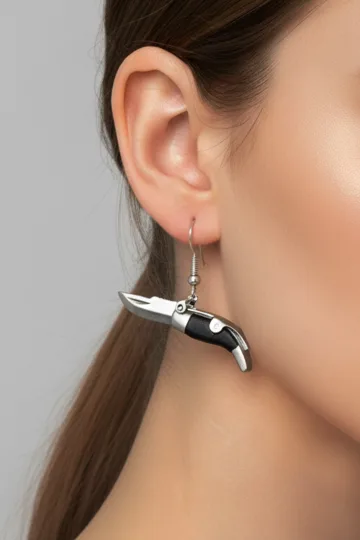
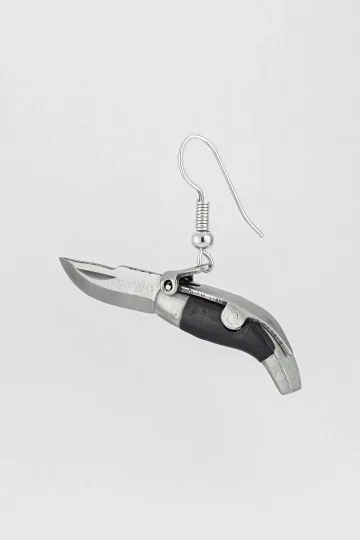
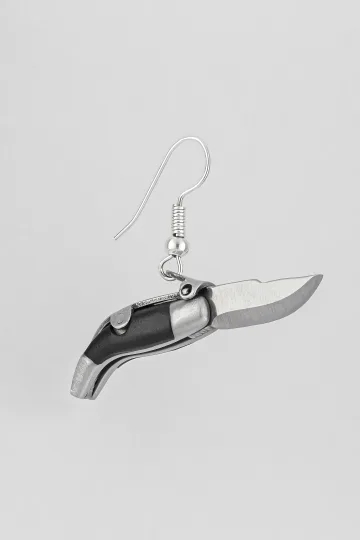
CAPAORA mini knife pendant
The 18th-century Spanish navaja in miniature: 40 mm of stainless steel, a real folding mechanism and a Palanquilla lock that clicks. An affordable gift to remember.
Authentic · Ships from Spain · 14-day returns
Bangle as Gift: What the Choice of Format Says
A bangle is often chosen as a gift, and the choice of form conveys a message. Unlike a chain or earrings, a bangle has a cultural code that reads without words. Let's see what different formats mean as a gift.
Thin Minimal-Bangle in Gold
The most universal gift format for colleagues, distant relatives, a boss, a friend. Carries no romantic subtext, doesn't claim intimacy, doesn't require the receiver to change style. A thin gold hoop fits into almost any wardrobe.
As a gift to a colleague for project contribution, it's appropriate. As a gift from an adult daughter to mother, it's appropriate. As a first-dating gift to a spouse, it's formality, not counted as a living gesture.
Stack of Coloured Glass Bangles
A gift for a friend, daughter, niece. Light, playful, has no financial weight (a glass stack costs like a restaurant dinner). Good as a seasonal gift for summer or vacation. Not suitable for serious events like anniversaries or weddings, because it reads as not serious.
One Jade Bangle
A serious gift with high emotional load. In Chinese tradition, mother passes jade to daughter, father gives it to daughter at coming of age, husband gives it to wife on anniversary. Each scenario carries weight.
Giving a jade bangle to someone who doesn't understand cultural context is risky. The receiver may read it as just stone jewellery, and then you've spent a lot on a gesture that doesn't count. First make sure the person values heirloom meaning.
Victorian Bangle with Engraving
Story gift. Suits anniversaries, silver or gold wedding celebrations, important dates. When it makes sense to invest meaning into a thing. Engraving can be a family motto, date, initials.
Engraving on bangles must be thought out beforehand. The engraver works by example and doesn't return for corrections. A mistake in text is a lost piece.
Diamond Bangle (Riviera)
A gift with financial weight. Most often between spouses or passed between generations in wealthy families. Less appropriate for colleagues and distant relatives because it signals the relationship level.
A diamond bangle is not a first gift to a partner. It's a tenth or twentieth-year gift to a big date. For an anniversary, it's perfect; for the first anniversary, it's too heavy.
Gift to Yourself
A separate category. Banggles are often self-purchased to mark an event: university graduation, promotion, child birth, divorce. There's no receiver except yourself. The logic of choice is different: not "what will others read" but "what do I want to see on my hand every day."
A self-gift bangle is often bolder in design than a gift to someone else. There's no one to spare, no need to fit someone's style. One heavy cast 22-karat gold hoop that shouts "I chose this" is a completely normal self-purchase.
Leave your email, we'll send your discount code. No spam, unsubscribe anytime.
The code arrives by email, valid on your first order.
Bangle in Modern Fashion: 2026 Trends
Modern fashion for bangles moves in several directions at once, and understanding these vectors helps choose a current piece, not a yesterday's one.
Return of Ethnic Forms
After the minimal aesthetics of the 2010s, the pendulum swung back. Ethnic forms return to major runways and independent designers. Indian choodi, African copper hoops, Thai silver with yin-yang ornament, all are current in 2026.
Major fashion house stylists openly cite traditional forms, sometimes directly (a stack of thin gold bangles in Indian style), sometimes reinterpreting (African massive brass with lacquer inserts).
This trend works both ways: Western consumers buy ethnic forms, and in India itself, modern brides return to traditional 21-bangle after a period of fascination with European minimalism of the 2000s.
Mixed Metals as Norm
Until 2015, mixing gold and silver in one set was considered bad taste. By 2026, it's the norm. A stack of yellow gold with white gold, rose gold, silver, brass, all completely accepted and even considered a mark of taste.
The logic is simple: jewellery is always asymmetrical in reality. A ring can be yellow while a chain is white. Watch case is steel but the strap is brown leather. The requirement "all jewellery one colour" is not a law of nature but a 20th-century convention, and this convention is fading.
Vintage Revival
Vintage bangles from the 1920-30s, 1950-60s, 1970-80s actively enter fashion. Auction houses record growing demand for Art Deco bakelite, Italian 1950s gold minimal, American 1970s jewellery modern.
Vintage gives two things. First, uniqueness: each piece exists in one copy; no one will come to dinner in the same. Second, history: the thing lived before you, and this life adds character.
Buying a vintage bangle requires care. There are many vintage fakes today, especially Art Deco and bakelite. Buy from verified auctions and galleries, not social media.
Minimal in Softened Form
Minimal as a style doesn't die but mutates. The straight flat 2-millimetre hoop of the 2010s gives way to slightly more textured forms: with light forging, matte surface, thin engraving, micro-stone.
This is evolution: minimal is still calm but no longer empty. Pure form without life in 2026 reads as dated.
Eco-Materials and Recycling
A new segment is bangles from recycled gold and silver. "Recycled gold" marking appears on independent jewellers and major houses. The idea: secondary gold doesn't require new mining, and the jewellery industry was historically one of the main consumers of gold mining.
For the buyer, there's no difference in properties: recycled 18-karat gold is the same gold with the same chemistry and durability. The difference is in ethical subtext and marking, valued by part of the audience.
Technology Experiments
3D printing of gold bangles is already commercial practice. The designer models in 3D, sends for wax printing, then metal casting. The result is complex geometries that traditional technique couldn't make: spirals, lacework structures, asymmetric forms.
Technically, these bangles don't differ from cast ones in metal composition, but visually it's another language. For those interested in modern form, this direction is actively developing.
How to Stack: Odd Numbers, Mixed Materials, Paired with Watch
A stack of bangles is several hoops together. A good stack has rules. Not dogma, but following them gives visually harmonious results.
Rule of Odd Numbers
The basic rule. An odd number of bangles in a stack looks visually more interesting than even. Three, five, seven, nine, eleven, twenty-one. Even numbers create pairs, and pairs read as incomplete division. Odd numbers create rhythm with a centre, and the eye reads this as a completed composition.
Why. Law of visual symmetry. If three bangles are on the hand, the middle one automatically becomes the visual centre, two on the sides frame it. You get rhythm 1-1-1, which the eye quickly reads as whole. With four, you get a pair 2-2, and the eye starts counting halves.
Exception. Symmetrical paired bracelets on different hands. One bangle on left, one on right, this is not four in a stack, it's two different pieces. The odd-number rule doesn't apply.
Mixed Materials
One metal in a stack looks monotonous. A mix reads livelier. Basic combinations:
- Yellow gold + white gold. Colour temperature contrast. Yellow warm, white cold. Works well in Edwardian and modern Italian style.
- Yellow gold + rose. Soft transition. Rose differs by copper content in the alloy. Warm, feminine.
- Gold + silver. More contrast. Long considered "mixed," but by modern fashion it's standard.
- Gold + brass. Vintage palette. Brass has similar yellow tone but matte, no shine. Works in ethnic styles.
- Gold + glass. Indian classic. Glass bangles as coloured accent to metal base.
Principle: one material dominates by quantity, the second adds accent. If stack has 7 bangles, 5 can be the main metal and 2 the accent. If 5-3 proportion, the main outweighs, accent works.
Mixed Thickness
All same-thickness bangles are a flat boring wall. Mixed thickness creates relief.
Basic scheme: 3-5 thin bangles 1-2 mm wide plus 1-2 medium 3-4 mm wide plus 1 wide 6-8 mm. The wide one becomes visual centre of the stack, thin ones create rhythm around it.
Alternative for Indian stack: all thin but different texture. Smooth, twisted, corrugated, engraved. Thickness is the same, difference is in texture.
Paired Bangle with Watch
Watch on one hand, stack of bangles on the other. This is the most common modern composition.
Logic. A watch is a technical object with certain visual weight: 36-42 mm case, 18-22 mm band width. If you add a stack to the same hand, you get overload and the watch is lost among bangles.
Therefore: watch and stack go to different hands. Watch on dominant hand (for right-handers, left), stack on free hand. On the free hand, stack can be full (5-7 bangles) because it doesn't compete with watch position.
Alternative. One minimal bangle next to a watch on one hand, thin hoop 2-3 mm that adds metal colour (e.g., rose gold next to white watch case) but doesn't claim independence. Rule: one and only one, otherwise overload.
Bangle and Cuff in One Set
A complex composition, but works beautifully. Idea: on one hand a stack of 3-5 thin bangles plus one cuff with opening. The cuff adds graphicness (sharp gap on wrist), bangles add chime and movement.
Condition: overall metal colour or overall style language. Silver cuff with silver bangles is natural. Silver cuff with gold bangles is debatable, needs another connecting element (gold ring on finger, silver earrings).
Stack with Charm Bracelet
Sometimes a charm bracelet is added to a stack as a "living" element: charms chink against each other, add noise and sparkle. This works in boho and teen style but doesn't combine with strict minimal stack.
Rule: either pure bangle stack or bangle stack plus one charm bracelet. Two charm bracelets in a bangle stack is overload already.
Antipatterns: What You Don't Do with a Bangle
Each jewellery category has typical mistakes. Bangles have seven, and almost all relate to wrong sizing or combination.
1. Too Small Size
The most mass error. A bangle that doesn't slide through the hand painfully. Sometimes managed with soap or oil, but that means it's equally hard to remove, and each removal traumatizes skin.
There's no "I'll stretch it later." A closed hoop doesn't stretch. If in the shop a bangle "almost fits," take the next size.
2. Too Large Size
The opposite error. A bangle that slides on without resistance and falls off when you bend is unpleasant differently. Constant feeling that the thing is about to slip. The sound of a gold bangle hitting pavement is not the most pleasant sound in life.
5 mm clearance between hand diameter and inner bangle diameter is optimal. More than 10 mm clearance is too much: the bangle rattles and falls.
3. Heavy Bangle on One Hand All Day
A 30-40 gram bangle is normal for independent jewellery. Two-three heavy bangles on one hand totaling over 100 grams is load, by day's end, tiredness appears.
Solution: either distribute across hands or alternate days. Today heavy bangle, tomorrow thin or nothing.
4. Too Different Styles Mixed in One Stack
A stack should have common language. If one stack has Art Deco with geometric black enamel and Indian glass red and Victorian with miniature, it's collage chaos, reads like a shop window.
The unifying principle can be by colour (all yellow gold), by era (all 1950s vintage), by culture (all Indian). Without a unifying principle, the stack falls apart.
5. Bangle over Long Sleeve
Technically possible, but the sleeve creases from metal friction in several centimetres around the wrist. After an hour of wear, there's a characteristic crease. Especially noticeable on silk and thin cashmere.
So a rigid hoop over a sleeve is a solution for short sleeves, 3/4 shirts, sweaters with rolled sleeves. Under a long sleeve, hide the jewellery (we don't wear watches under long sleeves either, for the same reason).
6. Narrow Hoop with Wide Watch
A composition mistake. A thin bracelet 2 mm wide next to a massive watch 18 mm wide loses visually. A thin band disappears against the watch background, reads as accidental.
If the watch is large, choose a hoop at least 5 mm wide to create visual balance. Or don't put jewellery next to the watch at all; move it to the other hand.
7. Excessive Stack at Work with Fine Details
If the profession requires precise small hand movements, watchmaker, surgeon, dentist, jeweller, musician, tech specialist, a stack of hoops is a hindrance. Chiming distracts, weight changes tactile sensitivity, metal catches on tools.
The solution is obvious: at work, a minimum set or no bangles. On weekends, the full stack.
Care and Adjustment: Why the Hoop Isn't Resized
A rigid hoop asks almost nothing in the way of daily maintenance, but it comes with a short list of rules that are not negotiable.
Why a Hoop Cannot Be Resized
A bangle, unlike a chain bracelet or a cuff, cannot be resized because it's a closed circle. If it's too tight or too loose, the only solution is to buy a different size.
Why you can't resize: to make a bangle larger, you have to cut the hoop, add metal, and rejoin. Rejoining a circle creates a weak point where stress concentrates. The first time you slide it on your hand, there's a chance it will break at the join. A bangle under the size of pressure from hand movement stresses continuously, and a weak point fails.
This is different from resizing a ring or a chain where you have an open structure. A closed hoop has no beginning or end; any intervention creates structural damage.
What can be resized: a cuff, because it's open. A chain bracelet, because you can add or remove links. A ring, by opening the band and adding or removing metal.
The cost of that rebuild is comparable to the cost of a new piece, so the economics rarely make sense. The quality of the result depends entirely on the jeweller: a good one closes the seam so that you cannot find it, an average one leaves a visible line of solder that catches the light every time the hoop turns. On a vintage or antique piece, any such intervention reduces the collectable value, and on a hallmarked hoop it can obscure part of the mark.
There is one absolute exception. A jade or stone hoop cannot be altered at all. Stone cannot be added or removed, and the hoop is a single carved object. What you buy is what you keep.
The practical conclusion: get the size right at the point of purchase. If a piece is tight, return it and exchange it for a larger diameter. If it slides off, exchange it for a smaller one. Under UK consumer law an online purchase can usually be returned within fourteen days of delivery, and most high-street jewellers will exchange an unworn piece; once a hoop has settled into your jewellery box for a season, your options narrow to almost nothing.
What You Must Never Do
Never try to stretch a hoop by hand or with a tool. A closed circle in 22-carat gold turns into an oval under pressure and does not spring back. Worse, the wall of the section thins on one side after the deformation, and a thinned wall is where the metal will eventually crack.
Never heat the metal over a flame or a lighter in the hope that it will expand. Thermal expansion is real but negligible, fractions of a millimetre, while the polish, any enamel, and any set stone can all be ruined in seconds, and you will very likely burn your hand putting the thing on.
Never insert a screwdriver, a spoon handle, or any other lever inside the hoop to prise it open. Point deformation creates a fatigue zone, and after a few such episodes the hoop splits at exactly that spot, usually while you are sliding it over the knuckle.
Polishing and Patina by Metal
A silver hoop darkens from air and from skin, faster in humid coastal air than inland. A polish once or twice a year brings it back. The options, in descending order of safety:
- A professional ultrasonic bath. The most effective and the safest, done at a jeweller's bench in about twenty minutes, and worth it for anything with detail work where tarnish hides in the recesses.
- A silver-cleaning cloth impregnated with a mild polish. Slow but very controllable, and the right choice for a piece with an oxidised finish you want to keep in the low areas.
- Toothpaste and a soft brush. The kitchen-cupboard method. It works, but the abrasive in toothpaste is coarser than it feels, and repeated use will thin the polish over the years.
Gold darkens far less, but it accumulates microscratches from contact with desks, door handles, and keyboards. An annual polish at a workshop restores the surface, and it is worth doing on anything worn daily.
Copper patinates deliberately: the darkening is part of the aesthetic, and many people want it. If you prefer the original pink, rub the hoop with a paste of salt and lemon juice, then rinse in clean water and dry thoroughly. It will darken again within a week, which is normal and not a fault.
Cleaning and Storage
Gold bangles need no special care. Wash with regular soap, dry with a soft cloth. Store in a dry place, not exposed to temperature changes.
Silver bangles darken over time. To clean: soak in a solution of soda and water (one tablespoon per litre) for 15-20 minutes, then rinse and dry. Or use a soft silver-cleaning cloth. Store in a dry place.
Jade bangles: avoid sudden temperature changes. Don't take from cold water and put on a warm heater. Store separately wrapped in soft cloth so they don't hit other jewellery.
Glass and bakelite bangles: avoid impacts. Don't let them fall from height. Store in a jewellery box with soft padding.
Jade Needs Its Own Regime
A jade hoop dislikes abrupt temperature changes above everything else. Out of a hot bath into a cold hallway, or off a chilly windowsill and onto a radiator, and the microfractures already present in almost every piece of stone can grow.
Do not run jade under a hot tap. Warm water is neutral, hot water sets up stress gradients across the stone. Do not put jade in an ultrasonic bath either: the vibration is precisely the wrong energy for existing microfractures, and it is one of the few ways to destroy a hoop that has survived a century. Clean it with a soft cloth and, if it needs more, mild soapy water at room temperature.
Pay particular attention when taking a jade hoop on and off. The danger moment is when the stone passes over the knuckle, because that is when it is most likely to slip. A drop onto a tiled bathroom floor usually ends in a crack, and a cracked hoop cannot be repaired in any way that restores its strength. Change over a bed or a carpeted floor, not over a sink.
When to Wear and When to Remove
A bangle can be worn constantly, showering, swimming, sleeping. Gold and silver hold up fine. The only exception: jade and stone bangles, which don't like extreme temperature changes (avoid ice-cold water transitions to hot).
Remove during sports and heavy physical activity if there's risk of hitting the bangle against something hard. In gym, remove stacks and wear only one lightweight bangle or nothing.
When You Need a Jeweller
A few situations call for a professional rather than a home remedy. If the hoop has a visible crack or chip, get an assessment before you wear it again: a jeweller will tell you whether it can be saved or whether continuing to wear it will finish it off. If it has been squashed out of round, a careful bench correction can bring the circle back, but each correction works the metal further, so it is not something to repeat indefinitely. If a new pattern of internal fractures appears in a jade hoop, have it looked at, because a growing fracture eventually reaches the surface.
Do not attempt repairs yourself. Every amateur attempt, especially anything involving heat or glue, reduces the chance of a successful professional restoration and can turn a repairable piece into a lost one.
Send a friend a discount code, they save on their first order.
Frequently Asked Questions
Q: Can a bangle be stretched if it's tight? A: No. A closed hoop doesn't stretch. If it's tight, it's the wrong size and you need a different one.
Q: How often should a silver bangle be cleaned? A: Depends on your climate and activity. In a dry climate, once every 6-12 months. In humid, every 3-6 months.
Q: Can I wear a bangle on top of a tattoo? A: Yes, a bangle can wear over a tattoo. The hoop will slide and may cause minor irritation if the tattoo is fresh or sensitive.
Q: Is it necessary to wear bangles on both hands? A: No. Modern fashion allows asymmetrical wearing: stack on one hand, watch on the other, or nothing on one hand.
Q: How long does a gold bangle last? A: 18-karat gold lasts decades to centuries depending on thickness and care. A thin gold bangle (1-2 mm) after 50 years of daily wear may show wear patterns but won't break.
Q: Can I sleep in a bangle? A: Yes, a properly sized bangle can be worn to sleep. The hoop is smooth and doesn't have sharp elements. Some people prefer to remove bangles at night for comfort.
Q: Are bangles suitable as a gift for a child? A: Yes, if properly sized and from safe materials. Glass and plastic bangles are suitable for kids. Avoid heavy metal bangles for young children.
Q: How to know if a vintage bangle is real? A: Check hallmarks, test for weight, look for wear patterns consistent with age. Buy from verified dealers or auction houses, not random sources.
Q: How do I measure myself for the right size? A: Make a fist with the thumb tucked in against the palm, then measure the widest part of the hand with a tape measure or a strip of paper. Divide that circumference by 3.14 and add four to five millimetres of clearance. The result is the inner diameter you need. Do not measure the wrist: a hoop goes on over the hand, not over the wrist, and wrist measurements are the single most common reason a bangle bought online will not go on.
Q: Bangle or cuff, which should I choose? A: If you want to wear several at once and you like the sound they make as you move, choose bangles. If you want one firm accent that sits still and stays where you put it, choose a cuff. A cuff is far easier to size, since it flexes, while a closed hoop demands that you get the diameter right first time. But that closed circle is what gives a stack its character, and no cuff will ever reproduce it.
Q: How many hoops should I wear at once? A: It depends on the register you are aiming for. One is a self-contained statement, the Chinese jade approach. Three to five is a restrained modern stack that works in most British offices. Seven to twenty-one is the Indian choodi tradition, and it announces itself. Odd numbers are generally preferred and even numbers avoided, a convention that runs across several of the source cultures.
Q: Can men wear a bangle? A: Yes, and there are long traditions to draw on. In Indian practice men wear a copper kada, often connected to ayurvedic ideas about the metal. In Sikh tradition the iron or steel kara is a religious article worn permanently, and you will see it on wrists across Britain every day. In contemporary Western dress a men's hoop is less common but in no way taboo: a thin, plain silver or gold band reads as quietly deliberate.
Q: I am not South Asian. Is it appropriate for me to wear a stack? A: It is, provided you are not performing someone else's ritual. Wearing a full bridal stack of twenty-one hoops when you are not at an Indian wedding looks like fancy dress, because you are enacting a ceremony you have no part in. Wearing three to five hoops in a style informed by the tradition, with no claim to ritual meaning, is ordinary fashion and always has been. The line between citation and caricature is respect for the source.
Q: Isn't 22-carat gold too soft for daily wear? A: It is softer, yes. The Indian preference for 22 carat exists because the tradition values colour and purity above hardness, and because high-carat gold is a store of value. In practice a thin 22-carat hoop will deform sooner than an 18-carat one under the same treatment. That is the trade you are making: colour and fineness against durability. Worn with reasonable care, 22-carat gold lasts decades and comes down through a family without complaint.
Q: Can I wear one in the shower or in the sea? A: Gold at 18 and 14 carats copes fine with water, soap, and shampoo. Sea water is tolerable but rinse in fresh water afterwards, since salt left in a crevice will work on any solder joint. Silver tarnishes faster with frequent wetting, especially in hard-water areas across the south and east of England, where limescale also dulls the surface. Jade dislikes hot water and sudden temperature change. Bakelite dislikes alcohol and heat. Glass hoops technically survive water and then shatter against bathroom tiles.
Q: My wrist is narrow but my hand is wide, and the hoop slides everywhere. What can I do? A: This is one of the most common fitting problems and there are two workable answers. Either choose a thicker, heavier hoop whose own weight keeps it sitting low near the hand, or wear a stack of several, which hold each other in place through friction. A single thin hoop on that hand-to-wrist ratio really will travel from the fingers to the elbow all day, and no amount of adjusting will fix it.
Q: What does the colour of a jade hoop mean? A: In Chinese tradition green stands for health and life, white for purity, lavender for luck in love, and black for strength and protection. The most prized is imperial jade, a deep emerald green with high translucency. Lavender and black are scarcer. The colour comes from trace elements in the crystal structure, chromium for the green, iron and manganese for the darker tones, and it cannot be judged reliably under shop lighting alone.
Q: How long does a glass hoop last? A: With careful wear, a few years. The realistic average is one to two years before the glass cracks somewhere, usually against a door frame or another hoop in a suitcase. This is not a defect. The Indian tradition assumes glass bangles are renewed regularly, which is part of why they are made in bright seasonal colours in the first place.
Q: Can a bangle cause an allergic reaction? A: It can, if there is nickel in the alloy. That mostly concerns cheap 14-carat gold alloys and low-grade base metals rather than the traditional materials. Pure 22-carat gold, nickel-free sterling silver, copper, and surgical steel rarely cause trouble. Nickel release in jewellery sold in the UK and the EU is capped by regulation, but vintage and imported pieces predate or sidestep those limits, so if the skin under a hoop itches or reddens, change the material rather than persevering.
Q: Can a hoop be passed down to the next generation? A: It can and it should, if the piece means something. Gold at 18 or 22 carats, sterling silver, and jade all outlast several lifetimes with ordinary care. An engraving adds the personal dimension that turns an ornament into a document. If the original size does not fit the person inheriting it, having the metal reworked into a new hoop while preserving the original engraving is a long-established and entirely respectable practice.
Buying it as a gift? Each one arrives ready to give.
 A branded Zevira box and a little card come with every order.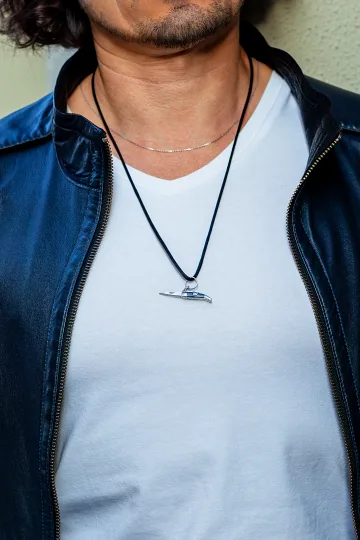




Conclusion
A bangle is not just jewellery, it's a form that carries thousands of years of cultural meaning. From Indian wedding ritual to Chinese family inheritance to European Art Deco geometry, each tradition found in the closed hoop a symbol of something important: continuity, status, identity, beauty.
Today's bangle lives in all these traditions simultaneously. You can choose a minimal thin hoop for office wear or a full Indian-style stack for creativity. You can inherit a piece from your grandmother or buy a new jade bangle as a reminder of your heritage. The form remains the same, a circle, closed, no clasp, but its meaning is entirely personal.
A properly chosen bangle becomes invisible after a few weeks of wear. You stop thinking about it. And then, at some moment, writing at a desk, raising your hand, seeing the glint of gold or silver in light, you remember it's there, and it means something.
That's the real function of a bangle: not to be noticed constantly, but to be felt as presence. A quiet, continuous, true presence on the hand.
Wear the symbol, don't just read about it. These are in stock:




About Zevira
Zevira makes jewellery in the artisan tradition of Albacete, Spain. A bangle is a form where everything comes down to the precision of the profile and the cleanness of the closed hoop, and that is exactly the kind of work a craftsperson does by hand, not a stamp.
What you can find with us in bracelets and rigid hoops:
- Smooth minimal hoops with a thin profile for everyday wear and stacking
- Sterling 925 silver bracelets that can be personally engraved with a date or initials
- Pieces in 14-18K gold for an heirloom gift, an anniversary, or an important date
- Forms built for a mixed stack: different thicknesses and textures in one metal colour
- Options sized by the diameter of your hand rather than your wrist
Every piece can be personalised with engraving, with the option of personal engraving. Sterling 925 silver and 14-18K gold.
Silver, gold, engagement rings, symbolic jewellery, paired sets.