Black opal: the chemistry, geology, history and how to spot a real stone
Why one stone shows the whole rainbow
Pick up a black opal and turn it under a lamp. Flashes of red, green and blue chase across the dark field like sparks on a night sky. There is no dye inside: the colour is born from pure physics of light. That puzzled people for thousands of years, and it still makes the stone one of the most recognisable in all of jewellery.
A black opal is not a "black stone with glitter". It is a variety of opal with a dark body on which the play of colour (the term is opalescence) reads with unusual contrast. Below we go through it properly: what the stone is made of, how it forms, where it is mined, how it was used through history, what the varieties are, how to tell a real one from a fake, and how to care for it. We will touch on symbolism too, but honestly: where there is tradition and where there is a verifiable fact.
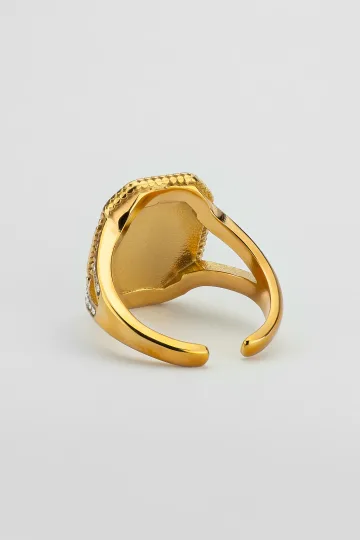
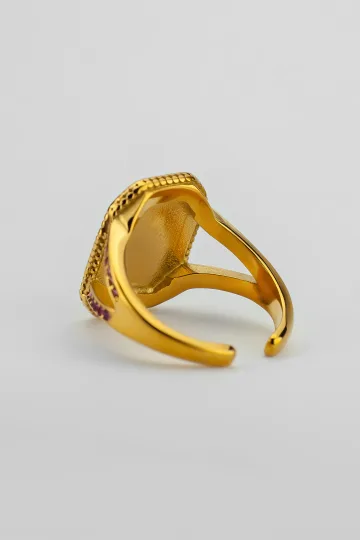
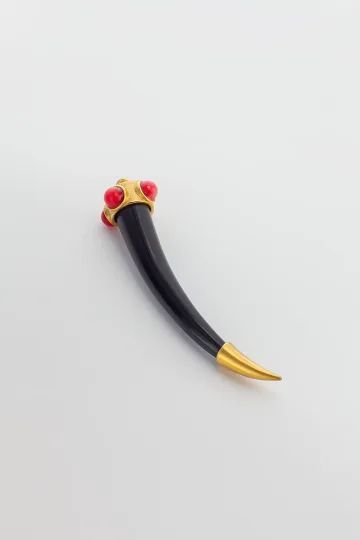
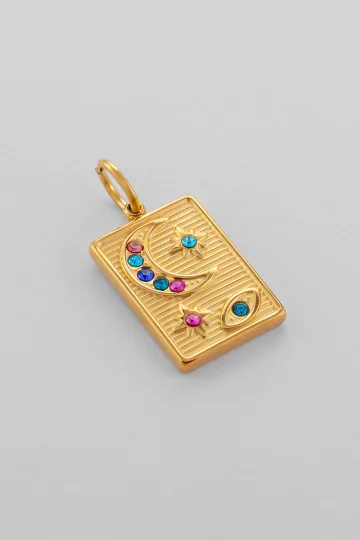
Wear the symbol, don't just read about it. These are in stock:





The chemistry and physics of black opal
Composition and structure
Opal is a hydrated, amorphous silica. The formula is written as SiO₂·nH₂O: silicon dioxide with a variable amount of bound water. The water content is usually between 3 and 10 percent, sometimes more. That is what separates opal from quartz, which has the same chemical base but a strict crystal lattice.
Opal is amorphous, meaning it has no regular crystal structure and no crystal system of its own. Under an electron microscope you can see that it is built from tiny silica spheres of roughly equal size, packed into a more or less regular three-dimensional array. These spheres measure between 150 and 400 nanometres. It is precisely the regularity of that packing that produces the colour.
Mineralogists divide opal into several structural types. Precious opal (the kind that plays with colour) is classed as opal-AG and opal-AN, where the packing of spheres is sufficiently ordered. Common opal with no play of colour (opal-CT, opal-C) is far more frequent and counts for little in jewellery.
Where the rainbow comes from
The play of colour is the diffraction and interference of light on the regular grid of silica spheres. When white light passes between the ordered spheres, different wavelengths are deflected at different angles, and what reaches the eye is a spectrum already split into colours. The principle is the same as in a diffraction grating.
Which colour you see depends on the spacing between the spheres. Small spheres in tight packing give the cool part of the spectrum, blue and violet. Larger spheres give warm colours, all the way to red. Red play is therefore the rarest of all: it needs the largest, most evenly laid spheres, and that combination is scarce in nature.
It is worth putting numbers to that, because they explain almost everything else about the stone. The spheres run from roughly 150 to 400 nanometres across. Around 150 to 200 nm returns violet and blue, the middle of the range returns green and yellow, and it takes spheres of about 350 nm and up to return red. Since larger spheres are harder to grow evenly and pack without collapsing, red play is not merely uncommon, it is structurally difficult, and that is why the price of an opal tracks the amount of red in it more closely than anything else.
The relationship is described by the Bragg equation, the same law that governs how X-rays scatter from a crystal lattice. What the equation says in plain terms is that the colour you see depends on both the sphere spacing and the angle you look from. That is the physical reason an opal changes colour as you tilt it, and the reason a stone can be red from one angle and green from another. It is also why the play of colour dies at some angles in a poorly oriented stone: the ordered domains inside the opal are pointing the wrong way for your eye.
Those domains explain the patterns the trade names. An opal is not one lattice but a mosaic of small ordered patches, each with its own sphere size and orientation, separated by disordered material that shows no colour at all. Large, well aligned domains give broad patches of solid colour, which is harlequin, the most valuable pattern of all. Tiny domains scattered densely give pinfire, a spray of small sparks. Domains that share an orientation across a wide area give a rolling flash that sweeps over the stone as it turns. Where the domains failed to order at all, you get a dead spot.
The body colour, the stone's own tone, is no longer diffraction but absorption. In a black opal the dark body comes from finely scattered impurities: iron oxides and sulphides, and carbonaceous matter. The dark backdrop absorbs the light that did not go into diffraction, so the colour flashes read more brightly against it than against a milky-white body. The same physics of play works in the pale varieties, discussed in the piece on the rainbow opal, only there the body is light and the contrast is softer.
Hardness, density, optics
On the Mohs scale opal sits around 5.5 to 6.5. That is noticeably softer than quartz (7), let alone sapphire or diamond. The stone is relatively brittle and sensitive to knocks and scratches, which has a direct bearing on how to wear it (more on that in the care section below).
Opal's density is low for a gemstone, roughly 1.98 to 2.25 g/cm³. The water and the porosity of the structure account for that. The refractive index is also low, around 1.37 to 1.47. Opal is amorphous and optically isotropic, so it has no birefringence and no pleochroism: the play of colour delivers all of its optical drama, rather than dispersion in the classic sense, as in a diamond.
A black opal wants black around it and the stage to itself. Crowd it with five rings and you have murdered the rainbow. Don't.
What to wear black opal with
Over years of working with stones a black opal has passed through dozens of looks for me, from the strict office to the evening out. I have gathered here what really keeps the stone in the spotlight, by occasion.
How do I wear an opal every day? For everyday I recommend a small ring or studs with an opal over plain knitwear, a grey or charcoal roll-neck, a white shirt. Black clothing is the best ally here: against it the shimmer flares stronger, and even a modest stone looks expensive. For metal I suggest something cool and matte, silver or white gold, so nothing argues with the play of colour.
Is an opal right for the office? Quite, if you keep it restrained. I choose a pendant on a fine chain over a shirt, or studs, and I keep the rest of the jewellery to a minimum: the opal pulls the eye as it is. For a deep V-neckline I recommend a mid-length pendant, so the stone sits just above the décolletage and catches the light as you move.
How do I build an evening look? The evening is the opal's territory. I suggest bare shoulders, smooth satin or velvet in a deep tone, emerald, wine, navy, which echo the colours inside the stone. Drop earrings or a large pendant belong here, and it is better to skip the necklace so as not to compete with the opal.
Which metal do I wear black opal with? White gold and silver give maximum contrast and cool drama, and that is my choice when I want the play to be bright. Yellow and rose gold soften the stone and suit a warm colouring, under classic and vintage shapes. If you already own gold pieces, an opal in the same metal tone will pull the look together.
Who does black opal suit especially? Those who do not fear attention and like one strong accent rather than a scatter of trifles. A rule that never lets me down: wear one opal piece at a time and do not overload the hand with rings next to it. The stone needs a stage where its shimmer is the only bright spot.

Turn on your camera, pick earrings, a pendant or a ring, and see the piece on yourself in real time.
Switch items in one tap.
Everything runs in your browser: no photo or video is ever uploaded.
How opal forms in nature
Most gemstones crystallise from a melt or from hot solutions. Opal takes a different route: it precipitates from silica-rich waters at low temperatures, right near the surface of the earth.
Rainwater seeps through silica-rich rocks, dissolves some of the silica and carries it downward. In cracks, voids and cavities the solution gathers and gradually loses its water. The silica settles out as microscopic spheres, and if they manage to lie down evenly enough, a precious opal with a play of colour is formed. If the packing is disorderly, the result is common opal with no play. The process is slow and runs for millions of years.
Opal often fills the void left by something that came before: cracks, the pores of the rock, sometimes the cavities of shells, bones or wood. That is how opalised fossils arise, where the form of an organism is preserved while its substance has been wholly replaced by opal. Australia is known for finds of exactly this kind.
Geology and deposits
The world's main supplier of precious opal is Australia, and it is Australia that yields almost all of the gem-quality black opal. The opal fields formed in the sedimentary rocks of an ancient inland basin, once a shallow sea and later a long-weathered landmass.
The key points on the map:
- Lightning Ridge (New South Wales) is the chief source of dark and black opal. Most stones with a truly dark body come from here.
- Coober Pedy (South Australia) is the largest district for light opal. The town is famous for the fact that many of its houses and shops are dug underground to escape the heat.
- Andamooka and Mintabie are other Australian fields with their own types of opal.
Outside Australia opal is also mined, but mostly the light or semi-transparent kind. Ethiopia has brought a great deal of so-called Welo opal from volcanic rocks to the market. Mexico is known for fire opal with an orange-red body (that is a separate story, covered in the piece on the fire opal). Opal is found in Brazil, Peru and the United States. But the dark body that gives a true black opal remains largely an Australian trait.
The history of black opal
Antiquity and the name
The word itself goes back to the Sanskrit "upala" (stone, gem) and, through the Greek "opallios", came into Latin as "opalus". Opal was known in the ancient Mediterranean. The Roman writer Pliny the Elder, in his "Natural History", marvelled at opal and described it as a stone that combined the fire of a ruby, the brilliance of an amethyst and the green of an emerald all at once. That is perhaps the earliest clear description of the play of colour in literature.
In antiquity and the Middle Ages, "opal" mostly meant the light, playing stones brought, by later understanding, from the East. The dark Australian opal was not yet known to Europe at that time.
The stone's reputation
Opal has a complicated reputation. In the Middle Ages and later it was at times prized as a stone of luck and keen sight, at times feared. The stubborn superstition that opal supposedly brings misfortune took particular hold in nineteenth-century Europe. Historians of jewellery usually link it to the literature of the period and to the fact that the soft stone was easily damaged and cracked on its owners. The belief has no factual basis whatsoever; it is pure cultural history.
The turning point in perception came when Queen Victoria in Britain openly wore opals and gave them as gifts. Royal taste did much to lift the stone's bad name and to support the fashion for it.
The Australian finds
The industrial history of black opal begins in Australia at the turn of the nineteenth and twentieth centuries. The opal fields of New South Wales, and Lightning Ridge above all, yielded stones with a dark body and bright play never seen before. From that moment the black opal became the rare and costly stone it is known as today. Australia secured its standing as the opal country and later made opal its national gemstone.
Customer reviews
Zevira is a real jewellery shop. Genuine payments, deliveries and customer thank-yous.
🥰🥰🥰 gracias

Ok, ¡gracias! 🙂

Types and varieties of opal
Opal is classified first of all by the tone of its body and by the character of its play.
By body:
- Black opal has a dark body, from dark grey to near-black. The most valuable group, because on a dark field the play of colour reads with the greatest contrast.
- Dark (semi-black) opal has a grey body, an intermediate option.
- Light and white opal has a milky, pale body. The most common.
- Crystal opal is transparent or translucent, with the play visible as if in volume.
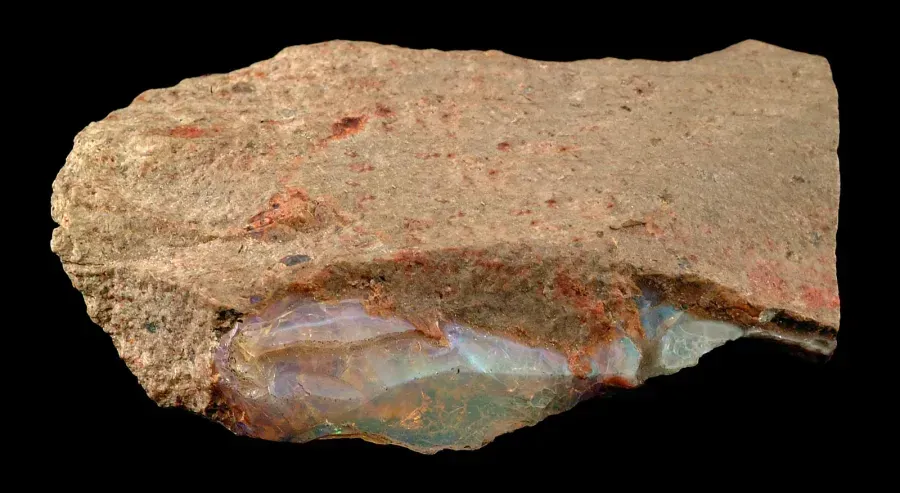
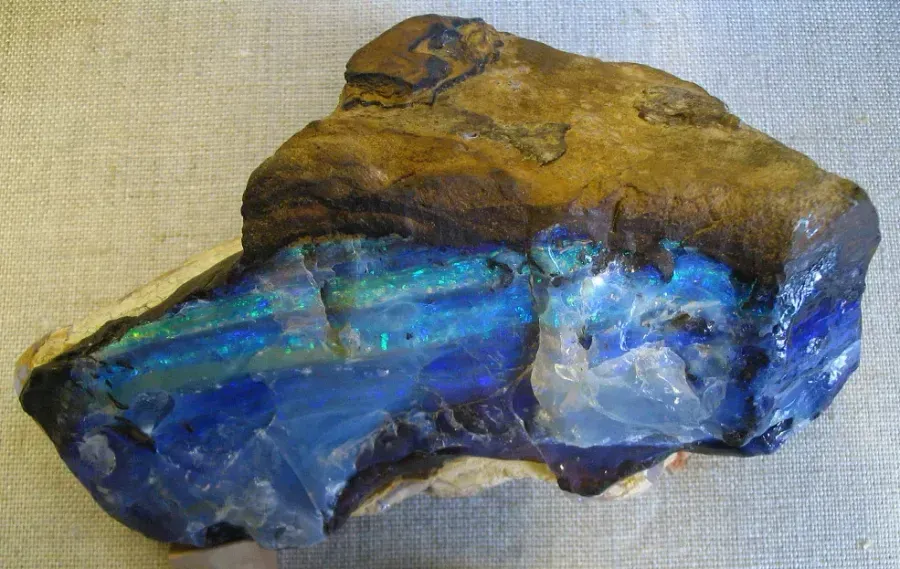
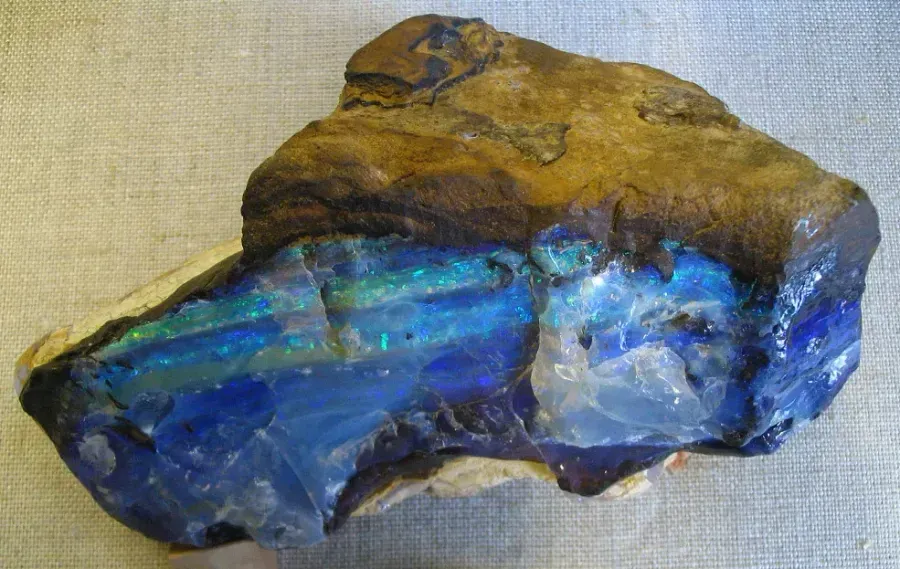
- Boulder opal is opal in thin seams on the parent rock (ironstone). The stone is cut together with its backing of natural rock, and the dark rock strengthens the play. It is a single natural material, not a glued assembly.
- Fire opal has an orange-red body, with a play of colour that may be present or absent.
By pattern of play:
- Pinfire has small, frequent sparks across the whole stone.
- Flash has large patches of colour that flare up when the stone is turned.
- Harlequin (mosaic) has large, angular blocks of colour laid like a mosaic. The rarest and most valuable pattern.
The quality of black opal on the market is usually described by the tone of the body (on a scale from light to black), by the brightness of the play, by the dominant colour (red is rarer and dearer, blue and green more ordinary), by the pattern and by the clarity.
Solid opal, doublets, triplets and synthetics
What is sold as a solid stone is often a composite. The difference matters both for the price and for the durability.
- Solid opal is one natural stone from the body to the surface. The most valuable option.
- Doublet is a thin slice of opal glued onto a dark base (often a black material or potch, colourless opal). The dark backing imitates a black body. Cheaper than a solid stone, but the join shows along the edge.
- Triplet is the same as a doublet, plus a protective dome of clear material (quartz, glass) on top. It often gives an unnaturally mirror-like shine.
- Synthetic opal is grown in a laboratory. It has a play of colour, but under magnification you often see an overly regular "snakeskin" or columnar structure to the colour zones.
- Imitations are glass, plastic and sintered materials. The play looks even and monotonous.
Composites deserve a fuller explanation, because they are not frauds in themselves and the trade has used them openly for over a century. Precious opal often occurs as a seam only a millimetre or two thick, sitting on grey or colourless potch. Cutting that seam as a solid stone would mean throwing away nearly all of it, so the cutter slices the colour bar thin and backs it with something dark. That is a doublet, and the honest ones are sold as doublets.
The problem is water, and it is the same problem that runs through everything else about this stone. A doublet has a glue line running around its full circumference, and that glue line is exposed at the edge of the setting. Water gets in by capillary action, the adhesive clouds, and a milky crescent creeps across the stone from the rim inwards. It is not reversible without recutting. This is why doublets should never be worn in the shower, the sea or a swimming pool, and why a doublet ring worn while washing up will fail within a few years while a solid stone in the same ring will not.
A triplet adds a third layer, a clear cap of quartz or glass over the opal slice. That cap makes the stone far tougher against knocks and scratches, and it magnifies the colour beneath it, which is why triplets often look brighter than their material deserves. It also means you are looking at the play through a lens, so the colour has a flat, glassy quality and does not shift the way it does in a solid stone. Triplets carry two glue lines rather than one, so the water problem doubles.
None of this makes composites a poor purchase at their own level. A triplet gives a great deal of visible colour for very little outlay, and it survives daily wear better than a soft solid stone would. What matters is knowing which of the three you are buying, because the gap between a solid black opal and a triplet of the same face size is measured in orders of magnitude.
How to tell a real opal
A few practical signs:
- Look at the edge of the stone from the side. In a doublet and a triplet you see a straight glue line and a sharp boundary between layers. In a solid opal the colour transition is smooth and natural.
- The underside. A solid opal usually has an uneven natural base, while a doublet has a flat bottom, ready for gluing.
- The pattern of play. In a synthetic, the colour zones often fall into regular columns or scales, visible under a loupe when tilted. In a natural opal the pattern is irregular.
- The shine. A triplet under a glass dome shines like a polished lens, even and cold. A natural opal gives a softer glow.
- The evenness of the body. A perfectly even body without the slightest variation is suspect: a natural stone is always a little uneven.
The most reliable route for an expensive purchase is a report from a gemmological laboratory. It confirms that the stone is natural and solid, and states whether any treatment has been applied.
Treatment
The dark body is sometimes enhanced artificially: by impregnation with sugar followed by acid treatment (the stone carbonises and darkens) or by smoking. Such methods are lawful if they are disclosed, but a treated stone is worth less than a naturally dark opal and must be declared as treated.
Upload a photo of your pet, someone you love, or an object. We'll build a 3D model and hand-cast it in pewter.




Crazing: the main risk with opal
Opal has a feature that hard gemstones do not, and one buyers are rarely told about. The stone can develop a web of fine cracks, called crazing. The cause is water: opal holds it inside its structure, and when the moisture is lost quickly the body of the stone contracts unevenly, the surface becomes covered with a cobweb of cracks, and the play of colour goes out in those places.
Crazing is provoked by sudden drying, direct sun in a display case, a hot hairdryer, a radiator under the jewellery, or a flight in a dry cabin. Opal from certain deposits is more prone to it, which is why a mined stone is often left to settle for months before cutting: if it is going to crack, better it happens before the sale than on the owner's finger. Australian solid opal is one of the most stable in this respect, while Ethiopian hydrophane opal (which absorbs water and clouds over temporarily) behaves more capriciously.
What follows from this when buying. Examine the surface under bright side light and under a loupe: a cobweb of cracks that has already started shows as a thin net of lines. This is not a cutting defect, it is irreversible, and such a stone is not worth taking. With a reputable seller the opal has already gone through its natural settling by the time of sale. Haste here is on the buyer's side: a stone that has lain stable for a year will almost certainly stay that way.
The cut and how to judge a stone face-up
Opal is almost always cut as a cabochon, a smooth dome with no facets. The reason is not tradition but physics: the play of colour is a surface optical effect, and a faceted cut like a diamond's would add nothing to it while losing mass to the facets. A domed shape catches light from every angle and shows the shimmer at any turn.
The height of the dome and the thickness of the playing layer are money. In cheap stones the colour layer can be a fraction of a millimetre, and during repolishing it may simply come away. In a good solid opal the playing layer is thick and the dome is convex. A flat stone, almost like glass, should put you on guard: it is either a very thin layer or a composite doublet.
Opal is judged face-up, as it will be seen in the jewellery, not from the side. Things to watch for:
- Directionality of play. Turn the stone every way and tilt it. In a good opal the flashes live at any angle. In a weak one the colour is visible only from one position and dies from others; such stones are called directional and valued lower.
- Dead spots. Areas with no play, dull patches of the opal body. The fewer and the less noticeable they are, the dearer the stone.
- Brightness over colour. A dull red loses to a bright blue. First you look at the strength of the glow, and only then at the palette.
- Where the play sits. The shimmer should be right at the surface of the dome, not somewhere deep beneath a cloudy layer.
The shape is more often left freeform (oval, teardrop, an uneven outline) to keep the maximum of playing material: an even calibrated oval in an opal means that some of the precious colour went to waste for the sake of geometry.





Caring for black opal
The softness and porosity of opal dictate some simple rules.
Wearability. A hardness of 5.5 to 6.5 means the stone is easily scratched by sand and dust (which contain quartz at hardness 7) and is afraid of knocks. For a ring worn every day and knocked against everything, opal is a risky choice: better to save it for earrings, a pendant or an occasion ring. Boulder opal and a solid stone are tougher than a thin doublet.
Cleaning. Warm (not hot) water, mild soap, a soft cloth or brush. No ultrasonic cleaning and no steam: sharp swings and vibration produce micro-cracks. Give aggressive chemicals and solvents a miss too.
Why an ultrasonic bath is genuinely off limits. This is worth spelling out, because high street jewellers still drop rings into the tank as a matter of routine and an opal can come out ruined. An ultrasonic cleaner works by cavitation: the transducer drives the fluid at tens of thousands of cycles a second, microscopic bubbles form in the low pressure phase and collapse violently in the high pressure phase. Each collapse is a tiny shockwave scrubbing at the surface. On a diamond or a sapphire that is harmless. On opal it is not, for three separate reasons at once.
First, opal is amorphous and porous rather than crystalline, and it already contains water and internal stress from its formation. Cavitation shock propagates into that structure and can start or extend a crack from a flaw that was doing no harm before.
Second, the bath heats up. A tank in normal use climbs well above hand temperature, and thermal shock combined with drying is exactly the mechanism that produces crazing. An opal that survives the tank can still craze days later, which makes the cause easy to miss.
Third, if the stone is a doublet or a triplet, the cavitation attacks the glue line directly and drives fluid into it. A composite in an ultrasonic bath will often separate or cloud in a single cycle.
Steam cleaning is worse still, since it combines heat, pressure and rapid drying. The safe routine is the dull one: lukewarm water, a drop of washing up liquid, a soft brush around the setting, a rinse and a soft cloth. When leaving a piece with a jeweller for repair or resizing, say the word "opal" out loud and ask them not to use the tank, because once the damage is done there is no repolishing it out.
Water and heat. Take the opal off before a shower, a sauna, the pool and the sea. Sharp temperature swings and drying out are the most harmful things of all for the stone.
Storage. Keep opal away from hard stones to avoid scratches, in a soft pouch or a separate compartment. The advice to "store it in water" does not apply to precious Australian opal; there is no need to keep it constantly wet. Simply avoid extremely dry and hot air.
Setting. Once a year it is worth checking that the stone is held firmly in its setting, especially with rings.
Symbolism: what is tradition and what is fact
Opal has been credited with all sorts of things. In some traditions it is a stone of loyalty and hope, in others, on the contrary, a source of superstitious fear. The play of colour long gave reason to see it as a stone of change and many sides, since it literally never looks the same twice.
It is worth saying plainly: opal has no healing or "energy" properties, and there is no proven effect on health, sleep, anxiety or luck. All of that belongs to the realm of belief and cultural association, not to physics or medicine. The stone is beautiful in itself, and that is enough. If the symbolism of change appeals to you, treat it as a pleasant story rather than a property of the material.
Leave your email, we'll send your discount code. No spam, unsubscribe anytime.
The code arrives by email, valid on your first order.
Opalised fossils and life on the opal fields
The Australian opal fields hold something almost nowhere else in the world can offer: dinosaur bone, shells and wood replaced entirely by opal with a live play of colour. An inland sea once covered this country. Mud settled on its floor and the remains of animals piled up in it. Later the sea withdrew, the rocks weathered for tens of millions of years, silica-bearing water seeped into the voids left by decayed organisms and slowly filled them with opal. The shape survived; the substance became something else.
Opalised dinosaur bone
Lightning Ridge yields opalised vertebrae, teeth and skeletal fragments of Cretaceous reptiles. This is one of the rare cases where palaeontological value and gemstone beauty land in the same object. Finds of this class usually end up in museums rather than on a counter, because the scientific worth of a complete opalised skeleton outstrips anything a cutter could do with it. Several species known to science are described from opalised material alone, which means the type specimen for an animal is also, technically, a gemstone.
The mechanism is worth pausing on. For an opal cast to form, the original bone has to dissolve away almost completely while the cavity holds its shape, and then silica-rich water has to arrive slowly enough for the spheres to settle in ordered layers. Get the timing wrong and you have common potch in the shape of a tooth. That a colour-playing stone can reproduce the root canals of a hundred million year old jaw says a good deal about how precisely opal fills the voids in rock.
Opalised shells and wood
Alongside bone the fields turn up opalised bivalves, belemnites and pieces of timber. Opalised wood can preserve growth rings and fibre structure, only with colour flashing where the charred organic matter used to be. Collectors prize these specimens, and pieces are occasionally cut for jewellery where the pattern and the soundness of the material allow it. A shell whose spiral chambers each fire a different colour is one of the strangest objects the mineral world produces.
Life in the opal towns
Coober Pedy became a legend as much for how people live there as for what comes out of the ground. Summer temperatures climb high enough that residents dug their houses, churches and shops straight into the rock, where an even coolness holds all year round. Lightning Ridge works differently: scattered miners' claims where luck decides everything, and neighbouring shafts a few metres apart can produce a treasure and dead ground. Opal mining has remained largely the business of individuals and small partnerships rather than corporations, which is unusual in the gemstone trade and explains why supply is so erratic from one year to the next.
CAPAORA mini knife pendant
The 18th-century Spanish navaja in miniature: 40 mm of stainless steel, a real folding mechanism and a Palanquilla lock that clicks. An affordable gift to remember.
Authentic · Ships from Spain · 14-day returns
Black opal and its neighbours in the display case
To place black opal properly it helps to set it beside the stones that end up next to it, or get confused with it.
Black opal and labradorite
Labradorite also flashes colour across a dark ground, and an untrained eye mixes them up. The physics differs, though. In labradorite the effect is iridescence on thin lamellae inside the crystal, a calm blue or green glow that floods a whole plane at once. In opal the flashes are discrete, multicoloured and arranged into a pattern. Labradorite is harder and far cheaper, which makes it the practical choice for large pieces, but it cannot deliver opal's drama. The best labradorite, spectrolite from Finland, comes closest, and still reads as one sheet of colour rather than a scatter of sparks.
Black opal, onyx and haematite
Sometimes "black opal" is used loosely for any dark stone, onyx or haematite included. That is simply wrong. Onyx is opaque and single-toned with no play of colour whatsoever; haematite gives a metallic sheen. If a dark stone shows no shifting spectral flashes, it is not opal, it is another material, and it should be priced as one. This confusion is common enough in online listings that it is worth checking the wording of a description before anything else.
Black opal and black pearl
Both count as dark premium gems, and both carry an Australasian and Pacific reputation. But pearl is organic, grown inside a shell, with a soft nacreous shimmer, while opal is a mineraloid from deep in sedimentary rock with a sharp spectral play. They often appear in the same price conversation despite the physics of their lustre having nothing in common. A useful practical difference: pearl tolerates humidity and dislikes dryness in much the same way opal does, so the two at least share a storage regime.
Black opal, spinel and black tourmaline
Black gemstones such as dark spinel or schorl give a deep, even colour and the sparkle of cut facets, but no diffraction rainbow. Their strength lies in purity of tone and in hardness, which makes them far more reliable for an everyday ring. Opal wins on play rather than uniformity, which is exactly why it stays a stone for the occasion rather than for rough daily wear. If you want the visual weight of a dark stone in a piece that will be knocked about, spinel is the sensible answer and opal is not.
Famous opals and celebrated finds
The story of black opal rests both on the fields as a whole and on individual stones that people have talked about for decades.
The best known Australian stones
Among the celebrated finds of Lightning Ridge are large dark opals with names of their own, passed from collection to collection and valued as national treasures. They were named the way ships are named, and every public appearance of such a stone became an event for gemmologists. Size is secondary here. What sets the value is the combination of a deep body, bright multidirectional play and a rare harlequin pattern of broad, even patches of colour.
Australian museums hold several of the most important, and the practical effect of that is a good one: the reference standard for what a fine black opal looks like is on public display rather than locked in a vault. Anyone who has seen a first-class stone in a museum case reads a shop counter very differently afterwards.
Why a large black opal is a rarity
A gem-quality dark body forms rarely in nature to begin with. For a thick playing layer, high brightness and an absence of dead spots to coincide in the same piece takes luck cubed. Genuinely large, clean black opals are therefore counted individually and their histories tracked by name. Most of the dark material mined goes into small cabochons rather than museum specimens, and the fields do not run on demand: a season can pass with nothing exceptional coming up at all.
What black opal costs and what drives the figure
We will not quote numbers, but the logic of pricing is worth understanding, both to avoid overpaying and to avoid buying a composite sold as a treasure.
What pushes the value up
The dearest material is a solid Australian stone with a genuinely dark body, bright multidirectional play, plenty of red and a broad pattern such as harlequin. The thicker the playing layer and the fewer the dead spots, the higher the value. A laboratory report confirming that the stone is natural and solid adds real weight in the market, and for anything above a modest size it is close to mandatory.
What pulls the value down
A pale or grey body, dull unidirectional play, a fine pinfire pattern and visible dead spots all drag the figure down. Composites (doublets and triplets), synthetics and an artificially darkened body sit several times below natural solid opal. Crazing that has already begun wipes out the value almost entirely, however beautifully the stone played to start with.
Everyday points of reference
A modest light opal cabochon sits in the same bracket as a nice small treat, an evening out or a good book. An exceptional solid black opal of museum grade can cost as much as a car, and the very finest as much as a house. The whole market lies between those poles, and where a given stone falls on that scale is set by the trio of body, play and solidity. When you buy, you are paying for brightness and integrity, not for the word "black" in the description.
The psychology of a dark stone with a rainbow inside
Black opal attracts for a reason that is easy to feel and hard to state. The dark ground reads as restraint and depth, while the colour flashes add surprise and motion. The result is a contrast between the calm and the vivid inside a single object, and the eye keeps catching on it.
Why people choose it
An opal does not look like itself from one turn of the hand to the next, and that registers as a small living secret on a finger or at the throat. People who value things with character and dislike repeating themselves are drawn to precisely that unpredictability of pattern. No two exist, and the owner knows the piece is unrepeatable in a literal rather than a marketing sense.
The stone as a mark of individuality
Where faceted transparent stones read as classicism and status, opal speaks about taste and independence of choice. It is harder to wear, it demands care, and that makes it a considered decision rather than a default one. A gift of black opal usually means the giver was paying attention to the person rather than reaching for the nearest safe option.
Send a friend a discount code, they save on their first order.
Black opal in culture and art
Opal in literature and its bad name
The sharp reversal of opal's reputation in the nineteenth century is often traced by historians to Walter Scott's novel Anne of Geierstein, published in 1829. Its heroine wears an opal that changes its glow with her mood, and a drop of holy water extinguishes both the stone and its owner. The reading public took this as a hint that the stone was cursed, and opal sales across Europe collapsed for a time. It stands as a fine example of how fiction can strike a whole market, and as a reminder that the "unlucky opal" superstition is younger than most people assume, roughly two centuries old rather than ancient.
There is a second, quieter reason the reputation stuck. Opal is soft and holds water, so pieces genuinely did crack in the hands of jewellers and owners more often than harder stones did. A superstition that matches an observable failure rate survives much longer than one that does not.
Victoria and the return of fashion
Queen Victoria repaired the damage. She was fond of opals, wore them herself and gave them to her daughters, and in that era the taste of the monarch counted for a great deal in fashion. Britain was also receiving opal through its colonies, so backing the stone was a matter of commerce as well as taste. Gradually the superstition receded and opal came back into jewellery. Late Victorian and Edwardian work made heavy use of it, often set with small diamonds in a way that flattered the play of colour, and those pieces are the ones now sought at British auctions.
Australia's national gemstone
Australia, which gave the world black opal, made it the country's official national gemstone. Opal became part of the national image alongside its landscape and its prospecting history, and black opal in particular is the state emblem of New South Wales, where Lightning Ridge lies. It is a rare case of a specific gem tying so tightly to one territory that it turned into a symbol of it.
Facts that surprise
Red play is dearer than any other
Red is the scarcest colour in an opal's palette, because it requires the largest silica spheres and requires them to lie perfectly evenly. A stone burning with red is worth more than a blue or green one, all else being equal. What is curious is that the colour here is a question of geometry in nanometres rather than the chemistry of a pigment: nothing in the stone is red, the spacing simply happens to return red light to your eye.
Opal is nearly a tenth water
The body of an opal can hold ten per cent or more of bound water. One of the most spectacular gemstones is therefore closer kin to a set gel than to a hard crystal. That water is exactly what makes it capricious, because when it leaves it takes the play of colour with it.
A single stone holds billions of microspheres
The play of colour is produced by the packing of silica spheres a few hundred nanometres across. A small cabochon holds billions of them, laid down evenly enough to diffract light. Nature assembled that lattice with no machinery at all, purely through millions of years of patient settling, and no laboratory has yet matched a top natural stone for irregular, living pattern.
Whole skeletons turn up in opal
Opal replaces organic material so faithfully that opalised bones of dinosaurs and ancient reptiles have been found in Australia. A stone that looks like pure ornament sometimes turns out to be a Cretaceous scientific find as well. It is the only gem material that regularly hands palaeontology fossils that flash with colour.
Boulder opal is cut together with its host rock
Boulder opal is never separated from its mother stone: the thin opal vein is left on its dark ironstone backing and cut as one piece. The dark rock acts as a natural black ground and intensifies the flashes. This is neither a glued composite nor a deception, simply an honest natural material that happens to come with a stone back, and it is a sensible way to own dark-bodied play without paying black opal money.
Opal loses its play if it dries out
Keep a precious opal in heat and dryness and it can craze through and lose its shimmer for good. No other popular gemstone depends on humidity to anything like this degree. That is why mined stones are sometimes rested for months, to see whether they survive drying, before anyone commits them to the cutting wheel.
There is opal on Mars
Orbital and rover surveys have found deposits of opaline silica on Mars. For geologists that is a signal that water was once present, because opal on Earth is born from watery solutions. A stone from a display case turns out to double as a clue about the climate of another planet.
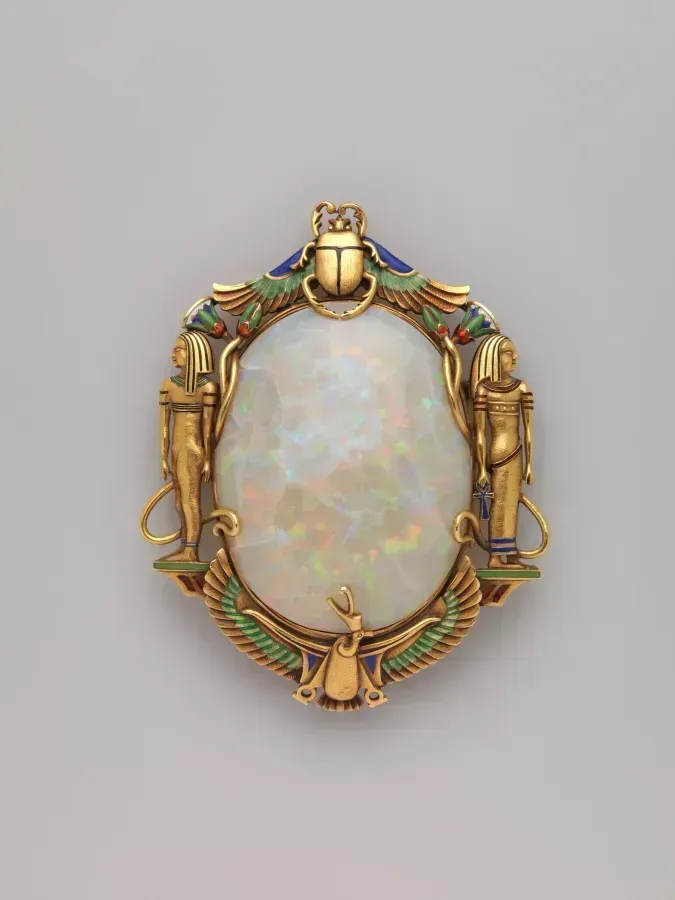
Opal and the metal of the setting
A cool metal suits a dark opal. White gold and silver give the strongest contrast: a pale setting emphasises the dark body and makes the colour flashes more visible. Yellow and rose gold soften the stone and lend it warmth, a choice that works well for classic and vintage forms. Silver is more affordable but oxidises and needs care; the standard fineness of jewellery silver is 925.
If you want a bright play of light but in a stone tougher for everyday wear, take a look at zircon in all its colours: it is harder than opal and copes more calmly with knocks and water.
Frequent questions about black opal
What is opal made of?
It is hydrated silica, SiO₂·nH₂O. Chemically the same base as quartz, but without the crystal lattice: opal is amorphous and contains from a few to ten or more percent water.
Why does opal shimmer in every colour?
The play of colour is the diffraction of light on the regular packing of microscopic silica spheres. The spacing between the spheres sets the colour: small spheres give blue, large ones give red. That is exactly why red play is rare.
How does black opal differ from white?
Only in the tone of the body. A black opal has a dark stone body, against which the play of colour reads with more contrast. The physics of the flashes themselves is identical.
Which opal is the most valuable?
A black opal with a bright, multicoloured pattern, especially if there is plenty of red in the play and the pattern is large (harlequin). The darker and more even the body, and the brighter the play, the dearer the stone.
Where is black opal mined?
Almost all gem-quality black opal comes from Australia, above all from Lightning Ridge. Light opal also comes from Ethiopia, Mexico and Brazil, but the dark body is an Australian speciality.
What is opal's hardness and can it be worn every day?
On the Mohs scale 5.5 to 6.5, a soft and brittle stone. For an everyday ring it is better to choose a harder stone, and to save the opal for earrings, a pendant or occasion pieces.
How do you tell a real opal from a doublet or triplet?
Look at the stone from the side: in composites you see a straight glue line and a sharp boundary between layers, while a triplet has an even glass dome on top with a cold shine. In a solid opal the transitions are smooth and the base is uneven. For an expensive purchase get a laboratory report.
How do you tell a natural opal from a synthetic?
Under a loupe, when tilted, a synthetic often shows overly regular colour zones: columns or scales. The natural pattern is irregular and the body a little uneven. A precise answer comes from a gemmological examination.
How do you clean opal?
Warm water and mild soap, a soft cloth. No ultrasound, steam, boiling water or solvents. Take the piece off before the pool, the sauna and the sea.
Is it true that opal brings misfortune?
It is a superstition, mostly European and mostly of the nineteenth century. It has no factual basis. The stone has no healing or "energy" properties either; that is the realm of belief, not of proven effects.
Buying it as a gift? Each one arrives ready to give.
 A branded Zevira box and a little card come with every order.














About Zevira: jewellery with black opal
In the Zevira catalogue black opal is a stone chosen one at a time: no two are alike, each with its own pattern of play and its own body tone. We look at the darkness of the body, the brightness and colour of the flashes, the clarity and the secure seating of the stone in its setting.
Every opal piece is checked for the stone, the setting and the finish of the metal. For a dark opal we more often choose a cool metal, white gold or silver, so the contrast works for the play of colour.
Zevira jewellery with black opal
Rings, earrings and pendants with natural black opal. Each stone is unique and never repeats. The pieces are certified, with a guarantee.
Open the catalogue and find your opal:
Go to the Zevira catalogueThe short version
Black opal is a hydrated, amorphous silica, a soft (5.5 to 6.5 on the Mohs scale) and brittle stone whose famous play of colour is born not from paint but from the diffraction of light on ordered silica spheres. The dark body is created by iron and carbon impurities, and it is that body which makes the colour flashes so bright. Almost all gem-quality black opal is mined in Australia.
When buying, look at the wholeness of the stone and beware of doublets, triplets and synthetics, and for expensive pieces get a laboratory report. In care, the main thing is to protect the stone from knocks, ultrasound, heat and sharp swings in humidity. And all the mysticism around opal is a pretty piece of cultural history, no more than that.