Crescent moon and star: meaning, history and jewellery
Introduction: a symbol older than its most famous meaning
A friend in Manchester wore a small gold crescent and star pendant for years before discovering its full history. She bought it as a teenager because she loved the moon and thought it looked beautiful. Years later, a colleague at work asked if she was Muslim. She was not, but she realised the symbol had a more layered meaning than she had assumed. She kept wearing it, with a deeper sense of what she was carrying.
The crescent and star is one of the most layered symbols in the world. Most people know it as a sign of Islam, and that is true in part. But the symbol is much older than Islam: it appears in the ancient Near East as a celestial symbol, was adopted by Byzantium as a symbol of Constantinople, became the badge of the Ottoman Empire, and only then became associated with Islam in the nineteenth century. Today it is the official emblem of many countries and at the same time a fashionable jewellery motif on people of any faith or none.
Wear the symbol, don't just read about it. These are in stock:


This guide covers the full history of the crescent and star, from ancient Mesopotamia to modern fashion. The meaning in Islam and outside it. Pendant, earring and ring designs. Materials and craft. How to wear with respect, when the symbol fits, and ethical questions about wearing a religious sign without belonging to that religion. The aim is to give you full context so you can choose with knowledge.
If you are interested in moon symbolism in general, see the moon phases meaning guide. For celestial jewellery in general, see the celestial jewellery guide. For symbolic jewellery overall, see the complete symbols guide.
What the crescent and star symbol means
The crescent and star (a crescent with a star, often five-pointed, beside it) is read on several levels at once. Its visual simplicity makes it immediately recognisable on flags, mosque domes, jewellery and book covers, yet each viewer brings a different layer of meaning to the same image.
Modern primary meaning
In the modern world the symbol is most often perceived as Islamic. It appears on the flags of many Muslim-majority countries (Turkey, Pakistan, Tunisia, Algeria and others), on mosques, on Muslim community emblems. For Muslims it stands for faith and identity.
It is important to know one thing at the outset: the Quran does not mention or require this symbol. No verse establishes the crescent as an emblem of faith. The symbol became associated with Islam through a long historical and political process, not through theological prescription. This does not diminish its meaning for believers who use it, since a symbol can carry profound significance simply through centuries of use, without needing a scriptural basis.
Older meaning
Before its association with Islam, the symbol carried other meanings across many civilisations:
- Lunar deities (the goddess Selene in Greece, the god Sin in Mesopotamia)
- Femininity (the moon is a feminine principle in many traditions)
- Night and dreams, the protection of the city and its gates
- Cyclicality, change, renewal, transformation
- Light in darkness, guidance, hope
What it means today for jewellery wearers
For Muslim wearers, the crescent and star is a personal sign of faith, worn much as Christians wear a cross or Jews wear the Star of David. It can be given at milestones: a birth, a coming-of-age, the end of Ramadan, a wedding. For people of Muslim heritage who do not practise actively, it can mark a cultural and family bond, a connection to a grandmother, a home country, a way of life. For non-Muslim wearers the symbol most often reads as an aesthetic motif, a romantic reminder of the night sky, a symbol of femininity and the lunar cycle, or simply a beautiful design within the wider trend of celestial jewellery.
Layered reading
These three readings coexist on the same object. A single pendant can mean faith for one person, family memory for another, and pure beauty for a third. Understanding this plurality is the key to choosing, wearing, or giving the piece wisely.
A crescent wants a bare neck and one chain. Bury it under five charms and you get a junk drawer, not a night sky.
How to wear the crescent and star
The crescent and star has passed through dozens of looks on shoots and fittings. It is an easy symbol to style, but it rewards precision in metal and length. Here is what actually works, by occasion.
How do I wear it every day? For daily wear I recommend a thin crescent on a 45 cm chain over a plain tee, a linen shirt or a soft knit. I pair cool clothing (white, grey, denim blue) with silver and white gold, and warm tones (beige, terracotta, khaki) with yellow gold and turquoise. The star inside the arc catches the light on its own, so I keep the rest minimal: fine studs, one ring.
Does it work at the office? It does. I suggest a small crescent worn high on the neck, under a blouse collar or over a lapel, at 40 to 45 cm. No enamel, no large stones; a clean silhouette reads as a tidy detail rather than a statement. It sits perfectly under a V-neck, where the neckline leads the eye to the pendant.
How do I build an evening look? For evening I choose the opposite logic: an open neckline or a strappy dress and a larger crescent on a 50 to 60 cm chain. I go for a material with some play (opal, pearl or small stones as the star) and blue or green enamel with an eastern nod. Against bare skin at the collarbone it reads best.
How many pieces should I layer? I like layers, but in moderation. I pair the crescent with other celestial charms (a single star, a moon phase) on chains of different lengths so they never tangle. I mix gold and silver only on purpose: then I add a third piece in each metal to tie the look together. One precise crescent still beats a handful of small ones.
Who does the symbol suit? Almost everyone, especially anyone drawn to the idea of night, cycles and quiet strength. It sits equally well on a minimal look and in layers. I follow two rules: length follows the neckline, not the other way round, and size follows the proportions of the neck. A long slim neck carries a larger crescent; for a shorter neck I recommend a medium one on a 50 to 55 cm chain.

Turn on your camera, pick earrings, a pendant or a ring, and see the piece on yourself in real time.
Switch items in one tap.
Everything runs in your browser: no photo or video is ever uploaded.
Origins: ancient roots
The symbol's history goes back thousands of years, long before any monotheistic religion. The oldest urban civilisations of humanity were already using this pair of celestial bodies as a sacred sign.
Mesopotamia (third millennium BC and earlier)
The first images of the crescent and star are found on Sumerian and Akkadian artefacts. The crescent represented the moon god Sin, called Nanna among the Sumerians, whose great sanctuaries stood at Ur and Harran. The star represented Ishtar, the goddess identified with the planet Venus, deity of love and war. This combination of crescent and star, sometimes joined by the solar disc of the sun god Shamash, appears on cylinder seals, royal steles, and ritual boundary stones called kudurru. It is the earliest clear attestation of the motif, and already it signifies the divine sky, the cosmic order watching over the world of men.
Ancient Egypt
In pharaonic Egypt the lunar crescent was associated with the god Khonsu, a lunar deity depicted as a young man crowned with disc and crescent. Thoth, god of writing and knowledge, was also linked to the moon and its cycles. The most important star in the Egyptian sky, Sirius, whose rising announced the flood of the Nile, was identified with the goddess Isis. The night sky was fully divine territory, populated by celestial figures of which the crescent and stars were the visible markers.
Ancient Greece and Rome
The crescent moon is the attribute of the goddess Artemis (the huntress) and Selene (the personified moon). In the Greco-Roman world, Artemis (later Diana for the Romans) wore a crescent on her brow. The goddess Hecate, deity of crossroads and night magic, completed this lunar triad. Jewellery of the period often bore crescents, and a type of ornament called the lunula (a small crescent pendant) was worn by women and children as a protective amulet. The crescent was a feminine and apotropaic sign, believed to ward off misfortune.
Carthage and the Phoenician world
The Phoenician colony of Carthage (modern Tunisia) used the crescent and star as a sacred symbol of the goddess Tanit, the city's tutelary deity. This motif appears on votive steles, cult objects, and personal jewellery. The Phoenician world, a great diffuser of motifs across the Mediterranean, helped spread the lunar-star association throughout the basin long before the symbol became Byzantine or Ottoman.
Persia and India
In ancient Iran the crescent was the symbol of the goddess Anahita, patron of waters and fertility. Sassanid coins frequently carry crescent imagery. In the Hindu tradition the crescent is an attribute of the god Shiva (chandrashekhara, "crowned by the moon"), symbolising his mastery of time and cycles.
A common feature of antiquity
In nearly all ancient Near Eastern cultures the crescent and star were sacred celestial bodies linked to lunar and stellar deities. Each civilisation read its own meaning, but the visual element repeated with remarkable consistency across geography and time.
Byzantium: crescent as a symbol of Constantinople
A key chapter in the symbol's history, and one that most people overlook entirely.
Foundation legend
According to ancient tradition, around 339 BC King Philip II of Macedon (father of Alexander the Great) besieged the Greek city of Byzantium and attempted a night attack. According to legend, a crescent moon suddenly appeared in the sky, its light revealing the advancing attackers to the defenders, and the assault failed. The city was saved. In gratitude, tradition relates, Byzantium adopted the crescent as its city emblem, in honour of the goddess Hecate, lunar deity associated with the protection of gates and walls. Whether or not the legend is historically exact, the crescent is well attested as a symbol of Byzantium on ancient coins.
Constantinople: a Christian city with a crescent
When the emperor Constantine refounded Byzantium in 330 AD and named it Constantinople, the crescent did not disappear. It remained attached to the city, and a star was sometimes added alongside it. For more than a thousand years the crescent and star remained an emblem of Constantinople, capital of the Eastern Roman Empire (later the Byzantine Empire), deeply Christian and Orthodox. This is a crucial point: throughout the medieval period, the motif that people today think of as exclusively Islamic was first and foremost the sign of a great Christian city. The symbol has no religion of its own; it has a history.
The Ottoman transfer
In 1453, Sultan Mehmed II captured Constantinople after a long siege, ending the Byzantine Empire. The Ottomans, in taking the city, also inherited its symbols. The crescent, the city's emblem for a millennium, was taken up and gradually adopted by the new masters. It was through this transfer, not through any religious prescription, that the crescent began its career as an Ottoman emblem and eventually as an Islamic one. The symbol's history is made of successive layers: a Mesopotamian celestial motif, then the sign of a Greek city, then the emblem of a Christian empire, then the emblem of a Muslim empire.
The Ottoman Empire: a new era for the symbol
How the crescent became an Ottoman emblem, and then an emblem of the wider Muslim world.
Adoption of the Byzantine symbol
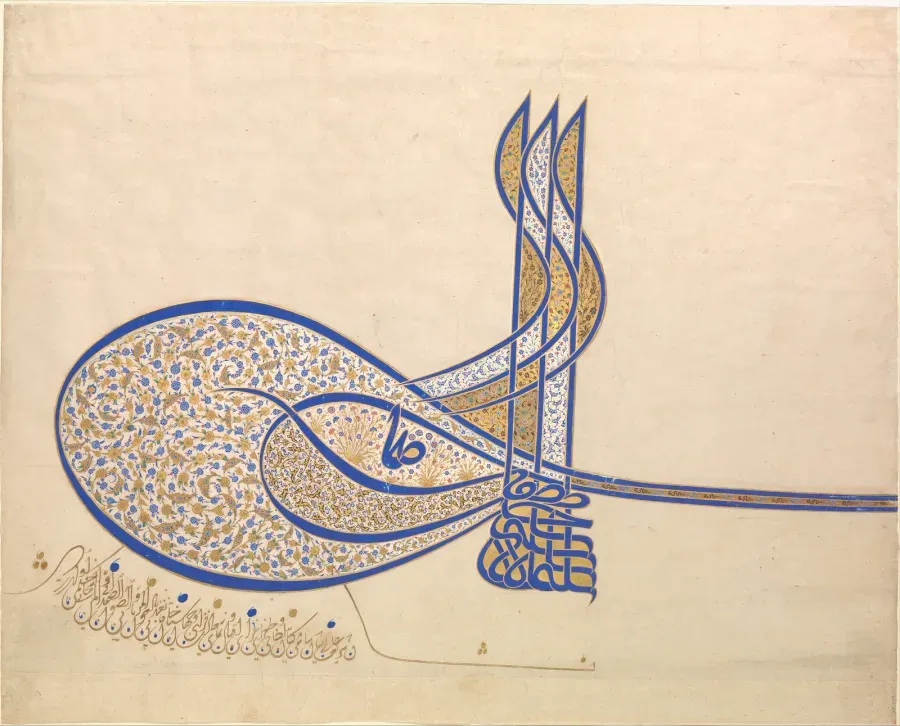
Mehmed II the Conqueror, after the fall of Constantinople, took up the crescent as a symbol tied to his new capital. The adoption was not immediate or systematic: for some time the Ottomans used a variety of emblems depending on military, dynastic, and religious context. The crescent gradually established itself as the most consistent sign. The star was added later, and its form varied: first with multiple points, then standardised at five branches in modern usage. The crescent-star pair took several centuries to stabilise as a recognisable official emblem.
Eighteenth century: star added
The five-pointed star was formally added to the Ottoman flag in the eighteenth century. Historians debate the exact date and reason: one account places this under Sultan Selim III (1789 to 1807), another under Sultan Mahmud II (1808 to 1839). In either case, by the early nineteenth century the crescent and star had firmly become the empire's symbol.
The official Ottoman flag
In 1844 Sultan Abdulmejid I standardised the design: a red field, a white crescent and a white five-pointed star. This flag survived until the empire's collapse in 1922 and became the flag of the Republic of Turkey with minor modifications.
Association with Islam
The Ottoman Empire's expansion across much of the Muslim world, from North Africa to the Balkans to the Arabian Peninsula, gradually identified the crescent and star with the Islamic religion itself. As the empire presented itself as the principal power of Sunni Islam, its political emblem acquired a religious reading. By the nineteenth century, especially in Western perception, the crescent and star had become "the symbol of Islam," by analogy with the Christian cross. This equivalence is recent in the symbol's long history.
Influence on other Muslim countries
In the nineteenth and early twentieth centuries, when Muslim countries were gaining independence (from the Ottomans, the colonial powers, or both), many adopted the crescent and star as a sign of solidarity with Ottoman heritage and Muslim identity.
Customer reviews
Zevira is a real jewellery shop. Genuine payments, deliveries and customer thank-yous.
🥰🥰🥰 gracias
Ok, ¡gracias! 🙂
Connection with Islam: religious meaning
The association between the crescent and Islam is, as seen above, late and historical rather than theological. But that does not mean the link between the moon and Muslim religious practice is weak. It is, on the contrary, profound: it runs through the calendar rather than through the emblem.
The Quran and the symbol
The Quran does not mention the crescent as a religious symbol to wear or display. No surah establishes an emblem of faith. Original Islam of the seventh century had no graphic symbol comparable to the cross. This explains why some strands of Islamic thought, attached to strict conformity with the texts, view the crescent as a cultural addition rather than a legitimate religious symbol. Other traditions accept it fully as a historical expression of the community.
The moon in the Islamic calendar
Where the connection is solid is in timekeeping. The Islamic calendar is purely lunar: its months are calibrated on the phases of the moon, not on the solar cycle. The month begins with the sighting of the first thin crescent after the new moon. This observation has a major practical importance: the fasting month of Ramadan begins at the appearance of a crescent and ends at the appearance of the next, which announces Eid al-Fitr. The moon thus structures the entire religious rhythm of the year. The crescent is not an arbitrary emblem for Muslim culture; it refers to the celestial body that measures sacred time.
A gradual adoption
As a visible sign on buildings, flags and jewellery, the crescent established itself slowly, from roughly the ninth to the fifteenth century, then rapidly under the Ottomans. It was not a single decision but a slow accumulation of usage across many contexts.
Current theological status
Today, for many Muslims around the world, the crescent and star are recognised and experienced as symbols of their faith, despite the absence of a Quranic basis. The symbol is both cultural and religious: religious through usage, cultural through origin. This dual nature explains why it can be worn with very different intensities of meaning, from a sign of deep faith to a simple marker of identity.
The modern Muslim world
The state of the symbol today.
Countries with the symbol on the flag
The crescent and star appears on the national flags of Turkey, Pakistan, Tunisia, Algeria, Mauritania, Malaysia, Azerbaijan, Turkmenistan, the Comoros, Singapore and others. Each has its own colours and its own historical relationship to the motif. Not all Muslim-majority countries use the crescent on their flag: Saudi Arabia carries the shahada and a sword; Iran uses a stylised tulip-inscription of "Allah"; Afghanistan has traditionally shown a mosque. The direct equation "Islam equals crescent" is not universal even among Muslim states.
On state symbolism
In addition to flags, the symbol appears on coats of arms, seals, and national insignia. The crescent on the dome or minaret of a mosque is a standard element of Muslim architecture from Istanbul to Kuala Lumpur, a tradition that spread from the Ottoman period.
Personal jewellery for Muslims
Many Muslims around the world wear the crescent and star as personal jewellery: pendants on chains, earrings, rings. This is similar to Christians wearing crosses and Jews wearing the Star of David. For the believer it is a reminder of faith and membership of the global Muslim community. Jewellery traditions vary by region: in the Maghreb, yellow gold dominates, often worked in filigree. In Turkey the motif frequently combines with blue enamel, a colour also linked to protection against the evil eye. In South Asia the crescent appears alongside an exceptionally rich ornamental tradition.
Differences within Muslim communities
Some Muslim communities (especially conservative ones in the Arabian Peninsula) regard the symbol as inauthentic to original Islam. Others (Turkey, Pakistan, much of South Asia and Southeast Asia) use it fully as an expression of religious identity.
Upload a photo of your pet, someone you love, or an object. We'll build a 3D model and hand-cast it in pewter.



The crescent and star on flags
A separate part of the symbol's history.
Turkey (1923 to today)
White crescent and five-pointed star on a red field. Directly inherited from the Ottoman design, standardised in 1936. The visual reference for all other flags with this symbol.
Pakistan (1947)
Green field, white vertical stripe for religious minorities, white crescent and star. Created at independence from British India.
Tunisia (1827, official since 1959)
Red field, white circle, red crescent and star inside. One of the oldest preserved national flags with this symbol, with roots going back to Ottoman governance of the region.
Algeria (1962)
Green and white field with a red crescent and star. Adopted at independence from France; the crescent and green were already markers of the national movement.
Malaysia
Red and white stripes with a blue canton containing a yellow crescent and fourteen-pointed star. A fusion of regional and Islamic symbolism.
Singapore
An unusual case: Singapore's flag carries a white crescent and five white stars on a red and white field, but the crescent is officially described as symbolising a young nation on the rise, with no religious connotation intended.
A note on diversity
The diversity of national uses confirms that the crescent can carry different meanings: Islamic identity for some, cultural heritage for others, youthful growth for yet another. The symbol lends itself to multiple readings, and its presence on a flag does not mechanically mean the same thing everywhere.
Beyond Islam: universal symbolism
The crescent and star is not solely Muslim.
The lunar cycle
In many Western and Eastern traditions, the crescent symbolises the lunar cycle, change, growth, transformation. A reminder that nothing is permanent. Before any religious association, the crescent moon was a lunar symbol in virtually all ancient cultures. The moon governs tides, structures calendars, marks the feminine cycle. Everywhere it evokes the same cluster of ideas: femininity, cycles, renewal, fertility, intuition, night, dream, mystery.
Femininity and intuition
The moon is traditionally associated with the feminine principle in nearly all cultures. The crescent and star together can express feminine intuition, dreaminess, emotional sensitivity. In Neopagan and Wiccan traditions the crescent moon is a sacred attribute of the Goddess in her three aspects (maiden, mother, crone). The moon is connected to the feminine cycle, to natural magic, to a non-institutional spirituality. Lunar jewellery in these traditions carries strong symbolic weight with no connection to Islam.
Astrology and romanticism
In astrology the moon is one of the most significant planets (treated as a planet in astrological convention). It symbolises emotions, dreams, and the unconscious. The surge in astrological and celestial aesthetics from the 2010s onward brought all sky motifs back into fashion: stars, moons, suns, planets, constellations. Designers of minimalist jewellery widely used the crescent for delicate pendants and fine chains. In this context the motif is chosen for its graphic grace and poetic charge: the mystery of the night, the dreaming inner self.
A romantic and universal motif
In modern fashion the crescent and star is often a romantic decorative motif without religious meaning. The night sky as a symbol of the mysterious, the secret, the beyond. Commercial and cultural uses are equally widespread: the motif appears in heraldry, children's bedroom decor, fairytale illustration, and brand imagery. It belongs to a shared visual vocabulary of humanity in which each culture and era draws for its own purposes.



Turkic and Central Asian tradition
A separate cultural layer that explains why the symbol took such deep root in the Ottoman and post-Ottoman world.
Pre-Islamic Turkic peoples
Before adopting Islam, the Turkic peoples used the crescent and star in their cosmological tradition as a sign of Tengri, the highest deity of the sky. The crescent represented the lunar deity, the star the celestial path. Images of the crescent appear on stone stelae from Siberia to the steppes of Central Asia.
Islamisation and continuity
When the Turkic peoples adopted Islam (mostly in the eighth to tenth centuries), the existing crescent and star symbol blended naturally with the new religion. The symbol was already culturally familiar, which explains why it took such deep root in the Turkic world and why, via the Ottomans, it spread so widely across the Muslim world.
Turkey today
In Turkey the symbol carries both Islamic and pre-Islamic Turkic meanings. The Hilal-Yıldız (crescent-star) in traditional Turkish jewellery is often in yellow gold, enhanced with blue enamel, a colour tied to protection against the evil eye. The crescent and the nazar (the blue evil eye disc) are frequently combined in protective compositions. Turkish jewellery thus blends religious symbolism, popular protective imagery, and a highly developed sense of ornament.
Central Asia
Uzbekistan, Kazakhstan, Kyrgyzstan and their neighbours have ancient jewellery traditions featuring the crescent and star, often in finely worked silver, sometimes with stones such as cornelian or turquoise. The crescent motif there is simultaneously a marker of Islam and an inheritance of a pre-Islamic steppe cosmology.
Byzantine and Greek heritage
The Christian Orthodox connection.
Constantinople before Islam
For more than a thousand years (330 to 1453) the crescent was a Christian symbol of the Byzantine capital Constantinople. Christian Byzantines wore crescent jewellery without any religious conflict. In Byzantine and old Orthodox art, traces of this ancient significance of the crescent as a symbol of the imperial city survive. Some Byzantine church architecture retains crescent motifs from the pre-Ottoman era. This Christian layer of the crescent's history is largely unknown, overshadowed by the later and much more prominent association with Islam.
Crescent and the Virgin Mary
After Constantinople adopted Christianity, the crescent was reinterpreted within the new faith. It became a symbol of the Virgin Mary, linked to the passage in Revelation 12:1: "a woman clothed with the sun, with the moon under her feet." Byzantine icons of the Virgin often show her with the crescent below her feet. This tradition persists in Orthodox and Catholic iconography to the present day. In Spain, Murillo's paintings of the Immaculate Conception are a well-known example.
Modern Greek tradition
Modern Greeks have a complex relationship with the symbol. On one hand it was Constantinople's badge, the historic centre of Greek Orthodoxy. On the other it became the Ottoman emblem, the sign of the conquerors of that city. The symbol's identity shifted across the conquest, and most Greeks today do not wear it as a personal piece.
Universal ownership
No tradition can claim exclusive ownership of the crescent. It has been Mesopotamian, Greek, Roman, Byzantine Christian, then Ottoman and Islamic, and today also a secular and romantic motif. Each tradition added its layer; none erased the others.
Modern fashion: the symbol's revival
How the crescent and star returned to fashion.
Boho fashion of the 2010s
The boho style (bohemian, free spirit) brought celestial moon and star symbols back into mainstream fashion. The crescent and star without religious context, as a beautiful motif tied to the sky and dreams.
Celestial jewellery trend
The celestial jewellery trend of the late 2010s and early 2020s brought all sky motifs to the fore: sun, moon, stars, planets, constellations. Minimalist jewellers made the crescent a staple: thin chains with a small crescent pendant, sometimes with a tiny star, became a classic of contemporary collections. Worn by young women in cities everywhere as part of a clean, layerable style. The crescent's closed, legible shape suits small formats well, which is part of why it succeeded in the layering trend.
Astrological and personal symbolism
Beyond fashion, many people choose the crescent as a personal symbol for what it evokes: the night, the mysterious, the secret inner self, femininity, intuition, renewal, the capacity to pass through dark phases as the moon passes through its cycle. The crescent can mark a rebirth, a new beginning, an attachment to one's inner life. In this use the motif is entirely detached from religion: it is an intimate symbol chosen to resonate with a personal story.
K-pop and global spread
Korean and Japanese fashion aesthetics brought minimalist crescent and star designs to global attention. Modest forms, clean execution, suitable for any age.
Stacking and layering
Multiple thin chains with different pendants worn together. The crescent and star is one of those pendants in a personal constellation of meaningful symbols, worn alongside stars, planets, initials, or other meaningful charms.
Sustainable jewellery
Modern lab-grown stones, recycled metals, ethical production. The crescent and star fits comfortably into the contemporary ethical jewellery movement.
Leave your email, we'll send your discount code. No spam, unsubscribe anytime.
The code arrives by email, valid on your first order.
Types of crescent and star jewellery
The most common forms.
Pendant
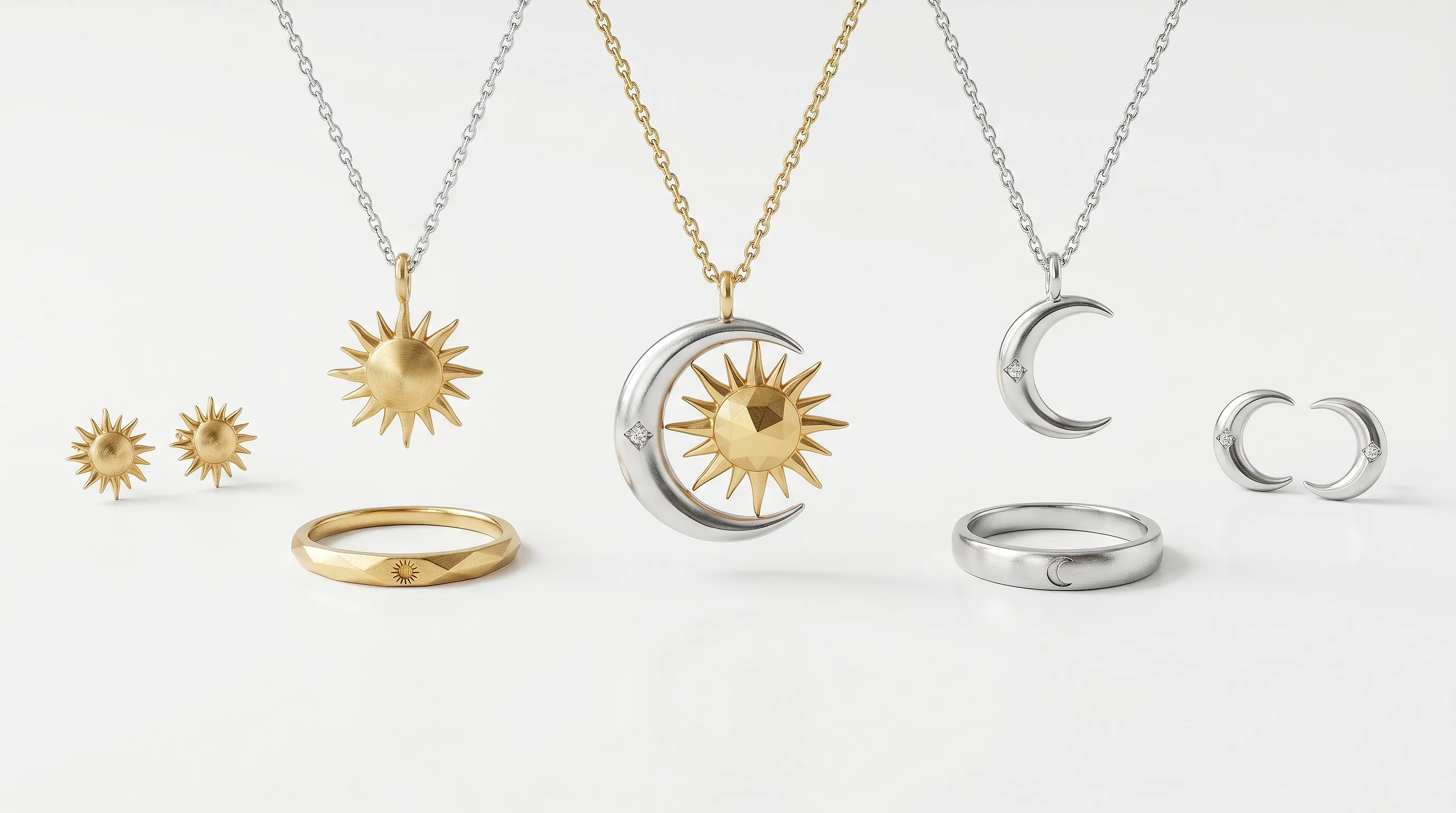
The most common form. The pendant is by far the most emblematic format: it is the most visible and the most loaded with meaning, the most commonly given as a gift. The crescent and star is a single piece on a chain. Classic composition places the star inside the arc of the crescent, set in the curve of the moon. Other designs juxtapose the two elements, or keep the crescent alone.
Earrings
Crescent and star earrings come in two main forms. Studs: small pieces placed directly on the earlobe, understated, suited to everyday wear and continuous use. Drop earrings: the crescent hanging from a post or a small chain, more visible and bringing movement. Mismatched pairs are a contemporary trend: one ear with a crescent, the other with a star.
Ring
A ring with a stamped or carved crescent and star on the flat surface. The more precious versions pave the crescent with small diamonds or stones, for a glittering effect that evokes moonlight. The ring is more discreet than a pendant and suits the wearer who wants the symbol present but understated.
Bracelet
A bracelet with crescent and star charms, or a fine chain with a single central element. The charm format suits those who like to accumulate meaningful symbols on one piece.
Brooch
Vintage style. The crescent and star as a brooch is a classical idea from the late nineteenth and early twentieth centuries, with direct Ottoman heritage. As the brooch returns to contemporary fashion, this format is regaining visibility.
Anklet and hair accessories
Thin chain with a crescent and star around the ankle. Especially popular in boho styles. Hairpins, combs and headbands with the crescent and star also appear, particularly in celestial-themed styling.
The crescent and star pendant
The most popular form deserves a closer look.
Classical layout
The crescent sits open to the right or upward. The five-pointed star sits beside or inside the crescent. Variations in orientation exist and are culturally neutral.
Sizes
Mini (up to 1 cm): barely visible, fine, for everyday wear. Suits layering with other pendants. Can be worn under clothing as a private sign.
Small to medium (1 to 2 cm): discreet, minimalist. Suitable for everyday wear, layering, working environments. The most versatile range.
Medium (2 to 2.5 cm): the classic size. Most popular. Visible but not overwhelming. A safe choice for a gift.
Large (3 cm and up): a statement piece. For formal occasions, evening wear, or boho looks. Needs an open neckline and worn with confidence.
Designs
Classic: a simple crescent sheltering a five- or eight-pointed star. The most recognisable composition, without ambiguity.
Modern minimalist: clean lines, plain metal, no stones. Suits contemporary aesthetics and fine-chain layering.
Ornate: the crescent paved with small diamonds or stones, the star as a central gem. A shimmering treatment suited to evening pieces.
Calligraphic: crescent combined with Arabic inscription. Explicitly religious in character, intended for observant wearers.
Enamel: the crescent and star enamelled. Common: blue or green enamel against gold metal, drawing on Turkish and Maghrebi jewellery tradition.
Star variants
Five-pointed: the classic Ottoman version. The most common by far.
Six-pointed: occasionally used, less canonical in Islamic tradition.
Eight-pointed: appears in Central Asian and Arabic regional traditions. Visually striking.
Chain
Standard chain length is 40 to 50 cm. A chain of 40 to 45 cm places the pendant at the throat; 50 cm brings it to the collarbone. For more on chain types and lengths, see the chain types guide and the chain length guide.
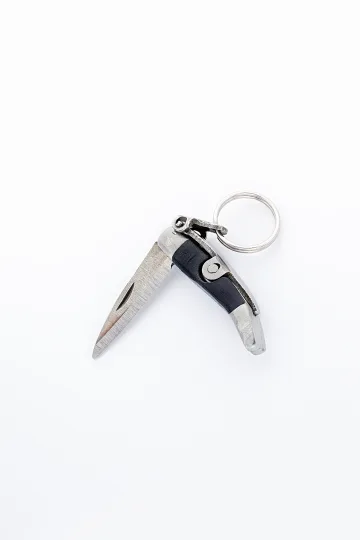
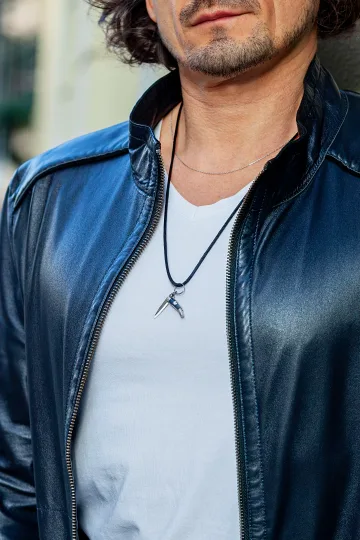
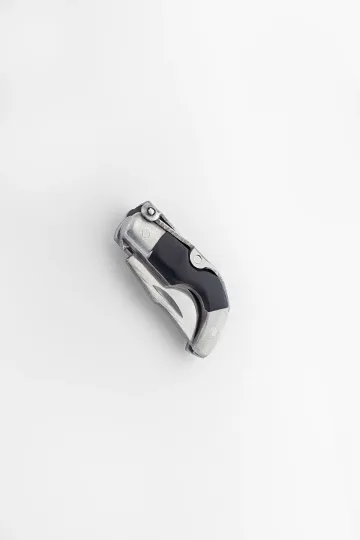
CAPAORA mini knife pendant
The 18th-century Spanish navaja in miniature: 40 mm of stainless steel, a real folding mechanism and a Palanquilla lock that clicks. An affordable gift to remember.
Authentic · Ships from Spain · 14-day returns
Earrings and rings
Less common but with their own appeal.
Earrings
Studs. Small crescent and star pieces on the earlobe. Minimalist, suited to continuous wear.
Hoops. A round earring with a small crescent and star within the hoop. Contemporary style.
Drops. A long earring with the crescent and star hanging at the end. More visible, ceremonial, suited to evenings.
Mismatched. Modern trend: one ear with a crescent, the other with a star. Asymmetric and playful.
The crescent in earring form pairs well with other celestial charms: single stars, suns, planets, in a personal night-sky combination.
Rings
Signet. A flat ring with a stamped or engraved crescent and star. Vintage feel, echoing Ottoman signet tradition.
With stones. A ring with a small diamond or other gem in the star position, the crescent forming a metal arc.
Stacking. A thin ring with the crescent and star as part of a set of several thin rings worn together.
The ring format is more discreet than the pendant and a good choice for someone who wants the symbol present but not centred.
Materials: gold, silver, enamel
The most common choices.
Yellow gold
Traditional choice. The colour of the symbol on Ottoman and modern flags. Warm, classic, does not tarnish, and carries the weight of tradition. Especially dominant in Maghrebi and Turkish jewellery for this motif. Yellow gold suits warm and olive skin tones particularly well and is the natural choice for a family piece intended to be passed down.
White gold and platinum
A modern choice. Cool finish, fits minimalist styling and cooler skin tones. Takes the crescent and star out of its traditional oriental context and places it firmly in contemporary celestial jewellery.
Rose gold
A trend of the 2010s and 2020s. Warm pink-gold colour, romantic feel. Less traditional but widely liked among younger buyers.
Silver
Sterling 925 silver is accessible and classic. It tarnishes over time and needs occasional care, but its cool tone suits contemporary styling well. Historically, silver was also the metal of choice for many amulets in the Ottoman and wider Islamic tradition.
Enamel
The crescent and star can be enamelled: blue or green enamel is characteristic of Turkish and Maghrebi traditions. Blue is also connected to protection against the evil eye. Enamel is delicate: it chips under sharp knocks and should not contact chemical cleaners.
Stones
Small diamonds, sapphires (especially blue), turquoise (a traditional stone in Ottoman and Central Asian contexts), garnet, opal. The star can be a single small stone at its centre, or the crescent can be fully paved with small stones.
Mixed materials
A gold crescent with a silver star, or contrasting metals in a single piece. Modern designer style.
How to choose the pendant size
A practical question.
By body proportions
Petite frame: smaller (1 to 1.5 cm).
Average build: medium (1.5 to 2.5 cm).
Tall or larger frame: can carry a larger piece (2.5 to 4 cm).
By neckline
Round and V-necks: any size works.
Open necklines (deep V, off-shoulder): medium or large for visibility.
Closed necklines (polo, high sweater): small or medium so the pendant does not get tangled.
By style
Minimalist: small (1 to 1.5 cm), thin chain.
Classic: medium (2 to 2.5 cm).
Boho or occasion: medium to large (2.5 to 4 cm), often with additional elements.
Statement: large (3 to 5 cm), striking metal, worn with assurance.
For a gift
If you know the recipient's style well, a medium size is the safest choice: it suits most situations. If you are less certain, a smaller piece integrates into almost any existing wardrobe without clashing. For a gift with religious significance to a Muslim recipient, a medium size reads more clearly as a sign of faith.
Layering
When wearing several pendants, the crescent and star is usually one of the middle layers. Choose chains of different lengths (for example 40, 45, 50 cm) so the pendants fall at different levels and do not tangle.
The symbol in men's jewellery
A growing trend.
Historically
In the Ottoman tradition men also wore the crescent and star, especially as signet rings and brooches. A symbol of faith and social identity.
Today
Modern Muslim men often wear a crescent and star pendant on a chain (especially around their wedding) and as a signet ring. A sign of faith and belonging. Across North Africa, Turkey and the Gulf, the male crescent pendant is a well-established tradition. Contemporary young men outside Muslim-majority countries also wear the symbol as an aesthetic or cultural marker within the broader trend for male jewellery.
Designs for men
Wider, heavier chain. Thicker than women's, often 2 to 4 mm wide. Curb chain or figaro are common.
Larger pendant. 2.5 to 4 cm. Proportional to the broader physique and heavier chain.
Minimalism. Without small stones or filigree. A clean, strong silhouette.
Texture. Brushed, oxidised, or antiqued metal gives a masculine, worn-in quality.
Signet ring. The crescent and star engraved on a signet, worn on the right hand, is a classical Ottoman male tradition still practised today.
Cultural acceptance
In Muslim-majority cultures the symbol on a man is fully accepted and understood as a sign of faith. In Western contexts a man wearing the crescent and star is read as a sign of faith and cultural identity, worn with clear intention.
Send a friend a discount code, they save on their first order.
Care and storage
Practical advice for keeping the piece looking right.
Gold
Minimal care. Warm soapy water and a soft brush periodically. Rinse and dry thoroughly. Gold does not tarnish, is not harmed by water or sweat, and is the most straightforward material to live with long-term.
Silver
Tarnishes over time through contact with air and skin. A specialist silver polishing cloth brings back the shine quickly. Between wears, store in an anti-tarnish pouch. Avoid contact with perfume, chlorine, and sulphur-containing substances.
Enamel
Avoid sharp knocks (enamel chips). Wipe with a soft damp cloth. No acidic or abrasive cleaners. Avoid extreme temperature changes.
Stones
Care depends on the stone. Diamonds and zircons are hardy. Turquoise and lapis-lazuli are softer and porous: they dislike prolonged water exposure, chemicals, and impact, and need very gentle cleaning.
For full care guidance, see how to clean tarnished jewellery and enamel jewellery care.
Who to give a crescent and star piece
A practical question.
A Muslim woman
Common and welcome. For an 18th birthday, Eid al-Fitr or Eid al-Adha, a wedding, a birth, or a graduation. A culturally and religiously rich gift. For an observant believer, a more traditional or calligraphic design adds extra depth. For a Muslim woman who is less practising, the symbol as a cultural link and family memory is equally valid.
A woman of Maghrebi or Turkish heritage
For someone of North African or Turkish heritage, the crescent and star can signal family memory and cultural continuity even without active religious practice. The gift acknowledges where she comes from.
A Muslim man
A wedding gift from a spouse or family, or a piece for a milestone. The signet ring with the crescent and star has a long Ottoman male tradition.
A non-Muslim woman who loves the symbol
Acceptable if the recipient genuinely connects with the symbol for its lunar, celestial, or aesthetic meaning, independently of religious context. It is worth being clear in how the gift is presented, framing it as a lunar or celestial symbol.
A child
Small simple silver versions are traditional gifts for Muslim children at family celebrations. For a non-Muslim child, a minimalist crescent makes a beautiful first pendant.
To yourself
Always appropriate. A personal attachment to the moon, the night sky, a cultural heritage, or simply an aesthetic preference is entirely sufficient reason.
When not to give
If you are not sure the recipient will appreciate the symbol, choose a more neutral piece. The crescent and star carries weight; not every recipient will read them the same way.
Ethics of choice: respect for the symbol
Silver, gold, engagement rings, symbolic jewellery, paired sets.
A serious point.
A non-Muslim wearing the crescent and star
Wearing the crescent is legitimate when you genuinely love the motif for its aesthetic, when you connect with its universal lunar symbolism, or when the piece ties you to a real cultural or family memory. The crescent does not belong to one tradition alone: it has been Mesopotamian, Greek, Byzantine, Ottoman, secular and romantic in turn. Wearing it for its celestial dimension or for the beauty of the design is entirely consistent with the long history of the symbol.
What calls for reflection is reducing a symbol to a purely fashionable effect without any awareness of what it represents for those who hold it sacred. Knowledge changes everything: wearing the crescent knowing what it means for believers is wearing it with respect, even when you are not yourself a believer.
What to say if asked
If asked "are you Muslim?" while wearing the symbol, the honest answer (yes or no) is best. If no, a brief, calm explanation of why the symbol matters to you prevents misunderstanding. There is no need for a defensive tone. The symbol has two thousand years of history and numerous legitimate uses.
Cultural appropriation
The line between appreciation and appropriation depends on awareness, respect, and context. The general principle: if you can hold a meaningful conversation about the symbol's history and meaning, you wear it with respect.
Universal reading
The crescent and star has older meanings (lunar deity, femininity, cycles) that are independent of Islam. Wearing the symbol with that reading in mind is reasonable. The dominant modern reading remains Islamic, but the symbol's older meanings have never been extinguished, and many contemporary wearers engage with them genuinely.
Frequently asked questions
What does the crescent and star symbolise?
In the modern world most often Islam and Muslim identity. Historically: lunar deities, cycles, femininity, the city of Constantinople, the Ottoman Empire. Today also a widely used celestial and romantic motif.
Is the crescent and star originally a Muslim symbol?
No. Originally it was a Mesopotamian celestial sign, then the emblem of the Greek and Christian city of Constantinople, then the emblem of the Ottoman Empire, and only in the nineteenth and twentieth centuries became widely associated with Islam.
Why is the crescent on flags of Muslim countries?
Because of the Ottoman Empire's influence on Muslim-majority countries that took independence in the nineteenth and twentieth centuries. Many adopted the symbol as a sign of solidarity with Ottoman heritage and Muslim identity. But many Muslim-majority countries do not use it on their flag, which confirms that the symbol is a cultural choice rather than an obligatory religious emblem.
Can a non-Muslim wear the crescent and star?
Yes, with respect and awareness of the religious context. The symbol has older non-Islamic meanings as well, and many people wear it for its lunar, aesthetic, or celestial significance.
What does the star in the crescent stand for?
Several interpretations coexist: Venus as a companion to the moon in ancient cultures; a star of guidance or paradise in Islamic usage; spiritual illumination in more general symbolic reading.
Which finger or where to wear it?
Most often a pendant on a chain. Earrings, ring, bracelet are also options.
What size pendant works for everyday wear?
Small or medium (1 to 2.5 cm). Modest, comfortable, daily wearable.
Will it offend Muslims if a non-Muslim wears the crescent and star?
Most Muslims do not see it as offensive if worn respectfully. Some more conservative Muslims may view it less favourably. Awareness of the symbol's religious meaning is the essential thing.
Does the symbol exist outside Islam?
Yes. It is part of pre-Islamic Turkic, Mesopotamian, ancient Mediterranean traditions. Wiccan and Neopagan practices use the crescent moon symbol in their own way. The symbol also appears in Catholic and Orthodox Marian iconography.
What is the difference between a crescent alone and a crescent with a star?
The crescent alone is a more general lunar symbol. The crescent with the star is more closely associated with the modern Islamic and Ottoman tradition. The crescent alone is preferred by some Muslims precisely because the star is the Ottoman addition.
Should the crescent face left or right?
Both orientations exist. The most common has the opening to the right (facing right for the viewer). There is no universal rule, and both directions appear in Islamic and secular jewellery.
Can the crescent be combined with other symbols?
Yes. Often combined with the hamsa hand, the evil eye (nazar), and other celestial elements. For more on those, see the Hamsa hand guide and the evil eye guide.
Is gold or silver better for this piece?
Both work. Gold for the classical Ottoman feel, durability, and transmission as a family piece. Silver for accessibility, contemporary styling, and everyday wear.
Will the silver tarnish?
Yes, silver tarnishes over time. A polishing cloth every few months brings the shine back. Store in an anti-tarnish pouch between wears.
Can I give a Muslim friend a crescent and star piece?
Yes, this is a thoughtful and respectful gift. Make sure the design suits the recipient's personal style and, if they are observant, consider a more traditional or calligraphic design.
Does the colour of the star matter?
In Ottoman tradition the star and crescent are white on a red field. In jewellery the colour varies freely. Star and crescent are most often the same metal, though enamel accents in blue or green also have cultural roots in Turkish tradition.
Buying it as a gift? Each one arrives ready to give.
 A branded Zevira box and a little card come with every order.




Conclusion
The crescent and star is a symbol with a layered history: from ancient Mesopotamia to modern Islam, passing through Greece, Rome, Byzantium, and the Ottoman Empire. Each era added its meaning; none cancelled those that came before. Understanding the full history makes the choice meaningful. The piece can be worn as a religious sign, as a connection to Ottoman and Byzantine heritage, as a universal lunar and feminine symbol, or simply as a beautiful aesthetic motif.
Three principles guide the choice. First: understand what you are wearing. The symbol has a strong and real meaning for many believers; knowing this allows you to wear it with respect whatever your own motivation. Second: choose the design according to your use. A small minimalist pendant for daily wear; a larger or more ornate piece for special occasions; a traditional or calligraphic design for a religious gift. Third: hold the context. The crescent and star is a symbol that connects thousands of years of human culture. Wearing it is a small participation in that long history.
What else to read. On lunar symbols generally, the moon phases meaning guide. On celestial jewellery, the celestial jewellery guide. On other meaningful symbols, the complete symbols guide. On the Hamsa, the Hamsa guide. On the evil eye, the evil eye guide.
About Zevira
Zevira makes jewellery in the artisan tradition of Albacete, Spain. The crescent and star is one of the lunar motifs we return to again and again, from a fine minimalist outline to fuller pieces with enamel and stones in an oriental key.
What you can find with us in the crescent and star theme:
- Slim gold and silver pendants with a crescent and a small star for everyday wear
- Fuller pendants with an inlaid star (opal, pearl, turquoise)
- Stud earrings and mismatched pairs: a crescent in one ear, a star in the other
- Rings and signet rings with the crescent and star in an oriental style
- Versions in blue and green enamel that nod to the Turkish and Islamic palette
- Men's pieces: heavier, in oxidised silver and dark gold
Every piece can be personalised with engraving, with the option of personal engraving. Sterling 925 silver and 14 to 18K gold.