Dragon Jewellery: Meaning of an Eastern and Western Symbol
Dragon Jewellery: Meaning of an Eastern and Western Symbol
Introduction
The dragon inhabits the mythology of nearly every culture on earth, making it one of the most universal figures the human imagination has ever produced. A Han dynasty farmer and a Welsh bard of the early Middle Ages never met, shared no texts, and spoke wholly incompatible languages, yet both drew a scaled, winged creature linked to water, fire, and power. That coincidence is too consistent to be accidental, and the fact alone is more arresting than any single legend.
In the East the dragon remained, for centuries, a noble being: bringer of rain, guardian of rivers, rider of clouds. The Chinese emperor sat upon the Dragon Throne, wore robes embroidered with lung, and was considered the earthly reflection of the celestial creature. In Japan, the ryu dwells in temple pools and mountain springs and is bound to Buddhist wisdom. In Korea and Vietnam the dragon carries different names and different duties, but the same register: not an adversary, but a patron best left unirritated.
In the West the picture was long the reverse. The Greek Python guarded the Delphic oracle until Apollo struck it down. Ladon coiled around the tree of golden apples until Heracles came for his eleventh labour. The Norse Fafnir became a dragon, lay upon gold, and fell to Sigurd's sword. Saint George drives his lance through the serpent on countless frescoes. Here the dragon is almost always the guardian of treasure, a trial for the hero, an interior enemy to be overcome in order to come of age.
What is interesting today is that this sharp border has begun to dissolve. Western popular culture, from fantasy fiction to board games, has gradually learned that a dragon can be an ally, that its wisdom matters more than its claws, that conversation is possible. Meanwhile the Eastern dragon has ceased to be exclusively imperial: it has become part of personal aesthetics, a mark of inner strength and endurance. The two traditions are still distinct, but no longer locked in the opposition that defined the age of chivalric romance.
In jewellery the dragon has made the same journey. For centuries it appeared on the signet rings of European families, on Chinese jade pendants, on Japanese netsuke, and on bracelets where scales flow into links. Today dragon-theme work in silver and gold is active again, and that is not simply a fashion for mythology. It is a return to an image that knows how to frighten and protect at once, and in that double register lives its true power.



Dragon Jewellery: What to Choose
The dragon catalogue in jewellery is broader than it first appears, and the form of a piece substantially affects how the image reads. A pendant with a dragon's head works very differently from a ring where a scaled body coils around the finger, and small winged earrings read almost as pure graphic mark. It is worth mapping the categories before choosing.
Pendants. A dragon pendant is probably the most common choice and certainly the most flexible. A dragon's head in profile with an open jaw and a rendered mane reads as a protective talisman in the Eastern tradition. A coiled body biting its own tail references the ouroboros and sits closer to European alchemical lineage. A small medallion with an engraved silhouette suits even wearers who normally favour minimalist jewellery: the dragon becomes a detail rather than a declaration.
Rings. A separate and very expressive category. The classic form, where the dragon's body wraps one and a half or two times around the finger with the head emerging one side and the tail the other, is close to canonical in the genre. Rings with a flat shield and relief dragon take us back into European heraldry: such rings once served as seals, closing letters in hot wax. Subtler options exist where the dragon is only suggested in ornament, and those rings stack well with others.
Earrings. Small format demands precision, and here either very spare silhouettes or, conversely, filigree work with fully rendered scales tends to succeed. Asymmetric pairs, one ear carrying the head and the other the tail, make the wearer part of a single composition, which is witty without being showy. Long drop earrings with a flying dragon suit special occasions and need a relatively bare neck and hair worn up.
Bracelets. Here scales find their element. A chain of scaled links encircling the wrist can dispense entirely with a head: texture and rhythm alone are enough to evoke a coiled creature. More narrative bracelets show the dragon in motion, tail resolving into a clasp. The paired format also works: one bracelet each for two close people can render a single joined silhouette, intersecting with the idea of paired jewellery built from complementary halves.
Brooches. Nearly forgotten, now returning. A dragon brooch on a lapel or a wool coat lands unexpectedly, particularly if the dragon is rendered in an engraved, almost book-illustrative manner. It is a sound way to carry an expressive image in formal dress without breaking a dress code.
Scale-texture chains. A separate sub-type where the dragon theme lives in texture rather than figure. Dense chains imitating armour or scales, without any depiction of the creature, still reference dragon mythology. Men and women wear them equally, and they combine well with plain solid-colour clothing.
Types of Dragon in Jewellery
When an artist takes on a dragon, the first question is which dragon, because there are several mythological traditions and mixing them is a mistake. A viewer familiar with the subject will instantly read whether the piece depicts a Chinese lung or a Norse serpent, and an error shows.
The Chinese lung. The most recognisable and the most regulated type. The body is long, serpentine, and wingless (it flies by supernatural power, not aerodynamics), with mane, whiskers, and antler-like horns. The face is elongated, the eyes large. Beyond the silhouette, the main distinguishing mark is claw count. Five claws on each foot marked an imperial dragon, reserved for the emperor and his immediate circle. Violation in the imperial era carried harsh penalties, and the tradition of the five-clawed dragon as the highest rank survives in decorative art today.
The Japanese ryu. A close relative of the lung but with its own character. The ryu typically has three claws, an even more serpentine body, a softer face, and a closer cultural bond with water and Buddhism. Japanese ukiyo-e prints depict the ryu among waves and clouds, and that compositional logic still shapes how the Japanese dragon theme sits in jewellery: the body usually moves diagonally across the piece, with a wave or cloud in the frame.
The Korean yong. Four claws, culturally between the Chinese and Japanese. Less common in jewellery but recognisable by its more compact proportions and short mane.
The Western winged dragon. This is what most Europeans mean by "dragon": a massive lizard body, powerful hind legs, often two fore-legs, large membranous wings, long tail, horned, fanged. This is the dragon of medieval heraldry, the creature in Beowulf, the Fafnir of the Norse sagas. In jewellery the Western dragon almost always occupies more space than the Eastern: its volume requires mass of metal, and pendants with it are rarely miniature.
The wyvern. A variant with only two legs (hind) and wings replacing the fore-limbs. English heraldry distinguishes the wyvern from the full dragon precisely, and an artist aiming for historical accuracy observes the distinction. The wyvern is considered slightly less regal and more aggressive.
Y Ddraig Goch, the Welsh Red Dragon. A distinct figure, resident on the flag of Wales since Tudor times and rooted in Celtic legend. In early Welsh texts Merlin prophesies about the red dragon that will eventually prevail over the white Saxon. Henry VII, of Welsh descent, brought the red dragon to the English throne. In jewellery it is rendered in red enamel or garnet, and wearing it is a mark of Celtic identity, related to other Celtic motifs such as the interlace knot.
The Slavic Zmey. The three-headed Zmey Gorynych of Russian byliny, Polish and Czech serpents, Balkan azdahe form a separate branch. Functionally closer to the Western dragon (adversary, abductor, fire-breathing evil), visually sometimes closer to Eastern: long body, multiple heads, strong connection with water and mountains. In contemporary jewellery this branch is evoked mainly through three-headedness and through engraving styled after early Slavic manuscript ornament.
History of the Dragon as Symbol
The oldest surviving dragon imagery comes from Mesopotamia. In the Babylonian epic Enuma Elish, Tiamat, goddess of primordial waters, is depicted as a vast serpentine being. The god Marduk cleaves her in two and makes sky and earth from the halves. The narrative of "hero defeats chaos embodied in a scaled creature" was born there and radiated outward through cultures.
In ancient Egypt the serpent Apep attacked the solar bark of Ra each night, and the falcon god beat back the assault. In India the serpentine nagas are simultaneously beneficent and dangerous, living underwater and guarding treasure. In Vedic tradition Vritra holds back the waters and the thunder-god Indra frees them with his vajra. The pattern is consistent: the dragon locks away a vital resource; a god or hero unlocks it.
China in the Shang and Han periods. In China the dragon underwent its decisive transformation: from chaotic monster to noble force. As early as the Shang dynasty (second millennium BCE) the stylised dragon mask taotie appeared on bronze ritual vessels. By the Han era, from the third century BCE to the third century CE, the dragon was firmly bound to imperial authority, to rain, and to the East as a cardinal direction. The five-clawed lung became the emblem of the emperor; lower-ranking dragons were distributed among officials and aristocracy.
Classical antiquity. Greeks and Romans knew dragons mainly as adversaries. Python and Ladon are noted above. Hesiod's Theogony populates a whole menagerie of scaled monsters descended from Typhon. The Romans added a practical note: the draco, a dragon standard, became the battle emblem of certain legions, and this likely influenced medieval European military symbolism.
The early Middle Ages. When Germanic and Celtic traditions met Christianity, the dragon's image moved almost wholly into the negative. Satan in Revelation is called the great dragon. Saints George, Martha, and Michael, among dozens of others, defeat dragons in hagiographic literature. This was the period when the scaled creature read unambiguously as evil, and the Western assumption we still live with was laid down.
Medieval heraldry. Interestingly, despite the Christian negative, dragons and wyverns entered coats of arms and banners. The Welsh red dragon, the English Tudor wyvern, the Lombard Visconti serpent swallowing a man: all emphasised not evil but the power of a lineage and its capacity to defend its lands. The dragon here is no longer the adversary but the ally, and that ambivalence has since been part of European visual language.
The Renaissance and after. Alchemists took from dragons the ouroboros, the self-biting serpent, as a sign of the cyclic unity of matter. Seventeenth-century naturalists discussed seriously whether dragons existed and drew them in zoological treatises. By the nineteenth century the dragon had migrated definitively into literature and decorative art, where it has remained. Victorian silver rings with dragon heads, Japanese netsuke with ryu, Chinese jade pendants of the Qing period: all are ancestors of contemporary dragon jewellery.
The Dragon in Different Cultures
China: Emperor, Rain, and Sky
The Chinese dragon is not simply a figure from stories but an element of state and cosmological system. The five principal dragons in classical classification are linked to five directions: the four cardinal points plus the centre. The Azure Dragon of the East joins the canon of four celestial creatures alongside the Vermillion Bird of the South, the White Tiger of the West, and the Black Tortoise of the North. The Golden Dragon of the Centre governs the earth. This framework shaped architecture, urban planning, even the orientation of tombs.
On the practical side the dragon was petitioned for rain and harvest. Drought signified that the lung was angry or asleep, and ceremonies were dedicated to it. The Dragon Boat Festival, celebrated on the fifth day of the fifth lunar month, still draws races in long decorated boats, a direct continuation of the ancient tradition. In Tang and Song period jewellery the dragon appeared on imperial consorts' gold diadems, on jade belt plaques, on pendants. Jade was considered the lung's favoured stone, and the pairing of dragon and jade has remained stable.
Japan: Water, Buddhism, and Quiet Wisdom
The Japanese ryu inherited much from its Chinese ancestor but developed a different temperament in local culture. It is less bound to state power and far more closely tied to natural elements, especially water. The ryu lives in temple ponds, mountain springs, the sea. Many Japanese temples stand on purportedly dragon sites, and the courtyard well is often shaped as a dragon's mouth. Buddhism introduced the idea of the dragon as protector of the Dharma, and the Eight Great Dragon Kings entered iconography. In Edo-period printmaking the dragon became a favoured subject: scrolls and fans with the ryu flying through clouds. From there Japanese jewellery inherited a compositional manner where the dragon's body is always in motion, always in its element, never fixed statically as on a heraldic shield.
Wales and the Celtic World: Red Dragon as Mark of the Land
Y Ddraig Goch is not simply a flag motif but a creature with a long genealogy. The Historia Brittonum of the ninth century tells of two dragons, red and white, fighting beneath a mountain. The young Merlin interpreted this for King Vortigern as a prophecy of Britons against Saxons. Henry VII Tudor, of Welsh descent, carried the red dragon onto the English throne, where it remained on royal banners until the union with the Scottish lion and Irish harp.
In Celtic jewellery the red dragon frequently interlaces with knotwork. The tradition of a dragon body that becomes the pattern itself, without beginning or end, derives from early medieval manuscripts such as the Book of Kells, where dragons and other creatures interlaced across pages into endless ornament. Silver with blackening and a red inset is close to canonical for this branch.
Scandinavia: Nidhogg, Fafnir, and Dragon-Ships
The Norse sagas gave world culture several significant dragons. Nidhogg lives at the roots of the world-tree Yggdrasil and gnaws them, embodying the destructive aspect of time. Fafnir, transformed from a greedy dwarf into a great serpent, lies on his hoard until Sigurd kills him and bathes in his blood, becoming nearly invulnerable. Beowulf at the end of his life fights a dragon and defeats it at the cost of his own death. In all these stories the dragon is always a trial through which the hero either passes and becomes great, or falls with dignity.
Viking ships carried dragon heads on their prows, the drakkar, not as decoration but as a warning to the spirits of foreign shores and to enemies. In Viking jewellery the dragon motif appears on fibulae, bracelets, and sword hilts. The stylisation is severe, almost abstract: the body becomes a ribbon of pattern twisting into S-shaped loops. Contemporary Scandinavian dragon jewellery frequently quotes exactly this visual language.
Wagner and the German Tradition
Beyond the Norse sagas, Germany gave the dragon tradition its own literary and musical dimensions. The Nibelungenlied, the Middle High German epic of the twelfth century, recounts how Siegfried slew the dragon Fafnir, bathed in its blood, and became invulnerable save for one spot on his shoulder where a leaf had fallen. Richard Wagner's Ring Cycle, premiered in Bayreuth in 1876, brought this dragon back into European cultural consciousness with a fully staged Fafner, making the creature a symbol of greed, hoarding, and the corrupting weight of gold. In German jewellery this lineage tends toward bold, sculptural forms: the dragon not as decorative motif but as a moral presence.
What the Dragon Symbolises
When someone chooses a piece of dragon jewellery, they are usually selecting not just an image but a specific set of meanings. That set depends on the cultural layer, and it is honest to name them separately.
Wisdom. In the Eastern tradition the dragon predates humanity, remembers the time when the world was still forming, and knows what humans cannot. This is not the book-learning of a scholar but the wisdom of long memory. To wear such a symbol is to claim not cleverness but steadiness and the capacity to see beyond the present day.
Protection and guardianship. In almost every tradition the dragon guards something: treasure, a temple, a spring, a border. In jewellery this function transfers to the wearer: a ring or pendant with a dragon is worn as a sign of self-protection, a reminder that personal boundaries also need defending. This is particularly legible in situations requiring one to hold one's ground against demanding circumstances.
Power. The imperial lung in China, royal dragons in European heraldry, military standards: the dragon was for centuries a mark of hierarchy. Today it no longer signifies literal rank; nobody seriously claims a throne. But the symbolic idea, "sovereign of one's own territory," "the person who decides how to live," has remained and is readable without explanation.
Fortune. A purely Eastern connotation. The Chinese dragon brings rain, and rain brings harvest, and by that chain it became a patron of prosperity. In contemporary context this functions more gently: the dragon as a sign under which it is useful to begin a project, a move, a new chapter. Not because it does anything magical, but because the wearer is more focused and acts more deliberately.
Trial and the internal enemy. The Western line. The dragon that the hero slays is not simply an external monster but a metaphor for what one must pass through in order to come of age. The Jungian school of psychology directly linked the dragon-slaying myth to the process of individuation. In this reading a dragon pendant is not a reminder of victory over an external adversary, but of the capacity to recognise and overcome one's own fears and ingrained habits.
Connection with fire and water. The elemental layer, shared across many traditions. The dragon breathes fire and lives in water, combining opposites and thereby symbolising wholeness. That rare combination gives the image unusual stability: the dragon cannot be reduced to a single element.
It is worth stating clearly what the dragon does not do. It does not bring romantic love, does not guard against specific illness, does not substitute for medicine, and does not draw money. Such promises sometimes appear in esoteric shops and have no relation to the authentic mythological tradition. The genuine meanings of the dragon are strong enough to need no such additions.
Materials and Techniques
Metal for a dragon piece is chosen with an eye to surface texture, because the creature's scales and musculature require play between light and shadow. A purely polished surface rarely serves. Several technical approaches have therefore become established.
Silver with oxidising. The classic choice and the most common. Oxidising forces dark pigment into the recesses of engraving, and scales, folds, and muscles emerge with sharpness. Raised areas polish slightly over time through contact with clothing, while the dark lines remain deep, and the image grows only more expressive with years. Such silver needs minimal care: wipe with a soft cloth and avoid abrasive cleaners that would lift the oxidising.
Yellow and rose gold. Gold works differently: it gives a warm, almost honeyed light that suits Eastern motifs well. A gold Chinese lung looks natural, because in China the imperial dragon was often depicted in gold. For the Western winged dragon gold also works, particularly in a heraldic, seal-type composition.
Platinum and white gold. Less common, but chosen when an artist wants to stress the cold, sharp character of the dragon and link it to the metals of armour, sword, and steel. A platinum wyvern reads as a character from a chivalric romance cast in gemstone-grade metal.
Cloisonne enamel. A technique without which any discussion of Eastern dragons is incomplete. In cloisonne, thin wires are soldered onto the metal surface forming cells, each cell filled with coloured enamel and fired. Chinese jingtailan enamel is a direct descendant of this technique. On dragon pendants and bracelets cloisonne allows colour to enter the piece -- green, blue, red, gold -- while preserving clean graphic lines. This is not mass production: each piece requires hours of hand work.
Engraving. The primary method for rendering scales. Several schools exist: Eastern fine-needle engraving produces dense, small patterns close to actual fish scale. European burin-cut work is broader and gives a more relief, almost sculptural surface. The choice of school follows the intent: an Eastern dragon calls for fineness, a Western dragon often reads better in bold cut.
Eye insets. A small detail on which everything depends. The dragon's eye is where the viewer's gaze returns, and the maker typically sets a small stone: garnet, ruby, black onyx, sapphire, sometimes enamel. Red eyes read as martial, black as mystical, blue as aquatic (for the ryu). In Zevira pieces with Eastern motifs, small garnets are preferred because their warm tone complements silver oxidising and enamel.
Relief and depth. Many dragon pieces are made in multiple planes: the body projects, wings recede to another level, the background carries its own texture. This requires either casting from a composite wax model or a combination of casting and subsequent hand-finishing. Mass-stamped jewellery cannot achieve this degree of depth, and the difference between handwork and stamping is visible even to an untrained eye.
How to Wear
Dragon jewellery announces itself by default, and that needs accounting for. Placing it in the right context is easier than trying to minimise it, so there are some working principles.
First principle: one accent at a time. A substantial ring with a coiling dragon is already an event in itself, and adding an equally expressive pendant and heavy earrings is too much. If the ring carries the main part, other pieces recede into support: a fine chain, a simple pendant, small stud earrings. The rule applies in reverse: if a long-chain dragon pendant is the centrepiece, keep the rings neutral.
Second principle: a monochrome or very calm ground. The dragon's own pattern is rich, and it conflicts with busy fabric, bold prints, bright patterns. A black sweater, a white shirt, a grey jumper, a dark navy roll-neck: all allow the piece to emerge. For summer, a natural-coloured linen shirt works because it does not compete with the metal and brings out the relief.
Third principle: chain length. A dragon pendant usually gains from a medium or long chain, not at the throat. When the pendant falls below the collarbones, the dragon has room for its gesture and the viewer sees it in full rather than in pieces peeking above a neckline. A shorter chain works for small pendants where the dragon is sign rather than scene.
Fourth principle: pairing with other mythology. Combining dragon jewellery with other strongly mythological motifs is risky. A dragon alongside a cross, a Star of David, an Om, or an Egyptian ankh creates visual noise and semantic conflict. If building a personal collection of symbolic pieces, place them on different parts of the body -- one at the neck, one at the wrist, one on a finger -- but arranged so they do not clash in the same frame.
Fifth principle: gender and format. Dragon jewellery is worn by men and women equally today, and there are no rigid rules. But form does work differently. Heavy rings and wide bracelets tend toward male wardrobes; fine earrings and smaller pendants toward female. Medium pendants are universal. In paired sets where the dragon divides into two halves or becomes two dragons in engagement, a pleasing shared story emerges, and that direction is developing actively.
Sixth principle: occasion appropriateness. In an office a substantial dragon ring may read as eccentricity, and that is not always helpful. But a small dragon pendant beneath a shirt collar, a discreet brooch on a lapel, or an understated engraved signet work even in fairly formal environments.
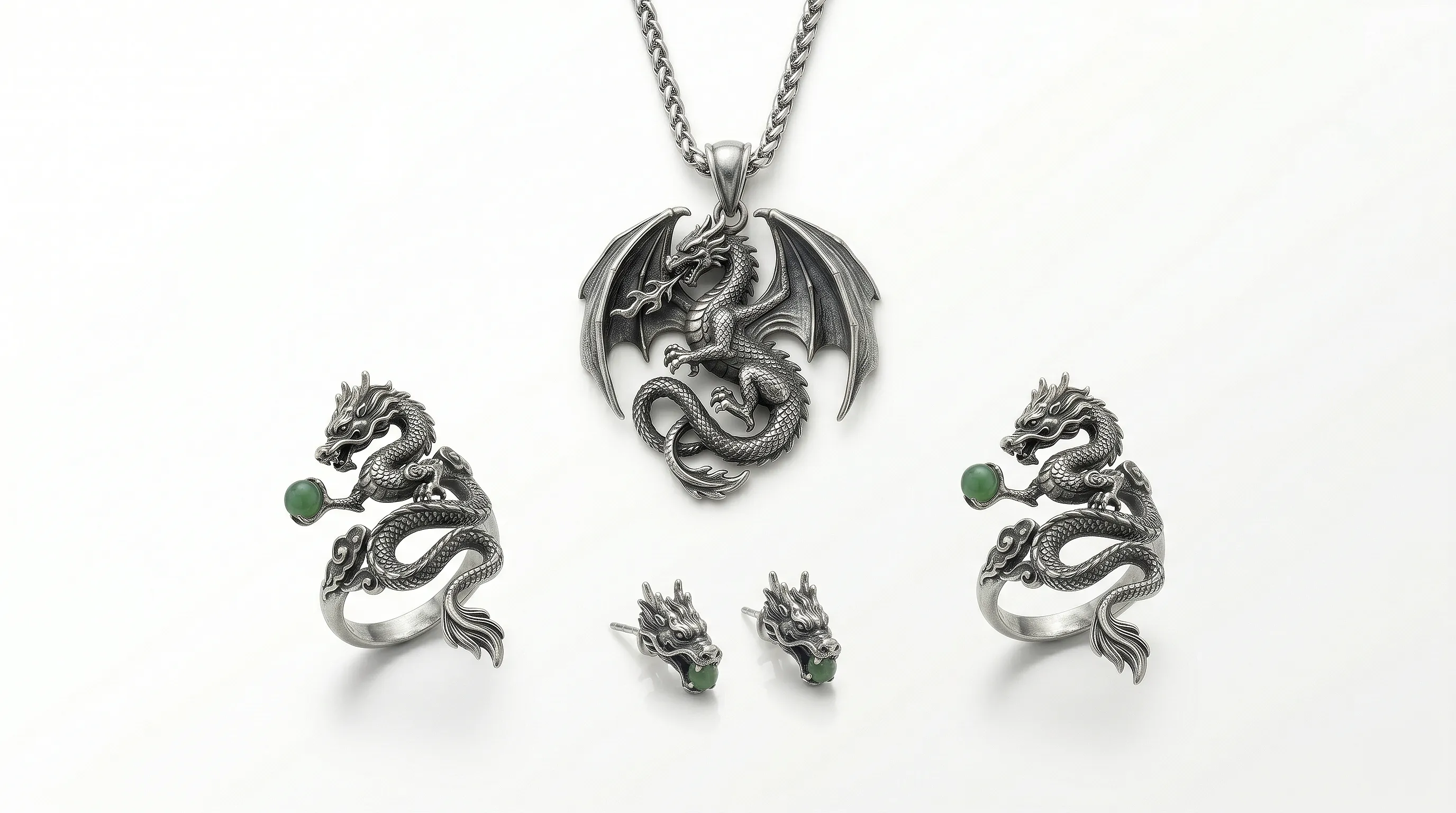
Rings, pendants, and earrings with Eastern and Western dragons in silver and oxidised silver.
Who It Suits
Dragon jewellery is not a universal gift, and saying so honestly matters more than stretching to claim it suits everyone. There are groups for whom this image genuinely works.
First, lovers of mythology and history. For someone who reads sagas, has an interest in ancient China, and knows the difference between a wyvern and a full dragon, the piece becomes not a decoration but a continuation of a conversation. Such a wearer can explain that what is on their finger is specifically a Japanese ryu rather than a Chinese lung, and that distinction matters to them.
Second, people drawn to Eastern aesthetics. Japan, China, Korea as cultural worlds have become part of many people's personal interest: film, literature, ceramics, calligraphy. A dragon piece in the Eastern school is for such a person a logical element of a broader style, alongside other elements of that engagement.
Third, those drawn to Gothic and dark aesthetics. The Western dragon with its ties to the Middle Ages, castles, alchemy, and heroic legend fits naturally into a wardrobe that already includes blackened silver, wide rings, heavy chains. This need not be subcultural Gothic: it may simply be a taste for austere gravity.
Fourth, people for whom strength and endurance are part of their self-definition. Athletes, members of the armed forces, surgeons, entrepreneurs under sustained pressure often choose symbolic jewellery not for aesthetic reasons but as a daily reference point. The dragon image works without any magic: metal is cold against skin, engraving is tactile under a fingertip, and in a difficult moment this returns the wearer to a collected state.
Fifth, adolescents and young adults finding a visual language for a passage. The dragon-slaying myth is not associated with initiation rites by accident. A dragon piece given or bought for oneself at a turning point fixes that threshold. It is one of the few situations where a mythological symbol genuinely functions as a personal marker.
Who it suits less well: people seeking a maximally neutral everyday accessory, those not prepared to field questions about their choice, the committed minimalist. A dragon is always visible, and if that quality is an irritant, something more restrained is the better path.
Frequently Asked Questions
What is the difference between an Eastern and a Western dragon? The Eastern dragon -- Chinese lung or Japanese ryu -- has a long, wingless, serpentine body, is bound to water and sky, and is regarded as a noble and protective being. The Western dragon is winged, massive, connected with fire and treasure, and in the Christian tradition was a symbol of evil; in heraldry it stood for the power of a lineage. The two are easy to tell apart by the presence or absence of wings and by their proportions.
How many claws should a dragon have? The Chinese imperial lung has five claws per foot; an ordinary Chinese dragon typically four; the Japanese ryu three; the Korean yong four. This is not decorative choice but a mark of rank, and a craftsperson working carefully respects the tradition. If a piece claims Chinese style but the dragon has three claws, that is a slip, not a variant of the Chinese canon.
Is the dragon a masculine or feminine symbol? In most traditions the dragon is masculine, but not exclusively. In China the lung is paired with the feng-huang phoenix, the pair representing emperor and empress, male and female. In contemporary jewellery dragon pieces are worn by all genders; the difference lies more in the format of the piece than in the symbol itself.
Can I wear a dragon piece if I have no interest in mythology? Yes. The image is strong and self-sufficient enough to function as a decorative element even when the wearer has not read a saga. But knowing the context adds pleasure: understanding that your ring bears a Welsh dragon or a Norse Fafnir is more satisfying than wearing "some creature."
How does dragon jewellery work with a classic suit? Best approach: one piece of modest or medium size, most often a signet ring with an engraved shield or a discreet pendant worn under a shirt. Large coiling rings and long pendants sit uneasily with a formal suit. For business environments a restrained dragon is appropriate; in informal settings a more expressive piece is possible.
Do religious people of different traditions wear dragon jewellery? Practice varies. In Buddhist and Daoist traditions the dragon is a natural part of the cultural landscape and is worn without question. In Christian circles the historical attitude has been more cautious given the apocalyptic symbolism, though for many contemporary believers this is long since a matter of aesthetics rather than dogma. In Jewish and Islamic contexts the attitude is generally easy, and dragons in the Eastern interpretation appear even in Islamic miniature painting. Each wearer decides for themselves how this fits their own value system.
About Zevira
Zevira is a Spanish jewellery house based in Albacete. The dragon line is one category within the catalogue. Current availability and details are in the catalogue.
The dragon has held its place in world culture longer than almost any other symbol, and that persistence is not coincidence. It unites fear and admiration, threat and protection, chaos and order, and that internal contradiction makes it inexhaustible. When one era tries to reduce it to a monster, the next era finds in it a wise counsellor, and the image outlives every ideological fashion.
A dragon piece does not change a life or bring magical fortune -- making such a promise would be dishonest. What it does is simpler: each day the wearer puts on the ring or fastens the chain, they receive a brief reminder of their own choice, of which story they consider their own. That is enough to keep the dragon motif alive a thousand years after the first craftspeople began engraving scales onto silver.