Gold Plating on Jewellery: How Long It Really Lasts and What Determines It
Gold Plating on Jewellery: How Long It Really Lasts and What Determines It
An Honest Conversation About Coatings
A gold-plated ring looks like gold. It costs considerably less than gold. That is the entire appeal. The golden glow without the golden price.
But there is a question that sellers prefer to avoid: how long will it last? And the answer depends on a dozen factors that most buyers only learn about after the coating has started to wear away.
This guide is about the truth. No marketing promises of "everlasting gold plating" (those do not exist) and no panic about "gold plating is rubbish" (that is also untrue). Gold plating is a technology with specific parameters, and if you understand them, you can make informed decisions.
What Gold Plating Is and What Types Exist
Gold plating is a thin layer of gold applied to the surface of another metal (the base). The base is usually stainless steel, brass, copper or silver. The gold sits on top, ranging from a few atoms to several microns in thickness.
And here is where it gets interesting: "several microns" is an enormous range.
Flash Plating
Thickness: less than 0.175 microns. Essentially, a golden mist on the surface of the metal. Cheap costume jewellery from the high street is usually flash plating. It looks excellent in the shop. After 2 to 4 weeks of active wear, the coating begins to wear on raised areas. After a couple of months, the base is visible.
This is not a defect. It is physics: the layer is so thin that any friction removes it.
Gold Plating (Standard)
Thickness: 0.5 to 2.5 microns. The most common type in mid-range jewellery. Lasts from 6 months to 2 years with daily wear. With careful handling, longer.
Legally, to be called "gold plated" in the US, the coating must be at least 0.5 microns. In the EU, requirements vary by country, but generally the term implies a measurable layer of gold deposited by electroplating.
Gold Vermeil
Thickness: minimum 2.5 microns of gold on a base of 925 sterling silver. Vermeil is a standard. Not just any thick gold plating, but specifically: gold of at least 10 karats, on silver, at least 2.5 microns.
Lasts longer than standard plating (1 to 3 years with regular wear). The silver base is hypoallergenic. Visually closer to real gold than thin plating on brass.
Gold Filled
Thickness: minimum 5% gold by total weight of the piece. This is not a coating in the classic sense - it is a layer of gold mechanically bonded to the base metal under pressure and heat. The gold layer is 50 to 100 times thicker than standard plating.
Lasts 10 to 30 years. Some gold-filled pieces from grandmothers still look decent. This is closer to real gold in terms of durability than to a coating.
PVD Coating (Physical Vapour Deposition)
Not gold plating in the traditional sense, but often used to create a gold colour. A metal (titanium, zirconium or their nitrides) is deposited onto the surface in a vacuum chamber. The coating is exceptionally hard - harder than gold itself.
Lasts 3 to 10 years with daily wear. Does not wear through friction the way traditional plating does. But the colour is not quite gold. PVD gold is slightly cooler, slightly more artificial than the real thing. For most people, the difference is unnoticeable.
Comparison Table
| Coating type | Thickness | Lifespan | Can be replated | Cost |
|---|---|---|---|---|
| Flash plating | < 0.175 um | 2-8 weeks | Not worth it | Low |
| Gold plating | 0.5-2.5 um | 6 months - 2 years | Yes, by a jeweller | Medium |
| Gold vermeil | 2.5+ um on silver | 1-3 years | Yes | Above medium |
| Gold filled | 5% of weight | 10-30 years | Not needed | High |
| PVD | 0.5-5 um (ultra-hard) | 3-10 years | Difficult | Medium-high |
What Destroys Gold Plating Fastest
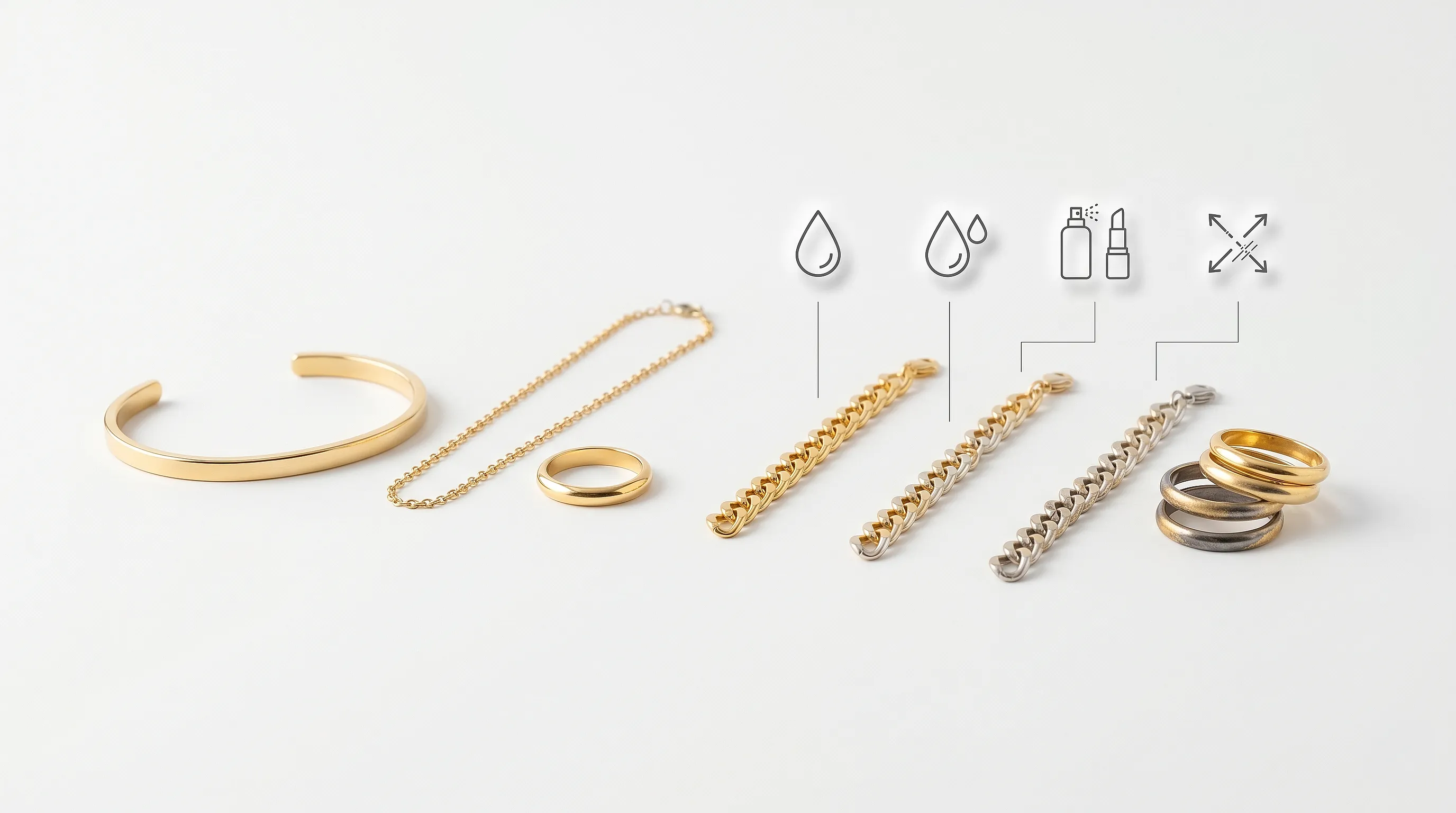
Water
Showers, swimming pools, washing up. Water itself does not dissolve gold, but:
- Chlorine in pools chemically attacks the coating
- Soap and shampoo create an alkaline environment that weakens adhesion
- Hot water accelerates all chemical reactions
- Moisture trapped between skin and jewellery creates a micro-environment for corrosion of the base metal
One bath will not kill the plating. A daily shower wearing a bracelet will kill it within months.
Perspiration
Perspiration is a salty, acidic liquid. Its pH ranges from 4.5 to 7.0, and it contains chlorides, ammonia and urea. For a thin gold coating, this is an aggressive environment. People with more acidic sweat (this is genetics, not hygiene) lose their plating faster.
The gym in gold-plated earrings is a guaranteed way to accelerate wear.
Cosmetics
Perfume, lotions, creams, hairspray, sun cream. All contain chemical compounds that react with gold plating. Alcohol-based products (perfume) and acid-based products (AHA/BHA in skincare) are particularly damaging.
The rule: jewellery goes on last, comes off first. Apply makeup, spray perfume, wait two minutes, then put on the jewellery.
Friction
Mechanical wear. Rings suffer the most - they contact tables, keyboards, steering wheels, other rings. Pendants on a chain last longer - they hang freely and touch very little. Earrings last longest of all: minimal contact with surfaces.
Wear rate by jewellery type:
- Rings - fastest wear
- Bracelets - second (contact with desks, keyboards)
- Chains - moderate (links rubbing against each other)
- Pendants - slow
- Earrings - slowest




How to Extend the Life of Gold Plating
Remove Before
- Showering and bathing
- Exercise
- Applying cosmetics and perfume
- Washing up
- Swimming (especially in chlorinated water)
- Sleeping (sweat plus friction against the pillow equals double damage)
Store Properly
Separately from other jewellery. Metal scratches metal. Ideally in individual pouches or compartments of a jewellery box. Not in a heap.
Store in a dry place. A humid bathroom is the worst place for gold plating. Bedroom, wardrobe - better.
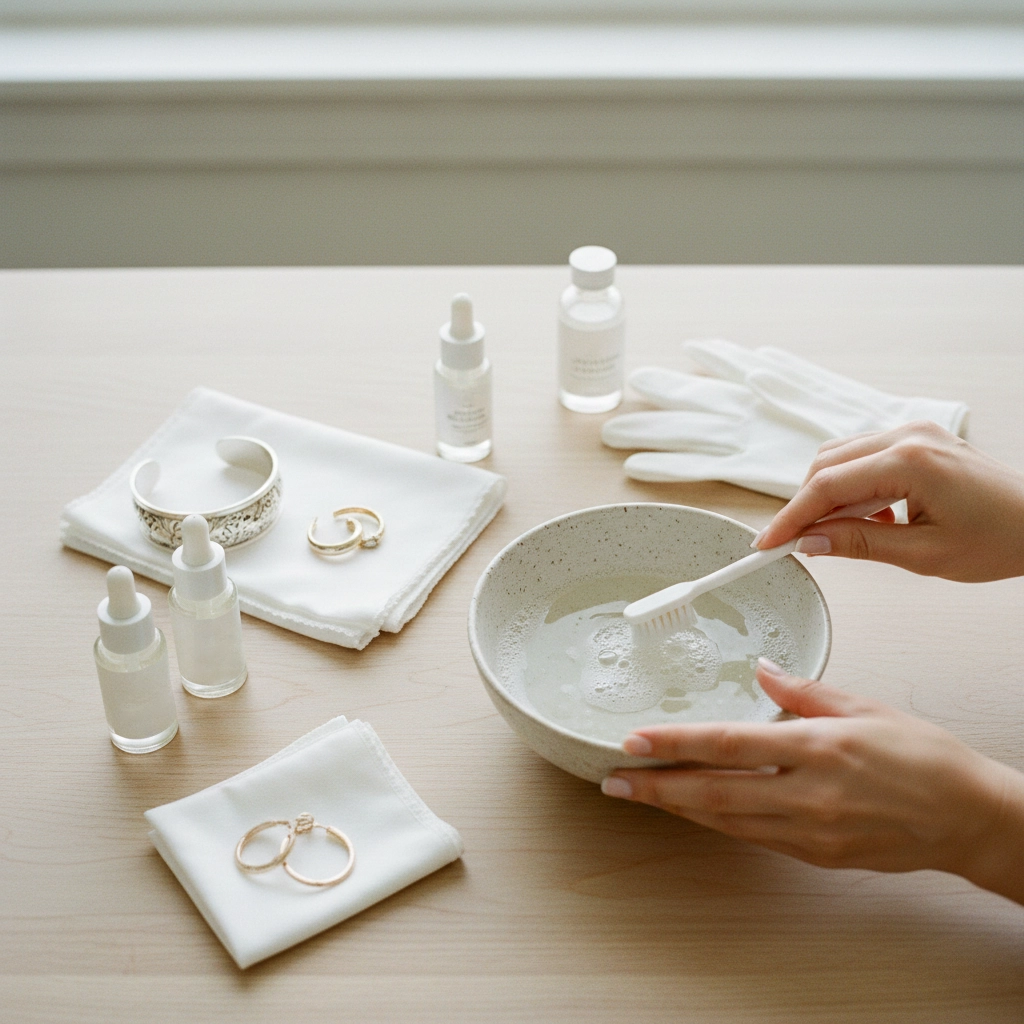
Clean Gently
Soft cloth (microfibre), warm water, a drop of mild soap. Wipe, rinse, dry. That is all.
Never: toothpaste (abrasive, scratches the coating), vinegar (acid, attacks the coating), silver polish (removes the plating along with the tarnish), ultrasonic cleaners (too aggressive for thin coatings).
More on cleaning in our jewellery cleaning guide.
Rotate Your Pieces
If you have three gold-plated rings, wear them in rotation, not all three every day. Every day of rest equals less sweat, friction and chemistry on the coating. Rotation doubles (or triples) the lifespan.
Gold Plating vs Other "Gold-Colour" Options
Gold plating vs real gold. Visually, almost indistinguishable for the first months. Tactilely, identical. Durability, incomparable. Real gold does not wear away (it can scratch, but gold remains gold). The price difference is 10 to 50 times.
Gold plating vs PVD. PVD is harder, more durable, more resistant to scratches. But the colour is slightly different from real gold. For everyday wear, PVD is objectively the better choice. For maximum visual closeness to gold, vermeil.
Gold plating vs natural-colour stainless steel. Stainless steel without coating is silver-toned. It does not wear, does not tarnish, requires no maintenance. If the gold colour is not essential to you, stainless steel is simpler, cheaper and more durable than any coating. More in our metals comparison guide.
Gold plating vs gold filled. Gold filled is the clear winner on durability. But it costs noticeably more than standard plating. If you need gold colour for years, gold filled. If for a season, standard plating.
Can Gold Plating Be Renewed?
Yes. A jeweller can strip the old coating and apply a new one. This costs money, but less than buying a new piece.
It makes sense for items with sentimental value or expensive designs. For cheap costume jewellery, the cost of replating will exceed the value of the piece itself.
The process. The jeweller removes remnants of the old coating, polishes the base, applies a new layer by electroplating. The result is like new.
Frequency. Depends on wear. With daily use, once every 1 to 2 years for standard plating. With careful use, less often.
Signs That Gold Plating Is Wearing
- Colour change on edges and raised areas. The first places where the coating goes are corners, ridges, areas of maximum friction. A silvery or coppery tint of the base metal appears.
- Spots. Uneven darkening is corrosion of the base metal showing through thinning coating.
- Tactile roughness. New plating is smooth. Wearing plating is slightly rough. These are microscopic breaks in the coating.
- Green marks on the skin. If the base is brass or copper, the base metal showing through the worn plating begins to leave a green trace. More in our guide on why jewellery turns skin green.
When Gold Plating Is the Right Choice
Fashion pieces. Trends change faster than the coating wears. If a piece is on trend for 1 to 2 seasons, the plating will outlast the trend. Why pay for eternity when you will want a different design next year?
Variety. For the price of one gold ring, you can buy 10 to 15 plated ones. A collection, rotation, different styles for different moods. The maths favours plating if you love variety.
Experiments. Not sure if the gold colour suits you? Try plating before investing in gold. A test drive for modest money. More on colour matching in our metal and skin tone guide.
Symbolic gifts. When the meaning matters more than the investment. A pendant with the infinity symbol or the tree of life is about significance, not carat weight.
When Gold Plating Is a Poor Choice
Wedding rings. 24/7 wear, constant friction, water, hand washing. No plating can withstand this. Wedding rings need stainless steel, real gold or PVD.
Allergy sufferers. If you are allergic to nickel and the plated piece has a brass base containing nickel, the coating will eventually wear through and the allergen will contact your skin. For allergy sufferers, 316L stainless steel or titanium without coating is safest. More in our nickel allergy guide.
Water jewellery. Beach bracelets, pool pendants. Water plus plating equals rapid wear. For aquatic environments, stainless steel. More in our jewellery and water guide.
Everyday rings and bracelets. If you never take a piece off, plating is not for that item. For "put on and forget," you need stainless steel or PVD.


The History of Gold Plating: From Ancient Egypt to Electroplating
People have been coating things in gold long before they knew what electricity was. The history of gilding is a history of ingenuity, chemistry and the desire to appear wealthier than one is. Though not only that: gilding was also used in religious art, architecture and medicine.
Mechanical Gilding (Ancient World)
The first method is the most obvious. Take a thin sheet of gold, wrap it around an object, press it tight. Done. The Egyptians did this 4,500 years ago. The mask of Tutankhamun is not solid gold. It is a wooden base covered with gold leaf. Ingenious, practical, visually indistinguishable.
The problem with gold leaf is adhesion. The gold holds through friction and pressure, not chemical bonding. Over time, the sheets lift, especially on curved surfaces.
Mercury Gilding (Antiquity to 19th Century)
The next step was fire gilding, or amalgam gilding. Gold is dissolved in mercury (forming an amalgam), applied to the surface, and the object is heated. The mercury evaporates, the gold remains. The bond with the base metal is much stronger than with gold leaf.
The method was used for gilding domes, sculptures and jewellery. The cupolas of Versailles were mercury-gilded. Beautiful, durable. And deadly. Mercury vapour killed the gilders. Average life expectancy for a gilder in the 18th century was significantly below average. The method was banned in the 19th century when the connection between mercury and death became too obvious.
Electroplating (From the 1840s)
The Italian chemist Luigi Brugnatelli conducted the first experiment in electroplating gold in 1805. But the technology became commercial only by the 1840s, when the Elkington brothers in Birmingham patented the process of electrogilding.
The principle: the object is immersed in a solution containing gold. An electric current causes gold ions to deposit on the surface. Evenly, thinly, with good adhesion. No mercury, no deaths, with controlled thickness.
This is the same method used in the jewellery industry to this day. 180 years and the basic principle has not changed. The equipment, solution formulations and quality control have evolved. But the essence remains: gold from solution, current, deposition.
The Science of Adhesion
Adhesion is the bonding of one material to another. In the case of plating, gold to the base metal. And this is not simply "gold sitting on top." Real physical and chemical processes occur between the coating and the base.
Surface Preparation
Before coating, the base metal goes through several stages: degreasing (removing oils and dirt), etching (removing the oxide film), activation (creating a chemically active surface). Skipping any stage means the coating will adhere poorly. It will peel off within a week instead of a year.
In cheap production, surface preparation is where corners are cut. Quick dip, quick out, quick into the box. Looks excellent. For a month. Then spots and peeling. If you see a plated piece that has started to peel unevenly (in patches rather than uniform wearing), it is almost certainly poor surface preparation, not poor gold.
The Intermediate Layer
Between the base and the gold, an intermediate layer is often applied - usually nickel or palladium. The intermediate layer serves two functions: it improves gold adhesion and creates a barrier preventing base metal atoms from diffusing into the gold layer (which would change its colour).
The problem: nickel is an allergen. In the EU, nickel content in jewellery that contacts skin is regulated by the REACH directive. But plating is a tricky thing: as long as the coating is intact, nickel does not touch the skin. When the coating wears through, nickel reaches the surface. And the allergy begins.
How Climate Affects Gold Plating
Where you live affects the lifespan of the coating just as much as how you wear it.
Tropical climate. High humidity, high temperature, heavy perspiration. Plating in the tropics lives shorter, sometimes significantly. Constant moisture accelerates corrosion of the base under the coating.
Dry climate. Desert, continental dryness. Plating lives longer: less moisture, less corrosion. But dry air can cause static electricity, which attracts dust. Fine abrasive particles in dust work like sandpaper during movement. Wipe your jewellery more often.
Coastal climate. Salt air. Chlorides in the air attack the coating even without direct water contact. Simply living by the sea subjects your plating to a more aggressive environment. Stainless steel or PVD is the better choice for coastal living.
Urban air. Polluted air contains sulphur and nitrogen oxides. They react with metals, accelerating tarnishing and corrosion.
Temperature swings. Rapid changes (from a warm building into frost) cause condensation on the surface of the jewellery. Micro-droplets in places where the coating is thinner can initiate spot corrosion.
Industry Standards and Labelling
Plating is a territory where labelling can mislead if you do not know the terminology.
"Gold plated." In the US (FTC standard), minimum 0.5 microns of gold of at least 10 karats. In the EU, there is no single standard - requirements differ by country. "Gold plated" on a label from an unknown source can mean anything from a proper 2-micron coating to flash plating.
"Gold vermeil." A strict standard: minimum 2.5 microns of gold of at least 10K on a base of 925 silver. If any parameter is not met, it is not vermeil, even if the label says so.
"Gold filled." Minimum 5% gold by total weight. Marked with a fraction: 1/20 14K GF means "1/20th of the total weight is 14-karat gold." This is a regulated standard with real legal meaning.
"Gold tone" or "gold colour." A red flag. This means "looks like gold, but we are not claiming it is gold." Could be anything from lacquer to a spray.
Myths About Gold Plating
"Gold plating is fake." No. It is a technology. Like laminate is not a fake of wood, but a different material with different properties. A gold-plated ring is not pretending to be gold. It is gold-plated, and that is honestly stated. The problem is not the technology, but sellers who conceal it.
"A thick layer is always better." Not always. A thick layer of soft 24K gold will scratch faster than a thin layer of hard 14K. Thickness matters, but without considering the karat and application method, it is meaningless.
"Gold plating cannot get wet." It can. Once. Accidental contact with water will not kill the coating. The problem is systematic exposure: daily showers, swimming, washing up. A single rain shower - wipe dry and forget about it.
"All gold-plated jewellery is the same." Flash plating for pennies and gold vermeil for reasonable money are different planets. Lumping them into one category of "gold plating" is like lumping a bicycle and a motorcycle into "two-wheeled transport."
"PVD completely replaces gold plating." Not completely. PVD gives a slightly different shade - cooler, slightly more synthetic. For most people, the difference is unnoticeable. For connoisseurs of the warm gold tone, it matters. Both technologies have their place.
The Economics of Gold Plating
Simple mathematics worth doing before purchasing.
Scenario 1: fast fashion. A plated ring from the high street. Flash plating. You wear it for 3 months, the coating comes off, you buy a new one. Over 3 years: 12 rings. Considerable total spend. 12 items of waste.
Scenario 2: standard plating. A ring with standard coating. You wear it for a year, have it replated, wear it another year. Over 3 years: one ring plus two replatings. Similar total cost to scenario 1, but less waste (one item instead of twelve).
Scenario 3: PVD or gold filled. A ring with PVD coating. You wear it for 5 years with no maintenance. Over 3 years: one ring, zero additional cost. Higher initial price, lower total cost.
Scenario 4: uncoated stainless steel. A silver-toned 316L ring. You wear it for a decade. Zero maintenance, zero additional cost, zero waste. If the gold colour is not essential, this is the mathematical champion.
The best investment depends on what you value: gold colour, durability, or variety. Plating gives colour and variety at the expense of durability. PVD and gold filled give colour and durability at the expense of initial price. Stainless steel gives durability and price at the expense of colour.
There is no right answer. There is an informed choice. And that is exactly what this guide is for.
Gold Plating and Gifts
Giving gold-plated jewellery is perfectly normal. But context matters.
For a birthday or just because. Plating works excellently. It is a fashionable piece with a golden glow for a reasonable outlay. If the recipient loves variety, plating allows you to give three or four pieces in different styles instead of one "forever" piece.
For an anniversary. This is trickier. An anniversary implies durability. Plating and durability are not the closest friends. If giving for an anniversary and wanting a gold colour, consider gold filled or PVD. Or real gold, if the budget permits.
The key rule: do not hide it. If you are giving plating, let the recipient know it is plating. Not to apologise for the choice (plating is a worthy choice), but so the recipient knows the care rules. A person who thinks their pendant is gold will wear it in the shower and be upset when the coating comes off. A person who knows it is quality plating will remove it before water and wear it for years.
Honesty is the best packaging for a gift.
The Future of Gold Plating
Coating technologies are developing faster than most buyers keep track of.
Nanoscale coatings. Research promises layers only nanometres thick but with strength exceeding micron-thick coatings. The key is not thickness but structure. Molecularly ordered layers could theoretically be thinner and simultaneously stronger. Still at the laboratory stage, but could reach commercial jewellery within a few years.
Hybrid coatings. Combining PVD and electroplating: a PVD base for strength, a thin electroplated layer of real gold for authentic colour. The best of both worlds. Some premium brands are already experimenting.
Eco-friendly processes. Traditional electroplating uses toxic solutions (cyanides, acids). New methods work with less hazardous electrolytes. The difference is invisible to the end consumer but significant for the industry and the environment.
Gold plating will not disappear. It will evolve. In ten years, coatings considered excellent today (2 to 3 microns, 1 to 2 years of life) may look like yesterday's news. But the basic principle will remain: a thin layer of beautiful over a strong base. This has worked for 4,500 years. It will keep working.
FAQ
How long exactly does gold plating last? It depends on the thickness, type of wear and care. Flash plating: weeks. Standard plating: 6 months to 2 years. Vermeil: 1 to 3 years. Gold filled: 10 to 30 years. PVD: 3 to 10 years.
Can you get gold-plated jewellery wet? Technically yes. Practically, you should not. Every contact with water shortens the coating's life. Caught in the rain by accident - nothing serious, wipe dry. Daily shower - remove it.
Does gold plating cause allergies? The gold itself does not. But when the coating wears, the base metal contacts the skin. If the base contains nickel, an allergy is possible. Look for plating on stainless steel or silver if you have sensitive skin.
Does gold plating tarnish? Not the gold itself, but the base metal showing through the coating. Or dirt and cosmetics accumulating on the surface. The first is wear. The second cleans off with a soft cloth.
Which plating base is better: brass or stainless steel? Stainless steel. Brass oxidises, may contain nickel, leaves green marks. Stainless steel is inert, hypoallergenic, does not oxidise. Even if the plating wears off, beneath it is clean silver-toned metal, not greening brass.
Is gold filled worth buying? If you want gold colour for years, yes. It is the closest analogue to real gold in terms of durability at a significantly lower price. Downside: fewer designs than standard plating.
What is the difference between 14K and 18K plating? The karat of gold in the coating. 18K has more gold, warmer colour, softer coating (pure gold is soft). 14K has less gold, slightly cooler tone, harder coating. 14K is more practical for daily wear. 18K is more beautiful visually.
Can you tell plating thickness by eye? No. Flash plating and 2-micron plating look identical in the shop. You will see the difference after a month of wear. The only way is to ask the seller about the thickness. If they do not know or will not answer, it is most likely flash.
Personal Experience vs Marketing: How to Tell the Difference
Forums and reviews are full of stories: "the plating came off in a week" and "I have been wearing plating for three years, everything is perfect." Both stories can be true, because "gold plating" is an umbrella term for a dozen different technologies.
When reading reviews, look for specifics. "The plating came off" without specifying the coating type, thickness and wearing conditions is useless information. Flash plating on brass worn in the shower every day - of course it came off. That is not the fault of gold plating as a concept, but a mismatch between expectations and reality.
When a seller promises "everlasting gold plating," that is marketing. Everlasting plating does not exist. Durable plating with proper care does. The difference in wording is a difference in honesty. Choose sellers who speak specifically: "PVD coating, 3 microns, expected lifespan with daily wear of 3 to 5 years." That is an honest answer. "Our plating never wears off" is not.
Final Thoughts
Gold plating is not a swindle and not a compromise. It is a technology with understandable limitations. It works excellently for fashion pieces, for collecting, for experimenting with colour. It works poorly for items worn daily without removal.
Knowing the coating type, thickness and care rules is the difference between "it peeled off in a month" and "I have been wearing it for two years and it is fine." The difference is not luck. The difference is information.