Multi-Stone Rings: How to Combine Gemstones in One Setting
A ring with one large diamond usually costs more than a ring of three stones of the same total weight. It sounds absurd until you understand the mechanics. A single big crystal has to be clean and transparent throughout its whole volume, and stones like that are rare in nature. Three smaller ones can each be more modest, yet together they give three points of light and more colour. So a multi-stone ring often looks pricier than it is, while a single-stone ring looks plainer than it really is.
This article is about building a ring from several stones so it works visually and lasts for years, instead of looking like a random handful of gems. We will cover price, hardness, colour, cut, setting and care.
What a multi-stone ring actually is
A multi-stone ring is a piece with two or more stones in one setting. We mean genuinely different stones, not one large gem with an elaborate cut. The stones can vary in type, colour and size.
Usually one stone dominates in size or brightness, and that one is the centre. The rest play a supporting role: smaller, or the same size but a different colour. Sometimes every stone is the same size but a different shade.
A single-stone ring says: here is my stone, look at it. A multi-stone ring gives you more freedom in colour and composition, but it asks the stones to agree with each other rather than argue.
Types by structure
Three-stone ring. The steadiest and most popular layout: a larger stone in the centre, two smaller ones at the sides. This format has been used in engagement rings for over a century. "Three" reads as a finished composition.
Five stones or more. More colour and sparkle, but harder to balance. Without careful proportions it is easy to end up with an overloaded look.
Asymmetry. Stones placed freely rather than in a strict line. It looks modern and designer-led, but it needs a good craftsman; done cheaply it looks careless.
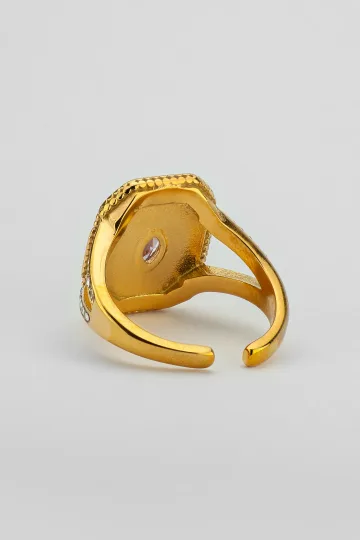
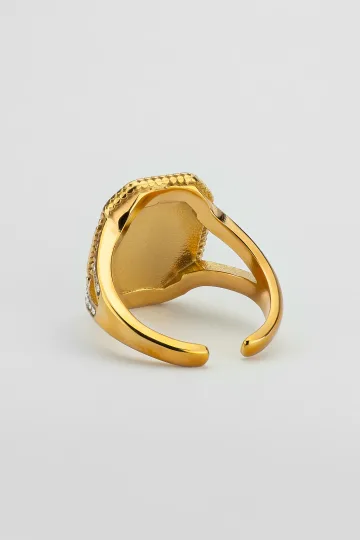
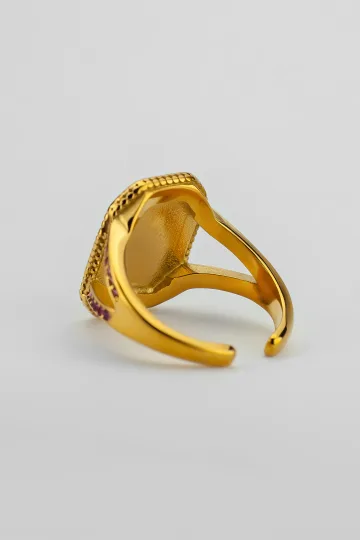
Wear the symbol, don't just read about it. These are in stock:





A short history of multi-stone rings
The idea of a ring with several stones is older than the European jewellery canon by several centuries. In different parts of the world people reached the same conclusion independently: several stones look more interesting than one.
Antiquity
In Ancient Egypt, mining gems was costly and difficult, and a finished stone turned up rarely. Jewellers set one larger stone in the centre and framed it with small ones, creating an impression of wealth while saving material. Each stone was given its own meaning, and a combination was read as the union of several qualities.
In India, multi-stone pieces were assembled around a system that matched stones to celestial bodies. That tradition produced the navaratna, a set of nine stones discussed further below.
The Middle Ages and the Renaissance
In the Renaissance a multi-stone ring became a mark of learning. Each stone carried a meaning in the accepted system: ruby for power, sapphire for wisdom, emerald for fertility, pearl for purity. A whole programme could sit on a single finger.
Queen Elizabeth I of England wore rings with several stones, where each was a family heirloom or a diplomatic gift. Such a ring read as a portrait of political alliances rather than mere decoration.
The 18th and 19th centuries
The Victorian era invented acrostic rings, where the first letters of the stone names spelled out words. REGARD stood for Ruby, Emerald, Garnet, Amethyst, Ruby, Diamond. DEAREST was built from diamond, emerald, amethyst, ruby, emerald, sapphire and topaz. The ring became a coded message you could wear and read every day.
The 20th century and today
The three-stone ring settled in as the classic engagement format during the 20th century. People attached the meaning of "past, present, future" to it, but its popularity came mostly from practice: it is the middle ground between a modest single stone and one expensive large gem. It looks substantial yet stays within reach.
Today a multi-stone ring is more often chosen as a way to step away from the standard and put together something personal.
A ring where three stones all shout at once is a market stall, not jewellery. One soloist, the rest hum along, and I won't hear otherwise.
What to wear a multi-stone ring with
Hundreds of rings have passed through my hands on shoots, and the multi-stone ones are always the divas on camera. Here is what actually works, by occasion and by look.
What do I wear a multi-stone ring with every day? For everyday I recommend a ring with a coloured centre and quiet sides: a sapphire or diamond in a low setting that does not catch on sleeves. It sits well with jeans, knitwear and light cotton. Plain clothing lets the stone speak at full volume, while a busy print steals its attention, so I suggest an even neckline and a solid fabric under the ring.
Is it right for the office? Quite, as long as you keep it restrained. I choose a harmonious pair of close tones: light blue with white, pink with nude, in white or rose gold. A ring like that reads as a detail of taste, not a loud accent. I would not bring heavy asymmetry or sharp contrast to a strict dress code; save those for the evening.
How do I build an evening look? For the evening I suggest unlocking contrast in full: ruby with diamonds, emerald with pale sides. Artificial light mutes coloured stones, so I choose saturated shades and a lively cut over pastels. A deep fabric, wine, emerald or navy, lights up any gem.
Which metal should you match to the stones? I go by the skin undertone. For warm skin I recommend yellow gold, which warms the stones; for cool skin, white gold or platinum. I choose rose gold when in doubt, since it suits almost everyone. The same pink tourmaline drifts toward peach in yellow gold and reads cleaner in white.
Who does a multi-stone ring actually suit? Almost everyone; the question is the combination. For a restrained type I advise monochrome and close tones, for a bold one asymmetry and contrast. Two rules that never fail. First: for daily wear I take stones of 8 and up on Mohs and a low seat, or the ring loses its looks within a year. Second: if you wear several rings at once, keep one metal and let the multi-stone one lead while the neighbours stay quieter.

Turn on your camera, pick earrings, a pendant or a ring, and see the piece on yourself in real time.
Switch items in one tap.
Everything runs in your browser: no photo or video is ever uploaded.
Why three stones are often cheaper than one large one
It seems logical that three small stones cost less than one large one of the same total weight. In practice that is true, and there are several reasons.
Price rises non-linearly
A diamond's price grows faster than its weight, not in proportion to it. A one-carat stone costs noticeably more than two half-carat stones of the same quality. The reason is simple: large flawless crystals are far rarer in nature than small ones, and that rarity carries a premium.
So three half-carat stones cost less in material than a single one-and-a-half-carat stone, but not three times less; the gap is real, just smaller than you might expect.
Cutting yield
A rough crystal rarely cuts into a stone without losses. To get a flawless large stone, a cutter may have to discard half the mass or more, working around inclusions and cracks. For small stones the clarity standards are gentler, and the rough goes further. So several small stones from the same rough come out cheaper than one perfect large one.
Certification
A large stone usually travels with a certificate from an independent lab (GIA, IGI, AGS); without one an expensive stone is hard to sell. In a three-stone ring, often only the central stone is certified, while the side stones go in as supporting. That lowers the share spent on paperwork.
The psychology of perception
The eye reads three sparkling stones as a more valuable piece than one, even when the total weight is lower. Three points of light, three focal points, and the brain files it as "pricier." The effect is strongest at first glance.
Types of combination
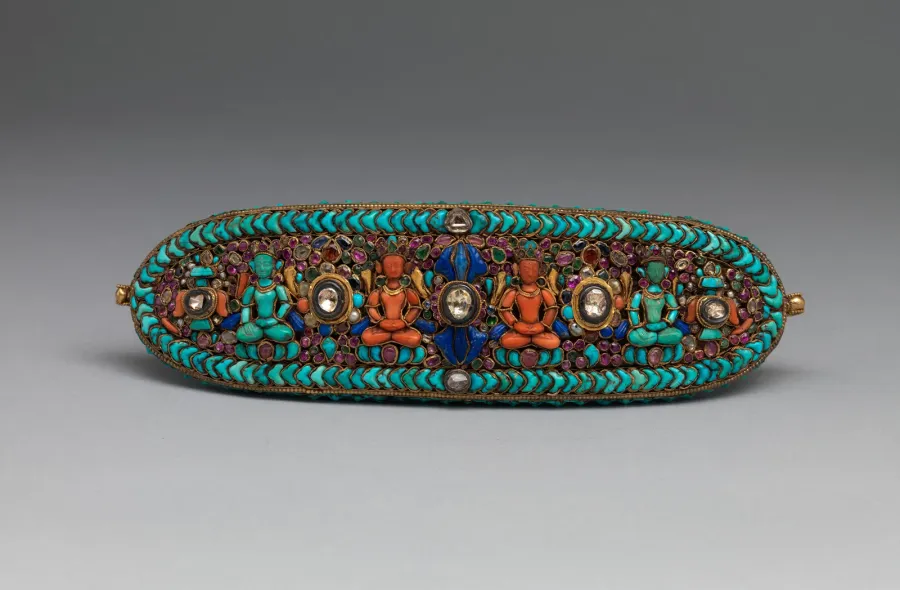
There are proven layouts that work almost every time, and experimental ones that work if you understand what you are doing.
Three in a row
A larger stone in the centre, one smaller stone on each side. The most conservative and reliable option. It pairs well with a wedding band and looks balanced. The downside: it is easy to make dull if you reach for the standard combination.
A typical layout: a sapphire, ruby, emerald or diamond of one to two carats in the centre, and two side stones of half to three-quarters of a carat.
Asymmetry
Stones of different sizes set at different distances from each other. It looks modern and designer-led, but it slips easily into "randomly threaded." It calls for good taste and a careful craftsman. For example: one larger stone shifted slightly off-centre, with two small ones to the side and above.
A line of different stones
Stones across the whole top of the ring, like an eternity band but of different types: sapphire, diamond and tourmaline alternating. Maximum sparkle and individuality. The downsides: it needs cleaning more often, sits heavier in wear, and is harder to resize.
Centre with a scatter
One larger stone and several small ones scattered across the shank. It looks refined but is costly to make and easily overloaded. You need an experienced craftsman.
How to combine stone colours
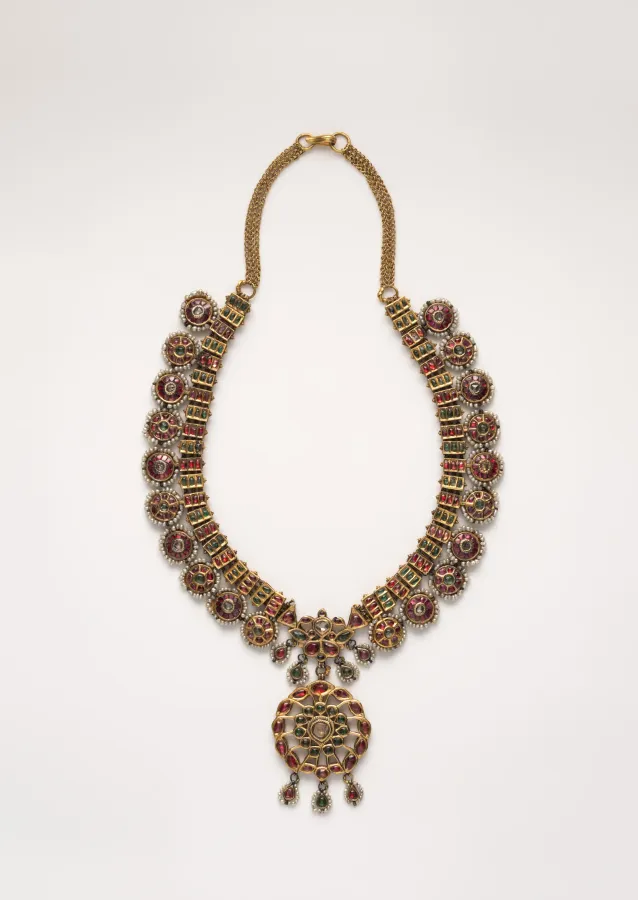
The colour of a neighbouring stone can lift or mute the central one. There are two approaches that work.
Contrast. Stones on opposite sides of the colour wheel: blue sapphire and yellow tourmaline, red ruby and green emerald. Each stone becomes more visible and the eye stays interested. The risk: with poor-quality stones or careless placement it can look like a toy.
Harmony. Close tones: pink tourmaline, pink topaz and pearl; blue sapphire, light-blue aquamarine and diamond. Calmer and more elegant, but more sensitive to your skin undertone.
Proven combinations
Sapphire, diamond, sapphire. The most popular scheme in history. The sapphires can be of different saturations for depth, and a colourless centre costs less than three blue stones yet still looks expensive. This is the style of ring, a sapphire ringed by diamonds, that Princess Diana wore.
Ruby, diamond, ruby. Bolder and warmer. Rubies cost more than sapphires, and on a hand with a warm skin undertone they look especially striking.
Emerald, diamond, diamond. Green against white looks fresh. Diamonds at the sides balance the emerald and keep the ring from looking dated.
Warm centre, light sides. A yellow sapphire, citrine or yellow topaz in the centre, with a diamond and a soft pink stone at the sides. A warm, contemporary pairing.
When the side stones can be plainer
Sometimes the side stones are deliberately chosen less than perfect to set off the central one. This only works if it is intentional: the centre must be clearly larger and cleaner, so the small stones read as a worthy frame rather than a flaw.
Metal as a fourth colour
The setting sets the overall tone. Yellow and rose gold make stones warmer; white gold and platinum make them cooler. A pink tourmaline in yellow gold can drift toward peach, while in white gold it opens up cleaner.
Yellow gold suits warm stones and a warm skin undertone, white gold and platinum suit cool shades and cool skin. Rose gold is the most versatile option.
Customer reviews
Zevira is a real jewellery shop. Genuine payments, deliveries and customer thank-yous.
🥰🥰🥰 gracias

Ok, ¡gracias! 🙂

Stones for multi-stone rings: hardness and character
The main practical figure is hardness on the Mohs scale, from 1 to 10. It decides whether a stone will survive daily wear.
Diamond
Hardness 10, the maximum. It does not scratch in everyday life and suits both the centre and the sides. Versatile across skin tones and clothing. Two diamonds flanking a coloured centre is a classic and relatively economical scheme.
Sapphire
Blue corundum, hardness 9. Very durable and has held its place in engagement rings for centuries. Shades range from pale blue to deep cornflower. A sapphire centre with two diamonds is timeless without trying to be.
Ruby
Red corundum, hardness 9. More expensive than a sapphire of the same size and quality. A bright, eye-catching stone. Rubies are often treated with oil or resin to mask fractures; cleaning can carry some of the oil away, so handle them more gently.
Emerald
Green beryl, hardness 7.5 to 8, softer than corundum and more brittle. Almost every natural emerald carries inclusions and tiny fractures, called the "garden" and treated as a sign of authenticity. Emeralds are oiled too. They suit daily wear less well and are better for evenings out.
Semi-precious stones
- Topaz: hardness 8, many colours; can fade in sunlight.
- Amethyst: purple quartz, hardness 7; affordable but pales in strong sun.
- Garnet: hardness 7 to 7.5, deep red or brown.
- Opal: hardness 5.5 to 6.5, very fragile, not suited to an everyday ring.
- Pearl: an organic material, hardness 2.5 to 3, very soft, scratched by sweat and grit.
Rare and interesting
- Alexandrite: changes colour, green in daylight and red under artificial light. Hardness 8.5, rare and expensive.
- Tourmaline: up to a dozen colours, from red rubellite to green verdelite and blue indicolite. Hardness 7 to 7.5, excellent in colourful compositions.
- Aquamarine: blue beryl, hardness 7.5 to 8, clear and cool in tone.
Upload a photo of your pet, someone you love, or an object. We'll build a 3D model and hand-cast it in pewter.




Which stone can take an everyday ring
A ring is the most exposed of all jewellery. The hand constantly meets countertops, door handles, keyboards, sand on the beach. Earrings and a pendant hang free, while a stone in a ring takes the knocks and friction every day. So the first question when choosing a stone for an everyday ring is not about colour or price, but whether it will survive a year of ordinary life.
The hardness threshold for daily wear
The practical line runs at about 7 on the Mohs scale. Stones of 7 and above resist the chief enemy of gems in a ring: quartz dust. Ordinary household and street dust is made mostly of tiny quartz particles with a hardness of 7. Anything softer is slowly abraded by that dust: facets dull, the polish clouds, the stone loses its glow even without obvious scratches. That is why diamond (10), sapphire and ruby (9) live in rings for decades, topaz and spinel (8) hold up well, while opal (5.5 to 6.5) and pearl (2.5 to 3) are too delicate for constant wear.
Hardness is not the whole of toughness
Here is a subtlety often missed. Mohs hardness is resistance to scratching, not to impact. Diamond is the hardest mineral on earth, yet it has cleavage planes along which a precise blow can split it. Emerald, at hardness 7.5 to 8, is brittle because of its internal fractures and takes a sharp knock badly. So two more properties sit alongside hardness: toughness (resistance to chipping) and stability (resistance to light, heat and chemicals). The ideal everyday stone scores high on all three: that describes corundum (sapphire and ruby) and, handled with care, diamond.
Stones better kept for occasions
Tanzanite, for all its lovely blue-violet colour, has a hardness of only 6 to 7 and noticeable cleavage; in a ring its facets cloud quickly. Opal fears both impact and dryness: losing moisture brings on tiny cracks. Pearl is eaten away by sweat, perfume and cosmetics, and its surface dulls from ordinary soap. Turquoise is porous and soaks up creams and oils, darkening over time. These stones are wonderful in earrings, a pendant or a ring for rare outings, but a daily ring is no place to risk them.
Hardness table for rings
A quick guide to which stone goes where. The number is Mohs hardness.
| Stone | Hardness | Everyday ring |
|---|---|---|
| Diamond | 10 | Yes, the benchmark |
| Sapphire | 9 | Yes |
| Ruby | 9 | Yes |
| Spinel | 8 | Yes |
| Topaz | 8 | Yes, protect from knocks |
| Emerald | 7.5-8 | With care, brittle |
| Aquamarine | 7.5-8 | Yes |
| Tourmaline | 7-7.5 | Yes |
| Garnet | 7-7.5 | Yes |
| Amethyst | 7 | Yes, fades in sun |
| Citrine | 7 | Yes |
| Tanzanite | 6-7 | No, for occasions |
| Opal | 5.5-6.5 | No, fragile |
| Turquoise | 5-6 | No, porous |
| Pearl | 2.5-3 | No, very soft |
How to choose a stone for your lifestyle and finger
The same stone in the same setting serves different people differently. What decides it is both fashion and how you live and which finger you wear the ring on.
For your lifestyle
If you work with your hands, play sport, cook or tend a garden, the ring takes knocks constantly. Here only the top of the scale makes sense: diamond, sapphire, ruby in a low, protective setting. For office life, where the hands meet paper and a keyboard, the whole middle range opens up: topaz, aquamarine, tourmaline, garnet. If the ring is a dress piece that comes off for chores, you can allow yourself the delicate stones, opal or tanzanite, since the risk of a knock is small.
For the finger
The finger sets the allowable size and height of a stone. Long, slim fingers are flattered by oval and pear cuts and suit medium-sized stones. A short finger gains length from an oval or marquise, while a large round stone shortens it. The ring finger is the classic place for an engagement ring; it moves little and protects the stone well. The index and middle fingers are more active and knock into things more often, so a low setting and a hard stone are wiser there.
For the size of the hand
A large hand carries a large stone easily, while a small one is lost on it. A massive stone overwhelms a small hand, which suits a delicate composition where several small gems work better than one large one. Band width depends on the hand too: a wide band looks heavy on a slim finger, a narrow one looks fragile on a large hand.




Stones for an engagement ring
An engagement ring is worn for years without coming off, so the choice of stone is judged most strictly of all. The main requirement is single: the stone has to survive decades of daily wear.
Diamond and its place
The diamond became the standard engagement stone not through ancient tradition but thanks to a mid-20th-century advertising campaign. Still, there is practical logic behind it: hardness 10 and a strong sparkle make it the most durable and showy choice. A colourless diamond is neutral and suits any skin and any metal.
Coloured alternatives
If you want colour, the safest bet is a sapphire of any shade: blue, pink, yellow, peach. At hardness 9 it takes daily wear almost like a diamond. A sapphire engagement ring is no modern whim but a tradition with centuries behind it; before the diamond spread, the blue sapphire was the most coveted engagement stone in Europe. A ruby suits those who lean toward warmth and passion, and it is just as hard as a sapphire. An emerald is beautiful but brittle and needs careful handling, which makes it risky for an active hand.
What to avoid in an engagement ring
Opal, pearl, tanzanite and most soft gems will disappoint in an engagement ring: within a year or two they cloud or split. If your heart is set on such a stone, it is wiser to make it the centre of a ring for rare outings and keep a sapphire or diamond for every day.
Cut and shape
The cut decides how a stone plays in the light and how it reads from a distance.
Round (brilliant)
Fifty-eight facets calculated for maximum return of light. It looks expensive under any lighting. Three round stones is the classic, safe scheme. The downside: the round cut costs more because it demands precise work and good rough.
Cushion and antique cuts
The cushion sits between a square and a circle, soft and slightly vintage. Antique cuts (Old Mine, Old European) suit historical and vintage compositions. An antique centre with two round sides looks designer-led and steps away from the standard three-in-a-row.
Shape and contrast
The same species looks different in different cuts: an oval sapphire seems more saturated than a round one because the oval concentrates colour. In a colourful composition it pays to vary the shapes: rather than three identical circles in different colours (which reads as a scattered handful of sweets), pair a round centre with an oval and a cushion at the sides.
To see how shape behaves with light and proportion, look at the full guide to diamond cut shapes; the same laws apply to coloured stones.
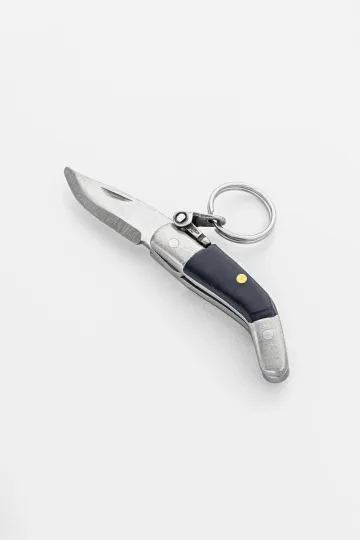
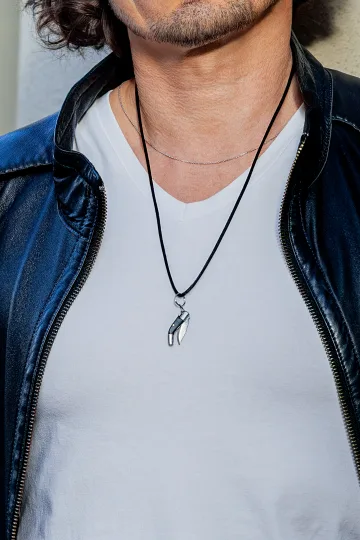
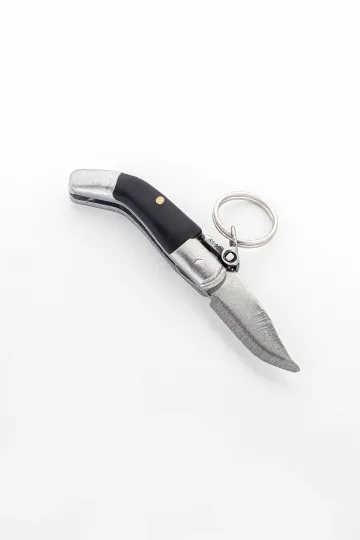
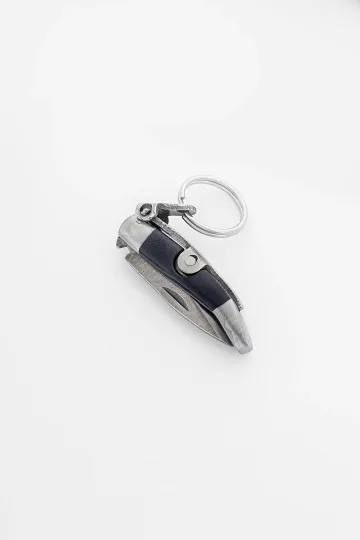
CAPAORA mini knife pendant
The 18th-century Spanish navaja in miniature: 40 mm of stainless steel, a real folding mechanism and a Palanquilla lock that clicks. An affordable gift to remember.
Authentic · Ships from Spain · 14-day returns
Setting and metal
Types of setting
- Prong (claw): the stone is held by claws from above. Maximum light, but if a claw bends out the stone can fall.
- Bezel: the stone is ringed by metal on all sides. Less sparkle but maximum protection. A good choice for active wear and a costly central stone.
- V-shaped: the side stones are raised, creating an "embrace" effect; it looks romantic.
- Pave: a scatter of small stones around the larger ones. Maximum sparkle, but it needs frequent cleaning.
A good pairing for a three-stone ring: a bezel in the centre (protecting the costly stone) and prongs at the sides (sparkle for the small ones).
Metal
- Yellow gold: warm and traditional, suits warm stones and a warm skin undertone.
- White gold: cool and contemporary, for cool stones and cool skin.
- Rose gold: a soft tone, versatile.
- Platinum: does not tarnish, needs no re-polishing, lasts for decades. Heavier than gold and pricier, but the most durable.
How to choose your own combination
Step 1. Purpose and budget
First decide what this is: an everyday ring, an engagement ring or a piece for a special occasion. The stones and the setting both follow from that.
For the level of spend, think in terms of a segment rather than a fixed sum:
- Accessible: several small natural coloured stones in 925 silver, or a natural centre with small lab-grown stones at the sides. Good for an everyday ring you would not mind scratching.
- Mid-range: a natural sapphire or ruby in the centre with two diamonds at the sides, or three coloured stones in white gold. Ideal for an engagement ring: it looks expensive yet stays within reach for many.
- Premium: rare or very clean stones (alexandrite, high-quality emerald) in platinum or 18-carat gold. For a durable piece meant to be passed down.
Step 2. The central stone
This is the main decision; everything else assembles around it. Ask yourself:
- An everyday ring or one for outings?
- Do you prefer transparent stones (diamond, aquamarine) or dense ones (opal, agate)?
- Which metal do you like?
- Is your skin a cool or a warm undertone?
- Is your work or sport active, with a risk of knocks?
For an everyday or engagement ring the centre has to be hard (8 to 10 on Mohs): diamond, sapphire, ruby. Opal, pearl and soft emerald are risky for constant wear.
Step 3. The side stones
The side stones should be:
- Smaller than the centre: usually 30 to 50 per cent of its size, so the hierarchy holds.
- In the right colour key: contrast or harmony, your choice.
- Hard enough, if the ring is for daily wear.
Sensible layouts:
- Centre a 1.5-carat sapphire, sides two 0.5-carat diamonds.
- Centre a 1-carat ruby, sides two 0.3-carat rubies (monochrome).
- Centre a 1-carat diamond, sides two 0.4-carat sapphires (the classic).
Step 4. Setting and metal
Match the setting type to your lifestyle (a lower seat and more protection for active wear) and the metal to your skin undertone and the stone colours. See the sections above.
Step 5. Try it in different light
A stone looks different in daylight and artificial light, in the box and on the hand. Where you can, see the ring on the hand, in various light and in a photo. Many rings come into their own in wear rather than on the shelf. Watch the height of the seat: the stone should not stand too proud and catch.
Leave your email, we'll send your discount code. No spam, unsubscribe anytime.
The code arrives by email, valid on your first order.
Caring for a multi-stone ring
The more stones, the more crevices where dirt gathers. Care needs more attention than for a single-stone ring.
At home. A soft toothbrush, warm soapy water, gently into the gaps between the stones. No sharp temperature swings and no boiling water; hot water can weaken the oiling and the glue under small stones.
In wear. Take the ring off before sport, washing up, cleaning and sleep (if the ring is bulky). At those moments dirt packs into the crevices, especially with creams or sweat on the hands.
What to avoid. Ultrasonic cleaning is risky if the side stones are glued or oil-treated (emerald, ruby). Household chemicals can damage stone treatments. Abrasive sponges scratch the metal.
A yearly professional clean. A jeweller will check the settings, polish the metal and make sure the stones do not wobble. It is cheaper than hunting for a lost stone.
Checking the settings. After the first month of wear, ask a jeweller to check the side stones; settings sometimes "settle" a little. If a stone starts to move under pressure, do not wait, take it in to be re-set.
Storage. Apart from other jewellery, in soft fabric or a lined compartment, so the stones do not scratch each other.
A multi-stone ring for every day and as an engagement ring
A multi-stone ring wears very well day to day, but the stones have to be chosen with awareness.
For constant wear take a centre and sides of hardness 8 to 10 (diamond, sapphire, ruby, topaz), a low seat and a protective setting. Opal, pearl and brittle emeralds are a poor idea for an active life.
As an engagement ring. The classic is a diamond or blue sapphire in the centre: both last for decades. If you want colour, a sapphire (blue, red, yellow) is safer than an emerald or opal. Two small side diamonds are a safe choice.
For your lifestyle. Sport and manual work: hard stones only (diamond, sapphire). Office work: you can allow an emerald or topaz. If the ring comes off before work, almost any stone will do.
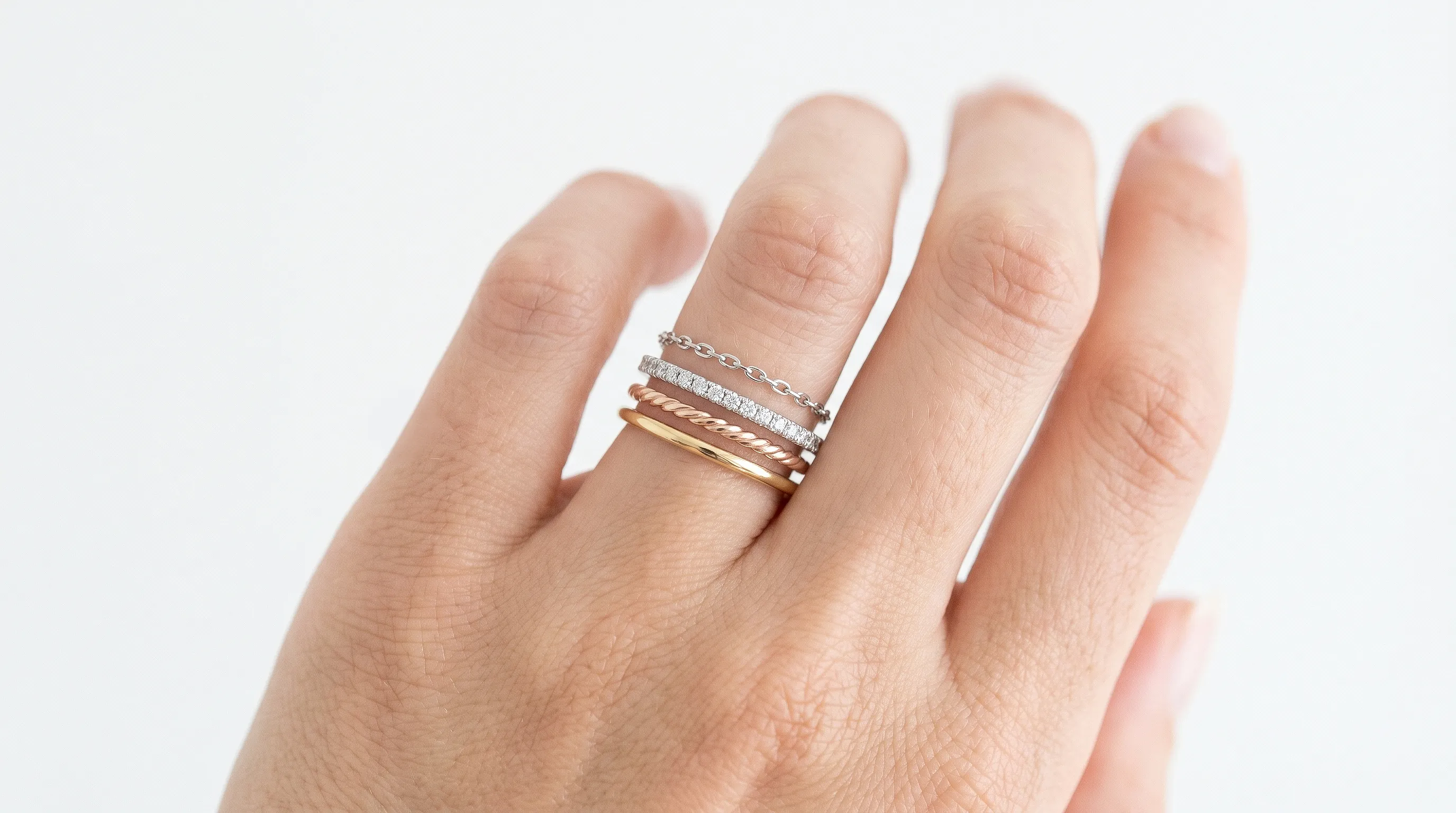
A multi-stone ring lives happily alongside other rings too. If you like wearing several at once, see how to build a ring stack on one finger so the stones do not fight each other.
Natural and lab-grown stones, the ethics of origin
A natural stone formed in the earth over millions of years; a lab-grown one is created in days or weeks. In chemistry and optics a lab-grown sapphire or diamond is the very same material, but on resale it is worth noticeably less.
In multi-stone rings a natural centre is often combined with lab-grown side stones, which is cheaper. When sold, this is stated honestly.
Origin matters from an ethical side too. After the 2000s the Kimberley Process was introduced, a certification meant to keep diamonds from conflict zones off the market, though the system is not perfect. Those who care about origin choose lab-grown stones, natural ones with a clear pedigree (Botswana, Canada, Namibia) or recut older stones.
Rough guides by source:
- Diamonds: Botswana, Canada, Namibia, South Africa.
- Sapphires: Sri Lanka, Australia, Thailand, Myanmar.
- Rubies: Thailand, Africa (Tanzania, Kenya), Myanmar.
- Emeralds: Colombia, Zambia, Brazil.
Value over time: what holds it and what does not
Some buyers also look at a ring as an investment. What usually keeps its price:
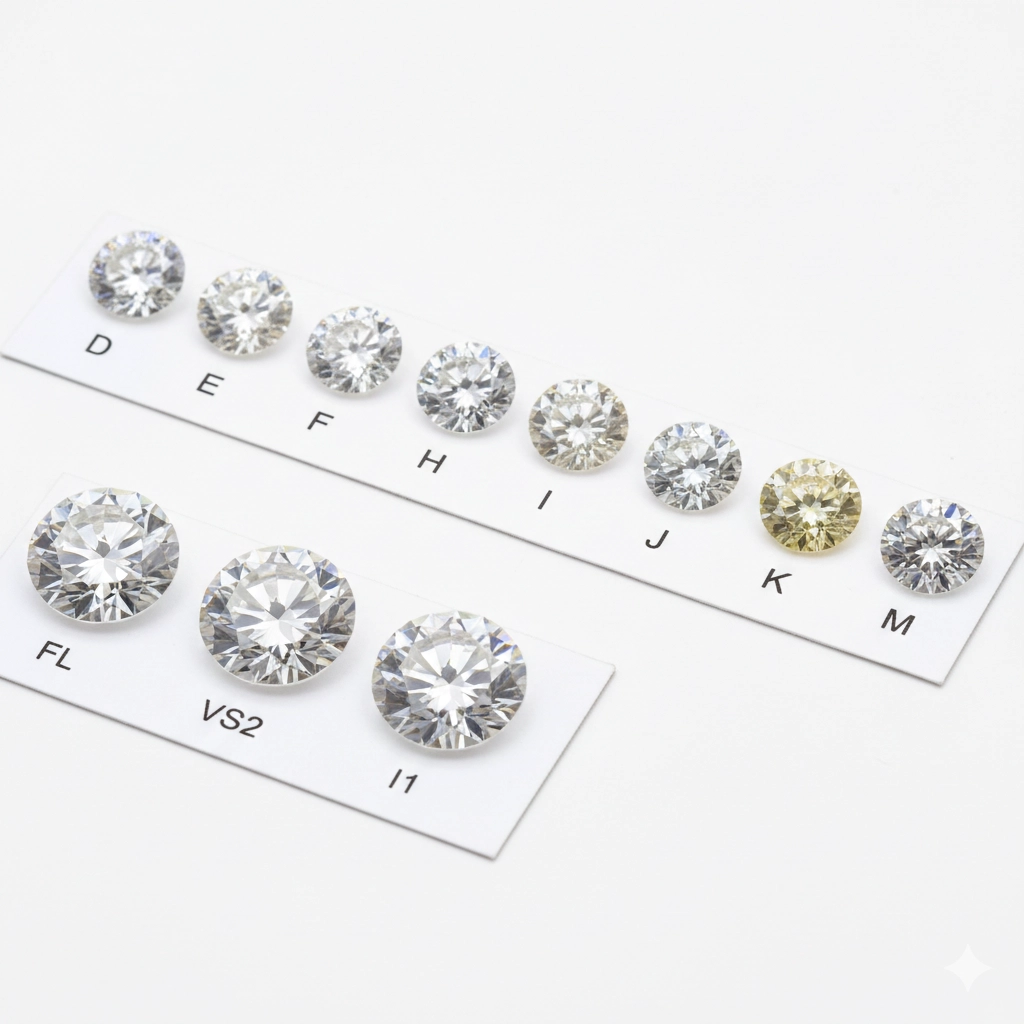
- Diamonds that are certified (GIA, IGI, AGS), colour D to G, clarity VS1 and above, from half a carat each. If those letters still look like a code, the guide to diamond colour and clarity will make sense of them.
- Blue sapphire: of high clarity and saturated colour; stones from Myanmar and Kashmir are valued above the rest.
- Ruby: the most expensive of the coloured stones, especially untreated or only heated without oiling.
- High-quality emerald: even with the usual inclusions, Colombian stones are valued higher.
What loses value: lab-grown stones (cheaper over time), heavily treated stones (oiling, irradiation) and most semi-precious ones (topaz, amethyst, garnet can fade). That does not make them poor choices for an everyday ring: they are affordable and you do not have to baby them in active wear.
Multi-stone rings overall resell worse than single-stone ones: a buyer wants exactly your combination. A realistic return on resale is 40 to 60 per cent of the original price, much as for jewellery in general.
Remaking an old ring
An old multi-stone ring is a good candidate for a remake: the stones are often better than the dated setting. It makes sense if the stones are of good quality, the metal is genuine, and the design no longer suits you.
Remaking a three-stone ring costs more than a single-stone one: each stone has to be removed, checked for hidden cracks, matched with a replacement if needed and reset. If a side diamond is lost, a replacement is easy to find. If a large central stone of a rare colour is gone, it is sometimes simpler to redesign the ring around a different centre.
A useful takeaway for the future: choose a central stone that would be easy to replace. Blue or red sapphire is everywhere, while rare shades (peach, green) can become a problem.
Send a friend a discount code, they save on their first order.
A ring as a set of personal symbols
The most honest way to give a ring meaning is to choose stones not for an "energy" attributed to them, but because each one means something to you personally. That is how family rings appeared, gathering the birth-month stones of loved ones.
The system of monthly stones (so-called "birthstones") was fixed by jewellers in the early 20th century; it is a marketing tradition, not a scientific one. Stones have no proven properties. But if you like the idea that ruby is your son's month and aquamarine your partner's, it works perfectly well as a principle of composition. The ring becomes a talking point and a personal story rather than an amulet.
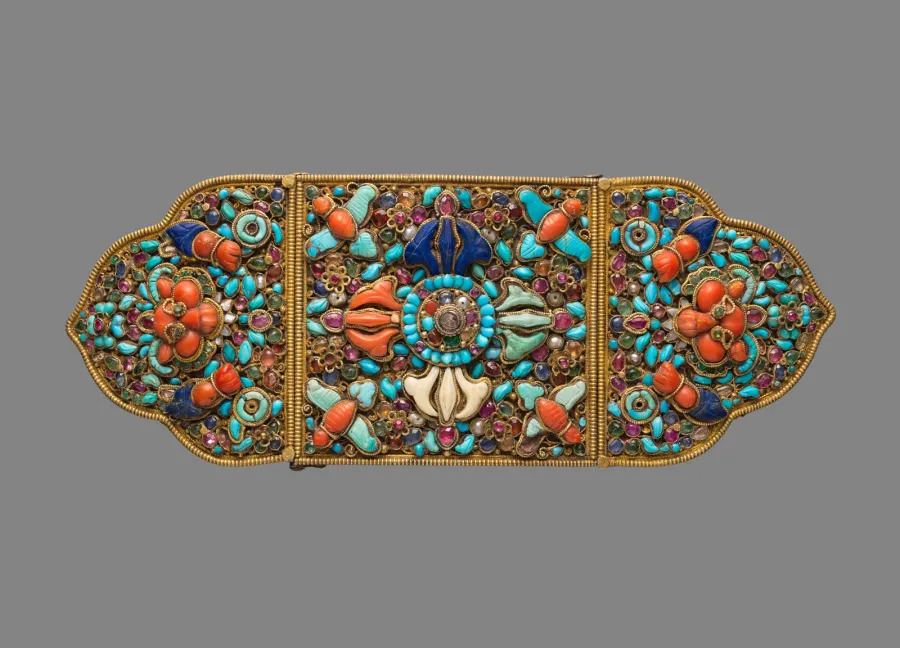
A similar approach is the Indian navaratna: a set of nine stones (ruby, pearl, coral, emerald, yellow sapphire, diamond, blue sapphire, garnet, cat's eye), one for each of the nine celestial bodies of traditional astrology. It is more often a pendant or a bracelet than a ring. Today the navaratna is worn both as a cultural symbol and simply as a beautiful multicoloured piece; no confirmed effects stand behind it.
Multi-stone versus single-stone
By look. A multi-stone ring looks more interesting and personal, and makes a stronger first impression. A single-stone ring is more classic, with the focus wholly on one stone, whose quality is visible at once.
By price. A multi-stone ring is usually cheaper in material but costlier to make and resells worse. A single-stone ring is more expensive in material, simpler to make and easier to sell.
By practicality. A multi-stone ring needs more frequent cleaning and checks of several settings. A single-stone ring is simpler to care for and safer for active wear.
Choose a multi-stone ring if you want to stand out, like modern design and are willing to give time to care. Choose a single-stone ring if you value the classic, maximum practicality and easy resale.
Buying it as a gift? Each one arrives ready to give.
 A branded Zevira box and a little card come with every order.













What to avoid when choosing a stone for a ring
A handful of mistakes repeat more than the rest, and almost all of them are about a mismatch between the stone and the lifestyle.
A soft stone in an everyday ring
The most common and the most disappointing mistake. Opal, pearl, turquoise and tanzanite look luxurious in a display case, but in a daily ring they lose their look within a year. The buyer blames the maker or the seller, though it comes down to physics: the stone simply was not built for daily knocks and dust. If you fall for a soft gem, give it to earrings, a pendant or a ring for special occasions.
A high seat on an active hand
The higher the stone sits above the finger, the more often it catches on clothes, bags and door handles, and the harder the impact when it snags. For an active life choose a low seat and a protective setting, even if a tall crown looks more striking in a photo.
Weak claws and a thin setting
A pretty openwork setting with thin claws holds a stone worse than a sturdy one. Thin claws wear and bend out faster, the stone starts to wobble and one day falls. For a costly or rare stone a bezel or thick claws are safer.
Stone colour in isolation from skin and metal
A stone that charmed you under the shop lamps can look different at home in daylight. A cool blue sapphire argues with warm yellow gold, a pale stone is lost on darker skin. Try a stone on your own hand, in daylight, with your usual metal.
Chasing size at the expense of quality
A large but cloudy, cracked stone looks cheaper than a small, clean, bright one. The eye reads the play of light, not the grams. Better a smaller, lively stone than a big, dull one.
Facts that surprise
The dust around us is harder than most gems
Ordinary household dust contains quartz particles of hardness 7. That means a stone softer than quartz is slowly abraded just from sitting on the hand and being wiped with cloth. Opal and turquoise cloud not from knocks but from this invisible daily sanding.
Sapphire and ruby are the same mineral
Both sapphire and ruby are corundum. The only difference is the trace element: chromium gives the red colour and the name "ruby," iron and titanium give blue and the name "sapphire." In hardness and toughness they are twins; only the colour, and the price that follows it, differs.
A diamond can be split with a hammer
A diamond is the hardest mineral, but hardness and toughness are not the same thing. A diamond has cleavage planes, and a precise blow in the right direction will split it. Cutters used this for centuries to divide large crystals before diamond saws existed.
An emerald's "garden" is a sign of authenticity
Almost every natural emerald is dotted with fissures and inclusions that jewellers fondly call the "garden." A perfectly clean emerald is so rare that its clarity hints at a lab origin rather than exceptional natural luck.
Alexandrite changes colour with the light
Alexandrite is green in daylight and red-purple under an incandescent lamp. The effect is named after the stone's origin, discovered in the Ural Mountains in the 19th century. A good alexandrite is rare and valued above many diamonds of the same size.
Pearl dissolves in acid
Pearl is calcium carbonate, and a weak acid eats it away. There is a famous legend of an ancient ruler who dissolved a huge pearl in vinegar and drank it to win a wager over the costliest feast in history. Modern pearl, for the same reason, fears fruit juices and acidic perfume.
Tanzanite was found only half a century ago
Most gems have been known for thousands of years, but tanzanite was discovered only in the late 1960s, at a single deposit at the foot of Kilimanjaro. It is one of the youngest jewellery stones in history, and it is still mined in just one place on the planet.
Wear the symbol, don't just read about it. These are in stock:

FAQ
Can you wear a multi-stone ring every day?
Yes, if the stones are hard (sapphire, ruby, diamond, 8 and up on Mohs) and well set. Opal, pearl and soft emeralds are risky for active wear. For manual work and sport, choose the harder stones.
Why is a multi-stone ring sometimes pricier than a single-stone one if the stones are cheaper?
Because three stones mean triple the work in matching, setting and polishing, plus higher demands on the craftsman over proportions. The complexity of the making offsets the saving on material.
How do you size a ring with several stones?
The size is the size of your finger; the stones do not affect it, only the width of the band. Watch that the ring does not stand too proud: a high seat is uncomfortable and easier to knock.
Can a ring be repaired if one stone falls out?
Yes. If a side stone is lost, a replacement is easy to match. If a central stone of a rare colour is gone, finding an exact match can cost more, which is why a yearly preventive check of the settings matters.
Which multi-stone ring looks the most expensive?
Several identical stones of high quality look pricier than one large stone of low quality. A neat asymmetry looks pricier than a standard three-in-a-row. A platinum setting always reads as more expensive.
Do multi-stone rings suit men?
Yes. Men's versions are usually heftier, with finer side stones. The classic is a larger diamond in the centre and two small ones at the sides.
How does a ring look under different lighting?
In daylight it is brighter and sparkles more; under artificial light it darkens and seems muted, which is normal. A diamond looks brighter than coloured stones under artificial light. So try a ring both in the shop and at home, at different times of day.
Can a single-stone ring be turned into a multi-stone one?
Yes, but it is real work: you need a craftsman to add the side stones and make a new setting. It makes sense if the central stone is genuinely valuable or dear to you.
A multi-stone ring is not a compromise on price but a way to assemble a piece with more light, colour and personal meaning. The main thing is that the stones agree in colour and match your lifestyle in hardness, and that the setting protects the most precious of them.
Rings with gemstones, coloured stones and combinations in 925 silver and 14 to 18-carat gold.
About Zevira
We make multi-stone rings with a logic you can follow. Each one is worked out so the stones work together by colour and hardness rather than just sitting side by side. We choose them so they read as a single composition.
Find out more about our ring collection and how to choose your own combination: