Music Symbols in Jewellery: Treble Clef, Guitar, Notes
Wear the symbol, don't just read about it. These are in stock:


Introduction
Music is one of the most personal of all human experiences. It is invisible, exists in time rather than space, and disappears the moment the last note fades. This is precisely why it has always been given visible form: notes, clefs and staves were invented so that a melody would not die with its final sound. Jewellery bearing musical symbols continues that idea on a more intimate level. It translates an invisible art into something tangible, something worn every day.
In jewellery tradition, musical motifs fall into two broad groups. The first is professional: the signs of the craft itself -- treble clef, bass clef, instrument silhouettes, the five-line stave, rests and accidentals. Musicians, teachers and conductors tend to choose these pieces, because a clef or a note reads as a working language they already know. The second group is emotional, rooted in personal memory: an engraving of the first bars of the song played at a wedding, a lullaby a mother once sang, the theme from the film during which a proposal was made.
Between these two poles lies enormous variety. A tiny stud in the shape of a note is almost invisible on an earlobe. A large brooch with a treble clef and a stone set in the curl of the scroll reads as an evening accent. A pendant engraved with the opening four bars of a melody becomes a score that could, in theory, be played. When a piece of jewellery becomes a source of sound, even if only a theoretical one, the boundary between goldsmithing and music ceases to be hard.
In this article we look at which musical symbols work in jewellery, how they emerged from the history of musical notation, what they mean and who wears them. A substantial section is devoted to personalisation: how to order a pendant engraved with the notes of a specific song, what size it needs to be for the notation to remain legible, and which melodies people choose most often. No mystical talk of cosmic harmonics or universal vibrations. Just a love of music and the wish to carry it as a recognisable sign.
Zevira makes these pieces in its own workshop in Albacete, and personalised note engraving is offered as a dedicated service. Below is a detailed look at every category and option, so you can choose or commission exactly what you need.
Music Jewellery: What to Choose
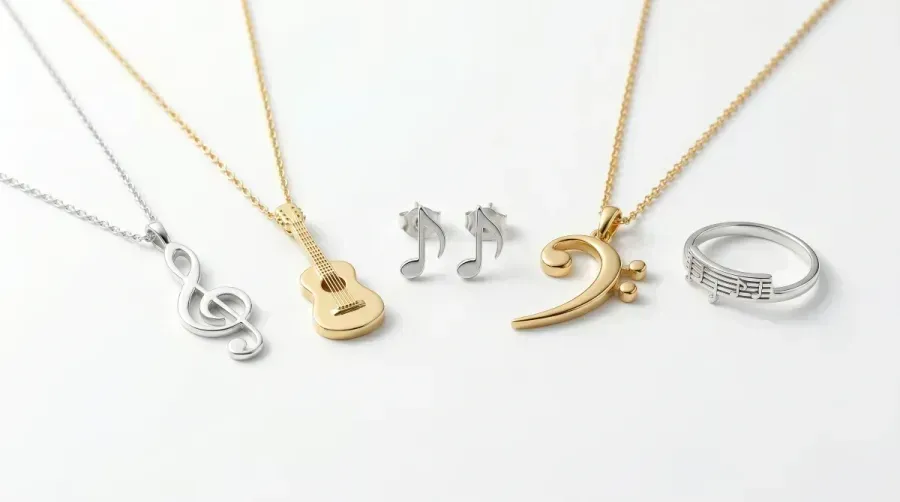
The foundational form is a pendant with a single recognisable symbol on a fine chain. A treble clef measuring one and a half to two centimetres suits everything from a cable-knit jumper to an office blouse, and needs no explanation. It becomes an everyday companion read as a feature of character rather than a statement accent. A forty-five centimetre chain suits most necklines, placing the clef just below the collarbone.
Stud earrings with a note or a miniature clef occupy less than a centimetre and suit daily wear. A quaver with its flag reads as a graphic sign and works even with hair worn down, because it does not catch. Long drop earrings with a stave motif are suited to evenings where a vertical accent is wanted.
Rings with a musical theme come in two registers. The first is restrained: a relief treble clef on a plain silver or gold band. The second is playful: a ring shaped as a fragment of a keyboard, alternating white keys in mother-of-pearl and black keys in enamel or onyx. Professional pianists wear this, as do those who simply enjoy a striking, identifiable piece.
Brooches with a treble clef or an instrument silhouette belong to a more formal register. A brooch four to six centimetres long is at home on a jacket lapel, a dress collar or the heavy wool of a coat. In academic music circles, a treble clef brooch remains one of the most sought-after gifts for conductors and concert masters.
Charm pendants for a bracelet let you build a musical theme gradually. A small guitar, a note, a miniature grand piano, a bass clef sign and a rest can all sit on a single bracelet together. Such a bracelet grows with its wearer's story, each new charm marking a significant event: entry to a conservatoire, a first major concert, a wedding, the birth of a child.
The men's line is built around pendants on leather cord. A silver guitar pick with engraving, an electric guitar silhouette, a bass clef in a larger format all work within rock aesthetics or simply as a sign of personal connection to music. Miniature instrument cufflinks are worn by orchestral musicians for concert dress. Paired pieces using two treble clefs, or a combination of clef and note, are ordered by musician couples and by those who want to express a duet -- not necessarily a professional one, but a metaphor for shared life. The separate article on paired pendants explores the mechanics of two halves in detail.
A distinct category is pendants engraved with the opening bars of a song. This is the central format of personalisation, discussed at length in its own section below.
A single note at the collarbone rings louder than a whole brass band round your neck. You are not a music box.
How to Wear
Over years of putting looks together, the musical sign has passed through dozens of shoots and evenings under my hands. Here is what genuinely works, occasion by occasion.
What do I wear a treble clef with every day? For daytime I recommend a small clef or note on a fine chain over plain knitwear, a shirt or a basic tee. An open collar and a soft neckline give the pendant room, and a light, simple fabric lets the sign read clearly. The calmer the outfit, the sharper the symbol.
Is a music pendant right for the office? Perfectly, as long as the register stays restrained. I suggest a silver or gold clef one and a half to two centimetres under a blouse or a fine-knit top, with small note studs in the ears. I keep the metals in one family: silver with silver, yellow gold with yellow gold, no mixing tones within a single look.
How do I build an evening look around a large brooch or clef? For evening I choose a contrast of scale: a dark dress with a bare shoulder and a large clef with a stone in the scroll, or a brooch on the lapel. I keep the earrings neutral, with no musical theme, so the motif does not repeat twice. Velvet and heavy silk hold oxidised silver and matte gold especially well.
How should a guitar or plectrum be worn on a man? I build the masculine version around a leather cord: a plectrum or an instrument silhouette under a dark shirt, a jumper or a leather jacket. I recommend a cord of fifty to fifty-five centimetres and keep the piece the single accent, with no extra chains.
And if you want to wear several pieces at once? Then I suggest one strong piece per look. If a set is wanted, I choose two at most and always at different scales: small earrings with a large pendant, or a brooch with a fine ring. That way the look does not dissolve into identical points.

Turn on your camera, pick earrings, a pendant or a ring, and see the piece on yourself in real time.
Switch items in one tap.
Everything runs in your browser: no photo or video is ever uploaded.
The Treble Clef in Jewellery
The treble clef remains the most popular musical motif in jewellery, and the reason is simple: it is recognised without explanation. Even someone who has never opened a music book reads it as the sign of music in general. Technically it is the G clef, and its form derived from a stylised letter G indicating the line corresponding to the note G above middle C. Over centuries, copyists extended the tail downwards and curved the top into a spiral, and by the fifteenth century the shape had settled into the form we know today.
In jewellery the treble clef exists in many variants. A smooth, classic silhouette cut from a sheet of silver or cast in gold works as a minimalist sign. A size of one to two centimetres keeps it everyday; three to four centimetres lifts it into an evening piece. Inside the upper spiral a small note is often placed, most commonly a crotchet, creating an internal composition from two musical symbols.
A version with a gemstone set in the eye of the clef -- the centre of the upper curl -- appears in higher-end ranges. A ruby, sapphire, emerald or cubic zirconia of two to three millimetres transforms the sign into something alive. Light catches the stone with every movement of the head, and the treble clef ceases to be purely graphic.
A large brooch, four to six centimetres, suits concert or formal dress. These are often made in oxidised silver to emphasise the volume of the scrollwork, or in gilt silver for warmth of tone. A small stud, one and a half centimetres, reads on the earlobe without overwhelming the face. A ring with a relief treble clef standing proud of the shank is the most distinctive form among rings with a musical theme.
Stylistic registers vary considerably. Clean minimalism suits office and everyday dress. Filigree Art Nouveau with plant tendrils growing from the clef itself refers to the turn of the nineteenth and twentieth centuries, when musical jewellery was part of the wider botanical language of that movement. A contour cut-out design, in which the interior of the clef is left open, functions as a graphic sign and sits particularly well against pale clothing.
A pair of treble clefs, one on each pendant, is often ordered by musician couples or by those who express their bond through the metaphor of a duet. A variant with one clef and one note on two separate pendants creates a visual relationship: the note can only be read with the key, and vice versa.
Customer reviews
Zevira is a real jewellery shop. Genuine payments, deliveries and customer thank-yous.
🥰🥰🥰 gracias
Ok, ¡gracias! 🙂
Guitar, Bass and Other Instruments
After the treble clef, instrument silhouettes are the most popular category, and the guitar comes first. Its appeal lies both in its decorative shape, readable from a distance, and in the breadth of its associations: from classical Spanish guitar to the rock stage. Two types of guitar silhouette appear in jewellery. The acoustic guitar with its characteristic soundhole and rounded body is more commonly made in silver with light engraving, sometimes with a mother-of-pearl soundboard overlay. The electric guitar with the outline of a Stratocaster or Telecaster body, its distinctive horns clearly visible, reads as rock aesthetics and suits men's pendants on leather cord.
In Britain, the guitar carries particular weight as a cultural symbol. The guitar tradition associated with the folk revival and the early rock scene of the 1960s runs deep, and a silver guitar pendant connects to a lineage that goes well beyond any particular genre. Abbey Road in London has become a global landmark of recording history, as enduring as the music it represents.
The bass guitar appears less often but works especially well in the men's register. The long neck and extended body create a more austere, almost graphic silhouette. It is chosen by bass players or by those who prefer a less obvious musical sign.
The violin and cello shift the theme into an academic register. Their vertical silhouettes with the curves of the f-holes, neck and scroll headstock sit beautifully in Art Nouveau styling. A miniature silver violin three to four centimetres long works as a brooch or a large pendant, and at one quarter of natural size the detail reads accurately. The cello gives a more spare, less decorative outline and is chosen more often by cellists themselves.
The saxophone with its characteristic curved bell and keywork is immediately recognisable and sets a jazz accent. In jewellery it is made in yellow gold or gilt silver to echo the brass colour of the instrument. A miniature saxophone two to three centimetres as a pendant or cufflinks is known among jazz musicians and their immediate audience.
The piano is treated two ways. First, a keyboard fragment: several white keys in mother-of-pearl with black keys in enamel or onyx. Such a fragment can be one and a half to two centimetres long and reads as a graphic pattern, almost like a barcode. Second, a grand piano silhouette seen from above, with its characteristic curved body and raised lid. The second variant needs a larger size -- from three centimetres -- for the shape to register. The miniature grand piano often serves as a souvenir charm for a bracelet.
Drum kit, tuba, flute, clarinet and harp appear less frequently. They are ordered specifically, usually for a known individual who plays that particular instrument. A gilt silver harp with fine wire strings remains one of the most striking and technically demanding silhouettes, made in limited runs. A set of orchestral instruments as a gift series suits conductors and ensemble directors, gathering violin, piano, trumpet, timpani and harp on one bracelet or collection of medallions as a metaphor for the full ensemble.
Upload a photo of your pet, someone you love, or an object. We'll build a 3D model and hand-cast it in pewter.



Notes and the Stave
A single note is the most minimalist of musical motifs. A crotchet with its filled note-head and vertical stem reads instantly. A quaver adds one flag, a semiquaver two, and each of these signs has its own graphic character. A semibreve reduces to a simple unfilled circle, which in jewellery often simply becomes a ring of metal with no further elements.
The five-line stave is used as the basis of a graphic composition. Cut from silver or applied by engraving, one or more notes sit on top of it. When the notes on the stave form a real, playable sequence, the pendant becomes a genuine score. It can be read, taken to an instrument and played. This is what distinguishes musical jewellery from any other themed piece: the sign on the pendant carries sound information that can actually be extracted.
Size matters for legible notation. A single bar in standard notation occupies roughly one and a half to two centimetres of width on a mid-sized score. Two to four bars of a recognisable phrase fit onto a surface three to five centimetres wide and can be read without a magnifier. This is the minimum size we recommend for personalisation: smaller makes the notes illegible; larger begins to exceed the proportions of a jewellery piece.
Rests, sharps and flats work as decorative accents. A crotchet rest, with its characteristic zigzag form, gives an unusual graphic sign that only those familiar with notation will fully read. A sharp and a flat, placed alone, assemble into something resembling a geometric ornament. These accents are most often combined with the main motif: a note with a sharp preceding it, or a rest following a notated phrase.
Among those who favour minimalism, a single note on a smooth circular pendant one and a half to two centimetres in diameter is popular. This works as a modern version of the classic medallion: one sign in the centre, nothing else. For those who prefer more complex graphics, a horizontal stave three to four centimetres wide with a fragment of melody reading left to right like a line of score is the preferred option.
The History of Musical Symbols in Jewellery
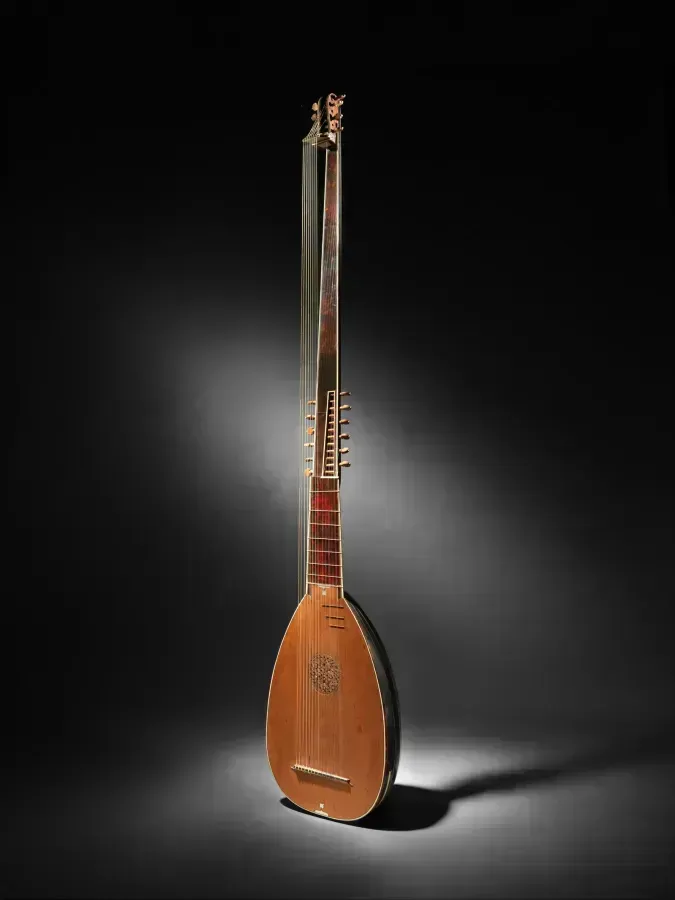
The history of musical notation begins in the ninth century, when monks in western European monasteries began marking signs above the lines of liturgical texts. These signs, called neumes, indicated the direction of vocal movement: up, down, sustained, ornamented. They did not fix the precise pitch, and each choir interpreted them differently, relying on oral tradition.
The breakthrough came in the early eleventh century through Guido of Arezzo, an Italian Benedictine monk who lived roughly between 991 and 1033. Guido devised a four-line stave in which each line corresponded to a precise pitch, and introduced the syllable names of the notes -- ut, re, mi, fa, sol, la -- taken from the opening syllables of successive phrases in a Latin hymn to Saint John. Later ut became do, si was added, and the familiar seven-note scale emerged. From Guido onwards, musical notation ceased to be an approximate hint and became a precise instruction.
Through the twelfth to the fifteenth centuries notation continued to evolve. The stave grew from four lines to five, durational values became writable, the treble clef assumed its familiar form, and the bass clef followed. By the fifteenth century the notation already resembled the modern system, though full standardisation occupied another couple of centuries.
Musical jewellery as a distinct direction took shape in the eighteenth and especially the nineteenth century, when European aristocracy developed a cult of the composer as creative genius. Bach, Mozart and Beethoven became cultural icons; their initials were woven into monograms on brooches and rings, the opening bars of recognisable symphonies were engraved on lockets. The Romantic era produced silver lockets containing a lock of a musician's hair: after the deaths of Liszt and Chopin, admirers commissioned such lockets, obtaining the hair through intermediaries or the deceased's families. This seems strange today, but in the nineteenth century it was part of a wider culture of relics.
The same period saw the spread of brooches with miniature instruments: violins, flutes and lyres three to five centimetres in silver or gold with enamel. The lyre, as an ancient instrument, was particularly beloved because it referred simultaneously to music and to classical culture. Monogram lockets in the Art Deco style of the 1920s continued this line but in a more geometric, austere aesthetic.
Britain has its own deep musical heritage that informs this jewellery tradition. Edward Elgar and Benjamin Britten gave British music a standing equal to any European tradition, and the concert halls of London -- from the Royal Albert Hall to the Barbican -- have been centres of musical life for generations. Abbey Road Studios in St John's Wood became a landmark of recording history in the twentieth century. This heritage means that a musical pendant carries real cultural weight in a British context.
The mass spread of musical jewellery came in the twentieth century. The treble clef became one of the most reproduced signs in silver and gilt alloy. Laser engraving from the 2000s onwards made it possible to engrave notation in high resolution on small surfaces, and pendants engraved with the opening bars of a favourite song entered wide circulation. Today microgravure technology allows a pendant three by four centimetres to carry a full notated phrase, readable to the naked eye or with a simple magnifier. This technical capability transformed the genre: musical jewellery ceased to be only a sign of profession or general enthusiasm, and became the carrier of a specific, personal melody.
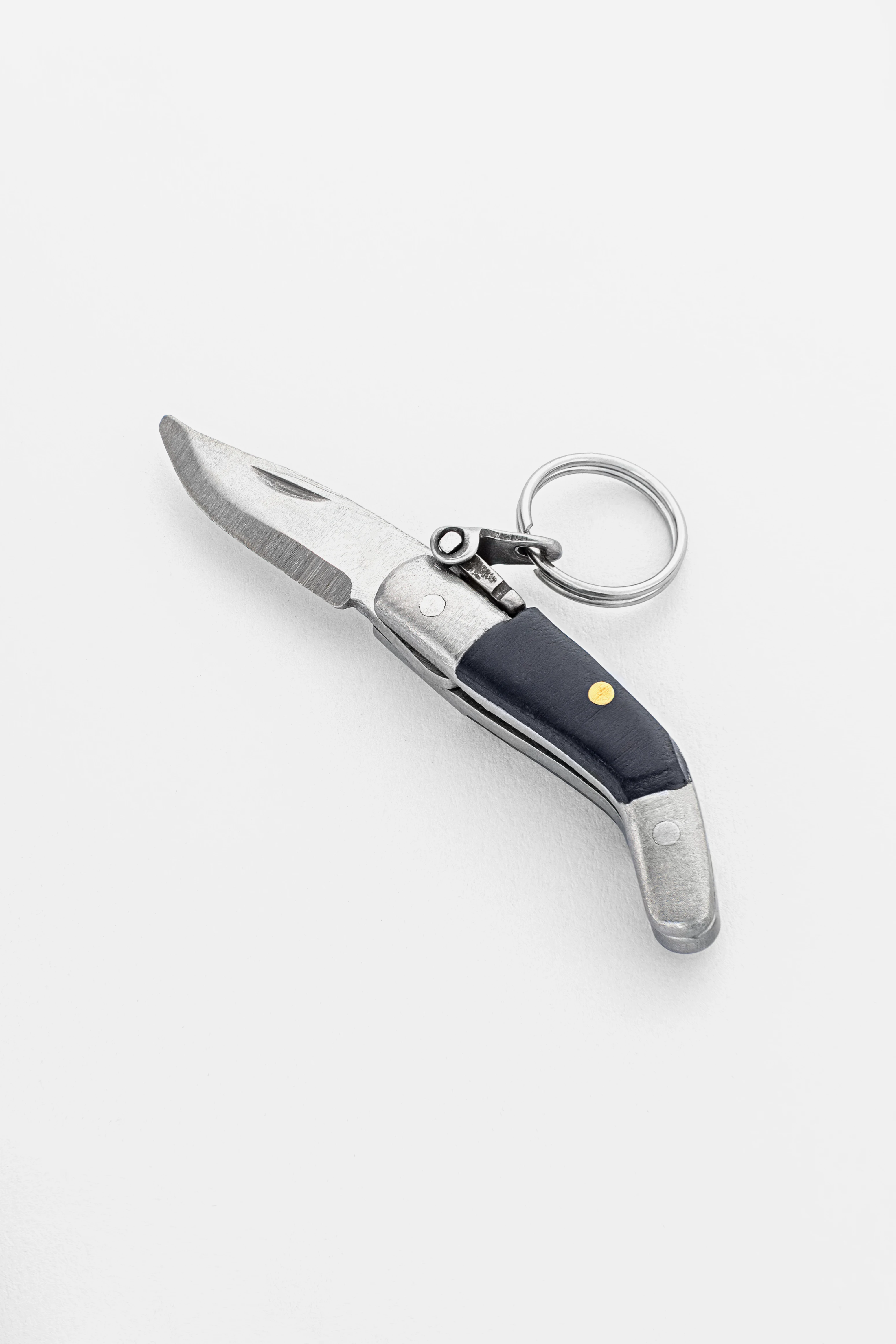
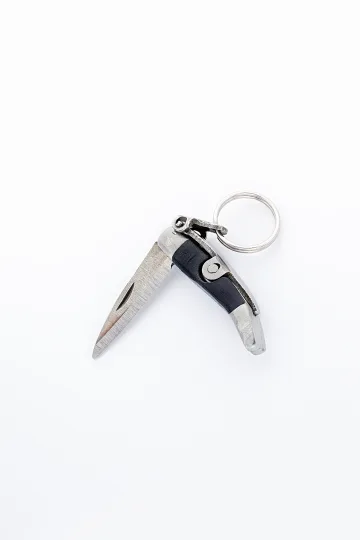
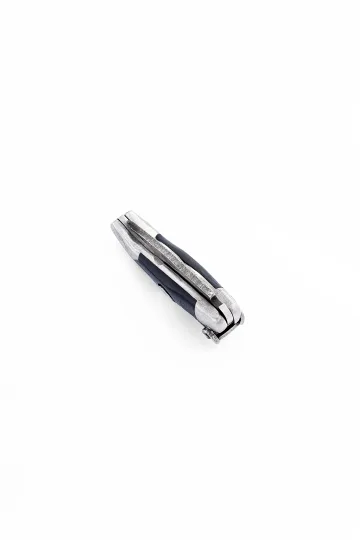
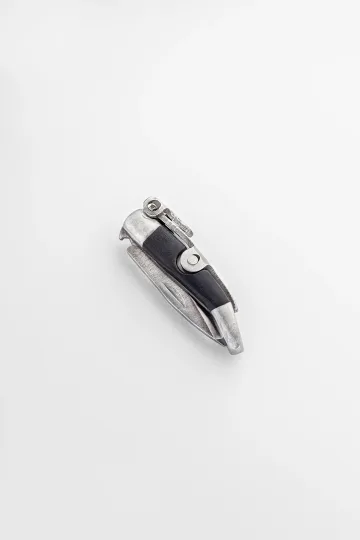
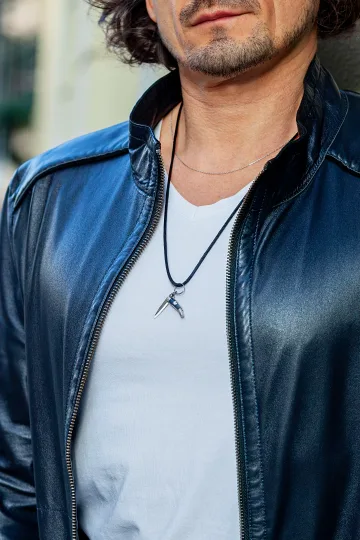
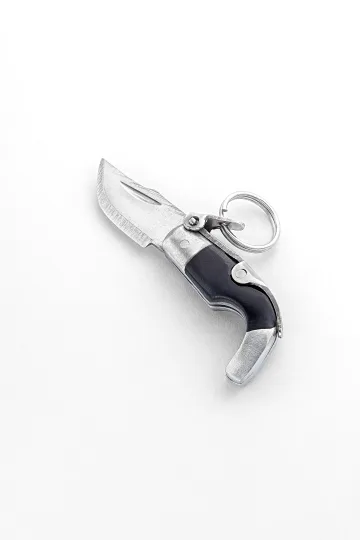
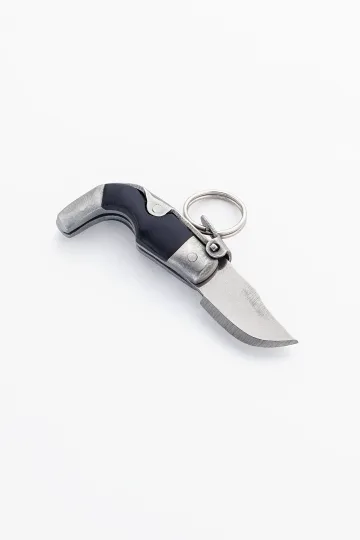
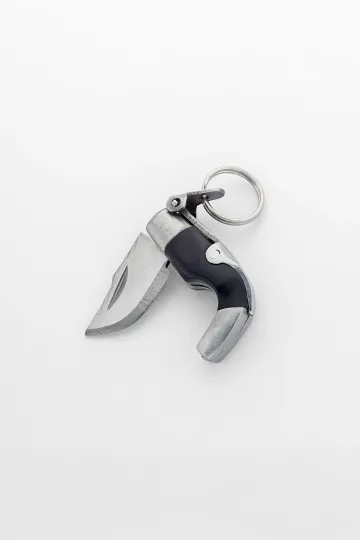
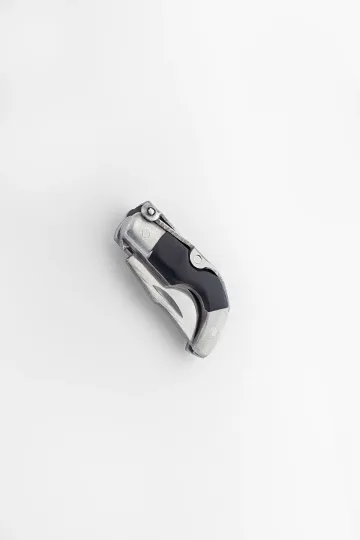
CAPAORA mini knife pendant
The 18th-century Spanish navaja in miniature: 40 mm of stainless steel, a real folding mechanism and a Palanquilla lock that clicks. An affordable gift to remember.
Authentic · Ships from Spain · 14-day returns
What Musical Motifs Symbolise
Love of music as a form of self-identification is the primary meaning of these pieces. When someone chooses a treble clef pendant, they are not necessarily declaring that they play an instrument. They are declaring that music matters to them, that it is part of their inner structure, and that they are prepared to carry this sign visibly.
For professional musicians, musical jewellery works as a trade sign, comparable to the caduceus for doctors or scales for lawyers. A treble clef on the brooch or ring of a conservatoire teacher, a concert master or an organist is read by colleagues as a sign of belonging to the guild. It is a form of membership that requires no words and no questions.
The memory of a specific song or melody tied to an important moment in life is the second great line of meaning. The first dance at a wedding, with the opening bars engraved on matching pendants. A lullaby a mother sang in childhood, on a pendant an adult daughter wears all her life. The theme from the film during which a proposal was made. The melody playing on the day a child was born or during the last conversation with someone who has gone. Music in these cases becomes a way of keeping a moment close that would otherwise dissolve in time.
A universal language understood across cultures is another side of musical symbolism. A note written on a stave reads identically in Madrid, Tokyo and Buenos Aires. Unlike written language, musical notation has no national variants in the Western tradition. This makes a musical pendant recognisable in any cultural context.
The emotional range from joy to grief passes through the same system of signs. The same notes combine to make a wedding march and a requiem. This is a reminder that the language of music is itself neutral; meaning is supplied by context. The coexistence of creativity and discipline in musical tradition mirrors a wider truth: notation demands precision, performance demands freedom, and a piece engraved with notes carries both dimensions.
When someone puts on a pendant bearing the notes of a song first heard at eighteen, what is happening is a specific, personal connection to specific music, not a mystical fusion with the music of the spheres. That is the strength of such a piece: it speaks of something very particular, not of a philosophical concept.
Leave your email, we'll send your discount code. No spam, unsubscribe anytime.
The code arrives by email, valid on your first order.
Personalisation: Your Own Melody on a Pendant
Personalised note engraving remains the most sought-after service in musical jewellery, and it deserves detailed treatment. The process begins with choosing a song that matters to a particular person. It might be a wedding dance, a favourite composition, a childhood lullaby, a theme from an important film, the soundtrack to a turning point in life. Sometimes it is a fragment of the customer's own composition.
The next step is obtaining the score. If the song has published sheet music, the task reduces to choosing the fragment. Usually the opening two to four bars are taken: they are the most recognisable and fit comfortably on a pendant of legible size. If no score exists, one can be generated from a MIDI file via notation software, or a hand transcription can be commissioned from a musician who listens to the recording and writes it in notation. For Zevira, we normally receive the notated fragment as an image or file and pass it to the engraver in the workshop.
Transfer to metal is done through micro-engraving. A laser engraver works to an accuracy of around 0.1 millimetres, sufficient for the thin stems of notes, flags, accidentals and stave lines. Hand engraving with a burin remains available for exclusive commissions. The burin is a cutting tool with which the craftsman manually removes a fine shaving of metal, leaving a mark with a characteristic brightness at the cut edge. This technique is rare in the twenty-first century, takes considerably longer than a laser and is valued by connoisseurs for the visible trace of a living hand.
Pendant size for legible notation matters. The minimum for two to four bars is two and a half by three and a half centimetres. The optimum is three by four and a half centimetres. Larger formats, four by six centimetres, allow up to eight bars or a two-stave layout with vocal part above and accompaniment below. Below two and a half centimetres notes begin to merge and lose legibility.
Materials: a flat silver or gold oval, a rectangle with rounded corners, a classic round locket. A double-sided locket with a photograph on the reverse and notation on the front is a popular separate format: one side shows the face of a loved one, the other the opening bars of a song associated with them.
The most frequently requested melodies tend to be classical works whose notation is in the public domain. Brahms' Lullaby, short and fitting within a fraction of a bar, suits a gift for a new mother. Schubert's "Ave Maria," Bach's opening bars from the Goldberg Variations, Beethoven's "Moonlight Sonata," Mozart's "Turkish March" all appear regularly. For more recent songs that remain under copyright, the simplest and safest route is to supply the notation of a melody that already belongs to you, or one you are licensed to use.
Personal choice is more powerful than any classical favourite. The first dance at a wedding, when a specific song belongs to a specific couple. A parent's lullaby, remembered by an adult child. The theme from the film where a proposal was made. The song playing in the car during an important conversation. The melody a child falls asleep to. These tunes appear on no chart, and it is precisely they that most often become an engraving on a pendant.
Paired pendants with notation come in two variants. First: two copies of the same melody on two lockets, identical for both partners. Second, more interesting: one partner carries the vocal line, the other carries the accompaniment. Together the two lockets give the complete notation; apart, each carries a half. This is a precise graphic metaphor for a duet.
Combined designs with initials or monograms are both possible and popular. Notes on one side, a two-letter monogram on the other; or the two elements on the same face, with the stave running through the initials. The article on initials and monograms in jewellery covers all type styles and compositions in detail.
Materials and Techniques
Sterling silver (925) remains the primary material for musical jewellery. It holds fine engraving well, the depth of a laser line is precisely controlled, and oxidation brings out the stave lines, giving notes visual depth. Silver also has a neutral, undemanding tone that works for both daily dress and evenings out. The price of a silver pendant is comparable to a dinner for two at a modest restaurant, making it an accessible gift.
Gold is chosen for a more significant gift or for wedding symbolism. Yellow gold carries a warm tone that works particularly well with jazz motifs -- saxophones, trumpets. White gold suits minimalist notes and treble clefs. Rose gold sits most naturally with the personal melody theme. A gold pendant engraved with the notes of a favourite song is in the register of once-in-a-lifetime gifts: a wedding, a significant birthday, the birth of a child.
Enamel works as colour contrast. Blue enamel on a silver clef creates a cool, concert-hall look. Green enamel refers to the naturalistic Art Nouveau. Black enamel is the classic: notes on a black stave read with maximum graphic clarity, like typeset print. White enamel with black notes gives the reverse effect: a score sheet in miniature.
Laser micro-engraving is the technical foundation of personalisation. Accuracy of 0.1 to 0.2 millimetres allows genuine musical notation to be reproduced without loss of legibility. Hand engraving with a burin remains available for exclusive commissions. The tool cuts a thin shaving of metal, leaving a mark with a characteristic brightness at the edge. This technique is now rare, takes far longer than laser engraving, and is valued by those who want to see the trace of a living hand on the pendant.
Oxidation to deepen stave lines is the final step on many silver pieces. A thin layer of sulphide darkens in the recesses, and the lines read more clearly, gaining visible depth. Filigree elements -- twisted fine-wire weave -- suit the Art Nouveau register, particularly for treble clef brooches where the scrollwork opens into plant ornament.
Gemstone combinations are among the most beautiful of jewellery techniques. A ruby or sapphire set in the eye of a treble clef -- two to three millimetres -- creates a central point of light around which the whole form is organised. A small emerald at the centre of a note, where the round head becomes its setting, works on the same principle. Mother-of-pearl inlay creates the keyboard effect: white pearlescent keys with black enamel intervals form a miniature piano fragment one and a half to two centimetres wide.
Wearing Scenarios, One by One
The everyday scenario is the simplest of all. A small treble clef or a miniature note, one and a half to two centimetres, on a fine chain of forty-five centimetres, goes with everything. A pendant this size lands just below the collarbone, reads at close range and overloads neither an office look nor a weekend one. It becomes part of the background, asking for no attention but visible to anyone who looks.
A large treble clef worn as a brooch belongs to the evening register. A black dress with the brooch high on the left of the chest, long earrings with no musical theme so that the motif is not repeated. A sharply cut suit with a white shirt and the brooch on the lapel suits concert going, academic settings and formal occasions. The brooch has a practical advantage over a pendant here: it sits on structured fabric rather than on skin, so a heavier, more detailed piece becomes wearable.
A guitar pendant on a leather cord is the masculine version in a rock register. A black tee or a leather jacket, a cord of fifty to fifty-five centimetres, an instrument of four to five centimetres. It works at a gig, on a bike, and in ordinary city life for a man whose life is bound up with playing.
A score pendant carrying a personal melody is a quiet everyday symbol. It is usually worn without explanation, and only the people closest to the owner know what is written on it. This kind of pendant works well under a closed collar, visible only in the moments the wearer chooses to show it.
At concerts and music events anything goes. Large brooches, long note earrings, treble clef pendants on heavy chain, all of it fits the context. Orchestral players wear miniature instrument cufflinks on a dress shirt, and that belongs to a formal wear tradition that dates back to the nineteenth century, when the professional orchestra took its modern shape and its members began signalling their instrument in miniature on the cuff.
Layering deserves one specific warning. Avoid the decorated tree effect: note earrings, a treble clef pendant, a keyboard ring and an instrument charm bracelet all at once. A single strong musical sign carries further than five weak ones. If you want a set, pick two pieces at most, at deliberately different scales, small earrings with a large pendant, or a brooch with a fine ring, so the look does not break up into a scatter of identical points.
One British note on materials for daily wear. Anything worn against the skin all day should be nickel safe under the limits set out in the EU Nickel Regulation, which is retained in UK law: sterling silver, solid gold and surgical grade steel all comply comfortably. Cheap plated pieces sold as festival jewellery frequently do not, and a note stud is exactly the sort of small item that ends up in a pierced ear for a week at a time.
Send a friend a discount code, they save on their first order.
Who It Suits
Professional musicians, as a trade sign and an expression of identity. Teachers at music schools, conservatoires and academies. Choral conductors, concert masters, organists -- all those whose professional life is tied to a stage or a teaching room.
Conservatoire students are often given musical jewellery at graduation or after a first major concert. It is a gift they will wear for the rest of their lives, marking the beginning of a professional path.
Lovers of classical, jazz, rock, folk or electronic music -- the musical sign is universal and tied to no particular genre. The primary motif, treble clef or note, works equally for someone who listens to Bach and for someone who prefers contemporary music. A specific instrument is a genre pointer: a saxophone references jazz, an electric guitar references rock, a harp references classical or Celtic tradition.
Music lovers for whom a specific song is its own world are the natural audience for personalised note pendants. This is a gift that cannot be bought off a shelf without the buyer's involvement, and that is precisely what makes it valuable.
A wedding gift with the opening bars of the first dance is a classic. The couple orders two lockets: one with the notation, one with the wedding date or initials, or both with the same musical inscription. A gift for a mother with the notes of the lullaby she sang in childhood works on several levels at once: it returns an adult to childhood, it shows that the melody was heard and remembered, it transforms a quotidian domestic scene into a lasting sign.
A gift for a teenager with the notes of their first favourite song works well between the ages of fourteen and eighteen. At that age music often becomes the means of building a personal identity, and a piece engraved with a composition that matters right now fixes that moment in silver or gold.
A gift for an older person with the melody of their youth is a particularly effective form. The songs danced to at twenty, the songs playing on early dates, the themes from the films of those years -- these become a guide back to moments remembered more vividly than recent years. Such a gift is often given to parents and grandparents, and it rarely passes without a response.
It is not suited to those looking only for a decorative motif without personal connection. Musical symbolism always makes a statement: about profession, about taste, or about memory. If none of those lines is relevant, it is better to choose a neutral geometric form or another symbol. For those who want graphic, recognisable signs in jewellery, there are adjacent motifs: the guide to initials and monograms or paired jewellery in key and lock format offer alternative languages of personal symbolism.
Frequently Asked Questions
Can I order a pendant with the notes of my own song? Yes, if you have a score in notated form or can supply one as a file. If the song exists only as audio, we can commission a transcription from a musician who will convert the melody into notation. The craftsman then transfers the drawing to the pendant through micro-engraving with accuracy down to fine note stems and flags.
Which is better, standard notation or guitar tablature? Notation is universal and readable by any trained musician; it is the international language. Tablature is a specific language for guitarists, showing strings and frets rather than pitch. It works for those who are primarily guitarists and read it more fluently than conventional notation. If you are unsure, choose standard notation: more people can read it.
Does a musical pendant suit a non-musician? Absolutely. It expresses a love of music, not a professional qualification. The majority of people who buy note and treble clef jewellery are not players themselves, but those for whom a particular piece of music, or music in general, holds an important place in life.
Can notes be combined with initials? Yes, and this is one of the most popular wedding and family designs. A stave with opening bars and a two or three letter monogram fit on the face of a pendant three by four and a half centimetres without compromising legibility. The article on monograms covers engraving styles in detail.
What if I cannot read music? There is no need to. The engraver will copy the notation exactly, and the pendant will carry your melody for those who can read it. For you and for most people around you it will remain a beautiful graphic sign connected to a specific song you know by heart.
Can such a pendant be given to a child? Yes, especially with a lullaby, a theme from a favourite cartoon or the first song a child danced to. It is a gift with a story, one the child will wear and which will survive as a material memory of a specific period of childhood. For children we make pendants on shorter chains, thirty-five to forty centimetres, and recommend 925 silver as a hypoallergenic metal.
What size does a pendant need to be for the notation to be legible? For two to four bars the minimum working size is two and a half by three and a half centimetres. We consider three by four and a half centimetres the optimum: at that size the noteheads, stems, flags and stave lines are visible to the naked eye, and the pendant still sits in proportion as a piece of jewellery. Larger lockets of four by six centimetres take up to eight bars, or a two stave arrangement with the vocal line above and the accompaniment below. Below two and a half centimetres the notation starts to run together and stops being readable, turning into decorative pattern.
Silver or gold? Sterling silver is the baseline choice for daily wear: it holds fine engraving well, oxidation picks out the stave lines, and the neutral tone suits any style. Gold is the choice for a milestone or wedding gift. Yellow gold sits especially naturally with jazz motifs, white gold suits minimalist notes and clefs, and rose gold is the softest ground for a personal melody. The gold version tends to belong to the once in a lifetime register: a wedding, a significant anniversary, the birth of a child.
How many bars of a song will fit on a pendant? Two to four bars is the usual choice, and it is almost always enough: the opening of a melody is the most recognisable part, and it is the part a person hears internally when looking at the notation. Two to four bars sit comfortably on a three by four and a half centimetre face. If you want more, up to eight bars fit on a four by six centimetre locket. We do not recommend engraving a whole verse: the notation has to shrink past the point of legibility, and the value of a recognisable score is lost.
Can a matching pair be made for two people? Yes, and it is one of the most frequent requests. The first version is two copies of the same melody on two identical lockets, one each. The second, and the more expressive, puts the vocal line on one pendant and the accompaniment on the other, so that together the two lockets carry the complete piece and apart each carries only half of it. It is a graphic metaphor for a duet, and it works particularly well for couples who both play. The mechanics of two halves are covered in the guide to paired jewellery.
Can engraving be added on the back? Yes. The most requested format is a double sided locket: notation on the face, and a date, a name, a short line or a portrait on the reverse. That way the melody and the context it belongs to meet in one piece. Wedding orders usually take the date of the ceremony, gifts for a mother take initials and a year, memorial pendants take a short line of text. The engraver will agree the typeface and the layout with you before starting.
About Zevira
Zevira is a Spanish jewellery brand from Albacete. The line with musical symbols and note engraving is one of the catalogue categories. Current stock and full details are in the catalogue.
Buying it as a gift? Each one arrives ready to give.
 A branded Zevira box and a little card come with every order.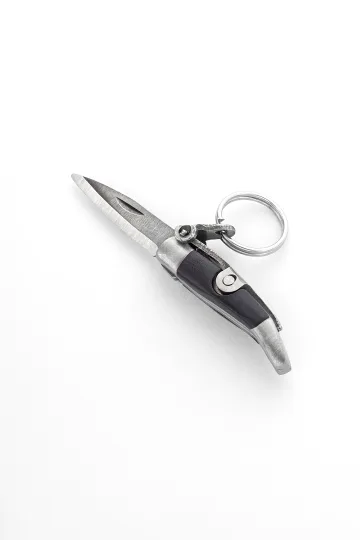




Conclusion
Music is invisible and temporal by nature. It sounds while the sound lasts, and vanishes the moment silence returns. But one part of it remains material: graphic notation -- notes on a stave, a clef on the margin, bars divided by vertical lines. That notation developed over a thousand years within the European tradition, and today it can be transferred onto silver or gold the size of a coin. A pendant engraved with notation becomes a way of keeping something fugitive close, preventing it from dissolving with time.
For a musician such a piece works as a trade sign, understood by colleagues without words. For everyone else it becomes a way of wearing a favourite melody, inaudible to anyone but the owner. A treble clef on a chain, the opening four bars of a wedding dance on a locket, a miniature guitar on a leather cord -- each of these forms says the same thing: music means something to us, and we are prepared to carry that sign visibly. Not because it is fashionable, but because it is true.