Pegasus Jewellery Meaning: The Winged Horse of Greek Mythology
Wear the symbol, don't just read about it. These are in stock:



The Most Enduring Figure of Classical Antiquity
Of all the images that ancient Greece produced, Pegasus may be the one that has travelled furthest through time with the least distortion. Roman emperors knew him, Renaissance scholars debated his genealogy, Romantic poets invoked him, and today his silhouette appears on the crests of the Inner Temple in London, on academic medals, in publishers' colophons, and in jewellery workshops from Albacete to Edinburgh. He survived the fall of Rome, the conversion of Europe to Christianity, the Reformation, the Enlightenment, and the industrial age, and he is still immediately recognisable to a schoolchild opening a book of Greek myths for the first time.
Two quite different Pegasuses exist in the modern imagination. The first is the popular-culture version: simply a horse with wings, interchangeable with any flying horse and sometimes given a unicorn horn for good measure. This Pegasus has shed his biography. The second is the mythological Pegasus of Hesiod and Pindar, a creature with specific parents, a specific hero for a rider, specific deeds to his credit, and a constellation bearing his name in the northern autumn sky. The second Pegasus is immeasurably richer, and he is the one this article is about.
We will trace the myth from Hesiod and Pindar through Ovid and the Renaissance emblem tradition, examine how the image lived in British heraldry, on classical coinage, in royal arms, and in the work of poets from Sidney to Keats, and then turn to how a thoughtful jeweller works with the motif today. Pegasus is not a flying amulet that will deliver inspiration on demand. He is a cultural sign with a long literary memory behind him, and he is worn as such, not otherwise.
At Zevira, the classical mythology line is one of our most considered directions. We make Pegasus in sterling silver, in gilt, in filigree wing-work and engraved antique profiles, and we aim for every piece to sit respectfully within the canon rather than simply glancing at it. What follows is the full cultural context for that ambition.
One preliminary note. Pegasus is not an active religious image in the way that a saint's medal or a devotional talisman is. No one prays to Pegasus; no liturgical tradition assigns him protective power. In the modern cultural field he is an artistic and literary sign, well suited to signify a creative profession, an academic affiliation, or a love of classical antiquity. That is already a wide and honourable field. But presenting him as an esoteric engine of inspiration would be to replace a cultural symbol with a commercial promise, and that is not something we are prepared to do.
Pegasus Jewellery: How to Choose
Pegasus works across a wide range of jewellery formats, from delicately small to sculptural and bold. The choice depends on how often you plan to wear the piece, in what contexts, and how much you want the mythological reference to be legible to those around you.
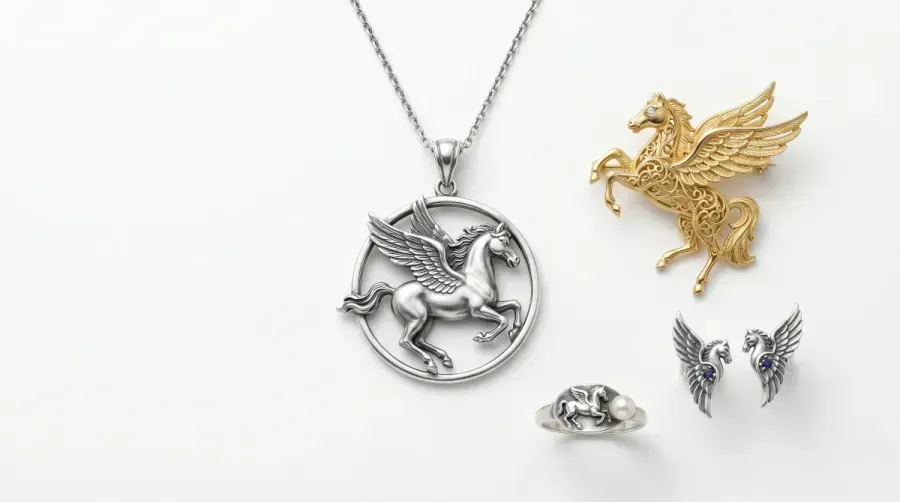
Pendant with Pegasus in flight. The most recognisable and the most versatile option. Pegasus is shown in profile, wings fully spread, one or two forelegs raised. The pendant typically measures two to four centimetres at its widest. It hangs on a fine or medium chain and sits just below the collarbone. It reads as an everyday sign: not loud, but immediately legible to an attentive eye.
Rearing Pegasus pendant. A more dynamic and more explicitly heraldic format. Pegasus stands on his hindquarters, forelegs raised, wings half-spread. This composition reads directly from European heraldic practice and suits anyone who wants the piece to read not as "a decorative horse" but as a specific classical or Renaissance motif with a traceable history.
Large-format brooch. For those who want a strong visual statement. A Pegasus brooch can be larger than any pendant, with more detailed wing-feathering, a finely rendered mane, and a fully spread tail. It is worn on a lapel, on a coat, on a heavy-weave jacket. It shows particularly well in an autumn or winter wardrobe, against dark cloth where silver reads in sharp contrast.
Paired Pegasus earrings. The rule here, as with all directional motifs, is strict symmetry. Two Pegasuses facing each other, or both facing the same way in mirror composition. A single Pegasus in one ear is a visual error: the winged horse has a direction of movement and an asymmetrical silhouette. Studs are more practical than drop earrings, since the wings of a drop Pegasus catch on hair and collars.
Pegasus signet ring. Two options: a full signet ring where the three-dimensional horse occupies the entire table, reading as a heraldic device; or a slender band with Pegasus engraved flat along the shank. The signet is worn as a single strong accent on one hand; the band sits comfortably in a daily stack.
Men's formats on leather cord. Pegasus is one of the mythological images that works as well in a masculine register as in a feminine one. In the men's version the common choice is a large flat silver pendant, often oxidised, on a fine leather cord at about fifty centimetres. It sits well under an open shirt collar, on a dark rollneck, or under a leather jacket. Historically Pegasus appeared more often in male heraldry and on academic crests than in female ornament, and that line remains readable today.
Wings alone as allusion. A modern format: the jewellery depicts only the pair of wings, sometimes with a suggestion of the horse's shoulder-line to nod towards the classical source. A quiet sign for those who know the myth but prefer not to have a literal figure on their person. Those who recognise it will; others simply see elegant wings.
Paired set for two. A separate genre, particularly for couples connected by arts or academic life. Two matching pendants, each Pegasus facing inward, so that when held together they form a mirror composition. We discussed paired jewellery at length in our guide to paired pieces and matching halves, and Pegasus fits that genre naturally, since mirror symmetry is inherent in the image.
Pegasus wants a clean shirt, not a fancy-dress toga. Spare me the laurel wreath, I beg you.
How to Wear Pegasus
I have run the classical line for years, and the winged horse has passed through dozens of looks with me. Here is what actually holds a look together, by occasion.
How do I wear Pegasus every day? For daily wear I recommend a small silver pendant on a medium chain over a white shirt, a chunky grey knit, or a light cotton dress. Here the winged horse works as a quiet personal sign: visible, but never pulling focus. Over a rollneck I suggest letting the pendant sit on top of the fabric so the wing silhouette reads.
Does it work at the office? It does. Pegasus is one of the few mythological images that raises no questions in a work setting. Under a blazer or a sheath dress I choose a compact pendant or a slim ring with an engraved silhouette, clean silver or restrained gilt, no bright enamel or large stones. A brooch on a jacket lapel reads as a precise professional accent.
How do I build an evening look? For the evening I suggest a bolder format: a large brooch on a dark jacket, or oxidised silver with an antique patina against a black dress. Deep dark cloth (burgundy, charcoal, navy) gives silver its contrast, and the winged horse reads at its most refined. One strong accent, the rest set aside, so Pegasus stays the lead.
What do I pair it with in a set? I keep the one-accent rule. If a Pegasus pendant is at the neck, I recommend simple, slim rings and earrings with no competing motif. For neighbours I choose the classical line only: meander, laurel, the profiles of the gods. I never put East Asian or fantasy symbolism in the same set with him; those are different cultural codes.
Who does it actually suit? Anyone who values restrained expression and cultural depth over loud effect. Pegasus likes a clean ground and a stage of his own, so he reads best against clothing with a clear line. He lands especially well on those who work with words or love antiquity, but in truth he suits almost anyone who wears him without the fancy-dress trimmings.

Turn on your camera, pick earrings, a pendant or a ring, and see the piece on yourself in real time.
Switch items in one tap.
Everything runs in your browser: no photo or video is ever uploaded.
Styles of Pegasus in Jewellery
Pegasus appears in several distinct stylistic traditions, each rooted in a different historical period. Understanding them helps you choose the version that best suits your wardrobe and your aesthetic sensibility.
Classical antique profile in flight. Pegasus in side view, wings spread wide, body extended in the characteristic pose of a flying or galloping animal. This version descends directly from the Corinthian silver stater of the fifth century BC, the coin on which the winged horse served as the official device of the city-state of Corinth. The proportions are naturalistic and close to a real horse, with only the wings added. The mane and tail are rendered neatly, without excess decoration. This is the most historically grounded register and the choice for anyone wanting classical rather than fantastical styling.
Rearing Pegasus in heraldic pose. Vertical composition: Pegasus standing on his hindquarters, forelegs in the air, wings raised. This pose came not from antiquity but from medieval and Renaissance European heraldry, where animals in crests were conventionally shown rampant. A rearing Pegasus reads immediately as a heraldic element and suits large brooches and bold signet rings.
Minimalist contour silhouette. The contemporary reading: Pegasus reduced to a clean recognisable line, sometimes barely more than a horse with two curved wings. Ideal for fine pendants, small stud earrings, or children's pieces. It needs no caption and works as a light graphic sign.
Carved high-relief with full detail. The opposite pole. Every feather of every wing, every strand of the mane, every muscle of the body worked in detail. This requires high skill in casting or hand engraving and results in something closer to a miniature antique sculpture. High-relief Pegasus pieces typically run to medium-to-large pendant size, substantial signet rings, or exceptional brooches.
Pegasus with rider. A rare and fully narrative composition: Bellerophon mounted on Pegasus, sometimes with a spear, sometimes at the moment of the Chimaera fight. This requires large format, since at small scale the figures become illegible. It occurs principally in Art Nouveau pieces of the late nineteenth and early twentieth century, when mythological multi-figure scenes were fashionable, and today is made mainly on commission.
Pegasus head close-up. A compact variant: only the horse's head, with wings growing from the temples or poll. This echoes coin types from Tarentum and Syracuse, where a winged horse head appeared regularly on reverses. Well suited to small pendants and ring engraving.
Wings only. An abstract sub-genre: a pair of spread wings with no horse. Very contemporary; favoured by minimalists; works well combined with other classical motifs.
Art Nouveau Pegasus. A stylised silhouette of the 1890s-1910s, with the flowing lines and floral framing characteristic of the period. Less naturalistic than the antique profile, more decorative, often set within swirling vegetation or wave-forms. These pieces live in museum collections and are occasionally revived by jewellers working in the tradition.
Customer reviews
Zevira is a real jewellery shop. Genuine payments, deliveries and customer thank-yous.
🥰🥰🥰 gracias

Ok, ¡gracias! 🙂

The Myth of Pegasus
No jewellery article about Pegasus can do without his biography. The Greeks gave him parents, a rider, heroic deeds, a tragic ending, and a place in the night sky. All of it entered European cultural memory and all of it is still active.
The birth of Pegasus is one of the strangest in classical mythology. His mother is the Gorgon Medusa, the one mortal among the three Gorgon sisters, whose gaze turned the living to stone. The hero Perseus, tasked by the tyrant Polydectes to bring back the Gorgon's head, killed Medusa by watching her reflection in his polished shield. At the moment his sword fell, two beings sprang from the severed neck: the giant Chrysaor, whose name means "golden sword," and the winged horse Pegasus. The father of both is Poseidon, who, according to one tradition, had been Medusa's lover before her transformation. The entire scene of two creatures emerging from a severed throat is among the most memorably strange in Greek myth.
Ancient etymologists connected the name Pegasus with the Greek word "pege," meaning "spring" or "source." The link is not accidental: Pegasus is associated throughout his story with water springs, and he himself causes one to appear, as will be seen below. Some modern philologists suggest the name may carry pre-Greek, Anatolian roots, reaching the Greek world through Asia Minor.
The principal rider of Pegasus was the hero Bellerophon. Their meeting is told in full by Pindar in his Thirteenth Olympian Ode and summarised by other ancient authors. Bellerophon, a young hero from Corinth, receives an oracle advising him to sleep a night in the temple of Athena. In a dream the goddess appears and presents him with a golden bridle, with which he can tame the wild Pegasus drinking at the spring of Pirene in Corinth. He wakes to find the bridle beside him, goes to the spring, and successfully casts it over the horse. Pegasus submits.
Together Bellerophon and Pegasus accomplish several feats. The greatest is the killing of the Chimaera, a monster with a lion's head, a goat's body, and a serpent tail, which had been laying waste to the lands of Lycia. The Chimaera breathes fire, so approaching it on the ground is impossible. From the back of Pegasus, Bellerophon circles above it, shooting arrows until he kills it. He and Pegasus also defeat the Amazons and the Solymi marauders.
Bellerophon's story ends with a lesson central to classical Greek ethics: hubris and its punishment. Drunk on his own achievements, he tries to ride Pegasus all the way to Olympus, claiming a place among the gods. Zeus responds by sending a gadfly that stings the horse; Pegasus bucks, and Bellerophon falls from an enormous height. In some versions he is killed outright; in others he survives but lame and mad, wandering in misery for the rest of his days, despised by the gods. Pegasus flies on to Olympus alone and serves Zeus there, carrying his thunderbolts.
The final act is the transformation. Zeus sets Pegasus among the stars as the constellation that still bears his name. It is one of the oldest recorded northern constellations, visible each autumn. The Great Square of Pegasus, formed by four bright stars, is recognisable even to a casual observer. A horse born from the blood of a Gorgon, who carried a mortal hero to the threshold of Olympus, who struck a spring open for the poets with a single blow of his hoof, and who was placed in the sky for all time by Zeus: that is the complete story, and it is one of the most coherent and resonant in the Greek canon.
Upload a photo of your pet, someone you love, or an object. We'll build a 3D model and hand-cast it in pewter.




Pegasus and the Poetic Tradition
The most durable part of the Pegasus story has nothing to do with warfare. It is the connection with poetry and inspiration, and it is this thread that carries the image through European literature from Hesiod to the present day.
The critical episode takes place on Mount Helicon in Boeotia, the sacred mountain of the Muses. As told by Hesiod, Ovid, and the geographer Pausanias, Pegasus at some point struck the rock of Helicon with his hoof, and a spring burst forth at the spot. The spring was named Hippocrene, meaning "horse-spring" in Greek. Its waters were held to be sacred, and it was believed that those who drank from it received the gift of poetry. The Muses, who lived on Helicon, drank from Hippocrene and inspired poets who came to the mountain.
Hesiod opens his "Theogony" with a scene at Helicon, near that very spring. The Muses appear to him, press a laurel staff into his hands, and breathe into him the power to sing of gods and heroes. Hesiod is probably the first European poet to leave us a first-person account of his poetic initiation, and that account is inseparable from the Heliconian landscape and from Pegasus as the horse that opened the spring.
From this passage a complex metaphorical knot is drawn tight in ancient poetry: Pegasus is connected to the spring, the spring to the Muses, the Muses to the gift of verse. Pegasus becomes a surrogate or mediator of poetic inspiration. Pindar, Horace, and Ovid use him in precisely this sense, though not always naming him directly.
In British literary tradition the connection runs deep. Philip Sidney in "Astrophil and Stella" (1582) calls on Pegasus when seeking the right word. Edmund Spenser invokes him in "The Teares of the Muses." Keats, in his 1820 "Ode to a Nightingale," reaches for the same inheritance when he writes of the imagination as a vehicle that lifts the poet out of the "dull brain." The phrase "to mount Pegasus," meaning to attempt creative flight, is current in English from at least the sixteenth century, and Alexander Pope uses the image satirically in "The Dunciad" (1728), which itself confirms how firmly embedded it was.
In British heraldry, Pegasus has a specific institutional life. The Inner Temple, one of the four Inns of Court in London, has borne the winged horse as its emblem since at least the sixteenth century. The arms of the Inner Temple show Pegasus on a field of silver, and the image appears on the Temple Church and throughout the Inn's buildings. Any barrister called to the English bar through the Inner Temple carries this heraldic connection. Pegasus also appears in various forms in the royal arms of several European monarchies and on the arms of a number of British universities and schools, precisely because of his long association with learning and eloquence.
In the Renaissance, when the whole of classical mythology underwent a powerful revival, Pegasus became one of the central emblems of humanist scholarship. Academies in Florence, Rome, and Naples placed him on their devices, medals, and seals. The winged horse announced that classical learning was the foundation of their enterprise. Andrea Alciato, whose "Emblematum Liber" of 1531 set the standard for European emblem-making for two centuries, included Pegasus as a symbol of fame and eloquence.
What should be said clearly is that this entire poetic tradition lives within literary language and cultural code. When a poet today wears a Pegasus pendant, the gesture belongs to that tradition; it does not mean waiting for inspiration to flow on a schedule. We say this directly because we want a buyer to understand what level of metaphor the symbol operates at.
CAPAORA mini knife pendant
The 18th-century Spanish navaja in miniature: 40 mm of stainless steel, a real folding mechanism and a Palanquilla lock that clicks. An affordable gift to remember.
Authentic · Ships from Spain · 14-day returns
What Pegasus Symbolises
Gathering together the classical myth, the Renaissance revival, and the modern cultural field, several stable meanings attach themselves to Pegasus. These are not magical properties; they are cultural associations, each with a long literary and visual tradition behind it.
Inspiration and creative breakthrough. Through his connection with Hippocrene and the Muses, Pegasus became the symbol of the poetic gift and, more broadly, of any creative breakthrough: the moment when an image, a sentence, a melody, or an idea arrives. The Greeks themselves described inspiration as something sudden and beyond the poet's control, literally a gift from outside. Pegasus expresses that quality of suddenness well: the winged horse arrives and departs on his own terms.
Freedom and flight as a mental category. Pegasus flies, and in that literal sense he is a sign of freedom. But the transferred meaning matters more: the state of thought that exceeds its ordinary limits, that breaks free of professional habit, of age, of social convention. Renaissance humanists prized Pegasus for exactly this reason; he stood for the mind's capacity to rise above the particular and see the whole.
The overcoming of limits. Pegasus is a paradoxical creature. A horse is a creature of the earth: powerful, grounded, bred for the soil. Wings belong to the sky and to birds. The combination of these two natures in one body is the symbolic core of the image. The winged horse is a metaphor for human consciousness: biologically tethered to body and ground, yet capable in thought of transcending those limits entirely. This theme is central to Renaissance and Baroque allegory, where Pegasus often appears alongside personifications of Philosophy and Knowledge.
A frank note on the symbol's limits. Pegasus does not guarantee inspiration. He designates it. That is a significant difference, which we deliberately articulate. Wearing a winged horse does not summon the Muse more often, does not speed up the writing of a dissertation, does not unblock a creative impasse. What it does: it becomes a personal sign of belonging to the world of writing, art, and creative thought. It works as a reminder to oneself and to others of one's membership in that world. That is cultural self-identification, and in that capacity Pegasus works very well. As an instant-action amulet, he does not work, because cultural symbols do not work that way.
Academic affiliation. A meaning solidified in European university tradition from the Renaissance onward. Pegasus is the emblem of the Muses; the Muses patronise the humanities; therefore Pegasus became an informal badge of humanistic learning. In many European universities his image still lives in the crests of humanities faculties, in the devices of literary societies, on graduation medals for arts programmes. The Inner Temple connection gives Pegasus a particularly specific institutional life in England, where his image has denoted legal and learned culture for five centuries.
Beauty as an independent value. Pegasus is one of the most aesthetically successful mythological creatures; his silhouette with spread wings is immediately recognisable and almost universally associated with nobility and beauty. A Pegasus jewellery piece works both as a symbol and simply as a beautiful object. That aesthetic value is no less real than the cultural one.
Pegasus in Art and Heraldry
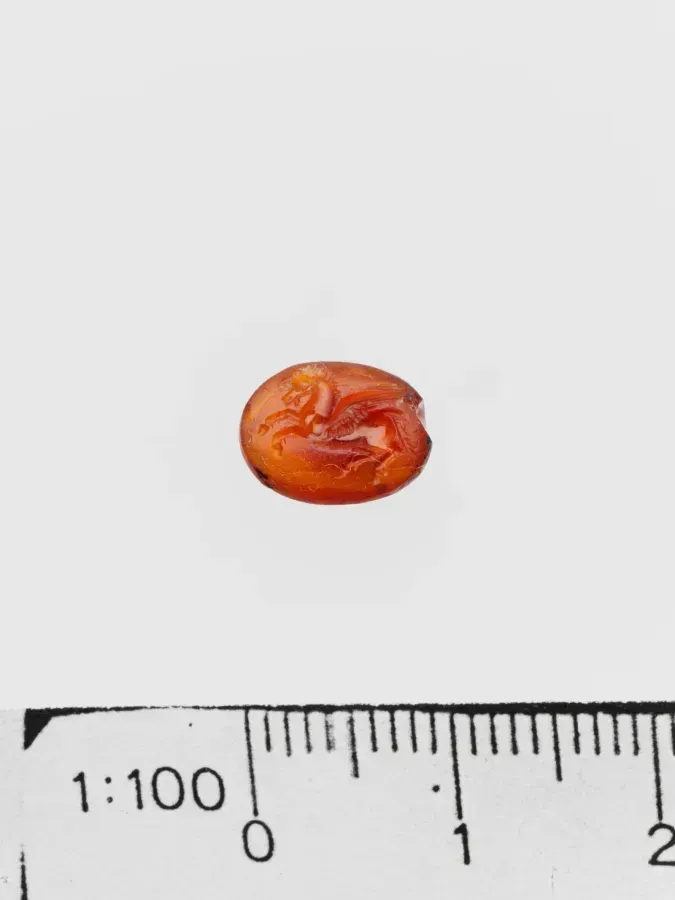
The history of Pegasus in the visual arts crosses antiquity, the Middle Ages, the Renaissance, the Baroque, Neoclassicism, Art Nouveau, and modern design. Below are the key nodes worth knowing.
Corinthian silver staters. The Corinthian stater bearing Pegasus on the reverse is one of the most widespread and long-lived coin types of the ancient Greek world. The earliest staters with the winged horse date to the late seventh and sixth centuries BC. The obverse showed the helmeted head of Athena (the goddess who gave the bridle); the reverse showed Pegasus in flight. These coins were minted over several centuries and Pegasus became the visual identity of Corinth across the Greek world. Corinthian staters are still found in the earth and on the antiquities market, and their image is directly quoted in many contemporary jewellery pieces.
Coins of Syracuse, Tarentum, and other cities. A winged horse head appeared on coins of Syracuse in the fifth century BC and on coins of Tarentum and other cities of southern Italy and Sicily. In each case it signals a specific mythological connection or local tradition.
Pompeian frescoes. In the houses of Pompeii and Herculaneum, preserved by the eruption of Vesuvius in AD 79, archaeologists found several frescoes featuring Pegasus, typically in scenes with Bellerophon and the Chimaera or in decorative compositions with the Muses.
Medieval bestiaries. In medieval European manuscript bestiaries, the winged horse appears alongside the unicorn, the griffin, and the phoenix as one of the fabulous beasts. In these texts he typically loses his classical biography and becomes simply a "winged horse" to which various moral meanings are attached.
British heraldry: the Inner Temple. In England, Pegasus entered heraldic culture with particular force. The device of the Inner Temple, established by at least the sixteenth century, shows a Pegasus rampant. The image appears on Temple Church, on the buildings of the Inn, and on the formal dress of its officers. Any English or Welsh barrister called through the Inner Temple carries this emblem as part of their institutional identity. Pegasus also appears in variants of the royal arms and in the arms of numerous universities, schools, and learned societies across Britain, consistently marking the same association with learning and eloquent argument.
Renaissance emblems. The era of the revival restored Pegasus to his full classical meaning and made him the emblem of humanist societies and certain aristocratic families. Alciato's "Emblematum Liber" of 1531 placed him as a symbol of fame and eloquence. Medici emblematic programmes, Roman academy medals, and Neapolitan coinage all carried the winged horse in this period.
Baroque and Neoclassical. In the seventeenth and eighteenth centuries Pegasus remained one of the most legible allegorical figures. Nicolas Poussin painted him in scenes with Apollo and the Muses on Parnassus. Fountains in Versailles and in English formal gardens incorporated him. In Russia he appears in the decoration of late eighteenth-century palaces and academies.
Art Nouveau. The new wave of interest in mythological imagery in decorative and floral compositions brought Pegasus into the jewellery of the fin de siecle. Alphonse Mucha, Rene Lalique, and Georges Fouquet depicted the winged horse in the sinuous, plant-like forms of the period. These pieces now live in museum collections and remain a primary source of inspiration for contemporary jewellers working the classical vein.
Twentieth century: logos and emblems. Vacuum Oil, later Mobil Oil, adopted a red Pegasus as its logo in 1911, and that red horse still stands at many filling stations around the world. Publishers, theatres, airlines, and universities have all used Pegasus as a device. This commercial diffusion does not erase the classical meaning; it simply adds a modern layer of association.
Leave your email, we'll send your discount code. No spam, unsubscribe anytime.
The code arrives by email, valid on your first order.
Materials and Techniques
The choice of material has a serious effect on how a Pegasus piece reads and sounds.
Sterling silver (925). The foundation of most contemporary Pegasus jewellery. Silver has a Platonic quality, a cool tonality and a grave register, that suits the classical subject better than warm yellow gold. Engraved profiles, chased wing-detail, and oxidised recesses all show best on silver. Most European Pegasus jewellery of the nineteenth and twentieth centuries was made in silver. For those with metal sensitivities, 925 silver is generally a safe choice.
Gold. A more ceremonial register. Pegasus in gold reads as a formal piece, a heraldic device, an academic medal. It suits occasions when the jewellery is intended as a significant and memorable gift: a doctorate, a call to the bar, graduation from a humanities programme.
Filigree for the wings. One of the most beautiful techniques specifically for Pegasus. Filigree is work in fine wire, twisted and soldered onto a base in a complex openwork pattern. Wings made in filigree create the illusion of individually distinguishable feathers in a light, almost aerial structure impossible to achieve through casting alone. Spanish and Italian filigree masters have worked in this tradition for centuries.
Engraving of the mane and body. A smooth, unworked mane loses all expressiveness. A mane worked in fine engraved hair-lines comes alive. Good engraving requires hand-work and significant skill from the maker; it is visible at close range and is one of the things that distinguishes a thoughtful jewellery piece from a cast reproduction.
Enamel for colour accents. Enamel is used sparingly on Pegasus: to highlight an eye, to provide a coloured ground under a wing, or to accent a saddle-cloth when Bellerophon is present. White enamel on the wings makes the horse read like a piece of antique marble sculpture; blue and green enamel combined with silver gives an Art Nouveau effect. Enamel requires careful handling: it should not be dropped on hard surfaces or subjected to sharp temperature changes.
Oxidising for antique patina. A treatment that gives silver the appearance of having lain in the ground for a century: a chemical solution darkens the metal, which is then partially polished so that raised areas remain bright while recesses stay dark. For classical subjects, this patina is close to ideal; it immediately places the piece in a historical rather than a contemporary commercial context.
Stone as eye. A small stone as the eye of Pegasus works with surprising force. A red garnet or ruby gives a "hot" gaze; a blue sapphire or aquamarine a cold one; black onyx a dramatic one. The stone is typically between one and a half and three millimetres; its job is not to shine for itself but to bring the figure alive.
How to Wear Pegasus
Pegasus is versatile, but a handful of practical rules keep him from reading awkwardly in a real wardrobe.
A pendant on a medium chain. The workable length is 45 to 50 centimetres, roughly 18 to 20 inches, which puts the figure just below the collarbones. The Pegasus itself wants to measure 2.5 to 4 centimetres at its widest point, wingtip to wingtip. Smaller than that and the silhouette dissolves into a bright speck; larger and it becomes heavy for daily wear. Keep the chain fine and small-linked, a belcher, curb, or figaro, so that the eye goes to the horse rather than to the metalwork holding it.
A substantial brooch on a lapel. Pegasus in brooch form belongs on cloth with body: wool, tweed, heavy linen, velvet, moleskin. The lapel of a jacket or the revers of a winter coat is the natural home. It performs at its best against a plain dark dress or a dark suit, where a silver winged horse becomes the single visible accent. Brooch formats usually run larger than pendants, 4 to 6 centimetres across. On fine blouse silk or thin jersey a brooch of that size drags the weave, so choose a firmer ground or a lighter piece.
Earrings only in symmetry. This rule applies to every paired motif, but with Pegasus it matters more than usual. A winged horse is an asymmetrical creature with a direction of travel built into it. One earring worn alone looks like half of a thought. A pair oriented consistently, either facing one another across the face or both facing forward, reads as deliberate. Studs, with a compact Pegasus sitting close to the lobe, are more practical than drops, because the wings of a hanging figure catch in hair, collars, and scarves throughout the day.
Plain grounds beat busy ones. White, grey, navy, burgundy, and black are the colours that give the motif somewhere to stand. Against a floral print or a strong check the winged horse simply disappears, because the eye is already busy with the cloth. The ideal backdrop is clothing with a clean line: a white shirt, a grey crew-neck, a black dress, a navy blazer.
Skip the costume props. This one is worth stating plainly. Pegasus carries two and a half thousand years of classical history, and he does not need reinforcement from fancy dress. Draped "Greek goddess" gowns, laurel wreaths, decorative wings, and gilt cord all drag the piece down to the level of a party costume and strip it of seriousness. The image sounds better in a classical or minimal wardrobe where it is the only mythological reference in the room and everything else stays quiet.
Structured clothing suits him. Tailoring works: jackets with a defined shoulder, shirts with a proper collar, shift dresses, a good coat. Pegasus prefers clothes that give him an even ground rather than competing with him for attention. Soft, unstructured layers tend to swallow a small metal figure entirely.
Company he keeps. Pegasus sits happily with the Greek key, the laurel leaf, the profiles of the classical gods, and geometric antique borders, all of which come from the same visual world. He does not sit comfortably beside East Asian or Northern European mythological symbols in the same set, since those are different cultural codes and the mixture reads as indecision rather than range.
Building a set. The one-accent rule serves Pegasus well. If the winged horse is at the neck, keep rings and earrings slim and free of competing motifs. If Pegasus is in the ears, the neckline wants either a bare chain or a small plain pendant. In this respect he behaves like a letter initial, an image we covered at length in the guide to initials and monograms.
On everyday wear. Pegasus belongs to the small group of mythological images that need no occasion at all. He is not provocative, he raises no eyebrows in an office or on a train, and he does not demand an explanation from strangers. If you intend to wear one constantly, choose a format without fragile enamel, since enamel is the first thing to chip against a desk edge or a seatbelt buckle.
Silver, gold, classical mythology pendants, brooches, and paired sets.
Send a friend a discount code, they save on their first order.
Who Wears Pegasus
Pegasus is a universal image, but certain people reach for him with particular certainty.
Writers and poets. The most direct address. A poet or novelist who wears Pegasus makes an exact cultural gesture: not an expectation that inspiration will flood in, but a declaration of belonging to the world of language. It is especially fitting as a gift from one writer to another.
Screenwriters, playwrights, and those who work with language broadly. Copywriters, essayists, critics, long-form journalists. For all these Pegasus functions as a quiet sign of membership in the word-craft tradition.
Classicists and teachers of ancient literature. Scholars of Greek and Latin, teachers of classical mythology and ancient philosophy. For these people Pegasus is not a metaphor but working material, encountered daily, and wearing him is a natural extension of their intellectual biography.
Students of humanities and classical studies. Excellent as a gift on matriculation, on the completion of a dissertation, or on graduation. Pegasus functions as a sign of entry into the learned community that deals with humanistic tradition.
Those with a serious classical education. People who have read Hesiod, who know the difference between Apollo and Dionysus, for whom antiquity is not a sub-field of cultural studies but a living part of their thinking. Pegasus, for them, is not exotic: it is a mark of recognition.
Barristers and lawyers with Inner Temple connections. The heraldic link is specific enough to make Pegasus a particularly fitting piece for anyone called to the bar through the Inner Temple, or indeed for any English or Welsh barrister who appreciates the resonance.
Amateur poets and members of writing groups. For someone beginning to take their writing seriously, a Pegasus piece can work as a private rite of commitment to the craft.
Collectors of mythological jewellery. Anyone assembling a collection of pieces with Egyptian, Greek, Roman, Celtic, or Norse mythological subjects should have a Pegasus. Without him the Greek section is incomplete.
A gift for a humanities graduate. One of the most precisely targeted gifts one can give a person at a significant moment in their academic life. It works better than a generic ornament because it connects to the specific cultural tradition in which the recipient is professionally invested.
Who Pegasus suits less. Those who want quick magic or a specific esoteric instrument. That is not what this image is. Pegasus is about cultural tradition, about the long history of language and thought, about the respect owed to the written word, not about instant results. He can also feel displaced in a sharply industrial, punk, or streetwear aesthetic, where antique references compete with the dominant mood rather than complementing it.
Frequently Asked Questions
Is Pegasus the same as a unicorn?
No, they are two entirely different creatures, though they are constantly confused. A unicorn is a horse with a single horn on its forehead and no wings; it originates in medieval European and partly Eastern mythology and symbolises purity. Pegasus is a horse with two wings and no horn; he originates in ancient Greek mythology and symbolises poetic inspiration and freedom of thought. Their biographies also differ: the unicorn has no specific mythological narrative and is essentially a legendary animal, while Pegasus has parents, a rider, and deeds attributed to him. When an ornament combines wings and a horn, it is neither the classical Pegasus nor the classical unicorn but a modern fantasy composite with no roots in a specific ancient tradition.
Is Pegasus an appropriate image for a man?
Yes, historically more so than for a woman. In ancient culture Pegasus was the mount of Bellerophon, a male hero. In European heraldry Pegasus appeared more often in male family arms than in female ones. In university tradition he was the device of academies and faculties that were, until the twentieth century, predominantly male. Today Pegasus is entirely gender-neutral and worn equally by men and women. But someone wishing to emphasise the masculine side of the image does so with full historical justification.
How many wings does Pegasus have?
Two, as a bird has two. This is the canonical count from antiquity. In antique vase-painting, where Pegasus is shown strictly in profile, the two wings sometimes appear as one because of the flat perspective, but the Corinthian coins and the Pompeian frescoes consistently show two wings, with the second sometimes hidden by the horse's body. When modern popular culture shows Pegasus with one wing, it is either an error or a deliberate stylistic simplification. In serious jewellery work two wings are always used, and this is the correct canon.
Can Pegasus be combined with Christian symbolism?
Yes, in European cultural tradition this combination is both possible and historically grounded. From the twelfth century onward, Christian allegorists occasionally read Pegasus as a symbol of the soul's ascent to heaven, which made him compatible with themes of transfiguration and elevation. In Renaissance and Baroque Catholic churches one can find decorative Pegasuses alongside angels and Christian allegories. A modern person wearing both a cross and a Pegasus pendant is following no tradition into contradiction; they are rather continuing the syncretic Renaissance culture in which classical and Christian imagery habitually coexisted.
Why did an oil company use Pegasus as its logo?
The American company Vacuum Oil, which later became Mobil Oil, adopted a red Pegasus as its logo in 1911. The logic was straightforward: the winged horse symbolised speed, power, and freedom of movement, which were precisely the associations the company wanted to attach to motor fuel at the dawn of mass motoring. This chapter of cultural history does not interfere with the jewellery use of Pegasus; the classical image is far larger than any single commercial application. Indeed, because of the filling-station logo, the red Pegasus became one of the most widely recognised visual symbols of the twentieth century, which only extended the cultural vitality of the image.
Does Pegasus bring luck to creative people?
The honest short answer is that Pegasus does not "bring" anything in the literal sense. He is a cultural symbol that works as a sign of self-identification. The wearer of a Pegasus piece declares their membership in the world of creativity, language, and art. That self-identification can have a psychological effect: someone who feels a strong sense of belonging to a cultural community tends to act more confidently within it. But this is a social and psychological mechanism, not a magical one, and it operates only to the degree that the wearer invests meaning in their sign. To promise "guaranteed inspiration" would be dishonest, which is why we do not.
Who rode Pegasus?
The rider in the Greek myth is Bellerophon, a hero from Corinth. In Pindar's account he was given a golden bridle by Athena in a dream and used it to master the wild winged horse as it drank at the spring of Peirene. Together they accomplished several feats, the greatest of which was killing the fire-breathing Chimera from the air, a battle that could only be won by an attacker who did not have to stand on the ground. The story ends badly for the man: grown proud, Bellerophon tried to ride up to Olympus itself, Zeus sent a gadfly to sting the horse, and the rider fell from a great height. Pegasus completed the journey alone and stayed in the service of the thunder god. In jewellery this matters because the rare compositions showing "Pegasus with rider" are depicting Bellerophon, sometimes at the moment of the Chimera fight. Scenes of that kind need the surface area of a large brooch or a medallion, since two figures at pendant scale turn into an unreadable tangle of limbs and wings.
Silver or gold for a Pegasus piece?
It depends on what the piece is for. Sterling silver is the main and the most historically faithful choice: a cool, severe tone suits the classical subject better than warm yellow metal, and engraving of the profile, chasing on the wing feathers, and oxidised recesses all read more clearly on it. The great majority of European Pegasus jewellery of the nineteenth and twentieth centuries was made in silver, which is why an antique-patinated silver piece looks immediately correct. Gold shifts the register towards ceremony and sounds like an academic medal or a formal emblem, so it is the right metal when the piece is meant as a milestone gift, a doctorate or a call to the bar. For daily wear silver is the more practical of the two, and it is generally kind to sensitive skin. Whichever metal you choose, look at the hallmark: British pieces carry the sponsor's mark, the standard mark, and the town mark of an Assay Office such as London, Birmingham, Sheffield, or Edinburgh.
Can a Pegasus pendant be worn every day?
Yes, and he is one of the easiest mythological images to live with. He is not provocative, he prompts no awkward conversations at work or on the street, and he asks for no special occasion. For constant wear take a pendant of 2.5 to 4 centimetres at the widest point on a chain of 45 to 50 centimetres, so that the figure settles just below the collarbones. Silver is the more forgiving metal in daily handling. The only real constraint is aesthetic: Pegasus is expressive against clean grounds such as a white shirt, a grey knit, or a navy jacket, and vanishes against busy prints. If the piece will be on you constantly, avoid fine enamel, which is the first element to suffer from knocks, and give the chain a check at the clasp every few months, since a lost pendant is a far more expensive lesson than a replacement bolt ring.
About Zevira
Zevira is a jewellery maker based in Albacete, Spain. The classical mythology line, including Pegasus and related motifs, is one of the categories in our catalogue. For current pieces and details, please visit the catalogue.
Buying it as a gift? Each one arrives ready to give.
 A branded Zevira box and a little card come with every order.
















Conclusion
Pegasus has lived in European culture for two and a half thousand years not because he delivers inspiration to those who wear him and not because he carries a special energy. He has endured because the Greeks found in him a precise visual formula for something true about creativity: that genuine inspiration is unexpected, free, liberating, and lifts the mind above the ordinary. A winged horse born from the blood of a Gorgon, who carried a mortal hero to the boundary of Olympus, who opened a spring for the poets with a single blow of his hoof, and who was placed in the night sky by Zeus and is still there each autumn above our cities: this is a compact and accurate emblem of what the creative act feels like.
To wear Pegasus is to acknowledge that this category of experience exists, that there is a difference between work done by inertia and work done in freedom of thought, between mere reproduction and genuine making. The jewellery does not deliver inspiration, but it works as a quiet sign of its possibility. In that capacity Pegasus is precise, honest, and genuinely useful. Sterling silver, filigree wing-work, an engraved mane, and a small stone in the eye: these add up to an object that makes no promises but marks, beautifully and appropriately, one of the best things human experience contains.