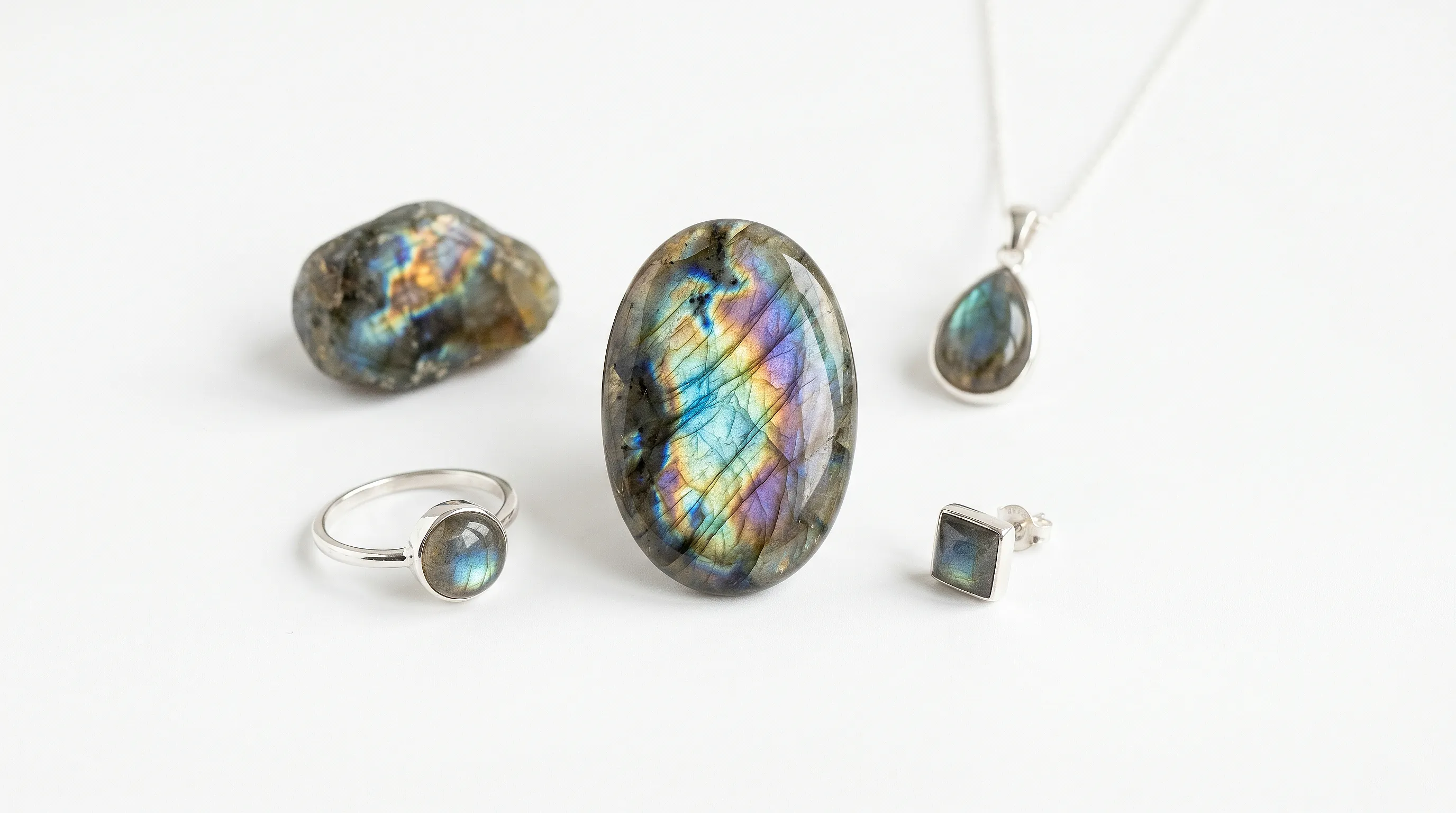
Spectrolite in jewellery: the Finnish labradorite with a full rainbow spectrum
When a rainbow is born inside a stone
Spectrolite was found in Finland in 1940, and almost by accident: workers building the Salpa defensive line near the village of Ylämaa struck labradorite in the bedrock. Samples reached the geologist Aarne Laitakari, and the stone shimmered not in one or two colours, the way Canadian or Madagascan material does, but across nearly the whole visible spectrum. From the Latin spectrum and the Greek lithos the name was born.
Spectrolite is not a separate mineral but a trade name for Finnish labradorite with an unusually full play of colour. The same plagioclase feldspar, the same physics as labradorite from other deposits, only the Finnish material flashes richer and often catches every colour at once. The main supply comes from around Ylämaa in south-eastern Finland, inside a rapakivi massif roughly 1.6 billion years old.
People value it not for rarity in any strict sense but for the physics: that whole rainbow comes down to how light behaves, with no need to believe in magic. It is one of those rare cases where you can find something beautiful and understand exactly how it works at the same time.
Wear the symbol, don't just read about it. These are in stock:

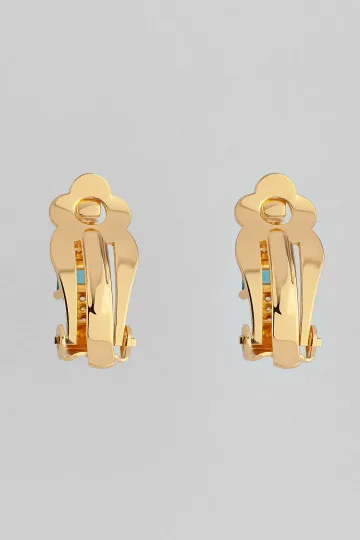
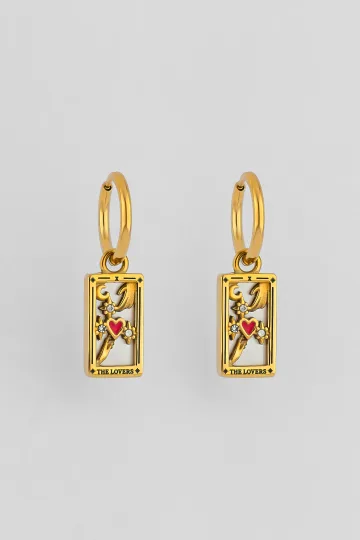


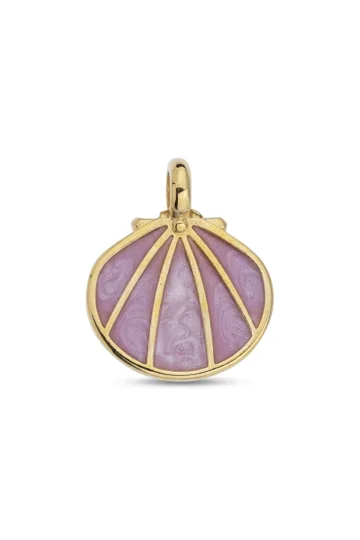
The history of spectrolite: from a chance find to a Finnish symbol
Labradorite was first described in the eighteenth century from samples off the coast of Labrador in Canada, which is where the name comes from. The Finnish material was noticed much later, around 1940, during road-building and quarrying work in the Ylämaa district. Its play of colour turned out to be so much brighter than the Canadian stone that Finnish specialists set it apart as its own trade category and gave it the name spectrolite.
After the Second World War, Finland staked a claim on spectrolite as a recognisably national stone. Ylämaa gradually became a cutting centre: lapidary workshops opened there, stone fairs were held, and cutting was taught. Spectrolite came to be seen as part of Finnish design alongside glass and furniture, and in that role it found its way into export.
Today spectrolite remains a niche stone for studio jewellery. It is not produced by the tonne for the mass market: veins with a good play of colour are limited, the material needs careful handling, and it is hard to pass cheap labradorite off as spectrolite because the flash is always poorer. In recent years attention has been fed by a fashion for unusual engagement rings and by curiosity about how and where stones are mined.
Spectrolite only catches fire against black. Drape it over a floral print and the rainbow dies, your fault, not the stone's.
What to wear spectrolite with
After years around shoots and display cases I have learned one thing about spectrolite: the stone is colourful on its own, so everything around it should stay quiet. Here is what actually works, sorted by occasion.
What do I wear spectrolite with every day? For everyday I recommend one detail and a dark ground: black, graphite, navy, wine. Against that fabric the blue and green fire flares strongest. I suggest studs or a slim ring under a polo neck, a plain shirt or knitwear, a quiet accent you notice only after a moment.
Is spectrolite right for the office? Absolutely. I choose a minimalist setting in silver or white gold and a closed neckline. That way the stone reads as a sign of taste rather than jewellery on show. Clean, strict lines only help it, and it will not shout.
How do I build an evening look? For evening I turn up the volume: drop earrings with cabochons, or cascade designs that flash as the head turns, livelier than any rhinestone. It works best on a bare shoulder or a deep neckline. For a special occasion I assemble a set in one metal, with no motley mix of stones alongside.
Which metal should I choose for spectrolite? For the cool blue-green flash I recommend silver, white gold or platinum: a neutral ground, and the stone burns brighter. Warm gold I suggest when I want a soft contrast to the blue. One rule: in a single look I never mix warm and cool metal, I pick one.
Who does spectrolite actually suit? Anyone who values restrained depth over show. Two simple rules that never fail. First: I match the pendant length to the neckline, short to a closed throat, long to a V-shape. Second: the size of the stone to the occasion, small by day, large for going out.

Turn on your camera, pick earrings, a pendant or a ring, and see the piece on yourself in real time.
Switch items in one tap.
Everything runs in your browser: no photo or video is ever uploaded.
The origin of spectrolite: the geology of a full spectrum
What spectrolite is at the molecular level
Spectrolite, like all labradorite, is a variety of plagioclase feldspar from the aluminosilicate group. Its composition is described by the series formula (Ca,Na)[Al(Al,Si)Si2O8], with the calcium component dominating. The crystal system is triclinic and the Mohs hardness is around 6 to 6.5, which makes the stone reasonably tough for everyday wear, though softer than quartz and far softer than diamond.
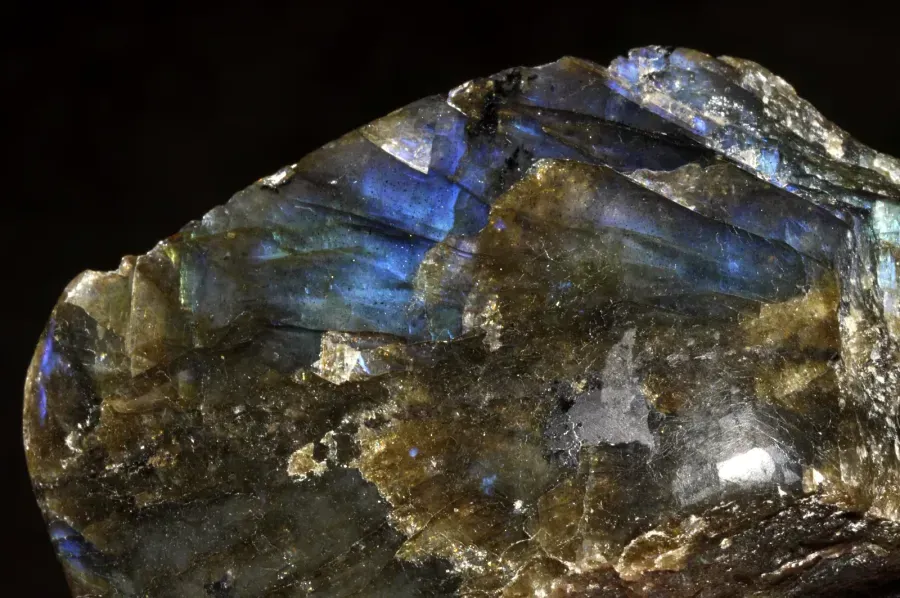
The rainbow flash, called labradorescence, does not come from colouring impurities the way it does in an emerald or a sapphire. Inside the crystal, the thinnest possible layers of two feldspar varieties alternate, one richer in calcium and one richer in sodium. The thickness of these layers is comparable to the wavelength of visible light, and that structure works as a natural diffraction grating.
When light hits these layers it splits: different wavelengths are reflected at different angles. Turn the stone and you watch one colour give way to another. It is closer to the rainbow on a soap bubble than to a rainbow in the sky: the colours do not follow a fixed order but depend on the angle. The whole effect is explained by thin-film interference and the diffraction of light.
How it forms
For labradorite with a strong play of colour to grow, several things have to coincide:
Magmatic origin and slow cooling. Feldspar crystallises from a melt, and the separation into a calcium phase and a sodium phase needs very unhurried cooling, otherwise the layers never have time to form.
A precise ratio of calcium to sodium in the original melt. A shift in either direction gives a different variety of plagioclase with no pronounced labradorescence.
No strong later metamorphism. High temperature and pressure stir the layers, and the flash weakens or disappears.
Finnish spectrolite is tied to a rapakivi massif, a granite roughly 1.6 billion years old. These are very ancient rocks, and the combination of composition with slow crystallisation is exactly what produced material with such a saturated play of colour.
The Finnish deposit
The main mining is concentrated in the Ylämaa district of south-eastern Finland. This is not a vast quarry but a source limited in reserves, so there is little good material on the market. In this respect spectrolite is a little like charoite, which is also tied to a single mining area, and that tie does much to shape its reputation.
Labradorites from Canada, Madagascar and elsewhere stay simply labradorites, whatever their quality. By established tradition, spectrolite is the name given specifically to the Finnish material with a full play of colour.
Why the Finnish labradorite gives every colour and not two
The unmixing that happened inside the crystal
The most common question about spectrolite runs like this: if it is the same labradorite, why does the Canadian material flash blue while the Finnish one flashes every colour at once. The answer hides in the scale of the internal layers. When a feldspar melt cools slowly enough, a single crystal separates into the finest alternating lamellae of two compositions, one richer in calcium and one richer in sodium. Mineralogists call this the unmixing of a solid solution, and the layered structure itself is named after the Danish researcher who described it, as Bøggild intergrowth. The thickness of the lamellae sets the colour of the flash: the thicker the layers, the longer the reflected wavelength and the warmer the play.
In most labradorites the layer thickness is more or less uniform across the whole stone, so the entire specimen flares in one or two cool colours, usually blue. In the Finnish material from Ylämaa the thickness wanders noticeably from patch to patch. One domain reflects blue, its neighbour green, a little further along gold and red. The eye gathers all those flashes into a single rainbow. The full spectrum of spectrolite is not a separate mineral but a particular unevenness within the same mineral.
Why the thick layers occur in Finland in particular
Thick lamellae, the ones that give the warm reds and golds, form only under a very long and undisturbed cooling, with no later reheating to mix the layers back together. The rapakivi massif, at roughly 1.6 billion years old, supplied exactly those conditions: an enormous volume of magma cooled extremely slowly and then lay for billions of years without strong metamorphism. That is why the red end of the spectrum, the most prized and the rarest, appears more often in the Finnish material than anywhere else. Canadian and Madagascan labradorite cooled under other conditions, its layers are thinner and more even, and the cool blue dominates as a result.
Why the play of colour is not a pigment and therefore does not fade
In sapphire the colour comes from traces of iron and titanium, in emerald from chromium. A colour of that kind can in principle be lost if the chemistry changes. Spectrolite has no colour at all in the ordinary sense: the body of the stone is grey to black, and the whole rainbow is light playing on layers, pure physics of reflection and interference. There is simply no pigment present that could burn out. So the play of colour in spectrolite does not dim from sunlight, from time or from lamps. Only the cleanliness of the surface changes, and that comes back with an ordinary wash.
Customer reviews
Zevira is a real jewellery shop. Genuine payments, deliveries and customer thank-yous.
🥰🥰🥰 gracias

Ok, ¡gracias! 🙂

Why two identical stones flash differently
The play of colour in spectrolite is tied to the plane of those extremely thin internal layers. The light flares only when you look almost perpendicular to that plane, so the cutter matters almost more than the rough itself. A good cutter first finds the angle of maximum fire, which is called orientation, and only then cuts and polishes the stone to suit it. Miss it by a couple of degrees and the same piece gives a pale band instead of a full spectrum.
From this comes a practical rule when buying: do not judge from a single angle, rock the stone. A properly oriented spectrolite flashes across a wide turn, forty degrees or more. If the fire lives in a narrow slit and vanishes at the slightest tilt, the stone is either mediocre rough or unluckily oriented in the cut.
And one more normal feature, often mistaken for a fault. Every labradorite has what is called a dead position: turn the stone to a certain angle and the flash goes out almost completely, leaving the grey-black base. This is neither a defect nor a fake, just the physics of the layers. There is no need to be alarmed by that fading, what matters is that the fire is full and bright at the working angles.
Types of spectrolite
By intensity of the play of colour
On the market the stone is loosely sorted by how bright and full the flash is:
Top grade. A full spectrum from blue to red, saturated, visible from a distance in ordinary light. The colours change crisply. There is little such material, and it sits in the upper price tier.
Good grade. A full or near-full spectrum, but less bright or needing a particular angle of light. The mid to upper tier.
Commercial grade. There is a play of colour, but in one or two tones, usually blue-green. In effect this is just decent labradorite. The budget tier.
To keep all the categories in view, below is a comparison by the main features: fullness of spectrum, intensity of flash, typical tier.
By dominant colour
Even with a full spectrum, one colour usually leads:
Blue. The most common and the most recognisable. Considered the classic of Finnish spectrolite.
Green. Rarer than blue, valued a little lower.
Golden. A yellow-gold tone in the flash, seen only now and then.
Red. A rare variant, prized highly because of its rarity.
By cut
Cabochon. The classic for labradorite stones. A domed polished surface shows the play of colour from every side.
Faceted. Facets add sparkle, but the play of colour reads worse if the cut is poorly oriented. It calls for an experienced cutter and is seen less often than the cabochon.
Natural form. A minimally worked stone where the natural cleavage faces do the work.
Upload a photo of your pet, someone you love, or an object. We'll build a 3D model and hand-cast it in pewter.




The energy of spectrolite: what tradition says
How it was understood before
A note up front: everything below belongs to folklore, not to proven properties. In the northern folk tradition, stones with a rainbow glow were linked to light and treated as a charm that helps you keep your clarity. Spectrolite is often called the stone of change and of vision, meaning not mysticism but the ability to look at a situation from a fresh angle.
The logic is plain to see: the stone literally looks different with every turn. From there comes the symbol: the circumstances are the same, what changes is the point of view. That is why people like to give spectrolite during periods of change, a new job, a move, the start of a big undertaking, but as a reminder of mindset rather than as a remedy.
Where there is a real effect
Without any esoterica the stone has an honest psychological effect. When you turn a spectrolite in your hands and follow the shifting colours, your attention comes back of its own accord to the here and now. It works as a simple anchor for focus, much like counting the breath in meditation practice. The stone gives off no energy of any kind, the effect lies entirely in our perception.
Claims of aura protection, third-eye activation or chakra balancing are not borne out by science. They are part of the crystal tradition, and they are worth treating as a tradition rather than as fact.





Spectrolite in Finnish design
The stone that became a national symbol
After the war Finland was looking for a visual language of its own, and spectrolite fitted that line without strain. A dark stone with cool blue and green flashes seemed to repeat the country itself: lakes, granite, the northern lights, long dark winters and sudden colour. Finnish designers of the mid century built an aesthetic on simple form and natural material, and spectrolite slid into it easily. Nobody tried to make it opulent. The settings were kept spare on purpose, so that the stone could do the talking.
Cutting as part of a maker's signature
Unlike transparent stones, which are cut to established formulas, spectrolite is cut afresh for each particular piece of rough. The cutter first hunts for the plane where the play of colour is fullest, and only then decides on a shape. That is why two stones from one vein come out unalike: one carries fire across the whole surface, the other in a narrow band. It brings the work closer to woodcarving, where the grain dictates the form of the object. A whole school of cutters grew up around Ylämaa, people who can read rough, and their hands did much to make the stone's reputation.
Why it stayed a niche stone
The mass market likes predictability: identical stones, even colour, a comprehensible size. Spectrolite resists all three. Every stone is individual, the yield of good material from a vein is modest, and the cutting takes experience. All of that keeps spectrolite in the zone of studio jewellery and small workshops, where the lack of repetition is precisely the point. For a buyer this is an advantage: a piece with spectrolite is almost guaranteed to be the only one of its kind, and an exact copy cannot be found.
A famous flash: the stone in the wider story
Labrador, where it all began
Labradorite itself entered European science at the end of the eighteenth century, thanks to specimens from an island off the coast of Labrador in Canada. The stone quickly became fashionable in the jewellery of the day: its dark, secretive lustre suited an age with an appetite for the unusual and the natural. Finnish spectrolite arrived on that ready-made reputation almost a century and a half later and carried it to its limit by adding the full spectrum.
The northern lights inside a stone
The Finnish habit of linking spectrolite with the aurora is no accident. The resemblance is literal: in both cases cool coloured flares run across a dark background and shift as you move. The comparison has stuck in descriptions of the stone and become part of how it is presented. The connection is purely a figure of speech, since the physics of an aurora and the physics of the stone are quite different, but the visual rhyme works and it explains why this stone in particular became the northern one.
Feldspar on the Moon
Minerals of the feldspar group, to which labradorite belongs, turned out to be among the most abundant in samples of lunar soil. The pale lunar highlands are built of anorthosite, a rock rich in calcium plagioclase, a relative of spectrolite. This does not mean that finished gem material with a full play of colour is lying about on the Moon, since that needs particular cooling conditions. But the backbone of the mineral that flares into a rainbow on an earthly ring is among the principal building blocks of the lunar crust.
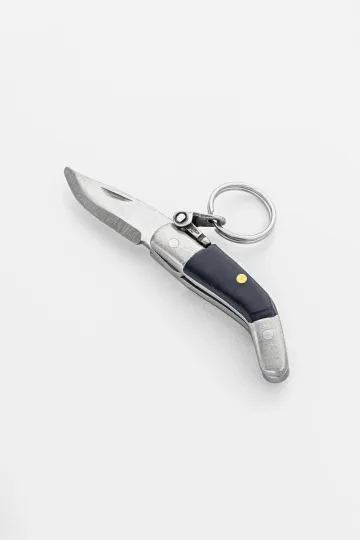
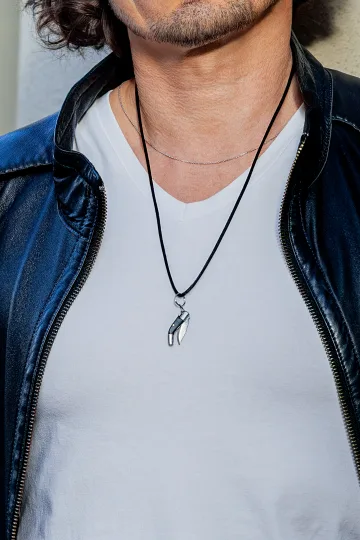
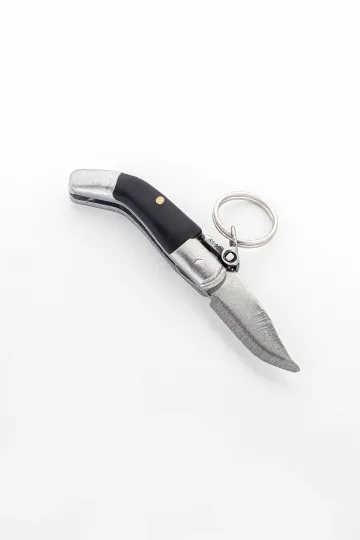
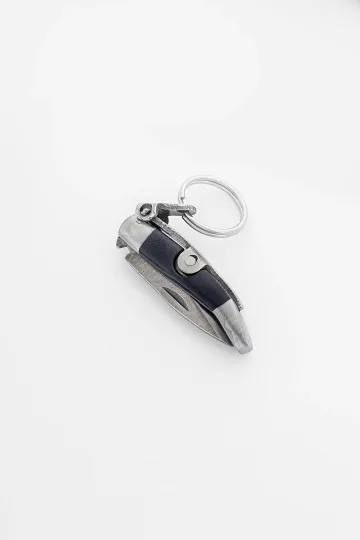
CAPAORA mini knife pendant
The 18th-century Spanish navaja in miniature: 40 mm of stainless steel, a real folding mechanism and a Palanquilla lock that clicks. An affordable gift to remember.
Authentic · Ships from Spain · 14-day returns
Spectrolite jewellery: types and styles
Rings
With a central cabochon. The classic: the stone in a closed setting of silver, white gold or platinum. The play of colour is visible from any angle. The price depends on the quality of the stone and the metal, from the mid to the upper tier.
Signet. A broad ring with a large cabochon. Worn by men and women alike.
A stack of slim rings. Several narrow rings with small stones on one finger.
Earrings
Drops with cabochons. As the head moves the stone flashes, and the effect comes alive.
Studs. Small cabochons for everyday wear and the office.
Cascade. Several stones of different sizes on a single earring, an evening option.
Pendants
A simple pendant. A cabochon on a chain with no extra setting.
In a closed setting. The stone is edged in metal, only the face left open, for a more restrained look.
In a wire wrap. Handwork that keeps the natural form of the stone.
Bracelets
Of beads. Polished beads on a thread or chain, flashing as the wrist moves.
With cabochons on a chain. Several stones set along the bracelet.
A rigid cuff. One or two stones as an accent.
Pairing with metals and stones
With metals
Silver and white gold give a neutral cool ground on which the blue-green flash reads brightest. The classic of Scandinavian style.
Yellow gold creates a warm contrast to the blue of the stone, a more traditional choice.
Platinum does not tarnish and looks the most refined of all, though it also costs more.
Black metal (steel) gives a sharp contrast that underlines the brightness of the flash. Popular in men's and avant-garde pieces.
With other stones
With clear quartz. Quartz works as a light neutral setting, and the flash of the spectrolite stands out more against it.
With moonstone. Both have an optical effect (adularescence in moonstone, labradorescence in spectrolite), and together they look intriguing.
With black tourmaline or onyx. A contrasting dark pair, dramatic to look at, common in studio jewellery.
With amethyst. Violet amethyst echoes the violet part of the stone's spectrum.
Spectrolite is best not mixed with overly bright red and green accents: the colours start to compete.
Leave your email, we'll send your discount code. No spam, unsubscribe anytime.
The code arrives by email, valid on your first order.
How to choose and avoid a fake
Telling spectrolite from ordinary labradorite
Fullness of spectrum. A good spectrolite shows every colour from blue to red as you turn it. A weak labradorite gives one or two, usually blue-green.
Intensity. A strong flash is noticeable from a distance, a weak one needs the stone brought close and the light caught.
Evenness. The flash runs across almost the whole surface rather than flaring on a single patch.
Imitations
Glass with film. A cheap fake with a rainbow film stuck on. It shows almost at once: the flash looks pasted on rather than coming from within.
Dyed labradorite. Low-grade material is sometimes tinted. The colour looks as if it sits on the surface rather than being natural.
Ordinary labradorite passed off as spectrolite. The most common case. Good labradorite from another deposit is sold as the Finnish stone. There is one defence: buy from a trusted seller and, for a major purchase, ask for a gemmologist's report.
Similar natural stones confused with spectrolite
More often spectrolite is confused not with a fake but with other genuine stones of similar optics. The difference is real and visible to the eye.
Rainbow moonstone. It is often called that, but mineralogically it is the same labradorite, only almost colourless and semi-transparent, with a blue sheen. Spectrolite, by contrast, is dark and opaque, and its flash is multicoloured, not just blue. If the stone is pale, transparent to the light and gleams with a single cool blue, it is rainbow moonstone, not spectrolite.
True moonstone (adularia). Its glow, adularescence, looks like a soft milky-blue cloud drifting across the stone rather than crisp coloured flashes. Spectrolite gives a sharp change of colour with angle; moonstone, a glowing patch.
Sunstone. A close relative from the same feldspar group, but the effect differs: tiny sparks from inclusions glitter within (aventurescence), the colour is warm, coppery-gold. No full spectrum at all.
Andesine and treated feldspar. A red-green feldspar turns up on the market, sold as a rare stone. It has an even solid body colour seen through it, not a play of colour across the surface. Spectrolite works by reflected light, not by body colour.
What affects the price
- Size: large clean stones rise in price faster than their growth in linear measure.
- Intensity and fullness of the flash: a full bright spectrum is markedly dearer than a single colour.
- Clarity: cracks and rough inclusions sharply lower the price and are risky in wear.
- Origin: Finnish material is valued above other labradorites.
Caring for spectrolite
Cleaning
Wash under cool running water with mild soap, wipe with a soft cloth or brush. Dry afterwards with a soft tissue.
Do not use hot water, hard brushes, abrasives or an ultrasonic bath: the layered structure does not take to them.
Storage
Keep it apart from harder stones so it does not get scratched, in a box or a soft pouch. Avoid sharp swings in temperature, which create stress in the layers and a risk of microcracks.
If the stone cracks
A crack shows right in the play of colour, and there is no neat way to repair it. The practical course is to replace the stone in the same setting.
Which setting protects the stone
Labradorite has two cleavage planes along which it splits more cleanly than in any random direction. A heavy knock in the wrong place chips the edge along a layer, and that is exactly why the setting matters more for spectrolite than for a hard stone such as sapphire.
The most reliable seat is the closed bezel: a thin rim of metal hugs the stone all the way round and takes the blow itself. For an everyday ring it is the best option. A prong setting, where claws hold the stone, leaves the edges exposed and suits earrings and pendants rather, which do not knock against tables and door handles. The thin sharp edges of a cabochon are best slightly blunted under prongs, so there is no point for a chip to start.
One more practical detail: an opaque spectrolite is often given a closed back rather than an open basket. That way the flash reads brighter against the dark ground, and no dirt gets packed under the stone, the kind that is hard to clean out of an open setting.
Spectrolite for different people
For those who like to understand how everything works. Spectrolite is ideal: its beauty breaks down entirely into the physics of layers and diffraction, with nothing to believe in.
For creative people. The shifting colours hold the attention and help you return to your work, if you keep the piece in view.
For those in a period of change. The stone is handy as a personal symbol: a change of job, a move, a new beginning. Not as a lucky charm, but as a reminder of mindset.
For those who care about restraint. A single bright but not loud stone meets the need for colour in a minimalist wardrobe.
The psychology of the choice: why the play of colour pulls at us
Attention loves movement
The human eye is tuned to catch change. A motionless object soon stops being noticed, whereas something that shimmers and shifts holds the gaze. Spectrolite works on exactly that: turn your hand slightly and the stone flares in a new way. So a piece with spectrolite draws a companion's attention gently, without the glitter of a diamond announcing its price. It is attraction through curiosity rather than through display.
A stone that never repeats
Part of the appeal of spectrolite is that it is literally one of a kind. Someone buying a transparent stone knows their neighbour may have an identical one. With spectrolite that is ruled out: the pattern of the play is unrepeatable, like a print. Psychologically this matters, since people enjoy owning a thing that exists nowhere else. Hence the affection of studio jewellers for the stone: it lets them make something certain to be unique without any fuss.
The calm of a dark background
Bright transparent stones demand attention constantly. Spectrolite behaves otherwise: at rest it is a restrained dark stone, and it opens up only in movement. That character is a soothing one, and the piece neither dominates nor tires the eye across a day. Many people choose spectrolite for precisely this combination, quiet in its ordinary state and vivid when it needs to be. For anyone who values restraint it is a rare compromise between colour and calm.
Facts that surprise
The name is younger than the stone
Labradorite is more than one and a half billion years old, while the word spectrolite is barely past eighty. It was coined in Finland in the middle of the last century, specifically to separate the local material with its full play of colour from ordinary labradorite. So the stone is older than almost any rock at the surface, and its name is younger than many people now living.
The stone has a dead angle
Turn a spectrolite to a certain angle and the whole rainbow goes out, leaving a grey-black slab. This is neither a fault nor a fake but a normal property of the layered structure: at that angle the layers simply do not reflect light towards the eye. A newcomer seeing it in a shop often decides the stone has gone out for good. A slight turn brings the fire straight back.
The play of colour is visible from one side only
Unlike a transparent stone, which plays right through, spectrolite works by reflected light and only from the front plane. From the back it is a plain grey stone with no fire at all. The cutter therefore cannot afford a mistake in orientation, because what is being cut is in effect the single working surface.
One mineral goes by three names
Labradorite, spectrolite and the so-called rainbow moonstone are largely the same plagioclase, differing in the play of colour and in transparency. The names describe the visual effect and the origin rather than the chemistry. That is the source of so much confusion in the market, where seller and buyer sometimes discuss one stone in different words.
Red is the rarest and the dearest
Although spectrolite is valued for its full spectrum, red and orange flashes are the least frequent within it. They require the thickest internal layers, and such zones are rare in the rough. A stone with a clear red burning in the play is valued noticeably above a blue one, all else being equal.
Its relatives lie on the Moon
Calcium plagioclase, the nearest relative of spectrolite, is among the principal minerals of the lunar crust. The pale lunar plains are built of rock made from such feldspars. The earthly stone on a finger and the soil of the lunar highlands are constructed from one mineral family.
It was found during the building of fortifications
Finnish spectrolite was noticed not by geologists on an expedition but by workmen on a defensive line in the early 1940s. The stone now sold around the world came to light almost by accident, out of wartime road and quarry work.
Send a friend a discount code, they save on their first order.
Myths and misconceptions about spectrolite
There is plenty of confusion around the stone, from belief in its healing powers to superstitions about the right hand and the phase of the moon. Let us take apart the most persistent claims.
Myth 1: Spectrolite is so rare it is almost impossible to find
Reality: it is mined mainly in one district of Finland and in limited quantity, but buying a piece of spectrolite jewellery is not hard; many studio jewellers carry it. The high price comes down to the quality of the flash and to reputation, not to unavailability.
Myth 2: Spectrolite dulls over time
Reality: the flash is born of a microstructure that does not change. The surface can get dirty, but that is sorted out by cleaning.
Myth 3: Spectrolite is a variety of amethyst
Reality: no. It is a plagioclase feldspar (labradorite), while amethyst is quartz. Entirely different minerals.
Myth 4: Spectrolite will happily replace a diamond in an engagement ring
Reality: it can, with a caveat. In hardness (around 6 to 6.5 against 10 for diamond) and because of its layered structure, it is more vulnerable to chipping. For a ring worn every day without taking it off, diamond, moissanite or spinel is tougher. Spectrolite is better in pieces taken off for physical work.
Myth 5: Spectrolite has scientifically proven magical properties
Reality: only its optical properties are scientifically confirmed. Aura protection, the third eye and the rest belong to folklore. A psychological response is possible, but that is an effect of perception and mindset, not of the stone itself.
Myth 6: Spectrolite needs to be recharged with energy regularly
Reality: from the standpoint of physics the stone needs no recharging at all. It is a ritual from crystal practice with no scientific basis.
Myth 7: Spectrolite fades in the sun
Reality: the flash does not fade, it does not depend on pigments. But it is not worth keeping the stone in direct sun for long because of temperature swings and the risk of microcracks.
When spectrolite suits less well
An honest conversation includes the stone's weaker sides too.
For heavy physical work. Despite its decent hardness, the layered structure makes the stone vulnerable to a knock along the layers. Those who work with their hands should take off rings and bracelets with spectrolite or prefer a pendant under clothing.
If you expect a miracle from the stone. Spectrolite works as a symbol and an anchor for attention, not as a button that solves problems on its own. As a lucky charm it will be a disappointment.
For a bright, multicoloured look. Among saturated red and green accents the spectrolite gets lost. It needs a calm ground.
For small children. The stone is easy to chip or lose, and its value is high. Better to wait for the age of careful handling.
Buying it as a gift? Each one arrives ready to give.
 A branded Zevira box and a little card come with every order.













FAQ
How does spectrolite differ from ordinary labradorite?
Spectrolite is Finnish labradorite with an especially full play of colour, where turning it shows nearly every colour of the spectrum. Ordinary labradorite from other deposits usually gives one or two colours. In mineral composition it is one and the same stone.
Can spectrolite be worn every day?
Yes, a hardness of around 6 to 6.5 is enough for that. But before sport and physical work the piece is best taken off, to avoid chipping.
How can I check that a spectrolite is genuine?
Look at the fullness and evenness of the play of colour (whether all the colours show from different angles, whether the flash runs across the whole surface). For a major purchase it makes sense to ask for a gemmologist's report and confirmation of origin.
Is spectrolite expensive? Is there anything cheaper?
Yes, ordinary labradorite from other deposits costs markedly less and looks similar. Moonstone too gives an optical effect. If budget matters, labradorite is a reasonable alternative.
Is spectrolite worn by men or only by women?
Everyone wears it; the stone has no gender attachment.
Can you be healed with spectrolite?
No. The stone does not replace treatment. As an aid for focus through meditation it can be pleasant, but it is not medicine. For any health problems, see a doctor.
Does spectrolite fade in the sun?
The flash does not fade, it is not pigment-based. But it is not worth keeping the stone in direct sun for long because of temperature swings.
Is spectrolite considered a precious stone?
Formally it is classed as an ornamental rather than a precious stone. That does not stop it being a desirable stone for studio jewellery.
Can spectrolite be worn with other stones?
Yes: it looks good with clear quartz, moonstone, amethyst, black tourmaline. Avoid overly bright red and green neighbours, which compete for attention.
Why is spectrolite called the stone of change?
Because it looks different with every turn. From there comes the symbol: it is not the situation that changes but the angle of view. Close to it in spirit is alexandrite, which changes colour with a change of lighting and is also considered a stone of change.
Why does Finnish labradorite flash every colour while others give only blue?
It comes down to the thickness of the internal layers. In the Finnish material from Ylämaa that thickness varies strongly from patch to patch, so one domain returns blue, another green, a third gold and red, and the eye gathers the lot into a rainbow. In Canadian and Madagascan labradorite the layers are thinner and more even, hence the dominance of a cool blue.
Which colour of the play is the most valuable?
Red and orange. They call for the thickest internal layers, and such zones are scarce in the rough, so a stone with a clear red fire costs more than a blue one, all else being equal. The most common and recognisable colour of Finnish spectrolite is blue.
Does spectrolite make a good gift?
Yes, and a successful one. Every stone is unrepeatable, so the gift is certain to be the only one of its kind. It is often given at moments of change, a new job, a move, the start of something large, as a reminder of a frame of mind rather than as a talisman. For a present a pendant or earrings in a closed setting is the safer choice, since they chip less easily than a ring.
Does spectrolite darken over time?
No. The play of colour is born from a microstructure that changes neither in sunlight nor with age. Only the surface can dull, from dirt and grease, and that comes back with an ordinary wash in cool water with mild soap.
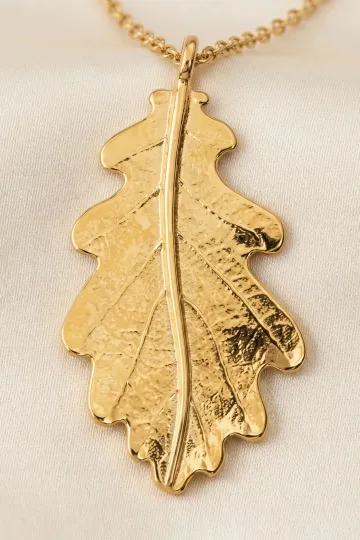
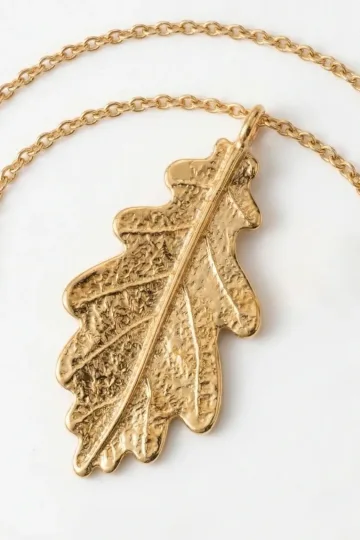
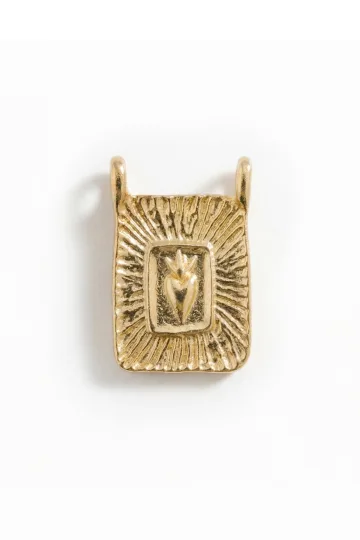
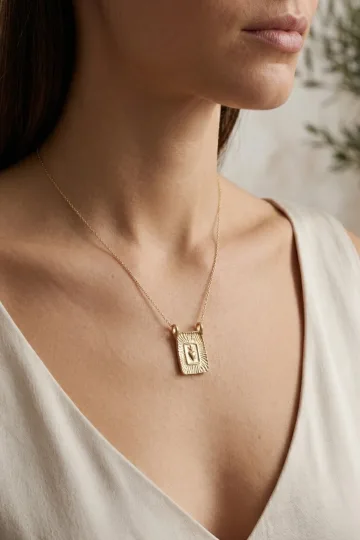
Wear the symbol, don't just read about it. These are in stock:

About Zevira: where to buy spectrolite jewellery
Zevira offers a select collection of spectrolite jewellery from masters of European studio craft. Each piece is made with the physics of the stone in mind: the setting and the cut are chosen so the play of colour opens up more fully.
We work with Finnish spectrolite and, where needed, provide confirmation of origin. If you would like to match a stone to a particular piece or commission an individual design, write to our team.
A piece of spectrolite jewellery suits those who like beauty to have a clear explanation: its whole rainbow is the physics of light, and that does not make it any less alive.