Charoite: the purple stone that comes from a single deposit on Earth
Charoite is mined in exactly one place on the planet. Not one country, one spot: a patch of taiga where the Chara and Tokko rivers meet, in the far east of Siberia. There is no charoite in Brazil, none in Africa, none in India. When that one deposit runs dry, no new charoite will ever form. That makes this purple stone the most geographically rare gem that ever ends up in jewellery.
Geologists only described it officially in the late twentieth century. For a mineral, that is yesterday. Emeralds were being cut five thousand years ago; charoite is younger than the motor car. And yet it has already become a favourite of collectors from Tokyo to New York and a quiet obsession for anyone who loves a stone with a real story behind it.
What follows is how a violet rock from the bottom of a Siberian valley went from a nameless boulder to a stone set into rings and pendants: the story of its discovery, the geology of its one and only massif, the grades and shades, the symbolism, how to choose a piece, and how to spot a fake.
What charoite is and why it stands alone
Charoite is not a single mineral in the strict sense; it is a rock of complex makeup. The lead role belongs to a rare mineral, also called charoite: a silicate of potassium, calcium, sodium and barium with water locked into its structure. Around it sit aegirine, tinaksite, fedorite, canasite and a dozen other minerals, several of which are rarities in their own right.
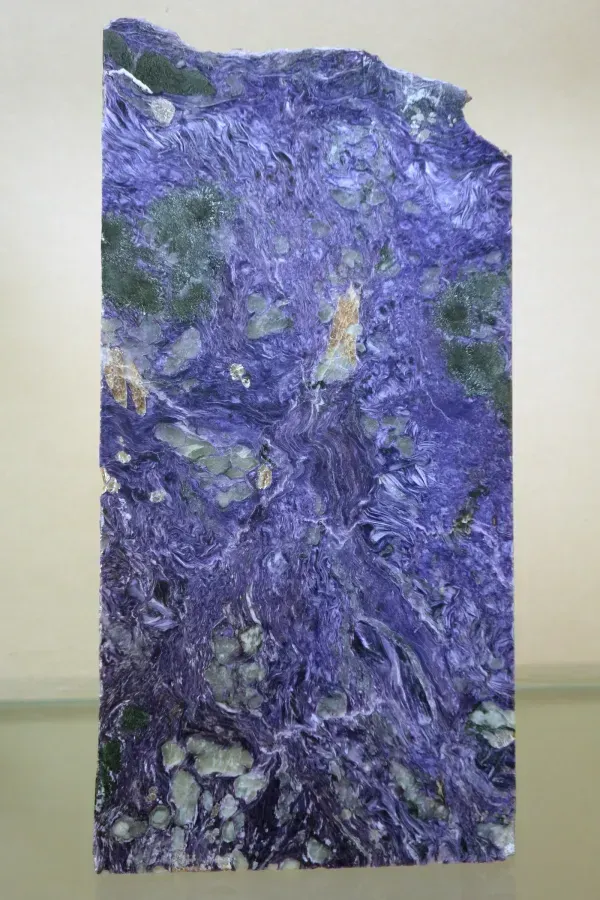
That cocktail is what gives the stone its signature look: lilac and violet fibres swirled into pearly whorls, stitched through with golden needles and dark flecks.
Why violet is so rare
Purple is uncommon in nature. Most stones are white, grey, brown or green. A stable lilac pigment comes from manganese, and only in very particular geochemical conditions does it lock in tightly enough to colour an entire rock.
Wear the symbol, don't just read about it. These are in stock:

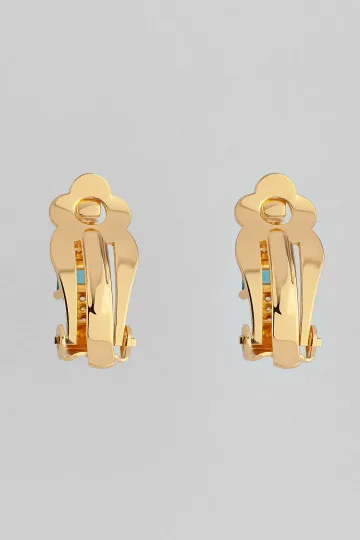
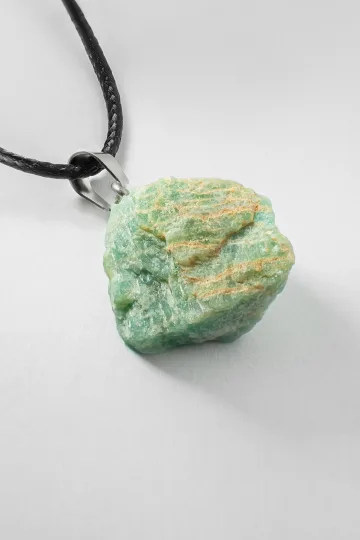


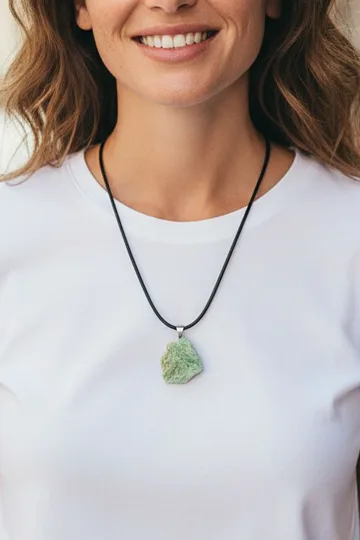



Amethyst, charoite, sugilite, lepidolite and the clear iolite with its violet-blue pleochroism make up a short list of natural purples, and charoite is the most patterned of the lot. Its figure never repeats: every slab is a separate picture, with swirls that cutters compare to the northern lights, to a peacock feather, to ripples on water.
Why charoite is soft and silky
Charoite sits at roughly 5 to 6 on the Mohs scale. That is softer than quartz, softer than the edge of glass. The stone is not built for a ring you wear every day and never take off, but it lives happily in a pendant, in earrings, in a brooch, in a ring kept for occasions.
It polishes up to a soft, silky sheen, sometimes with a faint shimmer that gemmologists call chatoyancy, because the light slides along the fibres the way it would along silk.
One deposit for the whole world
And here is the heart of it: the entire world's supply comes from a single body of rock around ten square kilometres in area. To put that in perspective, that is smaller than many a city park. The reserves are finite and cannot be replaced.
So when people say charoite is a single-source stone, that is not a marketing flourish, it is a geological fact. There are no other deposits, and the appearance of new ones is unlikely.
The story: how the stone was found, lost and found again
A nameless find in the taiga
Charoite's story did not begin with a triumphant discovery but with ordinary fieldwork. In the late 1940s, prospecting was under way in a remote stretch of eastern Siberia. The teams were after mica, coal and rare metals; the country was rebuilding after the war and hungry for raw materials.
Among the samples, chunks of a strange lilac rock ended up in the collection. They were taken for a variety of an already known mineral and set aside. The stone sat in storage for years, unidentified by anyone.
That arc is typical of geology. Plenty of minerals are first found, then lost, then rediscovered once the instruments arrive to analyse them properly. Charoite followed exactly that path.
The turning point
The key figure in the stone's history is the geologist who, working with colleagues in the 1960s, noticed the unusual purple rock and refused to file it away. It was their group that, in the 1970s, carried out the detailed study and posed the question: this is not a known mineral, but something new.
The arguments dragged on for years. A mineral is only recognised as a species in its own right after a strict review of its chemical makeup and crystal structure by a dedicated commission. The scientists had to prove they were looking at a genuinely new structure, not a variety of something already described.
Charoite was officially confirmed as a new mineral species in 1978. From that moment the stone had a name and a scientific passport. By the standards of mineralogy, that is only the other day.
Where the name comes from
There are two stories about the name. The official, geologically correct one: the stone is named for the Chara river, in whose basin the deposit lies. The rules of mineralogical naming favour a geographical link.
The second version, more romantic and more popular, ties the name to the idea of charm and enchantment. Geologists insist on the first. But the beauty of the coincidence has not gone anywhere: a violet, patterned stone whose name sounds like "charm" was always going to gather legends.
The deposit itself
The deposit has its own name in the local language, meaning roughly "the lilac stone". It lies on the watershed of the Chara and Tokko rivers, inside the Murun alkaline massif. The climate there is harsh: long winters, permafrost, no roads.
Mining has always been difficult and seasonal. The rock is taken not down deep shafts but mostly from the surface, picking out the seams with the best pattern and colour. The logistics in that wilderness are a problem of their own: simply getting the stone out is a job in itself.
The stone reaches the public
In the 1980s charoite became popular fast. Its unmistakable lilac figure turned up at exhibitions, in museum cases and in the work of lapidaries. Large blocks were turned into vases, caskets, table tops, desk sets, spheres and eggs in the long European tradition of decorative stonework.
It was the kind of stone that ended up in important collections and formal gifts, precisely because you could not buy it anywhere else.
Why charoite suited the role of a showpiece stone:
- You cannot source it from anywhere but its single origin.
- The recognisable violet colour reads instantly.
- There is a genuine story of discovery behind it.
- Large, ceremonial pieces look impressive.
The crisis of reckless mining
At the same time a problem appeared that has followed charoite ever since: the temptation to dig out as much as possible, as fast as possible. The reckless mining of the 1990s stripped the easiest, prettiest seams, and the market filled with mediocre chunks.
That hurt the stone's reputation. Buyers began to confuse dull grey-lilac material with real, high-grade charoite. The finest grades, meanwhile, grew even more expensive, precisely because so little accessible material was left.
Charoite today
Today mining is regulated, output is limited, and the best blocks are split between workshops and collectors. The stone has firmly entered the ranks of the world's rarest decorative gems.
At international gem shows charoite reliably draws a queue: people recognise the colour from a metre away and understand that there is no other source, and never will be.
Why interest in the stone only keeps growing:
- The reserves are finite, and the best seams are slowly being worked out.
- Demand is worldwide, including among collectors.
- Every quality stone is unique and irreplaceable.
- In half a century, no second deposit has ever been found.
So in fifty years a nameless boulder from a field collection became one of the most recognisable stones in the gem world. By the slow clock of mineralogy, that is a meteoric career.
Charoite wants silver and a plain black dress. Pile gold chains on top and you are just noise, darling.
How to wear charoite
After years on shoots I keep one rule for charoite: the violet figure leads, everything else plays backup. Here is what actually works, by occasion.
How do I wear charoite every day? For daily wear I recommend a thin pendant with a small cabochon or neat studs in silver. They sit easily over a white shirt, a chunky grey knit, a denim look. I suggest a shallow neckline, a boat neck or a soft V, so the stone rests on clean fabric instead of hiding in folds. Silver beats gold here: the cool sheen lifts the lilac and argues with nothing.
Does charoite work at the office? It does, as long as you keep it the single accent. I choose medium cabochon earrings or a quiet pendant under a closed collar, an even shade without drama, one metal across the set. Against a cool-toned suit, against grey, graphite, navy, charoite lands perfectly. I would not wear a ring daily to the office: a soft stone dislikes keyboards and paperwork.
How do I build an evening look? In the evening I let charoite open up: a large shimmering cabochon on a pendant, bold earrings or a brooch on the lapel. Under it I choose smooth fabric in a deep cool tone, black, wine, emerald silk or velvet, where the shimmer reads most clearly. I set pearls nearby; they soften the cold and add evening warmth.
Which metal suits my skin tone? Here I read the undertone. For a cool undertone I recommend silver: it strengthens the lilac and suits most people. For a warm one I suggest yellow gold, which gives a contrast and echoes the golden needles inside the stone. If in doubt, start with silver; with charoite it never misses.
Can I layer charoite with other stones? You can, but carefully. Charoite's pattern is busy and wants quiet around it, so I keep the companions few and calm: rock crystal, moonstone, black onyx. I build layers on plain links with no figure of their own. I never set a ginger carnelian or a bright citrine beside it; the warm starts to fight the cool, and the charoite goes flat.

Turn on your camera, pick earrings, a pendant or a ring, and see the piece on yourself in real time.
Switch items in one tap.
Everything runs in your browser: no photo or video is ever uploaded.
Geology: how a violet rock is born
The Murun massif
To understand charoite, look at the place where it lives. The Murun alkaline massif is a large geological body, formed by ancient igneous processes. Here, melts saturated with alkaline elements rose towards the surface: potassium, sodium, barium, strontium.
Such magmas are rare. Most of the Earth's rocks form from more ordinary compositions; here, a special chemical laboratory came together. The massif's rocks are reckoned to be hundreds of millions of years old.
What is unusual about the Murun massif:
- A rare alkaline magma, rich in potassium, sodium and barium.
- Host limestones and dolomites that the solutions reacted with.
- A long process of formation at very particular temperatures and pressures.
- A unique set of minerals, many of them first described right here.
- A location deep in remote taiga over permafrost.
A slow chemical drama underground
Charoite itself formed where alkaline solutions met the host limestones and dolomites. Hot fluids seeped through cracks, dissolving some minerals and depositing others.
In that slow chemical drama, a unique set of silicates came together that exists nowhere else. The process ran for millions of years, at strictly defined temperatures and pressures. Change any one of those, and the rock would have come out differently.
Why only here
Geologists know plenty of alkaline massifs around the world: in Greenland, in Canada, on the Kola Peninsula. Some of them carry related rare minerals. But it was the exact combination of magma composition, host-rock type, temperature, pressure and time at Murun that produced charoite.
Alter a single parameter and the rock would be something else. It is like a recipe in which every detail matters, down to the minute.
Scientists are still studying the massif, and in theory related rocks might one day turn up under similar conditions. But for half a century since the discovery, no second deposit of charoite has been found. For now the violet stone remains a geographical one-off.
Companion minerals
Inside the charoite rock, dozens of minerals sit side by side, and many of them were first described here too.
- Tinaksite gives the golden-orange needles that stitch so prettily across the lilac background.
- Aegirine is responsible for the black-green inclusions.
- Microcline and other feldspars add whitish and cream patches.
- Canasite, fedorite, miserite: names known mainly to specialists, yet these are what build the unrepeatable pattern of every slab.
This mineral complexity is exactly why no two pieces of charoite ever look alike. A cutter sawing a block is, in effect, developing a picture that nature painted over millions of years, and cannot know in advance what the cut will reveal.
The main minerals in charoite rock:
- Charoite, the core silicate, gives the lilac colour.
- Tinaksite gives the golden-orange needles.
- Aegirine gives the black-green inclusions.
- Microcline and feldspars give the white and cream patches.
- Canasite, fedorite, miserite: rare companions for specialists.
A finite resource
The deposit is small and irreplaceable. Unlike quartz or agate, which turn up all over the world in enormous quantities, charoite exists in a strictly limited volume.
When the accessible seams are worked out, mining will stop. That gives the stone a particular status: every piece of quality charoite is a fragment of a resource that will not renew itself. Collectors and investors treat it exactly that way.
What makes charoite geologically unique:
- A single deposit in the world, in eastern Siberia.
- A complex makeup of dozens of rare minerals.
- A unique combination of forming conditions, unrepeated in any other massif.
- A finite, irreplaceable resource.
- An unrepeatable pattern in every slab.
Kinds and shades of charoite
Grading by colour and pattern
Charoite varies hugely in quality, and the price gap between grades is enormous. The main criteria: depth of the violet, contrast of the pattern, pearly shimmer, and the absence of unwanted grey and brown tones.
Top grade. A deep, saturated violet-lilac, a pronounced fibrous pattern with a pearly shimmer, golden tinaksite needles, and a clean structure with no dirty grey zones. This material goes into fine jewellery and high-class display pieces. There is little of it, and it costs many times more than ordinary stock.
Middle grade. The lilac is even but less deep, the pattern is there but without the bright play of light, and grey areas creep in. This is the workhorse of most jewellery: pretty, recognisable, affordable.
Lower grade. A dull grey-lilac, blurred pattern, plenty of foreign inclusions. It goes into inexpensive tumbled stones, budget beads and souvenirs. It was material like this that dented the stone's reputation in the 1990s.
What separates top grade from low:
- Depth of colour: rich violet against dull grey.
- Play of light: pronounced silkiness against a flat sheen.
- Cleanliness: minimal grey zones against muddy washes.
- Pattern: contrasting waves and needles against a mush.
- Integrity: a solid block against crumbs.
Types by dominant figure
Cutters single out several characteristic kinds of pattern, each with its own informal name.
Swirled, or wavy. The lilac fibres curl in smooth waves, and the shimmer slides across the surface as you turn it. The most striking and sought-after kind.
Needled. Against the violet background, golden and orange tinaksite needles stand out sharply, creating a radiant figure. A contrast of warm and cold.
Mottled. Lilac zones alternate with white, cream and black patches. Decorative, graphic, lovely in larger pieces.
Solid, even-toned. A flat violet with almost no pattern, prized for purity of colour; it goes into beads and small inlays.
Shades of violet
Charoite's colour ranges from pale lilac to a dense aubergine. Warmer specimens drift towards a pinkish lilac, cooler ones towards a blue-violet.
The most prized is usually a deep royal purple with a pearly sheen. But tastes differ: some prefer a gentle lavender, others a dramatic dark tone. Since every stone is unique, the choice is always personal.
The main shades of charoite, from light to dark:
- Gentle lavender, a pale, light, airy tone.
- Even lilac, the classic middle shade.
- Saturated violet, deep and expressive.
- Dark aubergine, dramatic, almost plum.
- Cool blue-violet and warm pinkish lilac, the extremes of warmth.
Charoite and lookalike stones
A beginner can easily confuse charoite with other purple stones.
- Sugilite, also a rare purple, but denser and more uniform, without the fibrous shimmer.
- Lepidolite, flaky and crumbly, noticeably softer.
- Amethyst, a clear crystalline quartz, an entirely different texture.
Charoite is recognised by the combination of a lilac ground, a pearly silky shimmer along the fibres, and golden needles. No other stone repeats that set.
Energy, meaning and symbolism
First, to be honest: no stone heals or protects in any direct, physical sense, and it would be wrong to credit charoite with medical powers. But stones have another, cultural life, in beliefs, symbols and personal meanings that people pour into them. Here charoite has taken a striking place, despite its youth.
A stone of transformation
Charoite is most often linked to the theme of transformation. The logic is simple and rather lovely: the stone was born from the rarest coincidence of geological circumstances, from the reforging of one rock into another, and people transfer that idea of change onto themselves.
Anyone living through a shift, a move, a change of career, the end and the start of a relationship, often picks charoite as a symbol of passage. It shares this role of renewal with another single-source stone, tanzanite, which is associated with creativity. This is not magic, it is a way of marking an important phase with an object you see every day.
Protection and inner calm
The second steady association is protection and inner calm. Violet has long been tied, in European tradition, to the spiritual, the elevated, the regal. Purple was worn by rulers and church leaders because the dye was once outrageously expensive.
Charoite inherits that colour symbolism: it is given as a talisman of calm, a reminder to keep yourself steady in the rush. Again, it is not the stone that works but the person's attention to their own state, which the stone helps to hold.
A bond with the land it came from
The third theme is a bond with the land of its origin. For many, charoite is valued precisely as a stone born in harsh wilderness, a symbol of northern nature and of the effort of the people who found it.
A piece with charoite is often chosen as an object with character and provenance, rather than faceless prettiness. Behind it stands a precise spot on the map and a concrete story of discovery.
Why provenance matters to the owner:
- The stone is tied to a single point on the planet.
- A real story of geological discovery stands behind it.
- It belongs to a wild northern landscape with its own history.
- An object like that is a pleasure to give and to pass on with its tale.
Where the line lies
The line is simple. The stone is a prompt, an anchor, a symbol. The power lies in the person and in the meaning they bring.
People have worn gems as talismans for thousands of years, not because the stones radiated anything, but because an object that reminds helps you to gather yourself, to settle, to hold an intention. Charoite is a young but expressive member of that lineage.
If you boil the symbolism of charoite down:
- Transformation and change, the main and steadiest theme.
- Calm and inner steadiness, from the symbolism of violet.
- A bond with a wild landscape, from the stone's origin.
- Rarity and singularity, as a metaphor for a person's own uniqueness.
- An honest caveat: these are symbols and personal meanings, not magic.
Customer reviews
Zevira is a real jewellery shop. Genuine payments, deliveries and customer thank-yous.
🥰🥰🥰 gracias

Ok, ¡gracias! 🙂

Jewellery with charoite: what to choose
Pendants
A pendant is the ideal format for charoite. The stone here is large, the pattern is visible whole, and the gentle hardness is no obstacle: on the chest, a piece is better protected from knocks and rubbing than on a finger.
An oval or teardrop cabochon shows off the shimmer at its best. Silver underlines the cool lilac palette, and a slightly matte silver looks especially noble. Yellow gold plays on the contrast with the violet, echoing the golden tinaksite needles inside the stone.
A pendant with a large charoite is quiet expression: a piece people do not notice at once, but then cannot look away from.
What to look at when choosing a pendant:
- The cabochon shape: oval and teardrop show the shimmer best.
- The setting: a closed bezel protects the stone; an open one is prettier.
- The chain length: a large stone sits best at medium length.
- The metal: silver for the cool palette, gold for warm contrast.
- The size: medium for every day, large for occasions.
Earrings
Earrings with charoite call for attention to weight: the stone is not the lightest, so large cabochons are better as a short drop than as heavy long earrings that pull at the lobe.
Matched stones are hard to pair perfectly, since the pattern always differs, so good makers look not for identical but for echoing cuts, close in tone and figure.
Small charoite studs make a neat everyday option; large cabochons are for going out. Silver is the most frequent companion here too.
Tips for choosing earrings:
- Weight: large cabochons are better as a short drop, not in long heavy earrings.
- Pairing: look for stones that echo each other in tone, identical ones do not exist.
- Day format: small studs, understated.
- Occasion format: large cabochons, a visible shimmer.
- Fastening: a secure clasp; a soft stone dislikes frequent knocks.
Rings
A ring comes with a caveat about hardness. Charoite is softer than you would want for a ring worn day in, day out. So a charoite ring is a piece for special occasions, or for someone willing to look after the stone.
Visually, though, it is lavish: a large lilac cabochon in a silver setting, with applied granulation or filigree, looks like something from a museum case.
A closed bezel protects the stone at the sides and prolongs its life. Open prong settings are prettier but leave the stone exposed; it is a choice between drama and durability.
What to bear in mind with a ring:
- Wear: for everyday, never-off wear, charoite is not ideal, being soft.
- Setting: a closed bezel is safer than open prongs.
- Occasion: a charoite ring is for going out, not for rough work.
- Taking it off: remove it before cleaning, sport and washing up.
- Style: a large cabochon in silver with filigree looks museum-grade.
Bracelets
A bracelet of charoite beads is the most democratic way into the world of this stone. Beads of 8 to 10 millimetres on an elastic cord or silver findings are affordable and good at showing the variety of pattern: each bead is its own.
The downside of a bracelet is that it meets surfaces more often: the beads rub against each other and against the desk, so over time they go matte. The fix is care and the occasional re-polish.
A bracelet with a large cabochon as the centrepiece is a more formal option.
What matters in a bracelet:
- Bead size: 8 to 10 mm, a universal balance.
- Variety: each bead with its own pattern, that is the charm.
- Wear: beads rub and go matte; an occasional re-polish helps.
- Cord: elastic is simpler, silver findings are sturdier and smarter.
- Care: take it off for handwork, protect it from knocks on the desk.
Brooches and large inlays
In the long tradition of decorative stonework, charoite often goes into large, ceremonial pieces: brooches, clasps, sets. A big surface lets the pattern unfold, showing the waves, the needles and the pearl all at once.
Such pieces lean towards oxidised silver with granulation, towards a restrained, opulent, northern style. This is not everyday wear but an object with a statement and a history.
Where brooches and large inlays belong:
- A formal, ceremonial look.
- Outerwear: a coat, a jacket, a cape.
- A restrained, opulent, northern style.
- As the single accent against a calm background.
Setting metals
Sterling silver is the classic and most frequent companion for charoite: the cool gleam of the metal strengthens the lilac, and the price stays reasonable. You can read more about the metal in our piece on sterling silver.
- Yellow gold gives a warm contrast and echoes the golden inclusions.
- White gold and rhodium-plated silver give a neutral, cool ground.
- Oxidised silver with filigree nods to a traditional folk style and sits well on larger pieces.
How to wear and "activate" charoite
Take the word "activate" here without any mysticism. It is about rituals of attention: about how a person tunes themselves through an object. The stone stays a stone, but the habit of turning to it helps to hold an intention. Here is how people who wear charoite thoughtfully treat it.
First acquaintance
Many, on getting a stone, spend a few quiet minutes with it: studying the pattern, getting used to the weight and the coolness, holding it in the hand.
It is a simple way to move a purchase out of the category of "things" and into the category of personal objects. The more attentive the first contact, the more the stone comes to mean.
How to spend your first acquaintance with a stone:
- Study the pattern under different light, catch the shimmer.
- Hold it in your hand, feel the weight and the coolness.
- Notice the particular figure that is yours alone.
- Decide for what occasion and with what meaning you will wear it.
Wearing with intent
Charoite is often chosen for a period of change and worn deliberately: putting on the pendant in the morning, a person reminds themselves of a goal or of a decision to stay steady.
What works here is not the stone but the ritual, the same as a knot tied to jog the memory, only prettier.
Cleansing and care
By "cleansing", understand ordinary care plus a symbolic gesture. Wipe the stone with a soft cloth, rinse it in cool water if you like, and dry it thoroughly.
Important: charoite is soft and dislikes harshness, so no ultrasonic baths, hot water, acids or abrasives. Symbolically, some leave the piece apart overnight, to put it on afresh in the morning. That is about the person, not the physics of the stone.
Breath and pause
A simple practice: in a tense moment, take the pendant in your palm, draw a few slow breaths, and switch your attention to the coolness and texture of the stone.
This is a working trick of self-regulation, and a patterned violet stone makes a handy anchor. The stone does not do the work for you, but it helps you to stop and gather yourself.
Careful storage
An "active" stone is a stone that stays whole. Keep charoite apart from harder jewellery, in a soft pouch or its own compartment, so it does not get scratched.
Protect it from long, bright sun, which over time can mute the violet. Take it off before sport, cleaning, the shower and sleep. A well-kept stone serves for decades and passes on.
When you should always take charoite off:
- Before sport and physical work.
- Before cleaning and contact with household chemicals.
- Before the shower, the bath, the pool, the sea.
- At night, so it does not rub against the pillow and linen.
- Before applying creams, perfume and hairspray.
A stone for one intention
Those who wear charoite deliberately often tie it to a single task for a period: getting through a move, steadying themselves before a big step, holding calm under stress. The stone becomes an anchor for one thought.
- Choose one intention, not ten at once.
- Link it to putting the piece on in the morning.
- Return to it through the day with a touch of the stone.
- When the phase is over, mark it, and change the intention if you wish.
Upload a photo of your pet, someone you love, or an object. We'll build a 3D model and hand-cast it in pewter.




Charoite paired with other stones
Pairing stones is a matter of taste and symbolism, not chemistry. But charoite has good neighbours and bad ones.
Good neighbours
Charoite and rock crystal. Clear, colourless quartz is a universal companion: it does not argue with the colour, it lights up the lilac. A safe pairing for anyone who wants charoite to take the lead.
Charoite and silvery stones. Moonstone, labradorite and hematite give a cool, silvery, pearly palette in which the violet sounds especially deep. There is a separate piece on a shimmering companion stone, labradorite in jewellery.
Charoite and amethyst. Two purples side by side, a bold move. It works if the shades differ: a clear crystalline amethyst and a patterned matte charoite make an interesting contrast of textures within a kinship of colour.
Charoite and pearl. Warm cream pearl softens the cool lilac, giving a gentle, feminine pairing for evening looks.
Charoite and black stones. Onyx and black agate pick up the dark inclusions inside the charoite and make the look graphic and stern.
What to avoid
Do not set charoite next to bright, warm stones such as carnelian, garnet or citrine: warm and cool begin to argue, and charoite's pattern is lost.
Nor is it a good idea to surround it with a crowd of gaudy gems; charoite's own complex figure needs a calm setting.
A quick crib on pairings:
- Rock crystal lights it up and lets it lead.
- Moonstone, labradorite, hematite, a cool silvery palette.
- Amethyst, a bold contrast of two violet textures.
- Pearl, a warm softening for evening.
- Black onyx and agate, graphic sternness.
- Carnelian, garnet, citrine, better avoided, they argue with the cool tone.
How to choose charoite and spot a fake
Because there is so little genuine, quality charoite, the market is full of fakes and misgraded stock. Here is what to look at.
Colour and pattern
Real high-grade charoite is a saturated violet with a pearly shimmer along the fibres and golden-orange needles.
If you are faced with an even, screaming-purple stone with no structure and no shimmer, it is most likely an imitation: dyed quartzite, pressed crumbs or plastic.
The shimmer
Turn the stone under the light. On natural charoite, a soft silky glint slides across the surface along the fibres. A flat, lifeless sheen with no play is a warning sign.
Tinaksite needles
Golden and orange inclusions are hard to fake convincingly. Their presence is a good sign of authenticity, though in dense, single-toned grades there may be almost none.
Temperature and weight
A natural stone is cool to the touch and noticeably heavier than plastic. A plastic imitation warms up quickly in the hand and is suspiciously light.
Price
Quality charoite cannot cost as little as a trinket. If a large, vivid stone in a pretty setting is offered for the price of a cup of coffee, that is reason to doubt.
A good charoite pendant is closer in cost to a dinner out or a weekend away, while large display pieces approach the price of a used car.
Provenance and seller
Ask where the stone comes from. An honest seller will tell you about the single deposit and the grade.
Evasive answers and promises that the charoite was "brought from Brazil or Africa" are a clear sign of deception: there are no other deposits in the world.
Pressed crumbs
A common form of misgrading is pieces made from charoite crumbs glued with resin. Technically that is charoite, but a solid stone is always dearer and lovelier. Under a loupe you can see the boundaries of the fragments and bubbles in the binder.
The imitations you meet most often
- Dyed quartzite: hard, but without the fibrous shimmer.
- Pressed crumbs on resin: visible fragment edges and bubbles.
- Dyed plastic: warm to the touch, light, no pattern.
- Glass with a coloured pour: an even, screaming tone with no figure.
- Dyed marble or howlite: soft, no tinaksite needles.
A quick check in the shop
- Turn the stone under the light and look for a silky shimmer.
- Hold it to your cheek: natural is cool, plastic is warm.
- Weigh it in your hand: stone is heavier than an imitation the same size.
- Study the figure: look for fibres and golden needles.
- Ask about the deposit: the answer should point to the single source in eastern Siberia.





Charoite in figures and facts
A short summary that makes the stone easy to remember.
- Colour: violet and lilac in various shades, with a pattern.
- Hardness: about 5 to 6 on the Mohs scale, soft.
- Makeup: a rock of many minerals, the chief one being charoite.
- Deposit: the only one in the world, in eastern Siberia.
- Officially described: 1978.
- Working: cabochon, slab, bead, carving; not faceted.
- Main associations: transformation, calm, a wild northern land.
- Status: a decorative gem; the best grades on a par with precious stones.
A brief timeline of charoite
The stone's story fits into a few decades, and it is easy to see it by its turning points.
- Late 1940s. Prospecting near the Chara and Tokko rivers. A strange lilac rock ends up in collections, but remains unidentified.
- 1950s. The samples sit in storage, taken for a variety of a known mineral.
- 1960s. A geologist and colleagues notice the unusual rock and begin to study it.
- 1970s. Detailed analysis of composition and structure. The conclusion: a new mineral.
- Charoite is officially confirmed as a new mineral species. The stone gets a name.
- 1980s. A boom in popularity. Exhibitions, museums, carved pieces, formal gifts.
- 1990s. Reckless mining, a flood of low-grade material, a blow to the reputation.
- 2000s onwards. Regulated mining, rising prices for the best grades, the status of a collector's stone.
In those years a nameless boulder from a field collection became one of the most recognised stones in the gem world. What follows looks more closely at what stands behind these dates.
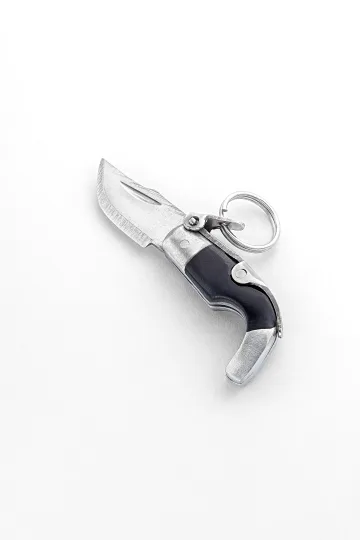
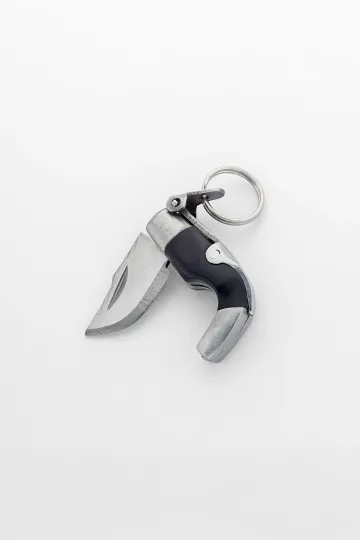
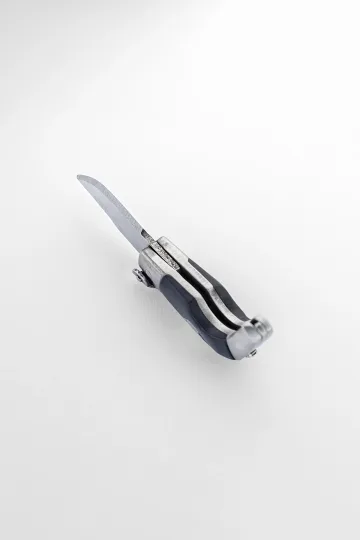
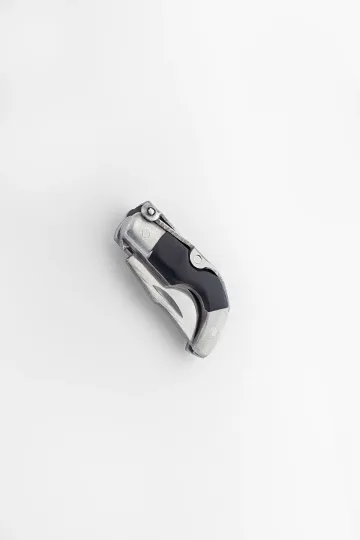
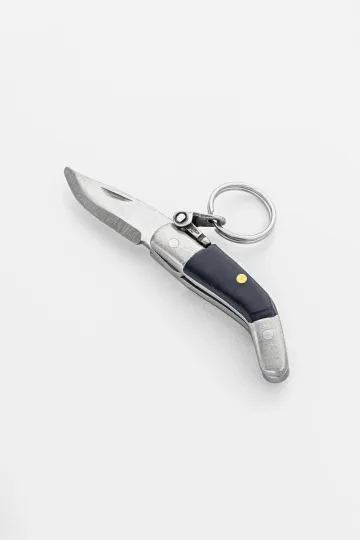
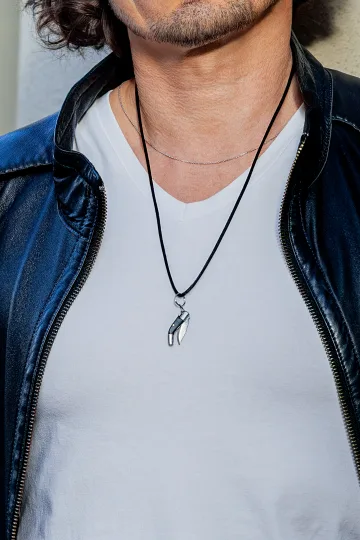
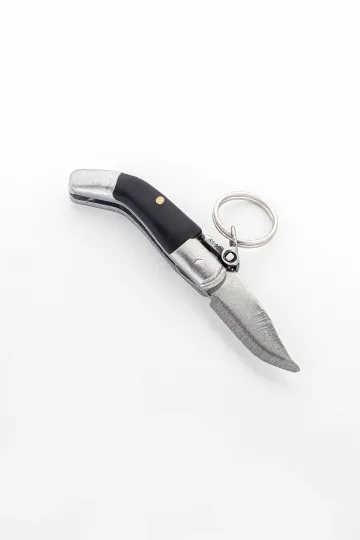
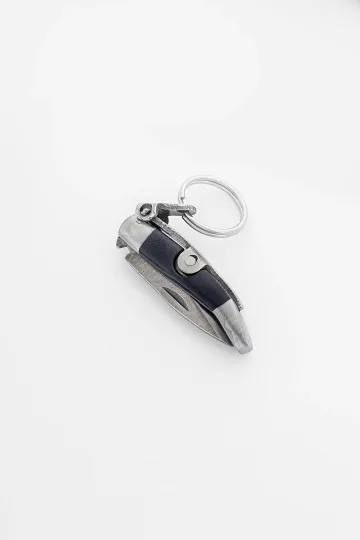
CAPAORA mini knife pendant
The 18th-century Spanish navaja in miniature: 40 mm of stainless steel, a real folding mechanism and a Palanquilla lock that clicks. An affordable gift to remember.
Authentic · Ships from Spain · 14-day returns
Legends and folk beliefs
The stone's youth has not stopped it gathering folklore fast. That is normal: a beautiful, rare gem draws stories like a magnet.
The stone of enchantment
The most enduring legend plays on the sound of the name, which echoes the word for charm. Popular belief quickly made charoite a stone of enchantment and attraction, even though geologists insist on the river etymology. But people like the "charm" version, and it travels from text to text.
The stone of change
The idea of transformation is not an ancient tradition but a modern reading. Because the stone was born from the reforging of rocks and was discovered so recently, it was easily tied to the theme of renewal and passage. The association is young but firm.
A northern talisman
The bond with a harsh northern landscape gave rise to the image of charoite as a talisman of endurance. A stone from the edge of the world, surviving in permafrost, became a symbol of resilience and support. Again, this is a poetic image, not an ancient belief.
Where the truth lies
The honest position is simple: charoite has no thousand-year mythology like emerald or turquoise. All its legends are younger than half a century and were invented recently. That does not make them worse, but to call them ancient would be untrue. The stone's power lies in its real rarity and beauty, not in an invented antiquity.
Charoite in the lapidary tradition
To understand charoite's standing, it helps to look at the tradition it slotted into. The decorative-stone schools of the world took shape over centuries around hardstones, around the great cutting workshops that supplied courts, churches and museums across Europe.
A heritage of the great workshops
Famous lapidary works, from Florence to the centres of central Europe, cut agate, jasper and porphyry for huge vases that still stand in museums today. Such workshops served palaces and cathedrals.
These schools worked out a particular language: large objects, calm forms, an accent on the natural figure of the stone, a minimum of fuss. The stone should speak for itself; the master only helps.
How charoite entered the tradition
When charoite came onto the scene in the 1970s and 1980s, lapidaries met it as a gift: a new material with the richest of patterns, and available in large blocks. They began to make from it exactly what they had known how to make for centuries.
- Vases and bowls, where the pattern unfolds around the whole circumference.
- Caskets and boxes, with walls matched by figure.
- Table tops and panels, assembled from slabs.
- Desk sets, seals, paperweights.
- Spheres, eggs and pyramids, lapidary classics.
- Mounts, metal inlays, small carvings.
A showpiece for collections
Pieces of charoite quickly became prized gifts. A violet stone that exists in only one place on Earth made the ideal gesture: you simply could not buy it anywhere else.
So charoite took its place among the short list of hardstones that the world of decorative carving treasures for their rarity and their figure.
Charoite as an object of collecting and investment
Why people collect it
The collector value of charoite rests on three pillars: a single deposit, a finite resource and the unrepeatable nature of every pattern. Mineral collectors hunt for specimens with rare companion minerals. Lovers of the stone gather slabs with the most expressive figure.
It is a rare case where geological rarity, beauty and irreplaceability all meet in one material.
What raises the value
Not every charoite climbs in price. A set of factors matters.
- Grade: deep violet with a shimmer is worth many times a dull grey.
- Integrity: a solid block over pressed crumbs.
- Size: large top-grade blocks are a great rarity.
- Pattern: pronounced waves, tinaksite needles, contrast.
- Provenance and papers: confirmed origin from the single source.
- Authorship: the work of recognised cutters is valued separately.
A sober view of investment
Let us be plain: a piece of jewellery is first of all jewellery, not a financial instrument. Ordinary beads and souvenirs are unlikely to appreciate noticeably. What rises in price are the best grades, large solid blocks and signed work.
If you do look at charoite as an investment, it is sensible to aim for top grade, integrity, size and a well-kept history. But the reason to buy a stone is, above all, that you like it; a possible rise in price is a pleasant bonus, not the goal.
Leave your email, we'll send your discount code. No spam, unsubscribe anytime.
The code arrives by email, valid on your first order.
Charoite around the home
Small things with a big character
Beyond jewellery, charoite lives in the home as a decorative stone. A small polished slab on a desk, a sphere on a stand, a figurine, all of these are a handy way to keep a favourite stone nearby without wearing it.
The violet colour goes well with light wood, with silver, with a white and grey interior. Charoite adds an accent without overloading the room.
Caring for decorative pieces
Larger pieces need the same care as jewellery. Wipe them clear of dust with a dry, soft cloth, do not stand them in long direct sun, and protect them from knocks and falls.
- Do not use household chemicals to polish them.
- Do not stand them on a windowsill in scorching sun.
- Wipe off dust with a soft cloth, not an abrasive sponge.
- Leave re-polishing to a stone specialist.
Treated that way, a decorative charoite holds its colour and gleam for decades.
Who charoite suits
By lifestyle and character
Charoite is a stone for those to whom the story and provenance of an object matter, while its sparkle is secondary. It speaks to people who value rarity, who love pattern and texture, who are relaxed about the fact that the stone needs care.
This is not a stone for the gym and rough everyday wear. It is a stone for thoughtful wearing, for objects taken out for the occasion and looked after.
By the moment in life
Charoite is especially apt at moments of change. Its symbolism of transformation makes it a logical choice for anyone changing jobs, moving, beginning a new chapter.
- A change of profession or the start of your own venture.
- A move to a new city or country.
- An important personal decision, a turning point in a relationship.
- A gift to yourself in honour of a milestone passed.
By aesthetic
Charoite is for those who love a cool violet palette, a natural figure, an understated depth instead of a loud sparkle. It sits well in a northern, restrained, slightly dramatic style, and badly with gaudy brightness.
How to read charoite's pattern
The pattern is the heart of this stone, and learning to read it means learning to choose. Here are the elements that make up the figure.
Fibres and curls
The base of the pattern is the fine lilac fibres, gathered into bunches and curls. The more expressively they twist, the more interesting the stone. Smooth waves are valued above a chaotic jumble.
The pearly shimmer
As you turn it, a silky glint slides along the fibres. This is charoite's signature play. A stone without the shimmer looks flat and costs less.
Golden needles
Tinaksite needles are warm, golden-orange strokes on a cool ground. They add contrast and life. In the best specimens there are few of them, but they are placed like sparks.
Black and white patches
Aegirine gives black-green inclusions, feldspars give white and cream. In moderation they adorn the figure; in excess they clutter it and make the stone look dirty.
Grey zones
Grey-brown muddy areas are the chief enemy of quality. The fewer of them, the higher the grade. When you look at a stone, first of all seek the purity of the violet, with no dirty washes.
Charoite versus other purple stones
There are not many purple gems, and it helps to understand how charoite differs from its neighbours in colour.
Charoite and amethyst
- Amethyst is transparent, charoite is opaque.
- Amethyst is faceted, charoite is cut en cabochon.
- Amethyst is everywhere and cheap, charoite is from one spot and rare.
- Amethyst has an even colour, charoite a fibrous pattern.
Charoite and sugilite
- Sugilite is dense and even, charoite is fibrous with a shimmer.
- Sugilite comes from Africa and Japan, charoite only from eastern Siberia.
- Both are rare and both are tied to the theme of spirituality.
- Charoite has golden needles, sugilite has none.
Charoite and lepidolite
- Lepidolite is flaky and crumbles, charoite is solid.
- Lepidolite is softer and looser, charoite holds a polish.
- Lepidolite is often a pale lilac, charoite is saturated.
Charoite and fluorite
- Fluorite is transparent and very soft (4 on Mohs), charoite is denser.
- Fluorite gives even colour zones, charoite a fibrous figure.
- Fluorite is widespread, charoite is unique in its origin.
A care calendar for charoite
To make the stone last, it helps to keep a simple rhythm of care in mind.
After every wear
- Take it off and wipe it with a soft dry cloth.
- Remove traces of skin oil and cosmetics.
- Lay it apart from harder jewellery.
Every few weeks
- If needed, rinse in cool water with a drop of mild soap.
- Dry it thoroughly at once, not with a hairdryer or on a radiator.
- Inspect the setting and the way the stone is held.
Once a year
- Show the piece to a specialist, check the setting is secure.
- If you wish, send worn beads for re-polishing.
- Check for any chips and scratches.
What never to do
- Ultrasonic and steam cleaning.
- Hot water, acids, solvents, bleaches.
- Abrasive pastes, tooth powder, stiff brushes.
- Long storage in direct sun.
Common mistakes buyers make
It is easy to slip up with charoite, especially as a beginner. Here are the typical traps.
Chasing brightness
A too-even, screaming-purple stone with no pattern and no shimmer most often turns out to be a dyed imitation. Natural charoite is always patterned and shimmering, never flatly bright.
Ignoring provenance
If a seller talks of "Brazilian" or "African" charoite, that is an alarm bell. There is one deposit. Any other version means a fake or ignorance.
Confusing crumbs with a solid stone
Pressed crumbs on resin are cheaper and look poorer. Under a loupe you see the fragment edges and bubbles. A solid stone costs more and is worth it.
Buying a ring for daily wear
A soft stone in a ring for constant wear quickly goes worn. For everyday, a pendant or earrings are better, and keep the ring for occasions.
Not asking about the grade
The difference between top and bottom grade is several times over in price and beauty. It is worth asking the seller about the grade outright and comparing stones in person.
Send a friend a discount code, they save on their first order.
The science of the colour violet
Violet is one of the rarest colours in the mineral world, and in charoite it rests on specific chemistry.
Where the lilac comes from
The colour is down to manganese in the structure of the mineral. Manganese ions absorb part of the visible light and reflect the lilac-violet part of the spectrum. A similar mechanism works in some other purple minerals, but the precise shade depends on the exact surroundings of the ion in the crystal lattice.
Why the shades differ
Even within one deposit the colour ranges from a pale lavender to a dense aubergine. The reason is non-uniformity of makeup: a touch more or less of an impurity, a different neighbour mineral, and the tone shifts.
- Warm specimens drift towards a pinkish lilac.
- Cool ones drift towards a blue-violet.
- The most prized: a deep royal violet with a shimmer.
Shimmer and fibres
The silky glint is not a colour but an optical effect. Light reflects off a multitude of parallel fibres, and as you turn the stone the highlight slides across the surface. The finer and more ordered the fibres, the more expressive the shimmer.
Colour stability
Charoite's violet is broadly stable, but the manganese pigments of many minerals are sensitive to long ultraviolet exposure. So prolonged direct sun can slightly mute the saturation over months and years. Ordinary wear does the stone no harm.
Frequently asked questions
Where is charoite mined?
Charoite is mined in a single place on the planet, on the watershed of the Chara and Tokko rivers in the far east of Siberia. It is part of the Murun alkaline massif. No other deposits of charoite exist anywhere in the world, and in half a century since its discovery no second one has been found. So any genuine charoite is Siberian in origin, regardless of where the jewellery was made. Claims by sellers that the stone was "brought from Brazil, India or Africa" are a sign of a fake or a mistake. The finite nature of its single source makes charoite the most geographically rare gem of all.
Why is charoite so rare?
Charoite's rarity is twofold. First, geographical: it forms in only one small massif, where a unique set of conditions came together, a special alkaline magma, the right host rocks, the needed temperature and pressure and millions of years of holding. Change one parameter and the rock would have come out differently. Second, in resource terms: the deposit itself is small and irreplaceable, and the best grades make up a tiny share of output. When the accessible seams are worked out, no new charoite will ever form on Earth. That finiteness and singularity of the source is the chief reason collectors worldwide prize the stone.
How much does charoite cost?
The price depends heavily on grade. Beads and souvenirs of low grey-lilac material are inexpensive, comparable to a couple of cups of coffee. Middle-grade pieces in silver are already at the level of a good dinner or a weekend away. Top grade, with a deep violet, a bright shimmer and tinaksite needles, costs many times more, while large collector's display pieces, vases, caskets, table tops, can approach the cost of a used car. The main price drivers: depth of colour, contrast and shimmer of the pattern, the size of a solid piece, and the absence of grey zones. Pressed crumbs are always cheaper than a solid stone.
What does charoite mean?
Charoite is most often linked to the theme of transformation and change: the stone was born from the reforging of one rock into another, and people transfer that idea of change onto life's passages. The second steady association is calm and inner steadiness, inherited from the symbolism of violet, long held to be elevated and regal. The third is a bond with a wild northern land and the character of its nature. The stone has no magical or healing powers in any direct sense. It works as a symbol and an anchor of attention, an object that reminds and helps a person hold an intention and gather themselves. The power lies in the meaning the owner brings.
Is charoite healing?
No, charoite does not cure illness, and it would be wrong to credit it with medical powers. Folk sources often link it to relieving stress, improving sleep and easing headaches, but there is no scientific support for this. The real benefit a person can get from the stone is psychological: a beautiful anchor-object helps to switch attention, to settle, to carry out a simple practice of breath and pause in a tense moment. This is a working trick of self-regulation, but the one doing the work is the person, not the mineral. If there are health problems, you need a doctor, not a stone. Charoite is jewellery and a symbol, not a medicine.
How do you tell real charoite from a fake?
Look at four signs. Colour and pattern: real charoite has a violet ground with a fibrous figure, not an even, screaming pour. Shimmer: as you turn it under the light, a soft silky glint slides along the fibres. Needles: golden-orange tinaksite inclusions are hard to fake. Temperature and weight: a natural stone is cool and heavy, plastic is warm and light. A suspiciously low price and a seller's tales of non-existent foreign deposits should also put you on guard. Pressed charoite crumbs on resin stand apart: technically that is charoite, but under a loupe you can see the fragment boundaries and bubbles. A solid stone is always dearer and lovelier.
How hard is charoite, and can you wear it every day?
Charoite's hardness is about 5 to 6 on the Mohs scale, noticeably softer than quartz, let alone sapphire. The stone can be scratched even by household dust, which contains tiny quartz particles. So a charoite ring is not the best choice for everyday, never-off wear: hands subject a stone to knocks and rubbing more than anything. Pendants, earrings and brooches, though, can be worn regularly: on the chest and in the ears the stone is better protected. The main rules: take it off before sport, cleaning, the shower and sleep, keep it apart from harder jewellery, and protect it from knocks and long bright sun. Treated carefully, charoite serves for decades.
How do you care for charoite?
Caring for charoite is simple but calls for gentleness because the stone is soft. Wipe the piece with a soft, dry or slightly damp cloth after wear. If needed, rinse it in cool water with a drop of mild soap and dry it thoroughly at once. Categorically out: ultrasonic and steam cleaning, hot water, acids, solvents, abrasive pastes and tooth powders, all of which damage the surface and mute the colour. Do not leave the stone long in bright sun, which over time can weaken the violet. Store it apart in a soft pouch or its own compartment, so harder stones do not scratch the charoite. Bead bracelets go matte over time from rubbing; a specialist can re-polish them.
Is charoite a man's or a woman's stone?
Charoite suits both men and women; it all comes down to the form of the piece. Women's pieces are pendants with large shimmering cabochons, earrings, rings, beads, in gentle lavender or a saturated violet. Men's are signet rings with a dense dark stone in a massive silver setting, cufflinks, bracelet inlays, prayer-bead stones. A deep violet with black inclusions looks stern and noble, without excess decoration. A stone with character, a remote origin and a story of geological discovery often appeals precisely to men who value an object with meaning. So charoite is confidently worn by both; you only have to choose the right format and shade.
Which star sign does charoite suit?
In astrology, charoite is most often recommended to Aquarius, Pisces, Virgo and Sagittarius, tying it to the violet colour and the theme of spiritual growth. But such correspondences are best treated as tradition and entertainment, not as a rule: astro-mineralogy has no scientific basis. It is far more sensible to choose a stone by whether you like its colour and figure, whether it fits your wardrobe and way of life, and whether its story and symbolism of change matter to you. If a violet stone with the story of a single deposit speaks to you, it is yours, whatever your birth date. A personal bond with an object means more than any horoscope.
How does charoite differ from amethyst?
These are entirely different stones, joined only by the colour violet. Amethyst is a transparent or translucent variety of quartz, crystalline, hard (7 on Mohs), often faceted, with an even lilac or purple colour. Amethyst occurs worldwide in enormous quantities and is therefore cheap. Charoite is an opaque, patterned rock with a fibrous pearly shimmer, softer (5 to 6 on Mohs), worked en cabochon rather than faceted. The chief difference is rarity: amethyst is mined by the thousand tonnes on every continent, while charoite exists in a single deposit on Earth. In texture they are nothing alike: charoite has fibres, needles and swirls, amethyst a clean crystal.
How does charoite differ from sugilite?
Charoite and sugilite are two rare purple stones that are sometimes confused. Sugilite is denser and more uniform, often an even violet-pink with no pronounced fibrous shimmer, and is mined chiefly in southern Africa and Japan. Charoite is recognised by its fibrous structure, its pearly silky shimmer along the fibres, and its golden tinaksite needles, and it comes only from eastern Siberia. Both are rare and prized, both are tied to the theme of spirituality and transformation. If you are faced with a purple stone with a wavy figure and a shimmer, it is more likely charoite; if it is dense and even, more likely sugilite. In hardness they are close, and both call for careful handling.
Can charoite get wet?
Brief contact with cool water does charoite no harm: you can rinse it during cleaning and dry it at once. But long soaking, hot water, chlorinated pools, seawater and a shower with cosmetics are better avoided. Charoite is a complex rock of many minerals, some of which are sensitive to the acids and alkalis found in household chemicals and pool water. So take the piece off before the shower, swimming, washing up and cleaning. If the stone does get wet, do not dry it with a hairdryer or on a radiator, just blot it with a soft cloth. With sensible handling, water is not a problem; the dangers are aggressive liquids and prolonged damp.
Does charoite fade in the sun?
Charoite's violet is broadly stable, but prolonged, intense sunlight can over time slightly mute the saturation, as happens with many minerals coloured by manganese. This is not about a couple of walks but about months on a bright windowsill or in a display under direct light. To keep the colour alive longer, do not leave the piece long in the sun, and store it in a box or pouch when you are not wearing it. Ordinary wear does the stone no harm; the problem is constant direct exposure. This is one more argument for keeping charoite in closed storage and taking it out for the occasion, rather than displaying it in the light forever.
Is charoite a precious or a decorative stone?
Formally, charoite is classed as a decorative gem rather than one of the classic precious stones of the first rank like diamond, ruby or emerald. Decorative stones are those worked en cabochon and used both in jewellery and in larger ornamental objects, vases, caskets, table tops. But this classification says nothing about value: the best grades of charoite, because of their unique rarity, cost more than many an ordinary precious stone. Charoite is prized precisely for its unrepeatable figure, its shimmer and the singularity of its deposit, not for transparency and the sparkle of facets. So the label "decorative" here is technical, not dismissive; in status and price, high-grade charoite is on a par with precious gems.
Is there synthetic charoite?
There is practically no industrial synthetic charoite grown in a lab; its complex multi-mineral makeup makes that unprofitable. Imitations, though, are widespread: dyed quartzite, pressed stone crumbs on resin, dyed plastic and glass passed off as charoite. These are not a synthesis of the real stone but fakes of it. The pattern helps to tell them apart: natural charoite has a fibrous shimmer and tinaksite needles that are hard to reproduce. There is also misgrading: pieces made of charoite crumbs glued with resin. Technically that is charoite, but under a loupe you see the fragment boundaries. So when buying, look at the structure, the shimmer and the weight, and ask about the single-source origin.
Is charoite suitable for an engagement or wedding ring?
Charoite is a beautiful and symbolic stone, but for an everyday wedding ring it is not ideal because of its softness: a hardness of 5 to 6 means that with daily wear the stone will in time scratch and go worn. If you want charoite specifically in an everyday ring, choose a closed bezel that protects the stone at the sides, and be ready to look after it. Symbolically, charoite is apt for an engagement: the theme of transformation and passage sits well on the start of a life together, and the singularity of the deposit rhymes prettily with the singularity of a person. Many couples choose charoite for a dress ring rather than an everyday one, or add it to a main engagement piece set with a harder stone.
How does charoite pair with other stones?
Charoite's best neighbours are calm, cool stones that do not argue with its complex figure. Clear rock crystal lights up the lilac and lets charoite take the lead. Moonstone, labradorite and hematite create a silvery pearly palette in which the violet sounds deeper. Pearl softens the cool with a warm cream tone. Black onyx and agate pick up the dark inclusions and make the look graphic. Amethyst beside it works as a bold, playful contrast of two violets of different textures. Bright warm stones, carnelian, garnet, citrine, are better avoided: warm and cool begin to argue, and charoite's pattern is lost. The general rule: charoite needs a calm setting.
Why is charoite called a single-source stone?
Because it literally is: the world's only deposit of charoite lies in the far east of Siberia, on its single source. No other country can offer natural charoite, it simply is not there in the ground. The stone was discovered by geologists and confirmed as a new mineral species in 1978, becoming one of the symbols of the world's decorative-stone art alongside hardstones like malachite and jade. Large blocks were turned into ceremonial pieces given as prized gifts, precisely because they could not be bought anywhere else. So charoite has earned the status of a single-source stone, geographically, historically and culturally. To own genuine charoite is to hold a fragment of that one place.
What charoite gift to give, and to whom?
Charoite is a good gift for someone on the threshold of change: at a change of job, a move, an important life decision, a stone of transformation becomes a meaningful symbol of passage. It is given to those who value the rarity and story of an object, who love the colour violet, who take an interest in stones and their origins. For a woman, a pendant or earrings with a shimmering cabochon will suit; for a man, a ring with a dense dark stone or cufflinks. A bead bracelet is a happy neutral gift, affordable and suiting almost anyone. As a souvenir with character, small carved pieces are good, a sphere, an egg, a figurine. Charoite's main advantage as a gift is the ready, beautiful story behind it, of a single deposit on Earth.
Can charoite be passed down as an heirloom?
Yes, and that is one of the stone's pleasing sides. Handled carefully, charoite keeps its colour and shimmer for decades, and its pattern is unique and irreproducible, so a piece becomes a genuine family object with a history. Because the deposit is finite and irreplaceable, good old charoite pieces can hold their value, both material and sentimental. For the stone to reach your grandchildren in good shape, store it apart, protect it from knocks, aggressive chemicals and long sun, and have worn beads re-polished from time to time. When passing the piece on, pass on its story too: where the stone is from, what it meant, when it was bought. That is how charoite turns from an object into family memory.
Does charoite appreciate over time?
Many collectors hold that high-grade and large charoite grows scarcer over time. The reason is simple: the single deposit is small and irreplaceable, the best seams are slowly being worked out, and demand, including worldwide collector demand, persists. As the accessible reserves deplete, quality material is met less and less often. This does not mean every charoite should be seen as an investment: ordinary beads and low-grade souvenirs are unlikely to interest collectors. Solid blocks of top grade, large display pieces and old work by recognised cutters are what more often enter collections. If collector value matters to you, it makes sense to choose top grade, a large size, a solid stone with no grey zones, and to keep the provenance and papers.
Why is charoite worked en cabochon rather than faceted?
Charoite is opaque, so the faceting that transparent stones need to play light inside is useless for it: there is nowhere to catch the sparkle of facets. A smooth, domed cabochon, by contrast, shows off exactly what charoite is prized for: the fibrous figure, the pearly shimmer, the contrast of lilac with golden needles. A rounded polished surface lets light slide along the fibres and bring out the silkiness. Besides, the stone's softness (5 to 6 on Mohs) makes thin sharp facets impractical, they would quickly go worn. So cabochon, slab, bead and large carved form are the natural formats for charoite, and it is faceted only rarely, and only in decorative experiments.
What carved pieces does charoite suit?
Thanks to its large blocks and striking figure, charoite became a favourite material for desk and interior carving. From it are made vases, caskets, table tops, desk sets, candlesticks, spheres and eggs in the long tradition of decorative stonework. A large cut surface lets the pattern unfold in full: waves, needles and pearl come together into whole landscapes. Such pieces were given for decades as prized gifts. For the home, small carved figurines are good, spheres on a stand, pyramids, they show the stone and adorn the interior. The downside of large pieces is the price: a big solid top-grade block is rare and dear, so ceremonial carving from charoite was always a status object.
When was charoite discovered?
Charoite is a very young stone by the measure of mineralogy. The strange lilac rock was found during fieldwork as far back as the late 1940s, but at the time it was not identified and was taken for a variety of a known mineral. It was a geologist and her group who took up its proper study in the 1960s and 1970s. After careful analysis of its composition and crystal structure, charoite was officially confirmed as a new mineral species in 1978. For comparison: people were working emeralds and turquoise thousands of years ago, while charoite is younger than many modern things. This youth explains why the stone has no ancient mythology: all its legends were invented recently.
What colour is charoite?
Charoite is always violet, but the shade ranges widely, from a pale gentle lavender to a dense dark aubergine and an almost plum tone. Warm specimens drift towards a pinkish lilac, cool ones towards a blue-violet. The colour is down to manganese in the structure of the mineral. Besides the main violet, the stone almost always has extra colours: golden-orange tinaksite needles, black-green aegirine inclusions, white and cream feldspar patches. It is exactly this combination of a cool violet ground with warm and dark strokes that creates the signature figure. The most prized is a deep royal violet with a pronounced pearly shimmer.
Can you sleep in charoite jewellery?
You should not sleep in charoite jewellery, and the reason is purely practical. The stone is soft (5 to 6 on Mohs), and at night a piece rubs against the pillow, catches on the linen and comes under the weight of the body, all of which leads to scratches and a worn polish. Besides, the thin setting of a pendant or earrings can deform or snag. It is far more sensible to take charoite off at night and lay it apart in a soft pouch or box. If you want the stone near you during sleep for symbolic reasons, set it on the bedside table rather than wear it. Careful storage at night noticeably prolongs the life and beauty of the stone.
Is charoite suitable as a gift for a man?
Yes, charoite is a fine gift for a man, if you choose the right format and shade. Men's charoite pieces lean towards restraint: a signet ring with a dense dark stone in a massive silver setting, cufflinks, a bracelet inlay, prayer-bead stones. A deep violet with black inclusions looks restrained and noble, without decorative clutter. Many men are drawn precisely to the stone's story: a single deposit on Earth, a harsh wilderness, a geological discovery of the twentieth century. It is an object with character and its own geography. A small carved piece for the desk also makes a good gift, a sphere, a seal, a paperweight of charoite.
How old is charoite as a geological rock?
The mineral charoite as a rock is far older than its discovery. The rocks of the Murun massif, in which it lies, formed hundreds of millions of years ago through ancient igneous processes. Charoite itself formed during the long interaction of hot alkaline solutions with the host limestones and dolomites, and that process ran for millions of years. So the stone you hold in your hand is older than the dinosaurs. The paradox is that geologically charoite is ancient, while as a mineral known to people it is young: it was described only in 1978. This gap between the age of the rock and the age of its discovery is typical of rare minerals hidden in remote places.
Why is charoite dearer than many common gems?
It comes down to rarity and the finiteness of the resource. Most popular gems, amethyst, agate, rock crystal, are mined by the tonne all over the world, and so are cheap. Charoite exists in a single small deposit, its reserves are limited and irreplaceable, and the best grades make up a tiny share of output. When the accessible seams are worked out, no new charoite will ever form on Earth. That uniqueness sets the price: you pay both for the beauty of the figure and for the impossibility of finding such a stone anywhere else. Large high-grade charoite approaches precious gems in cost, even though formally it is classed among decorative stones.
How should charoite jewellery be stored?
Store charoite apart from other jewellery, especially from harder stones and metal items that could scratch it. A soft cloth pouch or a separate, soft-lined compartment of a box is best. Keep the stone away from long direct sun, which over time can mute the violet, so open displays and windowsills are not the best place for permanent storage. Protect it from knocks and falls: at a hardness of 5 to 6, charoite is more fragile than many gems. Store bead bracelets so the beads do not rub against hard surfaces. Treated that way, the stone keeps its colour, shimmer and gleam for decades and passes on with dignity.
Buying it as a gift? Each one arrives ready to give.
 A branded Zevira box and a little card come with every order.









A pre-purchase checklist for charoite
To avoid slipping up, keep a short list of checks to hand.
Authenticity
- The figure is fibrous, not a flat, bright pour.
- A pearly shimmer is visible as you turn it under the light.
- There are golden tinaksite needles (in dense grades they may be faint).
- The stone is cool and noticeably heavy, not like plastic.
- Under a loupe there are no glued-fragment edges or resin bubbles.
Quality and grade
- A saturated violet with no dirty grey washes.
- A pronounced contrast of pattern, not a muddy uniformity.
- A solid stone, not pressed crumbs.
- A clean polished surface with no chips.
Provenance
- The seller names the single source.
- No tales of Brazilian or African charoite.
- Supporting papers where possible.
Format for the task
- For everyday: a pendant, earrings, beads, not a ring worn without removal.
- For occasions: a large cabochon, a brooch.
- As a gift: a bead bracelet as a neutral option.
- For your skin tone: silver for cool, gold for a warm undertone.
Price
- A quality stone does not cost as little as a trinket.
- Top grade is noticeably dearer than middle and low.
- A large solid block is always a premium on the price.
Cutters and ceremonial pieces
Charoite came into the hands of cutters raised in the tradition of the great European cutting works. That school knew how to work with large stone and to subordinate form to a natural figure.
What was made from charoite
- Ceremonial vases and bowls with the pattern running around the whole circumference.
- Caskets and boxes with walls matched by figure.
- Table tops and panels, assembled from slabs.
- Spheres, eggs, pyramids, lapidary classics.
- Desk sets, seals, paperweights.
- Small carvings and animal figurines.
Why these are status objects
A large, solid top-grade block is a great rarity, so ceremonial carving from charoite has always cost dear and been considered a showpiece. Such pieces entered museums and prized collections.
Each large work is also a stroke of the master's luck: sawing a block, he cannot know in advance what figure will appear on the cut, and must subordinate his idea to what nature has given.
The legacy in today's jewellery
Today the same principle carries over into jewellery: the stone leads, the setting serves. A good master does not argue with charoite's figure but presents it, choosing the cabochon shape, a calm setting, a metal that strengthens the lilac. So the tradition of great stone carving lives on in a small pendant or ring.
Wear the symbol, don't just read about it. These are in stock:


Care and everyday wear: practical questions
Can you wear charoite in the shower and in water?
Better to take it off. A short rinse in cool water during cleaning does the stone no harm, but hot water, pool chlorine, sea salt and shower cosmetics gradually spoil the surface. After contact with water, blot the stone at once with a soft cloth, do not dry it with a hairdryer or lay it on a radiator.
How do you clean charoite at home?
Wipe it with a soft, dry or slightly damp cloth after wear. If needed, rinse in cool water with a drop of mild soap and dry it thoroughly at once. No ultrasonic baths, hot water, acids or abrasive pastes: the stone is soft, and aggressive cleaning mutes the colour and wears down the shimmer.
How do you tell real charoite from a fake?
Look for a fibrous figure and a silky shimmer that slides as you turn it under the light, plus golden tinaksite needles. A natural stone is cool and heavy, plastic is warm and light. An even, screaming-purple pour with no structure, and tales of a Brazilian or African origin, are a sure sign of imitation: there is one deposit in the world, in eastern Siberia.
Is charoite suitable for an everyday ring?
Not the best option. A hardness of 5 to 6 means that with constant wear the stone scratches and goes worn. For everyday, choose a pendant or earrings, where the stone is better protected, and keep a charoite ring for occasions and in a closed bezel.
To whom, and for what occasion, do you give charoite?
Charoite is given to someone on the threshold of change: a change of job, a move, a new chapter. The theme of transformation and the single deposit on Earth make it a meaningful gift to anyone who values the rarity and story of an object. A bead bracelet suits almost everyone as a neutral option, a pendant or earrings for a woman, a ring or cufflinks for a man.
What do you pair charoite with?
Charoite needs a calm, cool setting. Rock crystal, moonstone, labradorite, hematite, pearl and black onyx sit well beside it. Warm, bright stones such as carnelian, garnet and citrine are better avoided: the warm argues with the cool violet, and the pattern is lost.
About Zevira
Zevira works with stones that have character and a story, and charoite is one of the most striking such heroes. It is a stone with a precise birthplace: one point on the map, taiga between the Chara and Tokko rivers, and nowhere else on Earth.
We love objects with a real story behind them rather than an invented legend, so we talk about stones honestly: where the fact lies, where the belief, where the geology, and where the pretty myth.
In charoite jewellery we value the fact that every stone is unique; nature painted its lilac figure over millions of years and never repeated itself once. Silver, a careful setting, attention to grade and shimmer: that is how a violet stone from a remote rock becomes an object you want to wear and pass on.
A violet stone with a single address on Earth
Take a look at jewellery with charoite and other rare gems in the Zevira collection. Every stone has its own figure, its own story and an honest account of where it came from.
View the collection