Tsavorite: the green garnet discovered by accident, twice
Tsavorite turned up in 1967 near the Kenya-Tanzania border, yet it only reached the market in 1974. Seven years passed between the find and the shop window: a stone geologically older than most known gems, but commercially younger than half the rings in any modern jewellery case. It is a bright green grossular garnet, and carat for carat it is rarer than emerald.
The colour of tsavorite comes from vanadium and chromium sitting inside the garnet structure. The very same elements tint emerald, yet the stone is built quite differently: it carries none of the gas-and-liquid inclusions and fractures typical of emerald, so a good specimen is cleaner and tougher. Garnet has no cleavage, and that makes green garnet noticeably more resistant to chipping than the familiar green stone of the same shade.
Below we go through tsavorite on its merits: what it is made of, how it is born in the metamorphic rocks of East Africa, how it differs from emerald, demantoid and ordinary green glass, how to avoid a fake, and how to care for it. No mysticism, and no promise that the stone will "do" anything for you.
What tsavorite is: composition, hardness, optics
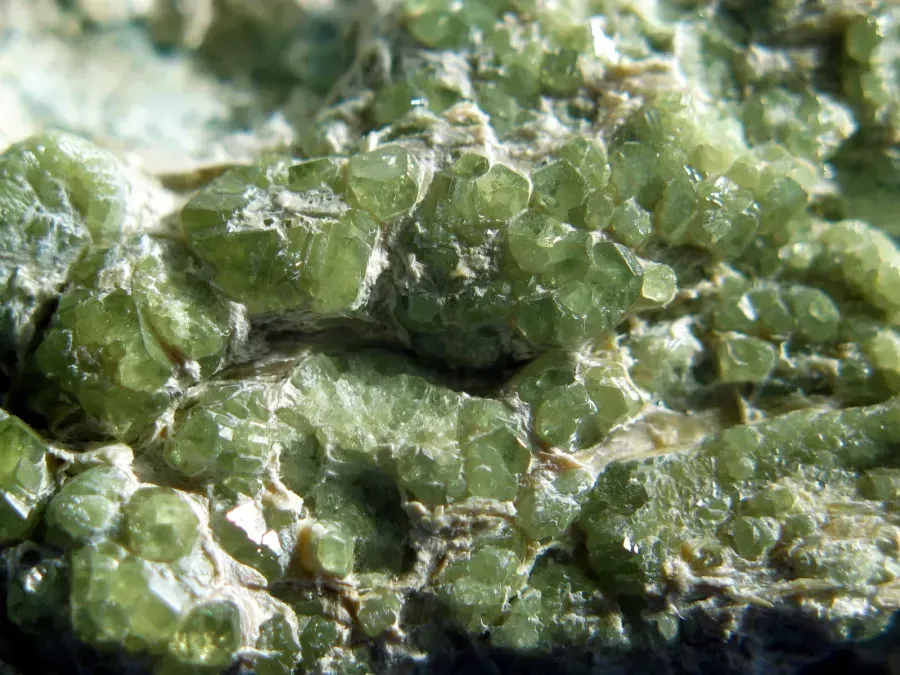
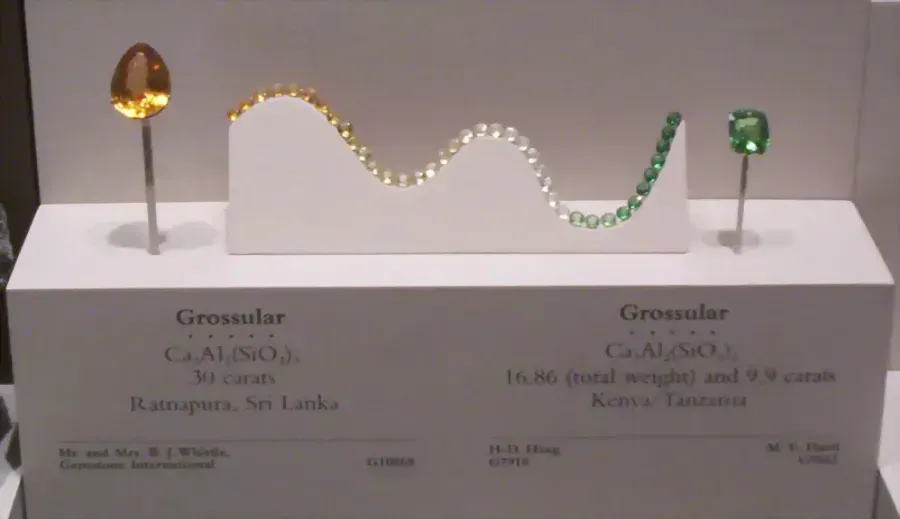
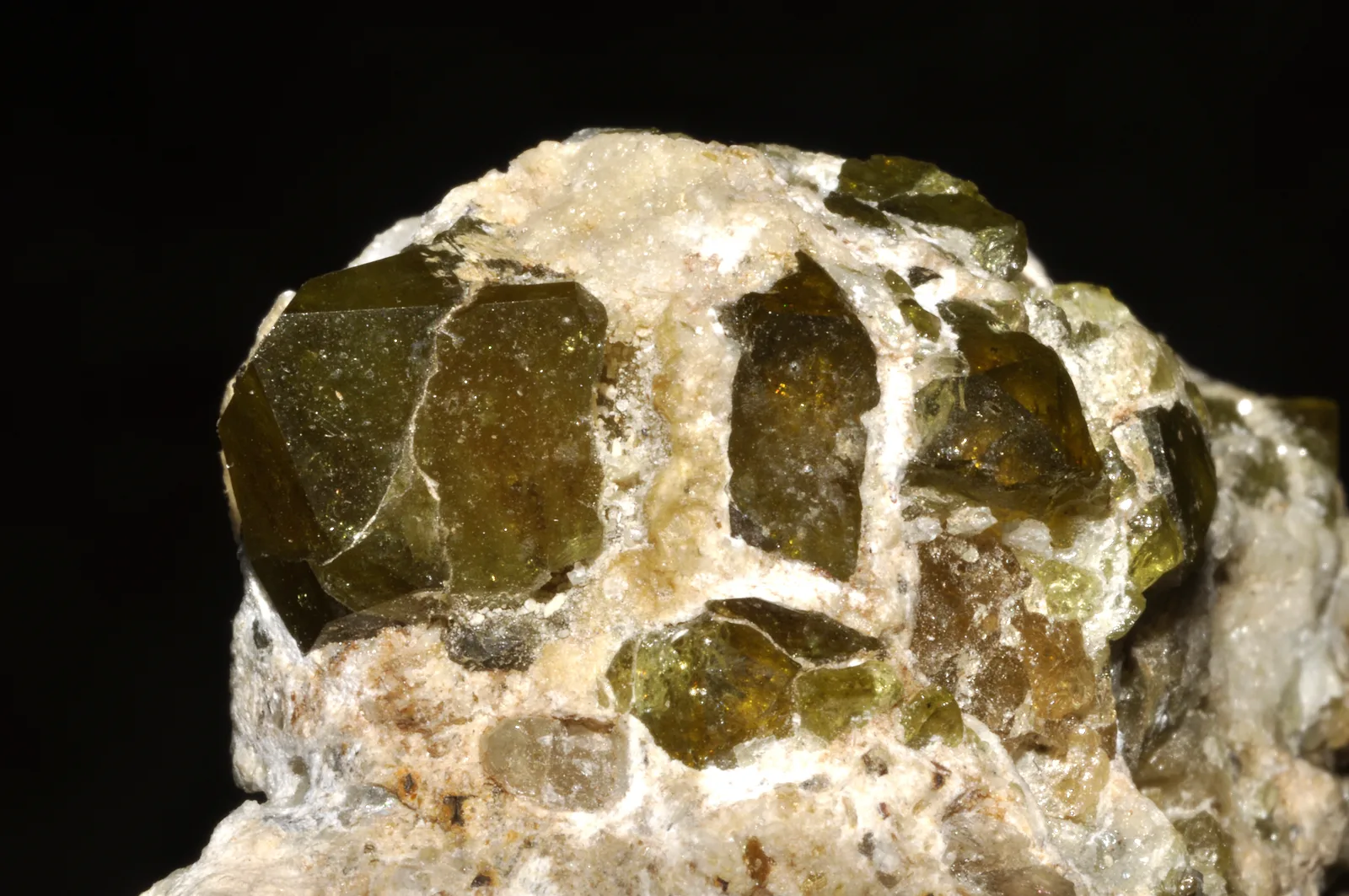
Tsavorite is the vanadium-and-chromium variety of grossular, a mineral from the large garnet group. Grossular on its own can be colourless, honey, orange or green; the name tsavorite belongs only to the transparent, juicy green grossular of gem quality. In other words, tsavorite is a special case of grossular, the way Champagne is a special case of wine: all Champagne is wine, but not all wine is Champagne.
Chemistry and physics
The dry facts worth leaning on when you buy:
- Chemistry: a calcium-aluminium silicate of the grossular series, general formula Ca3Al2(SiO4)3. The green comes from a trace of vanadium (V) and, to a lesser degree, chromium (Cr) replacing aluminium.
- Crystal system: cubic. Because of that high symmetry tsavorite is optically isotropic; it does not show double refraction and has no pleochroism, so the stone looks the same from every angle.
- Hardness: roughly 7 to 7.5 on the Mohs scale, harder than quartz, on a par with tourmaline.
- Cleavage: none. This matters: a garnet has no plane along which to split, so at equal hardness it takes a knock better than emerald.
- Density: about 3.5 to 3.7 g/cm3, more than three and a half times the weight of water. For its size, tsavorite feels notably heavy in the hand.
- Refractive index: high, in the region of 1.73 to 1.75. That is the source of the lively, glassy, almost diamond-like shine on a good cut.
- Dispersion: moderate (about 0.027). Tsavorite throws a gentle scatter of coloured flashes, but distinctly less than demantoid, the most fiery of the garnets.
- No pleochroism and no cat's eye: the cubic symmetry rules out the first, and the absence of fibres rules out the second.
The colour rests on vanadium and chromium. A pure grassy green with a faint blue cast is prized above all; a drift towards yellow or olive lowers the value. Unlike emerald, tsavorite is almost never "treated" with oil and resin: nature usually delivers clean material, and enhancement here is rare.
Wear the symbol, don't just read about it. These are in stock:


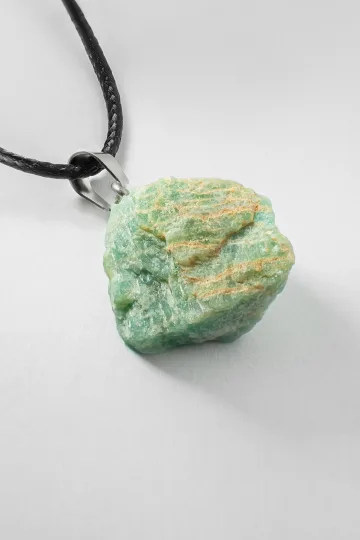


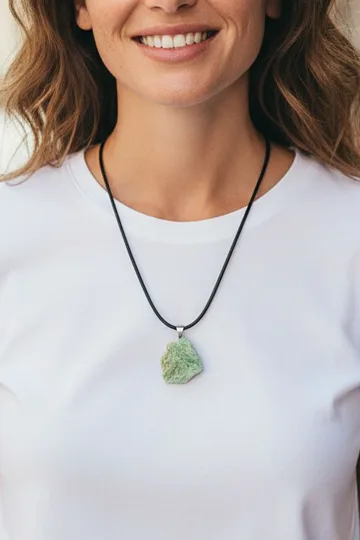


To the touch, a cut tsavorite is cold, heavy and brighter than most green stones. The 7 to 7.5 hardness and the lack of cleavage make it fit for rings, earrings, pendants and bracelets in everyday wear. Harder stones (diamond, corundum, topaz) will scratch the facets, so tsavorite should be stored on its own.
The garnet family
Garnets are not a single mineral but a large family of silicates with a shared crystal frame and differing chemistry. Within the family, colour and properties depend on which metals sit in the lattice:
- Grossular: calcium and aluminium; the green grossular coloured by vanadium is tsavorite.
- Andradite: calcium and iron; its green chromium variety is demantoid, with its fiery dispersion.
- Pyrope and almandine: the red garnets familiar from old jewellery.
- Spessartine: orange, coloured by manganese.
Tsavorite and demantoid are both green, but they are different garnets: the first a grossular (calcium-aluminium), the second an andradite (calcium-iron). For the whole clan, read the general piece on garnets in jewellery.
An honest note on symbolism
Tsavorite, like most green stones, is credited with links to growth, abundance and calm. That belongs to stone lore and the crystal-healing fashion of recent decades, not to the mineral itself. There is no proven effect on mind or body. We cover the symbolism below in a short separate section, without making a fuss of it.
Geology: how the green garnet is born
Tsavorite forms in metamorphic rock, in masses that spent millions of years being heated and squeezed deep underground as ancient continents collided. It is not an igneous stone: it grew not from a melt but from the recrystallisation of sedimentary rock under pressure and heat.
Metamorphism and a rare mix of elements
For tsavorite to form, several conditions had to meet in one place at once: calcium and aluminium from clay and limy sediments, traces of vanadium and chromium, the right pressure and temperature, and an almost complete absence of iron (iron would have gone into red or brown garnets and snuffed out the clean green).
Such a coincidence is rare. That is precisely why gem tsavorite turns up at only a handful of points on the planet, while red garnets are found everywhere. The crystals grow inside so-called graphitic gneisses and calc-silicate rocks, often in small grains; a large clean tsavorite is a geological stroke of luck.
What happened to the rock, step by step:
- On the floor of an ancient sea, clay and limy sediments built up, carrying traces of vanadium and chromium.
- As lithospheric plates collided, those masses were driven deep.
- Pressure and heat recrystallised the rock, and metamorphism began.
- Calcium, aluminium and silicon gathered into garnet crystals.
- Vanadium and chromium slotted into the lattice, replacing some aluminium, and gave the green.
- The near-total absence of iron kept the tone clean.
The result: a rare clean green garnet without the fractures and oil-filled "healing" typical of green stones of igneous origin.
Kenya and Tanzania: the Mozambique belt
The main source of tsavorite is the so-called Mozambique metamorphic belt, which runs down the eastern side of Africa. The stone is mined where Kenya and Tanzania meet: on the Kenyan side around Tsavo National Park (hence the name), and on the Tanzanian side around Lemshuko and Merelani, next door to the tanzanite deposits.
The mining is hard and artisanal. The tsavorite-bearing layers are thin and twisted into folds, and miners follow the seam by hand through narrow, sloping workings. Large material is scarce: most of what comes out is under a carat. Stones above two or three carats already count as significant, and anything over five is rare.
The belt's rocks are ancient: their folding is tied to events hundreds of millions of years ago, when a supercontinent was taking shape. The crystal you hold grew in an age when the planet's land looked nothing like it does today.
Madagascar and the rare finds
Beyond the East African belt, tsavorite is found now and then in Madagascar and occasionally in Pakistan and Antarctica (the last is scientific rather than commercial interest). But the trade rests almost entirely on Kenya and Tanzania. If someone offers you tsavorite "from ten different countries", be wary: most likely green glass, dyed stone or another green garnet is being passed off as tsavorite.
Tsavorite reserves are limited by nature: the metamorphic conditions of its birth are unique and not reproduced on any foreseeable scale. The seams are thin and the mining hard, so large clean tsavorite will only become scarcer with time.
From seam to jewel
- Mining. Rock carrying the seam is taken by hand, in narrow sloping shafts. The yield of large clean material is low.
- Sorting. Rough is graded by colour and clarity. Most is set aside as small stuff.
- Sawing and orientation. The crystal is studied to plan a cut with minimal loss and the best colour.
- Cutting. Tsavorite is most often faceted (brilliant, oval, emerald cut), because the high refractive index opens up precisely in the facets.
- Polishing. The facets are brought to a mirror; that is how the shine works.
- Matching and setting. The stone is set in metal; for earrings a pair of close-toned stones is matched.
At every step some material is lost, so a large clean tsavorite of saturated tone is always the result of heavy culling. That is one reason it is rare and valued.
Customer reviews
Zevira is a real jewellery shop. Genuine payments, deliveries and customer thank-yous.
🥰🥰🥰 gracias

Ok, ¡gracias! 🙂

Tsavorite wants a black dress and a bare collarbone. Pair it with turquoise and you have insulted both stones.
What to wear with tsavorite
After years working with green stones I follow one simple rule: tsavorite is an accent on its own, so I keep everything around it quiet. Here is what actually works on set and in real life, case by case.
What do I pair tsavorite with day to day? For everyday looks I recommend a neutral base: a white shirt, grey knitwear, a black dress of simple cut, beige and sand. On that backdrop the green reads clean and expensive. I also like a natural palette: olive, earthy, warm brown, tone on tone, so the stone sits softly and picks no fight.
Which metal do I choose for each green? I take my cue from the tone of the stone. For a deep emerald green I choose a cool metal: white gold, platinum, silver 925, which sharpens the purity. Grassy green is universal and takes any metal. Yellowish and olive shades I suggest setting in warm or rose gold, warmth to warmth.
How do I build an evening look? For the evening I recommend a single large accent stone: a ring or drop earrings on a plain dress in a deep colour, black, graphite, navy, wine. The green becomes the only spot of colour, and that is enough. I put nothing else bright beside it.
Which colours does tsavorite refuse? I keep it away from other saturated shades. Bright red, orange and turquoise argue with it in one look, and the green loses. And I would not wear two different green stones at once: they cancel each other out. Green's best partner is neutral and metal.
Who suits tsavorite, and how do I pick the size? It suits anyone who loves clean colour without extra sparkle. For the office I recommend a restrained format: a small stone in a ring, studs, a thin pendant in white metal. For going out I choose a larger stone. The size rule is simple: the brighter the green, the less of it you need, a large rich tsavorite works as a soloist, not in a crowd.

Turn on your camera, pick earrings, a pendant or a ring, and see the piece on yourself in real time.
Switch items in one tap.
Everything runs in your browser: no photo or video is ever uploaded.
History: a stone younger than half a century
Most famous gems carry histories stretching back millennia. Tsavorite's is short and well documented: a rare case where we know almost everything from the first years.
1967-1970: a find in Tanzania and Kenya
The gem-quality green garnet was found by the Scottish geologist Campbell Bridges: first, in 1967, in Tanzania, and then, around 1970-1971, on the Kenyan side of the border, near Tsavo National Park. Tanzania soon restricted the export of rough, and the centre of mining shifted into Kenya.
The stone was new to science: a transparent green grossular of this quality had never appeared before in commercial quantities. Geologically it is an ancient mineral, but as a gem material it was unknown to the world until these finds.
1974: a name and the market
The name "tsavorite" was proposed in 1974 in honour of Tsavo National Park. From that year the stone was promoted as a new green gem. The marketing leaned on an honest advantage: tsavorite is cleaner and tougher than emerald, needs no oil treatment, and cracks less often.
So in a few years the green garnet went from a geological curiosity to a recognised gemstone. It is one of the few gems whose commercial biography we know almost year by year.
Why tsavorite has no ancient legends
Online you will find texts about "ancient Egyptians with tsavorite" or a "stone of African kings". These are inventions. Until the late 1960s gem tsavorite was unknown to the world, and any "thousand-year tradition" around it is a late fiction of sellers. Green garnets did occur earlier, but tsavorite as a gem is a phenomenon of recent decades.
The lack of ancient myths is no weakness. Tsavorite is a rare example of a stone whose reputation we watch in real time, with no layering of legend. It is valued for what the eye can see: clarity, bright green and a lively shine.
A timeline in dates
- hundreds of millions of years ago: metamorphism forms tsavorite in the rocks of future East Africa.
- 1967: Campbell Bridges finds green garnet in Tanzania.
- around 1970-1971: a find on the Kenyan side, near Tsavo.
- 1974: the stone is named "tsavorite" and reaches the market.
- 1980s-90s: tsavorite settles in as a recognised green gem.
- present day: large clean material is scarce, and the value of quality stones is rising.
Upload a photo of your pet, someone you love, or an object. We'll build a 3D model and hand-cast it in pewter.




Types and shades: from grassy green to deep emerald tone
Tsavorite is prized above all for its colour. No two stones are alike, but by shade you can pick out a few recognisable groups.
Grassy green
The most common and recognisable tone: the fresh, juicy green of young grass. Clean, without yellow or grey. This is the benchmark tsavorite, the very colour the stone is valued for.
Deep emerald green
The most coveted and costly version: a saturated green with a faint bluish cast, close to the finest emerald tone but more transparent and cleaner. The deeper and cleaner the green while keeping its brightness, the higher the value. A stone too dark loses its shine and goes flat, so a balance of depth and light is what is prized.
Yellowish-green and olive
More affordable shades with a touch of yellow or olive. They are softer and quieter, but valued below pure green. Sometimes such material is closer to ordinary green grossular than to benchmark tsavorite.
What matters most: colour, clarity, size
Three things together set the value of tsavorite:
- Colour. A clean bright green costs more than a yellowish or greyish one.
- Clarity. Tsavorite is usually cleaner than emerald; visible inclusions cut the price more sharply than in emerald, where they are tolerated.
- Size. Large material is rare, so the price per carat climbs steeply with weight: a three-carat stone costs more per carat than a half-carat one.
The tsavorite palette in descending order of value:
- Deep emerald green with blue, the rarest and dearest.
- Pure grassy green, the benchmark, highly valued.
- Light bright green, lively and more affordable.
- Yellowish-green, softer, cheaper.
- Olive and greyish, the most modest.
What to ask the seller:
- Origin: Kenya or Tanzania.
- How clean the green is, whether there is yellow or grey.
- Whether there are visible inclusions.
- The weight in carats and the proportions of the cut.
- Whether it is confirmed to be tsavorite and not another green stone.





How to tell tsavorite from similar stones and fakes
Tsavorite is confused with other green stones, and sometimes fakes are passed off as it. Here are the differences.
Tsavorite and emerald
The main pair to compare. Both are green from vanadium and chromium, but they are built differently:
- Clarity. Tsavorite is usually clean and transparent; emerald almost always carries inclusions and tiny fractures (the "jardin").
- Treatment. Emerald is treated en masse with oil and resin; tsavorite almost never.
- Toughness. A garnet has no cleavage, so it is more chip-resistant at the same hardness.
- Shine. Tsavorite has a higher refractive index, so the shine is livelier and brighter.
- Size. A large emerald with inclusions is common; a large clean tsavorite is rare.
All else equal, a small or medium tsavorite often looks "cleaner" than an emerald of the same tone.
Tsavorite and demantoid
Both are green garnets, but from different series. Demantoid is andradite (iron-based), with higher dispersion: it "plays" more strongly with coloured flashes, sometimes with the characteristic fibrous "horsetail" inclusions. Tsavorite is grossular (vanadium-based), with a glassy shine but a quieter play. Demantoid is usually dearer and rarer.
Tsavorite and green tourmaline, peridot, chrome diopside
- Green tourmaline shows pleochroism (its tone shifts as you turn it); tsavorite is isotropic and does not change.
- Peridot is noticeably yellower, "oily" in shine, with a doubling of the back facets when you look inside.
- Chrome diopside is softer (hardness about 5.5 to 6), easy to scratch, and often darker, almost black-green at larger sizes.
Glass and doublets
Cheap imitations are made from green glass and from doublets (two stones glued together). Glass gives itself away with air bubbles inside, warmth to the touch (glass heats in the hand faster than stone), mould seams and a suspiciously light weight. Tsavorite is cold, heavy (density above 3.5 g/cm3) and holds no round gas bubbles.
Price and papers as a signal
For an expensive large stone it makes sense to ask for a gemmological lab report: it confirms the mineral, the origin and the absence of treatment. For a small stone in a bracelet that is overkill. A large clean tsavorite of saturated tone cannot cost the price of a handful of glass beads: a suspiciously low price for a "big bright tsavorite" almost certainly means glass or another green stone.
Buyer's checklist
- The stone is cold and heavy for its size.
- The green is bright and clean, with no obvious yellow or grey.
- There are no round gas bubbles or mould seams inside.
- The tone does not change as you turn it (no pleochroism), which fits a garnet.
- The price is reasonable: a large clean tsavorite is never cheap.
- For an expensive stone there is a lab report.
Leave your email, we'll send your discount code. No spam, unsubscribe anytime.
The code arrives by email, valid on your first order.
Care and storage
The 7 to 7.5 hardness and the lack of cleavage make tsavorite one of the most practical coloured stones for everyday wear. It is tougher than emerald and takes a knock well, yet it is not indestructible: a sharp blow on a facet edge can still cause a chip.
What to do and what to avoid
You can:
- Wash it in warm water with mild soap and a soft-bristled brush.
- Wipe it dry with a soft cloth.
- Store it in its own soft pouch or box compartment.
You should not:
- Store it loose with harder stones (diamond, corundum, topaz), which scratch the facets.
- Subject it to sudden temperature swings.
- Use abrasives, aggressive household chemicals or acids.
- Drop the jewel onto hard surfaces; an edge chip is possible.
Ultrasonic and steam cleaning tsavorite usually takes better than emerald (it is not oiled), but if the stone has visible inclusions it is safer to stick to warm water and a brush. Take the ring off before dirty work and sport.
How hardness affects wearability
In a ring, tsavorite behaves reliably: high hardness and no cleavage forgive what would destroy an emerald. For a large stone in a ring, a setting that shields the facet edges from direct blows is still sensible. In earrings and pendants the load is lower, so a more open setting that opens up the shine works well there.
If the shine goes dull
Over time, grease and dust build up on the facets, and the stone seems to die down. That is not wear but grime: warm soapy water and a soft brush bring the shine back in a couple of minutes. If the facets themselves are scratched (from storage with harder stones), a re-polish by a craftsman helps, a rare procedure.
CAPAORA mini knife pendant
The 18th-century Spanish navaja in miniature: 40 mm of stainless steel, a real folding mechanism and a Palanquilla lock that clicks. An affordable gift to remember.
Authentic · Ships from Spain · 14-day returns
Symbolism: what tradition says
Everything below is cultural symbolism and the crystal-healing tradition, not a medical or physical fact. The mineral has no proven effect. We describe what people believe, not what "will happen".
In tradition, tsavorite, as a green stone, is credited with several themes, all grown from its colour and context:
- Growth and abundance. Green is associated with spring, plants and fertility, hence the reputation of a "stone of growth".
- Calm and renewal. The same green tone is traditionally tied to an even mood and the start of a new stage.
- Vitality. Bright, living green reads as energy, hence the symbolism of vigour.
The stone "does" nothing on its own. If it supports a person at all, it does so the way any meaningful keepsake does, through attention and habit, not through some mystical emanation. There is nothing shameful in that, and nothing to overstate.
Jewellery with tsavorite: rings, earrings, pendants, bracelets
Tsavorite is a stone for cutting, and almost all jewellery with it is built around the shine of the faceted stone. Let us go through it by item type and the metal of the setting.
Rings
A ring is the classic for tsavorite. Most often an oval, round or emerald cut in a single stone, sometimes ringed by small clear companion stones that set off the green. High hardness and no cleavage make green garnet dependable in a ring, unlike fragile emerald. For a large centre stone, choose a setting that slightly shields the facet edges.
Cool sterling silver and white gold give a neutral backdrop on which the green reads brighter. Yellow gold adds warmth and slightly "lights" the stone from within.
What to look for:
- The stone sits firmly, not loose in the setting.
- The green reads evenly under different light.
- The cut is symmetrical, the shine lively across the whole table.
- The size is proportionate to the hand.
Earrings
In earrings tsavorite demands matching: two stones must agree in tone and saturation of green and in cut. A perfect match is hard to reach, natural colour always varies a little, but a good craftsman finds a close pair. Small tsavorite studs in silver or gold are a good everyday choice; large stones in drop earrings are for an occasion.
Pendants
A pendant lets you show one fine stone in close-up. Tsavorite in a pendant on a thin chain catches the light at the throat and works as a bright accent. An open setting opens the shine, and a light frame of small stones adds play.
Bracelets
A bracelet with a line of small tsavorites or with a single accent stone is an elegant format. Small tsavorites in a bracelet cost less than a large stone in a ring, yet give the same clean green. High hardness takes the active wear of the wrist well.
Metal colour to suit the stone
- Deep emerald green: white gold, platinum, sterling silver. Cool metal sharpens the clarity of the tone.
- Grassy green: versatile, both white and yellow metal.
- Yellowish-green: yellow and rose gold. Warm to warm.
- Small companion stones: white metal, so as not to argue with the green.
Silver and white gold are the most predictable choice: they add no foreign undertone to the stone. The key thing in a setting for a large tsavorite is protecting the facet edges from direct blows.
Send a friend a discount code, they save on their first order.
Frequently asked questions
What is tsavorite in plain words?
It is a bright green transparent garnet of gem quality, a variety of the mineral grossular. The green comes from traces of vanadium and chromium. The stone was found in the late 1960s on the Kenya-Tanzania border and named in 1974 after Tsavo National Park. Tsavorite is valued for its clarity, bright green and shine: it is usually cleaner than emerald, needs no oil treatment and is more chip-resistant.
Is tsavorite a garnet or not?
It is a garnet, and a transparent gem one at that. Tsavorite belongs to the garnet group, to its grossular series (a calcium-aluminium silicate). Among garnets it is one of the most valuable. For more on the base mineral, read the piece on grossular, and for the whole family the article on garnets in jewellery.
How does tsavorite differ from emerald?
In colour they are alike, in nature they are not. Emerald is a beryl, tsavorite is a grossular garnet. Emerald almost always carries inclusions and tiny fractures and is treated en masse with oil; tsavorite is usually clean and barely enhanced. Garnet has no cleavage, so tsavorite is more chip-resistant at the same hardness. The shine of tsavorite is livelier thanks to a higher refractive index. At the same time a large clean tsavorite is rare, while a large emerald (even with inclusions) is more common.
How does tsavorite differ from demantoid?
Both are green garnets, but from different series. Tsavorite is a vanadium grossular, with a glassy shine and moderate play of light. Demantoid is an iron andradite, with very high dispersion, so it "burns" more strongly with coloured flashes, sometimes with the characteristic fibrous "horsetail" inclusions. Demantoid is usually rarer and dearer.
Where is tsavorite mined?
The main source is the junction of Kenya and Tanzania in the Mozambique metamorphic belt: the Kenyan side near Tsavo National Park and the Tanzanian districts around Merelani and Lemshuko. Tsavorite is found now and then in Madagascar and occasionally elsewhere, but the trade rests almost entirely on East Africa.
Why is tsavorite so expensive?
Because of rarity combined with quality. Forming the stone needs a rare mix of conditions: calcium, aluminium, vanadium and chromium, the right pressure and temperature, and an almost complete absence of iron. The seams are thin, the mining artisanal, large clean material scarce. So the price per carat climbs steeply with size: a three-carat stone costs more per carat than a half-carat one. At the same time small tsavorite is quite affordable.
How large does tsavorite get?
Mostly small: the bulk of mined material is under a carat. Stones of two or three carats are already significant, and anything over five carats is a rarity prized especially highly. This follows directly from the geology: tsavorite grows in small grains in thin seams, and a large clean crystal is a stroke of luck.
Can you wear tsavorite every day?
Yes. A Mohs hardness of 7 to 7.5 and the lack of cleavage make tsavorite one of the most practical coloured stones for everyday wear, noticeably more reliable than emerald. The main risk is an edge chip under a strong blow, so for a large stone in a ring choose a setting that shields the edges. Take the jewel off before dirty work and sport.
Is tsavorite treated?
In the great majority of cases, no. Unlike emerald, tsavorite usually goes on sale without oil treatment or dyeing: nature supplies clean material. This is one of its advantages over emerald. So when you buy, the question is usually not "is it oiled" but "is it tsavorite at all, or another green stone".
Does synthetic tsavorite exist?
Synthetic tsavorite is practically absent from the market in commercial quantities: growing it is not economic. Imitations, however, do turn up: green glass, doublets and other cheaper green stones (chrome diopside, for example) passed off as tsavorite. So the buyer's main question is not "natural or synthetic" but "tsavorite or fake". It is checked by weight, shine, the absence of gas bubbles and, if needed, a lab.
How do you tell tsavorite from green glass?
By several signs. Tsavorite is cold and heavy for its size (density above 3.5 g/cm3); glass is lighter and heats faster in the hand. Inside glass you often see round gas bubbles and mould seams, which a garnet has not. The shine of the stone is livelier, "glassy to diamond-like". A suspiciously low price for a large bright "tsavorite" almost certainly means glass.
Is tsavorite a precious or semi-precious stone?
The old classification puts garnets among semi-precious stones, but that applies to tsavorite only loosely. By rarity and price a good large tsavorite costs more than many formally "precious" stones of low quality. Value is set not by a label but by the colour, clarity, size and rarity of the particular specimen. Today tsavorite is firmly counted among the valuable gemstones.
Does tsavorite change colour under different light?
It shows no marked colour change like alexandrite. But under different lighting the tone may vary slightly: in daylight the green is a touch cooler, under warm artificial light a touch warmer. That is the ordinary behaviour of a coloured stone, not a "colour-change" effect. Tsavorite has no pleochroism (tone shift on turning) at all: the cubic symmetry of garnet rules it out.
Which metal should you choose for tsavorite?
It depends on the shade. For deep emerald green a cool metal is better, white gold, platinum or sterling silver: it sharpens the clarity of the tone. Grassy green is versatile and good in both white and yellow metal. Yellowish shades come alive in warm yellow and rose gold. The key thing in a setting for a large stone is protecting the facet edges from blows.
Can you wash tsavorite in water?
Yes. Tsavorite takes warm water with mild soap and a soft brush calmly; that is the best home cleaning. Since the stone is usually not oiled (unlike emerald), it does not fear water. Just avoid sudden temperature swings and aggressive chemicals. After cleaning, wipe the stone dry with a soft cloth.
How does tsavorite differ from ordinary green grossular?
Tsavorite is green grossular, but of the highest, gem quality: transparent, with a clean bright green from vanadium and chromium. Ordinary green grossular can be cloudy, pale or with a yellowish, olive cast, and does not reach the level of tsavorite in colour and clarity. So every tsavorite is a grossular, but not every green grossular is a tsavorite. For more, read the piece on grossular.
Short takeaways
- Tsavorite is a bright green transparent grossular garnet; base Ca3Al2(SiO4)3, the green from vanadium and chromium, hardness 7 to 7.5 on Mohs, density 3.5 to 3.7 g/cm3.
- Discovered in the late 1960s on the Kenya-Tanzania border, named in 1974 after Tsavo park.
- Its main advantage over emerald is clarity, toughness (no cleavage) and the absence of oil treatment.
- Large clean tsavorite is rare; the price per carat climbs steeply with size.
- Fakes are green glass, doublets and other green stones; weight, shine and gas bubbles give them away.
- The symbolism (growth, abundance, calm) grew from the green colour; it is a cultural tradition, not a proven fact.
- It is faceted and worn in rings, earrings, pendants and bracelets; the stone is practical for everyday wear.
- Protect it from edge blows, temperature swings and scratches by harder stones, and it will serve for decades.
Buying it as a gift? Each one arrives ready to give.
 A branded Zevira box and a little card come with every order.













About Zevira
At Zevira we love stones with an honest reputation, and tsavorite is exactly that: it has no thousand-year legends, but it does have a transparent origin, a clean green and a shine the eye can see. We choose material by the purity of tone and the brightness of the green, cut it to open up the shine, and set it in metal that does not argue with the colour: white gold and sterling silver for deep emerald green, warm metal for grassy and yellowish shades.
We talk about stones honestly: where there is history and where a pretty invention, where a fact and where a tradition. Tsavorite need not "do" anything for you, but if you want to wear a rare green stone that is tougher and cleaner than emerald and asks for no special care, it is hard to picture a more sensible choice.
Find your green
Rings, earrings and pendants with natural tsavorite, the green garnet from East Africa. We will match a stone to your shade of green and your occasion: from easy everyday wear to an evening accent.
See jewellery with tsavoriteWant to go deeper into green stones and garnets? Read our pieces on grossular, the base mineral of tsavorite, on demantoid, the most fiery of the garnets and on garnets in jewellery in general.