Demantoid garnet: the rare green stone with more fire than a diamond
One green stone scatters coloured sparks harder than a diamond does. That is not a turn of phrase but a measurable fact: the dispersion of demantoid runs about 30 percent higher than diamond's. And the world's output of gem-grade demantoid is counted not in tonnes, not even in carats, but in kilograms a year.
Demantoid is the rarest and most expensive variety of garnet. It was found in the Ural Mountains in the middle of the 19th century, and Ural stones are still treated as the benchmark. From here on, the practical side: what it is made of, how it forms, how it differs from look-alike green stones, how to tell a genuine one from a fake, and how to look after it.
What demantoid is and where the name comes from
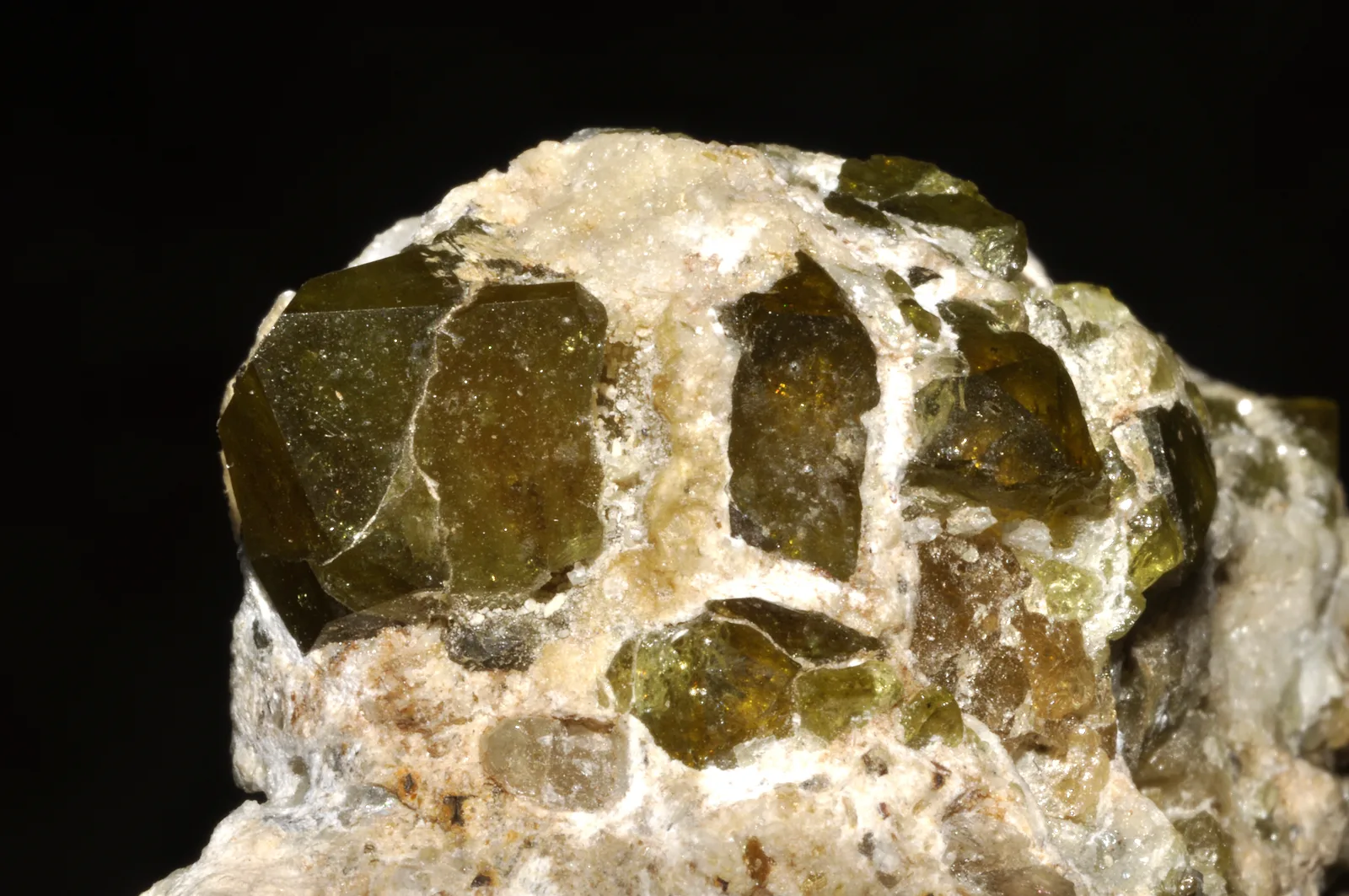
Demantoid is a garnet, more precisely the green variety of andradite, the calcium-iron member of the garnet group. The chemical formula of andradite is Ca₃Fe₂(SiO₄)₃, often written as Ca₃Fe₂Si₃O₁₂. Its structure combines calcium, ferric iron, silicon and oxygen in strict proportions.
The green colour comes from trace elements, chromium first of all, then ferric iron. The more chromium, the cleaner and deeper the grassy tone. An excess of iron pulls the colour towards yellow-green and olive.
The word garnet comes from the Latin granatus, meaning grainy: garnet crystals often grow as rounded grains in the host rock. The name demantoid is built from the German demant, diamond, and the Greek eidos, form. Literally, diamond-like. The name stuck because of the optics: in its play of light the stone really does rival a brilliant.
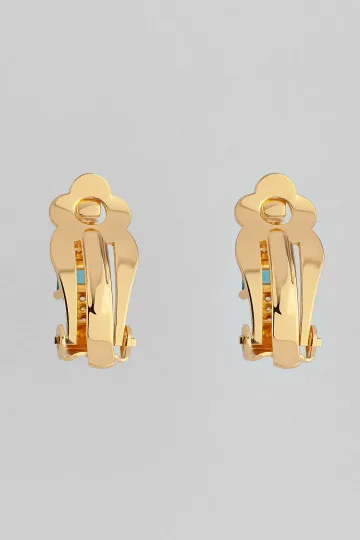
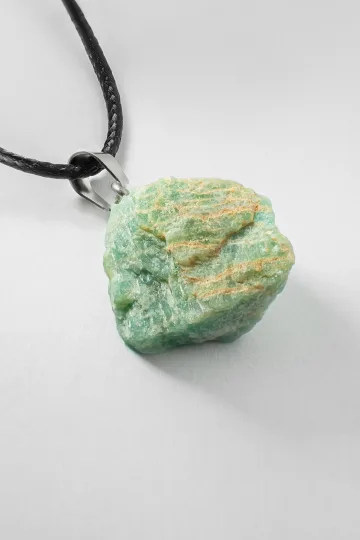
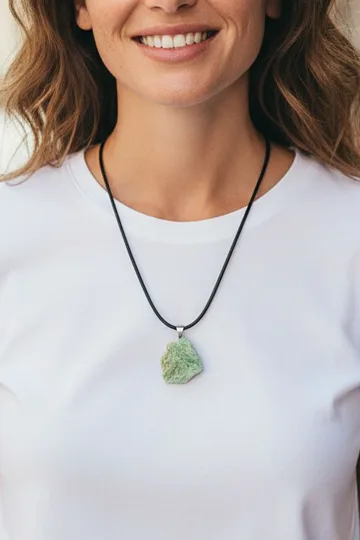
Wear the symbol, don't just read about it. These are in stock:





The crystal system is cubic, so demantoid is optically isotropic and singly refractive. Its refractive index is about 1.88, its density roughly 3.8 to 3.9 g/cm³. Hardness on the Mohs scale is 6.5 to 7, noticeably below sapphire and ruby. Garnet has practically no cleavage, but it chips on impact.
Demantoid among its andradite relatives
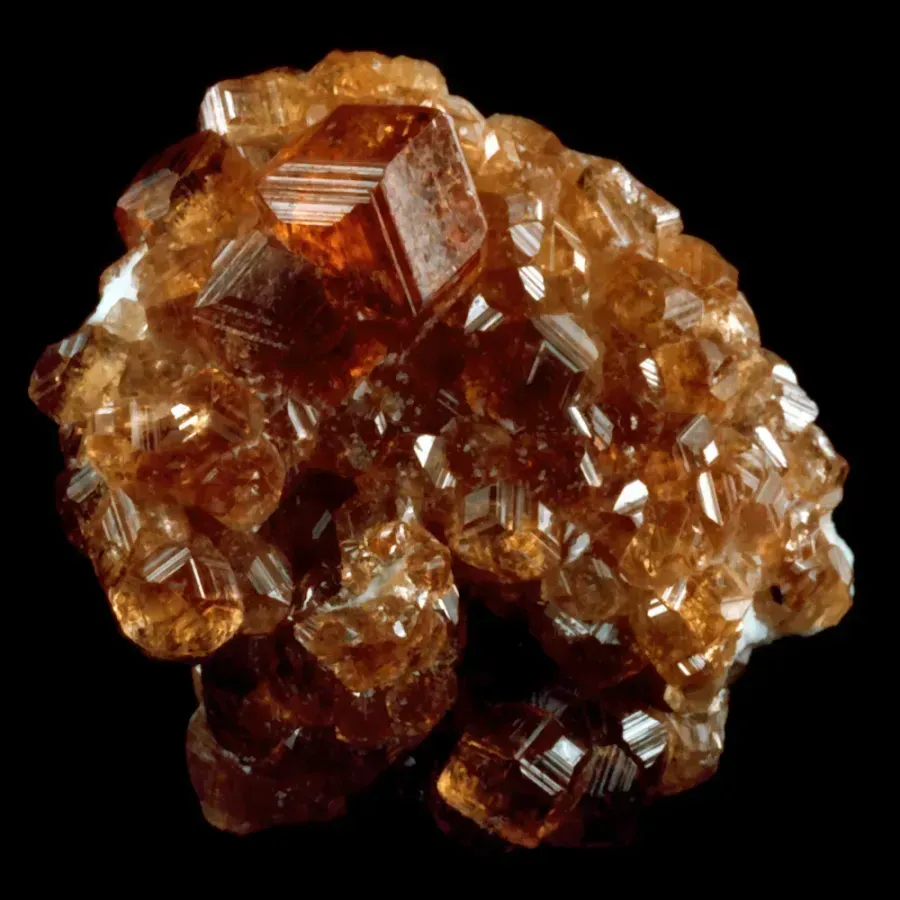
Andradite is colourless on its own; trace elements give it colour, and they decide which name the stone earns. Green chromium-bearing andradite is demantoid. Yellow and honey-gold andradite is called topazolite: it turns up in the same serpentinites, sometimes on the same piece of rock beside the green grains, but it is cut less often because of its small size. Black opaque andradite is melanite, saturated with titanium, and in the 19th century it served as a mourning stone. So demantoid is not a separate mineral but the luckiest member of the andradite family: the one in which green chromium, transparency and decent size all came together.
It is worth keeping demantoid apart not only from other green stones but from its green cousins within the garnet group. Tsavorite and its relative grossular are green thanks to vanadium and chromium, but they are a different garnet species with another density and no diamond-like lustre. Uvarovite, a vivid emerald-green chromium garnet, almost always grows as a crust of tiny crystals unfit for cutting. Demantoid remains the only garnet that rivals diamond for fire.
The history of demantoid
Discovery in the Urals
Green garnets with an unusual lustre were found in the central Urals in the early 1850s, around Sysert and, by some accounts, near Poldnevaya and the valley of the Bobrovka river. The Finnish mineralogist Nils von Nordenskiöld described the stone as a new chromium-bearing variety of andradite around 1864, and the name demantoid was settled through the Saint Petersburg Mineralogical Society in 1878. The variety was singled out for its diamond-like fire.
The deposits lay in serpentinite rocks, where iron meets calcium and silicon in the right ratio. From the outset, mining was artisanal and seasonal: the rock was washed by hand, and volumes depended on the spring floods. It was the limited source that earned the stone its reputation for rarity as far back as the century before last.
Yekaterinburg was the centre of the country's lapidary trade, so the new stone quickly reached cutters and jewellery workshops. Ural demantoid with a clean grassy colour was immediately costly and sought after.
The turn-of-the-century heyday in jewellery
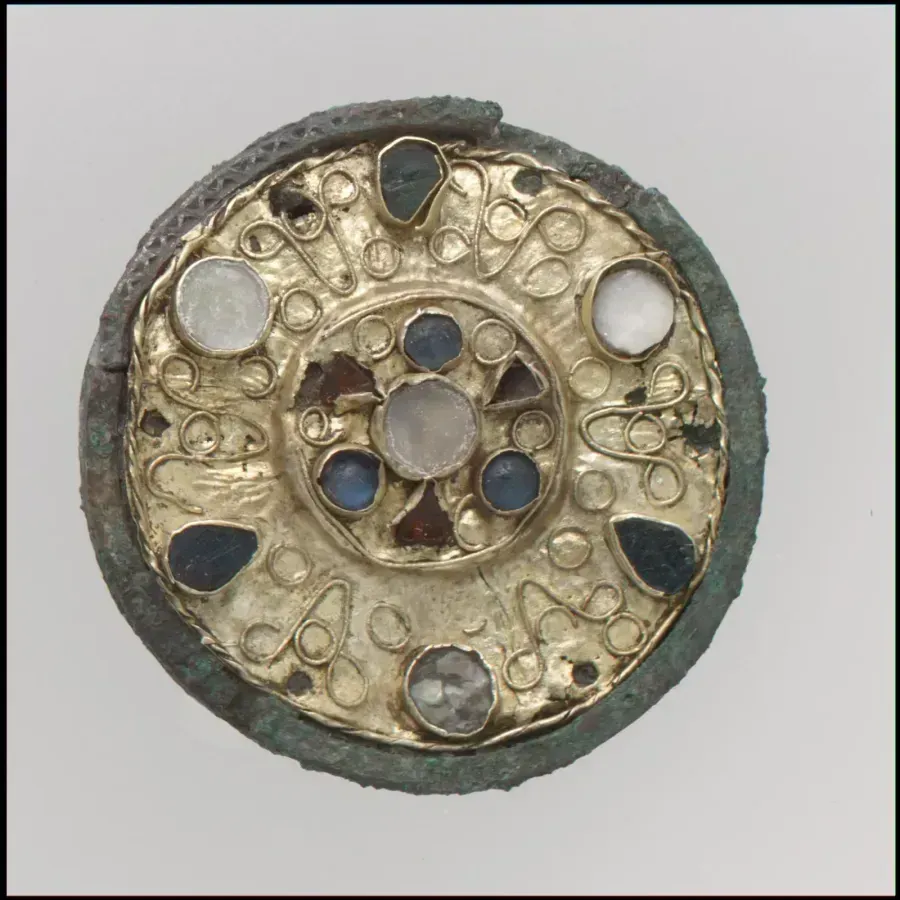
By the late 19th and early 20th century demantoid had a firm place in the jewellery of the day. Leading workshops of the era used it freely: the green fire looked superb in brooches, rings and pendants alongside brilliant-cut diamonds and enamel. The stone carried status precisely because it was rare and costly.
Through traders the stone became known in Europe too, yet it never went mainstream: there was always too little material. Antique pieces set with Ural demantoid turn up today in museum and private collections and are valued as rarities.
The 20th century: disappearance and return
After 1917, Ural production all but stopped, and for decades demantoid practically ceased to reach Western markets. Antique pieces with the stone became scarce and rose in price.
New Ural veins were worked in the Soviet period, around Sysert and at the Mariinsky (Malyshevsky) site, but the volumes stayed small. The turning point came in the 1990s, when demantoid was found in Namibia. The African deposit gave the world market its first sizeable inflow of the stone, though it differs in character from the Ural material.
A demantoid burns by candlelight. Under office fluorescents it is a corpse, and don't argue.
How to wear demantoid
Over years on shoots demantoid has passed through dozens of looks with me, and few stones are fussier about their light. Here is what actually works, sorted by occasion.
What do I wear demantoid with every day? For daily wear I recommend small studs or a slim pendant: the stone throws a green spark near the face without needing an occasion. Fire reads best on plain clothing in deep tones, I suggest grey, charcoal, navy or wine, where the flashes do not argue with the pattern of the fabric. Under a rounded or V-shaped neckline I choose a shorter pendant so the stone lands in the open zone rather than hiding under the cloth.
Is it right for the office? Yes, as long as you keep it to one noticeable detail. I choose studs or a clean ring in white gold: it looks composed and does not pull attention from the work. For chain length I recommend 45 to 50 cm, so the pendant sits under the top button of a shirt and reads as a quiet accent, not a loud statement.
How do I build an evening look? For evening the logic reverses. The pointed light of a hall reveals the stone's play in full, so I suggest larger earrings or a cocktail ring. Smooth fabrics, silk and satin, reflect the light and add sparkle. A deep colour, emerald or black, holds the stone as the soloist, and I keep the rest of the jewellery to a minimum.
Gold or silver for demantoid? The rule here is simple. A cool setting, white gold and platinum, I choose when I want to strengthen the green and make the fire cleaner. Yellow gold I pick for the warm honey sparks and the byssolite fibres, it gives a more antique voice. For a warm skin undertone I recommend yellow, for a cool one white or platinum.
Who does demantoid actually suit? Anyone who values restrained expression over loud brilliance. The stone sits well on a minimal look and in layers, but I leave the stone itself as the soloist, not surrounded by a handful of mismatched pieces. Two rules that never fail. First: I choose the length for the neckline, not the other way round. Second: green befriends violet amethyst and golden tones, while I save the contrast with red for bold evening entrances.

Turn on your camera, pick earrings, a pendant or a ring, and see the piece on yourself in real time.
Switch items in one tap.
Everything runs in your browser: no photo or video is ever uploaded.
Geology: how demantoid forms and why it is rare
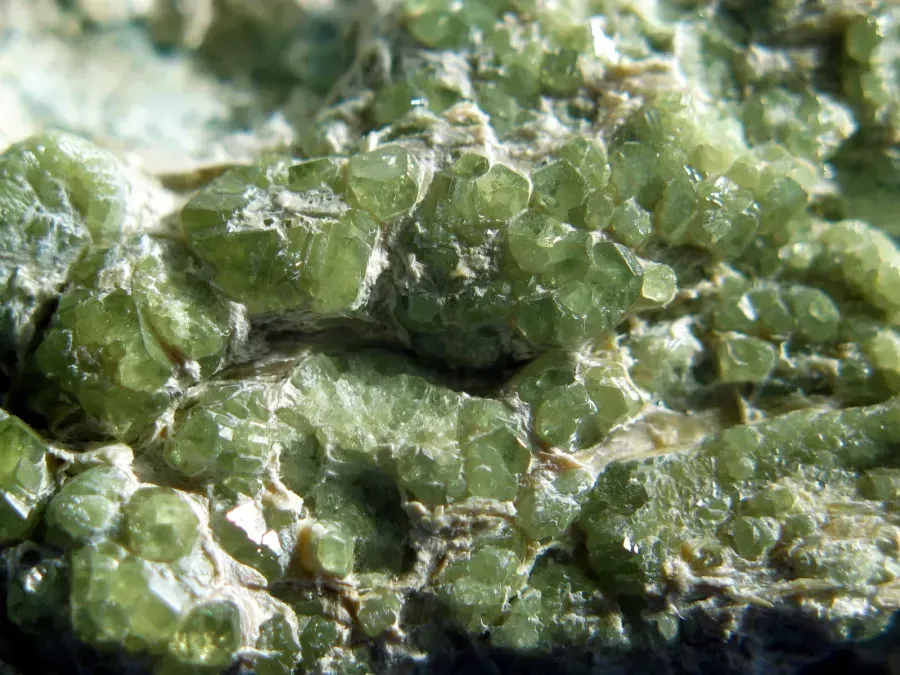
Demantoid crystallises during the metamorphism and hydrothermal reworking of rocks rich in iron and calcium, above all serpentinites and skarns. When iron-bearing solutions react with calcium-silicate minerals at the right pressure and temperature, andradite crystals grow in fractures and cavities.
Demantoid often forms thin crusts and grains over the surface of other minerals rather than large, free-standing crystals. That is the main reason for its rarity.
That rarity is the sum of several factors at once:
- Narrow conditions of formation. The needed combination of rock composition, pressure and temperature is uncommon, so gem-grade demantoid is known from only a handful of places on the planet.
- Small size. Most crystals are a few millimetres across. A stone larger than a centimetre is already a rarity, and only a small share of what is mined is fit for cutting.
- Fragile occurrence. Surface crusts and grains break up easily during weathering and mining; not everything survives to be cut.
- Low content in the rock. Within the ore body demantoid may make up a fraction of a percent by volume, so mining means processing large masses of rock for a small yield.
Ural demantoid
The Urals remain the benchmark. The local stone is recognised by its clean grassy colour and its characteristic byssolite inclusions, fine golden fibres that fan out from a single point. This pattern is called a horsetail, and it is found almost exclusively in Ural material. For a collector it is a mark of origin and authenticity, not a flaw. The old placers are largely worked out, and present-day output is modest.
Namibian demantoid
The Namibian deposit, opened in the 1990s, is tied to different host rocks geologically. African stones more often yield larger, cleaner crystals, but usually without a horsetail and sometimes with a slightly warmer, yellowish undertone. For the buyer it is a choice between Ural authenticity with inclusions and African clarity and size. Both are legitimate and beautiful; the difference is one of character.
Other sources
Pale, sometimes yellowish-green demantoid comes in small amounts from Madagascar. Deposits are known in Iran (Kerman province), and individual finds have been recorded in Italy, Pakistan and Afghanistan. Together they add only a drop to the overall volume. In effect the market rests on two sources, Ural and Namibian, and neither satisfies demand. Gemmologists put the yearly output of high-quality gem material in the low tens of kilograms, whereas diamonds are mined by the millions of carats.
Optics: the fire of demantoid
The chief difference between demantoid and other green stones is its play of light, which the science calls dispersion and everyday speech calls fire.
What dispersion is
Dispersion is a stone's ability to split white light into spectral colours, as a prism does. The higher it is, the more noticeable the coloured flashes as the stone moves. The numbers speak for themselves:
- diamond: dispersion 0.044
- demantoid: dispersion 0.057
So demantoid is roughly 30 percent more fiery than diamond, and on this count it is one of the champions among transparent gems. As the stone moves, red, orange and yellow sparks flare inside it. The effect shows strongest in pointed, directional light: under a lamp, by candlelight, in bright sun. Diffuse, overcast light softens the flashes but shows the depth of colour better.
Refraction and lustre
Demantoid's refractive index is about 1.88, one of the highest among garnets. A high index gives a strong, almost diamond-like lustre to the facets. It is precisely this resemblance to diamond that once led demantoid to be confused with, or passed off as, a brilliant. A refractometer and an examination of inclusions under the microscope tell the stones apart with certainty.
An important caveat about fire: it shows only in a transparent, sufficiently light stone. In a very dark, deeply coloured demantoid the dispersion is still there, but the dark background swallows the flashes. So the most valuable stone combines a saturated colour with transparency.
Customer reviews
Zevira is a real jewellery shop. Genuine payments, deliveries and customer thank-yous.
🥰🥰🥰 gracias

Ok, ¡gracias! 🙂

Colour and shades
The base colour of demantoid is always green, but the shade and saturation vary.
The most valued is a clean grassy green, free of yellow and brown undertone, of medium saturation: not pale, and not so dark that it looks black in weak light. The classic Ural stone gives exactly this colour, the work of chromium traces.
Yellow-green and olive shades turn up more often in Namibian material and stem from iron prevailing over chromium. They cost less than a clean grassy green, though some people like their warmer voice.
Dark green, almost blue-green stones are rare and heavy in iron. Fire reads less well on them: the dark ground smothers the flashes. Light and near-colourless examples are poor in both chromium and iron, unpopular for jewellery, yet prized by collectors for showing the most visible fire against a light ground.
Upload a photo of your pet, someone you love, or an object. We'll build a 3D model and hand-cast it in pewter.




Cutting: why demantoid is cut unlike the rest
With demantoid the cutter works not only for colour but for fire, and these two aims sometimes pull against each other. The deeper the stone, the further the light travels inside and the denser the green reads, but too deep a pavilion smothers the flashes. So a good cutter looks for the middle ground and usually makes the stone a little shallower in height than an emerald of the same diameter, to let the dispersion play.
The commonest shape is the round brilliant cut with a large number of facets: it is the many small planes that catch and scatter the coloured sparks. Oval, pear and cushion shapes also appear, while the step-cut emerald shape with long smooth facets suits demantoid poorly, because the wide planes show fire only sparingly. The high refractive index, around 1.88, forces the pavilion angles to be held precisely: an error of a couple of degrees leaves a dull window in the centre of the stone through which light passes straight out rather than returning to the eye.
Because the material is dear, demantoid is cut sparingly. The crystals are small, so the cutter more often keeps weight at the cost of perfect symmetry than trims away material for textbook proportions. Hence the advice to the buyer: look not at clarity on paper but at how the stone comes alive under pointed light. Old Ural stones were often cut a little differently, by eye, and examples gone dull with time are recut today, returning their sparkle without any loss of natural origin.
Demantoid and its symbolism
Green garnet, like the whole garnet line, was linked in old traditions to prosperity, clarity of mind and creative energy. You can read more about the symbolism of the family in the piece on garnet in jewellery.
Let us be plain: there is no scientific proof that the stone affects thought, feeling or finances. This is part of cultural history and a beautiful language of symbols, not a physical effect. If a piece of jewellery brings joy and recalls something important, that is psychology at work, not the properties of the mineral.





Demantoid in jewellery
Because of its rarity and the small size of its crystals, demantoid is rarely used in large or mass-produced pieces. More often it is an accent stone in bespoke and collectors' items.
Rings. Demantoid is usually set as the central stone. Weights tend to be modest, up to a couple of carats; anything larger is a rarity. Given the moderate hardness, a setting with high walls or a closed bezel that protects the girdle is sensible for a ring.
Earrings. A convenient format, because matching a pair of stones close in colour is easier than finding one large one. Studs with paired demantoids are scarce precisely because of the difficulty of matching a pair.
Pendants. The protected position of the stone makes a pendant one of the most practical options: less risk of knocks and scratches than a ring.
Brooches. Historically a frequent format for demantoid, often combined with enamel and brilliant-cut diamonds. Antique brooches with Ural stones turn up today among museum and collectors' pieces.
Bracelets. Seen rarely: they need a lot of material and a secure setting for a costly stone, so they are made to order.
Leave your email, we'll send your discount code. No spam, unsubscribe anytime.
The code arrives by email, valid on your first order.
How to choose demantoid and avoid a fake
The quality of demantoid is made up of the same basic factors as any coloured stone: colour, clarity, cut, weight. But demantoid has its own emphases.
Colour. The chief virtue; a clean grassy green without a brown or dull undertone is valued highest. Yellow-green and over-dark stones cost less.
Fire and transparency. The stone should be transparent and play well. Transparency matters more than perfect clarity: it is what gives the fire.
Inclusions. A byssolite horsetail in a Ural stone is a plus and a mark of origin, not a flaw. Cloudy zones, cracks and dark iron-bearing inclusions, by contrast, reduce both beauty and price.
Cut. A correct cut releases the fire; a poor one ruins even good material. The stone should not look dull in the centre.
Size. Large demantoids are rare in themselves, so the price rises disproportionately with weight.
Treatment
Demantoid is one of those rare gems that are almost never treated. It is not soaked in oils, as emerald is. Now and then a light heating removes a brownish undertone from part of the Namibian material, but that is the exception. The natural purity of the stone's fire is usually enough without intervention.
How to tell it from doublets and fakes
Other green stones are sometimes passed off as demantoid. The signs that help:
- Chrome diopside is close in colour but gives almost no fire and is softer in lustre.
- Tsavorite, also a garnet, is beautiful and green, but its dispersion is markedly lower, with almost no bright flashes.
- Green zircon is told apart by its double refraction (doubling of the facets), which the singly refractive demantoid lacks.
- Glass gives itself away by air bubbles inside and a warm feel against the skin.
The surest judge of authenticity is a gemmologist: the refractometer gives the characteristic refractive index of about 1.88, the microscope shows typical inclusions, above all the byssolite tail in Ural material. For a stone of noticeable size, a certificate from an independent laboratory is a sensible condition of purchase: it records natural origin, weight, colour, the presence of any treatment and often the likely deposit.
There is also a subtle gemmological clue in the colour. The green of Ural demantoid comes from chromium, and in the spectroscope a chromium stone shows characteristic dark absorption bands in the red part of the spectrum, while iron adds a line in the blue. In Namibian material, with more iron and less chromium, the spectral pattern is different, closer to a purely iron one. For the same reason the Ural stone shifts its shade more strongly with a change of lighting: clean grassy in daylight and a touch warmer under incandescent light. This is no salesman's trick but a direct consequence of which metal colours the lattice. From such a spectrum and the type of inclusions a laboratory often points to the likely region of origin, which feeds directly into the price.
Caring for demantoid
Demantoid's hardness on the Mohs scale is 6.5 to 7, lower than sapphire and ruby, so the stone is afraid of scratches and chips. A few simple rules extend its life.
Cleaning. A soft brush and warm soapy water. Rinse and wipe with a soft cloth. Ultrasonic and steam cleaning are best avoided: they risk damaging the inclusions and the setting.
Wear. In a ring the stone is vulnerable to knocks, so during cleaning, sport and manual work the ring is best taken off. For everyday wear, earrings, a pendant or a brooch, where the stone is protected, are safer.
Cosmetics and chemistry. Creams, perfume, household chemicals, sea salt and pool chlorine form a film on the stone and eat at the metal. Put the piece on after make-up and take it off before bathing.
Storage. Apart from harder stones, so they do not scratch the facets, in a soft pouch or a separate compartment of the box, in a dry place.
The stone is chemically stable and does not fade: the colour is set by the make-up of the crystal and holds for centuries. Antique pieces are the proof; their demantoids burn just as they did on the day of cutting. Over time, with careless wear, the facets dull, and then the stone is sometimes recut to bring back the sparkle.
CAPAORA mini knife pendant
The 18th-century Spanish navaja in miniature: 40 mm of stainless steel, a real folding mechanism and a Palanquilla lock that clicks. An affordable gift to remember.
Authentic · Ships from Spain · 14-day returns
Demantoid and its green look-alikes: a closer comparison
Green gemstones are plentiful, and an untrained eye mixes them up without much effort. The differences show up quickly once you know where to look. The main divider is fire: only demantoid throws bright coloured flashes as the hand moves, while the rest of the green family glows evenly.
Demantoid and emerald
Emerald is a beryl, demantoid is a garnet, and the kinship between them is purely visual. Emerald almost always carries a net of fissures and inclusions inside, which the trade calls a jardin, a garden, and treats as normal for the species. Demantoid is valued the other way round, for transparency and for the clean drawing of the byssolite tail. Emerald burns with a deep even light and no rainbow flashes; demantoid scatters sparks. The two sit close on the hardness scale, yet emerald is internally stressed and chips more readily on a knock. A large emerald usually belongs to a higher segment of the market, while demantoid grows rare faster as the size climbs, so at the top of both scales the gap narrows.
Demantoid and tsavorite
Both are garnets, both are green, and this is where the confusion happens most often. Tsavorite is green grossular, coloured by vanadium and chromium, and it reached the London trade from East Africa only in the second half of the twentieth century. The difference is fire again: the dispersion of tsavorite is markedly lower, it has almost no bright flashes and gives an even saturated glow instead. Tsavorite is a shade harder and usually comes larger in cut stones. If a stone is green and transparent yet refuses to throw coloured sparks under a lamp, you are most likely holding tsavorite.
Demantoid and chrome diopside
Chrome diopside is the commonest budget stand-in on colour. Its grassy tone can look very close indeed, but the lustre is softer, glassy rather than adamantine, and there is no fire at all. Chrome diopside sits well below demantoid on the Mohs scale and scuffs quickly, so it has a short working life in a ring. Under a ten times loupe the diopside shows double refraction, a visible doubling of the back facets, which singly refractive demantoid never does. That single test settles the question at a fair or an antiques centre without any laboratory.
Demantoid and green tourmaline
Green tourmaline is far more widespread and sits in a friendlier segment, and its colour runs from grass through olive to blue-green. Tourmaline is doubly refractive and noticeably pleochroic: turn the stone and the saturation shifts from one direction to another. Fire is almost absent. Demantoid barely changes colour on turning, yet flashes with sparks as it goes, and that contrast alone separates the two in a shop window.
Demantoid and green glass
The crudest imitation of the lot. Glass is homogeneous, without natural inclusions, yet it often hides round air bubbles inside, which never occur in a natural crystal. Glass feels warmer to the touch and takes up the warmth of the hand at a different rate, its lustre is softer, and it scratches easily. The cutting on a glass fake frequently shows rounded, slightly melted edges instead of crisp ones, and the facet junctions do not meet at a clean point. None of the real fire is there; at best the colour is copied.
Demantoid in art and culture
Demantoid was never a stone of the crowd, and that settled its place in art. It stayed a stone of workshops rather than of production lines, so it turns up in one-off pieces from the turn of the nineteenth and twentieth centuries, an age that prized fine cutting and difficult enamel above sheer carat weight.
Snakes, lizards and nature motifs
The green fire suited Art Nouveau and its British cousin, the Arts and Crafts movement, with their shared love of natural line. The stone went into pieces with lizards, snakes, ivy leaves and dragonflies, where the green spark played the part of a living eye or a drop of dew. The small size of the crystals turned out to be an advantage rather than an obstacle: a scatter of tiny demantoids was laid along the curve of the metal, and the piece seemed to catch light from inside itself.
Demantoid in court jewellery
In Russian court taste at the turn of the century the green garnet became a mark of refinement, valued precisely because it was rare and legible only to someone who knew stones, unlike a showy diamond. In Britain the same material arrived through the Hatton Garden trade and settled into Edwardian work, where it sat well with fine platinum lacework and the garland style of the period. Antique brooches, pendants and cufflinks with Ural demantoid live today in museum and private collections, and they hold their value largely because of that pedigree rather than because of size.
The collectors' revival
After the long quiet of the twentieth century, demantoid became desirable among collectors of coloured stones once more. A Ural stone with a symmetrical horsetail is hunted as keenly as a large sapphire, and specialist coloured-garnet sales in the London and Geneva salerooms draw a narrow but competitive circle of buyers. The stone has become a marker of taste again, legible mainly to those who already know what they are looking at.
The psychology of choosing demantoid
Demantoid is rarely chosen by accident. It is a stone for someone who has already had a turn with obvious sparkle and now wants a piece with character rather than a label. Green in itself reads as calming, tied in most European traditions to balance and renewal, and that quiet note pulls in people who have grown tired of loud jewellery.
There is also the appetite for owning something scarce. Demantoid cannot be picked up from any window; it has to be looked for, its origin worked out, its inclusions read. That search turns a purchase into a small piece of research, and for many buyers the research is half the pleasure. A horsetail inside a Ural stone works as a natural autograph: the owner holds evidence that this crystal came out of one particular corner of the planet more than a century ago.
Finally, demantoid is often chosen as a stone for oneself rather than for display. Its play opens up close to the eye, under a single point of light, in a quiet minute. It is jewellery for looking at, for private satisfaction, and that makes it congenial to people who prefer restrained expression to volume.
Send a friend a discount code, they save on their first order.
Surprising facts about demantoid
Even people who know coloured stones well keep finding a few surprises in this one.
It burns brighter than a diamond
The dispersion of demantoid is 0.057 against 0.044 for diamond, so the green garnet splits white light into rainbow colours roughly a third more strongly. On pure fire demantoid beats the king of gemstones outright, giving way only in hardness and in the mirror polish the harder material takes.
A year's output fits into a suitcase
Gem-quality demantoid of good colour is mined in the first tens of kilograms a year for the entire planet. Diamonds, by comparison, are counted in millions of carats. The whole world crop of fine demantoid for a year would travel comfortably in one suitcase, and much of it never reaches a shop at all.
A tail of asbestos grows inside the Ural stone
The famous horsetail is a bundle of byssolite fibres, a mineral of the amphibole group and in effect a natural asbestos. What counts as a hazard in the wall of a building counts as a certificate inside a demantoid. The logic is worth spelling out, because it runs against the usual rule. In most gemstones an inclusion means light lost and a grade dropped. Here the fibres are a geological signature: they grew only where garnet crystallised alongside serpentinite in the Ural placers, no laboratory reproduces them, and no African or synthetic stone can borrow one. The market is therefore paying for proof of origin rather than for clarity, and a stone with a fine symmetrical fan stands above a flawless stone of the same weight.
One stone shifts its shade under different lights
Chromium-bearing Ural demantoid warms noticeably under an incandescent bulb and sounds cleaner in daylight. That is not a seller's trick, but a direct consequence of chromium doing the colouring, since chromium answers warm and cool light in different ways. It is worth looking at any stone twice, once by a window and once under a lamp, before deciding.
It was mistaken for diamond
Because of the high refractive index and the adamantine lustre, demantoid was in earlier decades sometimes taken for a green diamond, and sometimes passed off as one on purpose. Only instruments settle that argument: a refractometer reads about 1.88, and a microscope finds inclusions that no diamond would carry.
A Finn gave it its name, Russians gave it its fame
The stone was described as a new variety by a Finnish mineralogist, while its reputation was built by the Ural placers and the jewellery workshops of the following decades. The geography of the discovery and the geography of the fame parted company early, which is why the literature is split between Scandinavian mineralogy and Russian trade history.
Black and yellow relatives go by other names
The same mineral, andradite, occurs black, and then it is called melanite, and honey-yellow, and then it is topazolite. Demantoid is only the green, chromium-bearing and by far the luckiest branch of one family, and the other two rarely leave mineral collections for a ring.
Old stones are recut without losing value
If the facets of an antique demantoid have gone dull, the stone is occasionally cut afresh. Natural origin is untouched by that, and the stone plays again as it did on the day of its first cutting. The cost is a little weight, so a cutter works to keep the horsetail centred and intact, since the inclusion is the part that carries the pedigree.
Frequently asked questions about demantoid
How does demantoid differ from other garnets?
Demantoid is the green variety of andradite, the calcium-iron garnet. From red almandine it differs in colour, and from green tsavorite (also a garnet) above all in fire: demantoid's dispersion is 0.057, tsavorite's is markedly lower, so demantoid has strong coloured flashes while tsavorite has an even glow.
How does demantoid differ from emerald?
They are different minerals, united only by green colour. Emerald belongs to the beryl family, demantoid to the garnets. Demantoid has fire and scatters coloured sparks; emerald burns with an even deep light and no rainbow flashes. Emerald almost always carries visible cracks and inclusions (a garden), while demantoid is prized for transparency and for the byssolite tail. They are close in hardness, but emerald is more brittle because of internal stresses.
What is a horsetail in demantoid?
It is a bundle of fine golden byssolite fibres fanning out inside the stone from a single point, a pattern recalling an open fan or a horse's tail. Such inclusions occur almost exclusively in Ural demantoid, so for a collector they are a mark of origin and authenticity. A stone with a beautiful symmetrical tail is valued above a clean stone of the same size.
Is demantoid suitable for everyday wear?
Hardness on the Mohs scale is 6.5 to 7, less than sapphire and ruby. In a ring for daily wear that means a risk of scratches and worn facets. It is wiser to wear demantoid in earrings, a pendant or a brooch, where it is protected. If you need a ring, choose a setting with high walls or a closed bezel, and take it off for manual work and sport.
Are there large demantoids?
A large demantoid is a great rarity. Most cut stones weigh under a carat; a two-carat stone is already notable, three carats and up is a collector's piece. Large crystals come more often from the Namibian deposits, so big demantoids are often of African origin. A Ural stone of large size with a clean colour and a horsetail is the summit of collecting.
Is demantoid treated?
Almost never. It is not oiled, as emerald is. Now and then a light heating removes a brownish undertone from part of the Namibian material, but that is the exception. The natural purity of the stone's fire is usually enough without intervention.
Which light best reveals demantoid?
Fire shows strongest in pointed, directional light: by candlelight, under incandescent light, in bright sun. Diffuse, overcast light softens the flashes but makes the depth of colour more apparent. So the stone is assessed under different lighting: pointed for the fire, daylight for an honest colour.
What does dispersion mean and why does it matter?
Dispersion is a stone's ability to split white light into the colours of the rainbow, as a prism does. The higher it is, the more noticeable the coloured flashes. In demantoid it is higher than in diamond, and that is its chief pride. Fire shows only in a transparent, light stone: in a dark, deeply coloured one the ground swallows the flashes, so the most valuable stone combines a saturated colour with transparency.
Does demantoid have doublets and imitations?
Yes. Green zircon, chrome diopside, tsavorite and green glass are passed off as it. Chrome diopside is softer in lustre and without fire, tsavorite gives almost no flashes, zircon doubles the facets, glass is given away by air bubbles. The surest way to tell demantoid apart is a gemmologist's refractometer and a search for characteristic inclusions under the microscope.
Is there synthetic demantoid?
Synthetic andradite is grown in the laboratory, and on the market it costs substantially less than the natural stone. So for a stone of any size, expertise and a certificate confirming natural origin matter.
How does demantoid behave over time?
The stone is chemically stable and does not fade: the colour is set by iron and chromium in the lattice and holds for centuries. Victorian pieces are the proof. Over time, with careless wear, only the facets dull, so old stones are sometimes recut to bring back the sparkle.
Is it worth buying demantoid without a certificate?
For a stone of noticeable size a certificate from an independent laboratory is a sensible condition: it confirms natural origin, records weight, colour, the presence of treatment and often the likely deposit. Demantoid's resemblance to other green stones makes a mistake too likely. For small stones in mass jewellery a certificate is not always needed.
Can demantoid be passed down as an heirloom?
Yes, it is one of the best stones for a family heirloom: it is rare, durable and does not lose colour. To preserve the value, keep its certificate and provenance papers together with the piece. A written history, of who bought the stone and when, turns a piece of jewellery into a family archive.
Common questions
How do I clean demantoid at home?
Warm soapy water and a soft brush, then rinse and wipe with a soft cloth. Ultrasound and steam are best left alone: they risk loosening the setting and disturbing the fibrous inclusions inside the stone. Clean calmly, without aggressive chemistry, and the sparkle of the facets will hold for a long time.
Can I wear demantoid in the shower and the pool?
It is best to take the piece off before bathing. Pool chlorine and sea salt eat at the metal of the setting, while soap and shampoo leave a film on the stone that smothers the fire. The garnet itself will not dissolve in water, but the lustre dulls, and in a ring there is the added risk of catching the stone.
Who is demantoid for, and for what occasion?
It is a stone for those who value restrained expression over loud brilliance. Small earrings or a pendant suit every day, while a large ring comes into its own in the evening, under the pointed light of a restaurant or a hall. For an anniversary or a celebration demantoid becomes the main accent, and then the rest of the jewellery is best kept to a minimum.
What to combine demantoid with?
The green fire reads cleaner in a cool setting, in white gold and platinum, while yellow gold underscores the warm honey sparks. From clothing, plain deep tones work best: charcoal, navy, wine. Among stones it gets on with violet amethyst and smoky warm shades, while it stays the soloist itself, not lost in a handful of mismatched insets.
What to choose instead of demantoid if it is out of reach?
The green garnet closest in spirit is tsavorite: also from the garnet family, clean and transparent, though with almost no bright flashes. Chrome diopside gives a similar grassy colour more cheaply, but without fire and with a softer lustre. There is no full substitute for demantoid's fire among affordable stones, and therein lies its singularity.
Is it true that demantoid brings prosperity and clarity of mind?
It is a beautiful part of cultural history, not a property of the mineral. In old traditions green garnet was linked to prosperity and creative energy, but there is no scientific proof of the stone influencing thought or finances. If a piece brings joy and recalls something important, it is psychology at work, not the crystal itself.
Buying it as a gift? Each one arrives ready to give.
 A branded Zevira box and a little card come with every order.













About Zevira
At Zevira we value the rarity and the history behind every stone. Demantoid gathers everything close to us: rarity, the mastery of the cut, a quiet beauty and a long lineage.
We make every Zevira piece with respect for the stone and for the person who chooses it. If you want a demantoid, natural and with papers, we will help you find your stone.
Green stones in 925 silver and gold, made in the craft traditions of Albacete, with the option of engraving.