Garnet in Jewellery: Root-Chakra Energy, the Stone's History and How to Wear It
Until the eighteenth century, blood-coloured stones from Sri Lanka were sold across Europe as "Ceylon ruby". Only once gemmology learned to read crystal structures did the truth come out: most of them were garnet, specifically almandine. Garnet has always liked to hide in plain sight. Geologists still use it as a signpost when prospecting for diamond, because the two minerals form deep in the earth under the same conditions and magma carries them to the surface together. A stone with that kind of biography deserves a conversation without the mysticism.
What garnet is and where it comes from
Garnet (from the Latin granatum, a grain or seed) is not a single mineral but a whole family of aluminosilicates that share one crystal lattice while differing in chemistry. The crystals often turn up as rounded grains embedded in rock, and their likeness to the seeds of a pomegranate gave the stone its name. Medieval Europeans called the red varieties carbuncle (from the Latin carbo, coal), because in the light the stone seems to smoulder from within.
Garnet forms in metamorphic rock and in deep magmatic bodies, where high temperature and pressure rearrange the material. The main sources of gem-quality garnet are these:
- Mozambique yields red pyropes and almandines, and Mozambican material is treated as a colour benchmark.
- Sri Lanka is famous for deep-red almandines, the very "Ceylon rubies" of the old inventories.
- India (Rajasthan) supplies pyropes in warmer shades.
- Bohemia (now the Czech Republic) is the historic source of small almandine, the backbone of the Bohemian garnet trade through the seventeenth to nineteenth centuries.
- The Ural region produces pyropes in dark, almost black tones that flush red at the edges when held to the light.
Much of the cutting and finishing of coloured stones from the East happens in Thailand, with Bangkok as the hub where rough is brought in from many deposits.
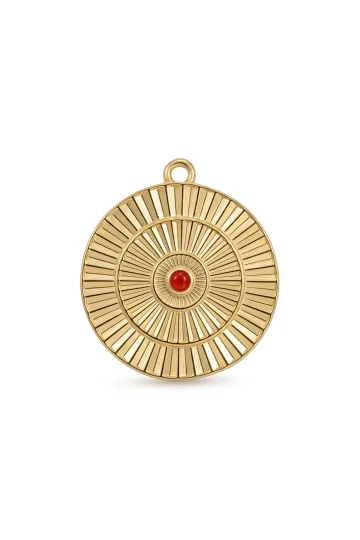
Wear the symbol, don't just read about it. These are in stock:




Types of garnet: colour and composition
Garnet comes in almost any colour, and the colour depends on which elements have taken up places in the lattice. By chemistry, garnets split into several main types.
Pyrope, fiery red
The name comes from the Ancient Greek pyr (fire) plus ops (eye, sight), literally "fire-seeing". Its makeup is magnesium and iron. The colour is a deep red, almost black in a large piece and reddening towards the edges. Hardness sits at 7 to 7.5 on the Mohs scale (for reference: diamond 10, sapphire 9, quartz 7). For purity of colour, pyrope is valued above other red garnets in jewellery. If you want to dig into this variety on its own, we have a separate piece on pyrope as the blood-red crystal of love and courage.
Almandine, burgundy
The most common garnet, rich in iron. The colour runs darker than pyrope: burgundy, with a violet undertone. Same hardness, 7 to 7.5. It was almandine from Bohemia that flooded the courts of Europe under the name "Bohemian carbuncle".
Spessartine, orange
Named after the Spessart hills in Bavaria, where it was first described. The makeup is manganese and iron, with a colour ranging from yellow-orange to a rich mandarin. Lighter than the red garnets, it is sometimes mistaken for orange sapphire or fire opal. Bright, clean spessartines fetch high prices.
Grossular, green and yellow
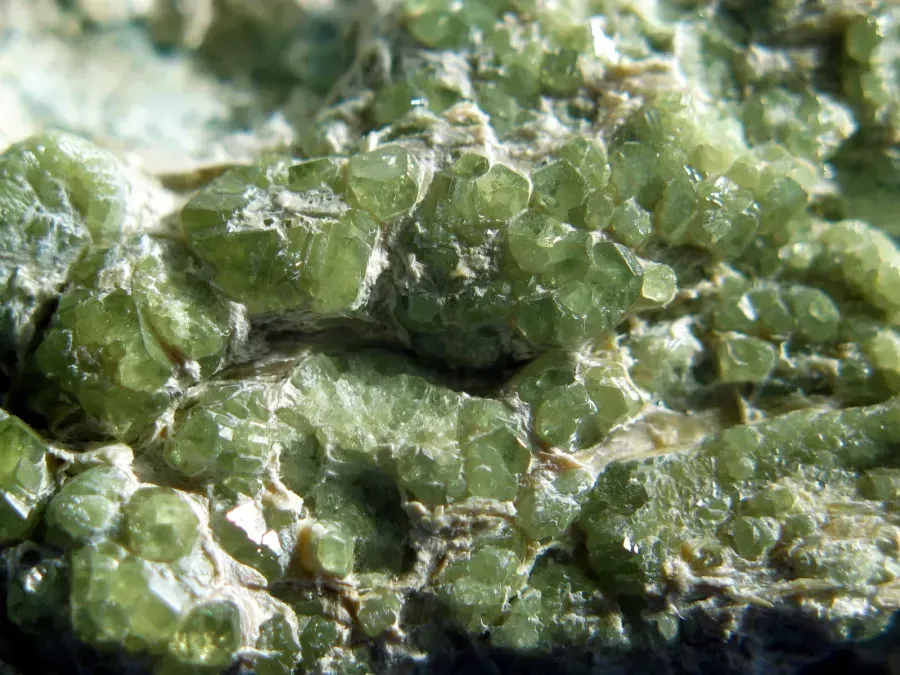
A garnet rich in calcium. The name comes from the Latin grossularia, gooseberry, after its characteristic green tone. It also appears in yellow, orange and brownish shades. The vivid green variety found around Tsavo, on the Kenya-Tanzania border, is called tsavorite and gets confused with emerald. Hardness is around 7. For how green grossular, the stone of wisdom and harmony differs from emerald, it is worth a read on its own.
Andradite, from black to green
A garnet of calcium and iron, named after the Portuguese mineralogist d'Andrada. Andradite has very high dispersion, the ability to split light into rainbow sparks, higher even than diamond. Hardness is 6.5 to 7. The most prized variety, green demantoid with its fiery inner ray, is reckoned dearer than other garnets precisely because of that play of light.
Rhodolite, pink-violet
An intermediate composition between pyrope and almandine. The name comes from the Greek rhodon (rose). The colour runs from pink to violet-red; the stone is light and transparent, which is why jewellers love it.
Tsavorite, grass green
A vivid green variety of grossular, coloured by traces of vanadium and chromium. It was found at the start of the 1970s on the Kenya and Tanzania border, near Tsavo National Park, which gave the stone its name. Tsavorite catches light more briskly than emerald and needs no oil treatment, because it generally carries fewer fractures. Large clean crystals are rare: most tsavorite stays small, and a stone of a couple of carats already counts as notable.
Demantoid with a horsetail
Demantoid, the green andradite, produces the most curious internal signature in the whole mineral kingdom. Stones from the Urals contain golden fibres of byssolite radiating from a single point in a fan, exactly like the tail of a running horse. An inclusion that would lower the value of any other stone works the other way round here: the horsetail confirms Uralian origin and lifts the price. It is a rare case of a flaw being promoted to a mark of quality.
Hessonite, the cinnamon stone
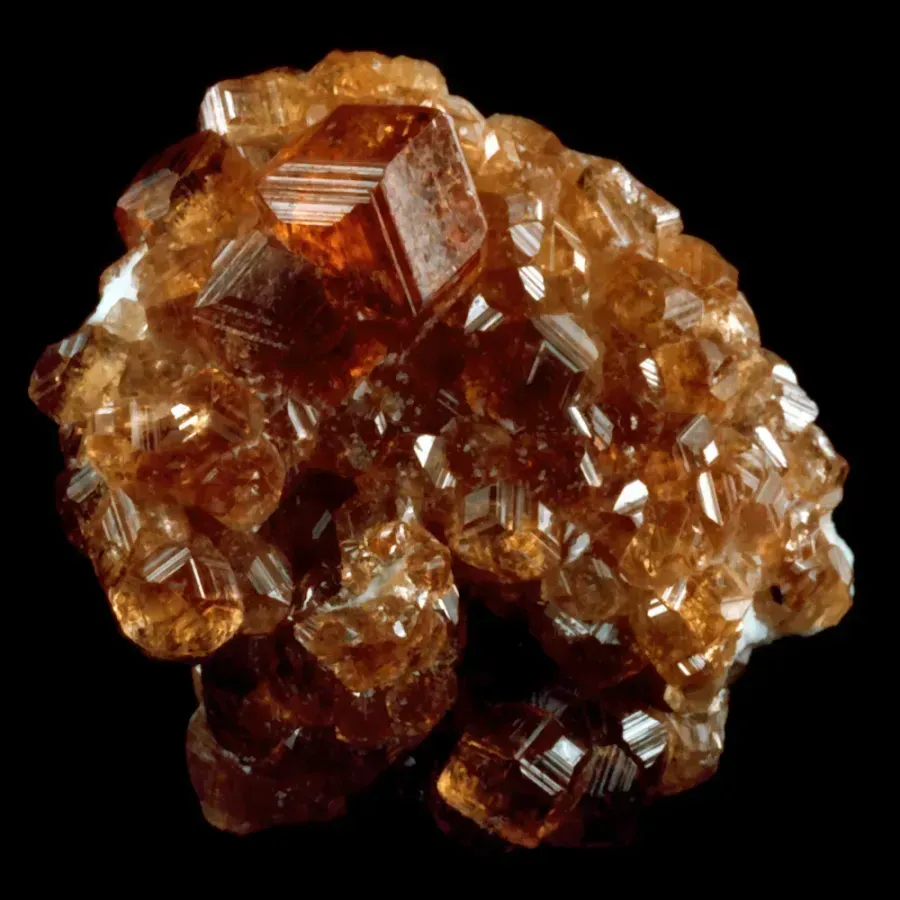
Another grossular variety, honey-orange or reddish brown, and known as the cinnamon stone for that colour. Hessonite carries characteristic swirling inclusions that make the stone look as though it were filled with thick syrup or spilled treacle. In Indian Vedic astrology hessonite is known as gomed and belongs to the set of nine sacred stones, the navaratna, which gave it a separate and very durable tradition of wear.
Uvarovite, emerald green
The rarest of the gem garnets, coloured pure emerald by chromium. It is named after Count Uvarov, president of the St Petersburg Academy of Sciences. The problem with uvarovite is size: it almost always grows as tiny crystals on the host rock, so a faceted stone is nearly impossible to find. Jewellers set it as whole druses instead, brushes of minute crystals that glitter like a continuous green velvet.
Rhodolite, malaia and umbalite: the borderline compositions
Garnets are rarely a single clean mineral, and are usually a blend. Those blends produce the trade names. Malaia, from the Swahili word for "outside the group", is a pink-orange stone of the pyrope and spessartine series from East Africa that was at first rejected as a faulty rhodolite. Umbalite, a soft pink garnet from the Umba river in Tanzania, is another intermediate. These names describe attractive transitional shades of a solid solution rather than any new mineral, which is worth knowing before paying a premium for a label.
To keep all the types of garnet in view at once, let us compare them by colour and hardness.
Burgundy garnet wants a dark backdrop, never a scarlet dress. Red on red is two divas clawing for the spotlight, and I won't hear otherwise.
What to wear with garnet
Over the years garnet has passed through dozens of my looks, from everyday to evening. Here is what genuinely works, by occasion.
How do I wear garnet every day? For everyday I recommend small garnet studs or a thin ring: a single point of colour in a calm palette. Plain knitwear, a white shirt, grey cashmere, warm beige, against that kind of background the red rings loudest. A pendant I suggest on a short chain, at a boat or V neckline, so the stone sits composed and does not argue with your clothes.
Is garnet right for the office? Perfectly, if you keep it restrained. I choose one stone as the single point of colour and keep the rest in neutral tones. A pendant on a short chain under a business collar reads as a quiet detail, not a loud statement. A strict dress code is no obstacle for garnet.
How do I build an evening look? For evening I suggest a deep backdrop: black, emerald, wine, navy velvet or silk, against which garnet grows richer and the facets play in artificial light. For an open neckline I recommend a large drop or chandelier earrings; for a high turtleneck, long earrings that lengthen the neck.
Which metal should I pair with garnet? I look at the skin undertone. For a warm undertone I recommend yellow or rose gold, which underlines the stone's warmth and gives a vintage feel. For a cool one I suggest white gold or silver, which pull garnet into a modern, slightly cooler register. Oxidised silver I choose for a characterful, slightly gothic setting.
Who does garnet suit especially? Those who love colour and do not shy from being noticed, and those flattered by a warm skin tone and chestnut, red or dark hair. Two rules to close on. First: do not mix garnet with other large, bright stones, let it take the solo. Second: under a saturated red outfit go for a darker stone, a burgundy almandine, so the piece carries the fabric on rather than fighting it.

Turn on your camera, pick earrings, a pendant or a ring, and see the piece on yourself in real time.
Switch items in one tap.
Everything runs in your browser: no photo or video is ever uploaded.
Star garnet and colour change
Beyond the ordinary transparent garnet there are two rare optical varieties that a buyer often knows nothing about.
The first is star garnet. In an opaque almandine-pyrope with correctly oriented needle inclusions, cutting a cabochon makes a star of light flare across the surface. Most star stones (sapphire, ruby) show six rays, but garnet also gives a rare four-ray version, and sometimes both patterns at once. One of the world's few sources of this garnet sits in the state of Idaho, where star garnet was made the state gemstone; the second notable source is India. The stone is only ever cut as a cabochon: the star shows only on a smooth dome and vanishes on faceted surfaces.
The second is colour-change garnet. This is no flaw and no fake, but a natural effect. The stone looks greenish, blue-green or khaki in daylight, then flushes to a raspberry red under a warm incandescent lamp. The effect is stronger than in the famous alexandrite, and it turns up in garnets of mixed pyrope-spessartine composition. These stones are rare and clearly dearer than the usual ones, so "a garnet that changes colour" is no reason to suspect a swindle; quite the reverse, it points to a valuable variety.
The science of garnet: one lattice, six characters
Garnets are held together as a family by geometry rather than by colour or lustre. All of them share the same crystal framework, a cubic lattice built from two sets of metal atoms and silicon-oxygen units. The only thing that changes is which metals have taken the positions inside that framework. Put magnesium in and you get pyrope. Iron gives almandine. Manganese gives spessartine. Calcium with aluminium gives grossular, calcium with iron gives andradite, calcium with chromium gives uvarovite. Six characters on one skeleton, like siblings who look nothing alike.
Solid solution: why a pure garnet barely exists
Nature does not sort atoms neatly. Magnesium readily stands in for iron, iron stands in for manganese, and several compositions end up mixed within a single crystal. Mineralogists call this a solid solution: the stone turns out to be a smooth transition between pyrope and almandine rather than either one. That is where the endless garnet palette comes from, and where trade names like rhodolite and malaia come from too, since they sit exactly halfway between the end members. A clean, hundred per cent pyrope or almandine is almost unknown in nature. A real stone is always a blend.
Garnet as a geological thermometer
Garnet holds down an unusual second job. From its composition a geologist can read the temperature and pressure at which the surrounding rock formed. Particular metals only enter the lattice under particular conditions, so the chemistry of the stone works like the black box recorder of a flight: open it, measure it, and you know the depth and heat at which it grew. A garnet from deep mantle rock records one pressure, a garnet from shallow schist another. Geologists call the method garnet geothermobarometry and use it to work out how plates moved and mountains rose.
Why prospectors hunt diamonds by following garnet
That same fussiness about conditions makes garnet a guide to diamond. A particular bright red chromium-bearing pyrope, which geologists label G10, forms at the same enormous depths and pressures as diamond, inside kimberlite pipes. Diamonds are rare and small and hard to spot in rock, but that chromium pyrope is abundant in the same pipe and easy to see. So prospectors wash river sand looking for those red grains: find a diamond-indicator pyrope, then walk upstream towards the source. Garnet has opened more than one diamond field in exactly this way.
Dispersion: where demantoid gets more fire than diamond
When people praise the play of a stone they mean dispersion, the ability to split white light into coloured sparks like a prism. Diamond has high dispersion and part of its fame rests on it. Green andradite, demantoid, has higher dispersion still. In practice that means a well-cut demantoid throws rainbow flashes harder than a diamond of the same size. The word demantoid itself translates roughly as diamond-like, and it was given for that fire rather than for hardness, where garnet falls well short of diamond.
Customer reviews
Zevira is a real jewellery shop. Genuine payments, deliveries and customer thank-yous.
🥰🥰🥰 gracias

Ok, ¡gracias! 🙂

Is garnet treated
The short answer: almost never, and that is one of its strengths. Garnet is one of the few gemstones that reaches the counter exactly as it came out of the ground. Its colour is not "improved" by heat, as with sapphire and ruby; it is not irradiated, as with blue topaz; it is not soaked in oil, as with emerald; and its cracks are not dyed. The reason is simple: the red, orange, pink and green of garnet come from the chemical elements of the lattice itself, not from impurities that a furnace might "wake up".
There is a practical conclusion in that for the buyer. When you are shown a beautiful, saturated garnet, its colour is almost certainly natural rather than the product of treatment, so it will not "fade" or drift from a treatment that never happened. With a ruby or sapphire on the same price shelf, you have to ask separately whether the stone was heated. With garnet, that question almost always answers itself.
Rare exceptions do exist. Now and then fractured stones are coated with a colourless substance for shine, and the odd green andradite on the market may have been lightly stabilised. But this is no mass practice, and for an ordinary red garnet it is simply not needed. So a lab report on garnet usually reads "none detected" under treatment, and that is the normal, expected state of the stone rather than rare good luck.
Garnet among similar red stones
There are many red stones, and on the counter garnet is easily confused with ruby, red spinel, red tourmaline (rubellite) and plain glass. Their prices differ, so it pays to tell them apart, at least roughly.
The chief physical sign of garnet is that it is singly refractive. Light passes through it in a single ray, without the doubling of the back facets you see in ruby. Spinel is also singly refractive, but ruby, tourmaline and sapphire are doubly refractive, and under a loupe their back facets split in two. This is not magic but optics, and a gemmologist reads it in seconds.
- Garnet versus ruby. Ruby is harder (9 against 7 on Mohs), lighter, brighter, and several times dearer. Garnet is darker, deeper, almost black in the centre of a large stone. Ruby shows facet doubling under a loupe; garnet does not.
- Garnet versus red spinel. Both are singly refractive, which makes them harder to separate. Spinel is usually cleaner, with a "purer" red free of any brown undertone, and noticeably dearer. A lab is the safer bet here.
- Garnet versus rubellite (red tourmaline). Tourmaline is doubly refractive and often markedly dichroic: turn it to the light and the shade shifts from red towards a pinker or browner tone. Garnet shows no such shift as you turn it.
- Garnet versus glass. Glass is lighter (lower density), often too even in colour, with round air bubbles inside instead of natural crystal inclusions. To the touch, glass warms faster in the hand.
One honest point so as not to mistake hope for fact: an expensive stone is still worth showing to a gemmologist. Home tricks give a rough bearing, not a verdict.
Upload a photo of your pet, someone you love, or an object. We'll build a 3D model and hand-cast it in pewter.




The history of garnet in jewellery
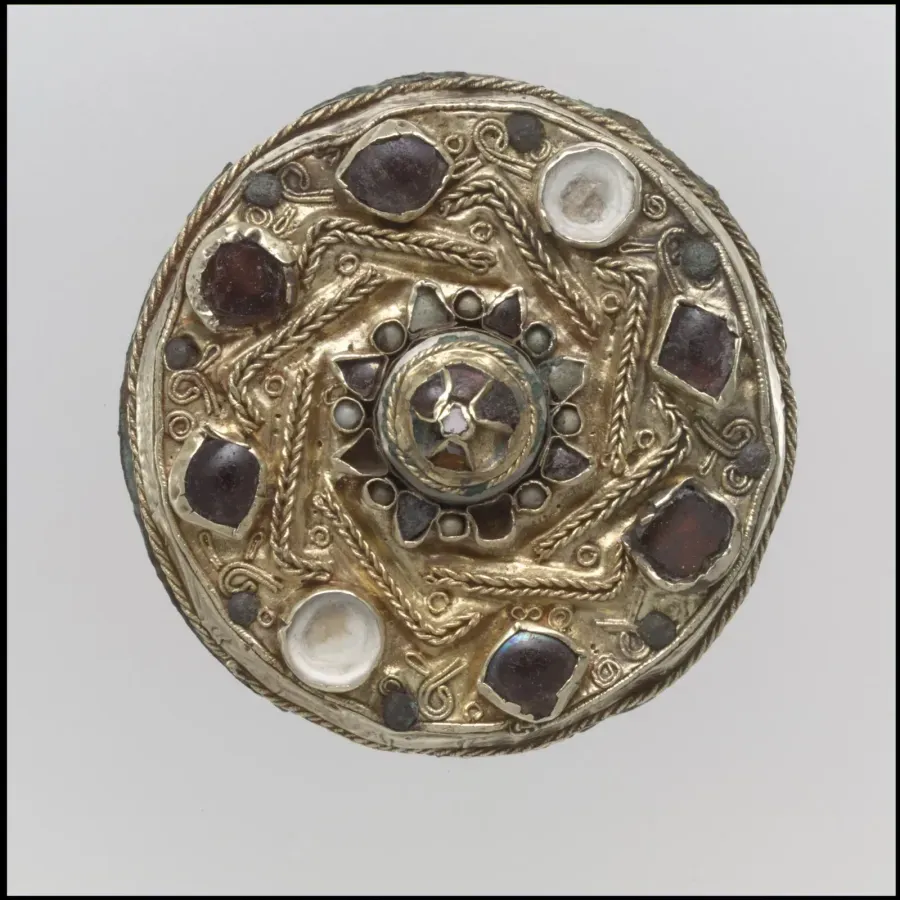
Garnet is one of the oldest gemstones worked by people. Garnet amulets and inlays turn up in Egyptian burials dated thousands of years before our era. The colour, so like blood, was tied in many cultures to life and strength, and the stone became a marker of status early on.
Antiquity
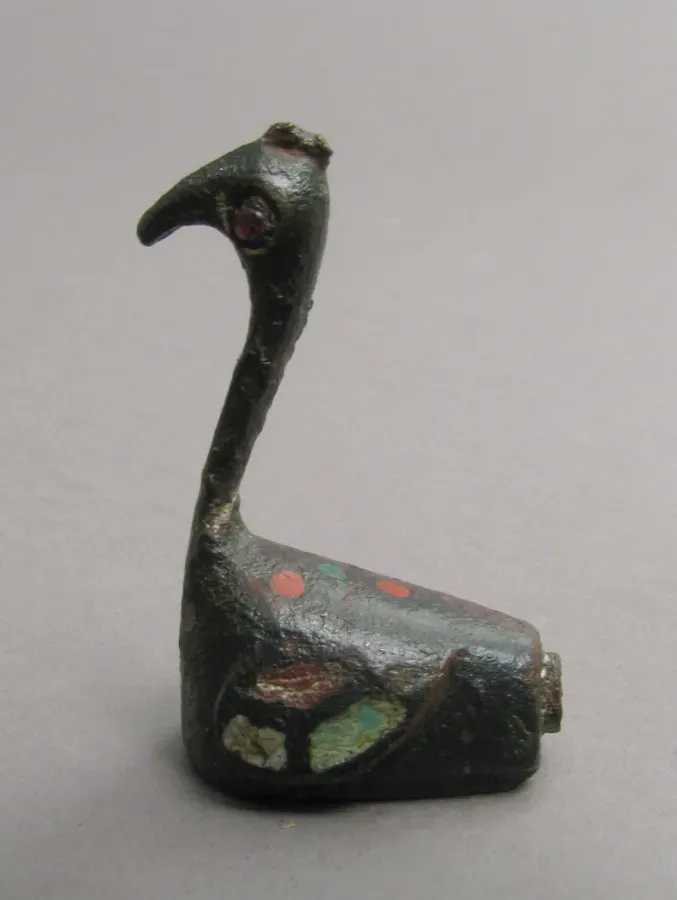
Pliny the Elder, in his Natural History, describes red stones under the name carbuncles and notes their fiery shine. The Romans imported garnet in quantity once trade with the East and East Africa expanded, and they used it in signet rings and fibulae. The cloisonné technique, packing thin plates of garnet tightly between fine gold walls, produced a dense glowing red that no single stone could match.
The Middle Ages
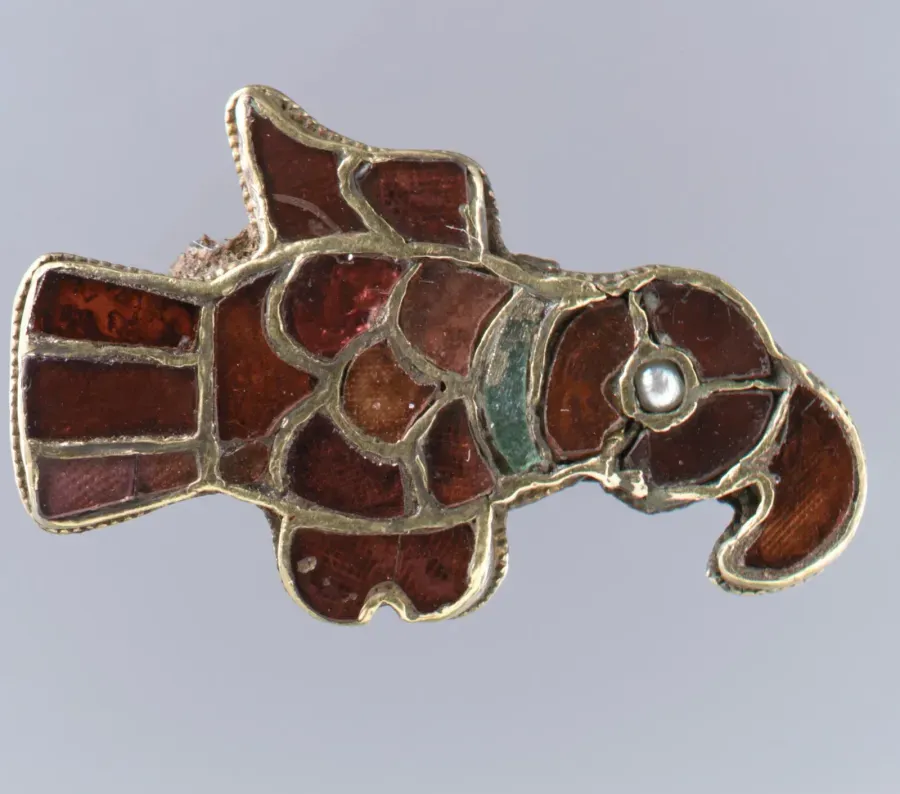
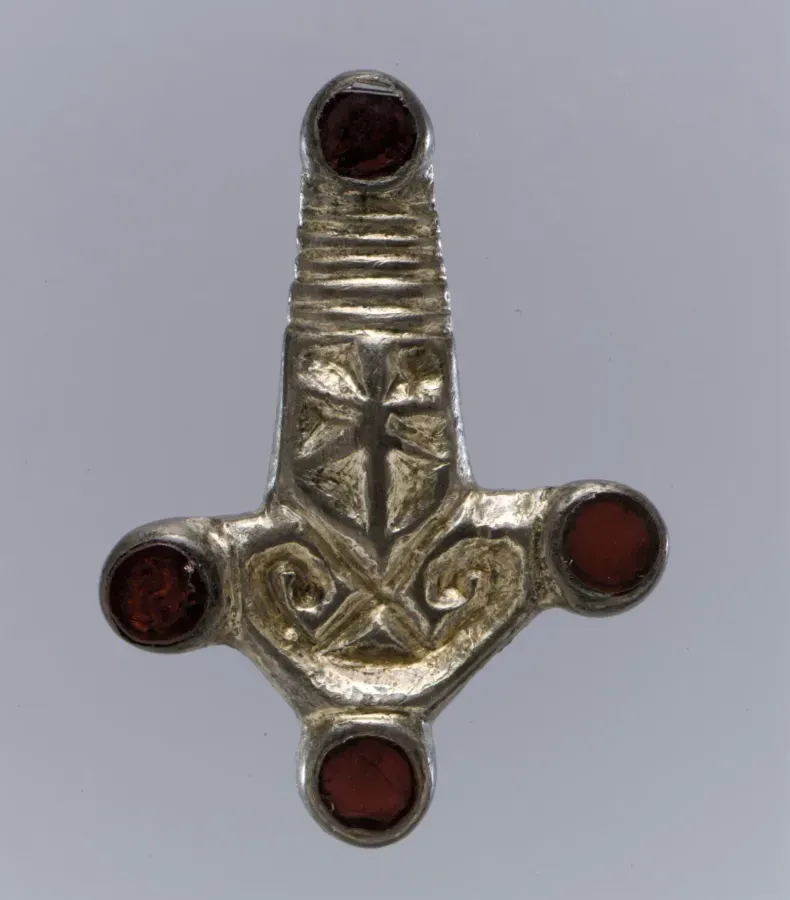
Among the Germanic tribes of the migration period, garnet inlays in gold were a sign of rank, which is why so many Frankish fibulae fill museum collections. In the Christian tradition the red stone was linked to blood and the theme of resurrection, and garnet adorned church plate and vestments. Bohemia mined its own small almandine in great quantity, and "Bohemian garnet" became a standalone mark of European jewellery.
From the Renaissance to the nineteenth century
With the influx of Burmese rubies and cut diamonds, garnet was pushed out of the top tier, yet Bohemian material stayed affordable and therefore widespread: it was worn by the town classes and the lesser nobility. Through the eighteenth and nineteenth centuries mineralogists began systematically dividing garnets into types by composition, and the stone entered scientific classification for good.
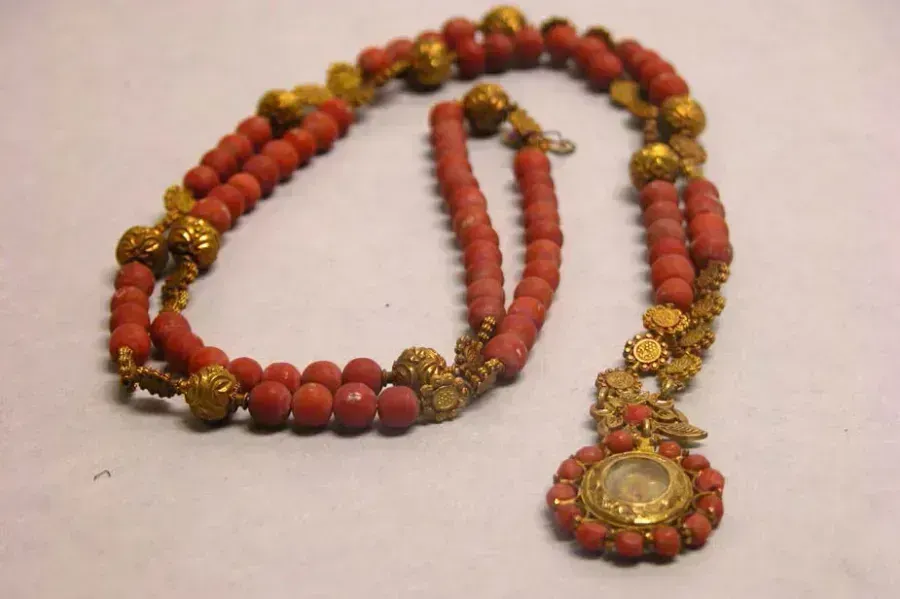
The Victorian era was garnet's high point. The dark stone played especially well by candlelight and gaslight, and it went into bead necklaces, brooches and rings, including mourning pieces. By the end of the nineteenth century, large-scale mining had put garnet jewellery within reach of a broad public.
The twentieth and twenty-first centuries
In the twentieth century garnet was partly displaced by synthetic stones and the fashion for bright laboratory sapphires and rubies; it settled into a reputation as the "grandmother's" Victorian stone. Interest returned with the taste for natural stones and vintage: buyers once again want a coloured stone with a history and a clear origin, and garnet answers that demand on both price and looks.





Garnet across cultures
The story of garnet is not a single line running from Egypt to the Victorians. It is a scatter of independent traditions that grew apart from one another and gave the stone very different meanings.
The Scythians and the nomads of the steppe
The nomads of the Eurasian steppe knew garnet long before European courts took an interest. Scythian and Sarmatian burials yield gold plaques, torcs and fittings inlaid with flat plates of dark garnet. The steppe taste for red stone in gold proved catching: it was through intermediaries at the edge of the steppe that the technique of gold packed tightly with garnet spread across the classical and early medieval world. A steppe warrior carried his wealth on his person, and the red stone was part of that portable fortune.
The Anglo-Saxons and the Sutton Hoo treasure
The most famous hoard of early medieval Europe, the ship burial of an Anglo-Saxon leader in Suffolk, is packed with garnet. The gold buckle, the shoulder clasps and the purse lid are set with thousands of hand-sawn plates of almandine, each laid over ridged gold foil so that the stone would flare even in dim light. Geochemical work on those plates produced a surprise: much of the garnet reached northern Europe from India and Sri Lanka. A trading chain half the world long was already functioning fifteen hundred years ago, and demand for red stone was what pulled it.
Bohemia and the garnet rush
The Czech uplands turned out to be scattered with small pyrope of remarkably even colour, washing straight into the river gravels. By the nineteenth century Bohemian garnet had grown into a full industry with cutting workshops, workers' guilds and its own recognisable style: dozens of tiny stones set so tightly that almost no metal shows, so that a brooch or a bracelet burns as a continuous garnet carpet. The Czech authorities later fixed the definition of genuine Bohemian garnet in law to keep imitations from diluting the name. The inherited garnet brooch that circulates through central European families almost certainly comes from this tradition.
India and the nine sacred stones
In Indian Vedic astrology garnet belongs to the navaratna, a set of nine stones each linked to a heavenly body. Red garnet there often stands in for ruby, which was out of reach for ordinary people, while the orange-brown hessonite, gomed, answers for its own planet in its own right. Navaratna stones are worn on an astrologer's calculation rather than for looks, which gave garnet a ritual life on the subcontinent quite unlike European ornament.
Native America and the anthill mine
In the deserts of the American Southwest bright red pyrope was gathered off the surface for centuries, with unexpected help. Ants excavating their nests bring small stones to the top and pile them round the entrance, garnet grains included. Collectors simply walked the anthills and lifted the ready-sorted scatter. For their fiery colour the stones were nicknamed Arizona rubies, although they are ordinary pyrope.
Famous garnets and historical pieces
Garnet has no single crowned specimen in the way diamond has its great named stones. Its fame is spread across many objects, which suits a stone that has always been comparatively democratic.
Roman intaglio rings
Museum collections hold classical signet rings in which tiny portraits and scenes are carved into garnet. A hardness of seven let the engraver cut the stone without it crumbling under the tool, and Roman gravers valued that balance highly. Because the carving was done in reverse, into the stone, these rings doubled as seals: pressed into wax they printed the owner's identity, which made the piece a legal instrument as well as an ornament.
Frankish and Lombard cloisonné brooches
Early medieval brooches with dense garnet inlay, of the kind that survive in several European collections, are considered the peak of cloisonné work. The maker built a honeycomb of thin gold walls, then cut each garnet plate to fit its individual cell. There was no margin for error: a plate cut a fraction too small left a visible gap, and a plate cut too large would not go in at all. Modern goldsmiths who have tried to reproduce the technique tend to come away impressed.
Nineteenth century garnet suites and the Uralian demantoids
A full nineteenth century set of necklace, earrings, brooch and bracelet in solid Bohemian pyrope was a desirable part of a dowry and passed down as family property. Large demantoids made their own noise later in the same century, when green andradite with the horsetail inclusion was found in the Urals and quickly became a fashionable rarity at European courts and in the workshops of the leading jewellers of the day. Supply was erratic, so old demantoids are still hunted by collectors.
Leave your email, we'll send your discount code. No spam, unsubscribe anytime.
The code arrives by email, valid on your first order.
Garnet in art and language
The red stone left its mark in jewellery boxes and equally in words and images.
Carbuncle: the stone that burns
For a thousand years any glowing red stone in Europe was called a carbuncle, from the Latin for a little coal. Medieval bestiaries and romances described the carbuncle as a stone that shone in the dark by its own fire and could light a hall. It does nothing of the kind, of course; it simply reflects candlelight very well. The legend proved durable all the same, and its echoes still surface in fantasy and in fairy tales, where a burning red stone is invariably magical.
The colour garnet and the fruit that shares its name
The stone takes its name from the pomegranate and its ruby seeds, and the debt runs both ways. A deep dark red with a slightly cool undertone settled into the language as garnet colour, distinct from scarlet and from burgundy. Painters valued the shade for its depth and used it for draperies and robes where richness had to be conveyed without shouting.
Garnet and the root chakra: what tradition says
In the Indian chakra system, the colour red is matched to muladhara, the lowest, root chakra at the base of the spine, which in that tradition governs the sense of steadiness and connection to the body. Garnet landed on the "root" list purely on colour: a red stone for the red chakra. This is symbolic logic, not a proven physical mechanism, so it deserves to be taken as part of a tradition rather than as medicine.
No stone heals or "opens" energy centres in any testable sense. If wearing garnet helps someone gather themselves before a big step, that is ordinary psychological focus at work, not the vibration of a mineral. And that is quite enough for the stone to be pleasant and meaningful, without promises it cannot keep.
The January stone and the anniversary gift
In the European birthstone tradition garnet is fixed to January, and this is the most stable part of its symbolism. By the same custom garnet marks the second wedding anniversary. The roots are practical rather than mystical: the modern birthstone list was settled early in the twentieth century by a trade association and simply distributed the available gems across the calendar. A garnet for a January birthday is therefore a pleasant tradition and a useful prompt for a gift, and no kind of law of fate.
The stone of passion and fidelity: where the label came from
Red reads in most cultures as the colour of blood, fire and the heart, so a stone of that tone was almost bound to collect themes of love, passion and loyalty. Medieval lapidaries credited garnet with sustaining friendship and keeping a traveller safe on the road, which is where the custom of giving garnet to someone departing, so that they would come back, originated. All of it is decorative cultural scaffolding built on a simple fact: a saturated warm red is genuinely pleasant to wear and easy to associate with strong feeling. Loving the stone for that is reasonable. Expecting it to manage someone else's feelings is not.
Garnet and the zodiac signs, kept in proportion
Astrological tradition most often assigns garnet to Capricorn, since the sun passes through that sign in January, and then pulls in Scorpio and Leo on the strength of the colour's fiery character. It is a convenient association rather than a prescription: the stone is neither stronger nor weaker for the constellation its owner was born under. Anyone can wear garnet, and the only real test is whether the colour and the mood suit the person.
CAPAORA mini knife pendant
The 18th-century Spanish navaja in miniature: 40 mm of stainless steel, a real folding mechanism and a Palanquilla lock that clicks. An affordable gift to remember.
Authentic · Ships from Spain · 14-day returns
How to choose a garnet piece
Garnets are rarely flawless; natural inclusions are the norm for them. The guideline is simple: a stone that is clean to the eye (inclusions visible only under a loupe) is a good working standard for jewellery. The more obvious the cloudiness and dark specks, the lower the price.
Colour
Colour decides almost everything.
- Red (pyrope, almandine): saturated, deep, with no blackness in ordinary light. The baseline jewellery tone.
- Burgundy (almandine): darker, with a wine undertone, usually cheaper than red.
- Orange (spessartine): bright, clean stones are rare and highly valued.
- Pink-violet (rhodolite): light and transparent, above average in price thanks to its looks.
Steer clear of stones that look black in natural light, and of very pale ones resembling rose quartz.
Cut and shape
- Round brilliant: catches the most light, more costly to cut.
- Oval, cushion, pear: easy to set in rings, pendants and earrings, and they hold the stone well.
- Emerald (step) cut: emphasises the colour, looks restrained.
- Uncut crystal: the most budget-friendly choice, for those who care about the natural form.
The lines of the cut should be crisp. Blurred facets are a sign of over-polishing.
Setting and metal
Yellow and rose gold emphasise the warmth of red garnet and lend a vintage look. White gold and silver pull the stone into a cooler, more modern register. Sterling silver (925) is a sound everyday choice. Avoid silver-plated brass and similar alloys that tarnish quickly.
Size and price
Garnet is noticeably cheaper than ruby and sapphire, so the same budget buys a larger stone. The price per carat climbs non-linearly: a large, clean, saturated stone costs disproportionately more than a small one. For an everyday ring, a stone of a few carats is sensible, so the setting does not turn heavy.
Certificate
For an expensive stone it makes sense to ask for an independent laboratory report. It states the type of garnet, the nature of the stone (natural or synthetic), any signs of treatment, the colour, clarity, weight and cut parameters. Reputable labs such as the GIA can tell pyrope from almandine even where the eye cannot.
Garnet jewellery: which forms
Garnet lives in almost every kind of jewellery, and each has its own practical knack.
- Rings: a stone of a few carats; a rounded cut sits more securely in the setting. Better to let garnet take the solo than to crowd it with other large, bright stones.
- Pendants: an oval cabochon or a faceted stone on a sturdy chain. Take a chain no thinner than sterling silver or 14k gold, or you risk losing the drop.
- Bead bracelets: comfortable and inexpensive. Black stones alongside (hematite, black tourmaline) balance the red in colour.
- Earrings: from small studs for the office to long drops and chandeliers for the evening.
- Brooches: a large stone in gold, sometimes ringed with small accents, the classic vintage format.
Myths and facts about garnet
Send a friend a discount code, they save on their first order.
Caring for garnet
Garnet is hard (7 on Mohs), but not invincible.
Cleaning. Warm water, a drop of mild unscented soap, a soft brush, then rinse and pat dry with a microfibre cloth. Skip ultrasonic and steam cleaners: they are dangerous for stones with inclusions. Sharp temperature swings are best avoided too.
Storage. Keep it apart from other jewellery, in a fabric pouch: garnet will scratch softer opal and pearl, and will itself suffer from diamond or sapphire. A cool, dry place, with no direct sun on the setting.
Wear. Take it off before sport, heavy work and the swimming pool (chlorine oxidises the setting). A sharp point-blow can still crack the stone. A garnet clouded by micro-scratches is brought back with a re-polish by a jeweller.
Garnet as a gift
Garnet sits well as a gift for someone who loves colour and natural stones, who values things with a history, or who collects jewellery and already owns a ruby and a sapphire. It is also often a man's first piece of jewellery: the stone looks restrained rather than "delicate". Garnet is markedly cheaper than ruby, yet gives a noble natural red instead of the glassy glint of an artificial stone, hence its handy role as the "not obvious, yet not ruinous" gift.
When something else is the better call: for a strict minimalist, a saturated red may read as too loud, and for someone who easily loses things, an expensive ring is a risky present.
Surprising facts about garnet
A stone with a biography this long has picked up stories that sound implausible until you check them.
Diamonds are found by following a red stone
It sounds like alchemy and it is working geology. Bright red chromium pyrope forms at the same depth as diamond, it is plentiful in kimberlite and it is easy to see. Prospectors sift river sand specifically for those grains, because they lead back to the pipe.
The same stone is cut for a ring and used to measure the heat of the earth
The stone that glitters in a ring becomes a thermometer in a geologist's hands. From the set of metals in the lattice, researchers calculate the temperature and pressure at which the rock grew, and from that reconstruct the movement of continents.
The horsetail raises the price rather than lowering it
In almost any stone an inclusion is a fault. In Uralian demantoid the golden fibres fanning out from a point do the opposite, confirming origin and making the stone dearer. It is an unusual case of a defect being promoted to a proof of authenticity.
The Sutton Hoo garnet came from India
The almandine in the treasure of the Anglo-Saxon leader turned out not to be local. Geochemistry pointed to deposits in India and Sri Lanka, proving that a trading chain half the world long was already operating fifteen hundred years ago.
Ants mine garnet on people's behalf
In the Arizona deserts, ants excavating their nests carry small pyropes to the surface and stack them round the entrance. Collectors only have to walk the anthills. The fiery colour earned the stones the nickname Arizona rubies.
Garnet has more fire than diamond
Measured by dispersion, the ability to break light into rainbow sparks, green demantoid beats diamond. The name of the stone translates as diamond-like, and it was given precisely for that play of light rather than for hardness.
Iron-rich garnet is slightly magnetic
Almandine, which carries a lot of iron, responds to a strong neodymium magnet. Gemmologists use this as a quick way of separating garnet varieties without sending a stone to a laboratory, and it also distinguishes garnet from most red imitations.
Garnet comes in green, in three different ways
Green can be grossular tsavorite, coloured by vanadium, or andradite demantoid, coloured by iron, or uvarovite, coloured by chromium. Three separate greens within one mineral group, and tsavorite in particular is easily mistaken for emerald.
Buying it as a gift? Each one arrives ready to give.
 A branded Zevira box and a little card come with every order.













FAQ: common questions about garnet
Garnet and ruby, what is the difference?
Ruby is red corundum coloured by chromium, hardness 9 on Mohs, dearer and rarer. Garnet is an aluminosilicate, hardness 7, softer and more affordable. Ruby is usually lighter and brighter, garnet darker and deeper. Until the nineteenth century the two were regularly confused; the types began to be separated as gemmology developed.
Can garnet count as a substitute for ruby?
For looks, certainly, if you like a darker, deeper red, and at a lower price. For an everyday ring that takes a lot of wear, ruby is more practical thanks to its greater hardness.
If a garnet is cheap, is it definitely fake?
Not necessarily. A cheap stone can be a low-grade natural one, a synthetic, or simply a glass imitation. A suspiciously low price paired with a flawless look is a reason to ask for documents or walk away.
How do you spot a fake?
A glass imitation gives itself away by a suspiciously even colour with no natural zoning, a complete absence of inclusions, and a lighter weight from its low density. The safest course is to buy from a trusted seller and ask for a report on the stone's origin.
Is synthetic garnet a bad thing?
It has the same physical properties as the natural stone, and it is cheaper. For budget jewellery it is an honest choice. The difference is only in origin, not in the "power" of the stone.
Does garnet deteriorate over time?
The mineral itself does not; it outlives generations. The setting is what wears: it dulls, bends, scratches. The surface of the stone can pick up micro-scratches from long daily wear, and that comes off with a re-polish.
Can you wear garnet in water?
It is not afraid of water. Avoid chlorinated pool water (the setting suffers) and sharp temperature swings. After the sea, rinse the piece in fresh water.
Does garnet glow in the dark?
No, that is an old myth. The stone only reflects light. By candlelight and gaslight it seemed to smoulder, but that is the play of refraction, not a glow of its own.
Does garnet change colour in the sun?
A good natural garnet keeps its colour, unlike amethyst, which can fade. There is a rare colour-change variety of garnet under different lighting, but that is a feature of the stone, not damage.
How much does a good garnet cost?
It depends on quality, size and colour. A cloudy stone with inclusions costs next to nothing; a clean, saturated, mid-size one moves into the mid-range; rare colours and large clean stones reach the upper tier. A finished ring with a small mid-grade garnet runs about the price of a good dinner for two, and from there it all depends on the setting.
Which garnet to choose for a ring?
A stone of a few carats (larger is awkward for daily wear), clean to the eye, of a saturated colour with no blackness and no paleness, in a rounded cut that sits more firmly in the setting. Before buying, ask the jeweller to check the stone for micro-cracks.
Does garnet suit men?
Yes, and men have worn it since antiquity, from ancient signet rings to medieval fibulae. The stone looks restrained and stern, fine in a ring or a single setting.
How do you tell pyrope from almandine?
By eye it is hard; even specialists slip up. The rough bearing: pyrope is lighter and brighter, almandine darker, with a violet or brownish undertone. They are told apart reliably by composition in a laboratory.
Is garnet magnetic?
Not on its own. But iron-rich garnets such as almandine have a weak magnetism that gemmologists sometimes use for diagnosis with a strong neodymium magnet. Household appliances have no effect on the stone.
Which stones go with garnet?
Best with neutrals: black stones (onyx, black tourmaline, hematite) give contrast, white ones (opal, moonstone, pearl) set off the red. Several large bright stones side by side usually argue with one another.
Garnet and the zodiac?
Garnet is traditionally taken as the stone of January and tied to Capricorn, partly to Scorpio and Leo. This is part of astrological tradition rather than a rule: anyone may wear the stone.
About Zevira: a philosophy of choosing garnet
Rings, pendants, bracelets and brooches in garnet are about the long history of a simple yet noble stone. We choose garnets by clear marks: colour, clarity, quality of cut and the soundness of the setting, not by promises the stone cannot make.
We work with suppliers in Mozambique, Sri Lanka and India and look at every stone: how even the colour is, whether there are visible inclusions or cracks, how it plays in the light. It matters more to us that a piece serves for decades and can be passed on than that a pretty legend surrounds the stone.
Garnet is good because it is honest: a natural red, a clear origin, a sensible price. That is enough to wear it every day and not part with it for years.
Garnet rings, pendants, earrings and bracelets in sterling silver 925 and 14-18K gold, assembled in the artisan tradition of Albacete.