Grossular: the see-through garnet from honey yellow to emerald green
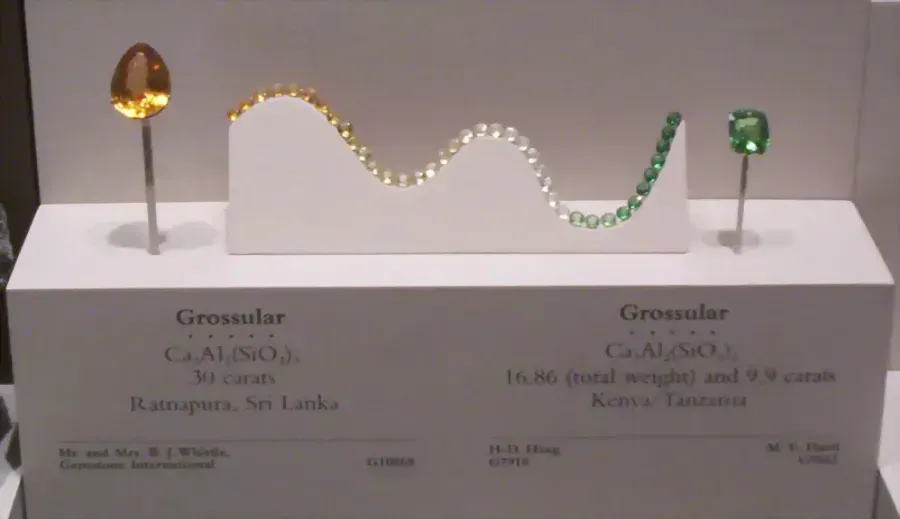
Most people are certain garnet only comes in deep red. Yet grossular is a garnet that can be yellow, orange, pink, even a dense forest green so clear that the finest green stones get mistaken for emerald. The name comes from the Latin grossularia, gooseberry: the first crystals ever described were a yellow-green that looked exactly like the unripe fruit.
What grossular actually is
Grossular is one of the varieties of garnet, a mineral from the silicate group. Garnet is not a single stone but a whole family of closely related minerals: almandine and pyrope (red), spessartine (orange), andradite (yellow-brown and green) and grossular. They all share a cubic crystal lattice, yet differ in chemistry and, with it, in colour.
Grossular stands out among its relatives for its clarity and its unexpected palette. Pure grossular would be colourless; the colour comes from trace elements. Iron tints the stone yellow and orange, chromium and vanadium turn it green, manganese adds pink. The proportions of these elements are tiny, a few percent at most, yet the colour shifts dramatically because of them.
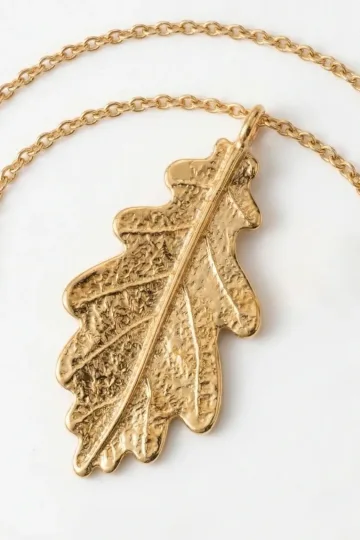
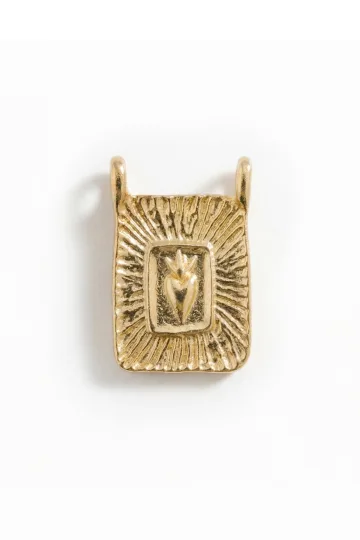
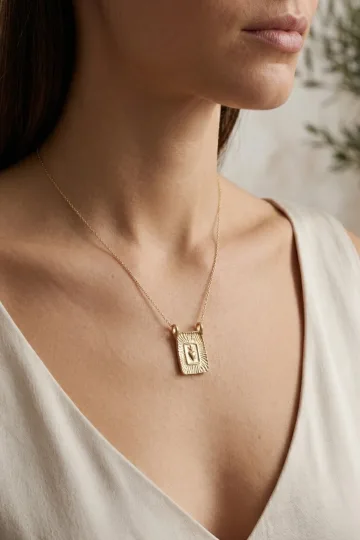
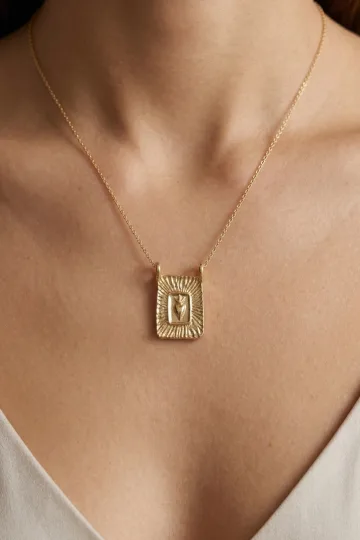
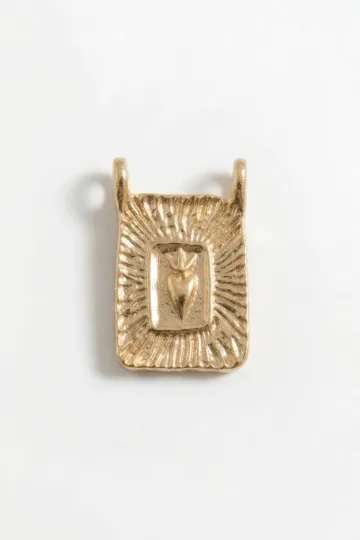
Wear the symbol, don't just read about it. These are in stock:




There is a separate piece on how garnet is used in jewellery and the history and symbolism people have attached to it.
Where grossular sits in the garnet family
Mineralogists split garnets into two broad lines according to which metal holds the key position in the lattice. The first line is the pyralspites: pyrope, almandine and spessartine, built around aluminium, with magnesium, iron or manganese standing where calcium would be. The second line is the ugrandites, and this is where grossular belongs, alongside andradite and uvarovite. What unites the ugrandites is calcium, which occupies the same site in every one of them; what separates them is the second metal, aluminium in grossular, iron in andradite, chromium in uvarovite.
The boundary between varieties is a gradual one rather than a sharp line. Pure grossular hardly ever grows in nature: more often it is a solid solution in which part of the aluminium has been replaced by iron, and the stone then drifts towards andradite, picking up yellows and browns. That is why two neighbouring crystals from the same deposit can look noticeably different in colour: their share of impurity is not the same. This chemical kinship is worth understanding as a buyer, because the same patch of green in a piece of jewellery could be grossular in the form of tsavorite or andradite in the form of demantoid, and the two differ in price and in character.
How grossular differs from the red garnets
The garnet most people picture is the red almandine or pyrope from the pyralspite line. Their colour comes from iron built into the structure itself rather than arriving as an impurity, so the red is deep and all but unavoidable. Grossular works the other way about: its own colour is no colour at all, and the whole palette comes from minute additions. Hence the difference in temperament. A red garnet is predictable and uniform, while grossular is capricious and varied, running from honey to emerald. That unpredictability is exactly what makes clear warm and green grossulars markedly rarer and more sought after than an ordinary red stone.
The chemistry and physics of the stone
Composition and crystal structure
The chemical formula of grossular is Ca₃Al₂(SiO₄)₃: calcium, aluminium and silicate groups. In practice pure grossular barely exists in nature; it is usually mixed with other garnets, so the composition drifts, and the colour drifts with it.
Grossular crystallises in the cubic system. Cubic symmetry means the stone is optically isotropic: light passes through it the same way in every direction, with no double refraction. That gives a clean, even lustre with no rainbow splitting. Well-formed crystals often take the shape of a rhombic dodecahedron, a twelve-sided form that, in garnets, counts as nature's own classic cut.
Hardness, density, optics
- Mohs hardness: 7 to 7.5. That is harder than glass and quartz, but softer than topaz (8), corundum (9) and certainly diamond. For jewellery it is a good figure, though not limitless: the stone can be scratched by the hard particles of ordinary household dust, which often contains quartz.
- Density: roughly 3.4 to 3.7 g/cm³. Grossular is noticeably heavier than glass of the same volume, one of the clues for telling it from a fake.
- Refractive index: around 1.72 to 1.75. Higher than quartz and most semi-precious stones, so a cut grossular sparkles more brightly than you would expect from an inexpensive stone.
- Dispersion (the splitting of light into a spectrum, the so-called fire): moderate, distinctly weaker than diamond or demantoid. Grossular wins on clean colour and lustre rather than rainbow flashes.
- Pleochroism is practically absent in grossular; it is evenly coloured from any angle, which makes sense for a cubic mineral. A faint shift of tone is sometimes noted in individual orange stones, but that is the exception, not the rule.
Some tsavorites (the green variety) show faint fluorescence under ultraviolet. This is not a glow in the dark, only a response to a UV lamp.
How it forms in nature
Grossular is born of metamorphism, the recrystallisation of rock under pressure and high temperature. The raw material is limestone and marl rich in calcium, plus alumina and silica. When such rocks end up in a zone where tectonic plates collide, kilometres deep, at temperatures of hundreds of degrees, the minerals reorganise and garnet crystals grow out of them.
The process takes millions of years and is extremely slow. That is why large transparent crystals are rare: small grains and clusters are far more common. Grossular usually keeps company with other metamorphic minerals, vesuvianite, diopside, calcite, and collectors value an intergrowth with them in its own right.
Put a tsavorite beside an emerald and watch who blinks first. The garnet never does. And don't you dare hide it under a sweater.
What to wear grossular with
Over the years working with coloured stones, grossular has been through dozens of looks for me, from daytime to evening. Here is what actually works, sorted by occasion.
What do I wear grossular with day to day? For everyday I recommend a pendant with a yellow or honey stone on a fine chain over a plain T-shirt, a linen shirt or a simple dress. I like to pull warm yellow onto cream, sand and terracotta fabrics, and I suggest green tsavorite against white, grey and khaki, where the freshness holds all day. A neckline that opens the neck gives the stone room, and that is its best position.
Does grossular work at the office? It does, as long as you keep to one detail. I choose a stud or a discreet pendant that tucks under the collar: it reads as taste, not as a bid for attention. I suggest a calm metal without sharp glare and a shorter chain, so the eye stays near the face.
How do I build an evening look? For the evening I recommend a dark dress and a smooth fabric in a deep colour: blue, wine, graphite. Against that, green grossular becomes the accent for which I set every other bright piece aside. An orange stone I suggest in white gold or silver, where it sounds sharper; a yellow one in yellow gold, by contrast, gathers the look into a single warm range.
How do I match length and setting to the stone's colour? For length I go by the task: a short chain keeps the eye near the face and suits the daytime, a long one lengthens the silhouette for a romantic evening. For metal I follow the colour: a yellow stone I set in yellow gold, while orange and green look better in white gold, platinum or silver, where the cool tone makes the colour brighter.
Who does grossular actually suit? Anyone who likes colour with a story rather than a motley pile of stones. It sits equally well on a minimal look and in restrained layers. Two rules that never fail. First, one striking grossular beats three small ones. Second, mix metals deliberately, not at random, and the colour of the stone stays the lead.

Turn on your camera, pick earrings, a pendant or a ring, and see the piece on yourself in real time.
Switch items in one tap.
Everything runs in your browser: no photo or video is ever uploaded.
Geology and deposits
Grossular is found where ancient limestone has passed through metamorphism. The geography of mining is fairly compact, and each region has its own characteristic colour.
- Kenya and Tanzania. The border between the two countries near Tsavo National Park is the main source of green grossular, tsavorite. The deposit was discovered in the late 1960s, and that is where the emerald-green stone first reached the market. Reserves are limited and large clean crystals are rare.
- Madagascar. The island is known for orange grossulars and many other garnets.
- Namibia and Uganda. They yield yellow and greenish-yellow stones of good clarity.
- Mexico. Classic clusters of hessonite and green grossular on matrix, long familiar to mineral collectors.
- Canada, the Ural region, Italy, Sri Lanka, Pakistan. These supply hessonite and collector specimens.
Sri Lanka has been a source of hessonite since ancient times; the brown-orange grossular travelled the trade routes from there long before the stone ever had a scientific name.
The tsavorite belt of East Africa
The principal home of green grossular is a narrow geological band running along the border of Kenya and Tanzania. Geologists call it the Mozambique Belt: a seam left by an ancient collision of continental plates hundreds of millions of years ago. Caught in that seam were limestones and schists rich in calcium and aluminium, and tectonic pressure and heat recrystallised them, working traces of chromium and vanadium into the lattice. Tsavorite was born there. The band is narrow and mining in it is small-scale and gruelling: the stone sits in lenses and pockets within hard rock, and predicting where a clean crystal will turn up is close to impossible. That goes some way to explaining why reserves of green grossular are considered limited and unreliable.
Hessonite from Sri Lanka and India
The gem gravels of Sri Lanka, the same ones that supplied the world with sapphires for centuries, brought hessonite to the surface along the way. Rivers eroded the metamorphic rocks of the island's interior and carried rounded crystals down into the alluvial deposits, from which they were recovered by washing. Alluvial hessonite of this kind is usually honey-orange, with the swirling inclusions that give it away. Hessonite occurs in southern India too, and it was this Indian and Sri Lankan range that shaped the cultural standing the stone still holds in the local gem tradition.
Clusters and collector specimens
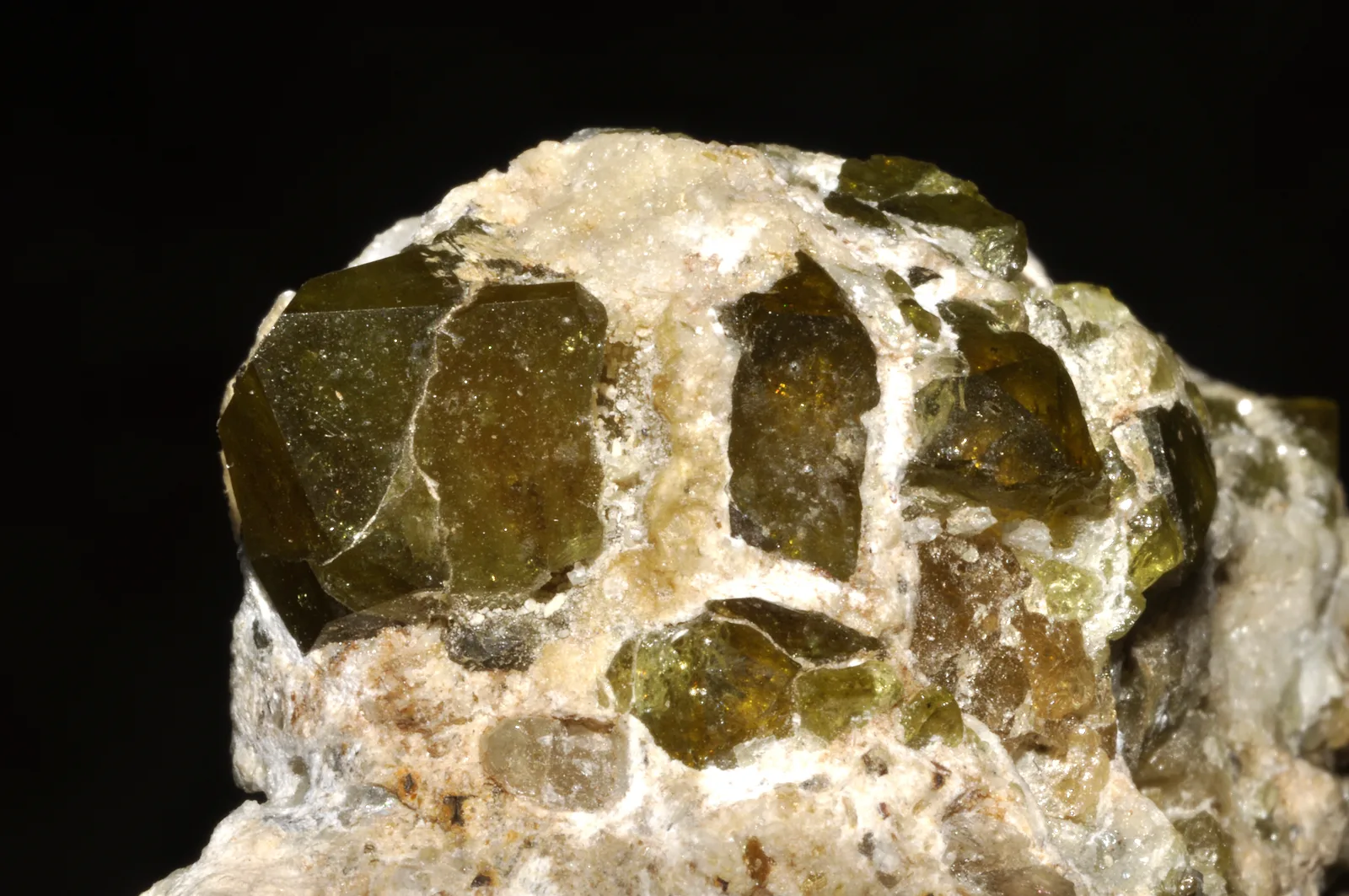
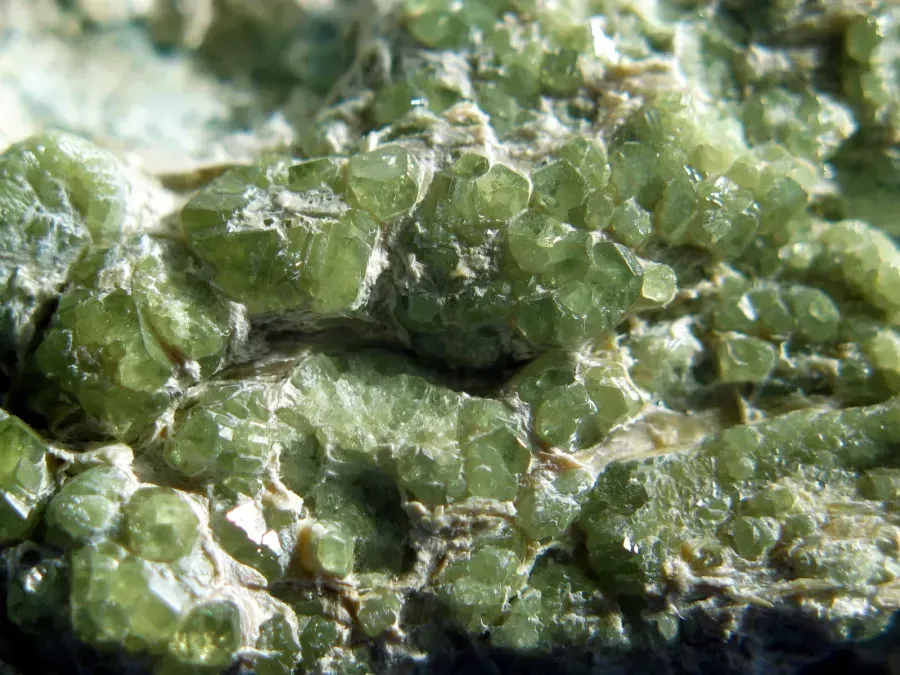
Beyond gem rough, grossular is prized by mineral collectors for its handsome clusters. The famous Mexican specimens are bright green or orange garnet crystals scattered across a pale matrix, small but faceted perfectly by nature itself into rhombic dodecahedra. Comparable collector clusters come from Italy, Canada, the Ural region and Pakistan. Here the stone is valued not for carat weight but for the perfection of the crystal form, the crispness of its faces and the company it keeps with other metamorphic minerals, vesuvianite, diopside and calcite.
Customer reviews
Zevira is a real jewellery shop. Genuine payments, deliveries and customer thank-yous.
🥰🥰🥰 gracias

Ok, ¡gracias! 🙂

History
Antiquity: hessonite in gems and seals
Transparent garnets in warm tones were used in jewellery and seals from deep antiquity. In ancient Rome and the Hellenistic world, hessonite, the honey-brown variety of grossular, was carved into gems and intaglios, miniature engraved stones bearing portraits and scenes. The stone was hard enough to hold the engraving and glowed pleasantly when held to the light.
Warm garnets suited engraving for practical reasons. At a hardness of around 7 the stone takes a fine line without crumbling, while its glassy lustre and slight translucency give a carved portrait depth when the seal is held up to a lamp. Roman workshops also liked hessonite because it sealed cleanly in wax and did not cloud with handling, and a signet was an object worn every day. Museum cases in Britain hold quantities of these small warm-brown engraved stones, and many catalogued simply as garnet turn out on modern analysis to be grossular.
The East: hessonite in the gem tradition
In India and Sri Lanka, hessonite was known by a name that gave it its label in the Sanskrit tradition, and it was valued as one of the gems linked in local astrology to particular celestial forces. That tradition is alive today, but it has nothing to do with mineralogy or with buying a piece of jewellery.
There is a curiosity in the scientific name of hessonite as well: it goes back to a Greek root meaning "lesser", because this garnet was held to be softer and less valuable than its dark red relatives. A whole hierarchy of stones as the ancients saw it sits packed inside a single word, and the ranking has not aged well, since a clean honey-orange hessonite now finds admirers who would pass over a common red garnet without a second look.
Europe: a late parting of the varieties
In Europe grossular was long not separated from other garnets: the eye saw a garnet, and the fine differences in composition stayed beyond reach. Telling the varieties apart only became possible with the rise of mineralogy. The scientific name was given to grossular early in the nineteenth century, in 1808, by the German mineralogist Abraham Gottlob Werner, for the resemblance of the green Siberian crystals to the gooseberry fruit (grossularia in Latin).
The reference crystals used for that first description came from Siberia, from the Vilyuy river country, which says something about how mineral science worked at the time: naming depended on whichever material reached a European cabinet, and a stone could carry the memory of a remote type locality for two centuries afterwards. British collections took an early interest as well, and nineteenth-century catalogues in London list grossular from Piedmont and from the Urals side by side, still under a handful of competing local names.
The twentieth century: the birth of tsavorite
Green grossular, tsavorite, is very young by historical standards: it was only discovered and brought into the jewellery trade in the second half of the twentieth century. A prospecting geologist found green crystals in the scrub country near the Kenya and Tanzania border in the late 1960s, and the stone soon took a trade name from the Tsavo national park beside which the finds lay. So it has no grand history in crowns and regalia; all its fame belongs to modern times. Tsavorite is interesting as proof that the world of gems is not a closed list: beautiful new stones are still being found in our own day, and some of them become desirable very quickly despite carrying no historical baggage whatsoever.
Upload a photo of your pet, someone you love, or an object. We'll build a 3D model and hand-cast it in pewter.




The varieties of grossular
Tsavorite, green grossular
The best-known and most valuable variety. The colour ranges from fresh mint to a deep grassy green, produced by chromium and vanadium. It is named after Tsavo Park on the Kenya-Tanzania border. Transparent stones larger than a few carats are rare, so a good tsavorite is highly prized.
Tsavorite is not the only green garnet. A similar shade, but with a character of its own, comes from demantoid: inside it flares a fiery play thanks to its high dispersion, something tsavorite lacks. These two varieties are often compared when choosing a green garnet.
Hessonite, brown-orange
The most common variety, coloured by iron and manganese. The colour runs from honey-yellow to brown-orange, often with a slight cloudiness and the characteristic oily, swirling inclusions that make hessonite easy to recognise under a loupe. An affordable stone with a warm, amber glow.
Yellow and orange grossular
Clean yellows and rich oranges are valued above cloudy hessonite. A bright orange grossular is a notable rarity and a coveted stone among collectors.
Pink and rare shades
Manganese traces give a pink grossular. There is also a dense green opaque variety (sometimes called garnet jade for its outward resemblance to nephrite), cut as cabochons and used in carving. A fully colourless grossular is a museum-grade rarity.
How to tell grossular from look-alikes and fakes
Grossular gets confused with topaz and citrine (in yellow tones), with emerald (green tsavorite), and with plain glass. A few simple bearings.
- Weight in the hand. Grossular is dense, noticeably heavier than glass of the same size. A light "stone" is a reason to suspect glass or plastic.
- Lustre without a rainbow. Grossular has moderate dispersion. If a stone scatters bright rainbow sparks like a diamond, it is either a diamond, coated glass, or synthetic cubic zirconia, but not grossular.
- Even colour from any angle. A cubic mineral shows no shift of tone when turned (no pleochroism). A clear play of two colours points to a different stone.
- Inclusions. Natural grossular, hessonite especially, shows those characteristic swirling oily streaks and crystal inclusions under a loupe. Perfectly clean glass, by contrast, gives itself away with round gas bubbles.
- Hardness. Grossular (7 to 7.5) scratches glass but is not scratched by it. A test like that should only be done on a hidden spot, and is best left to a specialist.
A note on tsavorite and emerald: emerald is almost always heavily "stitched" with cracks and inclusions and usually oil-treated, while tsavorite is generally cleaner and needs no oil. Synthetic grossular is practically absent from the market, as growing it is costly and unprofitable, so almost all stones are natural. Yellow grossulars are sometimes gently heated to improve colour; an honest seller will disclose any treatment. For an expensive stone it makes sense to ask for a report from an independent gemmological laboratory.
The trap of trade names
There is confusion around grossular's names on the market, and it is convenient cover for a mark-up or a swap.
- "Tsavorite" gets slapped on any green garnet. Andradite (demantoid) can be green, and so can a greenish hessonite. True tsavorite is green grossular coloured by chromium and vanadium. If the colour has a clear yellow or brown cast, it is more likely green hessonite, and paying tsavorite prices for it is unwise.
- "Garnet jade" or "Transvaal jade" is neither nephrite nor jadeite but a dense, opaque green grossular. The name plays on the resemblance, but the stone is different: cheaper than jadeite and cut differently.
- "Emerald" from a dishonest seller sometimes turns out to be tsavorite, and the other way round. These are different minerals at different prices; a laboratory report settles the question.
A safe habit: ask the seller for the specific mineralogical variety (grossular, and which one) rather than just a pretty trade name. An honest seller will name it without hesitation.
Treatment: what is done to grossular and what is not
On the question of treatment, grossular looks an honest stone next to many gems. Tsavorite generally reaches the market as it came out of the ground: the colour is natural, it is not impregnated with oil, and its fractures are not filled with resin. That is an important difference from emerald, where oiling has become close to an industry standard. Yellow and orange grossulars are sometimes given gentle heat to even out or slightly lighten the tone, but even that is less common than with most coloured stones, and it counts as stable: heated colour does not drift back over time. Irradiation, diffusion and the other aggressive methods typical of cheap gems are hardly ever applied to grossular, because the natural stone is good enough as it is and the effort would not pay.
A simple rule follows for the buyer. When grossular is offered to you, it is reasonable to ask about treatment outright, and an honest answer will almost always be either "natural, untreated" or "lightly heated". If the seller starts talking about oiling or fracture filling, that is a signal that what you are looking at is probably not grossular at all but an emerald or another stone dressed up as tsavorite. For an expensive purchase an independent laboratory report puts everything in its place: the laboratory will state both the mineral and any treatment.





How to choose a grossular: what to look at
Grossular has no single quality standard like the diamond 4Cs, but the logic is similar, only the weight given to each criterion differs.
- Colour decides almost everything. In tsavorite, a saturated grassy green with no grey or yellowish undertone is what counts: the cleaner and deeper the green, the dearer the stone. Too dark a stone loses value just as a too pale one does. With orange and yellow grossulars, by contrast, bright clean tones win out, while the slight brown muddiness of hessonite keeps the stone in the affordable bracket.
- Clarity depends on the variety. From tsavorite you expect transparency; visible inclusions knock the price down sharply. Hessonite, though, almost always carries those swirling streaks, and that is the norm, not a flaw: hunting for a perfectly clean hessonite is pointless.
- Cut and lustre. The high refractive index (1.72 to 1.75) gives grossular a good lustre, but only with a competent cut. A stone cut too shallow, or too deep, kills the light in the centre. Turn the piece under a lamp: a well-cut grossular plays an even light across the whole table, with no dark hole in the middle.
- Match the size to the variety. Hessonite and yellow stones turn up large with ease, while a clean tsavorite above two or three carats is already a rarity. If you are offered a large yet cheap green garnet, be wary: either the colour is weak, or it is not tsavorite at all.
A simple rule for the buyer: with tsavorite you cannot economise on colour, better to take a smaller stone with an honest, saturated green. With yellow and orange grossular the priority is the other way round, clarity and transparency first, and size is easier to come by there.
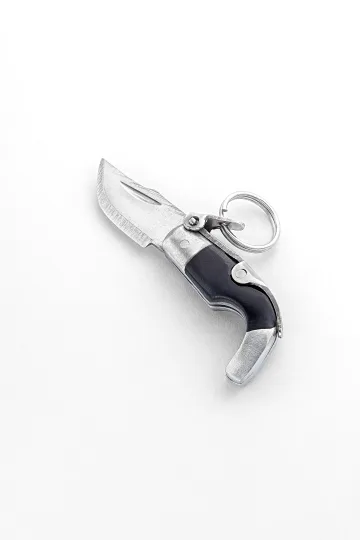
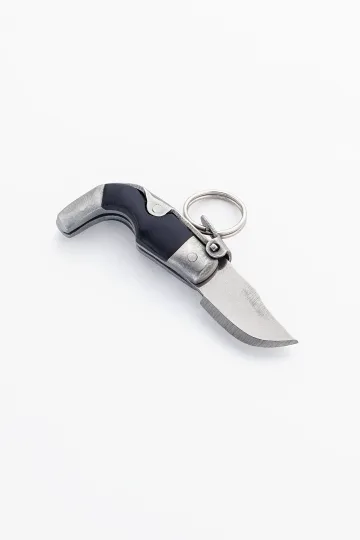
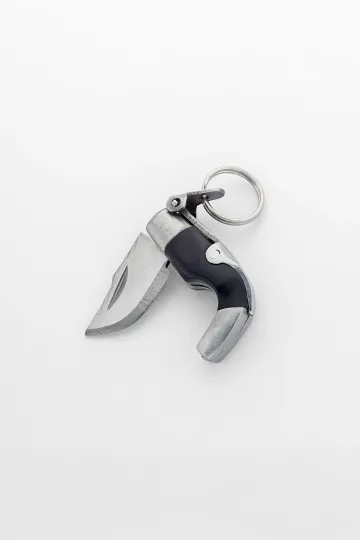
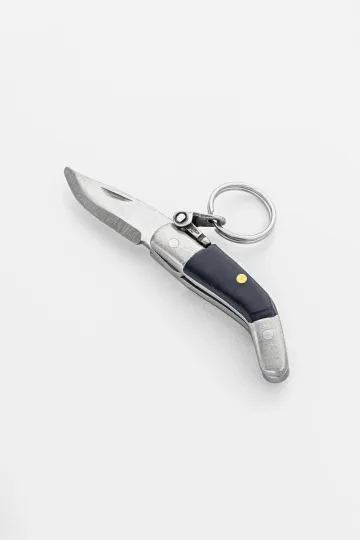
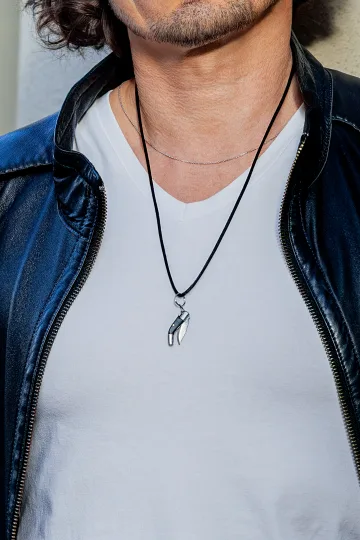
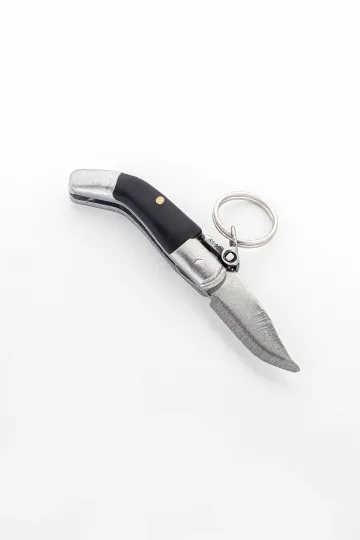
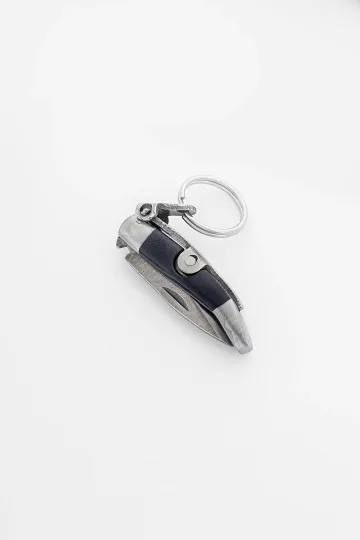
CAPAORA mini knife pendant
The 18th-century Spanish navaja in miniature: 40 mm of stainless steel, a real folding mechanism and a Palanquilla lock that clicks. An affordable gift to remember.
Authentic · Ships from Spain · 14-day returns
Why a large tsavorite costs so disproportionately much
For most gems the price per carat rises with size, but for tsavorite that curve is especially steep. The reason is geology: the stone crystallises in the fractured metamorphic rock of Tsavo, and a large piece most often turns out to be cracked or included. A clean transparent crystal that will yield even a two-carat cut stone is something miners find rarely.
Hence the practical lesson. A one-carat stone and a three-carat stone of the same colour differ in price per carat by multiples, not percentages. That is why jewellery with tsavorite often uses not one large stone but a scattering of small ones: this gives a bright green patch of colour without the rarity and cost of a large solitaire. For earrings and a pendant, a line of small tsavorites often looks livelier than a single stone, and costs more sensibly.
With hessonite and yellow grossular the story is gentler: large clean crystals turn up more often, and the premium for size is not so sharp. If you want a big warm stone for reasonable money, hessonite or yellow grossular will give it more easily than tsavorite.
Leave your email, we'll send your discount code. No spam, unsubscribe anytime.
The code arrives by email, valid on your first order.
Caring for grossular jewellery
A hardness of 7 to 7.5 makes grossular fit for everyday wear, but it calls for common sense. The stone is sturdy, yet not indestructible: a sharp knock on the edge of the cut, or contact with a harder abrasive, will leave a mark.
Where hardness matters most is in rings. A finger is forever catching on things, so a ring with grossular is best taken off during manual work, cleaning and sport. In pendants, earrings and brooches the stone is far better protected, and grossular sits comfortably there for daily wear.
Cleaning is simple: warm water, a drop of mild soap, a soft brush, then rinse and pat dry with a soft cloth. Grossular generally tolerates ultrasonic cleaning, but if there are cracks inside, or it is a hessonite with abundant inclusions, ultrasound can widen them, so hand-washing is the safer bet. Aggressive chemistry (acids, solvents, drain cleaners) harms the stone, as do sharp temperature swings: do not plunge a warm stone into cold water.
Store the piece apart from others, in a soft pouch or a compartment of a jewellery box, so that harder stones (sapphire or diamond, say) cannot scratch the grossular.
A special case: hessonite with inclusions
Hessonite asks for slightly more attention than a clean tsavorite, precisely because of what it is. Those swirling, oily-looking inclusions by which it is recognised are microscopic zones of strain inside the stone. In themselves they barely affect its strength, and in a pendant or a pair of earrings a hessonite lasts a long time. Under a sharp knock or a sudden change of temperature, though, the inclusions become the weak points along which the stone will crack more readily. So hessonite particularly dislikes ultrasonic cleaning and boiling water: a warm hand bath with mild soap is safer for it than any machine. In British homes there is one more thing worth noting, hard water in much of the south and east leaves a chalky film on the pavilion of a stone, so a rinse in filtered or boiled and cooled water gives a cleaner result than the tap.
Why grossular does not fade
Unlike amethyst, citrine or rose quartz, whose colour can be dulled by long exposure to sun, grossular holds its colour firmly. The reason is that the colour comes from metal ions in the crystal lattice rather than from light-sensitive colour centres. The chromium and vanadium green of tsavorite and the honey tone of hessonite are practically untouched by ultraviolet in ordinary wear. Only very long and intense irradiation can slightly mute the odd orange specimen, and running into that in daily life is close to impossible. Grossular can be worn in bright sun without a second thought, which puts it among the easier coloured stones to live with.
Symbolism, briefly and without mysticism
Various traditions have attributed many properties to grossular and to garnets in general: hessonite was linked to astrological forces in Indian culture, and green stones everywhere were given a sense of growth and renewal simply by virtue of colour. This is part of the stone's cultural history, and it deserves to be treated exactly as folklore.
Grossular has no proven physical or healing effect. The stone does not heal, and it does not influence sleep, blood pressure or mood through any "energy". If a warm yellow or a fresh green lifts your spirits, that is a normal reaction to a beautiful colour, not the magic of a mineral. And there is where it should rest.
What the colours mean: green, orange, yellow
Most of grossular's symbolism rests on its colour rather than on the mineral, and the honest thing is to say so. People everywhere read green as growth, spring, renewal and calm: an old and understandable response, since green is the colour of living vegetation. So a green tsavorite is easily read as a stone of beginnings, and many choose it in exactly that mood. Orange and honey grossulars work differently: warm tones carry associations of energy, briskness and autumn light, and hessonite is often worn as a stone of warmth and optimism. Yellow stands between the two, a clear sunlit tone that reads as lightness and clarity. It is worth keeping in mind that these are associations of colour, not properties of a mineral, and a glass stone of the same shade would produce the same emotional response.
Grossular as a stone of new beginnings
Of all the meanings attached to it, the one that has stuck to tsavorite most firmly is the image of a stone of change and of starting out. The logic runs on two tracks. First, fresh green hints at growth on its own. Second, the history of the stone itself is young: tsavorite entered common use within living memory, it carries no weight of centuries, and psychologically that makes it a stone of the new rather than of inheritance. So tsavorite is often given to mark a graduation, a new job, a move or some other turn in life, when the point is to mark a beginning rather than to sum something up. It is pleasant, harmless symbolism, and there is no reason not to enjoy it, as long as nobody mistakes the poetry for physics.
Grossular in jewellery: settings and formats
The colour of the stone suggests the metal. Yellow grossular settles naturally into yellow gold, the tones echoing each other and gathering into one warm range. Orange and green are more striking in white gold, platinum or sterling silver: the cool metal gives contrast and makes the colour brighter.
In format, grossular is versatile. Rings are lovely and comfortable, but because of the 7 to 7.5 hardness they call for care, especially in daily wear. Pendants and earrings are the most trouble-free choice: the stone is protected and barely risks a chip. Transparent stones are cut in classic styles (round, oval, cushion, emerald cut), while hessonite and dense green stones with inclusions are more often cut en cabochon, a smooth domed form that shows the colour softly.
Compared with similar stones
Grossular and ordinary (red) garnet. Both are garnets, kin in structure. The red almandine and pyrope are darker and more familiar; grossular is lighter, clearer and more varied in colour, while green and orange grossulars are markedly rarer and dearer.
Tsavorite and emerald. The colour is similar, but emerald is softer in "character": it is heavily fractured, it is oil-treated, it asks for gentle handling. Tsavorite is tougher in structure, usually cleaner and needs no oil. Emerald is, however, dearer and more familiar to the market.
Tsavorite and demantoid. Both green garnets. Demantoid has high dispersion and a marked fiery play; tsavorite has an even, clean colour with no flashes. The choice between them is a matter of taste: calm colour or inner fire.
Grossular and topaz/citrine. In the yellow range they are easy to confuse. Topaz is a touch harder (8) and good for rings; citrine is cheaper and can fade in the sun. Grossular holds its colour, sparkles brighter thanks to its high refraction, and is rarer.
Among green gems there are softer rivals in shade too, for example hiddenite, a tender green spodumene with a spring tone. Grossular beats it on hardness and lustre.
Send a friend a discount code, they save on their first order.
Who grossular suits
Grossular is a stone for the sort of person who finds the rare and the unobvious more interesting than a famous name on a ticket. It is not part of the standard set of classic gems, nobody wears it out of habit, and that is where its charm lies: the owner almost certainly knows something about their stone that a casual acquaintance does not. The warm yellows and honeys suit anyone flattered by a golden, warm palette and fond of comfortable, unshouty pieces for every day. Green tsavorite goes the other way, settling into a stricter, more collected look where a single saturated stone carries the whole accent.
As for occasions, grossular is flexible. Yellow and orange work as a calm everyday stone and as a warm gift with no pomp about it. Tsavorite, with its symbolism of beginnings, sits well among presents for a new stage of life. And for a mineral collector there is a separate interest in natural clusters and rare clean crystals, where the stone is worth having in its own right, with no setting at all.
Buying it as a gift? Each one arrives ready to give.
 A branded Zevira box and a little card come with every order.








Facts that take people by surprise
Behind its modest reputation grossular hides more that is curious than first appears.
- The gooseberry named the stone. Grossularia in Latin is the gooseberry: the first crystals described were yellow-green, the very image of an unripe berry, and the mineralogist saw no reason to invent anything grander.
- The best tsavorite is mistaken for emerald, and is cleaner than it. Green grossular is often more transparent than an emerald of the same colour, because emerald is nearly always densely stitched with fissures while tsavorite more often grows clean.
- Tsavorite is younger than television. A stone with a geological history of many millions of years only entered the jewellery trade in the second half of the twentieth century; it has neither a crown nor a legend, and all of its recognition is very recent.
- Pure grossular is colourless. Every bright colour we love is the work of tiny impurities: take away the iron, chromium, vanadium and manganese, and what remains is a crystal as clear as water, which the market almost never sees.
- "Garnet jade" is not jade at all. A dense, opaque green variety of grossular resembles jadeite so closely that it is cut into cabochons and sold under that misleading name, though the mineral is a different one entirely.
- Large tsavorite jumps in value rather than climbing steadily. Because the Tsavo rocks are so fractured, a clean crystal of even a couple of carats is a rarity, so the per-carat figure for a large stone runs several times that of a small one rather than a few percent above it.
- Hessonite is known by its oily swirls. Under a loupe a natural hessonite gives itself away with the characteristic swirling pattern of its inclusions, which is hard to confuse with anything else.
- Grossular and the familiar red garnet are relatives. They belong to one mineral family with the same cubic lattice; the red one is simply coloured by iron in the structure while grossular takes its palette from impurities.
About Zevira
In the Zevira collection, grossular is the stone for those who look for rarity without chasing a loud name. We select specimens of good transparency and clean, saturated colour, from warm yellow to deep green, and match each shade to the metal that brings the stone out best.
Grossular is chosen by people who see beauty in the unobvious and value a stone's character above the fashion for it.
Wear the symbol, don't just read about it. These are in stock:

Frequently asked questions about grossular
Are grossular and garnet the same thing? Grossular is a variety of garnet. Garnet is a group of closely related minerals: almandine and pyrope (red), spessartine (orange), andradite, grossular. So grossular is part of the garnet family.
Are tsavorite and grossular different stones? No. Tsavorite is a trade name for green grossular coloured by chromium and vanadium. All tsavorites are grossulars, but not all grossulars are tsavorites.
Which grossular is the most valuable? As a rule, the saturated green tsavorite and a bright clean orange. Hessonite and pale yellow stones are more affordable.
Is grossular suitable for an everyday ring? Technically yes, a hardness of 7 to 7.5 is enough, but on a finger the stone catches surfaces more often and risks a chip or scratch. For daily wear, pendants and earrings are calmer.
Can grossular fade in the sun? It is more stable than amethyst or rose quartz. Over a very long time, strong ultraviolet can slightly dim the orange tones, but in ordinary wear this is not a problem.
Does grossular come synthetic? Almost never on the market. Growing it is costly and unprofitable, so the overwhelming majority of stones are natural.
Is grossular treated in any way? Some yellow stones are gently heated to improve colour. Unlike emerald, grossular is not impregnated with oil or resin. An honest seller discloses any treatment.
Is grossular radioactive or harmful? No. It contains no radioactive elements and is completely safe to wear.
Can grossular be cleaned with ultrasound? Generally yes, but if there are cracks inside, or it is a hessonite with abundant inclusions, ultrasound can widen them. Warm water, mild soap and a brush are safer.
Which countries mine the best grossular? Green tsavorite is from the Kenya-Tanzania border (the Tsavo Park area). Oranges from Madagascar. Yellows from Namibia and Uganda. Hessonite from Sri Lanka and many other places.
Discover grossular in the Zevira collection
A transparent garnet from warm yellow to deep green, a rare stone with clean colour and bright lustre. Choose your shade and the setting that brings it out.
See the jewellery