Pyrope Garnet: The Red Stone, Its Chemistry, History and Care
Pyrope is rarely large. A stone above two or three carats is already a noticeable rarity, and the reason is not fashion but geology: pyrope is born deep down, in conditions where the mineral simply never has time to grow big. So historically it was not turned into a single huge gem but into a scatter of tiny, vivid red grains packed tightly into gold. That is what Bohemian jewellery of the 19th century looked like, and that is how pyrope is still recognised today.
In short: pyrope is the red variety of garnet, a magnesium-aluminium silicate. Its red colour comes not from the base of its makeup but from traces of iron and chromium. A hardness of 7 to 7.5 on the Mohs scale makes it tough enough for an everyday ring, and its abundance in nature keeps it affordable. Below we look at its composition and optics, how it forms and where it is mined, how it differs from ruby and from other garnets, how to wear and clean it, and where in this subject the facts end and the folklore begins.
What pyrope is: the chemistry and physics of the stone
Pyrope belongs to the garnet family, a large group of minerals with a shared structure but differing composition. Pyrope has the formula Mg₃Al₂(SiO₄)₃: magnesium, aluminium, silicon and oxygen. In its pure form that composition would be colourless. Colour arrives with the impurities.
Composition and the source of colour
The red shade in pyrope comes from ions of iron and especially chromium, which replace part of the magnesium and aluminium in the lattice. The more of these impurities there are, the deeper and darker the colour. Pure pyrope barely exists in nature: real stones are a blend of pyrope with almandine (the iron-rich garnet) and sometimes with spessartine. The ratio of that blend decides whether the stone will be a bright scarlet, a dark cherry, or one drifting toward brown.
Wear the symbol, don't just read about it. These are in stock:


The word itself comes from the Greek pyropos, "fire-like". The name is ancient and describes exactly the colour: a dark red that seems to smoulder from within when light hits it.
Structure, hardness, density
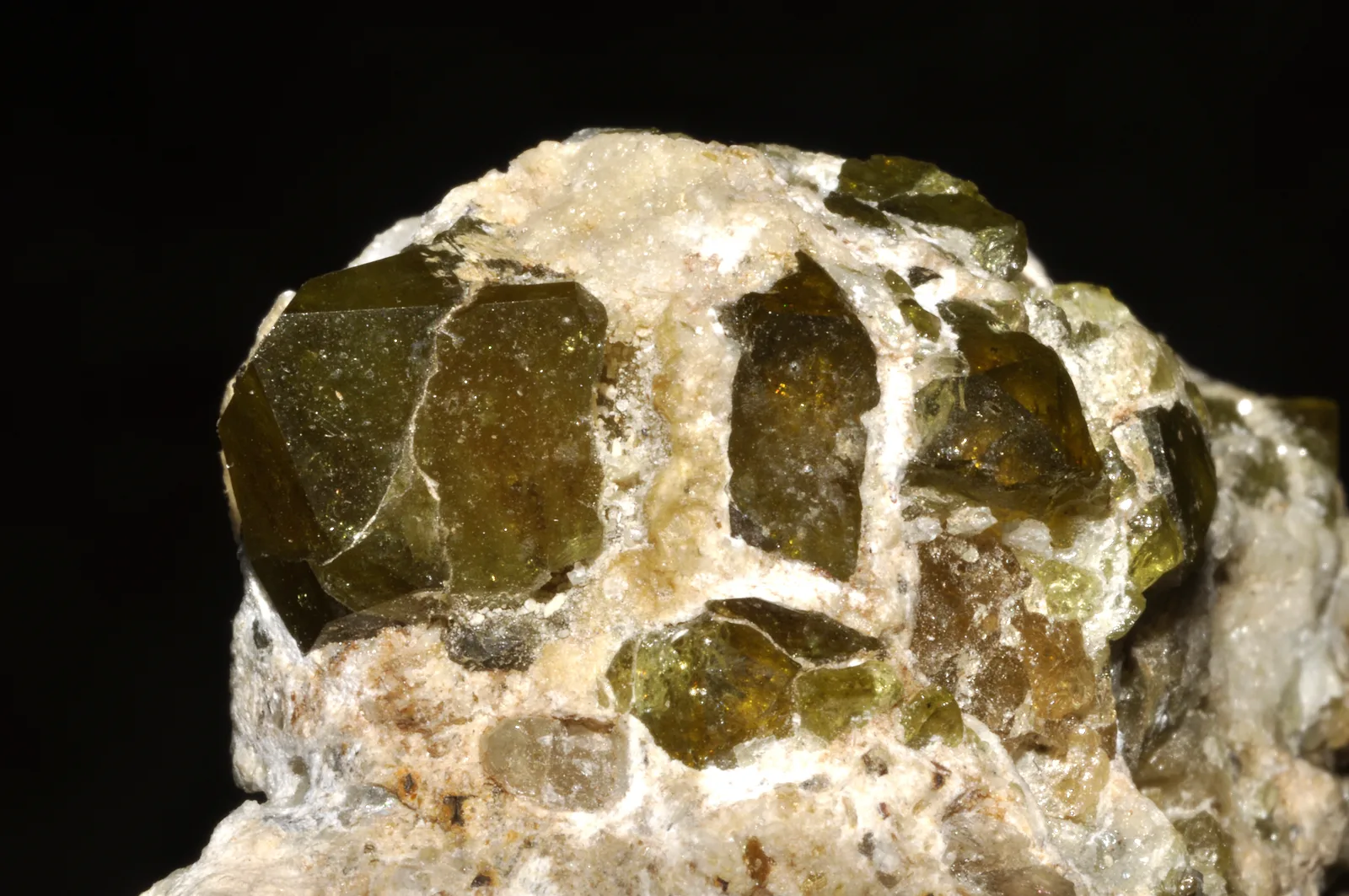
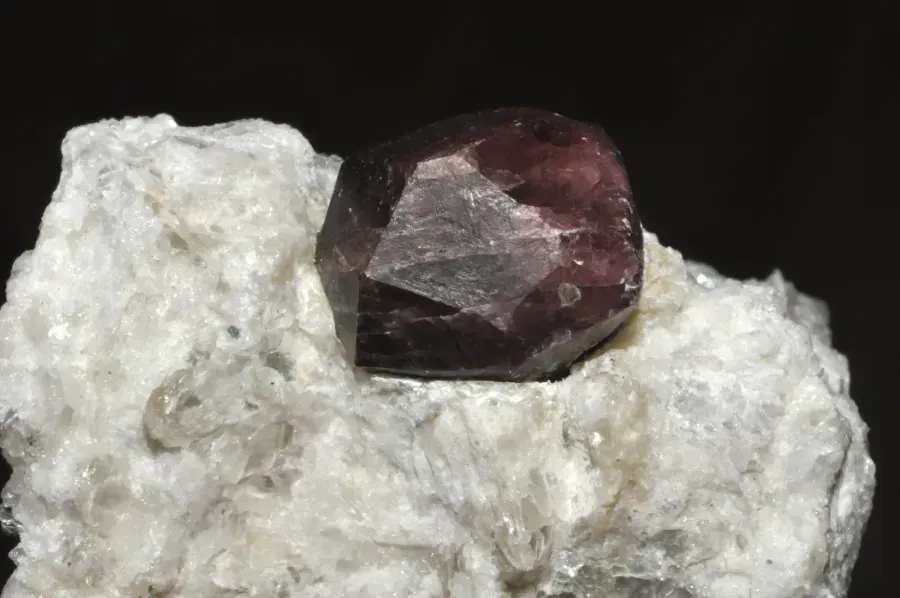
Pyrope crystallises in the cubic system. The characteristic shape of a natural crystal is the rhombic dodecahedron, a solid with twelve rhombus-shaped faces; such grains are found right inside the host rock. The cubic structure means there is no pronounced cleavage: the stone does not split along planes the way topaz does, and so it holds a cut and a knock well.
The hardness of pyrope is 7 to 7.5 on the Mohs scale. For comparison: quartz is 7, a steel needle about 6, and ruby and sapphire are 9. In practice this means pyrope is not scratched by household dust and lives happily in a ring, but a harder stone (sapphire, say) will scratch it if they are stored together.
The density of pyrope is around 3.7 to 3.9 g/cm³, noticeably higher than glass (2.5) and quartz (2.65). The stone feels heavier than its size suggests, and that is one of the quick signs of authenticity.
Pyralspites: where pyrope sits in the garnet family
Mineralogists divide the garnets into two large subgroups according to their chemical base. The first is the pyralspites, and pyrope belongs to it: the divalent metals are magnesium, iron, and manganese, while aluminium takes the trivalent role. That group contains pyrope itself (magnesium), almandine (iron), and spessartine (manganese). The second subgroup is the ugrandites, built on calcium: grossular, andradite, uvarovite. The name pyralspite is simply assembled from the first syllables of the three minerals in the series, PYRope, ALmandine, SPessartine, which is why it is easy to remember once you have seen it spelled out.
The practical point of the division is that within the pyralspites the metals substitute freely for one another and form continuous mixtures. Pure pyrope is consequently rare in nature: what you actually hold is nearly always a solid solution in which magnesium has been partly replaced by iron and sometimes by manganese as well. The proportion of each element governs the colour, the density, the refractive index, and even how the stone responds to a strong magnet, which is why two garnets that look alike can behave quite differently on a gemmologist's bench.
Rhodolite: the pyrope-almandine middle ground
Rhodolite is not a separate mineral but a trade name for stones in the pyrope-almandine series in which the pyrope share runs from roughly a half to two thirds. The name comes from the Greek for rose, and it describes the tone accurately: a clean pinkish crimson or purplish red with no drift towards brown and no blackness in the depths. That purity of tone is exactly what makes it more sought after than ordinary dark garnet.
Rhodolite is usually clearer and lighter than the dark almandines because it contains less iron. It takes a cut well, performs in movement, and works equally in earrings near the face and in a ring. Gemmologists draw no hard compositional boundary: the transition from pyrope through rhodolite to almandine is gradual, and the same parcel of rough can be described differently by two laboratories. For a buyer the visible tone matters far more than a precise figure in a report.
Chrome pyrope and its brightness
Chrome pyrope deserves separate mention, because in it the red is produced chiefly by chromium rather than by iron. These stones give a notably alive, saturated, faintly raspberry red that approaches the purity of a fine ruby. Chromium works in the garnet lattice the way it works in ruby and emerald: it generates intense colour from a very small quantity of impurity.
Collectors value chrome pyrope for exactly that open tone without blackness in it. The stone is associated with deep mantle rocks, and its composition serves geologists as a clue in the search for diamonds, which is covered below. For a jeweller, chrome pyrope is simply the brightest and cleanest of the red garnets, if also one of the least common.
Optics
Pyrope is optically isotropic: because of its cubic structure, light passes through it the same way in every direction. Two things follow. First, pyrope has no double refraction and no pleochroism: the stone does not change shade when you turn it, unlike ruby or tourmaline. Second, under a polarising microscope it stays dark as it rotates, which immediately tells it apart from many red look-alikes.
Its refractive index is high, roughly 1.73 to 1.76, so a cut pyrope returns a good inner glow. Dispersion (the play of different colours, as in a diamond) is moderate in red garnets and is almost invisible against the dark background of the stone's own colour: the eye reads the deep red first, not rainbow flashes. The lustre is vitreous, and in good specimens nearly adamantine in brightness.
How and where pyrope forms
Geology: pressure and depth
Pyrope is a high-pressure mineral. It forms deep, tens of kilometres below the surface, in upper-mantle rocks and in zones where the earth's crust has been strongly compressed and heated. Geologists even use pyrope as an indicator: its presence in a rock tells them the rock has been at great depth.
Because of this, pyrope is closely tied to two rock types. The first is peridotites and eclogites, mantle rocks that rise toward the surface with magma. The second, important in practice, is kimberlites, the very rocks that carry diamonds up. Red pyrope grains in kimberlite serve geologists as a pointer-companion: where pyrope of a certain composition is found, it makes sense to look for diamonds too.
After the rock rises and breaks down, the dense, durable pyrope grains end up in rivers and gather in placer deposits. It was from such placers that gem material was historically collected.
Deposits
The most famous historical deposit is in the Czech lands, the region of the Bohemian Highlands north of Prague. The local pyrope is called Bohemian or Czech garnet. It is rarely large, but it is even in colour, a saturated red and transparent, and it was on this stone that the Bohemian jewellery tradition was built.
Large sources of pyrope also exist in Africa: stones come from deposits in the south of the continent and from the placers of East Africa. African material more often appears as larger grains. Finds are known in the United States too (the states of Arizona and New Mexico, where pyrope is linked to volcanic rocks), and pyrope grains as a diamond companion are noted in kimberlite districts of various countries.
Pure pyrope without an admixture of other garnets is rare in nature. Most red garnets on the market belong to the pyrope-almandine series, meaning a blend, and the stone's behaviour (shade, density, refractive index) shifts smoothly with composition.
Chrome pyrope as a diamond indicator
One of the more interesting turns in the geology of pyrope concerns diamond prospecting. Both diamond and chrome pyrope form at great depth in the mantle under enormous pressure, and both rise to the surface through the same kimberlite pipes. Diamond is extremely scarce in the host rock and is lost in the mass of barren material, whereas the bright red grains of chrome pyrope are conspicuous and far more frequent. Geologists therefore use pyrope as an indicator mineral, a travelling companion that betrays a promising pipe.
The subtlety is that not every pyrope points to diamond. The precise composition matters, specifically the chromium and calcium content of the grain. Geochemists plot these on diagrams where pyropes from diamond-bearing rocks fall into a distinct area known as the G10 field. If a grain of the right composition turns up in a river gravel or a soil sample, the district gets a closer look. By following a trail of such grains upstream against the current, prospectors can walk back to the source. Major diamond deposits in several parts of the world were found this way, and there is a good deal of exact science standing behind an outwardly modest red garnet.
The "ant hill" pyropes of Arizona
The strangest method of collecting pyrope was worked out by ants. On the Colorado Plateau, in Arizona and north-eastern New Mexico, pyrope grains are scattered one by one through weathered volcanic rock. Picking them out of that ground by hand would be hopeless. But the local harvester ants, excavating their nests, bring small stones up to the surface and pile them in a ring around the entrance, and pyrope grains turn up among the debris. Prospectors simply walked the ant hills and sieved what had been thrown out.
Hence the popular names: ant hill garnets, sometimes Arizona rubies. The stones are usually small but of a deep, clean red, and in the nineteenth century they were set readily into inexpensive jewellery. The story sounds like a tall tale and is entirely true: the insects were literally sorting the dense, heavy grains out of the light dust on behalf of the people who came after them.
Customer reviews
Zevira is a real jewellery shop. Genuine payments, deliveries and customer thank-yous.
🥰🥰🥰 gracias

Ok, ¡gracias! 🙂

One garnet, full stop. Red lips, a red bag and a red stone at once make a traffic light, not an outfit. The stone does not share the spotlight, and I will not hear otherwise.
What to wear pyrope with
A red stone scares people off for no reason. Pyrope sits happily with an office and with an evening out alike, as long as you keep a couple of stylist's rules in mind. Let me sort it by occasion.
How do I wear pyrope every day? For daytime I recommend one accent and nothing more: a small ring or stud earrings with Bohemian pyrope over a white shirt, grey knitwear or a denim jacket. The stone brings colour but will not ask you to build the whole outfit around it. Navy, graphite and beige in your clothes lift the red gently, without overload.
Is pyrope right for the office? Yes, as long as you keep it restrained. I suggest a single pyrope in white gold or silver: it reads as a mark of taste, not as jewellery on display. Leave the large cocktail shapes for the evening; for the day a thin setting and one point of red under the top button are plenty.
How do I build an evening look? Here the logic reverses: the stone steps forward. For evening I choose a cocktail ring with a large pyrope or drop earrings against black, dark green or burgundy. An open neckline and pinned-up hair give the stone its place at the collarbones, and warm light reveals it most deeply, the very trick the Bohemian jewellers used by candlelight.
Which metal do I pair pyrope with? Red is friendly with warm yellow gold when you want a vintage note and some cosiness, and with cool white gold or platinum when you want contrast. You can mix metals, but I recommend keeping one as the lead, otherwise the look falls apart.
Who does pyrope suit, and how do I avoid overdoing it? It suits anyone who loves saturated, warm colours: chestnut and dark hair, fair and olive skin all gain beside red. Two rules to close on. Choose a pendant's length by the neckline: a short chain for a high collar, a long one for a deep neckline. And do not pile the red on; bright lips plus a large pyrope plus a red bag argue with each other, so leave the stone the role of the single accent.
For those who love warm, "heartfelt" stones, rhodonite may also be of interest, a pink-and-black stone of quite a different texture but a similar soft palette.

Turn on your camera, pick earrings, a pendant or a ring, and see the piece on yourself in real time.
Switch items in one tap.
Everything runs in your browser: no photo or video is ever uploaded.
The history of pyrope in jewellery
Garnets are among the oldest jewellery stones of all. Red grains were set into ornaments and weapons long before anyone distinguished garnet types by composition: what mattered to the craftsman was the colour, not the chemical formula.
Early eras
In late-antique and early-medieval Europe, red garnet was one of the main decorative stones. From thin plates of garnet, backed with gold foil, a pattern was assembled in the cloisonné technique: the stone was cut into segments and set into gold cells. Brooches, fibulae and hilts were decorated this way. It was not magic, nor a status rarity in our sense, but an affordable, vivid material that looked good in gold.
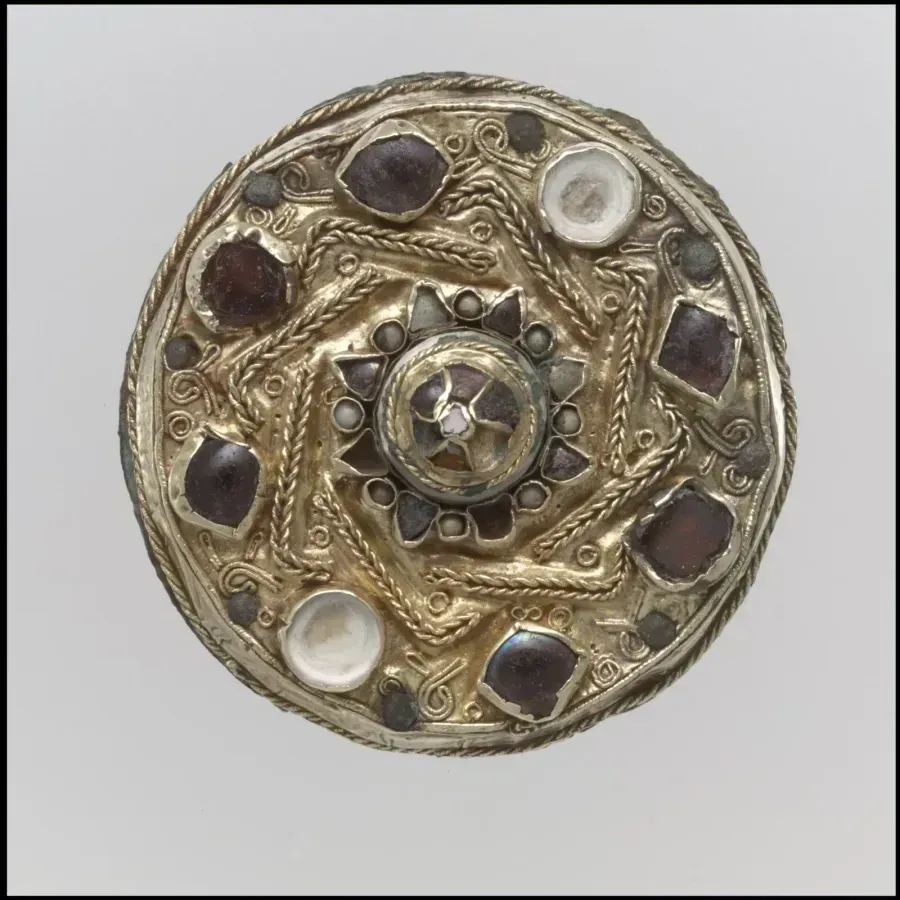
Bohemian garnet
The heyday of pyrope in particular is tied to the Czech lands. From the Renaissance onward, and especially in the 18th and 19th centuries, Czech garnets became a recognisable style. Since the local pyrope is small, craftsmen turned that into a method: dozens of tiny faceted grains were set right up against one another, with no gaps of metal between them, and the whole piece blazed red. Brooches, bracelets, earrings and rings were made this way.
In the 19th century Bohemian garnet was a mass-market ornament: it was worn by nobility and townswomen alike, and pieces like these have survived to our day in great numbers. It is a rare case where popularity did not cheapen the stone's reputation but fixed a distinctive, recognisable look upon it.
The Czech garnet industry of the nineteenth century
By the middle of the nineteenth century, working pyrope had become a genuine industry in Bohemia. Hundreds of cutters, polishers, and setters worked in and around the town of Turnov and in the foothills of the Krkonose mountains, with the raw material coming out of local alluvial deposits. Stones were graded by size, cut as minute rose and round forms, and sent out to workshops in batches. To protect the reputation of the material and to distinguish real pyrope from glass imitation, the region ran its own guild associations and its own rules for marking finished work.
The recognisable style rested on the pave technique: dozens of small grains set tight against one another, tier upon tier, so that almost no metal showed between them and the piece burned as one continuous red. To add life to darker stones, foil was laid behind them in closed-back settings, a practice that explains why so many antique Bohemian pieces must never be put in water. A garnet parure of brooch, earrings, bracelet, and ring became a characteristic dowry and gift, and Czech garnet was known far beyond the region that produced it.
Victorian garnet jewellery in Britain
In Britain, and across nineteenth-century Europe more widely, garnet arrived at exactly the right moment for several reasons at once. Its warm red read beautifully by candlelight and by the gaslight of the period, in a way that cooler stones did not; it was affordable enough for a broad middle-class market; and its deep, unflashy tone matched a fashion for restrained, serious luxury. Garnet went into rings, cluster brooches, pendants, and long drop earrings, and Birmingham and London workshops set imported Bohemian stones in quantity.
Mourning and sentimental jewellery gave it a particular place. After the death of Prince Albert in 1861, court mourning shaped British dress for decades, and dark stones including garnet were worn as a permissible, quiet accent when brighter colour was not. At the same time garnet was given readily as a token of attachment and constancy, the red being read as the warmth of the heart, and it appears frequently in the sentimental jewellery of the period alongside seed pearls and hair work. A great many Victorian garnet pieces still in circulation in Britain are Bohemian pyrope, dispersed across Europe from the Czech workshops, and the closed foiled backs are usually the giveaway.
The 20th century
In the twentieth century garnet stayed firmly in everyday use. It needed no rare deposits and no complex cutting, so it remained an affordable ornament across Europe. The Czech garnet tradition has survived to our day as a regional craft.
As for the loud legends about particular royal necklaces and celebrity rings, they are worth treating with caution. Around any popular stone grows a thicket of pretty but unverifiable stories. One thing is reliable: for thousands of years red garnet was a beloved decorative stone precisely for its colour and accessibility.
Upload a photo of your pet, someone you love, or an object. We'll build a 3D model and hand-cast it in pewter.




Varieties and shades
Within red garnets the shade depends on composition and origin.
Pure pyrope gives a bright, warm red, sometimes with a faint orange undertone. As the share of almandine grows, the colour darkens and drifts into cherry and brown. The intermediate stones of the pyrope-almandine series are the most common on the market.
Worth a separate mention is rhodolite. This is the name for pyrope with a noticeable share of almandine that yields a beautiful pink-raspberry or purple-red shade. Rhodolite is valued precisely for its clean tone that does not slide into brown.
Dark, almost black-red stones are usually richer in iron; bright, glowing ones are purer in pyrope and chromium. Neither of these is objectively better: it is a question of taste and of what the piece is for. Lighter stones look livelier in earrings near the face, while darker ones are more striking in a large ring under warm evening light.






How pyrope differs from similar stones
Pyrope and ruby
They are easy to confuse by colour, but these are different minerals. Ruby is corundum, aluminium oxide (Al₂O₃), hardness 9, and noticeably tougher. Pyrope is softer (7 to 7.5) and far more common in nature, so it costs less. A gemmologist tells them apart fast: ruby is doubly refractive and pleochroic (changes shade when turned), while pyrope is not. Ruby also usually glows under ultraviolet, whereas pyrope barely reacts.
Pyrope and almandine
Almandine is the neighbouring member of the same garnet family, the iron-rich one (Fe₃Al₂(SiO₄)₃). It is darker, often drifts into brownish-red, and is frequently less transparent. The border between pyrope and almandine in nature is blurred: most red garnets are a blend. How the whole family behaves and how its members differ is covered in detail in the piece on garnet in jewellery.
Pyrope and spinel
Red spinel (MgAl₂O₄) is also similar in colour and also isotropic, like pyrope. Spinel is harder (8) and rarer. They are reliably separated by density, refractive index and behaviour under ultraviolet, which is work for a laboratory and not for the eye.
Pyrope and green garnets
Not all garnets are red. Demantoid and grossular are the green members of the same family, and confusing them with pyrope by colour is impossible. How wide the garnet palette is can be seen in the article on grossular garnet.
How to tell it from glass and fakes
The most frequent substitutes are dyed glass and a cheaper red garnet passed off as quality pyrope. A few home pointers:
- Weight. Pyrope is dense (3.7 to 3.9 g/cm³) and noticeably heavier than glass of the same size.
- The edge against the light. In dyed glass the colour often pales toward the edges and you can see a seam or bubbles. Pyrope is coloured throughout and holds its colour evenly.
- Hardness. Glass (about 5.5) scratches easily, pyrope does not. But there is no need to scratch the piece itself: this is a test for reassurance, not for a beautiful stone.
- Behaviour when turned. Pyrope does not change shade when tilted (no pleochroism). If a red stone visibly plays two shades, it is not pyrope.
- Inclusions. In natural garnet, small crystals and needles are often visible under a loupe. A perfectly clean red with not a single speck is, rather, suspicious.
The final answer comes from a gemmological laboratory: it will measure density and refractive index and name the mineral exactly.
Is pyrope treated
The short answer: practically never, and that is one of its strengths. Pyrope belongs to a small group of gemstones that are almost always sold untreated on the market. It has no heating equivalent, as with sapphire and ruby, no glass filling of fractures, as with cheap rubies, no irradiation and no oil impregnation, as with emerald. The reason is simple: pyrope's colour is set by the crystal's chemistry (iron and chromium in the lattice), not by defects it would make sense to "patch up". Heating it to improve the tone is pointless, unlike with amethyst or citrine.
What is in fact done with pyrope:
- Cutting and polishing are not enhancement but ordinary processing. This also includes the right choice of stone depth for its saturation.
- Foiling. An old technique, especially in antique Bohemian jewellery: shiny or coloured foil was placed under a stone in a closed setting to add shine and light up the red. This is a historical setting technique, not a treatment of the stone itself, but it is worth knowing about: such a stone must not be wetted and must not be removed from its seat without losing the effect.
- Imitations and composites. Doublets (a thin plate of garnet glued to glass or another material) and dyed glass are sometimes sold as pyrope. That is no longer enhanced pyrope but a fake, and the discussion of it is in the section on telling it from glass above.
The practical takeaway for a buyer: if a seller talks about "enhanced" or "improved" pyrope, that is grounds to ask questions. Natural red garnet needs no improvement, and an honest seller will say so.
Leave your email, we'll send your discount code. No spam, unsubscribe anytime.
The code arrives by email, valid on your first order.
How to choose and judge a pyrope
Pyrope has no strict grading grid like the "four Cs" of a diamond, but several factors really do affect how good a stone is and what it costs.
Colour and "closing up". The main parameter. The best pyropes are a clean, warm red with a faint fire inside. The trouble with saturated garnets is that as iron and the stone's thickness increase, the red thickens to almost black, and dark opaque zones appear in the depth (gemmologists call this extinction). Look at the stone against the light and under diffuse light: if the centre "goes out" into blackness, the piece will read as a dark patch in the light. The ideal is the balance where the colour is deep but the stone stays alive and transparent right through.
Cutting for colour. This is not cosmetics but a tool for managing tone. A dark, dense pyrope is cut shallower (less depth) to let more light through and lighten the stone; a light one, conversely, is cut deeper to gather saturation. So a beautiful pyrope is almost always cut with an allowance for its own colour, not by a universal template. Very dark stones sensibly go into a cabochon.
Clarity. Natural inclusions in garnets are the norm, and under a loupe they are almost always there: small crystals, needles of rutile, "silk". For an everyday piece what matters more is whether inclusions are visible to the naked eye and whether fractures reach the surface (through which the stone is more vulnerable to a knock). Crystal clarity without a single speck is more a reason to suspect glass than a sign of a choice pyrope.
Size and rarity. Here pyrope turns the usual logic on its head. Since large clean crystals are rare, the price per carat in pyrope rises with size more sharply than one might expect: small grains are cheap and go by the scatter, while a clean, transparent stone of several carats is already a notable find. If you want a single large, expressive stone, that is a different budget from a handful of small ones.
For which piece. For a ring worn every day, a hardness of 7 to 7.5 is enough, but it is worth choosing a stone without surface fractures and preferring a protected setting (with a rim, or recessed) for an active lifestyle. For earrings and a pendant, which take fewer knocks, you can be bolder and take a bright stone with an open cut near the face.
CAPAORA mini knife pendant
The 18th-century Spanish navaja in miniature: 40 mm of stainless steel, a real folding mechanism and a Palanquilla lock that clicks. An affordable gift to remember.
Authentic · Ships from Spain · 14-day returns
Care and wear
A hardness of 7 to 7.5 puts pyrope among the stones that are calmly worn every day. It does not fear household dust and is not scratched by a chance contact with clothing or a table. At the same time it is not sapphire: a harder stone will scratch it, and a strong point impact on a facet edge can chip a face. So simple rules apply.
Cleaning. Warm water, a drop of mild soap, a soft brush, then rinse and dry with a soft cloth. That is enough for any everyday dirt. Aggressive chemicals (chlorine, bleach, glass cleaners) are best avoided, as they harm not so much the stone as the metal of the setting and its plating.
Ultrasonic and steam. With a clean pyrope, ultrasonic cleaning usually goes fine, but if the stone has visible inclusions or small fractures, it is better to abstain: sharp vibrations can open them. For a stone with inclusions, hand washing is safer.
Storage. Keep pyrope apart from harder stones, so they do not scratch it, and apart from softer ones (pearl, opal), which it can scratch itself. A soft pouch or a separate compartment of a jewellery box is best.
Regular checks. If you wear a ring constantly, every few years it makes sense to show it to a jeweller: to check whether the prongs of the setting have worn. The stone itself is practically eternal: stones are usually lost because of a loosened setting, not because of any fragility in pyrope.
Symbolism: what is attributed to pyrope
Red garnet has historically been credited with many meanings, and nearly all of them circle around the colour. In various traditions it was tied to blood, life-force, passion and courage, simply because it is red, like much of what people consider important and hot. In medieval Europe red stones were readily worn as a symbol of loyalty and of protection on the road.
There is a clear boundary to this. This is cultural symbolism, not a property of the mineral. There is no proven effect of the stone on health, sleep, blood pressure, mood or relationships. If a piece pleases you and lifts your spirits, that is the normal effect of a beautiful thing, not the "energy of the stone". Pyrope is worth choosing for its colour, its strength and its history, not for promises of miracles.
Send a friend a discount code, they save on their first order.
Facts that surprise
Pyrope has accumulated a set of oddities that few of the more famous stones can match.
The name means "fire-like"
Pyrope comes from the Greek pyropos, meaning fiery-eyed or fire-like, from pyr, fire, and ops, eye. Ancient writers used the word for a burning coal, and it was transferred to the stone because a good pyrope held to the light looks exactly like an ember with a flame still inside it. It is one of the very few gem names that describes an optical experience rather than a place, a person, or a colour.
Garnet was named after a seed
The family name has a different origin altogether. Garnet derives from the Latin granatum, the pomegranate, because the small rounded red grains of garnet in their host rock look precisely like the seeds inside the fruit. Once you have seen a pomegranate cut open next to a parcel of rough garnet, the naming stops seeming poetic and starts seeming merely observant.
Pyrope helps prospectors find diamonds
Because chrome pyrope forms at the same mantle depths as diamond and rises through the same kimberlite pipes, its bright red grains serve as an indicator mineral. Prospectors sample river gravels, check the chromium and calcium content of any pyrope they find, and if the composition falls in the right range they follow the trail upstream. Several major diamond fields were located by exactly this method.
The stones were mined with the help of ants
On the Colorado Plateau, harvester ants excavating their nests carry small stones to the surface and heap them around the entrance, pyrope grains included. Prospectors worked the ant hills rather than the ground, sieving what the insects had already sorted for them. The resulting stones are still sold under the names ant hill garnet and Arizona ruby.
Pyrope is almost never improved
Most coloured stones on the market have been heated, oiled, irradiated, or filled. Pyrope is one of the few that is routinely sold exactly as it came out of the ground, because none of the standard treatments does anything useful to it. This is worth knowing when comparing it with a treated ruby or sapphire, since the comparison is not like for like.
Perfect clarity under a loupe can betray a fake
With most gems, the cleaner the better. With pyrope the rule inverts at the extremes: natural garnet almost always carries some internal evidence of its growth, needles, small crystals, or faint zoning, whereas glass is optically empty apart from round gas bubbles and swirl marks. A stone of any size that shows absolutely nothing under a ten-times lens deserves a second look rather than a compliment.
Garnet responds faintly to a strong magnet
Because of the iron and magnesium in its structure, garnet is weakly magnetic, enough that a strong neodymium magnet on a thread will visibly drag a loose stone across a smooth surface. Glass, spinel, and most synthetics do not respond at all. It is one of the cheapest and most quietly useful tests available to anyone buying loose stones, and it does no damage whatsoever.
One of Europe's oldest jewellery stones
Garnet was being set into gold across Europe well before most of the familiar gemstones arrived. Migration-period and Anglo-Saxon goldsmiths worked it in the cloisonne technique, cutting thin garnet plates to fit gold cells with patterned foil beneath, and the finest surviving examples of that craft anywhere in the world came out of the ground at Sutton Hoo in Suffolk and in the Staffordshire Hoard. Those garnets travelled to England from sources as far away as India and the Czech lands, which makes them evidence of a long-distance trade in red stones running well over a thousand years before the Victorian fashion revived it.
FAQ: common questions about pyrope
Are pyrope and ruby the same thing? No. Ruby is corundum (aluminium oxide), hardness 9. Pyrope is garnet (a magnesium-aluminium silicate), hardness 7 to 7.5. They look similar in colour, but they are different minerals: ruby is harder, rarer and dearer, and is also doubly refractive and usually glows under ultraviolet, while pyrope does not.
Is pyrope a garnet or a separate stone? Pyrope is one of the varieties of garnet, the magnesium one. The same family includes almandine (iron-rich), spessartine (manganese-rich), grossular and demantoid (green). In nature pyrope almost always comes blended with almandine.
Can pyrope be worn every day? Yes. A hardness of 7 to 7.5 allows it. It is sensible to remove a ring during rough work, contact with abrasives and strong impacts, but in ordinary life pyrope is practical and reliable.
Can pyrope fade? Natural pyrope is coloured by impurities within its very structure and does not fade over time. If a red stone pales in the sun, that is grounds to suspect dyed glass or artificially tinted material.
How can I tell pyrope from glass at home? By weight (pyrope is noticeably heavier), by the evenness of colour against the light (glass often has pale edges, bubbles, a seam), by hardness, and by inclusions under a loupe. Full certainty comes only from a gemmological laboratory.
Which cut suits pyrope? A dark, saturated stone suits cuts that reveal colour and shine: round, oval, cushion, pear. Very dark stones are sometimes made as a cabochon. The deeper the colour, the less point in dozens of small facets; those work on lighter stones.
Does pyrope glow under ultraviolet? Usually not, or very weakly. This is a handy sign: a red stone glowing brightly under ultraviolet is more likely a ruby or a synthetic than a pyrope.
Is pyrope magnetic? Because of their high iron and manganese content, garnets, including pyrope, can react weakly to a strong neodymium magnet. This is even used for the preliminary sorting of garnets. To ordinary magnets the stone does not react.
Why is pyrope rarely large? It forms deep, under high pressure, and large clean crystals simply never have time to grow there. Stones above a few carats are uncommon, which is why historically pyrope was made into scatters of small grains.
Can pyrope be green or blue? No. Pyrope means red and pink-red shades. Green garnets (demantoid, grossular) are other varieties of the same family, with a different composition.
What is rhodolite? It is a trade name for pyrope with a noticeable share of almandine that yields a beautiful pink-raspberry or purple shade. Not a separate mineral, but a compositional variant within the garnet series.
Buying it as a gift? Each one arrives ready to give.
 A branded Zevira box and a little card come with every order.













About Zevira
Zevira works with jewellery made from natural stones, and red garnet is one of the most rewarding among them: a saturated colour, honest strength and a calm price for a genuine mineral. The collection has rings, earrings and pendants in which pyrope reveals itself in different ways, from small Bohemian scatters to a single expressive stone.
Every piece with pyrope at Zevira is:
- assembled from genuine natural garnet, with no passing off of glass or synthetic for the stone;
- set in sterling silver, gold or platinum to your choice;
- can be finished with engraving: a name, a date, a short inscription;
- available to your size and your preference of shade.
Pyrope is the case where a beautiful piece need not be expensive, and its strength lets you wear it for years.
Choose a piece with pyrope
Open the Zevira collection of natural garnets. Rings, earrings and pendants in sterling silver, gold and platinum, with engraving on request.
Open the cataloguePyrope is valued for its honesty: a genuine red mineral that formed in the depths of the earth over millions of years, with clear chemistry and verifiable properties. No promises of miracles, but with colour, strength and a long history behind it. If that is the approach to stones you favour, pyrope is a good choice.