Rhodonite: The Pink-and-Black Stone They Called "Russian" for Three Centuries
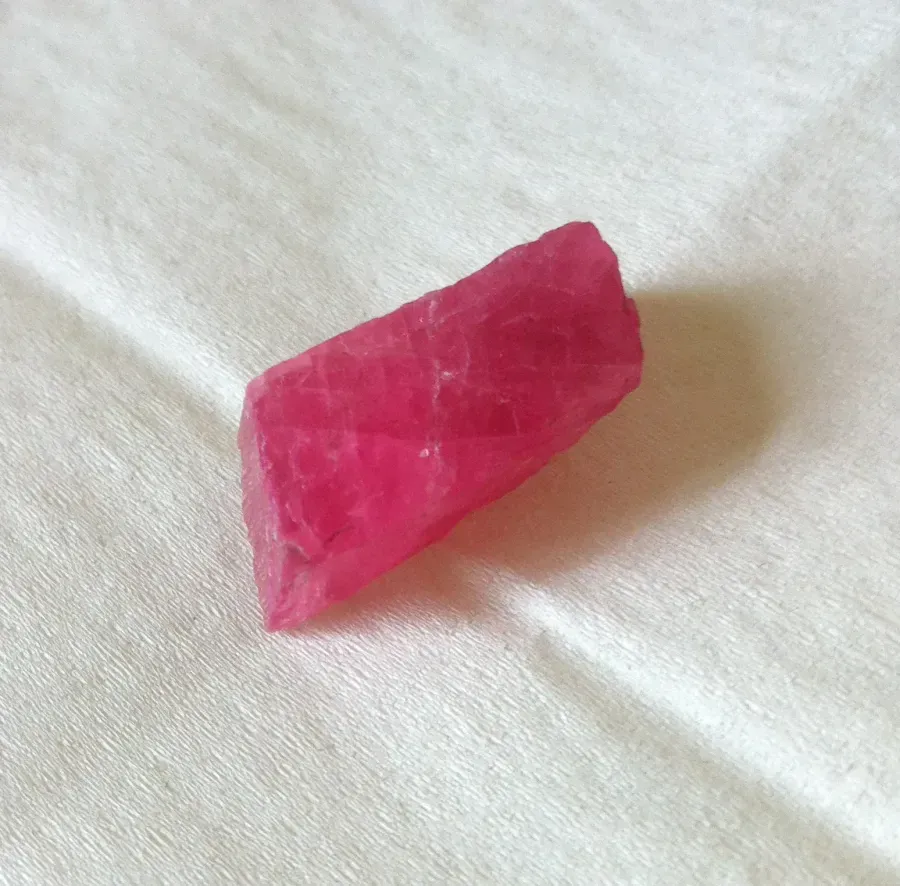
A pink mineral streaked with black veins of manganese turned up in the Ural Mountains from the 1780s onward. By the middle of the nineteenth century it was lining palace halls, and two-tonne vases carved from single blocks were being given to European monarchs. Today the same stone is cut into cabochons and strung into bracelets. The pink comes from manganese; the black veins come from its oxide. One mineral, two different stories inside a single piece.
Rhodonite is easy to recognise and almost impossible to mistake. A warm pink ground over which someone seems to have run a piece of charcoal: thin black threads, blots, a spider's web. That contrast made it recognisable long before anyone invented a "meaning" for the stone. People cut it, polished it, set it into signet rings and columns, and only afterwards began to attribute compassion and forgiveness to it.
Here is the plan, in order: the chemistry and physics of the stone, how it forms, where it comes from, how pink rhodonite differs from look-alike minerals, how it is worn, and how to avoid buying dyed marble dressed up as rare Ural material.
What rhodonite is and why nothing else looks like it
Rhodonite is a manganese silicate, a mineral from the pyroxenoid group. The ideal chemical formula is MnSiO₃, but pure rhodonite barely exists in nature: manganese is partly replaced by iron, calcium and magnesium, so the composition is more often written as (Mn, Fe, Mg, Ca)SiO₃. It is manganese that gives the signature pink colour, from soft coral to deep raspberry-red.
The mineral got its name in the early nineteenth century from the Greek word "rhodon", rose. So "rhodonite" literally means "rose stone". The logic is transparent: you see the colour, you name it after the colour. The same root lives on in the word "rhododendron".
The black veins, without which rhodonite is unimaginable, are neither dirt nor a flaw. They are oxides and hydroxides of manganese, usually close to pyrolusite and psilomelane. When pink rhodonite and black manganese oxide grow together in one rock, you get that "marbled" pattern that jewellers and lapidaries prize. The bolder and more graphic the veins, the more striking the material looks in a large piece.
Wear the symbol, don't just read about it. These are in stock:



On hardness rhodonite sits at 5.5 to 6.5 on the Mohs scale. That means it is harder than glass but softer than quartz. You will not scratch it with a penknife, but sand and dust (which always contain fine quartz) will gradually matte the polished surface over time. Hence the first practical rule: rhodonite likes to be kept away from anything abrasive.
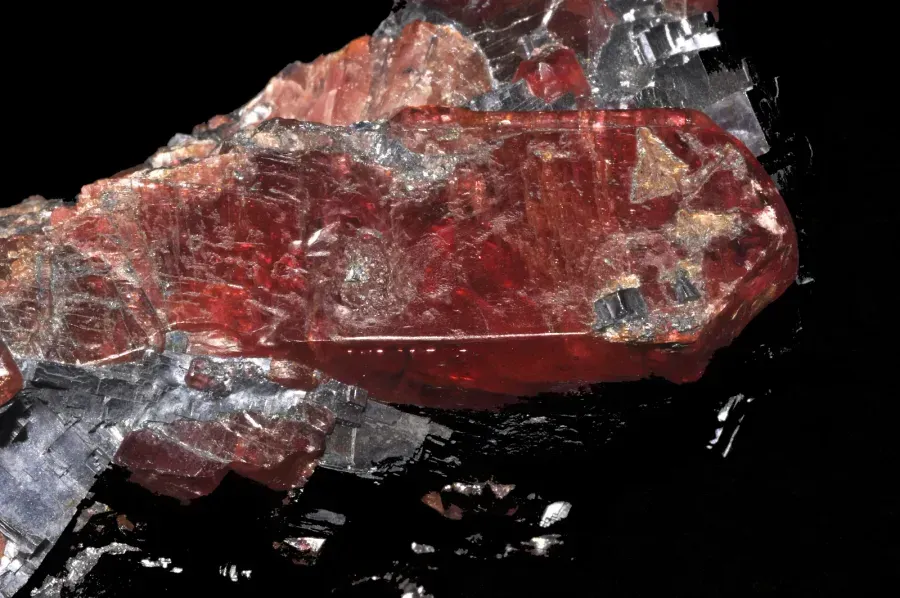
The stone's density is about 3.5 to 3.7 g/cm³; it is noticeably heavier than it looks. The lustre is vitreous, pearly on a fresh break. Transparent rhodonite crystals do exist, they are rare and go to collectors, but in jewellery the working material is almost always the opaque ornamental kind: dense, pink, with black graphics.
Do not confuse rhodonite with rhodochrosite. The names are similar, both are pink, both involve manganese, but they are different minerals. Rhodochrosite is a manganese carbonate (MnCO₃); it is softer, more often gives a banded, layered pattern, and lacks rhodonite's signature black dendrites. We will come back to this distinction in more detail below, because even sellers stumble over it.
The physics and mineralogy of rhodonite
Composition and crystal lattice
Rhodonite belongs to the pyroxenoid group, silicates with a chain structure, close to pyroxenes but with differently kinked silicon-oxygen chains. The ideal formula is MnSiO₃, a manganese silicate. In practice manganese is almost always partly replaced by iron, calcium and magnesium.
This very substitution explains why rhodonite from different deposits varies in shade. More iron means a cooler, darker tone. More pure manganese means a brighter, warmer pink. Rhodonite crystallises in the triclinic system, the least symmetrical of them all. Well-formed individual crystals are rare; what you find more often are dense granular masses, the ornamental material itself.
Where the pink comes from
The colour of minerals is a story about electrons and light. In rhodonite the pink-red is down to divalent manganese, Mn²⁺, sitting in the silicate structure. Manganese ions absorb part of the visible spectrum and reflect back the pink and red components. The more manganese, and the freer it is of iron impurities, the more saturated and warmer the colour.
This is the same chemistry that tints many manganese minerals: rhodochrosite, spessartine, morganite. Pleochroism in rhodonite is weak: the shade barely changes from one angle to another, unlike alexandrite or, say, tourmaline.
Where the black veins come from
The black pattern is neither organic nor dirt; it is oxides and hydroxides of manganese. They form later than the main stone, when part of the manganese oxidises and settles along microcracks. So the pale ground and the dark veins are two different "ages" of the same element.
These cracks appeared chaotically over millions of years and are repeated nowhere in nature. That is why the pattern of every piece of rhodonite is unique: this is not a marketing phrase but a geological fact, one you can easily confirm by comparing any two cabochons.
Properties that matter in practice
- Hardness 5.5 to 6.5 on Mohs. Harder than glass and feldspar, softer than quartz. Wary of sand and dust.
- Density 3.5 to 3.7 g/cm³. The stone is heavier than it looks: this helps tell it apart from plastic and glass.
- Perfect cleavage in two directions. So under a knock rhodonite may split along a flat plane rather than chip off in crumbs.
- Vitreous lustre, pearly on a fresh break. The polished surface glows softly.
- Fracture uneven to conchoidal. In dense masses the fracture is granular.
- Reaction to acid. Rhodonite itself barely reacts to weak acid, unlike rhodochrosite (a carbonate), which "fizzes". This is one way to tell them apart.
Customer reviews
Zevira is a real jewellery shop. Genuine payments, deliveries and customer thank-yous.
🥰🥰🥰 gracias
Ok, ¡gracias! 🙂
One rhodonite over grey cashmere, yes. A fistful of pink beads over lurex is a market stall, not a neckline, and don't argue.
How to wear rhodonite
I have styled rhodonite through dozens of shoots, and here is what actually holds up. The pink-and-black stone is loud on its own, so I choose the setting and its neighbours to let it lead rather than get lost.
What does warm pink rhodonite go with? I suggest a neutral ground: beige, cream, grey, white. Against it the warm pink reads as an accent. With black clothing I recommend playing the contrast, the stone's own black veins echo the fabric while the pink lifts a strict silhouette.
Silver or gold for rhodonite? In a cool palette (grey, blue, white, black) I choose silver: the cool metal keeps the discipline and sharpens the black graphics. In a warm palette (beige, brown, mustard, emerald) I recommend gold, it heightens the warmth of the pink.
What for daytime, what for evening? For day I suggest understated pieces: a small cabochon pendant, a thin bead bracelet, stud earrings. For evening I choose larger forms, a big cabochon in a ring, drop earrings, an expressive slice pendant with a natural pattern.
How much rhodonite in one look? One or two pieces are enough. A pendant plus earrings in one palette look pulled together. A pendant, earrings, two bracelets and a ring at once I would leave off, the stone is already vocal.
Which stones do I pair it with? Rose quartz makes a soft warm duet. Black stones (onyx, shungite, black agate) pick up the veins and make the look more graphic. Amethyst gives a lovely warm-and-cool pair, while transparent moonstone and rock crystal dilute the dense pink and add lightness.

Turn on your camera, pick earrings, a pendant or a ring, and see the piece on yourself in real time.
Switch items in one tap.
Everything runs in your browser: no photo or video is ever uploaded.
Geology: how and where rhodonite forms
How the stone is born
Rhodonite is born where manganese-rich sediments come under pressure and heat. It is a metamorphic mineral: primary manganese deposits on the seabed recrystallise over time deep underground, and manganese is built into the silicate lattice. Rhodonite often keeps company with other manganese minerals: rhodochrosite, spessartine, tephroite, bustamite.
The black veins appear at late stages, when part of the manganese oxidises and settles into the cracks as oxides. So the graphic black pattern is, in effect, the "second life" of the same element that gave the stone its pink.
The world's main deposits
The Middle Urals, Russia. The historical home of prestige rhodonite. The Sedelnikovo deposit near Yekaterinburg supplied the material for imperial pieces. This Ural stone is prized for its saturated pink tone and its large monolithic blocks. The classic reserves are heavily worked out, so old quality material is now largely a museum and collector category.
Broken Hill, Australia. Here they mine transparent and semi-transparent crystals of a deep red-pink. This is the rare gem-quality variety: clean faceted Australian rhodonites go to collectors.
Massachusetts, USA. Rhodonite was officially recognised as the state mineral back in the 1970s. The local material is dense, with pronounced veins, and works well in cabochons and carvings.
Peru and South America. These yield a bright pink rhodonite, often with a striking contrasting pattern, popular with bead and cabochon makers.
Other sources. Germany (where the mineral was first described and named in 1819 from Harz Mountain samples), Sweden, Mexico, Brazil, South Africa, Japan, Canada, Madagascar. Each deposit shifts the shade a little: from cool pink to warm raspberry, from a fine spider's web of veins to large black fields.
Associated minerals
Rhodonite rarely lies in the ground alone. A whole "manganese company" is usually found beside it, and it is by this company that geologists recognise the right rock.
- Rhodochrosite, a manganese carbonate, pink, soft.
- Spessartine, a manganese garnet, orange-red.
- Tephroite, a manganese olivine, brownish.
- Bustamite, a near pyroxenoid, paler than rhodonite.
- Manganese oxides, the very ones that give the black veins.
Upload a photo of your pet, someone you love, or an object. We'll build a 3D model and hand-cast it in pewter.



History: three centuries of the Ural stone
The Ural discovery
In the Urals rhodonite was found near a village close to Yekaterinburg back at the end of the eighteenth century, around the 1780s. Locals noticed that the pink stones often turned up near eagles' nests, as if the birds were deliberately carrying fragments into their clutches. From this came a folk name tying the stone to the eagle. There was a belief that a piece placed in a cradle gave a child strength and courage. That is a belief, not a fact, but it fixed the name for two centuries.
The Ural stone proved unique in quality. Blocks reached enormous sizes, the colour was saturated, the pattern of black veins expressive. Europe knew nothing comparable in volume of quality material at the time. So the pink stone from the Urals turned into a prestigious state resource.
The stone of palaces and the imperial court
In the nineteenth century rhodonite became a material for great lapidary art. At the Yekaterinburg cutting works they made vases, bowls, tabletops, floor lamps and cladding panels from it. Pieces dispersed among palaces and travelled as diplomatic gifts.
The most famous example is the huge sarcophagus for an empress in a cathedral in Saint Petersburg. It was carved from a single block of Ural rhodonite weighing several tonnes, and the work took many years in the second half of the nineteenth century. To this day it is one of the largest objects in the world made from solid rhodonite.
The stone clad the interiors of several palace halls, and some of these works later entered major museum collections. For nineteenth-century audiences the pink stone with black veins became as recognisable a national material as malachite or jasper. When people today write "Russian stone", they often mean precisely this rhodonite.
Why rhodonite in particular
The choice of stone for a large object is always a compromise between beauty and workability. This stone offered a rare combination: a saturated colour, an expressive pattern, and fairly large monoliths free of cracks. Malachite was brighter but came in thin crusts and demanded mosaic technique. Jasper was harder and quieter in colour. Rhodonite filled its own niche: a warm pink monolith for large forms. At the same time it was more capricious than granite, splitting easily along its cleavage, and a single error could ruin months of labour.
How rhodonite became the "stone of compassion"
Emotional properties began to be attributed to rhodonite late, mainly in the twentieth century, on the wave of interest in crystal healing. The logic was simple and visual: pink is the colour of warmth and tenderness; black veins are shadow and hard experience. A stone where pink and black live together is easy to read as a symbol of acceptance.
So rhodonite acquired a reputation as a stone of forgiveness and emotional balance. This is a cultural meaning, not a proven action. More on the symbolism in a separate section below, without exaggeration.



Types and shades: from spider's web to solid raspberry
Ornamental rhodonite with black veins
The commonest and most recognisable variety. A pink ground crossed by black threads and blots of manganese oxide. This is the "marbled" rhodonite from which cabochons, beads, boxes, obelisks and figurines are made. The pattern of each piece is unique: no two are ever alike.
Pure pink without veins
Now and then you find a dense rhodonite with almost no black pattern, an even soft pink or a saturated raspberry. This material appeals to people who want clean colour without graphics. It reads as softer and calmer, closer to a pastel rose.
Transparent gem-quality rhodonite
A rarity. Transparent and semi-transparent crystals of a deep red-pink, fit for faceting. The main source is Australia. Faceted rhodonite is brittle and soft for an everyday ring, so it goes mostly into collections and into jewellery for special occasions.
Rhodonite with green and brown inclusions
Sometimes greenish, yellowish or brownish zones turn up beside the pink in the rock, traces of associated minerals and oxidation. This is not a defect but a natural feature that gives the stone an earthy, more complex look.
Shades by intensity
- Soft pink, coral. Calm, light, "watercolour". Often without pronounced veins.
- Classic pink. The most recognisable "rhodonite" colour, medium in saturation.
- Raspberry-red. Deep, warm, striking. Highly valued, especially if the colour is even.
- Pink-grey. Muted, refined, looks good in minimalist settings.
The more even and saturated the pink, the more graphic and contrasting the black pattern, the higher the stone is rated. But this is a matter of taste: some prefer a bright raspberry, others a quiet pastel tone with a fine web.
Cuts and finishes
Ornamental rhodonite is almost never faceted; it is finished smooth.
- Cabochon. A smooth domed stone, the main format. Shows colour and pattern.
- Bead. A sphere for bracelets and necklaces, usually 6 to 12 mm.
- Slice. A flat natural cut showing the whole pattern of veins.
- Tumbled stone. A rounded "pocket" stone of irregular shape for the hand.
- Carving. Hearts, figurines, spheres, obelisks for the home.
The transparent gem variety, by contrast, is faceted, but that is a rarity for collections.
Leave your email, we'll send your discount code. No spam, unsubscribe anytime.
The code arrives by email, valid on your first order.
How to tell rhodonite from similar stones and fakes
How rhodonite differs from related minerals
Rhodonite is often confused with a whole family of pink stones. The key visual marker of rhodonite itself is the combination of a dense warm pink ground and black dendritic veins. That is its "signature".
Rhodonite and rhodochrosite. Similar names, different minerals. Rhodochrosite, a manganese carbonate, is softer (3.5 to 4), usually banded like a slice of boiled sweet, reacts to acid, and has no black manganese web. If you see a warm ground with black threads, that is rhodonite. If you see pink layers of varying saturation, that is rhodochrosite.
Rhodonite and rose quartz. Rose quartz is hard (7 on Mohs), semi-transparent, an even soft pink with no black veins. Rhodonite is more saturated, opaque, softer and with the signature graphics.
Rhodonite and morganite, tourmaline. Morganite (pink beryl) and pink tourmaline are transparent, hard, expensive gem stones for faceting. Rhodonite is mostly ornamental and opaque: it wins not by sparkle but by colour and natural pattern.
Rhodonite and bustamite, tephroite, spessartine. Bustamite, a near pyroxenoid, is usually paler and greyer. Tephroite, a manganese olivine, is more often brownish. Spessartine, a manganese garnet, is transparent and orange-red.
The main fakes and substitutions
Dyed stone. Dyed marble, quartzite or magnesite is sometimes passed off as rhodonite. Tell-tale signs: a colour too even and unnatural, dye darker in the cracks, colour that rubs off onto white cloth moistened with acetone.
Glass and plastic. Light weight, no real black dendrites, air bubbles inside glass. Rhodonite is noticeably heavy and hard.
Confusion with rhodochrosite. More often not a swindle but a mix-up out of ignorance. If you specifically want rhodonite with black veins, check that it is rhodonite and not rhodochrosite.
Simple home checks
- Hardness. Real rhodonite is not scratched by glass. Soft dyed marble is scratched.
- Dye test. A cotton pad with acetone on an inconspicuous spot: natural colour stays put, dye leaves a pink trace.
- Weight and cold. The stone is heavy and cool at first touch; plastic is light and warm at once.
- Pattern. Natural black veins are uneven and unique; a printed or painted pattern repeats and looks superficial.
For an expensive purchase (transparent gem-quality rhodonite, old quality material) it makes sense to ask for documentation or an appraisal. For an inexpensive bracelet, common sense and a couple of home tests are enough.
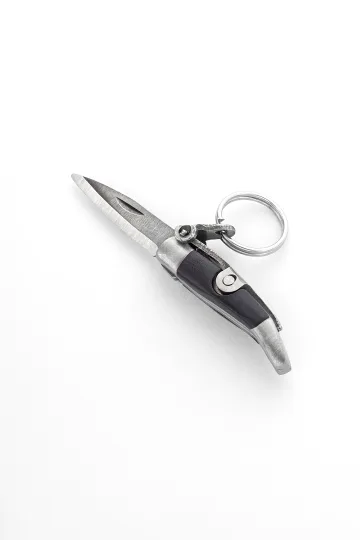
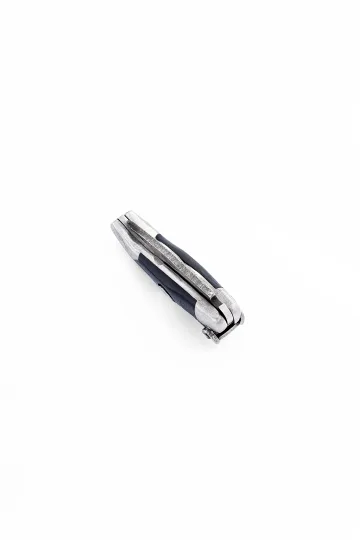
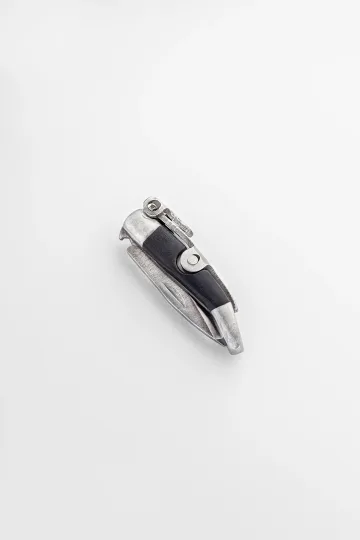
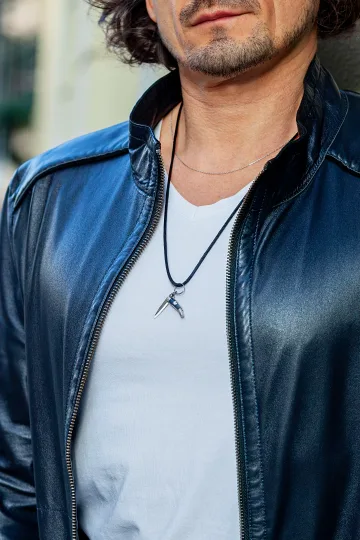
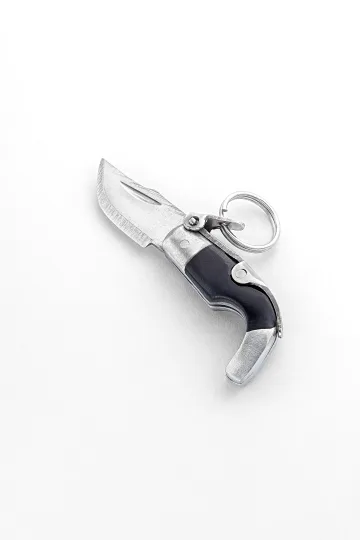
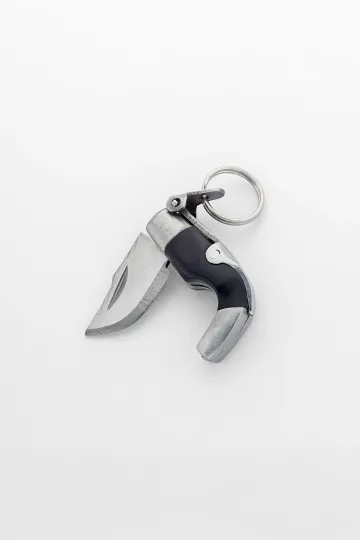
CAPAORA mini knife pendant
The 18th-century Spanish navaja in miniature: 40 mm of stainless steel, a real folding mechanism and a Palanquilla lock that clicks. An affordable gift to remember.
Authentic · Ships from Spain · 14-day returns
The symbolism of rhodonite: what people believe and what is proven
In the tradition of crystal healing rhodonite is established as a stone of the heart and of emotional balance. The logic of the symbol is simple and vivid: the pink ground is read as warmth and tenderness, the black veins as hard experience and pain. A stone where pink and black have grown into a single pattern becomes a metaphor of acceptance: the bright and the heavy can exist side by side.
From this come the three meanings attributed to it: compassion, forgiveness, balance. Let us be plain: this is a cultural tradition, not a proven physical effect. Rhodonite does not heal, does not relieve anxiety and does not "charge" you with energy. The mineral affects neither sleep, nor blood pressure, nor mood. Any medical promises around stones are marketing, not fact.
The only honest effect one can explain is tactile and psychological: a smooth warm object in the hand gives you a reason to pause and shift your attention. But what works here is the pause itself, not the manganese, and any other pleasant object would work just as well. Wearing the stone "for calm" is a normal human practice, as long as we do not confuse a symbol with a medicine.
In the symbolism of relationships rhodonite is read as a stone of reconciliation. It is given as a sign of a wish to restore a bond or start again. The pink colour ties it to the theme of warm, unpassionate love. This is a poetic reading, not a property of the mineral, but it is exactly what makes the stone an expressive gift.
Rhodonite jewellery: rings, pendants, earrings, bracelets
Rings
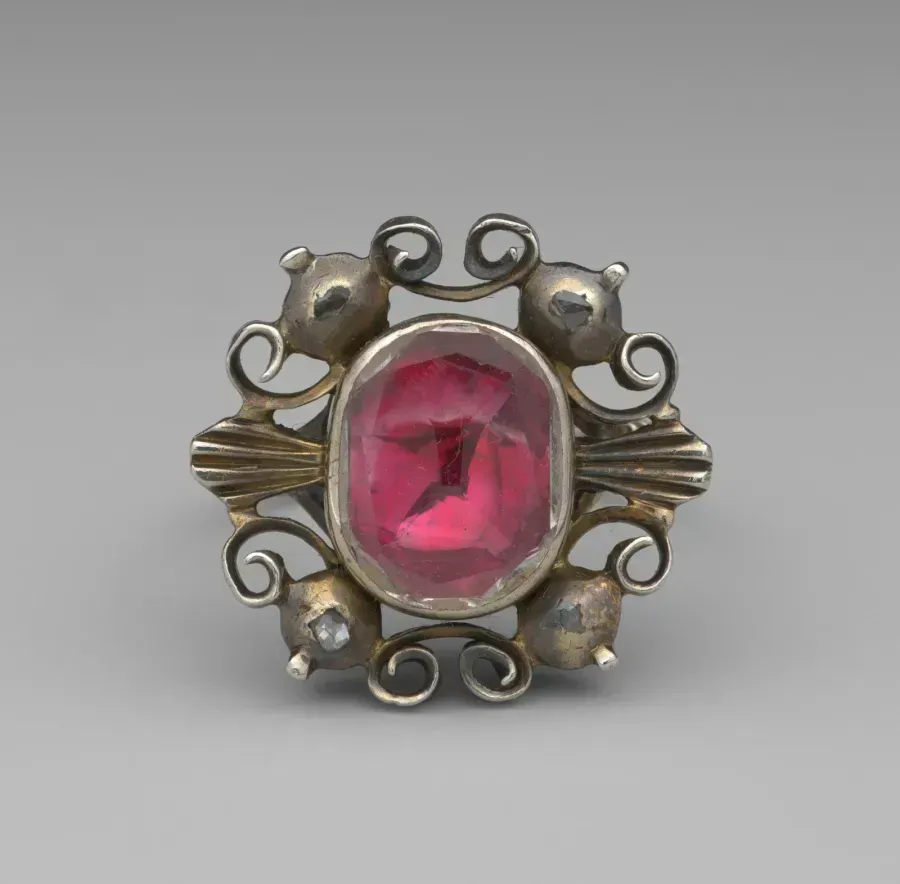
A rhodonite ring is almost always a large cabochon or a flat inset with an expressive pattern of veins. Ornamental rhodonite is not faceted; it is ground smooth to show colour and graphics. The pink stone looks best in sterling silver: the cool sheen of the metal heightens the warm pink and brings out the black threads.
Rhodonite also pairs with gold: yellow gold adds warmth, white gold plays on contrast, as silver does. Because of its hardness of 5.5 to 6.5, a rhodonite ring is not for heavy manual work or for daily wear on your working hand. Keep it from knocks and abrasion, and the stone will serve for decades.
Pendants
A pendant is the ideal format for rhodonite. On the chest the stone is better protected from knocks than on a finger, and a large cabochon or flat plate gives the most area to show off the pattern. Popular choices are simple cabochons in a silver setting, "drops", ovals, hearts, as well as flat slices where the whole natural texture is visible. The pink-and-black graphics read like a small painting.
Earrings
In earrings rhodonite works in pairs, and there is a nuance here: the two stones should echo each other in colour and pattern, but they will never be absolutely identical. Good craftsmen deliberately select pairs close in tone and character of veining. Light cabochon studs suit everyday wear; large drop earrings are for an evening look.
Bracelets and necklaces
The most mass-market format: rhodonite beads on elastic or thread, spheres of 6 to 10 mm. A bead bracelet is an affordable way into the subject. Necklaces and long strands are striking thanks to the repeating pink-and-black rhythm. The downside of beads is that they rub against one another, and over time the polish dulls. This is fixable by re-polishing at a craftsman's.
Carvings and interior
A separate theme, non-wearable pieces: boxes, eggs, obelisks, spheres, animal figurines. Here the very lapidary tradition continues that once turned this stone into imperial vases, only on a domestic scale. Such an object on a table is a calm pink accent and a nod to the stone's three centuries of history.
Which format to choose
- Ring. Striking, but demands care against knocks.
- Pendant. The best format: protected on the chest, shows the pattern.
- Earrings. Add colour near the face, take daily wear easily.
- Bracelet. The most affordable way in.
- Necklace. A striking pink-and-black rhythm, but the beads rub and dull.
- Home carving. A calm accent in the interior and a link to a long history.
If in doubt, start with a pendant or a bracelet: these are the most practical and versatile options.
Send a friend a discount code, they save on their first order.
Caring for rhodonite: so the pink does not fade
Rhodonite is softer than many gem stones, so caring for it is mostly about protection from three enemies: abrasion, harsh chemicals and long bright sun.
Abrasion. Sand, dust and hard surfaces gradually matte the polish. Take the jewellery off at the beach, while cleaning, at the gym. Store rhodonite away from hard stones (quartz, topaz, corundum, diamond), which scratch it easily, ideally in a soft pouch or a separate compartment of a box.
Chemicals. Perfume, hairspray, household cleaners, chlorinated pool water, sea salt, none of these are friends to rhodonite. The rule is simple: put the jewellery on last, after make-up and perfume, and take it off first.
Sun and water. A saturated pink can fade over time under direct sun, so do not leave the jewellery on a sunny windowsill for long. Cleaning: warm water, a soft cloth, a drop of mild soap if you wish, then dry. Ultrasonic baths and steam cleaners are out for rhodonite: its perfect cleavage and relative softness make it vulnerable to vibration.
Treated with care, rhodonite lives for generations: pieces made from old Ural material are a century and a half to two centuries old, and they are still pink.
Frequently asked questions
What is rhodonite in simple terms?
Rhodonite is a natural pink stone with black veins. The pink colour comes from manganese, and the black threads and blots from oxides of the same manganese. The mineral is a silicate, medium in hardness (5.5 to 6.5 on the Mohs scale); the opaque ornamental material is more common than the transparent gem kind. For three centuries in the Urals it had a folk name tied to eagles, and everything was made from it, from signet rings to imperial vases. Rhodonite is easy to spot: a warm pink ground over which charcoal seems to have been run.
Why is rhodonite associated with eagles?
A folk name arose in the Urals, where the pink stone was often found near eagles' nests. People believed the eagles deliberately carried fragments into the clutch, and a belief grew up that the stone gave strength and courage. This is a legend, not a fact, but the name stuck for nearly two centuries. Under that name Ural rhodonite became a prestigious stone. So the folk name and "rhodonite" mean one and the same stone, simply a folk name and a scientific one.
What is the difference between rhodonite and rhodochrosite?
The names are similar, and both stones are pink, but they are different minerals. Rhodonite, a manganese silicate, is hard (5.5 to 6.5), with characteristic black dendritic veins over a pink ground. Rhodochrosite, a manganese carbonate, is softer (3.5 to 4), usually with a banded pink-and-white pattern and no black manganese web. If you see a pink stone with graphic black threads, it is almost certainly rhodonite. If you see pink layers like a slice of boiled sweet, more likely rhodochrosite. You can also tell them apart by their reaction to weak acid: rhodochrosite "fizzes", rhodonite barely does.
What properties are attributed to rhodonite?
In the tradition of crystal healing rhodonite is credited with compassion, forgiveness and emotional balance, and is called a stone of the heart and of reconciliation. Keep in mind: these are cultural beliefs, not proven medicine. The stone does not cure illness, does not affect anxiety, blood pressure or sleep, and is no substitute for a doctor. The only thing one can explain is a tactile effect: a smooth warm stone in the hand gives you a reason to pause and shift your attention. That is, what works is not the mineral but the pause itself.
Can rhodonite be worn every day?
Yes, but with care. In hardness rhodonite is medium; it is softer than quartz and is easily scratched by sand, dust and harder stones. A pendant and earrings take daily wear well. A ring and a bracelet on the working hand wear faster: it is better to take them off during cleaning, sport and cooking. If you protect the stone from knocks, abrasion, harsh chemicals and long direct sun, rhodonite will serve for decades.
Does rhodonite fade in the sun?
A saturated pink rhodonite can indeed pale slightly under very prolonged direct sun. We are talking about hours or days of exposure, for example keeping the jewellery permanently on a sunny windowsill. To keep the colour bright, store rhodonite in a box or pouch away from constant direct light.
Where is rhodonite mined?
The historical capital of quality rhodonite is the Middle Urals in Russia, near a village close to Yekaterinburg. It was this Ural stone that supplied the material for imperial vases and the sarcophagus. Today the classic Ural reserves are largely worked out. The transparent gem variety is mined in Australia (Broken Hill). Rhodonite is the official state mineral of Massachusetts in the USA. Deposits are also known in Peru, Sweden, Mexico, Brazil, South Africa, Japan, Canada and Madagascar.
Which metal is best for a rhodonite setting?
Most often rhodonite is set in sterling silver: the cool sheen of the metal heightens the warm pink and beautifully brings out the black veins. This is the most popular and versatile option. White gold gives a similar effect, yellow gold adds warmth and suits saturated raspberry shades. The main rule: the setting should leave as much of the stone's area open as possible, so the natural pattern is visible.
How can you tell real rhodonite from a fake?
There are several simple checks. Pattern: natural black veins are uneven and unique, while a printed or dyed pattern repeats. Hardness: real rhodonite is not scratched by glass, while soft dyed marble is. Dye test: a cotton pad with acetone on an inconspicuous spot, natural colour stays put. Weight and temperature: the stone is heavy and cool at first touch. Most often dyed marble or magnesite is passed off as rhodonite, and it is confused with rhodochrosite. For an expensive purchase, ask for an appraisal.
How does rhodonite differ from rose quartz?
Both stones are pink, but different. Rose quartz is quartz, hard (7 on Mohs), semi-transparent, an even soft pink with no black veins. Rhodonite, a manganese silicate, is softer (5.5 to 6.5), opaque, with signature black veins over a more saturated ground. They are often worn together as a "heart duet": the quartz adds softness, the rhodonite depth and character thanks to its contrast.
Is rhodonite a precious or an ornamental stone?
Mostly ornamental. The overwhelming majority of rhodonite is the opaque dense material ground into cabochons and beads, cut into boxes and figurines. It is affordable. The rare exception is the transparent gem crystals of a deep red-pink, fit for faceting; they are found mainly in Australia, are highly valued and go to collectors. So the answer depends on the particular stone.
Can rhodonite be green or another colour?
Pure rhodonite is always in the pink-red range, from soft coral to deep raspberry, because the colour comes from manganese. But in the rock, greenish, yellowish or brownish zones sometimes turn up beside the pink; these are neighbouring minerals and traces of oxidation, not rhodonite itself. If you are offered a bright green or blue "rhodonite", it is most likely either another mineral or a dyed imitation. The marker is simple: rhodonite is a pink ground plus black veins.
Can rhodonite be washed with water?
Briefly, yes. Warm water, a soft cloth, a drop of mild soap if you wish, then dry, that is enough for regular cleaning. What you must not do: soak the stone for long, use ultrasonic baths, harsh chemicals, or hot water with a sharp change of temperature. Chlorinated pool water and salty sea water are no good either. The regular shower, bath, pool and sea harm rhodonite, so it is better to take the jewellery off before water.
Why does my rhodonite have a different pattern on different beads?
This is normal and even good. Rhodonite is a natural stone, and its black veins formed along random microcracks millions of years ago. There are no two identical spots in nature, so every bead will differ a little in shade and pattern. This is exactly what distinguishes real rhodonite from a dyed fake, where the pattern repeats or looks printed. If all the beads are perfectly identical, that is a reason to look closer: you may be facing an imitation.
Is it true that rhodonite is a "Russian stone"?
Partly yes. Rhodonite occurs all over the world, it was first described in 1819 from German (Harz) samples, and is mined today in Australia, Peru, the USA and elsewhere. But it was the Urals that gave the stone its world status as a prestige material. In the nineteenth century, imperial vases, palace-hall cladding and the famous many-tonne sarcophagus in a Saint Petersburg cathedral were made from Ural rhodonite. Europe knew nothing comparable in volume of quality material at the time. So rhodonite earned a reputation as a Russian national stone, like malachite and jasper.
Can rhodonite be re-polished if it has gone dull?
Yes, this is common practice. Over time rhodonite's polish can dull from wear: sand, dust and beads rubbing against one another matte the surface. A good lapidary or jeweller will re-polish the stone. It is important to re-polish only when needed, not "as a precaution": each polishing removes the thinnest layer of material. For necklaces and bracelets of many beads, re-polishing is especially relevant, because the beads rub against one another most actively.
Buying it as a gift? Each one arrives ready to give.
 A branded Zevira box and a little card come with every order.






About Zevira
Zevira works with stones as stories, not as "magic" objects. Rhodonite for us is three centuries of the Ural stone, the contrast of pink and black, a pattern that never repeats. We say honestly where history and geology end and beliefs begin: the stone does not heal and will not bewitch, but it is beautiful, it has a past, and every one of its patterns is unique.
Every rhodonite piece in our selection is a natural material with a one-off pattern of veins: your stone is literally the only one in the world. We choose settings so that as much area as possible stays open and the pattern reads like a small painting. If you are looking for a gift of reconciliation, a symbol of gentle settled love or simply a warm pink accent with character, this stone is one of the most charming options.
We prefer sterling silver: the cool metal heightens the warm pink and brings out the black graphics of the veins. With every piece we include an honest account of the stone, a history, not a promise of miracles. Choose rhodonite for its beauty, its history and its natural pattern, and it will serve you for decades.
Choose your rhodonite
Pendants, rings and bracelets in natural rhodonite set in sterling silver. Each stone with a unique pattern of veins and three centuries of history behind it.
See rhodonite jewellery