Morganite: the pink beryl, its chemistry, geology, history, and how to spot a fake
A pink stone in a shop window is easy to mistake for rose quartz or pink topaz. But if you can see the outline of your hand through it, and the facets give off a cool, clean shine, you are most likely looking at beryl, the same mineral as emerald and aquamarine, only coloured pink by manganese. The name is morganite. Gemmologists set it apart as its own variety in the early twentieth century, and it has stayed one of the most recognisable pink gemstones ever since.
Below we go through morganite honestly: what it is made of, how it forms, where it is mined, how to tell it from look-alikes and glass, and how to care for it. We will touch on the symbolism too, but without promises, because a stone is a stone.
What morganite is: beryl coloured by manganese
Morganite is the pink variety of beryl, a mineral from the group of beryllium aluminium silicates. The chemical formula of beryl is Be₃Al₂Si₆O₁₈. In the crystal lattice, rings of silicon and oxygen form open channels, and it is into those channels, along with the aluminium sites, that the impurities slip in and set the colour.
The pink and peach tones of morganite come from manganese (Mn²⁺ and, to a lesser degree, Mn³⁺). The manganese ion absorbs part of the visible spectrum, so the stone reads as pink. The more manganese present and the more stable its oxidation state, the deeper the colour. Pale stones are often improved with gentle heating: a moderate warming drives off the yellow and orange undertone caused by iron and leaves a clean pink behind. This treatment is considered acceptable and stable.
Wear the symbol, don't just read about it. These are in stock:





It is also worth clearing up a common mix-up: pink beryl is sometimes linked to a lithium impurity. Lithium does indeed travel alongside beryl mineralisation in pegmatites (spodumene and lepidolite turn up nearby), but the colour of morganite itself comes from manganese, not lithium.
Physical properties of morganite
- Class: silicate (ring silicate, a cyclosilicate).
- Crystal system: hexagonal.
- Mohs hardness: 7.5 to 8. That is high, harder than quartz (7) and on a par with the other beryls.
- Density: roughly 2.7 to 2.9 g/cm³.
- Refractive index: about 1.57 to 1.60.
- Birefringence: weak, of the order of 0.004 to 0.008.
- Dispersion: low (around 0.014), which is why morganite gives no "fire" like a diamond does; it wins on clarity and colour rather than play of light.
- Pleochroism: noticeable, usually two-tone, shifting from pale pink to a deeper pink or pinkish-violet as you turn the stone.
- Lustre: vitreous. Transparency ranges from transparent to translucent.
High hardness is good news for wear: morganite does not scratch as easily as feldspar or opal. But hardness is not the same as toughness. Beryl has a direction of cleavage, and a sharp knock on a facet can chip the stone. You can wear it every day; dropping it on a tiled floor is another matter.
How morganite forms: the geology of pegmatites
Beryl, morganite included, crystallises mainly in granite pegmatites, the coarse-grained vein rocks that form during the late stage of a granite magma cooling down. Once the main body of granite has solidified, a hot residual fluid is left behind, rich in water, rare elements, and volatile components. It cools slowly in cracks and cavities, and from it grow large, well-formed crystals: quartz, feldspars, micas, and beryl.
To grow, beryl needs beryllium, an element that is rare in the earth's crust to begin with. So good beryl crystals occur exactly where the geochemistry of a pegmatite has concentrated it. Morganite additionally needs manganese present in the right form. The coincidence of these conditions, beryllium plus manganese plus calm, slow crystallisation, is what makes transparent gem-quality morganite a relatively uncommon find.
More rarely, beryl turns up in certain hydrothermal veins and metamorphic rocks, but gem morganite is almost always a pegmatite stone.
Why manganese colours beryl pink
Colour in gemstones comes not from the bulk material but from the way electrons in an impurity ion absorb light. In morganite that job falls to manganese, which has taken the place of aluminium in the beryl lattice. Divalent manganese absorbs gently and gives a soft pink; trivalent manganese hits harder and adds a lilac, almost violet note to the tone. A real stone is always a mixture of both states plus a little iron, which is why the shades wander from peach to a cool pink-lilac. A geologist would put it briefly: the colour of morganite is an electron transition in the d shell of manganese, and the whole range depends on the ratio of its two forms and on how much iron came along for the ride.
Zoning, and why one crystal can be two colours
A pegmatite grows unevenly. The fluid becomes richer in manganese, then poorer, the temperature fluctuates, and the crystal lays down zones of different colour like the growth rings of a tree. As a result a single piece of pink beryl can contain areas of dense tone and areas that are nearly colourless. A good cutter reads that zoning in advance and orients the stone so that the saturated zone faces the table and the pale zone hides in the pavilion. Sometimes the zoning is deliberately left visible: bicolour beryls, where pink shades smoothly into a bluish aquamarine edge, are collected as a natural curiosity.
What grows alongside morganite in a pegmatite
Pink beryl rarely sits alone in the rock. Its usual neighbours are smoky and rose quartz, feldspars, black schorl tourmaline and pink tourmaline, lepidolite with its lilac flakes, and sometimes kunzite and topaz. That mineral set is the prospector's clue: where lithium micas and coloured tourmalines break the surface, beryl is worth looking for. The famous pink crystals from the Californian island workings and from the Brazilian veins were found in exactly that company, in whole mineral pockets where morganite shared a cavity with tourmaline and quartz.
Morganite wants a bare collarbone and low light, not a shop-window glare. And keep it away from yellow gold, that is the wrong crowd.
What to wear morganite with
Over years on shoots I have run morganite through dozens of looks, and the lesson is simple: this pink beryl is not about volume, it is about light near the face. Here is what actually works, sorted by occasion.
How do I wear morganite every day? For daily wear I recommend a solitaire pendant on a fine chain: it hides in the neckline of a sweater or shirt and works as a quiet accent that people catch when you turn your head and the stone takes the light. For metal I suggest rose gold, pink to pink, a single warm tone. I choose a length of 42 to 45 cm so the stone rests at the collarbones.
Is morganite right for the office? Yes. I suggest the same solitaire pendant or a small ring: a tender pink takes the edge off a strict blazer without making the look frivolous. For metal I recommend white gold or platinum, which hold the stone in a cool transparency and read as restrained.
How do I build an evening look with morganite? For evening I suggest bare shoulders and a deep neckline. Drop earrings near the face give a soft shimmer, while a stone on the chest pulls the eye upward to the face. Against deep colours (wine, emerald, black) morganite keeps the focus on itself. I choose a pendant length of 50 to 60 cm so it drops deeper into the neckline.
What do I wear morganite for a special occasion? For a birthday or an anniversary I recommend a larger stone in a ring as the centre of the whole look. I suggest keeping the neighbouring rings in a stack plain, without stones, so they support the morganite rather than argue with it. One noticeable stone almost always beats a scatter of small ones beside it.
Which fabrics and colours does morganite get along with? I suggest flowing materials (silk, viscose, fine knit, linen): they echo the lightness of the stone, while heavy denim and leather make a curious contrast of tenderness and character. For colour I recommend dusty rose, cream, sand, and grey-blue. Use yellow gold with care, since the contrast with pink can turn harsh.

Turn on your camera, pick earrings, a pendant or a ring, and see the piece on yourself in real time.
Switch items in one tap.
Everything runs in your browser: no photo or video is ever uploaded.
Where morganite is mined
Morganite is mined in several regions around the world, and the source affects the typical look of the stone.
- Madagascar. One of the historically most important sources, and the place where pink beryl was first described as a distinct variety. Madagascan stones often show a clean, lively pink with good transparency.
- Brazil (Minas Gerais). A classic pegmatite district that yields large crystals. Brazilian morganite is frequently a calmer, softer tone and lends itself well to large cuts.
- United States (Maine, California). The pegmatites of New England and California produced famous finds of pink beryl.
- Afghanistan and Pakistan. The pegmatite fields of the region produce beryl, including pink and peach hues.
- Namibia, Mozambique, Zimbabwe. African pegmatites, another steady source.
The list is deliberately restrained: these are the well-known pegmatite provinces. The specific mine named on a stone's certificate matters less than its actual characteristics, that is, colour, clarity, and cut.
The beryl family: where morganite sits among its relatives
Beryl is a whole group of colour varieties of a single mineral. What separates them is the chromophore impurity:
- Emerald is green, coloured by chromium and/or vanadium.
- Aquamarine is blue and blue-green, coloured by iron.
- Heliodor is yellow and golden-green, also iron.
- Morganite is pink and peach, coloured by manganese.
- Bixbite (red beryl) is very rare, an intense red.
- Goshenite is colourless beryl with no significant chromophores.
So aquamarine and morganite are literally the same mineral, with the same formula and structure, differing only in the colouring impurity. That is handy to keep in mind when comparing them: their properties (hardness, refraction, density) are close.
Customer reviews
Zevira is a real jewellery shop. Genuine payments, deliveries and customer thank-yous.
🥰🥰🥰 gracias
Ok, ¡gracias! 🙂
The history of morganite: a banker's name and a museum collection
Pink beryl was singled out as a variety in its own right in the 1910s. It was named after John Pierpont Morgan, the American financier and one of the greatest collectors of minerals and gemstones of his day. Morgan funded scientific acquisitions and built a collection, much of it tied to the American Museum of Natural History in New York. Naming a mineral after a person rather than a colour or a place is uncommon in gemmology, and it cemented morganite's reputation as a "collector's" stone.
In the first half of the twentieth century, through the Art Deco era, pink beryl was used in jewellery alongside other coloured gems. Large transparent specimens were prized as a rarity. A handful of exceptionally large morganites later made their way into museum collections; some natural history museums, for instance, hold faceted stones of several hundred carats.
Strip away the later legends and the historical fact is simple: morganite is a relatively young stone by the date of its description, given a collector's name and a reputation as a rare pink beryl.
Who proposed the name, and why a banker
The name was not chosen by the collector himself but by the mineralogist describing pink beryl from the island workings off the Californian coast. He suggested honouring the man whose money and appetite for minerals had assembled one of the finest public gem collections of the period in New York. The reasoning was straightforward: the financier had spent years buying rare stones and giving them to the museum, putting science within reach of ordinary city dwellers. Naming a newly described variety after him was both a thank you and a way of tying the stone permanently to its patron. Morganite has remained the only widely traded gem variety named for a collector rather than for a colour, a place or a discoverer.
Pink beryl before it had a name
People encountered pink beryl long before the start of the twentieth century. They simply did not separate it from other pale beryls, and frequently confused it with pink topaz or a washed-out amethyst. In old gem inventories, pinkish transparent stones were listed as one undifferentiated group, with no clear boundary between minerals. Gemmology as a science with precise instruments is young, and it took measurements of density, hardness and refractive index to sort the pink stones onto their proper shelves. Morganite therefore has a long anonymous prehistory: it decorated objects under other labels until the tools arrived to tell beryl from its look-alikes.
Morganite in the Art Deco years
The first loud jewellery fashion for pink beryl fell in the 1920s and 1930s, at the height of the geometric style. Large transparent coloured stones in strict symmetrical white metal settings were the taste of the moment, and the gentle morganite fitted that aesthetic perfectly: a clean tone, an open step cut, a spare frame. Pink beryl sat alongside aquamarine, citrine and rock crystal in the same pieces, giving makers a soft pastel palette to work with. That appetite for a large transparent stone in a simple geometric mount still shapes how morganite is set today.
Types and shades of morganite
Morganite ranges from pale pink to peachy pink and pinkish-lilac. The market uses descriptive labels that are handy to know, though they are not a strict classification:
- Clean pink. The most recognisable tone, with no yellow undertone. Often achieved after gentle heating.
- Peach. A warm pinkish-orange tone from a combination of manganese and iron.
- Pink-lilac. A cooler pink with a violet cast, especially visible in stones with strong pleochroism.
Size has a big effect on how the colour reads: the manganese colouring is not intense, so in small stones morganite looks almost colourless, while the colour "builds up" in larger cuts. That is why gem morganites are usually made fairly large and in open cuts (oval, pear, emerald, cushion) that show off clarity and tone.
Upload a photo of your pet, someone you love, or an object. We'll build a 3D model and hand-cast it in pewter.



How to choose morganite: what to look for when buying
You buy morganite with your eyes, and the order of priorities matters. Colour comes first, clarity second, cut third, and size brings up the rear.
Colour. Morganite is valued for saturation, not for brightness. The most expensive tone is a clean pink or pink-lilac with no yellow-orange undertone. Warm peach costs less, but that is a matter of taste, not a flaw. Look at the stone in daylight and under a warm lamp: peach intensifies under an incandescent bulb, while clean pink holds steadier. A tone so pale that it only shows at a certain angle looks flattering in the window but on the hand often reads as nearly colourless.
Size and colour are linked. Because of the weak manganese colouring, deep colour only appears in a large stone, usually from a couple of carats up. So a tiny, deeply pink morganite is almost always dyed or is not morganite at all. A realistic expectation: the smaller the stone, the lighter the tone, and you should pay for it as a light stone.
Cut. A good cut for morganite is one that adds depth of colour and does not scatter into glints. The stones are cut a little deeper than average so light travels longer and picks up tone. Open shapes (oval, pear, cushion, emerald step cut) show clarity and even colour. If the pavilion is too shallow, a bright window appears in the centre, the colour falls away, and the stone looks watery.
Clarity. A good gem morganite is clean to the eye. Beryl often grows transparent, so visible inclusions in pink beryl lower the price more than they would in, say, an emerald, where they are forgiven. The norm for morganite is no defects noticeable to the naked eye at arm's length.
Inclusions and treatment of morganite: what is fair to know
Under a loupe, morganite shows characteristic natural inclusions: thin hollow tube-like channels running along the axis of the crystal, needles, flat healed cracks shaped like feathers, and sometimes liquid-and-gas bubbles. These are not defects but signs of natural origin, and a gemmologist uses them to tell the stone from synthetics and glass. The warning sign is the opposite: a flawless void together with a suspiciously even, saturated colour in a small stone.
Treatment is something to ask about directly, and the seller is obliged to disclose it. The most common and accepted one is moderate heating: it removes the yellow and orange undertone from iron and leaves a clean pink. That colour is stable and does not fade with ordinary wear; it is not counted as a flaw. Separately, there is irradiated beryl in deep pink or orange tones: that kind of induced colour can be unstable and able to fade in the light (the effect is known in so-called Maxixe-type beryl). So an unnaturally bright pink at a suspiciously low price is a reason to ask about where the colour came from. The honest answer on a certificate: natural colour or heating, yes; lasting irradiation is rare for morganite and should be stated.


What affects the value of morganite
The price of morganite comes down to four things, and the order really is this:
- Saturation of colour. The main factor. A deep, even pink or pink-lilac is worth markedly more than a pale one. A yellow undertone cheapens the tone.
- Size. Since colour builds with mass, large saturated stones are prized disproportionately higher: doubling the weight while keeping the colour raises the price by more than double.
- Clarity. An eye-clean stone is worth noticeably more than an included one, because beryl can be very transparent and the market expects it.
- Cut. A precise cut with no bright window and even colour adds to the price; a crooked hand job with a dead centre takes away from it.
Morganite stays more affordable than emerald or aquamarine of comparable quality, and that is part of its appeal: a large clean pink beryl is genuinely wearable every day, without treating it like a safe-deposit treasure.
Famous morganite specimens
Pink beryl has its record holders, and almost all of them live in museums rather than private safes.
The faceted giants in museum cases
Because morganite gathers colour with mass, the most impressive stones are always large. Natural history collections hold faceted pink beryls of several hundred carats, transparent enough to read text through. Such stones are cut deliberately big: only in a large mass does the gentle manganese pink open up fully, whereas in a small stone the cutter would end up with an almost colourless droplet. These museum giants became the calling card of morganite and the clearest argument that pink beryl can be genuinely monumental.
Pocket crystals from the pegmatites
A separate source of pride for mineralogists is not the faceted stones but whole natural morganite crystals lifted from pegmatite pockets. Flat hexagonal plates and thick columns weighing many kilogrammes occur, sometimes with clean faces and an even pink tone throughout. The celebrated finds came from Brazilian veins and Californian workings, where morganite grew in cavities together with tourmaline and quartz. Specimens like these are valued above any cut stone: a faceted gem can be repeated, an ideal natural crystal cannot.
Why there are almost no private records
Unlike diamond or emerald, morganite carries no train of crown settings and famous auction names. The reason is simple: the stone was described late, it is valued moderately, and large specimens more often settled in scientific collections than in royal jewellery. That gives morganite a particular reputation as a museum and collector's stone rather than a status display. For a buyer this is an advantage, because a large handsome pink beryl carries no legend premium.
Leave your email, we'll send your discount code. No spam, unsubscribe anytime.
The code arrives by email, valid on your first order.
Morganite in culture and jewellery
Pink in jewellery has always read as softness, warmth and attachment, and morganite inherited that language ready-made.
The language of a pink stone
Pink in jewellery rarely shouts. It settles. That is why pink gems have been chosen for centuries for objects tied to closeness: anniversary gifts, engagement rings, pieces handed down through a family. Morganite arrived into that tradition already fitting, its gentle tone taking a place beside rose quartz and pink tourmaline as a stone of warm, quiet feeling. This is not mineral magic but a cultural habit of the eye: we read pink as affectionate.
Morganite in the modern engagement ring
Over recent decades pink beryl has become a visible choice for engagement and wedding rings, particularly paired with rose gold. The logic is practical and pretty at once: the stone comes large and gentle, the hardness suits daily wear, and the cost is calmer than for classic gems of the same size. Pink on pink, morganite and rose gold merge into a single warm tone that looks expensive and soft. For anyone who wants a living warm stone rather than a white one in an everyday ring, this is among the most sensible options available.
Neighbours in the pink palette
Morganite is rarely considered alone. It is held in mind alongside the other pink stones. We cover rose quartz in jewellery separately, the pink and black stone with dark veining in the piece on rhodonite, and the hot red relative among the tourmalines in the article on rubellite tourmaline. Against that field morganite occupies its own niche: clearer than quartz, calmer than rubellite, harder than most pink gems.
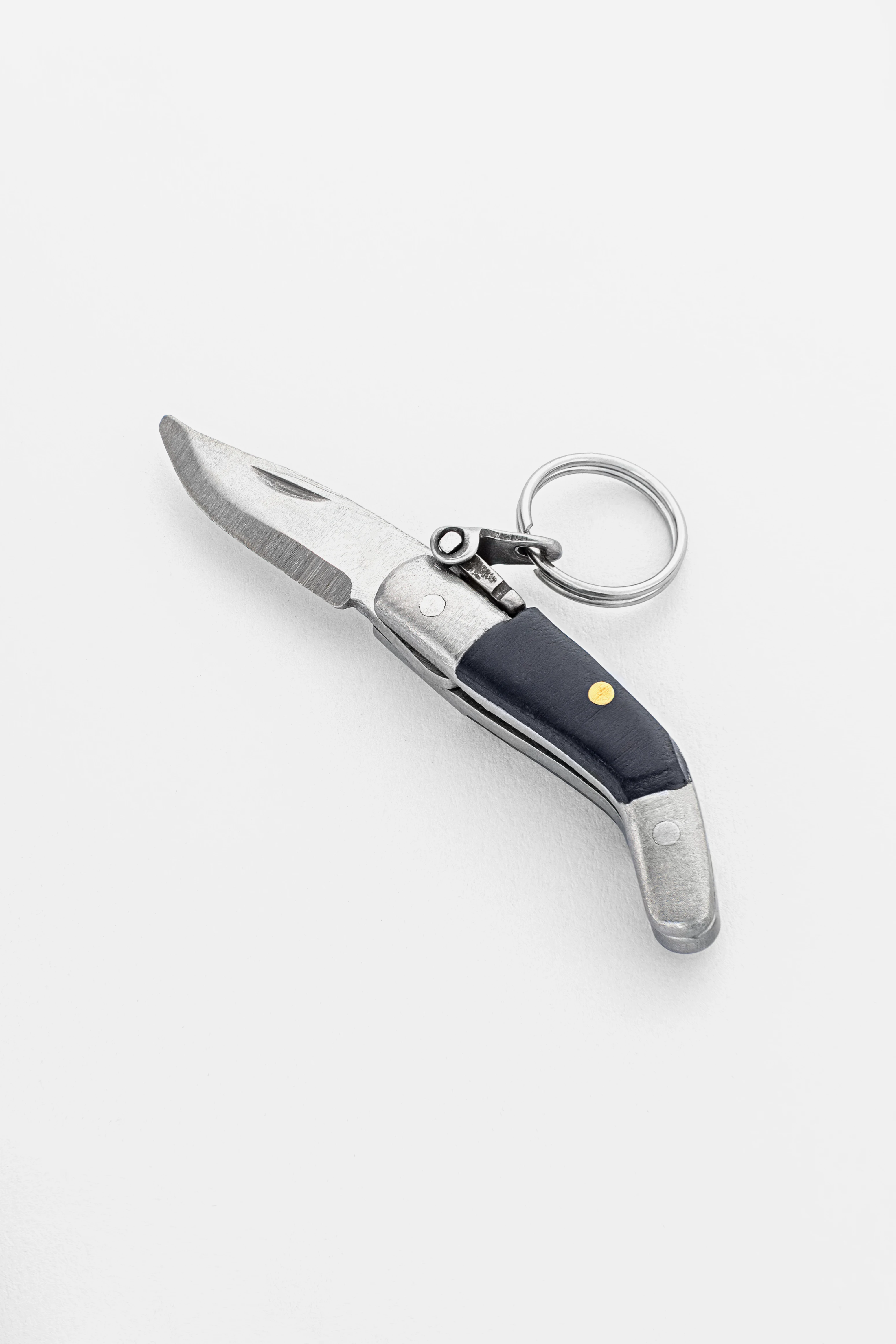
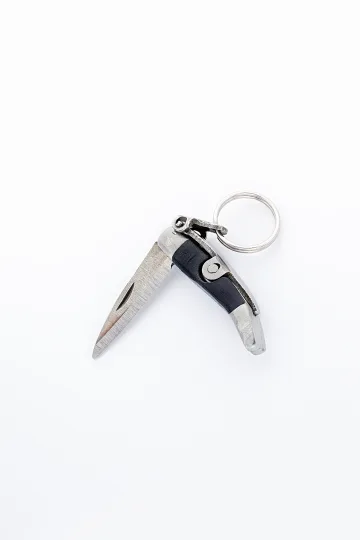
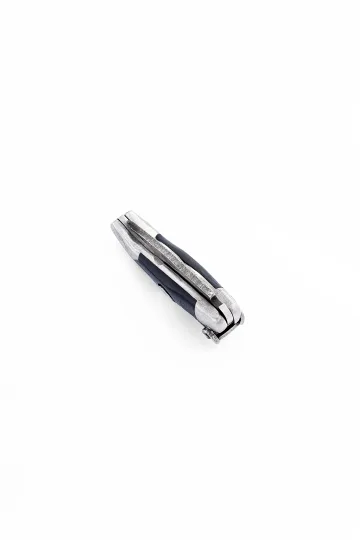
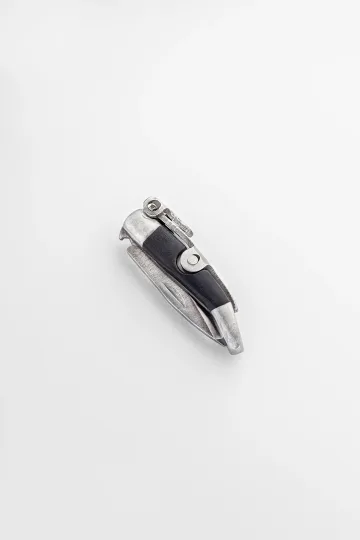
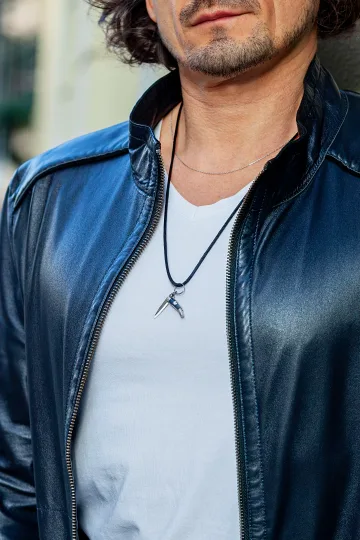
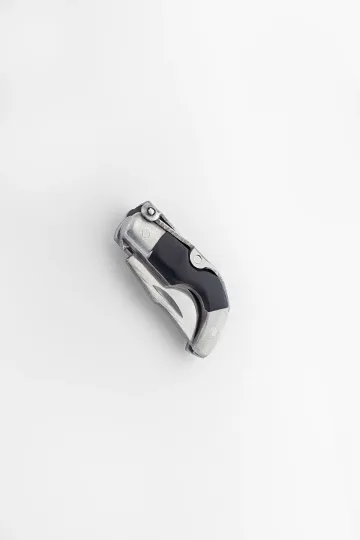
CAPAORA mini knife pendant
The 18th-century Spanish navaja in miniature: 40 mm of stainless steel, a real folding mechanism and a Palanquilla lock that clicks. An affordable gift to remember.
Authentic · Ships from Spain · 14-day returns
The psychology of the choice: why pink beryl appeals
Behind a decision to buy morganite there is almost always feeling rather than geology. Pink is perceived as a warm and safe colour. It softens a look and takes tension out of it, so people reach for it when they want to warm something rather than stand out. Transparency adds a sense of cleanliness and lightness: the stone appears filled with light from within rather than painted on the outside. There is a rational layer to the attraction too. Morganite delivers a large, noticeable stone for sensible money, so the wearer gets the effect of substantial jewellery without the feeling of carrying a safe deposit item on one hand. That combination of soft colour, clarity and accessibility is what makes pink beryl a stone people choose calmly and without second-guessing themselves.
Who morganite suits
Morganite has the useful quality of arguing with almost nobody.
By colouring
By complexion the stone particularly suits warm colouring. The peach tone echoes golden skin and chestnut hair, while the cool pink-lilac sounds well against fair skin with a cool undertone. Rose gold with morganite reinforces the warmth and white metal emphasises the clarity, so the stone is easy to tune to your own undertone through the setting rather than by hunting for a different shade of gem.
By occasion and by temperament
By occasion this is a stone for everyday wear and for quiet significant dates: an anniversary, a birth, an engagement, a gift for someone close. Anyone who likes a large stone but cannot bear a loud sparkle will find morganite ideal, because it is noticeable and still soft. Anyone who loves sharp fire and flashing will be disappointed, because beryl has none. It works through even colour and clarity, and that is worth understanding before you buy rather than after.
How to tell morganite from look-alikes and fakes
Many materials come in pink, and here confusion is more common than outright counterfeiting. What you can check:
- Rose quartz. Quartz is softer (7 against 7.5 to 8 for beryl), almost always cloudy or hazily translucent, with no pronounced pleochroism. Morganite is usually clearer and shifts tone slightly as you turn it.
- Pink topaz. Topaz is denser (around 3.5 g/cm³) and has perfect cleavage, with a different refractive index. By eye they are hard to tell apart; a gemmological test settles it reliably.
- Kunzite (pink spodumene). Also pink and strongly pleochroic, but softer, with very easy cleavage and more brittle.
- Pink tourmaline (rubellite). A different mineral with different constants; tourmaline's birefringence is markedly stronger. We cover its character separately, rubellite tourmaline and its fiery red.
- Glass and paste. Glass is softer, often with air bubbles inside and round "swirl" marks, warms up more slowly, and its facets are easily worn smooth.
Practical signs of natural morganite: moderate density, hardness at the level of beryl, noticeable two-tone pleochroism, vitreous lustre, and often small natural inclusions. Synthetic beryl does exist, gemmologically close to the natural stone, and it is told apart in a lab by the character of its inclusions and its spectra. For a significant purchase it is sensible to rely on the report of an independent gemmological laboratory, which records the variety, the weight, and any treatment.
Caring for morganite
A hardness of 7.5 to 8 makes morganite comfortable for everyday wear: it resists scratches better than most coloured stones. But it still deserves to be handled like a precious thing.
- Cleaning. Warm water, mild soap, a soft brush. That is enough. Rinse and wipe dry with a soft cloth.
- Ultrasonic and steam cleaning. Better avoided, especially if the stone has inclusions or cracks: beryl's cleavage makes it vulnerable to vibration and sudden temperature swings.
- Heat and sun. Strong heating (above a few hundred degrees) changes the colour of beryl, though that is a jeweller's furnace temperature, not a household one. Long stretches of direct ultraviolet and heat near a heat source are best avoided; manganese colouring is more sensitive than that of colourless beryl.
- Storage. Apart from harder stones (topaz, sapphire, diamond will scratch morganite) and apart from what it can scratch itself. A soft pouch or a compartment in a jewellery box.
- Take it off before sport, cleaning with harsh chemicals, and hands-on work where a knock to a facet is possible.
Send a friend a discount code, they save on their first order.
The symbolism of morganite, with a pinch of scepticism
In the crystal-healing tradition, morganite is counted among the "stones of the heart": it is credited with a link to love, tenderness, acceptance, and forgiveness. Alongside it, that symbolism often mentions rhodonite as the pink-and-black stone of forgiveness and rose quartz as the "first" pink stone.
It is worth calling things by their names: this is cultural symbolism, not a property of the mineral. Morganite has no proven physical or medical effect, and there is no need to wear it as medicine. If a pink stone pleases you and lifts your mood, that is a good enough reason in itself, without crediting it with energies.
Surprising facts about morganite
Pink beryl hides several things you would never guess from looking at a gentle stone in a ring.
Emerald and morganite are literally the same mineral
The green emerald that costs a fortune and the soft pink morganite are the same substance, beryl, with the same formula and structure. The entire difference lies in a trace impurity: emerald gets its colour from chromium, morganite from manganese. Swap the colouring atom and the pink stone would come out as a green relative worth many times more.
The prettiest stones are made large on purpose
With most gems a small stone is simply a small stone. With morganite, small means nearly colourless: the manganese colouring is weak, and the tone only appears over a long path of light. A tiny deeply pink morganite has therefore almost always been enhanced, while an honest pink beryl only comes into its own in a large cut.
It is harder than most of its rivals and still chips
Morganite is harder than quartz, harder than topaz in practical terms, and harder than nearly every coloured stone. It is difficult to scratch. Yet beryl has a direction of cleavage, and a knock on an edge can take a piece off a very hard stone. Hardness and toughness are different properties, and morganite demonstrates the difference neatly.
There is a pink beryl that fades in daylight
An irradiation-induced bright pink and orange colouring exists in beryl, known as the Maxixe type. That colour is unstable and can pale in light, turning a vivid stone into a washed-out shadow of itself. Natural morganite coloured by manganese holds its tone in ordinary use, but an unnaturally bright pink at a suspicious price is worth checking.
The stone was named after a living banker
In mineralogy, varieties are usually named for a colour, a place or a discoverer. Morganite broke the rule: it was named for a financier and collector during his lifetime, in thanks for the gem collection he had assembled and given to his city. It is an exceptionally rare case of a gemstone carrying a patron's name.
One crystal can be pink with a blue edge
Because the pegmatite fluid changes composition as growth proceeds, zones of different colour occur within a single beryl crystal. Some stones run from a pink morganite core to a bluish aquamarine rim, so that nature displays two varieties of one mineral in a single piece. Cutters occasionally preserve that boundary deliberately, and bicolour beryls are prized as a rarity.
Lithium is next door and still does not do the colouring
Pink beryl frequently forms in lithium pegmatites, next to lithium minerals such as lepidolite and spodumene, and out of habit people associate it with lithium. In fact lithium has nothing to do with the colour of morganite. The pink tone rests entirely on manganese, and lithium is merely a neighbour at the place of birth.
FAQ: common questions about morganite
How does morganite differ from rose quartz?
They are different minerals. Morganite is beryl (hardness 7.5 to 8), usually transparent, with noticeable pleochroism. Rose quartz is quartz (hardness 7), almost always cloudy and with no pleochroism. Beryl is harder and clearer.
What is morganite's hardness and can I wear it every day?
The hardness is 7.5 to 8 on the Mohs scale. For everyday wear it is reliable and resists scratches. But beryl has cleavage, so protect the stone from knocks to a facet.
Is morganite a natural stone or dyed?
Natural. The pink colour comes from manganese in the beryl. Many morganites are given moderate heating to remove the yellow undertone and make the pink cleaner; that is a standard and stable treatment, not dyeing.
Can morganite fade?
The manganese colouring is stable in everyday life but more sensitive than that of colourless beryl. Strong heating changes the colour, and very prolonged, intense ultraviolet could in theory weaken it. With ordinary wear the stone keeps its colour.
How do I clean morganite at home?
Warm water, a drop of mild soap, a soft brush, then wipe with a cloth. Ultrasonic and steam cleaners are best left alone, especially if the stone has inclusions.
What is morganite made of?
It is beryl, a beryllium aluminium silicate with the formula Be₃Al₂Si₆O₁₈. The pink colouring is given by a manganese impurity.
Where is morganite brought from?
From pegmatite districts: Madagascar, Brazil (Minas Gerais), the United States (Maine, California), Afghanistan, Pakistan, and several countries in Africa.
Why does small morganite look almost colourless?
The manganese colouring is not intense, and the colour "builds up" with size and the length of the light path through the stone. That is why gem morganites are usually made large and in open cuts.
Are morganite and aquamarine the same thing?
They are one mineral, beryl, but different varieties. Aquamarine is coloured blue by iron, morganite pink by manganese. Their structure and basic properties are shared.
How do I avoid buying a fake?
Glass gives itself away by bubbles and softness, rose quartz by cloudiness and lower hardness. For a serious purchase, rely on the report of an independent gemmological laboratory, where the variety, weight, and any treatment are stated.
Does morganite work for an engagement ring?
Yes, and this is one of its strengths. A hardness of 7.5 to 8 stands up to daily wear, the stone comes large at a sensible price, and paired with rose gold it gives a warm unified tone. Keep the cleavage of beryl in mind and protect the ring from knocks on the edge of the stone. Beyond that it is a dependable everyday choice, and a setting with a slightly raised bezel or protected corners removes most of the risk.
Why is morganite cheaper than emerald if it is the same mineral?
Because emerald is rarer in gem quality, its vivid green has been valued more highly for centuries, and inclusions are forgiven in it, which widens the market. Morganite was described late, is mined steadily and comes in large stones, so at comparable quality it stays more affordable. One mineral, two very different market histories.
Which colour of morganite is the most valuable?
A clean saturated pink or pink-lilac with no yellow-orange undertone. Warm peach costs less, but that is a matter of taste rather than a defect. The governing rule is that even saturation is prized above brightness, and the deeper an honest pink runs, the dearer the stone.
Should I take a morganite ring off before bed or a shower?
Bed is optional. A shower, a swimming pool and cleaning with harsh chemicals are not. Soap and household products leave a film, and chlorine and abrasives do no favours to either the stone or the setting. Take it off for sport and for rough work with your hands as well, because of the risk of a knock on the edge.
Pendants, rings, and earrings with morganite and related beryls: hand-cut pink beryl in 925 silver and gold.
Buying it as a gift? Each one arrives ready to give.
 A branded Zevira box and a little card come with every order.








About Zevira
Zevira works with coloured stones thoughtfully: for us the real characteristics of a stone (variety, colour, clarity, cut) matter more than the pretty legends around it. We love morganite for its honest nature: pink beryl coloured by manganese, hard, transparent, with a soft, noble colour.
Every morganite piece in the catalogue is a specific stone in a setting of 925 silver or gold, chosen for its colour and clarity, not for promises. If you want a pink gem that will stand up to daily wear and still look expensive and calm, morganite is one of the best options.
In closing
Morganite is pink beryl: the same mineral as emerald and aquamarine, coloured by manganese. A hardness of 7.5 to 8, good transparency, noticeable pleochroism, and a gentle colour make it a comfortable and beautiful gem. It grows in granite pegmatites, is mined in Madagascar, Brazil, the United States, and a number of other regions, and it took its name from a mineral collector of the early twentieth century.
What sets it apart from rose quartz is transparency and hardness, from glass density and lustre, and from other pink gems a set of gemmological constants. The care is simple: gentle cleaning, no ultrasound or strong heat, storage away from harder stones. And the love symbolism attached to it belongs to tradition, not to the properties of the stone.