Aquamarine in Jewellery: the Beryl the Colour of Seawater
Aquamarine is rarer in the earth's crust than diamond, yet it sells for ten to twenty times less. The reason has nothing to do with the quality of the stone. Over a century, an entire culture of engagement and investment was built around the diamond, and around aquamarine, nothing of the sort. The blue beryl stayed what it always was: clear, very blue, and honest, with no markup for marketing.
The name comes from the Latin aqua marina, "seawater". Ancient sailors really did carry jewellery set with blue beryl on long voyages, treating it as the traveller's stone. Behind the legend sits very concrete mineralogy: a variety of beryl coloured by iron, with a hardness almost matching sapphire and a transparency you rarely meet in coloured gemstones.
Let us look at what this stone actually is, on the level of chemistry and geology, how it is treated, how to tell it from fakes and from blue topaz, and how to choose a piece that will last for decades.
What aquamarine is: chemistry and crystal
Aquamarine is not a mineral in its own right but the blue variety of beryl. Beryl is a beryllium aluminium silicate with the formula Be₃Al₂Si₆O₁₈. Its crystal lattice is one of the most stable in nature: rings of six silicon-oxygen tetrahedra stacked into channels along the main axis. Thanks to this structure, beryl can lie in the ground for hundreds of millions of years without visible change.
In its pure form beryl is colourless (this variety is goshenite). The colour comes from impurities in the lattice. Blue beryl takes its tint from iron, and that is its fundamental difference from emerald, where chromium and vanadium are responsible for the green. This is exactly why aquamarine is usually clearer than emerald: an iron impurity does not require the growth conditions that load emerald with inclusions.
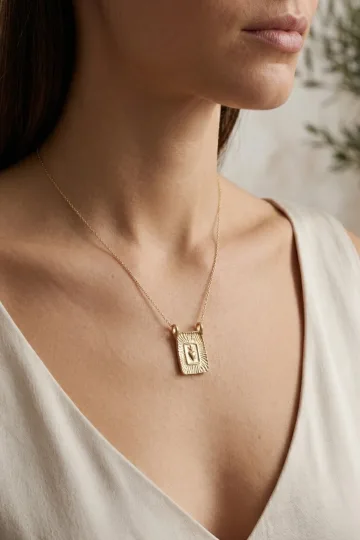
Wear the symbol, don't just read about it. These are in stock:







The iron in aquamarine appears in two oxidation states, Fe²⁺ and Fe³⁺, and the ratio between them sets the shade. Blue comes from divalent iron, Fe²⁺. Trivalent Fe³⁺ adds a yellow-green undertone (the same iron colours heliodor). Jewellers call the ideal balance "true blue", free of any green or grey cast.
The beryl family
Aquamarine has famous relatives, and they all share the same formula and crystal structure. The only difference is in the impurities:
- Emerald: green (chromium, vanadium)
- Morganite: pink (manganese)
- Heliodor: yellow (trivalent iron)
- Goshenite: colourless
- Red beryl (bixbite): one of the rarest gems on the planet, mined almost exclusively in one spot in Utah
The blue tone of aquamarine comes from the very same iron that lends a saturated neon shade to apatite: the play of impurities inside a crystal decides everything.
Physics: hardness, density, optics
| Property | Value |
|---|---|
| Mohs hardness | 7.5-8 |
| Density | 2.68-2.74 g/cm³ |
| Crystal system | hexagonal |
| Refractive index | 1.567-1.590 |
| Birefringence | 0.005-0.007 |
| Cleavage | imperfect |
A hardness of 7.5-8 is enough for everyday wear: aquamarine scratches window glass (5.5) and quartz (7), while it is itself scratched only by corundum and diamond. On the scale it sits just below sapphire (corundum, 9).
More important than hardness is toughness, the ability to take a knock without splitting. Aquamarine fares better here than emerald, which has pronounced cleavage and a brittleness born of natural fractures. The blue beryl forgives small carelessness better than its green cousin, but large stones (from five carats) almost always carry internal fissures and inclusions, and a sharp blow or temperature swing can open them up.
Aquamarine is pleochroic: depending on the viewing direction the crystal looks either a deep saturated blue or almost colourless. A good cut orients the stone so the eye sees the maximum blue from the top. This is not a flaw but a property the cutter has to respect when sawing the rough.
Geology: how beryl turns blue
Aquamarine forms in granite pegmatites, coarse-grained igneous rocks that crystallise slowly and let individual crystals grow to a large size. The surrounding melt is rich in beryllium, aluminium and silicon, the building blocks of the beryl molecule.
The catch is the beryllium: there is only around three parts per million of it in the earth's crust. For an aquamarine to form, this rare element first has to concentrate, usually in regions of ancient metamorphic mountains where rock layers were remelted by geothermal processes. That is why aquamarine deposits often sit alongside lithium, tantalum and niobium.
The blue colour appears when iron ions enter the growing crystal at temperatures of roughly 600-800 °C. They take up places in the lattice and absorb the red and yellow parts of the spectrum, letting the blue through. The more iron there is in the right oxidation state, the deeper the colour.
Brazilian aquamarines are estimated at around 500-600 million years old, Afghan ones at 30-50 million, which lines up with the rise of the Himalayas. Mountain-building, with its high pressure, is precisely what yields especially clean, transparent crystals.
Deposits and colour by geography
Geography shows up directly in shade and clarity, and an experienced gemmologist will often guess the origin before the lab does.
Brazil: about 70% of world output. The states of Minas Gerais and Espírito Santo yield clear stones of a deep blue, sometimes huge crystals running to hundreds of carats. This is the backbone of the jewellery market.
Nigeria: a source of premium stones with an intense blue that, at a glance, gets mistaken for a pale sapphire. Good transparency, few inclusions. The logistics are tricky, so collectors prize these stones.
Madagascar: the second-largest source over the past two decades. The colour is often deeper than the Brazilian, sometimes with a greenish cast. Quality ranges from cloudy market stones to clean, deep-blue ones.
Afghanistan (the Hindu Kush mountains): icier, almost whitish stones with a cool blue glint. A rare source because of the difficult high-altitude mining. Visually this is the colour of a high mountain lake, not a tropical sea.
The Ural region: a historic source, known since the nineteenth century, that supplied the imperial court. A characteristic pale blue with a greenish undertone. The old reserves are exhausted, and on the international market a Ural aquamarine is either an antique or a rarity.
Pakistan, the Red Sea region, Southeast Asia: these yield aquamarine of varying quality, from cloudy market goods to the exceptional. On certificates these sources are often simplified to "Africa" or "Asia". Pakistani stones often come from the same mountain systems as the Afghan ones.
How it is mined
Industrial methods are used mainly in Brazil; elsewhere it is largely hand work. Geologists look for signs of pegmatites, carefully open up the rock, extract the crystal whole (a split one loses value), and roughly clean it of matrix. From there the stone goes off for cutting and polishing. From deposit to finished piece usually takes from six months to a year.
Mining aquamarine is gentler on the environment than mining gold or diamonds: it needs neither mercury nor cyanide. That does not mean there are no problems, since in unstable regions mining can finance dubious outfits. A clearly stated deposit (for example, "Minas Gerais, Brazil") points to a traceable supply chain.
Customer reviews
Zevira is a real jewellery shop. Genuine payments, deliveries and customer thank-yous.
🥰🥰🥰 gracias
Ok, ¡gracias! 🙂
One aquamarine at a bare collarbone, full stop. A fistful of blue stones at once isn't luxury, it's a seaside gift shop, and I won't hear otherwise.
What to wear aquamarine with
Over years on shoots aquamarine has moved through dozens of looks for me, from denim-plain to evening velvet. Here is what actually works, occasion by occasion.
How do I wear aquamarine every day? For an everyday look I recommend a pendant on a fine chain at the collarbone over a white linen shirt or a plain T-shirt with jeans. The open collar matters most here: the stone should sit on the skin, not hide in a neckline. I suggest studs in the same blue to go with it, and that is enough.
Does it work at the office? It does, as long as you keep it restrained. I recommend studs and a slim ring, a pastel shirt, a grey or navy suit. A V-neck blouse asks for a short pendant, while under a closed polo-neck I choose a ring that shows when you gesture.
How do I build an evening look? For the evening I suggest a dark, dense fabric, black or emerald, silk or velvet, with aquamarine in drop earrings that sway as you turn your head. Against the dark the blue reads deeper. White gold or silver underline the coolness of the stone; warm gold steers the look towards the vintage.
What about a special occasion? For a special occasion I choose coherence: a set in one shade, pendant, earrings and ring together, or aquamarine framed by clear stones. One rule holds: a single accent. If the pendant speaks loudly, keep the rings slim, and the other way round.
Who does it actually suit? It suits everyone, because a cool blue is a neutral colour. On darker skin a deep blue looks nobler; on fair skin a pale blue looks fresher. I recommend a chain of 45-50 cm so the stone falls at the collarbone, and do not mix more than two shades of blue in one look.

Turn on your camera, pick earrings, a pendant or a ring, and see the piece on yourself in real time.
Switch items in one tap.
Everything runs in your browser: no photo or video is ever uploaded.
Colour: what drives it and how it is judged
For aquamarine, colour is the main driver of value, more so than size. Knowing the terminology pays off before you buy.
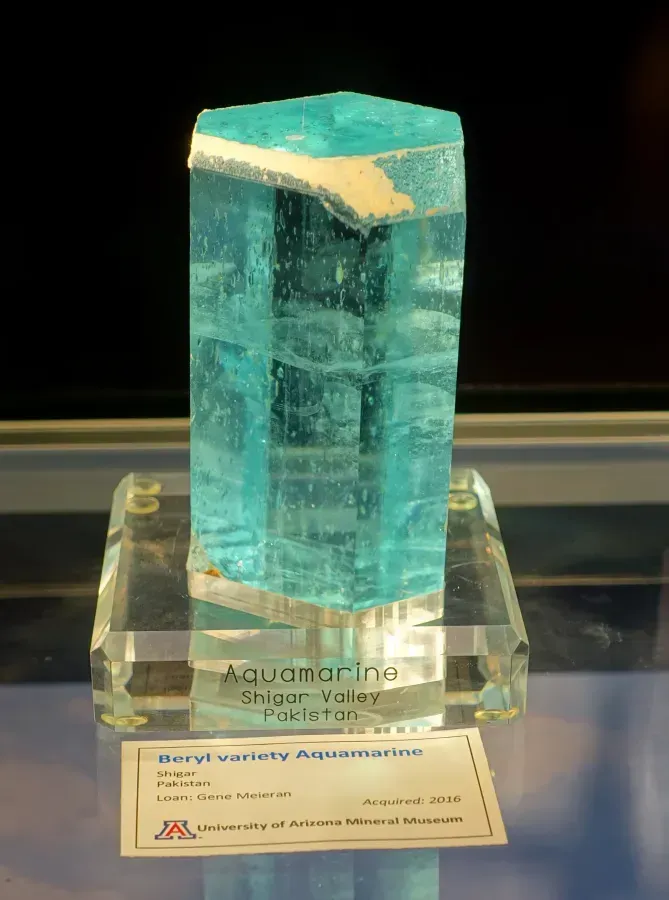
Gemmologists describe aquamarine colour along three axes: tone (light to dark), saturation and the purity of the hue (whether there is a green or grey cast).
- Saturated blue: intense and deep, like seawater at depth. The top of the price range.
- Clean medium blue: an even blue with no cast. The standard for good jewellery.
- Slightly greenish: a green cast lowers the price by 30-50%.
- Pale blue: light, and it reads as less expressive, especially under artificial light.
The ideal stone is coloured uniformly, with no banding or zones. Zoning (lighter in the centre, darker at the edges) counts as a flaw. For most people the sweet spot is a medium blue: very dark stones in a setting that lets in little light end up looking almost black.
Clarity is the second parameter. A stone that is "eye-clean" (no inclusions visible from 20-30 cm) costs 30-50% more than one with obvious inclusions. Unlike emerald, where inclusions are read as a passport of origin, in aquamarine it is transparency that is prized.
The cut delivers a third of the impression. The best performers are the oval, the cushion (soft corners maximise colour and hide inclusions), the emerald cut (step facets stress transparency but demand high quality) and the pear. The round gives the most brilliance, but any flaw shows on it. The cabochon is used rarely, only for cloudier stones.
What ultimately decides value
It helps to know how the parameters stack into a price, so that you do not overpay for the secondary ones. Colour does most of the work: a clean, saturated blue costs several times what a pale or greenish stone of the same size does. Clarity comes second, with an eye-clean stone worth markedly more than a hazy one. Cut quality is third, because it is the cut that releases both the colour and the transparency. Weight comes last.
That hierarchy is what separates aquamarine from diamond, where weight has historically pulled the price up almost in a straight line. With aquamarine a large but pale or cloudy stone loses to a smaller one that is clean and densely blue. So the sensible buying logic is simple: settle colour and clarity first, and only think about size with whatever budget remains. A medium-blue stone that is transparent and well cut will serve longer as a piece of jewellery than a large pale one that looks nearly colourless under artificial light, which in a British winter is most of the light it will ever be seen in.
Consistency across a parcel matters too. Aquamarines from a single crystal or a single dig hold one shade, and a set built from them looks coherent. Stones assembled from different sources almost always give a slight mismatch in tone, which shows up most cruelly in a riviere necklace or in drop earrings, where the eye compares two stones directly.
Trade names for colour: Santa Maria, Espirito Santo and the rest
The trade has evolved its own names for aquamarine shades, and they are easy to get lost in. The best known is Santa Maria. The name comes from the Santa Maria de Itabira mine in the Brazilian state of Minas Gerais, where in the middle of the twentieth century stones were found in a rare deep blue with no trace of green in them. That mine's reserves ran out long ago, so today Santa Maria denotes not an origin but a level of colour: a saturated, pure blue of the highest grade. Stones of that tone from Africa are sometimes sold as Santa Maria Africana, which is the more honest formulation, because it says outright that the source is different.
The name Espirito Santo belongs to lighter, transparent stones of an even blue from the neighbouring Brazilian state. They are softer in colour but flawless in clarity, and a good many buyers prize them precisely for the lightness of the tone. You will also meet the name Maxixe for a deep blue beryl, and here you should be on your guard: classic Maxixe beryl is coloured not by iron but by radiation centres, and its colour is unstable, fading in light within months. Natural aquamarine has no such defect.
The main thing to keep in mind is that an attractive name on a price ticket is marketing, not certification. Tone, clarity and the fact of treatment are settled by a laboratory, not by an evocative word printed next to a figure. Ask for the report rather than trusting the name.
Famous crystals and large stones
Aquamarine is one of those gems that grows to giant size in nature, and the large crystals have entered the record. In 1910 a crystal of around 110 kilograms was found in Minas Gerais in Brazil: a transparent blue-green column nearly half a metre long. It was sawn into hundreds of thousands of carats of cut stones, and for the market of the early twentieth century that was an event in itself.
Among large cut stones, the best known is the Dom Pedro: an obelisk around 35 centimetres tall and some ten thousand carats in weight, cut as an elongated column with internal facets. It is now in the collection of the Smithsonian Institution in Washington and counts as one of the largest cut aquamarines in the world. Its history carries a lesson: the original crystal was dropped during extraction and broke into three pieces, and only the largest of them yielded this masterpiece.
Stones of hundreds and thousands of carats point to a property of beryl worth understanding, because it explains something you will notice in any jeweller's window. Beryl crystals grow large and clean because pegmatite cools slowly and gives the molecules time to arrange themselves without interference. This is the same reason aquamarine in jewellery tends to be larger than ruby or emerald of a comparable clarity grade, and the reason a clean aquamarine is far easier to find than a clean emerald. Emerald grows in a chemically violent environment and carries the scars; aquamarine grows in a quiet one and usually does not.
Large crystals matter commercially as well. From a single big column a cutter obtains a parcel of stones in one uniform shade, which is a rare chance to assemble a coherent suite with no mismatch in tone. Finds of giant crystals therefore raise both collector and jewellery value, because they feed workshops with stones of one character for years afterwards. Small scattered crystals give nothing like that consistency, and building an even riviere out of them is a much harder job.
Treatment: what counts as normal and what is a warning sign
Most aquamarines on the market have been treated. This is an accepted gemmological practice, not deception, as long as it is disclosed.
Heat treatment
The most common method, and in practice the near-universal one. It is worth stating plainly what this means, because most buyers do not realise it: a large share of aquamarine comes out of the ground with a yellow-green undertone, and the pure blue that people think of as the stone's natural colour is very often produced in a kiln. The stone is heated to around 400 to 500 °C in a controlled environment, at which point the trivalent iron responsible for the green component rearranges, the green leaves for good, and what remains is the blue given by the divalent iron. Assume any blue aquamarine you are shown has been heated unless a laboratory report says otherwise.
The effect is permanent and irreversible, and no special care follows from it: a heated aquamarine will not fade in sunlight or revert in a warm room. On a certificate it is listed as heated. It barely affects price, by something like 5 to 10 per cent, because the method is standard and accepted throughout the trade. A confirmed unheated stone of good blue, by contrast, costs 30 to 50 per cent more, and that premium is paid by collectors rather than by people buying something to wear. If a seller presents heating as a scandal, or as grounds for a discount they are generously offering you, they are working on your unfamiliarity rather than telling you anything real.
Irradiation
Less common than heat. Irradiation alters the colour. The effect is usually stable, but it calls for care with strong ultraviolet: over decades in bright sun the colour can partly fade. On a certificate it is marked as irradiated. An irradiated stone costs 20-30% less than an untreated one.
Oiling
Rare for aquamarine (unlike emerald, where it is standard). It is used to mask surface fractures. If an aquamarine certificate lists oiling, that is a warning sign: the stone was damaged, and its durability is in question.
Synthetics and imitations
Synthetic aquamarine is grown by the hydrothermal method in a matter of weeks. Chemically and physically it is identical to the natural stone, three to five times cheaper, and fully transparent. A specialist will tell it apart under the microscope by characteristic growth features. For everyday wear it is an honest choice, provided the seller plainly calls the stone synthetic.
Glass looks blue but "dead": it lacks the play of light a crystal has and is lighter in weight. Blue topaz is a natural mineral, but a different one: half a point harder, more often irradiated for colour, glowing in a more glassy way. Synthetic spinel is a different mineral altogether, cheaper than glass.
Upload a photo of your pet, someone you love, or an object. We'll build a 3D model and hand-cast it in pewter.



How to tell a real aquamarine
A few checks that work without a lab.
Daylight. Look at the stone in natural light, not under the yellow lamps of a display case. Daylight reveals the true colour, the transparency and any cloudiness. A good aquamarine glows like water; glass looks flat.
Weight and chill. Aquamarine is denser than glass and stays cool against the skin for longer. A light "stone" that warms up fast is a reason to be wary.
Hardness. Aquamarine (7.5-8) scratches glass and is not scratched by a knife. If a knife leaves a mark, it is not aquamarine.
Inclusions. Under a loupe a natural aquamarine often shows fine parallel tube-like channels ("rain") or liquid inclusions. A flawlessly clean stone with no trace at all, and suspiciously cheap, is more often glass or a synthetic.
Certificate. For an expensive purchase, ask for a report from a recognised gemmological lab: it will state the nature of the stone, any heating or irradiation, and sometimes the origin.



Aquamarine among the blue stones
Aquamarine and sapphire
Sapphire is corundum (aluminium oxide) with a hardness of 9, markedly tougher and dearer. If you want maximum wear resistance for a stone you never take off, you choose sapphire. Aquamarine is softer (7.5-8) and gives a gentler, "watery" light: it passes through the stone rather than flashing from within. Among the blue gems aquamarine has rare neighbours, for instance larimar, which is mined in just one place on the planet.
Aquamarine and blue topaz
Blue topaz is harder (8), but it is almost always irradiated for colour and costs many times less. In a photo the two are easy to confuse; in a live comparison in daylight the difference shows at once: aquamarine is softer and more "watery", topaz is brighter and glassier.
Aquamarine and the other beryls
Morganite (pink) and goshenite (colourless) are comparable to aquamarine in rarity and price, but pink and clear pair with clothing differently. Aquamarine is the most versatile of the beryls by colour: blue works with almost any palette.
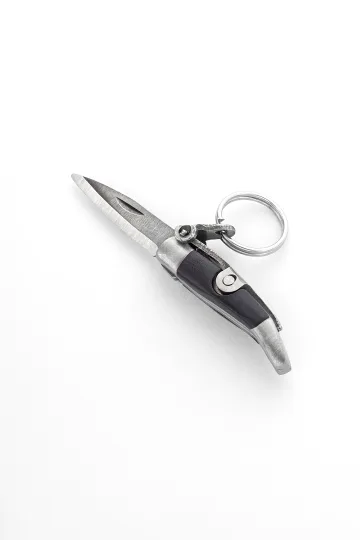
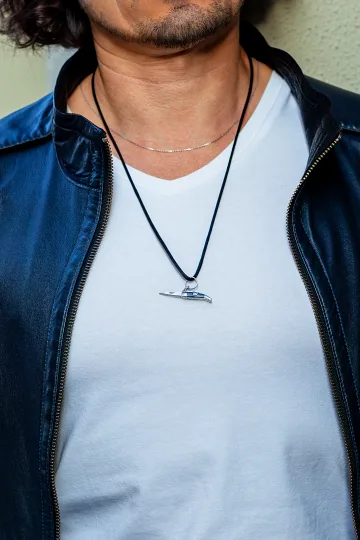
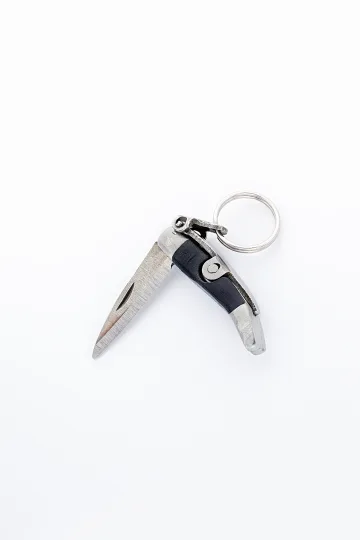
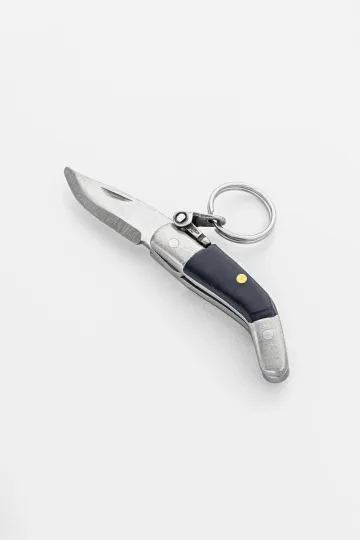
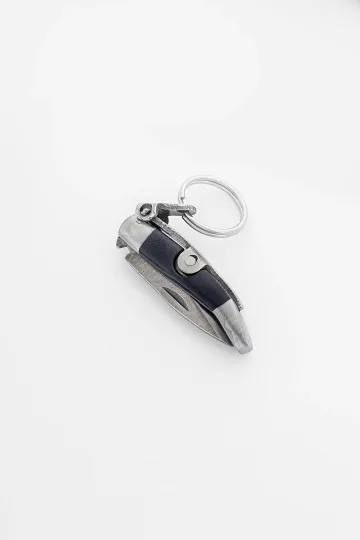
CAPAORA mini knife pendant
The 18th-century Spanish navaja in miniature: 40 mm of stainless steel, a real folding mechanism and a Palanquilla lock that clicks. An affordable gift to remember.
Authentic · Ships from Spain · 14-day returns
The history of the stone
Blue beryl has been known to people for several millennia, and its history is quite concrete, with no esoterics.
In ancient Egypt blue-green beryls were mined in the eastern deserts near the Red Sea. In Rome they were prized as the sailor's stone: Pliny the Elder, in his "Natural History" (first century), describes beryl and links it with the sea and water. The Latin aqua marina settled in as a name later, but the connection to the sea runs from here.
Archaeology offers hard evidence. At Pompeii, buried by the eruption of 79 AD, beryl beads turn up in townswomen's necklaces and gold pieces set with blue stones among the gentry, which means the stone was within reach of well-off Romans, not only the elite. In Scandinavian burials of the eighth to eleventh centuries, blue beryl beads appear beside runes and amulets: people who put to open sea without charts valued a stone the colour of calm water.
With the age of great discoveries, demand grew. Blue beryl remained the stone of those tied to the sea, an item of kit and of status on Spanish and Portuguese ships.
The turning point came in the nineteenth century. The discovery of large Brazilian deposits made aquamarine available for the first time beyond the nobility. Jewellery in the modern sense appeared, not amulets but the work of masters. Brazilian aquamarines were worn, among others, at the Spanish court (the parure of Queen Victoria Eugenie of the 1920s is well known); the stone came into fashion at the European courts.
In the mid-twentieth century Scandinavian modernism reimagined aquamarine as a stone of northern nature, ice and purity. At the same time, premium workshops began to position it as a gem in its own right, with its own history, rather than a cheap substitute for sapphire.
The birthstone of March and its symbolism
In the modern tradition of birthstones, aquamarine is the stone of March, and for those born that month it is a natural "own" stone. Nineteenth-century European jewellery writing linked blue beryl with faithfulness and sometimes called it the "bride's stone", the logic being simple: the blue of the open sky as an image of constancy. This is a cultural tradition, not a property of the mineral; there is no evidence that the stone influences a person.
Leave your email, we'll send your discount code. No spam, unsubscribe anytime.
The code arrives by email, valid on your first order.
Aquamarine jewellery: the formats
Aquamarine reveals itself differently depending on the type of piece and the cut.
Rings
A ring is where aquamarine is seen at its best. Light passes through the clear stone more gently than through a diamond. Tried and tested options:
- Solo ring: a single stone in a spare setting. It demands high quality, since there are no details to distract from the colour and clarity.
- Halo ring: a large oval surrounded by small clear stones. The halo boosts the brilliance and deepens the blue.
- Cushion: a cut with soft corners, comfortable for a large stone (3-5 carats) and good at working the inner glow.
- Engraved: on a large stone (from three carats) a master can carve a pattern or a word on the back. An old Mughal tradition.
A large stone (3-5 carats) reads as an accent, a small one (0.5-1 carat) as a restrained detail. For an everyday ring a smaller size is more comfortable: a large stone catches on things and calls for care.
Earrings
In earrings aquamarine catches the light on both sides of the face. Studs of 1-3 carats are the universal everyday option. Drop earrings on a chain sway gently and catch the light as you move, but they are mechanically more vulnerable. Cascade earrings with a stream of stones suit a celebration.
Pendants and necklaces
A simple pendant on a chain of 45-50 cm sits at the collarbone or over the heart, a classic for the next 400 years. Multi-strand necklaces and rivieres with stones set in a row demand evenness across every stone and read as a blue line on the skin.
Bracelets
On the wrist the stone turns and catches the light from new angles with every movement. A tennis bracelet alternating blue and clear stones looks like a continuous flow. A bracelet of aquamarine beads is the calm everyday choice.
Caring for aquamarine
Aquamarine is not fragile but it is delicate, and a couple of rules add decades to its life.
Cleaning. Warm water with a drop of mild soap and a soft brush (an old toothbrush or one made for jewellery). Go gently over the stone and the setting, rinse, and dry with a lint-free cloth. Between cleanings a glasses cloth is enough.
What to avoid:
- Ultrasonic and steam baths, which can open up internal fissures.
- Acids, harsh cleaning agents, chlorine.
- Stiff brushes that scratch the setting.
- Sharp temperature swings (hot steam then cold water).
When to take it off. At the gym, in the pool and at the beach (chlorine, salt, sand and the risk of loss), when cooking at a hot stove, when working with your hands. At the office and in ordinary life a ring and earrings are safe. Rings and bracelets are sensible to take off at night.
Storage. In a soft pouch or cloth, in a dry place, away from direct sun (long-term ultraviolet lightens the colour) and apart from harder stones that could scratch it. Every couple of years show the setting to a jeweller, especially if you wear the stone daily.
When you need a jeweller. If the stone wobbles in the setting, a chip or crack has appeared, the colour has visibly dulled or the setting is damaged. Do not put off a loose setting, since the stone can be lost.
On the road
Aquamarine has historically been the wanderer's stone, and it behaves conveniently when you travel. A ring is the safest option: it is on the finger, the risk of loss minimal. A pendant is easier to lose, a chain can break, so on the road it is best tucked into a case and in the hotel into the safe. Studs are safe and are rarely lost. The stone does not fear sea salt, sand or sun; it fears mechanical knocks and sharp swings of heat, so a hot beach and an icy pool back to back are out of bounds for it.
Who it suits and how to choose it as a gift
Aquamarine is a gift with meaning for several recipients. For the traveller, for the historical symbolism of the wanderer's stone. For someone born in March, as their personal birthstone. For anyone who suits a cool blue palette. As a second ring, not an engagement one, as a choice in favour of one's own aesthetic rather than convention.
When choosing, go by four parameters. Colour: blue, not green; the cleaner and more saturated, the dearer, but a light blue is beautiful too. Clarity: the stone should look transparent, with no visible clouds or lines. Cut: an oval, a cushion or an emerald cut bring out the colour best. Weight: for a first piece 1-2 carats in a pendant or 0.5-1 carat in a ring is plenty; a well-cut small stone impresses more than a large one of poor quality.
Ask about origin and treatment. A clearly stated deposit and an honest "heated" are a good sign. For an expensive purchase a lab certificate is sensible, along with the option to return the piece if in real life it looks different from what you expected.
Send a friend a discount code, they save on their first order.
Facts that surprise
Aquamarine looks like a straightforward stone, but there is plenty around it that rarely makes it onto a display card.
It is literally the same substance as emerald. Aquamarine and emerald are one mineral, beryl, with the same formula and the same lattice. The difference is a trace impurity: iron colours it blue, chromium colours it green. Change one element inside the crystal and instead of the sailors' stone you have the pharaohs' one.
The most beautiful stones started out green. A considerable share of aquamarine leaves the ground with a yellow-green undertone. The pure blue is given to it by heat: at around 450 °C the trivalent iron rearranges and the green goes for good. The tone people take for the most natural of all is, more often than not, made by hand in a kiln.
Cutters read a crystal along its length and across it. Aquamarine is pleochroic: along the main axis it is nearly colourless, across it a saturated blue. The cutter has to orient the rough so that the blue axis looks upwards. The same stone cut the wrong way loses half its colour. This is not lore, it is the optics of a birefringent crystal, and it is one of the reasons a well-cut small stone can outshine a badly cut large one.
Crystals grow the size of a person. Beryl is capable of producing giant crystals, and columns of aquamarine weighing a hundred kilograms and approaching half a metre in length are on record. The reason is prosaic: beryllium concentrates in slowly cooling pegmatites, and the crystal has millions of years to grow undisturbed.
Glowing in the dark is a myth. Aquamarine does not luminesce on its own. Under ultraviolet most specimens are inert or give a very weak response. The legend of the glowing sailors' stone is a good story that the physics does not support: blue beryl simply transmits daylight well, which is where the impression of an inner light comes from.
It is one of the cleanest of all gemstones. Unlike emerald, where inclusions are the norm and are read almost as a passport of authenticity, a good aquamarine is transparent to the eye. The buyer is paying precisely for that transparency rather than for a garden inside the stone. A flawless aquamarine is also far easier to come by than a flawless emerald of the same size, for the reason given earlier: beryl grows calmly in pegmatite, while emerald grows in a chemically turbulent setting that leaves marks on everything it produces.
It has rare relatives mined in a single place. The same beryl coloured by manganese gives pink morganite, and a different composition gives red beryl, mined essentially at one deposit in the state of Utah. Set against relatives like those, blue aquamarine looks like the most available and most versatile member of the family.
Buying it as a gift? Each one arrives ready to give.
 A branded Zevira box and a little card come with every order.








Frequently asked questions
How durable is aquamarine for daily wear? A hardness of 7.5-8 on the Mohs scale (for comparison: sapphire 9, diamond 10). That is enough for everyday wear, but you should avoid direct blows against hard surfaces. With normal handling a piece lasts for decades.
Can the colour fade in the sun? Long-term ultraviolet can lighten the stone slightly, but this happens over years of constant sun exposure. If you keep the piece in a box and simply wear it, fading is practically nil. The colour is restored with gentle heating by a gemmologist.
How does aquamarine differ from blue topaz? They are different minerals. Topaz is half a point harder, almost always irradiated for colour and many times cheaper. In a live comparison in daylight aquamarine gives a soft "watery" light, while topaz is more glassy.
Almost all aquamarines are heated, so is it a fake? No. Heating to 400-500 °C removes a greenish cast and gives a clean blue. This is a standard and honest procedure, listed on the certificate. A confirmed unheated stone is rarer and costs more.
Does natural aquamarine glow in the dark? No. That is a legend. Some minerals give a faint luminescence under ultraviolet, but aquamarine has no glow of its own in the dark.
How can you tell a natural stone from a synthetic one? A specialist tells synthetics apart under the microscope by their growth features. For certainty on an expensive purchase, request a report from a recognised lab, which will state the nature of the stone and any treatment.
Is aquamarine suitable for an engagement ring? It is, if what matters is colour and character rather than maximum wear resistance. For a stone worn without taking it off for years, sapphire (hardness 9) is tougher. It makes sense to protect aquamarine from knocks.
Can a piece be passed down as an heirloom? Yes. Beryl is one of the most stable stones. With careful storage and a check of the setting every few years, a piece moves calmly from one generation to the next. Sterling 925 silver darkens over time but cleans easily.
Does perfume harm aquamarine? Scents do not damage the stone itself. The alcohol in perfume can dull silver over time, so do not spray perfume directly onto the piece.
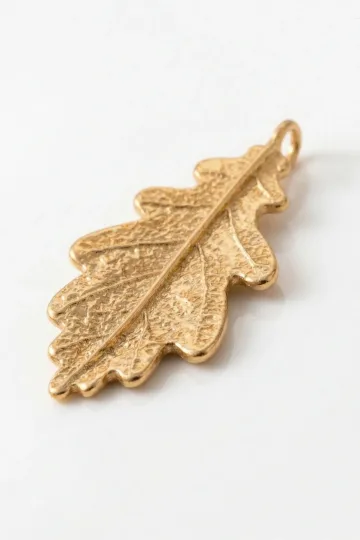
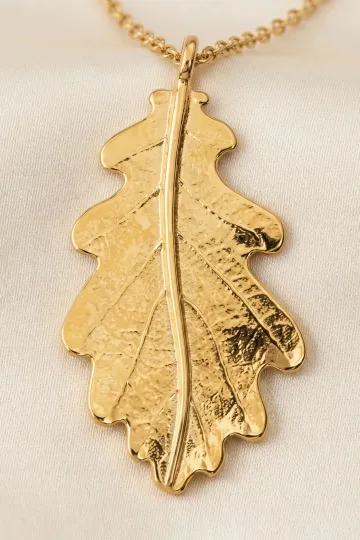
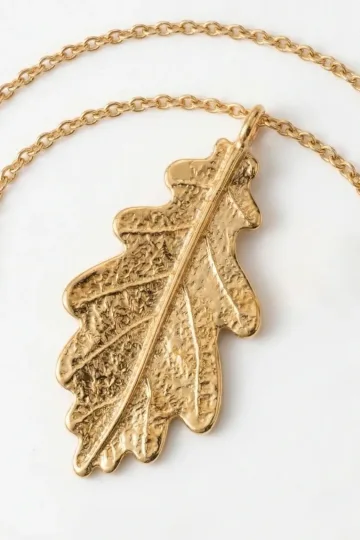
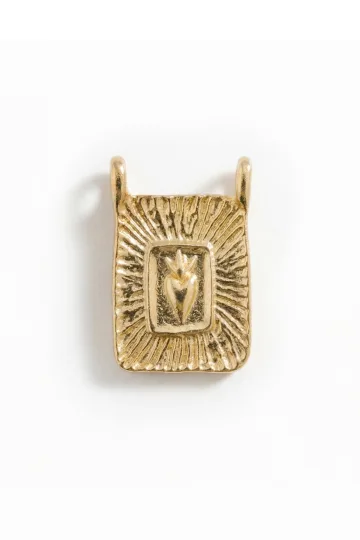
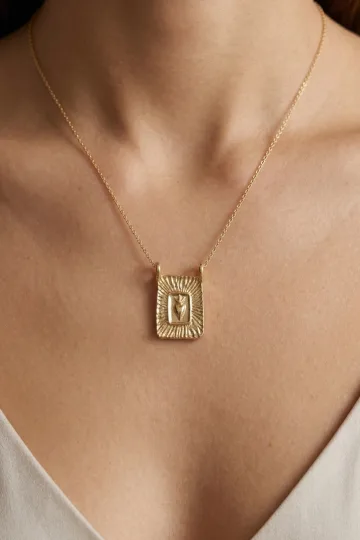
Wear the symbol, don't just read about it. These are in stock:




About Zevira
Zevira works with aquamarine as a stone that carries a thousand years of history and a clear mineralogy behind it. We select stones by colour, transparency and the quality of the cut, and we favour suppliers with a traceable origin, above all Brazil and Madagascar, where quality is consistent.
We make settings from sterling 925 silver: it underlines the coolness of the blue and, unlike gold plating, cleans up and lasts. Sets can be built up gradually, one piece at a time, since aquamarines from a single batch hold a single shade.
We work on the basis that jewellery is bought for the long term, and we stand behind it: we fix manufacturing defects and help sort out a loosened setting so the stone is not lost.