Apatite in Jewellery: The Stone of Every Colour, Its Make-up, Varieties and Care
Mineralogists named this stone from the Greek "apatao", "I deceive". Not out of spite, but out of fairness: for centuries apatite was mistaken for aquamarine, then beryl, then tourmaline. The colour, the lustre and the crystal shape line up almost exactly, yet what you actually hold is a completely different mineral, twice as soft. That talent for disguise is the whole of its character: a stone you have to learn to recognise.
What apatite is: the chemistry and physics of the stone
Apatite is a group of calcium phosphates with the general formula Ca5(PO4)3(F,Cl,OH). The third component in the brackets splits the group into three minerals: fluorapatite (fluorine), chlorapatite (chlorine) and hydroxylapatite (the hydroxyl group). In jewellery you most often meet fluorapatite, the most stable of the three.
This is the same mineral that builds the enamel of our teeth and a large part of our bone tissue. That is why the word "apatite" is familiar to a geologist and a dentist alike.
The basic properties worth memorising before you buy:
Wear the symbol, don't just read about it. These are in stock:



- Mohs hardness: 5. Apatite actually defines point 5 on the Mohs scale, it is the reference mineral. For comparison: quartz 7, topaz 8, sapphire 9, diamond 10. So apatite is softer than most everyday gemstones and can be scratched by a steel knife and a windowpane.
- Hexagonal crystal system. The crystals grow as six-sided prisms, often with a flat or pyramidal top. That geometry shows up both in natural specimens and in the cut: even faces, clean lines.
- Density around 3.16-3.22 g/cm3. The stone feels noticeably lighter in the hand than its size suggests.
- Refractive index 1.63-1.64, with weak birefringence (around 0.002-0.008). The lustre is vitreous, reaching greasy in opaque specimens.
- Low dispersion (around 0.013), so do not expect the fire you get from a diamond.
- Pleochroism is noticeable in the coloured varieties: the same crystal can look blue from one angle and greenish from another.
- Brittleness and cleavage. Cleavage is imperfect, but the stone is brittle and dreads a knock. The fracture is conchoidal.
Pure apatite is colourless. The whole palette comes from impurities: ions of iron, manganese and rare-earth elements replace calcium in the lattice and absorb part of the spectrum. Blue is usually linked to rare-earth elements, green to impurities that give a yellowish-green tone, violet and pink to manganese. Many apatites also luminesce under ultraviolet, glowing yellow, orange or lilac.
How apatite forms in nature
Apatite is one of the most common phosphates in the Earth's crust, yet very little of it reaches gem quality. It forms in three ways.
Magmatic. Apatite crystallises straight out of cooling magma and turns up as an accessory mineral in almost every igneous rock: granite, syenite, basalt. Slow cooling at depth grows the large transparent crystals that go for cutting.
Metamorphic. When sedimentary or igneous rocks come under high pressure and temperature, apatite recrystallises within marbles and gneisses. This is how, for example, the clean specimens from carbonate rocks are produced.
Sedimentary. Phosphorus builds up from the remains of marine organisms, forming thick beds of phosphorite. This is raw material for fertiliser, and almost no gem crystals are taken from it.
The key sources of gem apatite today are Madagascar (the bright neon-blue material), Brazil (Minas Gerais, Bahia) and Mozambique, as well as Myanmar, Sri Lanka, Canada, Norway, Mexico and the United States. Across Europe, notable historic apatite localities include Norway's Bamble district and the Alpine fissures, long described in old mineralogical works.
Neon apatite dies grey under a warm lamp. You want that electric blue? Drag it to the window, and don't argue.
How to wear apatite
Over years on shoots I have worked apatite in every shade, from neon blue to peach. Here is what actually holds a look together, sorted by occasion.
What do I wear apatite with every day? For daily wear I recommend blue apatite next to a basic wardrobe: a white shirt, grey knitwear, light denim. Against a plain background the sky tone reads cleanly, without noise. Stud earrings or a slim pendant on a 45 cm chain are enough here to make the look feel pulled together without dressing it up. Under a deep neckline I suggest a pendant, under a closed neck earrings, so the face is not left bare.
Is it right for the office? Yes, as long as you keep it restrained. I recommend green apatite in silver, or a brooch with the stone on a lapel: it looks fitting and does not pull attention from work. Cool clothing tones (navy, grey, charcoal) support a blue or green stone, warm ones (beige, sand, chocolate) light up the yellow and peach. I choose a plain fabric, a loud print drowns the stone.
How do I build an evening look? For evening I choose contrast: a black dress and blue apatite in drop earrings. A deep neckline opens the neck, and the stone on a chain works as a point of light. Here you can leave strict minimalism and build a layer: a fine chain plus a long pendant, two shades of apatite together. Blue beside violet gives a soft, gradient play.
Can I wear an apatite ring every day? I would not. Apatite is soft, hardness 5, and on the hand it quickly picks up scratches from a desk and a keyboard. If you really want a ring, I choose a closed setting that shields the stone, and I keep it for special days rather than for cleaning and the gym. For daily wear apatite lives in earrings and pendants, where nothing knocks it.
How do I pick apatite for myself? I start from the metal: silver refreshes and suits a cool colour type, yellow gold adds warmth and suits olive skin. Then two rules that never fail. First: one accent at a time, apatite does not get on with a crowd of sparkling stones nearby. Second: match the chain length to the neckline, a short one (40-45 cm) for an open neck, a long one (50-60 cm) for a closed top.

Turn on your camera, pick earrings, a pendant or a ring, and see the piece on yourself in real time.
Switch items in one tap.
Everything runs in your browser: no photo or video is ever uploaded.
A short history of apatite
The long story of apatite is the story of a muddled-up stone. Until the late eighteenth century it was not singled out as its own mineral: blue crystals were filed under aquamarine and beryl, green ones under tourmaline, transparent ones under chrysolite. The mineral was given the name "apatite" in 1786 by the German geologist Abraham Gottlob Werner, precisely for this habit of passing itself off as other stones.
In jewellery, apatite long stayed in a supporting role. The reason is simple and honest: a hardness of 5 stands up poorly to the knocks of everyday wear, and there were plenty of tougher gemstones to choose from. In the nineteenth century, on the wave of interest in inexpensive but expressive stones, apatite was set now and then into brooches and pendants, but no mass fashion ever took hold.
Apatite turned out to matter most not for jewellers but for industry and science. Its main use is as a source of phosphorus for fertiliser: without phosphate raw material there would be no modern farming. Synthetic hydroxylapatite is used to make bone and dental implants, a material biocompatible with the body. And geologists use apatite to date rocks by fission-track analysis: from the tracks left by uranium decay in the crystal they reconstruct the thermal history of a patch of the crust.
Apatite came back into full jewellery use only recently, when people began to value colour and oddity rather than a loud name. The bright neon-blue variety from Madagascar gave it the biggest lift.
The colour varieties of apatite
Apatite is not one stone but a whole family of shades, and the varieties are sorted by colour.
Blue apatite
The most popular variety. The colour runs from a soft sky tone to a deep saturated blue. Especially prized is the neon "paraiba" blue from Madagascar, a pure tone that seems lit from within, with no green or grey undertone. Transparent stones of rich colour are the most expensive in the group.
Green apatite
From a fresh lettuce green to a dark grass green. It is rarer than the blue and is easily confused with tourmaline and beryl. There is a variety called asparagus stone, a yellowish-green apatite named for the colour of young asparagus.
Yellow apatite
Pale-yellow and honey-golden crystals. They are easy to mistake for citrine or yellow topaz, but apatite is softer and usually duller in its fire.
Violet and lilac apatite
The colour comes from manganese. A rare and showy variety, close in appearance to amethyst but softer and gentler in feel.
Pink and peach apatite
Pale pink through to peach tones, again from manganese but at a lower concentration. A rarity.
Colourless apatite
Transparent crystals without impurities. Once faceted they give a bright sparkle, but because of their softness this apatite stays more of a collector's stone than an everyday one.
Cat's eye and pleochroism
With a large number of parallel inclusions, a band of light appears across a cabochon of apatite, the cat's eye effect. And thanks to its birefringence, coloured apatite shows pleochroism: at different angles the stone reveals different shades of the same colour. Sometimes blue and green zones combine in a single crystal, and such two-tone material is valued above the single-colour kind. Natural two-colour zoning of this sort also appears, by the way, in ametrine, where violet and yellow zones sit side by side in one crystal without any treatment.
Customer reviews
Zevira is a real jewellery shop. Genuine payments, deliveries and customer thank-yous.
🥰🥰🥰 gracias

Ok, ¡gracias! 🙂

How to tell apatite from look-alike stones and fakes
Apatite disguises itself as several gemstones, and it is easy to be fooled. Three things help: hardness, lustre and the character of the inclusions.
Hardness, the main giveaway. Apatite (5) is markedly softer than its doubles: aquamarine and beryl (7.5-8), tourmaline (7-7.5), quartz (7), topaz (8). Any of these will scratch apatite, while apatite will not scratch them. On a finished piece this test is done carefully and in a hidden spot, and is best left to a gemmologist.
Lustre and dispersion. Apatite has a vitreous but calm lustre, with no bright flashes of fire, and low dispersion. If a stone "shoots" coloured flashes, it is most likely not apatite.
Inclusions. Natural apatite nearly always contains fine needles, tubular channels and "healed" cracks. Glass gives itself away with round gas bubbles and swirling flow lines. A "too clean", perfectly transparent "apatite" at a throwaway price is reason to be wary.
What it gets confused with, exactly:
- Aquamarine and beryl: a similar blue and green colour, but they are harder and dearer.
- Tourmaline (green in particular): a close shade, but a different, trigonal structure and a higher hardness.
- Citrine and topaz: rivals of the yellow variety.
- Glass and dyed quartz: frequent imitations, betrayed by bubbles, the ease of faking, and the hardness of quartz.
- Synthetic apatite exists, but is rarely seen in jewellery: it is cheaper to imitate with glass.
What matters about treatment. Some of the blue material is heated to remove a greenish or cloudy tone, while fractured stones are sometimes impregnated with colourless resin or oil. Heating is a stable treatment, impregnation is not, and the seller is obliged to disclose it. For expensive stones it is worth asking for a report from a gemmological laboratory.
Cutting apatite: why the shape decides a great deal
A cutter working apatite is operating on the edge of the possible. Hardness 5 and brittleness mean the stone crumbles on the polishing wheel, so the cutter takes it more slowly and under less pressure than the familiar quartz or topaz. This raises the cost of the work and explains why a well-cut apatite is rarer than the rough.
Transparent, saturated stones are usually given a brilliant or a step cut (emerald, asscher, baguette) to pull out the colour and the brightness. Pale and less clean stones go into cabochons: the smooth dome hides inclusions and gathers the light into a soft pool, and at the same time it reveals the cat's eye where one exists.
What to look at in a finished cut:
- Windowing. If you can see the table below the stone through it and the centre looks washed out, the pavilion is too shallow and is returning no light. With apatite this is a common flaw: the cutter spares the weight and makes the stone flat. A well-cut apatite does not "fall through" against the light.
- Symmetry of the facets. Because of brittleness the facets easily come out uneven in size. Even edges and pavilion lines that meet at a single point are a mark of careful work.
- Girdle thickness. Too sharp an edge on apatite chips during setting. A slightly thickened girdle is not a fault for this stone but a protection.
Upload a photo of your pet, someone you love, or an object. We'll build a 3D model and hand-cast it in pewter.




Apatite at the jeweller's: repair, sizing, setting
This is rarely written on the showcase, but this is exactly where apatite most often comes to grief. The stone dislikes the workshop, and there are a couple of things worth knowing in advance.
Heat during soldering. Apatite tolerates sudden heat and thermal shock poorly. If a ring needs to be taken in or made bigger and the stone has not come out of the setting, a soldering iron or torch near it risks a crack along the cleavage. A competent jeweller unscrews the apatite from the setting before any soldering rather than soldering "around" it. Ask about this directly when you hand a piece in for repair.
Ultrasonic cleaning in the workshop. A standard ultrasonic bath, used to clean gold with diamonds, is off-limits for apatite. If you give a ring in for cleaning or polishing, warn them that the stone is soft and brittle: otherwise it will be run through the general cycle along with the hard stones.
Setting. When seating a stone in prongs the jeweller presses on the girdle, and on apatite that chips easily. So for this stone a closed (bezel) setting, or a half-closed one with a thick rim, is preferable: the metal takes the knock instead. Thin, sharp prongs on apatite catch on fabric over time and break off the edge of the stone.
Ring size. If an apatite ring is tight, it is better to take it a size looser from the start than to size it up later: every sizing operation means heat and mechanical strain, which a soft stone dislikes.



Colour and source: how to read the origin
The colour of apatite often gives away where it comes from. It is not a strict passport, but a working guide when you choose.
Madagascar gave apatite a second life: that famous neon blue, lit from within, which made the stone fashionable, comes from there. If a seller says "neon paraiba apatite", they are almost always talking about Madagascan material.
Brazil (the states of Minas Gerais and Bahia) is known for blue and blue-green apatite, as well as the yellow-green "asparagus stone". Brazilian crystals are often larger than the Madagascan ones, but their tone is calmer, without the neon glow.
Myanmar and Sri Lanka supply, among other things, the material for cabochons with the cat's eye effect. Canada (Quebec, Ontario) and Norway are known for large greenish-yellow crystals, the very ones by which apatite was described in the old mineralogical works.
The practical conclusion: if it is the glowing neon that matters to you, look for Madagascan origin, and do not overpay for the "neon" label where the tone is in fact the calmer Brazilian one.
How to choose apatite when you buy
The price of apatite rests on four things: colour, clarity, cut and size. Let us go through, in order, what is really worth checking.
Colour matters most. A pure, saturated, even tone with no grey or cloudy undertone is what is prized. The dearest is the neon "paraiba" blue from Madagascar: it seems to glow from within even in room light. Pale, "diluted" shades cost noticeably less. Look at the stone in daylight and under a lamp: apatite is sensitive to the source, and a tone that is lovely under showcase lighting sometimes turns grey by day.
Clarity. For the transparent varieties take a stone that is clean to the eye (eye-clean): inclusions are not visible without a loupe at arm's length. Fine needles inside are normal and even confirm that the stone is natural, but large cracks are dangerous: soft apatite splits along them under a knock or during setting.
Size and rarity. Here is an honest guide that changes expectations: clean, saturated apatites larger than 2-3 carats are rare, and the bulk of gem material is stones of up to a couple of carats. A big crystal more often turns out to be pale or included. So a large, clean, vividly coloured apatite is valued out of all proportion to its size, and you will not be able to gather "a lot of stone" cheaply the way you can with quartz.
Pleochroism to your advantage. In coloured apatite the colour changes with the angle. A skilled cutter orients the stone so that the most beautiful shade faces up. Turn the piece: if from one angle the tone visibly sags into grey, the stone has been set badly.
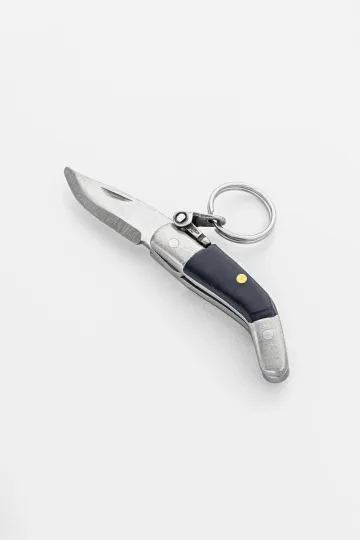
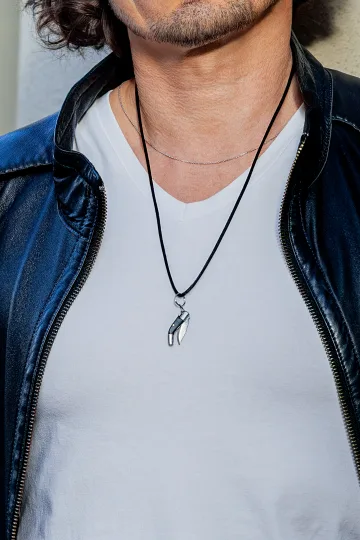
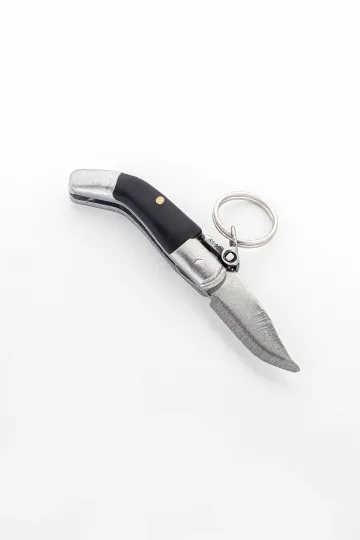
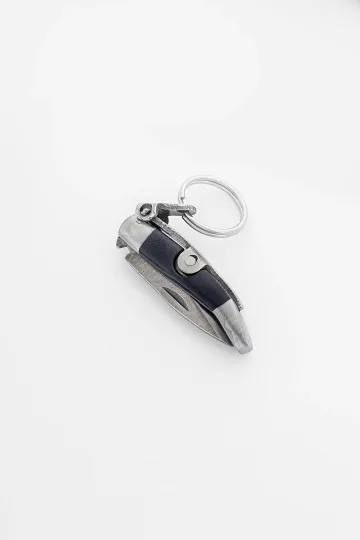
CAPAORA mini knife pendant
The 18th-century Spanish navaja in miniature: 40 mm of stainless steel, a real folding mechanism and a Palanquilla lock that clicks. An affordable gift to remember.
Authentic · Ships from Spain · 14-day returns
Caring for apatite
The whole practice of care flows from one fact: hardness 5 and brittleness. Apatite scratches easily, dreads a knock, and dreads sudden swings of temperature.
Cleaning. Only warm water, a drop of mild soap and a microfibre cloth. No ultrasonic or steam cleaning, the vibration and the hot steam can run along the cracks and split the stone. Hard brushes and abrasive pastes are out.
Storage. Apart from hard stones, in a soft pouch or a separate compartment of the box. Quartz, topaz and sapphire in a common heap will scratch apatite within a couple of outings.
Wearability. Hardness decides outright what to set the stone into. The most successful formats are earrings, pendants and brooches: there the stone is protected from knocks and friction. Rings and bracelets of apatite are an option for special occasions, not for every day: on the hand the gem quickly takes on scratches and loses its lustre. If you do want a ring, choose a closed (bezel) setting that covers the girdle, and take the piece off before housework, sport and water.
What to avoid. Household chemicals, perfume, acids, the swimming pool and the sea (chlorine and salt water harm both the stone and the setting), long spells of direct sun for the very palest specimens. Jewellery goes on last, after make-up and scent.
The symbolism of apatite
In crystal lore, blue apatite is traditionally linked to clarity of thought and communication, green to balance, yellow to confidence. It sounds lovely, but it is worth treating as a cultural tradition rather than a fact: the stone has no proven physical or therapeutic action, and any "energy" properties are unconfirmed by science. Apatite is first and foremost a beautiful mineral, and people wear it for the colour, not for an effect.
More curious is the entirely earthly side: the same calcium phosphate that makes up gem apatite forms the basis of our bones and tooth enamel. The bond between this stone and the body is not a metaphor here, but chemistry.
Leave your email, we'll send your discount code. No spam, unsubscribe anytime.
The code arrives by email, valid on your first order.
Apatite and similar stones: which to choose
If the choice is between apatite and a harder gemstone, the guide is simple: the wear scenario.
Apatite and aquamarine. Both are blue, but aquamarine (7.5-8) is far harder and lives calmly in an everyday ring. Apatite is brighter and more saturated in colour, especially the neon Madagascan kind, but calls for a gentle format: earrings, a pendant.
Apatite and quartz. Quartz (7) is more practical and cheaper, the choice for everyday rings. Apatite wins on colour and on the "glowing" blue that quartz never has.
Apatite and topaz. Topaz (8) takes a knock and sparkles brighter. Apatite is softer and gentler in tone, and is chosen for a particular shade rather than for durability.
Apatite and amethyst. This is the overlap in the violet zone. Amethyst is more affordable, harder (7) and more stable, and easier to find. If it is specifically a violet stone for every day that you need, it makes more sense to look towards amethyst. Violet apatite is a rarity for special occasions.
In the same calm blue-green range, apatite is close to amazonite, which is more matte and larger in bead form, and looks good in bracelets.
How apatite looks in nature
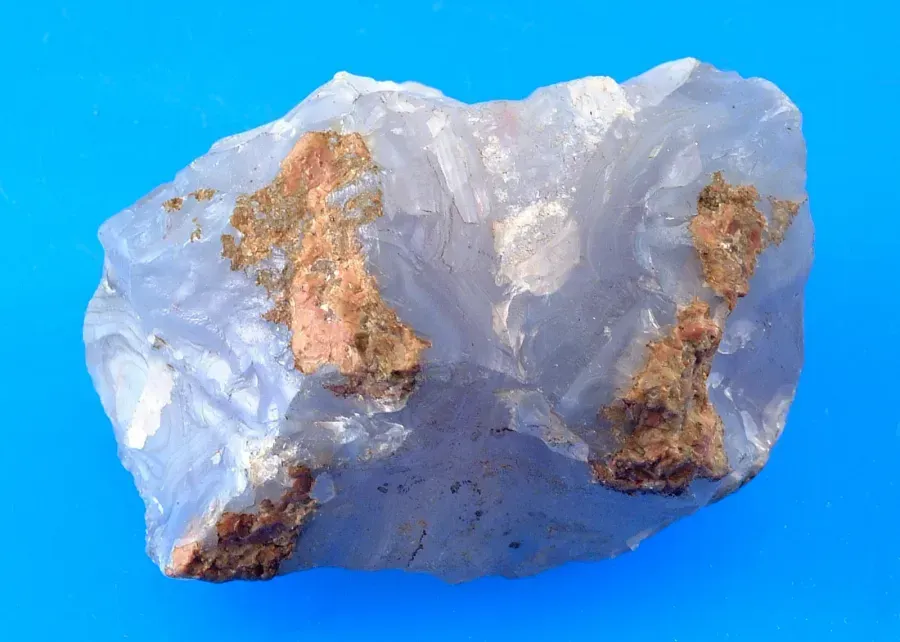
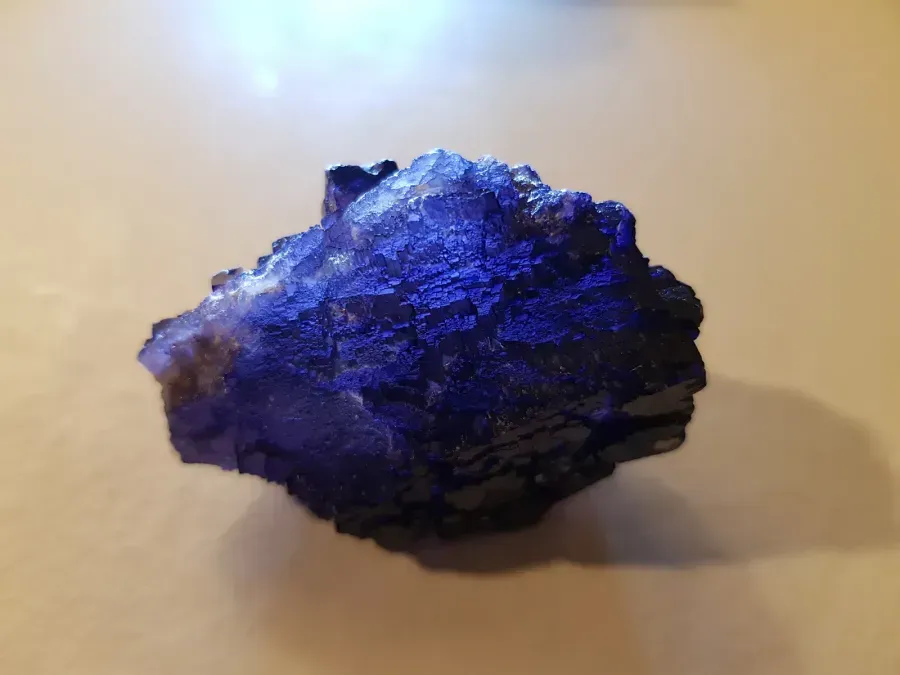
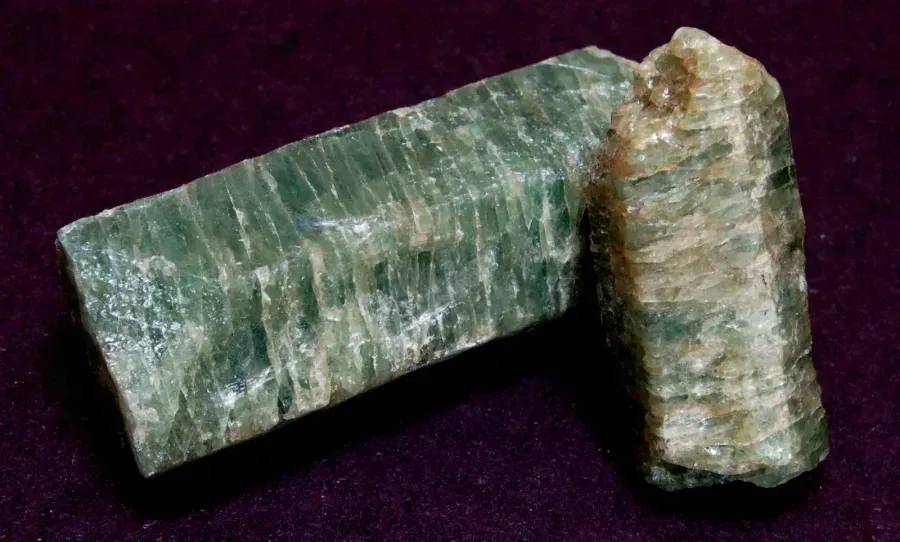
Natural apatite grows in its characteristic six-sided prisms, a direct consequence of the hexagonal crystal system. The faces are even, the top flat or pyramidal, the lustre vitreous. The colour depends on the source and the impurities: the Quebec crystals in the photo are greenish-yellow, the Madagascan ones neon-blue. It is by these hexagons with their clean edges that apatite is recognised in a mineral collection, although the geometry is lost in the cut.
Where the neon light comes from: the chemistry of colour
The question every apatite enthusiast asks sooner or later is why a Madagascan blue looks plugged into the mains while a Brazilian stone of much the same tone glows quietly. The answer lies in how impurity ions sit in the crystal lattice and what they do to light passing through it.
Why blue apatite seems lit from within
Pure calcium phosphate is colourless and lets almost the whole visible spectrum through. Colour appears when some of the calcium in the lattice is replaced by ions of other elements: they absorb particular wavelengths, and the eye sees what is left over. In the neon blues a rare combination is at work. The impurities knock out the red and orange parts of the spectrum almost completely, and what emerges is a narrow, extremely clean band of blue. The narrower that band, the more electric the stone looks. In calmer Brazilian material the transmitted band is wider, with a little green and grey still in it, so the glow is softer and more like an ordinary blue gem.
This is also why photographs of neon apatite so often disappoint. A camera sensor handles a narrow spectral band badly and tends to flatten it toward an ordinary sky blue, which is one reason the stone is far better bought in person than from an image.
The part played by rare earth elements
Apatite is well known for its appetite for rare earth elements: the lattice takes in cerium, neodymium, praseodymium, europium and their neighbours readily. These ions produce fine, narrow absorption lines, and it is those lines that account for the saturated blues and for the fluorescence under ultraviolet. A gemmologist can sometimes read an apatite spectrum rather like a barcode, using the pattern of narrow lines to separate a natural stone from an imitation. The same appetite makes apatite an important ore mineral for rare earths in its own right, quite apart from anything to do with jewellery.
Why apatite is so sensitive to the lighting
A narrow transmission band cuts both ways. A stone with a sharply defined spectrum depends heavily on what you shine at it. Warm domestic lighting is poor in the blue part of the spectrum, so a blue apatite under a filament bulb turns noticeably grey and flat, then flares back into life under daylight or a cool white LED. This is not a fault in the stone; it is the direct consequence of the same narrow window that makes the Madagascan tone so striking in the first place. Always look at the stone under both a warm light and a cool one before you buy, and ideally by a window as well. If you mostly wear jewellery in the evening under warm lamps, a slightly greener or deeper stone will serve you better than the most electric one on the tray.
Where the cat's eye comes from
The cat's eye effect is not produced by the apatite itself but by the order of the inclusions within it. When thousands of fine parallel channels or needles grow inside a crystal, light scattered from them gathers into a single bright line across the stone. To bring that line out, the material has to be cut as a cabochon and oriented precisely, with the axis of the dome set at right angles to the needles. If the cutter misjudges the angle the band spreads out and blurs, or vanishes altogether. That is why a good apatite cat's eye with a crisp band that slides across the dome as you tilt it is valued separately from ordinary cabochon material, and why so many attempts end up as dull, milky stones.
The sources of apatite in more detail
The apatite map is wider than the three fashionable addresses that appear on a showcase card. Each district has a characteristic look, and knowing those differences keeps you from paying a premium for a label alone.
Madagascar: the neon capital
The south of the island gave apatite its second life in jewellery. The blue and blue-green material from there has the lit-from-within quality that people buy the stone for in the first place. Crystals tend to be modest in size, clean saturated stones above a couple of carats are genuinely uncommon, and it is that combination of small size with intense tone that holds the price up. A good deal of Madagascan blue is gently heated to clear a greenish haze and pull the colour toward a clean sky blue. Material from this source is what most sellers mean when they simply say "neon apatite" without naming an origin.
Brazil: larger crystals in a calmer key
Minas Gerais and Bahia produce blue, blue-green and yellow-green apatite. Brazilian crystals are frequently larger than Madagascan ones, but the tone is more even and quieter, without the electric edge. This is also the classic source of asparagus stone, the yellowish-green material that gave apatite its oldest jewellery nickname. For anyone who cares more about size and a calm, wearable colour than about maximum intensity, Brazilian material is usually the more sensible buy, and it makes up the bulk of larger faceted apatites on the market.
Mozambique and East Africa
Mozambique supplies saturated blue and greenish-blue apatite, close in character to the Brazilian material. The region as a whole is rich in phosphate pegmatites, and gem-quality apatite tends to come out alongside other coloured stones rather than as the object of the search. Good Mozambican stones hold their colour evenly through the whole volume, without the zoned patches that spoil so much apatite, which makes them a reliable choice for a larger centre stone.
Myanmar, Sri Lanka and India
These countries are known above all for cabochon material with a cat's eye: the local apatite is often thick with parallel inclusions. Transparent bluish-green crystals turn up here too. India adds violet and lilac stones coloured by manganese, which come from the rarest part of the palette and are almost never seen in commercial quantities. Sri Lankan gravels have yielded apatite alongside sapphire and spinel for centuries, and a fair number of old European stones sold as something else came out of them.
Canada, Norway and the older mineralogy
Quebec and Ontario in Canada, together with the Norwegian deposits, produced the large greenish-yellow crystals on which nineteenth-century mineralogists based their descriptions of the species. The jewellery value here is modest, but the collecting value is considerable: the clean large hexagons from these mines fill museum cases, and specimens from the Norwegian localities in particular are prized by collectors. Anyone visiting the mineral galleries of the Natural History Museum in London will find apatite from this northern group among the phosphates.
The Kola Peninsula: apatite as an industrial giant
The Khibiny deposits on the Kola Peninsula are among the largest sources of apatite anywhere, but almost all of it is industrial: raw material for phosphate fertiliser rather than for gemstones. There is even a town named directly after the mineral it grew up beside. Transparent gem-quality crystals are a rarity within that enormous tonnage, which is why this source is known to agriculture and barely at all to jewellers. It is a useful reminder of scale: the world mines apatite by the tens of millions of tonnes a year, and the fraction that reaches a jeweller's bench would fit in a shed.
Treatments: what is done to apatite
Treatment matters more with apatite than with most stones, because the material is soft and often full of fractures, and the temptation to improve it is strong. A buyer is well served by knowing the difference between a stable improvement and cosmetic work that will not survive ordinary care.
Heating: a stable improvement
The commonest treatment on blue material is careful heating. It removes a greenish or greyish undertone and leaves the blue cleaner and brighter. Because heat alters the colour at the level of the lattice itself, the result is stable and needs no special handling beyond the usual caution appropriate to a soft stone. Apatite is heated more gently than harder gems: a sharp thermal shock will simply crack it. Heated blue apatite makes up most of what is sold, and reputable dealers state it as a matter of routine rather than as a confession.
Resin and oil impregnation
Fractured stones are sometimes impregnated with colourless resin or oil to disguise a network of cracks and lift the apparent clarity. This is cosmetic work. The filling clouds over time, and it reacts badly to solvents, heat and ultrasonic cleaning. An impregnated stone needs particularly careful handling and should cost noticeably less than a clean one. A dealer worth buying from will name the treatment without being pressed twice.
Irradiation and dyeing
Less commonly, apatite is irradiated to deepen colour, or cheap fractured material is surface-dyed. Dyed stones give themselves away under a loupe through concentrations of pigment sitting in the fractures, and often through a colour that looks like a coat of paint rather than something coming from inside. For a significant purchase it is worth asking for a laboratory report, which will separate a natural colour from an induced one and identify the type of treatment. In Britain the usual route is a report from one of the established gemmological laboratories, and any dealer used to selling coloured stones will know how to arrange it.
How to ask about treatment properly
The simplest form of words at the counter is: has this stone been heated, filled or dyed. An honest answer about heating is entirely normal, since heated blue apatite accounts for most of the market. Filling and dyeing are the ones you need to know about in advance, because they change both the price and the rules for looking after the piece. A seller who will not answer a direct question is telling you something in itself. Under the Consumer Rights Act a description given at the point of sale forms part of the contract, so it is worth asking for the answer in writing on the receipt for anything expensive.
Send a friend a discount code, they save on their first order.
Apatite, bone and teeth: where the stone meets biology
The oddest thing about apatite is that it is both a mineral out of the ground and a structural material in the human body. The same chemistry is at work in a crystal from a mine and in the enamel of a tooth.
The same mineral in enamel and bone
Tooth enamel is very nearly pure hydroxylapatite, the hardest substance in the human body. Bone tissue is likewise built on apatite, interwoven with the protein collagen. So gem apatite and your own skeleton are relations by composition: one calcium phosphate, grown under very different conditions. The difference in hardness comes from structure rather than chemistry, since enamel is a dense mass of tiny crystallites rather than one large transparent crystal.
Fluoride and fluorapatite in the mouth
When tooth enamel is treated with fluoride, some of the hydroxylapatite converts to fluorapatite, which is exactly the durable variety valued in jewellery for its stability. Fluorapatite dissolves less readily in acid, and that is precisely how fluoride protects teeth from decay. The link between a tube of toothpaste and a faceted crystal is direct and chemical. Where the water supply is naturally fluoridated, as in parts of the West Midlands and the north east of England, the same conversion happens slowly through drinking water.
Apatite in medicine
Synthetic hydroxylapatite is used as a coating for bone and dental implants: the body accepts it as its own material and grows directly onto the surface. The same synthetic apatite goes into bone cements and fillers. A mineral that spent centuries being mistaken for other gemstones does honest work in medicine under its own name, and rather more of it is manufactured for that purpose each year than is ever cut for jewellery.
Facts about apatite that catch people out
A few things about the stone that rarely make it onto a showcase card but change how you look at it.
- You are wearing apatite in your mouth. Tooth enamel is essentially pure apatite, the same calcium phosphate as the faceted crystal. The hardest substance in the body and a soft gemstone are chemical relations.
- Without apatite there would be no bread. The mineral's main use is as the raw material for phosphate fertiliser. Modern agriculture rests on phosphorus won from apatite ores, not on handsome blue crystals.
- The name means deceiver. The Greek verb apatao means to deceive. The mineral was named for its long habit of passing itself off as aquamarine, beryl and tourmaline.
- The stone helps read the history of the Earth. From the traces left by uranium decay in apatite crystals, geologists reconstruct when and how far a piece of the crust cooled. Fission track dating turns an unremarkable crystal into a clock reading in millions of years.
- There is a whole town named after it. A town on the Kola Peninsula is named directly for the mineral it grew up beside, the Khibiny being one enormous apatite mine.
- Apatite defines a point on the hardness scale. Five on the Mohs scale is not an approximation but a reference: apatite is the mineral Friedrich Mohs used to mark the middle of his ten-point scale in 1812.
- Blue apatite impersonates Paraiba. The most expensive tourmaline in the world and Madagascan apatite produce almost the same electric tone. The difference in hardness and in price is enormous, while the colour is close to indistinguishable by eye.
- The stone lights up in a darkened laboratory. Under ultraviolet many apatites flare yellow, orange or lilac because of their rare earth content, and that response helps a gemmologist identify the mineral.
- It occurs on the Moon and in meteorites. Apatite has been identified in lunar samples and in Martian meteorites, and the water trapped in its structure has been used to argue about how wet the early Moon was.
Buying it as a gift? Each one arrives ready to give.
 A branded Zevira box and a little card come with every order.














Common questions about apatite
Can apatite be worn in a ring every day?
Better not. A Mohs hardness of 5 means the stone will soon pick up scratches from the desk, the keyboard and other jewellery. For daily wear choose earrings, a pendant or a brooch. If it really has to be a ring, keep it for special occasions and in a closed setting that covers the stone.
How does apatite differ from aquamarine and topaz?
Above all in hardness. Apatite is 5, aquamarine 7.5-8, topaz 8. So apatite scratches easily where its doubles hold up. In colour apatite is often brighter and more saturated, but its dispersion is low, with no strong play of fire.
Does apatite glow under ultraviolet?
Many specimens do: under a UV lamp apatite luminesces yellow, orange or lilac. The glow depends on the impurities and helps a gemmologist with identification, but it does not serve as a single "passport" of authenticity.
Does apatite fade in the sun?
On the whole it is stable. But the very palest blue and pink specimens can dull a little under months of direct sun. Keep the piece in a box away from the window.
Can I wash my hands and swim in apatite jewellery?
The stone tolerates water, but the chlorine of a pool, salty sea water, hot steam and household chemicals harm both apatite and the setting. Before a shower, housework and a swim, it is better to take the piece off.
Is apatite often treated?
Yes. The blue material is frequently heated for purity of colour (a stable treatment), while fractured stones are sometimes impregnated with resin or oil (unstable, requiring careful handling). A conscientious seller states the treatment, and for expensive stones a laboratory report is requested.
Which colour of apatite is the rarest?
Transparent violet, followed by pink and peach. All three are produced by small amounts of manganese. Blue and green occur more often and are therefore more affordable. The neon-blue Madagascan material is valued separately.
Is apatite a precious stone?
In the usual classification, diamond, ruby, sapphire and emerald count as precious, with everything else called semi-precious or ornamental. Apatite formally falls outside that quartet, but fine transparent specimens of rich colour are well valued by collectors.
How do I clean apatite at home?
Warm water, a drop of mild soap, a soft cloth or microfibre. Ultrasound, steam, hard brushes and abrasives are out: they are capable of splitting the stone along its cracks.
Where does the best apatite come from?
The bright neon-blue is brought from Madagascar, the saturated blue and green from Brazil and Mozambique. Good material is also given by Myanmar, Sri Lanka, Canada and Norway. Among European sources, Norway in particular is known for fine apatite crystals.
How does apatite differ from Paraiba tourmaline?
By colour, hardly at all: neon blue Madagascan apatite and Paraiba tourmaline reach much the same electric tone, and side by side in a tray the two are difficult to separate by eye. The differences are hardness, where apatite sits at 5 against 7 to 7.5 for tourmaline, and price, where Paraiba is one of the most expensive gemstones in the world and apatite is incomparably more affordable. That is why apatite is described as the honest route to the Paraiba colour: the same visual effect for sensible money, on condition that you treat it far more carefully.
What is cat's eye apatite?
It is a band of light that slides across a cabochon as you turn it, rather like the pupil of a cat's eye. Thousands of fine parallel inclusions inside the stone produce it, gathering scattered light into a single line. The effect appears only on a correctly oriented cabochon, which is why an apatite cat's eye with a crisp, mobile band is valued separately from ordinary cabochon material. The best examples come from Myanmar, Sri Lanka and India, and they are usually green or greenish-blue rather than the neon blue.
Is it true that apatite is in our teeth?
Yes, and this is not a figure of speech. Tooth enamel consists of almost pure hydroxylapatite, the same calcium phosphate group as gem apatite. Bone tissue is built on apatite too. The mineral from the mine and your own skeleton are relations by chemical composition, which makes apatite the only common gemstone you could reasonably say you were born wearing.
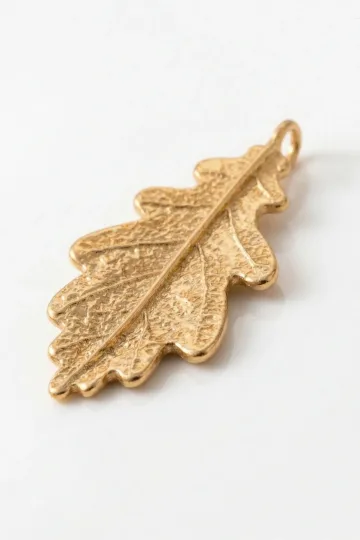
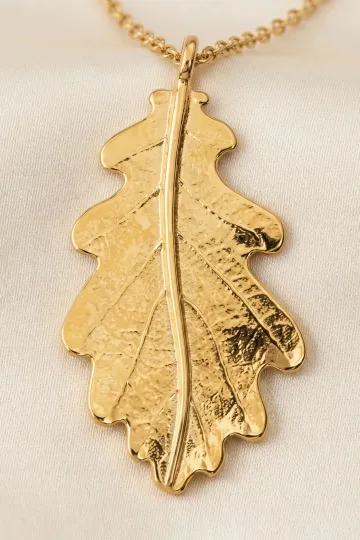
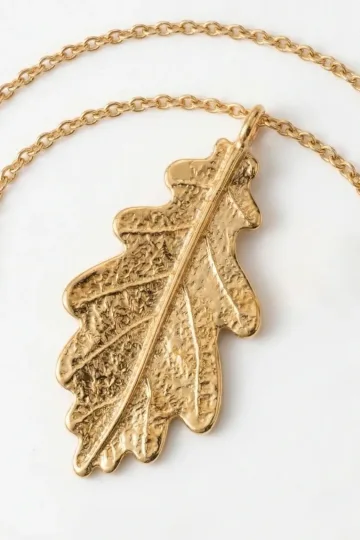
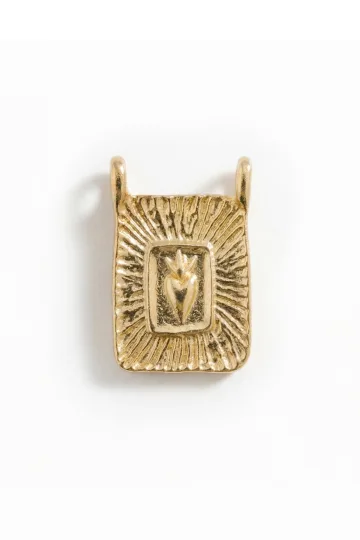
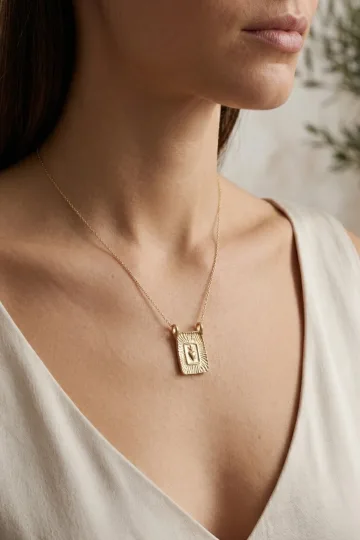
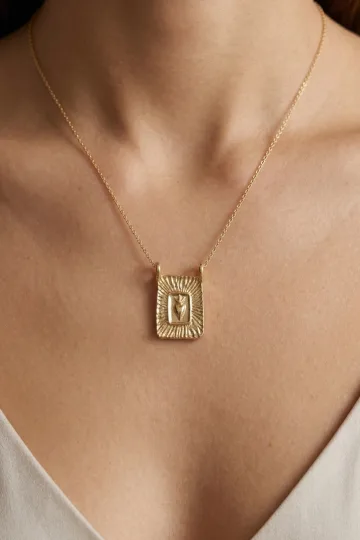
Wear the symbol, don't just read about it. These are in stock:

Apatite in brief
Apatite is the calcium phosphate of the same kind that builds our bones and tooth enamel. Hardness 5, hexagonal crystals, a calm vitreous lustre and a range of colours rare for gemstones: from neon blue to violet and peach. For centuries it was muddled with aquamarine, beryl and tourmaline, which is where its name "the deceiver" comes from.
The main thing when choosing is to remember its softness. Apatite is made for earrings, pendants and brooches, where nothing knocks it. Then the stone keeps its colour and lustre for a long time and stays exactly what you take it for: a rare and recognisable shade you would not confuse with a mass-market showcase.
Silver, gold, wedding rings, symbolism, matching sets.
About Zevira
The Zevira catalogue carries pieces with apatite in different shades. Every item is made by craftspeople who know what apatite is and how to handle a soft stone when cutting and setting it.