Fluorite in Jewellery: Chemistry, Colours, History and Care
Fluorite gave its name to two things most of us touch every day: the fluoride in toothpaste and the word "fluorescence." Yet the mineral itself is far less famous than the gemstones it rivals for beauty. Its crystals grow as perfect cubes, it glows violet, green, blue and yellow, sometimes all at once in layers inside a single stone. And it stays one of the most affordable gems on the counter.
The price for that beauty is softness. Fluorite scratches and chips easily, so in jewellery it behaves nothing like a sapphire and much more like a gentle stone for a pendant or earrings. Let us look at what it is made of, where its colours come from, where it is mined, how to tell it from glass, and how to care for it so it never fades.
What fluorite is: chemistry and physics
Fluorite is calcium fluoride, CaF2. The formula could hardly be simpler: one calcium atom for every two fluorine atoms. In its pure form the crystal is colourless and clear as glass. The whole spectrum of colour comes from impurities and defects in the crystal lattice, which we will get to below.
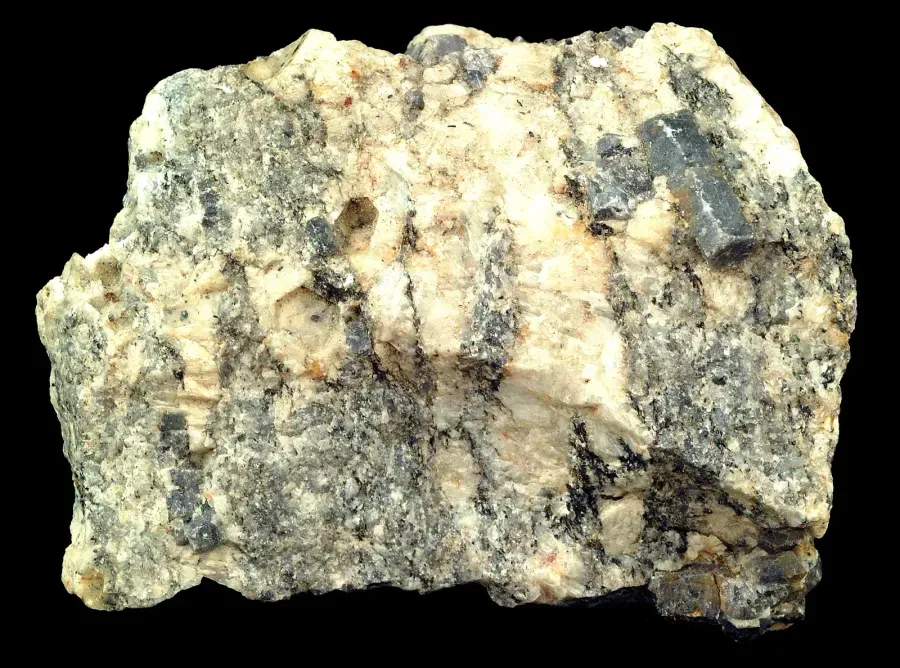
The mineral crystallises in the cubic system, one of the most symmetrical in nature. That is where the typical shape of natural specimens comes from: tidy cubes and octahedra with straight faces. A stone with a clean geometric shape is already a good sign of genuine fluorite.
The key properties worth knowing before you buy:
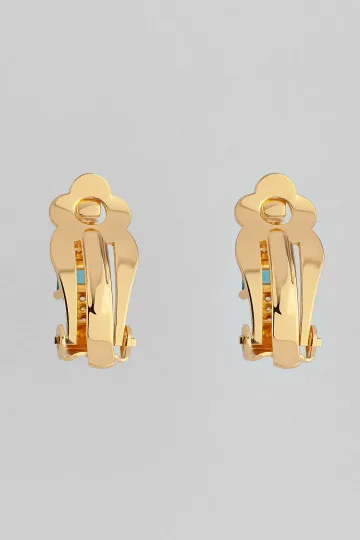
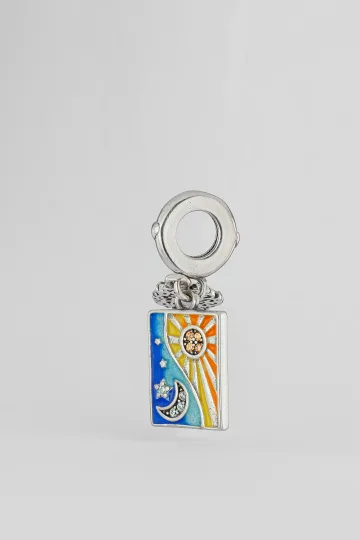
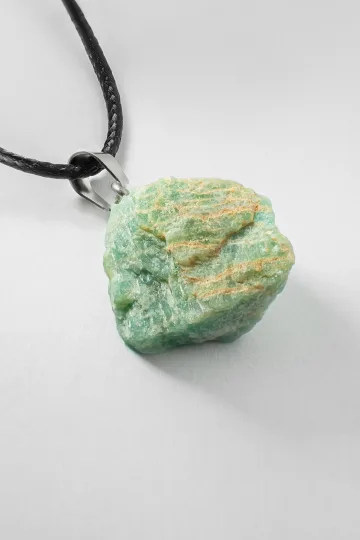
Wear the symbol, don't just read about it. These are in stock:





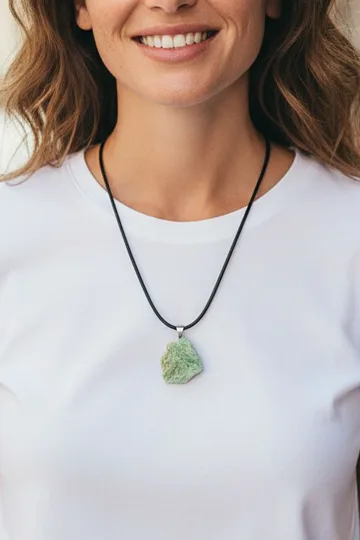

- Mohs hardness: 4. Fluorite is the reference mineral for the fourth step of the scale itself. For comparison: glass sits around 5.5, quartz at 7, sapphire at 9. Fluorite is scratched by a steel knife and even by sand that contains quartz. This is the main limitation for jewellery.
- Density: about 3.18 g/cm3. Noticeably heavier than glass of the same size. The stone feels weightier in the hand than you expect.
- Perfect cleavage in four directions (along the octahedral faces). The mineral splits along flat planes under a knock or a sharp squeeze. Because of this, cutting fluorite calls for a steady hand: one wrong cleavage ruins the stone.
- Refractive index around 1.43, low dispersion. Light passes through the stone almost undistorted, without the "fire" of a diamond or a zircon. Hence a soft, glassy glow rather than bright flashes.
- Brittleness. Fluorite is not ductile; it cracks rather than bends. A sharp blow can split even a thick stone.
These numbers explain almost everything about how fluorite behaves: why it is not set in everyday rings, why it must never be cleaned with ultrasound, and why it scratches so easily when it shares a box with harder stones.
Fluorescence and other optical effects
Under an ultraviolet lamp (the so-called black light) most fluorite specimens glow, usually blue or violet, less often green or yellow. Lattice defects absorb the ultraviolet and re-emit it as visible light. It was this very mineral that gave the phenomenon of fluorescence its name in the nineteenth century.
There is a rarer effect too: thermoluminescence and triboluminescence, a glow when the stone is heated or struck. Split certain specimens in the dark and you see a flash for an instant. In the Middle Ages this frightened people and bred tales of a "demonic" stone, though plain physics lies behind it: mechanical energy is released from the crystal as light.
Many specimens show pleochroism, shifting their shade depending on the viewing angle. Violet fluorite can drift towards grey or near-transparent as you turn it. Glass and dyed plastic cannot do this, so pleochroism is another clue to authenticity.
Colour centres: why one mineral comes in every colour
The central puzzle of fluorite is that pure calcium fluoride is colourless, yet in nature the stone turns up violet, blue, green, yellow and pink. The answer lies in defects in the crystal lattice. When the place of a negative fluorine ion in the lattice is left empty, a free electron sometimes moves in. That trap with an electron in it absorbs part of the visible spectrum and lets the rest through, and the eye reads the difference as colour. Mineralogists call these traps colour centres, or F-centres, from the German Farbe, colour.
From this follows a property no owner enjoys. An electron in a trap is not held for good. Give it the energy of ultraviolet light or heat and it escapes, the trap empties and the colour drains away. That is why violet fluorite fades in sunlight more than almost any other stone: its colour rests on the least stable form of the defect. Heating in a furnace can bleach a stone completely, while a dose of radiation does the opposite, creating fresh traps and deepening the colour. The same physics makes irradiating fluorite quick and cheap, which is worth knowing about when you buy.
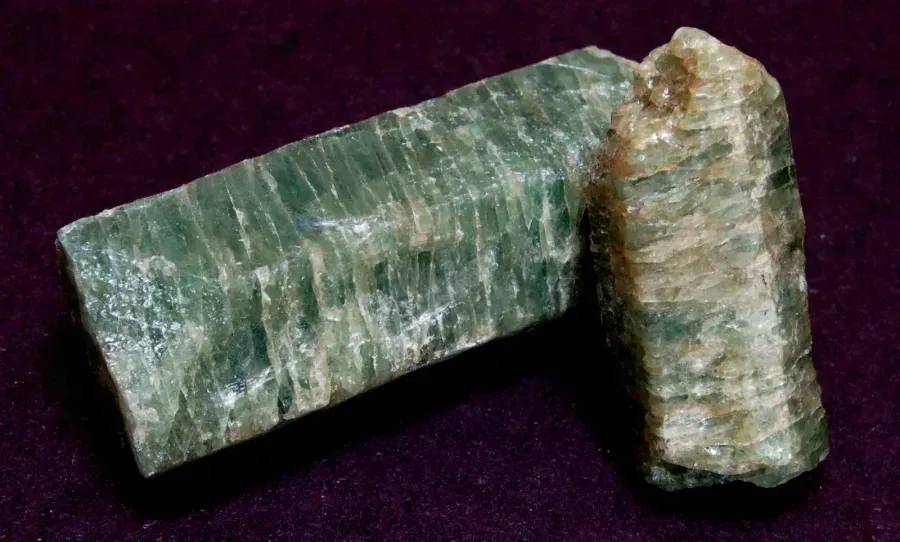
The second cause of colour is traces of rare earth elements such as yttrium, cerium and samarium. They sit in the lattice and act as light absorbers in their own right, giving steadier tones, green above all. That is why green fluorite fades more slowly than violet: its colour rests on a chemical impurity rather than a fragile electron trap.
Cleavage and brittleness: the real weak point
Fluorite has perfect cleavage in four directions, along the faces of the octahedron. That means the crystal contains four families of planes along which the bonds between atoms are weakest, and the stone parts along them easily and cleanly, as though ruled. Strike a set stone at the wrong angle, or squeeze it sharply with pliers, and a smooth triangular flake will come away. Cutters allow for these planes deliberately and orient the table so that the tool works across the cleavage rather than along it.
For the owner of a piece of jewellery this comes down to a simple rule: fluorite fears a point impact far more than quartz or topaz of the same size. A drop onto a tiled floor, a knock against a door handle, a careless tug at a ring, any of these can take a piece out of the stone, not by scratching it but by splitting it along a clean plane. Perfect cleavage plus a hardness of only 4 on Mohs make fluorite one of the most delicate gems in daily use, and that is exactly why setters hide its edges inside the mount. A ring is the hardest life a fluorite can be given: a hand meets doorframes, worktops and handbag clasps all day long, so a fluorite ring is a piece for occasions rather than for permanent wear, and the same stone in a pendant will still look fresh decades later.
The history of fluorite
Fluorite has a story unusual for a gem: first it was prized as a working material, and only later as an ornament.
The name comes from the Latin fluo, "to flow." Medieval metalworkers noticed that adding fluorite to the furnace lowered the melting point of the ore and made the slag more fluid. The stone worked as a flux, helping to separate metal from waste rock. From the Middle Ages it was deliberately added to smelters in Germany and England, and for heavy metallurgy it became a strategic raw material.
In ancient Rome there was the murrhine, the "myrrhine stone," from which precious cups and vases were turned. Most historians believe this was fluorite, often banded with zoned colour. Pliny the Elder described such vessels as objects of fabulous value. After the fall of Rome the knowledge of the deposits was lost, and in the early Middle Ages fluorite all but vanished from jewellery.
The turning point came in the Renaissance, when large local deposits were found across Europe. The best known example is the Derbyshire fluorite in England, especially the banded blue-and-violet variety called Blue John. In the eighteenth century craftsmen turned it into vases, bowls and decorative pieces mounted in gilt bronze.
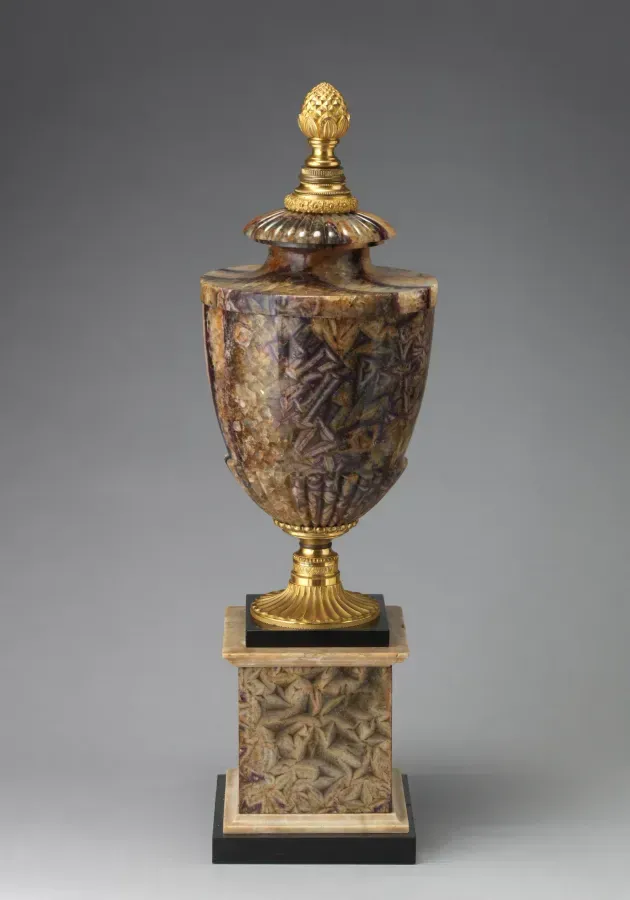
In the eighteenth and nineteenth centuries the technical value came to the fore again: as industrial metallurgy grew, factories needed fluorite in large quantities, and its use in jewellery slipped back into the shade. It returned to ornament towards the end of the nineteenth century, in the Victorian era, but now as an affordable semi-precious stone rather than a luxury for crowned heads.
In the twentieth century an optical role was added to its industrial one: flawless crystals began to be made into lenses for microscopes, telescopes and cameras. The link between the stone and "clarity of mind" was an invention of New Age writers in the 1970s and 1980s, drawing on the echo of its name and the word "flow." That reading has no historical roots; it is modern symbolism, not ancient tradition.
The riddle of the murrhine cups
The most contested episode in the history of fluorite belongs to ancient Rome. In his Natural History, Pliny the Elder describes costly vessels called vasa murrina, murrhine cups, for which the nobility paid sums equal to the price of an estate. The material, by his account, shimmered purple and white, had a soft rather than glassy sheen, and often gave off a pleasant smell. Modern scholars still argue, but most lean towards murrha being banded fluorite, most likely brought from Parthia and what is now Iran, where outcrops of zoned stone are known.
The story of these vessels has a whiff of ancient absurdity about it. The consul Titus Petronius was said to have smashed a murrhine ladle before his death rather than let it pass to Nero, and Nero himself was reported to have paid for a single cup what it would cost to equip an army. If murrha really was fluorite, this is the first case in history of a mineral that is soft and inexpensive by today's standards being valued above gold, entirely for the rarity of its banding and the difficulty of carving so brittle a material. After the fall of Rome the deposits were forgotten, and fine carving in fluorite revived in Europe only fifteen centuries later.
Blue John and the English fashion for carving
The English revival of fluorite hangs on one tiny place: Treak Cliff hill by the village of Castleton in Derbyshire. Here, and almost nowhere else, lies the banded blue and yellow variety that became known as Blue John. Mining peaked in the late eighteenth century, when English society took up interior pieces in the antique taste. Derbyshire stone was turned into vases, bowls, tabletops and columns, mounted in gilt bronze, repeating the Roman fashion for murrha almost to the letter.
Working Blue John took patience and a certain amount of cunning. The raw material crumbles along the boundaries between layers, so blocks were first boiled in linseed oil or soaked in resin to bind the bands together, and only then turned on a lathe. Polishing a finished piece ran into weeks. All that trouble meant that even a modest vase cost as much as a carriage and pair, and few could afford one. Today the veins are close to worked out, output runs to a few tonnes a year and only in winter, when the caverns are closed to visitors, so genuine Blue John remains one of the rarest decorative stones in Europe.
Customer reviews
Zevira is a real jewellery shop. Genuine payments, deliveries and customer thank-yous.
🥰🥰🥰 gracias
Ok, ¡gracias! 🙂
Violet fluorite on a beach day? It fades faster than your tan. Keep it in the shade, where it belongs.
What to wear fluorite with
Over years on shoots I have matched fluorite to dozens of looks, and I know its temperament: the colour does the work, and the stone likes not to be crowded. Here is what actually holds up.
What do I wear fluorite with every day? For daily wear I recommend a violet or green stone against plain clothes in calm shades: grey, beige, navy, olive. The fluorite becomes the single spot of colour, and that is enough. I suggest a pendant on a fine silver chain over a roll-neck or an open-collared shirt. For the office I choose studs or a small pendant: it does not distract on video calls and pulls the look together.
How do I build an evening look? In the evening I let the stone open up. I recommend a faceted violet fluorite under a deep neckline, a black or wine-coloured dress and soft directional light: the stone starts to play with pleochroism, shifting between violet and near-transparent. For a special occasion I suggest drop or chandelier earrings, which catch the light with every turn of the head.
Which metal do I pair it with? Silver and white gold first: the cool metal underlines the cool nature of the stone. Warm yellow gold I keep for yellow and green fluorite, where it belongs. With violet and blue the warm metal quarrels, so I leave it out.
How do I layer fluorite? I suggest neighbours that do not compete in character: rock crystal, moonstone, amethyst, pearl. Bright coloured stones alongside I avoid; fluorite is already multicoloured, and extra clutter blurs the picture. One striking fluorite piece per look does more than three at once.
What chain length do I choose? For a business look I recommend a 45 cm chain close to the throat; for the evening, a long one of 60 to 70 cm so the pendant drops below the neckline. Rainbow fluorite I choose under a spare outfit with no other loud detail, and let the piece lead the conversation.

Turn on your camera, pick earrings, a pendant or a ring, and see the piece on yourself in real time.
Switch items in one tap.
Everything runs in your browser: no photo or video is ever uploaded.
Geology: where fluorite is mined
Fluorite forms in hydrothermal veins. Hot solutions saturated with calcium and fluorine rise through cracks in the earth's crust, cool, and the calcium fluoride crystallises. The process runs over millions of years, which is why a single stone often shows layers of different colour: the composition of the solution changed over time.
The main sources by country:
- China, the largest producer, around 60% of world output. The stone comes in every grade, from technical to clear gem quality.
- Mexico (Durango, Chihuahua, Zacatecas), pale, very clear crystals, often with "phantom" coloured layers inside. Collectors prize them.
- England (Derbyshire), the classic green and yellow fluorite, and the banded Blue John.
- Germany (the Black Forest), a historic source of dark violet fluorite.
- France (the Massif Central), blue and violet stone with pronounced pleochroism.
- Afghanistan and Tajikistan, high-quality specimens with phantom structure.
Where the colour comes from
Pure calcium fluoride is colourless. The colour comes from rare-earth impurities and lattice defects (the so-called colour centres, where a trapped electron sits in place of an ion).
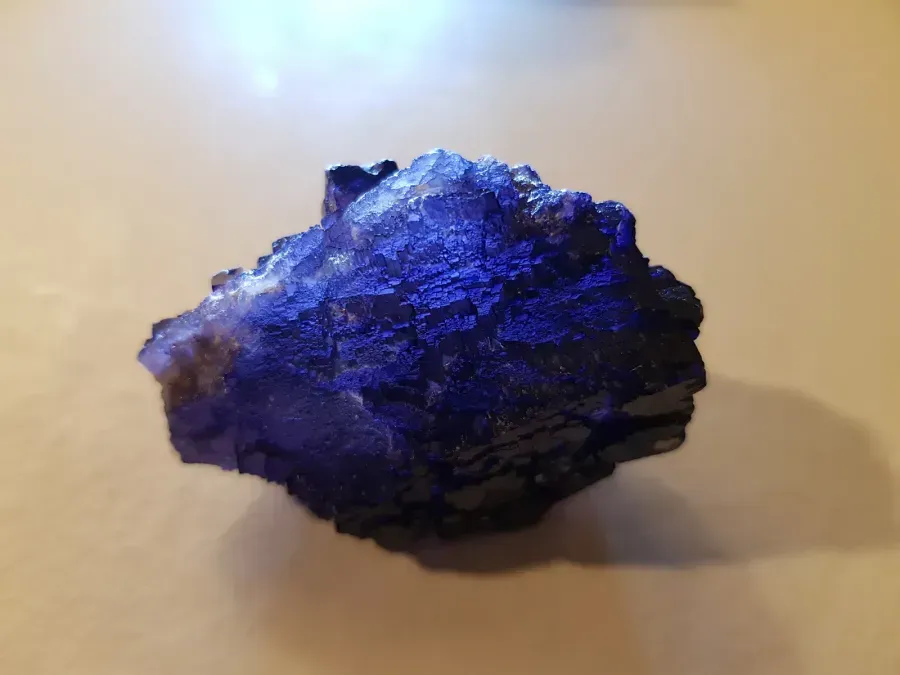
- Violet, the most common colour. It is down to colour centres and rare-earth impurities. The shade ranges from pale lavender to a near-black amethyst. This colour fears ultraviolet most of all and fades in sunlight over time.
- Blue, tied to a different kind of defect. It holds its colour better than violet. A deep sky-blue is rare and prized.
- Green, produced by impurities often linked to iron and rare earths. One of the most fade-resistant kinds. Derbyshire fluorite is frequently green with a yellow cast.
- Yellow, comparatively rare, pale and translucent, sometimes reminiscent of topaz.
- Colourless (white), the purest, almost free of impurities. High optical clarity, and used for lenses among other things.
- Multicoloured (rainbow), layers of violet, blue, green and yellow within one crystal. This is the result of repeated crystallisation as the solution's composition shifted. Found mostly in Mexico and Afghanistan.
One thing worth remembering: violet and blue fluorite can fade under direct sunlight and ultraviolet. Jewellery set with them is best kept in the dark and not worn for whole days in bright sun.
Blue John: a rare banded variety
Among fluorites the Derbyshire Blue John stands apart, a banded stone alternating violet-blue and honey-yellow layers. It is mined in only two workings near the village of Castleton in the English county of Derbyshire, and nowhere else in the world is there a natural match for these colours. The name itself, by the common account, is a corruption of the French bleu-jaune, "blue-yellow."
The banding makes the stone especially fragile: it splits along the boundaries between bands, so it is almost never cut into ring stones. Historically and to this day Blue John goes into carved vases, bowls and cabochons, and before working the slabs are often impregnated with resin, or the material crumbles. Mining runs in small quantities, a few tonnes a year, and only in the cold season when the workshops are not busy with tourists, so pieces of genuine Blue John are rare and valued above ordinary fluorite. Dyed ordinary fluorite or resin with a printed pattern is often passed off as it; the genuine article gives itself away by an irregular, slightly blurred banding and a noticeable weight.
Upload a photo of your pet, someone you love, or an object. We'll build a 3D model and hand-cast it in pewter.

Fluorite in science and technology
Beyond jewellery, fluorite plays a huge practical role, and that role explains much about the stone itself.
Optics. Flawless clear crystals transmit light with almost no scattering or chromatic distortion. They are made into top-grade lenses for microscopes, telescopes and camera objectives. Such optical fluorite must be perfectly clean and is rare, so it is expensive. Jewellery needs no such purity, which is why gem fluorite stays affordable.
Source of fluorine and flux. Industry obtains hydrofluoric acid and fluorine compounds from fluorite. In metallurgy it still works as a flux, lowering the melting point and thinning the slag.
Fluorescence. The glow under ultraviolet, after which the mineral gave the phenomenon its name. This same property is handy as a test of authenticity.
Chemical stability. Fluorite is inert to most substances and does not dissolve in water. Acids act on it slowly, but they do act, so contact with acidic substances is best avoided.


Facts about fluorite that take people by surprise
A mineral that has lent its name to several scientific ideas at once has collected a fair amount of the unexpected. Here is the part that never makes it onto a price ticket.
The word "fluorescence" comes from the name of the stone
The stone was not named after the glow; it happened the other way round. In 1852 the physician and physicist George Stokes was studying how certain substances re-emit absorbed light and wanted a short name for the phenomenon. The effect was brightest in fluorite, or fluorspar as it is known in English, so he coined fluorescence, on the model of opal giving us opalescence. That is how a mineral became godfather to a term now used across physics, biology and medicine.
The fluoride in toothpaste is a distant relative
The first industrial fluorine came from fluorite: the stone is the most accessible natural source of the element. From it come hydrofluoric acid, fluorides and, among other things, the compounds used to fluoridate water and toothpaste. So the mineral in the jewellery case and the tube on the bathroom shelf share a chemical ancestor.
The stone can flash when it is struck
Some fluorite specimens are triboluminescent: split one in complete darkness and for a fraction of a second you see a faint flash. The mechanical energy of the fracture comes out as light. In the Middle Ages that glow frightened miners and bred tales of a living or demonic stone, though ordinary physics stands behind it, the breaking of bonds inside a crystal.
Fluorite lenses spare photographs their coloured fringes
Glass bends different colours by different amounts, and photographs come out with a rainbow fringe along contours, chromatic aberration. Crystalline fluorite barely suffers from this defect, so flawless crystals are made into elements for the finest lenses, microscopes and telescopes. That green or white word "fluorite" on an expensive long telephoto is a direct nod to our mineral.
Rainbow fluorite is a record of millions of years
Layers of different colour inside a single crystal are neither accidental nor added later. Each band is a separate episode of growth: when the composition of the hot solution feeding the crystal changed, so did the colour of the new layer. A rainbow stone literally records the geological history of its own patch of ground, much as growth rings do on a cut tree.
The rarest fluorite is mined around a visitor timetable
Derbyshire Blue John lies in caverns that operate as a tourist attraction through the summer. Mining therefore happens only in winter, when there are no visitors, and the annual haul is counted in a few tonnes. It is one of the very few gems in the world whose output is limited not by geology but by an opening-hours schedule.
Fluorite named a whole vocabulary of the foundry
When the mineral serves as a flux in metallurgy, its role is so central that the word flux itself, from the same Latin fluo, to flow, settled into the language of works and foundries. The stone left its mark on two dictionaries at once, the technical and the optical: it thins the ore in the furnace and gave its name to fluorescence.
A good deal of myth has gathered around the stone, from the medieval fear of its glow to modern exaggerations about "magical power." Let us run through the common claims and separate fact from fiction.
Leave your email, we'll send your discount code. No spam, unsubscribe anytime.
The code arrives by email, valid on your first order.
Fluorite jewellery: the formats
With a hardness of only 4 on Mohs, fluorite shows at its best where it is shielded from knocks and rubbing. The further from working surfaces, the longer the stone lasts.
Pendants
The happiest format. A pendant hangs free, never rubs against a desk or keyboard, and the stone keeps its looks for a long time. Ways of working it:
- A tumbled stone of irregular shape in a simple setting or a wire wrap. The most affordable and practical option, with a natural look.
- A faceted stone (cushion, pear, square) plays beautifully in the light: you see the shifts of colour and the highlights. It costs more than the tumbled kind.
- A raw crystal, a natural cube or octahedron set as it is. Suited to those who value the mineral's natural shape.
Earrings
Another format that is safe for the stone: earrings take almost no knocks. Stud earrings are discreet and easy for everyday wear, while drop and chandelier earrings catch the light beautifully as the head moves and suit the evening. Pale fluorite gives a soft glow, while a saturated one gives a striking spot of colour.
Bracelets
A bracelet of fluorite beads (usually around 8 mm) on an elastic cord is a common, inexpensive option. Bear in mind that the wrist brushes surfaces more often than the chest or ears, so a stone on a bracelet scratches sooner. A version with a silver chain and clasp lasts longer than the elastic cord, which stretches over time.
Rings
The riskiest format. At hardness 4 a stone on the finger soon covers itself with scratches, and a knock can chip it along a cleavage plane. If you really want a ring:
- Choose green or blue fluorite, slightly tougher than violet and better at holding colour.
- Wear it on the less active hand and take it off for sport, cleaning, working with tools and water.
- Ask the jeweller to set the stone in a bezel or with prongs that shield the edges and corners.
- Treat such a ring as an evening piece rather than an everyday one.
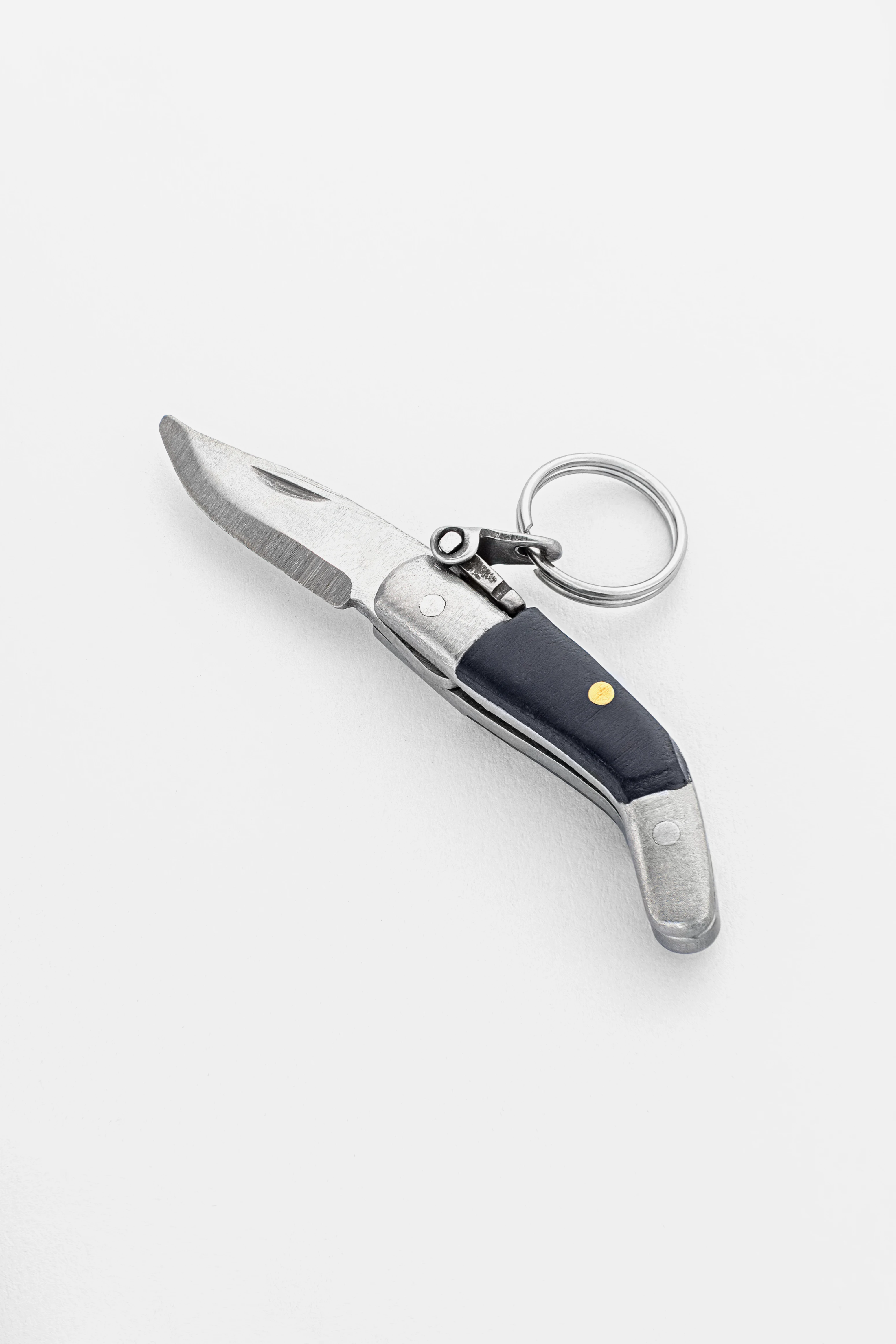
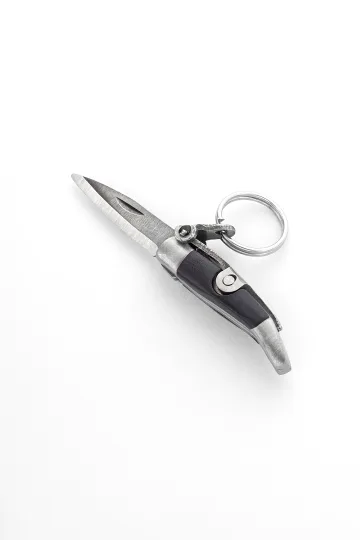
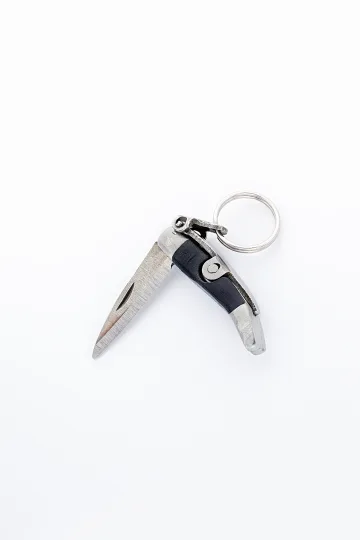
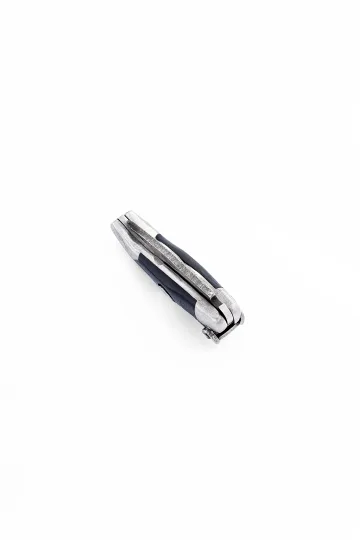
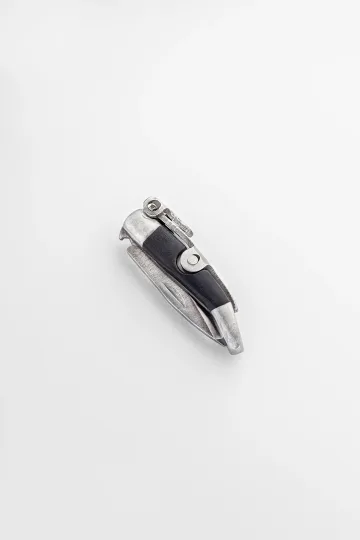
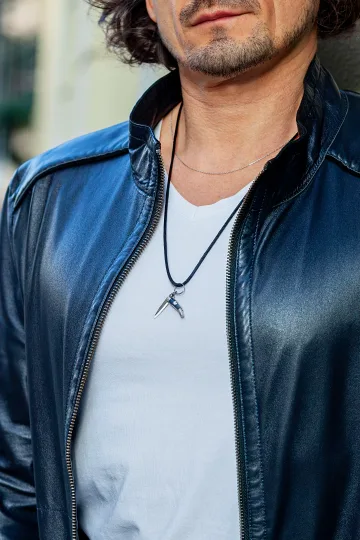
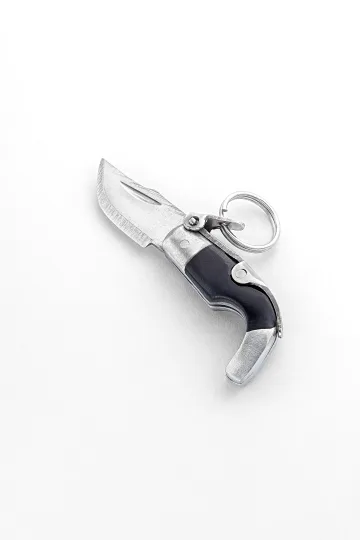
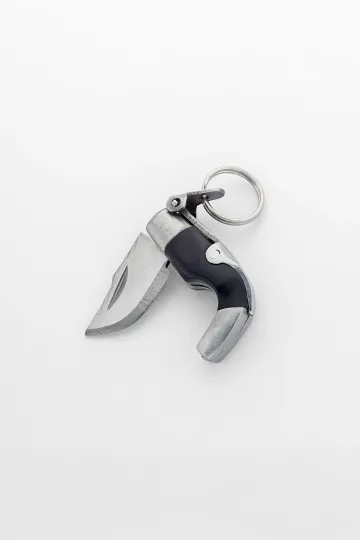
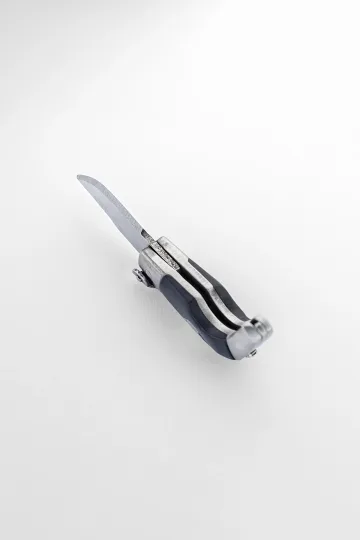
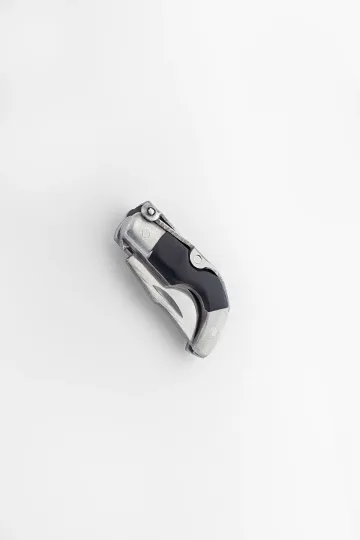
CAPAORA mini knife pendant
The 18th-century Spanish navaja in miniature: 40 mm of stainless steel, a real folding mechanism and a Palanquilla lock that clicks. An affordable gift to remember.
Authentic · Ships from Spain · 14-day returns
How to choose fluorite
When choosing a stone for jewellery, you look at several things: clarity, colour, pattern and finish.
Clarity
The ideal stone is fully transparent, with light passing through it as through clean glass. But natural fluorite often holds microcracks, cloudy zones, colour layers and gas inclusions. This is not a flaw but a feature of the mineral.
- A clear stone with no visible defects goes into top-quality jewellery and costs more.
- A translucent or slightly cloudy one in the centre, but beautifully coloured, is a common and affordable choice for everyday pieces.
- Specimens with inclusions and phantoms are prized by collectors for their pattern, though they suit cutting less well.
For a pendant you hold in the hand and hold up to the light, choose a cleaner stone. For an everyday bracelet, a translucent one is enough.
Colour
Natural fluorite has a soft, slightly uneven shade. A colour that is too even and neon-bright is reason to suspect irradiation or dyeing. Within a single colour there are gradations: pale lavender is softer and more affordable, deep amethyst rarer and dearer. Remember the fading: if a piece is often in the light, violet will lose its saturation over time, and it then makes more sense to take green or blue.
Phantoms and layers
Many specimens from Mexico and Afghanistan show parallel coloured lines, the "phantoms." This is not a defect but a record of the crystal's growth history: each layer crystallised at its own solution composition. With a good cut such layers look striking and make the stone recognisable, which is why many choose fluorite for the pattern alone.
How to tell real fluorite from a fake
What is most often disguised as fluorite is dyed glass or plastic. Checking is not hard:
- Weight. Real fluorite (density 3.18) is noticeably heavier than glass of the same size and much heavier than plastic.
- Glow. Most specimens glow under an ultraviolet lamp. If you are buying at a distance, ask for a video under black light. Glass and plastic usually do not glow, or glow differently.
- Temperature. Fluorite is cool to the touch and quickly draws heat from the hand. Plastic is warmer.
- Inclusions. Glass shows round air bubbles, while natural fluorite shows smooth colour transitions and microcracks.
- Shape. Natural crystals give cubes and octahedra with straight faces.
Synthetic fluorite exists, but it is grown for optics, not for jewellery: the natural stone is cheaper and more available, so faking it makes no economic sense. The marks of a lab stone: excessive perfect clarity, an unnaturally even colour and weak fluorescence.
How not to confuse fluorite with similar stones
Glass gives itself away by weight and bubbles, but fluorite is also confused with real gems of a similar colour. The difference shows in several signs.
- Violet fluorite and amethyst. Amethyst is quartz, hardness 7; a fingernail and a steel knife do not scratch it, whereas fluorite at hardness 4 scratches easily (test only on a hidden edge). Amethyst is colder in lustre and does not fade in sunlight so quickly. Under black light amethyst is usually inert, while fluorite more often glows.
- Green fluorite and green quartz (prasiolite). Again hardness and glow decide it: quartz is harder and silent under ultraviolet. Fluorite shows more obvious zoning and smooth colour layers.
- Blue fluorite and topaz. Topaz is markedly harder (8) and gives brighter highlights on its facets. Fluorite is softer in its glow, with no "fire."
- Rainbow fluorite and coloured glass made to imitate it. In the natural stone the phantom layers run parallel to the growth faces and never repeat exactly; in an imitation the pattern looks drawn or swirled, like streaks of paint.
The most reliable everyday set of tests stays the same: weight, coolness to the touch, glow under ultraviolet and the character of the inclusions. Run the scratch test only with a specialist or on a hidden spot; fluorite is easy to ruin.
Treatments: what is done to the stone honestly
Fluorite is cheap, so it is not "improved" on a mass scale, but a few techniques do appear, and they are worth knowing.
- Irradiation and heating for colour. Irradiation deepens the violet and blue shade; heating, by contrast, lightens or shifts the tone. The sign of intervention is an unnaturally even, neon-bright colour with no natural zoning. Such artificially boosted colour usually holds even worse in the light.
- Impregnation and stabilisation. Porous and cracked specimens are impregnated with colourless resin or oil to hide microcracks and strengthen the stone before cutting. You can spot it by an unnatural gloss in the cracks and a slightly tacky feel to the surface.
- Coating. Tumbled beads are sometimes given a thin iridescent or metallic film for "effect." It wears off at the edges and points of friction, baring the ordinary stone beneath, and that is what gives the treatment away.
- Doublets. A thin slice of fluorite is glued onto a glass or quartz base. The seam shows from the side at an angle as an even dividing line.
Zevira does not irradiate, dye or film its stones: fluorite gets its colour and its play of light in nature.
On price without figures
Fluorite is one of the most affordable gems, and it is rarely faked precisely because the natural stone costs little. Price depends on size, clarity, the rarity of the colour (violet and green are cheaper, blue, yellow and rainbow dearer) and the type of work (faceted dearer than tumbled, a carved talisman dearest of all). A suspiciously low price can point to a treated stone; an inflated one, to a mark-up under the guise of a "collector's" specimen.
Caring for fluorite
Fluorite is soft and brittle, so care comes down to a few simple rules.
- Cleaning. Only a soft brush, warm water and a little soap. No ultrasound and no steam; vibration and heat split the stone along its cleavage. Acidic products are off the table too.
- Light. Violet and blue fluorite fade in sunlight and under ultraviolet. Keep pieces in a box or pouch in the dark, and do not leave them long on a windowsill.
- Storage. Keep it apart from harder stones (quartz, sapphire, diamond), or they will scratch the fluorite. A soft cloth pouch or a lined compartment of a box will do.
- Wear. Take pieces off before sport, cleaning, the shower and swimming. Sweat is slightly acidic, and over time it can turn the surface matt.
- Knocks and temperature swings. Guard against drops and sudden changes of temperature: both can split the stone.
Handled with care, fluorite lasts a long time: it does not rust or break down on its own, and the main risks, scratches, chips and fading, are entirely in the owner's hands.
Send a friend a discount code, they save on their first order.
Symbolism and meaning of fluorite
Fluorite deserves an honest treatment on symbolism, because it has almost no ancient mythology and a great deal of recent overlay. This is not a stone out of legends about gods and heroes: for thousands of years it was valued as a working material rather than an amulet, and neither antiquity nor the Middle Ages left written lore about its powers.
What history says, as opposed to esoterics
The historical meaning of fluorite is a practical one. In Europe it is bound up with metallurgy and trade: the flux stone that fed the foundries and that prospectors were paid for. Banded Roman cups and English Blue John added an association with luxury and fine craft, with the skill of turning a brittle material into an expensive object. Those are the real meanings the stone accumulated over its history: labour, craftsmanship and rarity of pattern, rather than magic.
The modern reading: where "clarity of mind" came from
The image of fluorite as a stone of concentration and orderly thought was born in New Age writing in the 1970s and 1980s. The logic was simple and fairly shallow: the name echoes the word flow, therefore the stone supposedly orders the flow of consciousness. There is no ancient tradition behind this at all; it is a twentieth-century marketing metaphor. You can take it calmly enough: a pleasant image does no harm as long as nobody passes it off as an established fact or a medical property.
Colour as personal meaning
Something simpler works better than any esoterics: different shades of fluorite feel different to live with. Violet reads as restrained and contemplative, green as calm and natural, blue as cool and collected, rainbow as playful and impossible to miss. That is not a property of the stone but our reaction to colour, and it is exactly what makes a piece personal. Choose the shade that answers to you, and it will be a more honest choice than any energy ascribed to it.
Frequently asked questions about fluorite
Does fluorite fade in sunlight?
Yes, violet and blue especially. With daily outdoor wear the colour noticeably pales within a few months. Green holds up better. Keep pieces in the dark and guard against direct sun.
Can fluorite get wet?
It does not dissolve in clean water, and brief contact is harmless. But acids (including acidic sweat) act on the surface, so do not swim in a piece or keep it long in water.
How do I clean fluorite jewellery?
A soft brush, warm water, a little soap. No ultrasound, steam or acidic products; the stone is soft and brittle.
Is fluorite suitable for everyday wear?
Pendants and earrings, yes, they are shielded from knocks. Rings for every day are not the best idea because of the hardness of 4 on Mohs. If you want a ring, choose green or blue fluorite in a protective setting.
Is fluorite magnetic?
No.
Which colour of fluorite should I choose?
By taste and by how you will wear it. Violet is the most common but fades fastest. Green and blue stand up to light better. Rainbow is the most striking and rare.
Is fluorite tied to a star sign?
Popular astrology sometimes links it to Aquarius, but this is a cultural association with no evidential basis. Choose the stone by colour and shape, not by horoscope.
Can fluorite be engraved?
Yes; its softness makes it easy to carve. Engraving looks good on a pale stone. Better with a graver than a laser: heat can cause microcracks in this brittle mineral.
Is fluorite safe against the skin?
Yes, the mineral is non-toxic. The only risk is purely mechanical: the sharp edges of a raw crystal can scratch, and the stone itself is brittle.
Is there synthetic fluorite?
There is, but it is grown for optics, not jewellery: the natural stone is cheaper. The marks of a lab stone: too perfect a clarity, an unnaturally even colour and weak glow under ultraviolet.
Why does fluorite glow under ultraviolet?
The crystal contains lattice defects and impurities that absorb invisible ultraviolet and re-emit it as visible light, most often blue or violet. It was fluorite that gave the phenomenon of fluorescence its name in the nineteenth century. The glow under a black light doubles as a convenient home test of authenticity, since dyed glass and plastic stay dark.
How is fluorite different from amethyst?
Amethyst is quartz with a hardness of 7; it is not scratched by a knife and barely fades. Fluorite is softer at 4, scratches readily, and the violet variety pales in sunlight over time. Under ultraviolet an amethyst usually stays quiet while fluorite tends to light up. Fluorite also feels distinctly heavier in the hand than glass, though that comparison is about imitations rather than about amethyst.
Can I wear a fluorite ring every day?
Better not. With a hardness of 4 and perfect cleavage, a stone on the finger picks up scratches quickly and chips along a flat plane at the first solid knock. If you badly want a ring, choose green or blue fluorite in a mount with a raised rim, wear it on the less active hand and take it off for sport, housework and washing up. It makes far more sense to keep such a ring as an evening piece and let a pendant carry the stone day to day.
Why is fluorite so inexpensive?
It is widespread and easily mined in large quantities, so by the standards of gems it costs little. Because of that it is hardly ever faked: selling the genuine stone is cheaper than bothering with an imitation. What sits above the average are the rare colours (blue, yellow, rainbow), large clear crystals and carved pieces, Blue John above all.
What is Blue John?
It is a rare banded variety of fluorite with alternating blue-violet and honey-yellow layers. It is mined only in Derbyshire, in small quantities and only in winter. The material is very brittle, so it is turned into vases and cabochons rather than ring stones, and it is valued well above ordinary fluorite.
What does fluorite symbolise?
Historically in Europe it was associated with metallurgy and trade because of its role as a flux. The modern reading as a "stone of mental clarity" appeared in the twentieth century among New Age writers and rests on the echo of its name and the word "flow," not on ancient tradition.
Buying it as a gift? Each one arrives ready to give.
 A branded Zevira box and a little card come with every order.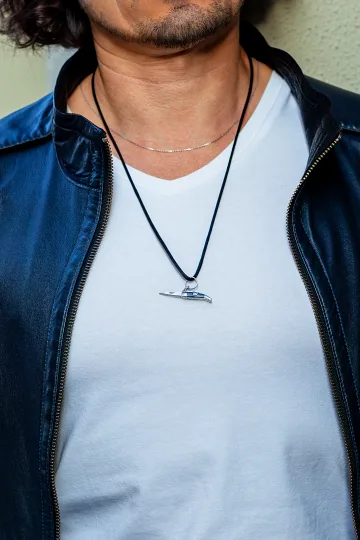





About Zevira
Fluorite is a stone for those who value unusual colour and character in a piece rather than loudness. Its cool pleochroism and crystal geometry make it recognisable, and it stays affordable all the while.
Our collection holds pendants, earrings and bracelets of fluorite in different shades, from soft lavender and deep amethyst to forest green, sky-blue and rainbow. We do not dye or irradiate the stones: you get the natural colour and the natural play of light.
We select each piece for clarity and purity of colour and send it with care advice, since fluorite is soft and likes gentle handling. If you are unsure which shade and format to choose, write to us and we will help you pick.