Ametrine: the two-colour quartz that grew purple and gold on its own
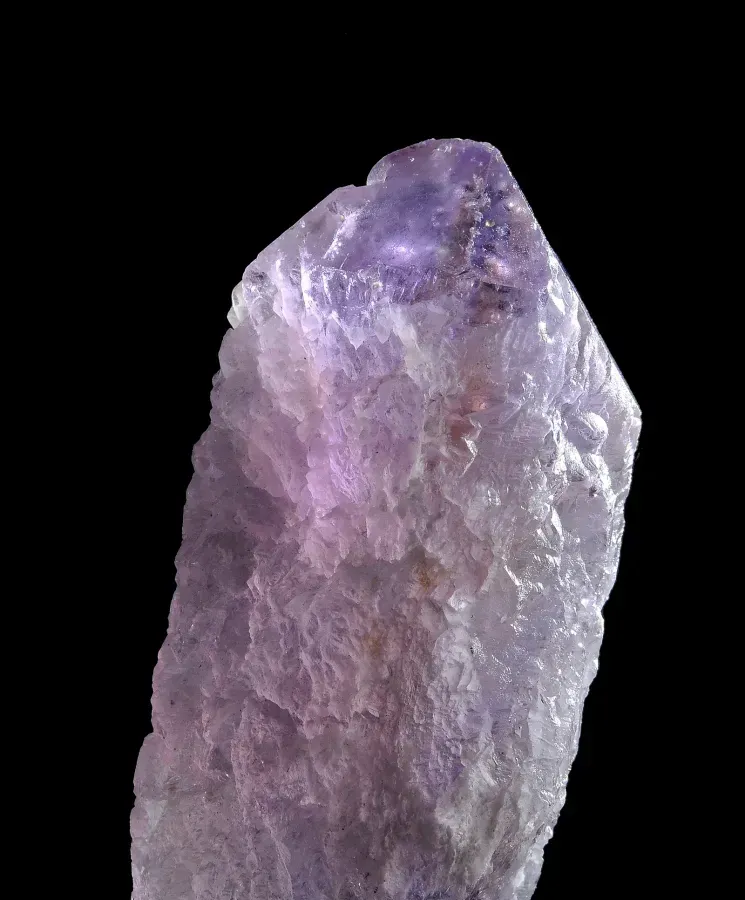
One crystal, two colours. The lower half is purple like amethyst, the upper half is yellow like citrine, and a clean boundary runs between them. This is not two stones glued together, and it is not dyed: ametrine grows two-coloured underground, with no help from anyone. Almost all of the natural ametrine on the planet comes from a single Bolivian deposit, which is why the stone is considered rare.
What ametrine is and where the name comes from
Ametrine is a variety of quartz in which an amethyst (purple) zone sits beside a citrine (yellow) zone within one crystal. The name is a blend of two words, "amethyst" and "citrine". It entered the trade in the 1970s, when Bolivian material began reaching Western markets and a short label was needed instead of the clumsy "bicolour quartz".
Different languages spell it their own way: English uses ametrine, German Ametrin, Spanish ametrina. You also meet older trade tags such as "bolivianite", named after the source. Mineralogically it is all the same quartz, silicon dioxide, simply carrying two kinds of colour in one crystal body.
The confusion is compounded by the fact that, for a long time, any bicolour quartz was suspected of being a fake. Purple-and-yellow pieces turned up in nineteenth-century collections, but they were often taken for dyed stones or for an edge that had oxidised by chance. Trust in natural ametrine arrived only once gemmologists studied the Bolivian samples under the microscope and saw that the colour boundary runs inside the crystal, along the growth planes, rather than sitting on the surface.
Wear the symbol, don't just read about it. These are in stock:



Chemistry and physics: what ametrine is made of
The base of ametrine is quartz, with the chemical formula SiO2 (silicon dioxide). Its properties are the same as those of rock crystal, amethyst and citrine, because it is one and the same mineral species.
- Mohs hardness: 7. Quartz scratches glass, but yields to topaz, corundum and diamond.
- Crystal system: trigonal. The crystals grow as six-sided prisms with a pyramidal "cap" at the tip.
- Density: about 2.65 g/cm3.
- Refractive index: roughly 1.54 to 1.55, with weak birefringence (around 0.009).
- Cleavage: practically none, with a conchoidal fracture. Quartz therefore breaks unevenly rather than along smooth planes.
- Lustre: vitreous.
The colour in both zones comes from iron, but in different oxidation states. The purple amethyst part owes its colour to iron in an oxidised form (Fe3+) within the crystal lattice: under natural irradiation it forms colour centres that absorb part of the spectrum and leave the eye with purple. The yellow citrine part comes from iron in a different form, dispersed through the lattice. What governs the colour is not the amount of iron but the way it is built in and the conditions present during growth.
Natural ametrine shows a faint pleochroism: tilt it, and the purple zone shifts its shade slightly. This is a normal property of coloured quartz, tied to the fact that light absorption depends on direction within the crystal. Under ultraviolet light, the coloured zones usually luminesce weakly or not at all, unlike some imitations.
Quartz also has a piezoelectric effect: under pressure the crystal produces a small electric charge. This is a genuine physical property, and quartz watches run on it. It has nothing to do with the wellbeing of whoever wears the jewellery, but as a fact about the mineral it is rather charming.
One ametrine on a plain shirt says everything. Pile three coloured stones next to it and you have turned a rarity into a jumble sale.
What to wear ametrine with
On shoots I set a two-colour stone as the single accent: purple and yellow already argue between themselves, and a third colour in frame has nothing to do. Here is what years of working with it taught me, case by case.
What do I wear ametrine with every day? I recommend a pendant on a fine chain over a plain top: grey, charcoal, wine, beige. Against a calm background the line between the zones reads clearly, while a busy print drowns it. I suggest matching the chain length to the neckline so the stone sits in the open area near the collarbones.
Which metal should I choose for ametrine? I look at which half of the stone I want to draw out. Silver, white gold and platinum lift the violet zone; warm yellow gold and copper light up the yellow. For a warm skin undertone I choose gold, for a cool one silver. When I mix metals in layers, I do it on purpose, not at random.
Does ametrine work at the office? It does. I recommend a small ring or stud earrings and keep the rest restrained so the stone stays the only accent. Under a smart blouse or jacket it adds colour without breaking the formality.
How do I build an evening look? For evening I suggest dark matte fabric: velvet, heavy silk, wool. A deep neckline carries a large pendant, while a closed top I balance with earrings. One notable stone plus a matching pair of earrings is enough; extra busyness around it does nothing.
Who does ametrine suit? Anyone who likes uncommon things with meaning and is not afraid of warm and cool shades side by side. For a ring I choose a stone from three carats up, or the colour transition blurs into a murky tone. And I keep one simple rule: ametrine needs a single companion and does the rest itself.

Turn on your camera, pick earrings, a pendant or a ring, and see the piece on yourself in real time.
Switch items in one tap.
Everything runs in your browser: no photo or video is ever uploaded.
How ametrine forms in nature
Quartz grows from hot, watery solutions saturated with silica that circulate through cracks in the rock. As the solution slowly cools, crystals build up on the walls of cavities. If the solution contains iron, the quartz comes out coloured.
The two colours of ametrine are the trace of changing growth conditions. During one part of the crystal's history, the temperature and oxidising environment produced amethyst purple; during another part, yellow citrine. The boundary between the zones coincides with the crystal's growth planes, which is why it often looks geometrically straight rather than a smudged blot.
The rarity of ametrine lies exactly in this combination: both kinds of colour must manage to form within a single crystal, and the transition must be sharp enough. More often nature delivers just one thing: either amethyst, or citrine, or colourless quartz. Geologically, the colour boundary is a kind of record of how the environment shifted while the crystal grew.
Ametrine crystals occur in hydrothermal veins and in cavities within volcanic rock. They take the prismatic shape usual for quartz, and the colour boundary often falls right at the pyramidal tip.
Where ametrine is mined
The main, and in practice the only, commercial source of natural ametrine is the Anahí deposit in eastern Bolivia, in the Santa Cruz department, close to the Brazilian border, in the Pantanal region. From here comes the overwhelming share of jewellery material with a clean, contrasting two-colour split. Bolivian origin is the benchmark for ametrine.
Individual finds of bicolour quartz have been noted in Brazil as well, but there the transition is usually pale and blurred, without the sharp, geometric boundary that the Bolivian crystals deliver. In meaningful quantities, good natural ametrine is not mined anywhere outside Bolivia.
Because the source is effectively a single one, the market carries a great deal of synthetic quartz and outright fakes passed off as ametrine. We will come back to the ways of telling the real stone apart below.
Customer reviews
Zevira is a real jewellery shop. Genuine payments, deliveries and customer thank-yous.
🥰🥰🥰 gracias

Ok, ¡gracias! 🙂

The Anahí mine: one deposit for the whole market
The deposit lies in the marshy lowland of the Pantanal in eastern Bolivia, and reaching it is no easy matter: the nearest road ends at a river, and from there you travel by water. The deposit itself is a system of hydrothermal veins in limestone, where ametrine grew in cavities alongside ordinary amethyst and citrine. Industrial methods are hard to apply here, and the bulk of the material is still brought out by hand, through narrow tunnels that follow the coloured veins.
A legend is attached to the mine, one the locals tell as part of the place's history. According to the tale, in the sixteenth century the Spanish conquistador Felipe de Áyez received these lands as a dowry for the princess Anahí of the Ayoreo people, and the deposit was later named after her. The two-colour stone is read in the legend as an image of her divided heart, torn between her native people and her foreign husband. This is purely a legend, with no documentary support for the pretty part of the story, yet the name Anahí has stuck for good.
After that, the history is solidly real. Following the colonial era the exact mining site was lost for centuries, and Europeans knew Bolivian ametrine only through rare stones of dubious provenance. The mine was found again and brought into systematic working only in the second half of the twentieth century, and only then did ametrine gain a steady supply and a trade name of its own. So when a stone's description honestly states Bolivia and the Anahí mine, that is not marketing but a pointer to the only recognised source of the natural material.
History and culture
Ametrine is a young gemstone. It became known as a material in its own right only in the second half of the twentieth century, when Bolivian ametrine reached the international market. It therefore appears in no ancient regalia, no crowns, and on no historical figures: back then it was simply not known as a separate stone. Amethyst, its purple half, has by contrast been known to culture for thousands of years.
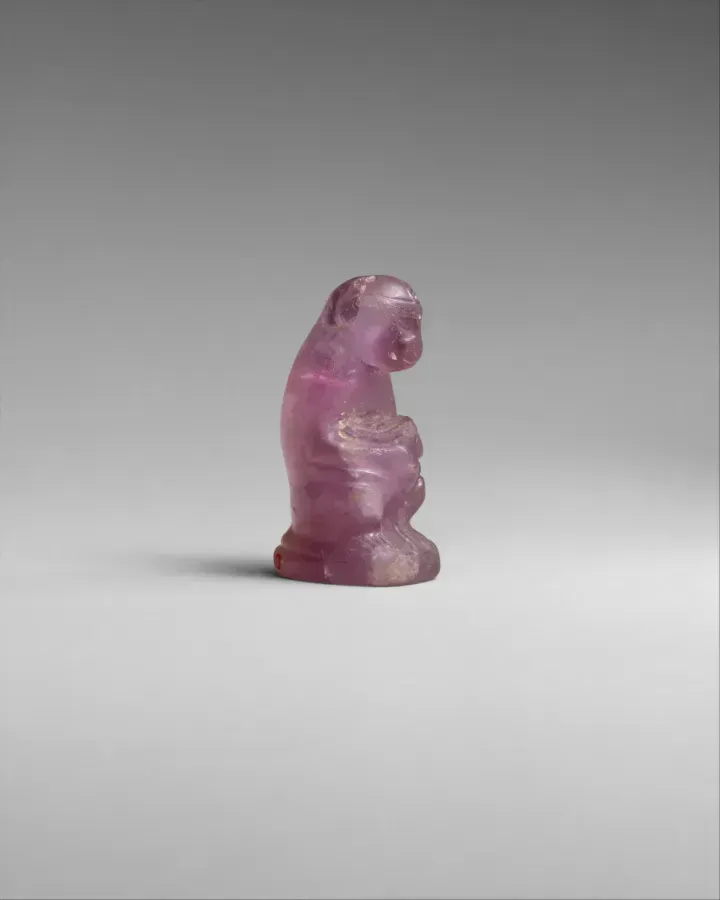
Its "parents", amethyst and citrine, have a long cultural history. Purple quartz was carved as far back as Ancient Egypt: the photograph above shows an Egyptian figurine made from solid amethyst, roughly four thousand years old. In antiquity and in medieval Europe, amethyst was worn as a stone of nobility and clergy, while yellow quartz was valued for its warm, sunny colour. Ametrine inherits both of those lines at once, but it has no ancient history of its own, and there is no point inventing one.
The Bolivian deposit, on the other hand, has a real story behind it. The local name Anahí is tied to the legend of the princess, and systematic mining got under way in the second half of the twentieth century. Since then the stone has held its place on the market of semi-precious gems.
Upload a photo of your pet, someone you love, or an object. We'll build a 3D model and hand-cast it in pewter.




Types and varieties of ametrine
Natural ametrine is distinguished above all by the character of the transition and by the saturation of the zones.
With a sharp boundary. The crystal is split into a purple and a yellow part almost evenly, with the boundary reading as a line. This is the most recognisable and most prized variant, and it is the one shown in catalogues.
With a soft transition. Between the purple and the yellow lies an intermediate zone of an orangey or beige tone. It looks gentler and is usually valued a little lower, because collectors love contrast.
Banded. A fine alternation of purple and yellow layers, visible against the light or under magnification. This is rarer.
Pale. One or both zones are weakly coloured, the purple drifting into lilac and the yellow into a barely perceptible lemon. The colour shows less well, and the value is lower.
By the ratio of the zones, there is roughly equal two-colour balance (50 to 50), and there is a tilt towards one colour, when the yellow or the purple clearly dominates. How well the transition reads depends a great deal on the cut: a skilled cutter orients the stone so that both zones are visible at once and the boundary does not hide beneath the facets.
The best cuts for ametrine are those that show the colour and hold the clarity: cushion, oval, emerald step cut. A bright brilliant cut with many small facets, by contrast, fragments and darkens the colour, so it is chosen for ametrine less often.




Why cutting ametrine is harder than usual
With a single-colour stone, the cutter fights only for brilliance and for yield by weight. With ametrine a third task is added: where to orient the colour boundary. A crystal from the Anahí mine reaches the cutter with its purple and yellow zones split along a growth plane, and whether you see honest two-colour or a murky mix depends on how the axes of the future stone lie relative to that plane.
The classic approach is to divide the stone in half exactly along the boundary, so that the purple and yellow halves read with equal area. That is why ametrine is so often cut as a rectangular emerald step or an elongated oval: a long shape lets the boundary run down the middle as one clean line. The stone is usually set upright, purple at the bottom and yellow at the top, because in the depth of the pavilion the purple looks richer.
There is also the reverse technique, fantasy cutting, where the cutter carves deep grooves and facets on the back so that the light inside the stone blends the two colours and an orangey or pinkish transition zone lights up in the centre. This is bespoke work, more expensive, found in collector's pieces rather than mass-produced ones. From the same bicolour material, cutters also slice flat intaglio plates for stone carving, where the artist deliberately uses the colour boundary as part of the image.
The practical takeaway for a buyer is simple: a long cut with the boundary down the centre is the technical norm for ametrine, not a whim. If both zones are visible at once in the stone, evenly and without murk, the cutter has done the job. If you have to chase the two colours by tilting the piece, the orientation was poorly chosen, and such a stone is not worth paying extra for.
How to tell ametrine from look-alikes and fakes
Since the natural material is essentially from one place, imitations are plentiful. Here is what to look at.
The colour boundary. In natural ametrine the transition runs inside the body of the crystal and coincides with the growth planes, so the boundary is even and geometric, and the colour is visible all the way through. In dyed quartz the colour sits closer to the surface, and the boundary is uneven and lumpy.
Two stones glued together (a doublet). A common fake: a piece of amethyst and a piece of citrine are glued and cut so as to hide the seam. Under a 10x loupe you can see along the seam line a thin film of glue and a chain of tiny air bubbles. A solid ametrine has none of this.
Synthetic quartz. It is grown in an autoclave, identical to the natural in formula and structure, and hard to tell apart by eye. Indirect signs: a suspiciously "perfect", overly uniform colour and an almost complete absence of natural micro-inclusions. Only a gemmological lab can tell reliably.
Ultraviolet. Naturally coloured quartz usually luminesces weakly or neutrally under UV. A sharp, bright glow or an obviously "wrong" reaction is reason to be wary. This test is supporting, not decisive.
Density and feel. Glass imitations are lighter than quartz (the density of quartz is about 2.65) and warm up faster to the touch, staying warm longer. Quartz is cooler and heavier than glass of the same size.
Origin and price. Natural ametrine means Bolivia. "African", "European" or "American ametrine" in a description almost certainly means synthetic or dyed quartz. A suspiciously low price per carat and a promise of a certificate for a tiny stone are alarm signs too.
A hundred-percent guarantee comes only from a gemmological check, but these simple steps weed out most of the obvious counterfeits.
Leave your email, we'll send your discount code. No spam, unsubscribe anytime.
The code arrives by email, valid on your first order.
Caring for ametrine
Ametrine is quartz, and quartz is a fairly tough stone for everyday wear: a Mohs hardness of 7 is higher than that of most household surfaces and dust. But it is softer than diamond, corundum and topaz, so a couple of simple rules extend the stone's life.
Cleaning. Warm (not hot) water, mild soap, a soft brush. That is enough. Avoid sharp temperature changes: thermal shock can crack the stone. Use ultrasonic cleaning rarely and briefly: if there are hidden micro-cracks inside, ultrasound can open them up. Steam cleaning is best avoided altogether.
Storage. Keep ametrine apart from other jewellery, in a soft pouch or a compartment of the box. Otherwise harder stones (diamond, sapphire, topaz) will scratch the quartz. Do not leave the stone in direct sun on a windowsill: like amethyst, the purple zone can lighten slightly under long ultraviolet exposure. We are talking about years of daily sun, not a couple of walks.
Wearability. A hardness of 7 means a pendant, earrings and a bracelet can be worn often with little concern. A ring calls for care, since the hand constantly knocks against hard surfaces, and the edge of the stone can chip from a blow against a tap, a tile or a door handle. For an everyday ring, choose a setting with a protective rim that covers the girdle. Take the jewellery off before cleaning, sport, cooking and bathing. The quartz itself is inert to water, but salt and chlorine quickly tarnish a silver setting and loosen small prongs.
Symbolism: what is said and what holds up
In the esoteric tradition ametrine is called a stone of balance, because it joins two colours: the calm of the purple and the energy of the yellow. From this come readings about "reconciling opposites" and "help during transitional periods". It is a lovely metaphor, grown from the very look of the stone.
Ametrine has no proven physical or healing effect. The mineral does not cure, does not influence blood pressure, sleep or anxiety, and does not "absorb negativity". Any effect a person notices is explained by psychology: a beautiful piece of jewellery works as an anchor for attention and a reminder of one's own intention. That is real and normal, but it is a property of the mind, not of the stone. So you may certainly wear ametrine with meaning, as long as you do not confuse a symbol with medicine.
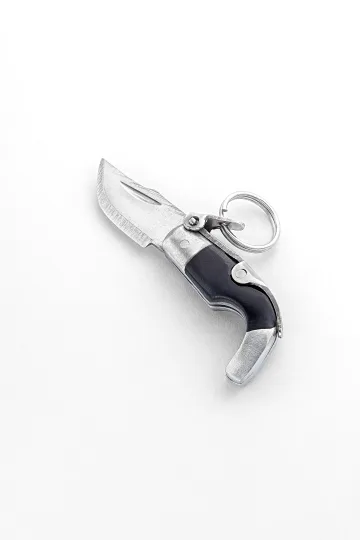
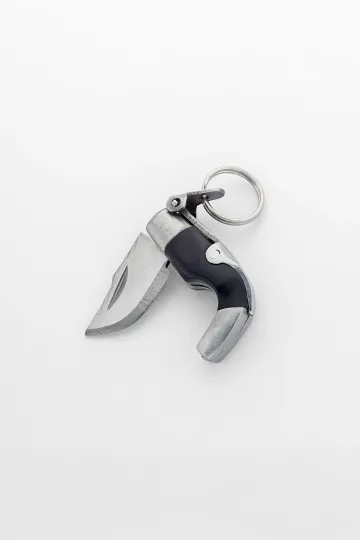
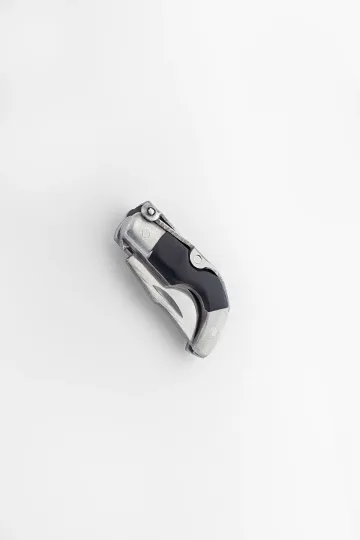
CAPAORA mini knife pendant
The 18th-century Spanish navaja in miniature: 40 mm of stainless steel, a real folding mechanism and a Palanquilla lock that clicks. An affordable gift to remember.
Authentic · Ships from Spain · 14-day returns
Ametrine among other stones
Ametrine is often compared with other bicolour and shifting stones, and here it helps to keep the differences in mind.
Amethyst and citrine on their own belong to the same quartz family, but they are single-coloured. Ametrine joins both colours in one crystal, which is why it is rarer than they are and usually pricier per carat.
Bicolour tourmaline is two-coloured as well, but it is a wholly different mineral, a boron silicate. It is harder than quartz and often dearer, with colouring that can be pink and green.
Tanzanite changes shade as it turns, thanks to pleochroism, but that is a shift of one colour, not the two-colour split of ametrine. Tanzanite is softer and more demanding to wear.
Smoky quartz and rock crystal are the closest relatives by composition, without the double colour. They sit calmly beside ametrine in jewellery and do not compete with it for attention.
Ametrine occupies a comfortable niche: it is more striking than ordinary quartz, yet more accessible than rare gems such as good tourmaline or tanzanite.
The science of two colours in one crystal
The real puzzle of ametrine is not that it holds two colours but that they sit side by side along a straight line and refuse to blend. To understand how that happens you have to go down to the level of the quartz lattice and look at what the iron is actually doing inside the silica.
Growth sectors: why a crystal divides into zones
Quartz does not grow as an even ball. It grows face by face. Each face of the crystal builds up its own volume of material, and that volume is called a growth sector. Faces inclined at different angles take up impurities from the solution with different readiness: one absorbs more iron, its neighbour less. The result is that a single crystal contains regions which grew on different faces and therefore differ in composition. In ametrine it is precisely the growth sectors that keep the purple zone living separately from the golden one instead of dissolving into it.
This is not unique to ametrine as a phenomenon. Sector zoning shows up in many minerals, and in some it produces the hourglass patterns collectors know from certain crystals. What is unusual here is that the two sectors happen to produce two colours that are both attractive, both stable and both saleable, which almost never coincides.
Why the boundary is so straight
The border between purple and gold in Bolivian ametrine often looks ruled. The reason is that it coincides with the plane dividing two growth sectors. That plane is geometrically straight because the faces of the crystal grow at the strict angles of the trigonal system. The colour changes not where the iron happened to run out but where one growing face ended and another began. Hence the impression that somebody cut the stone carefully and glued it back together, when in fact it grew that way on its own.
Look closely at a well cut stone under a lamp and you can sometimes see that the boundary is not a single line but a very narrow transitional band, a fraction of a millimetre wide. That band is the record of the moment the growth conditions shifted, and its sharpness is one of the things that separates a first-class stone from an ordinary one.
The same iron, two different results
The most surprising part is that both the purple and the gold in ametrine come from the same element: iron. The difference lies in how the iron atom sits in the lattice and what natural irradiation has done to it. Where iron took the place of silicon and came under the weak natural radiation of the deep earth, colour centres formed that give the purple amethyst tone. Where iron is dispersed through the lattice as minute particles in an oxidised form, the quartz returns a warm yellow citrine colour. One crystal, one chemical culprit, two routes, and both visible to the eye at once.
What heating tells us
The link between the two colours is easy to test with heat. Warm amethyst carefully and its purple fades and then turns yellow: that is the citrine most often sold under the name. Ametrine displays both stages of the transformation at once, in one body, with no furnace involved. It is therefore looked at as a natural snapshot of a process people usually have to reproduce by heating. Overheat an ametrine, though, and it loses its purple half and becomes simply yellow, which is the risk in any thermal treatment applied to this stone. It is also a practical warning for the owner, since a stone left on a sunny windowsill or subjected to a jeweller's torch during a repair can come back a different colour.
The Anahí mine: the only source on the planet
The Bolivian origin of ametrine has already been mentioned above, but the Anahí deposit deserves a section of its own, because the entire market for natural two-colour quartz rests on literally one point on the map. A natural monopoly like that is almost unknown among gemstones.
Where it is and why it is hard to reach
The mine lies in eastern Bolivia, in the department of Santa Cruz, right on the Brazilian border, in the country of the Pantanal. This is an enormous seasonally flooded lowland: for half the year water stands all around, roads turn into channels, and part of the journey to the mine is made by boat along the river. Logistics cost more than the extraction itself, and every crate of rock travels first by water and only then by road. That inaccessibility is part of the reason the deposit was lost to the outside world for centuries at a time.
How the deposit is arranged
Ametrine at Anahí sits in hydrothermal veins threading through limestone. Hot solutions carrying silica and iron once ran along the fractures, and quartz crystals grew in the cavities: amethyst in some places, citrine in others, and two-coloured ametrine in a few. The veins are narrow and capricious, so heavy machinery is nearly useless. The rock is taken out by hand, following the coloured seams along adits, and the material is sorted on site, picking out the rare pieces with a clean, contrasting boundary.
Why the contrast is born here in particular
Two-coloured quartz does turn up occasionally elsewhere, in Brazil for instance, but the transition there is usually feeble and smeared, without a sharp line. Anahí differs in that the growth conditions changed abruptly enough for the purple and yellow zones to separate along a distinct border. Geologists connect this with jumps in temperature and in the oxidation state of the solution. That is why a note about Bolivian origin in a stone's description is not a bit of exotic marketing but a pointer to the only recognised source of gem material.
What honest provenance means
When a seller writes Bolivia and the Anahí mine plainly, they are taking on a checkable obligation. Any gemmologist knows that natural ametrine does not occur in commercial quantities outside this deposit, so claims of African, European or American ametrine almost always give away synthetic material or dyed quartz. A reference to Anahí is a short way of saying that the stone is genuine and grew in the ground rather than in an autoclave.
Send a friend a discount code, they save on their first order.
The legend of Princess Anahí
The stone has its geology and it also has a story that Bolivia tells as part of the character of the place. It should be treated as a legend, but it is the legend that gave the mine its name.
The conquistador and the dowry
The tale holds that in the sixteenth century a Spanish conquistador reached these lands and married a princess of the local Ayoreo people, whose name was Anahí. The lands holding the two-colour quartz came to him as her dowry. The story therefore joins two worlds, the incoming Europeans and the indigenous inhabitants of the Pantanal, and puts the stone at the exact point of that union. Different tellings give the conquistador different names, which is itself a sign of how the account was carried orally rather than recorded.
A heart divided in two
The legend explains the crystal's two colours through the princess's fate. Anahí is said to have been torn between love for her foreign husband and loyalty to her own people, and her heart was as if divided in half. On this reading the purple and gold halves of the stone are two attachments in one breast. When the princess died, she left her husband these stones as a memory of her divided but whole love. The beautiful part of the story has no documentary support, and it is honest to keep it as a legend rather than as history.
What in the story is true
The real outline is more modest and, in its way, more interesting. After the colonial period the precise location of the workings dropped out of memory for centuries, and Europe knew Bolivian two-colour quartz only through occasional stones of murky provenance. The mine was rediscovered and brought into systematic working only in the second half of the twentieth century, and it was then that the stone acquired steady supply and a trade name of its own. So the legend of the princess and the dry chronicle of rediscovery together make up what is now called the history of ametrine.
The symbolism of balance and the unity of opposites
The look of the stone suggests its own central theme, and the esoteric tradition around ametrine has built almost everything on it. Two colours in one body read as an image of accord between different principles.
Why balance in particular
Purple amethyst is popularly associated with calm, reflection and restraint, and yellow citrine with warmth, energy and activity. Ametrine holds both poles side by side without letting either dominate, which is why it is called the stone of balance. It is a metaphor grown directly out of the mineral's appearance, and that is where its honesty lies: it promises nothing, it simply names what the eye sees.
The joining of opposites
From the same two-colour quality grows the idea of a unity of opposites: cold and warm, night and day, reason and feeling. Ametrine is easy to give and to wear as a reminder that different sides of a person, or of a relationship, can live together in one whole. The boundary between the zones is not erased in the process, and that is an important part of the image: unity here means calm coexistence rather than one thing dissolving into the other.
A stone of transitional periods
Hence the reputation of ametrine as a companion through change: a move, a new job, the beginning or the end of a large chapter. The logic is simple and psychological. When someone stands between a past and a future, the image of a stone that holds two halves together works as a visible reminder that a transition is a normal thing. There is no mysticism in it, only the familiar power of a symbol.
Where the line runs between meaning and medicine
It is worth keeping that line clear. There is no proven effect of ametrine on the body, on sleep, on blood pressure or on anxiety, and the mineral does not heal. Any effect an owner notices is explained by psychology: a handsome object with meaning works as an anchor for attention and a reminder of one's own intention. Wearing ametrine with meaning is perfectly reasonable, but a symbol should not be confused with a medicine.
Facts that surprise
A few things have gathered around ametrine that surprise even people who have loved stones for years.
The whole market rests on one mine
This is one of the rarest cases in which practically all the natural material on the planet comes from a single place. Close the Anahí mine and natural ametrine would all but vanish from the market, leaving the field to synthetics. Few gemstones depend so completely on one point on the map, and it makes supply unusually sensitive to weather, politics and the state of a single road.
Both colours are made by the same element
You would reasonably expect different colours to come from different impurities. In ametrine both tones are drawn by one iron, simply built into the lattice in different ways and touched differently by natural irradiation. One culprit, two results, in one crystal.
The stone is a frozen record of the weather underground
The colour boundary is not decoration, it is a chronicle. It marks the moment when the crystal's growth conditions changed sharply. In effect ametrine carries a notch recording how the temperature and chemistry of the solution shifted millions of years ago, which makes a cut stone a small geological instrument as well as an ornament.
Nature did what people do with a furnace
To obtain citrine, amethyst is often heated. Ametrine shows both stages of that transformation at once, with no furnace, having grown that way in the earth. It is a natural photograph of a process jewellers usually have to reproduce artificially.
A princess from a legend gave the stone its name
Very few minerals owe their trade name to a story about a specific person. Anahí is the name of a princess from a Bolivian tale, and it has attached itself seriously to both the mine and the stone.
It is a very young gemstone
For all the antiquity of amethyst and citrine, ametrine as a material in its own right has been known to the market only since the second half of the twentieth century. It has no crowns, no regalia and no ancient amulets, and there is no point inventing any. Anyone offering you an antique ametrine piece is offering you something that cannot exist.
The cutter faces a third problem
With an ordinary stone the cutter fights for brilliance and for weight. With ametrine a third decision is added: where to point the colour boundary. That choice determines whether you see an honest two-colour stone or a muddy blend, which is why long rectangular cuts are the technical norm here rather than a stylistic preference.
A piezoelectric that does not heal
Quartz under pressure produces a weak electrical charge, and quartz watches run on the effect. It is a genuinely interesting fact about the mineral, and it has no bearing whatsoever on the wellbeing of anyone wearing the jewellery.
Buying it as a gift? Each one arrives ready to give.
 A branded Zevira box and a little card come with every order.










Common questions about ametrine
How does ametrine differ from an ordinary amethyst or citrine in one piece of jewellery? Ametrine is a single whole crystal in which the purple and yellow zones grew together and are separated by a natural boundary along a growth plane. When a piece simply places a separate amethyst beside a separate citrine, those are two different stones held together by the setting. The difference shows against the light: in a real ametrine the colour transition runs inside the body of the stone, with no seam, no glue line and no shift in lustre. The price differs too: a whole bicolour crystal is rare, while assembling a pair from two common quartzes is much easier.
Can ametrine be worn every day? Yes, with reasonable care. The hardness of quartz is 7 on the Mohs scale, which is enough for everyday wear of a pendant, earrings or bracelet. Caution is needed with a ring: the edge of the stone can chip on impact with a hard surface. For an everyday ring, choose a setting with a protective rim and take the jewellery off before cleaning, sport, cooking and swimming.
Does ametrine fade in the sun? The purple zone can lighten slightly under long direct sun, as amethyst does. The yellow zone is more resistant. We are talking about years of daily exposure, not a couple of walks. Do not leave the stone on a windowsill in direct rays, and store it in a pouch away from the window. Even if the shade softens over time, the stone will stay transparent.
How can I quickly spot a fake without a lab? Look at the colour boundary and how the stone behaves against the light. In natural ametrine the boundary is geometric, and the colour runs through the body of the crystal. In dyed quartz the colour sits at the surface and looks uneven, while in a glued doublet a thin line with air bubbles is visible under a loupe. A suspiciously low price, a promise of a certificate for a tiny stone, and an origin such as African or European are warning signs.
Which setting suits ametrine best? It depends on which zone you want to emphasise. Silvery metals (silver, white gold, platinum) strengthen the purple part, while warm yellow gold draws out the yellow. The most expressive option is a mixed-metal setting, but that work is more demanding. The universal neutral solution is silver or platinum. Black and heavily tinted metals are best avoided, as they smother the two colours.
Which size of ametrine should I choose for a first piece? For a ring, aim for 3 carats and up: on a smaller stone the two colours get lost. For a pendant, 1 to 2 carats is enough with a careful cut. The most common range on the market is 3 to 8 carats. Large samples from 15 carats are already a collector's rarity.
Is ametrine heated or irradiated for colour? Good natural ametrine from Bolivia needs no treatment, as its two colours are natural. Weak material is sometimes gently heated to deepen the purple, but overheating sends the colour towards yellow, so this is a risky trick and a sign of less-than-best raw stone. An honest seller states any treatment in the description, and an untreated stone is valued higher.
Where does ametrine come from and why is it rare? Almost all natural ametrine is mined at the Anahí deposit in Bolivia. The rarity is that both kinds of colour, amethyst and citrine, must form within a single crystal, with a sharp enough transition. Nature more often delivers just one thing, so bicolour quartz with a clean boundary is uncommon.
Is it true that ametrine helps with stress and anxiety? There is no proven effect of the stone on the nervous system. A psychological effect is possible: a beautiful piece of jewellery works as an anchor for attention, and a glance at the boundary between two colours helps you switch focus. This is psychology, not a property of the mineral, and it should not be confused with medicine.
Does ametrine make a good gift? It does, especially where the symbolism of joining and transition fits: an anniversary, a new chapter, a birthday. The two colours read easily as an image of balance, so the gift carries meaning. It is nice to accompany it with a short story about how the crystal grew two-coloured in one of the planet's rarest deposits.
About Zevira
Ametrine is not about magic, nor about investment in the strict sense. It is a beautiful mineral that grew two-coloured in the ground on its own, under a very rare combination of conditions, and can now end up in your hand.
We select ametrine by simple, clear criteria: the sharpness of the boundary between the zones, the saturation of both colours, transparency and the quality of the cut. Each piece comes with a clear description: weight in carats, dimensions, origin and a note of any treatment, if there was one. An untreated stone is always valued higher, and we mark that honestly.
If you are choosing ametrine for the first time, keep three things in mind: size (the larger, the more striking the two colours), the sharpness of the boundary (a crisp boundary is a good sign) and your own feeling. The piece should please you visually, the rest is secondary.
Ametrine joins purple amethyst and yellow citrine in one crystal. Choose your version: sharp contrast or soft transition, ring or pendant, a large stone or a delicate one.
See the ametrine collection in the Zevira catalogue.